




Abstract
Social media users should have a critical approach and look at any of knowledge in social media environments through a rational lens outside of their personal beliefs. In the era of posttruth, the rational lens concerns the epistemological beliefs that are about questioning the source of knowledge and perceive knowledge with criticism. The purpose of this study was to develop the social media-specific epistemological beliefs scale. The dimensions for the scale to be developed in the study were determined on the basis of a theoretical structure earlier proposed in the literature. The development of the social media-specific epistemological beliefs scale consisted of five stages: creating item pool, content and face validity analysis, construct validity analysis, reliability analysis, and language validity analysis. The study group created to analyze the construct validity of the scale consists of 432 preservice teachers who are studying in the education faculty of a large state university in Turkey. As a result of exploratory and confirmatory factor analysis, the social media-specific epistemological beliefs scale was found to be composed of 15 items as a five-point Likert-type, which was fallen under three factors. Findings on the social media-specific epistemological beliefs scale showed that the scale was valid and reliable.
Introduction
Nowadays, with the information on the web environments is growing rapidly and this information is accessible and editable by everyone, these environments are becoming a primary source of information in every field (Chen, Chien, & Kao, 2018). Along with this, due to the fact that the Internet is a very open environment and every day millions of new documents, resources, news, and so forth are increasingly being added, things are becoming quite complicated (Askar & Mazman, 2013). There are many resources of different quality prepared by various people because everyone can create web pages in these environments (Bråten, Strømsø, & Samuelstuen, 2005; Geçer & Ira, 2015). But the main problem in this regard is to decide how reliable, objective, accurate, and high-quality information is accessed in the Web environments (Chiu, Tsai & Liang, 2015). The knowledge contained in the printed materials such as books, magazines, and so forth passes through certain filters. These resources are written and evaluated by field experts, but the knowledge gained on the Internet is not passed through certain filters by field experts or others as opposed to printed materials (Chiu et al., 2015; S. W. Y. Lee & Tsai, 2011). Considering the incredible size and variety of information on the Internet, the value of acquired information and the possibility of finding false or incomplete information that is questionable in terms of reliability, objectivity, up-to-dateness, and applicability raise the issue of questioning the source of information on the Web (Kammerer, Amann, & Gerjets, 2015).
In recent years, with the emergence of social networking sites that are often used by people for different purposes, online content has become very dense and dynamic. One of the purposes of using these environments is knowledge acquisition and knowledge sharing (Celik, Yurt, & Sahin, 2015). However, in the process of using social media for information purposes, in most cases, individuals are easily lost between information masses that are controversial in terms of the accuracy and reliability (Askar & Mazman, 2013). As a matter of fact, the dissemination of information in the social media and the perception of it by the individuals attract many researchers (S. K. Lee, Lindsey, & Kim, 2017; Shariff, Zhang, & Sanderson, 2017; Shin, Jian, Driscoll, & Bar, 2018; Spottswood & Hancock, 2016; Warner-Søderholm et al., 2018; Zarouali, Ponnet, Walrave, & Poels, 2017).
Social media is a special form of the Internet with features such as two-way communication and open-ended feedback (Eren, Celik, & Akturk, 2014; Kwahk & Park, 2016). Especially with the development of Web 2.0 technologies, the interaction of users with each other and with online content has increased. With this interaction, individuals freely and easily share their ideas, experiences, perspectives, information, and knowledge through social media (Kaplan & Haenlein, 2010). Shared knowledge can reach unpredictable numbers in a very short time. For example, a Twitter user can share a piece of knowledge that he or she reads in any area by adding a hashtag and just clicking on a button. This can lead to a rapid spread of a lot of knowledge from very different areas (economy, health, politics, education, etc.). The most important uncertainty regarding the use of social media is related to the reliability of shared knowledge and knowledge resources (Osatuyi, 2013). For this reason, social media users should have a critical approach and solid-based decision-making for any relevant knowledge that they encounter while using these environments (Chiu et al., 2015). In this context, it can be said that epistemological beliefs, which include questioning the source of knowledge (SK) and perceptions of the structure of knowledge, will play an important role in assessing the knowledge accessed in the social media. The purpose of this research is to develop the scale of epistemological beliefs that are independent of any subject and specific to social media.
Epistemological Beliefs
Epistemological beliefs refer to individual's subjective beliefs about what knowledge is, what learning is, and how learning takes place (Schommer, 1990). It is stated that epistemological beliefs should be considered as more than one and independent (Schommer, 1990; Schommer-Aikins, 2004). In this study, the theoretical dimensions that were developed for epistemological beliefs by Hofer and Pintrich (1997) were taken as the base. In her study, Hofer (2004) argued that four dimensions make up the personal epistemology, namely, certainty of knowledge, simplicity of knowledge, SK, and justification for knowing (JK). In this theoretical structure, the certainty of knowledge and the simplicity of knowledge dimensions are related to the nature of knowledge (i.e., what one believes knowledge is), and SK and JK dimensions are related to the nature of knowing (i.e., how one comes to know; Hofer, 2001). In the simplicity of knowledge dimension, individuals with naive epistemological beliefs perceive knowledge as consisting of an accumulation of isolated facts, whereas individuals with sophisticated epistemological beliefs perceive knowledge as highly interrelated concepts. In the certainty of knowledge dimension, individuals with naive epistemological beliefs perceive knowledge as absolute and unchanging, whereas individuals with sophisticated epistemological beliefs perceive knowledge as tentative and evolving. In addition, individuals with naive epistemological beliefs perceive the knowledge as a structure that can be transferred from external authorities in the SK dimension and as a structure that can be justifiable through feelings, observations, and authority in the JK dimension. Individuals with sophisticated epistemological beliefs construct the knowledge themselves in the SK dimension and evaluate the knowledge using rules of inquiry or controlling different sources in the JK dimension.
Epistemological Beliefs on the Internet Environment
Bråten et al. (2005) point out that scales related to personal epistemological beliefs should focus on beliefs about the nature of knowledge and knowing in the hypermedia technologies such as the Internet, as they provide new ways to presenting knowledge and knowing. According to them, measurement tools developed to measure epistemological beliefs in conventional print environments are not sufficient to measure beliefs about web-based knowledge (Bråten et al., 2005). For this reason, Bråten et al. have developed the scale of the Internet-specific epistemological beliefs by taking into account the opportunities offered by the Internet and evaluating the Internet as a particular domain. In addition, they found that university students' Internet-specific epistemological beliefs were significant predictors of Internet-search and -communication activities and Internet self-efficacy beliefs.
In another study, the effect of university students' Internet-specific epistemological beliefs on predicting the evaluation of results of Web-based searches for conflicting and unfamiliar medical issues was investigated (Kammerer, Bråten, Gerjets, & Strømsø, 2013). According to the research results, university students who perceive the Internet as a reliable, unchanging knowledge and a source of detailed facts have provided less verbal reflection about the credibility and the type of knowledge sources. Also, these students trust the certainty of knowledge they find as search results and are reluctant to check other resources. In some research works, it is revealed that individuals who perceive the knowledge as temporary, developing at the same time, complex, and interrelated are more capable in Web searches than those who perceive knowledge as unchangeable and certain. In these studies, it was found that individuals with sophisticated epistemological beliefs were more successful in distinguishing authoritative and nonauthoritative sources of knowledge and more critical of the knowledge they found on the Internet (Mason, Boldrin, & Ariasi, 2010; Whitmire, 2004).
Mason and Ariasi (2010) used eye-tracking methodology to evaluate resources during Web searches. This study revealed that university students with differing epistemological beliefs were more focused on different parts of a web page and researching different types of Web pages. In the study, it was found that individuals who perceived knowledge as certain and unchanging spent more time on the most well-known knowledge source and individuals who perceived knowledge as tentative and evolving spent more time on controversially and newer information pages.
Ulyshen, Koehler, and Gao (2015) have found that learners with more complex epistemological beliefs in semistructured search activities on the Internet use higher level learning strategies (such as building knowledge connections and flexible understanding) and better understand the information they have on the Internet. Strømsø and Bråten (2010) investigated the relationship between the Internet-specific epistemological beliefs of college students and self-regulatory learning on the Internet. According to the research results, the Internet-specific epistemological beliefs were found as significant predictors of the variables of Internet-based search, help-seeking, and self-regulatory strategies. Another finding in the study shows that students who believe that knowledge found on the Internet should be checked from other sources use self-regulatory strategies more often when doing research for assignments on the Internet.
Chiu, Liang, and Tsai (2016), in their study conducted with 1,070 students from high school and university, found that university students were questioning Internet-based knowledge from more diverse sources and constructed the knowledge they found on the Internet themselves. Another finding in the study was that as the experience of searching knowledge on the Internet increases, the skepticism about the certainty of the knowledge on the Internet increases and more information is being asked from the different sources. In a study investigating the relationship between epistemological beliefs and online knowledge search standards, epistemological beliefs play an important role especially in evaluating academic knowledge on the Internet with a critical approach (Dong, Liang, Yu, Wu, & Tsai, 2015). In the literature, the relevant studies on Internet-specific epistemological beliefs have more focused on individuals' information seeking behaviors. In these studies, it can be seen that Web 1.0 feature of the Internet is more prominent. Therefore, there is a need for studies examining individuals' knowledge (or information) sharing, production, and dissemination in Web 2.0 environments based on epistemological beliefs.
Social Media as a SK
Social media is defined as easily accessible digital platforms that provide knowledge sharing and information access for a common purpose or the opportunity to acquire new friendships (Jue, Marr, & Kassotakis, 2010). The concept of social media includes social networks. Social networks are member-based Internet communities (such as Facebook, Twitter, Instagram, and LinkedIn) that allow users to create a profile page and communicate with other users using innovative ways such as sending online messages to other users or sharing photos and videos (Pempek, Yermolayeva, & Calvert, 2009). Thanks to advanced Internet technologies, social media has become more interactive with numerous communication tools such as chat systems, audio or video conferencing software or feedback applications. Using social media, individuals can easily share not only their explicit knowledge through written communication, but also their tacit knowledge, which may be difficult to express in printed form. Hence, these technologies can make shared knowledge (or information) richer and more abundant, which in turn increases knowledge-sharing activities on social media (Kwahk & Park, 2016). Although only unilateral information transfer was possible in Web 1.0, the possibilities for publishing content of users in the emerging social media environments with Web 2.0 technologies arised (O'Reilly, 2005). For example, users on Facebook can create learning communities for all sorts of age groups and different purposes, and each user can share knowledge notifying other group members instantly (Davidovitch & Belichenko, 2018; Manca & Ranieri, 2016). Along with this, it can be seen how many people like the knowledge shared on Twitter or Facebook and who likes this knowledge. Users can follow the experts' social media accounts in different areas that are important to them and be informed about the knowledge shared by these experts. Social media users share the knowledge that experts share on their pages, contributing to the spread of that knowledge in the social media. In social media, perceptions toward a piece of knowledge in a subject shared by experts and liked by thousands of people may be different from the perception toward the same knowledge found in conventional print environments. Therefore, due to the interactive, collaborative, conversational, and community-based characteristics of social media (Kaplan & Haenlein, 2010), beliefs about nature of knowledge and nature of knowing may vary specific to social media. Moreover, the lack of editorial gatekeeping and the heterogeneity of knowledge resources that apply to online environments also apply to social media platforms (Kammerer et al., 2013). Although there is Internet-specific epistemological belief in the relevant literature, a developed scale of epistemological beliefs based on the features presented by Web 2.0 may contribute to literature. Therefore, the development of a measurement tool may be important to determine how individuals perceive knowledge in social media. As social media provides new ways of presenting and sharing information, the scale of epistemological beliefs developed in this study is focused on the characteristics of social media. In this study, social media-specific epistemological beliefs scale was developed in five stages.
Stages of Developing the Social Media-Specific Epistemological Beliefs Scale
Stage 1: Creating Item Pool
Procedure
A detailed literature review was first conducted before the items that would constitute a social media-specific epistemological beliefs scale were identified. The scale items were constructed based on the dimensions of Hofer and Pintrich's (1997) theoretical model. In accordance with Hofer and Pintrich's (1997) model, two dimensions of social media-based knowledge have been identified as certainty of social media-based knowledge and simplicity of social media-based knowledge. The dimensions related to social media-based knowing are defined as SK and JK. Subsequently, considering the theoretical definitions of the determined dimensions, the scale items developed for the epistemological beliefs in the related literature were examined (Bråten et al., 2005; Hofer, 2000; Jehng, Johnson, & Anderson, 1993; Schommer, 1990) and the adaptable items has been researched. The related studies on knowledge or information sharing, information dissemination in social media, and data collection tools of these studies were analyzed in detail (Spottswood & Hancock, 2016; Warner-Søderholm et al., 2018; Zarouali et al., 2017). Items examining perceptions of shared information on social media were reworded based on the theoretical framework of Hofer and Pintrich (1997). During the creation of scale items, the advantages that Web 2.0 offers to users and characteristics of social media such as sharing knowledge, liking, following a user, creating a user profile have been taken into consideration. Finally, a pool of items consisting of 20 items (10 positive and 10 negative) was formed within the theoretical model of Hofer and Pintrich (1997). The scales are in the form of five-point Likert (1932) and the options range from 1 = strongly disagree to 5 = strongly agree.
Results
The five items were written to measure certainty of social media-based knowledge. The low scores on this dimension indicate that individuals perceive knowledge in social media as true, accurate, and certain, while high scores indicate that they perceive knowledge as tentative and evolving. (Sample items: There is always the possibility that information that is accepted as correct, liked, and shared on social media may change over time. A problem discussed on social media has multiple correct answers. Information about a specific area in social media does not change and is certain [reversed].)
The four items were written to measure simplicity of social media-based knowledge. In this dimension, the low scores indicate that individuals perceive knowledge in social media as an accumulation of specific facts and details, while high scores indicate that they perceive knowledge as complex concepts and principled knowledge. (Sample items: The knowledge in social media is related to each other rather than being isolated or independent from a certain area. One of the most important aspects of social media is that it includes simple and concrete information [reversed]. A detail on a subject in social media is more important than other knowledge on that subject [reversed].)
The six items were written to measure sources of knowledge. The low scores on this dimension indicate that individuals perceive knowledge in social media as transmitted by external authorities, while high scores indicate that they perceive knowledge as constructed by the self. (Sample items: I criticize the knowledge on social media, even if it is shared by a particular field expert. Knowledge shared by any field expert on social media may not be accurate. I feel reliable when I share the knowledge that an expert shares in social media on my own account [reversed]. I do not hesitate to share the knowledge shared by any expert in social media on my own account [reversed].)
Finally, the five items were written to measure JK. The low scores on this dimension indicate that knowledge in social media is justified by way of feelings and observations or through an authority, while high scores indicate that knowledge in social media is justified by reasoning or checking the other sources of information. (Sample items: I evaluate whether the knowledge I see on social media is reliable or not, by associating it with the knowledge I obtained earlier. I check whether the knowledge I read on social media is logical or not from different Internet sites. Although I feel a piece of knowledge shared on social media is true, still I check on other sources.)
Stage 2: Content and Face Validity Analysis
Expert opinion
Procedure
Content validity is a systematic review of the extent to which each item on a scale is appropriate for the purpose of the scale (Anastasi & Urbina, 1997). The most commonly used approach to ensuring content validity is to seek expert opinion. In the relevant literature, it has been stated that at least three experts should be consulted for the content validity of the scale, and not to exceed 10 (Lynn, 1986). Considering the content of this study, opinions of four experts from the fields of computer and instructional technologies, curriculum and instruction, and measurement and evaluation were taken. Experts were asked about their opinions on the scale items and to rewrite the item if they have any recommendations. Then, by giving the description of the dimension to which each item belongs, they have filled a four-choice scoring form in order to evaluate to which degree the item measures the dimension it wants to measure. The choices of the evaluation form range between 1 = not relevant, 2 = somewhat relevant, 3 = quite relevant, and 4 = highly relevant. As Lynn (1986) suggested, the items that experts scored as quite relevant and highly relevant were included in the scale.
Results
According to expert opinions on scale items, two items scored as “not relevant” and “somewhat relevant” in the dimension of simplicity of social media-based knowledge were extracted from the scale. In addition, another item in the SK dimension was rewritten by transforming from negative to positive based on the expert opinion. For example, the item of “I criticize the knowledge on social media, even if it is shared by a particular field expert.” was extracted, and the item of “One of the most important aspects of social media is that it includes simple and concrete information” was rewritten. As a result, 18 items were determined for the pilot test of the scale.
Pilot study
Procedure
Pilot study to determine if the scale items are understood by the participants is a critical step in the scale development process. In the pilot study, the participants are asked to give feedback about whether the items are sufficiently clear and ordered logically. Another aim of the pilot study is to get an idea about face validity (Anastasi & Urbina, 1997; Koc & Barut, 2016). In this direction, a draft form consisting of 18 items was given to 12 university students. Participants were observed during the implementation of the scale. Then a focus group interview was held to determine how each item was perceived and understood.
Results
University students participating in the pilot study thought that the scales were clear and understandable in general. Corrections were made to further clarify the meaning of an item—the knowledge on social media is abstracted or related to each other rather than being independent of a particular area—that is included in the certainty of knowledge dimension based on the feedback of the participants. The views of the university students show that there was no problem regarding writing of the scale items and the face validity of the scale.
Stage 3: Construct Validity Analysis
Participants
The study group created to analyze the construct validity of the scale consists of 432 preservice teachers who are getting their degrees in the education faculty of a large state university in Turkey. Of them, 322 were females and 110 were males. The duration of the daily social media usage of the preservice teachers participating in the study was less than 1 hour (f = 73), 1–3 hours (f = 170), 3–5 hours (f = 134), and 5 hours and above (f = 55). The grade point average of the participants was lower than 2.00 (f = 7), 2.00–2.50 (f = 74), 2.51–3.00 (f = 154), 3.01–3.50 (f = 167), and 3.51 and above (f = 30), respectively. The ages of the participants ranged from 18 to 28 years with a mean age of 21.35 years (SD = 1.88). The study group of 432 participants was randomly distributed into two subgroups consisting of 216 persons by using the function feature of SPSS. Exploratory factor analysis (EFA) was performed with the first group and confirmatory factor analysis (CFA) with the second group.
Exploratory factor analysis
Procedure
The EFA is one of the statistical techniques that make a large number of interrelated variables factors that are small, meaningful, and independent of each other (Field, 2009). EFA was carried out through principal component analysis. Kaiser–Meyer–Olkin (KMO) and Bartlett's test of sphericity were performed to determine whether the data obtained were appropriate for component analysis. In order for the data to be appropriate for factor analysis, the KMO value should be above 0.60 and the Bartlett test should be significant (Fraenkel & Wallen, 2000; Reuterberg & Gustafsson, 1992). Eigenvalue is used to determine the number of factors resulting from the EFA (Field, 2009; P. Kline, 1994). Accordingly, variables with an eigenvalue equal to or greater than 1.00 are considered important factors (Tabachnick & Fidell, 2001). Item factor loading is the value of an item taken under a factor and its relation to the whole of the factor (P. Kline, 1994). Field (2009) suggests a factor loading of at least 0.512 for the sample group of 100 persons and at least 0.364 for the sample group of 200 persons. Ferguson and Takane (1989) stated that the item factor loading of developed scales should be 0.40. Considering the related literature, cut-off for factor loading was determined as 0.40 in this study. In this study, the EFA was done with SPSS 21.
Results
Simplicity and certainty of social media-based knowledge (SCK; 5 items): The low scores on this scale indicate that individuals perceive knowledge in social media as “an accumulation of specific facts and details” and “true, accurate, and certain,” while high scores indicate that they perceive knowledge as “complex concepts and principled knowledge” and “tentative and evolving.”
Results of EFA of Social Media-Specific Epistemological Beliefs Scale.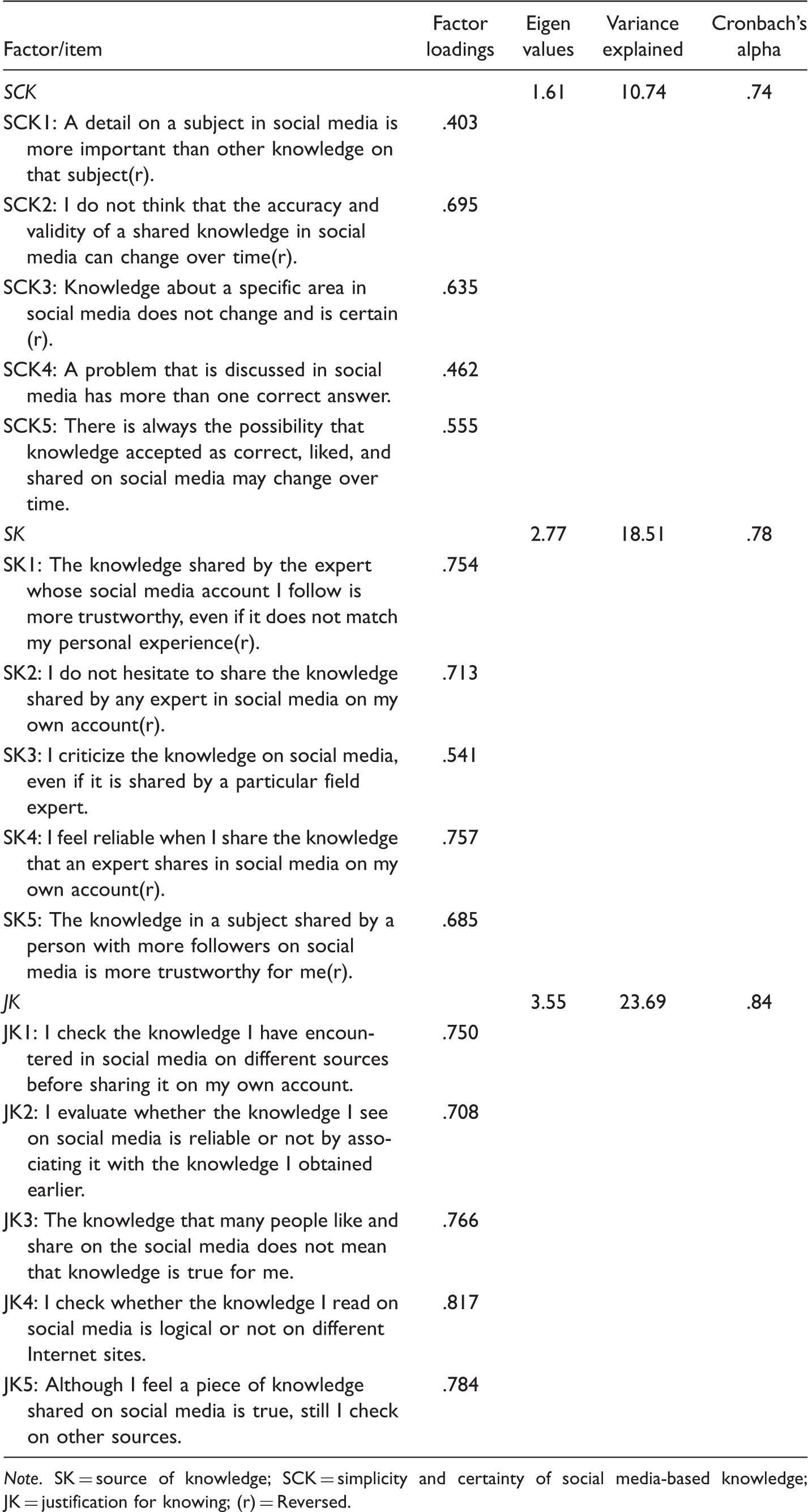
Note. SK = source of knowledge; SCK = simplicity and certainty of social media-based knowledge; JK = justification for knowing; (r) = Reversed.
Source of knowledge (SK; 5 items): The low scores on this dimension indicate that individuals perceive knowledge in social media as “transmitted by external authorities,” while high scores indicate that they perceive knowledge as “constructed by the self.”
Justification for knowing (JK; 5 items): The low scores on this dimension indicate that knowledge in social media is justified by way of “feelings and observations or through an authority,” while high scores indicate that knowledge in social media is justified by “reasoning or checking the other sources of information.”
Confirmatory factor analysis
Procedure
Fit Indices for CFA.
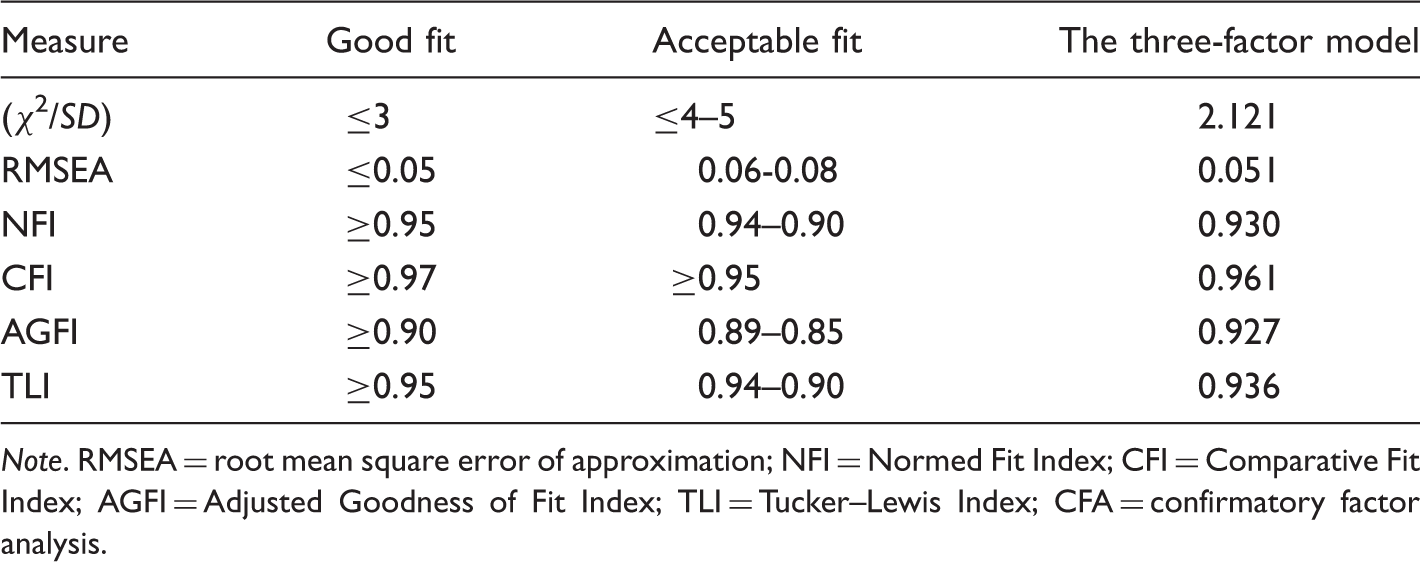
Note. RMSEA = root mean square error of approximation; NFI = Normed Fit Index; CFI = Comparative Fit Index; AGFI = Adjusted Goodness of Fit Index; TLI = Tucker–Lewis Index; CFA = confirmatory factor analysis.
Results
The assumptions for maximum likelihood were checked before CFA. A research group of 212 people is considered sufficient for the CFA. The skewness and kurtosis coefficients were taken into account in the normality tests of the data set (Skewness: −0.015, SD: 0.94, Kurtosis: −0.557). These results indicate that relevant assumptions were met. In the next stage, CFA was performed with three variables (simplicity and certainty of social media-based knowledge [SCK], SK, and JK) that were revealed as the result of EFA and the 15 items. As a result, the fit indices and the necessary modifications were examined. Modifications between the items “i4-i5,” “i6-i7,” “i8 -i9,” “i11-i12,” and “i14-i15” that were explained by the same factor were made. The new values obtained from the analysis are—(χ
2
/df) = 2.121. p < .000, RMSEA = 0.051, NFI = 0.930, CFI = 0.961, AGFI = 0.927, TLI = 0.936. According to the RMSEA and AGFI indices, the model has a good fit and acceptable fit according to other indices. The model tested is shown in Figure 1.
CFA results of the three-factor model.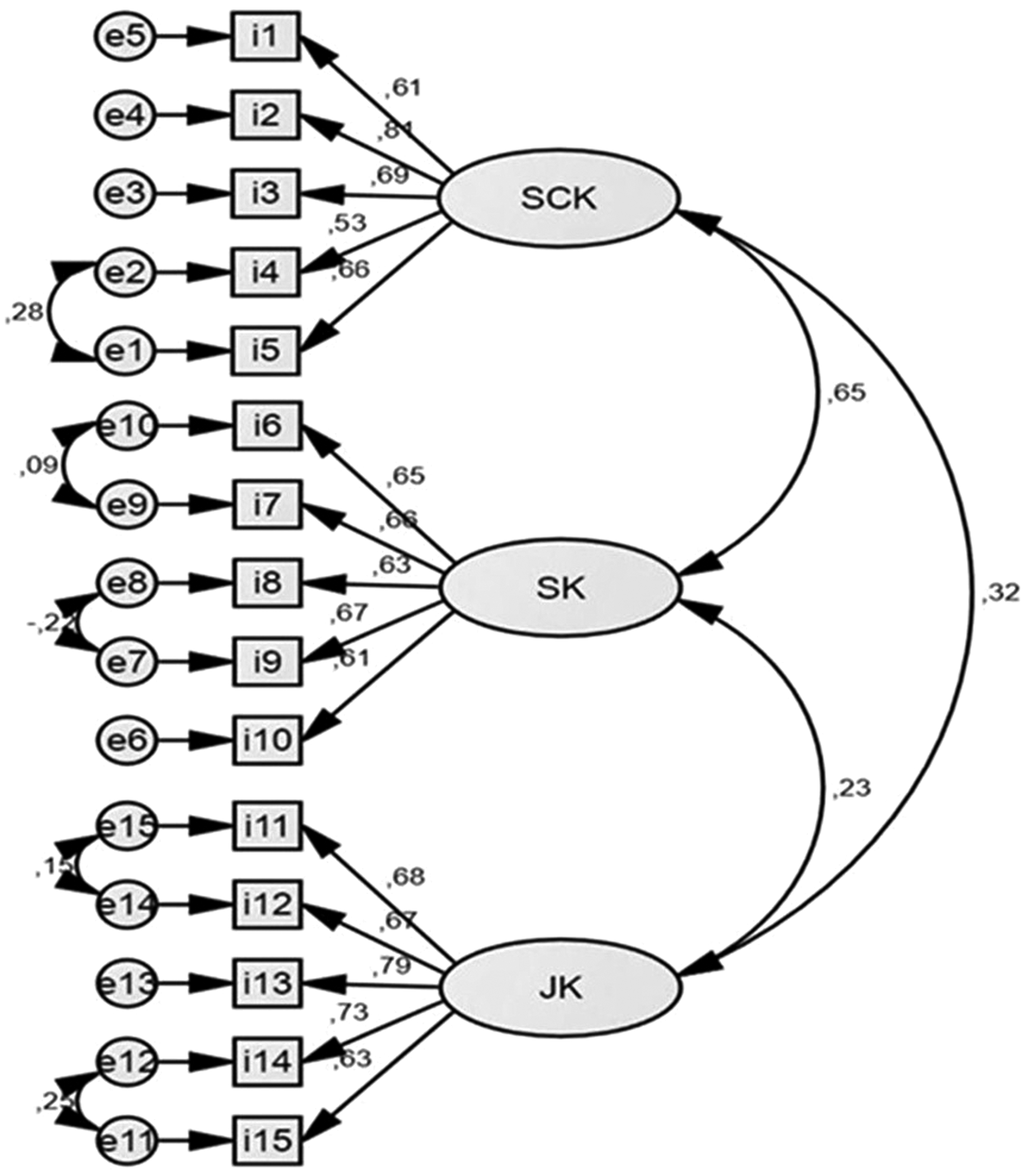
Stage 4: Reliability Analysis
Item-total correlation and item discrimination index
Procedure
Item-total correlation refers to the relationship between scores from scale items and the total score of the scale. The fact that item-total correlation is positive and high indicates that the items exemplify similar behaviors and the internal consistency of the scale is high (Büyüköztürk, 2010). For all items of a scale, it is recommended that the item-total correlation be higher than 0.30 (Pallant, 2007). Another way to do item analysis is to use the independent t test to determine the differences between the mean scores of the lower 27% and upper 27% items based on the total scores of the test. With this analysis, an item analysis based on the difference of group mean of lower 27% and upper 27% determined according to the total score on the scale can be performed. With the help of item analysis based on the mean of upper and lower group, the power of the scale to distinguish between those which have more quality and those which have less quality can be determined (Erkuş, 2005; Tezbaşaran, 1996). Significant differences among the groups in terms of the individual differences are indicative of the internal consistency of the test (Büyüköztürk, 2010; Koc & Barut, 2016).
Results
Item-Total Correlation and Comparison of 27% Lower and Upper Groups for Scale Items.
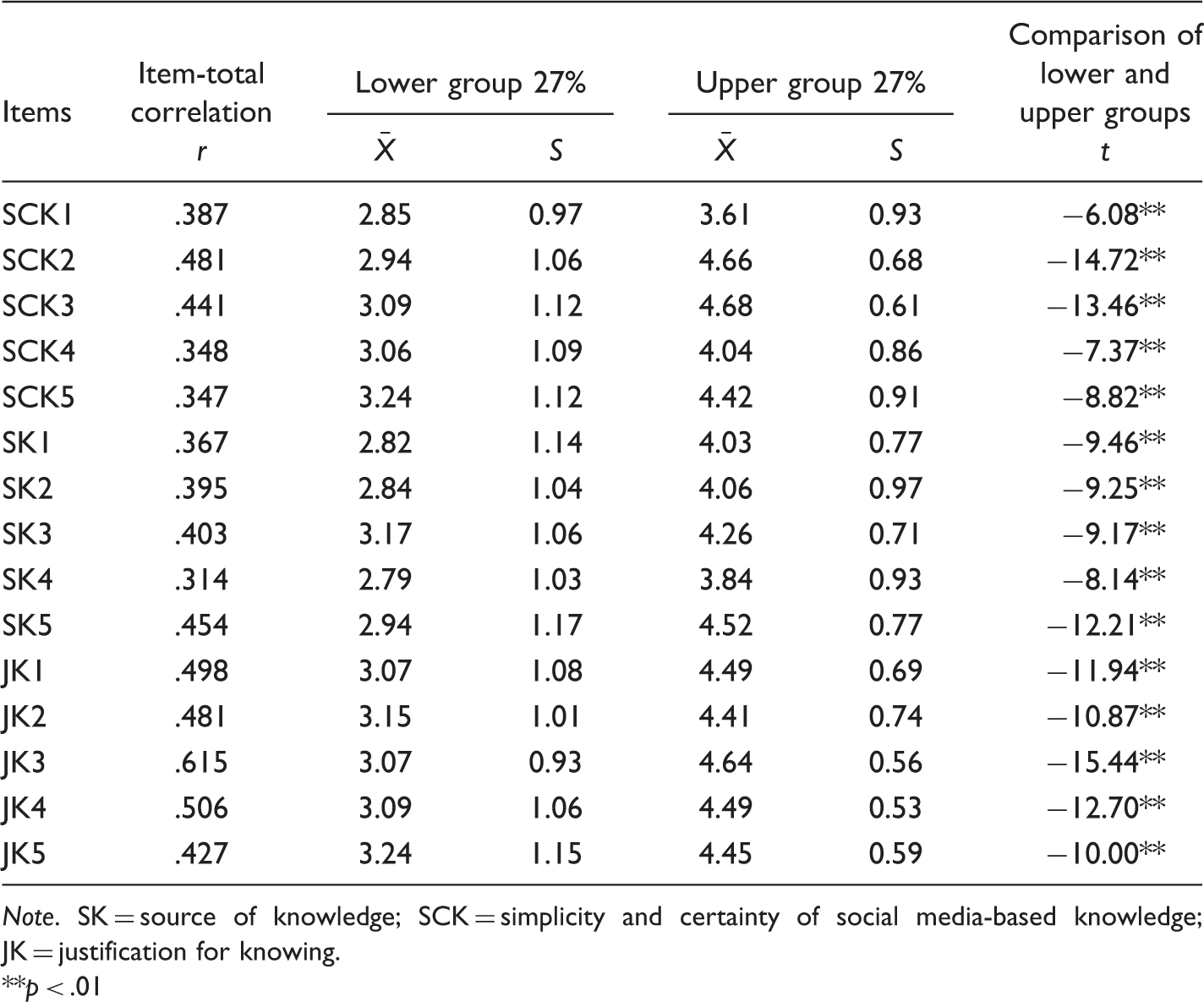
Note. SK = source of knowledge; SCK = simplicity and certainty of social media-based knowledge; JK = justification for knowing.
**p < .01
When the Table 3 is examined, it can be seen that the obtained t values change between −15.44 and −6.08 and are significant for each item. This finding indicates the discrimination of scale items. In addition, it is seen that there is a significant relationship between scores from each item and item-total correlation and this relationship is greater than 0.30. Thus, it can be said that the internal consistency of the scale is provided.
Internal consistency coefficient
Procedure
The internal consistency of dimensions of the scale and the whole scale was calculated by Cronbach's (1990) alpha internal consistency coefficients. This coefficient is an indication of the consistency of the scale items with each other and the measure of the same factor (Hair, Black, Babin, & Anderson, 2006). Cronbach's alpha coefficient of .70 and above is sufficient for internal consistency (Anderson, 1988; Robinson, Shaver, & Wrightsman, 1991).
Results
Cronbach's alpha coefficient was .74 for the SCK, was .78 for SK, and was .84 for JK. In addition, the internal consistency coefficient calculated for the whole scale was .80. According to these findings, it can be said that the scale was a reliable measurement tool.
Stage 5: Language Validity Analysis
Participants
The study group, which was established to determine the validity of the scale, consisted of 62 (38 female, 24 male) preservice teachers who were educated in the final grade in the Department of English Language and Education.
Procedure
For the language validity of the scale, the translation–retranslation method recommended in the literature was applied (Kevrekidis, Skapinakis, Damigos, & Mavreas, 2008). First, the scale was translated into English by three instructors working in the Department of English Language and Education, independent of the authors of the study. Later, the English form of the scale was translated into Turkish by a faculty who was proficient in both languages. For the final form of the scale, two translations were compared and necessary arrangements made. These changes were not related to the item structure of the scale but rather to the writing of the items and some synonyms. The English and Turkish form of the scale was applied to the final grade preservice teachers who studied at the Department of English Language and Education. A 3-week interval was used between the two administration stages.
Conclusions
For the language validity, English and Turkish forms of the scale were applied to a group consisting of 62 individuals over a 3-week period. The Pearson correlation coefficient between the two forms was 0.93 (p < .01). This finding indicates that the English version of the social media-specific epistemological beliefs scale met the language validity. See Appendix.
Discussion and Conclusion
The purpose of this study was to develop the social media-specific epistemological beliefs scale. The dimensions for the scale to be developed in the study were determined on the basis of the theoretical structure proposed by Hofer and Pintrich (1997). The development of the social media-specific epistemological beliefs scale consisted of five stages. At the first stage, an item pool was created for the scale. In the second stage, the expert opinion was consulted in order to ensure the content validity of the scale and the pilot application of the scale was carried out for the face validity. In the later stage, EFA and CFA were performed, respectively, to determine the construct validity of the scale. In the fourth stage, item-total correlation, item discrimination index, and internal consistency coefficients were calculated in terms of reliability analyses of the scale. In the fifth and last stage, the language validity analysis of the scale was carried out. Twenty items have been identified as the result of the stage of item pool formation. According to expert opinions, 2 items were extracted from the scale and a total of 18 items were analyzed for construct validity. As a result of EFA that is the first step in the construct validity analysis, two items with a factor loading lower than 0.40 and one item from more than one dimension were extracted from the scale. Although Hofer and Pintrich (1997) formulated the theoretical basis of four dimensions (certainty of knowledge, simplicity of knowledge, SK, and JK), three dimensions were determined for the scale developed according to EFA results. A single dimension (SCK) is defined for these two dimensions, since the items in the certainty of social media-based knowledge and simplicity of social media-based knowledge are included in the same dimension.
This finding regarding fact that the simplicity of knowledge and the certainty of knowledge were fallen under one factor was also derived from the scale developed by Hofer (2000). Two-dimensional structure (certainty, structure, SK, and JK) can be seen in the Internet-specific epistemological beliefs scale (Bråten et al., 2005) developed in the theoretical basis of Hofer and Pintrich (1997). As a result of the factor analysis in Strømsø and Bråten's (2010) study, Internet-specific epistemological beliefs were gathered under three dimensions: certainty and SK, structure of knowledge, and justification of knowing. In hypertext-based environments, studies of dimensionality of epistemological beliefs are limited and incompatible, and the dimensions of the epistemological beliefs in these environments may vary depending on different cultures (Kammerer et al., 2013). For this reason, it can be said that two different dimensions of Hofer and Pintrich (1997) theoretical structure are expected to be fallen under one dimension in the social media-specific epistemological beliefs scale developed in this study. As a result of EFA, the explained variance of the social media-specific epistemological beliefs scale was revealed to be 52.96% of the total variance. Since P. Kline (1994) states that variance rates ranging from 40% to 60% are considered acceptable in the social sciences, it can be said that the total variance of the scale was sufficient. For the CFA results, the fit indices obtained for the three-factor model were found to be good (RMSEA and AGFI) and acceptable (χ 2 /df, NFI, CFI, TLI). The item-total correlation, item discrimination index, and internal consistency coefficients calculated at the fourth stage of the scale indicated that the reliability level of the scale was sufficient. In the final stage, the English form and the Turkish form of the scale, which were formed by the translation–retranslation method, were applied for 3 weeks. The high relationship between the two practices suggests that the language validity of the scale was met.
Individuals live in a “posttruth” age, which means that emotions and personal beliefs are more effective than rational facts on a particular subject (Oxford Dictionaries, 2016). The fastest spreading of knowledge that people accept correctly can be seen as social media platforms such as Twitter and Facebook, because of their interactive nature. Individuals should look at any sorts of knowledge they face in social media environments through a rational lens outside of their personal beliefs. In the era of posttruth, the rational lens concerns the epistemological beliefs that are about questioning the SK and perceive knowledge with criticism (Peters, 2017). In particular, identifying epistemological beliefs specific to social media can give an idea of how people perceive knowledge. In this study, a scale was developed to identify epistemological beliefs specific to social media, and findings on the developed scale showed that the scale was valid and reliable.
Implications and Future Research
The use of social media affects the lives of individuals in many ways, and this effect is seen in educational meaning (Celik, 2012; Dobrean & Pasarelu, 2016). Various social media platforms, especially Facebook, are being used as online learning areas for distance education and blended learning to strengthen the learning of students (Callaghan & Fribbance, 2018; Greenhow & Askari, 2017; Kucuk & Sahin, 2013; Moghavvemi & Salarzadeh Janatabadi, 2018; VanDoorn & Eklund, 2013). Given that epistemological beliefs are a positive predictor of academic achievement (Arslantas, 2015; Schommer, 1993), researchers may want to determine to what extent social media-specific epistemological beliefs affect the academic success of a teaching in the social media. For this reason, social media-specific epistemological beliefs scale developed in this study can be used as an alternative to scales of epistemological beliefs developed by considering traditional environments. In addition, some investigations have shown that epistemological beliefs are positively related to online information search strategies (Çevik, 2015; Chiu, Liang, & Tsai, 2013). Future research may reveal the relevance of social media-specific epistemological beliefs to the search strategies of individuals in online environments. Especially with the development of Web 2.0 technologies, media literacy skills have been redefined as “new media literacy” at the beginning of the 21st century (Lin, Li, Deng, & Lee, 2013). Some of these skills are related to the ability to recognize potential bias and contradictions in the knowledge that individuals face in the social media environment. New media literate individuals are expected to distinguish the ironic expressions and parodies from the realities during their interaction with the virtual environment (Chen, Wu, & Wang, 2011). It may be thought that these skills are closely related to the epistemological beliefs of the individuals, as it requires a questioning of the source and nature of the knowledge. For this reason, social media-specific epistemological beliefs scale developed in the research can be used to measure for knowing how learners perceive knowledge in the social media in media literacy courses. In addition, the social media-specific epistemological beliefs scale was developed independently from any subject. Therefore, it can be used to measure individuals' perceptions of knowledge in many different fields such as economics, politics, and education on social media. Future research may analyze how individuals' social media usage times, personality traits, and innovation characteristics affect the social media-specific epistemological beliefs.
Footnotes
Appendix
Declaration of Conflicting Interests
The author declared no potential conflicts of interest with respect to the research, authorship, and/or publication of this article.
Funding
The author received no financial support for the research, authorship, and/or publication of this article.
Ismail Celik is a postdoctoral researcher in the Learning and Educational Technology Research Unit at the Faculty of Education, University of Oulu (Finland). He worked as a research assistant at Selcuk University (Turkey). His research areas cover social media use, technology integration models in education, epistemological beliefs, mobile learning, and scale development.