



Abstract
Motivation and math anxiety are crucial in performance and satisfaction, and augmented reality (AR) may be a useful tool in enhancing these factors because it provides users with interesting visual experiences. Since related empirical research is limited in investigating the effects of using free mobile AR apps integrating Keller’s ARCS (attention-relevance-confidence-satisfaction) motivation model on learning motivation, anxiety, and outcomes between students with different levels of anxiety in primary math education, this study investigated whether mobile AR differently affected learning, motivation, and math anxiety between students with high and low anxiety. The results showed that the AR group performed better than the non-AR group, and high-anxiety learners in the AR group outperformed in algebra and geometry. The AR group had higher motivation based on Keller’s ARCS model. The high-anxiety learners had higher confidence and satisfaction and lower anxiety when learning using mobile AR. The AR users were satisfied with ease of use, usefulness, playfulness, and benefit from exploration and hands-on experiences. Moreover, high-anxiety users in the AR group had higher perceptions of exploration, hands-on experiences, and playfulness. This study includes the participants’ experience in adopting mobile AR for their learning and discusses its constraints.
Introduction
Researchers believe that high anxiety and low motivation in math usually have negative impacts on mathematics performance (Cargnelutti, Tomasetto, & Passolunghi, 2017; Chang & Beilock, 2016). Math anxiety refers to a negative emotional reaction to calculations, numbers, and mathematics that influences an individual’s ability to manipulate numbers and solve problems (Ramirez, Shaw, & Maloney, 2018). Research has further indicated that levels of math anxiety rise in students from elementary school onward (Ramirez, Gunderson, Levine, & Beilock, 2013). Learning motivation is part of an individual’s beliefs and initiates his or her involvement in learning. The force of this motivation influences students’ willingness to make efforts, sustain attention, and pursue success in learning (Li & Keller, 2018). Research has shown the relationship between motivation and achievement is found to be reciprocal from elementary school on (Garon-Carrier et al., 2016). Guiding students to reduce math anxiety and facilitate learning motivation from elementary school on has become necessary (Cohen & Rubinsten, 2017). The results from other research generally show a positive relationship between students’ mathematics achievement and math motivation (León, Núñez, & Liew, 2015) and negative correlations between students’ math anxiety and math performance (Cohen & Rubinsten, 2017) as well as between math anxiety and motivation (Chang & Beilock, 2016). Stimulating students’ positive beliefs and feelings of their own competence in math leads to better math learning achievement (Timmerman, Toll, & Van Luit, 2017). Keller’s ARCS model is commonly used to improve individual motivation in a technology-integrated learning environment (Li & Keller, 2018). ARCS stands for attention, relevance, confidence, and satisfaction. In recent years, Keller’s ARCS model has been applied to the design and evaluation of instructional materials in different types of learning environments, including mobile learning, digital book, flipped classrooms, and game-based learning (Aşıksoy & Özdamlı; 2016; Chang, Hwang, Fang, & Lu, 2017; Turel & Sanal, 2018; Zhang, 2017).
Moreover, research has shown that considering affective factors benefits anxious students in math learning (Chang & Beilock, 2016; Riva, Baños, Botella, Mantovani, & Gaggioli, 2016). With the rapid development of technology, augmented reality (AR) technology, which gives users interesting visual experiences and visualizes abstract concepts (Civelek, Ucar, Ustunel, & Aydin, 2014), has the potential to make learning environments stimulating to improve learning motivation and performance and decrease anxiety (Cascales-Martínez, Martínez-Segura, Pérez-López, Contero, 2017; Chen & Tsai, 2012). AR combines the virtual and real worlds. While virtual reality comprises only simulation experiences, AR adds virtual objects such as pictures, three-dimensional (3D) graphs, and video clips to the real world (Hsiao, Chang, Lin, & Wang, 2016). The rapid development of mobile devices has shifted the attention of research to the effect of utilizing these tools on AR in the learning of ecology (Hwang, Wu, Chen, & Tu, 2015), history (Harley, Poitras, Jarrell, Duffy, & Lajoie, 2016), natural science (Lu, Liu, Chen, & Hsieh, 2018), weather (Hsiao et al., 2016), and language (Liu & Tsai, 2013). Although research shows that AR on desktop computers improved junior high school students’ spatial perceptions (Lin, Chen, & Chang, 2015) and that AR had the potential to enhance high school students’ motivation to learn math (Salinas & Pulido, 2017), an experimental research study determining the effect of mobile AR on primary students’ algebra and geometry learning, the influence on motivation and anxiety toward math, and the differences between students with high- and low-anxiety levels have not previously been undertaken. Furthermore, most research in AR has applied situated learning or has not taken pedagogy into consideration (Chang & Jen-ch'iang, 2013; Chen & Wang, 2015; Estapa & Nadolny, 2015; Ferrer-Torregrosa, Torralba, Jimenez, García, & Barcia, 2014; Lin et al., 2015; McMahon, Cihak, & Wright, 2015; Pérez-López & Contero, 2013; Saltan & Arslan, 2017; Tanner, Karas, & Schofield, 2014), limited empirical research has been conducted on integrating the ARCS motivation model into AR in primary math education, and the effects between different anxiety levels have not been fully discussed.
Due to the need to eliminate the differences in attitudes toward math between different anxiety levels, the stimulating visual experiences and spatial ability improvement obtained by AR, and the importance of providing instructional materials that improve learning and motivation and decrease anxiety in mathematics, this research aims to bridge the gap and provide recommendations for instructional designers. The purpose of this study was to determine whether mobile AR instructional materials improve learning performance and motivation and decrease anxiety in math between students with high and low anxiety. Five research questions were constructed:
Is there a significant difference in the algebra quiz scores between learners who use and do not use mobile AR instructional materials in different groups and anxiety levels? Is there a significant difference in the geometry quiz scores between learners who use and do not use mobile AR instructional materials in different groups and anxiety levels? Is there a significant difference in the learning motivation of learners who use and do not use mobile AR instructional materials in different groups and anxiety levels, with particular reference to the subscales of attention, relevance, confidence, and satisfaction? Is there a significant difference in their math anxiety between learners who use and do not use mobile AR instructional materials in different groups and anxiety levels? What are students’ experiences in using mobile AR instructional materials in their math learning?
Literature Review
Learning Motivation
Motivation is believed to be an important factor in learners’ satisfaction and performance in education (Hagger, Sultan, Hardcastle, & Chatzisarantis, 2015). Motivation refers to students’ engagement in a learning environment (Li & Keller, 2018). Students with high motivation will engage more in their learning activities, which leads to better performance (Aşıksoy & Özdamlı; 2016, Wu & Tai, 2016). How to motivate learners should thus be considered when designing instructional materials (Hung, Chao, Lee, & Chen, 2013; Wu & Tai, 2016). Lack of interest in math may come from failure in previous courses and further increase math anxiety as well as lower confidence (Ramirez et al., 2018). Instructors should carefully provide learning environments with motivation stimuli (Chang & Beilock, 2016). Chen (2014) stated that using Keller’s ARCS model would improve the quality of technology-integrated instructional design. The model proposed the following four factors:
Attention: Given an appropriate design, instructional materials will capture learners’ attention and prompt them to explore learning tasks (Keller & Suzuki, 2004). It is essential that the instructional materials stimulate and sustain learners’ interest. Relevance: Learners will be motivated when the content aligns with their learning objectives, personal needs, and experiences (Keller & Suzuki, 2004). This factor measures how the instructional materials meet learners’ needs and experiences. Confidence: The more successful a learning experience is, the more motivated a learner will be to improve his or her learning and performance (Keller, 2008). This factor emphasizes a learner’s perception of personal control and expected achievement. Satisfaction: This factor evaluates a learner’s attitude toward the learning process. Learners will be motivated when they feel that their learning experience is gratifying (Rodgers & Withrow-Thorton, 2005). Research notes that factors such as feedback, rewards, and perceived ease of use will affect learning satisfaction (Keller, 2010; Keller & Suzuki, 1988).
The Instructional Materials Motivation Survey (IMMS) was designed based on the ARCS model (Keller, 2010). The instrument will be suitable in this study because it has been used in several studies that have used technology as a motivational factor in education (Aşıksoy & Özdamlı, 2016; Lu et al., 2018; Wang & Yang, 2016). It is essential to facilitate students’ motivation to use instructional designs to improve their quality. Moreover, research shows significant negative correlations between math anxiety and achievement as well as between anxiety and motivation. There is also a significant positive correlation between motivation and achievement (León et al., 2015). Tsai, Kuo, Chu, and Yen (2015) developed a Kinect sensor-assisted game-based learning system based on the ARCS model to facilitate spatial learning. They concluded that the proposed system promoted students’ spatial visualization skills and enhanced their motivation. They further suggested that proper instructions should be provided to help students focus on the learning materials. This study provided instructions and introduced how to use the proposed AR system before the treatment to avoid confusion.
Math Anxiety and Math Learning
Math anxiety refers to feelings of fear and tension that people experience when manipulating numbers and solving mathematics problems (Hopko, Mahadevan, Bare, & Hunt, 2003). Students with high math anxiety were found to hold negative attitudes toward math, have difficulties with math-related problems, and even to tend to avoid learning math (Finlayson, 2014). Research also shows that poor math abilities reciprocally contribute to math anxiety (Gunderson, Park, Maloney, Beilock, & Levine, 2018). How to prepare learning environments that can help students alleviate their math anxiety has become essential for instructors and administrators to understand (Kim, Thayne, & Wei, 2017; Liu, McKelroy, Corliss, & Carrigan, 2017).
Environmental factors affect students’ attitudes toward math, and confidence in mathematics could moderate learning anxiety (Ferguson, Maloney, Fugelsang, & Risko, 2015). Instructors should try to reduce learning anxiety and increase learning confidence in anxious learners when designing learning materials in mathematics (Rubinsten, Bialik, & Solar, 2012). Research shows that a more constructivist math teaching approach that allows students to try and explore may help improve learning motivation and mitigate anxiety in math (Finlayson, 2014). Integrating appropriate technologies such as AR represents an opportunity to motivate students, decrease their math anxiety, and improve learning (Salinas & Pulido, 2017). Providing a learning environment that could engage students, increase interaction, and sustain their interest was also helpful to overcome math anxiety (Finlayson, 2014). Research further suggests that a significant difference exists in higher grades in elementary schools and that students should be given more help and practice in learning (Ma, Lee, Lin, & Wu, 2015). Creating a learning environment that could facilitate learning and motivation and decrease math anxiety, especially for highly anxious students, has become crucial for instructors and developers. Kim et al. (2017) tried to integrate an embodied agent to lower student anxiety for ninth graders for a week. The results showed that students’ math anxiety decreased and their learning increased. However, the presence of agents only influenced high-anxiety students. A longer experiment time and more in-depth qualitative data were recommended.
AR and Learning
Azuma (1997) defined three features in AR as a combination of real and virtual environments, accurate 3D registration of virtual and real objects, and real-time interaction. AR applications are widely used in marketing, advertising, gaming, medicine, military, library management, and education (Carmigniani, Furht, Anisetti, Ceravolo, Damiani, & Ivkovic, 2011; Shatte, Holdsworth, & Lee, 2014, Teng, Chen, & Chen, 2018; Tobar-Muñoz, Baldiris, & Fabregat, 2017). Wu, Lee, Chang, and Liang (2013) and Bujak et al. (2013) identified several features and affordances of AR for educational purposes, such as enabling learning content in a 3D format, a sense of presence, immediacy, and immersion. AR provides concepts in interactive 3D simulations that lead to deeper insights and enhance understanding (Martín-Gutiérrez, García, & Roca, 2015). AR can also convert abstract concepts into visual presentations of objects or phenomena to improve learning (Bujak et al., 2013; Civelek et al., 2014). Moreover, AR provides ubiquitous and situated learning environments (Wu et al., 2013). Since it is easy to use, attractive, and useful for students, AR has the potential to make the learning environment stimulating to improve learning and motivation as well as to decrease anxiety (Cascales-Martínez et al., 2017; Chang, Chung, & Huang, 2016; Hsu, Lin, & Yang, 2017). Mobile devices enable social interactivity, portability, and context sensitivity in the AR environment (Liu & Tsai, 2013).
AR has been applied in various fields such as history (Harley et al., 2016), general science (Mumtaz et al., 2017), programming language (Teng et al., 2018), reading comprehension (Tobar-Muñoz et al., 2017), and physics (Civelek et al., 2014) with positive effects. AR can be implemented on various platforms, such as desktop computers, hand-held devices, optical see-through head-mounted displays, and video see-through head-mounted displays (Harley et al., 2016; Hua & Javidi, 2014; Johnson, Levine, Smith, & Haywood, 2010). The rapid development of tablet PCs and smartphones has provided a convenient platform for AR applications and further created a subset of AR called mobile AR (Feng, Duh, & Billinghurst, 2008). Although AR technology was first developed in the 1960s, it has recently increased in popularity due to advances in mobile technology (Akçayıra & Akçayırb, 2017). Recent researchers have shifted their attention to the effect of utilizing these mobile tools in AR to enhance learning and interaction in history (Harley et al., 2016), weather (Hsiao et al., 2016), ecology (Hwang et al., 2015), and language (Liu & Tsai, 2013). However, designing mobile AR learning materials for geometry and algebra in primary education is still limited. Moreover, many instructors have difficulty developing mobile AR learning environments because they usually lack the related coding abilities or multimedia skills (Chin, Lee, & Hsieh, 2016; Saltan & Arslan, 2017). In this study, we used free mobile applications to develop mobile AR instructional materials and shared our experiences.
Based on the need to eliminate the differences of learning attitude as well as math anxiety between students with different anxiety levels, the importance of motivating students to learn math, and the potential for interactive and interesting learning experiences provided from mobile AR learning materials, this study tried to develop a mobile AR math learning environment and further investigated its effect on math anxiety and motivation based on Keller’s ARCS model, comparing results between students with different anxiety levels.
Methodology
Participants and Procedure
The research was conducted on six classes of 137 sixth-grade students—68 boys and 69 girls—in an urban primary school in northern Taiwan. These students had limited experience with using AR in math learning. After taking the pretest of the Abbreviated Math Anxiety Scale (AMAS) introduced in the next section, 41 students whose scores were in the upper 30% of the distribution were assigned to the high-anxiety group, since Johnston-Wilder, Brindley, and Dent (2014) suggested that approximately 30% of students show high mathematics anxiety. In turn, 41 students whose scores fell in the lower 30% were assigned to the low-anxiety group. Three classes of 40 students, including 22 high-anxiety students (55%) and 18 low-anxiety students (45%), were randomly assigned to the AR group; the remaining three classes of 42 students, including 19 high-anxiety students (45.2%) and 23 low-anxiety students (54.8%), were put in the non-AR group, to whom the course was taught using lectures and instructional materials that provided examples and questions through texts, videos, and graphs on mobile devices.
Three topics were chosen for algebra (multiplication of fractions, prime factors, and greatest common divisor) and geometry (volume, cylinder, and square measure). The topics were chosen according to the Grades 1 to 9 Curriculum Guidelines from the Ministry of Education in Taiwan. The content was designed based on the textbook published by the National Academy for Educational Research and reviewed by three elementary teachers. The content was modified after a pilot study was conducted to improve suitability and wording.
The course materials were designed according to the ARCS model. Multimedia content and opening questions (e.g., which slice of pizza on the screen is the biggest?) were provided to attract students’ attention. Prior knowledge was combined, and examples related to students’ lives (e.g., how big a piece of paper do you need to wrap the birthday gift on the screen?) were used. To improve learners’ confidence, review questions and feedback were available at the end of each subtopic. Moreover, new scenarios were given after all subtopics were learned for further applications and comprehensive assessment to improve satisfaction.
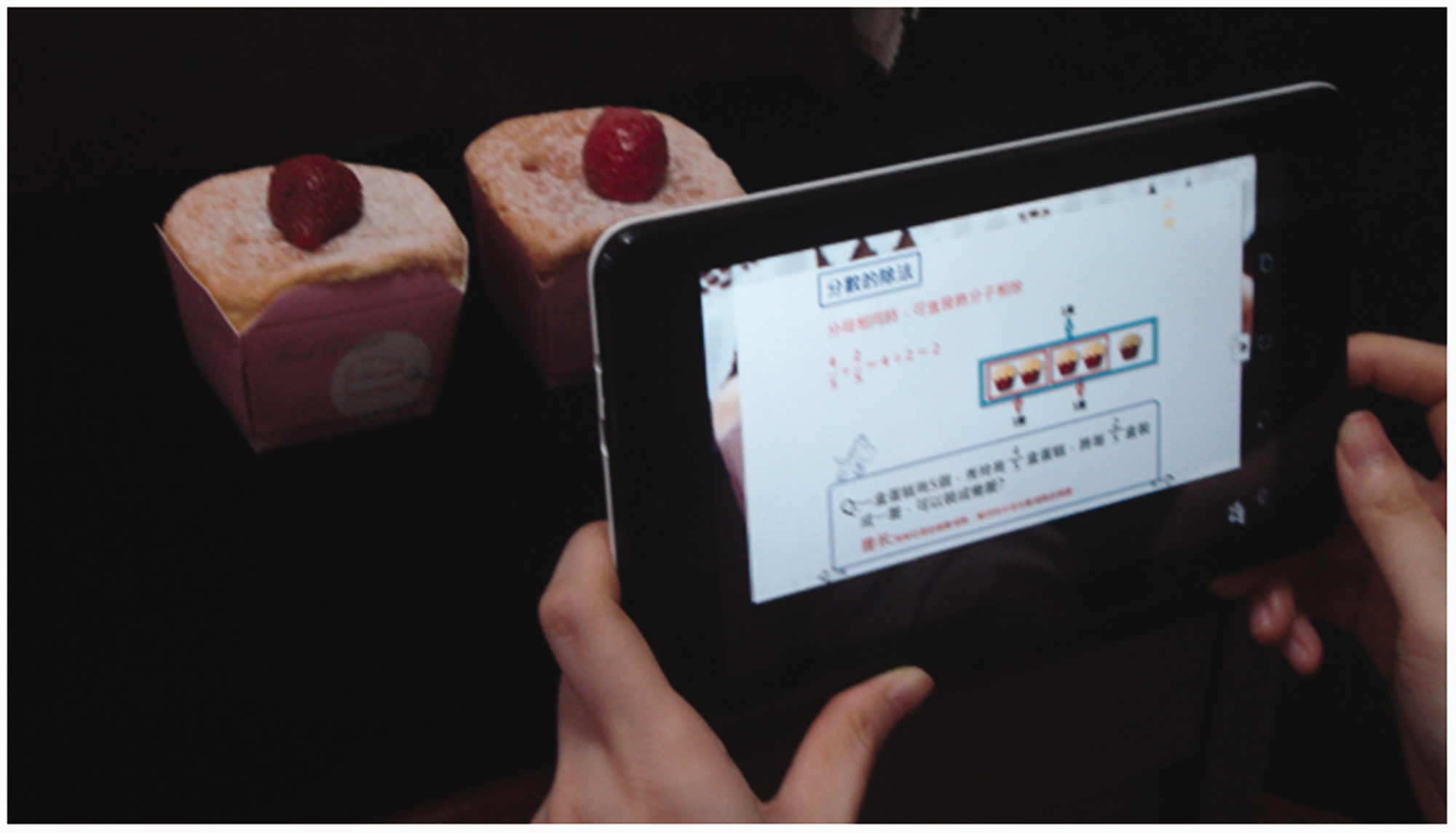
The course materials in video clips and two-dimensional (2D) graphs were designed by HP Reveal, and 3D models were designed by Augment, both of which are mobile AR applications. HP Reveal and Augment are both presentation and design tools. For HP Reveal, instructors first need to create an account and log in to the HP Reveal App or HP Reveal Studio (https://studio.hpreveal.com) on a PC. Designers must first create an overlay by taking pictures or making clips on their mobile devices and then capture a trigger image. After positioning the overlay, the application will create an AR action (Aura), which becomes available if it is in a public channel. When using Augment, designers need to upload 3D models in dae or obj formats as overlays, and the system produces markers as trigger images. Each student was given a tablet PC on which HP Reveal and Augment had been installed. When the specific trigger image appeared, the webcam in the tablet PC would automatically recognize it and display video clips and 2D and 3D graphs to present more in-depth explanations of the course material (see Figures 1 and 2).
The mobile AR system recognizes the trigger image and displays 3D graphs. The users could use the paperboard to manipulate the 3D model. The mobile AR system recognizes the real object as trigger image and displays video clips related to the learning content.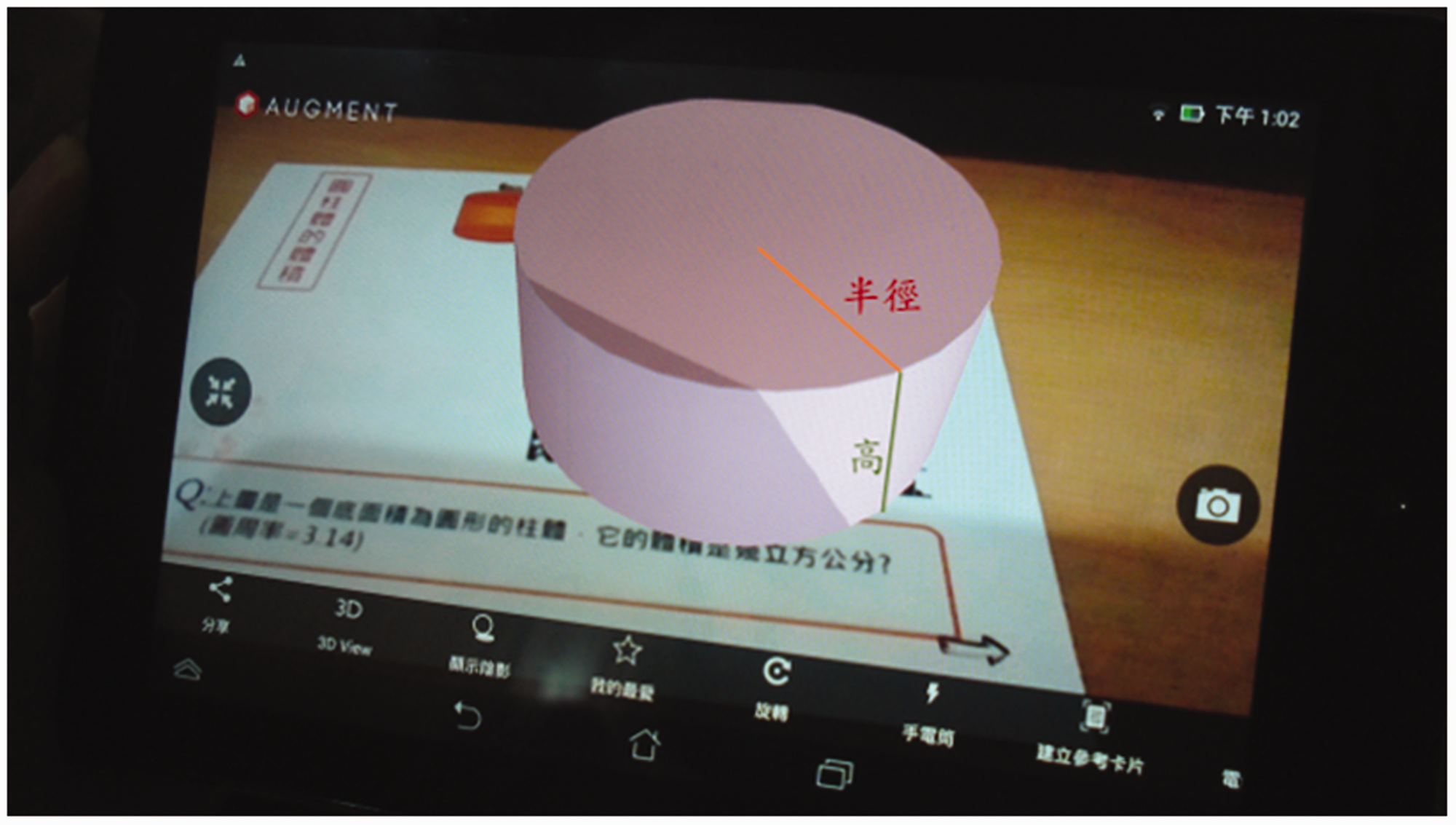
Two weeks before the treatment, the participants were given a pretest. The treatment included 3 weeks each for algebra and geometry. During each class of the AR group, the research team first explained how to use the mobile AR instructional materials on the tablet PCs. The students were then given real objects as AR trigger images or those on paperboards. The content in each geometry and algebra topic had previously been segmented into five subtopics, and the content in each subtopic was developed into mobile AR instructional materials. The students had 40 minutes to read the assigned materials and 20 minutes to complete the comprehensive quiz. During the 40-minute reading activity, each subtopic was further segmented into eight segments. The eight mobile AR trigger images were scattered throughout the classroom. The participants were divided into eight groups and took turns finding trigger images and then began using the mobile AR instructional materials. After reading the content in all segments, students could complete the comprehensive quiz in approximately 20 minutes. The instructor then provided answers to the comprehensive quiz and wrapped up the class. At the end of the geometry and algebra classes, comprehensive posttests, a motivation survey, a math anxiety scale and a mobile AR questionnaire were administered to the AR and the non-AR groups (see Figure 3).
The experimental procedure. AR = augmented reality.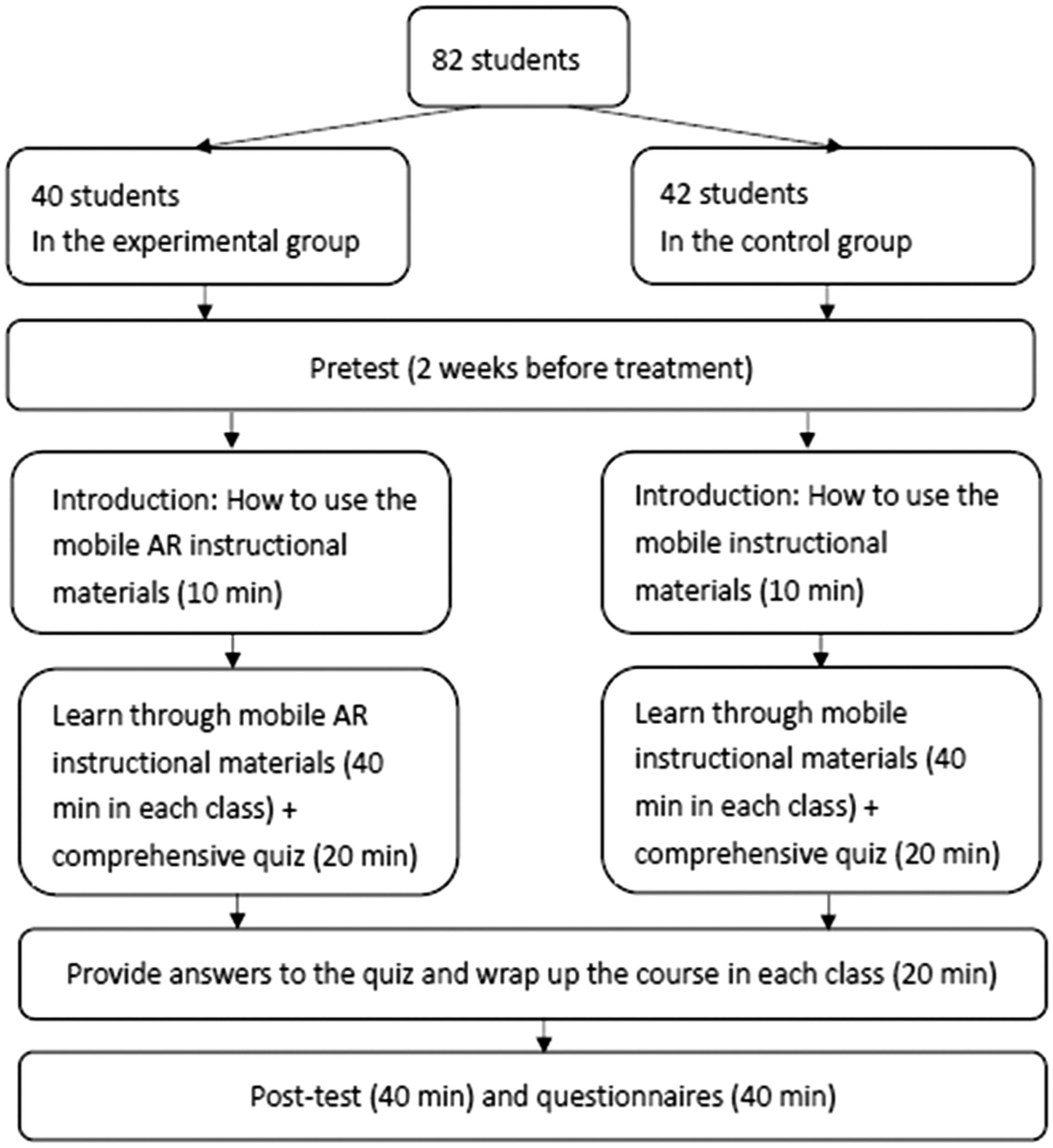
Measurement
The research tools in this study include pretests and posttests on algebra and geometry, a motivation survey, a math anxiety scale, and a mobile AR survey:
Pretest and posttest on algebra and geometry
The pretests and posttests on algebra and geometry contained 18 items each and included multiple-choice, cloze, and calculation questions that were closely related to the course content (e.g., how many prime numbers are there from 1 to 30?). Questions on the pretest and posttest were different, but the difficulty levels were similar. The tests were provided by Hanlin Publishers and were revised by instructors and content experts.
Motivation survey
The IMMS designed by Keller (2010) was revised to investigate the learners’ level of motivation. It originally contained 36 questions with 5-point Likert-type scale items. The IMMS is considered a valid instrument and has a documented reliability coefficient of .96 (Keller, 2010). In this study, the survey was modified to contain 26 5-point Likert-type scale items, which included (a) seven questions about attention (e.g., The way the information is arranged on the pages helped keep my attention); (b) eight questions about level of relevance (e.g., The content of these learning materials is relevant to me); (c) five questions about confidence in using instructional materials and learning (e.g., When I first viewed these learning materials, I had the impression that these would be easy to work with); and (d) six questions about learning satisfaction (e.g., I really enjoyed working with these learning materials). The ARCS Learning Motivation Scale was modified by expert opinion and a pilot study. After factor analysis using principal axis factoring, 10 questions with factor loadings under 0.5 were removed (Hair, Black, Babin, Anderson, & Tatham, 1992). After survey data were collected, Cronbach’s alpha coefficients were calculated, and the instrument had a reliability coefficient of .95. The reliability estimates for each category were satisfactory: attention (a = .87), relevance (a = .86), confidence (a = .82), and satisfaction (a = .89).
Math Anxiety Scale
The AMAS designed by Hopko et al. (2003) was revised to investigate learners’ level of math anxiety. The scale is appropriate for young children (Devine, Fawcett, Szűcs, & Dowker, 2012). The AMAS has been proven to have strong reliability and validity (Hopko, 2003; Hopko et al., 2003). The survey was modified to contain nine 5-point Likert-type scale items ranging from 1 (low anxiety) to 5 (high anxiety). The original AMAS includes nine items (e.g., How anxious are you when listening to a lecture in math class). The survey was modified by expert opinion and a pilot study to improve wording. After survey data were collected, Cronbach’s alpha coefficients were calculated, and the instrument had a reliability coefficient of .92.
Mobile AR questionnaire
The Mobile AR questionnaire, which assessed the students’ attitudes toward using mobile AR instructional materials in class, included 16 five-point Likert-type scale questions and three open-ended questions. The ease of use, perceived usefulness, and playfulness subscales were revised from the Technology Acceptance Model (Davis, 1989) to investigate students’ acceptance of the mobile AR learning materials. The exploration and hands-on experience subscale was also based on a review of literature finding that a more constructivist math teaching approach may help improve learning motivation (Finlayson, 2014). This subscale was designed to determine if exploration and hands-on activities in mobile AR help math learning in different anxiety levels. The questionnaire was modified by expert opinion and a pilot study. Principal component analysis was performed on the first 16 questions to determine the validity of the questionnaire, and the questions with factor loadings under 0.5 were removed (Hair et al., 1992). The analysis yielded four factors: (a) four items regarding perceived ease of use in mobile AR (e.g., It would be easy for me to become skillful at using mobile AR for learning); (b) four items about perceived usefulness (e.g., I found mobile AR useful for my math learning); (c) four items regarding exploration and hands-on experiences (e.g., Operating mobile AR models helps me learn); and (d) four items regarding playfulness (e.g., I found it interesting to use mobile AR in learning). The total variance accounted for by the four factors was 79.83%. The respondent ratings of the attitudes toward ease of use, perceived usefulness, exploration experiences, and playfulness of mobile AR were all judged as fairly reliable, with internal consistency reliability coefficients of 0.82, 0.79, 0.92, and 0.84, respectively. The last three open-ended questions aimed to determine students’ attitudes regarding benefits, drawbacks, and recommendations after using mobile AR learning materials. The collected data obtained from the open-ended questions were coded separately and brought together in a framework of specific concepts by two researchers.
Results
AR and Academic Performance—Algebra
Posttest Scores.

Note. AR = augmented reality.
Tests of Simple Main Effects—Algebra.
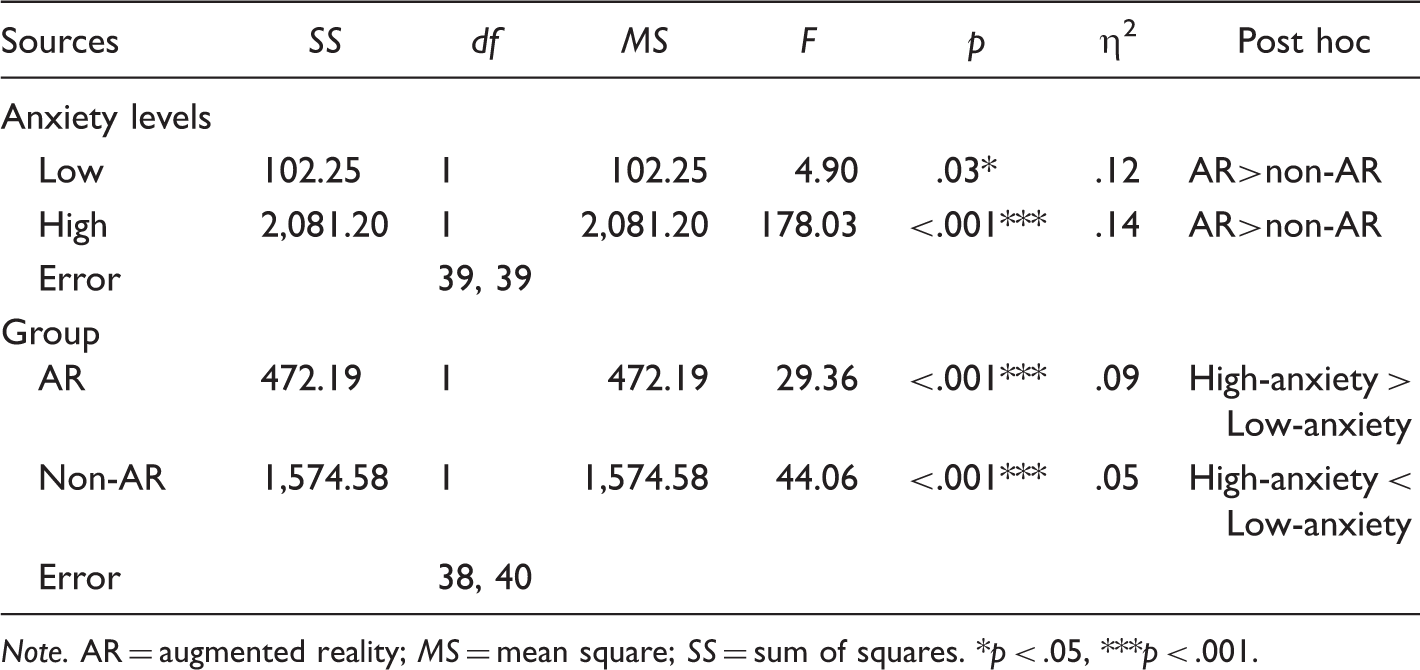
Note. AR = augmented reality; MS = mean square; SS = sum of squares. *p < .05, ***p < .001.
AR and Academic Performance—Geometry
Tests of Simple Main Effects—Geometry.

Note. AR = augmented reality; MS = mean square; SS = sum of squares. ***p < .001.
Learning Motivation: AR and Non-AR
Motivation Survey.

Note. AR = augmented reality.
Tests of Simple Main Effects—Confidence.

Note. AR = augmented reality; MS = mean square; SS = sum of squares. **p < .01, ***p < .001.
Tests of Simple Main Effects—Satisfaction.

Note. AR = augmented reality; MS = mean square; SS = sum of squares. **p < .01, ***p < .001.
Math Anxiety: AR and Non-AR
Math Anxiety Scale (Posttest).

Note. AR = augmented reality.
Tests of Simple Main Effects—Math Anxiety.

Note. AR = augmented reality; MS = mean square; SS = sum of squares. ***p < .001.
Experience of Using Mobile AR in Learning Math
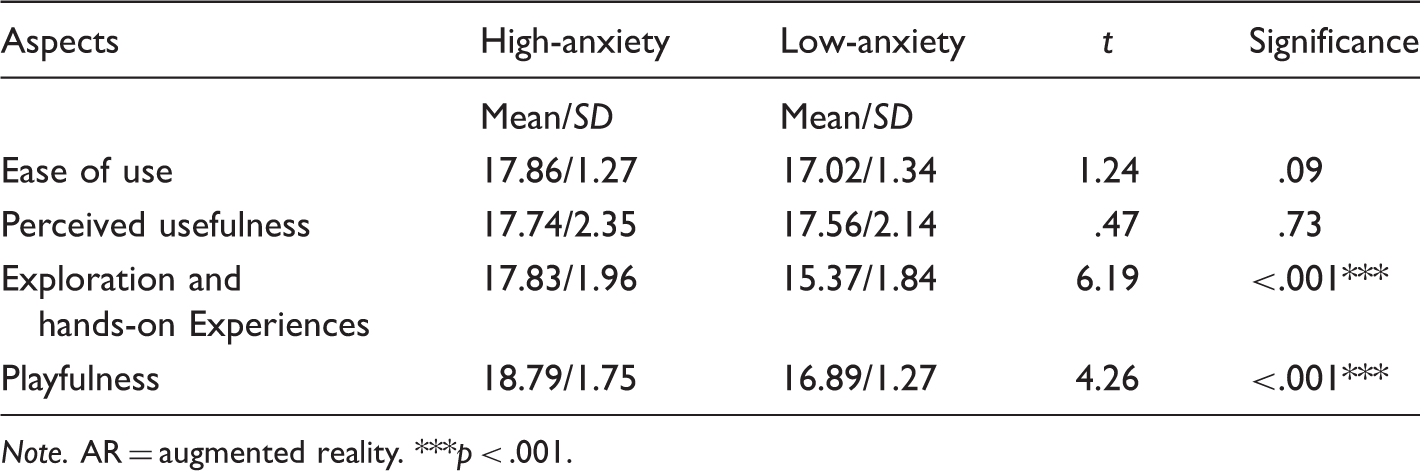
Mobile AR Survey Between Anxiety Levels.
Note. AR = augmented reality. ***p < .001.
Most participants agreed that mobile AR provided exploration and hands-on experiences that help their learning. The scores ranged from 4.09 to 4.51. After the independent t test, low-anxiety learners had lower level of attitudes that exploration and hands-on experiences help their learning than high-anxiety participants did in the AR group (t = 6.19, df = 38, p < .001). Finally, participants agreed that AR instructional materials were interesting and made math learning joyful. The scores ranged from 4.12 to 4.58. After using independent t test, low-anxiety learners had statistically significant lower playfulness than high-anxiety students did in the AR group (t = 4.26, df = 38, p < .001).
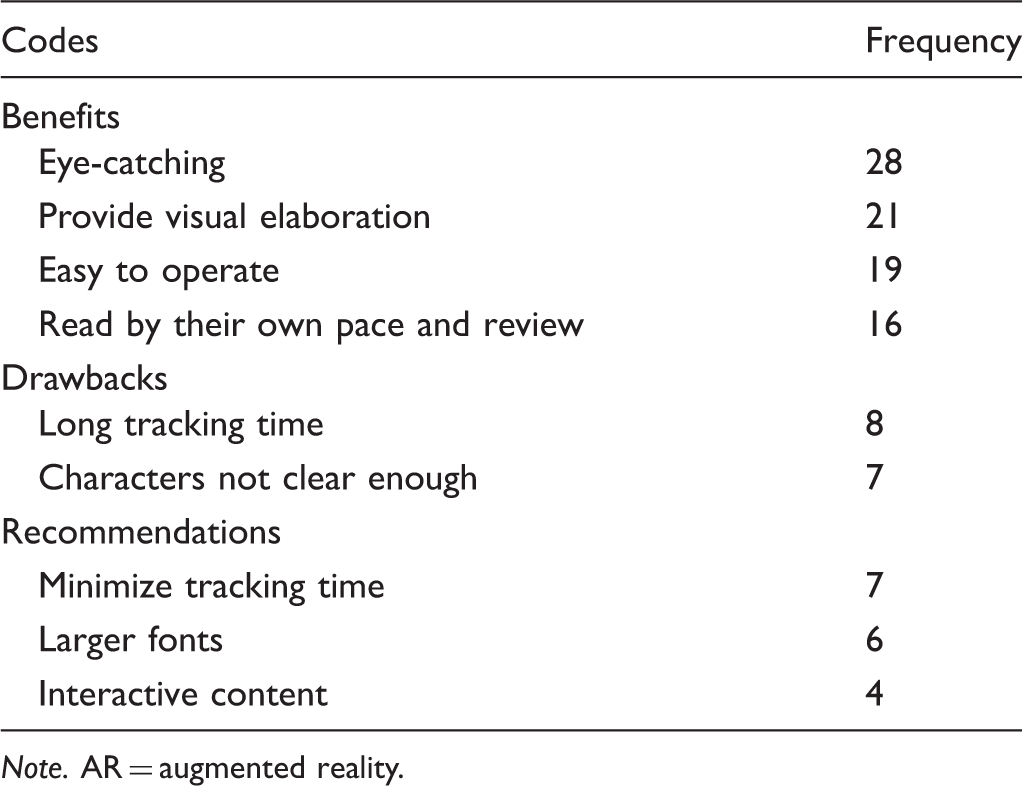
Students’ Experience Toward Mobile AR.
Note. AR = augmented reality.
Discussion
Mobile AR and Learning Performance
In this study, we tried to investigate the effect of using mobile AR instructional materials in math learning and its effect on students with different anxiety levels. The findings confirm that AR improves primary school students’ ability in math (in this case, algebra and geometry). This finding may be attributed to the key benefit of AR: allowing users to observe and operate during practice (Salinas & Pulido, 2017). The class enabled students to operate the mobile AR learning materials on their own. Students could read the materials according to their individual pace and ability. The 3D model embedded in AR also helps build students’ spatial thinking abilities and helps them visualize abstract concepts, thereby improving their math learning (Bujak et al., 2013; Magana, 2014). Moreover, the multimedia materials, including video clips and graphs, improve their understanding, math scores, and attitudes (Wu & Tai, 2016). The study also confirmed that mobile AR instructional materials benefit students with high anxiety in learning algebra and geometry. The results may relate to their improved learning motivation, lowered math anxiety, and positive learning experiences (García-Santillán, Escalera-Chávez, Moreno-García, & Santana-Villegas, 2016), which are discussed in the next sections. The results are consistent with the study conducted by Roca-González, Martín-Gutiérrez, García-Dominguez, and Carrodeguas (2017). They executed a training experiment using AR and a virtual orienteering game. The results confirmed that AR and VR tools could improve engineering students’ spatial ability. In contrast, Chen and Tsai (2012) found no difference between an augmented-reality library instruction system integrating situated learning theory and conventional librarian instruction. This difference in results may be due to the limited research time of 2 hours and the application of different pedagogy. The value of integrating AR into education is not solely regarding the technology itself; the pedagogical and learning issues should also be considered (Wu et al., 2013).
Learning Motivation and Math Anxiety
As for students’ learning motivation, the mobile AR learning materials helped participants have a more positive attitude toward attention and relevance than those in the non-AR group. Mobile AR learning materials provide students with stimulating visual experiences and combine topics of study with real objects in their lives, which successfully sustains their attention and feels relevant to their learning and lives (Civelek et al., 2014). For learners with high and low anxiety, participants in the AR group had higher perceptions of confidence and satisfaction than those in the non-AR group. On both the confidence and satisfaction subscales, high-anxiety learners had higher confidence or satisfaction than low-anxiety learners in the AR group did, while high-anxiety learners in the non-AR group had lower confidence or satisfaction. Using mobile AR learning materials could help high-anxiety learners increase their confidence and satisfaction in learning math. The results confirmed other research that AR attracts learners and improves motivation and performance (Chen & Tsai, 2012). The differences between AR and non-AR in this study were consistent with the prior research conducted by Mumtaz et al. (2017) in a general science class using AR. Students in the AR learning environment, which included text, videos, audios, and 3D models, had higher understanding and motivation on all four subscales than those in the classroom lecture group, which used slides, images, and relevant text. Providing numerous multimedia resources in AR helps students learn. However, Estapa and Nadolny (2015) found that high school math students in the AR group had a greater degree of learning motivation on the attention subscale than those in the website group. They concluded that too many items on one page may lead to distraction, which may negatively impact students’ attitudes on other subscales in relevance, confidence, and satisfaction in learning motivation. They further recommended that future developers limit items to 7 to 9 per page for better performance. Lu et al. (2018) conducted research integrating AR technology and a puzzle game in an elementary school natural science lesson. They discovered that although the AR group had an advantage on their posttest results, the AR group also had a relative drop in their learning motivation. These different outcomes may result from the short gameplay session of 80 minutes, different pedagogy, and different subjects.
Moreover, in the non-AR group, high-anxiety learners were found to still have higher math anxiety, while they had lower anxiety in the AR group. Both high- and low-anxiety students had lower anxiety when learning using AR. The mobile AR learning materials help tackle students’ math anxiety. The results are consistent with our findings in performance and motivation. Student anxiety significantly influences math performance (Ramirez et al., 2018) and motivation (Chang & Beilock, 2016) for learners. Possible reasons for this influence may stem from students’ different learning experiences, which are discussed in the next section.
Learners’ Experiences in Mobile AR
The mobile AR questionnaire reflected that the users were satisfied with the ease of use of the mobile AR instructional materials. AR was easy to use and convenient to them. Moreover, AR provided an environment with a high level of perceived usefulness, which allowed them to study effectively. Most users stated that AR improved their enjoyment of learning math and that they gained from the exploration and practical experiences. The high-anxiety students had higher perceptions of exploration and hands-on experiences that enhanced their learning and of higher playfulness when using mobile AR instructional materials. Creating mobile AR instructional materials could meet users’ needs and provide a convenient environment for learners (Hsiao et al., 2016). This provision may increase AR users’ confidence in math learning and satisfaction with the instructional materials. When the subject content is rather abstract and difficult, instructors could introduce mobile AR instructional materials to improve learners’ learning and motivation.
The previous research has shown that students with high anxiety usually have lower learning motivation, confidence, and performance in math (Chang & Beilock, 2016; Cohen & Rubinsten, 2017; León et al., 2015). In this study, students with high anxiety had different perceptions of confidence and satisfaction when using mobile AR instructional materials. These differences may be because mobile AR learning materials provide multimedia, interactive, hands-on practice, and playful learning experiences, which are usually not available for students to observe and manipulate on their own in regular math classes. The multimedia in the mobile AR learning materials helps improve high-anxiety students’ math problem-solving skills (Chang & Beilock, 2016; Cueli, Castro, Rodriguez, Nunez, & Pienda, 2017) and improve learning motivation (Belenky & Schalk, 2014). Moreover, environments that promote hands-on experiences as well as practical applications to promote investigation will benefit anxious students’ math learning (Finlayson, 2014; Hung, Huang, & Hwang, 2014; Ramirez et al., 2018). Hung et al. (2014) tried to use 2D drawings in ebooks but were still not able to corroborate differences in students’ anxiety ratings. Mobile AR provides opportunities for students to operate and observe examples as well as 3D models. The better visual elaboration further facilitates students’ learning (Salinas & Pulido, 2017). The playfulness provided by mobile AR learning materials enhances anxious learners’ attitudes toward learning (Ramirez et al., 2018; Salinas & Pulido, 2017). The results confirmed those of other research that found that emotion is essential for anxious students to learn using mobile AR systems (Riva et al., 2016) and that affective support benefits students in math learning and improve motivation (Chang & Beilock, 2016; Cooper, Sidney, & Alibali, 2018; Kim et al., 2017). According to Webster and Martocchio (1992, p. 204), computer playfulness has been defined as “the degree of cognitive spontaneity in microcomputer interactions.” Playfulness is shaped by users’ experiences with the system (Al-Gahtani, 2016) and is considered to represent an intrinsic belief or motivation to use new systems in learning (Venkatesh & Bala, 2008). The results of this study are consistent with other papers explaining that creating a relaxing and comfortable math learning environment is necessary to help high-anxiety students (Escalera-Chávez, Moreno-García, García-Santillán, Rojas-Kramer, 2017). Mobile AR in this study could improve students’ motivation and attitude as well as decrease learning anxiety, especially for high-anxiety learners.
There are still certain drawbacks when using mobile AR instructional materials, such as unstable tracking time and presentation quality. Better Internet quality and an appropriate number of 3D graphs will help present AR instructional materials more smoothly. Applying other tools that allow offline recognition may also solve the issue. Using bigger fonts and pictures with higher resolution will make reading easier.
Conclusions
This article designed an AR math learning environment integrating the ARCS motivation model in an attempt to help students, especially high-anxiety students, to improve their math motivation and learning performance and to decrease their learning anxiety. The proposed system confirmed that learners who used mobile AR had higher motivation, better performance, and less anxiety than those who did not use mobile AR. The mobile AR learners regarded the system to be useful, playful, and easy to use. The visual attraction and manipulation experiences in mobile AR that are usually not available in their math classes help promote high-anxiety students’ learning experiences. The playfulness in the system also provided affective learning support for high-anxiety students and improved their motivation. In addition to the technological benefits obtained from AR, pedagogical and learning issues also need to be considered when preparing students with appropriate math learning environments.
Limitations and Future Research
First, the data were collected from a sixth-grade math course in an urban primary school in northern Taiwan; therefore, care must be taken when generalizing to other contexts. Experiments with other grade levels, subjects, or areas could be examined in future research. Second, the participants were told to read their materials individually; future research may investigate whether integrating other pedagogies would influence learning. Finally, with the rapid growing of mobile AR, other tools such as Vuforia and Wikitude that were recommended to be used in classrooms (Herpich, Guarese, & Tarouco, 2017) to provide offline recognition and more target tracking types could be examined and discussed.
The high demand of time, cost, and ability of developing instructional materials usually impedes integrating new technologies into classrooms (Saltan & Arslan, 2017). This study tried to apply the free mobile AR applications HP Reveal and Augment into a primary math class. Although high-anxiety students are usually found to be less confident and more anxious in math, mobile AR helps these students increase their confidence in learning math and satisfaction with their learning materials. The results will be valuable for instructional designers when designing appropriate mobile AR instruction in math, and we sincerely hope that this study inspires the integration of suitable technologies to facilitate students’ learning motivation in math, especially for high-anxiety learners.
Footnotes
Acknowledgments
The current study is part of the research project (MOST 107-2511-H-034-001) supported by Taiwan's Ministry of Science and Technology. The author would also like to thank the insightful suggestions and feedback of anonymous reviewers.
Declaration of Conflicting Interests
The author declared no potential conflicts of interest with respect to the research, authorship, and/or publication of this article.
Funding
The author disclosed receipt of the following financial support for the research, authorship, and/or publication of this article: The author received financial support from Taiwan's Ministry of Science and Technology for the research, authorship, and/or publication of this article.