



Abstract
The purpose of this research was to examine college students’ conceptions of learning computer science and approaches to learning computer science and to examine the relationships among these two important constructs and possible moderating factors. Student data (N = 193) were collected using the conceptions of learning computer science and the approaches to learning computer science surveys at one public research institution in the southeastern United States. Data were analyzed with descriptive statistics, Confirmatory Factor Analysis models, internal consistency reliability, Pearson correlations, stepwise multiple regression models, and Multivariate Analysis of Variance models. The results suggest that college students most favorably employ a deep strategy approach for learning computer science in which prior knowledge is activated and meaningful learning strategies are used. College students appear to be more extrinsically motivated to learn computer science than intrinsically. Higher level learning conceptions are associated with a deep strategy approach to learning (e.g., Seeing in a new way) whereas low-level conceptions are associated with a surface strategy (e.g., Memorizing) approach to learning. Male college students have slightly higher conceptions of programming than their female counterparts. The findings are discussed and both limitations and delimitations of the study are enumerated.
Introduction
Computer science has been acknowledged as a critical discipline for the future of the information economy. Two presidents of the United States (former president Obama and president Trump) have formally underscored the importance of the field to our future economy and society and called for additional funding to support the development of computer science education both in K-12 schools and institutions of higher education (Obama White House, 2016; White House, 2017). Agencies such as the National Science Foundation and the Department of Education have established competitive grant programs to increase access and quality to computer science learning experiences. Private companies have also committed substantial resources to computer science education, including Google, Facebook, and Amazon (Wan, 2017). Professional associations such as the International Society for Technology in Education, the Association for Computing Machinery, and the Computer Science Teachers Association have also contributed to the cause by developing standards and definitions used in educational practice. Nonprofit organizations such as Code.org provide resources for students and teachers directed at spreading computer science education learning experiences.
As a consequence of these synergistic efforts, enrollments in computer science undergraduate degree programs have risen markedly in the United States since 2005 according to recent reports (National Academies, 2018). However, even with these increased enrollments in computer science degree programs, participation in these degree programs has had a low representation of minorities and women (National Academies, 2018). Furthermore, many students intending to major in computer science do not persist with the major to degree completion. With the increased emphasis in computer science education, educators and researchers are now turning to rigorous and relevant research methods to illuminate the complexity of computer science education among K-12 and higher education students. For example, introductory computer programming courses are often a major hurdle for students entering the major since computer programming is a requisite skill for the major. Evidence suggests that introductory programming courses in institutions of higher education have a pass rate of approximately 68%, which suggests that about 32% of the students enrolling introductory programming courses (also known as CS1) are not passing the course on the first attempt (Watson & Li, 2014). Given the criticality and crisis surrounding CS1, extensive research work has been conducted on various educational issues such as gender differences, pair programming, blended learning, block programming, and gamification. The literature on intermediate programming courses such as CS2 (second programming course) and CS3 (data structures) has been quite limited. Thus, relatively few studies have examined how perceptions of students enrolled in introductory programming courses vary from that of intermediate programming courses.
An area of importance to computer science education research is a fundamental understanding of students’ conceptions of learning computer science (COLCS). What do we know about the nature of learning computer science among undergraduate students? Students conceptions of learning have been connected to many other important constructs in education contexts, including approaches to learning (Lee, Johanson, & Tsai, 2008), study habits (van Rossum & Schenk, 1984), epistemological beliefs (Tsai, Ho, Liang, & Lin, 2011), self-efficacy (Tsai et al., 2011), and academic achievement (McCracken, 2001). Equally important, a firm grasp of the approaches undergraduate students take to learning computer science could shed light on successful instructional strategies to promote computer science learning. What approaches to undergraduate students take to learn computer science? More importantly, what are the relationships among student COLCS, and the approaches they take to learning computer science? This study explores these ideas with the goal of better understanding of undergraduate students in computer science. Such information could lead to improved instructional strategies for all computer science students and a deeper understanding of the nature of learning computer science.
Supporting Literature
Several previous studies have attempted to shed light on student COLCS, and on the approaches to learning computer science (ALCS). However, we were only able to identify one study that simultaneously examined both concepts in an effort to explore meaningful relationships between conceptions and learning approaches. Thus, we modeled our study after the work of Liang, Su, and Tsai (2015). We review previous studies to show the unique contributions of this study to the knowledge base.
Conceptions of Learning Computer Science
Conceptions of learning research refers to students’ views about their learning experiences and their preferred ways of undertaking the learning process in a subject domain like computer science. Säljö (1979) was the early pioneer in this body of research who started a series of relevant research studies to identify college students’ conceptions of learning. Using interviews as a research method, Säljö (1979) found the following five categories: (a) increase of knowledge, (b) memorizing, (c) acquisition of facts or procedures that can be retained and/or utilized in practice, (d) abstraction of meaning, and (e) interpretative process aimed at the understanding of reality. In this research, we are concerned with student learning conceptions of computer science. Since then, several other researchers have attempted to examine the domain of computer science.
Bruce et al. (2004) investigated students’ early experiences of learning programming. They conducted semistructured interviews of students who had either recently completed or enrolled in an introductory computer programming course. They interviewed 13 students from first-year Java programming course of a Bachelor of Information Technology degree. Their analysis revealed five categories of conceptions experienced by the students: (a) following—getting through the programming assignments by following the given instructions, (b) coding—learning the syntax of the language, (c) understanding and integrating—learning new concepts and integrating with known concepts and tasks to be completed, (d) problem-solving—doing what it takes to solve the problem at hand to complete the tasks, and (e) participating or enculturation—seeing differences how they think too that of a programmer and understanding what it takes to be part of programmer community.
Thuné and Eckerdal (2009) studied novice students’ conceptions of computer programming by interviewing students and recording their expressions of computer programming. They interviewed first-year engineering students enrolled in a computer programming course at a university in Sweden. They interviewed the students at the end of the semester. They analyzed the transcribed data to identify the categorical descriptions of how students’ see computer programming. Their analysis revealed five categories—computer programming as (a) writing text, (b) describing actions, (c) producing tools for everyday life use, (d) solving problems, and (e) empowering skill in various contexts. They applied variation theory and patterns of variation to analyze the categorical findings. Based on the analysis, they make recommendations for instructors on how to improve student experiences using the categorical dimensions they identified.
In a dissertation study, Hewner (2012) interviewed 37 students and advisors to investigate student conceptions of the computer science discipline. He analyzed the transcripts with a grounded theory approach to identify conceptions. The study findings revealed three main conceptions of computer science held by students: (a) computer science is mathematical study of algorithms, (b) computer science is mostly about programming, and (c) computer science has many subfields with focus on programming as well nonprogramming. Hewner (2012) connected student learning conceptions of computer science to student educational decisions and found a weak relationship between the two constructs. However, receiving poor grades in computer science courses did appear to provoke switching majors.
Liang et al. (2015) explored the relationship between two surveys—COLCS and ALCS. Both surveys were completed by 421 college students majoring in computer science in Taiwan. The authors performed principal component analysis, Pearson correlations, and stepwise multiple regression analyses. Their analyses showed that both surveys were sufficiently reliable to assess students’ learning conceptions, and ALCS. The COLCS included seven measures of student learning conceptions in computer science: Memorizing, Testing, Calculating and practicing, Programming, Increasing one’s knowledge, Application and understanding, and Seeing in a new way. These dimensions were the COLCS identified in the study.
Approaches to Learning Computer Science
Approaches to learning are students’ ways of processing various tasks in a situated learning environment (Biggs, 1987). This situated learning environment is this study is the domain of undergraduate computer science. The learning process is complex and composed of students’ motives and strategies for learning, and each motive and strategy combination defines an approach to learning (Biggs, 1987). With regard to approaches to learning, deep approach and surface approach are the two distinct categories. Using deep approach, the learner intends to understand the ideas for the learner self and is correlated with intrinsic motivation. The learner aims at transforming knowledge into meaningful use. The learner also actively relates the idea to previous knowledge and experience, and looks for patterns and underlying rules (Entwistle, 1998). Using surface approach, nevertheless, the learner aims at reproducing the information from the learning material in order to cope with course or test requirements. The learner is driven by extraneous motivation and studies without reflecting on the purpose, strategy, and achievement. The main strategy the learner uses would be memorizing facts and procedures without relating them to prior knowledge (Entwistle, 1998).
In the field of computer science, approaches to learning can be powerful predictors of achievement, particularly in computer programming courses (de Raadt et al., 2005). In this study, students employing a deep approach or deep motive have significant positive correlations with student achievement, whereas students employing a surface approach or surface motive had a significant negative correlation (de Raadt et al., 2005). The correlations between approaches to learning were stronger than other measures such as prior knowledge of programming or a general measure of cognition. However, we have evidence that computer science students do not always adopt the deep approach to learning (Malakolunthu & Joshua, 2012). Furthermore, the approach to learning computer science can be mediated by the multiple factors, like the context of the learning environment, students’ value and motivation, the professional capacity of the computer science instructors, the assessment methods, and the instructional rigor of the computer science curriculum (Malakolunthu & Joshua, 2012).
Forte and Guzdial (2005) tried to tailor a CS1 course to accommodate the interest and background of a variety of non-CS major students. Through designing tasks that were targeting the non-CS major students, they could relate computer programming with their prior knowledge in other fields. The results indicated a deep approach of learning for these non-CS major students by scaffolding learners to meet their needs. Notably, students’ pass rate and engagement significantly increased (Forte & Guzdial, 2005). In another study, Wishart (2005) used the Two-Factor Study Process Questionnaire (Biggs, 2001) to measure undergraduate students’ learning approach and connect them to learning styles. The study explicitly compared computer science students with information science students. Results of this study showed that computer science students were more likely to prefer problem-solving and adopt a deep approach to learning (Wishart, 2005).
Revisiting the study by Liang et al. (2015), the survey results from the ALCS produced four distinct factors: Surface motive, Surface strategy, Deep motive, and Deep strategy. These results were examined in relation to the seven factors noted from the COLCS using Pearson correlations and stepwise multiple regression analysis. The results showed that Memorizing, Testing, and Calculating and practicing had significant positive correlations with the Surface strategy, whereas Programming, Increasing one’s knowledge, application and understanding, and Seeing in a new way had significant positive correlations with Deep strategy. Their results show that there are deep relationships between students’ COLCS and students’ ALCS.
Purpose Statement
The purpose of this study is threefold: (a) to characterize college student’s COLCS and ALCS, (b) to explore the relationships between COLCS and ALCS, and (c) to explore the differences among college student’s COLCS and ALCS on gender and minority status. Most computer science instructors might be familiar seldom implement their classroom strategies to be gender and minorities inclusive as they may not be aware of how to make changes to be inclusive. Thus, studying students’ learning conceptions differences from gender and minorities perspectives can provide insightful information for instructors to prepare classroom materials that are gender and minorities inclusive. Inspired by a similar study conducted with Taiwanese college students (Liang et al., 2015), our study extends this work with college students from the United States and rigorously examines the survey measures using confirmatory factor analysis (CFA) models. Our guiding research questions are as follows: (a) what conceptions do college students have about learning computer science, (b) what approaches do college students take to learning computer science, and (c) what are the relationships among these two constructs, and (d) how do these constructs differ by minority status and gender?
Method
Institution
All data were collected from a public comprehensive university in the southeastern United States serving both traditional and nontraditional students. The regionally accredited institution serves approximately 16,000 students in primarily bachelor’s degree programs and select graduate degree programs. The institution has a diverse academic unit in computing disciplines with more than 15 full-time faculty members serving approximately 750 students. The schools offer a bachelor’s degree in computer and information sciences with four Accreditation Board for Engineering and Technology accredited tracks: (a) computer science, (b) information science, (c) information technology, and (d) information systems. Multiple computer programming courses are embedded in all four of the degree tracks.
Participants
One-hundred ninety-three of these computer and information science students (N = 193) participated in the research study with a typical computing discipline gender distribution of 78% males and only 22% females. Approximately 83% of the participants were full-time students with an average age of 22.27 (SD = 6.65). The students were at different points in their academic majors with 32% freshman, 22% sophomore, and 42% juniors (few seniors were in the sample). Seventy-two percent of the sample identified as White, 12% as Black/African American, and 11% as Hispanic/Latino (participants could choose multiple race/ethnicities on the survey). Most students reported the course in which we collected data as their first college computer science course at 47%, while 26% reported having taken one to two courses, and 17% reported having taken three to four computer science courses. Notably, 37% of the student participants had taken a high school computer science course, and approximately 10% of the participants were already working in the field in a full-time or internship position.
Instruments and Measures
Background and demographics
The background survey had nine separate items and collected basic demographic information about each student participant, including their gender, age, ethnicity, student classification (e.g., freshman), number of previous college computer science courses, high school programming experience, employment status, and degree program.
Conceptions of Learning Computer Science
The survey was originally designed and developed by Lee et al. (2008) to measure high school seniors’ conceptions of learning science. The survey was renamed as the COLCS and was adapted later to assess college students majoring in computer science related disciplines (Liang et al., 2015) using a 7-point Likert-type scale, which ranges from strongly disagree (1) to strongly agree (7). The modified survey measured seven constructs on a sample of N = 421 college student participants from Taiwan using principal component analysis and a varimax rotation. The seven-factor model accounted for approximately 75% of the variability in these data and was organized into the following factors (Liang et al., 2015):
“Memorizing” (three items): Learning computer science is viewed as memorizing what teacher lectures in the class, related definitions, rules, and code, as well as important concepts described in the textbooks that can help answer teacher’s questions. “Testing” (four items): Learning computer science means getting familiar with test materials, passing the exams, and getting high scores in the tests. “Calculating and practicing” (three items): Computer science is learned through practicing solving the coding problems and calculations and repeating using the program and formula. “Programming” (four items): Learning computer science is considered as learning how to program to improve performance in the course. “Increasing one’s knowledge” (3 items): Learning computer science is regarded as acquiring computer science knowledge that student did not know before. “Application and understanding” (four items): Learning computer science aims at understanding relevant knowledge and applying it to solve problems. “Seeing in a new way” (five items): Learning computer science is considered as using a new viewpoint, changing perspective, or finding a more reasonable explanation of the phenomena related to computer science and topics surrounding our lives.
All of the reliability coefficients in their model were above the .70 social science threshold with factor loadings all above .50 for the 26-item instrument (Liang et al., 2015). In this study, we maintained the same 26 items with one key difference: we used a 5-point Likert-type scale for the measures (strongly disagree, disagree, neither agree nor disagree, agree, and strongly agree). As surveys were conducted using paper and pencil format, we used 5-point scale instead of 7-point scale as longer scales tend to yield worse data quality (Yan, Keusch, & He, 2018).
Approaches to learning computer science
The original version of the ALCS was designed by Kember, Biggs, and Leung (2004) and later revised by Liang, Lee, and Tsai (2010) to measure student approaches to learning science. The ALCS was substantially revised for computer science contexts by Liang et al. (2015) in a study with N = 421 college student participants from Taiwan using principal component analysis and a varimax rotation. The ALCS used a 7-point scale from Strongly Disagree to Strongly Agree. The analysis of the ALCS revealed that the students’ responses to the survey were grouped into four distinct factors (Liang et al., 2015):
“Surface motive” (three items): Learning computer science is driven by external motivations like passing the exam, meeting the degree requirement, getting a well-paid job, or pleasing parents and other family members. “Surface strategy” (four items): Learning computer science is achieved by memorizing the most important concepts, rules, and codes to achieve high scores in exams. “Deep motive” (six items): Learning computer science is driven by students’ interest and curiosity as well as internalized external motivation “Deep strategy” (four items): Learning computer science is achieved by higher order thinking, like attaining coherent understanding, making connections of knowledge and skills, and applying knowledge into use.
The model explained approximately 69.65% of the variability in the data with all Cronbach’s αs above the .70 mark (Liang et al., 2015). Again, we maintained the 17-items and used a 5-point scale for the measurement system.
Procedures
All student participants were recruited from one metropolitan, comprehensive public university in the southeastern United States. All instructors at the institution teaching computer programming courses were sent an e-mail early in Fall 2018 academic semester to request permission for a member of the research team to collect data from their courses at a designated date and time approved by the instructor. Out of the 14 courses invited to participate, 9 agreed and were scheduled to collect these data. Titles of these courses ranged from introduction to object-oriented programming to computer science one to data structures. Instructors were encouraged to offer a small extra credit incentive for the students to participate in the research program. Upon attending a scheduled class, a member of the research team briefly described the goals of the research program while distributing the survey materials and informed consent documents to the student participants. As students completed the task, they returned the paper survey to the researcher. This process was repeated for each class. Next, these paper survey data were carefully ported to a digital version of the survey by members of the research team to prepare these data for subsequent analyses.
Data Analysis
This study employed both descriptive and inferential statistical methods using SPSS version 25 and Mplus version 8.0. We assessed the data using descriptive statistics, including the mean, standard deviation, skewness, and kurtosis for each item. Since our study was inspired by a similar study conducted with Taiwanese college students (Liang et al., 2015) using established measurements, we chose to employ CFA to test the factor structure of the COLCS and ALCS survey tools for these data collected from students within the United States. Several goodness-of-fit indices were used to assess the fitness of the research model to the data: χ2, root mean square error of approximation (RMSEA), standardized root mean square residual (SRMR), comparative fit index (CFI), and Tucker–Lewis Index (TLI). After assessing the measurement quality of the models, data were subjected to Pearson correlations and stepwise multiple regression models to examine the relationships among the survey constructs. Finally, we conducted multivariate analysis of variance (MANOVA) on each of the factors in relation to minority status and gender.
Results
We present our results by each of the measurement systems: COLCS and ALCS to first characterize the student participant sample and evaluate the fit of the data on the model using CFA based on the theoretical factor model (Liang et al., 2015). After, we examine the relationships among the factors from the two surveys using Pearson correlations and stepwise multiple regression models. We conclude by conducting MANOVA on each of the factors from the COLCS and ALCS surveys with minority status and gender serving as between subject conditions. We explore these variables to discern if conceptions of learning and ALCS vary by minority status or gender since these two individual differences are areas in which we seek to broaden participation.
Conceptions of Learning Computer Science
Descriptive Statistics and Factor Loadings for Each Item on the COLCS.

Note. COLCS = conceptions of learning computer science.
As can be gleaned in Table 1, the highest factor mean was for the Programming construct at M = 4.47, whereas the lowest factor is for the Testing construct at M = 2.35. Two of the constructs did not result in satisfactory internal consistency reliability as calculated by Cronbach’s α: Testing (α = .69) and Increasing one’s knowledge (α = .56). The estimation of the loadings of the items on the factors shows a high correlation between the factors and the corresponding items ranging from .44 to .82. About half of the items’ factor loadings are above or close to .70, which means that the factors can explain at least 50% of the variance of these items. Only the factor loading of Item 7 on the factor Testing is less than .50.
Approaches to Learning Computer Science
Descriptive Statistics and Factor Loadings for Each Item on the ALCS.

Note. ALCS = approaches to learning computer science.
Correlations Between Conceptions of Learning and Approaches to Learning Computer Science
Correlations Between COLCS and ALCS.
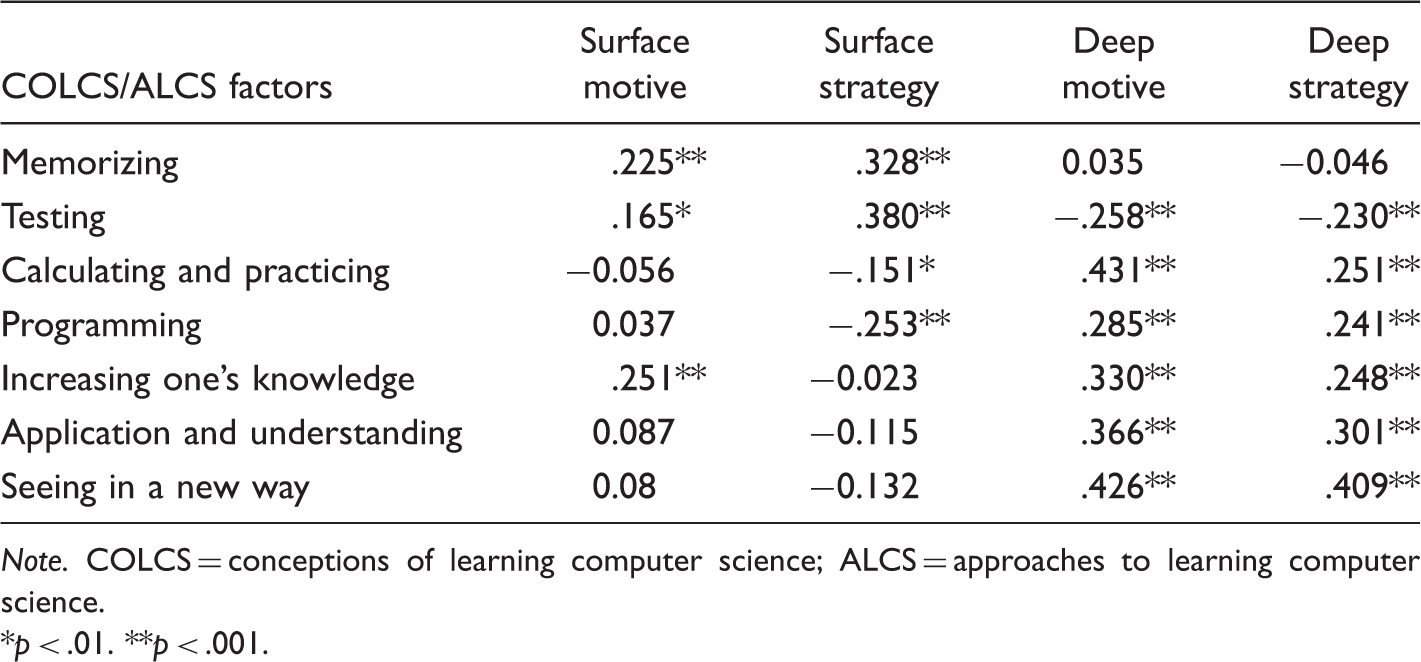
Note. COLCS = conceptions of learning computer science; ALCS = approaches to learning computer science.
*p < .01. **p < .001.
Stepwise Multiple Regression Analyses for Predicting Students’ Approaches to Learning Computer Science
Stepwise Regression Models for Predicting Approaches to Learning Computer Science.

*p < .01. **p < .001.
Exploring Differences by Gender and Minority Status
Descriptive Statistics and MANOVA Results by Gender for COLCS Survey Factors.
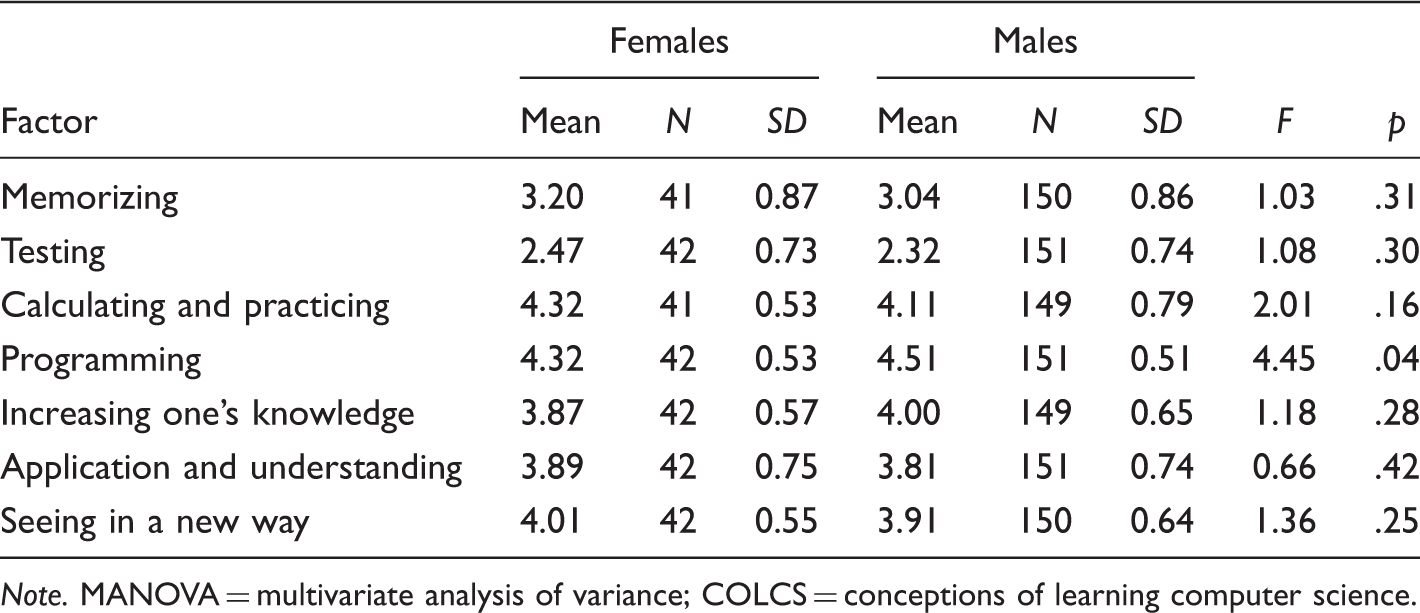
Note. MANOVA = multivariate analysis of variance; COLCS = conceptions of learning computer science.
Descriptive Statistics and MANOVA Results by Gender for ALCS Survey Factors.
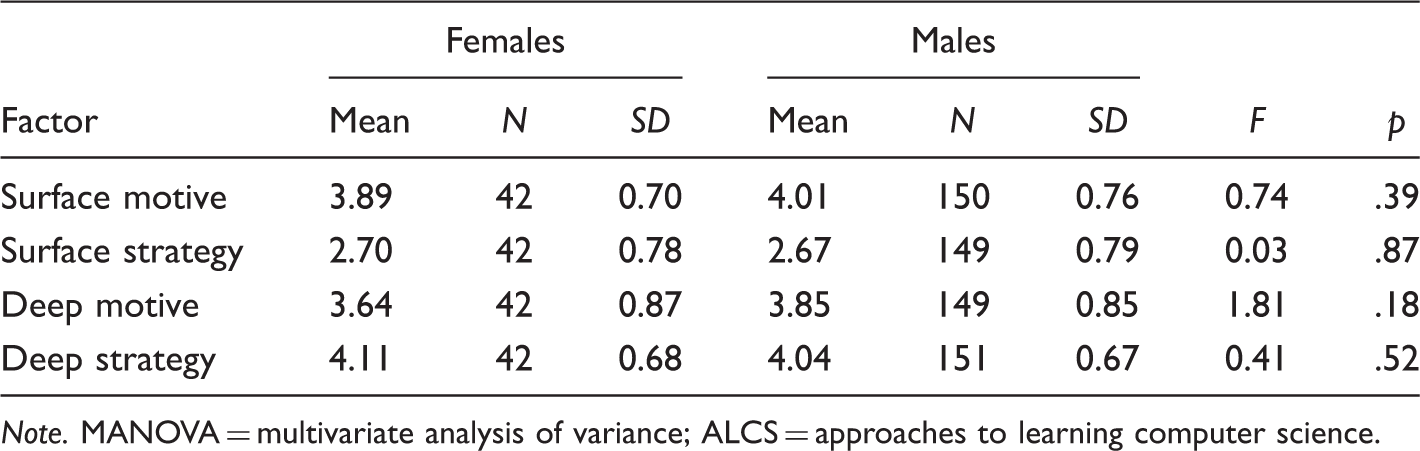
Note. MANOVA = multivariate analysis of variance; ALCS = approaches to learning computer science.
Descriptive Statistics and MANOVA Results by Minority Status for COLCS Survey Factors.
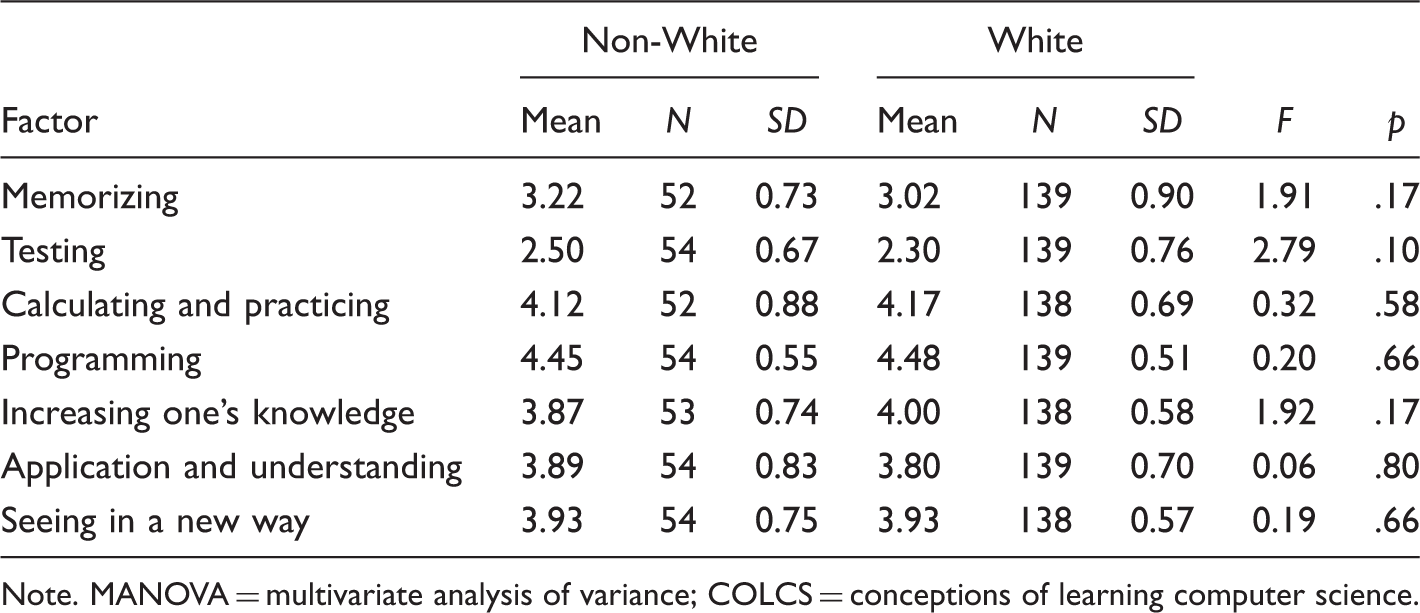
Note. MANOVA = multivariate analysis of variance; COLCS = conceptions of learning computer science.
Descriptive Statistics and MANOVA Results by Minority Status for ALCS Survey Factors.

Note. MANOVA = multivariate analysis of variance; ALCS = approaches to learning computer science.
Discussion
Interpretation of these results must be viewed in light of the limitations and delimitations of this study. First, the sample of student participants was from one university in the southeastern United States. Caution should be taken in generalizing these results to all undergraduate computer science students. Second, there were some measurement issues with the COLCS and ALCS survey factors with some items not loading well on the factors and the internal consistency reliability for some of the factors below the social science norm of .7 (Nunnally, 1978). Although the CFA showed a reasonable fit for both models, the data cannot be assumed to be without measurement problems. Furthermore, the original administration of the COLCS and ALCS survey used a 7-point scale, whereas we used a 5-point scale in this study. Third, we only collected quantitative survey data in this study as opposed to a mixed method design, which would have enabled us to collect qualitative data to triangulate our findings and potentially provide deeper explanations. Finally, as this is survey research, the honesty and accuracy of the student participants is also a factor since the students may have provided “socially acceptable” responses. With these considerations in mind, our results show some interesting and notable findings.
Undergraduate students appear to conceive of learning computer science in diverse ways with a greater emphasis on Programming and Calculating and practicing. These same students were least interested in the facets of Testing and Memorizing for learning computer science. It is unsurprising that Programming was a dominant factor in our study as we intentionally collected data from a range of computer programming courses at the institution. Also, the skill of Programming traces the computer science major from the early introduction courses (e.g., CS1) to the more advanced courses (e.g., compilers) that use programming as a skill to complete the learning activities. Analogous to prior research on student learning conceptions in computer science (Bruce et al., 2004; Hewner, 2012; Liang et al., 2015; Thuné & Eckerdal, 2009), programming plays a major role in how students conceive of learning within the field. Our results are also consistent with the prior study by Liang et al. (2015) that showed that students did not perceive of Testing and Memorizing as valuable for learning computer science. As noted by Kallia (2017), instructors use a wide range of assessment methods in computer science classrooms—not just traditional assessments that require rote memorization on a test.
When examining the ALCS, our data suggest that undergraduate students employ a Deep strategy to learning computer science involving strategies to make meaning of the subject and connect prior knowledge with new topics in computer science being learned. While the Deep strategy is rated as the highest factor, the Surface motive, in which students are motivated by extrinsic motivations such as getting higher grades or meeting teacher expectations appears to also drive student behavior more than the Deep motive in which students are motivated more by intrinsic factors like interest and curiosity. Notably, the lowest rated factor was the Surface strategy in which students remember rote information to pass examinations. These findings mirror those of Liang et al. (2015) with Taiwanese undergraduate students in computer science. Perhaps the ALCS span across international borders and cultures. However, to fully address that possibility, more data from across the globe must be collected and examined.
The findings from the Pearson correlations and stepwise multiple regression models among the factors on the COLCS and ALCS surveys suggest a clear pattern between conceptions of learning and ALCS. The Surface strategy was strongly related to Memorizing and Testing and negatively related to the remaining constructs. In contrast, the Deep strategy was strongly related to Calculating and practicing, Programming, Increasing one’s knowledge, Application and understanding, and Seeing in a new way and negatively related to Memorizing and Testing. After running the stepwise regression models, we can see that Testing (negative relationship) and Seeing in a new way (positive) were consistent for both the Deep motive and Deep strategy approaches. Memorizing was consistent in both the Surface motive and Surface strategy approaches with a positive relationship. These data show that low-level conceptions (e.g., Memorizing) and high-level conceptions (e.g., Seeing in a new way) can be generated based on these relationships. That is, conceptions of learning and ALCS are meaningfully related.
An important question to ask is what do these relationships mean to computer science education at the undergraduate level? Undergraduate computer science students with Deep motives and that employ a Deep strategy appear to have conceptions of learning unaligned with the test-centric focus of the computer science curriculum. Rather, these students appear to be more internally motivated by interest and curiosity and conceive of learning computer science as novel perspective for finding more reasonable explanations of the world related to computer science. Conversely, those students who have Surface motives and use Surface strategies are more externally motivated by passing the exam, meeting the degree requirement, getting a well-paid job, or pleasing family members. These students appear to employ weaker learning strategies like memorizing with a test-centric approach.
This study also sought to examine the individual differences of gender (male vs. female) and minority status (White vs. mon-White) across the factors on the COLCS and ALCS surveys. Employing a series of MANOVA models, only one construct showed a statistically significant difference: programming based on gender with male students having a slightly higher conception of learning than their female equivalents. Also notable, while not statistically significant, there was a potential relationship between White and non-White students on the use of the Surface strategy approach with non-Whites favoring the approach slightly more than Whites. As broadening participation among women and minority groups has been a stated objective of several computer science education grant programs by the National Science Foundation, understanding if women or minorities have different conceptions of learning and ALCS is an important research question. These preliminary findings suggest this research question may be worth expanding on a larger scale to fully understand whether these individual differences contribute to noticeable differences in learning conceptions and approaches.
Conclusion
What can we conclude about this research on conceptions of learning and ALCS? First, we have shown that there is variation in both these constructs in how college students both conceive and approach computer science. College students in this study appear to favor conceptions of Programming and Calculating and practicing over Memorizing and Testing. While extrinsically motivated, these college students appeared to favor a Deep strategy approach to learning computer science in which students use prior knowledge and deeper strategies to learn the topics. Second, there is a meaningful and palpable relationship between conceptions of learning and ALCS that manifests itself as both low-level conceptions (e.g., Memorizing) and high-level conceptions (e.g., Seeing in a new way) in relation to Surface strategy and Deep strategy, respectively. These relationships beckon further investigation in larger samples across institution types, national borders, cultures, and languages. Finally, there may exist some important differences between genders and minority status that deserve further attention from educational researchers and computer scientists. These differences may inform how we approach broadening participation in the field of computer science. Future research opportunities in this area are ripe with opportunity.
Footnotes
Declaration of Conflicting Interests
The authors declared no potential conflicts of interest with respect to the research, authorship, and/or publication of this article.
Funding
The authors received no financial support for the research, authorship, and/or publication of this article.