



Abstract
A key challenge for educators in business is to incorporate learning tools that mimic the uncertainty and complexity of the real business environment. However, recent advancements in technology have offered new tools that address this challenge. One such increasingly popular tool has been computer simulations. While the use of simulations has grown in business education, the research on simulations is quite nascent. This is especially true when it comes to understanding which factors lead students to perform better or worse in a business simulation environment. By integrating goal the orientation and generative learning literature, this study seeks to address this shortcoming in the existing literature. More specifically, we explore how student teams’ goal orientation affects their team’s performance in a simulation context. Results suggest Learn and Avoid Goal orientations are positively related to an objective performance metric (i.e., sales growth), while the Avoid Goal orientation is positively related to a subjective performance metric of team effectiveness. On the other hand, the Prove Goal orientation was negatively related to both metrics. The paper concludes with a discussion of the contributions and implications for both team development and pedagogical approaches to team support.
Keywords
A key challenge for management educators is to incorporate engaging methods and tools that teach students the skills needed to prosper in the business world. This is particularly important given the increasing complexity of the business world and employers’ expecting their employees to have the skills to succeed in such an environment. Unfortunately, finding learning tools that accurately portray an increasingly complex and dynamic business environment is difficult. One such tool – business simulations – is of particular interest in business education and has become more common (Lean et al., 2006) as part of an active learning approach to enhance business students’ knowledge and skills. A simplified version of a real business environment, business simulations require participants to make decisions which affect some type of specified outcome in an attempt to outcompete other participants. Prior research suggests educators can use simulations to support the skill and competency development needed for careers (Pivec, 2007).
Unfortunately, existing research on business simulations lacks unity. Many studies explore participants’ characteristics and their team’s simulation performance (e.g., Wellington et al., 2017). However, many business simulations require students to work in teams to achieve performance outcomes, making the applicability of individual-level results unclear. While some studies consider the relationship between team characteristics and simulation performance, this literature remains underdeveloped (Bell & Loon, 2015). This is troubling, considering organizations are increasingly using teams to manage and solve complex problems in the workplace (Stewart & Barrick, 2000).
This paper addresses this shortcoming of the literature by examining team characteristics and performance-based outcomes in a business simulation context. Moreover, recent research suggests team goal orientation may be a useful predictor in examining team outcomes in simulations (e.g., Mehta & Mehta, 2018). Thus, this paper integrates two theoretical perspectives to examine the influence of team goal orientation on objective and subjective measures of team performance. More specifically, this paper uses goal orientation theory (Vandewalle, 1997) to characterize the different learning orientations of each team. The paper also incorporates generative learning theory (Jonassen, 1988), which allows for viewing student team performance as the outcome of the interrelationships between course content, student understanding of course components, and individual experiences in a structured academic environment (Wittrock, 1985).
Literature Review
Simulations and Constructivism
Simulations have gained an increased level of popularity in recent years. This popularity is likely due to several factors, such as their impact on student learning outcomes (e.g., Ngai et al., 2012; Zulfiqar et al., 2019), the familiarity of today’s students working with, and learning from, technology (Matute & Melero, 2016), and the desire for students to learn via technology-driven active learning components (Akilli, 2011). From a theoretical perspective, simulation-based tools are consistent with constructivist theories of learning, whereby students are actively engaged in experiential-based activities (e.g., Dewey, 1938; Kolb, 1984; Vygotsky, 1978). According to constructive learning perspectives, the learner constructs knowledge based upon their experiences either individually or collectively (Narayan et al., 2013). Students use existing cognitive schemas and knowledge as a foundation when faced with new information as a result of changes, either in the environment or personal experiences. The insights from the new experiences then add to what the student already possesses, thus serving to modify, change, or update the student’s knowledge (Pelech, 2010; Richardson, 2003). Constructivism is a powerful perspective with which to frame student learning using simulations because it suggests students develop deeper understanding and meaning as a result of their interaction with others as they experience new learning activities (Richardson, 2003). Indeed, research suggests that students learn more through practical activities than passive learning techniques like lecturing or reading the course text (Chickering & Gamson, 1987), especially when those activities provoke more joy, happiness, or interest which can lead to motivated learning (Bergin et al., 2003; Zulfiqar et al., 2019).
Simulations satisfy a number of commonly suggested conditions that must be present for learning to occur according to a constructivist theory perspective (e.g., Narayan et al., 2013; Richardson, 2003). For example, simulations place the students at the center of the learning experience where they must solve problems without the direction of the instructor. The simulations often provide a complex learning environment structured around a series of ambiguous or uncertain decisions. Simulations incorporate group interactivity where teams of students work on the same set of decisions with the same goals and for which they are rewarded as a team. Simulations require students to draw upon their existing course knowledge learned via traditional means, such as lectures and textbooks, to understand and contextualize the simulation. Finally, they challenge students to think reflexively to diagnose the reasons why their team achieved (or did not achieve) specific performance outcomes and reflect on how they can improve. All these elements have been posited to be necessary for learning to take place according to the constructivist theory. Thus, it is reasonable to assume simulations are an important tool for student learning of course content.
Simulations and Relationship to Learning
Simulations can serve as a central part of an interactive and experiential learning environment. Zulfiqar and colleagues (2019) have argued business simulation games, in particular, can further student learning because they present students with an interactive opportunity where students within teams can brainstorm and challenge one another’s ideas. They further suggest simulations can be helpful in the learning process because feedback happens in real-time so students can reflect upon what did and did not work with their thinking. Simulations may also be a better tool for transferring know-how to students, which is difficult to do using traditional techniques such as a lecture or through a course textbook (Ngai et al., 2012; Taylor & Chi, 2006). Virtual environments, while not providing explicit instruction to students, do provide students with an experience that contextualizes the course material in a more practical way.
Simulations may also impact students’ motivation to learn. For instance, Foster (2011) theorized that students who are more interested in their learning and enjoy the learning activities become more cognitively engaged. Hence, students are more motivated to learn, which can lead to increased learning. Similarly, Wang (2010) found that individuals playing a simulation game to learn course content were more knowledgeable about the subject area and exhibited greater levels of motivation to learn about the subject than those in a non-simulation condition. Thus, it seems simulations can be a good tool for stimulating learning.
Indeed, a number of studies provide evidence that simulation-based tools can improve learning. For example, Bergin et al. (2003) found students working in a simulation were more interactive, engaged, and participatory in discussion compared to students in a traditional case-based condition. As a result, more students found the simulation to be a good learning tool compared to paper-based learning because it allowed them to take theoretical knowledge and apply it to something more realistic. Taylor and Chi (2006) found students in a simulation condition, as compared to those exposed to only the textbook, experienced higher knowledge gains on contextualized questions, as well as higher levels of inferred knowledge. Similarly, Vogel et al. (2006) showed that students experiencing an interactive simulation achieved higher cognitive gains and had better attitudes toward learning than those experiencing passive teaching methods. Finally, in a simulation designed to learn supply chain management, students said they learned more because of the simulation and attributed this to the simulation being more exciting, innovative, and worthwhile than just reading the textbook (Ngai et al., 2012). Taken together, simulations can stimulate learning in a variety of ways, and the evidence suggests simulations lead to more learning.
Business Simulations and Business Education
Whereas simulations are familiar tools, business simulations are uniquely situated to address the dynamic challenge in the business world while satisfying today’s student population who are increasingly technologically savvy. Business simulations have become prevalent only in the last 15 years, due to advances in computer technology (Faria et al., 2009). They offer several benefits that meet the expectations of today’s organizations (Aldrich, 2004). For instance, business simulations help teach decision-making skills, develop teamwork ability, and allow students to apply and integrate what they learned in prior courses (Faria et al., 2009). Recent work also indicates simulations impact analytical and strategic thinking, problem-solving, and time management skills (Mustata et al., 2017). Pedagogically, simulations have increased students’ internal motivation and improve learning outcomes (Kebritchi et al., 2010). Finally, simulations introduce a more problem- and project-based learning endeavor, which stimulates greater development, growth, and learning.
Beyond skill development, simulations provide a risk-free environment where students test assumptions about the content area absent and real-world consequences (Ebner & Holzinger, 2007) while engaging in active learning with scenarios that mimic situations they will face in their careers (Avramenko, 2012). Prior research on business simulations has largely focused on individual learners’ characteristics and their influence on individual learning outcomes and performance (Matute & Melero, 2016), while far less has focused on the relationship between team characteristics and simulation performance. This seems puzzling given business simulations are often team-based activities and assess team decision-making and performance (Seijts et al., 2004).
Prior work on team characteristics suggests shared team mental models (Van den Bossche et al., 2006), team locus of control (Boone et al., 2005), team knowledge and planning (Mathieu & Schulze, 2006), team psychological collectivism (Dierdorff et al., 2011), team cohesion (Mathieu et al., 2015), and team conflict (De Dreu & Weingart, 2003) all impact simulation performance.
Several studies have highlighted the importance of team characteristics, which may enhance learning, thus leading to better simulation performance. For example, Xu and Yang (2010) found team psychological safety was positively associated with the integration of team members’ perspectives, thus resulting in increased team mental model complexity, defined as students’ breadth of understanding of a specific knowledge domain. Since more complex models are indicative of a wider breadth of knowledge (Nadkarni, 2003), we would expect them to be associated with improved simulation performance. Lovelace et al. (2016) considered two team problem-solving orientations: collaborative and competitive. Whereas the collaborative orientation is high on both cooperation and assertiveness, the competitive orientation is high on assertiveness and low on cooperation. The collaborative orientation encourages open discussion of problems and mutually beneficial solutions; the competitive orientation emphasizes the pursuit of personal goals and the use of logic and benefits to persuade team members to follow one’s position. While the authors found a collaborative problem-solving approach was unrelated to performance, the competitive approach was negatively related to performance.
While these studies have helped to understand why some simulation teams perform better than others, this research is still in its infancy, and there remain many unknowns. For instance, one omission is the role team goals might play. Research indicates goals are an important motivational factor that may direct behaviors and affect performance (Seijts et al., 2004). Recent work has begun to illuminate this previously overlooked domain, suggesting team goal orientation may play an important role in team learning and performance outcomes in simulation activities (Mehta & Mehta, 2018). Unfortunately, there is little theory that explains how team goals’ influence may impact students’ transfer of concept knowledge to strategic decision-making, which impacts team simulation performance. The present study contributes to this line of inquiry and addresses this omission in the current literature by examining team goal orientations in the context of generative learning theory (Wittrock, 1985).
Team Goal Orientation
Team goal orientation represents a mutual understanding among team members, reflects the goals teams establish for themselves, and is rooted in achievement goal theory. This suggests students pursue both performance and learning goals (Elliott & Dweck, 1988) that manifest themselves in one’s desire to appear competent or enhance knowledge, respectively. Finch et al. (2015) refer to these goal orientations as Performance and Mastery (Learn) Goal Orientation, respectively. When motivated by wanting to appear competent for the associated learning task, students have a Performance Goal Orientation. When personal skill development drives students, they have a Learn Goal Orientation (LGO). Vandewalle et al. (2001) noted earlier models of goal orientation were two dimensional (i.e., Performance and Learn); these models failed to receive empirical support.
Later, scholars recommended a three-factor construct in place of the two-factor structure. Consistent with this, Vandewalle (1997) conceptualized goal orientation as comprised of Prove, Avoid, and Learn Goal Orientations. Bifurcating the Performance Goal Orientation is consistent with prior work by Heyman and Dweck (1992). Clarifying the dimensionality of the goal orientation construct suggests researchers should revisit the conclusions drawn from the prior model so they can distinguish between desires to appear competent (Prove Goal Orientation; PGO) and to avoid appearing incompetent (Avoid Goal Orientation; AGO).
Steeped in the individual achievement motivation literature (Dweck, 1986), an LGO focuses on enhancing one’s knowledge of the subject matter and tasks at hand. Students seeking ways to apply skills and frameworks learned in class are characterized by an LGO. Statements from such students might include, “I want to practice making strategic business decisions.”
Like the LGO, PGO and AGO are rooted in the individual achievement motivation literature. However, these orientations differ from LGO in important ways. Whereas an LGO focuses on enhancing knowledge, PGO and AGO focus on the perception of competence and avoidance of incompetence, respectively. Thus, students with these orientations are not primarily concerned with learning. Instead, they wish to be seen by their faculty and peers as competent about the tasks at hand (PGO). At the same time, there is a desire to dodge being viewed as unskilled (AGO). These motivations present themselves during the organization phase of the generative learning process. For instance, a common statement made by such students is, “I only want to get through this class.” Student teams dominated by different goal orientations might approach simulation activities in unique ways.
While goal orientation is often described at the individual level, recent research suggests it also exists at the team level (Gong et al., 2013; Mehta & Mehta, 2018). Individuals working in teams openly discuss goals and objectives in the beginning to establish a foundation from which the team will work. During this time, team members signal to one another their desires regarding team tasks. This may result in adapting their shared view of desired outcomes, which could impact learning, performance goals, or both (Chadwick & Raver, 2015). Intragroup coordination will facilitate decision-making during the simulation and reflects the shared understanding a team may have regarding assigned tasks (Bunderson & Sutcliffe, 2003). The result would be an impact on the team’s simulation performance.
Theory and Hypotheses Development
Generative Learning Theory
The theoretical framework underlying the model in this paper is generative learning theory (Grabowski, 2004; Wittrock, 1985), which positions the learner as an active participant in the learning process. Thus, the learner works to assimilate course content, personal experiences, prior knowledge, and other environmental stimuli to make decisions. Given the complex nature of business decision-making, allowing students to practice via simulations is a practical approach to building critical decision-making skills.
Four learning strategies comprise the generative learning theory: recall, organization, integration, and elaboration (Jonassen, 1988). Recall concerns the memorization of facts for later use. For instance, students memorize key terms to recall during an exam. Organization focuses on how students structure course content and material to improve understanding. In this vein, students orchestrate resources to maximize their success. Integration involves connecting new content with existing experiences, thoughts, and ideas. In other words, students blend new content with prior experiences when applying the knowledge gained. Finally, elaboration occurs when learners make inferences and draw conclusions. Here, students draw from recall, organization, and integration to make assumptions and choose paths toward a decision.
Grabowski (2004) describes how generative learning contributes to the design of instruction and learning. While not directly discussing simulations, Grabowski describes the pedagogical foundation inherent in the use of simulations. Generative learning occurs when learners connect knowledge from various reserves (e.g., course content, personal experience) to make decisions. Specifically, simulations encourage students to make use of information learned in prior courses (recall), develop their understanding of the business scenario presented (organization), connect course content to the business scenario (integration), and process consequences and draw conclusions from these decisions (elaboration).
Goal Orientation and Team Performance
Regarding goal orientations, the theory advanced in this paper suggests teams with a higher LGO will be motivated to improve performance more than teams lower on this dimension, as they are motivated by learning and content mastery. Individuals on a team with a high LGO are more likely to engage in problem-solving and change strategies once feedback is received (Dweck & Leggett, 1988). When faced with feedback that is worse than expected, those with a higher LGO view the feedback as a challenge to perform better (Colquitt & Simmering, 1998). The opportunity for learning extends into multiple facets when considering simulations. For instance, teams must learn how the simulation works, the different options available, and how to implement different strategies to achieve superior performance. Additionally, students must learn how to integrate what they learn in the course with the simulation. Thus, teams with a higher LGO would be more apt to utilize the four strategies of generative learning.
Teams with a higher LGO would be more likely to recall simulation information for later use because they would have spent time reading the simulation guides and taking advantage of the practice rounds that commonly precede the graded portion of the simulation activity. These teams would also be more likely to organize and integrate new concepts associated with the simulation with prior or current coursework, due to their focus on learning. Finally, teams with an LGO would also be better able to elaborate and draw conclusions from their performance. This might be because they are more familiar with the simulation reports and can link the strategies they used in the simulation with theoretical models from the course materials. Thus,
Whereas teams with a higher LGO are motivated to learn, teams with a higher AGO are motivated by a fear of failure and concerns over negative judgments. Thus, they may engage in counterproductive behaviors, undermining their success. As a result, teams with a higher AGO have low task completion percentages and hastily engage in recall learning strategies to avoid negative judgments. To protect their competence, teams with a higher AGO either limit or fail to engage in the more enriching learning strategies (e.g., integration, elaboration). The unfortunate but not unforeseeable consequence is that teams with a higher AGO fall behind their counterparts with different orientations. Given the toxic nature of the AGO, it should exhibit a negative relationship with business simulation performance.
Like teams with a higher LGO, teams with a higher PGO are likely to generate connections between prior experiences, course content, prior knowledge, and other environmental stimuli, but with different motives. Teams with high PGO are focused on proving their competence, and not necessarily on expanding their knowledge. In the quest to prove competence, these teams engage in generative learning strategies focused on completing tasks that lead to improved performance (Mehta & Mehta, 2018). However, unlike teams with a higher LGO that are focused on enhancing capabilities and learning, teams with a higher PGO make decisions to complete tasks in hopes of positively driving performance. While the motives of teams with higher LGO and PGO are different and may require unique behaviors, both are focused on performance improvement, and thus should positively influence performance in the simulation activity.
Goal Orientation and Team Effectiveness
While a team’s objective performance is important, it is equally important to consider perceived team effectiveness, as these perceptions are critical for the simulation’s success as an essential learning tool. Prior research on teams indicates one can use team effectiveness as an alternative performance measure (e.g., De Dreu & Weingart, 2003), and so it has been adopted here. Team effectiveness refers to a team’s perception of how well its efforts compare to its predefined measure of quality, as well as the team’s capacity to work together and contribute to each other’s growth (Van den Bossche et al., 2011).
There is reason to suspect all goal orientations will be associated with higher team effectiveness. For instance, when team members’ focus on learning as their primary outcome (i.e., LGO), they are more likely to develop strategies to learn and gain mastery over the material. On the other hand, when the main motivation is to avoid appearing unskilled (i.e., AGO), teams will likely develop strategies to meet minimal performance expectations. Finally, teams focused on proving their superiority (i.e., PGO) may be primarily concerned with objective metrics of success, and thus may focus more heavily on quantitative metrics (e.g., Net Profit) to validate their success. Because team effectiveness refers to the extent to which the team can achieve its pre-established goals, teams with all orientations can be highly effective, though their specific goals are likely to differ.
Method
Procedure
This study solicited students for participation from strategic management and finance courses where instructors required a business simulation. All participants were asked to complete two online surveys, administered using the Qualtrics platform. The first survey, distributed at the beginning of the semester, included measures of goal orientation and demographics. The final question asked for permission to contact their instructor at the end of the semester to collect performance-related data for their simulation firm. The second survey was administered several weeks later and included measures of team effectiveness. Both surveys requested participants to report their Student ID number; this was used to match participants’ responses to the surveys. At the end of the semester, instructors provided performance-related information for consenting participants’ simulation firms.
Sample
The sample included 86 students in 29 teams from a single, large university in the Midwestern United States. Slightly more than half of the participants were enrolled in undergraduate strategic management courses, while about one-third were enrolled in a graduate-level strategic management course. The remainder were enrolled in an undergraduate finance course. No teams had both undergraduate and graduate students.
The sample consisted of 37 males (43%) and 49 females (57%). Participants were mostly Caucasian (81.5%), though the sample also included minority students including African-American (2%), Asian/Pacific Islander (8%), and Hispanic (2%); four students (5%) reported ‘Other’ as their race, and one (1.5%) declined to include their race. Six participants (7%) identified as international students, while the majority (93%) did not. The average age of the sample was 25 years (SD = 5.5).
Simulations Used
Three simulations are represented in the study: Glo-bus, the Business Strategy Game (BSG), and Capsim. Each simulation is unique insofar as they focus on different competitive industries: Glo-bus teams compete in two industries (i.e., wearable cameras and drones), while BSG (i.e., branded, private-label footwear) and Capsim (electronic sensors) teams compete in one industry with multiple market segments. All simulations are fully online, require students to develop and execute competitive strategies, and involve decision-making in multiple functional areas (e.g., research and development, marketing, finance). After each set of decisions, teams receive feedback on their strategy via a series of financial and competitive reports.
Measures
Mean Sales Growth
An objective measure of firm performance, each team’s Mean Sales Growth for each of eight decision-making rounds in the simulation was calculated. Annual values were averaged to create a single measure for each team.
Team Effectiveness
A subjective measure of team performance, participants were asked for their perceptions of their team’s effectiveness using three items (α = 0.89) from Van den Bossche et al. (2006). Participants rated the accuracy of the three statements on a seven-point scale from ‘very inaccurate’ to ‘very accurate.’ A sample item is: “I am satisfied with the performance of our team.”
Learn Goal Orientation
LGO was assessed using a five-item (α = 0.85) scale from Vandewalle (1997). Each item was measured on a six-point scale from ‘strongly disagree’ to ‘strongly agree.’ A sample item is: “I often look for opportunities to develop new skills and knowledge.”
Prove Goal Orientation
PGO was assessed using a four-item scale (α = 0.83) from Vandewalle (1997). Each item was measured on a six-point scale from ‘strongly disagree’ to ‘strongly agree.’ A sample item is: “I’m concerned with showing that I can perform better than others.”
Avoid Goal Orientation
AGO was assessed using a four-item scale (α = 0.87) from Vandewalle (1997). Each item was measured on a six-point scale from ‘strongly disagree’ to ‘strongly agree.’ A sample item is: “I would avoid taking on a new task if there was a chance that I would appear rather incompetent to others.”
Control Variables
Control variables for team-level characteristics that may lead to performance differences were used. Number of team members was the total number of members on the team. Age diversity was the standard deviation of team member ages. Sex diversity measured the diversity in team members’ sex, while Race diversity measured the diversity in team members’ race or ethnicity. Given the qualitative nature of both sex and race, Blau’s index (Blau, 1977) was calculated for each; a higher score indicates a greater level of diversity. Finally, Undergraduate denoted the academic level of the team; the variable was coded ‘1’ for an undergraduate team and ‘0’ otherwise.
Hierarchical linear regression was used to test the hypotheses. The Breusch-Pagan test for heteroskedasticity suggested no need to employ a robust estimation approach with corrected standard errors. For the sake of thoroughness, each model was run with and without robust standard errors; coefficients and significance levels were consistent across both specifications. Additionally, Variance Inflation Factors (VIF) were calculated to assess multicollinearity concerns. The average VIF for each model was less than three, indicating multicollinearity was of no significant issue.
Measurement Model
To ensure the goal orientation items were appropriately specified, a measurement model was assessed through a series of steps. First, following Byrne (2010), the factor loadings were examined to determine if any were less than 0.50. All factors loaded above 0.50, so none were eliminated. Second, to assess the validity of the measurement instrument, the Average Variance Extracted (AVE) was calculated. According to Fornell and Larcker (1981), latent variables should exceed 0.50. The AVE for the three latent variables used in this study ranged from 0.55 to 0.66, indicating discriminant validity. Third, to assess the reliability of the measures, composite reliabilities were examined, using a cutoff value of 0.70 (Chin, 1998) to establish the indicators had different loadings and high reliability. The composite reliability values for all three measures exceeded 0.70: LGO = 0.90, PGO = 0.77, and AGO = 0.85. Hence, there were no validity concerns.
Finally, a confirmatory factor analysis was performed where the latent variables were permitted to correlate with one another. The analysis tested a series of models varying from one to four factors. Table 1 includes the fit statistics for all tested model configurations. In the one-factor model, all items were allowed to load on a single factor. In the two-factor model, all goal orientation items were loaded onto one factor and team effectiveness items onto a second factor. In the three-factor model, the LGO was loaded on one factor, the Performance Goal Orientations (Prove and Avoid) on a second factor, and team effectiveness on its own factor. Finally, for the four-factor model, each goal orientation, as well as team effectiveness, were allowed to load onto their own factor. The fit statistics (Table 1) show the four-factor model is the most appropriate according to Hu and Bentler (1999), who suggest using cutoff values close to 0.95 for both the CFI and TLI, 0.08 for SRMR, and 0.06 for RMSEA.
Fit Statistics for Confirmatory Factor Analysis.
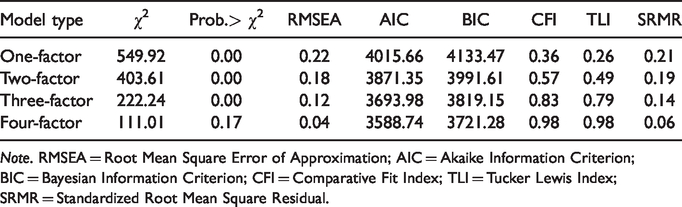
Note. RMSEA = Root Mean Square Error of Approximation; AIC = Akaike Information Criterion; BIC = Bayesian Information Criterion; CFI = Comparative Fit Index; TLI = Tucker Lewis Index; SRMR = Standardized Root Mean Square Residual.
Results
Table 2 presents descriptive statistics and pairwise correlations. Tables 3 and 4 show the tests of the study hypotheses for the dependent variables Mean Sales Growth and Team Effectiveness, respectively. Each table reports two models: one with study control variables (Models 1 and 3), and a second with the independent variables (Models 2 and 4). Due to the relatively small sample size, Pratt-adjusted r-squared was also calculated as an added measure to more appropriately assess the explanatory power of the models.
Descriptive Statistics and Correlation Matrix.
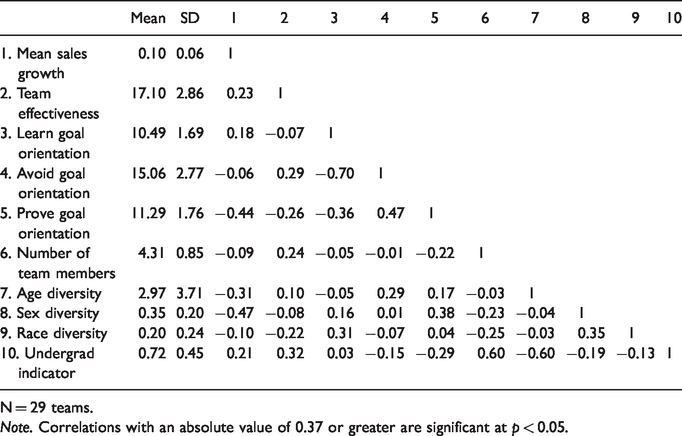
N = 29 teams.
Note. Correlations with an absolute value of 0.37 or greater are significant at p < 0.05.
Ordinary Least Squares Regression: Mean Sales Growth [Dependent Variable].

Ordinary Least Squares Regression: Team Effectiveness [Dependent Variable].
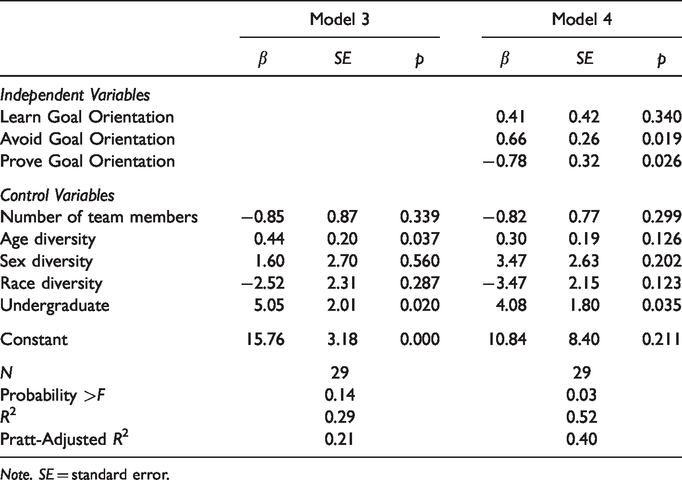
Note. SE = standard error.
Hypotheses 1 and 3 argued the LGO and PGO, respectively, would be positively related to firm performance, while Hypothesis 2 suggested the AGO would be negatively related to firm performance. Model 2 displays the results. The average team LGO was positively related to firm performance (β = 0.02; p = 0.013), supporting Hypothesis 1. Contrary to the hypothesis, the average team AGO was positively related to simulation performance (β = 0.01; p = 0.010). Thus, Hypothesis 2 was not supported. Hypothesis 3 was also not supported, as the relationship between PGO and simulation performance was negative (β = −0.01; ns). 1
Hypotheses 4, 5, and 6 argued average LGO, AGO, and PGO, respectively, were positively related to team effectiveness. Table 4 displays the results. There was no relationship between LGO and team effectiveness (β = 0.41; ns), and thus no support for Hypothesis 4. Consistent with Hypothesis 5, the average team AGO was positively related to team effectiveness (β = 0.66; p = 0.019). Finally, the average team PGO was related to team effectiveness, though not in the hypothesized direction (β = -0.78; p = 0.026). Thus, Hypothesis 6 was not supported.
Discussion
Business simulations are being used with increased frequency, yet why some teams perform better than others and whether students can transfer concept knowledge to actual strategic decision-making remain open questions. Thus, the goal of this study was to examine the influence of team goal orientations on two measures of performance (i.e., firm performance, team effectiveness) in the context of business simulations. The findings yield several important contributions to this literature.
First, using generative learning theory as the framework, there was a positive relationship between LGO and firm performance. These results confirm those found in prior studies (e.g., Mehta & Mehta, 2018), hence supporting that an LGO is beneficial for simulation performance. The theory behind this relationship is that teams with this orientation organized themselves in ways to maximize learning and transfer knowledge to their strategic decisions (Ritchie et al., 2013). In other words, teams with an LGO accepted the challenge of managing their simulation firms. Thus, the student teams who viewed the business simulation as a means to practice and refine their skills developed important techniques to improve firm performance. From a learning perspective, instructors utilizing simulations in a team setting should carefully plan when and how to interact with teams based on the team’s collective goal orientation. Tailored feedback for each team will serve as a small group lesson, more specific to the given team dynamics. More nuanced feedback may enhance an individual’s ability to integrate the pointed feedback (from the instructor) and prior experiences (with the simulation) more constructively to formulate conclusions and make better decisions.
Second, the findings relating to the AGO and PGO were mixed. Contrary to the hypothesis, the AGO-to-firm performance relationship was positive. The hypothesis was these teams would have low task completion due to suboptimal learning strategies implemented to avoid negative judgments. However, it seems these teams organized and focused their effort in ways that, perhaps unexpectedly, improved firm performance. It may be that these students engaged in activities to appear competent and, in doing so, used concepts that increased firm performance. These results are in contrast to prior research, which has failed to find a relationship between AGO and team performance (e.g., Mehta & Mehta, 2018). In addition, contrary to the hypothesis, the relationship between PGO and firm performance was negative and only significant at the 0.10 level of analysis. This suggests more research is needed to confirm the direction of the relationship between PGO and performance, and to understand how, and why, teams wanting to prove their superiority are unsuccessful in terms of simulation performance.
The last set of hypotheses posited all goal orientations would be positively related to perceptions of team effectiveness. The results indicated an AGO was positively related to team effectiveness while a PGO had the opposite relationship; the LGO was unrelated to team effectiveness. The results point to a departure from existing research. For instance, Mehta and Mehta (2018) used a measure of perceived performance in their research. They found that PGO was positively related to perceived performance, while perceived performance was unrelated to both AGO and LGO. While the results reported here support the null relationship between LGO and subjective performance, the results regarding AGO and PGO differ considerably.
Based on these results, two observations are offered. First, teams that focus on avoiding negative judgments (i.e., AGO) may believe their teams function more effectively. Alternatively, AGO teams may have lower performance expectations and are thus more likely to achieve them during the simulation. However, teams with a PGO may be so concerned with being perceived as competent that they try too hard to show their abilities. This may result in counterproductive behaviors where teams over-analyze their situations or take unnecessary risks to ‘show off.’ Alternatively, it is feasible that teams with a primary PGO were comprised of highly competitive team members who may vie for dominance within the team (i.e., proving superiority within the team). This could lead to a toxic team culture and deteriorate team effectiveness.
Another contribution of the present study is the support it lends to the notion that goal orientation can be present at the team level. While most research on goal orientations focus on the individual level of analysis, a growing stream of research has found its presence at the team-level (e.g., Gong et al., 2013; Mehta & Mehta, 2018). Building on the ideas in this literature as well as the practical processes in which students discuss goals and objectives at the outset of team-based projects, the results provide further evidence that goal orientations at the team level have predictive power.
Finally, in addition to the contributions to the goal orientation literature specifically, the findings also speak to a much broader line of research related to simulations and the motivation to learn. For instance, Foster (2011) and Wang (2010), amongst others, have posited that student motivation to learn can be enhanced using simulations. While this may certainly be the case, the results of this study suggest that simulations may prompt other types of motivations, such as those associated with avoiding the perception of incompetence, that explain why and how teams achieve certain levels of performance.
Implications
There are two primary implications: team development and pedagogical considerations. First, different team goal orientations may have unique implications for simulation outcomes. It may be helpful for instructors to evaluate students’ goal orientations at the beginning of the term, before forming simulation teams. For example, it may be beneficial to form teams of students with similar goal orientations, as doing so might quicken the pace of team development. Alternatively, instructors might find value in forming teams of students with varying goal orientations to help students learn how to work with others who have an outlook different from their own.
Once established, a better understanding of a team’s goal orientation might lead to more focused performance feedback. For example, if a team is focused on not appearing incompetent (i.e., AGO), this might result in making suboptimal strategic decisions. Such a team might require more or a different style of coaching from their instructor than a team with a different dominant learning goal.
Second, the study identifies important pedagogy implications that instructors using simulations should consider. The contention is there are four types of support/interaction warranted by the instructor, three of which are derived from Leemkuil and De Jong (2012) (interpretive, experimental, and reflective) and a fourth offered from this study (directive support).
Interpretive support focuses on the instructor offering information and knowledge throughout the simulation to help students organize information and frame problems properly. The objective of this support is to provide outside stimuli, to assist students in more informed decision-making. To be more prescriptive, instructors using simulations should plan for multiple structured interventions. For instance, an instructor may intervene before or after a significant event occurs in the simulation to focus teams on details that they may otherwise overlook. Experimental support focuses on the instructor assisting students with designing specific tests, forecasting possible results, and formulating conclusions based on the results from the tests. The goal is to build students’ capabilities in constructing sound experiments and effectively evaluating the outcomes from those experiments. This will require the faculty teaching simulations to not only assist students with designing the experiments but also with carefully interpreting the results. It is recommended that the experiment design and the interpretation of the results be separate grading elements on a rubric to emphasize the significance of each component. Separating the design of the experiment from interpreting the results will allow faculty to pinpoint opportunities to improve learning in one or both of the areas.
Reflective support focuses on guiding students to think through the inquiry process and the knowledge gained throughout the simulation. The nexus of this type of support is to engage the student in an introspective process that helps connect the simulation experience with course content. Instructors utilizing the simulation as an integral learning opportunity could require students to keep a journal encompassing their simulation journey. Collecting this information will help instructors fine-tune assignments and would invite students to reflect on specific milestones along the way.
Finally, directive support focuses on offering students research and prior class performance information regarding the different goal orientations. The intent of this type of support is to encourage the class to form teams carefully by systematically introducing data from prior performances. Engaging in the practice of providing information regarding previous performances will help students learn to associate decisions with performance outcomes from day one of starting the simulation.
In summary, this research contributes to the literature on teams and simulations. Still, more importantly, this study enriches active learning pedagogy in such a way that students and faculty alike can benefit. The study emphasizes that the four learning strategies of generative learning theory (recall, organization, integration, and elaboration) are active for both the student and instructor. When engaging in the different types of support, both students and faculty are activating different learning strategies. Students recall how the simulation works while actively organizing information received from their simulation performance. Simultaneously, students are integrating the inputs from assignments into the feedback process from the simulation. This results in the student and faculty elaborating on ways they can improve given all of the different inputs.
Limitations and Future Research
Every study has limitations, and this one is no different. The relatively small sample size of 29 teams and the diversity of students across different courses and levels, may limit the generalizability of the results. However, it is not without precedent to have sample sizes of less than 50 teams. For instance, Mathieu and Rapp (2009) analyzed data from 32 teams to study team performance trajectories using business simulations. Also, the diverse student sample might suggest the findings generalize to other business courses; however, alternative relationships might be found in more focused samples. Future research might consider building on these results by gathering larger homogenous or heterogenous samples of teams.
Responding to recent suggestions (e.g., Mehta & Mehta, 2018), this study focused on the direct relationships between team goal orientations and performance outcomes; however, it is likely that these relationships are more complex and include intervening variables not included in the study. Future research might consider some of these variables. Several intervening mechanisms have been highlighted above (e.g., recall, integration), which future research might explore to better understand the pattern of results reported in this study.
Finally, two performance measures were considered in the study: mean sales growth and team effectiveness, though there are likely other outcomes of importance for business simulations depending on the course objectives. For example, financial performance might be the primary concern in a finance course, while a strategic management course may prefer a more diverse array of performance outcomes. Accordingly, future research might consider incorporating alternative measures of performance and their relations with team goal orientations.
Conclusion
The goal of this study was to examine team goal orientation and its impact on team performance in business simulations. The results suggest team LGO and AGO are positively related to objective simulation performance, while AGO and PGO are related to perceived team effectiveness. It appears students in the study that were motivated to avoid negative judgments about their team’s competence and not those motivated to learn or demonstrate their superiority, were more likely to perform better across both outcome measures. The findings suggest instructors should actively engage in the learning process when simulations are used. Simply adding the simulation as an exercise is insufficient. To enhance the learning experiences of students while using simulations, faculty should prepare more specific points of feedback to teams to forge stronger cognitive connections between decisions made and performance outcomes.
Footnotes
Declaration of Conflicting Interests
The authors declared no potential conflicts of interest with respect to the research, authorship, and/or publication of this article.
Funding
The authors received no financial support for the research, authorship, and/or publication of this article.
