



Abstract
Group cognition is a cognitive science concept that studies how groups think, learn, and work. Most research investigates group cognition as a qualitative-oriented phenomenon. From a quantitative perspective, this research proposes a measure equation of group cognition, conducts empirical research during online collaborative problem-solving, and uses multiple quantitative methods to examine group cognition complemented with qualitative microanalysis. Specifically, social network analysis, behavioral pattern analysis, and quantitative content analysis are used to measure three groups’ group cognition. Results show that only one group successfully develops group cognition through synergistic coordination of social, behavioral, and cognitive activities. Students in the other two groups either take separate responsibilities to cooperate or have unequal participations, which indicates an inadequacy of group cognition. The extent that three groups develop group cognition is consistent with the order of groups’ final performance scores. Research analytical and pedagogical implications are provided to advance research and practice of group cognition.
Keywords
Introduction
In computer-supported collaborative learning (CSCL), small groups of students engage in higher-level cognitive activities (e.g., ill-structured problem solving) to create knowledge and relevant artifacts through sustained interactions, communications, and actions (Dillenbourg, 1999; Goodyear et al., 2014; Roschelle & Teasley, 1995). Since CSCL emphasizes the importance of small groups’ collaborative process, a critical research trend focuses on small groups’ cognition, e.g., how groups think, know, and learn as a strand of the cognitive science research (Cooke et al., 2013; Fiore et al., 2010; Stahl, 2006). In the past decades, varied concepts have been proposed to describe groups’ cognitive inquiry from social psychology, cognitive science, sociocultural learning, or organizational development perspectives. Those concepts include Distributed Cognition (Salomon, 1993), Collective Mind (Weick & Roberts, 1993), Intersubjective Meaning Making (Matusov, 1996), Team Mental Model (Carley, 1997), Socially Shared Distributed Cognition (Yoo & Kanawattanachai, 2001), Shared Cognition (Cannon-Bowers & Salas, 2001), Group Cognition (Stahl, 2005), MacroCognition-in-Teams (Fiore et al., 2010), Interactive Team Cognition (Cooke et al., 2013), Collaborative Cognitive Load (Kirschner et al., 2018), etc. Moreover, many recent work has started to focus on the collaborative cognitive load, group-level metacognition, or group performance from the group perspective (e.g., Dindar et al., 2020; Kuhn et al., 2020; Ouyang, Chen, Yang, et al., 2021; Zheng et al. 2021). Most of those work define and investigate group cognition from the qualitative, phenomenological perspective (e.g., Fiore et al., 2010; Matusov 1996; Stahl, 2005). Some researchers start to conduct quantifiable measurements of group cognition at different granularities (e.g., Amon et al., 2019; Fiore et al., 2010; Medina & Stahl, 2020). As the education field has promoted multilevel analyses for a better understanding of collaborative learning (Janssen et al., 2013; Medina & Stahl, 2020; Stahl, 2009), a quantitative measure of group cognition is necessary to complement qualitative understanding of group cognition. To achieve this purpose, this research first develops an operationalizable working definition of group cognition, then proposes a quantifiable measure equation to calculate group cognition, and finally empirically examines group cognition in China’s higher education context with mixed methods that integrate quantitative measurements and qualitative explanations.
Review of the Relevant Literature
Although varied concepts are proposed to describe groups’ cognitive inquiry, they all emphasize that group cognition is an irreducible cognitive structure on the group level, which has its own collective characteristic, change, and development. Consistent with the complex adaptive system theory, a group is a complex system, comprised of a set of elements and interdependent relationships of elements within the system (Byrne & Callaghan, 2014; Hilpert & Marchand, 2018). Here we elaborate three main research groups’ work conducted in the past decade to describe the group-level attributes of the development of group cognition (as a general term). First, Nancy Cooke’s research team proposes the concept of Interactive Team Cognition, which emphasizes the understanding of how teams process information, coordinate, and behave as a unit (Cooke et al., 2000, 2013, 2017). They propose that team cognition is an interactive activity rather than a final product, which should be measured and studied at the team level rather than the individual level. The interaction, collaboration, and communication among group members have laid the foundation for group behavior and cognitive development; in turn, the development of team cognition also provides a changing context for the formation of individual-level behavior and cognition. The group’s cognitive development may foster or constrain the individual’s cognitive inquiry (Cooke et al., 2013). Second, Gerry Stahl’s research team proposes the concept of Group Cognition based on research findings from the Virtual Math Teams (VMT) project (Çakır et al., 2009; Medina & Stahl, 2020; Stahl, 2009). Stahl (2009) designs an online mathematics system for groups of students to collaboratively solve mathematic problems online. In this system, groups of students construct and manipulate graphical objects, communicate with peers about their ideas through online texting, and make joint meanings to solve mathematical problems (Stahl, 2006; 2009; 2014). The key to develop a successful group cognition is how students make their chat posts and drawing actions intelligent to each other, organize a sequence of social, indexical, and semantic references, and achieve a coherence of knowledge development (Çakır et al., 2009; Stahl, 2006, 2009). Third, Stephen Fiore’s research team proposes the concept of MacroCognition-in-Teams, which focuses team cognition on the knowledge building process, particularly how individuals and teams generate new knowledge for addressing unique problems during collaborative problem-solving (Fiore, 2008; Fiore et al., 2010; Newton et al., 2018). They propose that MacroCognition-in-Teams generates from the coordinated interactions between the individual knowledge building and group knowledge building processes. Individual knowledge building includes individual information gathering, information synthesis, and the development of knowledge products; team knowledge building includes team information exchange, knowledge sharing, solution generation, team evaluation and negotiation, and team plan and regulation. The coordination of those two dimensions triggers the development of internalized team knowledge (the collective knowledge held in the individual minds of team members) and externalized team knowledge (facts or concepts explicitly agreed upon by team members). Although those concepts argue that group cognition is a complex, multidimensional, and multilevel phenomenon which cannot be simply attributed to the aggregation of individuals’ contributions (Akkerman et al., 2007; Ludwig, 2015; Stahl, 2009), very few studies have proposed operationalizable working definition of group cognition to ground further analysis of empirical research.
Based on the review of relevant literature published recently, we identify primary elements of group cognition and provide an operationalizable working definition of group cognition accordingly, which underpins the further proposal of a measure equation. The development of group cognition requires students to effectively organize, coordinate, and contribute to social, behavioral, and cognitive activities in order to ultimately build group knowledge, solve collective problems and achieve collective accomplishments (Akkerman et al., 2007; Çakır et al., 2009; Stahl, 2006). This collaborative interaction of group cognition consists of at least three elements, i.e., multimodal interaction (social), referential behavior (behavioral), and idea-centered discourse (cognitive). First, on the social dimension, the multimodal interaction is built through students’ verbal-in-interaction, text-in-interaction, and graphics-in-interaction (Zemel & Koschmann, 2013). The multimodal interaction is a prerequisite for the development of group cognition (Altebarmakian & Alterman, 2019), because collaborative work cannot be successfully completed with a low level of interactions between students (Stahl, 2009). Second, on the behavioral dimension, students develop referential behavior to coordinate their own behaviors on knowledge artifacts and the behaviors of others (Fiore et al., 2010; Stahl, 2017; Zemel & Koschmann, 2013). Third, on the cognitive dimension, to solve the collective problems, the group proposes, uptakes, negotiates and assesses knowledge within group members. The idea-centered discourse starts with the individual learner’s cognitive inquiry, followed with the rise-up of individual inquiry to the group’s knowledge negotiation, and finally the collective knowledge building as a group (Borge & Mercier, 2019; Damşa, 2014; Ouyang & Chang, 2019). More importantly, group cognition is an integrative, sequential, and coordinated phenomenon, where social, behavioral, and cognitive activities take place synergistically, intertwine inseparably, and influence each other. The group collectively build knowledge as a whole through multimodal interactions and actions, references of each other’s behaviors and discourses, and accumulations and negotiations of knowledge as a group (Damşa, 2014; Fiore et al., 2010; Stahl, 2009). Based on the review, we initially define group cognition as an intertwining social-behavioral-cognitive phenomenon, developing through members’ multimodal interaction, referential behavior, and idea-centered discourse to accumulate group knowledge in order to solve complex problems. This definition serves as an operationalizable working definition to underpin the proposal of a measure equation (see the following section), which is used as the analysis methods of this empirical research.
Moreover, to analyze the complex, multi-level characteristics, relevant work has used both qualitative and quantitative methods to reveal the interactions that can be attributed as group cognition during collaborative learning. First, earlier work of group cognition has used qualitative, ethnographic approaches (e.g., conversation or discourse analysis) to examine micro-level turn-taking relevancies between interactional, behavioral, and cognitive activities during a short time period of collaborative learning (Stahl, 2009). Based on the case study research method, Damşa (2014) used in-depth qualitative analysis to investigate the nature of productive interactions, the joint efforts to co-construct knowledge and the shared epistemic agency that emerged during groups’ problem-solving processes over time. From a qualitative perspective, those studies focus on the fine-grained microanalysis to reveal the moment-to-moment details of how members coordinate their interactions, discourses, and behaviors to build knowledge and relevant artifacts (Stahl, 2009). An advantage of qualitative analysis is that it can examine the inherent, delicate organization of prior, current, and subsequent practices of group members. With the development of learning analytics and educational data mining techniques, recent work has used quantifiable models and methods to analyze group cognition. For example, in terms of the concept of distributed cognition, Amon et al. (2019) used multidimensional recurrence quantification analysis to examine fine-grained collective patterns of regularity across team members’ speech rate, body movement, and team interaction during collaborative problem solving. Moreover, based on the interactive team cognition model, Gorman et al. (2020) used mixed quantitative models and techniques (including discrete recurrence, non-linear prediction algorithm, average mutual information) to detect real-time changes in team cognition in the form of communication reorganization patterns during collaborative training. An important advantage of quantitative approaches is that they can be applied in large size of data or long discourse sequences to investigate the structures, patterns, or orderings based on standardized procedures (Cohen et al., 2013). Complementing with each other, qualitative and quantitative methods together can provide a more holistic, multilevel, and multidimensional analysis of group cognition to reveal the characteristics of collaborative interactions at the group level rather than the individual level (Borge & Rose, 2021; Janssen et al., 2013; Suthers et al., 2013). Echoing this research trend, this work uses a mixed method to analyze groups’ development of group cognition based on quantifiable measurements, complemented with the qualitative, fine-grained microanalysis of groups’ social-behavioral-cognitive fragments. In the following sections, we introduce the measure equation of group cognition, elaborate the analytical methods, procedures, and results, and provide relevant implications.
The Measure Equation of Group Cognition
According to the operationalizable working definition, group cognition is developed when group members share individual ideas and perspectives, make joint meanings, and build group knowledge and artifacts through interactions, behaviors, and discourses. The conceptual framework is comprised of multimodal interaction, referential behavior, and idea-centered discourse, that have closely interrelated relationships (Figure 1). To measure group cognition mathematically, a corresponding equation (see Eq. (1)) is proposed based on the working definition. The equation is primarily comprised of group members’ accumulation of knowledge (i.e.,


The Conceptual Framework of Group Cognition.
First, in Eq. (1),
Methodology
Research Purposes and Questions
The main purpose of the empirical research is to initially propose, apply, and justify the equation of group cognition based on an operationalizable working definition. To achieve this purpose, we design and facilitate an online collaborative problem-solving (CPS) activity in China’s higher education and then analyze the empirical research data based on the proposed measure of group cognition. Our research question is: Whether, to what extent, and how did three groups build group cognition during the CPS processes?
Research Context, Participants, and Procedures
The research context was an online, synchronous CPS activity in China’s higher education context. CPS has been widely used as a collaborative learning activity to foster group cognition, because CPS stresses a group’s higher-order, cognitive accomplishments, development of problem-solving skills, as well as the creation of knowledge and artifacts (Damşa, 2014; Fiore et al., 2017; Hmelo-silver, 2004). In this research, the CPS activity was designed as one of the learning activities in a graduate-level course titled Distance and Online Education, offered in the Spring semester 2020 by the Educational Technology (ET) program at a top research-intensive university in China. The course instructor (the first author) designed and facilitated the CPS activity, aiming to engage small groups (triads) to solve authentic problems instructors faced in the distance and online education during COVID-19. A research consent form was sent through the ET program’s social media (WeChat groups) to invite students to participate in the research. Ten participants voluntarily participated and agreed with the data collections; one participant (who was very inactive and made few contributions) withdrew the participation in the middle of the semester, which was excluded from the research (see Table 1).
Participants’ Information.

The collaborative learning environment was a completely online learning setting supported with the online platform Huiyizhuo (https://www.huiyizhuo.com/). Huiyizhuo provides functions such as text chatting, audio and video communication, concept map, note and comment, resource sharing, etc. In the CPS process, group members first communicate through the audio and text chatting to determine how to proceed the problem; then, groups share resources, continued communications and construct concept map to demonstrate their problem-solving processes; and finally write up the groups’ solution proposals (see Figure 2). The concept map serves as the main medium for participants to interpret the problems, discuss and negotiate understandings, identify misunderstandings and reach the group consensus of the solution.

A Group’s Screenshot on the Huiyizhuo Platform.
Data Collection
The original data includes computer screen videos, audio recordings, texting chatting content, as well as Huiyizhuo clickstream files (about 1.5 hours/group). We deliberately choose the data from Week 4 to investigate group cognition, since the problem in Week 4 is to design an online activity for a mechanical engineering course. The topic is new to all participants such that they have the similar level of prerequisite knowledge. Although several participants (e.g., A2, A3) have some teaching experiences while others (e.g., B2, B3, C2) have educational technician working experiences, they are all new to instructional design of online teaching; therefore, we consider them as equal participants in this research regardless of their previous experiences. In addition, after three weeks’ practices, the participants are familiar with their group members, able to fully use the online platform’s functions, and familiar with the collaborative workflow.
The Analytical Approaches
An overall analytical framework of process data was proposed, supported with mixed methods to analyze social, behavioral, and cognitive dimensions (see Table 2). Mixed methods, including social network analysis, behavioral pattern analysis, and quantitative content analysis is used to measure the components in Eq. (1).
The Analytical Framework and Methods.
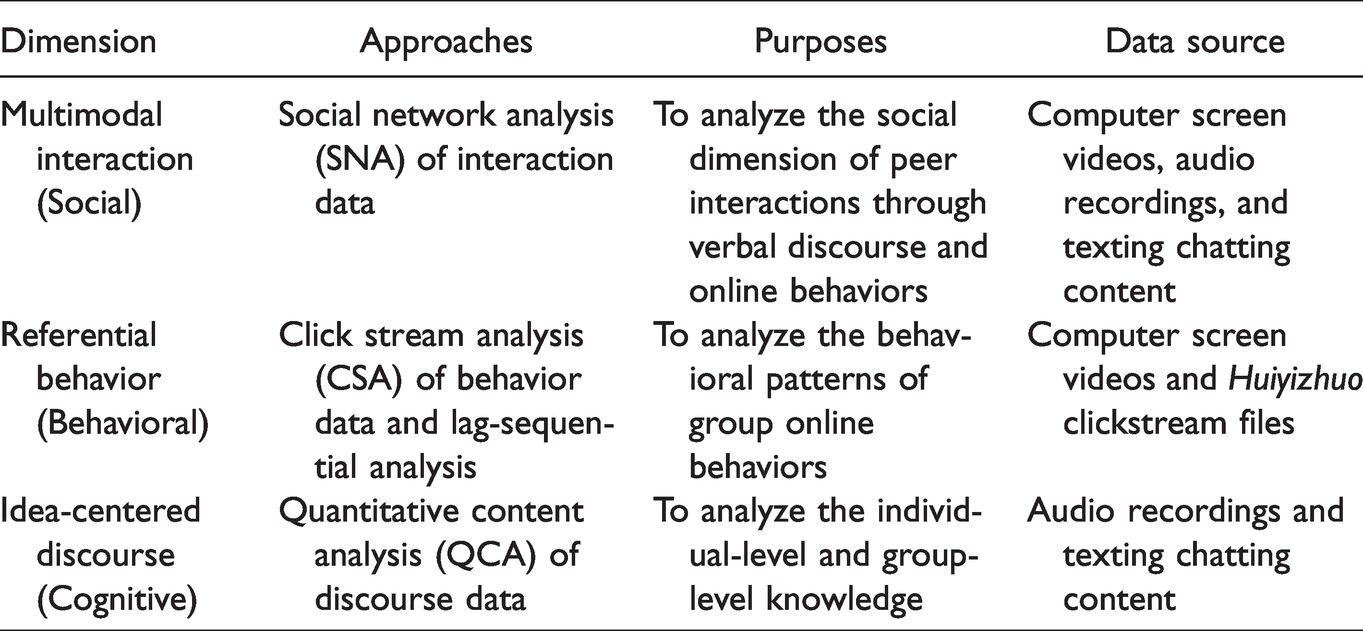
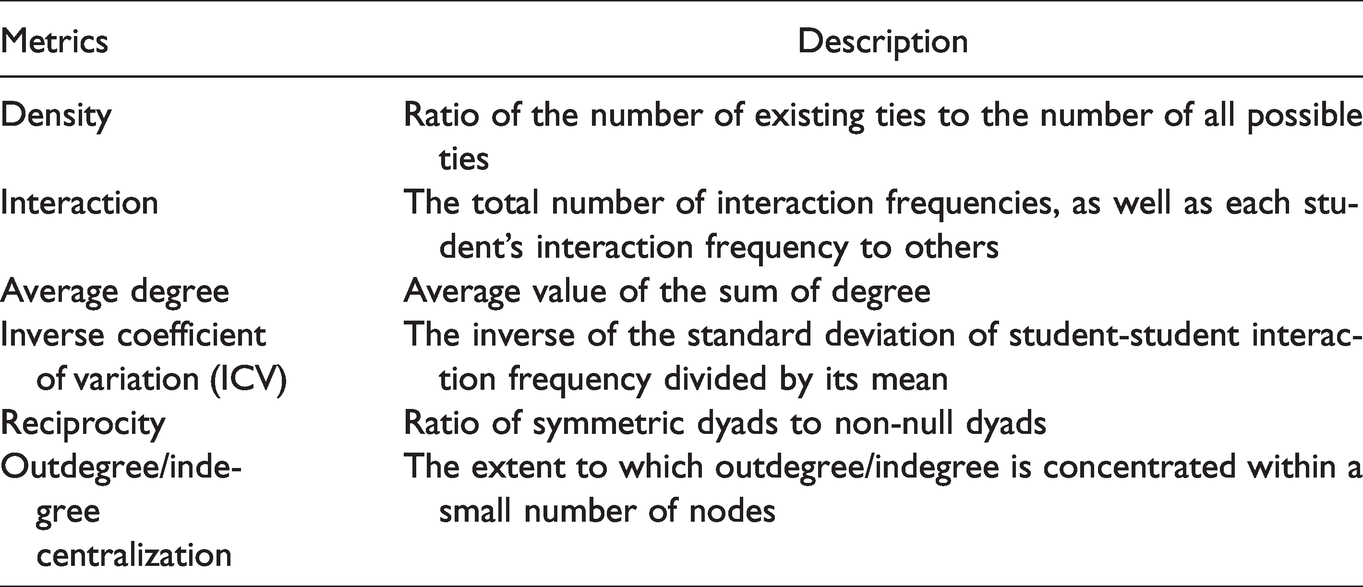
First, on the social dimension, social network analysis (SNA) is used to analyze the multimodal interaction network that represents student interactions through verbal communication (i.e., one student responds to others through audio), texting (i.e., one student replies to others through text), and knowledge artifact (i.e., one student builds on or modifies others’ work of the concept map). The original data is transformed into the directed, weighted student-student network dataset. In the networks, the direction represents who responds to whom and builds on whose work (i.e., bi-directional); tie weight represents the frequency of responses, replies and build-on work a participant makes to others (i.e., interaction frequency). In Eq. (1), the original
Descriptions of Network-Level Metrics.
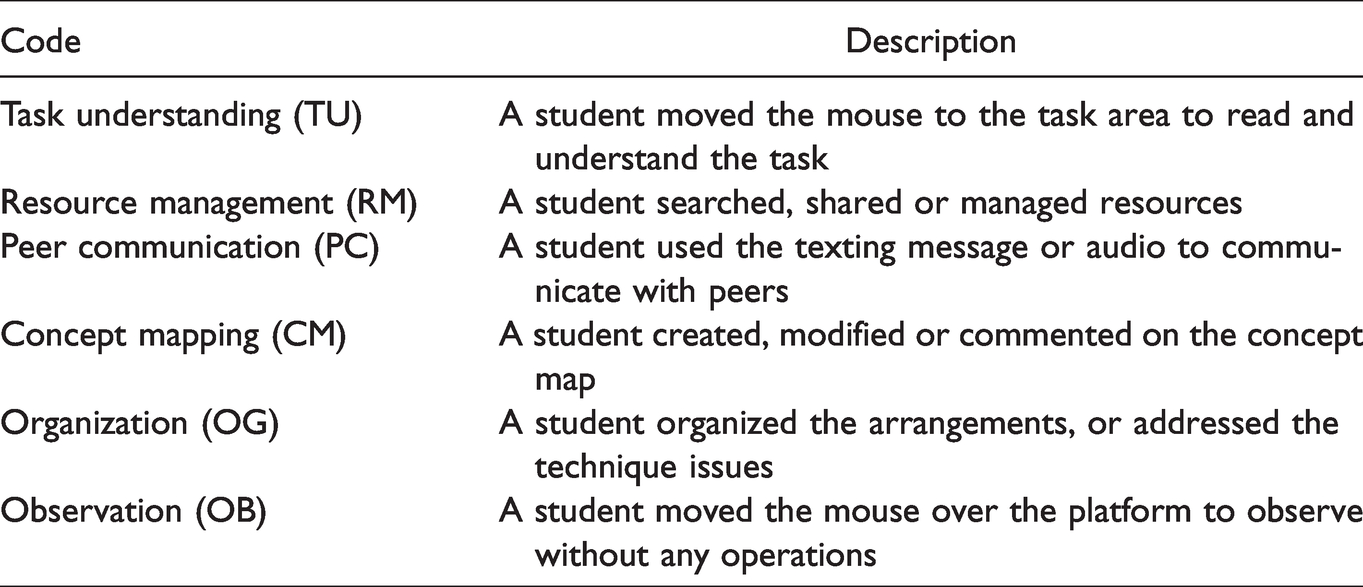
Second, on the behavioral dimension, we use the behavioral pattern analysis to analyze the students’ online behaviors from the computer clickstream videos, and then use the lag-sequential analysis (LsA) to examine the referential behavior related to the construction of knowledge artifact. The first author codes students’ online behaviors in terms of the time frame, identifies six online behaviors, and asks other authors to double check the accuracy of the codes (see Table 4). The quantity of each behavior code is calculated and the LsA approach (lag = 1) is used to examine the direct strength of the transition between behaviors (Chen et al., 2017). Yule’s Q measure (standardized measure ranging from –1 to +1) is used to calculate the strength because it controls for the base numbers to maintain the best explanatory power among all sequential measures (Chen et al., 2017). Yule’s Q values, which are smaller than zero, are all neglected. In Eq. (1),
Six Types of Online Behaviors.
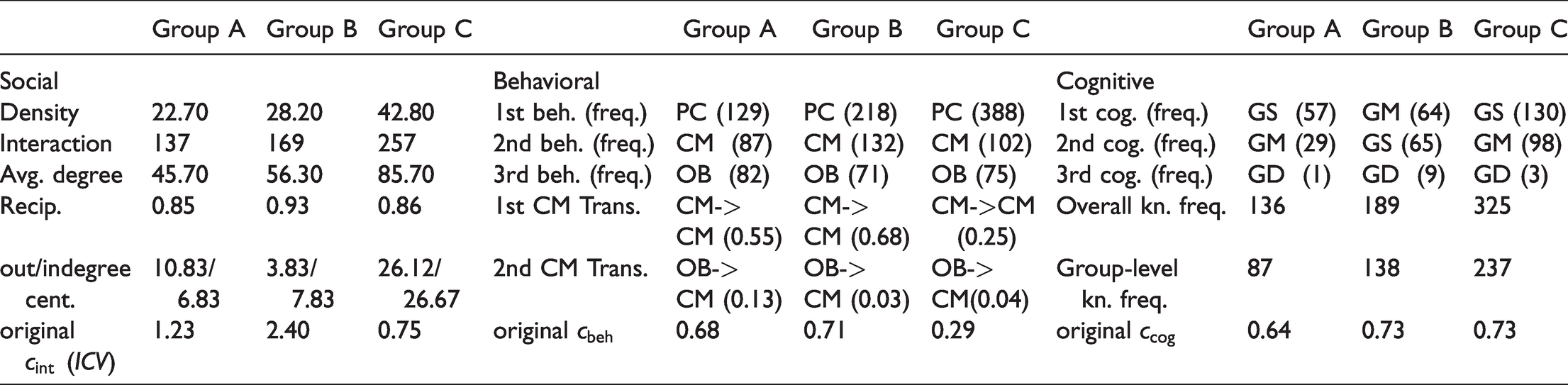
Three Groups’ Social, Behavioral, and Cognitive Measurement Values.
Third, on the cognitive dimension, quantitative content analysis (QCA) is used to analyze the individual-level and group-level knowledge. We transcribe the audio and texting recordings in term of the time framework, identify the unit of analysis as unit of idea (i.e., a sentence that represented an idea or a question), and use a predefined framework to analyze the transcripts (Ouyang & Chang, 2019) (see Table 5). Because group knowledge is built accumulatively from individual to group, the framework includes individual knowledge (capturing the individual knowledge inquiry in the initial ideas), and group knowledge (capturing the group knowledge advancement through peer responses) (see Table 5). The first author trains five raters to obtain a deep understanding of the framework; then six raters (including the first author) independently code the transcript data and reach an inter-rater reliability, i.e., Krippendorff’s alpha of 0.795. In Eq. (1), the original
The Code Framework for Quantitative Content Analysis (Adapted From Ouyang & Chang, 2019).

Finally, as the operationalizable working definition of group cognition shows, group cognition is mainly identified as the knowledge building conducted interactively by the group, as opposed to being simply provided by individuals in the group. Therefore, we calculate a group’s accumulated knowledge over a time duration as a weighted knowledge score (i.e.,
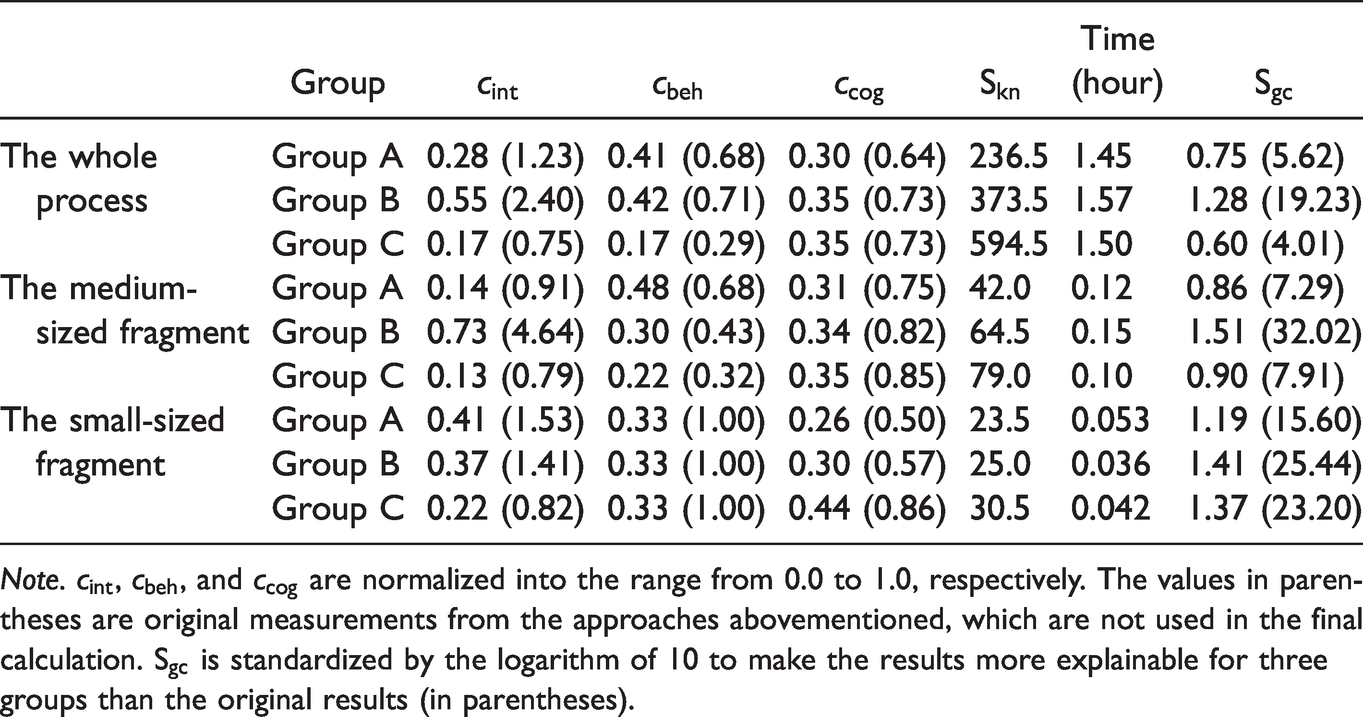
We initially test the equation and the measures of components to three types of social-behavioral-cognitive fragments from our dataset (see Table 6). These three types include the whole CPS process (time duration about 1.5 hours), the medium-sized fragments with at least one occurrence of the deep-level group knowledge (time duration about 0.15 hour), and the small-sized fragments without any GD (time duration about 0.04 hour). The requirement is that all members must participate in the fragment. Based on the equation, for the whole CPS process, Groups A, B, and C have the group cognition scores (
The Measurement Values of the Equation for Three Groups.
Note.
Moreover, we evaluated the groups’ final performance of the concept map artifacts and the solution write-ups in terms of the following standards. Adapting a previous assessment approach (Novak & Cañas, 2008), we assessed the concept map in terms of three dimensions for the nodes included, i.e., propositions, hierarchy, and examples (Scm = Nprop + Nhier + Nexam). In addition, we referred to the superficial, medium, and deep levels in the idea-centered discourse coding scheme (see Table 5) to analyze the groups’ write-up scores, coded as information sharing, solution proposal and solution elaboration, respectively (Swu = Nsup * 1 + Nmed * 2 + Ndeep * 3). The unit of analysis was a sentence separated by a semicolon or a period in the write-up that represented a complete idea. Two trained raters scored the concept maps and write-ups independently and reached an agreement if there were differences. Finally, each group was assigned a final score by adding the concept map score and the write-up score and then the final score was multiplied by ICV of student contribution to concept map and write-up, i.e., Sfinal = (Scm + Swu) * ICV.
Results
Overall Group Cognition Development
Based on the equation, Group B has the highest score of group cognition (

The Radar Graphs of Students’ Social, Behavioral, and Cognitive Contributions in (a) Group A, (b) Group B, and (c) Group C.
Group A
We analyze the social, behavioral and cognitive characteristics developed in Group A. First, on the social dimension, the network analysis results show that Group A has the lowest interaction, consistent with the density and average degree results; therefore, it is the least active group among three groups (see Table 7). Group A has an original ICV value of 1.23, ranked at the middle of three groups, consistent with the out/indegree centralizations (see Table 7). Group A has the middle level of distribution among three groups. Second, on the behavioral dimension, among all six types of behaviors (frequency = 324), the most frequent behavior is peer communication (PC; frequency = 129), followed by concept mapping (CM; frequency = 87), and observation (OB; frequency = 82) (see Table 7). Excluding RM and OG with a low frequency (below 5% of all behavior frequency), the transition occurs from CM->CM (Yule’s Q = 0.55), followed by OB->CM (Yule’s Q = 0.13) (see Table 7). This result indicates that students use the concept map intensively to demonstrate their ideas and occasionally observe others’ operations before making changes. The original
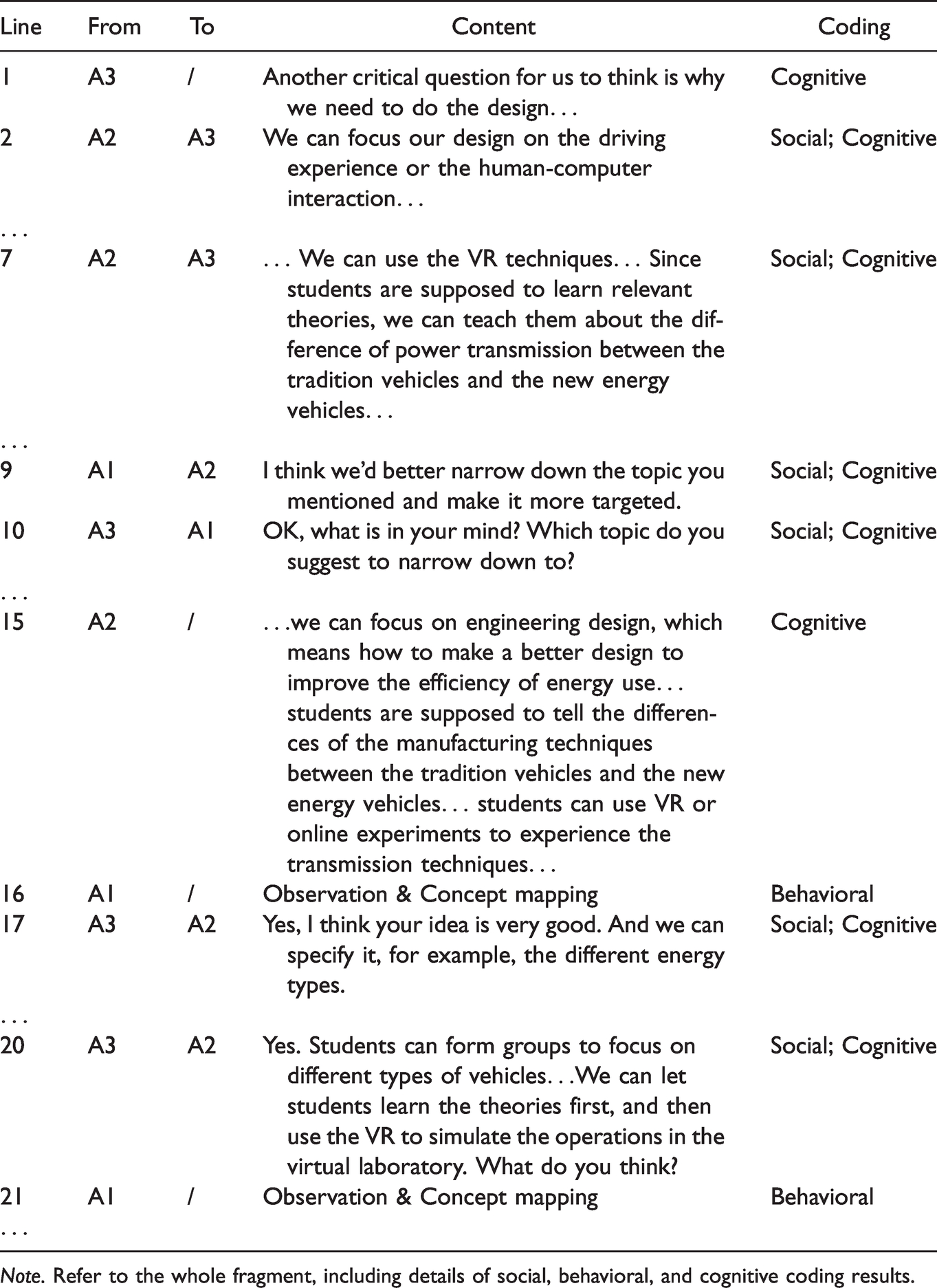
Finally, regarding the medium-sized fragment, Group A has a group cognition score of 0.86 according to the equation, which is the lowest score among three groups (see Table 6). In this fragment (see Table 8 and Figure 4), Group A’s students discuss about design content of the activity. A3 first proposes a question for the whole group to think (line 1), which triggers a few rounds of discussion among three students about human-computer interaction (line 2–7), techniques (line 15), and vehicle types (line 17–28). Group A’s interaction pattern is more like a form of cooperative learning rather than collaborative learning (Dillenbourg, 1999). For example, A2 is the student who proposes, synthesizes, and deepens group knowledge for problem-solving (line 15; coded as cognitive: GD). A3 communicates with A2 by initiating questions (line 3, 23), repeating ideas (line 28), and proposing suggestions (line 17, 20). A1 does not elaborate her thinking but takes agency to modify the concept map by reflecting A2’s ideas on the concept map (line 19, 21, 27, 29). When A2 explains his ideas back and forth, A1 adds, deletes, and modifies the concept map accordingly. This fragment demonstrates that in Group A, the deep-level group knowledge is initiated and deepened by one student A2; another student A3 tends to propose questions, explore ideas, and make suggestions; the third student A1 takes agency to reflect others’ ideas on the concept map without adding new perspectives. Therefore, Group A’s students take separate responsibilities, which is more like Dillenbourg’s (1999) description of cooperative learning: students split and assemble their parts of work into a final output.
Selected Excerpts From Group A.
Note. Refer to the whole fragment, including details of social, behavioral, and cognitive coding results.

The Temporal Change of Students’ Social-Behavioral-Cognitive Contributions from Group A.Note. A1-all, A2-all, and A3-all are not counted as the student-student interaction in the measure; they are demonstrated only for the neatness of graph presentation (same below).
Group B
We analyze the social, behavioral, and cognitive characteristics developed in Group B. First, on the social dimension, Group B has the middle level of interaction, with the same ranks of density and average degree among three groups (see Table 7). However, it is the most mutually-interactive and equally-distributed group, with the highest value of ICV and reciprocity, and the lowest out/indegree centralization (see Table 7). Second, on the behavioral dimension, among all six types of behaviors (frequency = 485), the most frequent behavior is PC (frequency = 218), followed by CM (frequency = 132), and OB (frequency = 71). Excluding RM and TU with a low frequency, the transition occurs from CM->CM (Yule’s Q = 0.68), followed by OB->CM (Yule’s Q = 0.03). The original
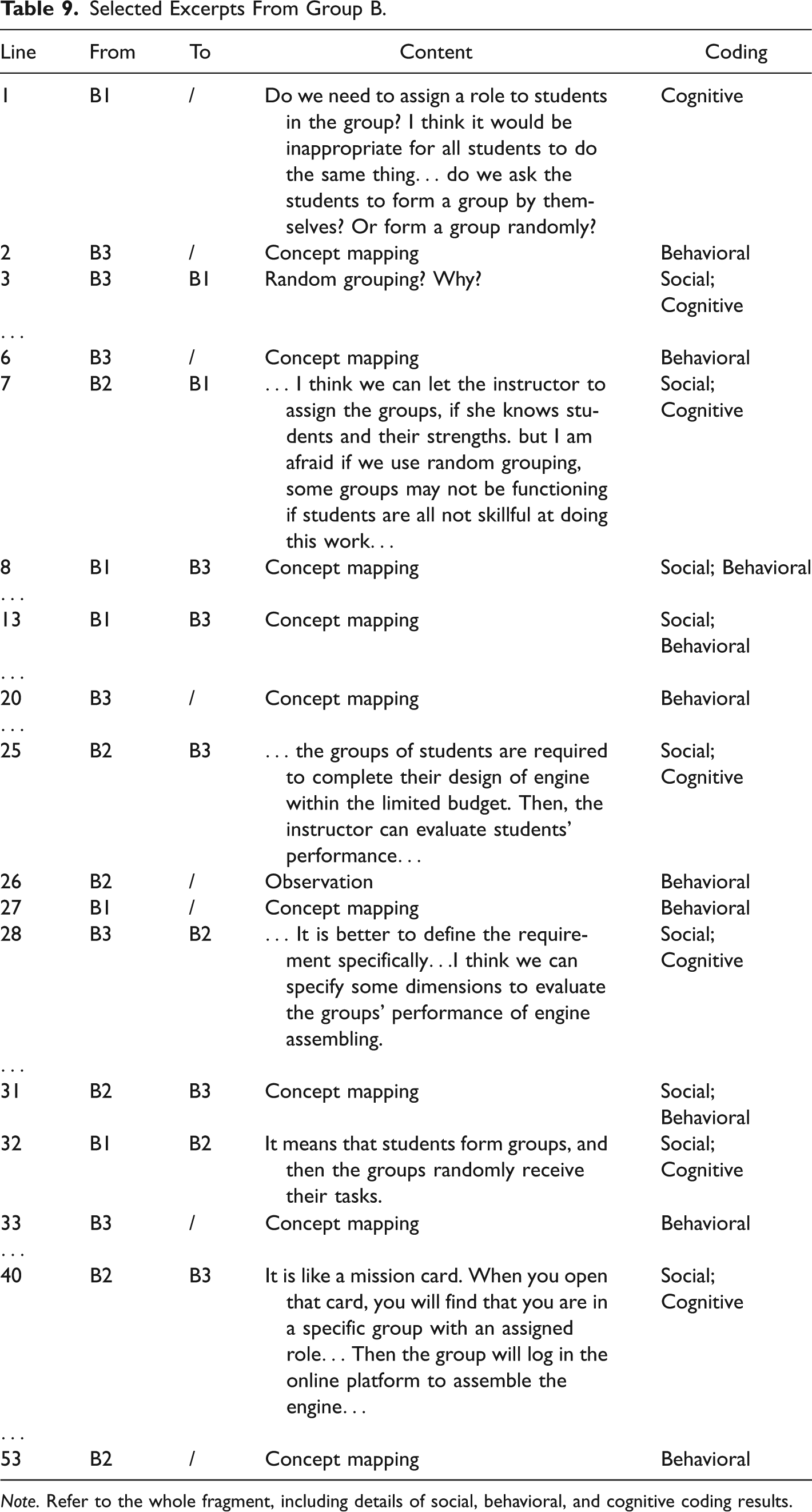
Finally, for the medium-sized fragment, Group B has a group cognition score of 1.51, which is the highest score among three groups (see Table 6). In this fragment (see Table 9 and Figure 5), Group B’s students discuss about design details of a collaborative small-group activity. B1 first initiates an idea about role assignment (line 1), which triggers an intensive discussion about grouping strategy (line 3-10), platform functions (line 12-22), mission card gamification (line 25-48; line 40 is coded as cognitive: GD) and learning evaluation (line 49-53). Group B’s collaboration is more like an exploratory participation pattern (Zemel et al., 2009), where group members contribute from multiple perspectives to construct knowledge and take joint actions to update knowledge through concept map. For example, B2 proposes an idea of group activity design (line 25), followed with B3’s specification of the idea (line 28), and B1’s further explanation of her understanding (line 32). Therefore, the discussion process involves an initiation of ideas or proposal from one student, an uptake of the ideas, and negotiation of solution strategies. In addition, students not only build on each other’s ideas sequentially to achieve group knowledge, but also take actions to refer to, build upon and update others’ ideas on concept map (line 2, 6, 20, 26, 53). For example, B3 modifies ideas in the concept map to reflect his own ideas and others’ ideas (line 2, 6, 20, 23, 33); B1 and B2 further update ideas in concept map created by B3 (line 8, 11, 13, 31). The microanalysis indicates that students form a mutual interaction to build on other ideas through verbal communication and artifact modification. Therefore, this fragment demonstrates an “exploratory participation” pattern where the group knowledge is articulated, raised up, and deepened by all students, reflected on the group’s concept map accordingly, and subsequently recognized and treated as a solution by three students.
Selected Excerpts From Group B.
Note. Refer to the whole fragment, including details of social, behavioral, and cognitive coding results.
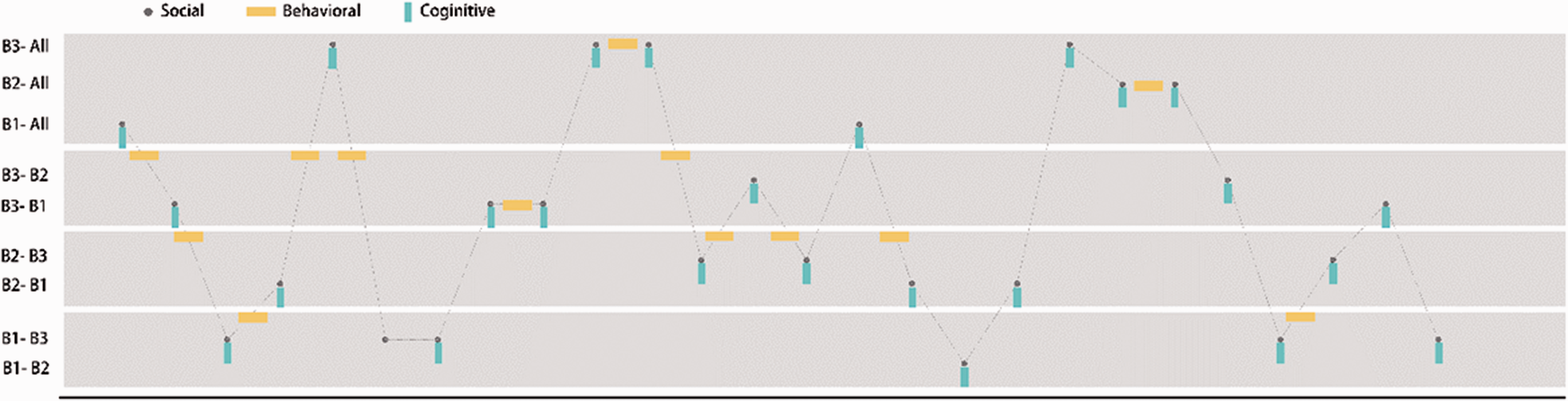
The Temporal Change of Students’ Social-Behavioral-Cognitive Contributions from Group B.
Group C
We analyze the social, behavioral, and cognitive characteristics developed in Group C. First, on the social dimension, Group C has the highest interaction frequency, with the same ranks of density and average degree among three groups. However, it is the most incohesive, centralized group among three groups, with the lowest ICV and the highest out/indegree centralizations (see Table 7). Like we discuss above (see Figure 3), most of the interactions occurs between two students in the group. Second, on the behavioral dimension, among all six types of behaviors (frequency = 680), the most frequent behavior is PC (frequency = 388), followed by CM (frequency = 102), and OB (frequency = 75). Excluding TU with a low frequency, the transition occurs from CM->CM (Yule’s Q = 0.25), followed by OB->CM (Yule’s Q = 0.04), resulting in an original
Finally, in the medium-sized fragment, Group C has a group cognition score of 0.90 (see Table 6). Group C’s students discuss about using video conferencing as an in-class practical activity (see Table 10 and Figure 6). This process is similar with the description of expository participation (Zemel et al., 2009), where one student takes responsibilities to propose his own ideas and solutions without others’ critical contributions of the problem-solving. For example, the most active student C3 initiates an idea of video conferencing (line 27), feasibility of web cam (line 31), activity’s timing (line 34, 39), and concrete ways of activity (line 45). Simultaneously, C3 directly operates on the concept map to reflect ideas he proposes (line 35, 40, 46, 49, 55). Another student C2 occasionally expresses her understandings about C3’s ideas (line 36), proposes a couple of questions (line 42), and repeats C3’s ideas (line 44, 47). C1 is less engaged in the group as a free-rider, which indicates inequality of participation. In addition, C1 and C2 merely observe C3’s concept map operation without any modification (line 26, 29, 38, 41), indicating they accept the ideas and solutions proposed by C3 without argumentation, rise-above and build-on. Therefore, this fragment to some extent implies an “expository participation” pattern where most critical knowledge work is contributed by one active student C3 (line 23, 27, 31 coded as cognitive GD) as an authority in the group.
Selected Excerpts From Group C.
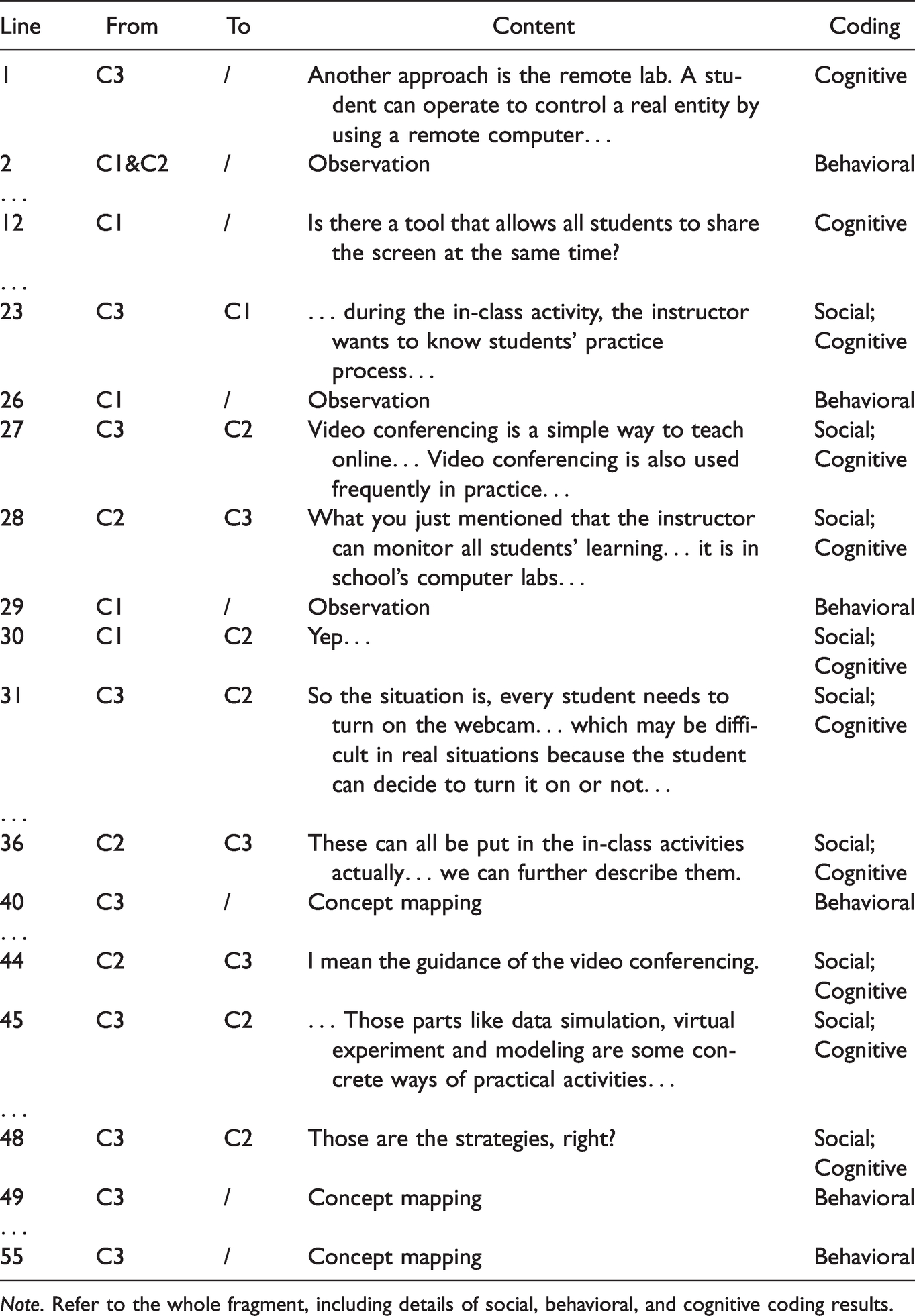
Note. Refer to the whole fragment, including details of social, behavioral, and cognitive coding results.
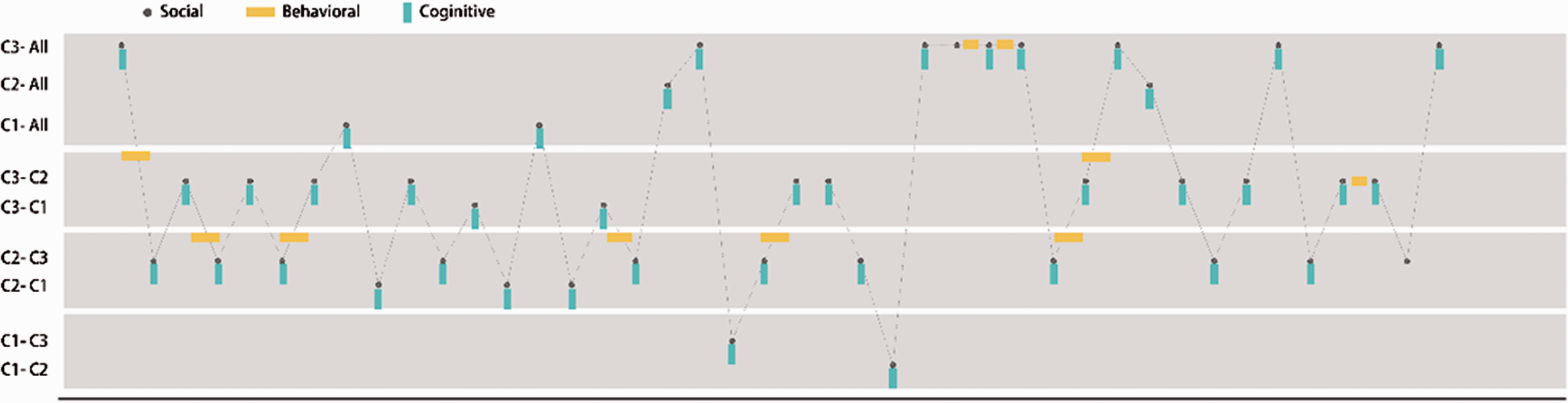
The Temporal Change of Students’ Social-Behavioral-Cognitive Contributions from Group C.
Discussions and Implications
Viewing from the socio-cultural perspective, the development of group cognition requires students to synergistically coordinate social, behavioral, and cognitive activities in order to collectively solve problems, construct knowledge artifacts, and advance group knowledge (Akkerman et al., 2007; Ludwig, 2015; Stahl, 2009). Unlike most previous work that defines and investigates group cognition from the qualitative, phenomenological perspective, this research proposes a quantitative measure equation based on an operationalizable working definition to analyze group cognition, which is further complemented with the qualitative, temporal microanalysis of group fragments. Specifically, this research analyzes how three groups accumulate knowledge through multimodal interactions, referential behaviors, and idea-centered discourses during online collaborative problem-solving processes. The empirical research results indicate that only one group (i.e., Group B) successfully develops group cognition through equal, interdependent, and synergistic collaborations. Moreover, Group B maintains the highest group cognition score throughout, which is reflected by analytical results of three different sizes of group fragments. Consistent with the quantitative results calculated from the equation, qualitative microanalysis of group fragment indicates that students in Group B form a balanced, distributed peer interaction, use the concept map intensively and sequentially to externalize ideas, and had multiple occurrences of deep-level knowledge building within the group. Unlike Group B, students in Group A tend to take social, behavioral, and cognitive responsibilities separately, which is not an effective development of group cognition (Stahl, 2009). This cooperative learning characteristic results in a relatively low score of group cognition of Group A throughout. Like Group A, Group C does not successfully develop group cognition neither; but Group C has different collaborative characteristics from Group A. Group C has an unequal participation pattern, forms a scattered knowledge building discourse, and make discrete operations on the concept map. Since mutuality and equality have been theorized to be critical for a successful collaborative learning (e.g., Damon & Phelps, 1989), Group C does not successfully develop group cognition, which is consistent with the measured score calculated from the equation. In addition, the extent that three groups developed the group cognition was consistent with the order of groups’ final performance scores. Overall, the results indicate that a successful group cognition must be developed from all members’ active, equal participations: they need to make synergistic coordination of their social, behavioral, and cognitive contributions for achieving a shared goal.
From the analytical perspective, the proposed equation offers a rigorous analytical procedure to quantitatively measure group cognition, as previous studies in the cognitive science field have promoted (e.g., Rasenberg, Özyürek, & Dingemanse, 2020). This quantitative measure integrates students’ social interactions, behavioral sequences, and cognitive contributions to analyze group members’ accumulation of knowledge as the development of group cognition. Researchers can reproduce the analytical procedures to analyze collaborative interactions in the group level (Borge & Rose, 2021; Liu et al., 2021). Considering that quantitative measures would probably miss some nuances of collaboration (Zemel et al., 2009), qualitative fine-grained microanalysis is used to further explain the development of group cognition of selected social-behavioral-cognitive fragments. Group cognition equation is initially verified by the qualitative microanalysis results. Echoing the research trend of educational measurement (Borge & Rose, 2021; Creswell & Clark, 2017; Janssen et al., 2013; Puntambekar, 2013), the research takes a step forward to propose and use a rigorous procedure to quantitatively measure group cognition, complemented and justified with qualitative microanalysis results. Future quantitative measure of group cognition can be improved in the following three ways. First, future work should focus more on the measures of group’s social, behavioral, and cognitive characteristics. In this research, we test the measures of components in the equation on three different sizes of the dataset; results indicate the similar ordering of three groups, which implies a certain level of justification of the equation. But further examinations indicate that the equation result in a higher score for the small-sized, short sequences than the large-sized, long sequences. The significant differences come from the measures of three coefficients (i.e.,
From the pedagogical perspective, the research results indicate that the development of group cognition is a new, challenging practice, for both students and instructors during collaborative problem solving (Fiore et al., 2017; Wiltshire et al., 2018). Simply putting students together in a group to work on collaborative tasks is no guarantee of the development of group cognition (Curşeu & Pluut, 2013); the practice of group cognition requires multiple conditions such as the communication and interpretation context, students’ shared intentionality and agency, social and cultural backgrounds, technological and pedagogical affordances, etc. (Borge & Mercier, 2019; Damşa, 2014; Stahl, 2007). Instructors should take advantage of instructional design, facilitation strategies, and technological supports to foster students’ practice of group cognition. First, during instructional design of collaborative learning activities, instructors can consider to provide students with choices to negotiate the collaborative purposes and procedures; when students view themselves as creators of the collaboration, they may be more prone to develop collective responsibility, joint actions and shared epistemic agency (Damşa, 2014; Ouyang, Chen, Cheng, et al., 2021; Ouyang & Chang, 2019). Students are more likely to form equal, interdependent participations with a shared, collective agency in the group, which is beneficial for students to develop group cognition. Second, instructors should be prepared to scaffold symmetrical, interdependent participation between students, particularly when some groups (e.g., Group A) or some group members (e.g., student C1 in Group C) show a low level of participation. Because the group cognition is dynamically influenced by the group’s social structures, dynamics, and changes (Damşa, 2014), one participant’s disengagement may significantly influence others’ participating motivation, which in turn influence the group’s productive collaboration (Altebarmakian & Alterman, 2019). Third, instructors should take advantage of the technologies and tools that have the functionalities to lower the barriers for equal, coordinated participation, to improve social- and cognitive-related group awareness, and to allow the real-time track of the group’s social learning processes (Chen et al., 2018; Damşa, 2014; Ouyang, Chen, & Li, 2021). Overall, these pedagogical implications have potential to foster students’ practice of group cognition.
Conclusion
The cognitive science of the small group—the group cognition theory—serves as a bridge between the psychological theories of individual mind and the social learning theories (Stahl, 2006). However, most research has conceptualized and investigated group cognition from the qualitative, phenomenological perspective. A researcher may see patterns in the data that others, even those with similar expertise, may not, due to cognitive biases regarding qualitative analysis results (Borge & Rose, 2021). The educational measurement field has argued a need to build rigorous quantitative methods and procedures to investigate collaborative interactions in the group level, that can be reproduced by others carrying out similar methods (Borge & Rose, 2021). More important, from a complex adaptive system perspective, a group system is an organic entity, comprised of a set of elements and complex relationships between them (Byrne & Callaghan, 2014; Hilpert & Marchand, 2018). Echoing this trend, this research provides a working definition of group cognition, proposes a quantitative equation to measure elements of group cognition through rigorous analytical procedures, and empirically investigates three groups’ development of group cognition. The results show that small groups of students have potential to synergistically coordinate their social, behavioral, and cognitive activities in order to develop a successful group cognition. Since the quantitative results are consistent with the qualitative observations as well as the final performance scores, the equation is initially justified. Based on the empirical research results, the relevant implications are provided for advancing the research and practice of group cognition.
There are several limitations of this research, which also guide future research and practice of group cognition. First, an advanced conceptualization of group cognition is needed to further consider the critical components of group members’ synergistic coordination of multimodal interactions, referential behaviors, and idea-centered discourses. Moreover, from a complex adaptive system theory, structural analysis can be considered in future research (Hibbeler & Kiang, 2015). Second, this research merely focuses on a small size of student sample, with a limited range of subjects’ demographic backgrounds and learning experiences. Future research should expand the sample size to further test, validate, or modify the group cognition measurement proposed. Third, only one group successfully develops group cognition; therefore, it is necessary for instructors to integrate the pedagogical and technological supports to foster group cognition by empowering collective agency, equal participation, and ownership for collaborative learning. Overall, this research develops a working definition and quantifiable measure of group cognition, and empirically examines group cognition in China’s higher education with mixed methods. The research results indicate that the development of group cognition is a new, challenging practice for both students and instructors, such that instructors should take advantage of instructional design, facilitation strategies, and technological supports to foster students’ practice of group cognition.
Footnotes
Acknowledgments
The authors acknowledge assistances from Zixuan Chen, Mengting Cheng, Zifan Tang for their preliminary data cleaning and analysis work.
Declaration of Conflicting Interests
The authors declared no potential conflicts of interest with respect to the research, authorship, and/or publication of this article.
Funding
The authors disclosed receipt of the following financial support for the research, authorship, and/or publication of this article: The research is financially supported by the National Natural Science Foundation of China (62177041; 61907038) and 2021 University-level Educational Reformation Research Project for Undergraduate Education, Zhejiang University (zdjg21033).
