




Abstract
While studies of contextualized game-based language learning (CGBLL) have to date gained a growing scholarly interest, there is still a lack of systematic review synthesizing its research trends regarding theoretical foundations, learning contexts, research foci and findings. To address the gap, this study collected data from the Web of Science (WoS) and reviewed a total of 82 Social Science Citation Index (SSCI) articles pertaining to CGBLL based on the proposed inclusion and exclusion criteria. The results revealed that most CGBLL studies were based on social frameworks, including situated learning and socio-cultural theory. Most learning activities were carried out in a local community. Language skills and learner perceptions were the two main research foci. The results also revealed that CGBLL not only improved students’ language performance and perceptions, but also promoted interaction and collaboration, knowledge transfer, autonomy and self-regulation, and higher-order thinking skills. In addition, technical issues, high cognitive load, difficult game tasks, the lack of user guide and explicit game instruction were the major challenges. Based on the results, implications have been made for teachers, designers, and researchers.
Keywords
Introduction
The past two decades have witnessed the rapid progress and application of game-based learning in diverse disciplines and settings (Bado, 2022), and digital game-based language learning (GBLL) technologies have been frequently adopted as an innovative learning approach to facilitate foreign/second language learning (FL/L2, Chiu et al., 2012; Li, 2022a; Zou et al., 2019). As the GBLL has been applied widely, its pedagogical affordances have been found to be beneficial for L2 skill development in many aspects, such as facilitating learners’ vocabulary skills (Lu & Chang, 2016), boosting L2 motivation (Sung et al., 2017), improving their pragmatic competences (Taguchi, 2022) and social interactions (Yang et al., 2010), among others.
While the pedagogical affordances of GBLL have been well-documented, it can be further classified into de-contextualized GBLL and contextualized GBLL (Li, 2021; Li et al., 2021). For the former, the de-contextualized GBLL approach employs digital games to drill and practice L2 learning (Chiu et al., 2012; Hung et al., 2018), and “encourage output that is repetitive and not indicative of real-life contexts” (Shortt et al., 2023, p. 534). L2 learners may find little connection between language use and realistic situations, which could cause unsuccessful knowledge transfer and reduce learning effectiveness (Fu et al., 2019; Hwang & Wang, 2016). For the latter, the contextualized GBLL refers to learning L2 in digital game environments with the provision of rich and vivid contexts, extending the traditional classroom, connecting it to real L2 learning scenarios, and encouraging more communication and meaningful interactions (Lin et al., 2018).
To date, motivated by the social constructivism and situated learning that emphasizes active cognitive processes and social interactions in L2 learning (Wu et al., 2012), researchers have begun to shift their attention from the de-contextualized GBLL to contextualized game-based language learning (CGBLL). By providing immersive contexts that are connected to real-life scenarios, CGBLL could benefit learners in the development of cognitive, affective, and meta-cognitive skills (e.g., Chen & Lin, 2016; Lan, 2015; Lin et al., 2018). As Lan and colleagues (2018) put it, CGBLL utilizes digital games as a platform to facilitate learners’ meaningful L2 learning by experiencing authentic contexts, for example, virtual L2 communities, 3D virtual context, Augmented Reality (AR), and Virtual Reality (VR), etc. By providing L2 game contexts that simulate the application of knowledge and skills in real life, such as in campus, local community, and business trip (e.g., Chen et al., 2023; Lee, 2020), CGBLL can facilitate L2 learning that is “largely context-dependent, context-sensitive, and closely bound to the situation in which it is used” (Lee, 2022, p. 298), and provide learners with context-dependent learning materials and connect them with real-world contexts by detecting their locations and the objects surrounding them (Giannakas et al., 2018; Lee, 2022).
In the literature, several reviews on the traditional GBLL have been performed. For instance, Chiu et al. (2012) meta-analysed the effectiveness of digital games in English-as-a-foreign-language (EFL) learning, and argued that compared to drill and practice games, contextualized games could help EFL learners better acquire language knowledge by affording authentic contexts. Hung et al. (2018) provided a comprehensive overview of the GBLL studies between 2007 to 2016 based on research methods, game genres, gaming platforms, participants, and research outcomes. In a more recent systematic review, Zou et al. (2019) evaluated studies on GBLL for vocabulary learning and focused on publication trends, game genres, theoretical frameworks, findings, and implications. They argued that vocabulary learning and motivation were frequently investigated in previous studies and suggested that future research should give rise to comprehensive theoretical frameworks that incorporate both linguistic and educational theories. Realizing the significance of authentic problem-based contexts in eliciting the use of target language, Peterson (2023) focused on digital simulation games and summarized the results from study contexts, methodologies, and findings.
While the aforementioned reviews have been helpful to shed light on the GBLL research, several issues remain open for debate. First, despite the importance of learning contexts in GBLL having been highlighted (Shadiev et al., 2017) and the affordances of CGBLL having been obtained, there is still a lack of research that systematically review the trends of CGBLL. Using the CGBLL approach, learners can practice target languages in an authentic context and relate the knowledge to their real-life embodied experiences (Lan, 2015). Second, considering the importance of CGBLL and sufficient empirical studies fraughted with the progressively accumulated data sources over the past decades, there is a need to revisit the research trends of CGBLL and gain a holistic understanding of its state-of-the-art development over the past decades. Third, despite the reported reviews on the traditional GBLL that have extensively touched upon GBLL’s theoretical foundations, learning contexts, research foci and findings, little is still known about the research trends of CGBLL from these dimensions, as understanding CGBLL from these dimensions could not only facilitate future CGBLL research, but also inform pedagogy (Li, 2022a). To this end, the current study reviewed relevant publications of CGBLL from the detailed dimensions of theoretical frameworks, learning contexts, research foci, and application effectiveness, advantages, and challenges. The research questions are to be addressed as follows. (1) What are the theoretical frameworks in the CGBLL articles published between 2005 and 2022? (2) What are the main learning contexts in the CGBLL articles published between 2005 and 2022? (3) What are the main research foci in the CGBLL articles published between 2005 and 2022? (4) What are the application effectiveness, advantages, and challenges in the CGBLL articles published between 2005 and 2022?
Methodology
Literature Retrieval
Given that articles published in the Social Science Citation Index (SSCI) journals are subject to strict review criteria, only SSCI journal articles were searched in this study from the Web of Science (WoS) dataset as had been done in the existing studies (Hung et al., 2018; Li, 2022e; Shadiev et al., 2020). In doing so, as apparent in Figure 1, a combination of the technology-related, context-related, game-related and language-related keywords integrated with Boolean operators was searched, including such keywords as (“online” OR “mobile” OR “computer” OR “digital” OR “technology”) AND (“context” OR “contextual” OR “contextualized” OR “virtual” OR “augmented” OR “3D” OR “three-dimensional” OR “authentic” OR “situated” OR “familiar” OR “ubiquitous” OR “location-based”) AND (“game” OR “games” OR “gaming”) AND (“language” OR “foreign language” OR “second language” OR “English” OR “EFL”). For this stage, a total of 325 studies related to CGBLL were initially identified via the literature retrieval. Data search and collection process.
The following inclusion and/or exclusion criteria were proposed to eliminate irrelevant studies. In what follows, a second-round manual inclusion and/or exclusion was executed. (1) Since CGBLL studies were rare before the year 2005 (e.g., deHaan, 2005), only full-length articles written in English during 2005–2022 (by June) were included. (2) The articles should be on the use of educational technologies for language learning, studies that involve traditional language learning or involve educational technologies for nursing, music, or physical education rather than language learning were excluded. (3) The articles should be on the use of game-based technologies for language learning, studies that used the non-game-based technologies for language learning were excluded. (4) The articles should involve only language learning through contextualized games. Studies that used non-contextualized games for language learning were excluded.
By strictly observing the proposed criteria, 77 remaining articles related to CGBLL were included. To avoid excluding the relevant literature, a further step using a “snowballing technique” (Biernacki & Waldorf, 1981) was conducted by scanning references section in the retrieved article, resulting in the inclusion of another 5 related articles. As a result, a total of 82 CGBLL articles formed the dataset for further coding and analysis.
Coding Scheme
The Descriptive Information of Coding Scheme.

Coding Procedures
Three coding procedures were executed after the code scheme was developed: First, two coders mutually negotiated with each other to ensure the consistent understanding of each coding item. Second, they independently coded the items and recorded the data with SPSS 24.0. Third, the discrepancies were resolved by consensus through mutual discussions, along with any necessary reviews of the coding scheme.
Results
Theoretical Frameworks
Theoretical Frameworks of the Selected Studies on CGBLL From 2005 to 2022.
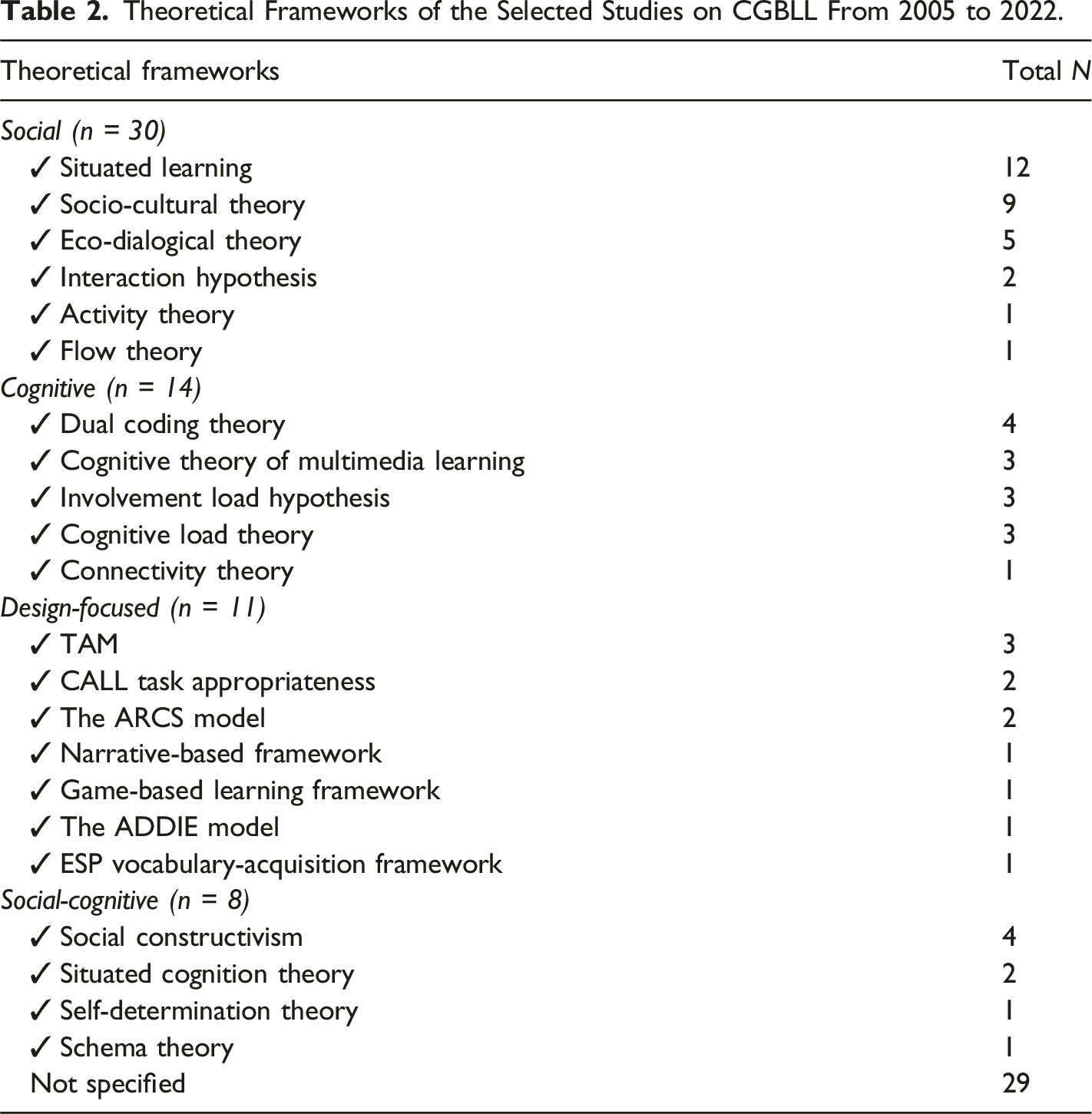
Regarding social frameworks, the following theories were involved: situated learning (n = 12), socio-cultural theory (n = 9), eco-dialogical theory (n = 5), interaction hypothesis (n = 2), activity theory (n = 1), and flow theory (n = 1). It is transparent to observe that situated learning and socio-cultural theory are the two most frequently adopted social theories. Situated learning views learning as inseparable from social contexts and highlights the significant role of social interaction in learning (Lave & Wenger, 1991). Based on situated learning, learners are situated in such real-life scenarios or situations as a local community, home and workplace. This is followed by socio-cultural theory, which claims that social interaction facilitates language learning (Vygotsky, 1980).
Cognitive frameworks were adopted to explain the roles of CGBLL in learners’ cognitive process. Cognitive frameworks include dual coding theory (n = 4), cognitive theory of multimedia learning (n = 3), involvement load hypothesis (n = 3), cognitive load theory (n = 3), and connectivity theory (n = 1). One of the most popular cognitive frameworks is dual coding theory (Clark & Paivio, 1991), which has been adopted to emphasize the importance of multimodal resources in CGBLL.
Design-focused frameworks were also adopted to intervene or analyze the features of CGBLL, including technology acceptance model (TAM) (n = 3), computer-assisted language learning (CALL) task appropriateness (n = 2), the attention relevance confidence–satisfaction (ARCS) model (n = 2), narrative-based framework (n = 1), game-based learning framework (n = 1), the analysis, design, development, implementation, and evaluation (ADDIE) model (n = 1), and English for specific purposes (ESP) vocabulary-acquisition framework (n = 1). One of the most adopted designed focused theories is TAM, which explains how the two primary factors, that is, perceived ease of use and perceived usefulness, influence learners’ adoption to a new technology (Davis, 1989; Meng & Li, 2023a).
As many contextualized games resemble real-life contexts, CGBLL is aligned with theories of social constructivism (n = 4), self-determination (n = 2), situated cognition (n = 1), and schema theory (n = 1). Social constructivism views knowledge co-construction as a learner-centered, social and collaborative process (Vygotsky, 1980). From the perspective of social constructivism, CGBLL learners could develop language skills by actively participating in collaborative tasks.
Learning Contexts
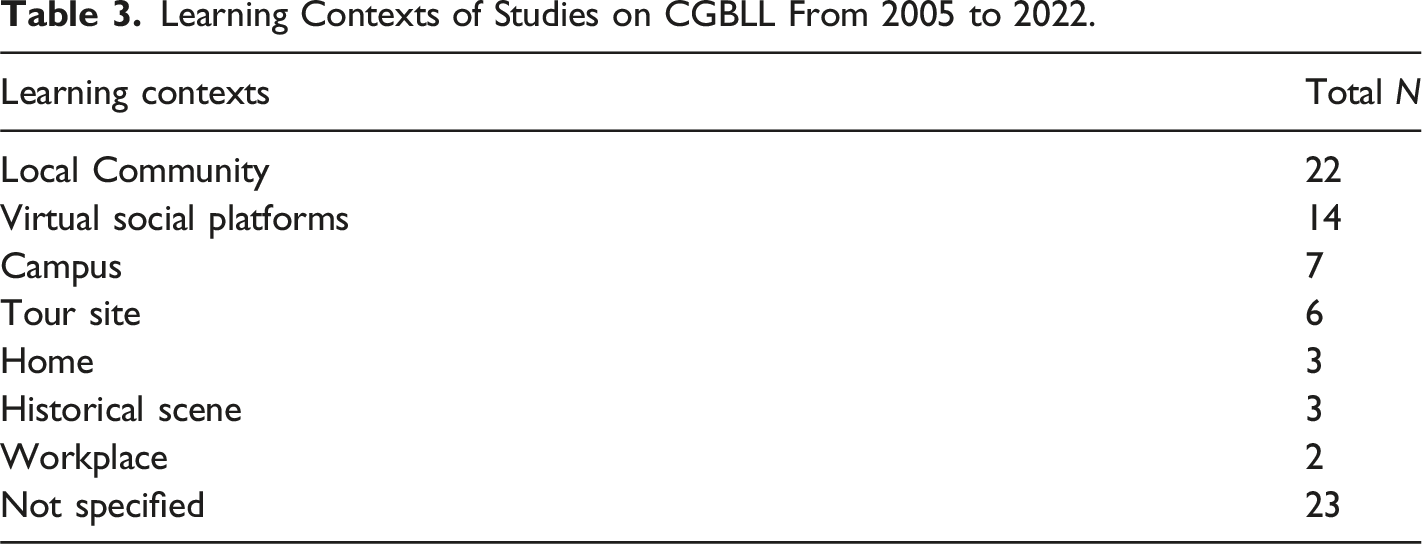
Learning Contexts of Studies on CGBLL From 2005 to 2022.
Research Foci
Research Foci From 2005 to 2022.
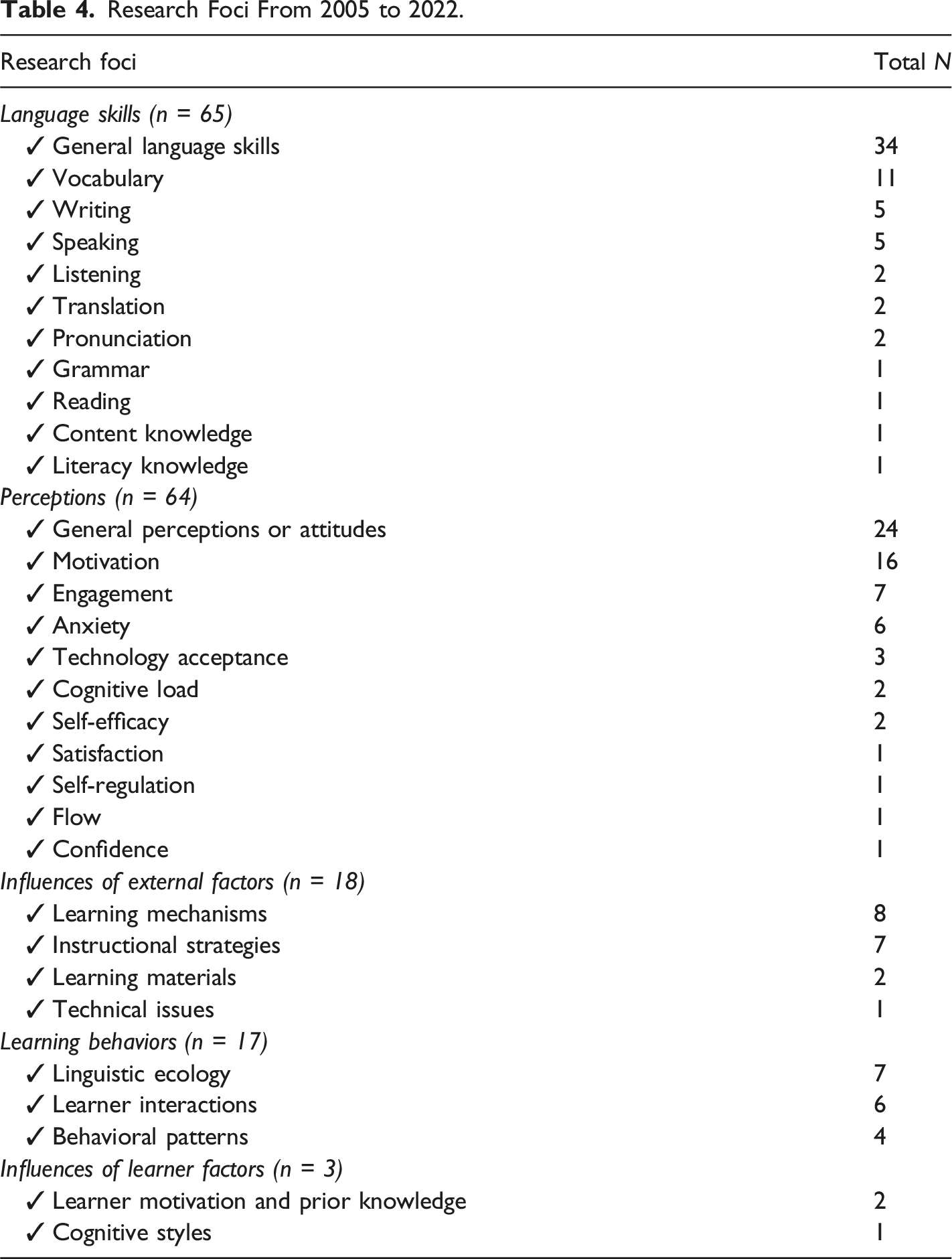
The development of learners’ language skills was one of the most important concerns of CGBLL. When looking at the specific language skills, most researchers typically applied CGBLL for general language skills (n = 34), vocabulary acquisition (n = 11), writing skills (n = 5), and speaking skills (n = 5). In contrast, the teaching and learning of other aspects, such as listening skills (n = 2), translation skills (n = 2), pronunciation (n = 2), grammar (n = 1), reading skills (n = 1), content knowledge (n = 1), and literacy knowledge (n = 1), were less commonly discussed in the identified CGBLL studies.
A wide variety of learner perceptions were also frequently explored. The most frequently reported perceptions were general perceptions or attitudes (n = 24), followed by motivation (n = 16), engagement (n = 7), anxiety (n = 6), and learners’ technology acceptance (n = 3). In contrast, learners’ other perceptions, including cognitive load (n = 2), self-efficacy (n = 1), satisfaction (n = 1), self-regulation (n = 1), flow (n = 1), and confidence (n = 1), were less frequently explored in the revied studies.
The influences of external factors were also frequently investigated, including learning mechanisms (n = 8), instructional strategies (n = 7), learning materials (n = 2), and technological issues (n = 1). Learning mechanisms involve intelligent adaption, cognitive complexity-based gaming design, immediate feedback and badge mechanism, etc. Instructional strategies include scaffolding strategies, mind-mapping learning, flipped learning and collaborative learning, etc. Learning materials are supplemented vocabulary exercises and glosses in subtitles. Technical issues, such as internet speed and accessibility, could also impact learning outcomes.
However, students’ learning behaviors and the influences of learner factors were less frequently explored. Learning behaviors include linguistic ecology (n = 7), learner interactions (n = 6), and behavioral patterns (n = 4). The influences of leaner factors involve prior knowledge (n = (2) and cognitive styles (n = 1).
Application Effectiveness, Advantages, and Challenges
Application Effectiveness, Advantages, and Challenges From 2005 to 2022.
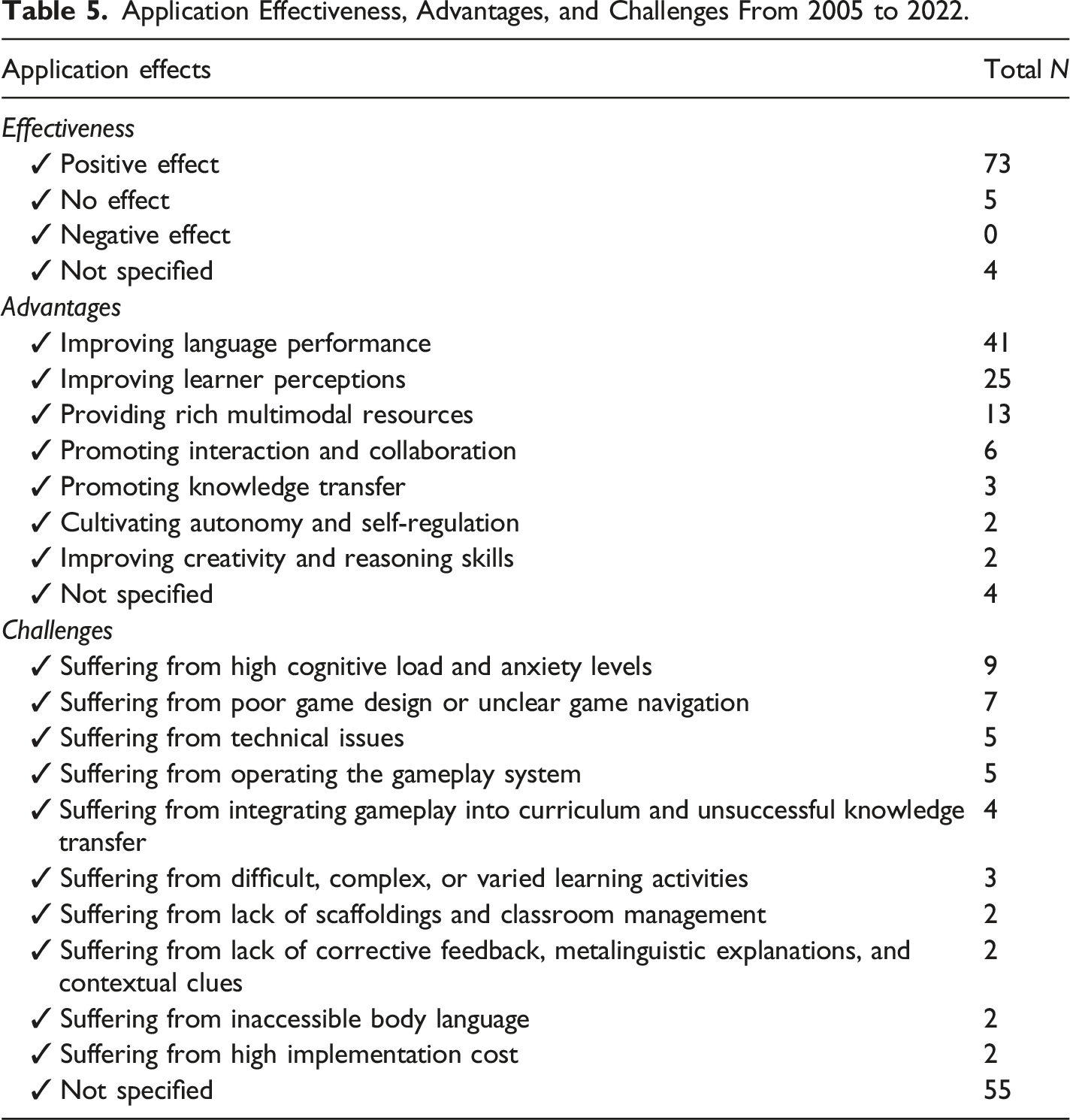
The most commonly mentioned advantages included improving language performance (n = 41), improving learner perceptions (n = 25), providing rich multimodal resources (n = 13), promoting interaction and collaboration (n = 6), promoting knowledge transfer (n = 3), cultivating autonomy and self-regulation (n = 2), and improving creativity and reasoning skills (n = 2).
On the other hand, the reported challenges included suffering from high cognitive load and anxiety levels (n = 9), poor game design or unclear game navigation (n = 7), technical issues (n = 5), operating the gameplay system (n = 5), integrating gameplay into curriculum and unsuccessful knowledge transfer (n = 4), difficult, complex, or varied learning activities (n = 3), the lack of scaffoldings and classroom management (n = 2), the lack of corrective feedback, metalinguistic explanations, and contextual clues (n = 2), inaccessible body language (n = 2), and the high implementation cost (n = 2).
Discussion
Regarding the first research question, results demonstrated that social frameworks served as the most popular theoretical foundations, followed by cognitive, design-focused and cognitive-social approaches. More specifically, situated learning, socio-cultural theory, social constructivism, TAM, and dual coding theory were the most frequently used theoretical frameworks because they directly relate to CGBLL. That is, in most studies, researchers posited that language learning was highly pertinent to social contexts in which students co-constructed knowledge through interaction (Fu et al., 2019; Yamazaki, 2018). Moreover, since CGBLL involves the development of novel technologies or systems, researchers tend to evaluate or explain the effects of CGBLL by utilizing design-focused frameworks in their studies.
The second research question dealt with learning contexts. Results revealed that most studies situated learning in a local community, which are scenarios resembling learners’ real-life contexts, resonating the claim that contextualized language learning usually occurs in a local community, campus, home or other familiar locations (Lee, 2022; Shadiev et al., 2017, 2020). On the other hand, unfamiliar contexts have also received a growing attention in recent studies. Researchers asserted that those unfamiliar contexts could facilitate the acquisition of specialized vocabulary (Ali Mohsen, 2016), and help learners gain a deep understanding of culture or literacy of the target language (Chen & Lin, 2016; Yamazaki, 2018). While unfamiliar contexts (e.g., museums and zoos) could also arouse learners’ curiosity, they seem less advantageous than those familiar contexts from a language learning perspective (Dickey, 2011). One plausible explanation might be due to knowledge transfer. In other words, familiar contexts could transfer learners’ language knowledge to real-life scenarios (Lan et al., 2013), which are also helpful to reduce learning anxiety and cognitive load (Hsu, 2017).
Regarding the third research question, results of research foci unveiled that most studies focused on general language skills, vocabulary acquisition, writing and speaking. By contrast, listening, reading, grammar, content knowledge, and literacy skills were underexplored, suggesting that CGBLL is more frequently applied for improving productive skills (e.g., general language skill, writing, and speaking) rather than receptive skills (e.g., listening and reading), because CGBLL might be more advantageous for productive skills that require higher cognitive load and other resources (Hsu, 2017; Li, 2023a). Another plausible explanation rests on the multimodal nature of CGBLL. In other words, CGBLL provides learners with rich multimodal resources, such as audios, texts, and videos, enabling them to practice various language skills simultaneously. Apart from language skills, learners’ general perceptions or attitudes were also frequently investigated. This is because researchers attempt to triangulate the data from different approaches and testify the feasibility of CGBLL for language learning (Li, 2022e).
The fourth research question concerned the research findings. Regarding application effectiveness, while most studies found a positive effect of CGBLL, there are still a few studies reporting a limited effect. For instance, Lin et al. (2020) found the limited effect of CGBLL approach on improving grammar as compared traditional CALL approach. One possible reason might be that learners paid more attention to the gamification elements than to the learning content, thus weakening their learning effectiveness.
The most frequently reported advantages were the enhancement of language skills and learner perceptions. For instance, Fu et al. (2019) stated that CGBLL integrated with the mind-mapping strategy could improve learners’ positive attitudes, writing fluency and elaboration. Yamazaki (2018) also maintained CGBLL could enhance learners’ incidental vocabulary acquisition and contextualized communicative competence. Besides, learners could also benefit from using CGBLL, because it could provide rich multimodal resources (e.g., Chen et al., 2023; Liang, 2012), promote interaction and collaboration (e.g., Chen, 2016; Tai & Chen, 2022), facilitate knowledge transfer (e.g., Dickey, 2011; Franciosi, 2017), cultivate autonomy and self-regulation (e.g., Chen & Hsu, 2020; Fu et al., 2019), and improve creativity and reasoning skills (e.g., Fu et al., 2019; Lee, 2019), among others.
Various challenges should be cautioned as well, such as high cognitive load and anxiety levels, poor game design, technical issues, unfamiliarity with the gameplay system, and difficulty in incorporating gameplay into learning curriculum. e.g., Taguchi (2022) mentioned that various features of immersive virtual reality, such as multimodal input, 360° navigation, and contextual processing, could increase learners’ cognitive load and result in less fluent speech. Lin et al. (2018) also reported that students have experienced high levels of anxiety during the gameplay and considered the learning tasks too difficult due to unclear game instruction.
Some limitations should be addressed though. On the one hand, as only studies on CGBLL published in SSCI journals from 2005–2022 were included, this study might fail to consider other influential yet non-SSCI-indexed journals (e.g., International Journal of Game-based Learning, Simulation and Gaming, and CALICO Journal). Future study may consider extending the research to other databases or publications, such as book chapters, conference papers, and PhD dissertations. On the other hand, our review focused mainly on the theoretical foundations, learning contexts, research foci, and application effectiveness, advantages, and challenges, further attempt should be done to cover other equally important coding categories, such as methodology, adopted technologies, and learning activities in CGBLL.
Implications
Implications for Teachers
First, teachers should adopt several plausible solutions to take full advantage of CGBLL’s pedagogical affordances, such as providing an overview of learning activities and newly learned knowledge before gameplay, offering scaffoldings and technical support when necessary, or applying debriefings or discussions on the problems that students encountered. Another solution is that teachers could also apply problem-based approach, simulated tasks, and authentic materials to help learners transfer newly acquired knowledge to real-life contexts (Lan et al., 2013). Second, teachers should ensure the difficulty levels of CGBLL’s learning materials to be in alignment with learners’ L2 proficiency, which could help reduce learner cognitive load and L2 anxiety (Li, 2022a, 2022b, 2022f). For instance, high frequency words and easy grammatical structures could be considered, as low proficiency learners often have small vocabulary size and limited morphosyntactic knowledge (Li, 2022b). Third, teachers should seek support from technical personnel or provide novice tutorials before gameplay to address technical issues.
Implications for Designers
First, designers should consider such game mechanisms as progress line, debriefing screens, mind tools, awarded feedback, and gamified exercises to strengthen educational purpose of CGBLL and improve learners’ cognitive engagement during the gameplay (Calvo-Ferrer, 2017; Li, 2023). Second, designers should provide user-friendly interface with clear navigation, utilize multimodal resources, and avoid extraneous in-game elements to reduce L2 learners’ cognitive load, so that they could locate the required information more easily (Wen, 2018). Third, since unfamiliar learning contexts could facilitate the acquisition of specialized vocabulary (Ali Mohsen, 2016), designers could integrate more unfamiliar contexts, such as clinical surgery, business trade, or historical scenes.
Implications for Researchers
First, since theoretical frameworks could help specify how CGBLL can be integrated into learning curriculum (Guan et al., 2022), future research should explicitly state the theoretical frameworks. Second, given that authentic learning contexts could provide rich opportunities for contextualized language practice and facilitate knowledge transfer (Shadiev et al., 2020), future research should explore students’ learning outcomes in diversified contexts, such as virtual social platforms and campus. Third, as existing CGBLL studies have mainly focused on learners’ language skills and perceptions, researchers should explore the effectiveness of CGBLL from other aspects, such as learning behaviors, the role of learners’ characteristics, and higher-order thinking skills.
Conclusion
The present study reviewed 82 SSCI-indexed journal articles with a particular eye on the theoretical foundations, learning contexts, research foci and findings of CGBLL. It was found that most CGBLL studies employed social frameworks, such as situated learning and sociocultural theory. A local community, virtual social platforms and campus were the most popular learning contexts. Language skills (e.g., general language skills and vocabulary) and learner perceptions (e.g., general perceptions, attitudes, motivation and engagement) were the major research foci. The most commonly mentioned advantages included enhancing language performance and perceptions, enriching multimodal resources, promoting interaction and collaboration, improving language transfer, cultivating autonomy and self-regulation, and developing higher-order thinking skills. The most commonly mentioned challenges were technical issues, high cognitive load and difficult learning tasks, and the lack of user guide and explicit game instruction. This study not only enhances our understanding of the state-of-the-art trends and characteristics of the effective CGBLL in language education, but also informs CGBLL researchers and practitioners regarding the theoretical frameworks, learning contexts, research foci, and application effectiveness for future studies and curriculum designs.
Supplemental Material
Supplemental Material - Contextualized Game-Based Language Learning: Retrospect and Prospect
Supplemental Material for Contextualized Game-Based Language Learning: Retrospect and Prospect by Lu Yang and Rui Li in Journal of Educational Computing Research
Footnotes
Declaration of Conflicting Interests
The author(s) declared no potential conflicts of interest with respect to the research, authorship, and/or publication of this article.
Funding
The author(s) disclosed receipt of the following financial support for the research, authorship, and/or publication of this article: This research was supported by Project funded by the Fundamental Research Funds for the Central Universities, Hunan University and Hunan Provincial Innovation Foundation for Postgraduate (grant number 2022JGZD020).
Supplemental Material
Supplemental material for this article is available online.
Author Biographies
 .
.
.
References
Supplementary Material
Please find the following supplemental material available below.
For Open Access articles published under a Creative Commons License, all supplemental material carries the same license as the article it is associated with.
For non-Open Access articles published, all supplemental material carries a non-exclusive license, and permission requests for re-use of supplemental material or any part of supplemental material shall be sent directly to the copyright owner as specified in the copyright notice associated with the article.
