



Abstract
Addressing cognitive disparities has become a paramount concern in computational thinking (CT) education. The intricate and nuanced relationships between CT and cognitive variations emphasize the needs to accommodate diverse cognitive profiles when fostering CT skills, recognizing that these cognitive functions can manifest as either strengths or limitations in different students. Consequently, understanding the connections between students’ cognitive functions and CT skills assumes pivotal importance in the design of personalized instructional strategies for CT. Despite a general consideration of learning variability in CT education, empirical insights exploring the correlation between cognitive skills and CT competencies remain notably scarce. This study endeavors to bridge this research gap by investigating the links between executive functions and CT skills, as well as the associations between their sub-dimensions. The results reveal a statistically significant correlation coefficient of 0.452 between these two domains, underscoring the notable connection between executive functions and CT abilities. Furthermore, the sub-dimensional analysis offers a comprehensive understanding of how specific executive functions uniquely contribute to certain CT skills. In light of these findings, this research offers a promising pathway for the development of tailored CT education programs that can cater to the unique needs of each individual, ultimately facilitating inclusive CT programs and making significant contributions to broaden STEM education and future workforce.
Background
In 1980, Papert (1980) described the power of computer-aided education, which he believed could enhance thinking processes and learning patterns. This marked the first use of the term “computational thinking” (CT) to describe the logical thinking processes that students engaged in while learning from computers. Later, Wing (2006) defined CT as a recursive thinking process necessary for solving complex problems. This process encompasses problem-solving, the construction of computational concepts, and the acquisition of CT skills, enabling students to abstract real-world problems and develop computational solutions through logical, algorithmic, and innovative thinking (Mohaghegh & McCauley, 2016). Students who acquire and apply CT skills will gain a competitive edge in future learning and professional environments (Haseski et al., 2018). Consequently, CT skills have been recognized as the core of all STEM disciplines (Weintrop, Beheshti, et al., 2016).
In parallel to the effort of bringing CT into K-12 education, more educators developed CT framework from a broader range of learning situations that beyond programming or coding (Kazimoglu et al., 2011). Instead of focusing solely on specific computer science concepts, researchers have emphasized the importance of general CT frameworks that highlight how students approach various subject domains (Barr et al., 2011). In 2011, Wing (2011) extended the prior work and described CT as “the thought processes involved in formulating problems and their solutions so that the solutions are represented in a form that can be effectively carried out by an information-processing agent (p.1).” This definition emphasized the cognitive aspects of CT and its applicability across multiple disciplines. In other words, CT involves a sophisticated cognitive process that combines problem-solving skills with computational capacities (Ambrosio et al., 2014).
Because of the diverse range of students in today’s K-12 classrooms, understanding the cognitive and psychological aspects of CT can greatly enhance the overall development of CT in K-12 education. For example, Baron-Cohen et al. (2009) conducted a comprehensive review on the association between autism and talent, revealing that students with autism spectrum conditions demonstrated exceptional attention to detail and exhibited hyper-systemizing behaviors. These characteristics indicate a strong potential for some individuals with autism to excel in tasks that require precise analysis and systematic problem-solving, which are essential components of CT. Similarly, Schneps et al. (2012) conducted a series of experiments to investigate the relationship between dyslexia and perception. The findings suggested that some individuals with dyslexia may exhibit enhanced memory for low spatial frequency components in reading tasks. This unique cognitive trait could potentially contribute to improved pattern recognition and visualization skills (Martinuzzi & Krumay, 2013), which are fundamental aspects of CT. Understanding the interrelated connectives between students’ cognitive abilities and CT efficiently provides unique opportunities to develop effective CT curriculum framework, specific CT instructional strategies, and personalized CT assessment techniques to meet the needs of all students (Robertson et al., 2020).
The concept of executive functions (EFs) was first introduced by Baddeley & Hitch (1974) as the “central executive”, which is responsible for perceiving how behavior is expressed (Lezak et al., 2004). EFs encompass various cognitive processes that are necessary in situations requiring attention, concentration, and thought organization (Diamond, 2013). It plays a crucial role in processing information, inhibiting ingrained behaviors, and managing actions in the face of challenges such as anxiety, distraction, and depression (Blair, 2017). As a result, EFs are particularly important in real-life situations that involve abstract concepts, complex problems, and ambiguous information (Jurado & Rosselli, 2007).
Existing research has indicated that EFs may serve as a foundation for distinct components of CT (Robertson et al., 2020). Students, differing in their EF levels, may exhibit unique strengths and constraints when participating in CT activities (Baron-Cohen, 2009). For instance, students with enhanced EFs might actively engage in CT activities, while others may struggle with distractions and emotional regulation issues (Semenov & Zelazo, 2019). A study conducted by (Arfé et al., 2019) explored the relationship between students’ response inhibition, planning skills, and their acquisition of CT skills during an unplugged CT activity. The findings indicated a significant association between students’ CT skill development and their EFs, particularly among younger students in first and second grades.
Despite the increased focus on promoting the flexibility and accessibility of CT instruction in K-12 education, the inherent complexity of CT concepts and practices poses significant challenges for young novices (Robertson et al., 2020). One crucial aspect is the ability to efficiently make decisions and self-monitor progress within systematic CT tasks. Students with developing EFs may encounter difficulties in maintaining concentration on specific goals and designing sequential steps to accomplish these tasks. Moreover, open-ended CT activities can be overwhelming and frustrating for students with inadequate EFs development. These variations in EFs among students wield a considerable influence over their cognitive processes, learning strategies, and performance in CT exercises. Acknowledging the cognitive disparities among students can guide researchers and educators in implementing tailored strategies and methods for CT instruction. This understanding can ultimately enhance the effectiveness of CT education (Martinuzzi & Krumay, 2013).
In light of the limited empirical research on the association between students’ EFs and their CT skills, there exists a pressing need to intensify efforts towards investigating the intricate connections between these domains and comprehending how EFs impact students’ CT performance. This study seeks to illuminate the pivotal role of EFs in the formulation of tailored CT instructions and scaffolding strategies, specifically designed to accommodate the unique learning requirements of each individual. To achieve this, this research employs statistical techniques such as Canonical Correlation Analysis (CCA) and linear regressions to investigate the connections between CT and EFs, while also revealing intricate relationships among their various sub-dimensions.
This study provides several promising contributions. First, it demonstrates the effective utilization of CCA to analyze the complex relationships between multi-dimensional variables. Second, this pilot study offers valuable insights by shedding light on the correlations between EFs and CT. These findings are poised to inform the enhancement of CT education, refining instructional methods, and scaffolding to address the diverse cognitive needs of students, ultimately fostering greater participation in STEM disciplines in the future. This study is framed by the following research question: what are the relationships between executive functions (i.e., working memory, response inhibition, interference resolution, and cognitive flexibility) and computational thinking skills (i.e., problem decomposition, pattern recognition, abstraction, and algorithm design)?
Theoretical Foundations
Computational Thinking
Definition of Computational Thinking
The core principles and practices of CT are closely linked with computer science, which shares its computational fundamentals with other disciplines like science and mathematics (Lye & Koh, 2014). Consequently, many CT frameworks draw upon computer science concepts, incorporating components like programming and computational theory. For example, Denner et al. (2012) developed a CT framework to evaluate the programming skills and CT knowledge of middle school students, comprising three key components: programming, documentation and understanding, and design. Similarly, researchers such as Weintrop, Holbert, et al. (2016) have proposed CT frameworks that encompass four dimensions for acquiring CT concepts and practicing related skills, which are particularly suited for considering CT in programming contexts. These frameworks offer guidance on how students can systematically improve their CT skills through structured learning experiences (Lye & Koh, 2014).
In parallel to the effort of bringing CT into K-12 education, a growing number of educators developed CT framework from a broader range of learning situations that beyond programming or coding (Kazimoglu et al., 2011). Scholars have contended that CT represented a robust cognitive competency that was linked to children’s intellectual development (Horn et al., 2012; Schneider & McGrew, 2012), emphasizing the importance of general CT frameworks that highlight how students approach various subject domains (Barr et al., 2011). In 2011, Computer Science Teachers Association defined CT as a problem-solving process that involves abstraction, recursion, and iteration. This definition places a primary emphasis on the cognitive processes employed by students, as opposed to the mere production of tangible artifacts or evidence in CT activities (Csizmadia et al., 2015). From this vantage point, students are required to cultivate domain-specific knowledge and problem-solving skills to adeptly comprehend and reason about both natural and artificial problems, adopting the perspective of a computer scientist within real-world scenarios.
Adopting a broader perspective, it becomes evident that CT transcends the confines of computer science and should be recognized as a problem-solving process comprising several stages, including abstraction, reflection, application, and self-regulation (Voskoglou & Buckley, 2012). Researchers have explored innovative approaches for nurturing students’ CT skills across diverse domains by incorporating intelligent agents into the CT framework (Weese, 2017). For instance, Kalelioğlu (2015) described CT as a mental ability that enables individuals to abstract information, generalize problem-solving processes, and automate algorithmic solutions. This perspective highlights the generalizable nature of CT skills, extending its relevance beyond specific programming contexts. Thus, a key aspect of the CT definition lies in the capacity to apply computer science knowledge and problem-solving strategies to domains outside the field of computer science.
Typically, the process of achieving CT knowledge mastery involves distinct phases (Alanazi, 2016) within problem-solving scenarios. Initially, students engage in problem decomposition to uncover implicit CT knowledge embedded within the problem-solving scenarios. Subsequently, they identify useful patterns and employ various strategies to design effective solutions. Finally, they put these solutions into practice and subject them to critical evaluation during specific CT activities. Drawing from insights gleaned from various sources in the field (Grover, 2017; Shute et al., 2017; Weintrop, Beheshti, et al., 2016), Rowe, Almeda, et al. (2021) has developed a learning progression for CT that aligns with the existing literature and maintains perfect congruity with the observed practices within this study: • Problem decomposition: Decomposing a complex problem into its constituent elements that is smaller and more manageable. • Pattern recognition: Recognizing patterns and rules governing the arrangement of objects. • Abstraction: Isolating the essential elements and key components while filtering out unnecessary details. • Algorithm design: Creating general solutions that can be applied to a broader set of related problems.
Computational Thinking Assessment
The current landscape of CT assessment in K-12 education reveals a significant gap in the availability of reliable and efficient CT measures (Mühling et al., 2015). Many existing CT assessments are predominantly aligned with computer science frameworks, limiting their applicability and accessibility to students with limited coding experience. For example, Werner et al. (2012) developed a CT test focused on measuring middle school students’ CT performance using pre-designed, semi-finished programming artifacts within a programming course. Similarly, Von Wangenheim et al. (2018) applied a rubric of CT measures to analyze students’ static code in a block-based programming environment. Additionally, Brennan and Resnick (2012) described a three-dimensional assessment of CT development (i.e., CT concepts, CT practices, and CT perspectives) specifically tailored for Scratch.
Although these CT assessment measures have provided valuable insights, their dependence on programming environments creates constraints in assessing the core CT skills of students who possess limited programming knowledge (Rowe, Asbell-Clarke, et al., 2021). As a result, there arises a demand for more comprehensive and adaptable CT assessment methods that can proficiently evaluate students’ CT abilities in diverse learning settings. Such measures would enable a wider range of students to demonstrate their CT proficiency, regardless of their programming background.
In parallel, recent efforts have been made to explore students’ psychological states and perceptions that may reflect their CT competency, drawing from cognitive science and self-efficacy research. For instance, Sáez-López et al. (2016) utilized a questionnaire to evaluate primary school students’ perceptions of CT concepts, while Chen et al. (2017) developed an instrument with multiple-choice and open-ended questions to examine how students applied their CT skills to solve authentic problems. Additionally, Bean et al. (2015) introduced a self-efficacy survey to measure teachers’ understanding of CT concepts in relation to their coding experience.
In this study, the Interactive Assessment of Computational Thinking (IACT) was employed as the measurement tool for assessing students’ CT skills. The IACT, as developed by Rowe, Asbell-Clarke, et al. (2021), stands out as a dependable and easily accessible means of evaluating the foundational CT skills. IACT assessment is tailored to students with varying levels of EFs and eliminates potential barriers, such as excessive text, multiple programming tasks, or other obstacles that might impede their ability to showcase their underlying CT capabilities. It consists of interactive logic puzzles that assess four key CT practices, which are aligned with the frameworks outlined in this study: problem decomposition, pattern recognition, abstraction, and algorithm design. To ensure both concurrent validity and test-retest reliability of IACT, prior research (Rowe, Asbell-Clarke, et al., 2021) engaged thousands of students in the validation study. The findings revealed moderate evidence of the validity and reliability of IACT items in large-scale studies that included students with and without cognitive diversity.
Executive Functions
Definition of Executive Functions
Defining EFs precisely has been challenging due to the absence of a single behavior directly tied to EFs (Cristofori et al., 2019). Nevertheless, numerous studies have underscored the complexity and importance of EFs concerning human adaptive behaviors (Sabat et al., 2020). EFs empower individuals to apply their existing knowledge and adapt their cognitive processes flexibly to varying circumstances. This adaptability is crucial for achieving success in learning and work environments (Jurado & Rosselli, 2007).
Zelazo (2020) highlighted several factors that contribute to the development of EFs in students. One significant factor is flexibility, which is often studied in the context of perseveration. Perseveration refers to the tendency to continue with a particular behavior or response even when it is no longer appropriate or effective (Van der Linden et al., 2003). The ability to flexibly adapt one’s behavior and switch between tasks or strategies is crucial for executive functioning (Jacques & Zelazo, 2001). Another important factor is working memory, which refers to the ability to hold and manipulate information in mind over a short period of time (Gathercole & Alloway, 2004). As students’ working memory capacity improves, they become better equipped to actively hold and manipulate information, which supports their ability to plan, solve problems, and make decisions (Jurado & Rosselli, 2007). Inhibition is also a crucial mechanism related to EFs. This factor refers to the ability to suppress or inhibit prepotent or over-learned response tendencies (Richard Ridderinkhof et al., 2011). Students who have effective inhibition mechanisms can resist impulsive behaviours, ignore distractions, and inhibit automatic responses that may interfere with goal-directed actions (Happaney & Zelazo, 2003). This executive function is essential for maintaining focus, self-control, and goal-directed behaviour.
Executive Functions and the Related Cognitive Mechanisms.

Executive Functions Assessment
Given the complexity and multifaceted nature of EFs, the development of reliable and valid assessment measures is a challenging task. Researchers commonly employ test-based measurements that involve complex problem-solving scenarios to gain insights into the development of children’s EFs. However, the use of performance-based tests in assessing EFs faces certain limitations. One is that the structural features of these assessment scenarios may restrict critical processes associated with EFs (Holmes-Bernstein & Waber, 1990). In other words, the assessments with ordered and organized structures provides executive control for children’s optimal performance (Isquith et al., 2013). Furthermore, Hughes and Graham (2002) has argued that most measures of EFs are flawed and unreliable due to their inability to distinguish between automatic and controlled behaviors, which are considered to reside at opposite ends of a circular continuum. Additionally, many contemporary assessments of EFs overlook the isolation and quantification of specific EFs, such as reasoning and problem-solving (Karr et al., 2018). As a result, the assessment of EFs remains a topic of ongoing debate within the field.
Recently, the University of California, San Francisco (UCSF) introduced a novel mobile assessment battery referred to as Adaptive Cognitive Evaluation (ACE) to measure students’ EFs (Anguera et al., 2016). It provides a reliable way to evaluate EFs by including adaptive, psychometric staircase algorithms, and trial-wise feedback (Anguera et al., 2016). To examine the effectiveness and performance of ACE, extensive empirical research (Hsu et al., 2021; Younger et al., 2021) has been conducted to evaluate its validity and reliability within the EF assessments. For example, Hsu et al. (2021) provided preliminary evidence suggesting that ACE tasks offer a reliable method for EF assessment, ensuring an appropriate challenge level without encountering ceiling or floor effects.
The ACE tasks consists of various modules, and within each module, students are required to respond to probes or targets within a given time frame. The evaluation utilizes adaptive algorithms that adjust the difficulty level based on the student’s performance. As the student’s accuracy and response time improve, the difficulty of the subsequent trials is appropriately increased to ensure an optimal level of challenge. The ACE tasks also provides trial-wise feedback to students, indicating whether their responses were correct, incorrect, or made after the allotted time.
ACE tasks encompass two working memory tasks, two response inhibition tasks, three interference resolution tasks, a cognitive flexibility task, one response time control task, and several other related tasks. In this study, four specific tasks have been chosen to evaluate students’ working memory, response inhibition, interference resolution, and cognitive flexibility. Additionally, response time is included as a covariate to account for its potential impact on the measured EFs. All these measures are aligned with the conceptual framework of EFs, as depicted in Figure 1. The relevance of ACE measures to EFs’ framework.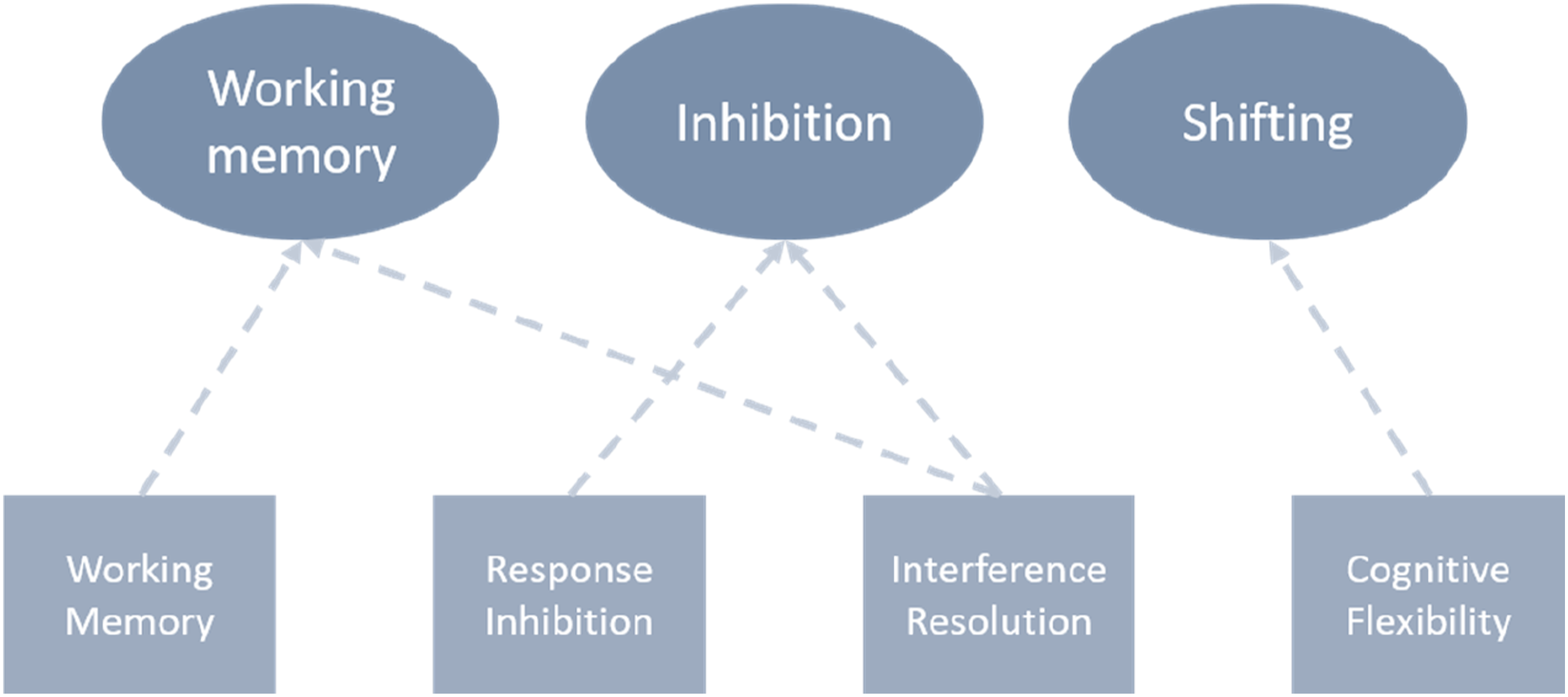
The Links Between Executive Functions and Computational Thinking
CT practices encompass a broad array of cognitive activities that require the involvement of higher-level EFs. The ability to engage in hypothesis testing, solution designing, and decision making (Rich et al., 2019) is closely related to certain aspects of EFs, such as working memory and cognitive flexibility. For example, debugging is considered one of the core CT skills, which involves identifying problems, learning from experience, and resolving errors (Brennan & Resnick, 2012). To navigate a successful debugging process, students must learn from their mistakes, generate alternative solutions, and flexibly switch between multiple response sets. Moreover, Çiftci and Bildiren (2020) indicated that engaging in coding activities can have a statistically significant positive impact on students’ planning and inhibition competency, as well as their problem-solving skills. In the pursuit of CT tasks, it is crucial for students to maintain their final programming goals and persevere in the face of failure (Robertson et al., 2020). Students with well-developed EFs are more likely to possess these efficient abilities and exhibit superior performance in CT practices.
Working Memory and Computational Thinking
Working memory refers to the cognitive processes involved in the temporary storage and manipulation of information, which are crucial for complex cognitive tasks such as reasoning, problem-solving, and learning (Baddeley, 1992). Gerosa et al. (2021) conducted a study utilizing mixed-effects linear regressions to examine the relationships between students’ CT skills and working memory. The study by Román-González et al. (2017) further supports these connections. Their findings revealed that well-developed working memory enables students to retain and process logical connections among subjects without constant reference, thereby enhancing problem-solving performance. These studies collectively contribute to the growing body of research that establishes the connections between CT skills and working memory.
In CT activities, working memory plays a crucial role in various cognitive processes, including top-down control of attention and protection of goals from interference with goal-oriented information (Hofmann et al., 2012). For instance, during the problem decomposition stage, students must retain the final goals in their working memory while breaking down complex problems into smaller, more manageable components. Well-developed working memory allows students to effectively maintain and manipulate stored information while resisting attention-grabbing stimuli (Wang et al., 2021), thereby supporting essential mechanisms within individuals’ CT processes.
Inhibition and Computational Thinking
Inhibition refers to the ability to suppress habitual, dominant, and mindless behaviors that are unnecessary in dynamic and ever-changing situations (Verbruggen & Logan, 2008b). Current understanding of the relationships between CT and students’ inhibition development is still limited (Di Lieto et al., 2017). However, research has begun to shed light on this topic. For example, a study by Senn et al. (2004) found that inhibition skills can predict problem-solving abilities and social prerequisites in preschool children. In the context of problem-solving scenarios, inhibition plays a crucial role in enabling students to maintain and update relevant information while inhibiting prepotent responses that may hinder problem-solving (Di Lieto et al., 2017).
Arfé et al. (2019) highlighted the significance of developed inhibition and planning skills in CT practices among young children. This study employed four neuropsychological tests to assess changes in students’ EFs. The results demonstrated that response inhibition skills developed rapidly during the elementary school years. Building upon this work, Arfé et al. (2020) investigated the impact of age-related inhibition development on students’ computational problem-solving performance. The findings revealed that children between the ages of 5 and 7 exhibited heightened sensitivity to CT practices. Given the rapid development of inhibition during childhood, it becomes particularly important to consider the effects of inhibition on students’ CT activities, especially within this developmental time span (Arfé et al., 2020).
Shifting and Computational Thinking
Shifting refers to the ability of flexibility and creativity (Miyake et al., 2000). This ability involves the capacity to adapt and switch between different strategies, tasks, or mental sets. Gerosa et al. (2021) aimed to explore CT skills from a cognitive development perspective, with a specific focus on providing targeted interventions for every individual. In this research, shifting, or cognitive flexibility, was considered as a foundational aspect of complex CT skills that undergoes exponential improvement during childhood. When students encounter complex problems, they may experience frustration and boredom. However, cognitive flexibility can offer a fresh perspective on these situations, enabling individuals to approach problem-solving with a new mindset and establish the belief that desired problem-solving goals can be achieved (Zapata-Rivera et al., 2019).
In CT practices, students with higher cognitive flexibility possess the ability to effectively switch between multiple goals and identify the most efficient methods to attain those goals (Hofmann et al., 2012). Flexible adjustments in behavior within problem-solving environments are vital for successful CT knowledge acquisition and skill development. For example, during the problem decomposition stage, repeatedly making the same errors indicates the need for a switch in problem-solving approaches. In such cases, students must reallocate their attention, inhibit the previous response, learn from their mistakes, and reconfigure their strategies to overcome the challenges (Monsell, 2003). This process of shifting requires cognitive flexibility, allowing students to adapt their thinking and behavior to address different aspects of a problem.
Methodology
Measures
Computational Thinking-IACT Assessment
Students with diverse learning challenges may encounter difficulties when attempting standard CT tests that involve complex, context-dependent scenarios. IACT assessment overcomes these challenges by incorporating logic puzzles designed to minimize text and eliminate the requirement for prior programming experience. By reducing these potential barriers, IACT allows students to engage in the assessment and demonstrate their performance without being hindered by language or programming constraints (Rowe, Asbell-Clarke, et al., 2021). It promotes a more inclusive assessment environment, where students can demonstrate their CT skills in a context that is accessible and conducive to their individual learning needs.
Operationalization of CT Practices in IACT Assessment.

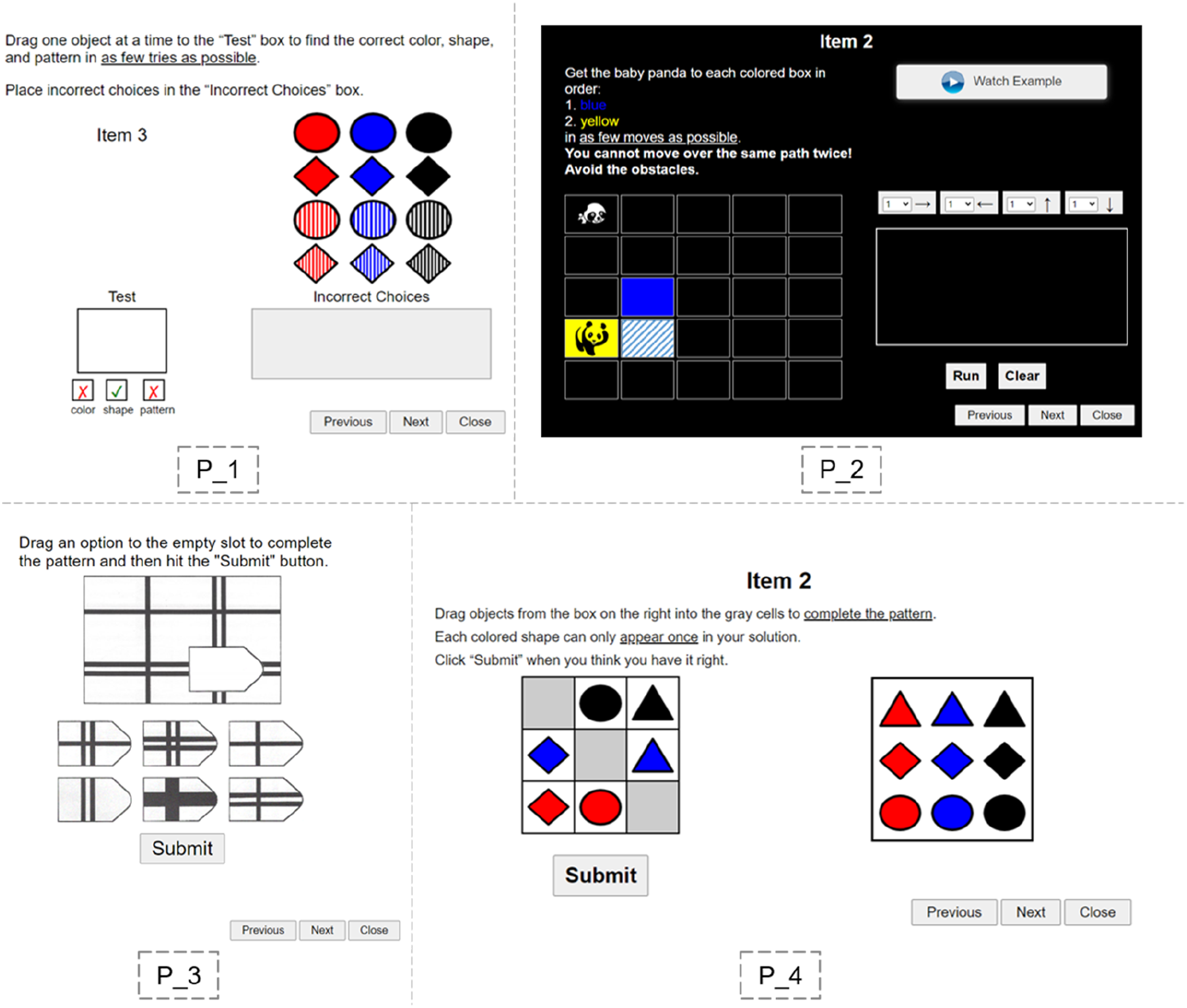
Four tasks of IACT assessment.
Problem Decomposition
This puzzle requires students to break down complex problems into manageable components and address each part separately. As illustrated in Figure 2, P_1 introduces a sorting challenge. Students are tasked with sorting objects based on either one aspect (such as shape) or another (such as color).
Pattern Recognition
In this puzzle, students are challenged to engage in various sorting and classification tasks, incorporating diverse forms of information. Developing the skill of recognizing patterns is crucial for generalizing problems into broader classes. In Figure 2, P_3 compels students to discern both vertical and horizontal patterns to complete the blank spaces.
Abstraction
This puzzle necessitates students to understand the underlying rules governing object patterns and apply these rules to complete the puzzle. In Figure 2, P_4 demands students to drag objects from an inventory on the right into grey cells on the left, thus adhering to the inferred rule and completing the pattern.
Algorithm Design
This puzzle exposes students to the operationalization of a set of rules through an algorithm—a sequential series of steps crucial for accomplishing a target task. In Figure 2, P_2 challenges students to arrange a sequence of arrows guiding a character along a maze path that adheres to specified criteria.
In the analysis of students’ IACT assessment scores, the “yes” response was used to indicate a correct answer for each item, while the “no” response represented an incorrect answer. To evaluate students’ performance on each task, the accurate percentage of their answers was calculated as a measure of their proficiency.
Executive Functions-ACE Assessment
The ACE tasks are used to measure specific aspects of students’ EFs. The assessment process involves presenting students with probes or targets, and they are required to respond before reaching the maximum reaction time. Immediate feedback is provided after each trial, indicating whether the response was correct, incorrect, or if the time limit was exceeded. In this study, four specific tasks are selected to measure working memory, response inhibition, interference resolution, cognitive flexibility. Studies (Christ et al., 2001; Fry & Hale, 1996) suggested that information processing speed could influence the improvements of EFs. ACE tasks evaluate students’ basic response time before students start other regular tasks. Therefore, the response time control task was included as a covariate to be regressed from performance metrics in all other tasks. Figure 3 shows the screenshots of these four tasks. Four tasks in ACE assessment.
Working Memory
Q_1 is designed by borrowing the idea of Corsi Block Task (Corsi, 1973). In this task, students are presented with a sequence of lighted stars on the screen. The sequence length gradually increases based on the student’s real-time performance. The task requires students to observe the sequence of lighted stars and then recall and reproduce the correct sequence in the same order. As the sequence length becomes longer, it becomes increasingly challenging for students to retain and reproduce the correct sequence.
Cognitive Flexibility
Q_2 assesses students’ shifting skills. This task is designed based on a trial-wise task-switching paradigm (Stephen, 2003). In this task, students are presented with stimuli that can be categorized based on their shape or color. The categorization rule is determined by the cue that immediately precedes the target stimulus. Approximately 70% of the trials have the same cue as the previous trial (Stay condition), while the remaining 30% of the trials have different cues (Switch condition). In this task, students need to quickly and accurately categorize the target stimulus based on the relevant cue designed and displayed by each trial. They must flexibly switch between the shape and color categories based on the cue information provided.
Response Inhibition
Q_3 is used to assess students’ ability to control their impulses and sustain attention. This task is adapted from the Test of Variable Attention. It consists of two conditions: a target frequent condition and a target infrequent condition. In the target frequent condition, the target stimulus appears in 80% of the trials, while in the target infrequent condition, the target stimulus appears in only 20% of the trials. The target frequent condition is designed to measure students' impulse control. They need to resist the impulse to respond to non-target stimuli and only respond when the target stimulus is presented. The target infrequent condition, on the other hand, evaluates students’ sustained attention. They must maintain focus and attention throughout the task, even when the target stimulus appears less frequently.
Interference Resolution
Q_4 assesses students’ inhibition abilities. This task is based on the paradigm introduced by Eriksen and Eriksen (1974). In this task, students are presented with a sequence of five arrows, and their goal is to identify the middle arrow. The task is designed to create interference by including distracting arrows that may conflict with the correct response. Half of the trials in this task exhibit congruent arrows, where all arrows point in the same direction. The other half of the trials include incongruent arrows, where the middle arrow points in the opposite direction of the surrounding arrows. By presenting both congruent and incongruent trials, the task measures students’ ability to inhibit the interference caused by the surrounding arrows and focus on identifying the middle arrow correctly. This requires students to avoid being influenced by the conflicting information provided by the other four arrows.
In terms of the measures in each task, there are some differences that should be clarified. In Q_1, the measure of the task is the maximum object span. It represents the maximum length of the sequence of lighted stars that students can correctly identify in the same order. In Q_2 and Q_4, the measures are the overall rate correct scores. This indicates the percentage of correct responses that students provide in each task. In Q_3, the measure is the mean response time. It provides an indication of students’ response inhibition and sustained attention, as faster response times generally indicate better impulse control and attentional focus.
The University of California, San Francisco also offers analysis scripts based on R. For this study, R Studio was employed to execute the developed package and obtain the analysis results.
Participants
Demographics of Participants.

Specifically, for estimating the canonical loadings, particularly in the case of the first canonical function, previous study (Stevens, 1996) suggested a sample size of at least 20 times the number of variables involved in CCA. Applying this guideline to this work, where only the first canonical function is under consideration, the recommended sample size would be 20 times the sum of variables for EFs and CT, totaling 160 individuals. Consequently, the chosen sample size for this study (N = 161) is sufficient for CCA.
Data Analysis
Students’ IACT scores and ACE measures were extracted from the raw log files of the participants. To ensure data integrity and consistency, rigorous data cleaning procedures were implemented using Python programming language. The raw data was processed and transformed into a structured format suitable for analysis. As a component of the data preparation phase, all results from IACT assessments and ACE tasks were subjected to normalization.
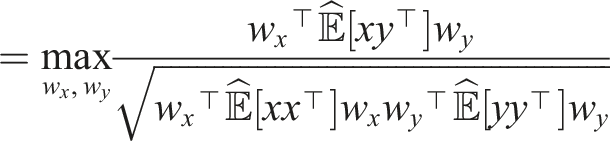
Canonical Correlation Analysis (CCA) was employed to investigate the relationships between students’ EFs and CT skills, as the measures for both IACT assessment and ACE tasks are multi-dimensional vectors. First introduced by Hotelling (1936), CCA aims to identify linear projections of two correlated vectors. Unlike traditional correlation analysis, which relies on the coordinate system in which the data is described, CCA aims to identify a pair of linear transformations for each set of variables. These transformations maximize the correlation between the transformed variables, irrespective of the coordinate system (Weenink, 2003). This makes CCA a powerful statistical method for the exploration of correlations between multiple sets of variables, taking into account the interconnections within each set as well as the overall associations across sets (Hardoon et al., 2004).
Canonical Correlation Analysis
Suppose we are given 

The goal is to find 
Suppose 


The covariance matrix of 
Therefore, equation (5) is rewriting as:
According to equation (7), 

The corresponding Lagrangian is:
Taking derivatives in respect to 

Rewrite equation (10), then obtain:
Suppose 
Then we get:
To find the coordinate system that optimizes the correlation, we have to follow two steps: first, solving the generalized eigenproblem of the for
To gain deeper insights into the potential connections between students’ EFs and their CT skills, Pearson correlations and linear regressions were subsequently used to investigate the associations between the sub-dimensions of these two domains.
Results
Descriptive Statistics
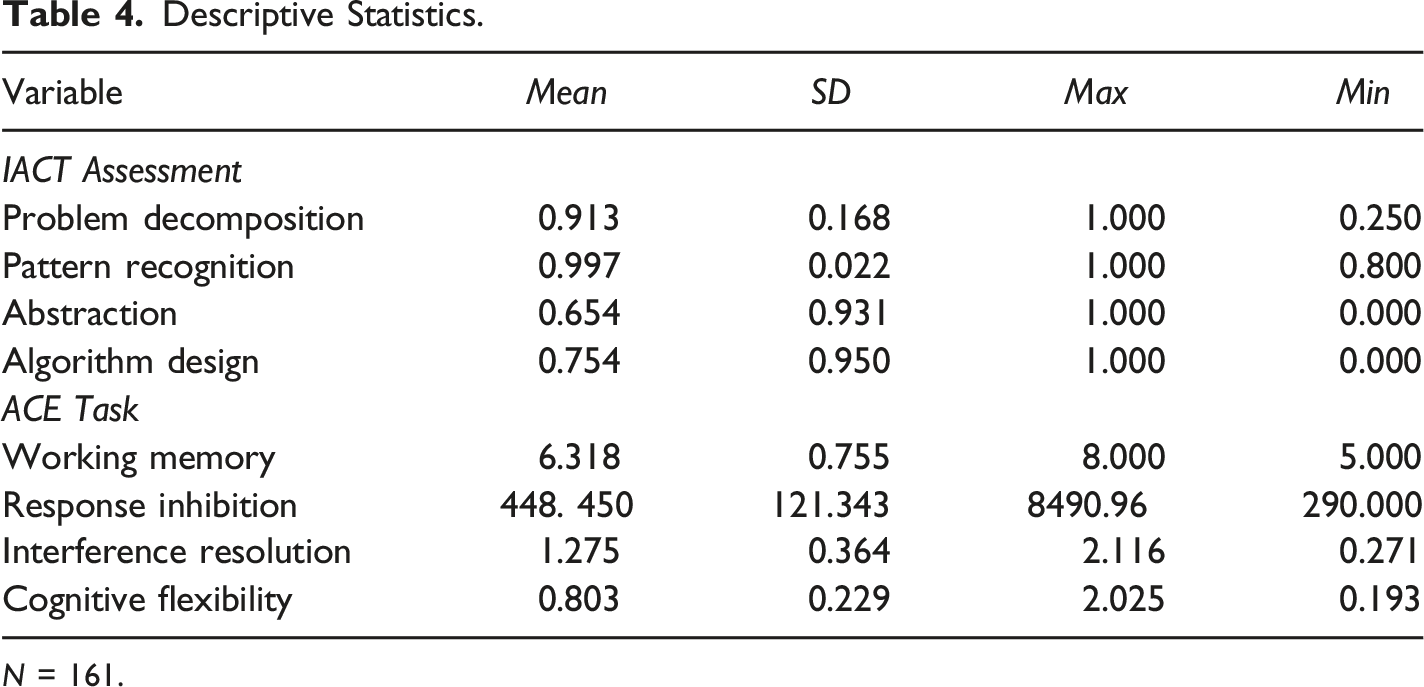
Descriptive Statistics.
N = 161.
When assessing student CT performance on IACT assessment, it was found that most students excelled in pattern recognition and problem decomposition. However, their performance was weaker in abstraction with a mean score of 0.654. In terms of algorithm design, the mean score was 0.754, which was lower than the first two CT practices. On the other hand, the ACE tasks measured four aspects of EFs. Working memory had a mean score of 6.318 and a relatively small standard deviation. Response inhibition was measured by response time, with lower response times indicating better performance. Interference resolution and cognitive flexibility had relatively smaller standard deviations, and the mean scores were at an average level for these two tasks.
Canonical Correlations
Canonical Correlations.

According to the standardized canonical coefficients from the first function, the following equations were developed. It was noted that 

According to the canonical loadings, interference resolution ( Structure coefficient of canonical factors.
Pearson Correlations
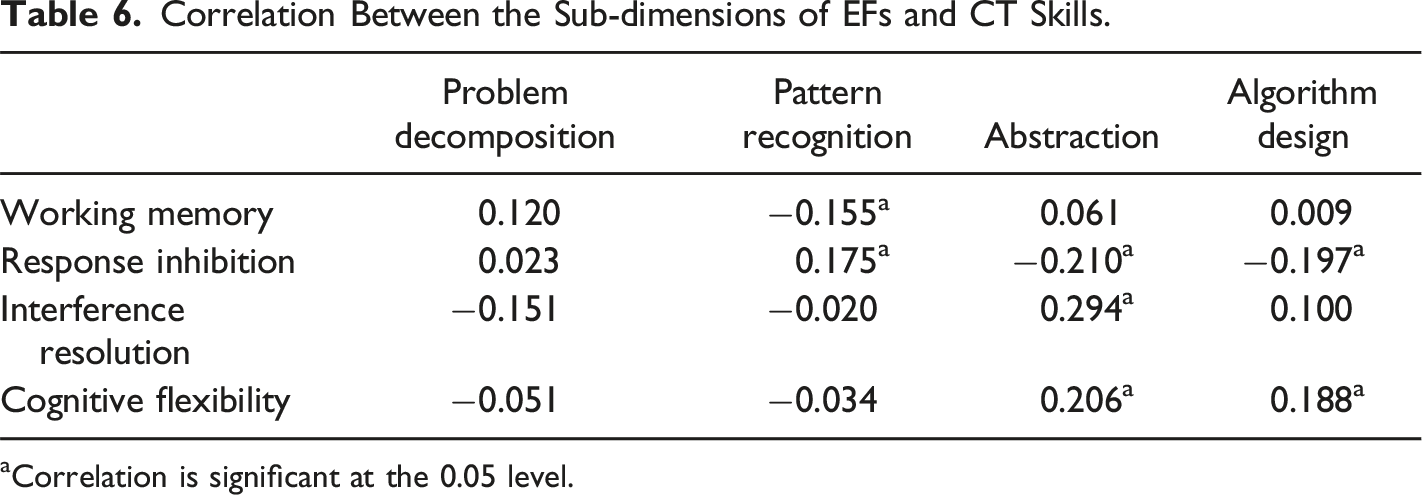
Correlation Between the Sub-dimensions of EFs and CT Skills.
aCorrelation is significant at the 0.05 level.
Based on Table 6, working memory was significantly related to pattern recognition (−0.155); response inhibition was significantly related to pattern recognition (0.175), abstraction (−0.210), and algorithm design (−0.197); interference resolution was significantly related to abstraction (0.294); and cognitive flexibility was significantly related to abstraction (0.206) and algorithm design (0.188).
Linear Regression
Based on the correlations between the sub-dimensions of students’ EFs and CT, Figure 5 was developed to illustrate how the students’ EFs could relate to their CT skills. Relationships between the sub-dimensions of EFs and CT skills.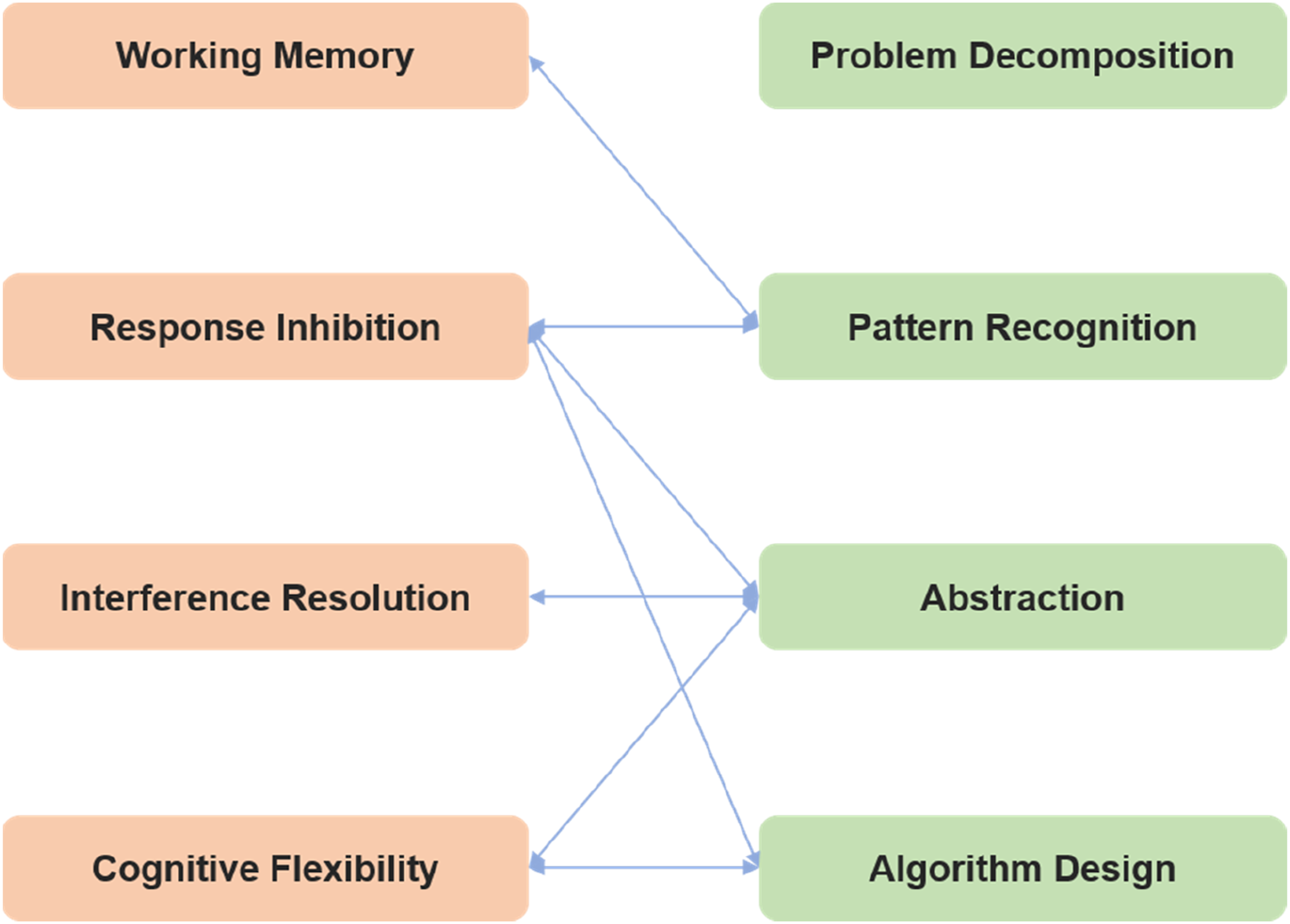
As depicted in Figure 5, there were no measured EFs significantly related to problem decomposition performance. However, students’ performance on working memory tasks and response inhibition tasks appeared to be linked to their pattern recognition achievements. Besides, three EFs (response inhibition, interference resolution, and cognitive flexibility) showed significant associations with students’ abstraction performance. Lastly, when students engaged in algorithm design puzzles, both response inhibition and cognitive flexibility seemed to influence their behaviors and performance.
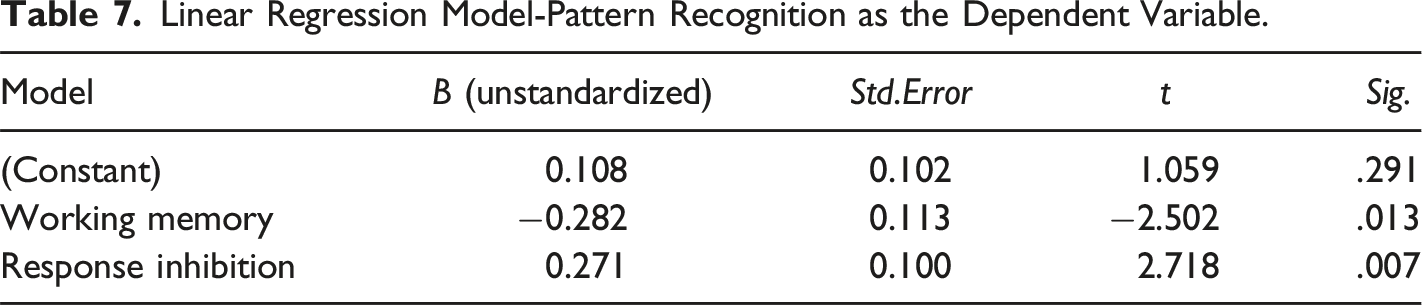
Linear Regression Model-Pattern Recognition as the Dependent Variable.
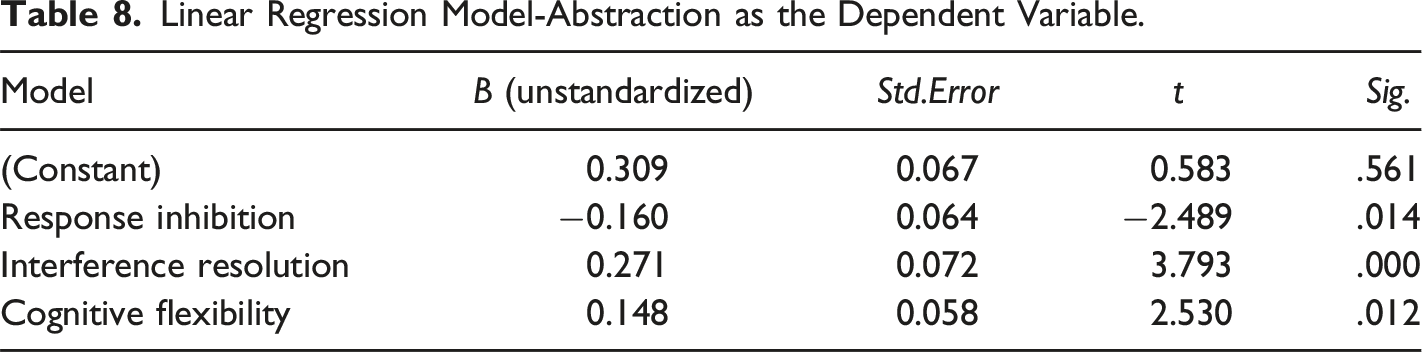
Linear Regression Model-Abstraction as the Dependent Variable.
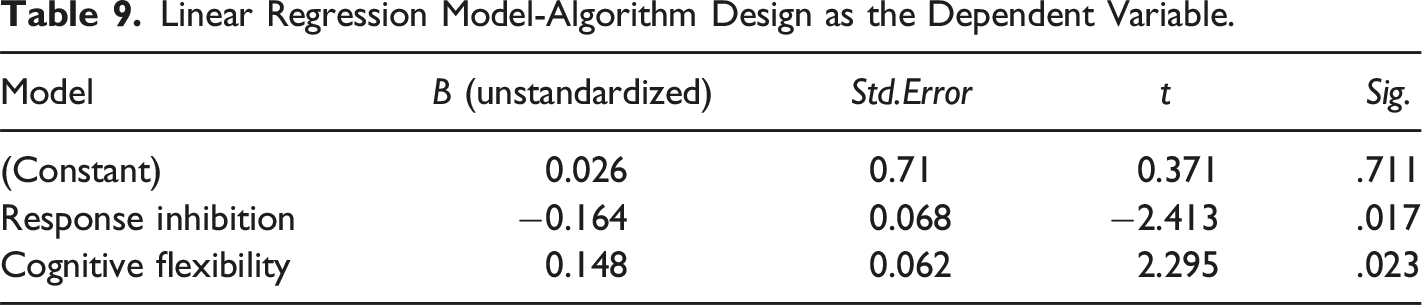
Linear Regression Model-Algorithm Design as the Dependent Variable.
According to Table 7, the regression analysis revealed a negative relationship between students’ Working Memory and pattern recognition, with a coefficient of −0.282. In addition, the effect of response inhibition on students’ pattern recognition performance was found to be in the opposite direction.
As shown in Table 8, interference resolution and cognitive flexibility were found to have a positive impact on students’ abstraction performance, with interference resolution having the greatest contribution. Conversely, response inhibition was found to have a negative relationship with students’ abstraction performance. Specifically, this negative relationship did not indicate any educational meanings.
With respect to algorithm design in Table 9, response inhibition and cognitive flexibility had opposite effects on students’ performance, with contributions of −0.164 and 0.148, respectively. However, the overall contribution of these two factors to students’ algorithm design performance remained similar.
Discussion
Correlation Analysis
In educational research, understanding statistical associations is critical for instructors to identify the factors that may influence students’ learning processes and academic performance. To construct high-performing models, various statistical factors must be taken into consideration. For example, as suggested by Goodwin and Leech (2006), certain factors can influence the size of a Pearson correlation, including issues related to linearity, variable measurements, and data characteristics. In this study, the assessment of students’ EFs and CT skills vary in types, dimensions, and measures. All these characteristics should be considered for the correlation analysis to generate the models with better performance.
The measures of students’ EFs and CT skills used in this study were multidimensional, with several sub-dimensions. Given the interrelated nature of these sub-dimensions, conventional correlation analysis may not adequately capture the intricate relationships among them. Consequently, it becomes imperative to account for the underlying connections between these sub-dimensions to provide an accurate depiction of the correlations between EFs and CT skills. CCA proves to be an effective method for analyzing these correlations by processing variables through the consideration of linear combinations of sets of two variables. It has gained widespread utilization in recent years for modeling the linear relationships between two multidimensional sets of variables. One way to conceptualize CCA is as a problem that involves identifying two sets of basis vectors for two groups of variables, with the goal of maximizing the correlation between the projections of the variables onto these basis vectors (Hardoon et al., 2004).
The CCA analysis performed in this study initially constructed linear combinations of sub-dimensions and subsequently established the correlations between these two combinations. In comparison to other correlation analysis methods, such as the Pearson correlation coefficient, CCA holds the advantage of simultaneously considering all sub-dimensions and capturing the intricate inter-relationships among them (Fukumizu et al., 2007; Yang et al., 2019). This comprehensive approach provides a deeper understanding of the relationships between EFs and CT skills, which can offer valuable insights for educational interventions or serve as a basis for further research. However, it’s essential to acknowledge that addressing the challenge of capturing nonlinear relationships between EFs and CT skills remains an important avenue for future work. This aspect should be taken into consideration to provide a more complete picture of the associations between these two domains.
Executive Functions and Computational Thinking
Revealing the cognitive foundations of CT could efficiently improve students’ computer science education experience. The results of this study indicated a strong correlation coefficient of 0.452 between EFs and CT. Notably, interference resolution and response inhibition emerged as the sub-dimensions with the most substantial contribution to students’ EFs, while abstraction and algorithm design exhibited the most significant impact on their CT practices. Additionally, this study identified specific relationships among the sub-dimensions of EFs and CT. Working memory and response inhibition were found to have a significant association with pattern recognition, with correlation coefficients of −0.155 and 0.175, respectively. Response inhibition, interference resolution, and cognitive flexibility significantly related to abstraction, with correlation coefficients of −0.210, 0.294, and 0.206, respectively. Response inhibition and cognitive flexibility were found to have a significant impact on algorithm design, with correlation coefficients of −0.197 and 0.188, respectively.
Pattern recognition is a cognitive process that involves students recognizing common patterns in problem-solving based on their prior experiences (Kuzle, 2013). This process involves evaluating the efficiency of each pattern and testing them in different problem-solving scenarios. According to Alloway (2010), working memory plays a fundamental role in students’ learning and is a fundamental cognitive skill required for a wide range of activities. In computer science education, visual-spatial working memory can enhance students’ logical, computational, and mathematical skills, including strategies in arithmetic and number knowledge (Alloway, 2010). Hence, students who do not face working memory challenges are more likely to exhibit a superior ability in pattern recognition.
Another relevant executive function that impacts pattern recognition performance was response inhibition. Previous studies (Roebers et al., 2011) have shown that young children developed the ability to inhibit prepotent responses rapidly, which is strongly linked to their academic achievement. Torgrimson et al. (2021) suggested that response inhibition could play a crucial role in inhibiting prepotent desire and disengage from the stuck moments in complex problem-solving scenarios. Therefore, students’ pattern recognition performance significantly related to their level of response inhibition. During this CT practice, students who possessed strong response inhibition skills might have the necessary cognitive abilities to participate in frequent pattern construction tasks. Specifically, response inhibition appeared to be the only executive function that was consistently linked to most CT practices in this study.
Abstraction is a fundamental concept in computer science and mathematics education, involving the creation of a structure or category that encompasses all relevant characteristics (Selby & Woollard, 2013). Cetin and Dubinsky (2017) considered that abstraction included three perspectives: extraction, decontextualization, and essence. As indicated in Figure 5, response inhibition, interference resolution, and cognitive flexibility were found to be significantly linked to students’ performance in abstraction tasks, highlighting the pivotal role of EFs in this CT practice. On one hand, students who possessed strong interference resolution skills were likely to be able to extract relevant information from complex tasks and decontextualize important features to recognize the essence of real problem-solving situations. On the other hand, cognitive flexibility skills enabled students to adapt to new conditions by comparing their previous experiences (Saleem Khasawneh, 2021). This executive function allowed students to build their CT knowledge that enhanced adaptation to different problem-solving situations and achieve their learning success in abstraction tasks.
Regarding algorithm design, this study identified two EFs significantly associated with this CT practice: response inhibition and cognitive flexibility. Algorithm design is a complex CT skill that requires students to design and develop effective algorithms and strategies to solve real problems (Choi et al., 2017). To achieve this CT practice, students were required to create reusable problem-solving patterns and procedures that could be applied to similar problems. Previous research has indicated that response inhibition can facilitate flexible problem-solving behaviors. When certain problem-solving actions are no longer effective in a new situation, students with strong response inhibition skills can stop those actions and replace them with more efficient and appropriate strategies (Verbruggen & Logan, 2008a). Similarly, cognitive flexibility is crucial for generating appropriate behavioral responses (Dajani & Uddin, 2015). Students with high levels of cognitive flexibility were able to adapt their problem-solving strategies based on feedback and responses learned from their previous experience. Additionally, a high level of cognitive flexibility might lead to positive emotions (Bertiz & Kocaman Karoğlu, 2020) and efficient switches (Timarová & Salaets, 2011) between different types of problems. As a result, students with strong cognitive flexibility skills tended to perform better in algorithm design tasks.
Influence of Executive Functions on Computational Thinking
Previous studies have suggested that engaging in CT activities could have a positive impact on students’ cognitive development (Liao & Bright, 1991; Mayer, 2013). In a study by (Román-González et al., 2017), it was discovered that CT is fundamentally associated with students’ general cognitive abilities, as well as specific cognitive aptitudes, such as inductive reasoning, spatial abilities, and verbal abilities. Robertson et al. (2020) further highlighted the importance of linking EFs with CT. Firstly, EFs had been identified as potential predictors of the development of students’ mathematical and computer science skills (Cragg & Gilmore, 2014). Secondly, the fundamental concepts of CT required the cognitive regulation aspects of EFs. Therefore, gaining a deeper understanding of the cognitive underpinnings of CT can facilitate its successful integration into K-12 curricula. This work extended previous research by quantitatively analyzing the correlations between EFs and CT. In addition, it explored the relationships between specific aspects of EFs and different CT practices by utilizing linear models. These findings innovatively provided empirical evidence to support the statement that EFs played a crucial role in developing CT skills.
Current research in CT education often lacks investigations into the development of specific CT competencies tailored to students of different grade levels (Angeli & Giannakos, 2020). This study establishes a connection between particular EFs and specific CT practices, offering emerging evidence that can guide the design and development of CT skills for students across various grades. Given that each executive function develops at distinct stages, such as working memory evolving through young adulthood and cognitive flexibility extending into adolescence (Huizinga et al., 2006), educators should consider age-appropriate CT competencies that align with the development of specific EFs in students of different ages and grades.
Students who lack prior knowledge of programming or debugging may find it challenging to reconstruct unfamiliar CT concepts using a combination of algorithms and strategies (Weintrop, Beheshti, et al., 2016). Therefore, understanding the relationship between EFs and CT skills can offer valuable suggestions for improving the clarity and efficiency of CT learning. For example, students with challenges with working memory or cognitive flexibility may struggle to grasp complex CT concepts and problem-solving strategies, which can lead to frustration and disengagement when working at abstraction or algorithm design tasks. By identifying which EFs are essential for each CT stage, educators can better design and develop appropriate CT skills for students of different ages and grade levels, ultimately leading to more effective CT education.
The successful learning of CT relies on a range of external and internal factors. For example, Gong et al. (2020) suggested that students’ motivation can have a positive impact on their learning strategies and CT skills. Dong et al. (2023) and Li and Kang (2021) have emphasized the importance of considering affective factors in order to enhance students’ engagement and effectiveness in CT skill development. Notably, EFs have been considered significantly related to these factors. Based on a study (Hauser-Cram et al., 2014), it became evident that students’ motivation played a critical role in their ability to perform well on the execution function task, as those with higher motivation levels achieved better accuracy and shorter response times. Additionally, recent studies (Holley et al., 2017; Schmeichel & Tang, 2015) contributed to the statements that EFs significantly related to emotion and emotion regulation. Well-developed cognitive abilities could help to shape students’ emotional and goal-oriented learning.
Understanding the relationship between CT and EFs is essential for developing effective CT (Yukselturk & Bulut, 2005) instruction, especially for neurodiverse students. The development of EFs can significantly impact students’ emotional regulation, motivation, and problem-solving behaviors. For example, students with less-developed EFs may struggle with frustration tolerance (Ametti et al., 2022; Zelazo et al., 2016), which can hinder their progress in mastering CT skills. In such cases, it’s crucial for educators to provide explicit scaffolding and effective instruction to help students overcome these challenges (Israel et al., 2015). Additionally, research has shown that there is a clear correlation between lower executive function performance and more frequent aggressive behaviors among students. This underscores the importance of executive functions in regulating behavior. Furthermore, Yukselturk & Bulut (2005) emphasized on the critical role of self-regulation in students’ ability to learn and excel in computer programming, underscoring the importance of supporting the development of self-regulation skills in programming education. These findings have practical implications for educators and instructional designers, who should consider the potential influence of EFs development on students’ self-efficacy and self-regulation behaviors in the context of CT.
Limitations
This study faced several limitations. First, this work only had limited measures for EFs and CT. As mentioned before, the constructions of these two areas are inherently complex in nature. Consequently, capturing the entirety of these EFs and CT becomes a challenging task when relying on any single measure or assessment tool. Hence, the analysis of the measures regarding students’ EFs and CT skills is restricted to the specific assessments used in this study. Future research should expand on these findings but with multiple measures of EF and CT.
Additionally, CCA analysis could not uncover the nonlinear relationships between two variables. In this study, the assumption was that students’ EFs linearly related to their CT skills, which might ignore other curve or nonlinear correlations. Currently, researchers have tried to develop enhanced CCA models, such as kernel CCA and deep CCA to solve these limitations. For example, kernal CCA (Akaho, 2006; Fukumizu et al., 2007) could transform the original data space into a kernel space by a predefined kernel function to discover the nonlinear relationships between two variables. Thus, future research should expand on the methodological approaches used in this work as a way to address this limitation.
Next, the unavailability of students’ demographic surveys due to the impact of COVID-19 prevented the consideration of age and gender differences in EFs and CT skills. As previous research has indicated, potential demographic variations in these areas, the findings of this study may not be generalizable to students of specific grade levels, ages, and genders.
Finally, this study does not provide the information the causality between EFs and CT. On one hand, the efficient development of CT skills may enhance abilities such as information processing, logical thinking, and task switching. On the other hand, well-developed EFs can support problem-solving, selective attention, and strategic flexibility. Future research should explore promising methods, such as casual inference, to assess the reciprocal influences between these two domains.
Conclusion
This study aimed to investigate the connections between students’ executive functions (working memory, response inhibition, interference resolution, and cognitive flexibility) and computational thinking skills (problem decomposition, pattern recognition, abstraction, and algorithm design) using correlation analysis. The findings revealed significant relationships between these two domains and developed models that quantitatively described the associations, shedding light on the performance variations of EFs in CT practice. These invaluable insights will be instrumental in advancing the development of inclusive and personalized CT programs meticulously crafted to address the distinct requirements of diverse students.
Footnotes
Declaration of Conflicting Interests
The author(s) declared no potential conflicts of interest with respect to the research, authorship, and/or publication of this article.
Funding
The author(s) disclosed receipt of the following financial support for the research, authorship, and/or publication of this article: This work was supported by the U.S. Department of Education (U411C190179).
