




Abstract
The use of peacekeeping to manage conflicts in the international system has grown since the end of the Cold War. While much attention has been devoted to what makes peacekeeping successful, the outcome of peacekeeping is ultimately tied to the willingness of the intervening actor(s) to “stay the course” and continue the mission until its objectives are complete. In this article we focus upon the empirical puzzle of peacekeeping missions’ sustainability. After states and international organizations overcome the collective action problem of forming a mission and deploying it, it is puzzling that so many missions drop out before completion. We adopt a competing risks framework in our analysis to identify the forces that determine whether peacekeepers stay until the end of a conflict or withdraw early. Our explanation argues that peacekeepers are more likely to stay the course as the capacity of the mission increases, the costs and risks of peacekeeping diminish, and traction towards peace is observed.
MONUA, the 3000-strong UN peacekeeping mission in Angola from 1997 to 1999, was established in the wake of the 1994 Lusaka Protocol that initiated the peace process between the Angolan government and UNITA rebels to monitor the cease-fire between the two sides and promote political and military reintegration in the country. Yet, the force was withdrawn in February 1999 after two UN aircraft were shot down, and violence escalated between the two sides sufficiently to force Secretary General Kofi Annan to declare that because of “the steadily worsening security situation … the conditions for a meaningful United Nations peacekeeping role in Angola have ceased to exist” (Annan, 1999: 10). Why would states and international organizations that have overcome the challenges of multilateral cooperation to deploy a peacekeeping force leave a war-torn area, essentially “give up” on peace?
This article examines peacekeeping durability—what determines whether peacekeepers continue their missions until the end of civil war. This is an important but, to date, under-studied phenomenon. 1 Though the majority of early peacekeeping operations were employed to help maintain stability between two or more states, they have more recently been deployed to civil conflicts to both maintain and impose a peace (Durch, 1993). Although belligerent consent and the termination of fighting were traditionally prerequisites for peacekeeping, about 21% of both UN and non-UN missions that intervene in civil wars do so during ongoing armed conflicts (Heldt and Wallensteen, 2007). We focus our analysis upon not only when peacekeeping missions end, but how they end. This approach allows us to focus on when third parties “stay the course” and continue peacekeeping through the end of a civil war versus when peacekeeping missions decide to “cut and run” prior to the end of the war. We build and test a theoretical argument of the duration of peacekeeping operations. Key to our explanation is the interplay of interrelated sets of factors: peacekeeping capacity, the costs of conflict versus the benefits of peacekeeping, and traction toward peace.
Toward Durable Peacekeeping
Since the end of World War II, more than 120 peacekeeping operations have been deployed. They vary greatly in size and scope. While most of these missions focus primarily on the physical separation of the opposing sides, more recent missions have increasingly come to focus on the broader elements of developing peace. Most of the missions since the end of the Cold War have also been deployed to civil wars, either into ongoing conflict or to help enforce a cease-fire or a negotiated settlement. Fearon and Laitin (2003: 76) define the end of a civil war as “the observation of a victory, wholesale demobilization, truce, or peace agreement followed by at least two years of peace” (emphasis added). 2 We focus on the challenge that peacekeepers face when attempting to attain and enforce those two years of peace. Diehl (2008) breaks apart the conflict process into four phases: pre-conflict, armed conflict, cease-fire, and post-agreement. While older missions (during the Cold War) typically deployed after the end of conflicts to help enforce a peace agreement, more recent (post-Cold War) missions, particularly those sent to civil wars, have increasingly engaged while conflicts are ongoing, and thus focused on bringing about peace as much as keeping it (Heldt and Wallensteen, 2007; Diehl, 2008). We conceive of missions as durable if they, once deployed, remain in the country until peace is established.
Considerable scholarly attention has been devoted to defining what it means for peace-keeping to be successful and understanding the impact that peacekeeping exerts upon conflict. Diehl and Druckman (2010) outline a debate among peacekeeping scholars about what peacekeeping success means. The debate asks whether peacekeeping can be labeled “successful” based solely on its mission mandate, allowing for a mission to be defined as “successful” if it did not resolve the conflict. Others suggest that the only way to deem a mission successful is for it to end the conflict in which it intervenes. From this perspective, Fortna (2003, 2004) focuses upon the question of whether peacekeeping is successful in helping to maintain a durable peace. Howard (2008) sees peacekeeping success as both the achievement of a mission’s mandate and in terms of the degree to which the institutions supported and established by UN peacekeepers continue to function after the withdrawal of peacekeepers.
Debate also persists over whether peacekeeping actually promotes post-civil war peace. Fortna (2003, 2004) concludes that peacekeeping does help maintain peace after conflicts end. Hartzell et al. (2001) and Hartzell and Hoddie (2004) find that third-party enforcement of civil war settlements are key contributors to their success. Doyle and Sambanis (2000) find that peacekeeping is most successful when missions have the broadest scope and most capability. Walter (1999) notes that for peacekeeping to help stabilize post-civil war environments, the combatants must believe that peacekeepers can help distribute credible information and enforce agreements and that peacekeepers are willing to stay until the conflict is resolved. Smith and Stam (2003: 10) note that “the more powerful the peacekeeping force and the more difficult it is for combatants to circumvent it, the more successful peacekeeping efforts are likely to be”. Recent work by Howard (2008) moves even further by tying UN peacekeeping success to the consent of the warring parties for peacekeeping, the interests of the Security Council, and the way in which organizational learning occurs and translates into organizational change within the UN during a mission. While the view that peacekeeping is generally successful is by no means universal (Regan, 2002; Greig and Diehl, 2005), 3 research on peacekeeping success suggests that the way in which missions are designed and the extent that peacekeepers are committed is quite relevant to the ultimate success of a peacekeeping mission.
Other recent work (Gilligan and Stedman, 2003; Fortna, 2004; Mullenbach, 2005; Rost and Greig, 2011) has focused on the onset of peacekeeping operations, noting that earlier studies that focus on whether peacekeeping “works” suffer from potential selection bias. This work shifts the focus from the conflicts to the states and organizations that sponsor peacekeeping. We seek to link the literature on peacekeeping onset with the research on peacekeeping success. By studying the conditions that encourage durable peacekeeping, our work here focuses upon what we see as an important question in understanding how to make peacekeeping more successful—what determines whether peacekeepers, once deployed, will be withdrawn before a conflict ends or will remain in country until peace is established?
Determinants of Peacekeeping Durability
We consider a peacekeeping mission durable if, once deployed, it stays until a conflict has ended. This concept of durability differs from concepts and measures of peacekeeping “success”. Some major conceptualizations of mission success generally focus on either the long-term achievement of peace (Fortna, 2004), well after a mission has departed and the conflict ends, or the achievement of a more positive peace (Howard, 2008), that may include democratization (Doyle and Sambanis, 2000), 4 but are unrelated to the length of time the mission was in place. 5 We explain peacekeeping durability as a function of the mission’s characteristics and capacity, the benefits and costs of peacekeeping, and the traction toward peace demonstrated by the conflict. A peacekeeping operation is more likely to stay on and continue when conflict costs remain tenable for the peacekeepers, peacekeeping appears to be beneficial, and a conflict shows potential for ending. If progress seems hampered by increasing human costs in the course of the conflict, however, they are more likely to leave before peace can be attained.
When peacekeeping capacity is very high, a mission should be able to limit rising conflict costs, promote stability, and endure. When the costs of conflict are very high and its benefits and prospects for peace are very low, it is less likely that a mission will endure until the war is over. When the prospects for peace are very high, even if a mission has low capability, a mission should be more durable. Although all of these sets of factors are interrelated, it is important to distinguish among them and understand how variance within each set of factors contributes to the decision to stay the course of a peacekeeping operation, independent of one another.
While many peacekeeping missions, such as the early interstate missions, were deployed to enforce a peace that was already achieved, our focus is on missions deployed while a conflict remains unsettled. 6 The missions we describe are ones in which the goal could be assumed to help bring peace rather than simply enforce a peace that began before they were deployed. As a result, core to our theoretical argument is the assumption that all of the peacekeeping missions we examine share a basic goal of facilitating an end of violence and promoting the sustainability of peace.
Mission Characteristics and Capacity
Peacekeeping operations that are better able to adapt to changes on the ground are less likely to abandon conflicts. There are several characteristics of missions that can affect their ability to adapt to such changes. Peacekeeping missions that have the greatest capacity to shape a conflict, those in which the costs of peacekeeping can be shared, and those in which the providers of peacekeeping have a high commitment to managing a conflict are the most likely to be sustainable. As such, we believe that larger missions, UN missions, and missions with multiple contributing states are the most durable. Large peacekeeping missions carry with them a greater capacity to effect change in the conflict, limiting civil war violence and laying the groundwork for the establishment of a lasting peace. Simply by virtue of their size and the resources they bring to bear, large peacekeeping forces should be better able to conduct activities such as cease-fire monitoring, disarmament, and, when needed, peacemaking, than smaller forces.
Beyond the extra conflict management capacity a large peacekeeping mission brings with it, a larger peacekeeping force signals a greater commitment to peacekeeping by a third party. Assembling a peacekeeping mission is not without costs. Large peacekeeping forces do come with significant added costs reflecting the increased challenges a large force presents in conducting such vital functions as maintaining adequate supply levels, coordinating activities among units (many of which may be from different countries in some missions), and transporting personnel. Regardless of whether the mission is led by a state, a regional organization, or the UN, increasing the size of a mission increases the costs absorbed by a mission sponsor. Because of the increased cost of larger missions, we believe that the largest and most extensive peacekeeping missions should deter all but the most committed parties from providing peacekeeping. As a result, this greater commitment should serve to increase the durability of these peacekeeping missions.
Hypothesis 1: The larger the peacekeeping mission, the lower the likelihood of early termination of the mission.
Although we expect that large peacekeeping missions, regardless of who provides them, will tend to be more likely to remain until the end of a civil war, there are other important differences across peacekeeping missions that we expect to influence mission durability. Most notably, we expect that who provides peacekeeping will be just as important to mission durability as the form that peacekeeping missions take. In this respect, we anticipate that whether peacekeeping is provided by the UN, an ad hoc collection of states, or a regional organization will, ceteris paribus, influence the likelihood that peacekeepers remain until the end of a civil war in which they are deployed.
Recent research (Fortna, 2004; Mullenbach, 2005) has focused upon the differences between UN and non–UN peacekeeping missions. Mullenbach (2005) notes that since the end of the Cold War regional and state-led missions (combined) outnumber missions conducted by the United Nations. Yet, despite their frequent use, post-Cold War, non-UN peacekeeping missions are less effective at keeping the peace than their UN-led counterparts (Fortna, 2004). Although regional peacekeeping missions bring a collaborative element with them similar to that of UN missions, they also bring some important downsides. Diehl (1993) warns that regional missions may not present as capable an alternative to UN missions as one might hope. Regional peacekeeping missions often draw upon less capably trained and led forces for their missions, bring fewer resources to missions, and have a less well institutionalized structure for the command of these missions. Such missions also have a smaller pool of force contributors from which to draw relative to UN missions, increasing the costs borne by individual contributors. In this sense, the diminished capacity for successful peacekeeping of regional peacekeepers suggests that regional missions will be less sustainable than those provided by the UN.
The issue of cost-sharing is even more apparent in ad hoc peacekeeping missions created by states and groups of states. Operating outside the rubric of an international institution, such missions face an even more difficult time dividing up the costs of peacekeeping among the participants. At the same time, because providing peacekeeping to a civil war amounts to, at least to some degree, a public good to the international community, ad hoc missions provided by states are likely to be less sustainable as the contributors balance the benefits of providing peacekeeping against the drawbacks of absorbing the majority of the costs of the mission. To the degree that one state, or even a collection of states, is shouldering the entire cost of keeping the peace, they will be much more susceptible to domestic political concerns and priorities than regional or UN operations, making them more likely to terminate the mission before the end of the civil war. As the number of states contributing to a mission grows, the individual burden on each contributing member of the mission is likely to diminish, increasing the durability of peacekeeping.
Hypothesis 2: UN peacekeeping missions and missions with a large number of contributors are less likely to be withdrawn early than other missions.
Finally, despite the similarity of basic goals, it is important to note that many peacekeeping operations have different mandates that vary in scope, ranging from narrowly tailored humanitarian missions to more expansive missions responsible for providing security or “peacebuilding” operations (Doyle and Sambanis, 2000). As a result, although we base our argument upon the assumption that the basic goal of any mission is to stay until the job described by their mission mandate is done, we recognize that the type of mission applied to a civil war will impact the likelihood that peacekeepers remain until the end of the war.
In some missions, for example, peacekeepers take on a security role typically provided by governments. As such, peacekeepers in these missions not only separate combatants, but often also play a vital role in protecting civilians. These missions tend to occur in highly unstable states, ones in which political institutions have often completely failed. As such, peacekeepers can become the de facto enforcement mechanism in the state in such situations. Security-centered missions are deployed with the knowledge that the states in which they are sent are very unstable, and are thus more expansive in goals than typical missions. Because these missions are just as concerned with the governance of the state after conflict as they are with helping to facilitate an end to it, it makes sense to expect that these missions will be the most committed and will tend to stay until the end of fighting.
Hypothesis 3: Peacekeeping missions that have a primary mandate to provide security are less likely to be withdrawn early than other types of peacekeeping missions.
Peacekeeping Commitment and Costs
Although the characteristics of peacekeeping missions impact their durability, peacekeepers do not operate in a vacuum. Once deployed to a conflict, changes in the conditions on the ground also influence the likelihood that peacekeepers will remain until the end of the conflict. The providers of peacekeeping must continually reevaluate the costs and benefits of maintaining their deployment. Maintaining peacekeepers in a conflict can offer significant benefits, potentially improving the security situation and lessening human suffering. Thus, the decision to sustain peacekeeping is influenced by the balance between commitment to the mission and the benefits it may provide, relative to the costs that may be increasing through the course of the mission.
Commitment to peacekeeping can be in the form of both strategic and humanitarian interests. We believe that an operation is less likely to withdraw early from a conflict if it has more ties to the country experiencing the civil war. A defense pact between the civil war state and a state leading a peacekeeping mission or a key supporter of the mission signals an important strategic interest for the peacekeepers, increasing the likelihood of durable peacekeeping. Historical ties, such as colonial linkages, between peacekeepers and a civil war state create both economic and social interests (Rost and Greig, 2011) that should encourage the continuation of peacekeeping throughout a conflict.
Peacekeeper interests, however, are not confined only to their narrow strategic interests. A distinguishing feature of modern civil wars is the suffering that they often impose upon civilians. As a result, peacekeeping missions are particularly likely to be deployed during humanitarian emergencies, the most acute threats to civilians (Jacobsen, 1996; Gilligan and Stedman, 2003; Finnemore, 2004; Regan, 2000). The human suffering among civilians produced by a civil war can also create a sense of urgency for peacekeeping that is likely to encourage sustainable missions. This same pressure for intervention to protect civilian lives is likely to make it difficult for the providers of peacekeeping to withdraw their forces while civilians remain threatened, encouraging more durable missions.
Hypothesis 4: The more committed to the mission a peacekeeping force is, the less likely it is to be withdrawn early.
Significant civilian displacements, however, do not guarantee the continuation of peacekeeping. The withdrawal of peacekeepers at the height of the violence in both Rwanda and Somalia are two prominent examples of early withdrawals in the face of a humanitarian disaster. We argue that these types of withdrawals are rooted in the costs and risks faced by peacekeepers during a deployment. Core to the ability of peacekeeping missions to “stay the course” is the willingness of the third party providing peacekeeping to continue to pay the costs of providing the force. This willingness to pay the costs of peacekeeping is tied to two key considerations: that peacekeeping is beneficial, carrying a positive effect upon the civil war in which it takes place, and that the costs of peacekeeping are not unbearable for the third party. As these costs and risk mount, third parties become less willing to sustain the deployment of the force. High levels of conflict after the arrival of peacekeepers can signal the intractability of a conflict, encouraging peacekeepers to conclude both that the conflict is unmanageable and that continued peacekeeping is likely to be costly. Given these conditions, the providers of peacekeeping may well conclude that there is little to be gained in continuing the mission and decide to withdraw their forces.
The occurrence of intense conflict after a peacekeeping mission is deployed exerts two key effects upon the persistence of peacekeeping missions, both negative. First, an increase in recent conflict intensity signals real risks for the peacekeeping force, suggesting to both politicians and domestic audiences alike that the costs of continued peacekeeping are likely to be high and, perhaps, unacceptable. Second, an increase in the intensity of conflict in the presence of peacekeepers can also signal the inability of the force to dampen conflict, undercutting the will of both policymakers and the public to continue the mission until the end of the civil war. While some missions may be better able to adapt to changes in the conflict on the ground, an increase in the conflict intensity, we believe, will cause an increasing hazard of early termination.
A worsening security environment for peacekeepers, however, is not necessarily confined only to the increasing intensity of conflict between the civil war belligerents. Outside military interventions on behalf of one of the combatants in a civil war have been shown to make conflicts more intractable and longer lasting (Balch-Lindsay and Enterline, 2000; Cunningham, 2006). For peacekeepers, an outside military intervention increases the complexity of a civil war, increasing the number of players involved in any effort to manage and resolve the conflict. More often, an outside military intervention expands both the number of combatants and the scope of conflict, not only making conflict management more difficult but also placing peacekeepers in greater peril. As a result, the occurrence of an outside military intervention during a peacekeeping mission should undermine hopes among the third parties of successfully managing the civil war while increasing their expectations of the costs inherent to the message. This logic suggests a greater likelihood of an early withdrawal of peacekeepers when outside parties intervene militarily in a civil war during a peacekeeping mission.
Hypothesis 5: Peacekeeping operations become more likely to withdraw early as the security situation during the mission worsens.
Traction Toward Peace
Core to the continuation of a peacekeeping mission is the existence of hope for its success. Just as a deteriorating security environment during a peacekeeping mission can discourage those providing peacekeeping, as the likelihood of successfully managing a civil war is reduced, agreements between civil war belligerents can signal better prospects for success, increasing the willingness of peacekeepers to stay. The presence of a cease-fire at the outset of a mission, even when conflict continues, can provide this sense of hope amongst those providing peacekeeping, suggesting to them that if the parties are capable of previously agreeing to a cease-fire, they might be capable of producing a future settlement. In this sense, while Mullenbach (2005) finds that conflicts in which cease-fires have been implemented have a greater likelihood of peacekeeping operations being deployed, we believe that for many of the same reasons, they are also more likely to be sustainable. Even if a cease-fire does not exist at the outset of a peacekeeping mission, it is still possible for a sense of optimism and progress to develop during the course of a peacekeeping mission if the relationship between the warring parties begins to improve. One sign of such an improvement is the movement of the warring parties toward dialogue with one another. As peacekeepers begin to stabilize a country in which they intervene, it becomes easier for the civil war belligerents to begin talks with one another. The presence of peacekeepers can provide a means of support and enforcement for an agreement reached between the parties while also reducing the parties’ fear of exploitation. At the same time, talks among civil war parties signal progress in the relationship between the belligerents, providing hope that the continued presence of peacekeepers will translate into continued dialogue between the parties. In this respect, talks between civil war parties should increase the tendency of peacekeepers to remain until the end of the conflict.
Hypothesis 6: Peacekeeping missions in which there is progress toward peace will be more likely to last until the end of the civil war.
Research Design
The focus of our analysis is upon peacekeeping missions deployed during an ongoing civil war. 7 Because our analysis examines peacekeeping missions conducted by the United Nations, regional organizations, states, and collections of states, we rely upon Mullenbach and Dixon’s (2006) Third-Party Peacekeeping Missions data set to identify the peacekeeping missions for our analysis. We use civil war dates from Fearon and Laitin (2003) to identify the peacekeeping missions that take place during a civil war. In addition, we individually research each mission in order to ensure that fighting was continuing at the time that peacekeepers were deployed. Our unit, then, is the mission-year. Due to data limitations, the temporal domain for our study covers 46 missions and 110 mission-years from 1958 to 1999.
We test our explanation of whether a mission leaves before the end of fighting or stays until the civil war ends. Because our approach focuses upon the occurrence of two mutually exclusive outcomes for peacekeeping, a competing risks approach is the appropriate choice for our analysis. The competing risks approach fits our expectation that the two ways in which we identify the termination of peacekeeping missions will be influenced by different causal factors. In other words, traction towards peace might have a stronger influence on decisions to sustain a mission to the end of a conflict, while mounting conflict costs might have a stronger influence on peacekeepers’ decisions to withdraw early. This approach permits the estimation of a duration model for each of our peacekeeping outcomes: withdrawal before civil war termination or continuation until civil war end. We estimate Weibull models for both the early withdrawal of peacekeepers and the continuation of peacekeeping until the end of a civil war because we expect that peacekeeping missions become more likely to terminate, either by withdrawing early or the civil war ending, the longer they continue. Our findings are consistent with our expectation of the presence of duration dependence, as both types of peacekeeping terminations show strong, statistically significant evidence of duration dependence.
We rely on Fearon and Laitin’s (2003: 76) definition of when civil war ends, which is “the observation of a victory, wholesale demobilization, truce, or peace agreement followed by at least two years of peace”. 8 After accounting for missing data, 18 of the 46 total missions in our analysis terminate prior to the end of the war, while 16 missions endure until after the end of the conflict. The remaining 12 missions in our analysis are censored and are coded as such. Of those 12 missions, 5 are right-censored because the civil war in which they are deployed remains ongoing after 1999 and 7 are censored by the deployment of a new mission to the civil war. The lengths of the missions in our data range from 1 to 12 years, with an average mission length of 2.47 years.
Censored cases occur in our data for two reasons. First, because both the civil war data and diplomatic data that we use end in 1999, we cannot observe whether peacekeeping missions that are ongoing in 1999 are subsequently either withdrawn or last until the end of the civil war. Arbitrarily coding such cases as either withdrawals or civil war termination endings would be incorrect, biasing our results. As a result, we treat these missions as censored observations. Second, some peacekeeping missions end prior to the end of the civil war in which they are introduced but do so because they are replaced by another peacekeeping force. Because the decision to withdraw the peacekeeping force cannot be separated from the decision to introduce the replacement mission, we treat such cases as censored. In this respect, we argue that the true ending of a peacekeeping mission cannot be known if another mission replaces it immediately after withdrawal. In order for a peacekeeping mission to censor an earlier mission, a different actor must conduct the new mission and there must be no more than one month separating the withdrawal of the first mission and the arrival of the replacement mission.
Because our focus is upon the decision of third parties to end military intervention in civil wars, rather than less substantial re-definitions of missions by the same actors that maintain peacekeepers in the field, we treat some peacekeeping missions identified by Mullenbach and Dixon (2006) as distinct missions or as continuations of the same mission. For example, we treat the United Nations operations in Somalia in the 1990s, UNOSOM I and UNOSOM II, as one continuous operation. In order for such cases to be treated as one continuous mission, there must be no change in the actor providing peacekeeping and no gap in the deployment of the forces.
Because third parties, at least in part, are likely to base their choices of where to send peacekeeping missions upon their expectations of the likely success of these missions, the study of peacekeeping poses important selection effect challenges. This creates a unique challenge in our analysis. Although a number of statistical techniques have been developed in order to deal with selection bias, none fit our analysis well. Because our analysis includes observations that are censored, it is important that we adopt an event history approach in our analysis in order to adequately deal with this censoring. Boehmke et al. (2006) have developed an approach to deal with selection issues in continuous-time event history models, models in which each case appears once in the data with fixed values for the independent variables. Our theory, however, requires several time-varying covariates, predictors that change across time for each case in our analysis. The number of battle-deaths and the occurrence of mediation, for example, change over time in our analysis. Unfortunately, there are no tools that we are aware of to deal with selection effects in time-varying event history models like ours. As a middle-ground approach, to keep the event history approach that we see as vital while also dealing with selection issues, we incorporate into our model variables that predict the onset of peacekeeping. These include not only the peacekeeper commitment and security situation variables described in our theory, but also a variable describing whether or not both warring parties consented to the presence of the peacekeeping force. While this is an imperfect solution to the selection bias concern, we believe it provides the best balance in dealing with the combined effect of selection issues, censored observations, and time-varying covariates.
Independent Variables
We focus upon a few sets of factors as influences upon the way in which civil war peacekeeping missions end. These variables are summarized in Table 1. First, we examine the influence that the capacity of a peacekeeping force has upon the durability of the mission. In order to measure the capacity of the peacekeeping force, we focus our attention upon the characteristics of the peacekeeping force and the third party providing it. We draw upon peacekeeping data from Mullenbach and Dixon (2006) to create each of these variables. We code a dichotomous variable for peacekeeping missions conducted by the United Nations and a separate dichotomous variable for missions conducted by a state or ad hoc collections of states. Peacekeeping missions conducted by regional organizations constitute the reference category for the analysis.
Summary Table of Variables

Because we expect that security-centered missions will both signal the greatest commitment to a peacekeeping mission by the provider and have the strongest capacity to establish peace in a civil conflict, we create a dichotomous variable that codes those missions identified by Mullenbach and Dixon (2006) as having law and order as their primary purpose as such. Similarly, because large peacekeeping forces signal both commitment and capacity, we also include a variable describing the number of peacekeepers deployed as part of the mission. As a further means of measuring peacekeeping capacity and ability to divide costs, we include a variable describing the total number of states contributing forces to the peacekeeping mission. To account for the skewness in both of these variables, we use the natural logarithm of both in our analysis. In order to identify the degree of outside conflict management taking place in a conflict, we also include a variable describing the number of concurrent peacekeeping missions taking place in the civil war state during any given year using data from Mullenbach and Dixon (2006). In order for missions to be considered concurrent, the mission deployments must overlap by at least one month during the year.
Second, we include two variables that reflect the urgency for peacekeeping and the costs of its provision. In order to measure the costs borne by the peacekeepers from the conflict and the degree to which their presence has improved conditions, we construct a variable using data from Lacina and Gleditsch (2005) that calculates the logarithm of the total number of battle-deaths in the civil war state during the previous year. As a further measure of the costs and threat faced by peacekeepers we focus upon military interventions by outside parties. Military intervention by another state during a peacekeeping mission serves not only to increase the potential costs faced by peacekeepers, but also to complicate their ability to manage the conflict. We construct a dichotomous variable identifying the occurrence of military interventions with data from Mullenbach and Dixon (2006) supplemented with data collected from Keesing’s Record of World Events.
Third, to capture the interests and commitment of peacekeepers to a conflict, we include four variables in the model. To capture the urgency for maintaining the deployment of a peacekeeping force caused by civilian displacements, we include a variable measuring the number of refugees produced by the conflict. Using data from Moore and Shellman (2004) we calculate the natural logarithm of the number of refugees produced by the civil war state during the previous year. Similarly, using data from Harff’s (2003) Annual Data on Genocide and Politicide we create a dichotomous variable coded 1 in years in which genocide is taking place in the civil war state. To measure direct peacekeeper interest, we also code two dichotomous variables for the existence of former colonial linkage and the presence of a defense pact. We use data from Hensel’s (2006) ICOW Colonial History Dataset to code the colonial linkage variable and data from Gibler and Sarkees (2004) to code the defense pact variable. For UN missions, a colonial linkage is coded if the civil war state is a former colony of a major power and a defense pact is coded if the state has a defense pact with a major power. For non-UN missions, both variables are coded by examining colonial ties and defense pacts, respectively, with the lead state of the peacekeeping mission.
As our final set of factors, we measure the degree of optimism for the eventual success of the peacekeeping mission. We use data from Mullenbach and Dixon (2006) to code a dichotomous variable for peacekeeping missions that are introduced following a cease-fire between the parties. We also create a dichotomous variable that identifies the occurrence of mediation between the civil war parties during the prior year for each year of the peacekeeping mission. We use data from Regan et al. (2009) to code this variable. To control for the willingness of the civil war belligerents to accept peacekeeping, using information from Keesing’s Record of World Events, the New York Times Archive, and Lexis-Nexis Academic Universe, we code a dichotomous variable as 1 for missions in which all of the warring parties consent to peacekeeping.
Analysis
In many respects, our findings with respect to the factors that shape the likelihood that peacekeepers will be withdrawn early from a conflict fit our theoretical argument well. Yet, these results also depart from our theoretical expectations in some notable ways. Our results also point to the difficulty faced by peacekeepers in establishing a lasting peace, even if they remain committed to managing the conflict. These results are summarized in Table 2. This table reports hazard ratios, which describe the effect of a variable on the risk of an outcome, controlling for the effects of the other variables in the model. Hazard ratios greater than 1 increase the risk of an outcome, while those less than 1 reduce the risk. 9
Hazard Ratios for Weibull Competing Risks Model of Civil War Peacekeeping Mission Sustainability.
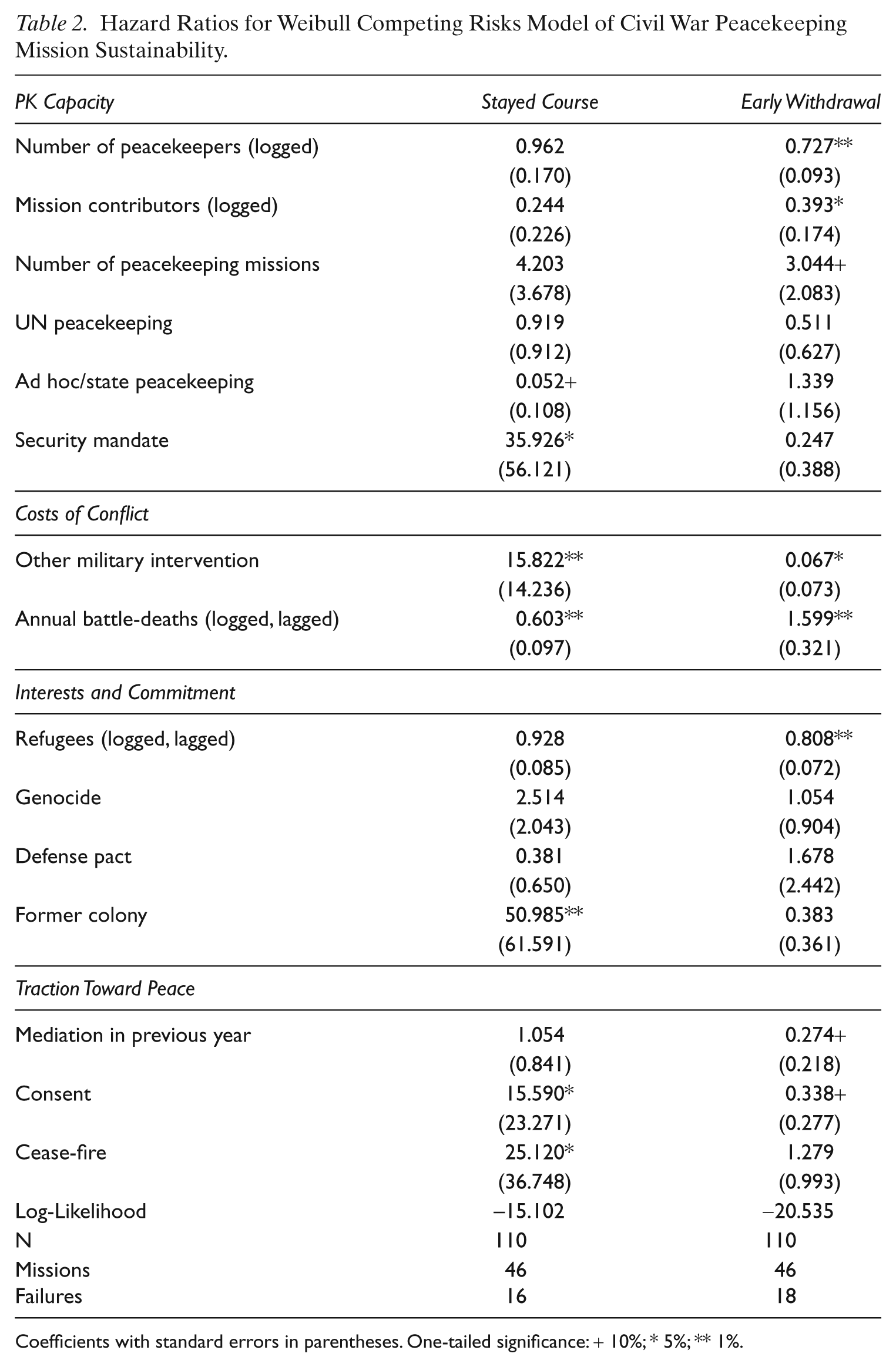
Coefficients with standard errors in parentheses. One-tailed significance: + 10%; * 5%; ** 1%.
Both operation design and mandate have important implications for mission durability. Missions with security as their primary mandate are nearly 36 times more likely to remain in the country until the end of the civil war than missions with other mission goals. Large peacekeeping missions are also less likely to be withdrawn before the end of the civil war. An additional 1,000 peacekeepers deployed to an average peacekeeping mission reduces the probability of early withdrawal of the mission by nearly 89%. Yet, adding peacekeepers does not significantly increase the likelihood that a peacekeeping mission will remain until the end of a conflict by the same amount.
At first glance, it might seem surprising that an increase in the number of peacekeepers deployed might reduce the likelihood of early withdrawal without increasing the odds that the mission continues until the end of the civil war. This result, however, suggests that larger peacekeeping missions are more likely to be censored, seeing their missions continuing without actually terminating the civil war. This logic is consistent with recent evidence in the literature (Regan, 2002; Greig and Diehl, 2005) that peacekeeping, while perhaps dampening the intensity of the conflict, may not necessarily shorten its duration or promote its successful resolution. Furthermore, this finding also points to the presence of a selection effect. The most challenging conflicts tend to require large peacekeeping missions to manage them. Yet, these challenging conflicts are also the most likely to prove to be intractable in the long run, increasing the likelihood that the conflict will go unresolved even with the continued presence of peacekeepers.
We note a similar effect for missions with a large number of contributing states. Increasing the number of states participating in a peacekeeping mission from 1 to 3 reduces the likelihood of early withdrawal of the force by nearly 73%. Yet, large missions are not significantly more likely to remain deployed until the end of a civil war. This suggests that missions with many contributing states have a tendency to appear censored in our analysis, neither giving up and withdrawing nor promoting the end of the civil war to which they are deployed. Interestingly, contrary to our expectations, UN missions were not significantly more durable than regional peacekeeping missions. In this respect, the number of states contributing forces to a mission appears to matter more than who sends them. Ad hoc peacekeeping missions, however, are an exception to this tendency, with their missions being nearly 95% less likely to stay until the end of a conflict than regional missions, although this effect is only weakly significant.
Viewing the effects of peacekeeping missions with a security mandate and missions with a large force deployment side by side suggests the differential effects of force capacity and peacekeeper commitment on mission durability. Peacekeeping missions with a large number of forces signal a significant commitment to managing a civil war by the party providing peacekeeping. There are significant costs involved in mounting a large peacekeeping mission, costs that are difficult to overcome, regardless of the provider of peacekeeping. Our results suggest that this commitment is enough to prevent third parties from withdrawing their peacekeepers while a civil war remains ongoing, but the parameters under which the force operates are not sufficient to force an end to the civil war. By contrast, missions with a security mandate show an enhanced force capacity to do so. Much like large peacekeeping missions, security missions face significant obstacles to their deployment. Peacekeeping missions with a security mandate, because they are costly peacebuilding missions typically applied to the most challenging conflicts where there is often little local capacity to provide security, face strong barriers to entry. As a result, only the most committed parties are likely to deploy missions to a civil war with security as the primary mandate. At the same time, security missions, by virtue of their mandate, bring with them the strongest capacity with which to effect change in a civil war and promote peace by imposing order in the state. Because of the joint effect of increased capacity and commitment, security missions are more likely to remain until the end of the civil war because the mission itself is empowered in a way that increases the likelihood that the civil war will end.
We see some evidence that the interests of the providers of peacekeeping influence the durability of peacekeeping missions. A historical colonial linkage between the key backers of a peacekeeping mission and a civil war state increases the likelihood that peacekeepers will remain until the end of the conflict by a factor of 51. A colonial linkage has an opposite effect on the risk of early withdrawal, although this effect falls just outside nominal statistical significance. Interestingly, we see no evidence that a defense pact between states providing peacekeeping and a civil war state influences the durability of peacekeeping missions. 10
The need a conflict demonstrates for peacekeeping does significantly reduce the likelihood that peacekeepers will be withdrawn early. An additional 10,000 refugees produced by a conflict in the previous year reduces the likelihood of early peacekeeper withdrawal by 86%. Here again, however, a reduction in the likelihood of early withdrawal does not translate to an increase in the likelihood that peacekeepers will remain until the end of the conflict. As before, this seems to indicate that when conflicts produce large numbers of refugees, the urgency for outside help is sufficient to persuade the providers of peacekeeping to continue their missions. This, however, does not contribute to the ability of peacekeepers to overcome the intractable nature of those conflicts most likely produce significant civilian displacement in the first place. The occurrence of genocide, however, does not significantly influence the durability of peacekeeping. The fact that refugees encourage peacekeeping durability but genocide does not suggests that humanitarian emergencies that carry cross-border effects, such as refugee flows, play a stronger role than those that tend to be confined to the civil war state.
Despite their willingness to continue peacekeeping in the face of a humanitarian emergency, the providers of peacekeeping do weigh the costs of continuing their peacekeeping during the course of a mission. As the number of civil war battle-deaths during the course of a mission increases, the likelihood that peacekeepers will remain until the end of the conflict diminishes and the likelihood of early withdrawal heightens. An increase of 1,000 battle-deaths in the annual fatality level during a civil war peacekeeping mission reduces the probability that peacekeepers will remain until the end of the civil war by 97% and increases their likelihood of early withdrawal by a factor of nearly 26. High levels of battle-deaths during a peacekeeping mission serve to increase the costs for peacekeepers, putting them at greater risk for casualties and making the task of imposing and maintaining a peace significantly more difficult. At the same time, a high level of battle-deaths during a peacekeeping deployment, because it demonstrates an inability of peacekeepers to dampen violence, also serves to undermine the perceived benefits ascribed to maintaining the peacekeeping mission, raising questions of whether the presence of peacekeepers is worth the mounting costs of maintaining the mission. We also observe some limited evidence of buck-passing in peacekeeping missions, with multiple missions deployed to a conflict simultaneously increasing the risk of early withdrawal by each of them. Multiple missions, however, do not have a significant effect on the risks that peacekeepers will remain until the end of the conflict, suggesting that, under some circumstances, multiple ongoing peacekeeping missions can push a conflict toward peace.
We expected that biased military interventions by other states during the course of a peacekeeping mission would encourage the withdrawal of peacekeepers by expanding the conflict and increasing the threats to peacekeepers. Contrary to these expectations, we found that peacekeepers are actually less likely to be withdrawn and more likely to remain until the end of the conflict when another state intervenes militarily in the civil war. Such an intervention reduces the likelihood of early peacekeeper withdrawal by about 93% and increases the likelihood of remaining until the end of the conflict by a factor of nearly 16. In this respect, rather than representing a sense of increased costs to peacekeepers that increase their propensity to withdraw, as we expected, outside military interventions instead demonstrate an increased urgency for peacekeeping, encouraging peacekeepers to remain until the conflict ends.
This result is especially interesting when compared to the effects of refugees on mission durability. While both forces reduce the likelihood of early withdrawal, only outside military interventions increase the chances that peacekeepers will remain until the end of the conflict. One possible explanation for this distinction rests upon the difference between the regional implications of refugees and outside interventions. Although both refugee flows from a civil war state and outside military interventions by neighboring states undermine regional stability, only outside military interventions directly expand the conflict itself. 11 By expanding the conflict, outside military interventions may encourage the contributors of peacekeeping to redouble their efforts to achieve a peace in order to avoid an even broader regional conflict. By contrast, even without ending a conflict, peacekeepers can still often manage its effects upon civilians by limiting the area of conflict, establishing safe havens, and distributing humanitarian relief.
Just as conflict costs shape the expectations of peacekeepers, progress toward peace between civil war belligerents shows a significant capacity to produce more sustainable peacekeeping missions. Both sides in a conflict simply consenting to the presence of peacekeepers dramatically increases mission durability, increasing the likelihood of the force remaining until the end of the conflict by a factor of more than 15 and reducing the odds of early withdrawal by 66%. 12 A cease-fire between the two sides further increases by a factor of 25 the chance that peacekeepers will remain until the end of the conflict, but does not significantly reduce the likelihood of early withdrawal. This suggests that cease-fires may not provide a long-term effect on the durability of peacekeeping. Peacekeeping missions will appear durable for those cease-fires that actually last and end the conflict. For those cease-fires that collapse, there will be little effect on the likelihood that peacekeeping will prove durable. 13
The effect of mediation during a peacekeeping deployment shows a different effect. A recent mediation effort between civil war belligerents during a peacekeeping mission reduces the probability of the early withdrawal of peacekeepers by approximately 73% but does not significantly increase the likelihood of peacekeeping remaining until the end of the conflict. Mediation conducted during the course of a peacekeeping mission signals at least the potential for some movement by the warring parties away from violence and toward a negotiated settlement, providing a basis for optimism among peacekeepers and encouraging the continuation of a peacekeeping mission. At the same time, the intractability of civil conflicts makes them difficult to end. Put together, these two dynamics create an environment in which peacekeepers avoid early withdrawal, but conflicts resist settlement.
Conclusion
Given that international actors have committed and deployed a peacekeeping operation, why do they sometimes turn away from their mission? Our explanation of peacekeeping mission durability is centered on the interplay between interrelated sets of factors. We posit that high capacity missions will be able to absorb increasing costs of conflict and are more likely to endure. Additionally, when the benefits of peacekeeping are high relative to the costs of the conflict, or when traction towards peace is increasing, missions are less likely to terminate early. Our findings suggest that this theoretical framework has merit. In this respect, some of the determinants of sustainable peacekeeping missions can be known at the outset of a mission while others evolve during a mission.
Our study challenges some of the criticisms often leveled at contemporary peacekeeping. A common critique, particularly of UN peacekeepers, is that even when the Security Council musters the will to deploy forces, their commitment to sustain the force in the face of the most challenging conflicts is often lacking. Peacekeeping in the Rwandan conflict fits this view. We find a more nuanced pattern for peacekeepers. Although peacekeepers do become more likely to withdraw as the severity of conflict increases during a mission, they also show a commitment to continued peacekeeping when it is needed the most—in conflicts producing large numbers of refugees or those that draw the intervention of other states and threaten to spread regionally. This does not mean that peacekeeping always solves the conflict, but the presence of peacekeepers can still function to manage the conflict and lay the groundwork for an eventual cessation of violence.
While we are hesitant to make too many policy prescriptions based on these results, our results suggest that in determining who should provide peacekeeping, the international community might focus more on states with ties to the conflict as a means of encouraging deployments with sufficient interest in a conflict to prove durable. This, however, cuts both ways. Although these interests can help maintain a peacekeeping force in the field, they can raise issues about the neutrality and motivations of the peacekeepers, questions that may pose challenges for conflict management. Our results also underscore the importance of the capacity of a peacekeeping force in shaping the durability of a peacekeeping mission. Missions with large forces sizes and many contributing states are less likely to be withdrawn early. Along these same lines, missions that focus on providing security are more likely to terminate with the end of the civil war than non-security missions. From a policy standpoint, these findings suggest the important role that the capacity of a peacekeeping mission plays in the durability of the mission. While good intentions may be enough to encourage the deployment of peacekeepers, if these same good intentions are not sufficient to foster sufficient political will to send a high capacity force, the mission is likely to terminate early.
Our findings suggest some important directions for future research. Although it was beyond the scope of this study, it would be useful to understand the way in which the structure of peacekeeping missions (who leads it, who provides the troops, how the mission command is structured) conditions the likelihood that peacekeepers will stay until the end of a conflict. Similarly, while we do not focus on mission replacement in which one peacekeeping operation is withdrawn and replaced completely by another, better understanding the linkages across peacekeeping missions would have important implications for peacekeeping success. More scholarly attention to the way in which distinct conflict management approaches can build upon one another is another important direction for the literature to follow. We found that ongoing mediation plays a role in reducing the likelihood of early peacekeeping termination. The literature, however, has often tended to study distinct conflict management tools like mediation and peacekeeping in isolation from one another. Better understanding of how diplomacy and peacekeeping can work together and manage a conflict would provide an important addition to the literature.
Footnotes
*
Earlier versions of this article were presented at the 2006 Peace Science Society (International) Conference and at the 2008 International Studies Association Annual Convention. We would like to thank Paul Diehl, David Mason, and Brian Pollins for their helpful comments. Replication data are available at  .
.
1
To our knowledge, there are no published quantitative studies examining peacekeeping mission duration.
2
Researchers do not universally employ this definition. Doyle and Sambanis (2000) require signature of a treaty or two years of non-violence. Sambanis (2004) requires a period of only six months of peace. The definition used for the Uppsala/PRIO Conflict Data Project (Gleditsch et al., 2002) also requires six months of peace. Regardless, most of these definitions require some period of time of non-conflict from an event that signals the end of fighting for the war to be considered over.
3
Regan (2002) takes a bleaker view of peacekeeping, noting that neutral conflict intervention (which includes multilateral interventions) does not seem to shorten conflicts, and that these types may be more appropriate after a conflict has already ended. echo the view that peacekeeping could discourage conflict settlement, suggesting that rather than resolving the issues of the conflict, it could simply temporarily stall the fighting.
4
Doyle and Sambanis (2000) measure the end of a conflict as the signature of a treaty or two years of uninterrupted non-violence. They count a peacekeeping operation as successful if the end of a conflict is then followed by at least two more years of non-violence. That is their most lenient measure of success. They note (Doyle and Sambanis, 2000: 783) that they prefer a stricter measure of success, one that includes some movement of a formerly war-torn state toward democratization. Fortna (2004) is testing for peacekeeping success by using the duration of non-violence, or negative peace: the longer the peace, the more successful the mission. offers a more positive approach to conceptualizing peace and counts her cases as peacekeeping successes when both the mandate of a mission is completed and positive peace achieved. All of these definitions of success require stricter and longer periods of peace than does ours. Our concept of mission durability has nothing to do with the level of peace or cooperation achieved after a mission or the end of a war.
6
7
This focus on ongoing conflict excludes missions such as the United Nations Mission in Haiti. All totaled, this focus excludes 51 distinct missions from our analysis.
8
Because Fearon and Laitin’s operationalization of civil war termination requires two years of peace, we also individually examined each early withdrawal mission to see if there were any missions that fell short of the two years of peace requirement but saw no new fighting during this period. We found one such case, an ECOWAS mission in Guinea-Bissau. We re-ran the analysis by recoding this mission as a durable mission. This change produced no substantive change in the magnitude, direction, or significance of any of the variables in the model.
9
To calculate percentage changes in the likelihood of failure, we subtract the hazard ratio from 1 if it is below 1. Thus, the percentage change in likelihood for early withdrawal as the number of peacekeepers increases is 1 – .7270, or roughly a 27% drop per 1 logged unit of peacekeepers. If the hazard ratio is above 1, then the interpretation is straightforward.
10
We also experimented with other measures of peacekeeper interest by including measures of population and share of Security Council resolutions addressing a civil conflict. These variables were not statistically significant and did not substantively impact the results of the analysis.
11
Of course, refugee flows can lead to civil war expansion (Salehyan and Gleditsch, 2006).
12
For robustness, we also included a dummy variable in the model to distinguish between missions deployed during and after the Cold War. This variable was insignificant and had no substantive effect on the overall results. This suggests that it is factors associated with the characteristics of peacekeeping missions and the conflicts to which they are deployed, rather than the historical era in which missions are deployed, that most directly influence peacekeeping durability.
13
We also measured progress toward peace by including a peace treaty variable in the model. Because we focus on missions deployed during ongoing conflicts, there were few (7) peace treaty cases. This variable was not statistically significant and did not impact the overall model. We thus opted for the broader variable for cease-fires.