




Abstract
This paper investigates the relationship between International Monetary Fund (IMF)-sponsored economic programs and contentious collective action in Latin America from 1980 to 2007, hypothesizing a positive relationship between participation in IMF programs and the likelihood of social protest. Specifically, we suggest that people in recipient countries protest the unpopular IMF mandates not only because of the negative effects that orthodox economic policies have on their livelihood, but mainly because they perceive a loss of legitimacy and question the sovereignty of their domestic governments. That is, deciding to participate in an IMF program can make governments more prone to being perceived as caving in to the pressures of international agents, increasing the likelihood of contentious collective action. Results from two-stage negative binomial selection models provide strong statistical support for our main hypothesis, remaining robust to different specifications of the second-stage equation and other procedures that correct for potential statistical problems.
Introduction
Since the 1980s, several Latin American countries have embraced economic and financial programs endorsed by the International Monetary Fund (IMF or Fund hereafter) that aim at reducing their vulnerability to economics crises. At the same time, economic growth and living standards have fallen dramatically, provoking anger and resentment (Pastor, 1989: 74), and fueling popular resistance against the Fund across the region (Stahler-Schock et al., 2008). On 23 and 24 November 2000, for example, a general strike of more than 15,000 workers protesting the “foreign meddling” of the IMF paralyzed Argentina for several days and paved the way to historic civil unrest and rioting that ultimately ousted President Fernando de la Rúa. This event is not isolated. Participation in IMF programs also prompted contentious responses in Bolivia, Ecuador, Mexico, Nicaragua and Venezuela among other countries in the region. 1
Given the salience of these protests, a rich body of literature has emerged to study the contentious responses to the implementation of neoliberal economic policies and anti-globalization movements in Latin America (Almeida, 2007, 2010; Arce and Rice, 2009; Arce, 2010; Auyero, 2001; Rossi, 2008, 2013). Other studies have analyzed more generally the effects of IMF programs on civil unrest and repression (Abouharb and Cingranelli, 2006, 2007) and government crises in developing nations (Dreher and Gassebner, 2012). While different in scope, they all suggest that people in recipient countries protest the implementation and subsequent negative consequences of IMF programs. This is an insightful claim. Yet, the theoretical argument and empirical findings of this paper as well as some anecdotal evidence from Latin America suggest that previous studies not only paint with a very broad brush the effects of the Fund on the most common indicators of contentious action (i.e. strikes, riots and demonstrations), but also underestimate the “pivotal role” that an important international actor—the IMF—can play in social unrest in Latin America.
Latin America is the region of the world where the Fund has been more active (Hutchinson and Noi, 2003: 993). Additionally, macroeconomic volatility is high in Latin American countries, making them prone to economic crises and thus to continue seeking assistance from the IMF. 2 Since, as mentioned before, the presence of the IMF has prompted large contentious reactions against it as well as an aversion to the intervention of external agents in the region, it is surprising that previous scholarship has not systematically analyzed the main research question of this paper: does entering into an IMF-sponsored economic program lead to a higher likelihood of contentious collective action across Latin American countries?
In contrast to previous studies, we suggest that people in recipient countries protest their government’s participation in IMF agreements not necessarily because of the internal domestic policies—both political and economic—mandated by the Fund, and their subsequent effects on their livelihood, but mainly because such measures are perceived as being spearheaded by the pressures of an international organism. That is, when a government participates in an agreement with the IMF, it is being effectively pressured to enact domestic austerity measures. Thus, people perceive that signing an agreement with the Fund is a challenge to their country’s national autonomy and/or sovereignty (González Souza, 1994). Building on theories of political dependence (Frank, 1980) and Third-World systems (Wallerstein, 1978), we then suggest that, by acquiescing to the policy mandates of an international organization, the legitimacy of the government can be called into question. Hence, deciding to participate in IMF programs can make governments more prone to be perceived as a sell-out to Western capitalist agents (Remmer, 1986). This is especially true in a region where intervention from the USA and other international actors has been a historical reality with important political effects (Immerman, 1982; Cottam, 1994; Rabe, 1998). Therefore, the effect of entering into an agreement with the IMF can make people question the government’s policies and motives, and such loss of legitimacy can lead to increased protests (Petras and Brill, 1986).
Since participation in IMF programs is non-random (Abouharb and Cingranelli, 2006, 2007; Przeworski and Vreeland, 2000; Vreeland, 2003), we use a two-stage model that corrects for potential selection to test our main hypothesis on an original dataset of 17 Latin American countries during the 1980–2007 period. Our results reveal that, even after controlling for alternative explanations of social protest, participation in an IMF-sponsored program exerts a substantive positive effect on contentious collective action across Latin America. The results are robust to different specifications of the second-stage equation and to different procedures that correct for potential statistical problems.
This study has numerous implications. First, we develop and systematically test a theoretical argument in which the Fund—and not the policies it mandates—plays a pivotal role in the likelihood of mass protest and civil unrest. As our main result indicates, international actors can substantively affect the level of social protest. Therefore, scholars and practitioners should pay more attention to explaining the link between international organizations and the domestic levels of contentious action. Second, our findings suggest that, by increasing the levels of social unrest, participation in IMF-sponsored economic programs may represent a serious challenge for the economic prosperity and democratic stability of the region. Third, by focusing on a particular region of the world, our analysis allows us to analyze in more detail the regional dynamics and political processes that are at play in the relationship under study.
Theoretical framework
IMF and economic (in)stability
IMF programs entail policies aimed at improving the socio-economic conditions of recipient countries and/or stabilizing the macro-economic indicators in countries that turn to the Fund for assistance. Although agreements between recipient countries and the IMF were initially intended to correct problems in the balance of payments and prevent economic contagion, they are now increasingly used to address a variety of social and economic issues, such as poverty reduction, infrastructure development and natural disaster relief (Brown, 2009; Przeworski and Vreeland, 2000).
The stabilization and/or structural adjustment programs sponsored by the IMF usually condition loan recipient governments to reduce their efforts to protect the social and economic rights of their citizens in a variety of areas such as housing, health care, education and jobs with the expectation that they will be able to make much larger efforts toward these ends later (Abouharb and Cingranelli, 2006). However, the reduction in social and economic rights, as several scholars have shown, has important negative socio-economic consequences that, in turn, can lead to dissent and repression (Abouharb and Cingranelli, 2006, 2007; Brown, 2009; Cleary, 2007).
Specifically, the literature suggests that the adoption of neoliberal reforms such as privatization, government expenditures cuts and trade liberalization can increase unemployment and inflation rates abruptly. For instance, Root and Nellis (2000) and Brown (2009) suggest that the rapid privatization resulting from signing agreements with the IMF fosters corrupt sales of government assets that tend to result in workforce cuts as enterprises struggle for profitability. As Garuda (2000) suggests, the fiscal adjustments implicit in IMF programs reduce social welfare spending, reduce public sector employment and perhaps lead to nominal wage cuts for those who remain employed. Rapid trade liberalization can drive out domestic producers as a result of sudden influxes of international goods, disproportionately favor skilled over other laborers and export-oriented sectors over domestic sectors, and lower the prices of non-tradable goods (Heller et al., 1988).
Social scientists have also documented the consequences of IMF stabilization and structural adjustment programs on the demand side of the economy (Crisp and Kelly, 1999; Heller et al., 1988; Przeworski and Vreeland, 2000; Tanzi, 1989). By cutting government expenditure, increasing the levels of taxation and reducing real wages and credit restraints, IMF programs can lead to important reductions in real incomes. Indeed, Przeworski and Vreeland (2000) find that participation in IMF economic programs lowers growth rates for as long as countries remain under the program. 3 More recently, though, Vreeland (2006) notes that measuring whether countries actually implement the austerity measures (instead of just signing the agreement but not complying with the policies) is more relevant for understanding the success or failure of the economic reforms mandated by the IMF. In other words, many countries sign agreements with the IMF, but do not carry out the conditionalities.
The negative effects on both the supply and demand sides of the economy that result from implementing the conditions associated with IMF agreements, in turn, are likely to change the pattern of redistribution in recipient countries, increasing poverty and income inequality (Crisp and Kelly, 1999; Heller at al., 1988; Pastor, 1987; Vreeland, 2002). Indeed, Vreeland (2002) suggests that, as the levels of income inequality and poverty increase, so does the likelihood that the adoption of IMF programs may disproportionately harm the poorest. A contractionary fiscal policy, for instance, lowers domestic absorption, inducing a decrease in the level of economic activity in the short run and a drastic reduction in social programs, such as public health services (Hajro and Joyce, 2009).
Alternatively, a decrease in the price ratio of non-tradable to tradable goods, which is one of the primary goals of a stabilization program, can also disproportionately affect the poorest. If the poor are rural farmers producing goods for export, devaluation will increase the value of agricultural goods in domestic currency, reducing poverty and improving the distribution of income. However, if the poor are urban consumers facing higher food prices, or rural farmers producing foodstuffs for domestic consumption, the distribution of income is likely to worsen. In general, income distribution improves if returns to labor and peasant-owned capital increase, and worsens if returns to capital and capitalist-owned land and natural resources increase (Garuda, 2000: 1035). The Mexican case illustrates the claims posited above since the number of Mexicans living under extreme poverty increased by more than 50% under the IMF-imposed economic reforms after the peso bailout in 1995. In addition, the minimum wage in the country fell by 20% as a result of the drastic economic measures implicit in the agreement with the IMF.
Together, the imposed IMF conditions to cut government expenditures on social programs, the less than optimal economic outcomes and the rising income inequality and poverty usually result in increasing economic risks and uncertainty among citizens in the recipient countries, fueling opposition to the reforms and those who implemented them (Kapur and Naím, 2005).
Neoliberal policies and austerity protests
A wave of mass protests in the region at the beginning of the twenty-first century has increasingly motivated scholars to study contentious collective actions against neoliberal policies and austerity programs in Latin America (Almeida, 2007, 2008a, 2010; Johnston and Almeida, 2006). In Bolivia, for example, the decision to privatize the Cochabamba’s public water system (Aguas del Tunari, a multinational consortium of private companies) generated at least two weeks of mass protests, road blockades and a general strike in the city of Cochabamba that demanded the resignation of Bolivian president Hugo Banzer (Arce and Rice, 2009; Suárez, 2003).
Ecuador also experienced massive protests in 2001 as a response to the government’s decision to sign an agreement with the Fund that ‘recommended’ a 60% increase in the price of cooking gas, plans for 18 privatizations in the electricity sector, an end to state monopoly for telecommunications, and the granting of a 30-year concession to a foreign company for the supply of water and sewage services to the city of Guayaquil. Perrault and Valdivia (2010) compare the case of Ecuador with that of Bolivia, and criticize academic explanations based on opportunity structure and grievances by showing that movements in these two countries aimed to counter neoliberal policies by making direct claims to the “obligations” of the nation-state. That is, these movements protested the role of the state in these processes, highlighting that its responsibility was to provide these services. Almeida (2008a), in turn, uses the cases of El Salvador and Costa Rica to examine specific protest campaigns, and shows how the intricacies of the sequence of events affect the policy outcomes in each of these movements against neoliberal reforms.
Also, in Argentina during 2001 thousands of workers protested against the signature of an agreement that included a 13% cut in public spending in exchange for US$20 billion dollars. The massive protests against participation in this IMF program constituted the peak of a cycle of contention that started in 1997 and ultimately resulted in the resignation of President Fernando de la Rua (Auyero, 2001; Rossi, 2013).
Shefner et al. (2006) compare the Argentinian and Mexican cases and find that a decline in social conditions by itself does not generally lead to more protest, but lack of economic growth coupled with a decline in social conditions does indeed tend to cause an increase in protest activity. Friedman and Hochstetler (2002) compare Argentina and Brazil and find that the political opportunity provided by economic liberalization and the level of democracy in these countries has incentivized social movement activity and civil society engagement, that is, participation both within and outside of the institutional political system. The more democratic avenues are open, the more contentious actors will try to interact with the democratic system—as in the case of Brazil. By contrast, when democratic openness is uneven, the social movement actors will be more prone to behave contentiously—as in the case of Argentina. Indeed, contentious collective actions in response to austerity measures have been documented in most of the major countries of Latin America and the Caribbean (Auvinen, 1996). In all, several hundred different protest events tied to austerity measures have been documented in Latin America in the 1980–2007 period (Almeida, 2010).
Limitations of the current literature
The aforementioned studies are very insightful as they provide important details of the country-specific dynamics of austerity protests. Yet they share a couple of shortcomings. First, most are either single-case or small-N comparative studies that do not allow us to understand more generally the effects of IMF-sponsored economic programs on contentious collective action in Latin American countries. Second, the majority focus on measuring the effects of globalization, austerity or liberalization processes on economic and political processes in each country. This makes it difficult to determine the direct effects of signing agreements with international organizations—like the IMF—on the amount of collective action in a country.
That said, a couple of earlier studies (Walton and Ragin, 1990; Walton and Seddon, 1994), conducted with data from the first wave of austerity protests (1970–1990), concluded that the emergence of contentious collective action in Third World countries was partially a response to the involvement of international agencies like the Fund (i.e. IMF pressure) and urbanization processes. However, these studies compared a large number of countries throughout the Third World, and their use of data that ends in 1990 is problematic as it does not allow us to understand the regional dynamics that may exist in Latin America. Several studies (Arce and Bellinger, 2007; Morley et al., 1999; Nielson, 2003; Paunovic, 2000) have established that economic liberalization in Latin America started at the end of the 1980s and the beginning of the 1990s. 4 Thus, results from the former studies can lead to erroneous inferences about the political consequences of participation in IMF programs.
Although not specifically focusing on the effects of participation in IMF stabilization programs, other studies approach this dilemma using a cross-national comparative methodology in Latin America. Evrensel (2002), for example, finds that austerity measures leave recipient countries politically destabilized. Kurtz (2004) finds that economic liberalization leads to a decrease in contentious collective action, especially in democratic countries, 5 while Arce and Bellinger (2007) test how economic liberalization policies have affected voter turnout and political protest in Latin America from 1970 to 2000. They find that economic liberalization increases the levels of political protest in open and democratic regimes.
Therefore, there is disagreement about the effects of both economic liberalization and participation in IMF programs on collective action. Moreover, with few exceptions (e.g. Abouharb and Cingranelli, 2007), most of these cross-national comparative studies ignore one key methodological problem that is likely to appear when one evaluates the effects of any policy or program, that of non-random selection (Heckman, 1988). Several scholars have documented that participation in IMF programs is non-random (Przeworski and Vreeland, 2000; Vreeland, 2003), and sample selection problems can introduce considerable bias in the dependent variable when trying to determine the effects of IMF programs on contentious collective action. Since the economic and political conditions of countries that participate in agreements with the IMF are different from those that do not, it is quite possible that the observed differences in contentious collective action may depend not only on the effects of the IMF, but also on selection.
Using a model that corrects for selection bias, Abouharb and Cingranelli (2007) study the effects of IMF programs on civil conflict and human rights abuses. Their work, however, leaves loose ends on four main fronts. First, their focus on explaining armed conflict (i.e. rebellion) does not allow us to pinpoint the causal mechanism that explains other (quite common) instances of contentious collective action. 6 In addition, their work lumps together IMF and World Bank structural adjustments programs, preventing us from drawing conclusions about the independent effects of IMF programs. Further, their cross-regional approach provides results that are potentially generalizable, but ignores that region-specific dynamics can play an important role in explaining the aforementioned relationship. Finally, they explore the effects of structural adjustment programs on rebellion with data that ranges only from 1980 to 1999.
Given those specificities, most of these studies cannot adequately respond to the query: do Latin American countries that enter into IMF agreements tend to observe an increase in contentious collective action? To overcome these problems, we need a comprehensive test that takes into account all of the previous findings and uses a statistical model that can adequately account for selection bias. At issue is the question of whether international organizations like the IMF can have a direct effect on collective action after taking into account other economic, social and political factors at the national level. 7
The focus of this study
Scholars have suggested that grievances, especially economic grievances, can have an effect on contentious collective action. Theories of relative deprivation (Galtung, 1964; Feierabend and Feierabend, 1966, 1972; Gurr, 1970, 1986a, b) assume a direct relationship between discontent induced by economic deprivation and collective action. For example, Midlarski (1999) argues that extreme inequality can lead to contention and even revolution. If, as suggested by our literature review, IMF programs have negative effects on growth rates (Przeworski and Vreeland, 2000), that result in rising income inequality and poverty in a country (Crisp and Kelly, 1999; Heller et al., 1988), this paired with the conditionality to cut government expenditures on social programs (Garuda, 2000) can certainly have a positive effect on social discontent. In that sense, a comprehensive model needs to control for several economic variables (e.g. inflation, income inequality, GDP per capita, economic growth and economic liberalization or openness) that can capture national levels of poverty and inequality that might lead to grievance-based discontent.
Collective action is also dependent on the political window of opportunity that any discontented group has to pursue its claims (McAdam, 1982, 1996; McAdam et al., 1996a, b; Tarrow, 1998; Tilly, 1978). At the national level, the most structural political opportunity becomes the level of oppenness of a regime (i.e. the regime type). In this sense, democracy becomes a key indicator of political opportunities because high levels of democracy effectively reduce a dissident’s need for contentious collective action since there are other institutional avenues for groups to assert their claims (Blanco and Grier, 2009; Davenport and Armstrong, 2004; Ellingsen, 2000; Feng, 1997; Ortiz, 2007, 2013; Parsa, 2003).
At the same time, divided political elites can also provide an opportunity for collective action (Powell, 1982, 1986; Tarrow, 1998). Sartori (1976) and Sani and Sartori (1983) suggest, for example, that higher levels of political polarization undermine the legitimacy of the regime, thus resulting in more contentious collective action. Therefore, democracy, and other indicators that might cause a heightened climate of political polarization (e.g. party polarization) become quite relevant when studying the effects of IMF programs on contentious collective action. These indicators should be included in a comprehensive model in order to account for domestic political opportunities that might provide incentives to engage in contentious activities.
If after including all of the aforementioned variables—and other socio-demographic controls—we still have an effect of IMF programs on contentions collective action, then we can assume support for the theoretical argument that contentious activity is, at least partially, dependent on the effects of the involvement of an international organization in domestic matters (i.e. domestic political economic policies). As Third World Systems and Dependence theories suggest, international dependence weakens the state’s legitimacy and autonomy (Wallerstein, 1978), and such loss of legitimacy can lead to more protest against austerity measures (Auyero, 2001; Petras and Brill, 1986). This is because agents perceive them as a curtailment of the sovereignty of the state (González Souza 1993, 1994). External agents to the state have long been shown as entities that can exert pressure and cause instability in a society by delegitimizing governments (e.g. Cardoso and Faletto, 1979). Remmer (1986) argues that the strategy of participating in IMF programs can cause a backlash since it can attract criticism of the government for caving in to the desires of international actors or external agents, leading people to question the legitimacy and sovereignty of their own government and increasing the likelihood of contention.
Since entering into an agreement with the IMF can be perceived as an imposition by an external agent, people lose their belief in the notion that the existing political institutions represent the interests of the society (Dahl, 1971; Lipset, 1983), and contentious action against the state can be one of the only avenues—given the discredited political institutions—that citizens have available to demand accountability (Jenkins, 1998). Indeed as Almeida and Johsnton (2006) and Auyero (2001) suggest, such findings would indicate that citizens are, in an informed way, interpreting such austerity measures as the effects of an acquiescence of domestic political elites in the involvement of an international agency—in this case the IMF—in domestic matters and are expressing their discontent through protest. The preceding discussion leads us to our hypothesis: Entering into IMF economic-sponsored programs increases the likelihood of contentious collective action in Latin American countries.
Method, data and variables
Method
The effects of IMF programs on contentious collective action may be epiphenomenal as the factors that lead a country to sign an agreement with the IMF may also determine the likelihood of social protest. In addition, as we mentioned before, country participation in IMF programs is not random because states usually request the IMF’s assistance when they face severe economic problems (Przeworski and Vreeland, 2000; Vreeland, 2003). Scholars often use the two-step Heckman selection model (Bushway et al., 2007; Greene, 2003; Heckman, 1988) to deal with such selection effects. Yet, two-stage Heckman models assume that the existence of the dependent variable in the second stage is conditional on the existence of the dependent variable in the first stage (Abouharb and Cingranelli, 2007: 86), a relationship that may not necessarily exist in our data. Moreover, exploratory tests revealed the presence of over-dispersion in our dependent variable—contentious collective action (see Figure 1)—which, in turn, is likely to violate the normality assumption between the selection and outcome equations of a Heckman model.

Frequency distribution of contentious collective action.
To address these challenges, we follow recommendations by Abouharb and Cingranelli (2007) and Bushway et al. (2007) and estimate a two-stage model in which the unit of observation is the country–year. Specifically, we first estimate a logit model that predicts the formal acceptance of an IMF-sponsored economic program. From that equation, we derive the predicted probability—labeled IMF selection—which is the actual instrument used to correct for selection bias. Since the measure of our dependent variable has an event count structure, we estimate a negative binomial regression model in the second stage and include the IMF selection variable to address the possibility of selection bias. 8 Finally, we include country and time fixed effects in each empirical model, 9 and include the lag of the dependent variable in each model to account for serial correlation common with time-series-cross-sectional data (Beck and Katz, 1995).
Data and dependent variables
To test the effects of entering into IMF programs on contentious collective action, we compiled an original time-series-cross-sectional dataset of 17 Latin American countries during the 1980–2007 period. We chose our data sources based on both their reliability and their validity for the period and countries analyzed. Our sample includes countries that both did and did not sign structural adjustment and economic stabilization programs with the IMF. This allows us to make inferences about the conditions distinguishing countries seeking financial assistance and others managing to avoid the involvement of external agents. In addition, our sample contains substantial cross-sectional and temporal variation in the dependent and independent variables, which helps to promote the efficiency of the estimates that we obtain. Table 1 provides a list of the countries in our sample and the years in which they entered into agreements with the IMF.
List of countries and years of signed IMF agreements

The dependent variable in the second stage of our model (i.e. the negative binomial regression) is contentious collective action. Contentious collective action is the summation of the annual number of politically motivated riots, demonstrations and strikes (Arce, 2010; Przeworski et al., 2000). Riots are the number of violent demonstrations involving more than a hundred citizens involving the use of physical force; demonstrations counts the peaceful demonstrations involving at least 100 citizens; and strikes is the number of strikes of 1000 or more industrial or service workers with the goal of affecting national policies or authorities. Data for these variables is drawn from the Banks (2012) Cross-National Time-Series Data Archive. The use of the Banks dataset is advantageous not only because it provides us with a suitable proxy for collective action (Arce, 2010), but also because it introduces a high degree of cross-national and temporal variation in our main dependent variable.
We also code a dichotomous variable for IMF programs, which is the dependent variable in the first stage of our model (i.e. the logit equation). The IMF’s stabilization and structural adjustment programs almost always include internal changes in economic policies (such as privatization and deregulation) as well as external ones (e.g. reduction of trade barriers). 10 Specifically, the IMF provides two types of funding under its structural adjustment and poverty reduction programs: (1) structural adjustment funds; and (2) poverty reduction and growth facility. It also provides six types of funding under its short-term stabilization programs: (3) standby agreements; (4) contingency funding facility; (5) buffer stock funding facility; (6) currency stabilization funds; (7) supplementary reserves; and (8) the extended fund facility. Following Przeworski and Vreeland (2000),Vreeland (2003) and Dreher and Gassebner (2012), the dummy variable IMF programs is coded as 1 when a country opts to participate in either one or some combination of the eight types of IMF program funds mentioned above and 0 otherwise. Data for IMF programs is drawn from the IMF’s Review of Fund Facilities (2009).
Independent and control variables
A dichotomous measure for the incidence of participation in IMF-sponsored programs is the main independent variable in the second stage of our statistical model. As mentioned before, IMF Programs equals 1 when a Latin American country enters into any of the eight types of IMF programs described above, and is coded as 0 otherwise. Next we discuss the variables included in the logit equation (first stage), as well as the control variables accounted for in the negative binomial equation (second stage).
Previous studies suggest that countries with bad economic fundamentals—such as low GDP per capita, output loss, low foreign exchange reserves, high external debt and balance-of-payments difficulties—are more likely to voluntarily participate in the IMF programs (Jensen, 2004; Knight and Santaella, 1997; Vreeland, 2003). We therefore control for the following economic variables in the first stage selection equation: GDP per capita, output loss, external debt/GDP, balance of payments/GDP, foreign reserves/GDP and inflation. In addition, following Przeworski and Vreeland (2000) and Vreeland (2003), we also control for election year, veto players and democracy to account for governments that sign IMF agreements in order to justify and push through wanted fiscal and economic policies that would otherwise garner opposition from other political forces within the country. 11
The negative binomial regression in the second stage includes several economic, political, socio-demographic variables that are common to collective action and political instability studies. As previously mentioned, scholars have suggested that economic deprivation fosters collective action (Crisp and Kelly, 1999; Gurr, 1986a; Heller et al., 1988; Midlarski, 1999). We test the effects of grievance-based discontent on our dependent variable using four different variables: GDP per capita, GDP growth, inflation and trade openness.
GDP per capita and GDP growth measure the goods produced by persons in the country and how fast the economy is growing, respectively. We hypothesize a negative relationship between GDP per capita and GDP growth and contentious collective action. Scholars have also suggested that economic crises increase the likelihood of protest (Gurr, 1986b; Schatzman, 2005). 12 Following Reuveni and Li (2003) we control for inflation (log), as a proxy for economic crisis, and expect its coefficient to be positive. Finally, we operationalize trade openness using the sum of exports and imports as a proportion of GDP in each country–year. Consistent with previous studies, we hypothesize a positive relationship between trade openness and contentious collective action. Data on all of these variables was obtained from the Penn World Tables Version 7.0 (2011) and the IMF’s (2011) International Financial Statistics.
Previous studies based on political opportunity structures arguments suggest that the level of democracy and political elite polarization in a country provides windows of opportunity for contention (e.g. Blanco and Grier, 2009; Davenport and Armstrong, 2004; Ortiz, 2007, 2013; Parsa, 2003). Therefore, we also include the following variables in our model: democracy and party polarization. Our measure of democracy takes the value of 0 when any of the following conditions are not met: (a) that the chief executive and legislature must be directly elected; (b) that there must be more than one party in the legislature; and (c) that incumbents must allow a lawful alternation of office if defeated in elections. It takes the value of 1 when all those conditions are present. Democracy is drawn from Cheibub et al. (2010). We expect a negative relationship between democracy and contentious collective action since democratic regimes allow citizens to participate in the political process and conflicts are more likely to be resolved through voting and consensus. Our measure of party polarization comes from the World Bank’s Database of Political Institutions 2010 (Beck et al., 2001), and is operationalized as the absolute maximum difference of partisan orientation among all parties of the government on a scale of 0–2. Since greater government polarization is associated with higher levels of contention (Powell, 1986), we expect a positive coefficient on party polarization.
Scholars have also suggested that the political and economic influence of the USA may decrease the level of political challenge by strengthening the state (Schatzman, 2005). Therefore, we introduce the variable US influence. US influence is a dummy variable that takes the value of 1 for years in which democracy in Latin America was an important item in the US foreign policy agenda (1980, 1984–2002) and 0 otherwise (Mainwaring and Perez-Liñan, 2008). We expect a negative relationship between US influence and contentious collective action.
We also control for the possibility of regional diffusion/contagion effects as there is a possibility that protesters in one country emulate successful contentions activities in neighboring countries (see Givan et al., 2010). 13 Regional protest is measured using the average number of contentious actions in neighboring countries. Therefore, we expect a positive relationship between regional protest and contentious collective action. Finally, we include two socio-demographic indicators: urban population and ethno-linguistic fractionalization. Urbanization, drawn from the World Bank’s (2010) World Development Indicators, measures the number of people per square kilometer. Following Annett (2001) and Walton and Ragin (1990), we expect urban population to encourage contentious action. Similarly, Ellingson (2000) and Annett (2001) suggest that high levels of ethnic and linguistic fragmentation increase the level of dissent in a country. We thus control for ethno-linguistic fractionalization from data by Fearon and Laitin (2003), which is computed as one minus the Herfindahl index of ethno-linguistic group shares and reflects the probability that two randomly selected individuals from a population belong to different groups. We expect a positive relationship between ethno-linguistic fractionalization and contentious collective action.
Analysis and discussion
First stage: logit equation
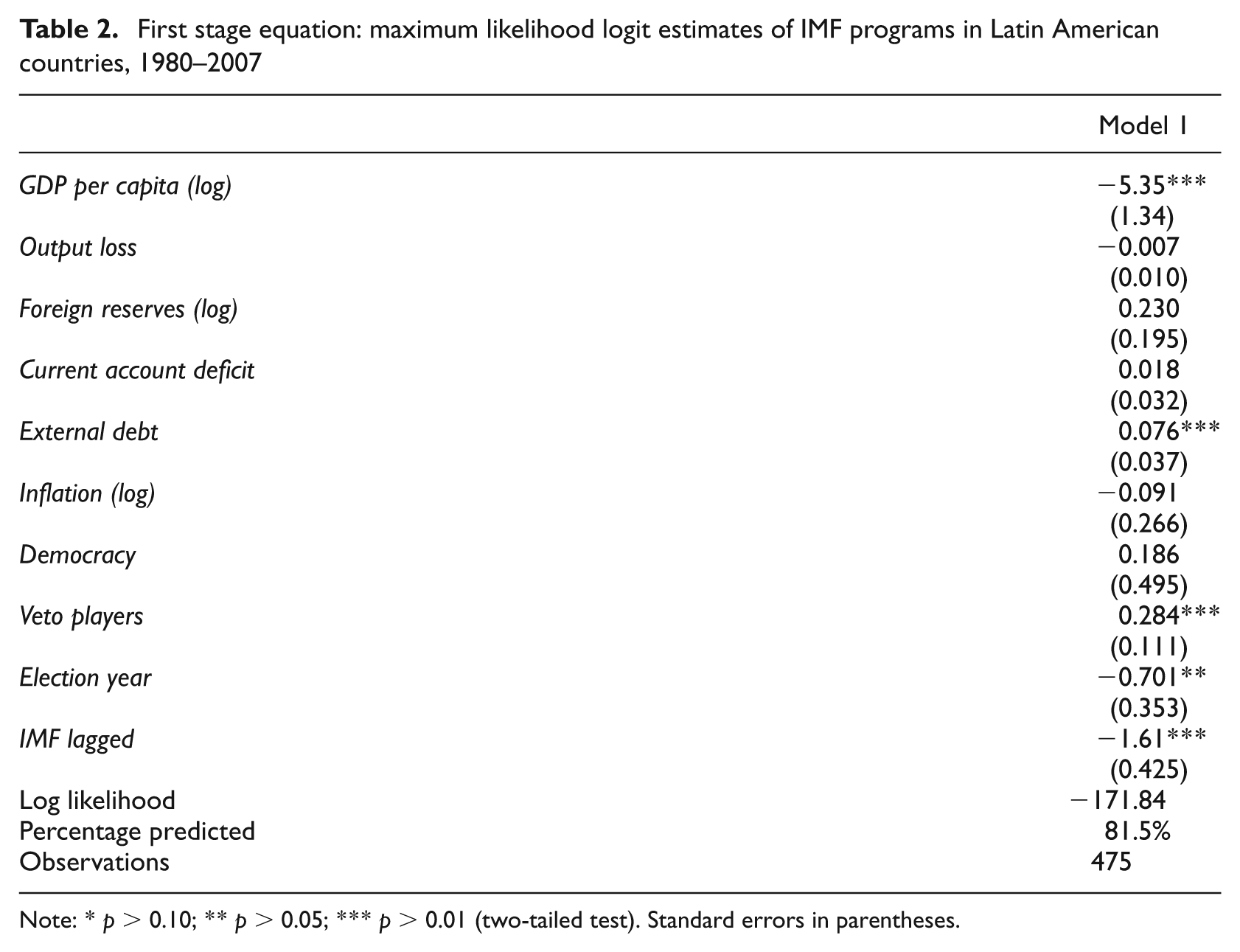
As called for by our research design, we first estimate a logit model that predicts the characteristics of governments that enter into programs with the International Monetary Fund. The dependent variable in this first stage logit equation is the dichotomous variable IMF programs, which measures whether a government entered into an agreement with the IMF or not. The results from the equation (i.e. logit estimates) of our first-stage model are reported in model 1, Table 2.
First stage equation: maximum likelihood logit estimates of IMF programs in Latin American countries, 1980–2007
Note: * p > 0.10; ** p > 0.05; *** p > 0.01 (two-tailed test). Standard errors in parentheses.
Our expectation that countries facing macroeconomic difficulties are more likely to enter into agreements with the IMF is borne out by the results in this equation. The results suggest that countries with lower levels of GDP per capita are more likely to ask for the IMF’s assistance, since the coefficient on GDP per capita (log) (−5.35) is negative and highly significant. In addition, the positive and highly significant coefficient on external debt (0.076) indicates that countries with high levels of external debt are more likely to sign agreements with the Fund. Finally, the coefficients on current account deficit and output loss have the expected signs, but lack statistical significance.
The results also suggest that, as the number of veto players (0.284) increases, governments in Latin American countries are significantly more likely to enter into IMF agreements. This supports previous studies that find a positive relationship between the number of veto players and the likelihood of entering into agreements with the IMF (Vreeland, 2003). We also find a negative and significant relationship between election year (−0.701) and participation in IMF programs. Consistent with previous literature (Przeworski and Vreeland, 2000; Vreeland, 2003), this finding suggests that, during an election year, Latin American countries are significantly less likely to enter agreements with the IMF in order to avoid possible repercussions of signing an unpopular agreement. Contrary to our expectations, previous participation in IMF programs—IMF lagged—negatively influences IMF participation in Latin America. The coefficient on IMF lagged (−1.61) is negative and highly significant. As model 1 in Table 2 indicates, the specification of the logit selection equation performs well, correctly predicting about 82% of all observations in the sample.
Second stage: negative binomial equation
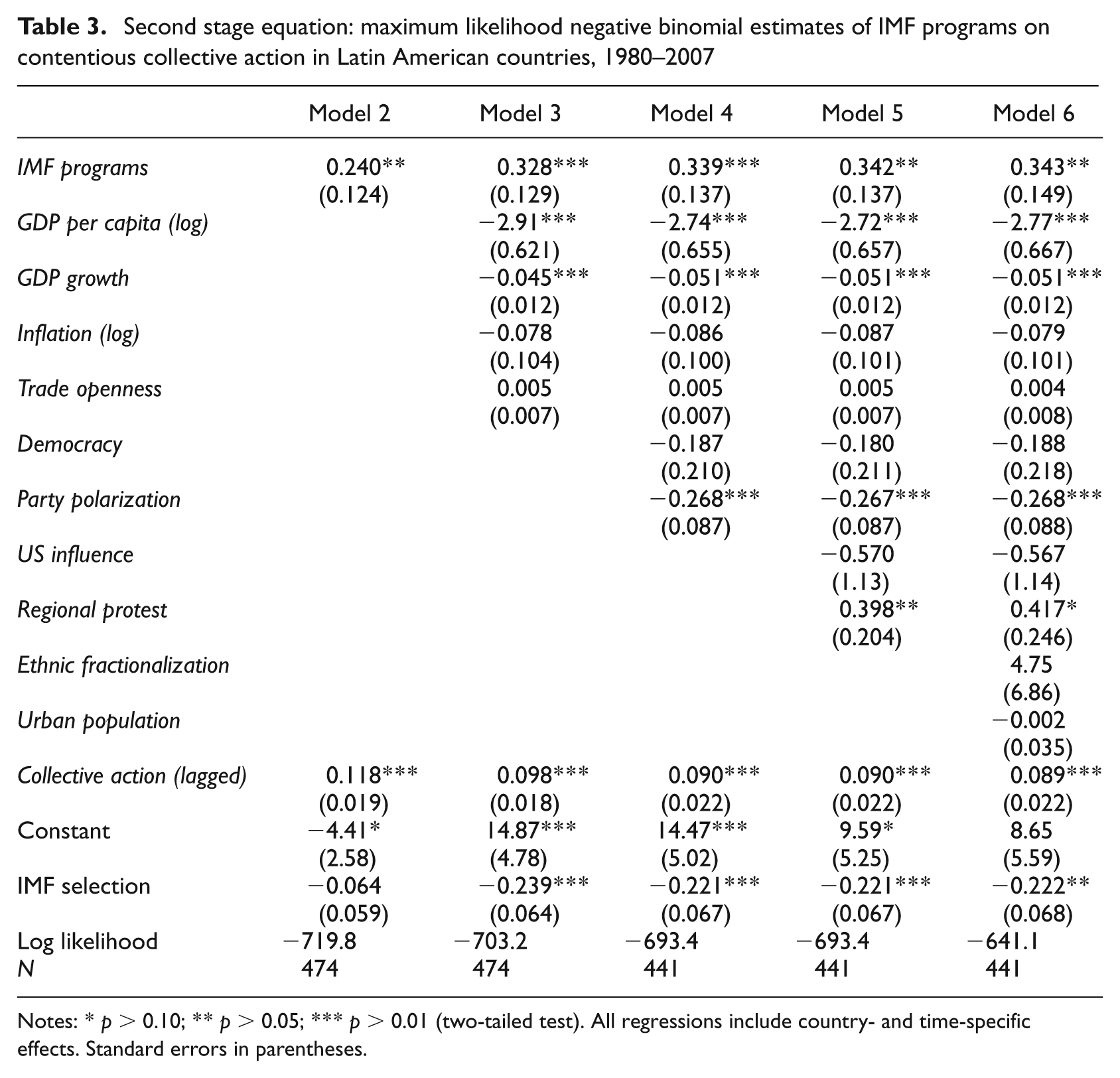
Model 2 in Table 3 presents the results from the baseline negative binomial regression where we estimate the effects of participating in IMF programs on contentious collective action. We use both country dummies and year dummies to control for country-specific and time-specific fixed effects. The specification in the baseline model includes our main independent variable (IMF programs), the lagged dependent variable and the selection effect of IMF programs derived from our first-stage logit equation—IMF selection. The coefficient of IMF programs (0.240) is positive and significant. These results provide initial support for our main hypothesis. In subsequent models of Table 3, we sequentially add all of our control variables to the baseline specification described above.
Second stage equation: maximum likelihood negative binomial estimates of IMF programs on contentious collective action in Latin American countries, 1980–2007
Notes: * p > 0.10; ** p > 0.05; *** p > 0.01 (two-tailed test). All regressions include country- and time-specific effects. Standard errors in parentheses.
In model 3, for example, we incorporate a battery of economic control variables that account for various theoretical explanations linking economic deprivation and contentious collective action. In models 4–6, we sequentially add several domestic and international political variables (models 4 and 5) as well as social controls (model 6) to the specification. These models account for political opportunities, diffusion and other socio-demographic arguments, respectively. The coefficient on IMF programs remains positive and significant in all of these models. The results statistically corroborate our hypothesis and show that entering into agreements with the IMF increases the likelihood of contentious collective action.
To analyze the substantive effect of the statistical results presented above, we use the estimates from model 6 to calculate the marginal effect of participation in IMF programs on contentious collective action. Our results indicate that the likelihood of contentious collective action increases by a substantial 38% when Latin American countries sign agreements with the IMF, even when controlling for all other factors. This indicates that there exists strong statistical and substantive support for our hypothesis.
Regarding arguments linking economic deprivation and contentious collective action, our results reveal that GDP per capita and GDP growth have a negative and highly significant effect on contentious collective action throughout all models. This confirms claims which suggest that low levels of economic growth foster societal conflict (Annett, 2001). Trade openness is also positive on all models, but statistically insignificant. The coefficient on inflation (log) is negative and insignificant. In sum, we only find statistical support for the argument linking relative deprivation and economic grievances when the former is operationalized using GDP per capita and GDP growth. 14
Turning our attention to arguments linking political opportunities and contentious collective action, our findings reveal that party polarization has a consistently negative and significant effect on contentious collective action (models 4–6). This result contradicts our expectation that higher levels of party polarization foster higher levels of collective action. In contrast, we do not find statistical support for previous explanations linking democracies with the dissidents’ need for contentious collective action as well as those that associate economic and political ties with the USA with low levels of social protest. While the coefficients of democracy and US influence have the expected positive signs in all models, they are not statistically significant. Therefore, we find weak support for the political opportunity arguments in our analysis.
In model 5, we find strong support for the diffusion argument. The coefficient on regional protest (0.398) is positive and significant. This supports previous findings that document a positive relationship between regional protest and domestic contentious collective action (Arce, 2010; Givan et al., 2010). On the other hand, we do not find statistical evidence corroborating the claims that higher levels urban population and ethnic fractionalization have a positive effect on contentious collective action. Our last variable, the estimate of contentious collective action lagged, is positive and highly significant in all models, suggesting that contentious collective action at time t − 1 increases the likelihood of social protest at time t, and is in line with previous findings in the literature (e.g. Muller, 1985; Ortiz, 2007; Poe et al., 1999). While we are confident about the accuracy of our results, we further check their validity by conducting additional robustness tests below.
Robustness tests and diagnostic checks
Our argument indicates that deciding to participate in an IMF program can increase the likelihood of contentious collective action in a Latin American country since it can make people perceive their governments as caving in and catering to the desires of international agencies (external actors). Such loss of legitimacy can lead to the questioning of the government’s legitimacy and increased protests. Therefore, to test the robustness of our results, we first estimated more specifications of our second stage binomial negative regression model by adding other variables that might, according to previous research, influence the incidence of discontent.
First, Remmer (1986) and Hutchinson and Noy (2003) suggest that the history of IMF programs in Latin America has been one of failure rather than success. To ensure that the likelihood of contentious collective action is primarily motivated by the popular response to a government’s decision to participate in these programs and not only linked to the implementation of austerity policies of such programs, we introduce a variable that measures the implementation of austerity programs into our model. 15 Measuring the success rate of IMF programs in recipient countries is a highly contested issue in the academic community, not only because the IMF asks recipient countries to simultaneously comply with a variety of structural conditions, but also because the publicly available data on compliance only includes information beginning in 1994. Nsouli et al. (2004), however, find robust evidence linking better-implemented programs with stronger fiscal outcomes. Thus we use data on government budget deficit as a proxy for our variable implementation of austerity measures.
Related to the argument above, it is also possible that the increase in the likelihood of contentious collective action is not driven by the perception that the domestic government is selling-out or caving in to the pressures of an international agent, but by the cumulative effects of being under IMF agreements over time (Abouharb and Cingranelli, 2007). We tested this possibility by introducing the variable Years under IMF, which is operationalized as the running count of the years a country has been under IMF programs. 16 Lastly, to account for the potential that governmental repression is driving the increase of contentious actions (Carey, 2006; Moore, 1998, 2000; Ortiz, 2007, 2013), we introduced the variable repression into our model. Repression, drawn from the CIRI dataset (Cingranelli and Richards, 2010), measures the extent to which the freedoms of assembly and association are subject to actual governmental limitations or restrictions (as opposed to strictly legal protections). 17
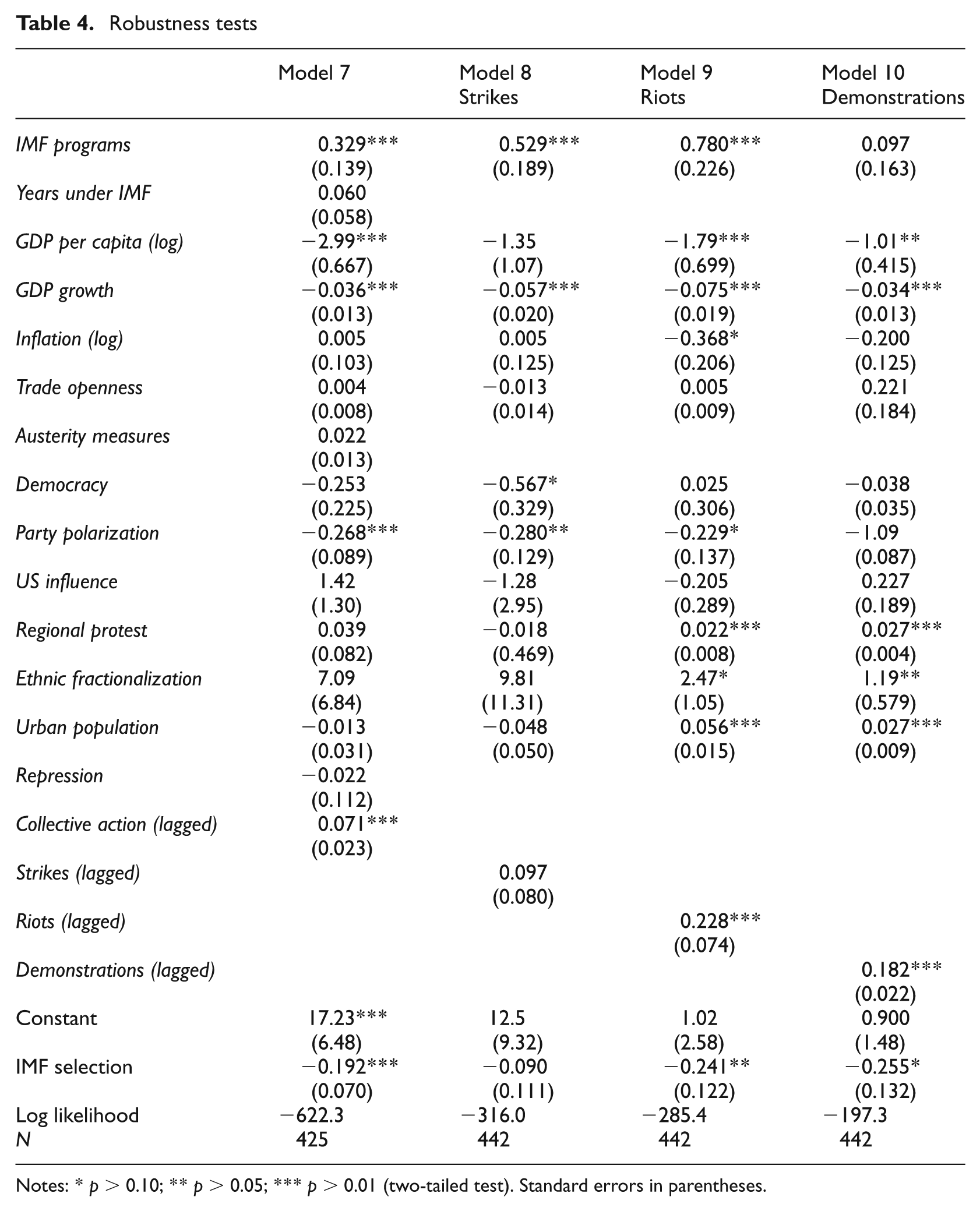
The results of model 7 in Table 4 show that the coefficient of IMF programs remains positive and highly significant (0.329), even when controlling for these three additional variables. Repression reduces the incidence of contention, although not significantly so. In addition, although both the implementation of austerity measures and the number of years under the IMF programs increase the likelihood of contentious collective action in Latin American countries, they do not significantly do so. On the other hand, entering into agreements with the IMF significantly increases the likelihood of contentious collective action in Latin American countries during the 1980–2007 period. In substantive terms, this result indicates that the likelihood of protest increases by 36% in years in which Latin American countries sign agreements with the IMF. 18
Robustness tests
Notes: * p > 0.10; ** p > 0.05; *** p > 0.01 (two-tailed test). Standard errors in parentheses.
Finally, we test robustness using each of the individual categories of contentious collective action (i.e. strikes, riots and anti-government demonstrations) as dependent variables in the second stage of our model. Doing so allows us to discount the possibility that the statistical and substantive relationship that we found before is somehow driven by our additive index of contentious collective action. 19 The results reported in models 8–10 are supportive of the claims made above, although they are stronger for the strikes and riots measures than for the demonstrations variable. In models 8 and 9, where the dependent variables are strikes (0.529) and riots (0.780), the coefficient on IMF programs remains positive and highly significant. In model 10, where the dependent variable is demonstrations (0.41), the coefficient remains positive, although it is not statistically significant. The results of these models suggest that, when Latin American countries enter into an agreement with the IMF, the probability of strikes significantly increases by 30% whereas the likelihood of riots significantly increases by 14%. These results are meaningful because they highlight that signing an agreement with the IMF leads particularly to an increase in the likelihood of violent demonstrations as well as large-scale, worker-organized contention, vis-à-vis peaceful demonstrations. The increase in the likelihood of strikes is particularly interesting, since unions and union workers are potentially the ones most affected by the signature of such an agreement, while at the same time, they have enough resources to quickly organize and mobilize at the signature of the agreement. Although mobilization in Latin America is less and less union-inspired (Almeida and Johnston, 2006; Almeida, 2008b), strikes were still a significant response to governments’ decisions to enter into agreements with the IMF during the 1980–2007 period.
Conclusions
Does participation in IMF programs lead to a higher likelihood of contentious collective action across Latin American countries? We argue that deciding to participate in IMF programs fuels contentious actions in Latin America as citizens perceive that signing an agreement with the IMF challenges the national sovereignty of their country. This, in turn, decreases the government’s legitimacy and makes them more likely to be perceived as caving to the pressures of international agents. That is, when external agents to the state get involved in domestic policy-making, people lose their belief in the notion that the existing political institutions represent the interests of the society and engagement in contentious action increases as a measure to demand accountability. Indeed, our findings indicate that citizens perceive that their political elites are “selling out” when they acquiesce to strict austerity measures by entering into agreements with the IMF, and they express their discontent through contentious actions.
This paper has numerous implications. As mentioned before, several studies have analyzed either the effects of globalization on political outcomes in Latin America (Adler Hellman, 2008; Arce and Bellinger, 2007; Friedman and Hochstetler, 2002; López Maya and Lander, 2005; Spronk and Webber, 2008) or the effects of IFI’s on repression and political instability across developing nations (Abouharb and Cingranelli, 2006, 2007; Dreher and Gassebner, 2012). We depart from those analyses by developing a theoretical argument that explains the pivotal role of the Fund—as opposed to the policies it mandates—as an important determinant of contentious collective action in Latin America. Our results thus indicate that scholars should take more seriously the role of this international actor in social unrest.
Second, we also contribute to a growing literature in sociology and political science studying the link between international organizations and democracy. This study shows that participation in IMF-sponsored economic programs has a positive effect on contentious collective action. Increasing levels of contentious collective action may, in turn, harm the prospects of social, political and economic stability across Latin American countries. Consequently, the results presented in this paper should motivate scholars to analyze more carefully the relationship between IMF programs and democracy.
Methodologically, our regional focus allows us to uncover political processes and potential diffusion effects that are more likely to explain the relationship between the IMF and contentious collective action in Latin America than in other regions of the world. These results highlight that signing an agreement with the IMF led particularly to an increase in the likelihood of violent demonstrations as well as large-scale, worker-organized contention in Latin America during the 1980–2007 period. Thus, this study has a key policy implication: Latin American governments should try to develop solid institutions and policies before asking for assistance from the Fund as participation in its programs increases social unrest. We lack space here to analyze what institutions and/or policies should be created, but one possibility is to design monetary institutions (such as more independent central banks) that insulate economic decisions from the government and promote economic stability.
The results presented in this paper are, however, just a step forward towards a more fully developed understanding of the connections between stabilization and structural adjustment programs sponsored by the IMF and their social and political outcomes such as contentious collective action. The analysis of this paper can be extended in several different ways. First, it would be useful to extend the scope of this paper and study the relationship between IMF programs and contentious actions across different regions of the world (i.e. Africa, Asia and Eastern Europe). Second, important insights into the role of the IMF in social unrest may be gained by theorizing and empirically testing how and why different levels of conditionality affect contentious collective actions across developing countries. Further, this analysis can be extended by examining how domestic political institutions mediate the effects of IMF participation on contentious collective action. That is, scholars should focus on specific domestic conditions (party alliances, union density, electoral volatility, infrastructure development) that could potentially act as mediators of the effects of signing an agreement with the IMF on contentious collective action.
Footnotes
Acknowledgements
We are grateful to the Stone Center for Latin American Studies and the Center of Inter-American Policy and Research at Tulane University for their support while developing this research. We also want to thank Glenn Palmer and the anonymous reviewers whose helpful suggestions greatly improved this article.
Funding
This research received no specific grant from any funding agency in the public, commercial, or not-for-profit sectors.