



Abstract
This paper provides a formal assessment of the effectiveness of the use of fear and anger on the decision to initiate a crisis. The formalization employs the finding that fearful decision-makers are risk-averting across frames and make pessimistic risk assessments, and that angry decision-makers are risk-seeking across frames and make optimistic risk assessments. The work presented here employs a sequential decision analysis based on the two-sided incomplete information version of the Traditional Deterrence Game. The analysis shows when the use of the emotions of fear and anger is effective, ineffective, and counterproductive in altering the decision to initiate or not initiate a crisis.
Introduction
An important insight generated by political psychologists, among others, holds that the choices leaders make during international crises can be strongly influenced by their perceptions, levels of stress and emotional states. Both theoretical and experimental work suggest that emotions play a role in a wide array of issues, including defining and changing a decision-maker’s values and preferences (Bueno de Mesquita and McDermott, 2004; Howard, 1993), shaping decision-making style (Hertel et al., 2000), and affecting memory, judgment and the cognitive processes responsible for choice (Lerner and Keltner, 2000, 2001; Schwarz, 2000).
We address the following research question. Under what circumstances does an emotional decision-maker choose an act that differs from the act that would have been chosen in a non-emotional state, that is, when do emotions matter? To analyze a decision-maker’s risk-related behavior in an emotional state, we are best served by a structurally simple model wherein the decision-maker chooses between a sure thing and a gamble. There are many such models. The analysis presented here employs a sequential decision analysis that is based on the Traditional Deterrence Game.
The Traditional Deterrence Game is an appropriate model for several reasons. One reason is that there are strong theoretical and empirical reasons to believe that fear and anger are the emotions that are most likely to surface prior to, and during, international crises (Crawford, 2000: 130). Deterrence theorists in particular emphasize the deliberate production of fear to induce the opponent’s compliance (Schelling, 1966). This compliance can take the form of not challenging the status quo in the first place. Or, if the status quo is threatened, this compliance can induce fear regarding the consequences of escalation, as in Stalin’s decision to lift the 1948 blockade of Berlin to avoid a general war with the West (Levy, 2008).
Anger, too, may be commonplace in a crisis context. Anger can be the reaction to being challenged in the first place, as exemplified by President Kennedy’s reaction to Soviet missiles in Cuba (Steinberg, 1991). Anger may also be deliberately or inadvertently induced in another player such that the angry player initiates a crisis. Examples include the 1987 Palestinian Intifada (Dacey, 1998) and Germany’s initiation of the 1905 First Moroccan Crisis following the angry reaction of key German leaders to the British giving France a “free hand” in Morocco (Hewitson, 2000: 585).
Another reason why the Traditional Deterrence Game is an appropriate model is that it is rich enough to generate a set of interesting results that compares decision-making in emotionally neutral and emotional states. Moreover, the model is parsimonious and avoids the problem of getting bogged down in the myriad special cases that would invariably be produced by employing more complicated models.
We hold the view that the emotions are not incompatible with the presumption of a rational decision-maker (Brams, 1997; de Sousa, 1987; Frank, 1988; Lupia and Menning, 2007, 2009), and thereby that formal models can shed light on the conditions under which informal claims about emotions in politics hold (Lepgold and Lamborn, 2001; Lupia and Menning, 2007, 2009). Previous studies that have employed formal models to examine emotions have generated interesting results on the role of anger/frustration (Brams, 1997, 2011) and the role of scare tactics or the use of fear vis-à-vis citizens (Lupia and Menning, 2007, 2009). Our research extends this line of inquiry in various ways. First, we examine the role of fear and anger in the context of a single, general model that allows us to generalize our findings to a reasonably large class of crisis decision-making settings. Second, we relax the Lupia and Menning (2009) assumption that decision-makers are risk-neutral. Risk neutrality is a perfectly reasonable assumption to employ for many analyses. However, we are interested in integrating the results from experimental work that have shown that being in a fearful or angry state has different, yet predictably reliable, effects on the risk attitudes and behavior of the decision-maker (Druckman and McDermott, 2008).
The formal account presented here incorporates the findings of the experimental work of Lerner and Keltner (2000, 2001), who found that fearful decision-makers are risk-averting across frames and make pessimistic risk assessments, and angry decision-makers are risk-seeking across frames and make optimistic risk assessments. It is important to note that the results reported by Lerner and Keltner have stood up to scrutiny (Angie et al., 2011; Tsai and Young, 2010), and recently have been applied to explain the different outcomes of the Arab Spring, where fearful Algerians chose not to rebel against their government, but angry Tunisians and Egyptians chose to rebel (Pearlman, 2013). Consequently, the Lerner and Keltner findings provide a solid foundation for also analyzing the effects of fear and anger in crisis decision-making.
The sequential decision analysis based on the two-sided incomplete information version of the Traditional Deterrence Game is a model that is compatible with the decision-theoretic experimental design employed by Lerner and Keltner (2000, 2001). The model allows us to identify the conditions under which an individual, under fear, would be induced to choose the risk-averting act when the same individual, under emotional neutrality, would choose the risk-seeking act. Similarly, the model allows us to identify the conditions under which an individual, under anger, would be incited to choose the risk-seeking act when the same individual, under emotional neutrality, would choose the risk-averting act.
The analysis presented here shows that the effectiveness of fear in inducing risk-averting behavior depends upon whether the target of the inducement faces either a small loss or a large loss. If the loss is small, then instilling fear in order to convert Challenger’s behavior from risk-seeking to risk-averting is ineffective in the majority of cases. However, if the loss is large, then instilling fear to convert Challenger’s behavior from risk-seeking to risk-averting is effective in the majority of cases. We also derive the likelihoods of observing the various cases of small losses and large losses. Interestingly, there is a case for which the use of fear is actually counterproductive. Here, the use of fear reverses the situation from the desired choice of the risk-averting act, chosen in an emotionally neutral state, to the undesired choice of the risk-seeking act, chosen under fear. Finally, the results for the anger cases parallel the results for fear under large losses. That is, instilling anger, in order to convert the individual’s behavior from risk-averting to risk-seeking, is effective in the majority of cases.
Literature review
The causal relationship between emotional states and decision-making can be examined from either of two directions. On the one hand, decision-making can influence the emotions, and on the other hand, the emotions can influence decision-making (Marcus, 2000). The former line of inquiry is particularly interested in the post-decisional emotions of disappointment and regret, which have been subject to extensive formal analyses (for an excellent example, see Loomes and Sugden, 1982). This line of inquiry is not pursued here.
This paper pursues the line of inquiry wherein the emotions can have a causal influence on decision behavior. Others have pursued aspects of this research by examining the causal influence of the emotions on the various components or inputs of a decision problem, including the specification of goals, values, preferences and payoff valuations, and the assessment of risk (Fischhoff, et al., 2005; Lerner and Keltner, 2000, 2001). While emotions may not be the sole determinate of decision-making, emotions clearly play a part in shaping preferences, actions and ultimately outcomes (Bueno de Mesquita and McDermott, 2004: 280).
One view holds that various emotions are implicit in many of the major theories of international relations and, at a minimum, warrant explicit articulation and investigation (Crawford, 2000: 155). Liberal internationalists may rely on implicit claims about the emotion of empathy, whereas realists in general, and deterrence theorists in particular, focus on the visceral emotions of fear and anger. Even though emotions may be ubiquitous in political life, we adopt the view in this paper that fear and anger are the emotions that are most likely to surface prior to, and during, international crises (Crawford, 2000: 130).
Crawford (2000) notes that deterrence theorists, and Schelling (1966) in particular, emphasize the deliberate production of fear to induce the opponent’s compliance, whereas Brams (1997, 2011) examined frustration-aggression (anger) and argued that frustration, and thereby anger, is instilled by the structure of the game an actor is compelled to play. A player can employ anger to try to change the game, thereby alleviating the frustration. Thus, contrary to conventional wisdom, visceral or negative emotions can help an actor improve her situation (Brams, 2011: 278), provide information (Schwarz, 2000) or signal a serious threat or be employed to improve her payoff (Frank, 1998).
One concern in studying emotions formally is the difficulty associated with predicting the impact of emotions on the decision-maker’s behavior. It is well known that the emotional state of fear can induce either a flight or fight response and that decision-makers may exhibit a wide range of responses to the same emotion at different times and in different contexts. The primary experimental studies show, however, that specific emotions produce different, but reliably predictable, responses by individuals (Lerner and Keltner, 2000, 2001). The Lerner and Keltner research focuses on determining the effects of fear and anger on judgment and choice. In particular, Lerner and Keltner (2001: 148–149) find that fearful individuals make risk-averting choices across frames and make pessimistic risk assessments, where pessimism is an increased probability of obtaining the downside outcome. In contrast, angry individuals make risk-seeking choices across frames and make optimistic risk assessments, where optimism is a decreased probability of obtaining the downside outcome.
The primary assumption of the ensuing analysis is that the results produced by Lerner and Keltner (2000, 2001) capture the relevant influences of fear and anger on the decision-making behavior of political leaders. The primary assumption is sound in that the results reported by Lerner and Keltner have stood up to scrutiny (Angie et al., 2011; Tsai and Young, 2010). As such, the Lerner and Keltner (2000, 2001) results provide a sound foundation for the analysis of the effects of fear and anger in crisis decision-making.
The Traditional Deterrence Game
The analysis presented here employs a sequential decision analysis that is based on the Traditional Deterrence Game. 1 The Traditional Deterrence Game (Morrow, 1994; Zagare and Kilgour, 1993, 2000) involves two players: Challenger and Defender. Challenger 2 moves first and can choose Threaten, that is, choose to initiate a crisis, or Not Threaten, that is, choose not to initiate a crisis. If Challenger chooses Not Threaten, then Challenger chooses the risk-averting act, and the game terminates in the status quo (SQ) outcome. 3 If Challenger chooses Threaten, then Challenger chooses the risk-seeking act and Defender can choose either Resist or Give In. If Defender chooses Give In, then the game terminates in Defender’s acquiescence (ACQ). If Defender chooses Resist, then Challenger can choose either Escalate or Back Down. If Challenger chooses Escalate, then the game terminates in conflict (WAR); if Challenger chooses Back Down, then the game terminates in Challenger’s capitulation (CAP). The tree for the Traditional Deterrence Game is presented in Figure 1.
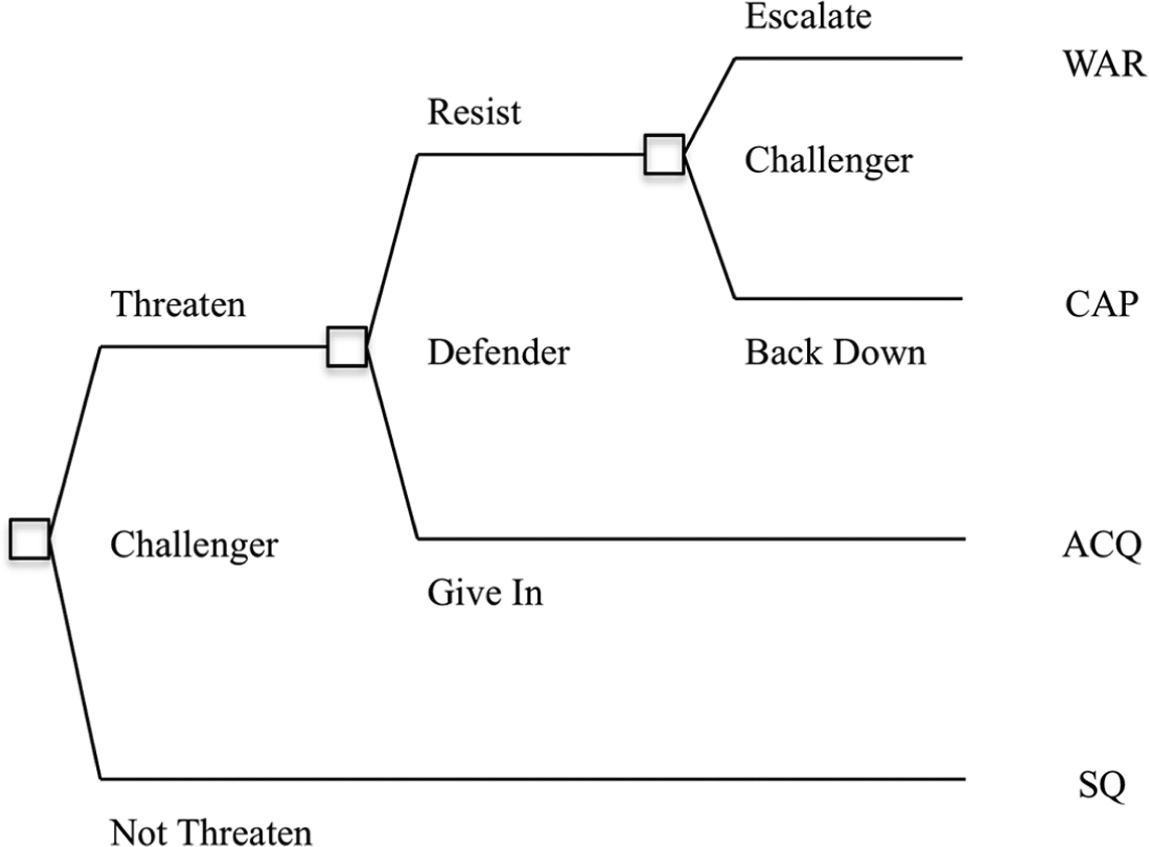
The Traditional Deterrence Game.
The Traditional Deterrence Game posits that Challenger and Defender each can be one of two types, resolute or irresolute, specified by their preference orderings, as follows: 4




In what follows, we employ a sequential decision analysis based on the two-sided incomplete information version of the Traditional Deterrence Game to analyze the effectiveness of fear and anger. 5 The tree for the decision problem, from Challenger’s perspective, is presented in Figure 2.
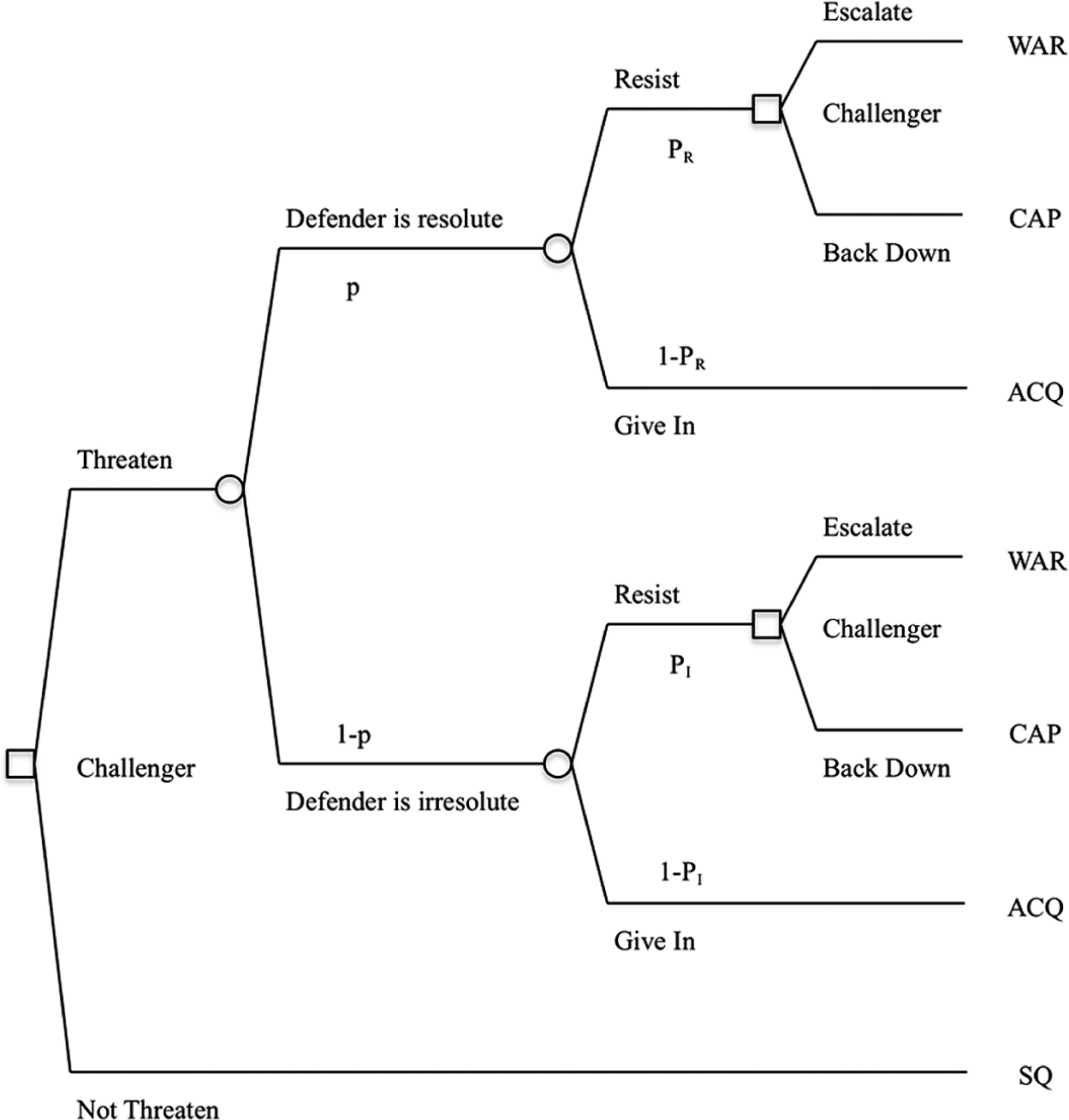
The two-sided incomplete information version of the Traditional Deterrence Game as seen by Challenger.
Challenger holds the probabilities p, PR and PI, where p is Challenger’s probability that Defender is resolute, PR is Challenger’s conditional probability that Defender chooses Resist given that Defender is resolute, and PI is Challenger’s conditional probability that Defender chooses Resist given that Defender is irresolute. The value of the probability p is determined by Challenger via a straightforward assessment of the likelihood of Defender’s type. The values assigned to the conditional probabilities PR and PI deserve comment. The values of PR and PI are determined via Challenger’s view of Defender’s decision-making. Challenger knows that Defender holds a probability q that Challenger is resolute, and has a valuation function V defined over the payoffs. Challenger also knows that Defender sees the choice between Resist and Give In as shown in Figure 3.
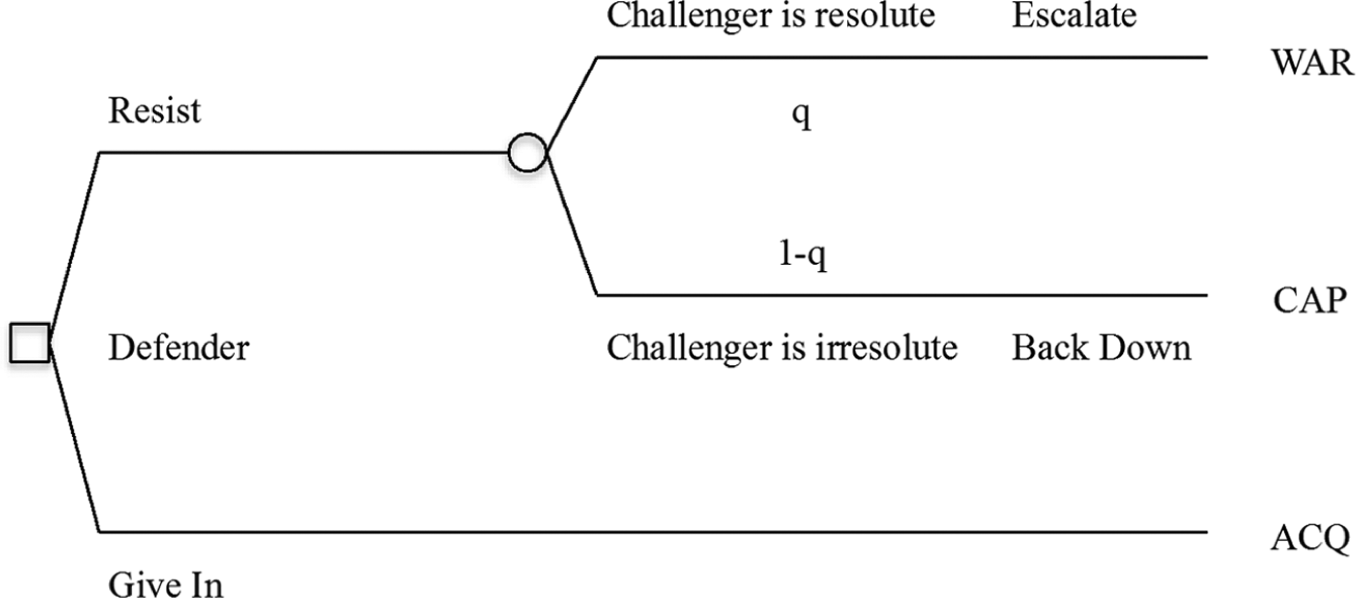
Challenger’s view of Defender’s decision regarding Resist and Give In.
Finally, Challenger knows that Defender chooses Resist over Back Down if and only if

If Defender is resolute, so that CAP
Returning to Figure 2, if Challenger is resolute, then the choice of Threaten yields WAR with probability pPR, WAR with probability p(1−PI) and ACQ with probability (1−p)(1−PI). Contrariwise, if Challenger is irresolute, then the choice of Threaten yields CAP with probability pPR, CAP with probability p(1−PI) and ACQ with probability (1−p)(1−PI). Therefore, since PR = 1, a resolute Challenger chooses Threaten over Not Threaten if and only if

and an irresolute Challenger chooses Threaten over Not Threaten if and only if

Note that, because ACQ
Prospect theory and the analysis of decision-making under emotional neutrality
We first treat decision-making under emotional neutrality and presume that the emotionally neutral Challenger has the value function of prospect theory. We make this assumption because prospect theory has withstood serious scrutiny and “30 years after its invention, prospect theory is still the only theory that can deliver the full spectrum of what is required for decision under uncertainty, with a natural integration of risk and ambiguity” (Wakker, 2010: 2). Simply put, prospect theory captures decision-making in a normal, that is, non-emotional, state.
Prospect theory, as advanced by Kahneman and Tversky (1979, 2000) and Tversky and Kahneman (1992), posits an S-shaped reference-dependent value function. The value function is concave for gains and convex for losses, and is more steeply sloped over losses than over gains. These properties are referred to as risk aversion over gains, risk seeking over losses and loss aversion, respectively. The S-shaped value function is shown in Figure 4.
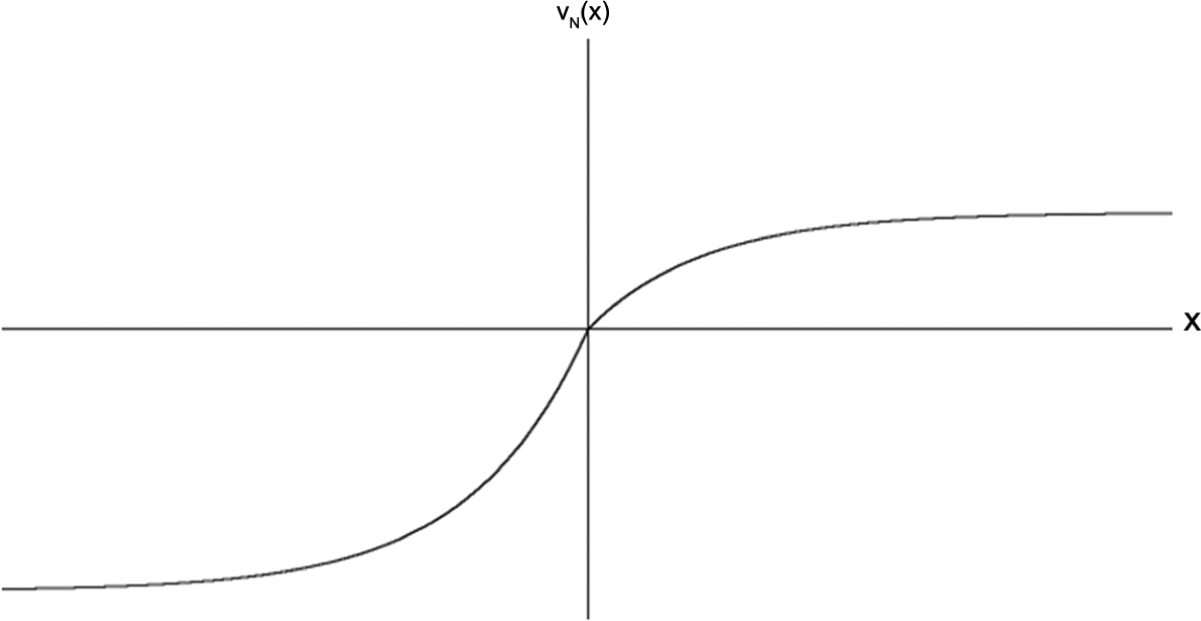
The S-shaped value function of prospect theory.
Prospect theory also posits a non-linear probability weighting function which over-weights low probabilities and under-weights medium and high probabilities (Tversky and Kahneman, 1992: 298). For ease of exposition, we will not employ the probability weighting function of prospect theory. Rather, we model the behavior of an emotionally neutral Challenger via the expected value of the prospect-theoretic value function, and we model pessimism (optimism) as an increase (decrease) in the probability of the downside outcome. The modeling of pessimism and optimism employed here is consistent with the formal analysis of pessimism and optimism employed in prospect theory (Wakker, 2010: 172–176).
Let vN denote the value function of prospect theory employed by Challenger under emotional neutrality. Then, consistent with prospect theory, vN displays risk aversion over gains, risk seeking over losses and loss aversion. Following Wakker (2010: 252), and for ease of exposition, we assume vN(SQ) = 0. 7 Also for ease of exposition, let rN denote Challenger’s probability, under emotional neutrality, that Defender chooses Resist, that is, let rN = p+ (1−p)PI. Then, a resolute Challenger will choose Threaten under emotional neutrality if and only if

and an irresolute Challenger will choose Threaten under emotional neutrality if and only if

The critical risk value of rN for a resolute Challenger is found by solving the equation

for rN. Thus, the critical risk value of rN, denoted CRN resolute, is

Similarly, the critical risk value of rN for an irresolute Challenger is found by solving the equation

for rN. Thus, the critical risk value of rN, denoted CRN irresolute, is

Challenger’s decision rule, stated in terms of the critical risk value, is as follows. If rN < CRN resolute or rN < CRN irresolute, then Challenger chooses Threaten, and thereby chooses the risk-seeking act and receives either the loss WAR or the gain ACQ if resolute or the loss CAP and the gain ACQ if irresolute. On the other hand, if CRN resolute < rN or CRN irresolute < rN, then Challenger chooses Not Threaten, and thereby chooses the risk-averting act and receives the sure thing payoff SQ.
The analysis of decision-making under fear
Fearful individuals make risk-averting choices across frames and make pessimistic risk assessments (Lerner and Keltner, 2001: 148–149). Thus, an adversary would instill fear in a resolute Challenger in an effort to induce Challenger to switch from the choice of Threaten under emotional neutrality to Not Threaten under fear, thereby averting the WAR outcome.
An example of fear is as follows. Lebow and Stein (1995: 160) claim that “…proponents of MAD stressed that Soviet leaders had to be convinced that the United States would retaliate if it or its allies were attacked and come to their assistance if they were challenged in other ways. [D]eterrence was based on the premise that both superpowers had an overriding fear of nuclear war.” More specifically, near the end of the 1973 October War between Egypt and Israel, the patron of Egypt, the USSR and its leader Leonid Brezhnev, were “fearful of escalation if Soviet forces were deployed in positions in Egypt where they were likely to encounter advancing Israelis” (Lebow and Stein, 1995: 164). “Fear of war restrained the Soviet Union” (Lebow and Stein, 1995: 164) from threatening or taking any action.
Another example of fear includes US behavior during the Vietnam War, 1965–1973. If we presume that the status quo was the division of Vietnam at the 17th parallel, then the USA was exceptionally reluctant to overturn that status quo. “US policymakers were fearful that vigorous military action against the North Vietnamese, especially in the form of troops on the ground invading North Vietnam, might provoke intervention by the Chinese” (Ray, 2008: 185). This fear, or explicit danger, restrained the USA from violating the status quo even though critics of American strategy in Vietnam claimed that this step may be necessary to win the war (Ray, 2008).
We translate “risk-averting across frames” to mean that, in the fear state, the decision-maker has a value function that exhibits risk aversion over both gains and losses. Let vN and vF denote the value functions under neutrality and fear, respectively. Then vN(x) = vF(x) for x≥ 0, so that both functions exhibit risk aversion over gains. Note that this entails vF(SQ) = 0 since vN(SQ) = 0, by assumption. However, vN exhibits risk seeking over losses whereas vF exhibits risk aversion over losses. We presume that vF defined over losses is a smooth continuation of vN defined over gains. Basically, we are presuming that vN is composed of segments of two functions—an everywhere-risk-averse function and an everywhere-risk-seeking function. In presuming that vF over losses is a smooth continuation of the risk-aversion segment of vN, we are simply assuming that the decision-maker reverts to the everywhere-risk- averse function that generated the risk-aversion segment of vN. 8
We translate “pessimistic risk assessment” to mean that a decision-maker places a higher value on the probability of loss under fear than the decision-maker places on the probability of loss under emotional neutrality. Let rF denote Challenger’s probability, under fear, that Defender chooses Resist. That is, let rF be Challenger’s value of p+(1−p)PI under fear. Then the interpretation of “pessimistic risk assessment” as an increased likelihood of the downside outcome amounts to rN < rF. 9
The presumption that the function vF(x) defined over losses is a smooth continuation of the function vN(x) defined over gains, together with the presumption that vN(x) defined over losses exhibits loss aversion, mandates that vN(x) and vF(x) must intersect in the domain of losses. Let Δ denote the payoff value where the functions intersect, that is, the value of x such that vN(x) = vF(x). 10 The graph of the value functions vN and vF is presented in Figure 5.
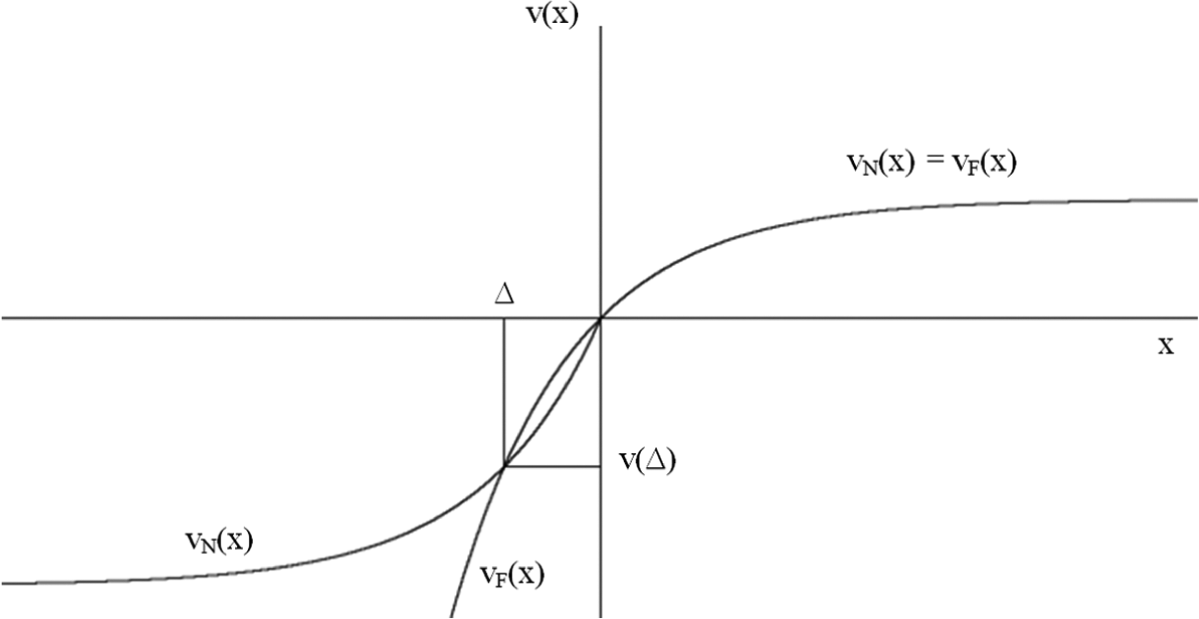
The value functions under emotional neutrality and fear.
A fearful resolute Challenger resolves the decision problem by choosing Threaten in preference to Not Threaten if and only if

Otherwise, a fearful resolute Challenger resolves the decision problem by choosing the sure thing Not Threaten. The critical risk value of rF is found by solving the equation

for rF. Thus, the critical risk value of rF, denoted CRF, is

The decision rule, stated in terms of the critical risk value, is as follows. If rF < CRF, then a fearful Challenger chooses the gamble, and thereby chooses the risk-seeking act and receives either the loss WAR or the gain ACQ. On the other hand, if CRF < rF, then a fearful Challenger chooses the sure thing, and thereby chooses the risk-averting act and receives the sure thing payoff SQ.
Defender will instill fear in a resolute Challenger if Defender perceives that Challenger will choose Threaten under emotional neutrality, that is, if Defender perceives that rN < CRN resolute. 11 We will say that instilling fear is effective if it induces Challenger to switch from choosing Threaten to choosing Not Threaten, that is, if rN < CRN resolute and CRF < rF. Contrariwise, we will say that instilling fear is ineffective if it fails to induce Challenger to switch from choosing Threaten to choosing Not Threaten, that is, if rN < CRN resolute and rF < CRF 12
In order to assess the effectiveness of the use of fear, we must first account for all of the possible cases that can arise. We begin with the cases wherein Defender properly perceives that Challenger will select Threaten. Owing to the intersection of vN(x) and vF(x) at Δ, the decision problem under fear admits of two distinct possibilities. We will say the loss is small if and only if

and we will say the loss is large if and only if

Given a small loss, vN(WAR) < vF(WAR) and vN(ACQ) = vF(ACQ). Therefore, it must be the case that CRN resolute < CRF. Given pessimism, rN < rF. The only cases consistent with a small loss and pessimism are as follows:



Now consider a large loss. Given a large loss, vF(WAR) < vN(WAR) and vN(ACQ) = vF(ACQ). Therefore, it must be the case that CRF < CRN resolute. Again, given pessimism, rN < rF. The only cases consistent with a large loss and pessimism are as follows:





The effectiveness of the use of fear to convert Challenger’s behavior from the risk-seeking act, Threaten, to the risk-averting act, Not Threaten, for small and large losses, is summarized below.
The results for the cases of a small loss are as follows. Note that in the first case we have rN < CRN resolute and CRF < rF, so that Challenger chooses the risk-seeking act, Threaten, under emotional neutrality, and the risk-averting act, Not Threaten, under fear. Thus, the use of fear is effective in this case. However, note that, in the second and third cases, we have rN < CRN resolute and rF < CRF, so that Challenger chooses the risk-seeking act under neutrality and under fear. Thus, the use of fear is ineffective in these cases. Therefore, under a small loss, the use of fear is effective in the first case, but ineffective in the second and third cases.
Consider the West’s risk related behavior in the recent Libyan and Syrian civil wars as examples of behavior under the perception of small and large losses, respectively. In February 2011, Libyans rebelled against the long-standing dictator, Qaddafi, who responded to the rebellion with brutal repression. The international community’s response was immediate. The UN Security Council authorized sanctions, an arms embargo and the freezing of Libyan assets. Most importantly, the UN authorized military intervention in the form of a no-fly zone, on the grounds of the responsibility to protect civilians (Daalder and Stavridis, 2012).
The decision to intervene militarily, via NATO, was the risk-seeking act motivated by the perception of small losses. Qaddafi’s military was weak and unprofessional and Qaddafi was isolated politically at both the domestic and international levels. As such, there was little Qaddafi could do to convert the West’s behavior from risk-seeking, that is intervention, to risk-averting, that is, non-intervention. In the end, Qaddafi was captured by rebel forces and killed and the allied forces did not suffer a single casualty (Daalder and Stavridis, 2012).
The results for the cases of a large loss are as follows. Note that, in the first four cases under a large loss, we have rN < CRN resolute and CRF < rF, so that Challenger chooses the risk-seeking act, Threaten, under neutrality, and the risk-averting act, Not Threaten, under fear. Thus, the use of fear is effective in these cases. However, note that in the fifth case we have rN < CRN resolute and rF < CRF, so that Challenger chooses the risk-seeking act under neutrality and under fear. Thus, the use of fear is ineffective in this case. Therefore, under a large loss, the use of fear is effective in the first four cases, but is ineffective in the fifth case. 13
Unlike Libya, the decision over whether to intervene in the ongoing Syrian civil war is more consistent with the case of large losses. US President Barack Obama is facing pressure to choose the risk-seeking act of intervention, conducted along the lines of the Libyan operation. However, many are quick to point out the costs of intervention. The Syrian regime has a more professional army backed, in part, by a powerful ally in Russia. Intervention, thereby, could lead to an intensification of the civil war, the destabilization of Lebanon as refugees pour in from Syria and the potential for Syrian President Assad to use chemical weapons on a larger scale as he becomes more desperate. Put differently, Syria resembles more Iraq than Libya (Zakaria, 2013: 18–20). As such, the combination of the fear of large losses and pessimism is currently (i.e. mid-August 2013) motivating the USA to choose the risk-averting act, that is, non-intervention militarily.
The asymmetry of the small and large losses findings is interesting. Given a small loss, the use of fear is effective in only one of the three cases, whereas given a large loss, the use of fear is effective in four of the five cases. The explanation of the asymmetry is straightforward and rests on the oddity that, given a large loss, the risk aversion over losses induced by fear places a markedly lower value on WAR than does the risk-seeking over losses under emotional neutrality. The low value of vF(WAR) yields a low value of CRF, so that the gap between CRF and CRN resolute provides ample opportunity to have the three conditions CRF < rF, rN < CRN resolute and rN < rF all hold simultaneously.
Misperception and the use of fear
Now suppose that Defender misperceives the anticipated behavior of Challenger under emotionally neutrality. That is, suppose Defender perceives that Challenger will engage in risk-seeking behavior, when, in fact, Challenger will engage in risk-averting behavior. If, in fact, Challenger will engage in risk-averting behavior, then it must be the case that CRN resolute < rN. Thus, misperception requires CRNresolute < rN. Given a small loss, we must have CRN resolute < CRF, and given pessimism, we must have rN < rF. The only cases consistent with misperception, a small loss, and pessimism are as follows:



Now consider misperception given a large loss. Again, given misperception, we must have CRN resolute < rN. Given a large loss we must have CRF < CRN resolute, and given pessimism, we must have rN < rF. The only case consistent with misperception, a large loss, and pessimism is as follows:

We will say that instilling fear under misperception is ineffective if it leaves Challenger’s choice of Not Threaten unchanged, that is, if CRN resolute < rN and CRF < rF. Contrariwise, we will say that instilling fear under misperception is counterproductive if it incites Challenger to switch from choosing Not Threaten to choosing Threaten, that is, if CRN resolute < rN and rF < CRF.
In the first two cases under small losses, CRF < rF, so that Challenger chooses the risk-averting act, Not Threaten, under fear. However, in the third case, rF < CRF, so that Challenger chooses the risk-seeking act under fear. Thus, in the first two cases, the use of fear, while mistaken, yields the desired result of risk-averting behavior, and does so without altering Challenger’s choice of Not Threaten under emotional neutrality. As such, the use of fear is merely ineffective. However, in the third case, the use of fear is both mistaken and yields the undesired result of risk-seeking behavior, and does so by reversing Challenger’s choice of Not Threaten under emotional neutrality. As such, the use of fear is counterproductive.
Now consider misperception given large losses. Given misperception, we have CRN resolute < rN, and given large losses, we have CRF < rF. Thus, Challenger chooses the risk-averting act, Not Threaten, under both emotional neutrality and under fear. Therefore, the use of fear, while mistaken, yields the desired result of risk-averting behavior, and is merely ineffective.
The analysis of decision-making under anger
Angry individuals make risk-seeking choices across frames and make optimistic risk assessments (Lerner and Keltner, 2001: 148–149). Thus, an adversary would instill anger in an irresolute Challenger in an effort to incite Challenger to switch from the choice of Not Threaten under emotional neutrality to Threaten under anger, thereby gaining the CAP outcome.
Sometimes a government’s inability or unwillingness to redress stagnant or deteriorating economic conditions or, separately, a perceived lack of justice can generate anger in citizens who take to the streets in protest or mass demonstrations, for example, the 1992 Los Angeles Riots. Other times, individuals react angrily to a change in policy that is perceived to be itself unfair. An example of the latter is the Israeli Iron Fist policy which angered Palestinians living in the occupied territories, and thereby provided the motivation for the first Intifada. The occupation of the Gaza Strip and the West Bank began in June 1967 and the Intifada began in December 1987. The Israeli occupation policy was designed to deter a widespread and sustained uprising. The Israeli occupation policy sowed the seeds of the uprising, but the Iron Fist policy was the cause in that, while also steadily increasing the levels of punishment, it moved the likelihood of punishing non-participants close to the likelihood of punishing participants (Dacey, 1998). This movement in the likelihood of wrongful punishment generated anger among many Palestinians.
Another, well-known example of anger in a crisis is Kennedy’s reaction after learning of Khrushchev’s decision to place Soviet missiles in Cuba. Kennedy’s emotional reaction to the deceptive nature of the Soviet strategy was personal and intensely angry. According to Richard E. Neustadt, Kennedy reportedly exclaimed, “He [Khrushchev] can’t do this to me!” (Blight and Welch, 1989, fn. 92, p. 367; as cited in Steinberg, 1991: 676). As a consequence, Kennedy initially rejected any course of action that involved a diplomatic solution.
We translate “risk-seeking across frames” to mean that, in the anger state, the decision-maker has a value function that exhibits risk-seeking over both gains and losses. Let vN and vA denote the value functions under neutrality and anger, respectively. Then vN(x) = vA(x) for x≤ 0, and both functions exhibit risk-seeking over losses. Note that this entails vA(SQ) = 0 since vN(SQ) = 0 by assumption. However, vN(x) exhibits risk aversion over gains whereas vA(x) exhibits risk-seeking over gains. We presume that vA(x) defined over gains is a smooth continuation of vN(x) defined over losses. Again, we are presuming that vN is composed of segments of two functions—an everywhere-risk-averse function and an everywhere-risk-seeking function. In presuming that vA over gains is a smooth continuation of the risk-seeking segment of vN, we are simply assuming that the decision-maker reverts to the everywhere-risk-seeking function that generated the risk-seeking segment of vN.
We translate “optimistic risk assessment” to mean that a decision-maker places a lower value on the probability of loss under anger than the decision-maker places on the probability of loss under emotional neutrality. Let rA denote an angry Challenger’s value of the probability p+(1−p)PI under anger. Then our interpretation of “optimistic risk assessment” is rA < rN. 14
The presumption that the vA defined over gains is a smooth continuation of vN defined over losses mandates that the vN and vA must not intersect in the domain of gains, and that vN(x) < vA(x) for all x in the domain of gains. 15 The graph of the value functions vN and vA is presented in Figure 6.
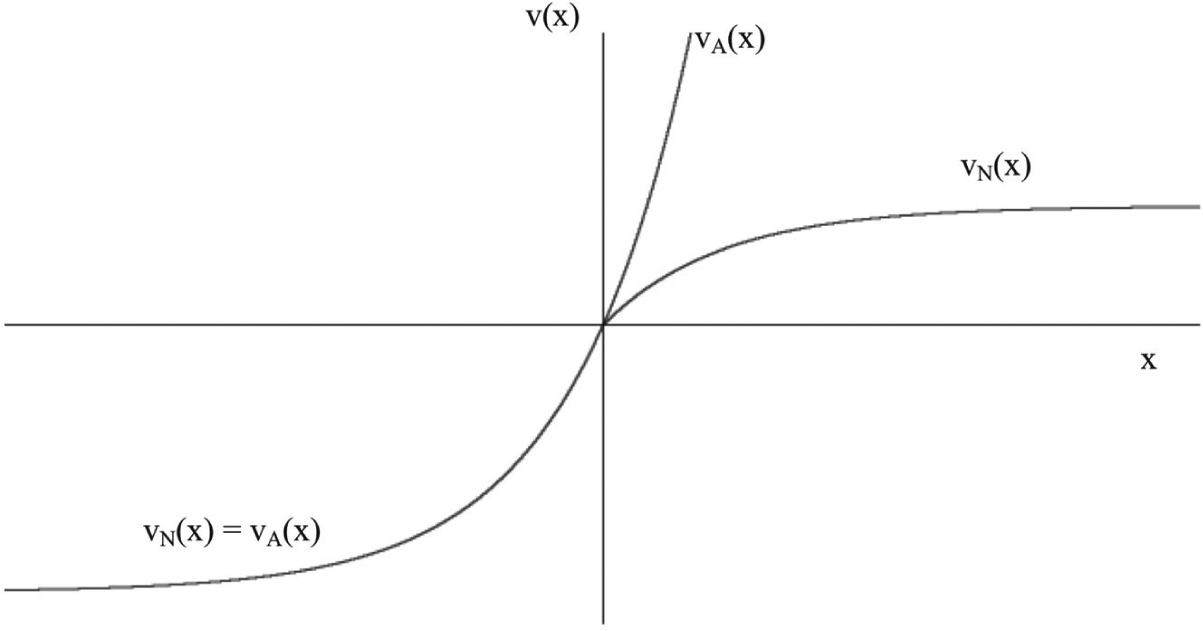
The value functions under emotional neutrality and anger.
An angry irresolute Challenger resolves the decision problem by choosing Threaten in preference to Not Threaten if and only if

otherwise, an angry Challenger resolves the decision problem by choosing the Not Threaten. The critical risk value of rA is found by solving the equation

for rA. Thus, the critical risk value of rA, denoted CRA, is

The decision rule, stated in terms of the critical risk value, is as follows. If rA < CRA, then an angry Challenger chooses Threaten, and thereby chooses the risk-seeking act and receives either the loss CAP or the gain ACQ. On the other hand, if CRA < rA, then an angry Challenger chooses the sure thing, and thereby chooses the risk-averting act and receives the sure thing payoff SQ.
In what follows, we examine the effectiveness of the use of anger as a device to incite Challenger to choose Threaten. Defender will instill anger in Challenger if Defender perceives that Challenger will choose Not Threaten under emotional neutrality, that is, if Defender perceives that CRN irresolute < rN. We will say that instilling anger is effective if it incites Challenger to switch from choosing Not Threaten to choosing Threaten, that is, if CRN irresolute < rN and rA < CRA. Contrariwise, we will say that instilling anger is ineffective if it fails to incite Challenger to switch from choosing Not Threaten to choosing Threaten, that is, if CRN irresolute < rN and CRA < rA.
We begin with the cases wherein Defender properly perceives that Challenger will select Not Threaten. Unlike the decision problem under fear, which admitted of small losses and large losses, the decision problem under anger admits of only one ordering of the payoffs, as follows: vN(CAP) < 0 < vN(ACQ) under neutrality and vA(CAP) < 0 < vA(ACQ) under anger. Since vA(CAP) > vN(CAP), we must have CRN irresolute < CRA. 16 The ordering CRN irresolute < CRA and the ordering rA < rN, reflecting optimism, yield five possible cases, as follows:





Note that, in the first four cases, we have CRN irresolute < rN and rA < CRA, so that Challenger chooses the risk-averting act, Not Threaten, under emotional neutrality, and chooses the risk-seeking act, Threaten, under anger. Thus, the use of anger is effective in the first four cases. However, also note that, in the fifth case, we have CRN irresolute < rN and CRA < rA, so that Challenger chooses the risk-averting act Not Threaten under both neutrality and anger. Thus, the use of anger is ineffective in the fifth case.
A prominent case of the use of anger is the Algerian War, or Algerian Revolution, 1954–1962. Algeria’s demands for independence, unlike the demands of Morocco and Tunisia, were repeatedly rejected by France on the grounds that Algeria was not just a colony, but a region of France. Anger and resentment incited Algerians (Petersen, 2011), led by the National Liberation Front in 1954, to choose various risk-seeking acts in the form of uprisings, guerilla warfare and terrorism. The French army countered these “treasonous” acts in a variety of different ways. In short, the Algerians were risk-seeking over (large) gains, that is, independence, and the anger induced by the French generated optimism, at least initially, that the Algerians would prevail. In 1962, France and Algeria signed the Evian Accords that ended the war and granted Algeria its independence (Gottlieb, 1975/1976).
Misperception and the use of anger
Now suppose that Defender misperceives the anticipated behavior of Challenger under emotional neutrality. That is, suppose Defender perceives that Challenger will engage in risk-averting behavior when, in fact, Challenger will engage in risk-seeking behavior. If, in fact, Challenger will engage in risk-seeking behavior under neutrality, then it must be the case that rN < CRN irresolute. Given optimism, we must have rA < rN. The only case consistent with misperception and optimism is

We will say that instilling anger under misperception is ineffective if it leaves Challenger’s choice of Threaten unchanged, that is, if rN < CRN irresolute and rA < CRA. In the only case at hand, that is, rA < rN < CRN irresolute < CRA, we have rN < CRN irresolute and rA < CRA, so that Challenger chooses the risk-seeking act under neutrality and under anger. Thus, the use of anger, while mistaken, yields the desired result of risk-seeking behavior, and does so without altering Challenger’s choice of Threaten under emotional neutrality. As such, the use of anger is ineffective. It is particularly interesting to note that, under misperception, the use of fear can produce a counterproductive reversal of behavior, whereas the use of anger cannot produce a counterproductive reversal of behavior.
Discussion
The foregoing analysis examined behavior for a class of decision problems that an emotionally neutral, fearful, and angry decision-maker might encounter in the empirical setting. The analysis revealed asymmetric results pertaining to behavior under fear, on the one hand, and the differences between fear and anger, on the other. These asymmetries would not have been discovered had we developed separate models, one for fear and one for anger. The combined results for fear and anger with correct perceptions and with misperceptions are summarized in Table 1.
Fear and anger results under correct perceptions and misperceptions
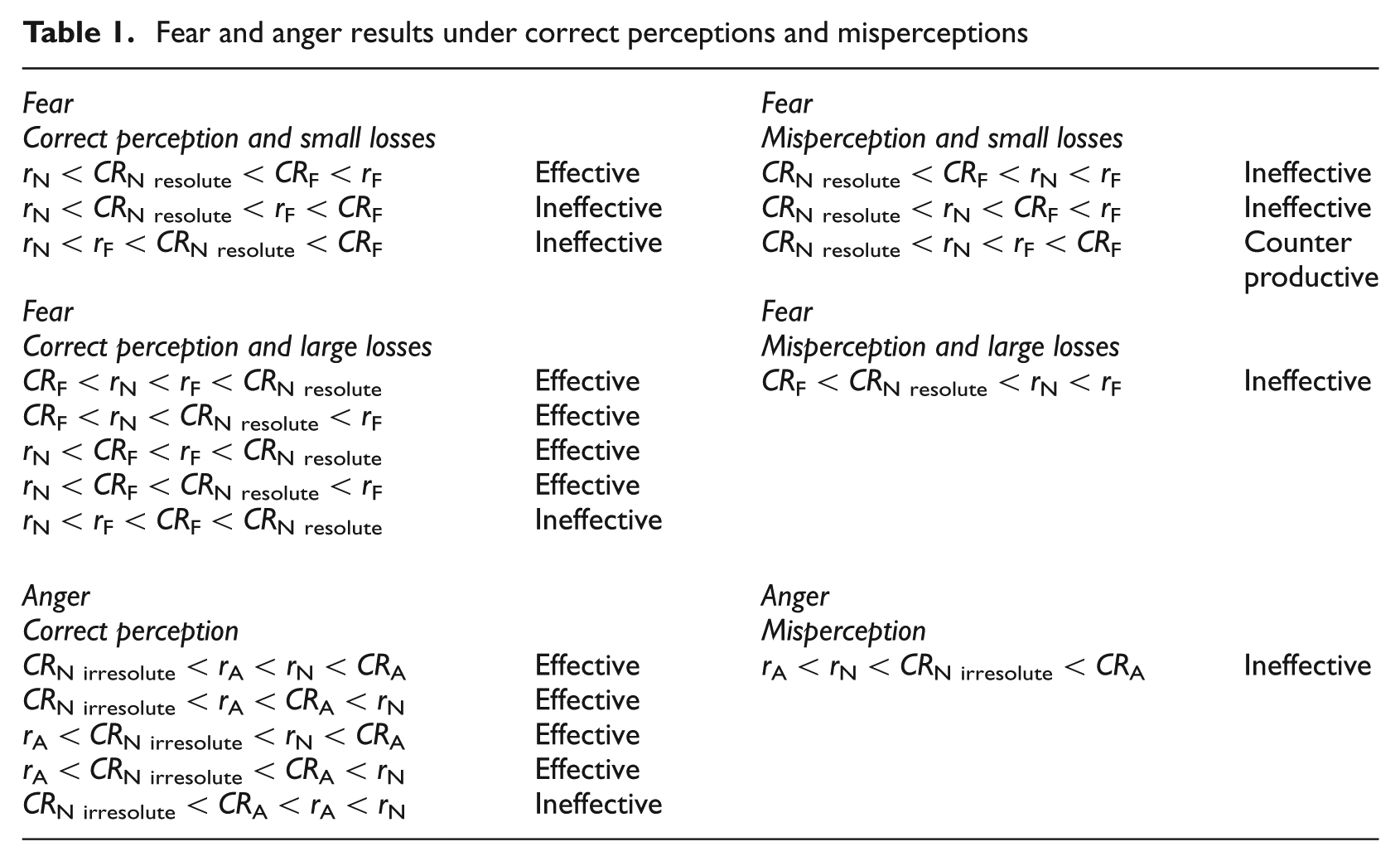
We can interpret the results presented in Table 1 in terms of risk. In order for the use of fear to be effective, Challenger must choose Threaten under emotional neutrality and Not Threaten under fear. Thus, we must have rN < CRN resolute and CRF < rF. The former inequality asserts that the likelihood of the downside payoff is low enough to make the choice of Threaten worth the risk; and the latter inequality asserts that the likelihood of the downside outcome is too high to make the choice of Threaten worth the risk. Similarly, in order for the use of anger to be effective, Challenger must choose Not Threaten under emotional neutrality and Threaten under anger. Thus, we must have CRN irresolute < rN and rA < CRA. The former inequality asserts that the likelihood of the downside payoff is too high to make the choice of Threaten worth the risk; and the latter inequality asserts that the likelihood of the downside outcome is low enough to make Threaten worth the risk. Thus, the key to the risk-interpretation of the results presented in Table 1 reflects the way in which the emotions of fear and anger alter Challenger’s perception of the riskiness of choosing Threaten.
The key to interpreting the distributions of effectiveness lies in the ways in which the pairings rN < CRN resolute and CRF < rF, and CRN irresolute < rN and rA < CRA, which determine effectiveness, can occur within the conditions specified by decision-making under fear and anger. Under fear and small losses, we must have CRN resolute < CRF, and under pessimism, we must have rN < rF. Similarly under fear and large losses, we must have CRF < CRN resolute, and under pessimism, we must have rN < rF. Under anger, we must have CRN irresolute < CRA, and under optimism, we must have rN < rA. The pairings that determine effectiveness and the pairings determined by fear, with small and large losses, and anger, can occur in only so many ways.
The results presented in Table 1 show that the effectiveness of the use of fear also depends upon whether the target of the inducement realizes either a small loss or a large loss in choosing Threaten. If the loss is small for a fearful Challenger, then instilling fear in order to induce risk-averting behavior is ineffective in two of the three cases. Contrariwise, if the loss is large for a fearful player, then instilling fear in order to induce risk-averting behavior is ineffective in only one of the five cases. The effectiveness of instilling anger exhibits a pattern similar to that of instilling fear given a large loss. That is, instilling anger in an emotionally neutral Challenger, in order to incite risk-seeking behavior, is effective in four of the five cases and is ineffective in only one of the five cases.
Clearly, inducing risk-averting behavior via fear or inciting risk-seeking behavior via anger, by itself, is not sufficient to convert a decision-maker’s risk-related behavior. Put differently, another condition that has to be taken into account to gauge effectiveness is the structure of the payoffs. Specifically, instilling fear will be more effective in the case of a large loss than in the case of a small loss. This result implies that, not only do politicians have an incentive to change another decision-maker’s emotional state from neutrality to fear, but they also have an incentive to manipulate the other decision-makers’ valuations of their downside outcomes from small losses to large losses. This process is, in essence, the core of nuclear deterrence theory as advanced by Schelling (1966).
An asymmetry between fear and anger shows that Defender’s misperception can lead to a counterproductive use of fear but not a counterproductive use of anger. Here, instilling fear not only fails to induce the decision-maker to choose the risk-averting act, but actually incites the decision-maker to move from the desired risk-averting act to the undesired risk-seeking act. As such, the use of fear is a strategic device that is employed with some risk, whereas there is no parallel risk in instilling anger in an irresolute Challenger.
Another asymmetry worth noting is with respect to the size of the critical risk values and the resulting likelihoods of the cases. Under a small loss, if v(WAR) is absolutely small, then we can have a critical risk value close to unity, whereas under a large loss, we cannot have a critical risk value close to unity unless v(ACQ) is remarkably large. If CRF is close to unity, then rF < CRF for almost all values of rF. The striking result is that the counterproductive case of fear under misperception, which occurs only under a small loss, can have a very high probability of occurring, as can the two ineffective cases of fear under proper perception.
Finally, it is worth noting how the likelihoods of the various cases might be determined. If the joint distribution of p and PI over the unit square is uniform, then the probability that Challenger initiates a crisis by choosing Threaten, that is, the probability that p+ (1−p)PI < CR, is CR+(1−CR)ln(1−CR). The latter is a monotonically increasing function of CR with a positive second derivative. As such, if CR is large, then the probability that p+ (1−p)PI < CR is also large. However, if CR is not large, then the probability is quite small. In particular, if CR = 0.90, then the probability that p+ (1−p)PI < CR is 0.67, whereas if CR = 0.50, then the probability that p+ (1−p)PI < CR is 0.15. Note that CR can be large in either of two ways. CR is large (a) if the denominator of CR is very small, or (b) if the value of ACQ is extremely large. The former can occur given the use of fear only under small losses and can occur given the use of anger. The latter can occur given the use of fear or anger. Thus, a small loss allows a very high probabiltiy of the choice of Threaten, with fear or with anger, whereas a large loss allows only a small probability of the choice of Threaten. Similarly, a very large gain allows a very high probabiltiy of the choice of Threaten, with fear or with anger, whereas a small gain allows a a very high probability of the choice of Threaten only if the loss is also very small. 17
Conclusion
Researchers have advanced various claims about the effects of emotions, particularly the effects of fear and anger, on decision-making behavior (Ellis, 2005; Hymans, 2006; Lupia and Menning, 2009; Mellers et al., 1999; Mercer, 2006; Park and Lee, 2011; Pearlman, 2013; Sasley, 2010; Studor and Clark, 2011; Van Kleef et al., 2004, 2006; Wubben et al., 2008; Young and Schafer, 1998). The formal account presented here incorporates the experimental results of Lerner and Keltner (2000, 2001), who found that being in a fearful or angry state has different, yet predictably reliable, effects on the risk attitudes and the behavior of the decision-maker. Specifically, they found that fearful (angry) individuals make risk-averting (-seeking) choices across frames and make pessimistic (optimistic) risk assessments, respectively.
We compared the behavior of a decision-maker in a fearful or angry state with the behavior of the same individual in an emotionally neutral state. We did so in order to assess the effectiveness of the use of fear and anger. Specifically, we identified the conditions under which an individual, under fear, chooses the risk-averting act when the same individual, under emotional neutrality, would choose the risk-seeking act. Similarly, we identified the conditions under which an individual, under anger, chooses the risk-seeking act when the same individual, under emotional neutrality, would choose the risk-averting act. The results show when fear can be used effectively to induce risk-averting behavior and when anger can be used effectively to incite risk-seeking behavior. We also obtained results that show when the use of fear and anger is ineffective and, in the fear case only, counterproductive.
This research raises several issues that can be explored in future work. One question involves the effect on third parties of the emotional inducement game played by two different actors. That is, can a third party, observing the use of either fear or anger on another player, learn from this behavior and adapt or adjust their response should they be the target of an inducement in the future? Another open issue pertains to the results of repeated play between the same two players. The present research involves what is essentially a one-shot game. If players were modeled as having a sequence of choices, then the question becomes whether emotions would have the same impact on decision-making as players update their information.
Recent research suggests that, in a static choice setting, angry players will choose the risk-seeking act; however, when an angry player makes a series of choices, behavior is reversed from risk-seeking to risk-averting (Bagneux et al., 2012). Incorporating repeated play into the model may or may not condition the results presented here. As we have stressed throughout, whether a decision-maker chooses the risk-averting act or the risk-seeking act depends not just on the decision-maker’s emotional state, but importantly, on the structure of the decision problem at hand.
The effects of the use of the emotions underscore the value of employing a well-specified model by showing when a generalization holds or fails to hold. The empirical testability of propositions that relate to human emotions specifically, and formal models generally, clearly involves serious methodological difficulties, particularly testing vis-à-vis large-sample datasets. As such, we agree with Levy (1997: 107) that any hypotheses derived from a model employing emotional and prospect-theoretic concepts, including those presented here, are best tested via experimental methods with human subjects where consistent measurement and control are possible.
Footnotes
Acknowledgements
We thank the participants in the 2011 meeting of the Peace Science Society (International) for their helpful comments. We also thank the three anonymous referees for their particularly helpful comments and suggestions.
Funding
This research received no specific grant from any funding agency in the public, commercial, or not-for-profit sectors.