



Abstract
In this study, we evaluate the effects of alliance behavior on the probability of militarized conflict initiation with specific emphasis placed on the issues at stake in the conflict. After much debate over the relationship between alliances and conflict, recent research suggests that specific types of alliances, namely defensive pacts for target states, decrease the likelihood that potential challengers will initiate militarized disputes. Revisiting the alliance–conflict relationship, we allow the type of issue at stake to vary in order to determine whether this deterrent effect holds even when the most salient of issues are under contention. Specifically, we introduce indicators for whether the two states are competing over territorial issues, a high-salience stake that is particularly conflict-prone. Using a number of different indicators for territorial competition and examining several different time periods, analyses suggest that targeted defensive alliances do indeed have a deterrent effect against named adversaries, even when the most salient of issues are at stake.
How does variation in the issues states compete over affect the alliance–conflict relationship? The question of whether alliances increase or decrease the likelihood of militarized conflict has longed vexed scholars, with both theoretical logic (see Smith, 1995) and early empirical findings producing an opaque picture of the relationship. Recent scholarship, however, has taken large strides toward clarifying the puzzle. By introducing variation in the types of alliances states sign, Leeds (2003) and Johnson and Leeds (2011) find that, when target states have defensive alliances, challengers are less likely to initiate militarized disputes; alternatively, neutrality pacts and offensive alliances increase the likelihood of conflict. In other words, the type of alliance matters when it comes to the alliance–conflict relationship. We build on this scholarship by readdressing the alliance–conflict relationship with special attention given to the stakes of competition.
Current alliance scholarship treats all types of disagreements as homogenous units, and simply allows the type of alliance to vary. We believe that this is problematic, as there is robust evidence that the salience of stakes varies greatly, and the level of salience influences whether states are willing to militarize the disagreement and escalate militarized conflicts to war. Consequently, we allow conflict issue type to vary to determine whether defensive alliances are able to deter dispute initiation even when particularly salient issues, like territory, are at stake. Given the variation in the salience of conflict stakes, we believe that this represents a more appropriate examination of the deterrent value of defensive pacts. Evidence that defensive pacts are able to constrain challengers, even in the context of highly salient and conflict-prone stakes like territory, will help clarify this long-ambiguous relationship.
Empirically, we evaluate the relationship between defensive alliances and conflict initiation, allowing the stakes of competition to vary. Three sets of models are reported, using three different measures of territorial competition: spatial rivalry (Colaresi et al., 2008), territorial disputes (Huth and Allee, 2002) and territorial claims (Hensel, 2001). The findings suggest that, even in the high-salience context of territorial competition, defensive alliances for target states decrease the likelihood of conflict initiation. We also estimate the models on samples exclusively from pre- and post-World War II in order to evaluate whether the relationship differs by time period. Although there are some differences, the reported analyses suggest that, overall, across measures of territory and time periods, defensive pacts reduce the likelihood of a challenger-initiated dispute.
We believe that these findings contribute to both research on alliances and that on territorial conflict. First, the results support recent claims that defensive alliances are an effective deterrent against challenger aggression. Defensive alliances presumably deter aggression by raising the costs of conflict—an aggressor state would have to fight two or more states instead of just the target. One could argue that, if the salience of the issue is high enough, potential challengers will be willing to bear higher costs in order to win the disputed good. Territory has been identified as one issue that states are consistently willing to bear high costs to “win” and, thus, alliances may not have the same deterrent effect that they would in the presence of other, less salient, issue. Our results suggest, however, that even when high-salience issues like territory are at stake, defensive alliances can still effectively deter aggression. It should be noted, however, that our conclusions are limited to those defensive alliances naming a target and deterrence of disputes with those relevant states. Assessing the ability of defensive alliances to deter disputes in general, when no target has been named in the alliance, is beyond the stope of this project and our implications. Second, we contribute to the literature on territorial conflict. Even through territorial competition is especially dispute- and war-prone, out findings suggest that there are foreign policy tools—like defensive alliances—that states can use to manage these highly threatening situations.
Alliances and conflict
Disagreements in the international realm are fundamentally a bargaining process. States use various tools of foreign policy to achieve or attempt to achieve their most preferred policy outcome or favorable division of goods. Certain factors, like uncertainty (over resolve and capabilities) and incentives to misrepresent, act as obstacles to achieving peaceful bargains (Fearon, 1997). Therefore, states often use costly signals to overcome these problems, and more credibly convey information to their adversaries. Alliances are one tool that states use in this bargaining process—sometimes used to enhance the credibility of commitments (Morrow, 2000) or credibly signal resolve or capabilities (Fearon, 1997).
As signals and credible commitments, alliances transmit information to relevant actors regarding the intentions of the participating states. In other words, alliances provide useful information to both alliance partners and targets. For targets of alliance provisions, the formalized and public commitment to defend may make the alliance a credible signal of resolve (Fearon, 1997). For alliance partners, signing a formal alliance potentially increases the reliability of an alliance by both making it easier for states to fight together and creating audience costs (Morrow, 2000: 72). If alliances are able to more credibly signal information about commitments, resolve or capabilities, we might expect that the presence of an alliance would potentially facilitate achievement of peaceful bargains. In other words, alliance should have a deterrent effect on violent conflict.
Unfortunately, there has been little agreement over the relationship between alliances and conflict—theoretical logic and empirical evidence has been largely ambiguous on this question. Formal theoretical work on the alliance–conflict question is not surprised by the indeterminate relationship, as Smith (1995) deduces logically that expectations should be mixed. 1 Despite the inconclusive findings of early research, recent research on the alliance–conflict relationship, focusing on alliance provisions, provides compelling evidence that defensive alliances in particular are a deterrent to militarized conflict (see Johnson and Leeds, 2011; Leeds, 2003). 2
Leeds (2003), for example, examines the influence of the content of alliance agreements on conflict initiation. Leeds (2003) argues that in order to understand the alliance–conflict relationship, one must first understand the types of commitments states are making (what is required of the partners) and what type of information those commitments transmit to relevant actors. Despite often being treated as such, alliances are not all created for the same purpose. Different alliances require different obligations of the participants: providing assistance if attacked (defensive alliances), assisting in an attack (offensive alliance), staying out of a conflict (neutrality pact) or simply consulting over an issue (entente). Because the terms of these types of commitments are so different, it is reasonable to expect that they will send different types of signals, elicit different types of behaviors and, thus, have different causal relationships with conflict outcomes (Leeds, 2003). In other words, the alliance–conflict relationship should be conditional on the terms of the commitment. Offensive alliances should be positively correlated with conflict because a potential challenger will be emboldened knowing it has a partner in the conflict. Defensive alliances will provide a disincentive for challengers to attack, as they will probably fight not only the target but also the target’s alliance partner. Finally, neutrality pacts should increase the likelihood of conflict initiation by providing assurance to a challenger that no third party will intervene on behalf of the target.
Leeds (2003) indeed finds support for these propositions. In an analysis of directed dyad–years from 1816 to 1944, Leeds finds that the terms of the alliance do inform our expectations about and the empirical relationship between alliances and conflict initiation. An updated analysis by Johnson and Leeds (2011) with an extended time period of 1816–2000 shows both that defensive alliances deter and that alliance partners with defensive alliances are less likely to be aggressive. Accounting for the strategic intent of the alliance is, therefore, critical for properly understanding the alliance–conflict relationship. Benson (2011) takes the content of alliance agreements a step further by focusing on the specific provisions that compel or deter potential attacking states. He finds that only the conditional deterrent type of alliance, which arranges intervention in the event of attacks, has a dampening impact on conflict. Furthermore, this relationship is only consistent if the alliance partner is a major power. Thus, this work contextualizes alliances based not only on agreement content, but also on the capabilities of states. This recent body of empirical research, taken together, suggests that the context in which alliances operate is crucial to understanding their role in conflict.
Although Leeds (2003), Johnson and Leeds (2011) and Benson (2011) provide compelling evidence that alliances have a deterrent on the likelihood of conflict targeting and initiation, there are reasons to believe that this relationship may be influenced by the types of stakes over which states are competing. First, regardless of the content of specific agreements, most dyads are unlikely to fight conflicts at any given time. Second, because alliances are likely to be made with potential conflict in mind, it seems more appropriate to examine the effects of defensive alliances in a more conflict-prone context. However, it could also be that dyads who are involved in high-stakes issue competition will have conflict regardless of alliance arrangements. Competing over territory produces conflict more than competition over other issues, and we believe that this is an appropriate laboratory for examining the deterrent properties of defensive alliances.
The relationship between territorial competition and conflict is well documented, so we will not belabor the point, but some discussion is warranted. There are a number of important empirical regularities regarding conflict and territory. For example, Senese and Vasquez (2003) and Huth (1996) use territorial claims data to test the relationship between challenges to the territorial status quo and militarized dispute onset. Using the presence of an ongoing claim as an indicator of dissatisfaction with the territorial status quo, Senese and Vasquez (2003) are able to demonstrate a positive relationship between competition over territory and the onset of a militarized dispute. Dyads with an ongoing claim are more likely to experience militarized disputes than dyads with no ongoing claim.
Furthermore, states competing over territory are more likely to experience militarized disputes (Senese and Vasquez, 2003), states targeted in a dispute over territory are more likely to respond with military force (Hensel and Diehl, 1994) and disputes over territory are more likely to recur (Hensel, 1994). The recurrence of a dispute is also likely to occur more quickly when territory is in question. Militarized disputes over territory are also likely to be more severe, producing higher levels of fatalities than other types of disputes (Senese, 1996).
Disputes over territory are also more likely to escalate to war (Vasquez and Henehan, 2001). For example, Leng (1993) finds that the presence of strategic interests—defined as threat to territory—encourages the use of more coercive strategies and that early use of coercive strategies is associated with eventual escalation to war (see also Gochman and Leng, 1983). Ben-Yehuda (2004), examining crises rather than militarized disputes, finds that, although territory is not always an important factor in crisis onset, it does seem to have a significant impact on crisis escalation. Contiguous rivals involved in crises over territory were especially prone to escalation. Indeed, disputes over territory seem to have dominated a significant proportion of wars in history (Holsti, 1991; Kocs, 1995). Finally, states are much less likely to experience conflict if they have settled outstanding territorial disagreements (Kocs, 1995; Owsiak, 2012), even if they have persistent disagreements over non-territorial issues (Hensel, 2006). 3 Thus, there is a systematic pattern between disagreements over the territorial status quo and conflict behavior.
In sum, recent scholarship, exemplified by Leeds (2003) and Johnson and Leeds (2011), provides convincing evidence that the alliance–conflict relationship varies by alliance type. Specifically, defensive alliances are associated with a lower probability of conflict because, in obligating the involvement of a third-party, and thus raising the cost of conflict, initiating violence becomes less attractive. We build on this scholarship by introducing variation over the stakes of competition. In particular, we evaluate whether alliances are able to deter aggression in the context of the especially salient issue of territory. In other words, we allow for the possibility that some stakes may be salient enough to risk violence despite higher potential costs. Consequently, even though alliances raise the costs of conflict, they may not do so sufficiently to offset the potential benefits of acquiring disputed territory. In the next section, we develop further the logic of why the territorial context might be different from other contexts. We then develop hypotheses based on expectations for the alliance–conflict relationship based on threat context.
Defensive alliances and territorial stakes
From the above discussion, it appears there is some empirical support for the claim that defensive alliances have a deterrent effect on militarized conflict in general. There is also reason to believe, however, that not all stakes that actors compete over are equivalent. Clearly, the empirical literature has identified stakes concerning which states are much more willing to engage in militarized conflict to secure their preferred outcome. In short, there are certain stakes that states are willing to pay higher costs (salience) for, in order to secure a favorable (preferred) distribution. Therefore, theoretically and empirically, it is possible that the alliance–conflict relationship varies not just by alliance type but also by issue type. It is not necessarily the case, as some have argued, that alliances “cause” war when certain issues are at stake. It is simply possible that, although defensive alliances do raise the cost of conflict, they may not do so sufficiently in some instances of particularly salient stakes to deter resort to arms. Consequently, we argue that allowing issue type to vary represents an appropriate test for the deterrent value of defensive alliances.
Although Leeds (2003) and Johnson and Leeds (2011) provide expectations for each type of alliance, we will focus exclusively on defensive pacts. Theories focusing on alliance content predict a positive relationship between conflict and offensive alliances, as well as conflict and neutrality pacts. There is no reason to believe that this relationship will necessarily differ by issue type, given that these alliances are built around the intent to initiate conflict and territorial stakes are already particularly conflict-prone. The real point of interest, then, is linking the expectations regarding the influence of defensive alliances to the issue of contention within the dyad.
Competition over stakes based on divergent preferences is inherently a bargaining process. Alliance formation affects the bargaining process, in part, by altering the expected payoffs for relevant actors. The entry of a third party on one side potentially raises the cost of conflict for the other side. For example, if a target in a territorial disagreement has a defensive alliance, the cost of initiating conflict is raised for the aggressor state. Thus, the presence of an alliance may potentially deter an aggressor state because the costs of fighting two states (rather than one) outweighs the potential gains from violent conflict.
The stakes underlying the competition can similarly affect the expected payoffs. The concept of salience, as it relates to stakes of competition, has been used in conflict literature to capture the extent to which states will defend an issue or state. Salience simply refers to the value of the stake—the potential payoff, given that the actor “wins” the dispute. The deterrence literature makes reference to the “issues at stake” in a conflict, and argues that increasing value of those issues potentially makes deterrent threats more credible (Huth, 1988). For example, Danilovic (2001: 349) argues that stakes are a “main ingredient of the inherent credibility” of threats, with credibility increasing with the salience of those stakes. Scholars capture this concept of salience in a number of different ways. In the extended deterrence literature, it is often measured in terms of linkages—political, economic or military—between two countries (Huth, 1988) or between a country and a region (Danilovic, 2001). For our purposes, we view salience through the lens of issues types over which states fight. Some issues are more salient than others and, thus, states may bargain harder or risk higher costs based on the salience of the issue under contention. In that sense, territory becomes a proxy or indicator of salience.
Territory is a particularly salient international issue over which states compete. From prior research, we know that it is highly conflict- and war-prone (Hensel and Mitchell, 2005; Vasquez and Henehan, 2001). High salience does not suggest, and we do not argue, that states will be un-deterrable. Salience simply refers to the level of costs actors will be willing to bear in order to “win” a disputed good. The higher the salience, the greater the costs states will pay in order to acquire their preferred share of the disputed good. The presence of a defensive alliance—where instead of fighting one state for a disputed good, the challenger may be required to fight multiple states to acquire the same prize—raises the cost of conflict such that states may be reluctant to attack. However, if the salience of the disputed good is high enough, the potential challenger may be willing to attack a target state even in the presence of a defensive alliance.
Several aspects of territory make it particularly salient. Goertz and Diehl (1992) divide the importance of territory into two broad categories: intrinsic and relational. Intrinsic importance refers to the actual physical value of the territory or the contents of the territory. This may include but is not exclusive to the presence of natural resources (oil, diamonds, water, etc.), the occupying population (pool for labor, taxation, conscription, etc.) or the strategic value. Relational importance refers to the emotional or psychological attachment to territory based on cultural ties or historical claims. Hensel (1999), using very similar logic, divides the importance of territory into three categories: tangible, intangible and reputation. What Hensel and Mitchell (2005) calls tangible and intangible are conceptually equivalent to Diehl and Goertz’s intrinsic and relational categories, respectively. The high salience of territory means that gaining territory can provide many benefits for states.
Defending territory is also very important. For Hensel (1999), reputation is an important addition because of the signal a failure to adequately defend territory potentially sends to others. A failure to defend territory or a willingness to negotiate over territory may encourage other potential revisionist states to challenge the territorial status quo. This is similar to the logic of Walter (2003), who argues that reputation is a more powerful explanatory variable for the salience of territory than both tangible and intangible factors. Finally, territory may be more salient because concessions over territory can affect the distribution of power and, thus, future bargaining power (Powell, 2006). If states believe believe that compromising over an issue potentially increases the bargaining leverage of the other state in the future, they will be more difficult to deter in the present.
How might the salience or importance of territory affect state decisions to engage in militarized conflict? In order to answer this question, it helps to examine how territorial threat is believed to affect domestic politics and, in particular, leader calculations. As Vasquez (1993) argues, territorial threat can be used to galvanize domestic audiences against an adversary, through threat magnification, making it easier for states to adopt more aggressive and riskier foreign policy behavior. This is presumably because territory is closely associated with national identity, and the protection of territory, unlike most issues states disagree over, is necessary for state survival. Similarly, Huth (1996: 59–60) argues that, because threat to territory is a threat to national sovereignty, leaders can demonize adversaries and use nationalistic rhetoric to rally publics, and once domestic audiences are mobilized against the external threat, it becomes more difficult long-term to make concessions.
Hutchison and Gibler (2007) find evidence consistent with this domestic story. Threat to territory has the effect of creating in-group/out-group dynamics, increasing cohesion among domestic audiences and decreasing tolerance for other groups. Further, they note that this effect only occurs for threat to territory, not for other types of external threat. Once domestic audiences are convinced of the significance of the threat and are mobilized against it, leaders may be punished for accommodative actions (Colaresi, 2004).
In sum, leaders can more readily rally publics over territorial threat than other types of disagreements. In addition, domestic audiences often coalesce over threat to territory and become more intolerant of perceived adversaries. Finally, leaders may be punished for not appearing strong in the face of threat, creating incentives to challenge the status quo and perpetuate the competition. Taken together, we would expect these dynamics to impact leader calculations. The threat gives leaders the justification for adopting more aggressive and costlier foreign policy behavior. Not only are domestic publics likely to support these actions, but they are also more likely to punish leaders for not taking them. Given the salience of territory, leaders would have strong incentives to endure higher costs to ensure a favorable outcome.
Faced with a choice between increased costs of conflict through a third-party alliance and domestic punishment—potentially through the loss of power—the leader may choose risking a costly conflict. Whereas with some issues, the increased costs generated by an alliance might be enough to encourage leaders to not defend or revise the status quo, the salience and potential domestic consequences of territory may alter this calculation. The costs of not defending or seeking revision of the status quo may still be higher than the increased cost of conflict generated by a target state alliance. If we couple the higher payoff for winning disputed territory (salience) with the high potential domestic costs of not depending/pursuing territory, it might be the case that, even in the face of an adversary with an outside alliance, which would certainly raise the costs of conflict, leaders may still be willing to initiate militarized challenges.
On the other hand, there is reason to believe that defensive alliances will have a deterrent effect, even in the conflict-prone context of territorial competition. Given that territorial competition induces states to behave in a more escalatory fashion, why might we expect a deterrent effect? First, we conceptualize states as strategic actors who understand their competitive environments and anticipate how their actions will affect the actions of others. States will consider the likely reaction of their adversary when building the alliance, and strategically choose a treaty that will provide the highest probability of achieving their preferred outcome (e.g. deterrence). This does not suggest that alliances will always be effective but, at the same time, there is little reason for states to consistently sink costs into alliance treaties if they expect them to have the opposite effect to that intended.
Second, we assert that alliances are purpose-built institutions. States take into consideration their strategic environment—to include issue type, target and potential alliance partners—when building alliance treaties. Taken together, this implies that alliances and alliance partners are not chosen at random. States choose to build these institutions based on the type of threat experienced. Furthermore, states are aware of the source of the threat and are likely to choose alliance partners with their target in mind. Not just any alliance partner will be chosen; instead, states will choose partners that are (a) likely to honor the agreement (i.e. have a strategic interests in the issues at stake) and (b) most likely to deter the adversary. Because territorial competition is so dangerous, would-be targets will choose alliance partners who are the most willing and capable in order to generate deterrence. In other words, states will choose partners and agreements that maximize the signal of resolve, particularly because the issue at stake is especially salient.
Thus, we argue that the cost and terms of the alliance are endogenous to the issues and threat type involved. States structure the alliance and choose alliance partners based on the stakes of competition and the source of the threat. The salience of the issue, and, thus, the extent to which the adversary will be willing to pay high(er) costs to “win” the disputed good will be considered as part of the strategic design of the alliance. Consequently, we would expect, assuming strategic actors and purpose-built alliances, that, given a defense treaty, challengers will be unlikely to initiate conflict, even in the context of salient issue competition. In other words, that issue and treaty type are endogenized in the alliance treaties means, observationally, that we should expect no difference in the alliance–dispute initiation relationship based on the stakes of competition. Consequently, we test the following hypothesis:
Research design
We are primarily concerned with understanding if defensive alliances dampen the likelihood of conflict when territorial competition is present. Thus, we need to compare the likelihood of dispute initiation across dyads engaged in territorial competition, with and without defensive alliances. Doing so allows us to determine if defensive alliances, which have been shown in general to have a dampening impact on conflict initiation (Johnson and Leeds, 2011), still have this dampening impact when we account for the salience of the issue under contention. In order to test our hypothesis, we employ a cross-sectional time-series design with directed dyad–years as the unit of analysis. In directed dyad–year data, there are two observations for each unique dyad. For example, there is an observation for USA–Canada, as well as for Canada–USA (see Bennett and Stam, 2004). Directed dyad–year is the appropriate unit of analysis because the hypotheses specify relationships necessitating the identification of the state initiating the dispute and the alliance behavior of challenger (initiator) and target states. In our data, only side A can initiate a dispute. Specific population samples and time periods differ from model to model based on the limitations of various key indicators employed; details on the different samples and time periods are provided below.
Dependent variable
Our dependent variable for all analyses is militarized dispute initiation by state A against state B. This is the proper dependent variable, as opposed to escalation to war, because it allows us to test for the deterrent effect of defensive alliances. If we were to examine disputes that had already begun, we would be potentially censoring out the cases in which defensive alliances were an effective deterrent. Furthermore, our focus on initiation allows us to understand better the ways in which dyads may select themselves on or off the conflict path. Dispute initiation is a dichotomous variable, coded 1 if state A initiates a militarized interstate dispute against state B in a given year (and a 0 otherwise). Data on militarized disputes is taken from the Zeev Maoz dyadic dispute data set (Maoz, 2005), as cited by Johnson and Leeds (2011). 4
Key independent variables
Three key independent variables are used: defensive alliance for the target state, presence of territorial competition, and an interaction term between the previous two variables. For defensive alliances, we employ the measure used by Johnson and Leeds (2011), taken from the Alliance Treaty Obligations and Provisions data (Leeds et al., 2002). They code for the presence of a “relevant” defensive alliance between the target and a third party. A “relevant” alliance is one that requires the third party to take action on behalf of the target in the event the challenger attacks. Therefore, if state B (the state targeted in the dispute) has an alliance with a third party that specifically names state A (challenger state initiating the dispute) as the target of the alliance, then state B is coded as having a “relevant” defense pact. If the third party has a defensive pact with the target and a neutrality pact with the challenger, the alliance (with the target) is not considered relevant. Other irrelevant defensive alliances might be ones that make no mention of the challenger state at all or do not obligate the third party in any way if the challenger attacks. It is thus important to exclude such agreements when testing the deterrent relationship of defensive alliances. 5 The ATOP coding differs from the alliance data housed as part of the Correlates of War project (Gibler and Sarkees, 2004), which does not include information on alliance targets. 6
We examine the interactive effect of territorial threat and defensive alliances, employing three different indicators of territorial threat. We utilize the Issue Correlates of War (ICOW) territorial claims (as used by Hensel and Mitchell, 2005), the Huth and Allee (2002) territorial disputes, as well as the Colaresi et al. (2008) spatial rivals, in order to evaluate the sensitivity of the relationship to specific indicator choices. Of the three indicators of territorial competition, only spatial rivalry is coded for the full time period (1816–2000) and for the entire international system. ICOW is spatially limited to the Americas and Western Europe, while the Huth and Allee claims are temporally limited to the period from 1919 to 1995.
The ICOW data indicates whether state A has an active territorial claim against state B. It is a dichotomous variable coded 1 if there is an active claim and 0 otherwise. ICOW codes whether one government claims sovereignty over a piece of land held by another government (Hensel, 2001: 90). 7 Currently, ICOW only contains data for Western Europe and the Americas. Combining the alliance data with data on territorial claims, our analyses include only dyads in Western Europe and the Western Hemisphere from 1816 to 2000. That being said, ICOW is also directional in nature, so in our case the potential challenger is also the state making the territorial claim and the target state the status quo actor. Thus, it is a fitting indicator of territorial competition for our purposes.
Huth and Allee (2002) code disputed territory from 1919 to 1995. Their data is organized with the claim as the unit, noting challengers and targets. Huth and Allee incorporate maritime claims and colonial claims in addition to land-based territorial claims. The Huth and Allee data is only available for 1919–1995, so our analysis of the pre-Cold War period is limited to only the interwar period up to the end of World War II. This loss in temporal domain is mitigated, we believe, by the use of two other indicators of territoriality. Although the time period is more limited, the Huth and Allee disputes cover the entire international system. Data for the Huth and Allee claim was taken from Paul Huth’s dataverse page. 8
We also include an analysis of spatial rivals, as coded by Colaresi et al. (2008). These are rivals that compete primarily over issues of territory and space, as opposed to primarily about power position. Rivalry, as coded by Thompson and his coauthors, is a perception-based measure—leader statements and historical narratives are used to identify whether or not a pair of states considered each other enemies (i.e. rivals) in the historical record. Although rivalry is not a directional indicator (by definition, it is purely dyadic), which is not ideal, this measure is the only one that we include that covers the entire international system and time period from 1816 to 2000.
Finally, because our hypotheses are all predictions about the effects of alliances in the context of territorial competition, we employ an interaction term: we interact ongoing territorial competition with the presence of a defensive alliance for the target state. A positive coefficient on the interaction term means that the outcome (i.e. militarized dispute initiation) is more likely under circumstances where both are present, suggesting that defensive alliances do not have a deterrent effect when especially salient issues like territory are present. On the other hand, a negative coefficient on the interaction term suggests that defensive pacts are able to deter aggression even in the presence of territorial stakes.
By examining three different indicators of territorial competition, we present a comprehensive investigation of the role that territory and defensive alliances can jointly play in conflict. Examining only one indicator might produce biased results based on specific coding decisions of individual indicators, or because of the spatial and temporal limitations of various data sets employed. For example, the ICOW indicator has spatial limitations and the Huth and Allee data covers a shortened time period compared with data used in many interstate conflict studies. Additionally, inclusion of Thompson’s spatial rival indicator allows us to evaluate pairs of states engaged in intense and focused competition over long periods of time. Thus, our analyses model the influence of defensive alliances on territorial competition as a whole rather than just particular aspects of that competition.
Control variables
In order to account for confounding processes, we include a number of control variables. A number of these are alliance-related. We chose these variables in order to make sure that the estimated effect of defensive alliances is not potentially confounded by some other aspect of the alliance–conflict relationship (such as between offensive alliances and conflict or the relationship between allies). We include controls for whether the challenger has an outside offensive alliance or a relevant neutrality pact. 9 The presence of either should increase the likelihood of the challenger initiating a militarized dispute against the target (Johnson and Leeds, 2011; Leeds, 2003). We also control for whether the challenger and the target share a defensive alliance commitment, also taken from ATOP. We do so because some research (Kimball, 2006) points out that allies sharing an alliance commitment are less likely to experience conflict against each other. We note that this variable does not conflate with the defensive alliance variable, nor does it overlap with the similarity in alliance portfolios (Leeds, 2003: 434). 10 Furthermore, we control for the similarity of alliance portfolios (S-scores), which measures the extent to which states have similar alliance partners, with greater similarity producing a lower probability of conflict (Signorino and Ritter, 1999).
We also control for variables commonly controlled for in conflict research: capabilities and proximity. Capability ratio is calculated using the Correlates of War National Military Capability score (Singer, 1987) and is a ratio of the challenger’s capabilities to that of the challenger plus the target (see Johnson and Leeds, 2011). The variable ranges from 0 to 1, where the challenger increases in strength relative to the target as the variable approaches 1. Stronger challengers should be more likely to initiate disputes than weaker challengers. We do this to make sure that the effects of defensive alliances are not confounded by material capabilities. We also control for the log-distance between capitals of the directed dyads, in line with Johnson and Leeds (2011). Dyads that are further away from each other should be less likely to fight. This logic is consistent with the contiguity hypothesis (see Bremer, 1992; Senese, 2005), in which states that interact more, such as neighboring states, are more likely to fight. Furthermore, since we are theoretically examining territorial competition, which frequently occurs between states who are proximate to one another, this control is especially relevant. 11
All variables, with the exception of the territorial competition variables, were taken from the Johnson and Leeds (2011) replication data. They note that the specific alliance variables are from ATOP (Leeds et al., 2002), while the other controls (including S-scores) were calculated using EUGene (Bennett and Stam, 2000). 12
Because our dependent variable is binary, we employ probit analysis for all of our models. In our analysis, we examine each set of models according to the full time period for which the key indicators are available, as well as the pre-Cold War and the post-World War II periods. As Senese and Vasquez (2008) demonstrate, there is evidence for temporal effects; they find that alliances are positively correlated with conflict pre-1946 but negatively correlated after 1945. Although the 1816–1945 time period is replete with territorial conflict, rivalries and major power rivalries, the post-World War II period after 1945 is a period of increasing territorial settlement and increased use of defensive alliances as the primary type of alliance agreement (Johnson and Leeds, 2011). Therefore, examining the pre-Cold War and post-World War II periods separately is essential for determining whether defensive alliances have a deterrent effect, and whether that relationship is consistent across different issues and time periods.
Given a cross-sectional time-series design, there is concern about the non-independence of like units across time. Consequently, we account for non-independence consistent with Johnson and Leeds (2011) and Carter and Signorino (2010) by including the cubic polynomials of peace years. This approach, which employs a count of peace years calculated for each spatial–temporal sample, then squared and cubed and included in the model, is a simpler way of accounting for temporal dependence than the method advocated by Beck et al. (1998). 13 For reasons of space and improved clarity, we have suppressed these variables in all tables. 14
Results
We analyze militarized interstate dispute initiation in three different spatial–temporal domains with three different indicators of territorial competition. Tables 1–3 present models for the entire time period available for the particular territorial competition indicators, as well as breaking them into the pre-Cold War and post-World War II periods. In each table, we present our models both with and without control variables. 15 We begin by displaying the models employing the ICOW territorial claims data (Table 1), followed by the Huth and Allee territorial dispute indicator (Table 2) and conclude by investigating the role of spatial rivalry and defensive alliances (Table 3). The primary pattern revealed in these analyses is that defensive alliances have a significant dampening effect on the initiation of conflict in the context of territorial competition. We elaborate more on the findings and implications in the sections below.
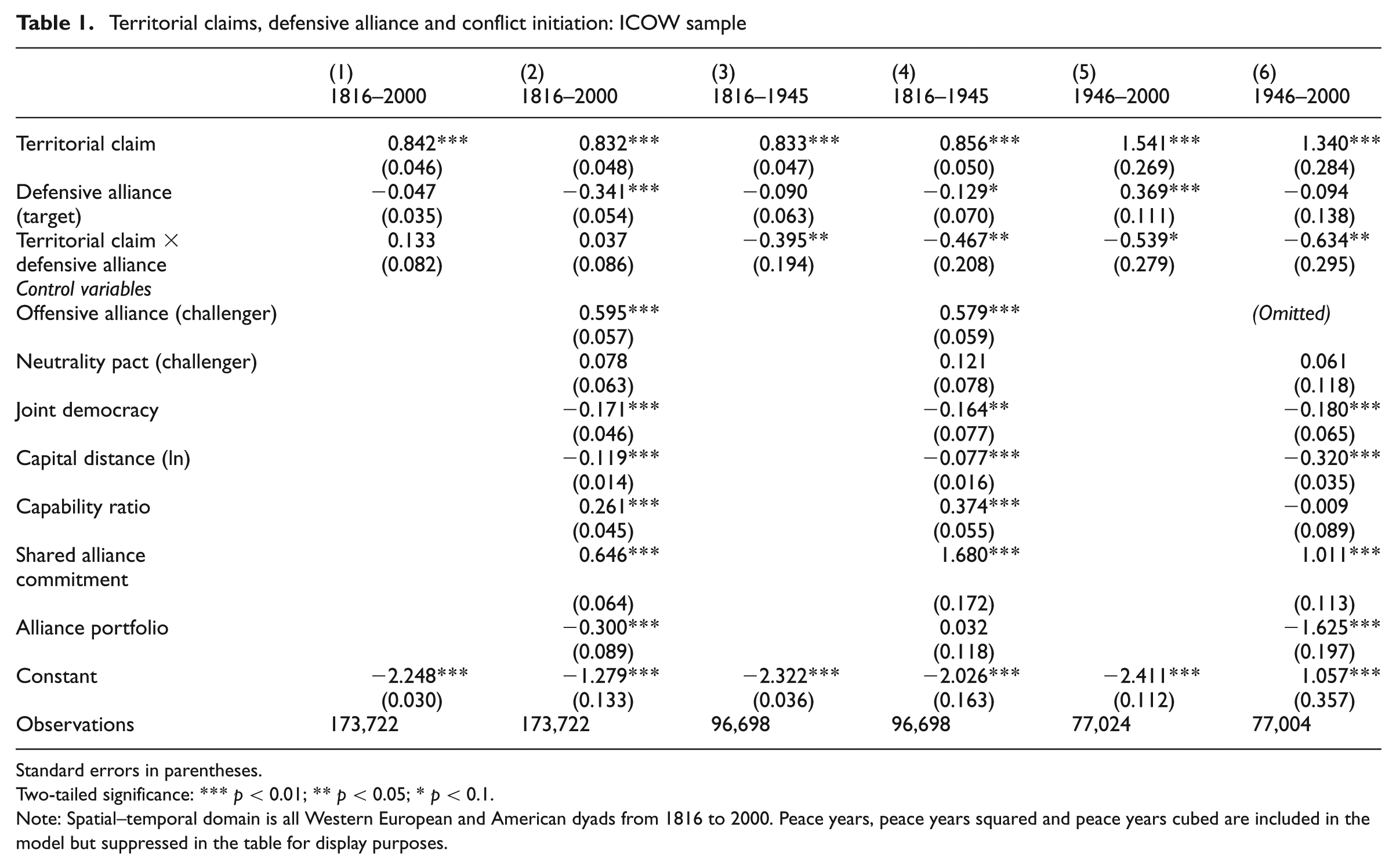
Territorial claims, defensive alliance and conflict initiation: ICOW sample
Standard errors in parentheses.
Two-tailed significance: *** p < 0.01; ** p < 0.05; * p < 0.1.
Note: Spatial–temporal domain is all Western European and American dyads from 1816 to 2000. Peace years, peace years squared and peace years cubed are included in the model but suppressed in the table for display purposes.
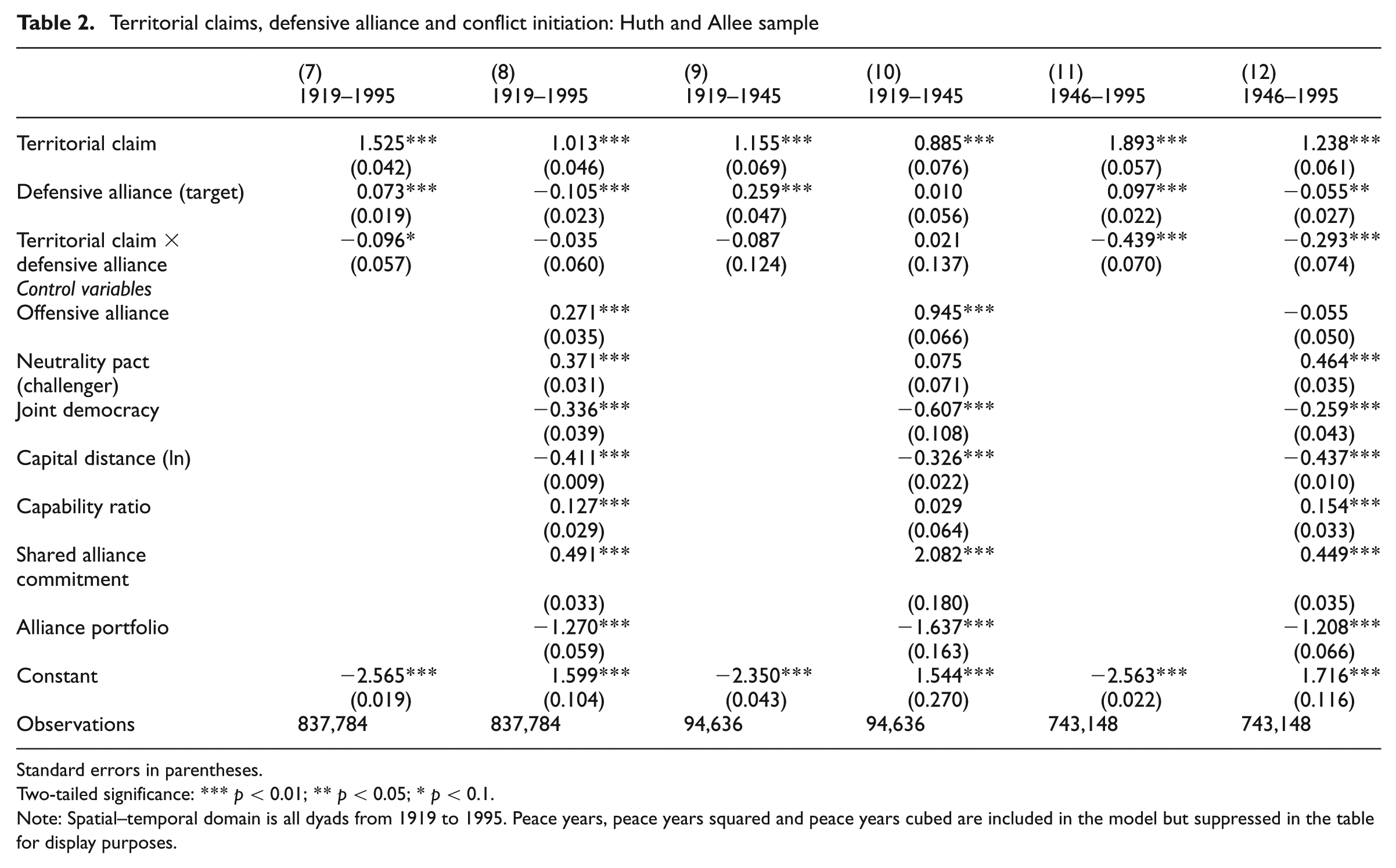
Territorial claims, defensive alliance and conflict initiation: Huth and Allee sample
Standard errors in parentheses.
Two-tailed significance: *** p < 0.01; ** p < 0.05; * p < 0.1.
Note: Spatial–temporal domain is all dyads from 1919 to 1995. Peace years, peace years squared and peace years cubed are included in the model but suppressed in the table for display purposes.
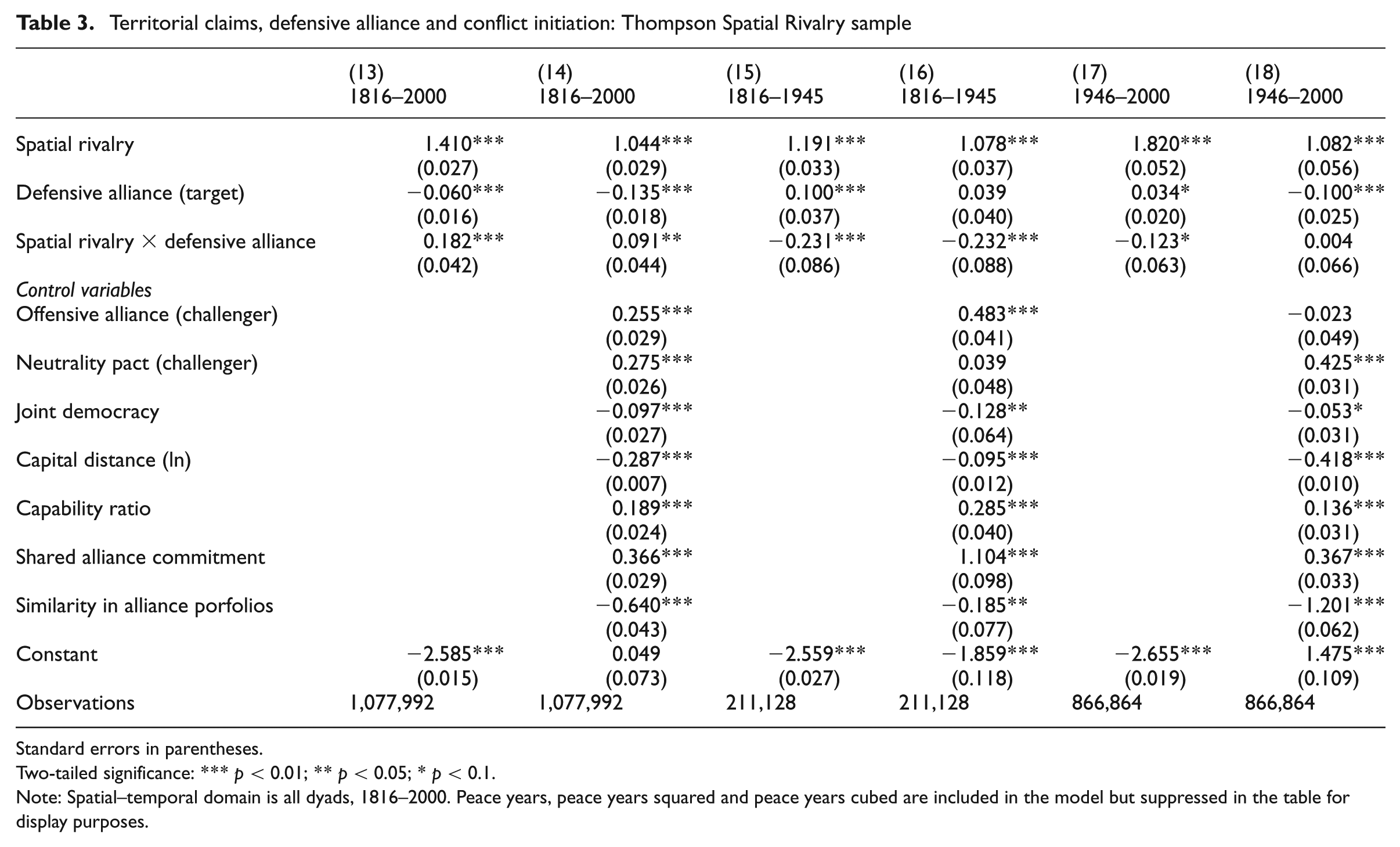
Territorial claims, defensive alliance and conflict initiation: Thompson Spatial Rivalry sample
Standard errors in parentheses.
Two-tailed significance: *** p < 0.01; ** p < 0.05; * p < 0.1.
Note: Spatial–temporal domain is all dyads, 1816–2000. Peace years, peace years squared and peace years cubed are included in the model but suppressed in the table for display purposes.
Findings on territorial claims, defensive alliances and conflict: the ICOW sample
Our first set of results, displayed in Table 1, employs the ICOW indicator of territorial claims. This data is available for the full time period of 1816–2000, but is spatially limited to territorial claims made in the Western Europe and the Americas only. Therefore, only directed dyad–years in Western Europe and the Americas are included. The spatial restriction significantly reduces the number of observations from the latter two samples. The sample for Table 1 is approximately 16% the size of the full spatial sample for the full time period presented in the analyses using Thompson’s spatial rivalry indicator. However, if the results are robust across different spatial domains, this should provide greater confidence in the findings presented across our analyses. In the full time period and pre-Cold War period, we find that the lower-order term on defensive alliances for the target state, conditional on the absence of territorial threat, produces a lower likelihood of conflict initiation by the challenger state. Across all three models, territory, conditional on the absence of a defensive alliance, is significant and positive, consistent with expectations. Our key variable of interest is the interaction between defensive alliances for the target state and whether or not the challenger state has a territorial claim against the potential target state. A negative coefficient on this variable indicates that, even in the conflict-prone arena of territorial competition, defensive alliances still exhibit a deterrent effect on conflict initiation.
We find that, when territorial claims against states with defensive alliances exist, the likelihood of conflict decreases. While we do not find this in the full sample, when the sample is broken down by the pre-Cold War and post-World War II periods, we find evidence of our hypothesized multiplicative effect. The interaction between defensive alliances for target states and territorial claims is negative and statistically significant. Thus, for Western Europe and the Americas, the deterrent impact of defensive alliances exists.
We believe that the divergent results from the broken down time periods compared with the full sample is a result of two shifts across time in this particular spatial sample. Territorial claims drop dramatically after World War II (only 22% of ICOW claims in our data), while defensive alliances become much more common after World War II (86% of our observations in this sample). As a result, the likelihood of conflict under territorial claims or when defensive alliances are just is very different in the two time periods. The effect of defensive alliance in territorial claims is the same in both periods: negative and significant, but the relative likelihoods of conflict in the context of claims are very different, which leads to a washing out of the effects in the full time sample. This indicates to us that our breaking down of the time periods is justified.
The control variables perform largely as expected. Offensive alliances for challenger states make conflict more likely. In the third model, however, offensive alliances are omitted from the analysis because of perfect prediction. Again, we attribute this to the fact that offensive alliances are not very common after the end of World War II (Johnson and Leeds, 2011). Neutrality pacts do not have a significant effect, although their coefficients are in the expected, positive, direction. Joint democracy, distance and similarity are significant and negative, as expected. Interestingly, shared defensive alliance commitment seems to have a positive and significant impact on conflict initiation. What this finding might mean theoretically is outside the scope of this particular paper, but Kimball (2006) suggests that the appropriate way of understanding joint membership in alliances and its influence on conflict is to model the alliance formation process along with conflict initiation; this is something we do not do, but certainly should be addressed in future research.
Because probit coefficients are not easily interpretable, we have calculated predicted probabilities for the two time periods. This allows us to gage the relative substantive impact of how influential defensive alliances are in the context of territorial competition. Figure 1 displays the probabilities for territorial competition with no defensive alliances and the interaction between the two, our relevant comparison. As expected, when target states in dyads engaged in territorial competition have outside defensive alliances, challenger states are significantly less likely to initiate militarized disputes against them. We calculated the change in probabilities between territorial competition (on its own) and the interaction between territorial claims and defensive alliances. The impact of defensive alliances in high-threat contexts like territorial competition is relatively large. When target states have defensive alliances in the context of a territorial claim, the likelihood of conflict initiation by a challenger state decreases by 89% (from 0.01497 to 0.00158) in the post-World War II period, and by 76% (from 0.0232 to 0.0056) before the Cold War.
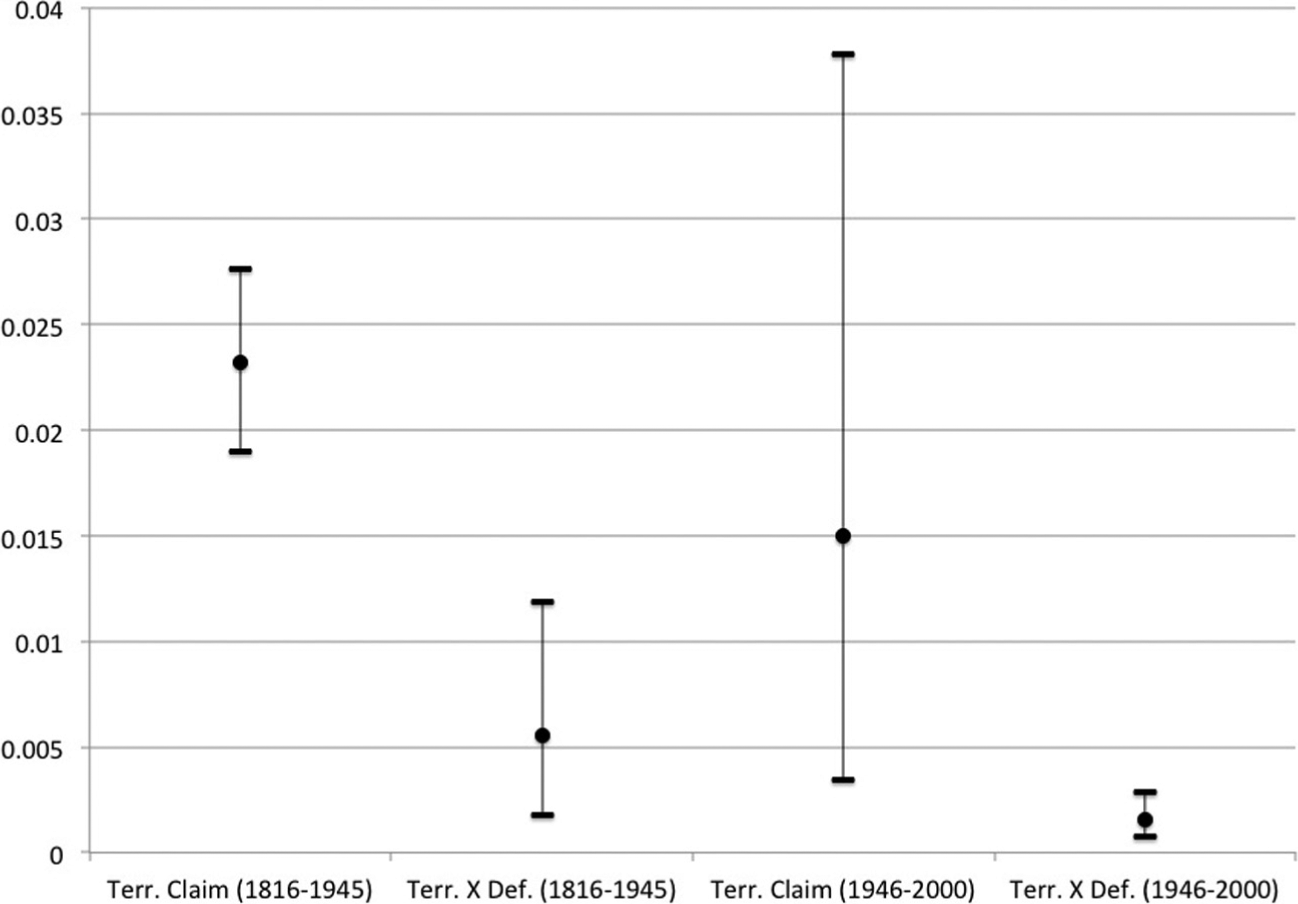
Effect of defensive alliances on conflict initiation in ICOW territorial claims.
Before moving on to the findings on the other indicators of territorial competition, we should note that ICOW data also contains a scale of territorial salience. Hensel and Mitchell (2005) find that increases in salience make conflict more likely. We conducted a test of this in our framework to see if, as salience increases, the relationship between defensive alliances and conflict initiation changes. Although we do not display these results because we want operational consistency across indicators of territorial competition, we note that the findings do not change as the salience of the claims increase. In other words, defensive alliances deter even as the salience of territorial claims increases. 16
Findings: the Huth and Allee sample
We now turn to our analysis of territoriality, defensive alliances and the likelihood of conflict initiation, employing the territorial dispute data by Huth and Allee (2002). While the spatial domain is the entire international system for these analyses, the temporal domain is limited by Huth and Allee’s data, which only covers the time period of 1919–1995. Thus, our spatial–temporal domain for this set of results is all directed dyad–years from 1919–1995. Table 2 displays the results for the entire period, as well as the pre-Cold War (1919–1945) and post-World War II (1946–1995) periods. The results on the full time period are similar to those presented in Table 1, with the exception of the control-free model (model 7), where we do pick up a negative finding on the interaction term. There are a couple of notable differences across the table. First, prior to the end of World War II, there appear to be no conditional effects for territorial competition given the presence of defensive alliances. This might be unsurprising considering that a large number of the conflict observations in this period are concentrated in World War II. After World War II, however, when territory is at stake, defensive alliances make conflict less likely. Across all time periods, the controls again perform generally as they did in Table 1 for the ICOW analysis, although offensive alliances have a negative impact after the end of World War II.
The time period of greatest interest and comparability to the other results is found in model 12, Table 2. This model examines the role of defensive alliances and territoriality on conflict initiation from 1946 to 1995. These results are similar on the whole to those found for the same time period in the analysis in Table 1. First, territorial disputes have a strong positive impact on conflict initiation, conditional on the absence of a defensive alliance (as found in all models across all indicators and samples). Second, conditional on the absence of territorial competition, defensive alliances have a dampening impact on conflict initiation. Third, even in the high stakes of territorial competition, defensive alliances decrease the likelihood of conflict initiation.
As with the analysis of the ICOW claims, we calculated predicted probabilities for the pre-Cold War and post-World War II periods. These are displayed in Figure 2. While the effect is insignificant in the pre-Cold War period, the relative impact of defensive alliances is again large, after World War II, in the context of territorial claims. If a target state has a defensive alliance in the context of a claim, the challenger state is 59% less likely to initiate a dispute (from 0.0166617 to 0.0067248), compared with a territorial claim with no defensive pact. Again, these results indicate that, in the context of territorial competition, a particularly conflict-prone issue, states become much less likely to initiate disputes when either they or their target state has a defensive alliance. These results give even more credence to the idea that alliance content matters in understanding the role between alliances and conflict outcomes, and further support that defensive alliances have a deterrent effect on conflict.
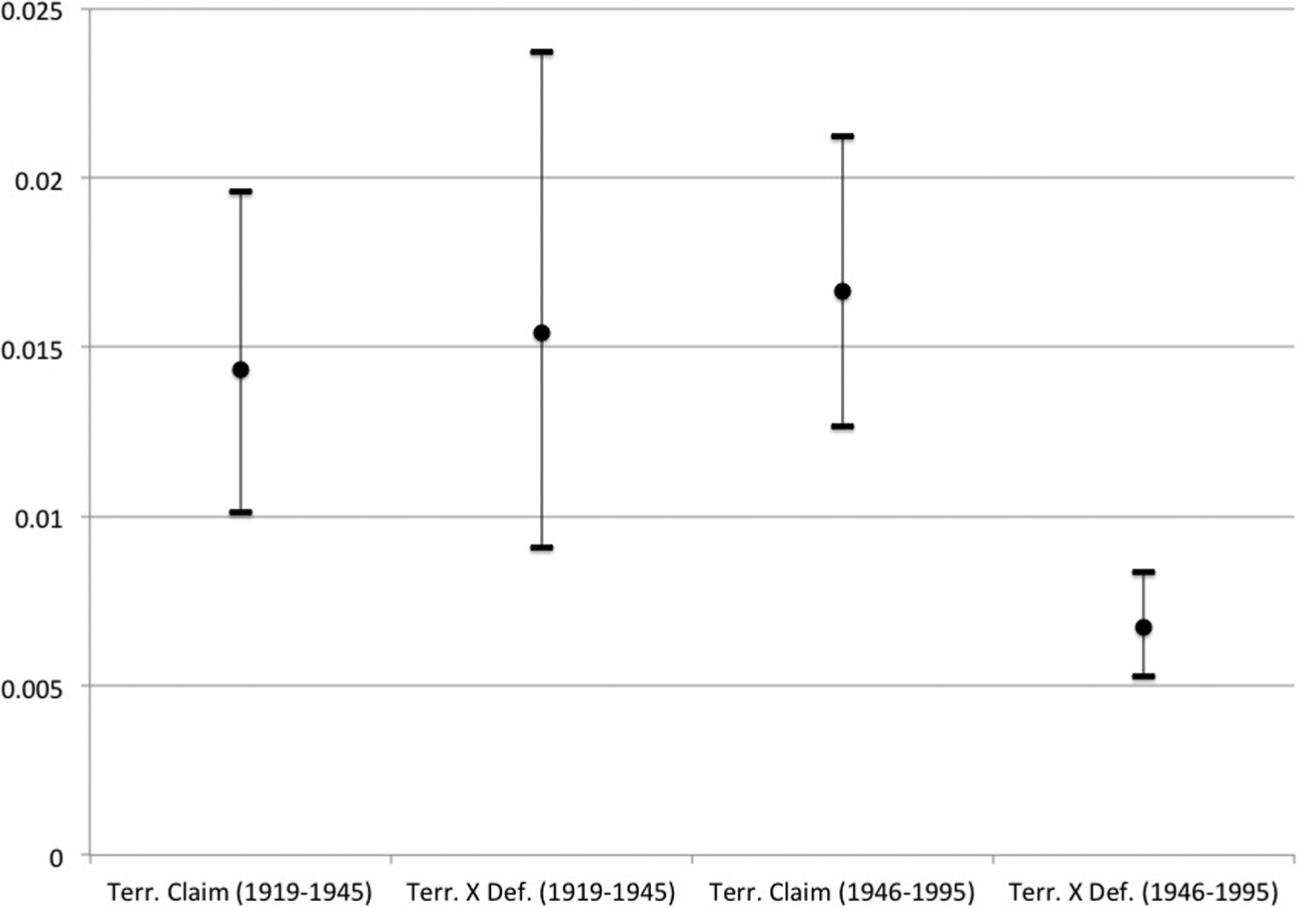
Effect of defensive alliances on Huth and Allee territorial claims.
Results: Thompson’s spatial rival sample
In Table 3, we present the results analyzing defensive alliances in and out of spatial rivalry. This indicator is broader than the others of territorial competition, as rivalry encompasses long-term perceptions of enmity between states. As such, states could be competing over multiple dimensions of space and over more than just one claim. Furthermore, it is not a directional measure, as are the claims measures we employ. That being said, comparing this set of results to the others gives us a more comprehensive understanding of how competition over space in the international system interacts with defensive alliances. This set of analyses is the only one that has samples representing the entire state system for the entire time period of 1816–2000.
The findings presented in Table 3 echo the earlier findings somewhat, but with some notable differences. First, spatial rivalry is positively associated with conflict initiation, given the absence of a defensive alliance. Defensive alliances, conditional on the absence of territory, are significant and negative only in the full time period and the post World War II period, and display a positive impact on the likelihood of conflict (absent spatial rivalry) in the pre-Cold War period. Regarding the interaction term, in the full sample it actually shows a positive and significant effect on conflict initiation. To better understand this curious finding, we calculated predicted probabilities (included in the Online Appendix), based on model 14 of Table 3. In these predicted probabilities, we actually find no noticeable difference between the effect of spatial rivalry and the interaction term. For the 1816–1945 period, we find that defensive alliances in the context of spatial rivalry have the expected negative and significant effect, while for the post-World War II period, we find the expected negative and significant effect, but only in the model without controls. 17 We believe that the divergent findings of the full time sample compared with the split time samples are, like the divergent results in Table 1, a function of the differing likelihood of conflict before the end of World War II and after the beginning of the Cold War.
The control variables perform similarly to those in the previous tables. Again, like in the Huth and Allee sample for the post-World War II period, offensive alliances actually have a negative impact on conflict initiation, but not significantly so. As we have mentioned above, the observations of offensive alliances in this period drop off dramatically, compared with the past (Johnson and Leeds, 2011). As with the prior analyses, we present predicted probabilities of the effect of spatial rivalry and the interaction between spatial rivalry and defensive alliances, which are displayed in Figure 3.
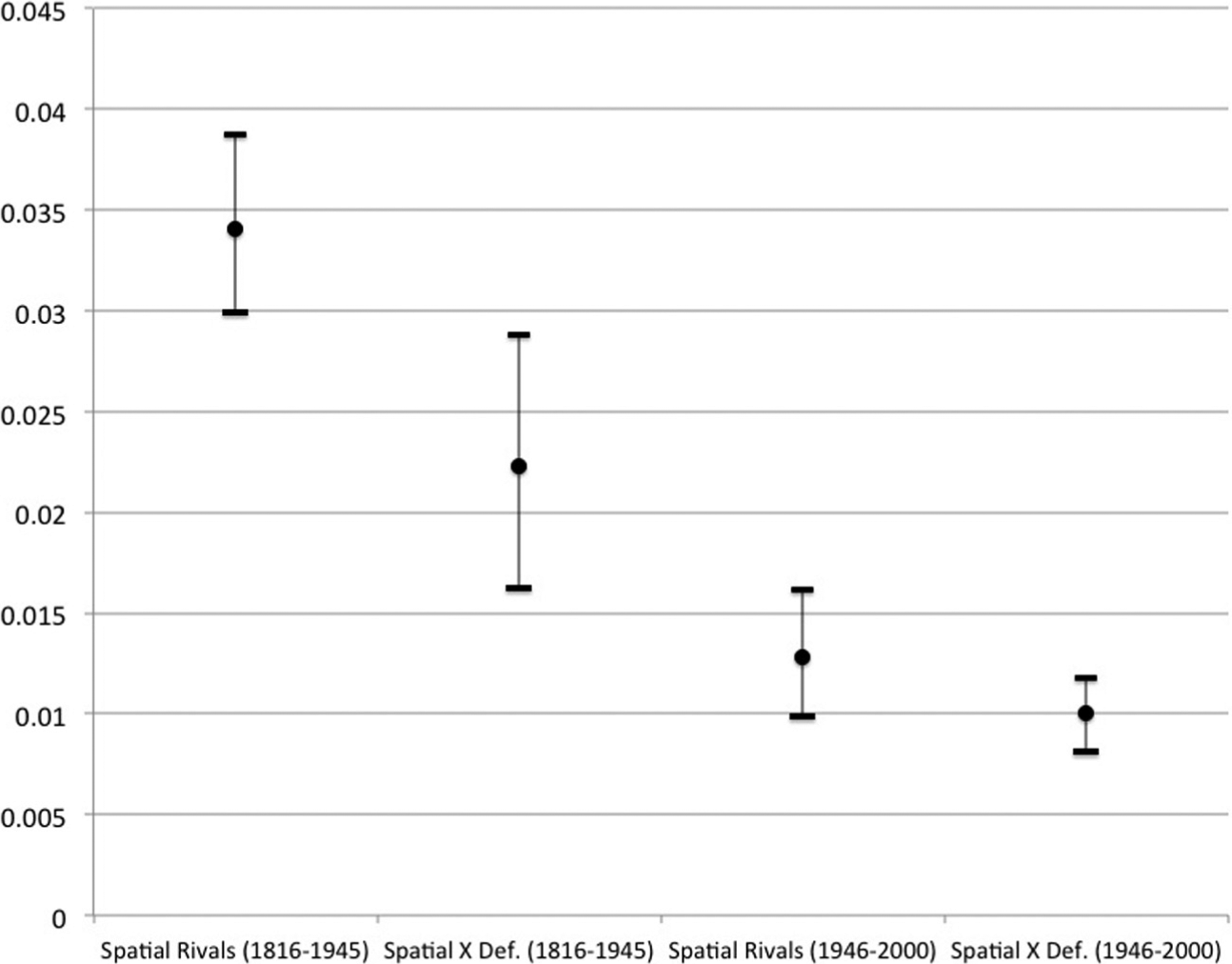
Effect of defensive alliances on spatial rivals.
Similar to Figures 1 and 2, when target states have a defensive alliance, they are less likely to have conflict initiated against them, even in the context of territorial competition. While this difference is only significant in the 1816–1945 period, the difference in likelihoods is in the expected negative direction for the post-World War II period. In the pre-Cold War period, when a target state involved in spatial rivalry has a defensive alliance, the likelihood of conflict initiation decreases about 35% (from 0.0341547 to 0.0223093), compared with spatial rivalry on its own. The results employing spatial rivalry show that, even when states consider each other enemies (beyond just a territorial claim), defensive alliances make conflict between them less likely, which speaks not only to research on territory and alliances, but also for the management of international rivalry. These results, taken with the results presented above, present a strong case that defensive alliances have a significant deterrent impact on the initiation of militarized conflict.
Our findings, across all samples, demonstrate that defensive alliances consistently exhibit a deterrent effect on challenger dispute initiation. The dampening effect of defensive alliances even holds when states compete over territory, a stake that has been shown to be particularly conflict-prone. When a state has a defensive alliance, that state is less likely to be targeted by a challenger, regardless of the competitive context. The robustness of this finding across a number of territorial contexts gives us greater confidence in the need to account for alliance provisions when assessing the relationship between alliances and conflict processes.
Robustness checks
We have performed a number of robustness checks to ensure that our findings are not sensitive to the particular model specifications we display above. Beyond the control-free models displayed above, we have also controlled for contiguity instead of the natural log of capital distance. Doing so provides largely similar results as those above, except that the findings for the strategic rivalry sample are stronger after World War II. When controlling for contiguity instead of distance, we find the expected negative interaction effect. Furthermore, we have also analyzed our models on samples of just politically relevant dyads, which are contiguous states and major powers only, and find substantively similar results. We further break down the sample to focus only on dyads engaged in territorial competition. In those analyses, defensive alliances still show similar effects to those above on dispute initiation, with the exception of the ICOW sample after World War II. We have also tested our models on a subset of dispute initiation, focusing the outcome variable only on those militarized interstate disputes in which the primary revision type is territorial. Our theory suggests that defensive alliances should deter against all militarized dispute initiation, even in the context of territorial competition, but it is also relevant to see if they have such a dampening effect on the initiation of territorial militarized interstate dispute specifically. Across the models, we find support for our expectation for both the Huth and Allee claims sample as well as the Thompson spatial rivalry sample, but not for the ICOW sample. Finally, in the period after World War II, when defensive alliances are the dominant form of alliance that states seek, multilateral alliance organizations like NATO and the Warsaw pact exerted a large amount of influence. In order to test if our results are driven in part by membership in these large alliance formations, we estimated a series of models controlling for whether the target state was a member of either organization and our results were unaffected.
We believe that the results of the sensitivity analysis showcase the robustness of our argument and key results. On the whole, we find that defensive alliances have a dampening impact on the initiation of conflict, regardless of whether states are engaged in highly salient territorial competition. In order to save space, the results of these robustness checks are available in an Online Appendix.
Discussion and conclusion
This study began with a basic puzzle: how is the relationship between alliances and militarized conflict influenced by competition over especially contentious issues? Recent research has helped clear up the broader question of alliances and conflict by integrating alliance provisions into empirical models (Benson, 2011; Johnson and Leeds, 2011; Leeds, 2003). Accounting for the provisions of alliances is premised on the basic assumption that not all alliances are created for the same purpose. For example, we should not be surprised that offensive alliances are correlated with militarized conflict, rather than peace (deterrence), given that they are formed for the purpose of waging war. Empirical analyses confirm the importance of accounting for alliance provisions, as offensive alliances and neutrality pacts are found to be positively correlated with conflict and defensive alliances are negatively correlated with conflict.
We further build on this strand of research by providing a test of the effects of alliance on conflict initiation, conditional on the provision of the alliances and the stakes of competition. From a strategic signaling perspective, the key aspect of alliances is the content of the agreement (Leeds, 2003; Leeds et al., 2000; Smith, 1995). If states negotiate their roles in alliance agreements with the competitive context in mind, the defensive alliance potentially represents a credible signal and may act as a deterrent. Therefore, if target states have defensive alliances, then challengers should be less likely to initiate militarized conflict. We ask whether this relationship holds if particularly high-salience issues are at stake, where states may be willing to incur the costs of conflict for a gain over a salient issue.
We test this proposition by examining the conditional effect of targeted defensive alliances on conflict initiation in the presence of territorial competition, across different time periods and employing multiple indicators of territoriality. Using an interaction between defensive alliances for target states and territorial competition, we provide what we believe is a more appropriate test of the deterrent effects of alliances. By allowing the type of stakes to vary, we can assess the extent to which salience affects the deterrent power of defensive alliances. A negative relationship between defensive alliances and conflict initiation, even in high conflict contexts like challenges to the territorial status quo, would give us greater confidence in the deterrent effects of defensive pacts. Indeed, this is what we find. Defensive alliances for target states have a dampening effect on dispute initiation when states are competing over particularly salient issues, such as territory. We find that this relationship holds in the pre-Cold War period for two of our indicators. This relationship after World War II is robust across two of three different indicators of territorial competition. Furthermore, the substantive impact of targeted defensive alliances in deterring conflict is stronger for dyads with territorial claims than it is for the full sample.
What are the implications for our research on alliances and the conflict process? Our findings clearly demonstrate that targeted defensive alliances can be effective in lowering the likelihood of conflict against relevant states, even when high-salience issues, like territory, are at stake. This finding reinforces the notion that research needs to take into account the strategic intent and agreement content of alliances in conflict models. Furthermore, we need to rethink how we account for and code alliances in empirical models. Given the importance of the content of alliance agreements for our findings, as well as in prior work (Johnson and Leeds, 2011; Leeds, 2003), future tests of the relationship between alliances and conflict should also take alliance content into account.
These findings also speak to the research on territory and conflict. One narrative of the relationship between territory and conflict is that, when states seek outside alliances in the context of territorial competition, it creates a security dilemma, making states less secure and, eventually, war more likely (Senese and Vasquez, 2008; Vasquez, 1993). Although examining war as an outcome would require a different model employing logic specific to escalation and joining behavior by potential allies, we show that alliances do not always make conflict more likely between states competing over territory. We provide evidence that certain alliance agreements—defensive pacts—potentially deter conflict between states competing over territory. Thus, we believe that this evidence shows that researchers trying to understand the link between territorial competition, alliances, disputes and escalation to war should take the content of alliance agreements into account.
This project raises a number of questions for future research. In what contexts or under what conditions do states seek alliances? Our findings suggest, as other research claims (Leeds et al., 2000), that alliances are formed to send specific signals against specific threats. Research suggests that threat can increase the likelihood of alliance formation (Gibler and Rider, 2004; Lai and Reiter, 2000), but little has been done to explore the impact of threat context (e.g. rivalry and issue type). Are rivals competing over territory more or less likely to form alliances than other dyads or states competing over other types of issues? If so, how does this eventually affect the likelihood that those states will escalate to war? Our findings suggest that issues and alliance seeking are related behaviors and this should be explored.
Finally, does the timing of alliance formation affect whether states move down a path toward war or toward peace? It is possible that defensive alliances formed early in a competitive process can raise the cost of conflict, decreasing the likelihood of dispute initiation. If challengers are deterred early on from initiating disputes, this could reduce the probability of recurrent conflict and escalation to war. Alternatively, alliances formed late in the competitive process may be associated with preparation for war, rather than deterrence. Theoretically and empirically exploring these questions will shed light on exactly how different types of alliance function in competitions between states and how these alliances affect the conflict process.
Footnotes
Acknowledgements
This paper was previously presented as a poster at the Peace Science Society (International) Conference in Claremont, CA, 24–25 October 2008, as well as the Midwest Political Science Association Annual Conference, Chicago, IL, 22–25 April 2010. Many thanks to Paul Diehl, Mike Findley, Derrick Frazier, Ashley Leeds, Brandon Valeriano, John Vasquez and Scott Wolford, as well as Glenn Palmer and reviewers for CMPS for helpful comments, questions and suggestions. We would also like to especially thank Todd Allee, Paul Huth, Paul Hensel, Ashley Leeds, Sara Mitchell, Karen Rasler and William Thompson for making their data publicly available and thus making pursuit of this question possible. Replication data as well as our Online Appendix can be found at: 
Funding
This research received no specific grant from any funding agency in the public, commercial or not-for-profit sectors.