




Abstract
In an era where state borders are relatively fixed and interstate wars are uncommon, it seems wise to begin to look beyond full-scale war when examining the relationship between military force and state-building. We thus examine the impact that a low-scale form of armed force, foreign military intervention, has on state-building in post-colonial countries. Using selectorate theory within an actor-centric framework, we hypothesize that certain democratic interveners tend to have a positive impact on post-colonial state-building efforts, while non-democratic and intergovernmental organization interveners have little if any impact. We test our theory using interrupted time series methodology in panel corrected standard error estimates of 80 countries from 1972 to 2002. While our empirical results are somewhat mixed, they demonstrate that different sets of interveners do have different state-building impacts.
The Democratic Republic of Congo (Congo) emerged in 1885 as a private domain of Leopold II of Belgium. Anyone who is familiar with Joseph Conrad’s Heart of Darkness understands Congo’s long, turbulent struggle to build a functioning state. Twice in its political history Congo has been considered “a threat to world peace” (Legum, 1961: 1), prompting external actors to intervene to create a state where none existed in 1885, called the Congo Free State, and to provide order and some semblance of state capability in the midst of the chaos of repeated mutinies, secessions and insurrections following colonial independence. In the first instance, external actors agreed that the Congo basin would remain a free trade area for all nations. In the second case, a United Nations (UN) led military intervention ended the largest post-independence threat to the state, the Katanga secession, in January 1963. As the UN was withdrawing from Congo in early 1964, however, two further rebellions broke out. Nearly half of the country fell into rebels’ hands (Fox et al., 1965), with the final result being a rapid period of state-building in the newly christened Zaire under the auspices of external patron states, especially the USA. From 1965 until the end of the Cold War, President Mobutu Sese Seko remained unchallenged, despite presiding over a personalistic state apparatus that would eventually produce a poorly funded and disorganized state apparatus and military. Whenever Mobutu’s grip seemed to falter, such as in 1977 and 1978 when Angola-based rebels proved a challenge, powerful patron states sent troops to his rescue.
Mobutu’s demise only accelerated the impact that external actors and their armies had on Congolese state development. Congo became the centerpiece of what some commentators have termed “Africa’s First World War”, 1 a brutal conflict that cost more than 4 million lives and lasted nearly five years from early August 1998 to the establishment of a transitional government in mid-2003. Nine African countries sent troops to Congo during the war, and UN and European troops were dispatched to help stabilize the country once the most serious fighting was over. UN troops remain on Congolese soil as of December 2013.
Although Congo’s recent history is perhaps an extreme example, it demonstrates that military intervention by neighboring states and major powers has the potential to have a significant impact on state-building efforts in post-colonial countries. While full-scale interstate war has long been a central feature of theories on state-building, the theoretical and empirical literature has given scant attention to the effect that force short of war may have on state-building. In an era where state borders are largely sacrosanct and all-out war is rare, we think that this is a significant oversight.
We attempt to fill this theoretical and empirical gap by building on Findley and Teo’s (2006) “actor-centric” approach to understand the broad state-building goals of different sets of intervening states. We maintain that the intervening state’s objectives provide clues to the role that foreign military interventions may play in post-colonial state-building, although events on the ground can obviously thwart the plans of any actor that sends troops into another sovereign country. If, for example, a particular set of states can be expected to have little or no interest in helping to develop state institutions in the countries where their soldiers are dispatched, then state-building is an unlikely outcome of their military ventures even if the military operation is successful. In contrast, if a set of intervening states tends to have incentives to help develop state institutions in the lands where their militaries are deployed, there should be a higher probability that target states will emerge stronger from such military incursions. We use Bueno de Mesquita et al.’s (2003) selectorate theory to map the state-building incentives of different external interveners.
While we find mixed empirical support for our theoretical framework, our results confirm that certain sets of intervening states tend to impact state-building in post-colonial countries while other sets do not. Before outlining our theoretical framework and reviewing our empirical results, we first define key terms and provide a brief literature review. We develop our theoretical argument in the second section of the paper and present our research design in the third section. We provide empirical results in the fourth section followed by our conclusions.
Definitions and a brief literature review
We define post-colonial countries as former colonies and states that joined the international state system after 1945. 2 The Correlates of War (COW) list of state system members is used to demarcate countries meeting the second criterion. We refer to the use of military force short of war as any purposeful dispatch of national or international military forces into another sovereign country, and use the International Military Intervention data collection to identify cases (Pickering and Kisangani, 2009). State-building is considered the development of “enduring resources contained within the state apparatus” that must be considered “in relationship to societal constraints that condition governmental behavior” (Barnett, 1992: 41). Thus, state-building is the ability of state managers to penetrate society and to extract resources while simultaneously retaining some degree of autonomy from domestic political and societal interests. Penetration of society is crucial because it allows leaders to tax, and taxation provides the reliable, steady stream of revenue from which the institutional infrastructure of the state is built (Rasler and Thompson, 1985; Tilly, 1992). 3 The importance of autonomy for state actors should be similarly self-evident. State actors that grow too dependent upon or subservient to powerful groups in society may no longer have decisive influence over policy, with the result being the gradual weakening rather than the development of the state (Geddes, 1990; Snider, 1988). Geddes (1990: 217) defines state autonomy as a situation where “the officials who constitute the state not only have preferences which are more than simple reflections of the preferences of powerful societal groups, but also that have the capacity … to carry out decisions based upon their preferences”.
Perhaps the most influential perspective on post-colonial state-building is the predatory approach derived from observations of the European state-building process. Tilly’s (1985, 1992) four-part framework is the most well-known research in this area. The first component of Tilly’s theory is war-making, which eliminates external rivals who claim territory the predatory ruler intends to control. Second is state-making. This is the process by which rulers eliminate or control internal rivals. Third, predatory rulers must provide for and protect the domestic players that support their rule and are crucial to their political survival. The final component is resource extraction that helps the leader achieve the first three goals. Typically, predatory rulers obtain resources through taxation, which tends to be a more reliable source of revenue than external borrowing. As taxation levels increase, the funds generated support the development and gradual institutionalization of state bureaucracies. The bureaucracies themselves soon begin to press for higher rates of taxation to ensure their survival and to expand their influence.
A host of studies have applied predatory theories to post-colonial countries in different regions of the world. This research has generally come to two largely opposing conclusions on the theory’s relevance for the contemporary era. One perspective contends that post-colonial states have developed, or will develop, in a way similar to early modern European states. 4 As a number of scholars point out, it is the virtual absence of interstate wars that explains the prevalence of weak states in the post-colonial world (Barnett, 1992; Centeno, 2002). This approach maintains that the few states that have successfully forged strong state institutions in the post-Second World War era, such as Israel and South Korea, did so because of their past experience with interstate war and lingering interstate threats (Desch, 1996; Migdal, 1988). Thies’s (2004, 2005, 2007) research is a notable example of this perspective. In a series of empirical studies in different regional contexts, he provides evidence that interstate rivalries play a substantial role in the post-colonial state-building process. His argument is essentially that post-colonial leaders enmeshed in interstate rivalries may have some fear that large-scale conflict will eventually break out, and they may increase levels of extraction from society to strengthen state institutions as a consequence. Even if they conclude that full-scale war is improbable, decision-makers may use the threat generated by rivalry to extract resources from society in a form of a “protection racket”.
An alternative view maintains that the modern international political environment is vastly different from that of early modern Europe. As a result, traditional predatory theories have limited the ability to explain the post-colonial state-building process (Herbst, 1990, 2000; Rasler and Thompson, 2009). For example, full-scale wars are less common in the post-1945 era in part because major powers often work to limit the escalation of disputes among post-colonial countries, a type of restraint that was rarely if ever present in early modern Europe (Lustick, 1997). Arguably more important than the influence of major powers is the development of a complex set of laws and norms over the post-1945 period that constrains aggressive interstate military actions. State sovereignty is now virtually guaranteed by the international legal and normative architecture and state borders are often considered inviolable (Ayoob, 1995; Bates, 2001). As a result, post-colonial leaders rarely have to fear conquest or even their own ousting by other state actors (Mueller, 2004) and state death at the hands of foreign armies has essentially disappeared as a phenomenon in the international system (Fazal, 2004). Among others, Jackson and Rotberg (1982) contend that these developments have created a new form of state sovereignty. Since post-colonial states’ sovereignty and legitimacy now rest primarily on international norms and law, they possess what Jackson and Rotberg term “juridical sovereignty”. This stands in stark contrast to the empirical sovereignty that was commonplace in previous historical periods, when state survival depended largely upon a combination of the government’s administrative and diplomatic skill and the country’s military and economic capabilities.
Both perspectives agree, however, that the scarcity of full-scale war and the rise of juridical sovereignty have resulted in relatively weak militaries in a large number of post-colonial states. Armed forces in these countries may be poorly constituted, trained and/or equipped (Bates, 2008; Herbst, 2000). They can be riven by ethnic tensions and/or rife with disciplinary problems. Rarely are they designed for or capable of prolonged conflict or lengthy deployments beyond their borders (Rasler and Thompson, 1999). Some would even be found lacking if they were tasked with defending their home state’s borders (see Kisangani, 2012).
As the example of Congo given previously underscores, one consequence of such weak militaries is that many post-colonial countries have experienced foreign military interventions by powerful or neighboring states or both. While these actions have rarely escalated into full-blown war, they nonetheless have the potential to affect state-building in target countries. Such interventions may last for months or years and they may involve considerable numbers of troops (Pickering and Kisangani, 2009). Even if they are short and involve only a small clutch of soldiers, they have the potential to have a significant impact on events on the ground and state-building given the limited effectiveness of state institutions and militaries in many post-colonial countries. 5
Unfortunately, the state-building consequences of foreign military interventions have yet to be systematically examined in empirical studies. This gap in the literature is made more noticeable by the presence of numerous analyses of foreign military interventions’ impact on other outcomes in target states, such as changing levels of democratization (Pearson and Olson Lounsbury, 2012; Peceny, 1999), quality of life (Pickering and Kisangani, 2006) and respect for human and women’s rights (Peksen, 2011, 2012). Thies’s (2005, 2007) recent, important research further underscores the utility of analyzing the relationship between military incursions short of war and state-building. Since Thies (2007: 720) demonstrates that interstate rivalry, which a number of post-colonial leaders consider a “symbolic threat”, has a notable impact on state-building, the next logical research step would seem to be an analysis of the more tangible phenomenon of foreign military intervention.
In this paper, we hope to offer an initial understanding of the surely multifaceted relationship between foreign military intervention and state-building. We evaluate whether differing attributes and motivations across intervening states have an effect on state-building outcomes in the target states. By focusing on intervening states, we take what Findley and Teo (2006) term an “actor centric approach”, which can be differentiated from a “phenomenon centric approach” that focuses on the interplay among variables on the ground in target states. In essence, an actor-centric approach is just a different analytical take on a relationship under study, with attention concentrated on the intervening state’s motivations rather than the complex array of domestic conditions in the target state. The approach does not claim to provide superior or special insight, only to add information from one perspective that can hopefully be combined with other studies to develop a compelling understanding of the phenomenon under study.
As the following section outlines, we suspect that certain sets of state actors may have stronger incentives to leave a state-building legacy in post-colonial target states than others. We use Beuno de Mesquita et al.’s (2003) selectorate theory to outline these varying incentives and to develop hypotheses on intervening states and their state-building impacts.
Theoretical development
The central assumption of selectorate theory is that political leaders want above all else to stay in office and they continually strive to satisfy the domestic constituencies that allow them to retain power (Bueno de Mesquita et al., 2003). Selectorate theory identifies two such constituencies. The first is the selectorate, or the set of citizens that has an institutional say in choosing leaders such as voting publics in democracies. The second is the winning coalition, which is the most minimal grouping of people, typically politicians and captains of industry, from whom leaders need support to remain in office.
Selectorate theory postulates that, as selectorates and especially winning coalitions grow larger, the delivery of public goods becomes more important for leaders’ survival in office. Leaders who rely on large winning coalitions must consequently perform in office. They must implement successful policies that deliver public goods to members of the winning coalition, and often to large segments of the country’s selectorate. The same does not hold for leaders who preside over small winning coalitions. These actors often have little reason to propose policies that generate public goods. They can retain office simply by ensuring that a steady flow of private goods placates members of their ruling coalition.
Selectorate theory often includes one additional explanatory variable when it is applied to international interactions, relative state power. 6 We postulate that two of these three variables, the size of an intervening state’s winning coalition and its power status, will provide useful guideposts for understanding the state-building proclivities of different interveners. There are, of course, a number of ways one could distinguish among intervener’s winning coalition sizes and their relative power. We begin the process of building knowledge on foreign military intervention and state-building by analyzing dichotomous categories for each variable. For winning coalition size, we distinguish between democracies that tend to have large winning coalitions and non-democracies that tend to have smaller winning coalitions. For relative power, we distinguish between major powers and non-major powers.
Democratic interveners: major powers and non-major powers
Since leaders of major power democracies tend, by definition, to be supported by large winning coalitions, one of the primary goals of their foreign military ventures will be to provide public goods to their domestic winning coalitions. Military interventions can accomplish this by providing policy outcomes that members of the winning coalition believe further the domestic common good, such as safeguarding national security or increasing access to natural resources, burgeoning markets and/or trade routes.
In a handful of cases, helping to foster democracy in the target state may facilitate these goals. In most cases, however, it will not. As Bueno de Mesquita and Downs (2006) and Peceny (2006) explain, a target state democracy creates rival agency demands that inevitably become a problem for the leaders of major power democracies. Even democratically elected leaders in target states who are favorably inclined toward the intervening actor and its interests have to satisfy their own domestic winning coalitions to retain power. They will not always respond favorably to requests by the intervening state, particularly on issues that can generate public goods for their domestic constituencies like natural resource or trade policy. If they do bend to the will of the intervening actor, they risk losing the support of their winning coalitions and possibly losing office. As a result, a “democratic leader of an intervening state will choose the safer and less costly strategy of supporting the establishment (or continued existence) of an autocracy or a rigged election democracy in the target state with a small winning coalition” (Bueno de Mesquita and Downs, 2006: 632). The reason for this is simple. Non-democratic target governments will rarely find it difficult to deliver policy concessions to the intervening state, which help to bolster the leader of the intervening state’s political standing at home.
Although major power democratic interveners rarely have incentives to promote “democratic nation-building”, they frequently help build the target state in the traditional sense of the term. They do so because they prefer stability in target states that enhances their own security, particularly if the target state is in a troubled or strategic part of the globe. Democratic interveners also prefer strong, stable target states because stability facilitates access to markets and to natural resources. Both of these public goods, security and economic access, are appreciated by selectorates and winning coalitions back home. Of course, a stable domestic political environment and secure borders are invaluable for post-colonial executives in target states as well. They provide a dependable, accessible population base for taxation, and they tend to expand the tax base by allowing economic activities to develop and to grow. The private goods that the democratic intervener provides to help keep the target government in power, such as foreign aid and military assistance, also provide revenue for state-building activities and will increase leaders’ autonomy from domestic interests (Bueno de Mesquita and Downs, 2006).
As important, selectorate theory maintains that major power democratic leaders tend to be more careful than non-democratic counterparts when selecting targets for military interventions and to try harder to ensure success once a military mission is launched. They are cautious when contemplating military operations overseas and vigorous when prosecuting them because failed missions, large numbers of casualties (Valentino et al., 2010) or even perceived missteps within victorious missions may raise questions about the leadership’s competence and result in diminishing support within the winning coalition. 7 If decision-makers in major power democracies do in fact go to great lengths to ensure that foreign military missions produce at least a modicum of success as selectorate theory contends, leaving stronger target state institutions in their wake may be considered one visible sign of accomplishment (Bueno de Mesquita and Downs, 2006: 631). Bueno de Mesquita and Downs (2006) point out that countless Western military interventions into post-colonial countries fit this general mold. Our example of Congo does as well. Frequent small-scale Western military interventions in the decades after Congolese independence did little to democratize Congo, but they helped to solidify Mobutu’s grip on power and provided access to Congo’s resources. Before the Mobutu government became racked with excessive cronyism and corruption in the late 1970s and early 1980s, a stronger state apparatus, replete with a relatively effective bureaucracy and a host of successful infrastructure projects, emerged (Kisangani, 2012; Young and Turner, 1985).
Non-major power democratic interveners will seek the same policy concessions from target states as major power democracies. They may, however, be slightly less likely to succeed because they have fewer resources at their disposal than major power democracies. While they have the same incentives to carefully choose intervention targets and to strive for intervention success as major power democracies, there may be cases when circumstances force them to intervene in less than ideal conditions, such as when a neighboring state falters. 8 It is in these cases that their resource shortcomings may become most apparent.
Our first two hypotheses are thus:
Non-democratic interveners: major powers and non-major powers
Non-democratic leaders that intervene in other countries do so to secure private goods from the target state, such as exploitable resources or regular economic concessions, for the small domestic winning coalitions that keep them in power. They are thus “unlikely to be concerned with the long-term internal affairs of states in which they intervene except to ensure the autocrat’s opportunities for material gain [are maximized]” (Bueno de Mesquita and Downs, 2006: 634). Since non-democracies do not tend to devote substantial resources to state-building projects in target countries, there should be little difference between the impact of major power and non-major power non-democratic interveners.
Of course, this does mean that non-democratic interveners never attempt to change target states’ governmental apparatuses. They may try to diminish target state capabilities when they want to extract resources over a relatively short period of time with little resistance. If they want to ensure a more sustained flow of private goods over a longer period of time, they may promote modest increases in the capabilities of compliant target governments. They may also be prone to increasing target state capacity slightly when the one public good that leaders presiding over small winning coalitions tend to value is at stake—territorial security (Bueno de Mesquita and Downs, 2006: 636). Stabilizing turbulent border lands removes potential threats to the survival of non-democratic leaders, while it simultaneously increases their ability to extract wealth from their own citizens that can be used to satiate members of their small winning coalitions.
The Congo case is again illustrative. The 1990s saw a virtual carousel of non-democratic neighboring states intervening in the country. Nearly all sought the same goals: either border security (for example, Rwanda during the First Congo War in 1996) or to weaken the target regime in order to exploit resources, namely diamonds and coltan (for example, Rwanda and Uganda post-1998).
9
In sum, non-democratic interveners have reasons both to strengthen and to weaken target governments at different times, but usually only at the margins. They typically will not allocate large amounts of resources to do either, and thus our third hypothesis is:
International governmental organizations as interveners
There is one final type of actor that sends armed forces into post-colonial states: international intergovernmental organizations (IGOs). An IGO “(1) is a formal entity, (2) has states as members, and (3) possesses a permanent secretariat or other indications of institutionalization such as headquarters or permanent staff” (Pevehouse et al., 2004: 103). All IGOs are thus constituted of multiple states, usually with some mix of members with small domestic winning coalitions and typically fewer with large domestic winning coalitions. There is thus an expectation that any large-scale IGO activity should have some ability to provide both public goods for the constituencies of democracies and private goods for the constituencies of non-democracies, conditions that make it difficult for IGOs to initiate and sustain the type of costly policy necessary to have a large impact on state-building in target countries (Bueno de Mesquita and Downs, 2006: 635–636). We expect IGOs’ limited state-building impact to hold across both regional IGOs and universal IGOs like the UN. Our hypothesis on IGOs is thus:
Research design
We employ panel corrected standard error (PCSE) estimates of 80 post-colonial countries from 1972 to 2002, with temporal boundaries determined by data availability on taxation, to test our hypotheses.
Dependent variables: tax and non-tax revenues
The International Monetary Fund (2006) supplies the data for each of our dependent variables. The first is the standard measure of tax extraction in the state-building literature, the tax ratio or the percentage of all taxes from gross domestic product (GDP) (Rasler and Thompson, 1985; Thies, 2007). 10 We also examine direct and indirect taxes, which are distinct forms of taxation within a state’s overall taxation structure. Each is operationalized as a percentage of total revenue. Direct taxes consist of income taxes, taxes on wealth and property, and corporate taxes. They capture the amount of revenue the government obtains from the most powerful groups in society, such as owners of labor and capital, as well as from ordinary citizens. The more direct the tax structure is in a country, the greater the degree of state penetration within society (Snider, 1988: 468). Indirect taxes combine duties on goods, services and international trade. Although there can be challenges to collecting indirect taxes in post-colonial countries, their administration typically requires a much less elaborate and institutionalized bureaucracy than direct taxes (FIAS/World Bank, 2009; Snider, 1988; Tripathy, 1985). States that rely on indirect taxes thus tend to do so because they have not built the administrative capacity to collect direct taxes and/or they lack either the coercive authority or the legitimacy to extract resources from the population.
While any form of government revenue may facilitate state development, indirect taxes are less suitable than direct taxes for state-building endeavors for two primary reasons. First, they tend to be more volatile than direct taxes because they are influenced by factors beyond state managers’ control like international trade volumes and commodity prices (Krasner, 1985: 47; Tripathy, 1985: 201–209). Steady and reliable revenue streams are crucial for state-building and are a principal reason European state-builders developed systems of direct taxation and the bureaucratic capacity to manage them (Bräutigam et al., 2008: 7). Second, indirect taxation does not have the same potential to develop bonds of legitimacy with society that direct taxation does. State penetration of society is consequently important for more than just the ability to extract revenue. It may build a host of tangible and intangible connections between governments and the governed (OECD, 2010). Consistent payment of direct taxes suggests that societal groups view the government as a legitimate entity performing worthwhile functions (FIAS/World Bank, 2009; Levi, 1988). 11 The relatively consistent revenue flow that direct taxes provide and their potential for generating positive political externalities explains why recent efforts to reform post-colonial tax systems have emphasized, among many detailed proposals, increased levels of direct taxation (see Everest-Philips, 2010; Fjeldstad and Moore, 2008).
Our final discrete measure of government revenue generation is non-tax revenue, which is also operationalized as a percentage of total government revenue. Non-tax revenues in post-colonial states typically consist of foreign aid, administrative fees, profits from state-owned enterprises and certain resource rents. Our operational definition of non-tax revenue excludes foreign aid for two reasons. First, compelling research already exists on the relationship between foreign aid and state capacity (e.g. Moss et al., 2006) and, second, little attention has been given to the state-building impacts of other forms of non-tax revenue (for an exception, see Tripathy, 1985). We thus concentrate on domestic sources of non-tax revenue that post-colonial state managers have some ability to control.
Domestic non-tax revenues are similar to indirect taxes because they do not require an extensive administrative apparatus to collect (Tripathy, 1985: 238). However, they have greater potential to offer post-colonial state-builders some degree of state autonomy (Snider, 1988) than indirect taxes. They allow leaders to generate revenues from sources other than direct levies on business, society or international actors via international commerce.
Non-tax revenues are nonetheless a double-edged sword for post-colonial state-builders. Governments that derive a small to moderate proportion of their income from non-tax revenues should be able to prevent powerful societal groups from capturing the policy agenda. This allows governments to implement policies for the good of the entire polity rather than just powerful interests, thus potentially enhancing the state’s legitimacy and its future ability to tax (and to broaden the tax base). Non-tax revenues may also help to buffer governments from the vicissitudes of the international economy (Snider, 1988). Excessive reliance on non-tax revenues can, however, have a corrosive effect on state-building. It can reduce the impetus for state-builders to penetrate and to build bonds with society. The result may be decreased state extractive capacity and declining tax revenue (Moore, 1998; Remmer, 2004). Rentier states, with all of their well-documented foibles, are extreme examples of over-reliance on non-tax revenues.
As should be evident, the literature has yet to provide unambiguous answers regarding the proper mix of these different revenue streams for post-colonial state-building. Determining the utility of some forms of revenue, particularly domestic non-tax revenues and indirect taxes, is a matter of degree rather than of kind. It is thus difficult for us to say with precision what types of increases or decreases in these forms of revenue facilitate the state-building process. Knowledge derived from extant literature does allow us to look for broad patterns, however. For example, there seems to be a fairly wide consensus that increasing the amount of direct taxation within a country’s revenue portfolio helps state-building. While indirect taxation does not harm state-building efforts because it represents revenue flowing into government coffers, if it becomes too large a proportion of the government’s revenue portfolio it can slow state-building. Non-tax revenue follows a similar pattern, but it has the added benefit of enhancing government autonomy. Consequently, for the purposes of this paper, we will consider increases in the proportion of government revenue generated by direct taxes and, to a lesser extent, non-tax revenues to be most helpful for post-colonial state-building. While these individual measures are admittedly relatively crude, they offer more precise information than tax ratios and they should help to enhance our understanding of the relationship between foreign military intervention and post-colonial government revenue generation.
Independent variable: foreign military intervention
Foreign military intervention is the sole independent variable. We operationalize the concept with Pearson and Bauman’s International Military Intervention (IMI) dataset (Pearson and Baumann, 1993), which was updated to 2005 by Kisangani and Pickering (2008). The IMI data collection records the “movement of regular troops or forces of one country into the territory or territorial waters of another country, or forceful military action by troops already stationed by one country inside another, in the context of some political issue or dispute” (Pearson and Baumann, 1993: iii). In essence, the dataset catalogs episodes when national or international military personnel are purposefully dispatched across national boundaries. Of course, other data collections that catalog the use of low-scale military force exist, but they have limitations for the study of post-colonial state-building. 12 Using the IMI collection, we code intervention as a dummy variable with scores of “1” the year that an actor initiated an intervention into a post-colonial country. To ensure that we are measuring only force short of war, we removed cases that overlap with COW intestate wars. 13 We use interrupted time series (ITS) methodology to capture the longer-term impact of IMI with a set of variables, which we explain below.
Mediating variables
Two mediating variables are central to our theoretical framework. The first is the distinction between intervening states that are democratic and those that are not. We use the polity2 variable in the Polity IV dataset to differentiate these two sets of actors (Marshall and Jaggers, 2011). States with scores of +6 or above on the −10 to 10 scale of this variable are considered democracies, while those below are considered non-democracies. The second is a dichotomous categorization of major powers and non-major powers. We use the COW demarcation of major powers to identify these two sets of actors in our sample.
Control variables
We use a standard set of 14 control variables from the state-building literature (see especially Cheibub, 1998; Thies, 2007). Strategic rivalry, internal rivalry, foreign debt, state age, GDP per capita, trade openness and a substantial state mining sector are typically thought to increase state revenue production. Foreign aid, inflation, production from agriculture, and a leader’s discount rate are commonly thought to decrease revenue production. Target state democracy seems to have a mixed impact on state-building efforts (Cheibub, 1998; Thies, 2007). Since the literature assumes that age 14 and GDP per capita tend to have non-linear relationships with revenue, the square of each of these variables is included in our estimates (Thies, 2007).
Thompson (2001) is the source for our data on strategic rivalry. An alternative measure, enduring rivalry (Diehl and Goetz, 2001), is included in supplemental estimates with no substantive change in the results. Internal rivalry is a dummy variable combining ethnic and revolutionary wars in the State Failure Task Force data (Thies, 2007). Data on foreign aid, foreign debt, GDP, trade, inflation and agriculture are from the World Bank (2009), while that on age is from COW’s state membership data. The discount rate is calculated as a hazard rate from a Weibull distribution model of chief executive survival as measured by the length of their tenure in office, past executive turnover and the country’s economic growth (Cheibub, 1998). Data for the former two variables comes from Beinen and van de Walle (1991) updated with information from Lexis-Nexus while data for the latter variable are from the World Bank (2009). One final concern must be addressed about our control variables. Since some governments nationalized mining industries in the 1960s and 1970s and classified mining income as non-tax revenue, we use a variable that captures only the income from private mining companies (mining-private) in our estimate of non-tax revenue and in supplemental estimates of our other dependent variables. Data for mining-private comes from Rodman (1988) and is updated with Lexus-Nexus Universe. Finally, we added three world regional dummies as recommended by the literature with Africa as our reference category.
Methods
Before reviewing our empirical outcomes, a few methodological issues must be addressed. First, we assessed endogeneity between our dependent variables (tax and non-tax revenues) and our independent variable with Hausmann specification tests. We failed to reject the null hypothesis of no simultaneity in these tests at the 1, 5 and 10% levels of significance. We nonetheless lagged our control variables to deal with any weak exogeneity that may arise (see Gujarati, 2002). Second, we assessed all models with Variance Inflation Factor tests to determine if multicollinearity was affecting our estimates and we concluded that multicollinearity does not have a pernicious effect on our estimates.
Our third and final concern is that we are able to trace both the immediate and the long-term impact of external military interventions on state-building in our estimates. We use ITS methodology for this purpose. ITS uses multiple variables generated from a single independent variable to capture discrete event-induced changes in the level (mean) and/or trend (slope) of a time series (Lewis-Beck, 1986). In our estimates, foreign military intervention represents the discrete event. The regression equation for estimating these changes is:

where Yit is the dependent variable, state-building; trendt is a variable counter for time 1…N; intervention levelt is a dichotomous variable scored 0 for observations before the military intervention and 1 for observations after the military intervention; and intervention trendt is a variable counter for times scored 0 for observations before the military intervention and 1, 2, 3, …, for observations after the military intervention; Zit is our set of control variables; wit is the error term; and b and c are parameters to be estimated.
Trendt thus captures the trend in Yit before a military intervention, while intervention levelt captures how a military intervention changes the intercept and intervention trendt captures the change in the slope following the intervention. The parameters b0 and b1 in Equation (1) represent the level and slope of the time series before a military intervention. To evaluate whether military intervention changes b0 and b1, we examine b2 and b3. It should be noted that ITS can also accommodate more than one military intervention in a single target in a given year, but since that was an uncommon occurrence in our sample we do not use multiple ITS.
Reviewing the empirical evidence
Table 1 highlights the general effect foreign military intervention has on state-building. It does not distinguish among different interveners, but rather includes any foreign military intervention into a post-colonial state during the time period of our study. It thus provides a baseline for an analysis of specific types of interveners. The four models in Table 1 fit the data quite well as indicated by statistically significant χ2 statistics. The negative sign and statistical significance of trendt in our first model indicates that tax ratios have in general been declining in the countries in our sample from 1972 to 2002. The statistically insignificant intervention levelt estimate implies that foreign military intervention does not change the intercept of the model.
PCSE model of state building, state as target of IMI in 1972–2002
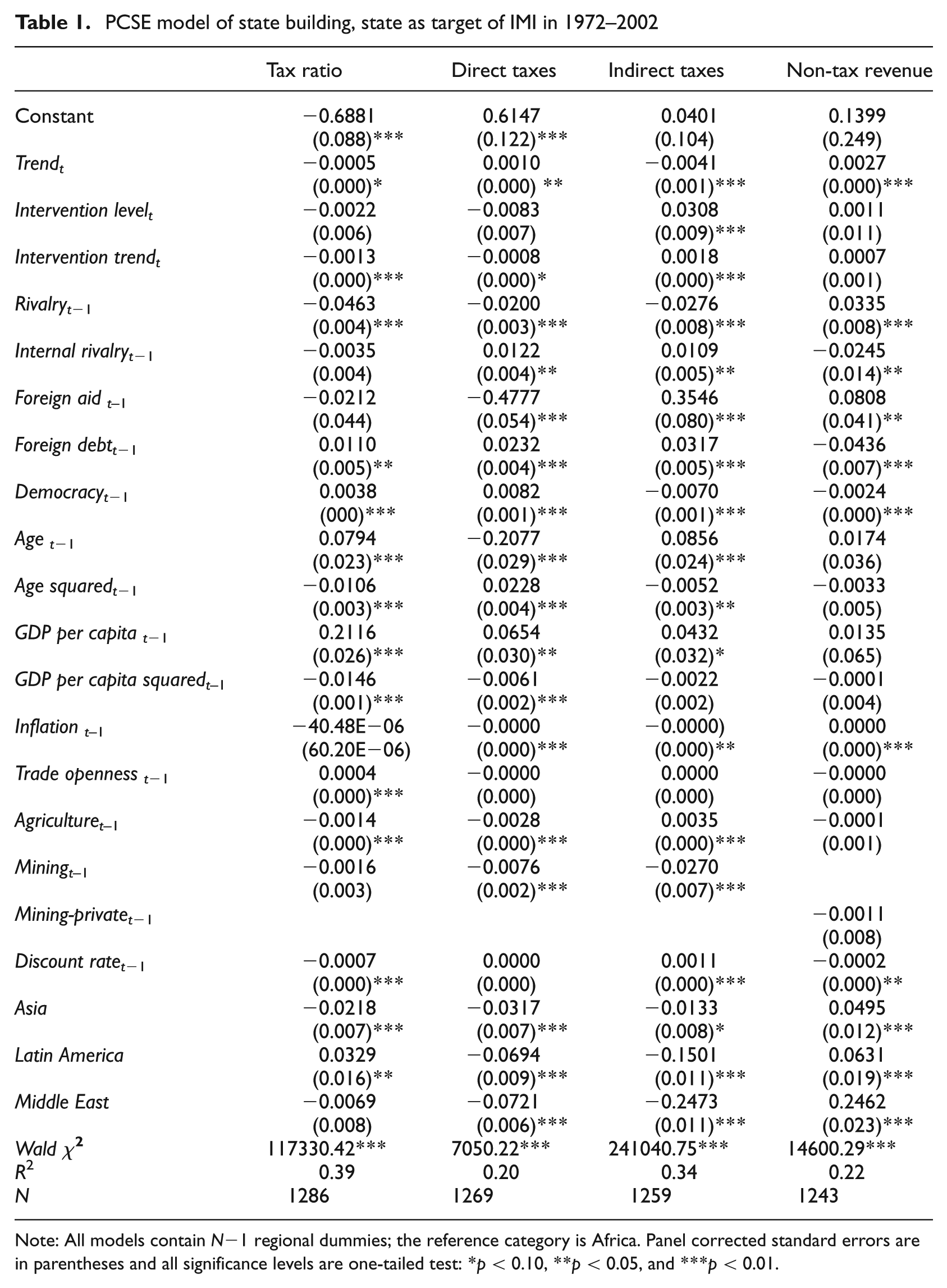
Note: All models contain N−1 regional dummies; the reference category is Africa. Panel corrected standard errors are in parentheses and all significance levels are one-tailed test: *p < 0.10, **p < 0.05, and ***p < 0.01.
Military intervention seems to have a long-term impact on tax ratios, however. Intervention trendt is highly statistically significant, which suggests that the post-intervention slope of post-colonial state tax ratios differs significantly from the pre-intervention slope. To assess the change in slope, we add the estimated coefficients of trendt and intervention trendt. This gives us (−0005–0.0013) or −0018. Military intervention into a post-colonial state thus appears to decrease tax ratios over the long term, but by less than 0.2% annually holding other factors constant. Our model for direct taxes provides similar results. Military intervention does not alter the intercept of direct tax collection, but it dampens the already meager growth in direct tax revenue over the long term. A positive pre-intervention slope of 0.1% growth is reduced to 0.02% (0.0010–0.0008) after foreign troops are introduced to post-colonial state soil.
Military intervention appears to have a more substantial impact on indirect taxes. The statistically significant estimate of intervention levelt suggests that it provides an immediate boost of almost 3.1% to levels of indirect taxation in target states, but the long-term slope of indirect tax collection following an intervention is statistically significant and negative. The annual decline is 0.2% or (−0.0041 + 0.0018). It will take roughly 15 years for this gradual post-intervention decline to dissipate the substantial boost that foreign military intervention seems to provide to levels of indirect taxation. Military intervention’s effect on non-tax revenue is far less substantial. It appears to change neither the level of non-tax revenue collection nor its slope.
Control variables in our four models in Table 1 generally behave as predicted with one notable exception. Strategic rivalry has a negative and statistically significant relationship with direct taxes, indirect taxes and tax ratios. The latter finding contradicts previous empirical studies (Thies, 2005, 2007). These results suggest that the role that interstate tensions play in post-colonial state-building may deserve further scrutiny. Post-colonial leaders may only expand state extraction in response to interstate rivalries under certain conditions.
Table 2 provides five models (A–E) and answers the question of whether the characteristics of the intervener matter in building the target state. It presents the statistical results for our independent variables and the key control variables rivalry and internal rivalry. The remaining control variable outcomes are consistent with findings from the full sample reported in Table 1. Model A provides results for major power democracies. When these states intervene in post-colonial states, it seems to have no statistically significant effect on tax ratios in either the short or the long term. A different picture emerges for specific types of government revenue. Democratic major power interventions seem to have a lasting, negative impact on direct taxation. Direct taxes decline in the short run by 2% following a military intervention by a major power democracy, holding other factors constant. The long-term trend following the intervention is also negative, with direct taxation rates deteriorating at a pace faster than prior to the intervention (0.01% annually or 0.0013–0.0033). Major power democracies’ military interventions have the opposite impact on indirect taxes. Indirect tax rates rise by 3.1% shortly after an intervention by a major power democracy and they seem to remain at that level. Non-tax revenue follows a pattern more consistent with direct taxes, with an almost 4% decline after a military intervention that is never regained. None of these results lends support to Hypothesis 1, which asserts that democratic major power interventions facilitate state-building in post-colonial states. In fact, they suggest that interventions by major power democracies tend to harm post-colonial state-building efforts. State penetration of society wanes, as demonstrated by the decline of direct taxes and the rise of indirect taxes. State autonomy also appears to suffer, as suggested by the drop in non-tax revenues.
PCSE model of state building by actor type, 1972–2002
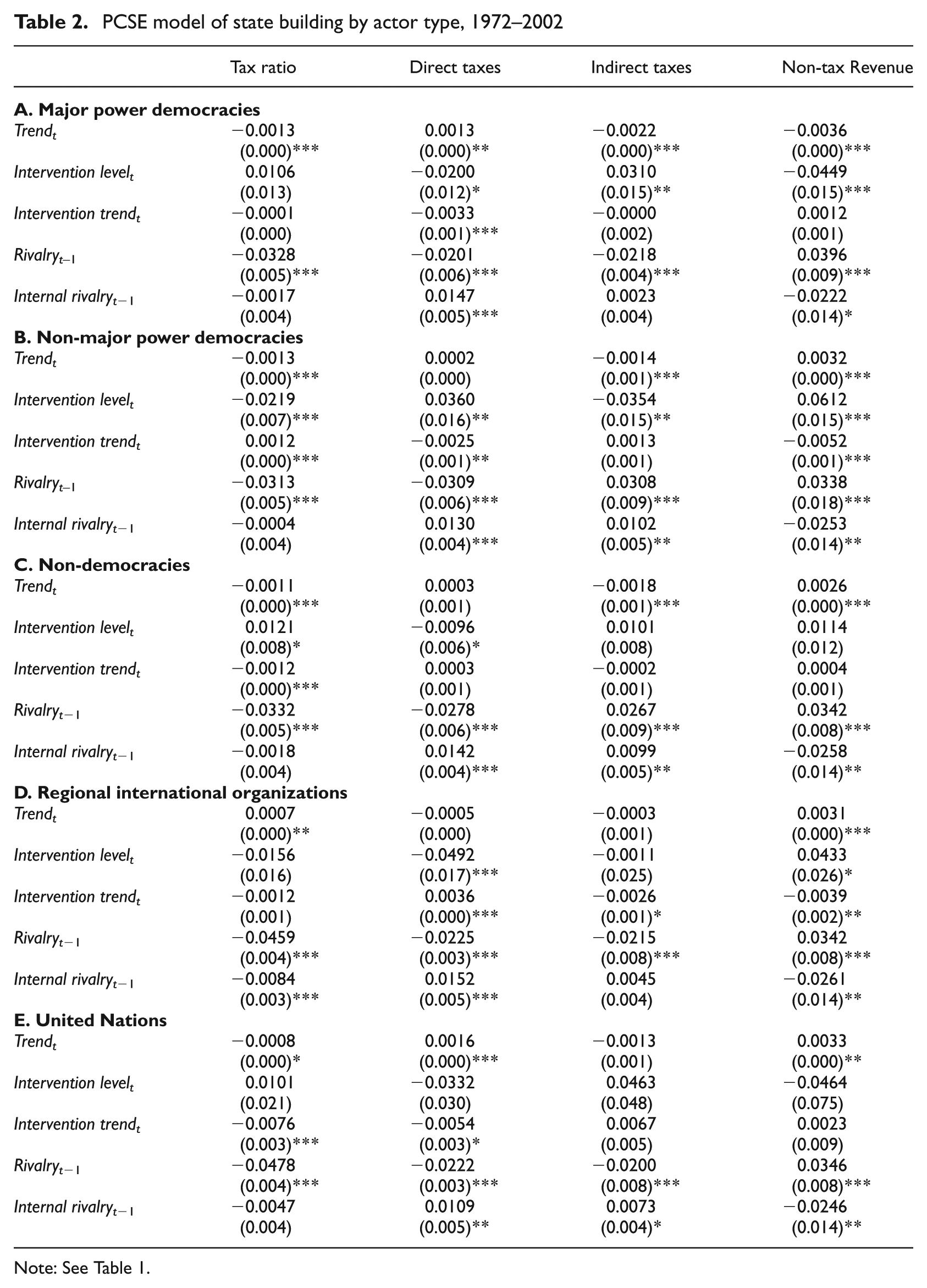
Note: See Table 1.
In contrast, interventions by non-major power democracies seem to have a substantial and positive impact on post-colonial state-building. This finding is not apparent when examining tax ratios, but it becomes evident when attention turns to specific forms of revenue generation. As model B illustrates, tax ratios decrease both in the short (−2.2%) and the long run (0.001%) following a military intervention by a non-major power democracy, although the negative post-intervention slope is considerably less severe than the pre-intervention slope. Direct taxes rise by 3.6% shortly after a military intervention, although these gains erode slightly annually by 0.25% in the years following the intervention. Indirect taxes decline by 3.5% shortly following a democratic non-major power military intervention, and these losses are not offset by a rise in the post-intervention slope. At the same time, non-tax revenues expand by almost 6.1% following a military intervention, with only a small annual decline in the post-intervention slope (−0.52%). Taken in total, these results suggest that democratic non-major power interventions seem to have considerable capacity to enhance the state-building process in post-colonial countries, by increasing both state penetration and state autonomy. The findings do not, however, support Hypothesis 2, which anticipated that interventions by non-major power democracies would have mixed state-building results.
This outcome is intriguing and deserves further research. It may be that our theory underestimates the impact that relative resource scarcity has on the interventionary behavior of non-major power democracies. Since decision-makers in non-major power democracies know that a failed military excursion abroad may affect support within their winning coalitions, perhaps resource limitations force them to be especially selective in choosing target countries. In contrast, major power democracies’ resource abundance may allow leaders to be somewhat less cautious when they initiate low-scale force, and their global responsibilities may draw them into situations that non-major power democracies would rarely, if ever, participate in. A key consideration in all of this may be the anticipated costs of the mission, with caution and selectivity probably increasing among decision-makers in major power democracies as expected costs rise (with the greatest selectivity being present on missions that have some probability of escalation to war). Whatever the cause, it appears that it is intervention by non-major power democracies that furthers state-building in post-colonial targets, not intervention by major power democracies as our theory proposed.
Hypothesis 3, which states that military interventions by non-democratic interveners will have little impact on state-building in target states, is supported by the empirical evidence (see model C). Tax ratios increase by 1.2% in the short run following a military intervention, but they decline by 0.23% annually after that. As important, direct taxation levels decrease by almost 1% (0.96%) in the short run. As selectorate theory presumes, non-democratic interveners seem to have little incentive to foster state-building in target states. Finally, the outcomes presented in model E provide empirical backing to Hypothesis 4, which contends that IGO interventions do not have a major impact on post-colonial state-building. This finding corroborates a number of recent studies on the failure of the UN to build post-conflict states (Adebajo, 2011; Zelizer, 2013).
Conclusion
Our results point to one methodological conclusion and one theoretical conclusion. Methodologically, our study highlights the utility of looking beyond the aggregate dependent variable tax ratio to understand the post-colonial state-building process. An analysis of specific types of revenue generation allows researchers to gain a more precise understanding of both state penetration of society and state autonomy. As our findings demonstrate, overall levels of taxation may hardly change while different forms of taxation and other sources of government revenue rise and fall substantially. These specific types of government funding arguably provide more substantive information on the post-colonial state-building process than the broad composite measure that is standard in the literature.
Theoretically, our results suggest that the actor-centric approach may have considerable value when analyzing post-colonial state-building. Although selectorate theory’s expectations are not fully met, it is clear that certain types of intervening actors tend to further state-building processes in post-colonial countries while other intervening actors do not. As anticipated, democratic interveners tend to have a more significant, lasting impact on post-colonial state-building than non-democratic actors and IGOs. What was not expected was that non-major power democracies have a positive impact while major power democracies seem to have a negative impact. The global responsibilities that major power democracies tend to have and their relatively high level of interventionary activity may partially explain this outcome. While major power democracies have some potential to be drawn into military missions in troubled lands with limited prospects for successful state-building, non-major power democracies may have the relative luxury of being selective when sending soldiers across borders. Whatever the explanation, this finding clearly deserves further exploration.
In sum, our results suggest that continued study of the impact that low-scale military force may have on the state-building process in post-colonial countries may pay considerable analytical dividends. Future research might focus solely on the target selection and interventionary behavior of non-major power democracies to further grasp how they influence post-colonial state extractive capacity. It might also be useful to look at military interventions by non-state actors, such as transnational rebels. Military operations by non-state actors have the potential to have a substantial impact on state extractive capabilities, as they may cut off state access to natural resources and populations that could otherwise be taxed. The military missions that post-colonial states launch against such transnational actors may also have interesting state-building ramifications. While a number of different approaches are possible, they all suggest that it would be beneficial to move beyond predatory theory’s focus on full-scale war and interstate defense to understand post-colonial state-building. In an era where state borders are relatively static and interstate war is uncommon, it seems logical to give at least some analytical attention to the state-building effects of lower-scale forms of military force.
Footnotes
Acknowledgements
We thank three anonymous reviewers and editor Glenn Palmer for their helpful recommendations. Any remaining errors in the paper are, of course, our own.
Funding
Funding for the update of the International Military Intervention data used in this paper was provided by National Science Foundation award SES-0518294.