



Abstract
Child soldiers remain a stark reminder of the suffering caused by civil wars. This paper explores the long-term calculations that rebel leaders employ when deciding whether or not to use child soldiers. A norm against the use of child soldiers has been strongly stated by the international community. Given their need to attract international support to achieve their goal of state recognition, we argue that separatist rebellions are unlikely to use child soldiers because they are constrained by these norms. We test our expectation on a newly collected dataset of child soldier use from 1998 to 2008. Our analyses find considerable support that separatists are more likely to follow accepted norms and refrain from using underage troops. Consistent with previous work, we also find that child soldier use increases as the duration of the war increases, when there is a vulnerable supply of internally displaced people, as youth unemployment increases, and when rebel groups rely on illicit funds.
They are known as moryaan (maggots) on the streets of Mogadishu and abejitas (little bees) in Colombia. Units of kadogos (little ones), no older than 15, routinely see combat in the eastern Democratic Republic of Congo (Rakisits, 2008). In response, in 2012 the non-profit organization Invisible Children released a video known simply as “Kony 2012”. It was viewed by more than 80 million people within 2 weeks, and the kidnapping, mutilation and forced recruitment of children in central Africa left millions of American Facebook users appalled and calling for action. Joseph Kony’s crimes are labeled as horrendous by a rarely unified internet audience. Yet, he and many others like him ignore this sentiment altogether. Although extremely difficult to estimate accurately, a commonly cited figure indicates that anywhere from 200,000 to 300,000 children are used by both governments and rebels in ongoing armed conflicts (Human Rights Watch, 2007). Even with the world’s attention focused on the conflict in Syria, for example, the rebel organizations fighting against President al-Assad—organizations who desperately need external support—have used children as young as 16 in combat missions (Human Rights Watch, 2012). With children fighting in at least 13 other conflicts today, the rebels in Syria are unfortunately not alone (Human Rights Watch, 2013).
Despite the disregard that so many groups show to the rights of children, there are a number of rebel groups that do not use children as soldiers. While the Revolutionary United Front (RUF) was notorious for employing thousands of children in combat, for example, the Ogaden National Liberation Front (ONLF) in Ethiopia does not (Coalition to Stop the Use of Child Soldiers, 2008; Denov, 2010). Even insurgencies that are condemned for acts of terror show variation in their recruitment practices. The Taliban regularly employs children as suicide bombers (Human Rights Watch, 2011). While it is not unheard for them to use underage fighters, many of the Palestinian liberation groups often shy away from bombers under 18 in favor of adults (Coalition to Stop the Use of Child Soldiers, 2008). This variation leads to an important and understudied research question: under what circumstances will rebel groups use child soldiers?
To answer this question, we characterize rebels as rational organizations that respond to contextual stimuli. The concept of the rational-rebel is offered in the civil conflict literature, and at present appears to be the dominant paradigm explaining rebel behavior during civil war. Building on this tradition, we argue that recruitment decisions, specifically whether to use child soldiers, are also a product of rational calculations of costs and benefits, with a keen eye towards the future. Rebels will refrain from using child soldiers if such restraint helps them reach their eventual goals. We focus on international legitimacy as a mechanism to explain why some rebel groups will use child soldiers and others will not.
We concentrate on two types of rebel groups: those who attempt to overthrow the government and those who seek to secede and form their own state. Regarding the former, rebel groups seeking to overthrow the government can succeed with brute force. With few exceptions, these groups need only to defeat the government forces to wrest control of the state and be recognized (albeit begrudgingly at times) by the international community. In contrast, rebel groups seeking to break away from their state cannot rely on brute force alone. As explained by Coggins (2011: 435), “Independence projects falter if they cannot secure external legitimacy”. We expect the added legitimacy requirement for secessionist movements to have an appreciable impact on their conduct during conflict. Although the use of child soldiers is widespread among rebel groups, a strong international norm against the use of child soldiers has emerged among states. We view this norm as a strong signal to rebel groups that the use of child soldiers is illegitimate behavior. Constrained by their desire for legitimacy, therefore, we expect separatists to avoid using child soldiers in their attempt to be recognized by the international community. We test this expectation with a quantitative analysis of original data gathered for 103 rebellions active from 1998 to 2008. Our results are strongly supportive of our theory—secessionist rebel groups seeking to join the international community are most likely to adhere to globally established rules of behavior and refrain from using child soldiers.
Why use children as soldiers?
Scholarly research on the causes of child soldiering generally falls into two categories: systemic influences and recruitment decisions. 1 Systemic influences are often described as supply-side theories. Scholars commonly propose that an excess of available children leads to high rates of recruitment. Two primary factors guide this approach. First, researchers look at the costs and benefits of joining a rebel group, most often focusing on economic circumstances as motivators behind child participation in conflict. Factors like poor education (e.g. Cohn and Goodwin-Gill, 1994; Wessells, 2006), poverty (Honwana, 2006; Machel, 1996; Singer, 2005) and lack of employment (Brett and Specht, 2004; Brett et al., 1996; Sesay and Ismail, 2003) can make joining a rebel group an attractive option for children. Even when poor economic conditions fail to outweigh the risk of choosing to join a rebellion, the conditions make pools of vulnerable youth ripe targets for ambitious recruiters (Achvarina and Reich, 2006). As Singer (2005: 4) explains, children in “special risk groups” (e.g. street children, rural poor, refugees) are at a high risk for forced recruitment compared with children from wealthier families because parents in the latter group can either pay off rebel groups or can send their children out of the country to avoid conscription. Whether elective or coerced, as the rapid population growth results in large numbers of youth, the use of child soldiers becomes unsurprising (Singer, 2005; Urdal, 2006).
The second supply-side explanation focuses less on the rational decision to join or conscript child soldiers, putting more emphasis on the socialization of children during warfare. Few civil conflicts exist in isolation. Rather, most conflicts are clustered either temporally (repeated conflicts in the same country) or spatially (conflicts in the same neighborhood) (Collier and Sambanis, 2002; Collier, 2007). Children in states that fall in both groups are apt to see militarization become part of their daily lives (Cohn and Goodwin-Gill, 1994; Wessells, 2002, 2006). Norms respecting the value of life are degraded as children are exposed to the slaughter that accompanies warfare (Machel, 1996), and children come to see participation in warfare as necessary for both protection and prestige (Barnitz, 1997; Munkler, 2005). Thus, even when participation in conflict is a poor choice based on a pure cost–benefit perspective, exposure to warfare can change values and perceptions of fighting to produce a large pool of children willing to fight.
While supply explanations offer theories of opportunity, demand explanations primarily explore short-term costs and benefits of exploiting children. Thus, the second category explores the motivations of the recruiters themselves, focusing on the costs and benefits of using underage troops. Two related arguments stand out here. The first centers on troop shortages and the need to maximize recruitment (Blattman and Annan, 2008; Twum-Danso, 2003). As Woods (1993) explains, recruiters often target children based on the simple need to fill quotas to produce more fighters. Blattman and Annan’s (2008) study of the Lord’s Resistance Army in Uganda provides strong support for this argument, explaining that children combine effectiveness and ease of retention, which makes them appealing to rebel groups with few or limited resources. Even when rebel groups are able to fight effectively in the early stages of a conflict without using child soldiers, Machel (1996) explains, they often find themselves needing to recruit children as the war lengthens.
The second demand-side explanation for the use of child soldiers concurs with the explanation above, but adds the proliferation of small arms to the story. Not only are children often needed to fill the ranks of rebel groups, but the rise and spread of modern war-fighting technology makes it easier to transform children into soldiers (Singer, 2005; Stohl et al., 2007). As summarized by Tynes (2011:30), “The small arms proliferation equation is: an easy-to-carry, easy-to-fire, deadly weapon, plus an easily coerced child, equals a plethora of new under-aged troops”. Debate exists over this explanation, however. Andvig and Gates (2010) and Beber and Blattman (2013), for example, argue that, while children are inexpensive and easy to recruit, their fighting effectiveness is limited.
Taken together, the literature on child soldieries has flourished recently, providing a plethora of testable implications and empirical research to explain the use of child soldiers. We seek to build on this work by bringing long-term costs and concerns for international audiences into the rebel calculus. Although almost all civil conflicts provide an environment where both the supply and demand for child soldiers is high, we continue to see a surprising number of rebel groups refrain from using child soldiers. In the subsequent section, we attempt to explain this puzzle by focusing on the role of international audiences in compelling rebel leaders to refrain from using child soldiers.
International signals and recruitment decisions
We begin our argument by noting the key differences between types of rebel groups. The most common distinction among rebel groups is between those that seek to overthrow the government or drastically change the political system vs those where the rebel group’s goal is secession or autonomy (Salehyan and Thyne, 2012). Regarding the former, non-separatist rebels have inertia on their side because states desire the continuity of the international system. In the context of civil conflicts, states are therefore more willing to accept new governments than new states (Coggins, 2011; Fabry, 2010). While it may be unpleasant to recognize a government born of revolutionary, military or otherwise unconstitutional means, it is often a practical necessity. Thus, the formula for recognition for rebel groups seeking to overthrow the state is rather simple: win the war.
In contrast to groups aimed at the center, the process by which secessionist groups can achieve their objectives is much less clear. Neither scholars nor policy-makers are able to agree on when or whether a secessionist movement should be granted independence. Scholars like Mearsheimer (1999) and Kaufmann (1996) advocate secession in most contexts, while others like Kaldor (1996) and Kumar (1997) promote the opposite. It is therefore unsurprising that we have seen policy-makers support secession in places like Bosnia and Slovenia, while rejecting statehood for Montenegro and Somaliland (Tir, 2005). Although the process by which secessionist movements can gain independence may be unclear, it does happen (Coggins, 2011). Given that at least 29 movements fought for independence over the last decade, it is likewise evident that rebel groups see independence as an achievable goal. However, as compared with rebel groups seeking to overthrow the state, we expect the bar for secessionist groups to achieve their objectives to be much higher.
Two strands of literature help explain how these objectives can be achieved. First, the majority of the scholarship takes a bottom-up perspective, focusing on internal outcomes to explain how groups can achieve independence. Factors here include ethnonational distinctiveness and mobilization (e.g. Emerson, 1960; Horowitz, 1985), colonial history (e.g. Spruyt, 2005), ethnic federations (e.g. Roeder, 2007) and the need for the secessionist movement to establish unambiguous internal sovereignty (e.g. Crawford, 2000). A more recent strand of literature explains that, while many groups have all of the internal characteristics needed for statehood, independence projects still fail (e.g. Tamil Eelam, Biafra, Somaliland). To solve these puzzles, scholars take a top-down approach to understanding state emergence by focusing on the role of the international community in enabling movements to achieve independence. As Coggins (2011: 435) explains, “It is clear that aspiring states need a quorum of the world’s states to consecrate their legitimacy”. We agree with the emphasis on international legitimacy in helping to understand why some independence movements achieve success while others falter, and we suspect that secessionist leaders have come to the same conclusion.
If it is true that international legitimacy makes it more likely for independence movements to be recognized, and that recognition is necessary for secessionist groups to achieve their goals, then we should expect rebel movements seeking to create their own state to act in a way that makes them seem legitimate in the eyes of international actors. While both types of rebel groups—those aimed at the center and those seeking independence—are likely to seek international support, the need for external support for those in the latter group is clearly more substantial than for those desiring a change of government. As we discuss next, international actors have sent clear and consistent signals about one aspect of rebel behavior that is likely to be viewed as illegitimate by the international community—the use of child soldiers. These signals provide the mechanism to understand why rebel groups aimed at the center are more likely to use child soldiers vs rebel groups seeking to secede.
Child protection norms
Without a codified process for statehood, quasi-states must impute the conditions by which their claims will be heard. While it is difficult to know what policies (self-determination, anti-communism, anti-terrorism, etc.) will lead to support for their claims, it is much easier to know what policies will hurt their chances. In the absence of global governance, international norms among states help shape expectations of state behavior (Finnemore, 1996; Finnemore and Sikkink, 1998; Tannenwald, 1999). Observing these norms provides a sense of what is expected if separatists are to be seen as equals. A norm against child soldiers has been clearly articulated by the international community. Although states alone have begun internalizing this norm, state behavior sends a strong signal to rebel groups about how their use of child soldiers is likely to impact their legitimacy in the eyes of the world community.
Child protection norms emerged and quickly grew in the first half of the twentieth century, beginning with foundation of Save the Children (1919) and spreading to the passage of the Declaration on the Rights of the Child (1924). We see this foundation strengthened later with the founding of UNICEF (1946) and the UN Declaration on the Rights of the Child (1959). The norm emergence reached a tipping point with the passage of the Convention on the Rights of the Child (CRC) in 1989. Although it met with resistance from the USA and Soviet Union, today the CRC is the most widely adopted human rights convention, with 193 parties and 140 signatories (Simmons, 2009: 312). 2
Evidence that states have accepted this norm abound. After passage of the CRC, countries began adopting a rapid succession of provisions through which children’s rights were institutionalized. Among others, the African Charter on the Rights and Welfare of the Child and the International Labor Organization Convention 182 continued to codify child rights. The UN also played a leading role, establishing the position of “Special Representative of the Secretary-General for Children and Armed Conflict”, a series of UN Security Council Resolutions, and bringing children’s issues into peace negotiations (e.g. The Good Friday Agreement in 1998 and the Lome Peace Agreement in 1999). The provisions against child soldiering reached a pinnacle with the UN Optional Protocol on the involvement of Children in Armed Conflict (OPCAC). This was a concentrated effort to narrow the CRC to the specific problem of child soldiers. This agreement raised the age limit of child recruitment from 15 in the CRC to 18 years old. The optional protocol was more slowly ratified than the CRC, but it has increased its signatories considerably in recent years. By 2012, 142 parties had signed and 119 of these had ratified the agreement.
Beyond acceptance, empirical evidence suggests that states have at least begun to internalize the norms respecting the rights of children. The past decade has seen a steady decrease in the number of states that allow children to serve in the armed forces, as states have followed through with their international commitments by adopting domestic laws to prevent the use of child soldiers. Testing the impact of child protection treaty ratification, Simmons (2009) finds a reduction in child labor rates and an improvement of national military recruitment laws. More specifically, Child Soldiers International (2012) reports that, in 2001, 70 states had passed national laws to limit military recruitment to 18 years or older. This number grew to around 100 by 2012. Regarding the actual use of child soldiers, around 25 states used children in their militaries from 1998 to 2008; this number decreased to less than 10 by 2012. Beyond the changes in state behavior, the international community is becoming increasingly active in attempting to punish non-state actors who have used child soldiers. For example, the International Criminal Court (2009) included enlistment of child soldiers as one of the crimes in the arrest warrant issued for Sudanese President Omar al-Bashir.
This evidence suggests that not only do ratifiers take their signatures seriously, but in the realm of child recruitment, states have at least begun to internalize the norms contained in the multitude of child protection documents. While the impact of child protection norms on state behavior is heartening, our interest lies in uncovering how these norms influence rebel behavior.
Interstate norms and intrastate behavior
Given that rebel groups played no role in the development of the norm against child soldiers and cannot be signatories to formal agreements, it is unsurprising to see that the norm has not influenced all non-state actors equally. This variance provides evidence that rebel groups have not accepted the norms in the same way that states have. This means that a normative argument explaining rebel use of child soldiers would (at best) be a tenuous undertaking. However, this does not mean that the norm against child soldiers has no influence on non-state actors.
Departing from the normative framework that seems to guide state decisions about the use of child soldiers, we take a rationalist perspective to understand rebel decisions. The concept of the rational-rebel is clearly not new to the civil conflict literature. Rational-choice theories have been used to explain behavior at various stages of a rebellion, ranging from the beginnings of political violence (Muller and Weede, 1990), initial acts by elites (Weede and Muller, 1998) and responses by the masses (Mason, 1996), to decisions to comply with a peace agreements (Mason and Fett, 1996; Walter, 2002). From this perspective, rebel groups are apt to refrain from activities that will draw the ire of the international community because doing so will either remove support or add costs for their cause. Thus, we should see a change in rebel behavior based on signals from the international community, particularly when international actors send clear signals about appropriate behavior.
That rebel groups care about the international community is not an altogether novel concept. Kilcullen (2010: 103) identifies a growing importance of the “influential spectators’ gallery of the international community”, and recent work presents many examples of how international signals influence rebel behavior. For example, Bob (2005) finds that rebels are willing to alter their message, goals and tactics to attract support from transnational non-governmental organizations. The Zapatista separatists, for instance, framed theirs as a movement against globalization rather than the initial fight for indigenous rights in order to attract international support. And at least since the 11 September attacks, terrorist tactics have severely hindered secessionists’ ability to rally international support for their cause (Hannum, 2005: 69). Recent CIA accounts of PLO members struggling to balance the attention-grabbing acts of terror with the negative publicity that follows are, therefore, unsurprising (Coll, 2005). Ultimately, the PLO reduced the intensity of their attacks because of the public-relations value of adopting less coercive tactics. The costs of neglecting signals from the international community are not merely hypothetical. In 1995, for example, Operation Storm by Croatia was a harsh but effective means of crushing the separatist Serbian Republic of Krajina. Commentators claim that the international community was mute because the Srebrenica massacre just two months earlier cost the Serbs sympathy (Kolstø, 2006: 737).
While the above examples indicate that rebel groups adjust behavior based on their expectations for support from international actors, it is rare for the international community to send clear and consistent signals to guide such behavior. The norm against the use of child soldiers is a notable exception in this regard. Given its near complete support by the international community, the norms regarding the rights of a child offer very clear signals of appropriate behavior. In a rationalist context, the likely removal of support from rebel groups that use child soldiers is apt to make fighting more costly for all rebel groups. While all rebellions can benefit from international support, secessionists face unique concerns. Secessionists cannot “win” without legitimacy. As Wood (1981: 133) notes, “no successful secession is complete until it has become institutionalized in a new government, legitimate at home and recognized abroad”. Quasi-states, if strong and autonomous, may exist without recognition. However, without statehood, it is only a matter of time before reabsorption or hostilities will resume (Islam, 1985). Although victory is the one common goal of every rebel leader, defeating government forces alone cannot achieve the ends sought by secessionist movements. “Winning” is a spectrum, and victory on the battlefield is only part of it.
The international community’s acceptance of a norm against child soldiering offers a clear and credible signal to rebel leaders indicating that using child soldiers is an overtly criminal activity that is near-unanimously condemned. As a result, using underage fighters would risk costing crucial support—costs that will be borne by all groups seeking international support, but costs that are particularly high for secessionist rebels because they undermine any chance of success. Seeking to avoid these costs, we hypothesize the following:
Several cases provide preliminary support for our hypothesis, showing that treaties serve as signals to non-state actors, causing them to adjust their behavior. The CRC and OPCAC are just two of the most prominent documents of which non-state actors may be aware. A number of rebel groups have indicated their commitments to these treaties. In 2007, for example, the KNLA in Myanmar instituted recruitment ages in its “Deeds of Commitment”. Likewise, both the Tamil Tigers in Sri Lanka and the SPLA in South Sudan made strong pledges of demobilizing their child soldiers throughout the 2000s. Some rebel groups have gone so far as to express explicit support for OPCAC, including the ONLF in Ethiopia and Hezbollah in Lebanon. The separatist movement in Somaliland provides perhaps the best example of this process, having earned the support of several non-governmental organizations owing to its commitment to protecting the rights of children. Following a public commitment to the UNCRC in 2001, Save the Children remarked that “[the government of Somaliland] has done much to honour the inherited signature to this treaty by working to align laws and policies to the international standards” (Save the Children, 2010: 5). Not only do the Somaliland Armed forces not allow anyone under the age of 18 to serve, but the government also offers a high degree of child protection. In response to UNICEF recommendations, the government passed new laws that raised the age of criminal liability, provided free education to boys and girls, and outlawed corporal punishment in schools. Such efforts, especially when compared with rebel groups seeking to overthrow the government in Somalia, are striking. The pursuit of international recognition offers the best explanation for Somaliland’s respect for children’s rights, including its refusal to use child soldiers.
Even when rebel groups flout the international norm against the use of child soldiers, we continue to see evidence of the causal mechanism described by our theory at work. For example, the New Peoples’ Army (NPA) in the Philippines claims to reject recruits that are under 18. When child soldiers were observed in their ranks, NPA officials defended the organization by claiming difficulty in verifying age (Coalition to Stop the Use of Child Soldiers, 2008: 277). Even the Taliban, who have deservedly earned condemnation by the world, have an official policy stating that “Mujahedeen are not allowed to take young boys with no facial hair onto the battlefield” (Coalition to Stop the Use of Child Soldiers, 2008: 41). Of course, this belies the fact that they routinely use young children in combat. However, the use of child soldiers is often vehemently denied, and revelations are followed by hasty post-hoc justifications. These series of examples suggest that secessionist rebels seek to either avoid the use of child soldiers in order to seem legitimate in the eyes of the international community or at least hide their illegitimate acts when they do use child soldiers. Both are evidence that the behavior of rebel groups—particularly secessionist rebels—is influenced by international signals to protect children. We now move toward a more systematic analysis of our theory.
Research design
Our theory predicts that secessionist rebellions are less likely to use child soldiers than non-secessionists rebellions. We test this expectation using an original dataset on 103 individual rebellions. The first step in compiling this dataset began with the Coalition to Stop the Use of Child Soldiers Annual Reports (2000, 2004, 2008). These reports contain detailed descriptions of child involvement by the government and armed groups in each country from 1998 to 2008. 3 They also included efforts to adhere to the UN Declaration of the Rights of the Child and statements to Coalition researchers about policies. We compiled a list of all armed groups presented in each report, which resulted in 526 non-unique armed groups for which some information was available. To assure comprehensive coverage and eliminate redundancy, we then reconciled this list with the Non-State Actors dataset (Cunningham et al., 2009). To verify rebel name spelling variation and splinter groups, the entries were then cross-referenced with secondary source material, including GlobalSecurity.org, DeRouen and Heo (2007), the World Bank Violent Conflict Dataset (World Bank, 2010b) and the START Terrorist Organization Profiles (Terrorism Knowledge Base, 2010). We cleaned the data by removing duplicate entries where the rebellion “ended” in the Coalition data, but began anew in the 1998–2008 time period. We further removed non-civil war dyads such as the USA vs Al Qaeda, and the ECOMOG vs (RUF) Sierra Leone. Our final unit of analysis includes 103 rebellions active at some point between 1998 and 2008, which are clustered within 45 countries. 4
Dependent variable
To capture the dependent variable, child soldier use, we relied on evidence from the Coalition to Stop the Use of Child Soldiers Annual Reports. The Coalition defines a child solider as, “Any person below 18 years of age who is, or who has been, recruited or used by an armed force or armed group in any capacity, including but not limited to children, boys and girls, used as fighters, cooks, porters, spies or for sexual purposes” (Coalition to Stop the Use of Child Soldiers, 2008). Their work documents violations of the rights of children by governments, government-backed militias and “armed opposition groups” within every country over the course of three time periods. 5 We used this definition and evidence from the Coalition to produce a dichotomous variable coded 1 when rebel groups used child soldiers and 0 otherwise. There is evidence for child soldier use by about 75% of the rebellions in the dataset. 6 In Figure 1, we provide a map that displays the countries in our sample including descriptive statistics on states where (a) no rebel groups used child soldiers, (b) some of the rebel groups used child soldiers, and (c) none of the rebel groups used child soldiers.
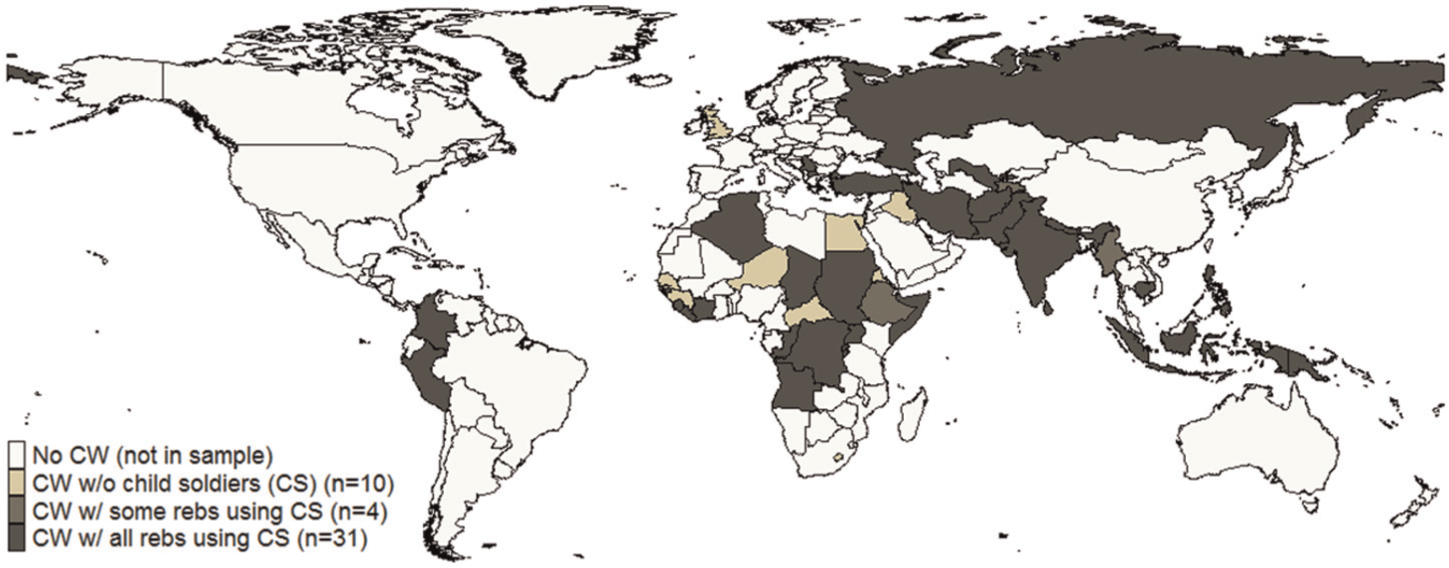
Child soldier use by state, 1998–2008. CW, Civil war.
Independent variables
Our primary independent variable, secession, is used to capture the primary goal of the rebellion. Akin to our case selection, we operationalized this concept by drawing on several data sources to assure coding accuracy. We began with the rebel “type” measure coded within the EACD dataset, and then updated and cross-referenced our variable with similar measures from the START Terrorist Organization Profiles (Terror Knowledge Database, 2010) and the para-military profiles from GlobalSecurity.org (2010). Our final measure is a dichotomous variable coded 1 if the rebel goals were primarily either “Nationalist/Separatist” or “Secessionist”. If any other goals were included (e.g. religious, communist/socialist, leftist), rebellions were said to be non-secessionist, and secession receives a value of 0. We report descriptive statistics and bivariate relationships for all independent variables in Table 1. As we can see in the first row, 28.2% of the rebellions in the sample are coded as secessionist. In the second and third rows, we see that 41.7% of the cases where child soldiers were not used were secessionist, while only 24.1% of cases where rebel groups used child soldiers were secessionist wars. In the final column we see that this bivariate relationship is significant, providing initial support for our hypothesis.
Descriptive statistics and bivariate relationships
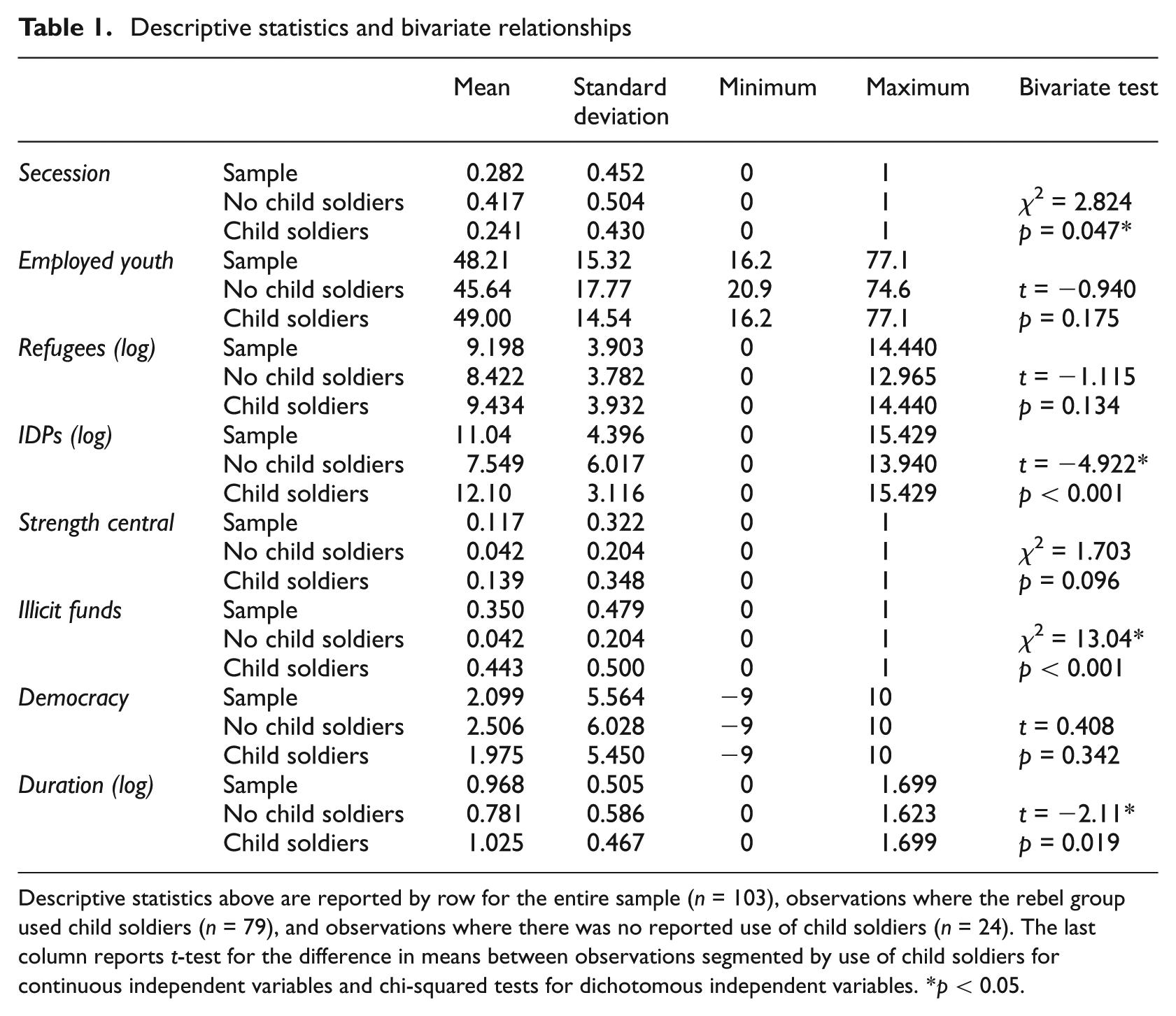
Descriptive statistics above are reported by row for the entire sample (n = 103), observations where the rebel group used child soldiers (n = 79), and observations where there was no reported use of child soldiers (n = 24). The last column reports t-test for the difference in means between observations segmented by use of child soldiers for continuous independent variables and chi-squared tests for dichotomous independent variables. *p < 0.05.
The empirical literature on child soldiers is limited. However, a number of concepts that are believed to be associated with the use of child soldiers are included as control variables. Focusing on the supply of potential child soldiers, Høisker (2001) suggests that youth unemployment increases the likelihood of child soldier use because the youth have few alternatives for livelihood. We capture this with a measure called employed youth, which is the employment to population ratio of youths aged 15–24 from the World Bank World Development Indicators (WDI) at the start of the rebellion. Similarly, Achvarina and Reich (2006) find that large pools of vulnerable children, such as those found in internally displaced person (IDP) and refugee camps, increase the number of conscripted child soldiers. Thus, our models include measures for refugees, which is the average number by country of asylum from 1998 to 2008, and IDPs from 2001 to 2008. Both variables come from the World Bank (2010a) WDI dataset and are logged to reduce skewness in the measures. The bivariate relationships presented in Table 1 indicate that all three supply measures behave as expected, although only the measure for IDPs is significant.
Second, previous work has shown that the level of internal discipline within rebel groups is a strong indicator of civilian abuse (Humphreys and Weinstein, 2006). Child soldiering is a variant of civilian abuse. Thus, we attempt to capture internal discipline with two proxies. First, we capture the strength of the central command of the rebellion. This control variable is necessary because secessionist rebellions might be more in control of their forces, lessening the likelihood that they use child soldiers in a way that departs from our theory. Drawn from the EACD dataset, strength central is a dichotomous measure coded 1 if the rebel group has strong or moderately strong central command, which includes around 12% of the cases. 7 Second, several scholars have commented on the difference between “old” and “new” wars, noting that, while old wars were often fought for anticolonial or ideological reasons, new wars are “nearly opportunistic predation waged by packs, often remarkably small ones, of criminals, bandits, and thugs” (Mueller, 2003: 507). We expect rebels in the latter type of conflict to be more apt to use child soldiers because they are largely defined by their predation. Using information from individual non-state actors from GlobalSecurity.org and the START Terrorist Organization Profiles, we code illicit funds as 1 for groups that used illicit funds, including conflict gemstones or drugs, and 0 otherwise. Around 35% of the groups use illicit funds. The bivariate relationships in Table 1 show strong support for illicit funds, but no support for our strength central measure.
Third, we control for the level of democracy in the state. Including democracy controls for cases where separatists might need to have a stronger international claim to statehood because democracies are more likely to be seen as legitimate. Therefore, separatists facing democrats might face different incentives to refrain from using children than do those facing non-democratic governments. However, the expected influence of democracy on child soldier use is unclear. Andvig and Gates (2010) point out that government action can lead to grievances, prompting many children to volunteer or parents to send their children to fight with the rebel forces. Alternatively, government repression may lead many adults to join the insurgency. This would lead to a glut in the labor market where children would be easier to turn away. Meanwhile, democracies are apt to provide more support to vulnerable children, while strongly authoritarian regimes may have enough control to make child recruitment difficult. Each of these explanations points to a potential curvilinear relationship, with child soldier use least likely in both strong democracies and strong authoritarian regimes. Thus, our measures include both democracy and the square of democracy, democracy2. We use the average Polity IV value for the country during the 1998–2008 time period (Marshall and Jaggers, 2009). Unsurprisingly, the bivariate relationship in Table 1 shows an insignificant relationship between democracy and the use of child soldiers. We analyze the curvilinear relationship in Table 2.
Determinants of child soldier use, 1998–2008
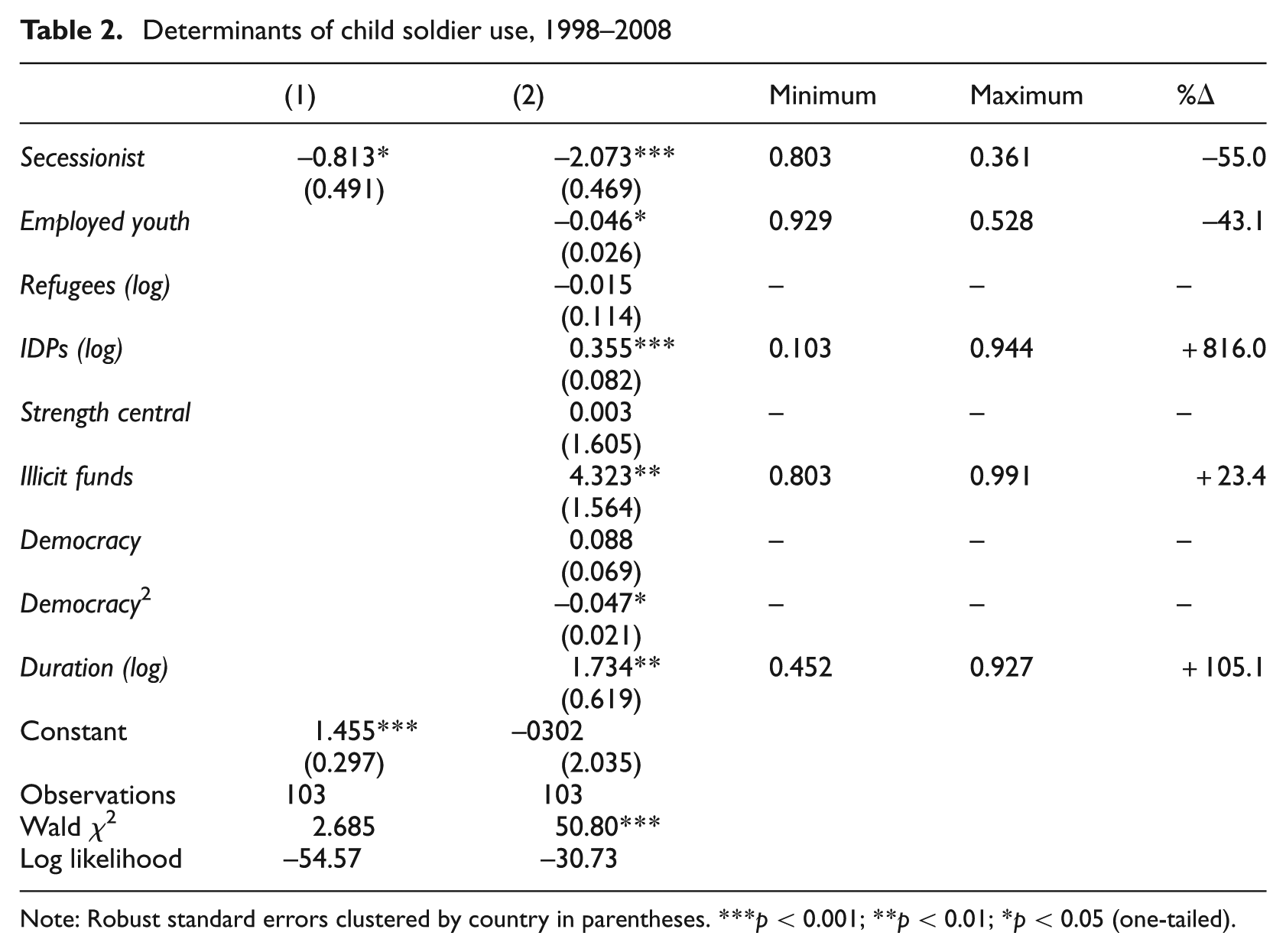
Note: Robust standard errors clustered by country in parentheses. ***p < 0.001; **p < 0.01; *p < 0.05 (one-tailed).
Our final measure attempts to capture the demand for child soldiers by including the duration of fighting in the analyses. We see two possibilities for this measure. Because rebel groups are often weaker than the government at the beginning of the conflict, it is possible that the demand for child soldiers will be highest early in the conflict. Alternatively, rebels may find themselves needing to use child soldiers later in the conflict as they begin to exhaust their supply of adult soldiers. Either way, it is important to control for the duration of conflict, particularly because secessionist wars have been found to last significantly longer than other war types (Fearon, 2004). The mean duration for wars in our sample is 14.4 years. We used the log value to account for skewness in the measure. 8 Our preliminary analysis in Table 1 indicates that child soldiers are used more frequently in long civil wars.
Results
Given that our dependent variable is dichotomous, we use logistic regression clustered by country to test our hypothesis. The results presented in Table 2 provide strong support for our hypothesis. We first run our analyses without control variables in model 1. Consistent with the bivariate test presented in Table 1, we see a significant negative influence of secessionist conflicts on child soldier use. We present our full analysis in model 2, again finding a strong negative relationship.
Beyond statistical significance, we gauge the impact of the independent variables by calculating each variable’s marginal effect on the dependent variable. The Clarify program was used to estimate predicted values for the significant variables in Table 2 (King et al., 2000; Tomz et al., 2003). The results for these calculations are presented on the right side of Table 2 and graphically in Figure 2. These results show how we should expect the likelihood of child soldier use to vary when each independent variable is moved from its minimum to maximum value while holding all other variables constant (at means and modes). We see that the likelihood of child soldier use is 0.803 for non-secessionist wars. This plummets to 0.361 for secessionist wars, representing a 55.0% decrease in the likelihood of child soldier use.
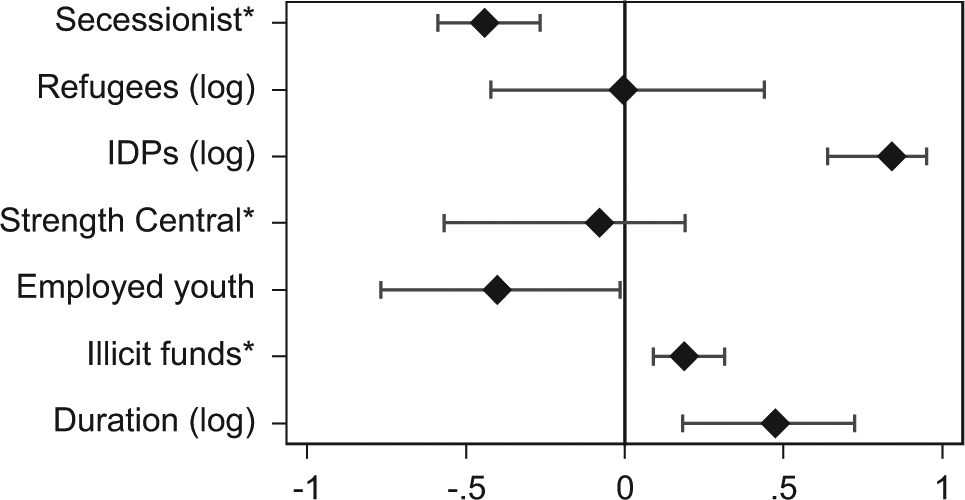
Determinants of child solider use, 1998–2008: substantive effects.
Moving to the control variables, we attempted to capture the available supply of child soldiers with three proxies: employed youth, refugees and IDPs. First, consistent with Høisker (2001), we find the expected significant and negative effect for employed youth on child soldier use. In substantive terms, the likelihood that a rebel group uses child soldiers drops by 43.1% when youth employment varies from its minimum (16.2) to maximum (77.1) value. This work coincides well with similar findings about the negative effect of school enrollment on civil war onset from Collier and Hoeffler (2004) and Thyne (2006), suggesting a second causal path by which providing opportunities for youth can lead to peace. Second, both our bivariate and multivariate analyses reveal that the use of child soldiers significantly increases with the number of IDPs, which is consistent with findings from Achvarina and Reich (2006). In substantive terms, we should expect the likelihood of child soldier use to increase by 816% when IDPs vary from their minimum (0) to maximum (15.4) values. Comparing our significant finding for IDPs vs our insignificant finding for refugees indicates that those in the former group are the most vulnerable. This is unsurprising because IDPs lack the same level of rights and protection afforded to refugees (Rosenberg, 2004).
Our next measures, strength central and illicit funds, were meant to capture the level of internal discipline of the rebel group. While the measure for the strength of the rebel group’s central command is insignificant, we see that rebels who use illicit funds are 23.4% more likely to use child soldiers compared with those who do not use illicit funds. In fact, there is only a single rebel group that uses illicit funds—the Democratic Forces of Casamance Movement in Senegal—that refrained from using child soldiers. This supports the notion that opportunistic rebels care little about being viewed as legitimate, which is consistent with the viewpoint of many modern wars being akin to large-scale criminal activity (e.g. Mueller, 2003; Thyne and Schroeder, 2012). Meanwhile, the null finding for strength central indicates that the decision to use child soldiers is not derived from a lack of centralized control of rebel forces. Combined with our findings for secessionist and illicit funds, we see instead that the goals of the rebel groups largely drive recruitment decisions.
The findings for democracy and democracy2 yield at least partial support to our theoretical expectation. Taken together, the findings reveal an inverted-U relationship between democracy and child soldier use, supporting the idea that child soldiers are afforded protection by democracies, and are controlled well by strongly authoritarian regimes. Finally, we see strong support for the idea that child soldiers are more likely to be used by all rebel groups as the duration of fighting increases. In substantive terms, the likelihood of using child soldiers increases by 105.1% when the duration measure moves from its minimum to maximum value.
Model fit
Given the increasing interest in forecasting political events, such as genocide, politicide and political instability (e.g. Goldsmith et al., 2013; Goldstone et al., 2010), it is important to discuss the overall model fit in order to gain an introductory understanding of whether our results could be used to predict future instances of child soldier use. We discuss two commonly used measures here. First, following King and Zeng (2001), we calculated the area under the Receiver Operating Characteristic (ROC) curve. This measure calculates the true-positive rate (predicting child soldier use when it did occur) against the false-positive rate (predicting child soldier use when it did not occur) for different possible cutpoints. Values range from 0.5 to 1, with values closer to 1 indicating a strong model fit. The ROC value for our model is 0.900, which indicates a very strong model fit overall (Tape, 2012). Second, we calculated the proportional reduction in error (λ), using 0.5 as the cutpoint for predicting child soldier use. Using this method, the uninformed approach (predicting the modal category) results in 24 incorrect predictions. This is reduced to 12 wrong predictions when applying our model, which is a 50% reduction in error. Taken together, these analyses reveal that our model predicting child soldier use is likely to have a strong predictive capacity.
Conclusion
This paper presents a theory for norm-constrained behavior of rebel recruitment. We argue that separatists should be less likely to use child soldiers because doing so would hurt their chances at achieving independence. This argument relies on a rationalist formula where rebel groups view the international norm against child soldiers as a strong signal about appropriate behavior. Because international support is a necessary condition for rebel groups to achieve their goals, we expect secessionist rebels to be less likely to use child soldiers than other types of rebel groups. Our empirical tests provide strong support for this theory. In a cross-national comparison of 103 rebel groups, separatist rebellions were much less likely to use child soldiers than non-secessionists, controlling for many additional factors.
This paper builds upon a growing body of work that examines child soldiers. Taken together, this work provides a plethora of policy implications to protect children during conflict. Scholars have suggested tackling child availability by securing refugee centers (Achvarina and Reich, 2006) and schools (Vargas-Barón, 2010). Others have suggested building the infrastructure necessary for organizing international support (McClure and Retamal, 2010) and targeting cessation of civil conflict itself (Mack, 2010). Despite these efforts and near universal condemnation, roles in conflict continue to deprive children around the world of a chance to grow up outside of the ravages of war. Our study adds to this by revealing that the collective voice of the international community does not fall on deaf ears. The evidence presented here suggests that, when 134 countries collectively voice their objections to a practice, it is not just other governments that are listening.Rebel leaders are also cognizant of the international mood and behave according to the motivation of their struggle. Separatist rebellions, desperately seeking recognition by the international community, refrain from the practice, while others less concerned with world opinion and global norms do not.
Rebellions and rebel leaders are not homogenous. They behave in different ways depending on their motivations and goals. Thus, they should not be treated as though they are all Foday Sankoh or Mullah Omar. These findings lend support to the idea that care is needed when condemnation is mete. Rebel leaders who refrain from human rights violations should be rewarded. Although it is impractical to support recognition in all cases, failing to recognize governments that protect the rights of children or failing to pass immediate sanctions against international deviants are actions that are likely to push all rebel groups to use all means at their disposal to kill.
These policy recommendations are consistent with the theory and empirical evidence shown here. However, much more research is needed on the study of child soldiers. First, more data is needed to confront the changes in time. Although our analyses cover the globe, they cover a short time period. Additionally, more information is needed on the function of child soldiers within a rebellion. For instance, whether children are being used in combat or support roles may completely change the rationale of the commanders. Further, more understanding is needed when discussing the differences between government and rebel behavior. Our work focuses exclusively on rebel decisions to use child soldiers, although we know that governments are not immune from this tendency. Unpopular governments may rely on forced recruitment of children because they cannot make up their shortfalls with able-bodied adults, for example. This inevitably leads to the question of troop capabilities. Child soldiers may serve as substitutes for adults as Singer (2005) maintains, or they may serve an entirely different function for the rebellion. Thus, further exploration of the types and goals of rebellions is needed. While more work is needed, we hope that this paper makes some effort toward understanding and preventing the use of child soldiers throughout the world.
Footnotes
Acknowledgements
The authors would like to thank the editor and anonymous reviewers for helpful comments. We would also like to thank Karen Mingst, Monica Udvardy, Horace Bartilow, Jonathan Powell and Danielle Lasley for valuable comments on earlier versions of this work. The opinions expressed in this article are those of the author and should not be construed as the official position or in any way representing the views of the Department of Homeland Security or any other Agency of the Federal Government.
Funding
This research received no specific grant from any funding agency in the public, commercial or not-for-profit sectors.