



Abstract
Diversionary war theory holds that insecure leaders are more likely to pursue aggressive foreign policies than their more secure counterparts. This hypothesis rests on the premise that interstate dispute involvement helps leaders deter potential challenges against their rule. We offer strong support for this premise by looking at coup attempts. Cross-national time-series evidence from interstate dispute participation over the period 1960–2000 indicates that a country in a militarized confrontation with another state is about 60% less likely to experience a coup attempt in the subsequent year. Consistent with our hypothesis, we establish that it is mainly militarized involvement in disputes, rather than non-militarized involvement, that is associated with lower coup likelihood. The results are robust to controlling for a wide set of potential correlates of coups and remain qualitatively intact when we focus entirely on within-country variations in coup attempts and interstate disputes.
Keywords
Introduction
As widespread phenomena from the 1960s to the 1980s, coups still continue to plague democratic politics in the twenty-first century. Only during the past decade, there were 30 coup attempts around the world, and almost half of these succeeded in overthrowing the incumbent regimes. In his study on nonconstitutional leader change, Svolik (2009) shows that almost 68% of authoritarian regimes are overthrown by coups d’état. Some of the most recent examples include the Egyptian military coup in 2013 and the coups in Guinea–Bisseau and Mali in 2012. Coup threat is especially prevalent in the developing world. An example from the African continent can illustrate the pervasiveness of coup attempts: from decolonization through 2004, Sub-Saharan Africa witnessed 84 successful coups, more than half of which took place in the 16 states of West Africa. Over the same period, there were 115 failed attempts and 155 discovered coup plots on the continent (McGowan, 2007).
Given the likelihood of violent overthrow and the high costs of failure, incumbent leaders follow a combination of different coup-proofing strategies to increase their chances of political survival. Co-opting potential opposition by distributing spoils and making policy concessions to a privileged group (Haber, 2006), using divide-and-rule tactics to play one opposing group against another (Acemoglu et al., 2004), establishing alternative armed units to counterbalance the military (Belkin and Schofer, 2005; Quinlivan, 1999) and using partisan legislatures to incorporate potential opposition forces (Gandhi and Przeworski, 2007) are some of the common survival strategies for leaders in coup-prone countries. Although anecdotal evidence suggests that coup-proofing measures are widely implemented by leaders (Belkin and Schofer, 2003), scholarly efforts to assess the success rate of these strategies have remained limited. 1 Powell (2012) is one recent exception that empirically analyzes some of the common determinants of coup attempt such as army size, funding and military expenditure per soldier. The effectiveness of most coup-proofing strategies mentioned in the literature has not been assessed beyond anecdotal evidence and case studies. In this article, we contribute to the discussion by testing the effectiveness of external threats in mitigating coup threat. Specifically, we focus on the role of international dispute involvement in reducing the likelihood of coup attempts. As a further step, we also differentiate between different types of conflict involvement to test whether militarized dispute involvements have a larger effect in preventing coup attempts than non-militarized dispute involvements.
A vast body of literature investigates the determinants of coup risk, 2 but the analysis of external factors remains more limited compared with the role of internal factors (Feaver, 1999: 222). A few studies suggest that, other things constant, the existence of an external threat should increase the ability of political leaders to keep the army in the barracks (Acemoglu et al., 2010; Aguero, 1995; Andreski, 1980; Desch, 2001; Huntington, 1957; Staniland, 2008). In this paper, we identify and discuss three different causal channels through which external threats can reduce the likelihood of coup attempts. First, the rally-around-the-flag mechanism implies that the existence of an external threat creates a national unity around the leader, leading both the public and the opposition elites to divert their attention to the outside enemy. This idea of national unity both bolsters the legitimacy of the incumbent regime and makes it costly for the military elite to defect, thus reducing the likelihood that they will attempt a coup in the short run. Second, the feasibility mechanism posits that there is a resource trade-off between the external and domestic roles of the military—the army will lose its effectiveness as an internal repression tool when it is busy fighting a war. When the resources (i.e. armed units) have to be split, the military officers are more likely to refrain from a coup attempt and divert their attention to the more pressing issue of external threats. Third, the credible commitment mechanism suggests that, when the external threats are high, the military elites are more readily convinced that the army will sustain its political power and economic interests within the regime. As such, the presence of international threats can prevent military intervention and facilitate democratic consolidation, since these threats act as a credible commitment device for civilians towards the army.
Although these causal links between external threat and coup decisions is theoretically appealing, no systematic empirical analysis of their validity exists to date. In order to fill this gap, we test two hypotheses regarding the relationship between external security threats and coup decisions. First, we propose that a country’s participation in an interstate dispute reduces the likelihood of a subsequent coup attempt. Our results confirm that a country that was actively involved in an external dispute 3 is about 60% less likely to experience a coup attempt in the subsequent year. Second, we hypothesize that a country’s militarized involvement in an interstate dispute reduces the coup risk more than indirect involvement. The results indicate that the mitigating effect of conflict involvement on coup risk is primarily driven by those cases where a direct militarized action was taken. Further evidence from external dispute participation by allied states suggests that our conclusions are not driven by reverse causality. We find coup attempt risk to be significantly lower even in the aftermath of those external dispute involvements that are more likely to be driven by defense alliance commitments—rather than diversionary incentives motivated by domestic factors. We also confirm that our results remain qualitatively unchanged even after accounting for country-specific fixed effects on coup risk. Finally, we conduct robustness checks with respect to the potentially confounding effects of political regime type, political instability, ethnic and religious fractionalization and military expenditures.
The rest of the paper is organized as follows. The next section presents a brief review of the related literature and lays out the hypotheses. The following section describes the empirical model and data. Subsequently we present the empirical results of the analyses and discuss the implications of our findings. The last section concludes.
Literature review and hypotheses
Do external threats help leaders remain in power? Can international disputes keep the army in the barracks? What mechanisms explain the effect of external threats in coup-proofing? The civil–military relations literature has long focused on these questions about the role of threat environment in military’s political intervention. In one of the earlier works on the topic, Lasswell (1941: 458) argued that the militarization of modern states and the need for fighting effectiveness led the professional soldier to be “more occupied with the skills and attitudes judged characteristic of nonviolence”. This line of thinking posited that an increase in the number and intensity of external threats should correspond to a more prominent role for the army in politics, creating a “garrison state”. On the other hand, many scholars believe that the increase in external threats and security needs of the modern state led to a specialization for the armed forces (Huntington, 1957; Tilly et al., 1975), thereby decreasing the likelihood that they would get directly involved in domestic politics. Andreski (1980) supports this view by suggesting that the internal and external missions of the army are inherently incompatible, and that the army will lose its effectiveness as an internal repression tool when it is busy fighting a war.
In a more recent and comprehensive theoretical framework, Desch (2001) famously argues that the strength of civilian control of the military is determined fundamentally by structural factors, and especially by the threat environment, which has the potential to affect all actors. According to his argument, holding the effect of internal threats constant, a decrease in the external threat level invariably translates to the weakening of civilian control over the military. The civilian control of the military is strongest when external threats are high and internal threats are low. Staniland (2008: 334) also contends that, ceteris paribus, external threats decrease military involvement in politics by providing the army with a mission to channel its resources. 4 Scholars suggest many different mechanisms through which the existence and intensity of external threats can influence the likelihood of coup attempts. Based on the existing literature, we identify and discuss three main causal channels: the rally-around-the-flag mechanism, the feasibility mechanism and the credible commitment mechanism.
“Rally-around-the-flag” mechanism
The relationship between political survival and international dispute participation is widely studied in the literature. Existing research suggests that domestic coup threat can have important cross-border ramifications for countries. As Barnett and Levy (1991: 373) observed, there is little evidence to assume that external security goals are always given priority in the policy calculations of states. At times of internal trouble, domestic goals can lead to risky foreign policy decisions. The most well-known theory explaining this link is the diversionary war theory. Diversionary behavior is defined as “military and diplomatic actions undertaken for the purposes of enhancing one’s internal political support” (Levy and Vakili, 1992: 119). The basic premise here is that, by pursuing aggressive foreign policies, politically insecure leaders can divert the opposition’s attention from domestic problems by using the rally-around-the-flag (hereafter RATF) mechanism.
The idea of RATF is originally derived from the in-group/out-group hypothesis, which posits that a leader can create in-group cohesion through conflict with an out-group (Levy, 1989). According to this logic, national identities become more salient during international crises and this leads to greater support for the incumbent regime among the citizens and the elite (Coser, 1956; DeRouen, 2000; Mercer, 1995; Mueller, 1973). 5 Building on this idea, many scholars argue that a high level of coup threat can create diversionary incentives and increase the likelihood of international dispute involvement (Huth and Russett, 1993; Miller and Elgun, 2011; Walt, 1996). 6 Following this line of logic, the reverse story is also plausible: the choice of a diversionary foreign policy by the leader is based on the belief that dispute participation will increase his chances of survival (Belkin and Schofer, 2005)—hence, increasing the level of external threats should reduce the likelihood of a coup. Most of the time, however, it is not certain that this strategy will indeed work to alleviate domestic problems for the regime (Oakes, 2006: 434). As such, it is important to determine how the RATF effect can work for the leader to alleviate the coup risk.
First of all, there are reasons to believe that the RATF effect bolsters the legitimacy of the existing regime in a high-threat environment. For instance, scholars make a compelling case that the decision of the domestically troubled regime in Argentina to invade the Falklands (Malvinas) Islands in 1982 helped to improve the regime’s low legitimacy and re-established a sense of national unity in the face of domestic opposition (Levy and Vakili, 1992; Oakes, 2006). This boost in public support is critical since many scholars argue that, as long as a regime is perceived to be legitimate, the military will refrain from a coup attempt (Belkin and Schofer, 2003; Finer, 1988; Linz, 1978; Nordlinger, 1977; Sutter, 1999).
Moreover, it is logical to assume that during international crises the RATF effect will be salient among military officers as well as the public. In times of high external threat, a coup attempt can harm the country’s prospects of winning a conflict by unleashing domestic strife and undermining the unity within the state. As such, a coup attempt leads to the loss of popularity for the armed forces in the eyes of the public. Given this public attitude, a priori there is no reason to assume that the officer corps within the armed forces feel any differently from the rest of the society when it comes to the discourse of external enemies. In fact, nationalistic sentiments can be even more prevalent among soldiers than among civilians, which will make it harder for the commanding group to convince its corps to support a coup attempt. To the extent that perceived external threats depend on the hostility level of dispute involvement, we can also expect the RATF effect to be more pronounced in times of militarized disputes.
Feasibility mechanism
Another potential channel, which we will call the feasibility mechanism, can also affect the calculations of the military elite concerning the availability of resources for staging a coup. The feasibility mechanism suggests that the internal and external missions of the armed forces are inherently incompatible given the limited nature of resources available at their disposal. As Staniland (2008: 334) notes, “external threats decrease military political involvement because the pressures of international competition discipline military adventurism and provide a mission toward which resources must be devoted”. The trade-off between internal and external repression is also empirically supported by Peceny et al. (2002: 18), who show that two military regimes are highly unlikely to wage war against each other. 7 The authors believe that this is because military regimes are constrained by internal security missions and therefore less capable of fighting wars. Following this logic, a coup attempt may be a more viable option for the military elite when the army is not mobilized against a security threat and its organizational and material resources are more readily available to carry out a coup. Conversely, when external security threats are high, the armed forces will be more occupied with their traditional role of national security.
The national security role of the army becomes even more pressing when the leaders opt for militarized dispute participation. Andreski (1980: 4) clearly highlights this incompatibility of the dual role of armed forces: “the more intensively they are—or have recently been—involved in a war, the less amenable and dependable they become as tools of internal repression”. The military elite will be more reluctant to engage in political intervention when the army is engaged in active combat, since a coup attempt may increase the risk of defeat against rival states. Fighting changes the characteristics of military units (e.g. military leaders are replaced, new weapons are purchased, etc.), which in turn can affect the feasibility of coups by creating an uncertainty of resource deployment. In particular, the exhaustion of armed units in combat can exacerbate the pressing need for additional manpower, making the army less amenable to domestic political intervention. Under this scenario, it is plausible to expect a decrease in the likelihood of coup attempts during periods of militarized interstate disputes.
Credible commitment mechanism
The nature of civil–military relationships is largely affected by the functions that the military performs within a country. When military officers are convinced that the army will maintain its importance and privileges, they can refrain from a coup d’état. Thus, the ability of the military to impose “reserve domains” for itself within the regime can be an important factor that keeps an army from direct involvement in military rule (Linz and Stepan, 1996). 8 As Huntington (1995: 16) argues, the definition of clear missions and roles for the army is an important element to prevent military intervention in politics, and these missions are hard to create in the lack of visible external enemies. The dissatisfaction in the army grows when they are not given traditional military missions that could involve “the deployment of armed forces abroad in situations where they could be called upon to fire or be fired upon”. This dissatisfaction arises not necessarily because the military officers have an inherent disposition to fight wars, but mostly because they are self-interested agents (Finer, 1988; Needler, 1987; Nordlinger, 1977). As such, they need a credible commitment from the incumbent elite that their interests will be protected.
The credible commitment mechanism rests on the premise that discontent among soldiers against the government intensifies when monetary transfers and political concessions to the military are low (Acemoglu et al., 2010). In principle, a government can always promise such transfers to the military to avoid a coup. However, in the absence of external conflict, the opportunity cost of these concessions (i.e. a big military budget) is higher for the government. Since their interests are less aligned with the military under these circumstances, leaders’ promises are less credible and they have the incentive to defect once they consolidate political power. Higher expectations of future conflict with other states, on the other hand, would credibly increase a leader’s dependence on military power and can lower the coup risk. As such, the credible commitment mechanism suggests that the leaders’ commitment for transfers to the military become more credible during high-hostility crises: militarized involvement implies both higher funds and an increased transfer of political power to the military. Furthermore, as opposed to a non-militarized dispute, which can be settled by other (e.g. diplomatic) means, a militarized dispute would certainly increase the government’s dependence on the armed forces.
Each of the three potential channels we have discussed is based on a theory about how external threats may shape the incentives of or the constraints faced by the incumbent elite, the opposition and the public, thereby affecting a leader’s chances of political survival. Although scholars suggest that the existence and intensity of external threats can influence the likelihood of coup attempts, a systematic empirical analysis of this effect does not exist to date. The mechanisms discussed here all point out that international dispute participation is likely to reduce the coup risk. Moreover, they all imply that the mitigating effect of militarized dispute involvement on coup risk should be larger compared with non-militarized involvement. We offer an empirical investigation of these premises by testing the following hypotheses:
Research design
Model specification
Our first hypothesis (H1) postulates a negative relationship between participation in interstate disputes and the likelihood of coup attempts, while the second hypothesis (H2) states that such a relationship is expected to be stronger if the home country has taken a militarized action during its dispute involvement. To test these hypotheses we estimate the following reduced form model of coup attempts on an annual panel of coup attempts and interstate disputes over the period 1960–2000:



where
We estimate the baseline model using the logistic regression, under which the contemporaneous disturbance terms
To address potential reverse causality, we also follow an alternative identification strategy. We investigate whether the qualitative results we obtain from our baseline model survive when we exploit plausibly exogenous variation in MID participation that is driven by disputes participated in by allied states with the home country. This approach treats MID participation by home country


where
Data and the baseline sample
Dependent variable
The dependent variable is coded as a dummy variable, taking the value of 1 when there was at least one coup attempt in a given country-year and 0 otherwise. The data on coup attempts come from the Center for Systemic Peace (CSP) coup events list that spans the period 1946–2009. The measure captures both successful and failed attempts by a dissident/opposition faction within the country’s ruling or political elites to forcefully seize the executive authority and office. 10 An attempt is considered successful if it results in a substantial change in the executive leadership and the policies of the prior regime.
One advantage of the CSP list is that the coded events do not include ousters of leaders by foreign forces or with substantial support from other states. Hence, the empirical relationship between interstate disputes and coup attempts mostly reflects the influence of the former on the decisions of the domestic actors rather than the channels through which foreign opposition against the regime could be manifested. Finally, the CSP list excludes popular uprisings, social revolutions and victories by oppositional forces in civil wars. This allows us to directly focus on the actions of the opposing elite faction, while controlling for different manifestations of popular dissent among ordinary citizens and armed opposition by non-state actors.
Independent variable: MID participation
Data on disputes come from the Militarized Interstate Disputes (MID, version 3) dataset of the Correlates of War (COW) project. For an event to qualify as an MID, at least one of the participating states must have taken a militarized action against one of the rival states. This militarized action can be a threat to use force, or the display or actual use of military force.
Our independent variables of interest are two indicators of MID incidence in the home country that distinguish whether the home country took any of the aforementioned militarized actions against a rival state.
The decision to engage in a militarized action may, among other things, depend on the strength of the enemy. Weaker states may avoid taking militarized actions against stronger states when they anticipate no realistic chance of victory. Instead they may choose to remain passive to minimize the costs of a potential defeat. A defeat, on the other hand, may erode the legitimacy of the leader and increase the support for a coup attempt. In some circumstances, poor management of an external crisis situation by the political leaders may invite a “guardian coup” and offset the otherwise coup-mitigating influence of MID participation that we hypothesize. 11 Therefore, unless dispute outcomes are controlled for, the effect of interstate dispute participation and, in particular, the type of action the home country has taken, may simply reflect the changing state of affairs between the military and the executive authority as a result of defeat or victory, rather than reflecting the role of external threats in shaping the coup attempt decision. To address this potential problem, we also include dummies in the model for MID participation capturing three outcome categories: (a) favorable outcome for the home country; (b) unfavorable outcome for the home country; and (c) other outcome. 12
Control variables
Legacy of coups in the past
Several studies suggest that countries with a coup in the past are more likely to experience one today, a phenomenon Londregan and Poole (1990) call the “coup trap”. Collier and Hoeffler (2005) offer evidence from African cases that coups can indeed trigger counter-coups. This finding possibly reflects the effect of accumulated grievances between opposing elites and the idea that using force to oust leaders who themselves came to power through irregular means can be easier to justify for coup plotters. Since our goal is to assess whether the likelihood of a coup attempt depends on recent MID participation, conditional on previous experience, in our baseline model we control for the cumulative number of past coup attempts from 1960 up to the year of observation.
Civil conflicts
Civil conflicts can reflect an elite rivalry in which the military may be compelled to take sides, or they can simply provide a pretext for military interventions. Moreover, civil unrest and internal conflicts are closely interlinked with interstate crises. There are many instances when cross-border diffusion of civil conflicts or internal clashes between rival groups have triggered militarized response from other countries. 13 Therefore, omission of these events is likely to create a bias. To address this concern, we control for civil conflict prevalence. The data on civil conflicts come from the UCDP/PRIO armed conflict dataset. The measure we use is a civil conflict incidence dummy that is coded 1 when there is an active intra-state armed conflict between a state actor and a non-state actor (e.g. rebel organizations or other organized armed groups) that resulted in at least 25 battle-related deaths. 14 Unlike threats from external enemies, internal conflict is unlikely to evoke rally-around-the-flag sentiments. Desch (2001) argues that internal threats such as civil conflict and domestic warfare reflect a problem of political legitimacy and inability of the government to deliver on the expectations of the citizens. Hence, there are reasons to expect a positive relationship between civil conflict incidence and coup attempts rather than a negative one.
Post-Cold War period
With the end of the Cold War, not only states’ perceptions of security threats, but also the intensity of Western promotion of democratic values and the overall tolerance to military regimes have changed. 15 To account for this and similar omitted variables scenarios, all regressions include a post-Cold War dummy in addition to year fixed effects.
Structural coup risk
There can be a reciprocal relationship between the coup risk a country faces and the foreign policies it pursues. While external threats may be effective in deterring coup attempts, in regimes that are structurally more prone to coup risk, leaders may be more reluctant to get involved in external adventures while they are occupied with coup-proofing. To account for such systemic factors behind coup risk we control for the coup risk index constructed by Belkin and Schofer (2003). The measure combines proxies for the legitimacy of the political regime—captured by regulation and competitiveness of political participation—and the strength of civil society—captured by the number of associational memberships in international non-governmental organizations held by individuals or groups—as well as the presence of a successful coup in the country over the last 10 years. 16
Income and population
Economic well-being and population size may influence both the capability and the incentives of states to participate in disputes. To the extent that these two factors are correlated with the likelihood of coups, omitting them may bias our estimates. To address this concern, the baseline model includes the natural logarithm of income per capita and population. Data on both measures come from the Penn World Tables.
Small island nations
Many small islands gained independence since the 1960s and there are now 31 sovereign island states in the world with populations of one million or less. Cross-country comparisons of small island nations with the rest of countries with respect to various measures of democracy have led some scholars to argue that being a small island state makes it more likely that a state will successfully build democracy (e.g., Hadenius, 1992; Ott, 2000; Stepan and Skach, 1993). Among possible mediating channels offered by scholars are colonial heritage, cultural homogeneity, small-scale social structure, relative insulation from the international system and the resulting lack of significant investments in security (Srebrnik, 2004). These factors, as these scholars argue, might have fostered a climate that is conducive to democratic politics. Yet, their small scale and geographical remoteness are arguably the very reasons why these island nations are less likely to take part in external disputes. The high propensity to become and remain a democracy coupled with a lower propensity to engage in external disputes suggest a potential omitted variable bias. To address this concern we include a dummy variable for small island nations in our model.
Other controls
To verify that our qualitative results are not driven by distance of countries from the Equator (a variable commonly included in empirical analyses of economic development), continent-specific fixed effects, and year fixed effects, we include a variable in the model measuring absolute latitude as well as continent and year dummies. To verify the robustness of the baseline results with respect to alternative correlates of coup attempts, we add per capita military expenditures and the per capita size of the military personnel, indicators for legal origin of a country, measures of domestic unrest (anti-government demonstrations, riots and general strikes), political regime type dummies and ethnic and religious fractionalization indices. 17
The sample period for the baseline regressions is 1960–2000 since this is the longest period for which data is available on all of the baseline variables. Table 1 presents the descriptive statistics for the variables used in the baseline regressions.
Descriptive statistics for the variables in the baseline model
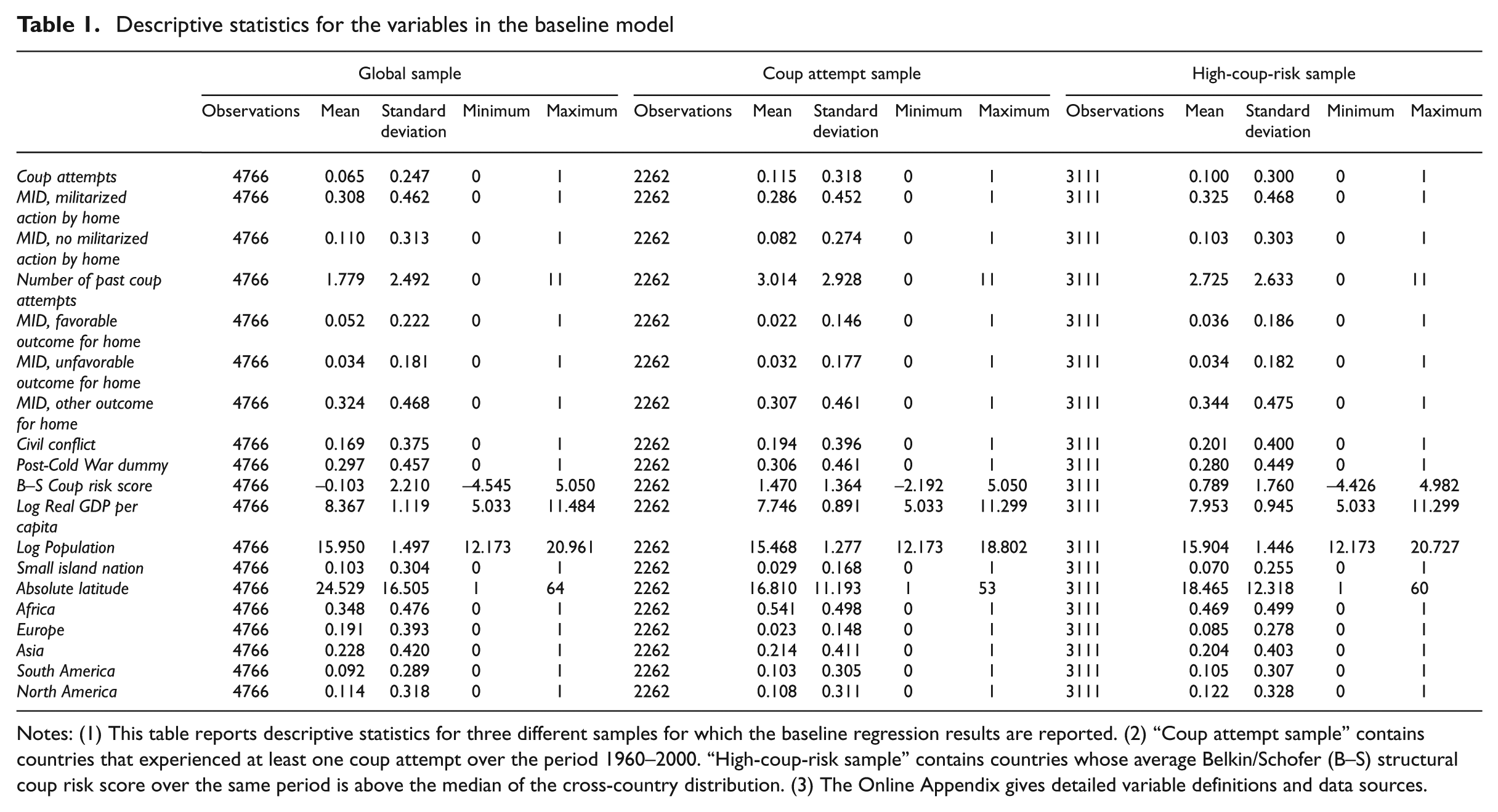
Notes: (1) This table reports descriptive statistics for three different samples for which the baseline regression results are reported. (2) “Coup attempt sample” contains countries that experienced at least one coup attempt over the period 1960–2000. “High-coup-risk sample” contains countries whose average Belkin/Schofer (B–S) structural coup risk score over the same period is above the median of the cross-country distribution. (3) The Online Appendix gives detailed variable definitions and data sources.
The table shows that years with at least one coup attempt constitute 6.5% of the whole sample. The corresponding figure for the subsample of countries with at least one coup attempt over the sample period (the “Coup attempt sample”) is 10%. MID years with and without militarized action by the home country make up 30 and 11% of all the country-years, respectively.
Empirical findings and discussion
The baseline results
Table 2 reports the main regression results. Incidence of a coup attempt is regressed on a successively expanding set of covariates leading up to the baseline model described in the previous section. The explanatory variables of interest,
Militarized interstate dispute participation and coup attempts—baseline regressions
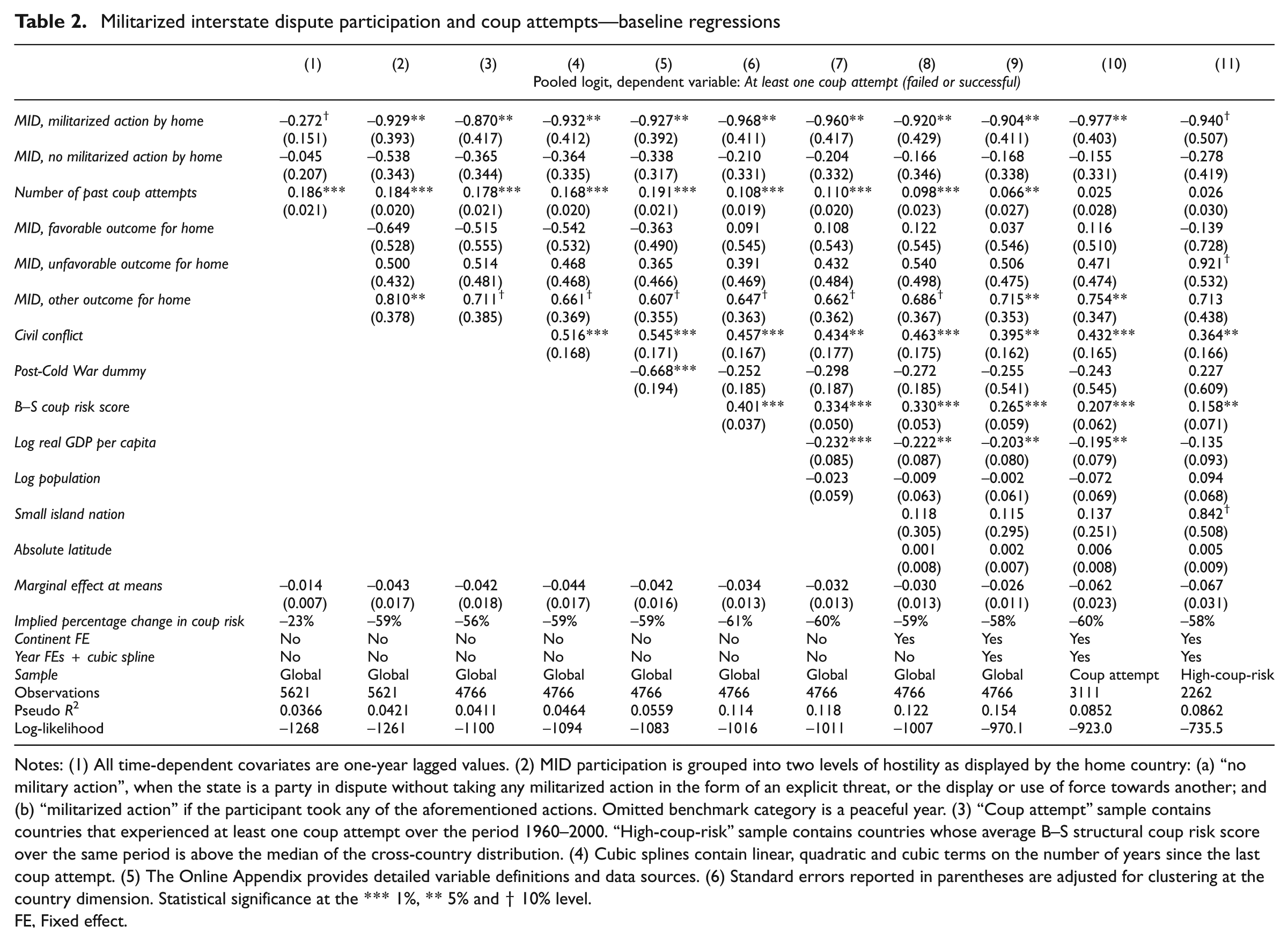
Notes: (1) All time-dependent covariates are one-year lagged values. (2) MID participation is grouped into two levels of hostility as displayed by the home country: (a) “no military action”, when the state is a party in dispute without taking any militarized action in the form of an explicit threat, or the display or use of force towards another; and (b) “militarized action” if the participant took any of the aforementioned actions. Omitted benchmark category is a peaceful year. (3) “Coup attempt” sample contains countries that experienced at least one coup attempt over the period 1960–2000. “High-coup-risk” sample contains countries whose average B–S structural coup risk score over the same period is above the median of the cross-country distribution. (4) Cubic splines contain linear, quadratic and cubic terms on the number of years since the last coup attempt. (5) The Online Appendix provides detailed variable definitions and data sources. (6) Standard errors reported in parentheses are adjusted for clustering at the country dimension. Statistical significance at the *** 1%, ** 5% and † 10% level.
FE, Fixed effect.
Moving to the results, the first column reports the simple relationship between recent dispute participation and coup attempts, once the strong positive effect of the legacy of past coup attempts are accounted for. Consistent with our second hypothesis, the coefficient on militarized MID participation is negative, statistically significant (p-value = 0.072) and larger in absolute magnitude than the coefficient on non-militarized MID participation, which is not significant at conventional levels.
In the next column, we add MID outcomes in the model. A comparison between columns (1) and (2) suggests that the negative relationship between recent dispute participation and coup attempts becomes substantially stronger in magnitude and statistical significance once MID outcomes are controlled for.
18
Column (3) simply repeats the same regression in column (2) on our baseline sample of country-years for which data on all baseline covariates are available. Despite the significant drop in the sample size, it is reassuring that both the size of the coefficient estimates (and the marginal effect of
Unlike the structural factors behind coup risk, we view interstate disputes as transitory shocks to perceived external security threats that are unlikely to have a persistent effect on the incidence of coup attempts. 19 Yet, a higher structural coup risk may lead to a more aggressive foreign policy in the home country overall, especially if external threats are effective in mitigating coup risk, as argued in this paper. In this case, the omission of structural factors behind coups should lead to an upward bias in the estimated coefficients on MID participation. A comparison of the results in columns (5) and (6) supports this prediction. The structural coup risk index of Belkin and Schofer (2003) is indeed a strong and positive predictor of coup attempts, and the fact that the negative correlation between militarized MID participation and coup attempts increases in absolute magnitude is consistent with the positive reverse-causality story that countries with higher structural coup risk are more likely to resort to conflict participation as part of a diversionary strategy. 20
In column (7) we control for income and population. As expected, income per capita enters with a negative and significant coefficient. Population does not appear to have a statistically discernible effect, conditional on other factors that were already accounted for. Reassuringly, the role of militarized MID participation remains intact with a negative coefficient that is significant at a level of 5%. The estimated marginal effects indicate that, for an average country-year, militarized involvement in an interstate dispute in the previous year lowers the likelihood of a coup attempt by about 3.2 percentage points. To put this magnitude in a context, this effect amounts to a reduction in coup risk by almost 50% from the sample mean—the average likelihood of a coup attempt is 6.5% in the sample. Alternatively, the results imply that the probability of a coup attempt, as predicted by the baseline model at the mean values of the explanatory variables, is 60% lower when there is a militarized MID compared with no MID participation.
In column (8), we include continent fixed effects in the model alongside two other geographical controls—absolute latitude and a dummy for small island nations. 21 The estimates under this more stringent specification verify that our results are not simply driven by unobserved continent specific factors not captured by the existing covariates.
In column (9) we control for year fixed effects and a cubic spline for years that elapsed since the last coup attempt in each country.
22
These controls should account for the residual time trend in coups and possible duration dependence in coup attempts that are unexplained by our baseline controls. The results remain qualitatively unchanged and significant at the level of 5%. Based on the estimates from this full baseline specification, for each country we predict—holding the rest of the right-hand side variables fixed at their country-specific means over the sample period—the likelihoods of a coup attempt when
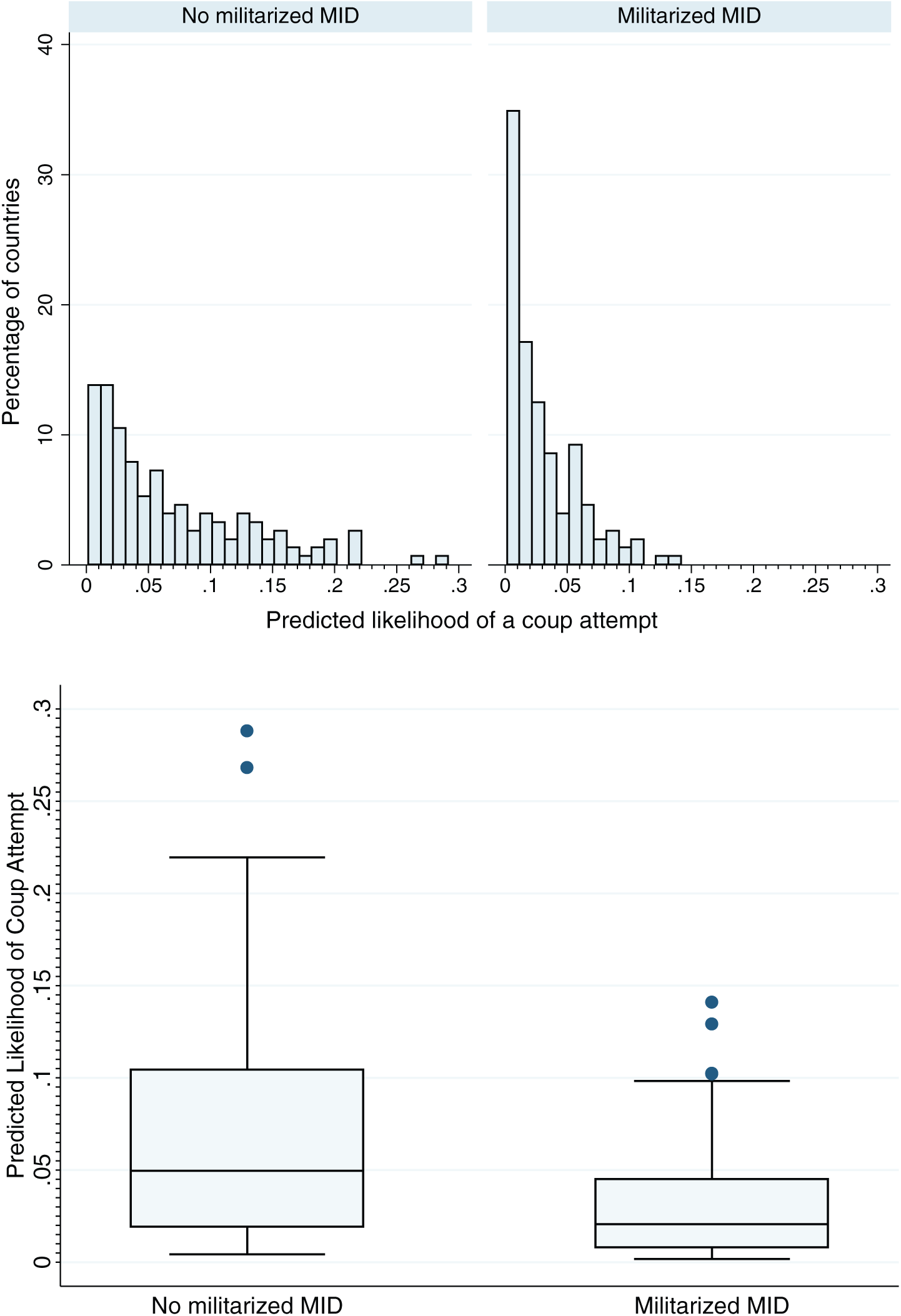
MID participation and the cross-country distribution of coup attempt likelihood.
The last two columns in Table 2 assess whether the predicted relationship between militarized MID participation and coup attempts holds for a subset of countries (the Coup attempt sample) for which coup d’état is a more evident risk. Column (10) reports the estimates on a subsample of countries that experienced at least one coup attempt over the years 1946–2009, the entire period over which coup information is available.
23
Compared with the previous column, the marginal effect of our variable of interest is somewhat stronger for this subset of countries. Finally, in column (11) we repeat the same specifications as in the previous two columns, this time on what we call the High-coup-risk sample.
24
The results indicate that more frequent external militarized confrontation is associated with a lower likelihood of coup attempts, a relationship that is somewhat less pronounced than in the Coup attempt sample, but significant at 10% (p-value = 0.064) despite a much smaller sample size. Furthermore, the marginal effect of
The AUC score for the in-sample predictive power of our baseline model in column (9) is close to 0.796. Panel (a) of Figure A1 in the Appendix depicts the changes in the in-sample predictive power of our empirical model in response to the omission of each of the explanatory variables. The results suggest that omitting our variable of interest (militarized MID participation), from the baseline model leads to a reduction in the in-sample AUC score by about 0.004. While this is not a large reduction in absolute terms, compared with other control variables, militarized MID participation appears to be one of the most important contributors to the predictive power of the baseline model, ranking above all the remaining explanatory variables with the exception of the B–S structural coup risk index and the cubic polynomial terms for the number of years since the most recent coup attempt. The out-of-sample predictive power of the baseline model is more moderate (an AUC score of about 0.745). As depicted in panel (b) of Figure A1, when militarized MID participation is omitted from the baseline specification, the out-of-sample AUC score falls by 0.003 (down to 0.742), putting our variable of interest above most of the other explanatory variables such as GDP per capita and civil conflict incidence.
Overall, the results lend support to both of our hypotheses. While MID participation has a mitigating effect on coup risk, this effect is primarily driven by those disputes in which the home country took militarized action against its opponents. Although both MID measures are negatively related to coup attempts, unlike that of militarized MID participation, the estimated effect of non-militarized participation is statistically not distinguishable from zero. 25
Addressing potential reverse causality
Although the baseline results presented so far are consistent with our hypothesis that external threats (as captured by MID participation) deter coup attempts, the extent to which they reflect a causal effect of disputes on the coup risk is not clear. The main concern is a possible reverse causality, implying that some of the MID participation decisions might be endogenous to coup risk. Moreover, it is not possible to predict the direction of the endogeneity bias, since there might be different scenarios pointing in opposite directions. Diversionary war theory suggests that leaders facing higher coup risk are more likely to pursue aggressive foreign policies. To the extent that this hypothesis explains the observed conflict behavior, our estimates would be understating the real coup-mitigating effect of dispute participation. 26
However, there are also plausible stories pointing in the other direction. For example, when support from the military and/or the domestic elite is weak, it might be more costly for a leader to engage in external militarized actions. Also, low internal support is often an indication that the leader’s prospects of political survival are weak. If this is the case, leaders will be more willing to participate in MIDs when they are confident of internal support. Therefore, it is desirable to tackle the endogeneity problem empirically.
To show that our results are not an artifact of reverse causality, we constructed various measures of dispute involvement by countries with which the home country has a defense alliance commitment (as identified in the ATOP dataset). Then we used these measures as instruments for home country participation in MIDs under the premise that an ally’s dispute participation decision creates an arguably exogenous obligation for the home country to follow suit.
Since both the outcome measure (coup attempt) and our variable of interest are binary variables, we employ, as already described, a maximum-likelihood bivariate (two-equation) probit approach that allows for dummy endogenous variables (Heckman, 1978). 27 This is a simultaneous equations model, in which the likelihood of a coup attempt depends on MID participation by the home country, while the latter is instrumented by MID participation by defense allies of the home country (our excluded instrument), along with the remaining right-hand-side variables (control variables included in the coup model).
Table 3 presents estimation results from four different specifications. The right-hand panel of the table reports the estimated equations for the home country’s MID participation, while the left-hand panel shows the coup attempt equations. The equations with the same column numbers are estimated as part of the same model. As the variable of interest, first, we focus on overall MID participation, which is coded as 1 if home country participated (with or without militarized action) in any MID in that year, and coded as 0 if otherwise. These results are presented in panel (A). In panel (B), we use militarized MID participation as our endogenous independent variable. In both panels, the excluded instrument for the home country’s MID participation is a variable measuring the number of its defense allies that are currently involved in some MID in that year.
MID participation by defense allies, by the home country and coup attempts—addressing reverse causality
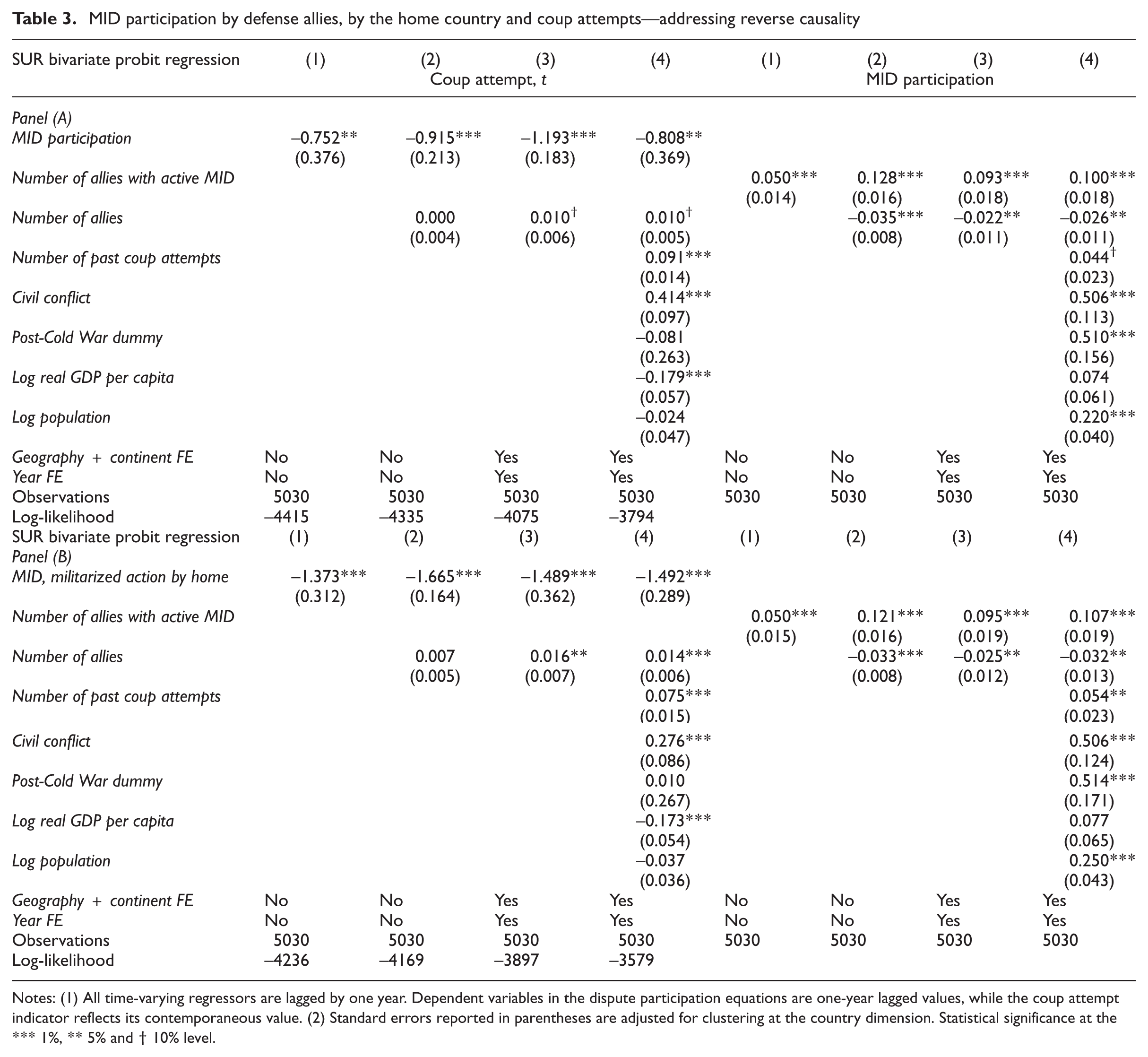
Notes: (1) All time-varying regressors are lagged by one year. Dependent variables in the dispute participation equations are one-year lagged values, while the coup attempt indicator reflects its contemporaneous value. (2) Standard errors reported in parentheses are adjusted for clustering at the country dimension. Statistical significance at the *** 1%, ** 5% and † 10% level.
Moving to the results, the dispute participation equations indicate that the excluded instruments are statistically significant at the 1% level. 28 There is a strong positive relationship between the number of the home country’s allies with active external dispute and overall MID participation by the home country (see panel A). The same is also true for militarized MID participation (see panel B).
The coup equations presented on the left-hand side of the table show that coup attempts are statistically less likely when there is an active MID in the home country. The unconditional effect in model 1 is significant at the 5% level for MID participation (panel A) and the 1% level for MID participation with militarized action (panel B). To show that the significance of our instrument is not merely reflecting a scale effect, the second model includes the total number of defense allies. Now, our excluded instrument appears as an even stronger predictor of the home country’s MID participation, and the latter’s coup-deterring effect is significant at the 1% level in both panels. The results remain robust when, in the third equation, we control for our usual set of geographical controls, continent dummies and year dummies. Finally, the last model (column 4) verifies that our findings are qualitatively similar even after we introduce the remaining baseline controls.
One may still argue that, in a given year, it is not so clear which party (the home country or the allied powers) was obliged to enter an MID. This possibility may cast doubt on the validity of the assumption that our instrument is exogenous to unobserved factors affecting the likelihood of coup attempts in the home country. To ensure that the first-stage relationship between the home country’s MID participation and dispute participation of allied powers (our instruments) is driven by the decisions of the latter (instead of those by the home country), we also run bivariate probit regressions that solely focus on those MIDs in which the home country was a joiner (rather than an originator) and use those with allied states’ participation in disputes only as targets or initiators (i.e. originators in any case). 29 Table 4 presents the findings under this alternative identification strategy. Excluded instruments are the number of allied states that are currently initiators or targets of an active MID. These instruments are plausibly exogenous to coup attempts, because it is highly unlikely that domestic factors that contribute to coup risk in the home country will also influence allied states’ decision to initiate MIDs against third parties or third parties’ decisions to target allied states.
MID Participation by initiating and targeted allies, home as a joiner and coup attempts—addressing reverse causality
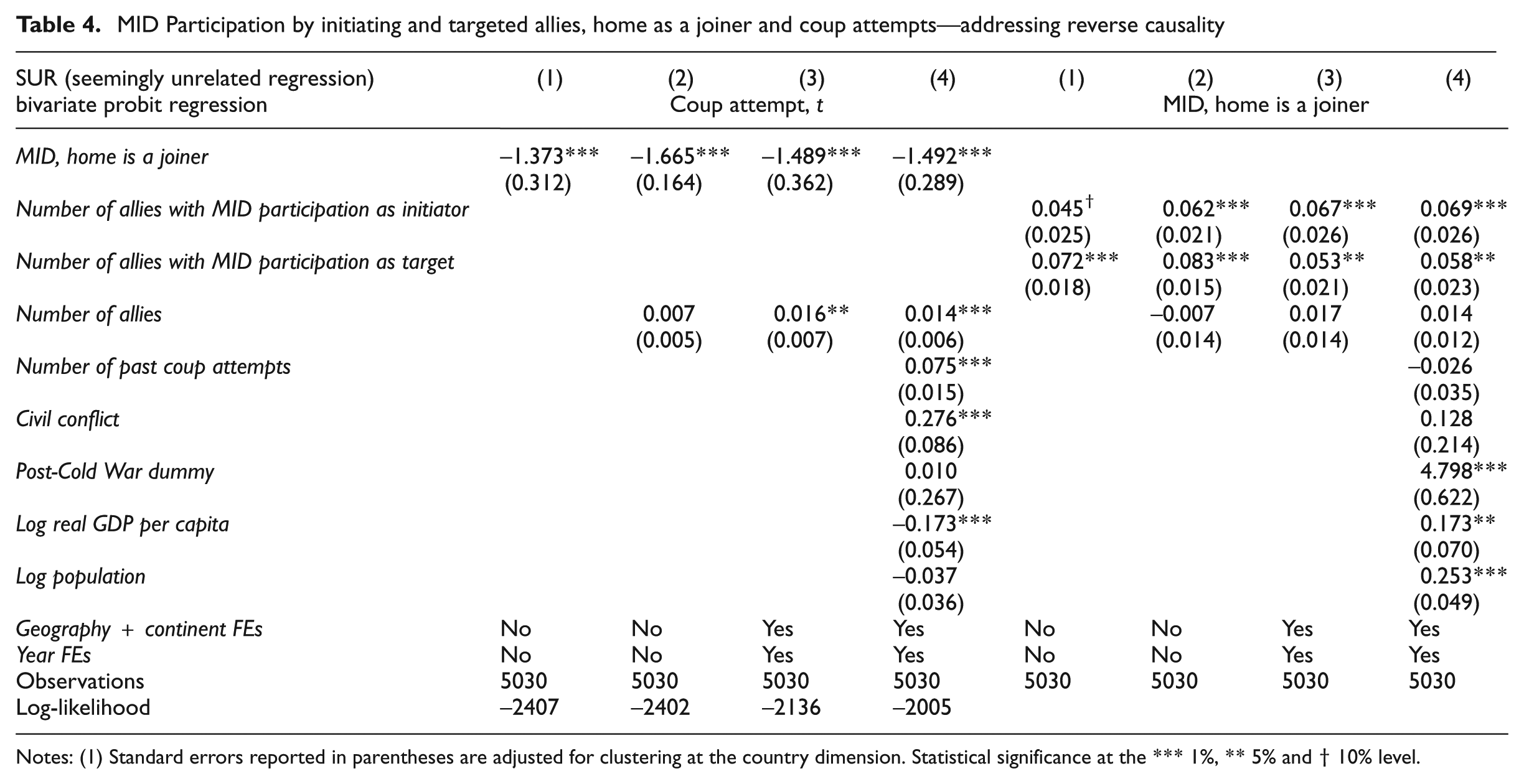
Notes: (1) Standard errors reported in parentheses are adjusted for clustering at the country dimension. Statistical significance at the *** 1%, ** 5% and † 10% level.
The exclusion restriction underlying our identification strategy is that allies’ participation in MIDs as initiator or target does not influence the likelihood of coup attempts through any channel other than the home country’s own MID participation as a joiner state. We believe that this is a reasonable assumption. First, both of our instruments are positive and highly significant predictors of the home country’s MID participation as joiner, suggesting that the home country’s dispute participation is a highly plausible channel that links allied states’ dispute involvement to domestic coup attempts. Second, it is hard to imagine a scenario whereby allied states’ dispute involvement as initiators or targets would still influence the likelihood of a coup attempt, if the opportunities and the incentives of domestic actors to carry out a coup were independent of whether the government would choose to honor its alliance commitments or not. One can argue that MID involvement of allied states against third parties may by itself constitute an indirect threat to security of the home country, increasing the expectation of an external confrontation and thereby shaping the relationship between the government and the potential coup plotters. Hence, even though such indirect external threats may not eventually result in direct MID participation by the home country, they may nonetheless influence coup attempt decisions. While this is certainly a reasonable scenario, it essentially relies on the role that increased security threat perceptions play in shaping domestic politics and, ultimately, it is consistent with our hypotheses.
Robustness checks
In this subsection, we carry out several robustness analyses. We first show that the identified correlations are not simply driven by cross-country variation in dispute involvement or by unobserved country fixed effects. Then, we present results from an extensive robustness analysis with respect to other potential structural and triggering causes of coups.
Within-country variation in MID participation and coup attempts
Research on the attitudes and preferences of military officers in many different societies shows that officers in different countries come from different socioeconomic, ethnic and educational backgrounds (e.g. Andreski, 1980; Carlton, 1997; Horowitz, 1980; Perlmutter and Bennett, 1980), and the degree of professionalism of the armed forces varies from one country to the other. Such country-specific factors may be influential in explaining variation in coup attempt incidence, as well as conflict behavior across countries. Although these factors are hard to quantify, they can be largely captured by country fixed effects given that they do not exhibit much variation over time. Establishing robustness to country fixed effects is also crucial to confirm that pooled logit results in Table 2 can be qualitatively generalized to the relationship between MID involvement and coup attempts within a country across time. To this purpose, in Table A2 we estimate a within-country fixed effects (FE) logit model of coup attempts. In the model, additional lags of MID participation and civil conflict dummies are introduced up to four years. 30
Moving to the results, column (1) shows that some militarized external dispute involvement is associated with a lower risk of coup attempt in the following year, a relationship that is significant at the level of 1%.
31
Unlike the pooled logit regressions, under which non-militarized MID participation
To partly mitigate a potential reverse causality problem, all the models have so far included only lagged values of time-varying right hand side variables. Column (5) shows that controlling for dispute participation in the current year does not change the results. While the first lag of militarized MID participation remains significant at the level of 1%, its contemporaneous effect is also negative, but smaller in magnitude and only significant at 10%. 33 Column (6) verifies that the results are robust to controlling for the remaining time-dependent variables in our baseline model, that is, B–S coup risk score, income per capita, and population.
Overall, the within-country effects we document in Table A2 offer further support for our hypotheses. These results also establish that the influence of interstate disputes on coup attempts tends to die out within a period of two years at most. This finding supports the idea that the relationship we uncover here is unlikely to reflect the latent effect of more persistent, country-specific structural predictors of coups that were unaccounted for in Table 2.
Controlling for other potential correlates of coups
The regressions in Table A3 show that the baseline results in Table 2 are robust to other factors that may be related to the incidence of coup attempts as well as conflict participation. To serve as a benchmark for subsequent regressions, the first column simply replicates column (9) in Table 2 on a global subsample of observations for which data are available on the entire set of robustness controls. 34
Nordlinger (1977) and other scholars of military organization emphasize that the collective corporate interests of the officer corps, including the level of the military budget and living standards of the officers, may influence their relationship with civilian governments. Column (2) shows that neither the size of the military personnel per capita nor per capita military expenditure has a significant association with coup attempts, conditional on the baseline covariates. Compared with the first column, the negative coefficient on militarized MID participation is slightly lower in magnitude but remains significant at 5%.
Column (3) verifies that the negative effect of
Finally, in the last column, we include all the previous sets of controls at once. The results remain qualitatively unchanged. Militarized MID participation is significant at 5% level with an estimated marginal effect of about 63% at the mean values of the covariates.
Alternative explanations
One can imagine alternative stories that would rationalize our results, other than the three causal mechanisms that we have discussed. Perhaps some potential coups did not happen precisely because foreign intervention removed leaders from power, effectively substituting for a potential coup attempt. Conversely, major foreign powers may choose to orchestrate or simply support domestic coups against the leaders in power as a substitute for direct foreign intervention. Both scenarios imply a negative relationship between MID involvement and coup attempts. To rule out this potential channel, we use the Archigos leader database to construct a dummy that indicates whether a leader was directly deposed by foreign forces in a given year. We control for this variable to ensure that the inverse relationship between our outcome variable and MID participation is not driven by a correlation between the dispute behavior of other states and their decisions to forcefully remove the leader in power. The results from a subset of the baseline models augmented with the “deposed by foreign forces” dummy—corresponding to columns (2) and (9) in Table 2—are presented in columns (1) and (2) of Table A4. As an alternative strategy, in columns (3) and (4), we simply drop the observations for which this dummy is equal to 1. Either way, the coefficient estimate on militarized MID participation remains negative and statistically significant.
Another possible factor behind the negative effect of dispute participation is exhaustion of the military. The army may be in a better position to carry out a coup when it is not currently mobilized against a security threat. In particular, in disputes where militarized action has been taken, military exhaustion of armed units may discourage or delay a coup attempt. 35 We believe that controlling for civil conflict incidence and military expenditures goes some way to partially account for this story to the extent these variables are good proxies for military engagement and the degree of armed mobilization. Nonetheless, there are additional proxies for military mobilization and exhaustion that we can exploit to offer a more stringent test of the exhaustion mechanism.
Specifically, we construct a proxy for MID-related deaths using the fatality classification provided in the COW-MID dataset. 36 We control both for contemporary and lagged values of this measure along with our variables of interest (militarized and non-militarized MID participation). In columns (5) and (6) of Table A4, we replicate a subset of the specifications in Table 2 by adding these fatality measures. While fatality measures enter with positive and mostly significant coefficients, the estimated effect of militarized MID participation remains negative and significant in all regressions. 37
Conclusion
This paper contributes to our understanding of how external forces can shape the political outcomes that are relevant for the survival of leaders in office, and the political instability that ensues from frequent changes in executive power. We hypothesized that external threats can have a deterring effect on coup attempts and argued that this effect may stem from three different channels. The first channel is based on the idea that external security threats can shift the priorities of domestic rivals from issues that divide them towards security concerns that unite them (the rally-around-the-flag mechanism). The second channel argues that there is a resource trade-off between the internal and external roles of the army, making the military unlikely to intervene in domestic politics when it is engaged in interstate disputes (the feasibility mechanism). The third channel posits that interstate disputes operate as an outside shock to current and anticipated reliance of leaders on military force, thus making transfers to the military actors more credible (the credible commitment mechanism).
Consistent with our hypotheses, we have offered evidence that interstate dispute participation is associated with a significantly lower likelihood of coups. We have also shown that this effect becomes more pronounced under militarized disputes. The results are robust to controlling for various political, institutional and economic factors, as well as accounting for other possible causal or reverse-causal explanations.
From a broad perspective, our findings support the basic premise of the diversionary war hypothesis that external threats can help insecure leaders hold on to power, thereby pointing to a trade-off that coup-prone regimes may face between political survival and external stability.
Several extensions to our study are possible. First, the conceptualization of external threats can be undertaken in different ways. Since dispute participation is one among the many means through which external threat perceptions are created, future research can focus on uncovering different types of threat measures. Additionally, empirically distinguishing between different causal mechanisms can be a challenging but valuable contribution. These issues are left for future work.
Footnotes
Appendix
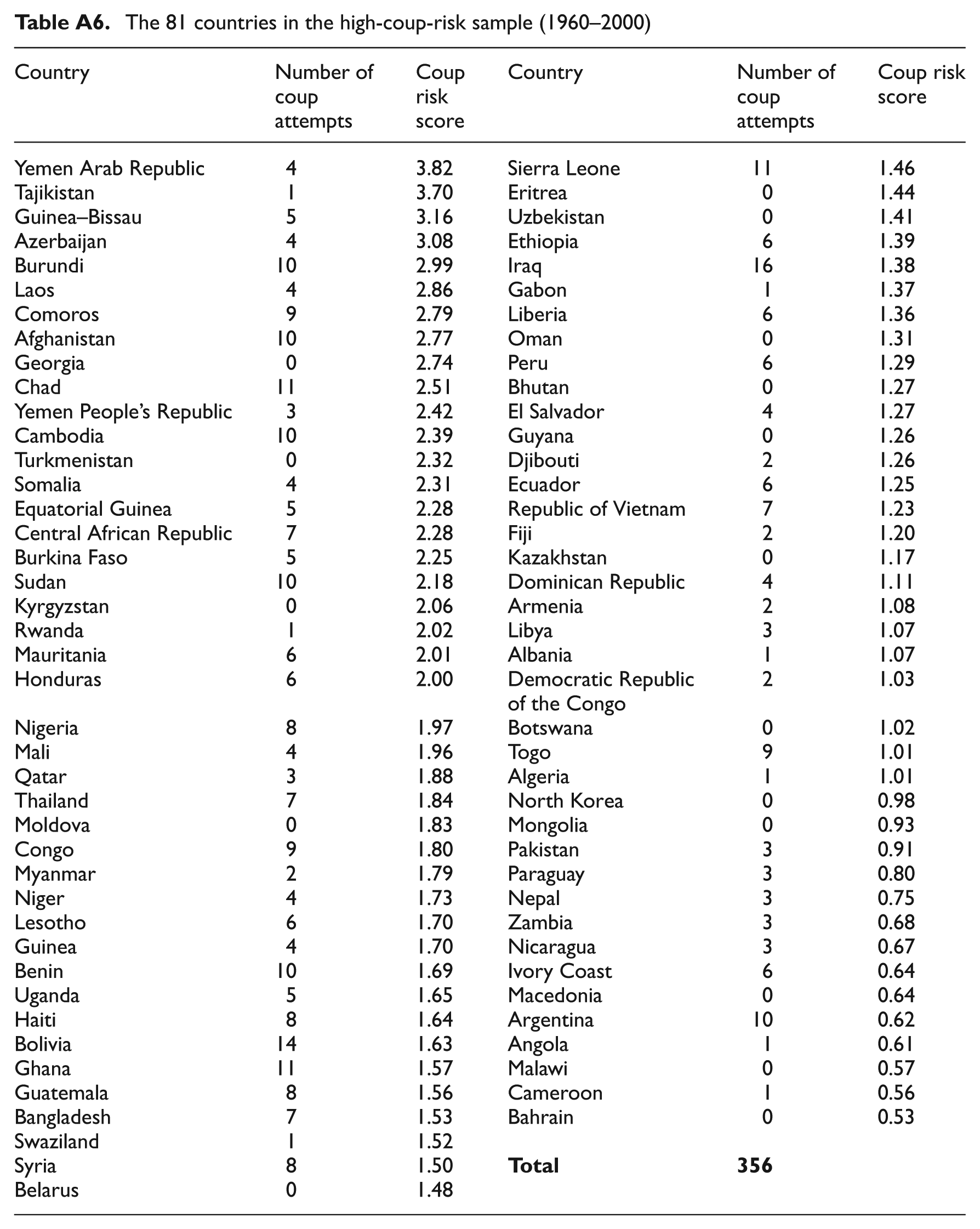
The 81 countries in the high-coup-risk sample (1960–2000)
| Country | Number of coup attempts | Coup risk score | Country | Number of coup attempts | Coup risk score |
|---|---|---|---|---|---|
| Yemen Arab Republic | 4 | 3.82 | Sierra Leone | 11 | 1.46 |
| Tajikistan | 1 | 3.70 | Eritrea | 0 | 1.44 |
| Guinea–Bissau | 5 | 3.16 | Uzbekistan | 0 | 1.41 |
| Azerbaijan | 4 | 3.08 | Ethiopia | 6 | 1.39 |
| Burundi | 10 | 2.99 | Iraq | 16 | 1.38 |
| Laos | 4 | 2.86 | Gabon | 1 | 1.37 |
| Comoros | 9 | 2.79 | Liberia | 6 | 1.36 |
| Afghanistan | 10 | 2.77 | Oman | 0 | 1.31 |
| Georgia | 0 | 2.74 | Peru | 6 | 1.29 |
| Chad | 11 | 2.51 | Bhutan | 0 | 1.27 |
| Yemen People’s Republic | 3 | 2.42 | El Salvador | 4 | 1.27 |
| Cambodia | 10 | 2.39 | Guyana | 0 | 1.26 |
| Turkmenistan | 0 | 2.32 | Djibouti | 2 | 1.26 |
| Somalia | 4 | 2.31 | Ecuador | 6 | 1.25 |
| Equatorial Guinea | 5 | 2.28 | Republic of Vietnam | 7 | 1.23 |
| Central African Republic | 7 | 2.28 | Fiji | 2 | 1.20 |
| Burkina Faso | 5 | 2.25 | Kazakhstan | 0 | 1.17 |
| Sudan | 10 | 2.18 | Dominican Republic | 4 | 1.11 |
| Kyrgyzstan | 0 | 2.06 | Armenia | 2 | 1.08 |
| Rwanda | 1 | 2.02 | Libya | 3 | 1.07 |
| Mauritania | 6 | 2.01 | Albania | 1 | 1.07 |
| Honduras | 6 | 2.00 | Democratic Republic of the Congo | 2 | 1.03 |
| Nigeria | 8 | 1.97 | Botswana | 0 | 1.02 |
| Mali | 4 | 1.96 | Togo | 9 | 1.01 |
| Qatar | 3 | 1.88 | Algeria | 1 | 1.01 |
| Thailand | 7 | 1.84 | North Korea | 0 | 0.98 |
| Moldova | 0 | 1.83 | Mongolia | 0 | 0.93 |
| Congo | 9 | 1.80 | Pakistan | 3 | 0.91 |
| Myanmar | 2 | 1.79 | Paraguay | 3 | 0.80 |
| Niger | 4 | 1.73 | Nepal | 3 | 0.75 |
| Lesotho | 6 | 1.70 | Zambia | 3 | 0.68 |
| Guinea | 4 | 1.70 | Nicaragua | 3 | 0.67 |
| Benin | 10 | 1.69 | Ivory Coast | 6 | 0.64 |
| Uganda | 5 | 1.65 | Macedonia | 0 | 0.64 |
| Haiti | 8 | 1.64 | Argentina | 10 | 0.62 |
| Bolivia | 14 | 1.63 | Angola | 1 | 0.61 |
| Ghana | 11 | 1.57 | Malawi | 0 | 0.57 |
| Guatemala | 8 | 1.56 | Cameroon | 1 | 0.56 |
| Bangladesh | 7 | 1.53 | Bahrain | 0 | 0.53 |
| Swaziland | 1 | 1.52 | |||
| Syria | 8 | 1.50 |
|
|
|
| Belarus | 0 | 1.48 |
Funding
This research received no specific grant from any funding agency in the public, commercial or not-for-profit sectors.