



Abstract
Several rebel groups actively recruit children to serve among their ranks. While this constitutes one of the most egregious violations of children’s rights, it remains unclear what impact recruited children have on the fighting capacities of these armed groups. The existing research suggests that, on the one hand, armed groups drafting children might also be militarily effective, since it is cheaper to provide for children, they are more obedient and aggressive than adults, and easily manipulable. On the other hand, children may negatively affect rebel groups’ fighting capacities as they are less proficient combatants than adults and often difficult to control. We add to this debate by systematically analyzing the quantitative evidence on the impact of child soldiers on rebel groups’ fighting capacities. Based on the analysis of newly compiled data on child recruitment by rebel groups between 1989 and 2010, our analyses show that children may actually increase rebel groups’ fighting capacities. That said, rebels’ ability to procure arms and the access to resources seem to be more important determinants of fighting capacity. The authors discuss these findings in light of policy implications and avenues for future research.
Introduction
Governments, militias and especially rebel organizations have actively and in large numbers recruited children throughout the world (Gates and Reich, 2010; Lasley and Thyne, 2015). 1 Although child soldiering is not a new phenomenon, it has turned (again) into a more common practice since the end of the Second World War, while the contribution of children has changed fundamentally as well (Brett and McCallin, 1998). With an increase in internal conflicts and changes in warfare (Gates et al., 2007), children as the targets of violence and, most importantly for this study, also as members and even combatants of rebel groups have become more central to the way wars are fought: their involvement in today’s conflicts can no longer be classified as passive (London, 2007). Although it is unclear how many children are currently involved in armed groups, the fact that children (have to) actively participate (even as fighters) in military campaigns constitutes one of the most serious violations of children’s rights (e.g. Brett and McCallin, 1998; Høiskar, 2001; Tynes, 2011: 2). 2
While the scholarly research on this phenomenon is substantially growing, activists, think-tanks or civil society groups have conducted most of the earlier work (see Achvarina and Reich, 2010). The existing academic studies on child soldiering—despite being few in number and largely focusing on single countries or being of a descriptive nature—have nonetheless revealed crucial insights. For example, given a predominant focus on child soldier recruitment, scholars looked at the “general systemic factors” such as globalization, the development of small weapons or legitimacy concerns (e.g. Honwana, 2006; Lasley and Thyne, 2015; Singer, 2006, 2010). Others examined why children would join armed organizations, that is, the so-called supply side of child soldier recruitment. Tynes (2011: 93), for instance, claims that children might join armed groups as a way out of poverty.
Building on this literature, we seek to contribute to the existing research by studying another important, but somewhat neglected, linkage: the relationship between child recruitment and the fighting capacity of rebel groups. 3 Put differently, is it the case that armed groups recruiting many children are more military effective, that is, do these rebel groups have a higher fighting capacity relative to the government? 4 Anecdotal evidence for this possible relationship is given by the Revolutionary Armed Forces of Colombia, which named their child soldiers “little bees”, because they can “sting” their enemies before these know they are under attack (Singer, 2006). Moreover, Kaplan (2005) states that children can be daring and tenacious in combat, particularly when under the influence of drugs or when compelled by political or religious zeal. Child units can greatly add to confusion on battlefields, slowing opposing forces’ progress. Yet, the relationship between child soldiers in rebel groups and their military effectiveness has not yet been explored systematically and rigorous empirical research remains scarce.
The existing work, although having a somewhat different focus on the recruitment of children, points to contradictory answers. On one hand, the presumed military effectiveness of child soldiers stems from their characteristics: they can provide logistical support, it is cheaper to provide for them, and they are more obedient and more easily susceptible than mature combatants. Also, children socialized into rebel groups acquire the norms and values of their militant environment and become significantly more aggressive than their grown-up counterparts (e.g. Andvig and Gates, 2010; Schauer and Elbert, 2010). On the other hand, adolescent soldiers may negatively affect rebel groups’ fighting capacities as children are less proficient fighters than adult combatants and they are more difficult to control.
We add to this debate by systematically analyzing the quantitative relationship between child recruitment and the rebel groups’ fighting capacities. To this end, we first give a brief overview of the existent literature on child soldier recruitment and elaborate on our definition of military effectiveness, that is, fighting capacity. We then develop the theoretical arguments on the impact of rebel child soldiers on their groups’ fighting capacity. Afterwards, we describe the research design and, based on newly compiled data on child recruitment by rebel groups between 1989 and 2010, we use probit models to analyze the data. Our results show that child soldiers may actually increase rebel groups’ fighting capacities. That said, rebels’ ability to procure arms and the access to resources, that is, some of the variables we include as alternative determinants of fighting capacity, seem more important determinants. We finish this study with a discussion of our work and its implications, and also suggest avenues for further research.
Examining the impact of child soldiers on armed groups’ fighting capacities may not only contribute to the on-going debate about what makes children attractive recruits, but additionally provide arguments against the use of adolescent soldiers in conflict, which has inherently short- and long-term implications for the development of children in affected countries (Singer, 2006).
The recruitment of child soldiers in armed conflicts: a brief overview
Children recruited for armed groups perform a range of tasks, for example, “participation in combat, laying mines and explosives, scouting, spying, acting as decoys, couriers or guards, training, drill or other preparations, and logistics and support functions such as portering, cooking and domestic labour” (Coalition to Stop the Use of Child Soldiers, 2010). In light of this, the academic literature on child soldier usage can generally be categorized along two interrelated, albeit different streams (see also Beber and Blattman, 2013; Tynes, 2011). The first one focuses on the general or systemic factors to explain the rise in child soldier usage since the end of the Second World War. 5 Honwana (2006), for example, argues that inequalities increased with globalization, which weakened social norms and value systems to protect children from recruitment. This, in turn, led to a rise in the number of children used in armed conflict. Additionally, Dallaire (2011) highlights the sheer abundance of young recruits, as overpopulation made children cheap or renewable resources, as an influence on child soldiering. Furthermore, Singer (2006, 2010) stresses the fact that weapons have been simplified and become lighter in the recent past, which makes them usable for children.
In this context, scholars have emphasized that these general systematic factors have facilitated the “transformation” of children into active fighters who are then just as militarily effective as adults. In turn, children may therefore be recruited more often than in earlier periods of time (Cohn and Goodwill-Gill, 2003). Put differently, while children may be recruited for secondary support functions (e.g. Dickson-Gõmez, 2002; Gates and Reich, 2010), for example, logistics, carrying goods, cooking or intelligence gathering, some of these systematic factors make it more likely that children will take a more active role in combat. Singer (2006), for instance, claims that most child soldiers do in fact participate in combat actively rather than fulfilling secondary functions. This is also confirmed by a UNICEF (2003) survey, which indicates that more than 90% of the children had served in combat rather than in more supportive functions. Individual research on armed groups active in Liberia, Colombia or the Central African Republic confirms this assessment (Human Rights Watch, 2003; International Labor Office, 2003; IRIN, 2003).
The second stream mainly studies the motivation of children to join armed groups, that is, the supply side of child soldiering. The most prominent influences in this context pertain to the lack of education and future perspectives, as well as poverty and starvation (e.g. Tynes, 2011: 93). Other identified supply-side variables are the social pressure exercised by family and friends owing to religious or ethnic identification, the desire to protect the home village and community, or the pursuit of “adventures and excitement” (Achvarina and Reich, 2010; Andvig and Gates, 2010; Becker, 2010; Brett and Specht, 2004; Cohn and Goodwill-Gill, 2003; Singer, 2006, 2010).
Against this background, a third stream recently emerged as a response to the inability of the first two to explain variation in child soldier usage across warring parties active in the same period of time and the same country (or a common region; Beber and Blattman, 2013). To elucidate this variation, scholars now increasingly focus on the so-called demand side of child soldier recruitment, that is, what are the incentives of armed groups to recruit children? One important and often mentioned reason might be that rebel organizations draft children because they improve the military effectiveness or fighting capacity of armed groups. Beber and Blattman (2013: 68) emphasize, for example, that “children will be recruited if they are more effective fighters than we suppose” (see also Tynes, 2011; Tynes and Early, 2014).
Military effectiveness: the role of fighting capacity
In the words of Biddle and Long (2004: 527), “military effectiveness can be defined in a variety of ways: see, for example, Brooks (2003) and Biddle (2004: chap. 1). This definitional complexity stems in part from the many tasks militaries are asked to perform”. That said, the arguably most detailed and disaggregated approach to this concept is given by Millett et al. (1986: 37; see also Millett et al., 1988). These scholars define military effectiveness as “the process by which armed forces convert resources into fighting power” (see also Rosen, 1995: 6). In turn, Millett et al. (1986: 38ff; see also Millett et al., 1988) distinguish between political, strategic, operational and tactical effectiveness. Specifically, the first type of military effectiveness pertains to the ability of the military leadership to secure the cooperation from the political elite. The second type focuses on the military’s ability to effectively pursue those goals of a military campaign that the political leadership stated in the first place. The third type refers to the military’s ability to achieve strategic war objects via the development and use of concepts and doctrines. Finally, tactical effectiveness captures the effectiveness of small combat units and their employed techniques to pursue operational goals.
Military effectiveness is thus a multidimensional concept that focuses primarily on the achievement of prescribed goals at various levels of military activity. A corresponding theoretical empirical focus is warranted, but unfortunately not possible owing to the lack of coding in our data that we describe below. Instead, for the remainder of this article, we follow Biddle and Long (2004: 528), “by focusing on one especially important military function”, that is, “the critical military function of destroying hostile forces while preserving one’s own”. In other words, we understand a rebel group’s military effectiveness in terms of its fighting capacity, which is the ability to employ its forces to destroy the government’s military while preserving its own troops—holding situational or environmental factors, force size and weapon technology constant (Biddle, 2004: 6; Dupuy, 1992: 71ff; Stanley and Brooks, 2007; see also, e.g. Brooks, 2003; Desch, 2008; Pollack, 2002; Rosen, 1995; Talmadge, 2013: 185f).
To this end, we focus on the core goal of any military organization. Again, while this mirrors in particular Biddle and Long (2004; see also Biddle, 2004: 6), this treatment is also consistent with the broader definition by Millett et al. (1986: 37), that is, military effectiveness is “the process by which armed forces convert resources into fighting power”. While this focus does not necessarily require that all recruited children have to perform combat functions (see, e.g. Millett et al., 1986), the shortcoming of this approach is that our empirical results only apply to this type of military effectiveness. Other aspects of military effectiveness, particularly those disaggregated elements highlighted at the political, strategic or operational level by Millett et al. (1986, 1988), are not addressed by this work.
Child soldiers and rebel groups’ fighting capacities: theoretical arguments
The literature on child soldiers lacks a systematic empirical analysis of whether child soldiers are militarily effective or not, but we can derive four interrelated, yet different theoretical reasons for why rebel groups recruiting children have a higher level of fighting capacity. First, children may possess certain characteristics that can lead to a higher fighting capacity of rebel groups drafting them, and, therefore, these characteristics make them attractive for conscription in the first place. What makes children equally strong, or perhaps even more effective fighters in comparison to adult combatants, is that the former are said to be more malleable, adaptable and obedient. Schauer and Elbert (2010: 316f), for instance, point out that “children might be told and believe that they have to ‘stand up’ against an enemy, who would otherwise kill them or hurt their families; they tend to trust and obey caretakers’ and families’ or key community leaders’ judgment on this”. Reiter and Stam (2002: 58ff) also emphasize such psychological factors in the more general literature on military effectiveness. In turn, children are more easily influenceable, which makes them easier to control and retain (e.g. Gutiérrez Sanín, 2010; Beber and Blattman, 2013). These characteristics not only facilitate their recruitment, but also are likely to lead to a higher fighting capacity of the rebel group. This is especially important for armed groups without a broad membership or support base (Beber and Blattman, 2013; Brett et al., 1996; Singer, 2006; Tynes and Early, 2014; Wessells, 2006; Woods, 1993).
Second, military effectiveness in the form of fighting capacity is not exclusively driven by the number of active combatants (Millett et al., 1986, 1988). The proper execution of logistical and support functions also affects the overall performance of an armed group. Reiter and Stam (1998: 261) argue that it is of vital importance that military organizations are able to master “tasks such as general planning, providing logistical support, gathering intelligence, preparing appropriate works such as entrenchments and ramparts, training, and achieving tactical surprise”. As indicated above, child soldiers frequently fulfill many of these logistics and support functions (Dickson-Gõmez, 2002; Gates and Reich, 2010; see also, e.g. Singer, 2006). Consequently, even if child soldiers are not directly active in combat, they may still strengthen the fighting capacity of an armed group: their logistical support indirectly improves the fighting capacity and, additionally, other members of this organization can then be allocated to combat tasks as they are not committed to logistical and support functions.
Third, regardless of their function as active combatants or logistical supporters, child soldiers are also said to be more loyal and committed, and less likely to desert than adults (Gates and Reich, 2010). Children might perceive their membership in rebel groups as their occupation and also see them as their primary social network—equal to that of a family or village community (Hazen, 2005: 4): there are numerous cases where former child soldiers returned to their fighting fraction “out of a sense of family, loyalty, and security” rather than for pecuniary rewards. In particular, the importance of this argument on loyalty and commitment enjoys wide support in the more general military effectiveness literature. Reiter and Stam (2002: 60ff; see also Reiter and Stam, 1998) and Biddle and Long (2004: 530f), for example, theoretically argue and empirically demonstrate that soldiers with a higher commitment to their leaders are the most effective fighters.
Finally, children may be more likely to take risks, can deal more easily with the dangers in battle and often feel that they are invulnerable (Brett and Specht, 2004). More specifically, Singer (2006: 80f) claims that children are unable to fully comprehend the risks and consequences of their behavior and have a so-called “underdeveloped death concept”. This might turn children into fierce fighters who could be even deadlier than adult combatants. Similarly, children are more likely to perpetrate a more diverse set of violent actions, for example, sexual violence, massacres, physical assault or mutilations (Hecker and Haer, 2015). Psychological research also emphasizes that child soldiers show more aggressiveness than adult combatants as they perceive violence as something positive and fascinating (Schauer and Elbert, 2010; Wessels, 2006).
In light of all those arguments, our first hypothesis suggests that recruiting children may increase a rebel group’s fighting capacity—irrespective of their function in that group. Children might here not necessarily be more effective than adults, but they could still improve rebel fighting capacity relative to not recruiting child soldiers at all. As a US military officer stated: adolescent fighters are nearly “as good as conscript-drafted Americans or Europeans in the use of NATO tactics” (Singer, 2006: 87).
However, several other studies argue that adolescent soldiers may be costly for the group, that is, negatively influence rebel groups’ fighting capacities as compared with not recruiting child soldiers at all. First, Gates (2011: 32) points out that “extremely few 12-year-olds possess the strength, endurance, and agility of a well-trained 22-year-old male soldier”. Biddle and Long (2004: 528) also emphasize the importance of physical strength, which children obviously do not possess.
Second, despite the development of small weapons (Singer, 2006, 2010), rebel groups still have to invest resources for the training of children either in relation to military tactics (combat role) or their logistical support function. For example, children are less likely than adults to have fighting skills and to understand military tactics in the first place. They do not know when to hide or to attack and they might take unnecessary risks, which increases the probability of being killed by the opponent’s forces (Singer, 2006). The broader literature on military effectiveness sees these strategies and tactical skills—and an understanding thereof—as critical for military success (e.g. Biddle, 2004: 38f; Biddle and Long, 2004; English and Gudmundsson, 1994: 15ff; Reiter and Stam, 2002).
Third, and derived from the previous point, child soldiers may be more malleable, obedient or influenceable, but rebel groups still have to invest more efforts and resources for their socialization process than in the case of adults (Gates and Reich, 2010). As a commander of a Myanmar armed group stated, “child soldiers are still children, and … they often misbehave, are unruly, and require frequent scolding, as young boys usually do” (Images Asia, 1997: 9). Consequently, without a thorough and perhaps rather costly socialization process in the first place, which would not (always) be necessary in the case of adult recruitment, children may be less likely to perform their tasks in an armed group and are, in fact, more likely to desert or run out of control (Beber and Blattman, 2013; Gutiérrez Sanín, 2010). Several reports provide accounts of out-of-control adolescent fighters. Recounting his observations in Sierra Leone in 1999, Junger (2000), for instance, writes that “[t]eenage soldiers … rounded up entire neighborhoods and machine-gunned them or burned them alive in their homes”.
To recap, most studies on child soldiering focus on why child soldiering occurs in the first place. Few studies have examined the consequences of child soldiering, which is related to the demand side of this phenomenon. One aspect of this pertains to how children might influence the military effectiveness of rebel groups. While there are arguments for a positive influence, other scholars have emphasized the potential problems related to their recruitment: child combatants are more likely than adults to run out of control and desert, they often lack strategic and tactical skills and require a costly socialization process, and they simply lack the physical strength necessary for combat. Our second, alternative hypothesis therefore states that all of these factors might, in turn, lead to the outcome that child soldiering negatively influences rebel groups’ military effectiveness. In the following, we use new data to shed empirical light on how and to what extent child soldiers affect rebels’ fighting capacity by quantitatively examining rebel organizations at the group level.
Research design
Data
We compiled new data on child soldiers in rebel groups between 1989 and 2010. The basis for our data collection and the succeeding analyses is the Non-State Actor (NSA) dataset by Cunningham et al. (2009, 2013). These data are an expansion of the Uppsala Armed Conflict Data (Gleditsch et al., 2002) and provide accurate information on the characteristics of rebel groups. The unit of analysis in these data is a conflict-dyad-period, that is, a government is combined with a rebel group in one period of time (of any length) in which the attributes of this conflict dyad do not change. As soon as there is a change in any of the dyad’s parameters, however, a new observation is given in the data.
Conflicts in the NSA data are a somewhat heterogeneous sample as the data include extreme cases like civil wars, but also terrorist-driven disputes of a smaller scale. Note further that one conflict may have more than one rebel organization fighting against governmental forces and, hence, each separate rebel group forms a conflict dyad with the government. We use version 3.3 of the data, which comprises 248 unique rebel groups and 295 conflict-dyad-periods between 1989 and 2010. In order to address potential intra-group dependencies across the conflict-dyad-periods, we cluster the standard errors of our upcoming models’ covariates on government–rebel dyads. 6
Dependent variable: the fighting capacity of rebel groups
As described above, we understand a rebel group’s military effectiveness as its fighting capacity, that is, the ability to employ its forces to destroy the government’s military while preserving its own troops—holding situational or environmental factors, force size and weapon technology constant (Biddle, 2004: 6; Dupuy, 1992: 71ff; Pollack, 2002: 10; Stanley and Brooks, 2007). Two crucial implications follow from this. First, fighting capacity is a dyadic concept, that is, it can only be assessed in relation to the opponent (see also Pollack, 2002: 10). Second, fighting capacity is related to, but conceptually distinct from victory and defeat on the battlefield. A rebel group might have a high fighting capacity, but still lose battles, operations or entire campaigns (Millett et al., 1988: 3; Pollack, 2002: 4).
We use the FIGHTCAP variable from the NSA data in order to measure a rebel group’s fighting capacity relative to the government (Cunningham et al., 2009). This variable measures the fighting capacity of a rebel group relative to the government on a three-point scale: low (N=193), moderate (N=84) and high (N=8). However, the original data only contain eight observations for the “high fighting capacity” category, meaning that these observations could belong to an outlier category that might overestimate our results. Therefore, we recoded FIGHTCAP by grouping the “moderate” and “high” categories together. Our final dependent variable FIGHTING CAPACITY then constitutes a less stratified, that is, binary item that receives the value of 1 for moderate to high fighting capacities of rebels relative to the government (N=92) and the value of 0 for a rebel group’s low fighting capacity relative to governmental forces (N=193).
Core explanatory variable: child soldiers in rebel groups
It is generally difficult to obtain accurate data on child soldier usage (Brett and McCallin, 1998; Høiskar, 2001; Tynes, 2011: 2), and thus there are only a few systematic cross-sectional data compilations on child soldiers. Achvarina and Reich (2006, 2010), for instance, estimate the percentage of children used at the macro level, that is, in an armed conflict per conflict-country. However, the arguably most prominent and comprehensive datasets that record the number of children used per armed group (“micro level”) were compiled by Beber and Blattman (2013) and Tynes (2011). 7 First, Beber and Blattman (2013) categorize the percentage share of child soldiers in 40 randomly selected Sub-Saharan African armed groups. 8 Second, Tynes (2011) recorded a dichotomous indicator on the use of child soldiers by 198 armed groups between 1987 and 2007 (see also Tynes and Early, 2014). 9
Our data collection sought to combine the strengths of both datasets by trying to compile data that go beyond a binary variable measuring child soldier usage, while ensuring a comprehensive coverage of rebel groups worldwide. We, therefore, constructed a variable capturing the use of child soldiers, defined as any person below 18 years of age who has been recruited or used by an armed group as a soldier (UNICEF, 2007), for each of the NSA data’s conflict-dyad-periods in 1989–2010 on a three-point scale: a conflict-dyad-period in which the rebel group did not use child soldiers at all (coded as 0); a conflict-dyad-period in which the rebel group used a few child soldiers, that is, less than 50% of the overall group size (coded as 1); and a conflict-dyad-period in which the rebel group used many child soldiers, that is, more than 50% of the group size (coded as 2). The coding of this ordinal variable is based on independent reports from, inter alia, Child Soldiers International (formerly known as the Coalition to Stop the Use of Child Soldiers), Human Rights Watch, Amnesty International, Global March against Child Labor and various independent news and academic sources in different languages (English, German, French and Spanish). The Online Appendix II describes these data and the coding decisions in detail.
To illustrate the coding of our variable more thoroughly, 75 rebel groups (i.e. 25.51% of all conflict-dyad-periods in our sample) did not recruit any child soldiers at all between 1989 and 2010. For instance, we did not find any official reports indicating that the Ethiopian People’s Revolutionary Democratic Front, the Algerian group Exile and Redemption, or the Turkish Maoist Communist Party relied on adolescent soldiers. Moreover, 165 rebel groups (i.e. 56.12% of our sample) used some child soldiers, and 54 groups (18.37% of our sample) are characterized in particular conflict-dyad-periods by using many child soldiers, that is, more than 50% of a rebel group comprised child soldiers in the time period for which we collected the data. For instance, the reports we used for the coding show that the Revolutionary United Front, once active in Sierra Leone, recruited children on a very large scale. The same holds for the Communist Party of Nepal (Maoist). Figure 1 gives an overview of the countries in which rebel groups operated that relied on child soldiering according to our data.
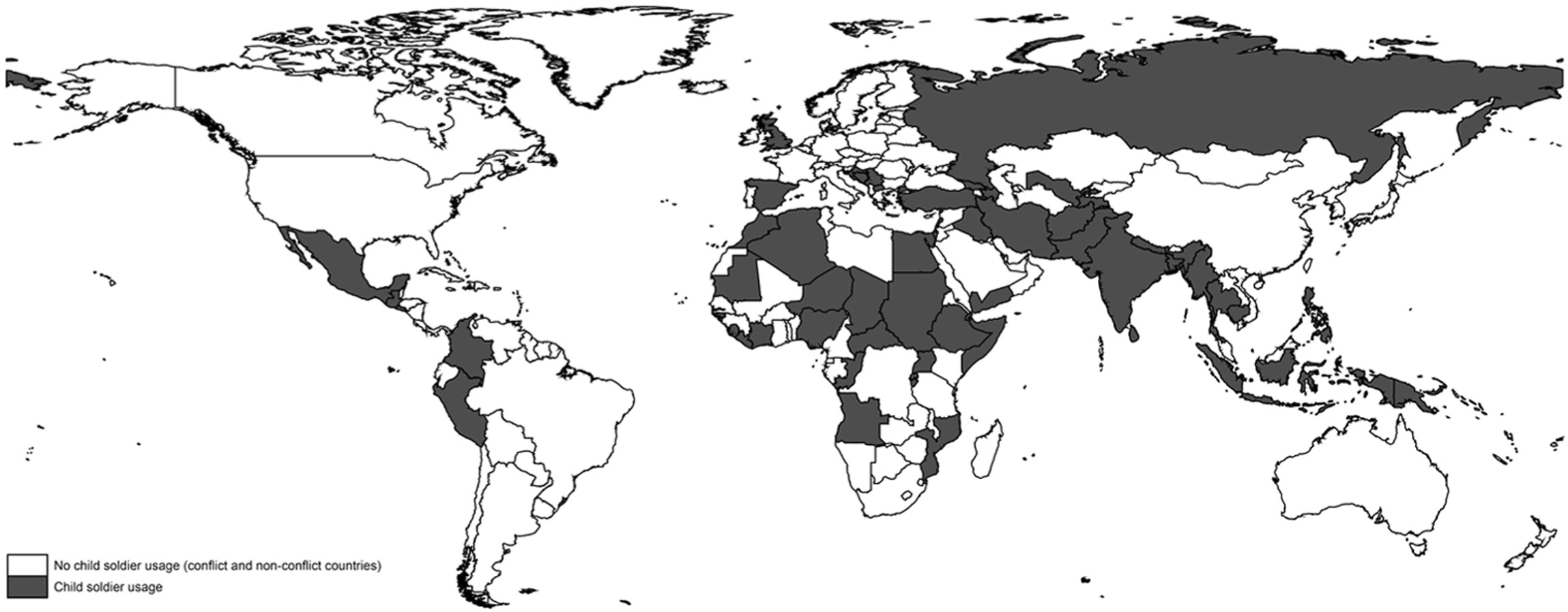
The use of child soldiers worldwide, 1989–2010.
Table 1 summarizes the frequency of observations for the values of our dependent variable (FIGHTING CAPACITY) along the categories of CHILD SOLDIERS. The table shows that most groups did employ some child soldiers, but had a rather low military effectiveness (118 groups). The People’s War Group in India, for instance, employed some children to provide food and to deliver ransom notes, but had a low fighting capacity compared to the Indian government. Table 1 also shows that some groups did not recruit any child soldiers at all, but had a high fighting capacity (24 groups). For example, there is no evidence that the military faction of Hugo Chávez active in Venezuela in 1992 used children, although they had a high fighting capacity according to the NSA data. Most crucially, though, the table demonstrates that there were in fact groups that employed many child soldiers (coded as 2) and did have a high fighting capacity. The LRA (active in Uganda) that used children as active combatants is an illustrative case for this. In addition, some groups having a high level of fighting capacity employed children in supportive functions. For example, the Mexican Zapatista National Liberation Army (EZLN) is known to have employed child soldiers especially in supportive groups (“bases de apoyo”), while having a high level of fighting capacity compared with the Mexican government. Some Cambodian rebel groups such as the Khmer Rouge, Khmer People’s National Liberation Front, and the Front Uni National pour un Cambodge Indépendant, Neutre, Pacifique, et Coopératif are similarly characterized (Seaman, 1999: 6). 10 While a clear relationship between the fighting capacity and child recruitment cannot be identified based on Table 1, the Pearson χ2 test indicates that the two items are indeed related to each other. Yet a more systematic analysis is required that also takes into account several potential other determinants of rebel’s fighting capacity or child soldier recruitment.
FIGHTING CAPACITY and CHILD SOLDIERS—contingency table
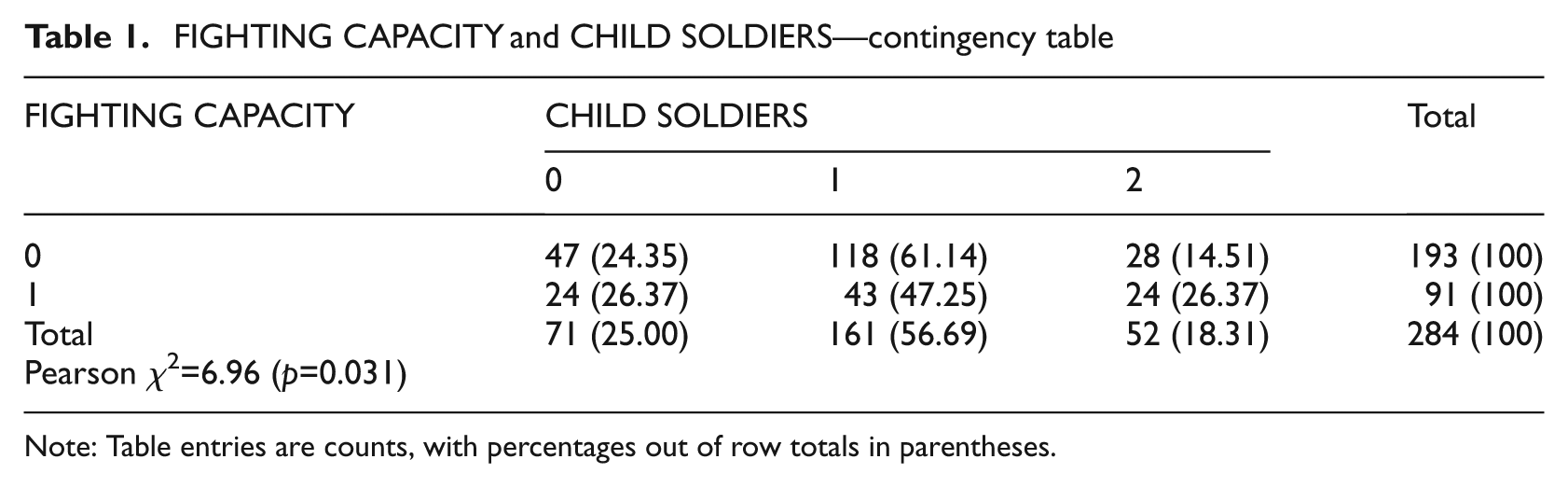
Note: Table entries are counts, with percentages out of row totals in parentheses.
Control variables
We control for other potential alternative explanations that have been identified as crucial influences of either fighting capacity (see, e.g. Biddle, 2004: 6; Dupuy, 1992: 71ff; Stanley and Brooks, 2007) or child soldier recruitment (see, e.g. Beber and Blattman, 2010; Honwana, 2006; Singer, 2006). The variables for the latter are particularly important for our empirical models in light of a “selection on observables”. 11 Moreover, these “child soldier recruitment variables” primarily pertain to the demand side of child soldiering, although some of them may also be listed under the supply side (e.g. RESOURCES) or are more general systemic factors (e.g. ARMS PROCUREMENT). Finally, with regard to the determinants of rebel groups’ fighting capacities, that is, situational or environmental factors, force size and weapon technology (Biddle, 2004: 6; Dupuy, 1992: 71ff; Stanley and Brooks, 2007), we closely follow Cunningham et al.’s (2009: 580) variables that capture “the ability of a rebel group to target the government with military force”.
First, there is STRENGTH CENTRAL COMMAND that measures the extent to which a central command exercises control over the constituent groups of an insurgent movement. According to Cunningham et al. (2009: 580), “a strong central command provides the organizational structure necessary to mount an effective rebel strategy against the state”. We employ an ordinal variable that ranges over [1; 3]: lower values signify no or only a weak central command structure, while higher values stand for stronger command structures of rebel forces, which is likely to influence their fighting capacity. We expect this variable to positively influence rebels’ fighting capacity.
Second, we consider a dichotomous variable for a rebel group’s mobilization capacity. When subscribing to the assumption that child and adult soldiers are complements rather than substitutes, rebel groups that have the ability to recruit a larger number of fighters are not only more likely to draft child soldiers, but also “present a clear threat to governments and engage in direct attacks” (Cunningham et al., 2009: 580). In other words, we assume that, the higher their mobility capacity is, the more likely they are to be military effective. According to this variable, about 40% of our observations have such a mobilization capacity (relative to the government).
Third, Cunningham et al. (2009: 580) suggest that “insurgents that have high capacity to procure arms should be better able to effectively target governments”. We, therefore, also incorporate their ARMS PROCUREMENT variable, which is a binary item receiving the value of 1 if a rebel group has the ability to procure arms relative to the government and 0 otherwise. Accordingly, this variable captures the argument that technology developments positively influence military organizations’ fighting capacities (Biddle, 2004; Dupuy, 1992; Millett et al., 1988) and controls for Singer’s claim (2006, 2010) that technological and efficiency advances in weapons affect the recruitment of child soldiers.
Fourth, another dichotomous variable measures whether a rebel group controls any territory (1) or not (0). Having a territory provides rebels with a variety of valuable resources and shelter from the government’s authorities seeking to disrupt their position, which is likely to increase rebels’ fighting capacity (e.g. Asal and Rethemeyer, 2008). Territorial control also facilitates the accommodation of training complexes, arms depots, etc., and may make it easier to draft adolescent fighters.
Fifth, the military effectiveness literature highlights the importance of force size (e.g. Biddle, 2004; Dupuy, 1992; Millett et al., 1986, 1988; Stanley and Brooks, 2007). The larger the size of a rebel group, the more likely it is to comprise people skilled at fighting and strategy/tactics. That said, it could also be the case that, the more people are being recruited, the less developed or advanced their training and equipment may be. Either way, in order to control for these possible influences, we include the NSA’s estimate of each rebel group’s size per conflict dyad (Cunningham et al., 2009). This measure ranges from 100 (i.e. the National Democratic Front of Bodoland in India) to 160,000 (i.e. the Armenian National Movement in 1990). We use the dataset’s “best estimate of the size of rebel armed forces”, and take the natural logarithm to account for the skewed distribution of this item.
Sixth, the duration of a conflict can have a major impact on the fighting capacity of rebel organizations. Commonly referred to as a situational or environmental factor in the literature (Biddle, 2004: 6; Dupuy, 1992: 71ff), one argument states that, the longer the duration of a conflict, the higher the likelihood that the fighting capacity of rebel groups increases owing to organizational learning (see, e.g. Asal and Rethemeyer, 2008). In addition, the longer the duration of a conflict-dyad-period, the higher the chances are that children have been recruited as fighters (Tynes and Early, 2014: 19). To control for these mechanisms, we include a count variable measuring the time (in years) elapsed since the start of a conflict-dyad-period until its end; this item is based on the Uppsala Armed Conflict Data (Gleditsch et al., 2002). Note that this variable also controls for any remaining temporal dependencies in the data as it captures the length of a conflict-dyad-period. 12
Seventh, rebels’ fighting capacity and their ability to recruit child soldiers may be determined by the wealth of a particular armed group (see, e.g. Dallaire, 2011). More affluent rebel organizations are better able to acquire weapons or invest more into military training. In other words, it is highly likely that wealthier rebel groups are the ones that are most militarily effective. While there are no accurate data on the financial track record of armed groups, we include a variable that measures the presence of several resources in the country in which an armed group is based. To this end, we use information from Buhaug and Lujala (2005), Gilmore et al. (2005), Lujala et al. (2007) and Lujala (2009) on the presence of drugs, petroleum, diamonds and gemstones in a country. On the basis of this information, we constructed an additive variable ranging from 0 to 4: higher values stand for the presence of more resources in the state in which the rebel group is active.
Finally, the literature on child soldiering shows that conflict type matters (Lasley and Thynes, 2015) and predominantly rebel organizations in civil wars have recruited children (Gates and Reich, 2010). Our last control variable thus captures in a dichotomous fashion whether the conflict of each conflict-dyad-period pertains to a civil war (1), as defined by the Uppsala Armed Conflict Data (Gleditsch et al., 2002), or not (0).
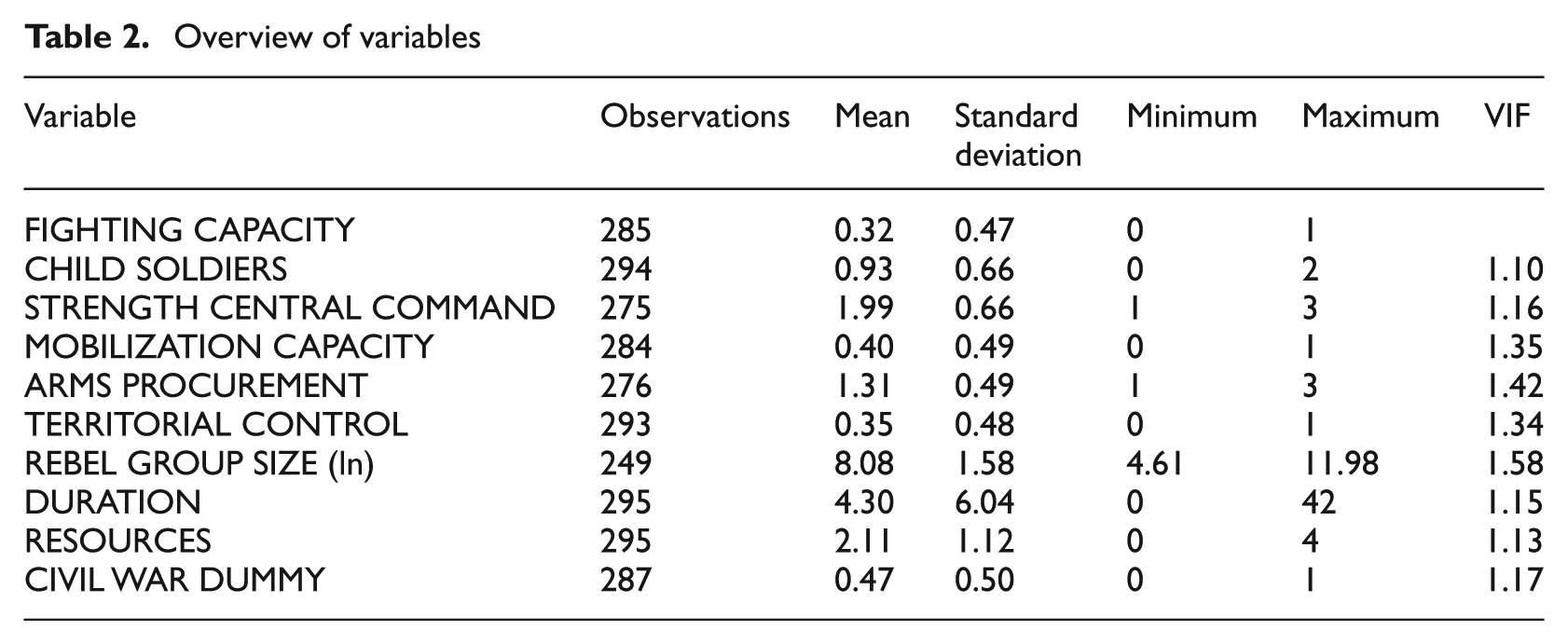
Table 2 summarizes the descriptive statistics and variation inflation factors (VIFs) of our variables. All explanatory variables are well below the used threshold level of 5, indicating that there is not much overlap or correlation between any of them.
Overview of variables
Empirical results
Owing to our dichotomous dependent variable, we use probit regression models to analyze the data. Table 3 shows our results. Model 1 only considers our core explanatory variable and those control variables that are seen as important drivers of rebel groups’ fighting capacities according to Cunningham et al. (2009). Model 2 incorporates all of the explanatory variables discussed in the previous section. In addition, Figure 2 graphs the substantive quantities of interest, that is, first difference estimates. A first difference estimate captures the change in the predicted probability (in the form of percentage points) of observing an outcome (i.e. y=1) as a given explanatory variable changes values from its minimum to its maximum, while all other explanatory variables are held constant at their medians (King et al., 2000).
The determinants of rebel groups’ fighting capacity
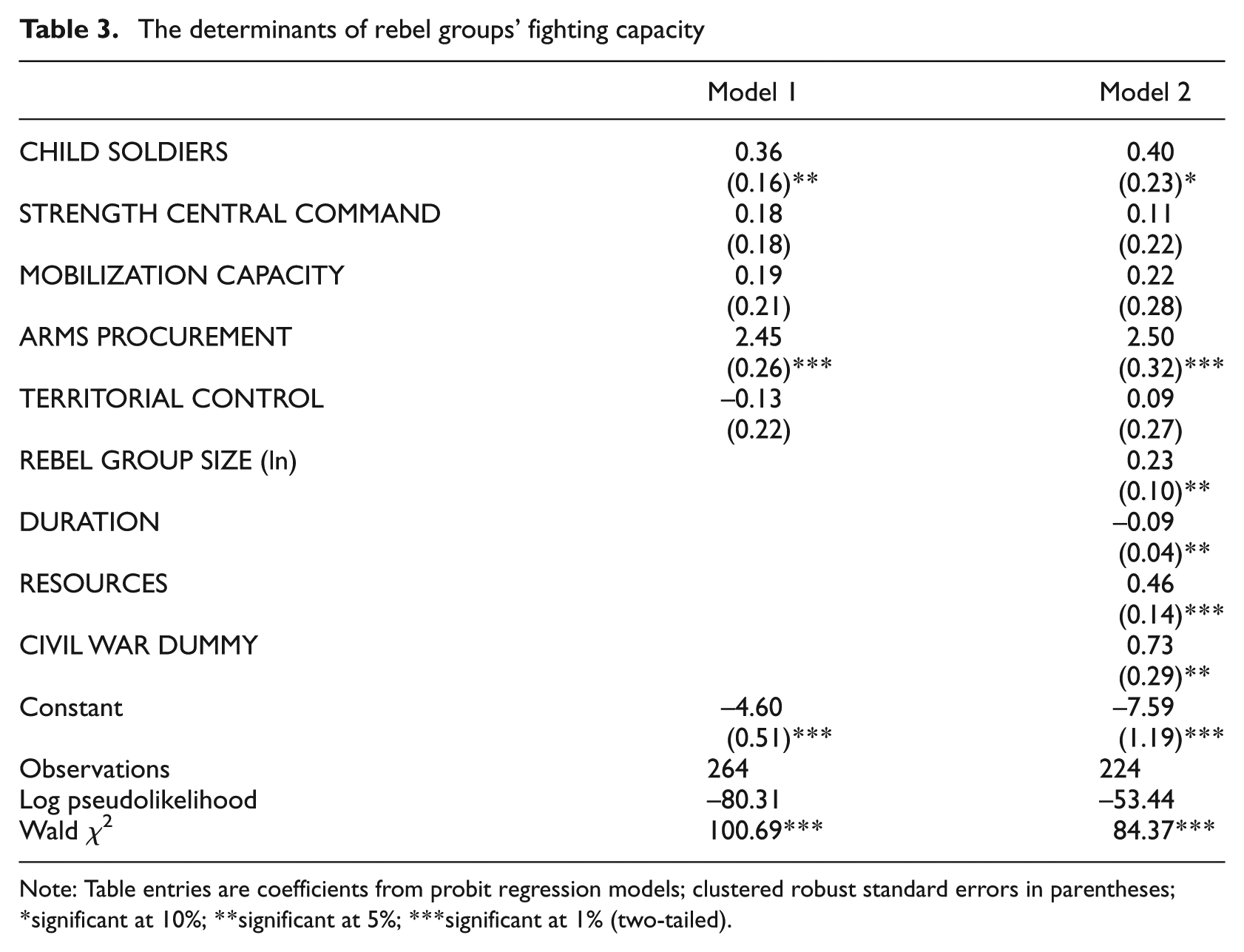
Note: Table entries are coefficients from probit regression models; clustered robust standard errors in parentheses;
significant at 10%; ** significant at 5%; *** significant at 1% (two-tailed).
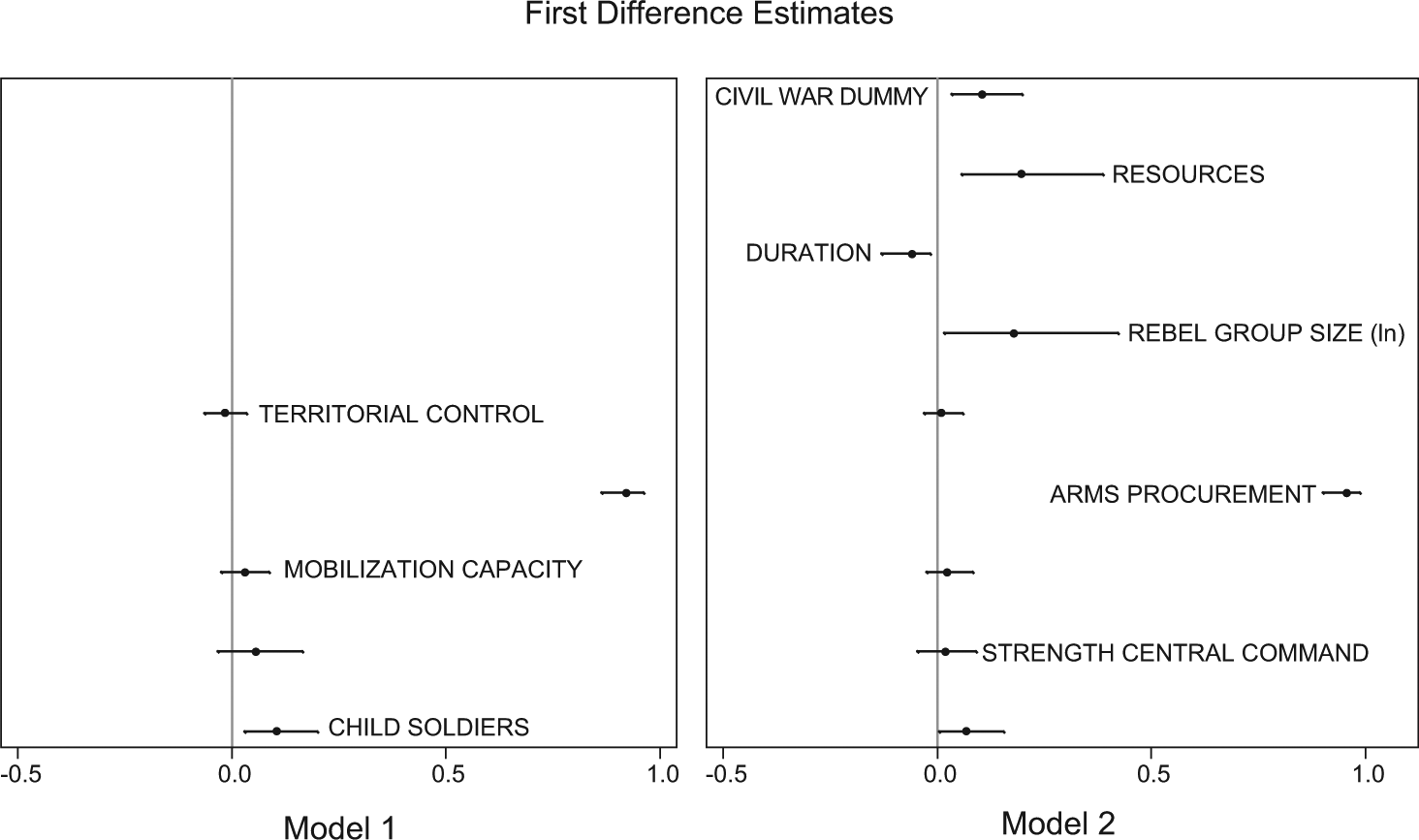
The impact on rebel groups’ fighting capacity: first differences.
Regardless of our model specifications, CHILD SOLDIERS has a positive and statistically significant impact on rebel groups’ fighting capacities. Hence, it seems that the recruitment of children does in fact increase the fighting capacity of a rebel group. The first difference point estimate of this item is at 0.11 on average throughout models 1 and 2: when raising CHILD SOLDIERS from its minimum to its maximum, the probability of a moderate to high fighting capacity increases on average by 11 percentage points. In other words, child soldier recruitment actually does make rebel groups more militarily effective and increases their chances of successfully fighting against governmental troops. This finding is robust across several model specifications; adding or dropping control covariates does not affect its substance. 13 The results of our analysis are therefore the first indication that the recruitment of children might indeed increase the fighting capacity of a rebel group (e.g. Beber and Blattman, 2013; Honwana, 2006; Singer, 2006, 2010; Tynes, 2011; Tynes and Early, 2014).
Coming to the control covariates in our models, their impact and substance essentially do not change over the model estimations. Most variables mirror existing findings or arguments in the literature (e.g. Beber and Blattman, 2013; Biddle, 2004: 6; Dupuy, 1992: 71ff; Honwana, 2006; Pollack, 2002: 10; Singer, 2006, 2010; Stanley and Brooks, 2007; Tynes, 2011; Tynes and Early, 2014) and we only discuss the statistically significant items. First, next to REBEL GROUP SIZE (ln), ARMS PROCUREMENT is one of the strongest determinants. This supports Cunningham et al. (2009), who argue that group size and skillful arms procurement positively influence a rebel group’s fighting capacity (see also Biddle, 2004; Dupuy, 1992; Millett et al., 1988).
Second, the more resources are available in a country, the more likely it is that rebels can exploit them (Fearon and Laitin, 2003; Koubi et al., 2014). Our results support these claims as RESOURCES has a positive and statistically significant impact. The point estimates for this variable’s first differences suggest an increase in a rebel group’s fighting capacity by 26 percentage points on average.
Third, Asal and Rethemeyer (2008), for instance, argue that, the longer the duration of a conflict is, the higher the likelihood is that the fighting capacity of rebel groups will increase owing to organizational learning. Our findings cannot support this claim. On average, the probability of a moderate to high fighting capacity decreases by 11 percentage points when DURATION is moved from its minimum toward its maximum. Hence, our models actually suggest that the longer a conflict continues, the higher the likelihood is that a conflict cycle will escalate, which weakens the rebels (e.g. Cunningham et al., 2009).
Fourth, the CIVIL WAR dummy has a statistically and significant effect on the fighting capacity of rebel groups. In other words, non-sate actors involved in a civil war are more likely to have a higher fighting capacity than those who are involved in short-term actions like terrorist-driven disputes.
Fifth, the analyses also highlight that DURATION and RESOURCES display a statistically significant and positive impact on the likelihood of child recruitment. The longer the duration of a conflict-dyad-period, the higher the chances are that children have been recruited (Tynes and Early, 2014: 19). Moreover, rebels’ ability to recruit child soldiers may be determined by resources, which can also be seen as a supply-side determinant (Tynes, 2011: 93).
Against this background, it is worth noting that the control items RESOURCES and ARMS PROCUREMENT seem to have a much stronger impact on FIGHTING CAPACITY than CHILD SOLDIERS. On average, ARMS PROCUREMENT has a higher impact than CHILD SOLDIERS by about 90 percentage points, while RESOURCES scores better by about 13 percentage points than our core variable of interest. Hence, although we could demonstrate that child soldiering does influence a rebel group’s fighting capacity and that it does so positively and significantly, RESOURCES and ARMS PROCUREMENT seem to be more important determinants. We return to this point in the conclusion now.
Conclusion
The academic discussion on child soldiers in armed conflicts has primarily focused so far on those factors that may make it more likely that children will be recruited as fighters or join armed groups. Only a few studies have examined what kind of consequences this might have for armed groups’ fighting capacity. The existing literature did not systematically try to answer this question empirically, and, in fact, seemed to simply rely on the assumption that children possess particular characteristics that make them as militarily effective as (or even more effective than) adult combatants—or militarily weaker. Based on a newly compiled dataset on child soldier recruitment by rebel groups between 1989 and 2010, we analyzed the relationship between these groups’ fighting capacities and the involvement of adolescent fighters. The results demonstrate that child soldiers are indeed more likely to be associated with higher fighting capacities of rebel groups. However, when taking into account our control variables as well, we found support for rebels’ ability to procure arms and the access to resources being more important influences.
Our findings are not necessarily counterintuitive given the various presented arguments for why child soldiers might be militarily effective. That said, it is important to note that, although there might be “benefits” associated with child soldiering, our research should not be seen as endorsing the use of child soldiers by rebel groups. Instead, it is meant to help decision-makers, international organizations and human-rights groups understand the persistence of child soldiering among rebel groups with a view toward the development of more effective strategies to abolish the use of children in conflicts.
Our work therefore highlights, for example, that the international community should realize that recruiting and using children during battles is not just an immoral strategy, but can in fact positively affect rebels’ fighting capacities. This certainly does not make the aim of abolishing child soldiering easier, as activists may be ill-advised to try to dissuade from child soldiering on tactical grounds. Hence, governments and activists should rather rely on other, more enforcing ways that can change rebels’ cost–benefit analysis more substantially. For instance, economic sanctions or counter-propaganda strategies can be considered as a worthwhile tool in order to enforce compliance with international law (e.g. Beber and Blattman, 2010; Keen, 2008).
Moreover, our work emphasizes, in line with existing research (e.g. Cunningham et al., 2009), that other factors also matter for rebels’ fighting capacity, and arguably even more so than child soldiering. The variables on arms procurement and the presence of resources are the most prominent examples here. Thus, our evidence for the impact of these key determinants further increases our understanding of rebel groups, how they operate and what they rely on, and more generally perhaps, our knowledge of the factors leading to conflict onset, duration and outcomes.
While it was our hope that we could shed light on the relationship between child soldier recruitment and the military effectiveness of armed groups, one study is insufficient to address this important issue comprehensively. Many questions remain and multiple avenues for further research exist. First, although we identified a positive correlation between child soldiering and rebel groups’ fighting capacities, we could not evaluate the relative impact of child soldiers in light of the potential costs that are associated with this. Rebels still have to invest resources for children’s military training and socialization. Given that the necessary investment efforts for these processes are potentially costly, child recruitment could well be an inefficient strategy: the costs associated with child soldiering in the first place may outweigh the benefits of an increase in rebel groups’ fighting capacity. However, our research focused on the estimation of benefits with the analysis of costs left aside. Consequently, it remains unclear (a) what kinds of costs are associated with child soldiering and (b) whether these costs outweigh (or not) the benefits. In light of this, there also seems to be a need for systematic micro-level studies on the causal mechanisms behind the decision to use child soldiers or not.
Second, the child soldier usage variable we employed is of ordinal nature, but more accurate measures—also for other military organizations such as governments’ military—could be constructed. Similarly, and in light of the costs of child soldiering that might be associated with socialization and training processes, the threshold value for child soldiers at 18 years of age might be problematic. Identity formation for a 17-year-old is much more concretized than for a 15- or 14-year-old (see Erikson, 1995). Moreover, while 14-year-olds could be easily socialized, 17-year-olds might be more obstinate. The under-18 threshold does not address this variation and, in fact, the coefficient on child recruitment may then be biased toward zero, since it averages groups that recruit a few older teenagers with groups that recruit large numbers of, say, 12-year-olds. Alternative data definitions, which rely on more accurate and disaggregated data, might find stronger results. However, additional data compilation efforts are necessary here.
Finally, our work focused on the demand side of child soldiering and, specifically, the fighting capacity of rebel groups. However, a more systematic analysis of supply-side influences and other aspects besides fighting capacity on the demand side is needed.
Footnotes
Acknowledgements
We are grateful for constructive comments, general support, or assistance with the data collection by Lilli Banholzer, Lena Garrettson, Valentin Gold, Katharina Holzinger, Daniela Kromrey, Caitlin Talmadge, Clayton Thyne and Thanakon Tiwawong. We also thank the anonymous reviewers and the journal’s former editor, Glenn Palmer, for valuable input. The dataset, codebook, replication instructions for the empirical analysis and appendices of this article can be found at the corresponding author’s website: 
Funding
This research received no specific grant from any funding agency in the public, commercial, or not-for-profit sectors.