



Abstract
Conventional wisdom has long held that conducting counterinsurgency wars overseas is an invitation for foreign policy difficulty, if not outright disaster for democracies. However, current research lacks systematic evidence to support such a claim, fostering uncertainty regarding the connection between regime type and the outcomes of such conflicts and leaving open the question if such a link even exists. I address these issues by linking the level of casualties suffered by an occupying force to its leadership’s decision to withdraw from the territory. Using a dataset of wars of occupation from 1800 to 2005, I find that, while democracies are no more likely to lose than their autocratic counterparts, they consistently abandon these conflicts at significantly lower levels of casualties.
Conventional wisdom among military scholars and policy-makers has long maintained that democracies are poorly suited to engaging in counterinsurgency campaigns and that doing so is a prescription for foreign policy difficulty, if not outright disaster (Arreguín-Toft, 2001, 2005; Feaver and Gelpi, 2004; Galula, 2006; Horne, 2006; Jentleson, 1992; Mack, 1975; Merom, 2003; US Army, 2007). The argument is simple: to successfully coerce an insurgency into laying down its arms and accepting the incumbent’s authority requires an acceptance of the costs of fighting and a willingness to use highly repressive violence. Democratic publics are believed to be fundamentally uncomfortable with both of these. As costs increase, the public withdraws its support, which compels its electorally minded leaders to abandon the effort before the insurgency can be defeated and their goals met. Democratic leaders, so the thinking goes, will also not allow their forces to employ extreme levels and methods of violence, which would violate their public’s (or the international community’s) beliefs regarding human rights and the proper conduct of war (Merom, 2003). Such normative restraint prevents democracies from decisively defeating their opponents, which in turn, allows for the costs to continue to accrue.
However, in a recent large-n study of counterinsurgency campaigns from the past 200 years, Lyall (2010) directly challenges this claim, finding no relationship between regime type and outcomes in these wars. Indeed, Table 1 suggests that the relationship between democracy and losing is minimal. In the 202 counterinsurgencies fought by nondemocracies between 1800 and 2005, 107 of them emerged victorious, a success rate of 53%. Somewhat surprisingly, and in contrast to the arguments surrounding the difficulties that confront them, democracies actually outperform their autocratic counterparts, achieving victory 55% of the time by winning 46 of 84 conflicts.
Outcomes of counterinsurgency wars by regime type
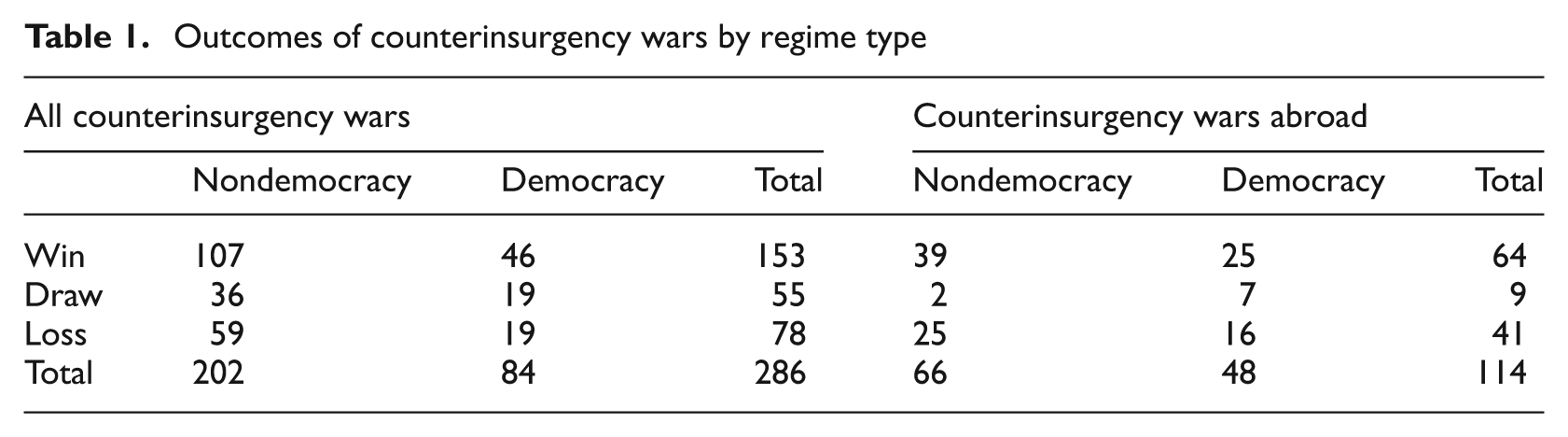
Table 1 also shows the success rates if we just look at those conflicts taking place in territories overseas. As Lyall (2010: 182) notes, most democracies conducting counterinsurgent campaigns are doing so as occupying forces, as they tend not to face insurgent rebellions at home. We can see that, while nondemocracies win about 59% of the time (39 of 66) in counterinsurgency wars abroad, democracies win slightly over half of such campaigns (25 of 48), or 52%. It is clear that democracies do not perform as well in these conflicts as they do in interstate wars, where they win about 93% of the time (Reiter and Stam, 2002: 29); however, we certainly cannot conclude that defeat is a preordained outcome. In light of the conventional wisdom, these findings are rather puzzling, leading us to wonder what, if any, is the relationship between regime type and the outcomes of these wars.
This paper strives to develop some degree of understanding of this relationship. Specifically, I identify the conditions under which democracies will be more likely than other regime types to abandon these counterinsurgency wars abroad. To do so, I return to the notion of costs, but I do so by theoretically identifying which costs matter most to democracies—casualties—and develop a statistical model that takes those costs into account by interacting them with regime type. Occupying forces, regardless of their regime type, can potentially leave at any time, and they win such wars when they either convince the insurgent enemy that they have no intention of leaving before they accomplish their goals, and, thus, resistance is futile, or they kill off anyone who is willing to fight. This requires a willingness to pay the costs of staying in the territory, and frequently that means a willingness to incur casualties. I argue that, when democratic states lose, meaning that they abandon the territory before fully suppressing violent opposition and achieving whatever aims they may have, their electorally minded leaders choose do so because the level of casualties they have incurred surpasses a threshold that their publics deem acceptable. Insurgents, therefore, are motivated to keep fighting despite experiencing their own mounting costs, fully aware that their ability, not to win militarily, but at least to inflict casualties, brings them one step closer to the departure of the occupier and victory. This stands in contrast to autocratic states involved in counterinsurgency campaigns overseas. Leaders in such states are largely unconstrained by the views and concerns of their populations, and, thus, do not fear removal from office through electoral loss owing to high levels of casualties. We should then expect these types of regimes to be much more willing to accept higher casualties before withdrawing than their democratic counterparts.
I test the claim that democracies have a lower tolerance for casualties than autocratic regimes in counterinsurgency wars overseas against a dataset of such conflicts between 1800 and 2005. I restrict my universe of cases to counterinsurgencies conducted overseas for two reasons, one theoretical and the other related to policy. As just suggested and as I will discuss in greater detail below, wars of occupation constitute a distinct category of civil war and insurgency in that the incumbent counterinsurgent can leave the territory at any time. This possibility of exit does not exist for indigenous incumbents, and thus, we require a distinct theory to explain when and why occupiers might give up the fight and go home. Second, democratic states typically select into wars that they can and do win (Reiter and Stam, 2002: 29). However, their relative lack of success in counterinsurgency campaigns abroad suggests that it may be useful from a policy perspective to identify the factors associated with defeat so that they can perhaps be avoided or mitigated.
I also examine the potential validity of competing mechanisms linking regime type to conflict outcomes. In particular, I assess the relationship between the duration of these conflicts and regime type, as democracies may be more likely to withdraw as government commitment and public attention turn away from the war to other issues, either at home or abroad. If other crises emerge that demand attention or the public is no longer interested in a conflict or its outcome, there may be little incentive for continuing it. The statistical results, however, strongly suggest that, rather than being separated by differing thresholds of duration, regime types are distinct in the level of casualties that they are generally willing to accept. This finding is largely robust to several alternative measures of regime type and several model specifications.
The remainder of the paper is organized as follows. I begin by discussing the connection between casualties and democracy in greater detail, paying particularly close attention to how casualties become salient in democratic societies. Next, I briefly offer alternative hypotheses and discuss their potential theoretical shortcomings. Following from this, I present the data and empirical strategy, explaining how the interaction of regime type with casualties is needed to accurately assess the theory. I then report the results, which suggest that regimes where leaders are accountable to mass publics do, indeed, withdraw from these conflicts at significantly lower levels of casualties than those where leaders answer only to smaller groups of political elites. I conclude by stressing the need for future work to further explore the relationship between costs and regime type and I suggest that democratic leaders should think hard about the prospects for success when putting troops in harm’s way.
Why casualties matter
Casualties are a cost of conflict, but I begin this section with a brief step back to discuss how states conducting counterinsurgency abroad are likely to view the general notion of costs differently than an indigenous counterinsurgent force. Leaders who select into counterinsurgency wars abroad, or the occupations where they occur, may view them as imperative to their own political survival, but the survival of the state usually is not in question. Nevertheless, such a leader will seek to demonstrate not just his own, but his entire state’s dedication to victory and the attainment of whatever objectives brought it to the territory in the first place, whether it be to acquire raw natural resources, secure policy concessions or install and protect a favored leader. He will frequently do so through statements of resolve. For example, following the passage of the Tonkin Gulf Resolution in August 1964, Lyndon Johnson stated, “Let no one doubt that we have the resources and we have the will to follow this course as long as it may take us” (Patterson, 2012: 24). Similarly, in 2003, George Bush argued:
Enemies of freedom are making a desperate stand there [Iraq]—and there they must be defeated. This will take time and require sacrifice. Yet we will do what is necessary, we will spend what is necessary, to achieve this essential victory in the war on terror, to promote freedom and to make our own nation more secure. (Bush, September 3, 2003)
These statements and countless others are efforts to signal to a variety of audiences, from domestic populations at home to the insurgents and populations abroad, that the occupier is no different than an indigenous incumbent fighting an internal challenger. These latter leaders do not have any trouble convincing their challengers that they are committed to remaining in the territory, as defeat would spell the end of their tenure in power and may even result in some sort of extreme punishment (e.g. imprisonment or execution; Lake and Baum, 2001: 594). As such, they have no option but to fight on regardless of the costs.
Costs, however, do influence the decision-making calculus of an occupier: such a state can simply leave the territory if they get too high. Scholars have located the motivations for insurgent action in a variety of other sources, from the desire to acquire selective and communal incentives (Collier and Hoeffler, 2004; Goodwin and Skocpol, 1989; Kalyvas, 2006; Mueller, 2000; Olson, 1965; Stoll, 1993; Weinstein, 2006) to a need to survive against what is thought to be certain death or enslavement (Mack, 1975; Simpson, 2010), as well as the desire to exact revenge (Anderson, 2005: 46–47; Hashim, 2006: 99–104; Lyall, 2009; Tishkov, 2004: 142; Wood, 2003: 18–19) or seek protection (Goodwin, 2001; Kalyvas, 2006: 151–159; Kalyvas and Kocher, 2007: 183; Leites and Wolf, 1970: 112–118; Mason and Krane, 1989). These factors potentially enable insurgents to overcome any collective action problems that might limit an individual’s willingness to participate in risky behavior such as rebellion. In confronting a domestic incumbent, these motivations must sustain a rebel group all the way to military victory, but in the case of a challenge to an occupying force, they need only to exist to allow the group to continue to extract some sort of costs to the point where the occupier is no longer willing to maintain its presence.
I have discussed costs to this point in rather general terms. We can imagine that they might fall into two general categories, financial and human. Financial costs would obviously include those required to send fighting forces to the territory. In some instances the state may have to design and construct the equipment needed to transport trained troops and their equipment, and once in theater, these troops need to be paid, fed and clothed while the equipment must be cleaned and maintained. On top of the costs of bringing troops and equipment to the territory, there are the added costs of maintaining the gains made through the capture of territory. The “clear and hold” sequence requires the occupier to pay the costs of garrisoning potentially remote or hostile regions, which can also be very costly from a logistical standpoint. Jacobsen writes of the situation in Iraq prior to the 1920 Revolt:
These posts [garrisons throughout the country] were not always readily supported or even supplied reliably … The outposts, too weak to defend themselves and too immobile to tour the countryside or reinforce other sites, drew criticism from home. However, in the political climate that obtained both in Iraq and in the region as a whole, withdrawal of forces anywhere suggested that the British were about to evacuate the entire country. (Jacobsen, 1991: 324)
Such financial costs are certainly significant, but they are not the only costs of conducting counterinsurgency. Troops are killed and injured in the course of these campaigns. The asymmetric nature of guerrilla warfare (Arreguín-Toft, 2001) means that front lines disappear and conventional battles become less frequent, although they certainly do exist. Insurgent actors adapt to employ technologies (e.g. improvised explosive devices) and tactics (e.g. suicide bombings) that can kill uniformed service personnel wherever they are located—on patrol, travelling in convoys or eating in mess halls.
The centrality of casualties to democracies
While all states incur costs through the course of conflict, who bears the brunt of those costs can vary. In democracies, leaders decide how resources at their disposal collected from the population are to be allocated across competing priorities, and upon doing so, the public then renders a decision through an election as to whether those resources were allocated in a way that reflects their interests. Relative to the financial costs, which can be obscured or delayed through budgeting mechanisms, battle deaths are a much more immediate and tangible cost that must be borne by democratic publics. News outlets will announce the names of the fallen, flags are flown at half-staff, memorials are erected and entire towns might attend a service-member’s funeral. Furthermore, enhanced media freedom within democracies also means that insurgents may attempt to carry out spectacular attacks likely to attract the attention of citizens in the occupying country.
With the widespread dissemination of these images through open and free media, a democratic public does not always need the assistance of opposing domestic elites to know that deaths are occurring. However, these elites can play a role in letting a democratic public know if those sacrifices are worthwhile and what the patterns of violence might suggest about the eventual outcome of the conflict. Both Baum and Groeling (2010) and Berinsky (2007) find that opposing political elites will potentially foster foreign policy interest within the public through vocal dissent, and Schultz (1998: 832) notes that this usually occurs when those opponents of the incumbent detect the possibility of electoral gain from doing so. Many of these conflicts may start out with near-consensus among elites regarding the need to emerge victorious, although it is unclear if such agreement is a result of true beliefs, groupthink or fears over being labeled as unpatriotic during what is known to be a brief “rally around the flag” effect (Brody and Shapiro, 1989; Brody, 1991; Jordan and Page, 1992; Lian and Oneal, 1993; Mueller, 1970, 1973; Oneal et al., 1996; Parker, 1995). However, the electoral incentives that Schultz (1998: 832) identifies may lead opposition leaders to abandon the argument that the state’s immediate security or survival is threatened. 1 Once this elite consensus breaks down, it then becomes very difficult for a leader to convince the public that the human cost is worth it (Burk, 1999: 60), as media coverage becomes more critical in response to the elite dissention (Zaller, 1994). These elites and the public who they have engaged through their dissent also can use casualty patterns to give meaning to current casualty rates (Gartner, 2008) and to approximate future costs (Gartner and Segura, 2005; Nisbett and Ross, 1980). 2
The resulting shift in public opinion can be quite dramatic. In July of 2003, 2 months prior to President Bush’s speech noted above, a USA Today/Gallup Poll included the question, “In view of the developments since we first sent our troops to Iraq, do you think the United States made a mistake in sending troops to Iraq, or not?” Twenty-seven per cent of respondents said that the USA “made a mistake,” while 72% said that it “did not make a mistake” (PollingReport.com, n.d.). When the question was asked for the last time in this poll in July of 2007, 62% of respondents said that the invasion was a mistake, while just 36% stated that it was not (PollingReport.com, n.d.).
As elite messages from the opposition erode support for the conflict (Gartner and Segura, 1998; Mueller, 1973) and the leaders responsible for it (Gartner and Segura, 2000), those leaders must either respond to those shifting preferences or face the electoral consequences. This logic has underpinned many existing studies that show that casualties influence the outcomes of elections for multiple branches of government within the USA (Carson et al., 2001; Gartner et al., 2004; Karol and Miguel, 2007; Voeten and Brewer, 2006) and their overall effect on leader tenure (Bueno de Mesquita et al., 2003).
However, it is not a foregone conclusion that occupiers will always suffer casualties at levels that shift public support for the conflict downward. A technological advantage might allow the occupier to incapacitate insurgents while largely staying protected from harm. For example, the arrival of military aircraft in the middle of Britain’s 1920 conflict in Iraq allowed it to kill insurgents with minimal human risk. Royal Air Force Commander Arthur Harris noted:
They [i.e. the Arabs and the Kurds] now know what real bombing means, in casualties and damage; they now know that within 45 minutes a full sized village … can be practically wiped out and a third of its inhabitants killed or injured by four or five machines which offer them no real target, no opportunity for glory as warriors, no effective means of escape, and little chance of retaliation or loot such as an infantry column would afford them in producing a similar result. (From Tanaka, 2010: 21)
Following the deployment of airplanes, the British were able to maintain control of the region at minimal human or financial cost into the next decade. Local inhabitants would still occasionally target British assets, but the use of air power allowed for those attacks to be dealt with swiftly and harshly, which lessened their frequency and lethality.
Similarly, an insurgent group inspired by the possibility of an occupier’s exit and defeat can only succeed if it possesses the capability to extract costs. If it does not have the means to carry out attacks that would make an occupier’s continued presence untenable, it is unlikely to have any effect on the domestic audience’s concerns over the course of the occupation. For example, in the 1906 Zulu Rebellion against the British in modern-day South Africa, local tribesmen armed only with seven guns and spears and shields were no match for the rifles and cannon of British soldiers (Thompson, 2003: 546). Insurgents do not need to be able to win militarily, but they must at least possess a minimum capacity to extract costs and, as this example suggests, that is not always the case. These strategies suggest that significant casualties in a conflict are not a given. However, when democratic states are unable to adopt strategies and operations that weaken the likelihood of suffering such casualties, the theory suggests that leaders responsible for the conflict come under increasing pressure to withdraw, ceding control back to their indigenous opponents.
In contrast, autocratic regimes largely do not possess the institutional mechanisms that allow for casualties to shape outcomes in the same way that they do in democracies. To be sure, if a state suffers casualties to the point where it can no longer effectively fight or control territory, it is likely to ultimately lose. However, this is probably the result of poor battlefield performance, not public discontent that compels a shift in policy. Rather, autocracies generally lack meaningful media freedom, which suggests that their publics may not even know the extent of the casualties being incurred. Also, the absence of visible and vocal elite opposition prevents them from acquiring any sort of context in which to place those casualties. Finally, even if the public were aware of the casualties the state was suffering, the lack of competitive elections would leave those individuals opposed to further involvement without the opportunity to voice their desire for a change in policy. Therefore, we would expect that, relative to democracies, autocracies will be more willing to accept higher levels of casualties before withdrawing in defeat from counterinsurgency wars abroad. More formally:
Alternative explanations
We can imagine, however, that democratic states might also withdraw from counterinsurgency campaigns overseas for a number of other reasons. Here, I focus on two plausible alternative explanations offered in the existing literature. The first is that democratic publics come to no longer believe in the prospects of winning. Feaver and Gelpi (2004) and Gelpi et al. (2005–2006) argue that the public’s belief in the likelihood of victory, however individuals choose to define it, outweighs all other considerations. If success is viewed as unlikely, a democratic public becomes less willing to support the conflict, which, in turn, forces the leadership of the state to end the conflict. Unfortunately, testing the validity of this mechanism requires the use of experimental surveys over a period of time, as Gelpi et al. (2005–2006) did with public opinion surveys during the early periods of the Iraq War, and so I will set it aside for further research.
Nevertheless, Berinsky and Druckman (2007: 134) give us reason to be skeptical of the logic that underpins such a claim. They raise the possibility that the relationship between support for war and belief in its success may run in the opposite direction from Gelpi et al.’s (2005–2006) argument: “Similarly, just as the observed correlation between vote choice and economic perceptions is a result of voters bringing their economic assessments in line with their political judgments, the causal arrow between perceived success and latent generalized support for war could run from the latter to the former, rather than vice versa” (p. 134). Indeed, in 2004 at a time of high partisan division with respect to support for the Iraq War, Berinsky (2007) found that 85% of Republicans and only 51% of Democrats thought that the conflict would be successful, suggesting that underlying partisan preferences may be driving both support for a conflict and belief in its success (Berinsky and Druckman, 2007: 134).
The other causal argument found in the literature involves the duration of the conflict and can be tested with available data. Reiter and Stam (2002) and Bennett and Stam (1998) find that the likelihood of victory for democracies in interstate war declines with time. As war persists, not only are human and financial costs accruing, but other crises and events both at home and abroad may also reshape how the public views the war and its perceived necessity. Economic crises at home or new security threats abroad may arise that reduce the public’s demand for an ongoing conflict, which then leads decision-makers to re-evaluate the need for continuing it, probably resulting in withdrawal as ongoing involvement no longer possesses any electoral value. An autocracy, on the other hand, may be more immune from such concerns regarding the duration of the war for the same reason that it might be insulated from the public’s aversion to casualties: it is not accountable to the public and so the beliefs and opinions of the public largely do not matter. These conjectures produce the following hypothesis for testing:
However, we have reason to be skeptical of this hypothesis as well. Whereas casualties may impact the public and not necessarily the elite policy-makers in autocratic societies, time is likely to impact both groups through two potential pathways. First, like democratic leaders, autocrats must pursue evolving agendas overseas and at home in their effort to remain in power, which means that their attention spans may be limited. Just as a public’s attention can shift, so too can that of an autocratic leader, and Goemans (2000) suggests that they are unlikely to pay a price for abandoning the conflict, as he finds that dictators are unlikely to lose power or suffer other punishments for losing wars. 3 The second explanation for why autocratic states might be just as likely as democracies to lose these wars as time goes on involves challenges to their leadership. Relevant political elites who are in a position to challenge the leader who oversees the conflict may grow frustrated with the ongoing diversion of resources from their own preferred priorities, producing a potential challenge to his authority. If the leader is replaced through such a challenge, we would then expect the new leader to withdraw from the conflict, as his supporters are not tied to or invested in its success. The former pathway, changes in the leader’s priorities, is likely to be present in institutional arrangements where would-be challengers possess little ability or incentive to organize, while the latter, regime change, will be likely to occur under configurations where organization is possible and the punishments for failed challenges are not sufficient to deter such efforts. However, regardless of which is operating, we have reason to believe that there should be little difference between the effects of a counterinsurgency war’s duration across regime types. Such a null finding would mirror earlier research that has found no link between regime type and the duration of civil wars (Collier et al., 2004; de Rouen and Sobek, 2004; Fearon, 2004; Lyall, 2010).
This section discusses three potential mechanisms underpinning the relationship between democratic regime type and loss in counterinsurgency wars. The first involves numbers of deaths among the occupier’s forces. As these increase, democratic publics turn against the idea of ongoing involvement, forcing their leaders to withdraw in defeat, abandoning whatever aims they may have had. Rather than a concern over casualties, the second mechanism surrounds the public’s sense of whether success is achievable. When democratic publics no longer believe in the possibility of victory, they withdraw their support. Finally, the third potential mechanism is time. As the duration of the conflict increases, democratic regimes will be less willing to maintain their involvement owing to the declining salience of the war or the emergence of other crises that demand the public’s attention. In the next section, I outline the research strategy to adjudicate between two of these three plausible explanations.
Data and empirical strategy
To evaluate the role of regime type in counterinsurgency campaigns abroad, I begin with a dataset of the 114 cases of occupation between 1800 and 2005 based on data collected by Lyall and Wilson (2009). 4 Lyall and Wilson code a state “as an external occupier if its military forces crossed an internationally recognized border in order to suppress an insurgency” (Lyall and Wilson, 2009: Appendix, 4). To enter the dataset, a conflict had to meet two primary criteria. First, it must have experienced a minimum of 1000 battle deaths, with at least 100 casualties on each side of the conflict. Also, the insurgency, which Lyall defines as “a violent, often protracted struggle by nonstate actors to obtain political objectives such as independence, greater autonomy, or the subversion of existing political authority” (Lyall, 2010: 175), must employ guerrilla warfare, a strategy that “(1) uses small, mobile groups to inflict punishment through hit-and-run strikes while avoiding direct battle when possible and (2) seeks to win the allegiance of at least some portion of the noncombatant population” (Lyall, 2010: 175).
Dependent variable
Conflict outcomes are operationalized in two ways, both of which come from Lyall and Wilson (2009). The first is an ordered win–draw–loss variable. A win occurs when the incumbent defeats the insurgency through military force, either remaining in the territory without granting any insurgent demands or leaving after it has secured the policy objectives the occupation was intended to secure. An outcome is coded as a loss when the incumbent occupier gives up control of the territory prior to military victory and the insurgent group and its supporters either assume control or go on to fight indigenous supporters of the occupier for it. A draw occurs when the occupier concedes to some, but not all of the insurgents’ demands. This means that the occupier remains in the territory, but grants the opposition some measure of regional autonomy or self-governance. In the 114 cases, there are 64 incumbent wins, 41 losses, and 9 draws. I also use a dichotomous win–loss variable that drops the 9 draws.
Explanatory variables
The model requires two primary explanators to evaluate hypothesis 1, regime type and casualties. Lyall and Wilson state that “militarily ineffectual rebels can … still win politically if they are able to influence the incumbent’s domestic scene” (Lyall and Wilson, 2009: 72). I argue that, for democracies, such influence primarily comes through the taking of casualties through the forms of irregular warfare noted earlier. The theory suggests that regime type on its own does not sufficiently explain why certain states win or lose counterinsurgency wars overseas. Rather, it is the combination of democratic governance and the level of casualties that serves as the proper explanation. As such, we need a model that observes the interaction of the two.
As is conventional in international relations, democracy is a binary variable that assigns all states with a Polity2 score of ≥7 in the Polity IV Dataset (Marshall and Jaggers, 2008) with a 1; all others receive a 0. Polity2 ranges from −10, the most totalitarian regimes, to 10, which is generally given to the most consolidated democracies. There are 48 democracies and 66 nondemocracies in the dataset.
The second explanatory variable, casualty ratio, will be interacted with democracy. The casualty ratio variable captures the number of occupying forces killed during the course of a conflict over the total number of occupying forces who fought in the territory. I use a ratio, as opposed to logged casualties, because the denominator contextualizes the casualties incurred across conflicts. For example, 10 battle deaths reveal little information or meaning regarding prospects for success, unless the statistic is accompanied by some indication of the larger war effort. If these 10 deaths were suffered by a force of 100 in one conflict, it would contain a different meaning for an engaged domestic audience than if they were suffered by a force of 1000 in another. For information on occupier battle deaths, I consulted several datasets and historical accounts of these conflicts, including the Correlates of War (Sarkees and Wayman, 2010) and Clodfelter (2002). Data on force size comes largely from Friedman (2011), as well as Clodfelter (2002) and other qualitative sources. The data collected represents the best estimates for casualties and force size available for the occupying state, and while I was able to collect data regarding the occupier’s force size and casualties for many of the wars, 70 in total, much of this data remains unknown, unsubstantiated or incomplete. 5
To evaluate hypothesis 2, which posits that democracies are likely to abandon counterinsurgency wars abroad earlier than autocracies, I interact the length of the war with regime type. Taken from Lyall and Wilson (2009), duration is operationalized by the natural log of the number of months the war lasted.
Control variables
In order to properly identify the causal effects of these interactions, it is important to account for some other factors that might be correlated with them or the outcomes of these conflicts. First, highly mechanized militaries are thought to be especially vulnerable to defeat by insurgents. Lyall and Wilson (2009) argue that military technology developed to win conventional interstate wars, such as tanks, armored personnel carriers, etc., actually make forces less capable in the conduct of counterinsurgency because they prevent troops from interacting with the local population, which is seen as key to success in counterinsurgency. Lyall and Wilson (2009) operationalize the level of mechanization as the ratio of soldiers per motorized vehicle, which is taken in the year prior to the war. Mechanization carries five values: 1–4 based on the level of mechanization and 0 for all conflicts prior to 1917, which is commonly viewed as the beginning of the mechanized era (Lyall and Wilson, 2009: 74).
Second, support from a third party is believed to increase an insurgent group’s chances of winning against an incumbent force, as such support frequently means access to weapons, funding, recruits and sanctuary (e.g. Record, 2007; Regan, 2002; Salehyan, 2008). An observation receives a 2 if the insurgency received both material aid and sanctuary from a third party, a 1 if it obtained only one type of aid, and a 0 if it did not receive any third-party assistance. The data is taken from Lyall and Wilson (2009).
Third, as a state’s power increases, so should its likelihood of victory. Stronger countries should be able to adapt and manage the costs of counterinsurgency campaigns better than smaller, weaker states. I follow Lyall (2010) and measure power using the Correlates of War’s Composite Index of National Capabilities (CINC) (Sarkees and Wayman, 2010) from the year prior to the onset of violence, which captures a state’s share of global economic and military power. 6
Fourth, the ruggedness of a territory’s terrain has been found to be significantly associated with rebel victory, as insurgents will frequently use remote, mountainous areas as sanctuary from incumbent forces, who typically control the large, urban centers (Collier and Hoeffler, 2004; Fearon and Laitin, 2003; Galula, 2006: 23–25). I borrow from Lyall and Wilson (2009), measuring terrain as the average altitude, in meters, of five different locations within the territory experiencing the conflict.
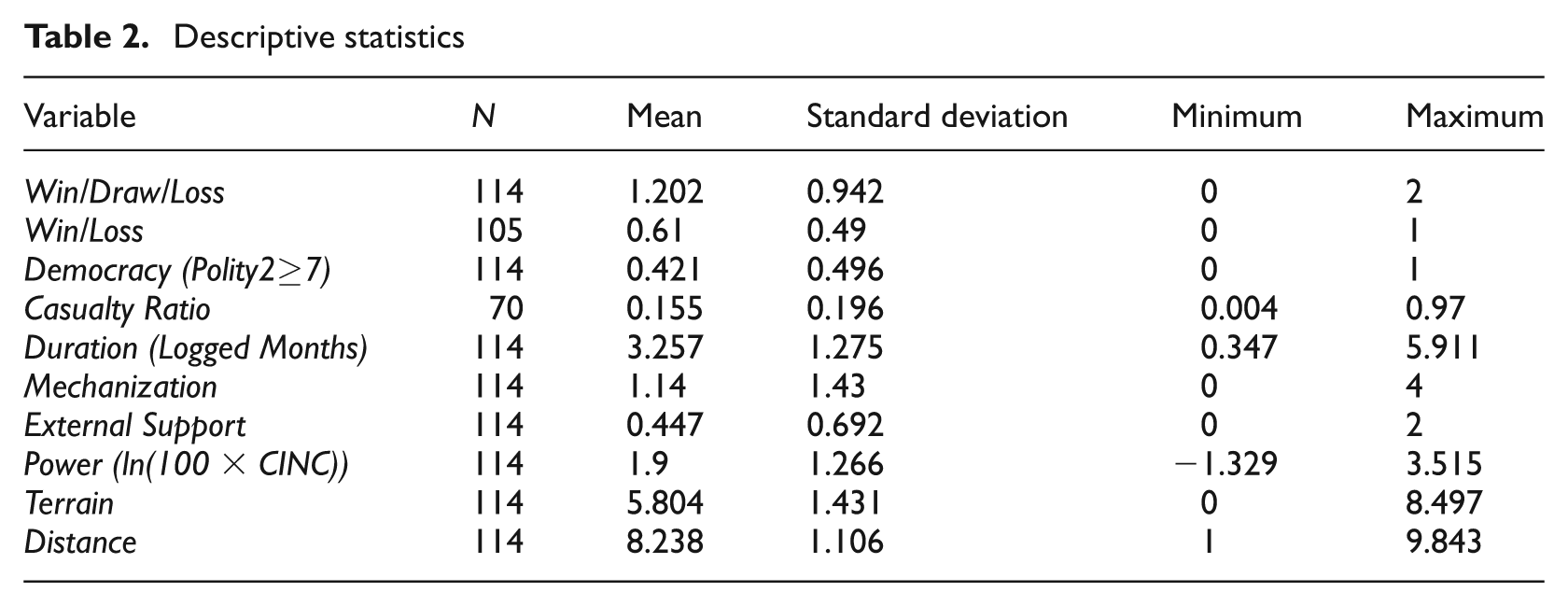
Finally, I discussed earlier the added costs of shipping soldiers and equipment long distances. One can imagine that it is much easier from a logistical standpoint to fight a counterinsurgency next door than on the other side of the world (Bueno de Mesquita, 1981). Therefore, to account for the possibility that occupier success declines with distance, I include a measure of the logged kilometer distance between the occupier’s capital city and the occupied territory (Lyall and Wilson, 2009). Table 2 contains the descriptive statistics for these variables, which will be tested using logistic regression.
Descriptive statistics
Results
Table 3 reports the statistical results of the models that test these hypotheses. Models 1 and 2 display the regression results for the win/draw/loss and win/loss models without the interactions of democracy with casualty ratio and duration, while models 3 and 4 show the results with those interactions. We see in the first two models that, while increasing casualty ratios lead to a decreased likelihood of victory, regime type has no significant independent effect on the outcomes of these wars, nor does duration of the conflict.
Regime type and the outcomes of counterinsurgency wars abroad
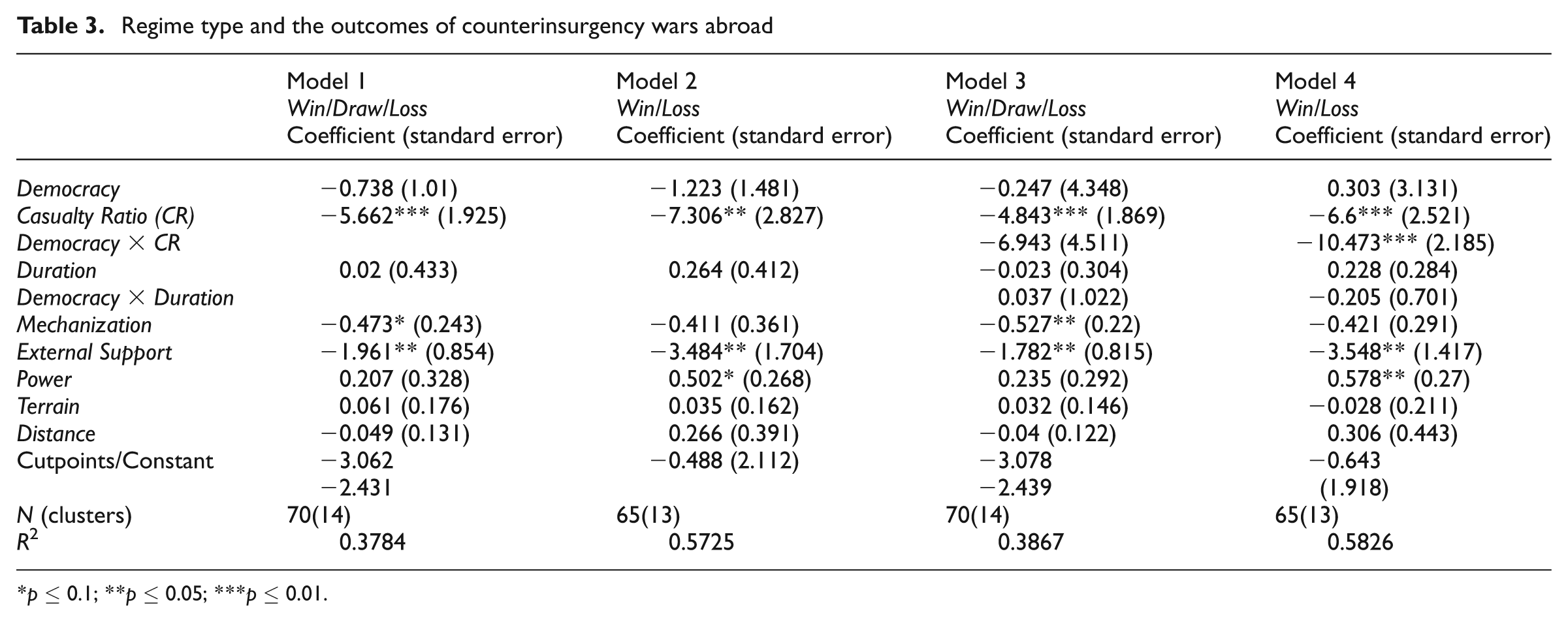
p ≤ 0.1; **p ≤ 0.05; ***p ≤ 0.01.
However, interpreting coefficients of interaction terms in logit models is somewhat difficult, and so Figures 1 and 2 provide a graphical interpretation of the results of hypothesis 1 found in models 3 and 4. They depict the predicted probabilities of winning for the different regime types as their casualty ratios increase, with 0.95 confidence and holding all other variables constant at their means.
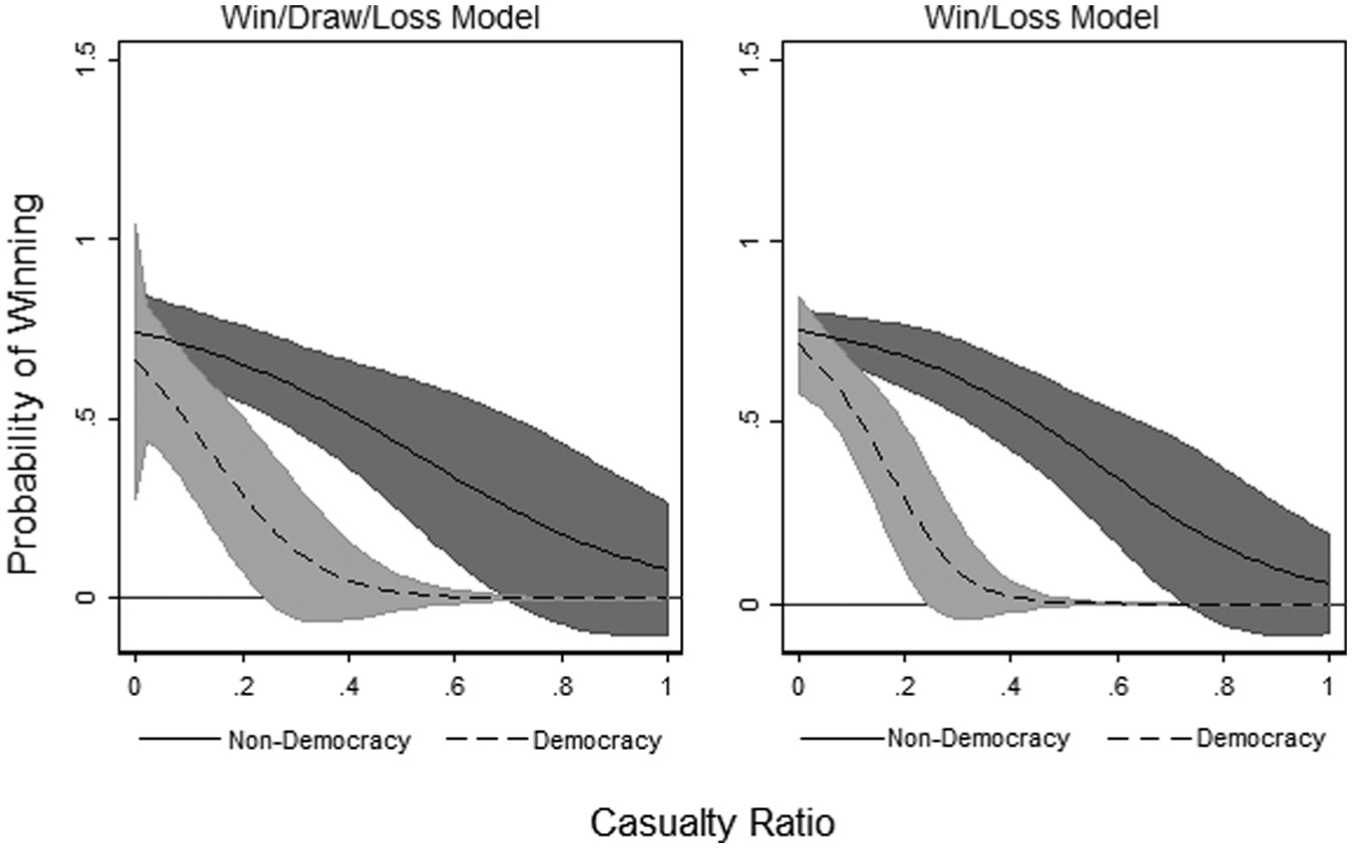
Predicted probability of winning as casualty ratio increases. Democracy (Polity2 ≥ 7).
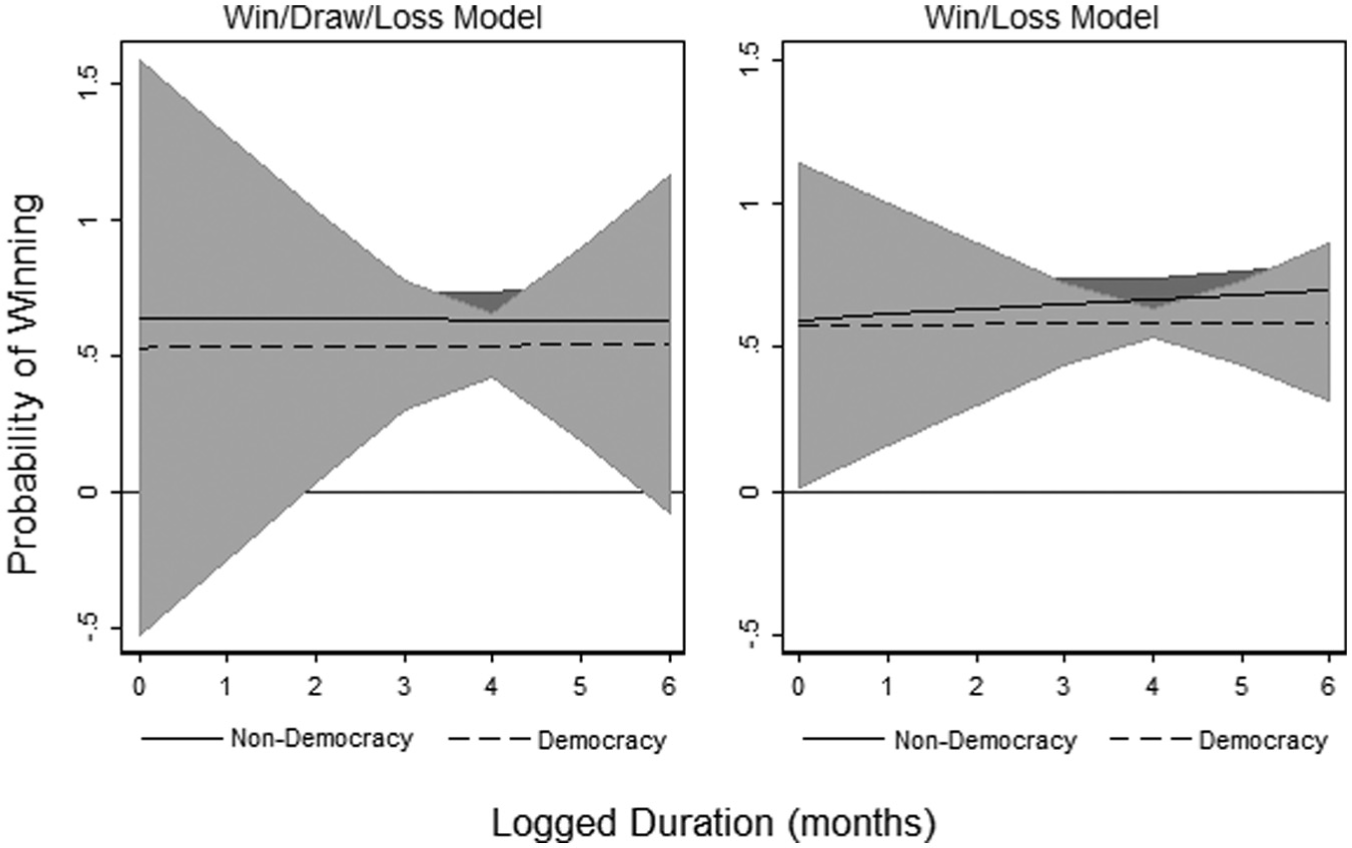
Predicted probability of winning as duration increases. Democracy (Polity2 ≥ 7).
In both graphs, we can clearly see that democratic states become much more likely to withdraw at lower casualty thresholds relative to their autocratic counterparts, meaning that hypothesis 1 is supported. It is worth noting here that, while the coefficient on the interaction term in model 3 is insignificant, this is due to the fact that a large portion of the casualty ratios, approximately 50% of them, are less than 7%. At this low threshold, we cannot say with a great deal of confidence that regime types act all that differently. However, as casualty ratios begin to increase, we can see that separation between regime types becomes much more clear. The left panel (model 3) suggests that democracies are statistically differentiated from nondemocracies once the casualty ratio approaches just under 20%. Also, their chances of winning fall below 50% once the casualty ratio reaches between 5% and 20%. Nondemocracies, in contrast, do not fall below a 50% probability of winning until their casualty ratio reaches between 25% and 75%.
In the right panel, the win/loss model (model 4), a similar pattern emerges. Democratic counterinsurgents become statistically more likely than autocratic forces to withdraw with a casualty ratio of around 15% and their chances of winning fall below 50% when they incur a casualty ratio between 10% and 25%. As was the case in the full win/draw/loss model, autocracies show much less sensitivity to casualties, as they do not fall below a 50% chance of winning until suffering somewhere between 30% and 65% casualties.
In contrast, Figure 2, which relates to hypothesis 2 as tested in models 3 and 4, illustrates the predicted probabilities of winning for democracies and autocracies as conflict duration increases, again with 0.95 confidence and holding all other variables constant at their means. In both panels, we are unable to discern any meaningful difference between democratic and autocratic occupiers in terms of their likelihood of victory as duration increases. From these two graphs, we can conclude that the effect of regime type is unlikely to be conditional on the duration of the counterinsurgency war, meaning that we can reject hypothesis 2. 7
To return to Table 3, we can also assess the significance of the remaining variables discussed above. In both interaction models, and as was the case in the noninteraction models, we see that, independent of casualties, regime type possesses no statistically significant effect on the outcomes of these wars, a finding consistent with Lyall’s (2010) results. Conversely, casualty ratios play a significant stand-alone role in determining outcomes. As the ratio increases, a state becomes less likely to win, regardless of regime type. Finally, the only significant control variable that finds statistical support in all four models is external support; as it increases, so too does the likelihood of defeat. Increasing levels of mechanization also lead to an increase in the likelihood of defeat, although this finding only achieves statistical significance in the full win/draw/loss models.
Robustness checks
In addition to these tests using both the trichotomous win/draw/loss and dichotomous win/loss outcome variables, I also conduct a series of robustness checks. The results are presented in the Online Appendix to this paper and only briefly summarized here. I first run the model with a number of alternative measures of regime type. The first, W, captures the size of the occupying state’s winning coalition and is a five-point scale taken from Bueno de Mesquita et al. (2003). 8 The second alternative operationalization, audience cost capacity (ACC), is a four-point scale taken from Uzonyi et al. (2012) and captures two key components of Polity’s democracy measure, the availability of challengers to the leader and the cost of mobilizing against him. I also use two alternative measures of democracy used by Lyall (2010) in his earlier analysis. I include the full continuous 21-point Polity2 scale (Polity2), which captures relative levels of democracy. Lyall also includes Geddes’s (2003; Weeks, 2008) regime typology, and codes this alternative measure of democracy (alternative demo) as a binary variable that generates 49 observations being assigned a 1, while those coded as nondemocratic receive a 0. Second, I include a number of additional controls, including those for new states, the occupying state’s population, as well as conflicts occurring during the Second World War and the Cold War. The findings of all of these models, except for the Geddes alternative coding of democracies, are consistent with results presented in Table 3 and Figures 1 and 2. Finally, to demonstrate that these findings are not due strictly to the changes in coding from the original Lyall and Wilson (2009) dataset, I also test these models using their original coding scheme, which results in a slightly different universe of cases. The results remain consistent and are contained in the Online Appendix.
Potential concerns
While the results clearly demonstrate that democracies behave differently in these conflicts than autocracies, three issues may be cause for concern. First, one might be concerned that the missing casualty ratio data is not missing at random but in some sort of systematic fashion, leading to biased estimates. Forty-four of the 114 conflicts in the dataset are lacking either the number of casualties or force size, or both. One can imagine that certain regime types or occupiers would be less willing or able to either report or disclose these data. In particular, record-keeping in older conflicts may not be as complete as it is in modern war, and closed autocracies may be disinclined to release these statistics, particularly if they find themselves on the losing side.
An analysis of the data, however, suggests that such systematic biases are unlikely to be present in this case. Of the 44 cases where at least one of the two elements of the casualty ratio is missing (casualties or force size), 22 are conflicts that took place prior to the First World War, while 22 occurred after its onset, suggesting that the period in which a conflict took place has little bearing on whether or not data for it are available. Conflicts conducted by autocratic states account for 25 of these cases, which at first glance, might suggest the possibility of bias. However, eight of these took place during the Second World War, and we can imagine that determining whether these occupying troops were present and dying in fighting the insurgencies rather than through the course of the larger conflict is difficult, if not impossible. Further, these occupiers—Germany, Italy and Japan—lost these occupations owing to a factor exogenous to the occupations themselves: they lost the Second World War. 9 Absent these eight cases, we have 17 cases of missing data coming from autocratic occupations and 19 coming from those conducted by democracies. This suggests that such a bias is unlikely to be present.
Also, one might be concerned that the suffering of casualties does not cause losing but that it is the definition of losing. This may be true when we think of warfare more generally, but in the case of counterinsurgency, and occupation more specifically, this is unlikely to be the case. Recall that, according to the definition offered above, occupations are efforts to combat insurgencies, which involve guerrilla warfare and indirect tactics, as defined by Lyall (2010: 175). Further, it is also important to remember that the occupier’s decision to withdraw, while coded as a loss, is not necessarily a signal of its inability to continue to fight, hold territory and perhaps even inflict further damage to the insurgency. As suggested above, these insurgencies do not need to win battles, only maintain the capacity to extract costs. This may mean that they “lose” every direct engagement, but the casualties they inflict, while perhaps limited in comparison to their own, may still be enough to influence the occupier’s decision to withdraw. Accordingly, Table 2 notes that the mean casualty ratio for these conflicts is 0.155, and this fairly low threshold suggests that a state’s decision to withdraw from an occupation is not predicated on its (in)ability to keep fighting. 10
The final concern is one of selection—that democracies select into different types of wars than autocracies and that this is what drives the observed results. Specifically, they might select into wars that will not require significant casualties (see Valentino et al., 2010). Indeed, we can imagine that policy-makers are acutely aware that domestic populations have the potential to grow weary of the fight should casualties get too high. While it is undoubtedly the case that democracies engage in these conflicts with the assumption that casualties will be kept to a minimum, accompanying that expectation, however, is the belief that the campaign will also end in victory. However, the findings show that, while the occupations in which they engage do not result in high casualties, it is not because they always win them. Rather, it is because they will frequently depart, or lose, before those casualties can mount to extreme levels or even those experienced by nondemocracies. Thus, while many democratic leaders may believe that they are selecting into different types of occupations (i.e. those that are clearly winnable at minimal cost), the findings suggest that a number of them are actually selecting into occupations that would require far greater casualties than their publics are willing to tolerate, which would lessen our concerns about this particular selection effect.
Conclusion
This paper provides the first cross-national, quantitative evidence of democracies’ increased sensitivity to casualties in counterinsurgency campaigns. Seeking electoral advantage, opposing elites capitalize on the media’s coverage of the growing death toll and argue that the war is unnecessary for state security and not in the national interest. In turn, the electorate demands that their leaders change course to end these conflicts or they will elect leaders who will. Knowing this, insurgents do not need to win militarily, only demonstrate their ongoing ability to extract these costs from the occupying democratic state.
The results shown in this paper do not necessarily indicate when those elites will make the decision to break ranks and engage in public opposition; rather, they suggest the thresholds where that opposition leads to a change in war policy and the decision to withdraw from the territory, which constitutes a loss in the conflict. 11 Specifically, the data suggest that democracies become more likely to withdraw than their autocratic counterparts when they reach a casualty ratio between 15% and 20%, and their chance of victory falls below 50% at casualty ratios beginning between 5% and 25%, depending on the model specification. This contrasts with autocrats, who do not fall below this threshold until achieving a ratio of between 25% and 75%.
Contrary to existing findings in interstate war (Bennett and Stam, 1998), it does not appear that democracies are sensitive to time in these conflicts. In light of the results with respect to casualties, this result makes sense. Casualties may accrue at a very slow rate, which may decrease the salience of the conflict among the public. If the public stops paying close attention because few people are dying, one might think it may lead leaders to withdraw from it, as there is little to gain from continuing it. However, as is suggested by the data, it appears that the opposite it is true. Leaders respond to this lack of attention by continuing the war because there is fairly little to lose. If we look at the cases of Iraq and Afghanistan, we can perhaps see this logic at work. Numbers of American casualties in Afghanistan are less than half those in Iraq. This might explain why public opposition to ongoing involvement in Iraq led to American withdrawal after 8 years, while operations in Afghanistan have continued for over 13 years.
These findings suggest a number of avenues for future research. The focus in this paper has been on the sensitivity of regimes to one particular type of cost. However, states, particularly nondemocracies, may be vulnerable to other forms of cost, namely financial. Nondemocratic leaders frequently must satisfy a coalition of other elites to remain in office (Bueno de Mesquita et al., 1999, 2003; Geddes, 1999, 2003; Haber, 2006), and conducting such wars can exhaust a state’s financial resources and divert them from the priorities of members of that coalition. This, in turn, may result in a challenge to the leadership, which, if successful, would bring about a withdrawal. Future work will want to assess this possibility.
Also, the results of this paper suggest that democratic leaders should be aware of their publics’ sensitivity to casualties when considering such campaigns. Yet they still select into these wars where the margins in terms of the public’s willingness to accept casualties are rather slim, and may frequently dismiss the possibility that casualties may be significant. Future research will want to tease out why leaders appear to discount the possibility of high casualty levels in the beginning of these conflicts only to take them seriously later on and subsequently change course.
Finally, the argument made here prioritizes structural determinants of outcomes rather than events on the ground and the “how” of fighting. However, scholars and practitioners are also engaged in a vigorous debate over the merits of population-centric “hearts and minds” warfare vis-à-vis those of brute force and conventional power. 12 Using fine-grained data from Afghanistan and Iraq, scholars have sought to identify what strategies and operations “work” in reducing insurgent violence (Berman et al., 2011a, b, 2013), but they have yet to connect those efforts to final outcomes. If it is true that democracies enhance their prospects for winning simply by reducing casualties, ongoing scholarship and theory may want to focus on identifying which strategies yielding a reduction in casualties in a particular location over a particular period of time are sustainable over the long term.
However, both categories of counterinsurgency strategy—brute force and “hearts and minds”—will be likely to require that an occupying force incur casualties. Those deaths may engender sufficient opposition within the domestic population back home that leaders will be forced to withdraw before that stability can be achieved. Therefore, democratic leaders may want to reconsider the aims of these campaigns abroad. If casualties are required to achieve the policy goal of the leader, the evidence suggests that the goal may be unattainable before the public demands the occupation come to an end. Instead, policy-makers should perhaps focus on achieving policy goals that may take time but do not require casualties. For example, independent of their normative implications, drone strikes along the Afghanistan–Pakistan border allow the USA to carry out one of its primary goals stemming from the original mission into Afghanistan, which was to disrupt the ability of terrorist groups to organize and plan attacks. The drone program does not allow for the USA to have as much of a say in the politics of the Afghan state, but, as the findings of this paper imply, the people of the USA may believe that those dynamics, and others like them in other parts of the world, have little to do with their own security and survival.
Footnotes
Acknowledgements
I would like to thank James Morrow, Allan Stam, Philip Potter, Christian Davenport, Robert Franzese, Gary Uzonyi, Trevor Johnston, Srinivas Parinandi, Alton Worthington, Lisa Langdon Koch, Molly Reynolds, Timothy Ryan, Vincent Arel-Bundock, Isaac Jenkins and participants in Michigan’s Peace and Conflict Workshop for their feedback on earlier versions of this paper. I would also like to thank the three anonymous reviewers and the editor for their comments and suggestions. All errors and omissions remain my own. Replication files and supplementary materials can be found online at  .
.
Funding
This research received no specific grant from any funding agency in the public, commercial or not-for-profit sectors.