



Abstract
Scholars have long recognized that imminent shifts in relative power may motivate declining states to initiate conflict. But what conditions exacerbate the risk posed by these anticipated power shifts? Building upon existing bargaining models of war, I show that larger initial power asymmetries increase the probability of preventive conflict. Theoretical extensions that account for certainty effects and variable costs of war, both of which are linked to initial dyadic power balances, drive this relationship. It follows that looming power transitions in which rising states approach and surpass parity, long considered war-prone scenarios, are not particularly problematic. Instead, the risk of conflict is greatest when preponderant powers confront conventionally weak but rising states. I test the theoretical predictions in the context of anticipated power shifts due to rivals pursuing nuclear weapons. Extensive empirical tests that relax assumptions employed in prior analyses of preventive conflict offer strong support for this contention. These results shed light on the underpinnings of many pressing contemporary interstate security issues.
I do think there’s no doubt about the outcome. There’s no question about who is going to prevail if there is military action. And there’s no question but what it is [sic] going to be cheaper and less costly to do it now than it will be to wait a year or two years or three years until he’s developed even more deadly weapons, perhaps nuclear weapons. And the consequences then of having to deal with him would be far more costly than will be the circumstances today. Delay does not help.
By emphasizing the problem posed by a future shift in relative capabilities, Cheney’s justification for the Iraq War highlights a commonly theorized cause of interstate conflict. The bargaining theory of war identifies power shifts and the resulting commitment problems as one of the primary rationalist paths toward war (Fearon, 1995; Powell, 2006). The logic is as follows: a rising state cannot credibly commit to a future distribution of a contested resource because its expanded capabilities will enable it to demand a division revised in its favor in later negotiations. The declining state initiates a preventive war before its bargaining leverage is diminished. Scholars of history and international relations have contributed to a voluminous literature exploring the preventive war motivation and its critical role promoting conflict stretching from the Peloponnesian War to the 2003 invasion of Iraq (Thucydides, 1935; Taylor, 1954; Levy, 1987; Trachtenberg, 2007; Lake, 2010; Debs and Monteiro, 2014).
This paper asks what conditions exacerbate the risk of power shifts causing preventive conflict, with an empirical focus on anticipated power shifts due to nuclear proliferation. Cheney’s justification offers a possible answer as he notes the highly asymmetric nature of the opposing sides’ forces and the consequent certainty of US victory. Building upon existing bargaining models of war, I hypothesize that the starker the initial power disparities, the greater the probability of commitment problems emerging and preventive conflict ensuing. 2
Prior work on commitment problems examines the size and speed of power shifts and whether states induce power shifts by expanding their arsenals as pivotal factors underpinning bargaining failures (for example, Powell, 1999; Bas and Coe, 2012). However, the literature generally neglects or argues against the existence of a relationship between initial power balances and the magnitude of shifts in relative power needed to induce conflict. 3
In contrast to past work, I introduce two extensions to a canonical bargaining model that show that initial power asymmetries have important implications for preventive conflict. A first addition introduces certainty effects to the decision process (Allais, 1953; Tversky and Kahneman, 1979; Andreoni and Spenger, 2012). With a preference for certainty, leaders of states with large power advantages and high certainty of victory in preventive conflict are particularly sensitive to adverse shifts that would introduce greater uncertainty over a conflict’s outcome. Consequently, for an anticipated power shift of a given size, the probability of preventive conflict is higher in these asymmetric dyads than in dyads near parity. The second addition incorporates variable costs of war under the assumption that fighting a weak adversary is less costly than fighting a strong one. Adverse power shifts increase a declining state’s future costs of war, making subsequent bargaining interactions less attractive. As I expand upon later, because these marginal cost increases are greatest for preponderant powers in decline, preventive war is most attractive in these asymmetric dyads. A model with these extensions reveals there is nothing particularly dangerous about balanced dyads with looming power transitions in which a rising state’s capabilities will surpass those of a declining state. In fact, the opposite is true. Growth in a weaker state’s capabilities is more likely to induce intractable commitment problems in highly unbalanced dyads.
Empirical tests show this hypothesis is not merely a modeling curiosity. Unlike much of the recent theoretical work on commitment problems, I conduct extensive quantitative tests that evaluate the effect of relative power endowments on the probability of preventive conflict and find strong support for the overall contention.
Multiple pathways can generate anticipated power shifts. A state’s rise could be due to rapid economic growth, a population boom, large military mobilization programs, resource discoveries, or technological breakthroughs. Unfortunately, quantitative tests of preventive motives are problematic because future power shifts are often difficult to systematically identify ex ante. To overcome this difficulty, I analyze instances where a state confronted a rival with a nuclear weapons program. A technological breakthrough of this magnitude presents a scenario with the stark possibility of a change in relative capabilities. As compared to alternative sources of power shifts, nuclear weapons programs are especially likely to induce preventive reasoning by rivals and are comparatively clear for researchers to identify ex ante. The empirical tests and robustness checks support the model’s predictions in the specific context of nuclear proliferation programs.
In addition to furthering our understanding of commitment problems, the findings contribute to work identifying rational factors promoting asymmetric conflict (Sechser, 2010; Allen and Fordham, 2011). Elevated risks of commitment problems in asymmetric dyads offer one explanation as to why states fight when the outcome is nearly a foregone conclusion. Consider the Iraq War. A number of valuable studies highlight domestic factors that contributed to the invasion (Monten, 2005; Shannon and Keller, 2007; Cramer, 2007). I do not dispute the presence or importance of such factors but wish to add another, systematic explanation. According to my hypothesis, US military preeminence ensures many of its dyadic relations are asymmetric and thus prone to commitment problems wherein a weak state expected to gain power cannot make sufficient concessions to offset US concerns about the future. This theoretical contention sheds light on why US concerns about adverse power shifts animate many of the most pressing security debates.
The rest of the paper is organized as follows. The next section surveys the theoretical and empirical literature on preventive war and asymmetric conflict. In the following section, I extend a bargaining model to formulate a theory linking initial dyadic power balances to the likelihood of preventive conflict and stipulate empirical implications that follow from the model. I then describe the research design, present empirical results, and calculate the substantive effect of power asymmetries. The final section concludes.
Extant literature
This study contributes to two literatures of international conflict. The first concerns power shifts, commitment problems, and preventive war. The majority of existing work concerns the size and rapidity of power shifts while largely ignoring the role of initial relative power endowments. The second addresses causes of asymmetric war. Why does conflict occur when there is little doubt about its outcome? I review existing explanations, none of which link asymmetric conflict to elevated risks of preventive war as I propose.
Studies of preventive war
A sizable shift in relative power is arguably the most often invoked cause of war. Taylor (1954: 166) claims, “Every war between Great Powers [in the 1848–1914 period] started as a preventive war, not a war of conquest.” 4 It is thus unsurprising that a vast literature on international conflict addresses the role of looming changes in power distributions in promoting conflict. The bargaining theory of war demonstrates that even with complete information, rational states can fail to achieve an accord if there is an impending shift in relative power (Fearon, 1995; Powell, 1999, 2006). 5 Recent contributions further this research agenda by making power shifts endogenous. Considerations include shifts generally (Chadefaux, 2011), probabilistic diffusion of new technologies such as nuclear weapons (Bas and Coe, 2012), fighting itself as a means to forestall power changes (Powell, 2012), or imperfect observability of nuclear proliferation (Debs and Monteiro, 2014).
In contrast to the substantial literature addressing the magnitude and timing of power shifts, little work considers what other factors may influence the likelihood of intractable commitment problems occurring. A few exceptions suggest preventive war is more likely when the offense–defense balance favors offense (Van Evera, 1999), the declining state is non-democratic (Schweller, 1992), or when the future is highly valued relative to the present (Tingley, 2011).
I argue another factor matters; preventive war is more likely when initial power asymmetries are greater. Consequences of the pre-shift power balance have received fleeting attention. Gilpin (1981) argues that radical revision to the status quo is most probable when transitions occur—that is, when a hegemon is overtaken. Rather than delaying conflict until equality is achieved, the declining state opts to eliminate the rising challenger while it maintains a military advantage. Levy (1987) suggests that the preventive motive can arise without the prospect of a power transition, noting that the size and speed of change are critical, not transition itself. However, this conjecture stipulates that if the declining state’s initial advantage is enormous, war is unlikely unless there is a stark and discontinuous shift in the dyadic balance of power, such as a rising state’s procurement of weapons of mass destruction. 6 In the bargaining theory of war, the symmetry of initial capability endowments and the possibility of a power transition are immaterial to commitment problems emerging. Debs and Monteiro (2014) are partial exceptions, positing that preventive war is more likely the larger the net effect of a shift in power on the relative balance of capabilities and the smaller the costs of preventive war. Both of these conditions, though not directly modeled in Debs and Monteiro (2014), are associated with asymmetric dyads. I reach a complementary conclusion while elaborating upon the cost argument and developing an alternative underpinning for the relationship between asymmetry and preventive war.
A litany of quantitative tests have generated little consensus regarding the effect of power shifts on conflict onset (Organski and Kugler, 1980; Kim and Morrow, 1992; Bennett and Stam, 2004). Furthermore, studies often operationalize power shifts in a retrospective manner that provides a test of power transition theories but not of preventive reasoning. That is, the quantity identified reflects whether past shifts, not anticipated shifts, induce conflict. The logic of conflict in this formulation is one of revision, not prevention. The dearth of quantitative testing of preventive war stems from the difficulties of operationalizing when a shift is approaching. Lemke (2003) and Weisiger (2013) provide rigorous expositions of these empirical hurdles and suggest a measure of past shifts can proxy for the presence of a preventive motivation. This proposition requires the assumption that states extrapolate past changes in relative capabilities into the future. Empirical specifications in this paper do not rely on this assumption, which I address in later sections.
Studies of asymmetric war
This study also speaks to the literature on asymmetric war which is perhaps most associated with deterrence failures. Facing challenges by more powerful rivals, weak states cannot credibly threaten to impose heavy costs in the case of attack. As a result, stronger actors pursue territorial aggrandizement or other self-enriching actions at the expense of weaker states by first making demands and then using force if the target does not capitulate. 7 While theories of deterrence provide a compelling account of why stronger states make onerous demands of weaker states, it is unclear why the latter do not simply concede. That is, why does bargaining break down into conflict? In bargaining accounts of war, the power balance of a dyad is immaterial to the likelihood of bargaining failures. It is not the distribution of power that matters, but how this distribution relates to the distribution of benefits—for example, territory or wealth (Powell, 1999). Novel theories make strides toward explaining how asymmetries may generate conflict. For instance, a powerful state’s inability to signal that it will not threaten a weaker state again in the future, coupled with the weaker state’s reputational concerns, may lead to asymmetric war (Sechser, 2010). Alternatively, a powerful state’s threats may lack credibility or its demands might be too onerous for the weaker state to meet, both of which lead the overmatched state to resist (Allen and Fordham, 2011). This paper contributes another explanation; asymmetric conflict can occur because strong states with large power advantages have a low threshold for initiating preventive conflict.
A bargaining model of asymmetry and prevention
This section describes a bargaining model of war and the equilibrium conditions producing preventive conflict. With extensions of the model, I demonstrate the effect of variation in the initial dyadic distribution of capabilities on the conditions requisite to making preventive war rational. These additions to the model yield the important and previously unconsidered comparative static that the probability of preventive war is increasing in initial dyadic power asymmetry.
Model structure
Consider a bargaining model entailing a two-player infinitely repeated game with complete information and a take-it-or-leave-it bargaining protocol (Fearon, 1995). Players A and B contest the division of a resource standardized such that R = 1, where A’s ideal outcome is 1 while B’s is 0. Play commences with A proposing a split of the resource whereby it retains x1A and B receives 1 − x1A. B decides whether to accept this proposal, in which case each player receives payoffs in accordance with A’s proposal, or rejects the offer. If B rejects, a costly lottery (war) ensues with the winner retaining the entirety of the contested resource and each side bearing the costs of war, respectively cA and cB. A’s probability of victory is given by p1, which is a function of the relative capabilities held by each state and is common knowledge. The winner of the resource receives a payoff of 1 in all subsequent rounds (discounted by δ), the loser earns nothing, and bargaining terminates. In contrast, if the proposal is accepted the game is repeated with the key difference that relative power, reflected by p, is dynamic between the first and second round of negotiation—that is, p1≠p2—and fixed thereafter. This shift, which favors A by assumption, arises exogenously and is also common knowledge (Fearon, 1995; Powell, 2006). That is, A is rising and B is declining. As before, A makes a proposal to retain x2A of the resource in period two, which B can accept or reject with identical repercussions to those of period one. Play continues in this fashion. I opt for the simplest bargaining protocol for expositional clarity. In the Supporting Information, I consider an alternative framework in which the game tree allows each state, not only the declining state, to initiate conflict. My central theoretical propositions also hold for this bargaining protocol, albeit in a more limited portion of the parameter space.
I propose two extensions to the above framework linking initial capability endowments to bargaining outcomes. Each is a distinct and separate addition relating the dyadic power balance to preventive war onset. Either extension is sufficient to generate the hypothesized relationship.
The first concerns preferences for certainty. Clausewitz suggested that “war is the province of chance,” 8 an intuition the model incorporates with probabilistic outcomes for war. This is the sole source of uncertainty in the complete information bargaining framework. 9 The magnitude of this uncertainty will fluctuate depending on either side’s probability of victory. Consider the extreme cases. Leaders of a state with a probability of victory equal to 1 have no uncertainty over conflict’s outcome while state leaders with 50–50 chances have great uncertainty. With lottery outcome values fixed for victory and defeat, expected utility theory’s independence axiom stipulates a state’s utility function is linear in the probabilities (Von Neumann and Morgenstern, 1948). Substantively, this implies the lottery’s uncertainty itself has no effect on utility except through affecting the likelihood of realizing the two potential outcomes.
Many empirical findings refute the independence assumption. The Allais Paradox is a famous example (Allais, 1953). According to the paradox, altering the prospects of a choice problem in an identical fashion reveals that individuals find it more desirable when the alteration shifts a prospect from a probable gain to a certain one, than when the alteration shifts a prospect from a probable gain to an even more probable gain. The finding contradicts expected utility theory which predicts neither change should be more desirable than the other. Subsequent studies similarly find that individuals overweight prospects that are certain versus those that are probable (for example, Tversky and Kahneman, 1979; Andreoni and Spenger, 2012), which Tversky and Kahneman (1979) dubbed the certainty effect.
Importantly, the finding is not restricted to choices with complete—that is, 100%—certainty. Wu and Gonzalez (1996) show similar effects when choices approach, but do not reach, certainty. That is, the preference for greater certainty holds even when shifting a prospect such that the more certain prospect still entails risk that the adverse outcome occurs. Put differently, the Allais result indicates individuals find it more desirable to shift the probability of receiving nothing (the adverse outcome) from, say, 66% to 0% versus from 67% to 1%. Wu and Gonzalez (1996) indicate this result is not unique to eliminating all risk of the adverse outcome. Reducing the probability of the adverse outcome from 63% to 3% is more desirable than reducing it from 65% to 5%.
In the context of conflict, if state leaders have a preference for certainty, less favorable bargaining outcomes will suffice to avoid war and its attendant uncertainty. Granting the possibility that decisions by state leaders exhibit such non-linearity in the probabilities, I incorporate a preference for certainty into the bargaining framework. Existing choice models introduce non-linearity in the probabilities by incorporating decision weights on the probabilities themselves (Tversky and Kahneman, 1979, 1992; Wu and Gonzalez, 1996). 10
To highlight the extension to the base model, I directly parameterize uncertainty premiums rather than use decision weights. To begin, consider a proxy for uncertainty. War is modeled as a binary event, or Bernoulli trial, with probability p that A wins. The variance of a Bernoulli trial, given by p(1 − p), measures the magnitude of uncertainty about war’s outcome and is a function of a dyad’s power parity or asymmetry. This variance dictates the size of the uncertainty premium. Accordingly, I introduce an uncertainty premium parameter r(p t ), which is a strictly concave function of p t such that r(p t ) = p t (1 − pt) and amounts to an additional cost parameter in the lottery. This captures certainty effects by imposing a small cost when war’s outcome is relatively certain and a larger cost as war’s outcome becomes increasingly ambiguous with the sharpest marginal changes occurring when victory is nearly certain. Incorporating decision weights into the utility function as opposed to using an uncertainty premium parameter yields similar results. 11
A second, and simpler, addition concerns each side’s costs of war which are typically modeled as fixed and exogenous. However, we might expect that a state’s costs are, at least in part, a function of the dyad’s relative capability endowments. Specifically, a declining state with a large initial power advantage would anticipate lower costs of war, cB, than a declining state facing a roughly equal foe. We can conceive of war costs (or the utility loss of conflict) as a function of both a state’s resolve and dyadic material conditions. The latter factor is of importance here. Following prior work, I anticipate a state’s war costs are inversely related to the favorability of the dyadic balance of power (Powell, 1999: 161). Intuitively, we expect a war against China today to be more costly for the US than one against Iraq in 2003. Formally, let c B (c A ) be a function of pt that is monotonically increasing (decreasing) and weakly concave, with t indicating the bargaining round. The weakly concave functional form captures a state’s diminishing sensitivity to the marginal losses associated with fighting stronger opponents. For concreteness, this implies the marginal cost (utility loss) resulting from the 18 US fatalities in the Battle of Mogadishu was greater than the marginal cost of the final 18 US fatalities suffered at the Battle of the Bulge. The concavity assumption recognizes that costs may approach a maximum at which point a state being even more overpowered than it already is will have negligible effects on that state’s war costs. 12
Note that the costs of war within the bargaining model reflect a state’s utility loss relative to the resource’s value. If the stakes of war are trivial, costs in the model will be relatively substantial even if the absolute material losses associated with war are small (Fearon, 1995: 387). For the theory and subsequent empirical tests, I am primarily interested in dyads with meaningful stakes such that war costs are not prohibitively high so as to preclude the possibility of conflict. The notion of dyadic rivalry—dyads in which states compete over meaningful stakes and view the use of force as a viable option—offers a fruitful conception of the cases of greatest interest.
Analysis
This section proceeds by first identifying when preventive war occurs in the unaltered model, then considers how uncertainty premiums and variable costs change the preventive constraint. When is initiating a preventive war rational? Within the standard framework there exists a series of parameter values for which B rationally rejects the round one offer and opts for preventive war. A discussion of the game’s equilibria is provided in the Appendix. Here I focus on the conditions under which an intractable commitment problem exists because the central concern of this paper is not the exact size of offers a rising state must make to avoid war, but whether any such offer exists at all. To begin, evaluate when no possible round one proposal satisfies B. That is, even if B gets the entire resource (x1A = 0), it still prefers the costly lottery of war over acceptance. Formally, B opts for preventive war if

where δ is the common discount factor, the left-hand side gives the expected war payoff, and the right-hand side the bargaining payoff. The above inequality reduces to the preventive war constraint

Preventive war is preferred when this inequality holds.
In previous studies, the comparative static of interest is that as the quantity δp2 − p1 increases, preventive war becomes more likely. 13 This is self-evident from Equation 2. In this framework, variation in the initial power asymmetry represented by p1 is not theoretically linked to the size of the shift in power necessary for the constraint to hold.
Certainty effects
Consider how introducing certainty effects impacts the relationship between initial power asymmetries and the likelihood of preventive conflict. Uncertainty premiums amount to an additional cost of war arising from uncertainty over conflict’s outcome. As demonstrated in the Appendix, introducing the new parameter r(p t ) yields a preventive war constraint of

Calculating the comparative static for initial power balance reveals that the constraint becomes less binding as p1 increases. 14 Commitment problems are most likely when the state in relative decline initially enjoys a great preponderance of power. When asymmetry is greatest (p1 is small), a broad set of conditions can make preventive conflict rational.
US military preponderance and the Bush administration’s consequent certainty of a victory in Iraq in 2003 illustrate the underlying logic. Though there are multiple potential causes for the Iraq War, numerous accounts argue that a perceived power shift in favor of Iraq was central to US reasoning. 15 Unsaddled by doubts over the conflict’s outcome, US leaders opted for preventive war rather than tolerate an adverse power shift resulting from purported Iraqi weapons programs that would make future military interactions less certain. The intuition is that the utility loss from greater uncertainty is most pronounced when losing a position of high certainty of victory. Consequently, state leaders with relatively high initial certainty of victory are less willing to tolerate unfavorable power shifts.
Variable war costs
Variable costs of war cause the range of conditions necessary to preclude peaceful outcomes to vary across levels of the initial power disparity. This result is straightforward and begins by substituting the weakly concave function c B (p t ) for cB in the analysis. As shown in the Appendix, I solve for the new preventive war constraint and calculate comparative statics for initial power asymmetry. With variable costs, the preventive war constraint is

The war constraint is less likely to hold as p1 increases. Binding commitment problems are more likely in asymmetric dyads than in dyads near parity. The intuition is that adverse power shifts increase a declining state’s war costs in future interactions. Marginal increases in costs are greatest for preponderant powers in asymmetric dyads. These large cost increases make subsequent bargaining less attractive for declining states that enjoy initial power advantages, increasing the relative appeal of war. Incorporating variable war costs yields the same prediction as incorporating certainty effects. Note that the effect of increasing costs for the declining state is not offset by decreasing costs for the rising state because the latter’s costs are not part of the war constraint. Even if the rising state’s costs do factor into the constraint, as in the alternative model in the Supporting Information, this offset is not exact due to the non-linearity of the cost function.
For an extreme example of the effect of asymmetries and war costs on preventive conflict, consider the Eisenhower administration’s debates regarding a preventive strike against the nascent USSR nuclear arsenal. In 1953 the US enjoyed an asymmetric advantage following the implementation of NSC-68 and the subsequent boom in defense spending. As a result, officials still believed nuclear war was in some sense winnable given its acceptable expected costs. 16 The mere contemplation of a preventive strike, as exhibited by the recommendations of Project Solarium’s Task Force C, illustrates the effect of capability asymmetries on war costs and commitment problems. As the Soviet nuclear capability approached and surpassed parity in subsequent decades, the anticipated costs of war rose and a preventive strike against the USSR was no longer taken seriously. In sum, greater power asymmetries decrease the costs of war for the declining state which makes the preventive war constraint more likely to hold.
Hypothesis and discussion
The model’s core prediction is that power shifts within asymmetric dyads are more likely to generate preventive conflict than power shifts in dyads near parity. An additional implication is that the effect extends across the entire range of initial relative power balances. A declining state with an initial asymmetric advantage is more likely to initiate preventive conflict than a declining state near parity, and a declining state near parity is more likely to initiate preventive conflict than a declining state that is already overmatched. The proposed relationship holds after incorporating either certainty effects or variable war costs. While the presence of both mechanisms will yield a sharper relationship between asymmetry and preventive conflict, either mechanism alone is sufficient. The analysis generates the following hypothesis:
Among dyads with anticipated shifts in relative power, the greater a declining state’s initial share of dyadic capabilities, the more likely it is to initiate preventive conflict.
A weak state’s rise is most dangerous when facing a far stronger power in relative decline. Whereas past work suggests power shifts at the 50–50 divide are most dangerous (for example, Gilpin, 1981), these results demonstrate the opposite. Recall that diminished bargaining leverage after shifts, not elevated survival concerns, underpin, commitment problems. Losing a position of preeminence is not in itself problematic as bargains can still be achieved that adequately compensate the declining power in the initial period so as to mitigate the preventive war logic.
Under a given set of conditions, such as an anticipated power shift of a fixed magnitude, there is a higher probability of conflict in asymmetric dyads than in those near parity. However, this does not imply that commitment problems cannot arise when near parity and transitions are imminent, but rather that a more restrictive set of conditions must be met to eliminate the bargaining range when near parity. A massive shift in power is one such condition that can make preventive conflict rational in relatively balanced dyads. Japan’s 1904 assault before the imminent completion of a Russian railroad to the Far East might be one such occasion when an anticipated power shift in a dyad near parity produced preventive war. Russia’s call for a 40% increase in troop levels, which induced preventive logic in Wilhelmine Germany, offers another example (Fearon, 1995). My contention is not that looming power transitions cannot generate commitment problems, but that transformative shifts of the requisite scale are rare. Rapprochement between the US and the UK is one example of a power transition in which the rising state’s growth was sufficiently gradual so as to mitigate preventive war motives. In contrast, more modest changes in relative capabilities are sufficient cause for preventive conflict in asymmetric dyads.
The hypothesis implies that for anticipated power shifts of a given size, preventive conflict is more likely in asymmetric dyads than in those at parity. This interpretation holds the type of the power shift roughly constant, which is the approach I adopt in the empirical section by focusing on potential nuclear acquisition by a rival state. An alternative interpretation is to consider an interaction in which smaller shifts are sufficient to generate conflict in asymmetric dyads while larger shifts are needed for conflict in dyads at parity. Testing this interpretation requires variation in terms of initial power balances and the size of power shifts. I leave such tests to future research.
A few points merit clarification. Following most of the literature, I model power shifts in terms of changes in the overall probability of victory as opposed to modeling the underlying capabilities of the states. 17 An alternative framework could model p using a contest function which takes the state’s capabilities as inputs. For instance, a ratio form contest function models p as the rising state’s share of total dyadic capabilities. My approach is problematic if adding new capabilities to the rising state’s stockpile causes a larger absolute change in p when the states are near parity as opposed to asymmetry. To fix ideas, imagine war outcomes are determined by the number of tanks each side has and the rising state is expected to build one new tank. It would be problematic if the addition of a new tank produces a bigger shift in p at parity versus at asymmetry. There is not a strong theoretical argument either direction and it is easy to construct scenarios that refute the critique. At parity where each side has 10 tanks, adding a new tank to the rising state’s capabilities produces a small shift in its victory probability (a roughly 2% point shift in the probability of victory using the ratio form). The shift is much larger at asymmetry where the rising state initially has a single tank while the declining state has 10 tanks (a roughly 7% point shift in the probability of victory). 18 While it is possible to construct counter-examples, there is no strong theory pointing in either direction as shown formally in the Supporting Information. Disaggregating p into a contest function adds complexity rather than clarity in this particular model.
Another clarification addresses whether the theory’s larger costs at parity due to certainty effects and variable war costs imply that conflict is always less likely at parity, even when power is static. If so, the hypothesis would challenge the broad empirical finding that conflict is generally most probable when states are at parity. I consider instances where power is static and where it is shifting to illustrate why this is not a concern. With static power, larger costs do not affect the probability of conflict if there is complete information. In models with asymmetric information, the size of costs can matter. However, prior work argues that there is the most asymmetric information in dyads around parity (Reed, 2003). Greater information asymmetry can more than offset the larger costs in static balanced dyads. Now consider cases with shifting power. Shifting power takes two forms in unbalanced dyads. In the first form the declining state has 90% of capabilities and the probability of conflict is high according to the hypothesis. However, this is offset by the low probability of conflict in the second form where the declining state has 10% of capabilities. These two scenarios aggregated together can have a lower overall probability of conflict than dyads at parity where regardless of which side is declining, that state has 50% of capabilities. Hence this paper’s theory where conflict is most likely when declining states have asymmetric power advantages does not inherently clash with existing empirical results.
Finally, this relationship taken to the extreme raises the question: why are there not more wars between strong and weak states? Should the US attack Mauritius if the latter grows faster than the former? Two factors limit this concern about extremely asymmetric cases. First, as noted earlier, war costs in the bargaining model capture a state’s utility loss relative to the value of the stakes. If the stakes are trivial, costs will be sufficiently high to greatly reduce the possibility of preventive conflict. In cases with low stakes and high war costs, such as non-rivalrous dyads like the US and Mauritius, the theory’s implications are less applicable. Second, the discount rate ensures an infinitesimal power shift does not preclude negotiated settlements. Provided the present is worth more than the future, the costs of war serve as a deterrent to conflict. For expositional purposes I adopted a simple relationship tying the war outcome probability to costs. A more realistic framework might include these variable costs plus a fixed cost for even the most lopsided conflict. The hurdle for war is lower for asymmetric dyads, but it still exists.
Research design
The model developed in the prior section predicts that power shifts in asymmetric dyads are more likely to generate preventive conflict than power shifts in dyads near parity and that those shifts near parity are more likely to generate conflict than those where the declining state is already the weaker party. In this section I describe the empirical specification used to test the hypothesis. Identifying the relevant set of cases for this test poses a substantial challenge. Specifically, how can we measure whether there is an anticipated future shift in relative power? Past examinations of the preventive war motive operationalized shifting power in a retrospective fashion by identifying whether conflict followed changes in the dyadic distribution of capabilities. However, unlike power transition theory (Organski and Kugler, 1980), the logic of preventive war dictates that declining states initiate preventive war not because of shifts that have already occurred, but due to concerns about looming shifts. Pre-conflict shifts are only helpful for identifying instances prone to preventive reasoning under the assumption that these trends continue, or at least that the state in relative decline perceives they will continue. Declining states might make this inference, but simply assuming so is problematic because it will include cases where declining states anticipate the power shift is complete and exclude cases where a declining state foresees power shifts that have not yet begun. Relying on the extrapolation assumption may be unproblematic in some contexts, such as when adjudicating between competing causes of conflict (Weisiger, 2013). However, the assumption is inappropriate for this study where conflict onset is the outcome variable of interest.
In the ideal test, we could perfectly observe and limit the study to cases where there are perceived future power shifts of equal magnitude, 19 no other causes of conflict are present, and these shifts are randomly distributed across the range of relative power balances. A higher rate of conflict in more asymmetric dyads would corroborate the hypothesis. While such a standard is unobtainable with observational data, I develop a targeted sampling strategy to best approximate these conditions. The objective is to identify directed dyads—a pairing in which one state is a potential target and the other a potential conflict initiator—with clear perceived future shifts in relative power away from the initiator.
This sampling strategy is appropriate for multiple reasons. First, it provides a direct test of the proposed theory. The hypothesis does not address whether anticipated shifts increase the risk of conflict compared to scenarios when power is static. Instead, it addresses the conditions under which conflict is most likely, conditional on an anticipated power shift. Second, the theory addresses asymmetry’s effect in the context of anticipated power shifts, not asymmetry’s effect more generally. Nonetheless, I include specifications in the Supporting Information that show asymmetry is especially problematic when in the presence of power shifts as compared to when relative capabilities are stable. This result ensures that the effect of power asymmetry on conflict is most pronounced when power is shifting as opposed to when power is static. Third, without identifying and sampling for anticipated power shifts, empirical results might be muddled by countervailing effects. Information asymmetries with incentives to misrepresent the truth, an alternative rationalist explanation for war, are often associated with power parity (Reed, 2003). Without the targeted sampling strategy, the hypothesized relationship between power asymmetry and commitment problems may be offset by the opposing relationship between power parity and informational problems. Fourth, while this non-random sampling procedure may introduce bias, there are reasons to believe this bias runs against the hypothesized effect, as I discuss later.
To develop a sample of observations with clear potential for future shifts in relative power, I use cases where a state’s rival has a nuclear weapons program. Nuclear programs are particularly appropriate as a rival successfully developing the technology represents a stark shift in the relative balance of dyadic power. Though the discontinuity in relative capabilities associated with acquiring nuclear weapons is unique, the high profile of nuclear weapons makes it ideal for flagging instances when power shifts are anticipated. This sampling procedure uses only a limited subset of all possible forms of power shifts but it is a substantively important and stark subset. In the terms of the formal model, limiting the nature of anticipated shifts to nuclear acquisitions holds the size of the power shift relatively constant. Thus the design does not test the effects of variation in power shift magnitude. It does however test the implication that for a given sized anticipated power shift, the preventive war constraint becomes more likely to hold as the initial relative power advantage of the declining state increases.
Demonstrating that the expected shift in power confers bargaining benefits is essential for selecting a valid sample to test the theory. Numerous studies show that nuclear states do enjoy diplomatic benefits and are more likely to win disputes without having to use force (Beardsley and Asal, 2009a,b; Gartzke and Jo, 2009). Though being a nuclear power may not yield bargaining advantages in some circumstances—such as when making compellent threats or depending on force posture (Sechser and Fuhrmann, 2013; Narang, 2013)—this does not mean there are no bargaining benefits to acquiring nuclear weapons. A state confronting a rival with a weapons program would reasonably expect to have a weaker bargaining position if the rival’s proliferation effort is successful. Moreover, prior work finds that states with proliferation efforts are more likely to be attacked, which is consistent with these instances suffering acute commitment problems due to shifting power (Sobek et al., 2012). Relative power shifts due to unequal growth in conventional capabilities certainly exist—such as in the Sino-Japanese dyad this century. However, proliferation efforts present the clearest indicator of an anticipated shift as opposed to a shift that already occurred.
Sample construction begins with the set of all years in which a state runs a nuclear weapons program up until it develops its first bomb or abandons the program as specified in the data used in Fuhrmann and Kreps (2010). 20 For instance, this includes the US from 1942 until 1945 or Argentina from 1968 until it abandoned its efforts in 1990. These data are supplemented with proliferation instances until 2007, which adds observations for Iranian and Syrian efforts (Sagan, 2011). To generate dyadic data, I identify all rivalrous dyads including a state with an ongoing nuclear program. Observations are included if they appear in either of two widely used rivalry data sets (Klein et al., 2006; Thompson and Dreyer, 2011). 21 These procedures produce a sample of 88 unique directed dyads and 1162 directed dyad year observations. 22
I use rivalrous dyads because preventive reasoning is especially likely in the face of a rival acquiring a weapon of mass destruction. Conditioning on rivalry ensures the disputed stakes are non-trivial and thus the utility loss (cost) of war is not enormous relative to the disputed resource’s value. Though the nuclear program itself can, and often does, become part of what is disputed, a rivalry’s stakes are typically broader and precede the existence of the program. North Korean–South Korean contestation pre-dated any proliferation efforts. Even if the weapons program is a central element of what is at stake in the rivalry, the preventive conflict logic is applicable provided that states are concerned about the instrumental bargaining leverage granted by successful proliferation. This dynamic is similar to models where contested resources affect future bargaining power (Fearon, 1996; Powell, 2006). Preventive conflict can occur in these models if the contested resource—for example, nuclear proliferation—creates discontinuities in the power balance. 23
As in prior studies (Fuhrmann and Kreps, 2010; Sobek et al., 2012) the sample includes cases where the declining state is militarily overmatched even before a shift occurs—for example, Indonesia–UK in 1951. As discussed earlier, the theory predicts war is unlikely in such cases due to the declining state’s already high war costs which increase only negligibly from the shift in power. A proper test of the theory should include observations with variation across the full range of the explanatory variable. Consequently, these observations merit inclusion in the sample to test the model’s implications. 24 Robustness tests discussed below that use flexible functional forms ensure that the relationship between a declining state’s share of capabilities and conflict is monotonically increasing. These tests establish that conflict is least likely when a declining state is initially overmatched, more likely when it is near parity, and most likely when it has an asymmetric advantage.
Rivals’ nuclear programs provide a sample of directed anticipated-shift dyads. I conduct tests using two distinct specifications; one where the directed anticipated-shift dyad year is the unit of analysis and another where the directed anticipated-shift dyad episode is the unit of analysis. The latter collapses all years within a given dyad into a single observation. Outcome, explanatory, and control variables are developed for each specification.
A divergence between the theoretical model and the empirical setup is that the source of anticipated power shifts is not exogenous. Beginning a weapons program is not a random event. As discussed in the results section, the endogenous nature of weapons programs will bias results in favor of the hypothesis only if weak states in asymmetric dyads are more willing, as compared to states in dyads at parity, to begin weapons programs despite the risk of preventive attacks. Existing work casts doubt on bias of this form. Weak states without allied support that face strong rivals are incentivized not to invest in nuclear programs due to the elevated threat of a preventive attack (Debs and Monteiro, 2014). This dynamic would bias against confirming the hypothesis because the only weak states that would pursue nuclear weapons would be those that believed a preventive attack was unlikely.
Conflict is a binary outcome variable indicating whether the declining state initiated a militarized dispute. The variable equals 1 when there is a Militarized Interstate Dispute (MID) (Ghosn et al., 2004). For the model using the episode as the unit of analysis, a dispute at any point within that episode’s duration is coded as 1. The outcome variable coding is similar to that used in Sobek et al. (2012). Robustness tests using a more restrictive definition of the outcome variable in which the MID must reach a hostility level of “use of force” or “war” find substantively and statistically similar results.
Explanatory and control variables
Relative Capabilities is the explanatory variable of interest. Capabilities are calculated in three ways. The first is based on annual military expenditures and military personnel, equally weighted, as provided by CINC scores (Singer, 1987). This variable reflects dyadic balance of power, operationalized as the potential initiating state’s percentage share of total dyadic capabilities. Consequently, it is a continuous variable bounded between 0 and 1 with 0.5 indicating dyadic parity. Note that the variable reflects the declining state’s probability of victory and is thus constructed as 1 − p1 as p1 is defined in the modeling section. The second capabilities measure is calculated equivalently but uses only military expenditures. I prefer to use only military measures because the equal weighting of all six elements in aggregate CINC scores—which includes total population, urban population, iron and steel production, and energy consumption—makes substantial changes in relative power a historical rarity due to the relatively static nature of population totals. Power shifts occur with far greater historical frequency when calculated with only military indicators (Powell, 1999; Debs and Monteiro, 2014). However, I include the full CINC scores as a third measure of relative capabilities for robustness checks. In the specification using the directed anticipated-shift dyad episode as the unit of analysis, the variable is the average of its yearly values for that episode.
Next, I control for variables commonly associated with conflict. Presence of a common border repeatedly emerges as a pivotal factor in dyadic conflict proclivity (Starr and Thomas, 2005; Vasquez, 2009). Contiguity is a binary variable measuring geographic proximity between two states that takes the value 1 if they share a land border or are separated by less than 400 miles of water and 0 otherwise. Duration reflects how long the weapons program has existed. For the model with episode observations, this variable takes the maximum yearly value. Accounting for duration helps ensure that findings are not driven by the perceived imminence of a power shift, which likely tracks with duration. In the yearly observation specification, I follow Carter and Signorino (2010) and account for temporal dependence in the binary outcome panel data with a series of polynomial terms measuring the duration of dyadic peace since the previous militarized dispute. Thus I include Peace Years, Peace Years2, and Peace Years3 in the model. 25 While the dyad episode observation model does not suffer similar dependencies because each dyad is included only once, I control for the duration of dyadic peace at the start of the episode with a Peace Years variable. Summary statistics for all variables, as well as robustness tests incorporating additional control variables such as regime type and alliances, are provided in the Supporting Information.
Results and discussion
Figure 1 provides a first look at the relationship of interest before imposing parametric assumptions. I calculate the percentage of anticipated-shift dyad years with a preventive conflict for each quarter of the explanatory variable’s range. Relative Capabilities is based on the initiating state’s share of total dyadic military spending and military personnel. The resulting plot in Figure 1 accords with the model’s predictions. Conflict is rare when a declining state is already overmatched, becomes more frequent around parity, and is most common in asymmetric dyads where declining states enjoy power preponderance. With data distributed throughout the explanatory variable’s range, as indicated by the rug plot, this preliminary analysis offers descriptive evidence consistent with the hypothesis.
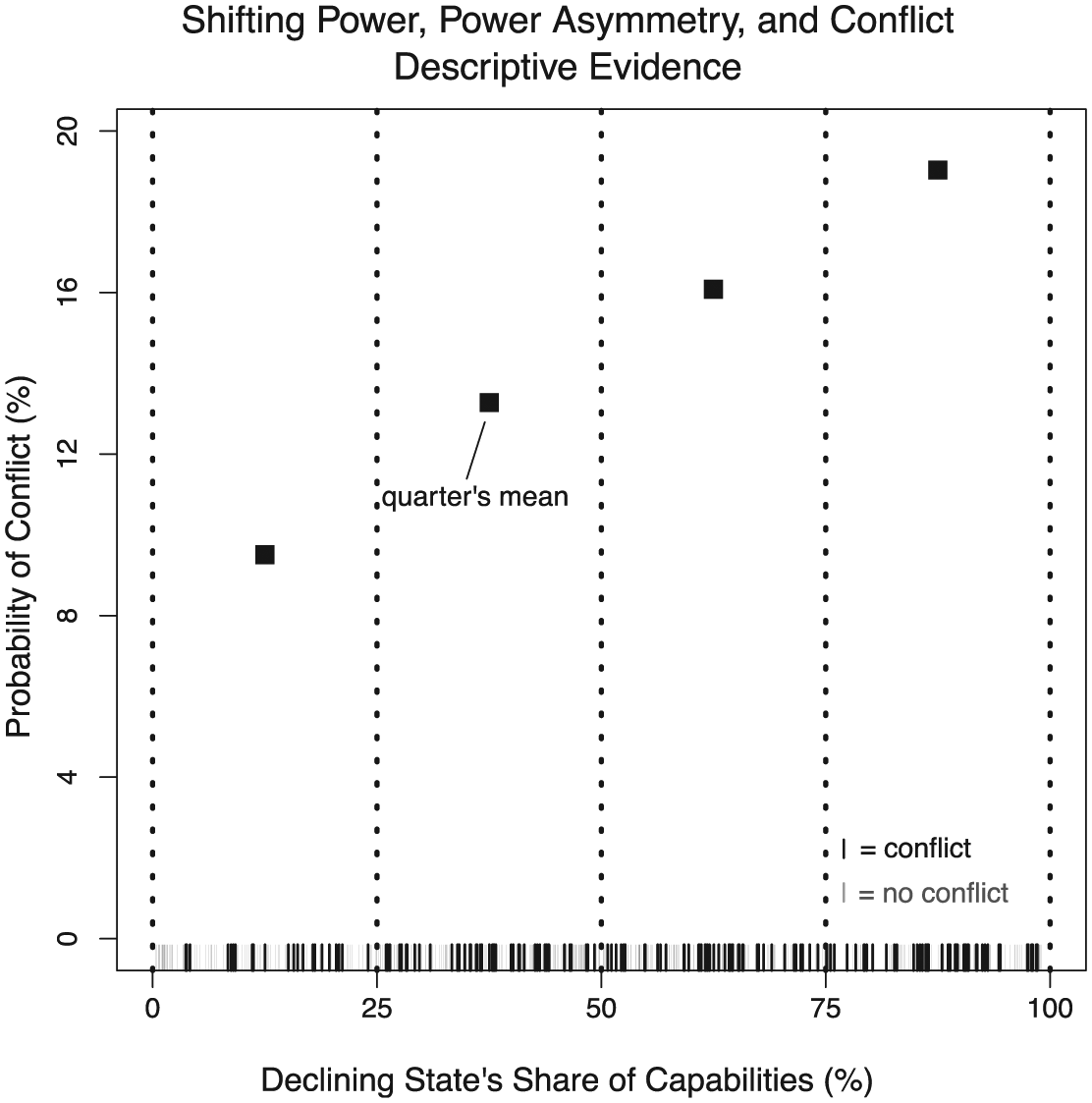
Conflict frequency by dyadic capability quarter with rug plot indicating data range for anticipated-shift dyad year observations.
The next step is to ensure the relationship in Figure 1 holds when accounting for confounding variables. Due to the dichotomous outcome variable for preventive conflict, I estimate all models using logistic regression with standard errors clustered on the dyad in the dyad year models. The results in Table 1 provide strong support for the hypothesis. Whether the unit of observation is the anticipated-shift dyad year or anticipated-shift dyad episode, increasing the initiator’s share of dyadic power elevates the probability of preventive conflict. The result persists across all specifications of the explanatory variable, whether based on both military spending and personnel, only military spending, or total CINC scores. This finding rejects the contention that looming power transitions in dyads near parity are especially problematic. Note that as expected, Contiguity and Duration are positively associated with preventive conflict in the dyad year and dyad episode specifications, respectively.
Anticipated-shift dyads: asymmetry and conflict
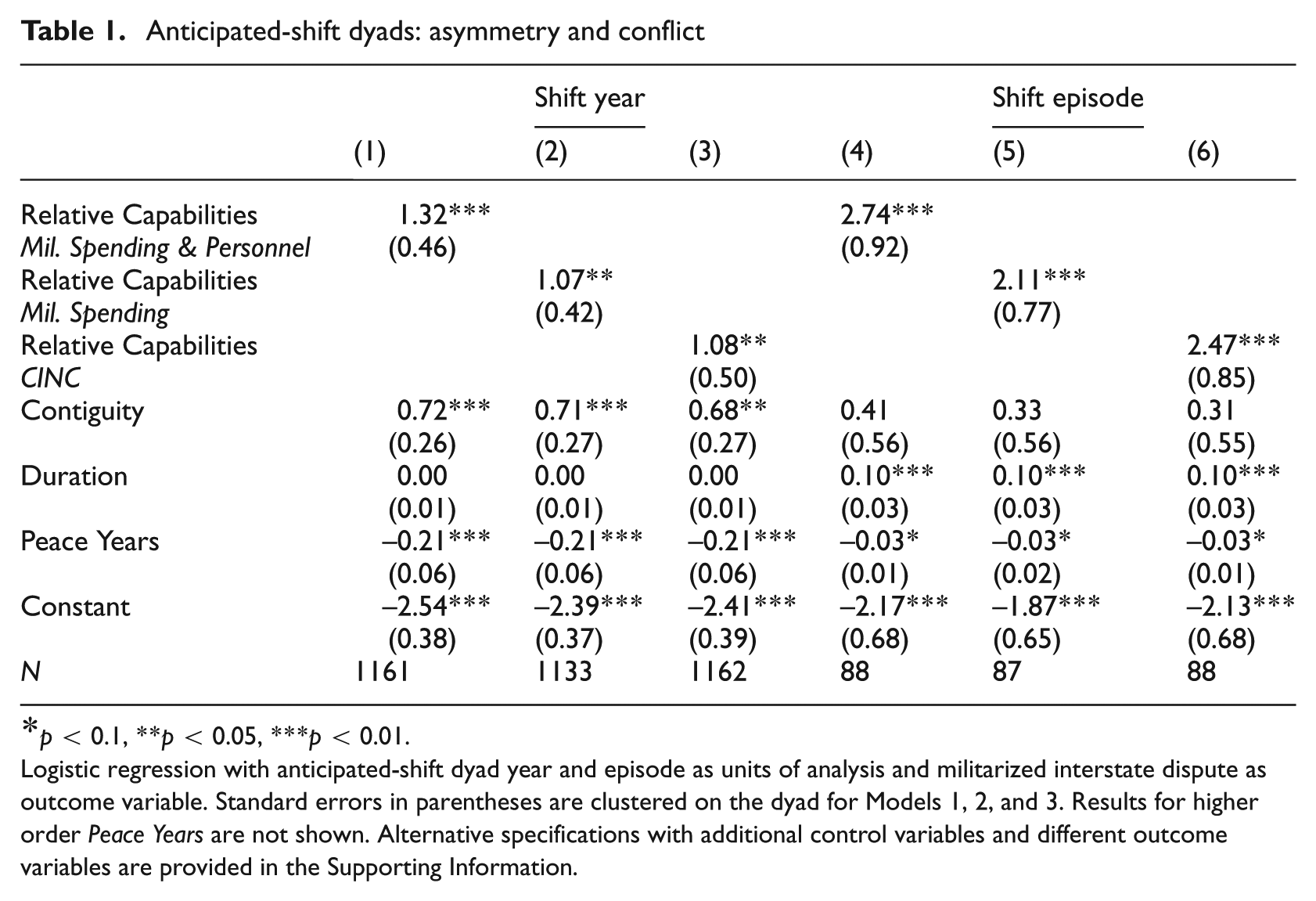
p < 0.1, **p < 0.05, ***p < 0.01.
Logistic regression with anticipated-shift dyad year and episode as units of analysis and militarized interstate dispute as outcome variable. Standard errors in parentheses are clustered on the dyad for Models 1, 2, and 3. Results for higher order Peace Years are not shown. Alternative specifications with additional control variables and different outcome variables are provided in the Supporting Information.
Focusing on the core relationship of interest, how important are power asymmetries in determining whether preventive conflict occurs in dyads with anticipated changes in power? Simulations conducted with Clarify employing Model 1’s anticipated-shift dyad year as the unit of analysis reveal asymmetry’s large effect (King et al., 2000). For this analysis, I consider observations with a common proliferator. This analysis uses the Egypt–Iraq 1993 and US–Iraq 1993 observations. 26 In paired observations the target is held constant which introduces equivalence on at least one key component of the analysis. The two observations reflect important values of the explanatory variable with Egypt–Iraq representing parity (Relative Capabilities = 0.48) and US–Iraq depicting asymmetry (Relative Capabilities = 0.90). Setting all covariates to the levels observed in the Egypt–Iraq observation yields a predicted probability of attack equal to 11.7%. To calculate the first difference, Relative Capabilities is shifted to the US–Iraq value while holding all other covariates constant. As shown in Figure 2, doing so induces a 7.1% point increase in the probability of a preventive strikes, with 90% confidence interval bounds spanning from a 2.7% to an 11.8% point increase. Put simply, the likelihood of conflict increases by more than 60% over the baseline rate when moving from parity to asymmetry. The historical record of these cases accords with this prediction as the US launched a preventive strike against Iraqi nuclear facilities in 1993.
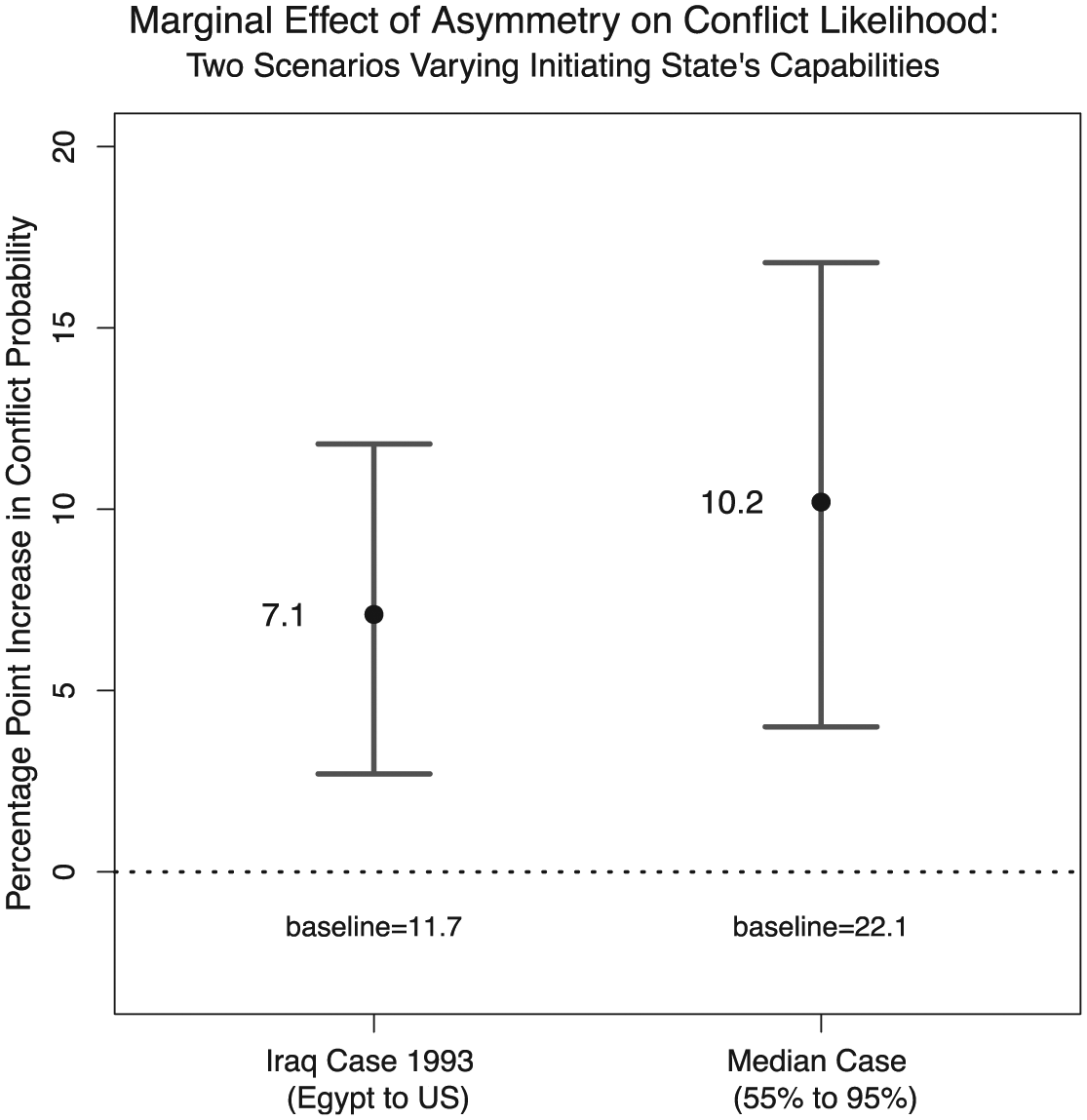
Marginal effect of increasing asymmetry on the probability of conflict with 90% confidence bounds.
Note that the large effect size is not contingent on the particular covariates of the Iraqi dyads. When setting all other variables at their median values, shifting relative power from 0.55 to 0.95 increases the likelihood of conflict from 22.1% to 32.3% with marginal effect 90% confidence bounds that exclude the null hypothesis. These simulations, depicted in Figure 2, highlight the elevated danger of preventive conflict in asymmetric dyads by showing a statistically significant effect across a salient range of explanatory and control variable values.
Robustness tests and limitations
The Supporting Information contains a series of tests offering further confirmation of the results. These demonstrate that the results are robust to alternative control variable specifications, including controlling for alliances, initiator and target regime type, or joint democracy. Results are similarly robust to using a stricter definition of preventive conflict that excludes disputes that only reach lower hostility levels, such as threatening to use force or showing force. Another test drops dyads where both states have nuclear programs at the same time, such as the India–Pakistan dyad between 1972 and 1987, because it may be ambiguous which state is rising. Doing so produces nearly identical statistical and substantive results.
One possible concern is that increasing the relative capabilities of an initiating state is always associated with a greater probability of conflict and is not unique to instances with shifting power. Tests in the Supporting Information use an alternative data set and demonstrate that the effects of power asymmetry are especially pronounced when in the presence of shifting power as compared to when relative power is static. The interaction term between the presence of an anticipated-shift and the dyadic power balance is substantively and statistically significant across multiple specifications. This result accords with that found in Table 3 of Sobek et al. (2012).
Additional checks ensure that the relationship between a declining state’s initial share of dyadic capabilities and the probability of conflict is monotonically increasing across the full range of the explanatory variable. These show that the results are not entirely driven by cases in which an already overmatched state confronts a rival with a nuclear program. The concern might be that the findings are due to already overmatched states being unlikely to attack rather than due to different conflict proclivities between dyads at parity and those in which the declining state is initially powerful. Numerous robustness tests presented in the Supporting Information rule out this possibility. Rather than assume a linear relationship between Relative Capabilities and Conflict, I use models with more flexible functional forms. These include (1) a model with cubic polynomials, (2) a generalized additive model, (3) a model with binary indicators for each quarter of the explanatory variable’s range, and (4) a bootstrapped basis regression with oracle model selection (Kenkel and Signorino, 2012). Across all specifications with power shifts, conflict probability increases monotonically in the declining state’s initial share of dyadic capabilities. The relationship differs in dyads where power is static, which further indicates that asymmetric dyads are particularly prone to conflict when power shifts are anticipated.
Three potential limitations to the analysis merit attention. First, while the results are consistent with the model’s predictions, they cannot adjudicate between the posited mechanisms. Certainty effects, variable war costs, or both may drive results consistent with the hypothesis. Second, the empirics are limited to a dramatic form of power shift and cannot speak to whether the model’s implications hold across other forms of power shifts. Third, selection effects might influence whether observations are included in the sample. Starting a nuclear weapons program is not a random or exogenous event. This non-random sampling is potentially problematic if the explanatory variable (relative capabilities) affects entry into the sample. If it does, then conditioning on the presence of a looming shift amounts to controlling for a post-treatment variable which will bias estimates (King and Zeng, 2006). However, it is ex ante unclear why, or in which direction, dyadic power balances would affect relative capability shift proclivity. Even if such a relationship exists, findings from the analysis will be biased upward only if weak states in asymmetric dyads are less dissuaded from building weapons by the possibility of preventive strikes than proliferating states in dyads approaching parity. Though possible, there is theory and evidence suggesting otherwise. According to Monteiro and Debs (2014), weak states without strong allies but with strong rivals face the most acute threat of preventive strikes and consequently are likely to refrain from investing in proliferation efforts. Thus, it is unlikely that the non-random sampling criteria would inflate results in a manner that validates the hypothesis. 27
Results from multiple specifications lend strong support to the central contention of this paper. The unobservable nature of anticipated shifts in relative power has long posed a difficult empirical challenge for researchers of preventive conflict (Lemke, 2003; Weisiger, 2013: 61). Though the tests employed in this study are admittedly limited in scope, they are a positive step toward capturing the logic of preventive war and offer a path for future work to pursue further.
Conclusion
This paper formulates and tests a theory of the conditions most likely to cause commitment problems resulting in preventive war. Consideration of uncertainty premiums—under the assumption that states prefer certainty—and variable war costs—under the assumption that fighting strong states is more costly than fighting weak ones—generates implications for a previously unaddressed relationship. Perhaps counterintuitively, these two extensions to a bargaining model illustrate that commitment problems are less likely around power parity and most likely when the dyadic distribution of power is asymmetric. Testing this contention is challenging due to the difficulty of identifying when states anticipate the adverse shifts in relative power necessary to induce preventive reasoning. Empirical specifications focused on nuclear programs, which do not rely on extrapolation of past trends to identify relevant cases, offer strong support for the theory.
I conclude with a suggestion for future research and two policy implications. For expositional clarity, this article incorporates certainty effects with a relatively simple decision weighting function to introduce non-linearity in the probabilities. Future studies may advance this line of work by considering alternative specifications. Additionally, distinguishing the results arising from certainty effects versus traditional risk aversion would be a valuable contribution, not only for commitment problems but for bargaining models of war more generally. Most broadly, this echoes suggestions that behavioral findings pertaining to decisions made under uncertainty might be fruitfully integrated with rationalist theories of conflict initiation (Lake, 2010).
A first policy implication applies to gradual changes in the distribution of power. For example, consider China’s rise. It follows from this study that as relative power shifts within the Sino-American dyad, the probability of an intractable commitment problem emerging is declining over time. As dyadic asymmetries attenuate and parity approaches, the conditions necessary for conflict continue to rise. According to the model, the US must anticipate even faster Chinese growth in the future than observed in the past for a US preventive strike to be rational. A second implication is less sanguine. This paper provides a rationale for why a powerful state adopts belligerent policies toward a potential rising actor even if the latter has little ability to threaten the former’s survival with or without a shift in power occurring. If the US maintains a preponderance of military power granting it relatively low costs of war and relatively minimal uncertainty about conflict outcomes, it follows that we ought to anticipate the US, or states privy to its protection, will be foremost advocates of preventive strikes against conventionally weak states with nascent nuclear programs. Indeed, scenarios of this form are often among this era’s foremost challenges to interstate peace.
Footnotes
Appendix
Fearon (1995) specifies an infinitely repeated game with the only parameter changes occurring between the first two periods and thus a backwards induction solution can commence with the second round. The unique subgame perfect equilibrium in round two is analogous to that found in the single-shot bargaining game. Because cA and cB> 0, war in round two is ex post inefficient and never occurs. A maximizes its payoff with a proposal of
Moving to the first round, evaluate under what conditions there is no proposal that B deems acceptable. Even if x1A = 0, B prefers war to acceptance. Formally, this occurs if:
where
Preventive war is preferred when this inequality holds. For comparative statics, collect terms on the left-hand side, let p2 = p1 + Δ, and differentiate with respect to p1.
Given δ ∈ [0, 1], the right-hand side is weakly negative. Thus, in the standard model, war is less likely as p1 increases, but trivially so as this relationship lacks substantive theoretical underpinnings.
Incorporating variable war costs and uncertainty premiums proceeds in a similar manner. For war costs, substitute the monotonically increasing weakly concave function cB (pt) for cB, where t indexes round of play. A makes B indifferent between war and peace in round two when
Here, δ−1 ≤ 0 and [cB′(p1)−δ cB′ (p1+Δ)] > 0 due to cB (pt) being a monotonically increasing, weakly concave function. Thus, the right-hand side is negative and the war constraint becomes less likely to hold as p1 increases. This relationship indicates that the conditions necessary for conflict become more restrictive in p1.
Relaxing the monotonicity assumption does not substantively change the result. For instance, war costs may decline beyond some threshold at which point a quick defeat ensures minimal wartime destruction. To capture this scenario, let cB(pt) be any weakly concave function. Returning to the right-hand side of Equation A2 and considering this functional form, the war constraint becomes less binding in p1 when the derivative is negative, which reduces to δcB′(p1+Δ) < 1+ cB′(p1). If cB′(p1+Δ)>0, this always holds as the right-hand side of
Now repeat the analysis with uncertainty premiums as an additional cost parameter in the lottery. A’s second round offer leaves B indifferent between war and peace when
Now establish when the value of the right-hand side is negative. Recall, uncertainty premiums equal the war outcome variance, r(pt) = pt (1 − pt), which is strictly concave, increasing in pt if pt ≤ 0.5, and decreasing otherwise. Again, the war constraint becomes less binding in p1 when the derivative is negative, which reduces to δ[1 + r′ (p1 + Δ)] < 1 + r′(p1). If 1 + r′(p1 + Δ) > 0, then the right-hand side of Equation A3 is negative for all
Acknowledgements
For helpful discussions and feedback, I am grateful to Erin Baggott, Muhammet Bas, Julie Faller, Jeff Friedman, Iain Johnston, Akos Lada, John Marshall, Max Palmer, Dustin Tingley, George Yin, three anonymous reviewers, and the editor. The Supporting Information as well as data and replication materials can be found at  .
.
Funding
This research received no specific grant from any funding agency in the public, commercial, or not-for-profit sectors.