




Abstract
How do embattled leaders hope to secure their hold on power by initiating conflict abroad? The literature on diversionary war has emphasized two distinct mechanisms by which leaders stand to gain from conflict — the “rally around the flag” and “gambling for resurrection” theories. But despite a massive literature on the subject, these competing theories of diversionary incentives have never been subjected to comparative empirical evaluation. This article seeks to fill this gap. I argue that the rally and gambling theories predict diversionary conflicts to target different types of states. Diversionary conflicts driven by a rally logic will target traditional enemies and out-groups, including rivals, neighbors, and geopolitically incompatible states. Gambling for resurrection, on the other hand, pushes leaders to target powerful states in order to demonstrate competence to their constituents. Challenging the conventional wisdom, I find little evidence to support the rally mechanism. The results offer substantial support for the gambling for resurrection theory, indicating that diversionary conflict may be primarily driven by unpopular leaders attempting to prove their competence domestically.
It is often argued that political leaders facing domestic turmoil and discontent are more inclined to provoke conflict abroad in order to secure their position at home. Indeed, the “diversionary” theory of war is perhaps the most widely known theory linking domestic political imperatives and international conflict. But how do embattled leaders stand to gain from initiating such risky conflicts? Do diversionary incentives derive from an attempt to rally the people behind the regime, or from leaders taking risky gambles to demonstrate their competence to the population?
The literature to date has specified several causal pathways through which domestic unrest pushes leaders to initiate conflict abroad. Yet these competing theories of what I call “diversionary incentives” remain largely untested. We remain unsure of whether diversionary conflict, to the extent it occurs at all, is driven by unpopular leaders attempting to prove their competence to coalition members, stir up nationalist sentiment at home, scapegoat foreign groups for domestic problems, or simply distract constituents from the government’s failings. Although scholars have posited numerous mechanisms potentially underlying diversion, recent work has largely centered on the “rally around the flag” and “gambling for resurrection” theories as the most plausible explanations of diversionary conflict. Rally around the flag theory derives from the social psychology literature and argues that the cohesion of an “in-group” increases during crises or conflicts against a widely recognized “out-group.” The gambling for resurrection logic argues that embattled leaders can rationally initiate risky conflicts in a last ditch effort to demonstrate competence to the constituents. Recent studies have made significant advancements in specifying the conditions under which diversion is likely to occur and the types of conflicts likely to be initiated (Smith, 1996; Gelpi, 1997; Clark, 2003; Mitchell and Prins, 2004; Fordham, 2005; Mitchell and Thyne, 2010; Tir, 2010). Little empirical work has been done, however, to adjudicate among the competing logics of how and why domestic unrest generates incentives for international conflict in the first place. This article addresses this gap, assessing the various mechanisms thought to generate diversionary incentives for embattled leaders.
I argue that we can gain significant leverage on the question of diversionary incentives by examining the types of states that are targeted in diversionary conflict. The rally and gambling theories posit entirely distinct logics behind the diversionary use of force, with immediate implications for the type of target chosen. Specifically, the rally theory predicts that diverting leaders will target traditional enemies and enduring rivals, as conflict against such persistent adversaries is most likely to promote in-group solidarity. According to the gambling logic, conversely, leaders are essentially agents that must demonstrate competence to their poorly informed principals, the general public or winning coalition (Bueno de Mesquita and Siverson, 1995; Bueno de Mesquita et al., 2003). In order for an international conflict to demonstrate competence to these principals, the target must be adequately powerful (Tarar, 2006). Defeating a weak adversary simply does not demonstrate a leader’s competence. Essentially, the rally around the flag and gambling for resurrection theories yield starkly different hypotheses regarding the likely targets of diversionary conflict. Testing these competing hypotheses can help us understand the nature of diversionary incentives and the domestic origins of international conflict.
The extant literature has largely relied, implicitly or explicitly, on the rally around the flag logic in explaining diversionary conflict. A systematic examination of diversionary targets, however, indicates that the gambling for resurrection logic may offer a stronger explanation of diversionary incentives. Diversionary conflicts do not disproportionately target a state’s traditional adversaries. But diversionary incentives do appear to induce conflict with powerful targets. These findings should lead us to re-examine the field’s implicit reliance upon psychological rally mechanisms in explaining diversionary conflict.
Literature review
Despite an enormous amount of theoretical and empirical work, we still lack an empirical basis for understanding exactly how and why unrest at home promotes diversionary conflict abroad (Ostrom and Job, 1986; Meernik and Waterman, 1996; James and Oneal, 1991; Morgan and Bickers, 1992; Gelpi, 1997; Morgan and Anderson, 1999; Dassel and Reinhardt, 1999; Mitchell and Prins, 2004; Tir, 2010; Mitchell and Thyne, 2010; Oakes, 2012). The most prominent competing theories of diversionary incentives have never been subjected to comparative empirical analysis.
Early empirical tests of the diversionary war hypothesis yielded notoriously mixed results, and the consensus held that domestic unrest had little effect on international conflict (Ostrom and Job, 1986; James and Oneal, 1991; Meernik and Waterman, 1996). 1 Subsequent studies found more robust support for diversionary war theory and showed that diversionary conflict is a highly conditional phenomenon. Not all embattled leaders respond to domestic unrest by initiating disputes abroad, but many do. Much of this work focused on the internal, domestic institutional factors that condition diversionary conflict (Gelpi, 1997; Miller, 1995; Pickering and Kisangani, 2005, 2010; Lai and Slater, 2006; Kisangani and Pickering, 2011; Brule and Williams, 2009; Johnson and Barnes, 2011; Oakes, 2012). Others focused on external factors. Research examining the behavior of potential targets has highlighted the ways in which an adversary’s “strategic conflict avoidance” can reduce the probability of diversionary conflicts occurring (Smith, 1996; Leeds and Davis, 1997; Miller, 1999; Clark, 2003; Chiozza and Goemans, 2004a; Fordham, 2005). Strategic conflict avoidance and the need for “conflict opportunities” are seen as important intervening factors potentially disrupting the link between domestic unrest and international conflict (Meernik, 1994, 2001).
These theories focus on the behavior of likely targets, and how their actions can preemptively interrupt the outbreak of diversionary conflict. But importantly, these theories say nothing about who these likely targets are. Essentially, strategic conflict avoidance and conflict opportunity theory can explain how targets of diversionary conflict will behave, but they say nothing about who these likely targets are in the first place. Comparatively little work has examined what types of states make the most attractive targets for embattled leaders seeking a diversionary conflict. What research has been done on diversionary targets is quite illuminating. Sara Mitchell and Brandon Prins (2004) showed that diversionary incentives are often significantly stronger within dyads that are engaged in an enduring rivalry. Mitchell and Clayton Thyne (2010) similarly found that states involved in contentious issue claims are more likely to initiate diversionary conflicts. Lastly, Jaroslav Tir (2010) has found that diversionary conflicts are particularly likely to take the form of territorial disputes. Tir sees such conflicts as uniquely likely to evoke strong emotional sentiments and induce a domestic rally effect.
Despite these important contributions, a more systematic examination of diversionary targets remains to be done. This oversight is especially unfortunate because careful empirical examination of diversionary targets can shed light on the mechanisms that push faltering leaders to provoke disputes abroad. As I argue below, an embattled leader who is initiating conflict to prove competence at home is likely to choose different targets than a leader attempting to provoke a domestic rally effect. Evaluating diversionary targets can help indicate whether diversionary conflict is the result of leaders attempting to rally their population against a foreign out-group or demonstrate their competence to coalition members.
Observed “rally effects” and the mechanisms of diversion
The empirical literature is also somewhat divided on the degree to which conflict actually exerts a reciprocal effect on a leader’s popularity or security in office. Early analyses indicated that international conflict created a strong and robust rally effect (Mueller, 1970, 1973). Some more recent studies have corroborated these findings (DeRouen, 1995, 2000), while others have found the effect of conflict to be either negligible (Lian and Oneal, 1993; Chiozza and Goemans, 2003) or highly conditional on institutional and political context (Baker and Oneal, 2001; Chiozza and Goemans, 2004b, 2011). Essentially, the empirical literature is again contested with regards to the effect of conflict on leader popularity and tenure. Additionally, recent work has argued that the generation of a rally effect is highly conditional on domestic institutional circumstances and the target of the conflict.
Two important claims run through this literature. First, some argue that findings indicating no significant domestic bump for leaders in the wake of a conflict is evidence that diversionary war theory as a whole is empirically invalid (Chiozza and Goemans, 2011). Second, those who do find evidence of conflict producing an increase in a leader’s popularity almost invariably attribute this bump to psychological rally effects (Lian and Oneal, 1993; DeRouen, 1995, 2000). I argue that both claims are unfounded.
First, evidence that diversionary conflict fails to improve a leader’s domestic political position does not necessarily indicate that the decision to initiate conflict was unaffected by domestic concerns. In order for a conflict to be properly called “diversionary,” the only major requirement is that the initiator’s primary motivation was to improve her domestic political standing. If the conflict backfired or otherwise failed to produce the desired results, this does not detract from the fact that the conflict was initiated for diversionary purposes. In short, a failed diversionary conflict is still a diversionary conflict.
Second, empirical work that does find a positive relationship between dispute initiation and leader popularity can tell us very little about the mechanisms underlying diversionary conflict. Although this work is typically couched in the language of “rally effects,” it cannot say exactly why conflict produces this effect and does not necessarily indicate that a rally logic drives diversionary conflict (Lian and Oneal, 1993; Oneal and Bryan, 1995; DeRouen, 1995, 2000; Baker and Oneal, 2001; Baum, 2002; Groeling and Baum, 2008). Increased leadership popularity or a stronger hold on power following a conflict could derive from either a psychological rally effect or increased perceptions of leader competence. Evidence indicating that diversionary conflict succeeds in bolstering a leader’s hold on power cannot say precisely how or why this happened. In short, both the rally and gambling theories could explain why conflict would produce this effect. Evidence frequently interpreted as indicating a psychological rally effect in response to international conflict is actually indeterminate with respect to distinguishing between the two mechanisms. Thus, empirical work examining the effect of conflict on a leader’s popularity or security in office can tell us little about the broader validity of diversionary war theory, and even less about the mechanisms underlying diversionary conflict.
Summary
As described above, the existing literature has not produced sufficiently fine-grained hypotheses to effectively differentiate between competing mechanisms of diversionary conflict. Both the rally and gambling theories predict a positive correlation between domestic unrest and the initiation of international conflict. Similarly, both expect international conflict to, under some conditions, boost a leader’s popularity. 2 Empirical tests demonstrating either of these basic correlations are thus entirely indeterminate in adjudicating between the rally and gambling theories. This basic observational equivalence has confounded rigorous comparative assessment of the mechanisms underlying diversionary incentives. But a more nuanced understanding of these theories reveals that each yields distinct auxiliary hypotheses. More specifically, each theory predicts diversionary conflicts to disproportionately target different types of states. Evaluating these hypotheses will help us understand what embattled leaders hope to gain by initiating diversionary conflict. Moving past the baseline observational equivalence of the rally and gambling theories, I argue that an examination of diversionary targets can shed significant light on the mechanisms underlying diversionary conflict.
Competing theories of diversionary incentives
I argued above that both the gambling for resurrection and rally around the flag theories predict a positive correlation between domestic discontent and conflict initiation. Because of this basic observational equivalence, we remain fundamentally ignorant of the mechanisms underlying diversion. So how can we distinguish between these competing mechanisms? Below, I argue that these two theories yield divergent predictions regarding the types of states likely to be targeted in diversionary conflicts. Testing these predictions can help adjudicate between the distinct mechanisms of diversionary incentives.
The “rally around the flag” hypothesis
Rally around the flag theory derives from the early psychological literature on in-group/out-group dynamics (Coser, 1956). The theory contends that politically or socially relevant groups become more unified and cohesive when engaged in conflict with an outside group. Applied to the realm of international politics, it holds that conflicts and crises should produce a rally around the flag effect in which a country’s population becomes increasingly patriotic and supportive of the political leadership, thus securing the leader’s hold on power. Political leaders facing discontent within their coalition or the broader population may then be tempted to manufacture a crisis abroad in order to reap domestic political benefits.
Conflict will only increase a group’s cohesion, however, under specific conditions. Most importantly, the external enemy must be a salient threat to the entire in-group (Coser, 1956: Ch. 5). As Jack Levy (1988: 667) writes, the cohesion of the in-group will be increased only if there already exists some minimal level of internal cohesion and only if it is generally perceived that the external threat menaces the group as a whole and not just some part of it. Otherwise, external conflict will lead to internal conflict and disintegration rather than cohesion.
Provoking a conflict against a friendly state with which many citizens in the initiating state sympathize and identify would not induce a rally effect. It would, if anything, exacerbate and deepen internal divisions and further weaken the domestic consensus behind the leadership.
Rally theory would then expect leaders contemplating the use of diversionary force to select targets that constitute a clear and easily recognizable out-group. Such targets are easily vilified, seen as highly threatening, and conflict with them should cause the population to rally behind the government. According to this logic, diversionary conflicts should target those states with which one has a history of conflict or an ongoing dispute, as targeting a friendlier state would be less likely to generate a strong rally effect (Mitchell and Prins, 2004; Tir, 2010). Diversionary incentives arising from a rally around the flag logic should largely reinforce pre-existing conflict propensities. If state A is historically likely to initiate conflict against state B, this tendency will be exacerbated by A’s diversionary incentives. According to the rally theory, diversionary conflicts should primarily target traditional adversaries.
But how can we operationalize these baseline conflict propensities? How do we know the types of targets a state would choose under normal circumstances? The existing literature on interstate conflict has reached a strong consensus that at least three target characteristics are relevant here. First, targets with which a sender is engaged in an enduring rivalry will have a history of persistent conflict that definitionally makes them a “traditional adversary” (Diehl and Goertz, 2000; Klein et al., 2006). Ongoing rivalry directly captures the dyadic conflict history that would make a target especially likely to elicit a rally effect. Such rivals are more likely to be seen as a salient threat, and conflict against them more is likely to induce in-group cohesion. 3
Second, quantitative studies of international conflict have clearly and repeatedly shown that geographic proximity is a strong predictor of dyadic conflict propensities (Bremer, 1992; Vasquez, 1995). Most importantly, geographic proximity is a key component of threat perception, often determining a state’s ability to use military force effectively against another. Neighboring states are also more likely to become embroiled in territorial disputes and conflicts over treatment of foreign ethnic kin groups. Finally, states with incompatible geopolitical preferences are more likely to have conflicting interests that can escalate into violent disputes (Bueno de Mesquita and Lalman, 1994; Bueno de Mesquita et al., 2003).
Although geographic proximity and political incompatibility do not directly capture a history of conflict, a wealth of empirical research indicates that proximate and incompatible states are disproportionately likely to be persistent adversaries. Conflict against such states would then be most likely to produce in-group solidarity and elicit a rally effect. Under normal political circumstances, we would then expect dispute initiations to be disproportionately directed against targets that are (1) rivals, (2) proximate, and/or (3) politically incompatible. 4 And according to the rally around the flag theory, these conflict propensities should be exacerbated by diversionary incentives. This yields the three Rally Hypotheses.
The “gambling for resurrection” hypothesis
The gambling for resurrection logic argues that troubled leaders might rationally pursue a risky, “high-variance” strategy of initiating conflict when they are likely to lose office (Richards et al., 1993; Downs and Rocke, 1994; Goemans, 2000; Goemans and Fey, 2009; Chiozza and Goemans, 2011). Such a gamble would be irrational under normal circumstances, as the high probability and high costs of defeat outweigh the low probability and marginal benefits of victory. But when leaders are already likely to lose office, they have little to lose from a risky conflict. Under such conditions, initiating or escalating a conflict is perhaps the only strategy available that will open up a small possibility of retaining office. The costs of defeat are minimal, as the leader is already likely to lose office. The benefits of victory, however, even if unlikely to be achieved, are significant as victory might enable the leader to maintain power. When we assume that the leader’s punishment is truncated at losing office, this may be a rational gamble (Chiozza and Goemans, 2011).
But what does the gambling for resurrection logic expect with regards to diversionary targets? Ahmer Tarar has formalized a principal–agent model representing this dynamic, showing the exact circumstances under which gambling for resurrection is rational (Tarar, 2006). Under the gambling logic, diversionary conflict is fundamentally intended to demonstrate a leader’s abilities to a population that remains uncertain of her true competence. A victorious conflict is an informative signal, however, only when it is directed against an adequately powerful target. Disputes against weak targets, even if victorious, do not demonstrate competence because the populace attributes victory to the power imbalance rather than the leader’s abilities (Richards et al., 1993). If diversionary conflict is driven by a gambling logic, “leaders will have incentives to choose tough targets” (Tarar, 2006: 177). This yields the Gambling Hypothesis.
There are several potential caveats to this claim. First, it is possible that embattled leaders would only target certain types of powerful states. It would be dangerous, for example, to provoke a strong ally that provides security for the initiating state. Additionally, it may be counterproductive for a leader to target extremely powerful states, as such conflicts are likely to end in defeat. Such a debacle would obviously do little to demonstrate a leader’s competence. Indeed, Tarar’s model predicts that diverting leaders will avoid extremely powerful targets precisely because these conflicts are unlikely to result in victory. Although unclear on the exact shape of the expected relationship, Tarar predicts a non-linear conditional effect, with very weak and very strong targets both ill-suited for diversionary disputes.
But importantly, both these caveats hinge on the assumption that the dispute will escalate to actual war. Tarar’s model does not allow a diverting leader to initiate a dispute and then de-escalate short of war in return for some diplomatic concession. And if we allow that such disputes might only take the form of “diversionary spectacles,” troubled leaders may be more willing to target extremely powerful states (Oakes, 2012). An unpopular leader might be more likely to prevail against an extremely powerful target in a dispute that does not escalate to the use of force. In less serious disputes, the powerful state may not find the matter particularly salient and would thus be more willing to make concessions, allowing the embattled leader to declare victory at home. This might be especially true for powerful targets that are generally friendly toward the initiating state. And a foreign policy victory against a powerful target, even one that is generally friendly toward the initiating state, is likely to provide fertile ground for an unpopular leader looking to trumpet his accomplishments to constituents. In short, if we allow that embattled leaders can initiate disputes that are highly unlikely to escalate to actual conflict, the Gambling Hypothesis as stated above is quite plausible.
By initiating only minor disputes, an initiating state can target friends and allies without causing a complete rupture in relations. Additionally, embattled leaders might target extremely powerful states hoping to extract minor concessions before quickly de-escalating the crisis, thereby minimizing the chances of provoking the target into fully applying its power advantage. The leader could hope to pocket these minor concessions, de-escalate the crisis, and simply declare victory to domestic audiences. The belief that the leader achieved a victory, even a limited one, over an extremely powerful adversary might serve to significantly increase perceptions of competence among constituents. Because the empirical analysis below focuses on disputes, rather than wars, I argue that the Gambling Hypothesis presented above accurately captures the logic of gambling for resurrection. 6
Data and research design
The tests described and presented below use a directed-dyad year data set of all politically relevant state dyads from 1948 to 2001. 7 Directed dyads consist of two observations per year for each pair of politically relevant states, differentiating between “senders” and “targets” in their interactions. I run all tests on the entire population of directed-dyad years, as well as subsets including only democratic or only authoritarian senders. The existing literature posits numerous ways in which diversionary incentives and behaviors are conditioned by regime type, and looking at the pooled data alone would obscure any such differences (Miller, 1995, 1999; Gelpi, 1997; Pickering and Kisangani, 2005, 2010). I code as democracies those senders whose aggregate democracy score (Democracy–Autocracy) according to Polity IV is 5 or greater (Marshall et al., 2002). I code all other states as authoritarian. The dependent variable in my analyses, conflict initiation, relies on the Correlates of War project’s data on “Militarized Interstate Disputes” (MIDs), version 3.0 (Ghosn et al., 2004). I use COW’s binary measure of dispute initiation, coding for whether a state publicly threatens, displays, or uses military force, short of war, against the other state in the dyad. If state A initiates a dispute against state B in year t, the dependent variable for this directed-dyad year is coded 1. If A and B continue that dispute into year t + 1, I do not consider this to be a dispute initiation.
The main independent variable is the level of domestic mass unrest in the sender state. In keeping with much of the literature, I use Arthur Banks’s Cross-National Time-Series data to measure mass unrest (Banks, 2012). Following convention, I sum the number of riots, strikes, and public demonstrations into an aggregate measure of mass unrest (Pickering and Kisangani, 2005, 2010; Tir, 2010). This is a widely used proxy for domestic unrest and regime instability. Such unrest, even if not initially directed against the government, can spin out of control or be redirected by regime opponents against the leadership. As such, it is a plausible indicator of regime instability. I lag the unrest variable by one year to ensure that it is causally prior to conflict initiation, not the result of it. Due to space constraints, I present an extended discussion of the results derived using several alternative indicators of leadership instability, including an economic measure capturing rates of GDP growth, in the supplementary appendix.
Control variables, sender types, and target types
Diversionary conflict theory more generally predicts a significant positive correlation between a sender’s level of domestic unrest and its propensity to initiate conflict. But this finding is indeterminate for assessing causal mechanisms, as both the rally and gambling theories would predict this outcome. Importantly, both the rally and gambling theories also expect this positive relationship to be conditional on target type. However, they expect the effect of unrest to be conditioned by different attributes of the potential targets. Testing the Rally and Gambling Hypotheses thus requires us to differentiate among types of targets. This section details the measurement of these target characteristics and specifies a series of control variables.
Target types
In order to test the Rally Hypotheses, we must operationalize and measure a target’s rivalry status, proximity, and political compatibility with respect to the sender. To test the Gambling Hypothesis, I need to capture the target’s relative power. I also include two target characteristics as controls only.
I thus include six distinct measures of target type. The first two are included only as controls, and the hypotheses specified above yield no predictions regarding the effect of these variables. First, I include a measure of the
I will now operationalize the four target characteristics pertinent to the hypotheses above: its rivalry status, proximity, compatibility, and relative power. First, I include a binary measure capturing whether the sender–target dyad was engaged in an ongoing
Sender types
The models below include the
Additional controls
Time-series cross-section data present numerous problems. Data dependencies can produce correlated error terms and yield biased and inefficient estimates. To control for temporal dependence in the data, I include a variable for the number
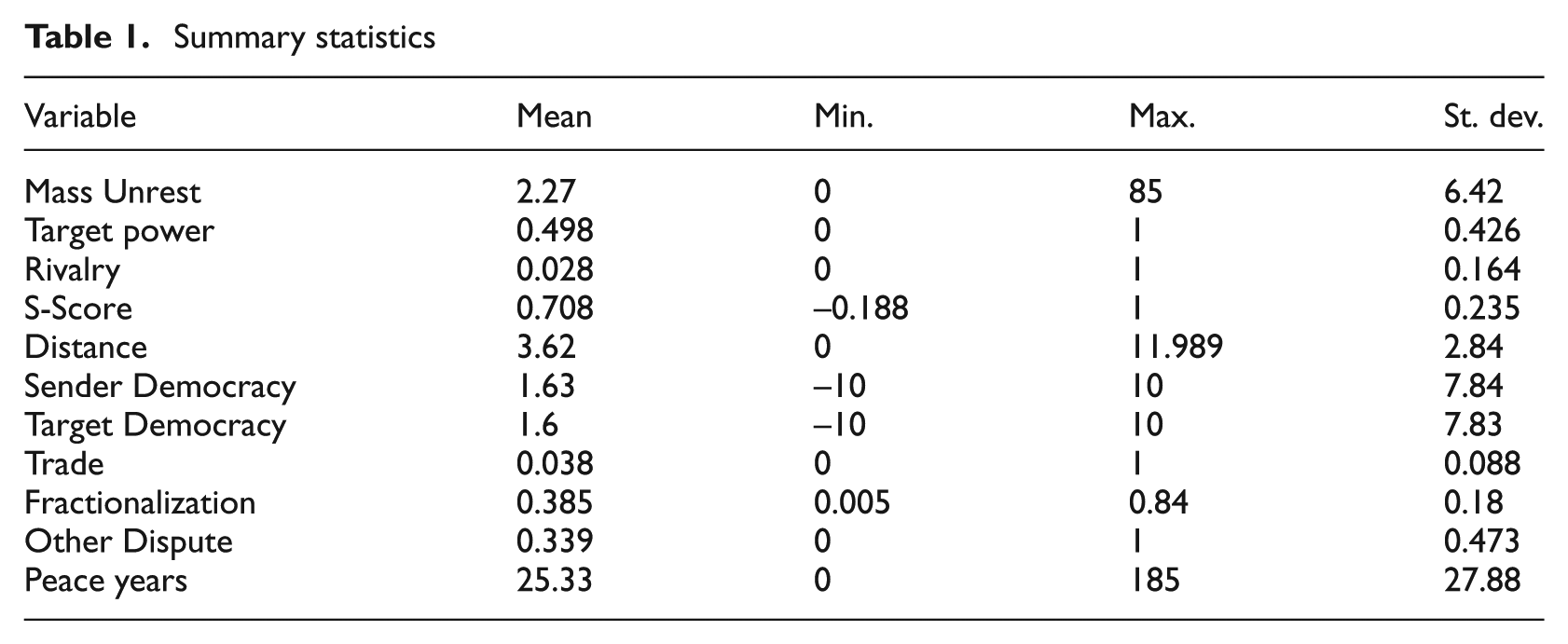
Summary statistics
Models and results
Because of the binary dependent variable, I estimate a series of logistic regression models, with robust standard errors clustered on directed-dyad. The hypotheses specified above are tested using a series of multiplicative interaction terms to assess the effect of domestic unrest conditional on certain characteristics of the target.
Rally Hypotheses
A baseline model of conflict propensities presented in the supplementary material reveals that states, under normal conditions, are indeed significantly more likely to initiate disputes against rivals, neighbors, and incompatible targets. The Rally Hypotheses specified above predict these baseline conflict propensities to be exacerbated by diversionary pressures. According to the rally logic, domestic unrest should produce a disproportionately higher probability of conflict in dyads where the target state is a rival of the sender, geographically proximate, or holds incompatible geopolitical preferences. Hypothesis R1 predicts the interactive coefficients for
Table 2 presents the results, including baseline models without controls as well as fully controlled tests. The results offer no support for the Rally Hypotheses. 9 Of the 18 interactive coefficients, 11 are statistically significant in the opposite direction of what the theory predicts. The remaining seven interactions point in the expected direction, but fall short of statistical significance. It appears that diverting leaders, if anything, tend to shy away from traditional adversaries. Although it cannot be ruled out, there is no prima facie reason to attribute these findings to strategic conflict avoidance. It seems unlikely that strategic interaction could produce a highly significant effect in the opposite direction of what the Rally Hypotheses predict.
Effect of unrest conditional on rivalry, distance, and compatibility
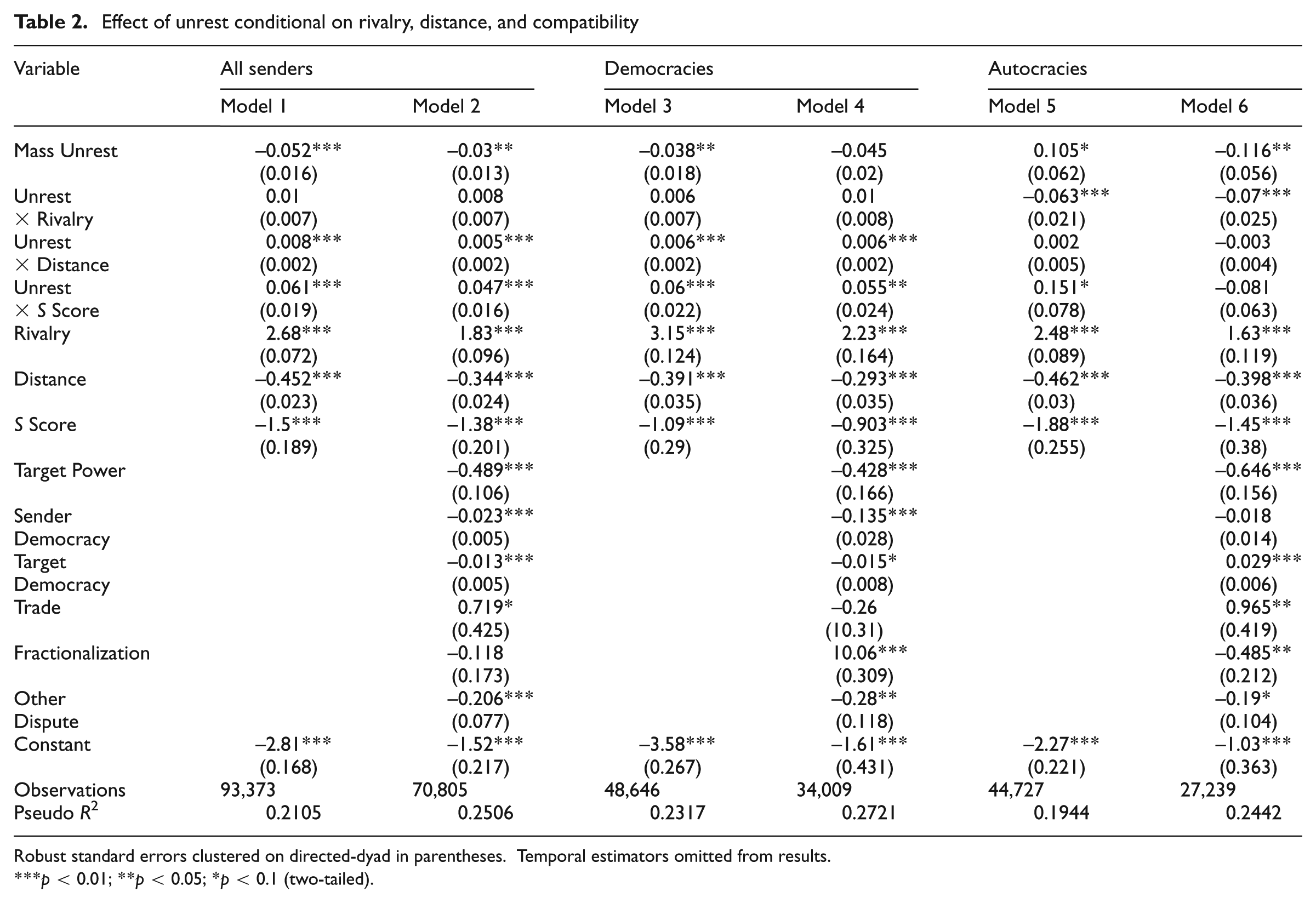
Robust standard errors clustered on directed-dyad in parentheses. Temporal estimators omitted from results.
p < 0.01; **p < 0.05; *p < 0.1 (two-tailed).
The graphs presented in Figure 1, derived from the Full Sample model in Table 2, reinforce this conclusion. These figures illustrate the effect of domestic unrest on the probability of dispute initiation against rival and non-rival targets (Figure 1a), contiguous and more separated targets (Figure 1b), and compatible and incompatible targets (Figure 1c). None of the figures offer support for the Rally Hypotheses.
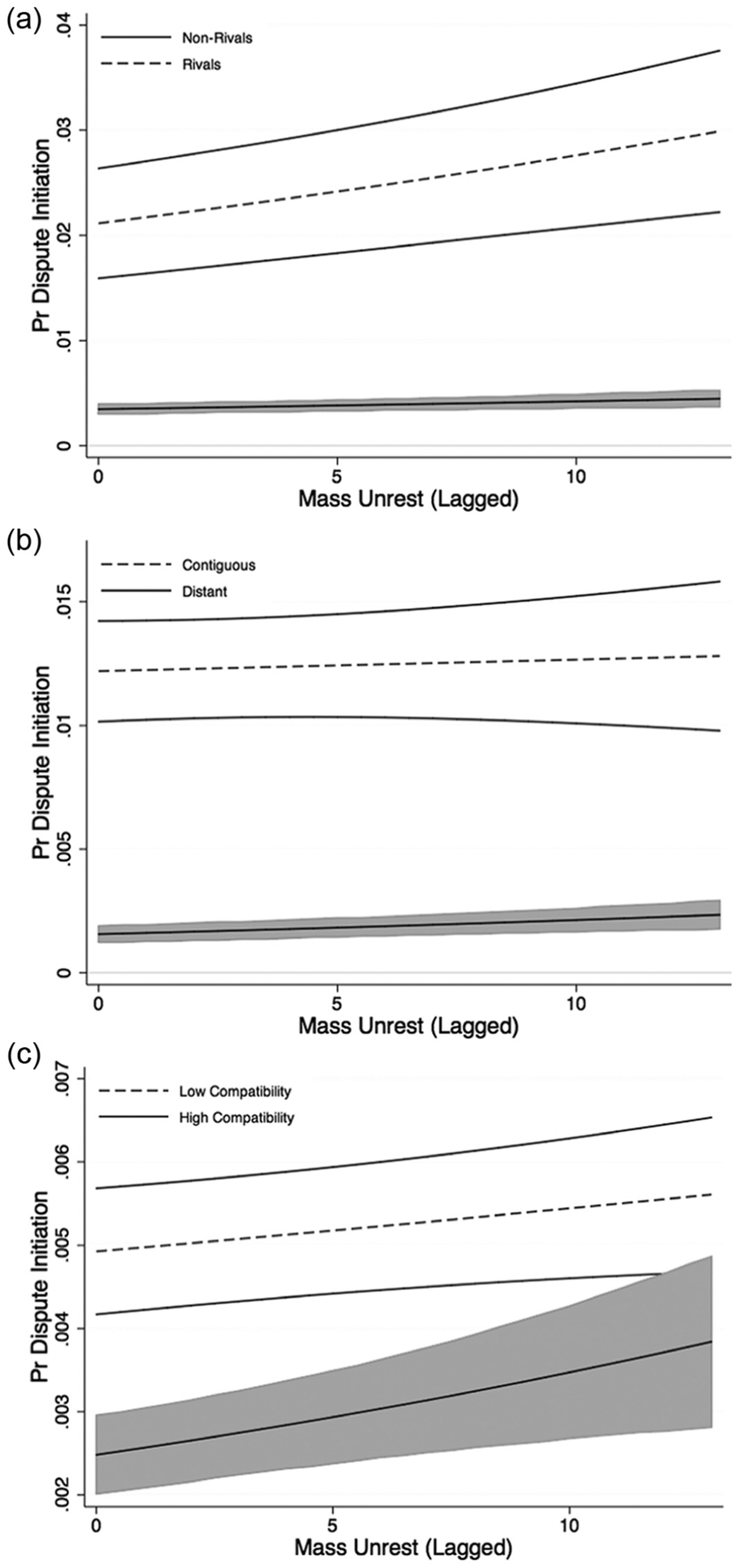
Effect of unrest on conflict, conditional on target rivalry, distance, and compatibility.
Table 2 reveals that unrest is if anything more likely to produce conflict against distant targets, contrary to Hypothesis R2. But Figure 1b demonstrates that the substantive magnitude of this conditional effect is extremely small. Figure 1c shows that unrest has a greater positive effect on conflict against compatible targets, the opposite of what Hypothesis R3 would predict. Figure 1a shows unrest to be slightly more likely to promote conflict against rivals, though this effect is far from significant. The positive effect of unrest is heightened when dealing with rival targets, but the upward slope of the dashed line in Figure 1a is quite small given the width of the confidence interval.
These results contrast with Mitchell and Prins’s (2004) findings that diversionary conflicts disproportionately target rival states. In stark contrast to the results presented in Table 2, Mitchell and Prins argue that this dynamic is most operative for authoritarian initiators. These seemingly contradictory findings highlight potential avenues for future research on the differing effects of economic and political unrest on diversionary conflict, as Mitchell and Prins rely on an economic indicator of leadership instability.
Gambling Hypotheses
Having found little support for the Rally Hypotheses, I now examine whether the Gambling Hypotheses fare any better. Recall that the Gambling Hypothesis predicts diversionary incentives to be significantly conditioned by a potential target’s power, with stronger states more likely to be targeted. I assess the Gambling Hypothesis with a model that interacts domestic unrest and the target’s share of dyadic power. Hypothesis G1 predicts a positive and significant coefficient on the interaction term.
Table 3 presents the results, which support the Gambling Hypothesis. All six models show positive and highly significant coefficients on the interaction term. The constituent
Effect of unrest conditional on target power
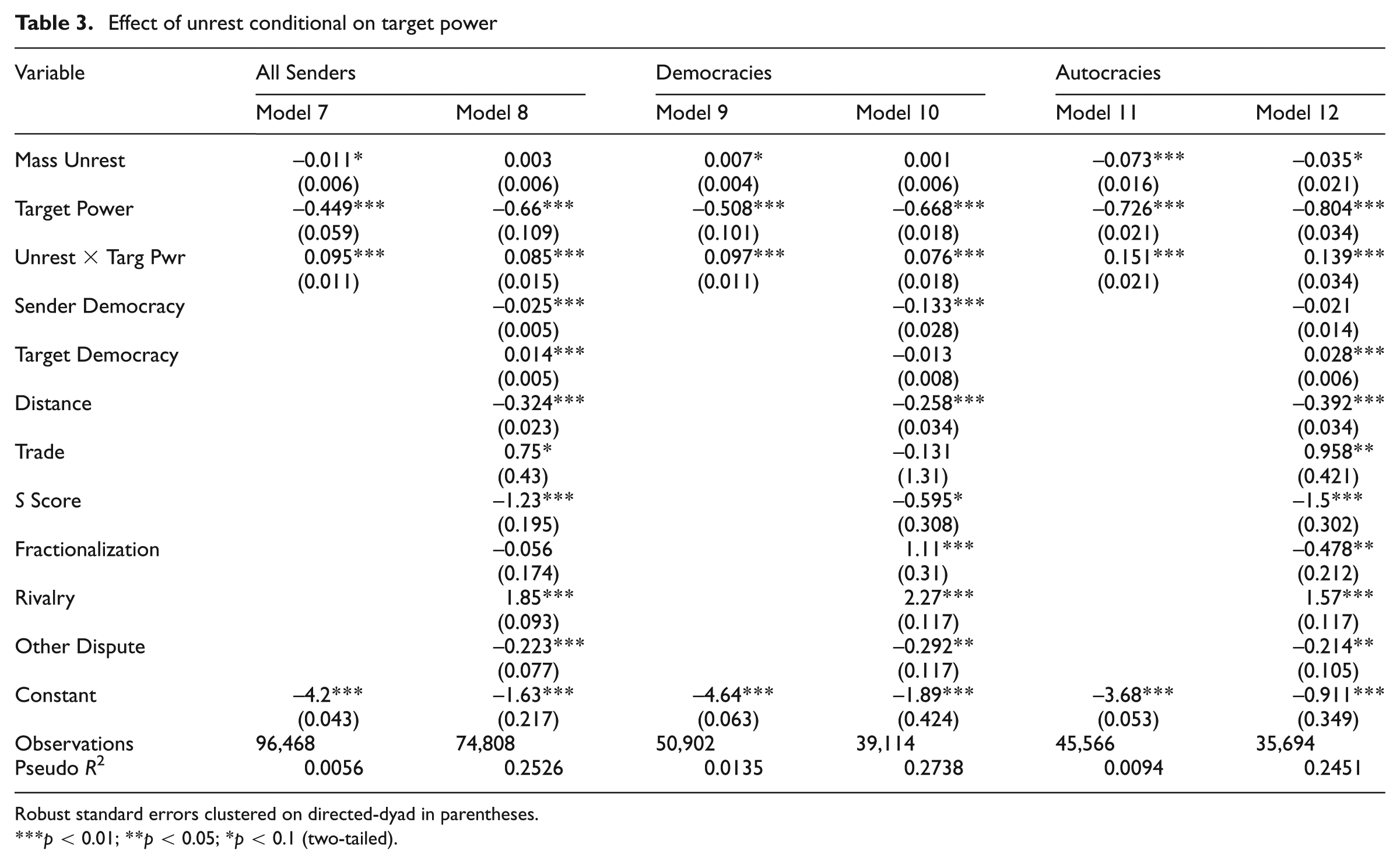
Robust standard errors clustered on directed-dyad in parentheses.
p < 0.01; **p < 0.05; *p < 0.1 (two-tailed).
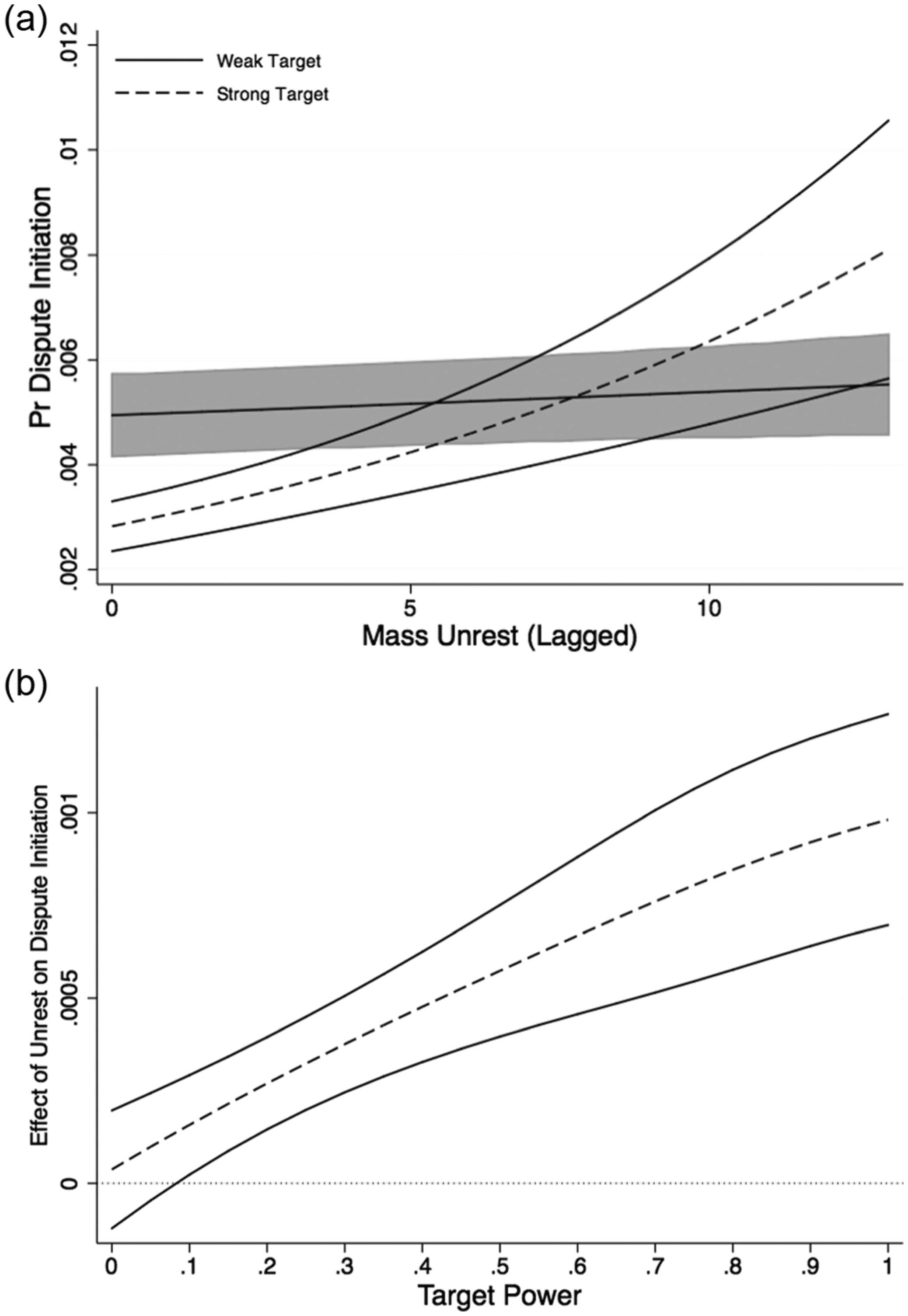
Effect of unrest conditional on target power. (a) Strong vs weak target; (b) Conditional effect plot.

Effect of target power conditional on unrest. (a) Low vs high unrest; (b) conditional effect plot.
Figure 2 illustrates the effect of mass unrest on dispute initiation, conditional on target power. 10 Figure 2a plots the effect of unrest on conflict against both strong and weak targets. The result is striking. The solid line indicates that unrest has virtually no effect on conflict against weak targets. The dashed line demonstrates, however, that this effect becomes significantly positive for strong targets. When the target’s power is one standard deviation below the sample mean, a two standard deviation shift in mass unrest only increases the probability of conflict initiation from 0.0049 to 0.0055, a roughly 12% increase. This effect is far from statistical significance. When facing a target whose share of dyadic power is one standard deviation above the mean, however, a substantial and statistically significant effect emerges. Against such strong targets, the same shift in unrest increases the predicted probability of conflict 190%, from 0.0028 to 0.0081. The conditional effect plot in Figure 2b reinforces this finding. At low levels of target power, the conditional effect of unrest is statistically indistinguishable from zero. The effect of unrest then grows sharply and becomes highly statistically significant as target power increases.
Figure 3 shows the inverse side of this interactive effect, how target power affects conflict propensities across different levels of mass unrest. The results are instructive. With no unrest, leaders appear highly reluctant to target strong states. The solid line in Figure 3a shows a strong negative relationship, with higher levels of target power significantly decreasing the probability of dispute initiation. But under diversionary conditions of high unrest, as the dashed line indicates, greater levels of target power actually increase the probability of dispute initiation. Figure 3b plots the conditional effect, showing again that target power has a significantly negative effect on conflict at low levels of unrest (when the unrest score is less than 5). But by the time unrest scores increase to around 12, the effect of target power becomes significantly positive. In short, the conditional effect of target power shifts from significantly negative when domestic unrest is nonexistent, to significantly positive at high levels of domestic unrest. Diversionary conditions thus appear to completely reverse a leader’s normal disinclination to target power states in international disputes.
Discussion
Generally, these results support the gambling for resurrection theory, and undermine the rally around the flag theory. Diversionary conflicts do not appear to target the traditional adversaries that would be most likely to produce a rally effect. Diversionary conflicts are, however, disproportionately targeted against powerful states. This is precisely what the gambling for resurrection hypothesis predicts, as even a limited victory against powerful adversaries would serve as a highly informative signal of the leader’s competence.
Before moving on to examine the robustness of these findings, a qualification is in order. It could be argued that the results in Table 3 are indeterminate, as rally around the flag theory would also predict diversionary conflicts to be directed against strong targets. Powerful states, even those that are geographically remote, may be seen as particularly threatening and conflict with them would thus be most likely to promote in-group cohesion (Richards et al., 1993). An embattled leader of a small country could possibly generate a massive rally effect by provoking conflict against a great power and portraying it as a global bully. This logic seems intuitively plausible. But I argue that the rally around the flag theory actually cannot account for these findings.
The results above indicate that states are if anything less likely to target powerful states under normal circumstances, as the baseline coefficients for
Robustness checks
To assess the robustness of these findings, I ran the tests above with alternative specifications of the primary independent and dependent variables, as well as different types of statistical models. Due to space constraints, I present these tests in the supplementary materials. The findings are impressively robust to alternative specifications.
Using both contemporaneous mass unrest and the two-year running average of mass unrest to measure domestic instability produces identical results to those presented above. Controlling for temporal dependence through the use of Generalized Estimating Equations models produces no change (Zorn, 2001). Using a measure of elite unrest produces comparably strong support for the Gambling Hypothesis. Estimating separate models to test each rally hypothesis individually produces similar results, as does an operationalization of dyadic rivalry that that relies on the number of peace years in the dyad. Similarly, the effect of unrest is significantly conditioned by target power even when the sample is subdivided into rival and non-rival, contiguous and non-contiguous, and compatible and incompatible samples. Lastly, correcting for the positively skewed distribution of the unrest variable produces no change in the results. The appendix presents additional tests using both the natural and common log of mass unrest, as well as samples that exclude outlying observations of unrest. All these tests mirror the findings presented above. These results reinforce the rejection of rally around the flag hypotheses and indicate rather robust support for the gambling for resurrection hypotheses.
The robustness tests do result in two important deviations from the findings presented above. First, tests using annual GDP growth to measure domestic unrest failed to support any of the hypotheses specified above. Aggregate levels of economic growth appear to have little effect on dispute initiation, either conditionally or unconditionally. Beyond undermining the specific rally and gambling hypotheses, these findings challenge diversionary war theory more broadly.
Second, coding the dependent variable as only fatal disputes produces weaker support for the gambling theory and reasonably strong support for the first Rally Hypothesis. Fatal diversionary conflicts are less likely than lower-level disputes to target power states, as only the full sample model shows target power to positively condition the effect of unrest of fatal dispute initiation. Fatal diversions are, however, more likely to target rivals as Rally Hypothesis 1 expects. This potentially supports the argument above that embattled leaders will only target powerful states when they expect to be able to de-escalate the dispute short of war. When disputes are likely to escalate to higher levels of violence, troubled leaders are less likely to target powerful states and risk provoking the ire of such formidable adversaries.
The stronger support for Hypothesis R1 here may be less a reflection of the diverting leader’s own preferences, and more a function of the fact that rivals are more likely to reciprocate and escalate disputes when they are targeted. It is possible that diverting leaders are not generally more likely to target rivals. But when they do divert against rival targets, the dispute is highly likely to escalate to the actual use of force. This indicates a previously untheorized form of strategic interaction in diversionary conflict. Diverting leaders may avoid targeting rivals not because of their conflict avoidance behavior, but because the embattled leader knows that rival states will fight hard and avoid making concessions in order to maintain a reputation for toughness within the context of the rivalry. These findings highlight a very promising avenue for further exploration, as existing work typically focuses primarily on the initiation of diversionary conflict, rather than its execution and subsequent escalation.
Conclusions
This paper has attempted to fill a massive gap in the literature on diversionary conflict by assessing exactly how and why domestic unrest translates into incentives to initiate conflict abroad. The extant literature has failed to adjudicate between the rally and gambling mechanisms of diversionary conflict. The basic observational equivalence of these theories, with both predicting a positive correlation between domestic unrest and international conflict, has hampered comparative investigation.
This paper addresses this problem. I argued above that systematically examining the targets of diversionary conflict can help us understand the origins of a leader’s diversionary incentives and the mechanisms underlying diversionary conflict. The gambling for resurrection and rally around the flag theories yield distinct predictions regarding the types of states that an embattled leader will target in a diversionary conflict. Testing these competing predictions yields surprising results. Diversionary conflicts do not appear to target traditional adversaries like rivals, neighbors or strategically incompatible states, confounding the expectations of rally around the flag theory. Diversionary conflict is, however, more likely to be directed against powerful targets. This is what we would expect if diversionary conflicts are driven by leaders adopting risky, high-variance strategies in a desperate attempt to prove their worth at home. This finding should lead us to rethink the conventional wisdom on the mechanisms underlying diversionary conflict and how the office-seeking behavior of leaders affects foreign policy.
Footnotes
Acknowledgements
The author would like to thank Todd Sechser, Giacomo Chiozza, Kyle Lascurettes, Kate Sanger, Brandon Yoder, as well as the editorial team(s) and anonymous reviewers at CMPS. All errors and omissions are the author’s responsibility alone. Replication files and supplementary empirical appendix can be accessed at  . The author can be contacted at
Funding
This research received no specific grant from any funding agency in the public, commercial, or not-for-profit sectors.