




Abstract
Anecdotal evidence suggests that high oil prices embolden oil-rich states to behave more aggressively. This article contends that arguments linking oil-exporter status to interstate conflict are implicitly price contingent, and tests this via a reanalysis of works by Colgan and Weeks. It finds a contingent effect of oil prices on interstate disputes, with high oil prices associated with significant increases in dispute behavior in petrostates, for which oil exports constitute more than 10% of GDP, while having a null effect in non-petrostates. Directed-dyadic tests indicate that this is due to petrostates initiating disputes, rather than becoming more attractive targets for conquest or coercion.
Introduction
Do high oil prices embolden oil-exporting states to behave more aggressively abroad? The events of 2008 would seem to indicate the answer is “yes”. Russia’s invasion of neighboring Georgia—ostensibly in response to Georgian aggression against the breakaway region of South Ossetia—occurred in August of that year, just after crude oil prices hit their then highest point since 1980. A month later, Bolivia’s Evo Morales and Venezuela’s Hugo Chávez—both part of the left-leaning “pink tide”—expelled their US ambassadors as punishment for the USA purportedly fomenting unrest. 1 Chávez sent 10 tank battalions to the Colombian—Venezuelan border in response to a Colombian incursion into neighboring Ecuador. 2 War raged between Israel and Hamas in the Gaza Strip. With Iranian backing, Hamas was able to launch rocket attacks on Bersheeba and Gedera. Khaled Mashaal, the chairman of the Damascus-based Hamas Political Bureau, would later say that Iran had played a “big role”, providing money and moral support. 3
Following Russia’s annexation of the Crimea and ongoing unrest in eastern Ukraine, energy politics are back in the spotlight: although prices had softened from previous highs, oil was still above US$100 per barrel in March 2014 when Russia forcibly annexed Crimea. 4 In April 2014, Russia’s state-owned Gazprom doubled the price it charges Ukraine for natural gas and threatened to shut off shipments to Ukraine’s state-owned Naftogaz. 5 Oil prices may have both emboldened Russia in the first place and provided it with a lever with which to put continued pressure on the Ukrainian government.
Examples of oil-backed coercive diplomacy abound: the 1967 and 1973 Arab oil embargoes, Chávez’s recurrent threats to embargo oil shipments to the USA and Russia’s intermittent restrictions of energy flows to Eastern Europe. In each of these instances, the use of oil as a source of coercive diplomatic leverage roiled markets, temporarily pushing up prices if not always dramatically curtailing supply. The 2008 examples, however, raise the question of whether high prices actually embolden leaders to pursue more bellicose foreign policies. The conventional wisdom in policy circles, embodied by Thomas Friedman’s “First Law of Petropolitics”, is that high oil prices lead to more aggressive behavior, including military actions, by petrostates, that is, those states for which net oil exports account for more than 10% of GDP:
When I heard the president of Iran, Mahmoud Ahmadinejad, declare that the Holocaust was a “myth”, I couldn’t help asking myself: “I wonder if the president of Iran would be talking this way if the price of oil were $20 a barrel today rather than $60 a barrel.” When I heard Venezuela’s President Hugo Chávez telling British Prime Minister Tony Blair to “go right to hell” and telling his supporters that the U.S.-sponsored Free Trade Area of the Americas “can go to hell”, too, I couldn’t help saying to myself, “I wonder if the president of Venezuela would be saying all these things if the price of oil today were $20 a barrel rather than $60 a barrel, and his country had to make a living by empowering its own entrepreneurs, not just drilling wells”. (Friedman, 2006)
This article investigates whether oil prices affect patterns of interstate dispute behavior, building statistical tests around reanalyses of Colgan (2010) and Weeks (2012). The main findings are as follows. First, higher oil prices are associated with an increased frequency of disputes in petrostates—those countries for which net oil exports constitute at least 10% of GDP—but not in non-petrostates. This finding is supported by both monadic and directed-dyadic analysis. Second, the results of the directed-dyadic analysis further indicate higher oil prices make petrostates more likely to initiate disputes; oil prices are not correlated with the probability that a petrostate will be the target of a militarized dispute. Thus, higher oil prices affect conflict by emboldening petrostates to behave aggressively and initiate disputes, rather than making petrostates more attractive targets for coercion or conquest. Finally, while the potential for endogeneity of oil prices to interstate conflict in petrostates is large, there is no systematic evidence that global prices are driven by dispute behavior in petro-states, suggesting that the identified correlations are not evidence of reverse causality.
The remainder of this paper proceeds as follows. The next section summarizes the nascent literature on oil and interstate conflict, argues that most causal mechanisms identified in the literature are implicitly price-contingent and develops hypotheses to test this conjecture. The following section discusses data, the estimation strategy and results. It then briefly considers the potential for endogeneity—that conflict behavior drives oil prices—before offering conclusions.
Theory: oil exporters and conflict behavior
There is now a well-established body of literature linking oil wealth to intrastate conflict (Fearon and Laitin, 2003; Le Billon, 2001, 2013; Ross, 2004a, b, 2012), although there is some disagreement about mechanisms: whether oil is primarily a contestable resource, whether extraction fuels grievances related to local environmental costs and diffuse economic benefits, or whether oil wealth tends to produce weak state institutions because of the ease with which states can capture resource rents. Others focus on the location of oil deposits, arguing for spatially differentiated effects. Lujala (2010) finds that onshore oil production increases the probability of conflict onset by 50%. In contrast, offshore production is not associated with conflict onset, suggesting that the link between oil production and civil conflict is contingent on the facilities being in areas where insurgents can access and attack them. Moreover, conflicts tend to last longer when oil reserves or gemstones are located within the conflict zone. Basedau and Pierskalla (2014) find that when oil deposits overlap territorially with powerful, politically included ethnic groups, the normal relationship between oil and conflict is reversed, and oil exploitation has a pacifying effect.
By comparison, the literature on the impacts of oil wealth for interstate conflict is still nascent. Jeff Colgan (2010) finds that petrostates have engaged in militarized interstate disputes (MIDs) 50% more frequently than non-petrostates in the post-Second World War era. 6 Natural resource exporters—particularly oil exporters—engage in militarized disputes more often than non-resource exporters, although these disputes rarely escalate into full-blown wars.
Why would oil exporters be more conflict-prone? Whereas the causal mechanisms linking oil to domestic conflict tend to flow through either local grievances, opportunities for capturing resource rents, or weak state institutions, the mechanisms linking oil to interstate conflict tend to revolve around (a) opportunities and incentives to win oil through conquest, (b) greater military spending and the security dilemma dynamics it engenders, or (c) the strategic significance of oil, which may engender moral hazard problems, particularly for certain kinds of risk-acceptant leaders.
De Soysa et al. (2011) note that oil is a highly contestable resource: a stock of natural capital that can be captured through conquest. Because of its contestability, oil may make a state a more appealing target. Hensel and Mitchell (2005) find that oil is one of the factors contributing to a given territory’s “tangible salience”, which is positively correlated with interstate dispute outbreak. Mitchell and Prins (1999) find that oil resources—particularly maritime resources—are one of the few issues associated with militarized disputes between democracies.
Fighting over oil may ultimately be less attractive, however, than either purchasing it or cultivating close ties with governments in producing countries. As the USA learned first-hand in Iraq, it is easy to underestimate the costs associated with occupying and directly governing foreign territory, even if (or perhaps because) that territory is rich in resources (Wimberley, 2007). Stability in oil-producing countries is often based on complex, dense networks of patronage that are much easier to destroy than to rebuild. The presence of oil veritably ensures that insurgents will have little trouble arming and equipping themselves, either through extortion—or “revolutionary taxation”, depending on one’s point of view—or through direct third-party support. Thus, the potential prize of oil-rich territory may be offset by the governance costs associated with occupying it. Moreover, higher oil prices increase the resources available for petrostates to invest in securing themselves against attack. The rents generated from oil exports help finance large, technologically sophisticated militaries in exporting countries. Since 2000, six of the top 10 countries in terms of military expenditures per capita have been oil exporters: the United Arab Emirates, Kuwait, Qatar, Oman, Saudi Arabia, and Norway (Hendrix and Noland, 2014: 61).
These military expenditures may create perverse outcomes: petrostates may be more conflict-prone because their pursuit of security provokes security dilemma dynamics. Even if these expenditures are driven by a desire to enhance defensive capacity, the fungibility of most military assets makes their amassment by one country an inherent menace to its neighbors (Jervis, 1977). While this menace can be mitigated through credible signaling of defensive intent (Fearon, 1997; Lake, 1992), said signaling is more difficult for many oil-exporting states, which are less democratic (Andersen and Ross, 2014) and less well integrated in global governance institutions (Ross and Voeten, 2015). Democratic institutions contribute to peace by overcoming the information asymmetry problems inherent to crisis bargaining (Schultz, 1998) and joint membership in international institutions suppresses conflict by conveying credible information of intent, socializing states into appropriate norms of behavior, and providing venues for bargaining and problem solving (Russett et al., 1998).
Alternatively, oil producers may be more conflict-prone because they expect to face less grave consequences for saber-rattling behavior. Because oil is a strategic resource, major powers invest significant resources in securing global supply lines and have incentives to prevent large-scale conflict in oil-producing countries that might result in global price spikes. Given that all the members of the UN Security Council except Russia are major oil importers, maintaining stability in oil-exporting states and deterring oil-seeking territorial aggression approach an international norm. The 1991 Gulf War, in which a US-led coalition responded to Iraq’s invasion of neighboring Kuwait, was waged under the auspices of a UN Security Council binding resolution. This implicit security guarantee may produce a form of moral hazard: essentially indemnified against large battlefield and territorial losses, oil exporters may be more casual about the use of force—or threats of force—in their dealings with other countries, especially countries that are not energy exporters and are thus not similarly insured themselves. De Soysa et al. (2011) find that oil exporters tend to initiate more MIDs with non-oil exporters, although the substantive effect is small.
These dynamics (outsized militaries and implicit security guarantees) may embolden certain types of leaders more than others. Because state authorities can easily appropriate oil revenues, they provide rulers with greater resources with which to buy off opposition and to spend on their militaries, reducing the domestic costs associated with more risky foreign policy behavior. Although this logic establishes means, it does not establish motive. Leaders of many oil-rich states—such as Saudi Arabia, the United Arab Emirates, Nigeria, and Gabon—are satisfied with their position in the status quo and lack revisionist ambitions: dissatisfaction born of a belief that they are not “receiving their due from the international order” (Kugler and Organski, 1989: 173). In contrast, revolutionary leaders—leaders who come to power by force and attempt to transform pre-existing political and economic relationships, both domestically and abroad—often have revisionist ambitions and are less hesitant about using force to resolve international disputes. Colgan (2010, 2013) argues that revolutionary governments with oil wealth have both motive and means to initiate militarized disputes, and finds that they initiate MIDs more frequently.
These findings relating oil exporter status to militarized disputes, however, are not conditional on oil prices, nor has the question—whether oil-exporting countries behave more belligerently when oil prices are higher—been a subject of inquiry. This gap in the literature is curious, since academic and policy community interest in the subject certainly correlate with price spikes: the 1973 embargo produced a decade of scholarship on oil and US national security (Krasner, 1978; Nye, 1980; Rostow, 1979), and the 2000s have seen renewed interest in energy security and broader energy-sector impacts on economic and political development (Birdsall and Subramanian, 2004; Colgan, 2013; Ross, 2012; Yergin, 2011).
All of the mechanisms outlined previously—being an attractive target, moral hazard dynamics related to strategic importance, military expenditures leading to security dilemmas, and leaders emboldened by deep coffers—should be attenuated or amplified by price effects. The issue salience school of international relations (Diehl, 1992; Hensel et al., 2008) argues that the value attached to a particular issue determines whether a state will be willing to commit scarce resources and bear costs associated with conflict to achieve its goals. States marshal their resources in pursuit and defense of their interests, but not all interests are equal. States will be more willing to bear the costs of conflict over highly salient issues. For all states, energy is a national interest. This interest should be more salient at times of high prices for two reasons. First, high prices increase the present discounted value of ownership of these resources, potentially making oil-rich countries more attractive targets for conquest. Second, the moral hazard dynamics engendered by major powers’ dependence on energy imports should be greater when prices are higher.
The military expenditure mechanism and the bloated coffers mechanism are predicated on receipts from sales of oil providing plentiful resources for investment in soldiers and materiel. Government revenues in oil-exporting countries can fluctuate wildly owing to changes in market prices. Take Nigeria, for which petroleum exports account for 70% of total export revenue. Figure 1 plots economic growth, total government revenue growth and oil price growth for the period 2004–12. While GDP growth was consistently over 5% per annum, government revenues fluctuated wildly: they increased from US$14.2 billion to US$17.5 billion from 2007 to 2008 (23% growth) before falling by US$2.4 billion the following year. These changes in revenue correlate closely with real oil prices (r = 0.6). When prices are low, government revenues in oil-exporting countries will be lower; when prices are high, revenues, and thus capabilities, will be higher.

Oil prices, government revenues and economic growth in Nigeria, 2004–2012. Sources: Hamilton (2009) and World Bank (2014).
In the bargaining model of conflict, fighting is ex post inefficient: because fighting is costly, there are always some outcomes that both parties would prefer over conflict (Fearon, 1995; Powell, 2002). As the perceived costs of conflict increase, the range of outcomes both parties prefer to war increases. These costs can be real, in terms of “blood and treasure”, but also take the form of opportunity costs: the economic and social losses stemming from diversion of productive resources into fighting. Opportunity costs are typically characterized as a “guns and butter” trade off, in which states decide between allocating resources to satisfying internal ends and allocating resources to military purposes (Powell, 1993). The more a state allocates to addressing internal demands, the fewer resources are available to invest in the military. When government revenues are down, the opportunity cost of conflict increases proportionally; internal demands on the state are more difficult to meet, giving leaders a less-free hand with which to pursue aggressive (and potentially expensive) foreign policies.
These theoretical conjectures yield a straightforward testable hypothesis:
However, a rejection of the null with respect to H1 could be consistent with multiple causal mechanisms. Petrostates might be more attractive targets at times of high prices and thus more likely to be the targets of aggressive behavior—the conquest mechanism—in which case they would be more likely to be the target of a dispute during times of high prices. Alternatively, high prices might actually embolden more aggressive behavior and thus a heightened propensity to initiate conflict by petrostates. Thus, two additional hypotheses will be tested:
What about the effects for non-petrostates? The theoretical effects are ambiguous. Low oil prices translate to lower mobilization costs. Modern armies are incredibly energy-intensive: the US Army, for instance, consumed an average of 47.7 million liters of fuel per day in 2006, roughly equal to the daily consumption of Iraq or Sweden (Lengyel, 2007). All things held constant, lower fuel costs reduce the perceived costs of engaging in conflict. Higher fuel costs, however, raise the present discounted value of control of oil supplies, a contestable resource, thus increasing the attractiveness of oil exporters as targets. However, per the moral hazard logic, high prices should also increase the incentives for major powers to act preemptively to deter escalation against oil producers. Theoretically, the two effects should counter one another, leading to the expectation that oil prices will not be correlated with dispute behavior in non-exporting states. Again, these theoretical conjectures yield a straightforward testable hypothesis:
Aggregate correlations are consistent with H1 and H4. Figure 2 plots the real price per barrel of oil (West Texas Intermediate, in 2008 dollars) against annual counts of MIDs involving oil-exporting and non-oil-exporting countries for the period 1947–2001. Oil prices are positively correlated with dispute behavior in petrostates (r = 0.5, p = 0.01), whereas oil prices are uncorrelated with dispute behavior in non-oil-exporting states (r = 0.07, p = 0.59). Of course, these correlations could be spurious; worse yet, they could be evidence of reverse causality, since conflict behavior in oil-exporting countries may cause price increases. For instance, spot crude prices jumped 11.6% on the day Iraq invaded Kuwait (August 2, 1990). 7 Also, these correlations provide no leverage on whether oil prices affect dispute initiation via emboldening aggressive behavior (H3) or making oil-exporting states more attractive targets (H2). More careful econometric analysis is needed.
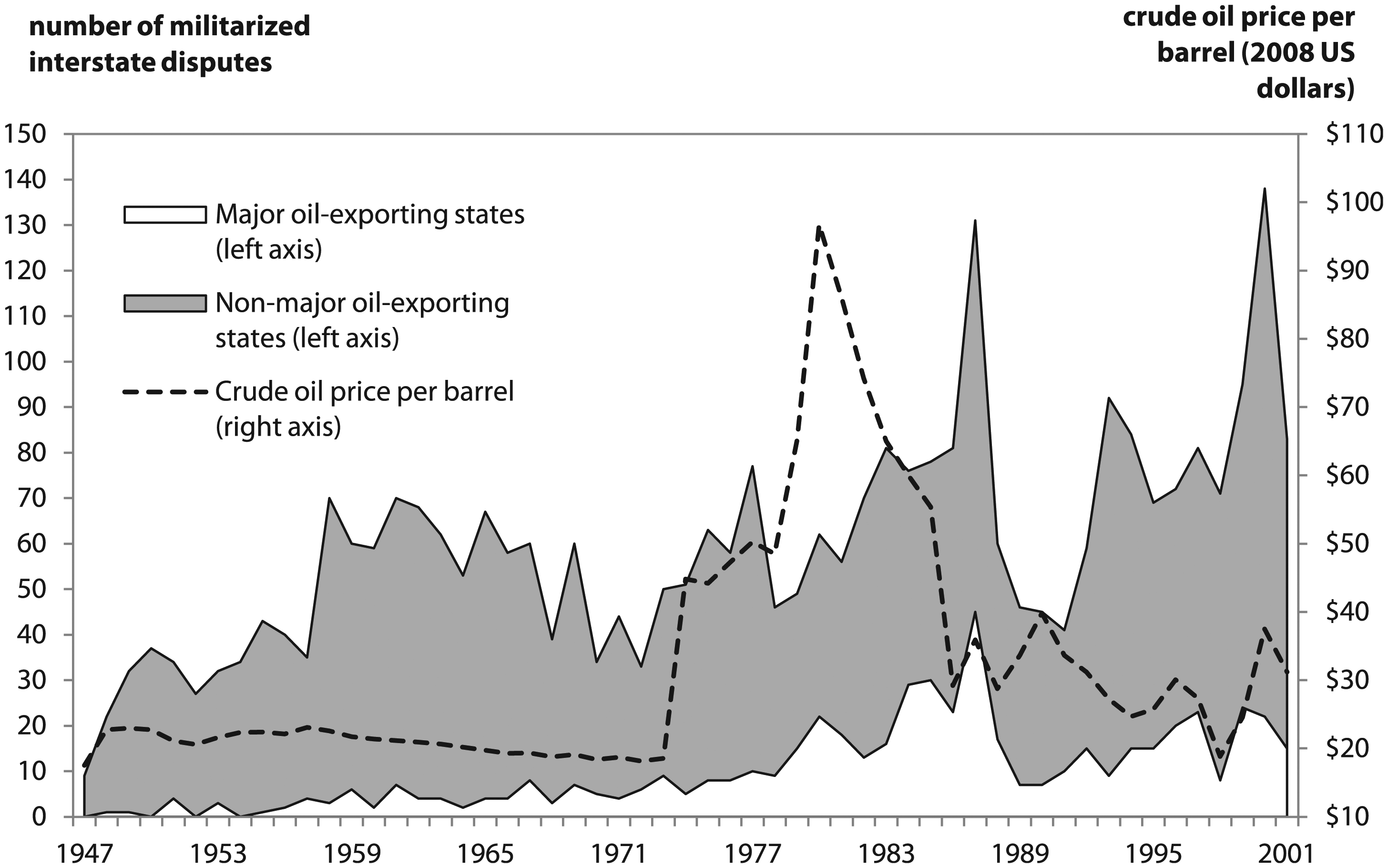
Oil prices and militarized interstate disputes, 1945–2001. Oil prices are strongly correlated with dispute behavior in petrostates where net oil exports account for 10% or more of GDP (r = 0.5, p = 0.01). Oil prices are uncorrelated with dispute behavior in non-oil-exporting states (r = 0.07, p = 0.59). Sources: Ghosn et al. (2004), Hamilton (2009) and Colgan (2010).
Data, estimation, and results
This study builds on replications of Colgan (2010) and Weeks (2012). The former is a monadic 8 analysis of the effects of oil exporter status on MIDs. The latter is a directed-dyadic 9 analysis of MID initiation. The Colgan replication is conducted on a sample comprising 153 states for the period 1947–2001; coverage of the variables restricts the analysis to 6014 country-years. The Weeks replication is conducted on a sample of 25,953 directed dyads for the period 1947–1998; coverage of the variables restricts the analysis to a maximum of 728,226 directed dyad-years. Although the Weeks study did not originally investigate the effects of oil prices on dispute behavior, it is a very highly cited and well-respected recent contribution to the quantitative empirical literature on MID initiation.
For the Colgan reanalysis, the dependent variable is the country-year count of MIDs. Behaviorally, MIDs range from relatively minor acts, such as or including troop incursions into disputed territory and firing warning shots, and attacks resulting in fatalities. This is considered the most comprehensive and widely used data source on interstate conflicts. Tests for two operationalizations are presented: total MIDs, irrespective of which state instigated, and instigated MIDs, those in which the country in question is the initiator (i.e. took the first action). The mean for MIDs is 0.5, with at least one MID occurring in roughly 25% of country-years, and with a maximum value of 26 (Iran in 1987). The mean for instigated MIDs is 0.24, with at least one MID instigated in 10% of country-years, with a maximum of 23 (Iran in 1987). For the Weeks reanalysis, the dependent variable is whether or not country A initiated a MID against country B in a given year. Initiated MIDs are quite rare, with initiated MIDs occurring in 0.18% of directed dyad-years.
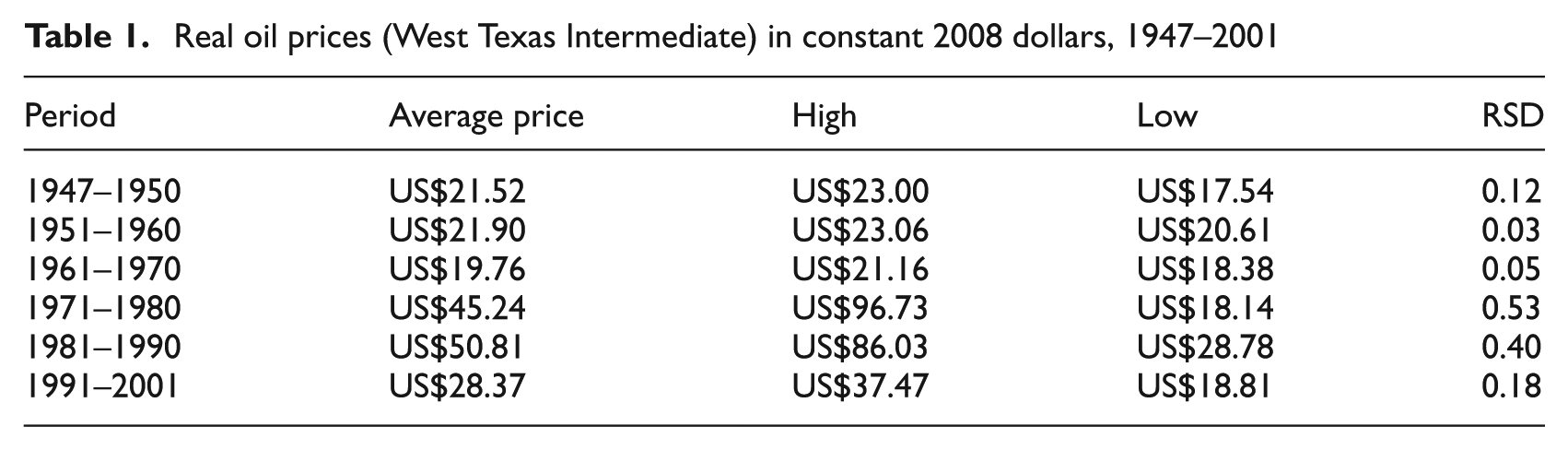
The main independent variable is the real price of oil per barrel (West Texas Intermediate, or WTI) in constant 2008 dollars; data are from Hamilton (2009). 10 WTI, along with Brent Blend and Dubai/Oman, is one of the three major benchmarks against which crude contracts are pegged. 11 Table 1 presents prices by decade for the period under study (1947–2001). Oil prices ranged from a low of US$17.54 per barrel in 1947 to a high of US$96.72 per barrel in 1980. Average prices were highest in the 1980s, when oil traded at prices 157% higher than the average of the 1960s. The relative standard deviation (RSD, σ/μ) indicates that while prices were higher on average in the 1980s, prices were more volatile in the 1970s, the decade characterized by two OPEC embargos. This stands in contrast to the 1950s and 1960s, a period characterized by comparatively low prices and very low price volatility.
Real oil prices (West Texas Intermediate) in constant 2008 dollars, 1947–2001
To test for conditional effects, the price variable is interacted with several variables drawn from Colgan (2010). Petrostate is a dummy coding that takes a value of one if revenues from net oil exports constitute at least 10% of GDP, and zero otherwise. Petrostates account for 11.6% of country-years and 13% of directed dyad-years in the samples, with 11 states meeting this threshold for the entire time period. 12
Revolutionary leader is a dummy coding for whether the head of state was a revolutionary leader or not. Colgan’s definition of a revolutionary leader has two components. The first component involves the means by which the ruler comes in to office: “First, has the individual leader used armed force against his own state at any time prior to coming to office as an integral part of coming to national influence, and ultimately, state leadership? Second, were there mass demonstrations or uprisings, violent or non-violent, that were instrumental in deciding the outcome of the transition?” (Colgan, 2012: 444–445). The second component refers to the types of policies the leader implemented while in office: “Did the leader usher in a major change to the constitution? Did the leader adopt communism or fascism as the official ideology of the state/ruling party? Did the leader overhaul rules governing property ownership?” (Colgan, 2012: 445). Revolutionary leaders are present in 13.8% of country-years in the sample, with Russia/Union of Soviet Socialist Republics (82%), Cuba (81%), Albania (79%), Serbia/Yugoslavia (78%), and the Democratic Republic of the Congo (76%) having the largest proportion of time spent under revolutionary governments. For a complete list of revolutionary leaders, see Colgan (2012).
Various controls are included as well. In the Colgan reanalysis, (ln) population size and (ln) GDP per capita are included. Larger states have engaged in more disputes, while the effect of GDP per capita is theoretically ambiguous: wealthier states tend to have more resources to invest in military capacity, but this would affect both their ability to project force and their ability to deter attempts to use force against them. Since major powers tend to be more involved in international disputes than even their population size and level of development would suggest, a control for major power status is included, as is a control for democracy. While pairs of democracies are much less likely to fight (Oneal and Russett, 1997), the theoretical effect of democracy in the monadic sense is less well established. However, it is important to include it as a control, since oil exporters tend to be more autocratic than non-oil-exporting countries (Anderson and Ross, 2014; Ross, 2001). Democracy is operationalized using the revised combined Polity score, a 21-point scale ranging from 10 (strong democracies) to −10 (strong autocracies) (Marshall and Jaggers, 2009). Finally, controls for temporal dependence—peace years, or a count of years since a country’s last MID, and its squared and cubed terms—are included as well. 13 All specifications include panel fixed effects and clustered standard errors. 14 All independent variables are lagged one time period to address concerns about the endogeneity of prices to conflict behavior, a relationship that will be probed further in robustness checks. Because the dependent variable is a count variable, negative binomial and Poisson regression are used.
In the Weeks reanalysis, the controls include indicator variables for a variety of authoritarian regime types (machines, juntas, bosses and strongmen; see Weeks (2012) for a description), measures of military capabilities, derived from the Correlates of War operationalizations thereof, for both states, major and minor power status, and peace years and its squared and cubic terms. 15 As the outcome is binary, logistic regression is used. Specifications include either directed dyad random effects or fixed effects as indicated. 16 Random and fixed effects represent two alternatives for addressing otherwise unmodeled attributes of directed dyads that affect the baseline propensity for conflict initiation.
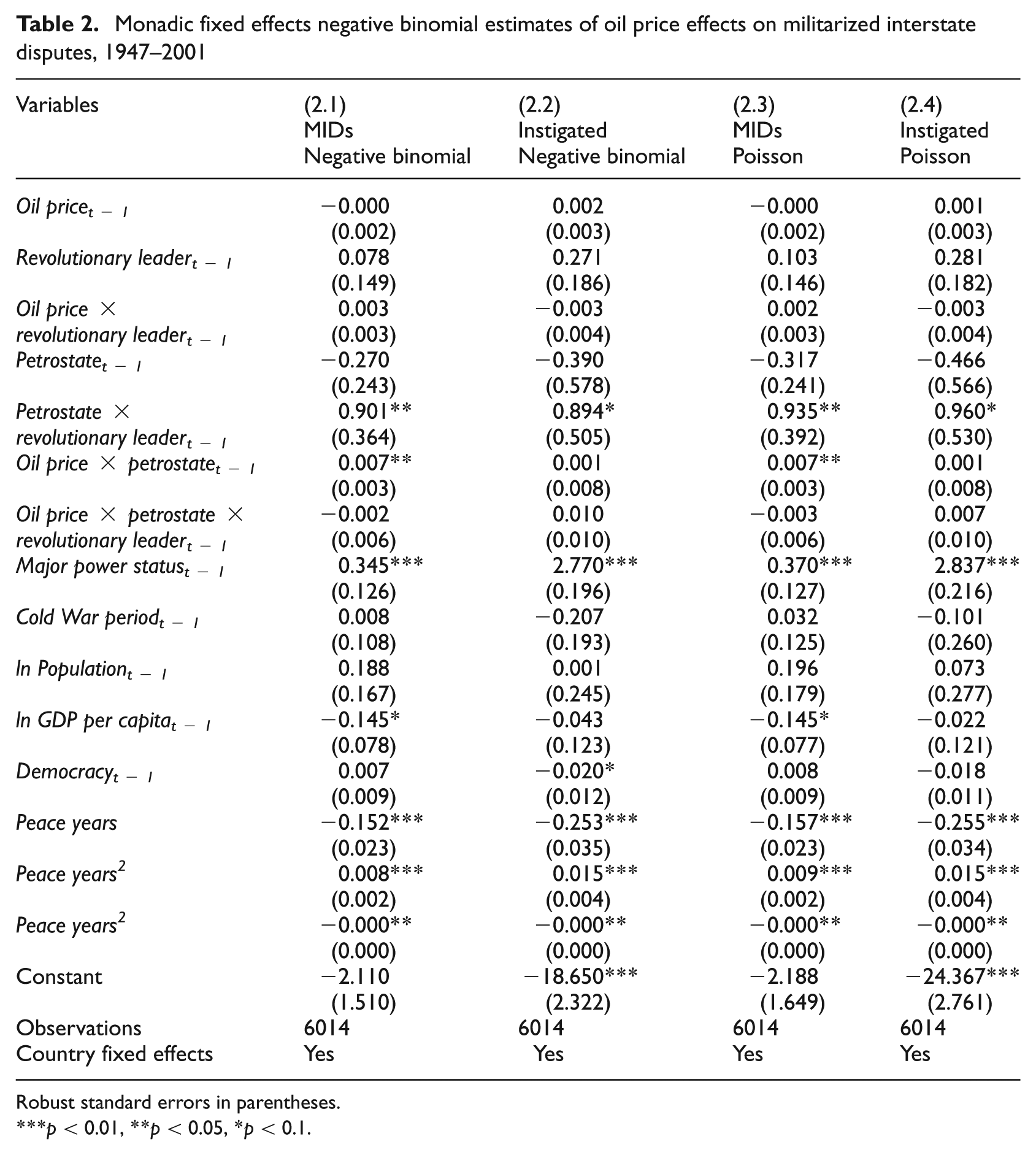
Table 2 presents results for the Colgan reanalysis; the odd-numbered models correspond to MID onsets and the even-numbered to instigated MIDs. Interaction terms complicate interpretation of coefficients, since levels of statistical significance are conditional on the mediating variable taking on a value of zero (Braumoeller, 2004). The dummy specifications of petrostate and revolutionary leadership, however, simplify interpretation. The coefficient on oil price represents the effect of oil prices on non-petrostate, non-revolutionary leader-led countries, while the coefficients on the petrostate and revolutionary leader represent the effect of these factors on MIDs and instigated MIDs when oil prices are zero—the effect necessarily varies across observed values of the interacted variable. To assess the impact of oil prices in petrostates and under revolutionary leaders, one must calculate the conditional slope as an additive function of the coefficients on oil price and the interaction terms.
Monadic fixed effects negative binomial estimates of oil price effects on militarized interstate disputes, 1947–2001
Robust standard errors in parentheses.
p < 0.01, **p < 0.05, *p < 0.1.
The results provide support for H1. Higher oil prices are associated with an increased frequency of MID onsets in petrostates, but not in non-petrostates. All things being equal, a one standard deviation (US$18.60) increase in the price of oil per barrel from the sample mean (US$33.81) is associated with a 13% increase in the frequency of MIDs (model 2.1). Phrased in Friedman’s terms, petrostates are roughly 30% more likely to be involved in disputes when oil prices are at US$60 per barrel than when they are at US$20 per barrel. No such relationship is found for non-petrostates, providing support for H4. Confirming the results of Colgan’s earlier analysis, however, the confluence of petrostate status and revolutionary leadership is associated with significantly more bellicose behavior, and this finding is not price contingent: the petrostate×revolutionary leader interaction term is positive and significant in all four specifications, while the oil price×petrostate×revolutionary leader interaction term is not statistically significant in all four specifications and the confidence intervals for revolutionary-led petrostates are so large as to be statistically indistinguishable from the other categories (non-petrostates and petrostates). Given that revolutionary-led petrostates are still petrostates, however, their dispute propensity increases as prices increase, although the proportional effects are smaller given the higher baseline incidence of MIDs.
The monadic results indicate that the bellicosity of petrostates relative to non-petrostates is price-contingent. Figure 3 plots predicted counts of MIDs for revolutionary-led petro-states, petrostates without revolutionary leaders, and non-petrostates across a range of values for oil prices. Above US$70 per barrel, petrostates are significantly more dispute-prone than non-petrostates: although the confidence intervals overlap, two-sample t-tests confirm that the estimated counts of MIDs for petrotates and non-petrostates are significant at and above US$70 per barrel. 17 Below US$30 per barrel, petrostates are less dispute-prone than non-petrostates, although the finding is not statistically significant. Revolutionary-led petrostates are the most dispute-prone across all oil prices, although the finding is statistically insignificant above US$70 per barrel.
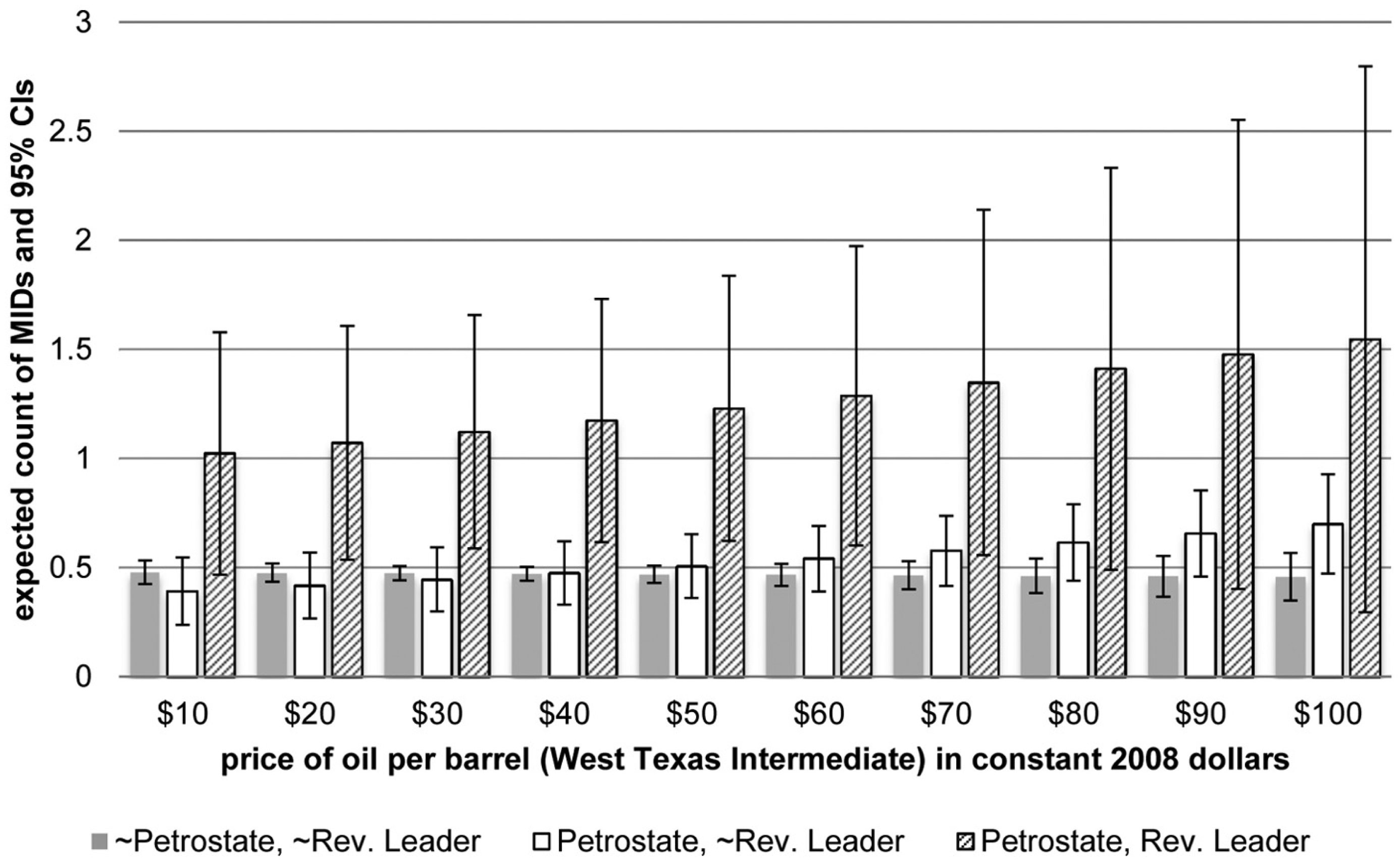
Expected counts of MIDs per year across the observed range of oil prices for non-petrostates, petrostates without revolutionary leaders, and petrostates with revolutionary leaders. Estimates based on monadic analysis presented in Table 2 (model 2.1). Source: author calculations.
The monadic results provide less support for a link between oil prices and initiated MIDs. The coefficients on oil price×petrostate in models 2.2 and 2.4 are close to zero with large confidence intervals. The coefficients on oil price×petrostate×revolutionary leadership are larger (β = 0.010) than those for oil price×petrostate in models 2.1 and 2.3, suggesting a potentially large effect on initiated MIDs. However, neither is statistically significant.
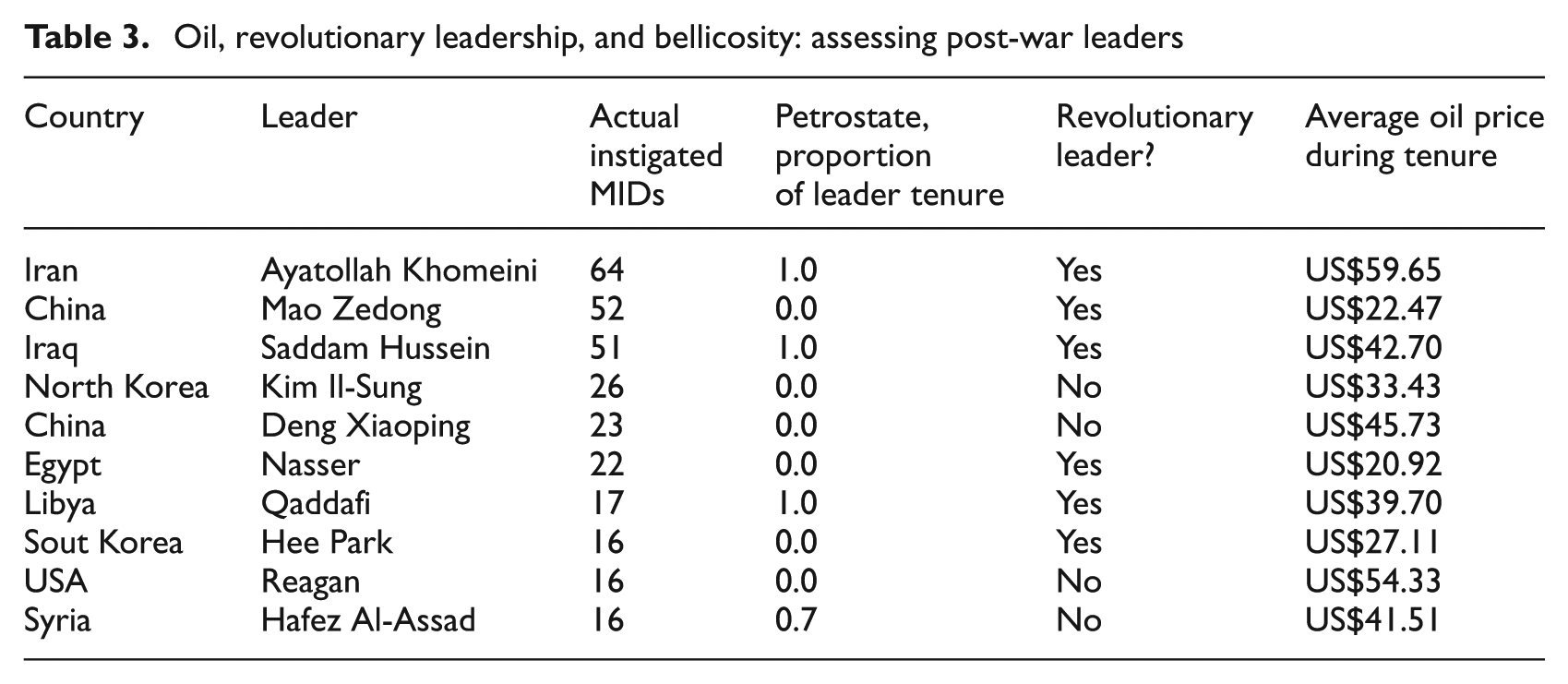
Descriptive statistics for the most bellicose leaders in the dataset are consistent with the findings derived from the econometric analysis. Table 3 presents the top 10 leaders by instigated MIDs per leader for all 1029 leaders in the dataset. Revolutionary leaders of petro-states account for three of the top 10 spots: Ruhollah Khomeini, Saddam Hussein, and Muammar Qaddafi. Revolutionary leaders of petrostates account for only 1% of leaders in the sample but 30% of the most bellicose. Moreover, average oil prices were above the sample mean during the tenures of these three leaders. The rest of the top 10 comprises the leaders of major powers (the USA and China), whose foreign policies tend to be more interventionist; long-serving Korean heads of state; and the non-revolutionary leader of an oil-exporting country (Syria). Replicating the same calculations for countries rather than leaders, the most bellicose countries are China, Iran, Iraq, the USA, and Turkey. While the USA and China are UN Security Council members, capable of projecting military power at a global scale, two of the top five positions are occupied by petrostates that have experienced significant periods under revolutionary leadership.
Oil, revolutionary leadership, and bellicosity: assessing post-war leaders
While the monadic findings do not support the notion that higher prices are associated with more frequent conflict initiation by petrostates, the dyadic results clearly indicate that oil prices affect initiator behavior. Table 4 presents results for the Weeks reanalysis. 18 Across both the more sparse and full sets of control variables and random vs fixed effects models, oil prices are correlated with an increased propensity to initiate MIDs by petrostates: the coefficient on oil price × petrostate, side a is positive and significant in all four models. Again, paraphrasing Friedman, petrostates are roughly 40% more likely to initiate disputes when oil prices are at US$60 per barrel than when they are at US$20 per barrel (model 4.5); oil prices do not affect the probability of dispute initiation in non-petrostates. Also, oil prices do not affect the probability that a petrostate will be the target of an MID: the coefficients on both petrostate, side b and oil price × petrostate, side b are insignificant. This finding helps rule out the notion that higher prices contribute to disputes in petrostates by making them more attractive targets for conquest. Thus, the directed dyadic results provide support for H2 but not H3.
Directed-dyadic random and fixed effects logistic regression estimates of oil price effects on militarized interstate disputes, 1947–1998
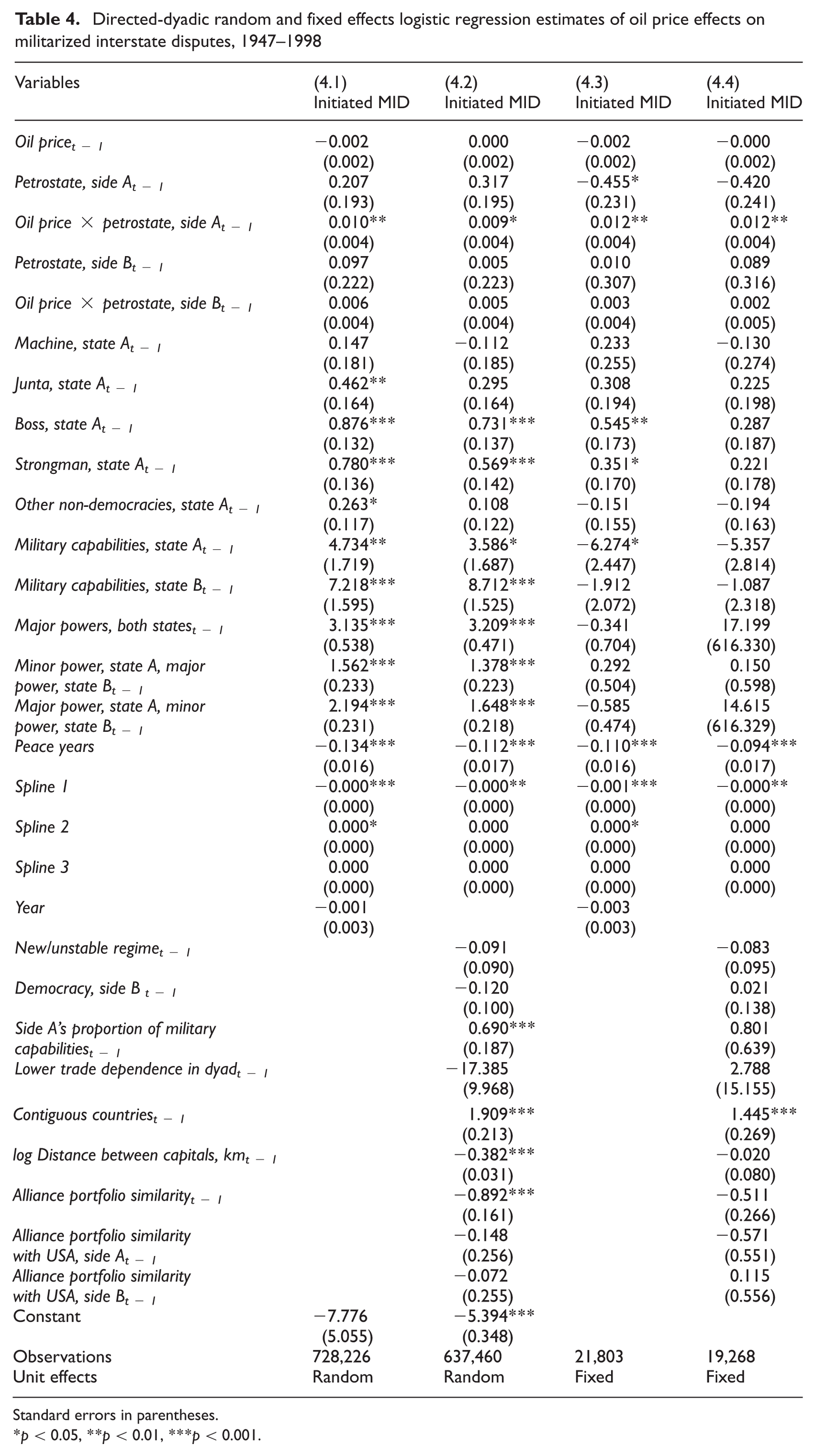
Standard errors in parentheses.
p < 0.05, **p < 0.01, ***p < 0.001.
Moreover, unlike in the monadic analysis, the relative bellicosity of petrostates vs non-petrostates is not particularly price contingent. Figure 4 plots the probability of MID initiation for petrostates and non-petrostates across a range of values for oil prices. Across the range of observed prices, petrostates are more likely to initiate MIDs than non-petro-states; the difference is statistically significant above US$30 per barrel (p < 0.05).

Estimated probability of MID initiation across the observed range of oil prices for petrostates and non-petrostates. Estimates based on dyadic analysis presented in Table 4 (model 4.1). Source: author calculations.
Some caution is warranted in interpreting the findings regarding initiated MIDs, however. While MIDs are observable, it is often difficult to assign clear initiator status in international disputes. If we believe that military action is governed by strategic dynamics and that military action can be initiated in response to non-military acts of provocation (e.g. public statements, declarations of territorial control, or threats of violence in the future), it significantly complicates the attribution of “aggressor” status. 19 However, to the extent said codings are defensible, the directed-dyadic results provide some additional support for the link between oil exporter status, oil prices, and bellicose behavior.
Are oil prices endogenous to conflict?
A possible alternative explanation for these findings is that conflict behavior, especially in oil-exporting states, drives up world prices, and thus the relationship is simultaneous (at best) or a case of reverse causality (at worst). There is plenty of anecdotal evidence to suggest conflict and/or unrest in oil-producing states affects market prices: in the month prior to Iraq’s invasion of Kuwait, oil had been trading at US$17.30 per barrel; in the month after, the price had shot up almost 60%. This case, however, may be atypical. Kuwait is one of the world’s top five exporters; Iraq is itself an oil-exporting country; and both are located in the Middle East, home to the world’s largest oil reserves.
Typically, instrumental variables would be useful in parsing causality. Ramsay (2011), for instance, uses natural disaster damage in oil-producing states as an instrument for oil income, which he demonstrates has negative effects for political democracy. However, the effects reported here are all interactive; thus, for instrumental techniques to provide leverage, one would need credible instruments not just for oil prices, oil exporter status, and revolutionary governments but also for their separate interactions. One cannot simply estimate interactions between an endogenous regressor with a valid instrument and non-instrumented mediating variables. 20
Instead, whether dispute behavior in the aggregate affects oil prices at the yearly level is assessed. Table 5 presents results for simple time series regression of global oil prices for 1947–2001 as a function of lagged prices (t−1) and various contemporaneous measures of dispute behavior in the international system: the total number of MIDs systemwide (models 5.1 and 5.2), the total number of MIDs in oil-exporting states (models 5.3 and 5.4), and finally the total number of MIDs in revolutionary-led oil-exporting states (models 5.5 and 5.6). Results are reported both for raw counts and log-transformed counts.
Time series estimates of dispute behavior and global oil prices, 1947–2001
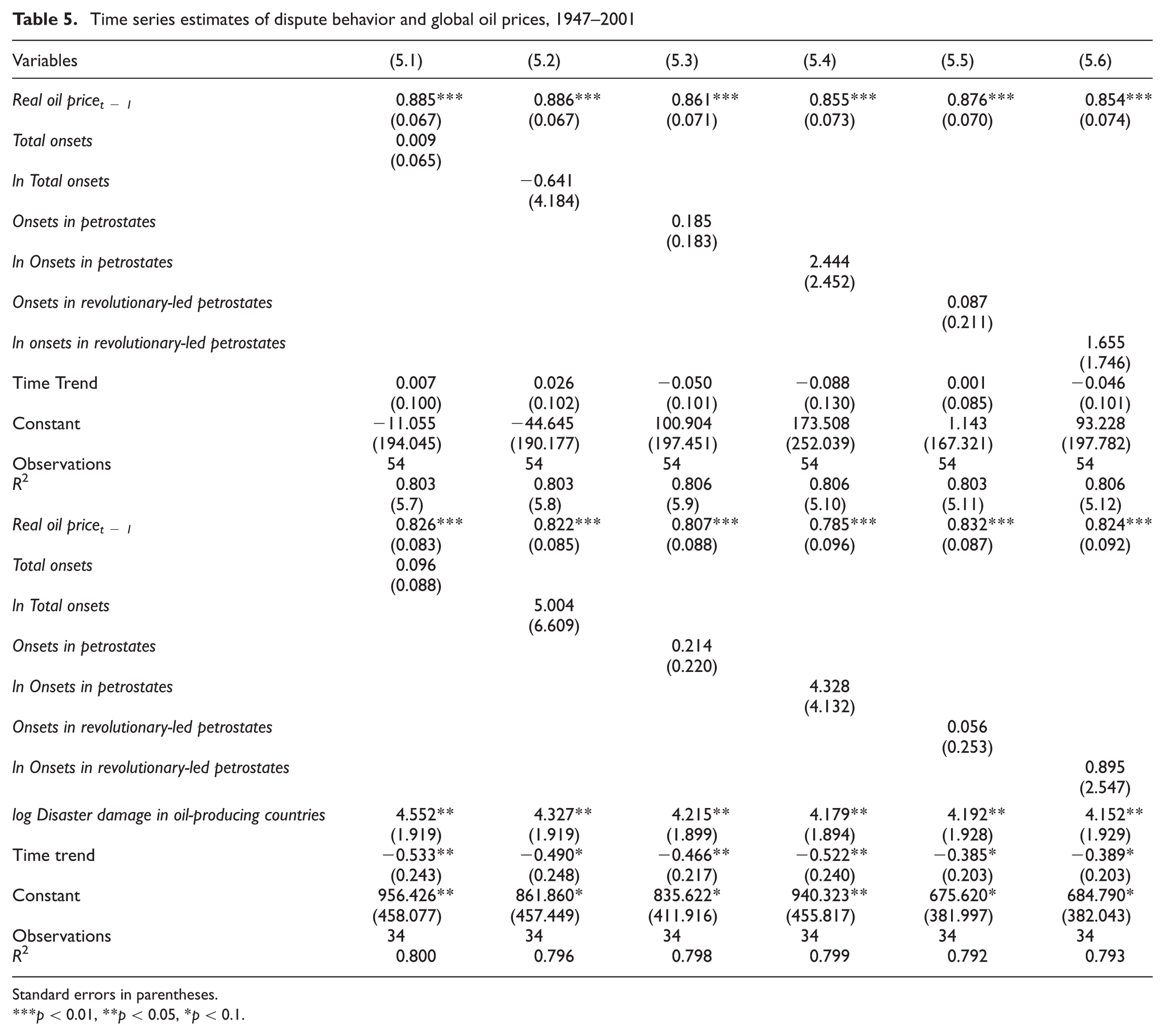
Standard errors in parentheses.
p < 0.01, **p < 0.05, *p < 0.1.
If dispute behavior is driving price changes at the global level, we should see positive correlations between these various operationalizations of conflict behavior and oil prices at time t. However, we do not: none of the coefficients on the dispute measures are significant; while the coefficient estimates for MIDs in petrostates and revolutionary-led petrostates are relatively large, the p-values are close to 1. There is no evidence that oil prices—or rather, oil price changes—are driven by dispute behavior at the global level or aggregate dispute behavior in oil-exporting states. Models 5.7–5.12 replicate the analysis, but include the logged, summed value of all damage from the natural disasters in oil-producing states 21 measure from Ramsay (2011), where natural disaster damage is shown to be a strong determinant of decreases in oil production. Although the sample is truncated owing to data availability, it provides strong evidence that natural disaster damage in oil-exporting countries is a significant driver of global prices, while dispute behavior is not. The coefficients on disaster damage are positive and significant (p < 0.05) in all six specifications, but never for the aggregate measures of dispute behavior. Oil prices may embolden more bellicose foreign policies among petrostates, but their dispute behavior does not, in the main, drive oil prices.
This evidence is at odds with conventional wisdom but consistent with some of the theor-etical mechanisms outlined earlier. While dispute behavior may drive price changes in the short term (i.e. over a period of days or weeks 22 ), the strategic significance of oil prices and oil-exporting states encourages major powers to act in ways that stabilize markets, either through market intervention, as with the release of oil from the US Strategic Petroleum Reserve in 1990, or through direct, armed intervention, as with Operation Desert Storm. Oil prices may have shot up 60% in the month after Iraq’s invasion of Kuwait, but the day after the US-led coalition commenced aerial bombing against Iraqi targets, they fell by nearly a third (from US$30.28 per barrel on 16 January 1991, to US$21.10 per barrel on 17 January), back to pre-invasion levels. By the end of hostilities, oil was back to trading at less than US$20 per barrel.
Conclusions
Friedman’s First Law of Petropolitics is consistent with an emerging body of evidence on the domestic political effects of oil resource wealth: democracy and oil wealth are inversely related (Andersen and Ross, 2014; Ross, 2001; Tsui, 2011), and as the price of oil rises, democracy in oil-producing countries wanes (Ramsay, 2011). 23 States with large endowments of oil wealth perform systematically worse in respecting human rights (DeMeritt and Young, 2013). Moreover, there is an emerging body of evidence that oil producer status exerts powerful effects on those countries’ international affairs as well, suppressing participation in institutions of global governance (Ross and Voeten, 2015) and, when combined with revolutionary, revisionist ambitions, making them more conflict-prone (Colgan, 2010, 2013). However, our knowledge of how oil prices affect interstate behavior is comparatively scant, since these studies do not explicitly incorporate price effects. This article addresses that gap, and provides evidence that petrostates are emboldened by high oil prices to behave more aggressively in the international arena. Moreover, it provides evidence that dispute behavior in petrostates is not as significant a driver of oil prices as conventional wisdom might suggest. While some major conflicts between oil exporters have moved markets temporarily (Iran–Iraq in 1980, Iraq–Kuwait in 1990), natural disasters in oil-producing states prove much more disruptive to markets than international disputes involving petrostates.
Ramsay (2011: 527) notes that an emphasis on prices, rather than a simple binary distinction (oil-producing/exporting state or not) “puts into play many new factors about the resource curse: world prices, strategic cartels, and drilling and environmental policies in the developed world can now all be understood as having important implications for the political development of oil rich countries”. This article demonstrates these price effects extend beyond the domestic political development of resource producers and into the international arena. A focus on prices, rather than producer status, opens the door also to practical policy implications. For instance, Iran is now, and will be for the foreseeable future, a petrostate; no policy intervention is likely to change that reality in the near term. To the extent that conservation, alternative fuel policy in developed countries, and increased exploration/supply diversification bring down prices, they will also have the positive externality of reducing conflict in the international system.
Footnotes
Funding
This research was supported by the Smith-Richardson Foundation via grant no. 2008-7432.