




Abstract
This study relates economic development to one of the well-observed predictors of domestic terrorism—minority discrimination—and revisits the relationship between terrorism and economic development. We argue that terrorism may be a rational choice when minorities’ exclusion from political power and relative deprivation from public goods increases and the unsettling forces in the initial phases of economic development provide aggrieved people with opportunities for mobilization. We find that economic development has a curvilinear relationship with terrorism. Highly developed countries are less likely to experience domestic terrorism than less-developed ones and the least developed countries have few targets. However, both rich and middle-income countries are vulnerable to domestic terrorism in the presence of minority discrimination.
Introduction
In the quantitative and qualitative terrorism literature, questions like “How does economic development affect terrorism?” and “Does minority discrimination in the form of economic discrimination and political exclusion increase terrorism?” have been explored and analyzed (Bradley, 2006; Choi and Piazza, 2014; Freytag et al., 2011; Kis-Katos et al., 2011; Lai, 2007; Li, 2005; Li and Schaub, 2004; Piazza, 2011). However, there is little scholarly study on: “How does economic development affect domestic terrorism in the presence of minority discrimination?” Several case studies (Buendia, 2005; Ergil, 2000; Whittaker, 2001) and large-N quantitative studies (Choi and Piazza, 2014; Piazza, 2011, 2012) have found that minority discrimination is a robust predictor of terrorism. Discrimination against minority groups may be a major source of grievance against a state. However, minority groups’ decision to resort to violent tactics like terrorism against the state might be aggravated by the unsettling forces rising in the initial phases of economic development. This paper explores how grievances interact with opportunities to produce terrorism. Although most studies (Abadie, 2006; Krueger and Laitin, 2008; Piazza, 2008a; Savun and Phillips, 2009) assume a linear relationship between terrorism and economic development, Enders et al. (2014) have found that terrorism and development have a curvilinear relationship. We revisit the relationship between terrorism and economic development with the finding that middle-income counties are indeed more vulnerable to domestic terrorism than either very poor or very rich countries. However, this research contributes to the terrorism literature by exploring the impact of economic development on terrorism in the presence of minority discrimination. We find that both middle-income and rich countries are equally at higher risk of domestic terrorism if one or more national minorities are discriminated against. Economic growth reduces domestic terrorism in general, but increases domestic terrorist incidents in the presence of minority discrimination.
We focus on domestic terrorism because, first, it occurs far more frequently than transnational terrorism, although the latter generates more media and scholarly attention (Abadie, 2006). Domestic terrorism represents by far the greatest part of all terrorist violence. Sandler (2003) notes, “Domestic terrorism is home grown and has consequences for only the host country, its institutions, people, property, and policies”. Second, any causal driver of domestic terrorism is endogenous to a state. Both economic development and discrimination, being endogenous to a state, are more applicable to domestic terrorism. Since our theoretical argument involves the interactive role of development and discrimination, we confine our present study to domestic terrorism.
The extant literature on development and terrorism
Extant literature on the economic drivers of terrorism inconclusively pulls in different directions. A study by Li and Schaub (2004) shows that economic development reduces the incidence of transnational terrorism in a country, thus giving credence to the neo-liberal reasoning of capitalist peace. On the other hand, Kis-Katos et al. (2011) find that terrorism is significantly more likely to originate from richer and more urbanized countries than from poorer countries. Other studies find no relationship between poverty and terrorism (Abadie, 2006; Boylan, 2010; Krueger and Laitin, 2008).
The widespread view that poverty creates terrorism has dominated much of the debate that was generated after the 9/11 attacks (Kahn and Weiner, 2002). The notion that poverty generates terrorism is consistent with the results of most of the literature on the economics of conflicts. Alesina et al. (1996) suggest that poor economic conditions increase the probability of political coups; Collier and Hoeffler (2004) show that economic variables are more powerful predictors of civil wars than political variables. Because terrorism is a manifestation of political conflict, these results seem to indicate that poverty might play an important role in explaining terrorism. Recent empirical studies, however, have challenged the view that poverty creates terrorism. Russell and Miller (1983) find that most terrorists arrested in Latin America, Europe, Asia and the Middle East came from middle- or upper-class families in their respective nations or areas. Similarly, Abadie (2006) shows that gross domestic product (GDP) per capita had no statistical relation with terrorist risk in 186 countries for 2003–2004; poverty is not related to terrorism. Other large-N studies support the above finding that poverty neither increases nor decreases terrorism (Boylan, 2010; Krueger and Laitin, 2008). On the other hand, some studies relate terrorism to economic prosperity (Berrebi, 2007; Lai, 2007). The scholarly disagreement over the role of economic drivers of terrorism is compounded by studies (Burgoon, 2006; Krieger and Meierrieks, 2010) arguing that social welfare policies—including social security, unemployment, health, and education spending—discourage terrorism by reducing poverty, inequality and socio-economic insecurity. Moreover, Choi (2015) finds that when countries enjoy high levels of industrial growth, they are less disposed to domestic and international terrorist events. The finding that economic growth might exert a dampening effect on terrorism renders the research on the economic drivers of terrorism even more inconclusive.
In explaining variation in domestic terrorism with economic development, the two contending schools of thought that traditionally connect conflict in general to economic development need a brief review. Although liberal and dependency theories have been widely used to explain interstate conflict, a limited number of scholars have also extended these theoretical explanations to intrastate conflicts. These two theories would generate two diametrically opposed sets of hypotheses. Liberal theory would causally connect economic development to reduction in terrorist violence. On the other hand, dependency theory would predict an increase in terrorism owing to socio-economic inequality resulting from the process of development (Hegre et al., 2003). In reality, we are witnessing an increase in terrorism, economic development and rising socio-economic inequality all at the same time. Therefore, neither the liberal model nor dependency theory can fully capture the present-day trends of development, inequality and intrastate violence. A new theoretical framework that combines both liberal and dependency theories and provides a better explanation for these emerging trends is needed. This paper contributes to the terrorism literature with the finding that in the presence of minority discrimination during the initial phases of development, domestic terrorism increases by providing grievances and opportunities for mobilization. Subsequently, economic development has a curvilinear relationship with domestic terrorism. Highly developed countries are less likely to experience domestic terrorism than less-developed ones and the least-developed countries suffer little terrorism. However, rich countries, similar to middle-income countries, are vulnerable to domestic terrorism in the presence of discrimination. 1
Economic development and terrorism: Looking beyond a linear relationship
A common belief among many, including many prominent world leaders and policy makers, is that terrorist activity is the result of poverty and/or ignorance (see Krueger, 2007). The basis of such a belief is that individuals who have “nothing to lose” (or comparatively less to lose) will be more likely to engage in self-destructive activities. Assuming that the logic of political violence against the state follows the traditional economic theory of crime (Becker, 1968), terrorism should have a greater appeal to those with lesser marketable options, and terrorist organizations should be populated with those individuals who have the lowest market opportunities. Does abject poverty lead to higher levels of terrorism? The answer would probably be negative. The destitute want material benefits like food and shelter, not policy changes. We mostly see civil wars begin over the control of resources in the poorest of the poor nations (see Collier, 2007). However, terrorism involves the demand for political, social or economic changes and such demands require a certain level of education and understanding of political and economic issues. Unlike civil war, most terrorist campaigns are fought over ideologies, which are usually outside the scope of the destitute, and being poor does not necessarily always result from being discriminated against. Moreover, unlike mercenaries involved in most civil wars, foot soldiers in terrorist campaigns generally have a strong commitment to their ideologies and are recruited on the basis of skills to carry out successful attacks (Lai, 2007). This hypothesis, that the destitute are not likely to be interested in political changes, can be supported by the observation that in several democracies the poor are less likely to cast their votes than their more prosperous fellow citizens (Ethridge and Handelman, 2012). Studies on terrorism empirically also support this hypothesis. Berrebi (2007), studying the terrorist activities of Hamas and Palestinian Islamic Jihad (PIJ) between the late 1980s and May 2002, finds that both higher education 2 and standard of living are positively associated with participation in Hamas or PIJ and with becoming a suicide bomber.
Several scholars, both economists and political scientists, have extensively elaborated on why people with higher levels of education and wealth are more likely to participate in terrorism than others (Abadie, 2006; Berrebi, 2007; Kis-Katos et al., 2011; Krueger, 2007; Lai, 2007; Piazza, 2006, 2011). Their arguments can be summarized in the following way. First, educational attainment, an indirect measure of relative prosperity, may potentiate terrorist activity because educated individuals may be more aware of instances of injustice and may contribute to the development of a sense of social responsibility and civic engagement. Second, terrorist organizations might attract richer individuals because richer individuals who come across barriers might suffer increased grievances and restrictions that poorer individuals do not even know exist (e.g. access to financial markets and commercial spheres). Third, the participation of better-educated individuals in terrorist activities may result from a deliberate choice of terrorist organizations in selecting better-educated individuals for their skills to carry out successful attacks. For example, Bueno de Mesquita (2005) argues that terrorist organizations, owing to the demanding nature of the job, screen recruits for those who are the most qualified. While those with low economic ability, low education and strong antigovernment dispositions are among the most likely to volunteer, terrorist organizations screen recruits from among the population willing to volunteer, and accept those that are the most skilled and educated. Moreover, acts of terror may require the investment of personal capital, for example, when weapons must be acquired on the expensive black market. In such cases, the wealthier of two equally motivated individuals may be chosen by the organization. Fourth, rich countries are replete with valuable targets that host governments value. On the contrary, most poor countries have few valuable targets. 3 Finally, rich countries have a greater presence of mass media than poor countries. Since terrorist organizations want extensive publicity, they will be most active in rich countries. This discussion will naturally lead one to hypothesize a linear and positive relationship between economic prosperity and domestic terrorism. However, we go beyond this linear relationship and argue that the middle-income countries are more vulnerable to homegrown terrorist attacks than others; domestic terrorism might decline as a country reaches a very high level of economic development.
Why are the middle-income countries more vulnerable to domestic terrorism than others? The process of economic development in its initial phases might cause grievances among sections of the population and, at the same time, create opportunities for violent political opposition to a state. At a general level, the Hecksher–Ohlin and Ricardo–Wiener–Samuelson theories of trade (Dixit and Norman, 1980) suggest that the process of economic development helps poor countries because labor, the abundant factor, benefits while capital, the scarce factor, may lose from greater openness to global markets. These theories also tell us that a country’s outward-oriented industry benefits while its inward-oriented industry may lose owing to openness to imports. While these stylized theories are useful, Flaten and de Soysa (2012) argue that it is hard to systematize how rich capitalists in developing countries and people associated with importing industries actually foment conflict. We need to look at more specific causal mechanisms to connect the process of development to domestic terrorism. Those causal mechanisms are discussed below.
First, the relationship between the capitalist model of economic development and conflict is modeled as a struggle between the winners and losers of global competition, and the resultant economic and social inequality. Economic development does not equally benefit everyone in society. The benefits of neo-liberal economic policies may not trickle down to the vast majority of poor people in the initial stages of development. Following Kuznets’s (1955) hypothesis, 4 several economists (Ahluwalia, 1976; Campano and Salvatore, 1988; Chang and Ram, 2000; Chenery and Syrquin, 1975; Eusufzai, 1997; Huang and Lin, 2007) have explored the phenomenon of rising inequality during the initial phases of economic development and presented empirical support for the argument. The relationship between inequality and intra-state conflict is age-old. Lichbach (1989) points out that many revolutions have been based on egalitarian ideas. 5 Likewise, Gurr (1970, 1993) argues that relative deprivation—a phenomenon whereby individuals become aggrieved when their material status does not match up to their expectations, partially set by the higher socioeconomic status of others in society—can explain the occurrence of political violence, thus linking socioeconomic inequality to terrorism. Piazza (2011) has also found strong empirical evidence that economic inequality is a robust predictor of domestic terrorism.
Second, increased economic competition might spur a “race to the bottom” in social standards, setting the stage for violent resistance and conflict. The spread of corporate capitalism and neoliberal policies can privilege capital over communitarian values. In addition, curtailing government control over taxing and spending decisions leads to the lowering of safety nets for the losers, and lower production of public goods (Rodrik, 1997). Countries seeking assistance from international financial institutions like the World Bank and IMF in the form of grants, aid and loans are often forced to adopt unsuitable neoliberal policies that may harm ordinary people (Woods, 2006). These initiatives primarily include a reduction in expenditure on social sector and development spending (Nooruddin and Simmons, 2006). Third, stiff economic competition might prompt the government to violate people’s human rights. The plight of small farmers and sharecroppers in India in the wake of the country’s post-1990 economic liberalization can be cited here to support the above suppositions. Scholars often connect India’s Maoist insurgency and terrorism to the government’s neo-liberal policy restructuring like the withdrawal of farm subsidies, the forceful acquisition of farm land for foreign investors and the forceful displacement of millions of tribal people from their ancestral forest land without proper resettlement (Chenoy and Chenoy, 2010; Walker, 2008). Fourth, many countries lack proper conflict-resolution mechanisms and other institutions that are necessary for neo-liberal policies to function in their initial phases of development. Crony capitalism, corruption and government inefficiency might create discontent against governments in many countries. For example, most factories in the ready-made garments sector in Bangladesh pay little attention to labor standards and labor rights, unsafe working environments, sexual harassment, torture of women and child labor. The government agencies’ negligence regarding flagrant violations of laws and fair labor practices has led to labor unrest in the ready-made garments sector and discontent in larger Bangladeshi society (Khan, 2006; Kumar, 2006). Fifth, terrorism is predominantly a form of urban warfare. “Urbanization is part of the modern trend toward aggregation and complexity, which increases the number and accessibility of targets and methods” (Crenshaw, 1981). In the initial phases of development cities emerge as centers of industrial production. Finally, terrorism is often associated with the emergence of an educated middle class. As a country transfers from an agrarian to an industrial economy the emerging middle class desires the social and political changes that are grounded in their respective ideologies. The economic elites who are strong at the beginning of development desire to maintain the status quo, whereas the weaker middle class intelligentsia strive to be the political stakeholders. For example, in the Russian anti-Tsarist revolutionary terrorism, the revolutionaries came from urban educated elites and almost always enjoyed support from a section of urban intelligentsia with limited appeal to the masses (Pomper, 1995). Similarly, a Marxist study group in Huamanga University under Professor Guzman in the 1960s started the Shining Path in Peru (Palmer, 1995).
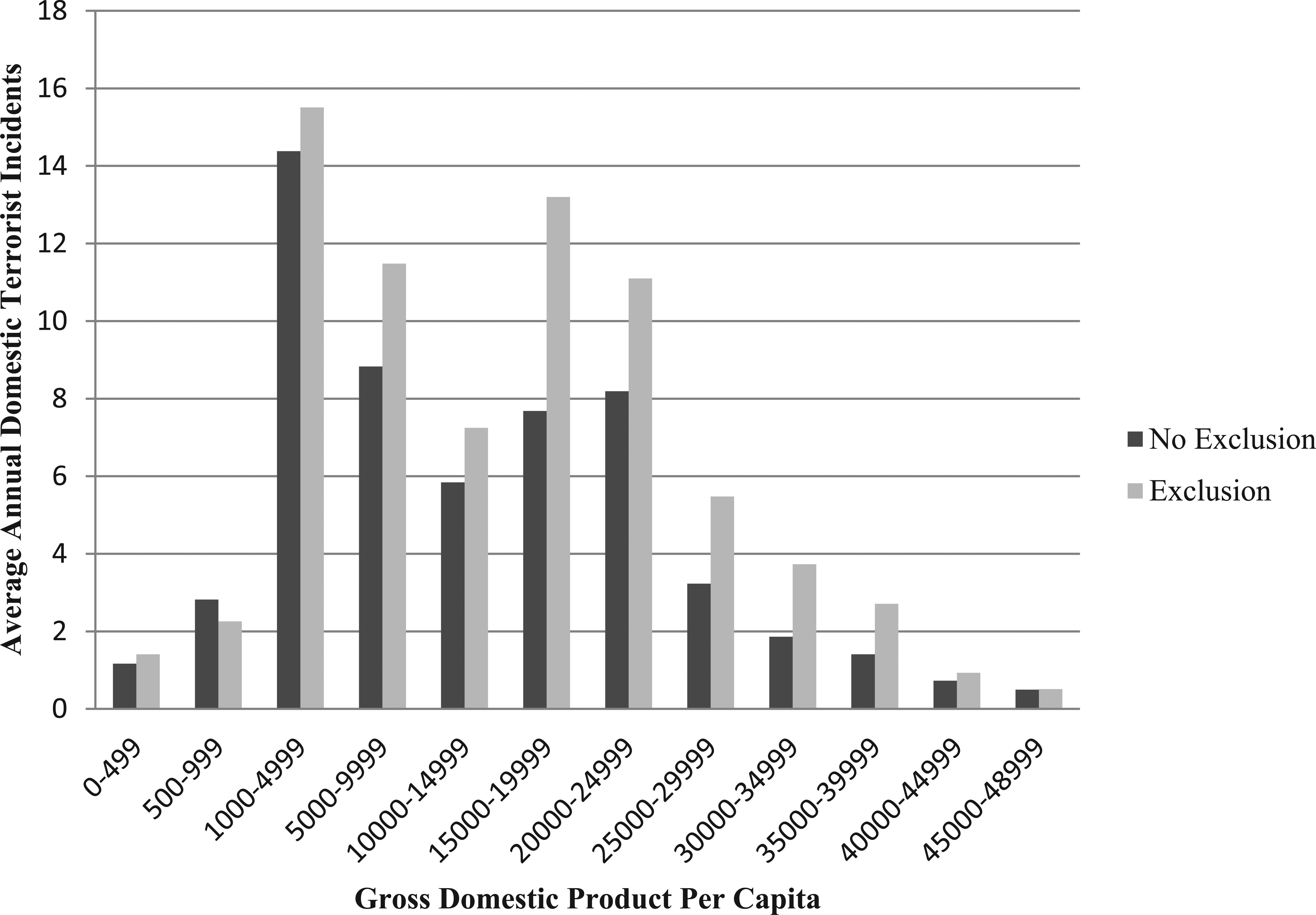
As the level of economic development crosses a certain threshold, we would expect domestic terrorism to decline. The data indicate that domestic terrorism is at its peak at an annual per capita GDP between US$1000 and 5000; terrorism starts to decline as per capita GDP crosses US$25,000 per year. 6 There are few incidents of domestic terrorism in a country-year when the annual GDP per capita is above US$45,000 (see Figure 1). Several factors might contribute to this declining pattern of terrorism at a high level of prosperity. First, the wealth generated at a high level of prosperity should enable a state to provide a higher level of welfare to the people affected by the unsettling forces unleashed in the initial stages of development, thus alleviating their grievances that led them to challenge the state in the first place. Some studies, in fact, support the supposition that an increase in welfare spending relative to GDP reduces the number of terrorist incidents occurring in a country and the total number of transitional terrorism incidents originating from a country (Burgoon, 2006). A similar study on the effect of welfare policies (indicated by social spending and welfare regime variables) on homegrown terrorism in Western Europe shows that domestic terrorism decreases as the total welfare spending increases (Krieger and Meierrieks, 2010). Second, high levels of development would generate income for a greater number of people and increase their opportunity cost to challenge the state (Enders et al., 2014). Third, rich countries generally have better political institutions such as an efficient bureaucracy, independent judiciary and impartial criminal justice system that go through a maturing process during the period of economic transition. In such cases, people are less likely to resort to extra-constitutional methods of political violence when grievances can be alleviated though peaceful constitutional means. In other words, economic prosperity might bring political stability, resulting in a decline in domestic terrorism. Finally, rich countries will have the resources necessary to implement effective counterterrorism measures (Enders et al., 2014). Better intelligence networks and the effective policing of a country’s territory can prevent potential acts of terrorism. A look at the State Fragility Index (Marshall and Cole, 2010) supports the view that most rich states are also strong. In addition, many studies have identified state weakness to be associated with high levels of terrorism (Lai, 2007; Piazza, 2008b).

Annual average counts of domestic terrorism in different income level countries, 1970–2007.
This section laid out the reasons why domestic terrorism might have a curvilinear relationship with economic development; that a country will experience higher levels of domestic terrorism as economic development increases, but that domestic terrorism is likely to decline as the country becomes highly developed. Now we will turn to a discussion regarding minority discrimination because its presence might change the curvilinear relationship between terrorism and economic development.
Minority discrimination, development and terrorism
An important factor in explaining terrorism is “the existence of concrete grievances among an identifiable subgroup of a larger population, such as an ethnic minority discriminated against by the majority” (Crenshaw, 1981). Discrimination against minority groups who may not share vital characteristics with those of the dominant group(s)—and who may have historically suffered from social, ethnic, political and/or religious discrimination—is widespread. Minority groups, with few exceptions, seldom have political clout in a polity. Ethnic, linguistic and religious fault-lines have often been the basis for political mobilization. When political parties are organized along divisive lines, discrimination against minorities gets institutionalized. The costs incurred by minority groups as a result of discrimination may outweigh the benefits of living in a heterogeneous state. In such cases the minority groups are likely to challenge the state when they are discriminated against. Empirically, political exclusion and discrimination have been shown to be predictors of domestic terrorism (Choi and Piazza, 2014; Piazza, 2011, 2012). In a heterogeneous state where one or more minority groups have long been discriminated against, economic development would benefit the majority population. Minority groups are likely to lack skills and resources to reap the benefits of industrialization. Moreover, the dominant groups might monopolize all the benefits of economic development by deliberately excluding minority communities. By lowering the opportunity cost of violence for the losers in the development process, adoption of neo-liberal economic policies can increase domestic conflict (Magee and Massoud, 2011). If the losers in the development process are from minority communities, terrorist organizations might see an increase in recruitment as they benefit from an increase in grievances against the state. Therefore, a country will experience higher levels of terrorist violence not only in the initial phase of development, but also at a very high level of development. Exclusion from executive-level political power in order to redress their grievances might further increase them, even in a high-income state. With reduced access to executive-level institutions, minority groups will be less likely to take advantage of the conflict-resolution mechanisms in high-income countries that could mitigate their grievances. In addition, when a government pursues policies of discrimination against minorities, they would be deliberately excluded from many public good provisions even in very rich countries. A cursory look at the data would support this supposition that a country that discriminates against one or more national minorities is likely to suffer from domestic terrorism even at a higher level of development.
In Figure 1, we observed that domestic terrorism declines when a country reaches an annual GDP per capita of US$25,000. An annual average of 8.98 incidents of domestic terrorism is observed for all the middle-income countries (US$1000–25,000 GDP per capita per year) in our dataset between 1970 and 2007. For all of the countries above an annual GDP per capita of US$25,000, the yearly average of domestic terrorist incidents comes down to 1.81. However, for the countries where one or more national minorities are politically discriminated against, the annual average of domestic terrorist incidents does not decline so sharply, even though their annual GDP per capita is above US$25,000. An annual average of 7.82 incidents is reported for these high-income (above US$25,000) countries with a high level of discriminatory policies and practices. 7 For example, the UK has had an annual GDP per capita over US$25,000 since 1999, but it has experienced a yearly average of 17.44 terrorist incidents between 1999 and 2007. Similarly, Spain crossed the US$25,000 GDP threshold in 2003, but it has suffered 16.4 annual attacks from domestic terrorist groups on average between 2003 and 2007. Both the UK and Spain are known to have been discriminating against the Irish and Basque minorities for a long time. 8 In fact, countries, irrespective of their levels of development, experience higher levels of domestic terrorist incidents in the presence of political exclusion than they do in the absence of political exclusion (see Figure 2). 9 We form the following two hypotheses from the above discussion:
Annual average counts of domestic terrorism in different income level countries in the presence of political exclusion, 1970–2007.
Research design
The following models are used to test our hypotheses: 10


where µ is the constant, β1−β10 are coefficients for the independent variables, and ε is the error term. Subscript i =1, …, N is the country, T is the year, and t = 1. To test the above hypotheses, we used random effect and fixed effect panel-data models with a negative binomial specification. We built a country-year database of 172 countries from 1970 to 2007. Because the dependent variable is an event count, ordinary least squares estimates can be inefficient, inconsistent, and biased (Long, 1997). Our decision to use negative binomial estimators—rather than ordinary least squares or Poisson models—is recommended by some unique features of the dependent variable. First, it does not include negative values. Second, it is highly unevenly distributed across cases and years, resulting in a wide difference between the mean and standard deviation. The Poisson regression model is often applied to model event counts in which the mean of the distribution is conditional on the independent variables. However, the Poisson regression model assumes that the conditional mean of the dependent variable equals the conditional variance. This assumption which may be violated in our models (see Online Appendix Table B 11 ) would cause underestimated standard errors and spurious statistical significance (Li and Schaub, 2004).
The dependent variable is the annual count of domestic terrorist incidents in a country. Enders et al. (2011) formed the most reliable dataset on domestic terrorism by deriving their count of domestic terrorist incidents occurring within countries by separating domestic from transnational terrorist incidents published in the widely used Global Terrorism Database (GTD). The GTD is a publicly available, open source event-count database of aggregated domestic and transnational terrorist incidents from 1970 to 2014 built and managed by the National Consortium for the Study of Terrorism and Responses to Terrorism (2012), housed at the University of Maryland. 12 Enders et al. (2011: 3) decompose incidents as transnational and domestic identifying 12,862 transnational terrorist incidents between 1970 and 2007. Next, after identifying uncertain incidents from the remaining terrorist events in the GTD, the remaining 46,413 incidents are identified as domestic terrorist events. This differentiated dataset covers the period between 1970 and 2007. The number of incidents per year measures the existence of terrorism and how widespread terrorism is in a particular country. It has been widely used by scholars in studies of terrorism (Krieger and Meierrieks, 2010; Lai, 2007; Li and Schaub, 2004; Piazza, 2011).
We use one right-hand-side variable to directly measure one of our primary theoretical variables of interest, minority discrimination, and four right-hand-side variables as measures of economic development. Our measure of minority discrimination as a grievance is the percentage of a country’s discriminated population taken from the Ethnic Power Relations (EPR) dataset (Wimmer et al., 2009). 13 The EPR dataset identifies all politically relevant ethnic groups around the world and measures their access to executive-level state power for members of these ethnic categories in all years from 1946 to 2010; this refers to the “presidency, cabinet, and senior posts in the administration, including the army” (Wimmer et al., 2009). Politically excluded minority groups are likely to be deprived of several public good provisions such as education, employment and other benefits.
We use four measures that operationalize economic development. First, we use the natural logarithm of GDP per capita (measured at constant 2005 US dollars). 14 The data on this variable come from the Penn World database (Heston et al., 2012). It is lagged by one year in order to avoid the problem of simultaneity. Several studies on terrorism have used log GDP per capita as a measure of development (Freytag et al., 2011; Kis-Katos et al., 2011). Second, we use the rate of GDP growth as a measure of economic development (measured at constant 2005 US dollars) from the World Bank (2012) database. The rate of GDP growth is the change in percentage of GDP from the previous year. The percentage of GDP growth has been used in conflict studies on terrorism (Choi, 2015). We lag this variable too by one year in order to avoid the problem of simultaneity. Third, we fix GDP per capita at three values—up to the 50th percentile (US$2431 and below), up to the 75th percentile (US$7436 and below) and over the 95th percentile (US$26,469 and above). Our theoretical expectation is that, ceteris paribus, countries at the 95th percentile and above (absent the presence of minority discrimination) will be negatively associated with domestic terrorism while countries at the two other levels will be positively associated with domestic terrorism. Fourth, we use GDP per capita (in US$1000). Both variables are lagged by one year in order to avoid the problem of simultaneity and come from the Penn World database (Heston et al., 2012). 15
A host of controls that frequently appear in empirical studies of terrorism (Li, 2005; Piazza, 2011; Wade and Reiter, 2007) are also included in all models. The Polity IV dataset (Marshall and Jaggers, 2010) is used to operationalize regime type. The Polity IV conceptual scheme examines concomitant qualities of democratic and autocratic authority in governing institutions, rather than discreet and mutually exclusive forms of governance. This perspective envisions a spectrum of governing authority that spans from fully institutionalized autocracies through mixed, or incoherent, authority regimes to fully institutionalized democracies. The Polity Score captures this regime authority spectrum on a 21-point scale ranging from −10 (strongly autocratic) to +10 (strongly democratic) and consists of six component measures that record key qualities of executive recruitment, constraints on executive authority and political competition. It also records changes in the institutionalized qualities of governing authority. Using the combined 21-point democracy–autocracy scale, states are coded as one of three regime types: autocratic (−10 to −6), anocratic (−5 to 5) and democratic (6 to 10). This breakdown is common in research using these data (Mansfield and Snyder, 2002). The empirical models include two of the categorical variables—anocracy and democracy. Autocracy is the excluded baseline category. Autocratic states might use repressive measures to control terrorism, while democracies and anocracies allow certain civil liberties and legal rights to citizens making them more vulnerable to domestic terrorism. The population of a country is often used in empirical studies of terrorism with the expectation that countries with a greater population might experience more terrorist attacks than less populated ones (Abadie, 2006; Lai, 2007; Li, 2005; Piazza, 2011). The data on this control variable comes from the Penn World database (Heston et al., 2012). We use the natural log of population (in millions). Eyerman (1998) and Li (2005) find the age of the current political regime to be a negative predictor of terrorism. The intuitive logic is that frequent regime changes might prevent the government from pursuing a long-term counterterrorism policy and provide terrorist groups opportunities to organize. Therefore, regime duration, which is calculated as the number of years the current regime has been in power, is included as a control variable in the models. The data on regime duration come from the Polity IV project (Marshall and Jaggers, 2010) and are lagged by one year. We also control for civil war 16 and interstate war in each of our empirical models. Governments confronting armed insurgencies are not likely to have the resources available to effectively control their territory, allowing groups to organize without fear of government reprisals (Lai, 2007). Interstate wars are also likely to limit the resources available to governments to fight internal political violence like domestic terrorism. Interstate conflict can potentially create a situation where a government’s engagement with a rival state makes it vulnerable to higher levels of terrorist violence. A minimum threshold of 1000 battle-related deaths defines both civil and interstate conflicts. Both variables come from the Uppsala/PRIO Armed Conflict Dataset version 4 (Themnér and Wallensteen, 2013). 17 Finally, we use a control dummy for the Cold War period. Many terrorist campaigns in the developing world were funded either by the Soviet Union or by the USA during the Cold War period as a part of superpower rivalry. Moreover, most East European countries and many developing countries in the Cold War years followed socialist models of development. In this paper, our theory centers on the capitalist model of development followed throughout the world after 1990. So, using a Cold War dummy would control for the possible effects of the above factors. Owing to missing data for some cases, the sample size varies from 4086 to 4813 observations, depending on the model. Online Appendix Table B presents a summary of all of the variables.
Analysis and results: the empirical findings
We use a set of time series cross-sectional regression models with negative binomial specification with random and fixed effect error structuring on the annual incidence of domestic terrorism. The study covers 172 countries from 1970 to 2007. We estimate panel country random effect and fixed effect models in order to control for unobserved heterogeneity. The Wald tests of the model fit are statistically significant at 99% confidence levels. Several models are presented for robustness checks. 18 Since there are three trending variables, GDP, population and growth, which might be picking up some of the time trends, we have used country and year fixed effect models (Online Appendix Table 2) as a robustness check. The results remain the same and give us confidence in our findings.
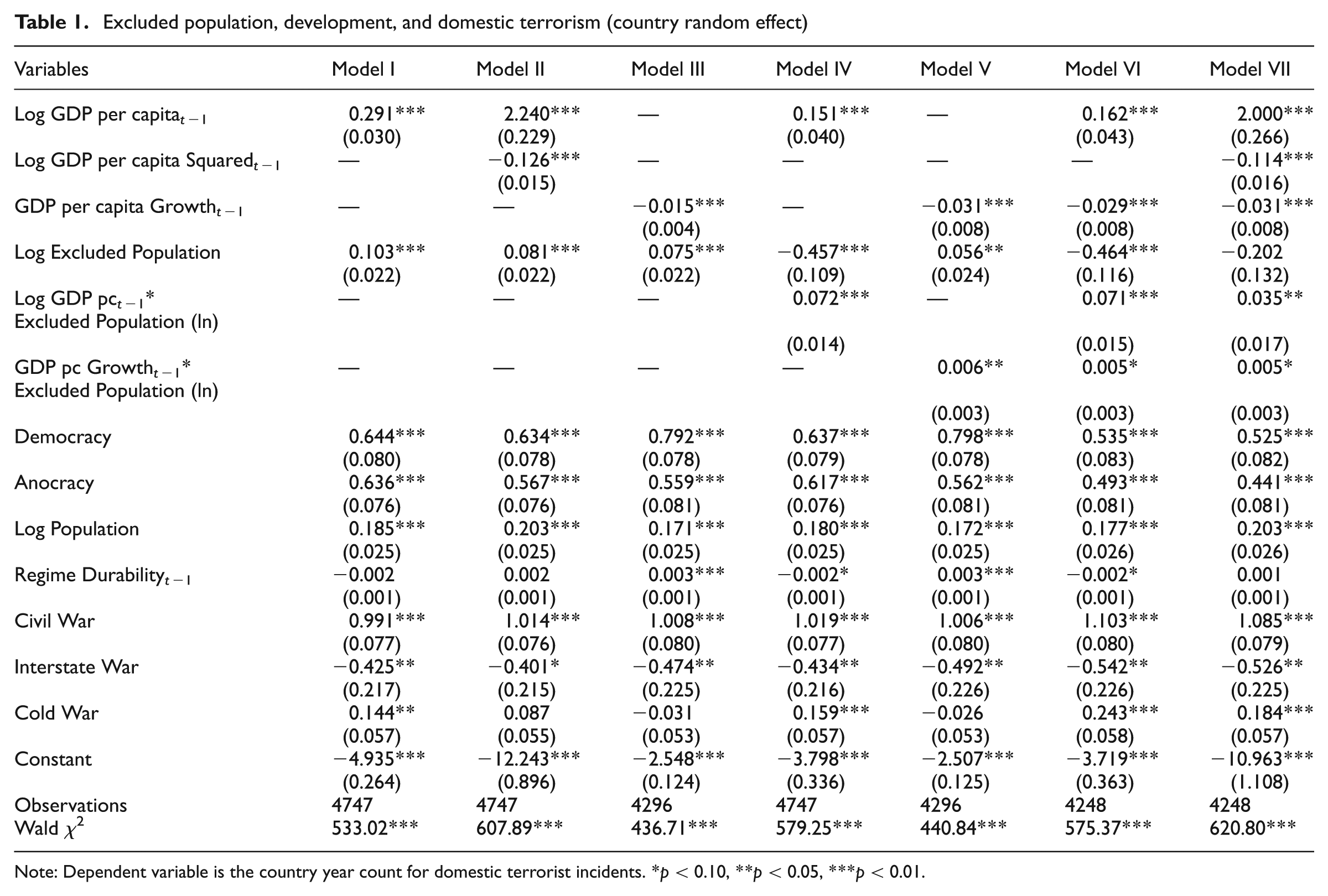
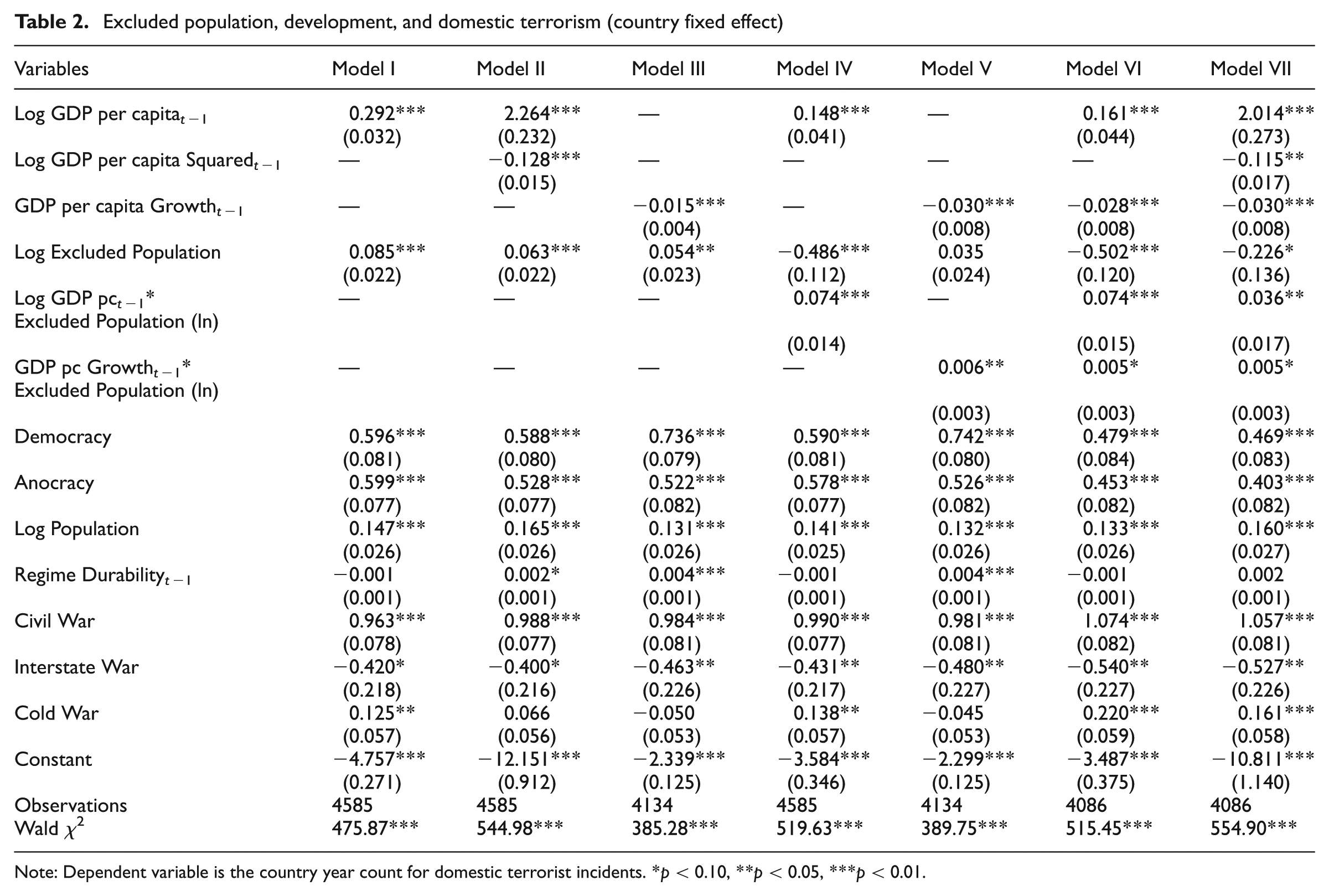
The models in Tables 1 and 2 present the results of seven models designed to test our hypotheses. The main explanatory variable—log GDP per capita—used to test the first hypothesis (H1) about the effect of economic development on the level of domestic terrorist incidents for the period between 1970 and 2007 receives strong empirical support. Log GDP per capita is positively related to the rate of terrorist incidents at a statistically significant level in all models (I, II, IV, VI and VII) in Tables 1 and 2. Economic prosperity increases the likelihood of domestic terrorist incidents in a country. This finding supports earlier empirical studies that terrorism originating in a country is positively associated with the country’s wealth or economic development (Berrebi, 2007; Burgoon, 2006; Lai, 2007; Piazza, 2011). However, models II and VII in Tables 1 and 2 show that log GDP per capita squared has a statistically significant negative relationship with domestic terrorism. The hypothesis (H1) on the curvilinear relationship between development and terrorism is supported at a 99% level of statistical significance; terrorism decreases as a country reaches a high level of economic prosperity. The middle-income countries are more vulnerable to homegrown terrorist attacks than others. This result supports previous research (Enders et al., 2014). Higher levels of economic development might help alleviate grievances and more developed countries might have conflict-resolution mechanisms that are not as readily available in poorer countries. Also, terrorist operations are clandestine and require certain skills to undertake. Relatively richer countries might have more skillful people than a poorer country. However, people might have economic opportunity costs in a highly developed country, making it harder for groups to recruit foot soldiers. Moreover, terrorism is often the handiwork of an ideologically driven middle-class intelligentsia (Pomper, 1995). An absolutely poor country may not have an educated middle class whose dissatisfaction will lead to homegrown terrorism. This finding that highly developed countries experience less terrorism is consistent with the neo-liberal expectation that high levels of prosperity alleviate the problem of intrastate conflict (Hegre et al., 2003). Although neo-liberal scholars and policy analysts might assume a linear negative relationship between prosperity and terrorism, 19 our finding of a curvilinear relationship contributes to the extant literature on terrorism. As a further test of this curvilinear relationship, we ran several models using GDP per capita fixed at three values and GDP per capita (in US$1000s) in Online Appendix Table A. GDP per capita up to the 50th percentile (US$2431) and up to the 75th percentile value (US$7436) increases the rate of domestic terrorism. However, the rate of domestic terrorism declines when we control for GDP per capita at the 95th percentile value (US$26,469) and over. In addition, GDP per capita (in US$1000s) is positively associated with higher levels of domestic terrorism while its squared term is negatively associated with domestic terrorism. These findings show that economic prosperity has a curvilinear relationship with domestic terrorism. Interestingly, models III and V in Tables 1 and 2 show that a high level of economic growth, in fact, is related to a low risk of domestic terrorism. This result supports Choi (2015), who found that economic growth reduces both transnational and domestic terrorism. Collier (2007) has argued that economic growth creates hope among people for a better future and makes rebel recruitment harder. The same logic can be used in that economic growth generates a short-term “feel good” effect among people. The prospect of a prosperous future raises the opportunity cost for domestic terrorism, thereby reducing the levels of political violence against the state. The models also show that discrimination is a robust driver of domestic terrorism, supporting earlier studies on terrorism (Choi and Piazza, 2014; Piazza, 2011, 2012).
Excluded population, development, and domestic terrorism (country random effect)
Note: Dependent variable is the country year count for domestic terrorist incidents. *p < 0.10, **p < 0.05, ***p < 0.01.
Excluded population, development, and domestic terrorism (country fixed effect)
Note: Dependent variable is the country year count for domestic terrorist incidents. *p < 0.10, **p < 0.05, ***p < 0.01.
Models IV, VI and VII of Tables 1 and 2 present the results of the empirical analysis in addressing the second hypothesis (H2) with our measure of minority discrimination, political exclusion, the percentage of a country’s discriminated population. Our finding shows that the interaction term between minority political exclusion and economic development is statistically significant in the hypothesized direction. Economic development increases domestic terrorism in the presence of minority discrimination in terms of political exclusion. Economic development measured by log GDP per capita does not indicate that everyone is equally prosperous; some are more prosperous than others. Minority political exclusion in a state would most likely result in the relative deprivation of minority groups that in turn might strengthen terrorist organizations’ attempts to challenge the discriminatory state with new recruits. The lower-level interaction terms (political exclusion and log GDP per capita) are also in the hypothesized directions or not significant. Yet since interactions between continuous variables are difficult to interpret by examining the coefficient values, particularly in maximum-likelihood estimation models, we present a visual depiction of the interactive relationship. Figure 3 shows the interaction and includes two graphs, with Figure 3a showing the marginal effect of political exclusion on domestic terrorism across the values of economic development (log GDP per capita), and Figure 3b showing the predicted rate of domestic terrorism for low (2 standard deviations below the mean) and high (2 standard deviations above the mean) values of economic development (log GDP per capita) across the values of political exclusion. The linear prediction is graphed at the above-mentioned two values of GDP while keeping all other variables at their mean values. Richer countries are clearly at higher risk of domestic terrorism across the values of political exclusion. Similarly, the interaction between political exclusion and economic growth is positive and statistically significant (see models V, VI, and VII in Tables 1 and 2). 20 Political exclusion has a positive marginal effect on economic growth in influencing the incidences of domestic terrorism. Economic growth might create a temporary euphoria among people that discourages them from challenging the state. However, when sections of people have long been discriminated against, they might already have lost faith in the discriminatory state. Once the state loses legitimacy in the eyes of certain sections of people, they might not view the prospect of prosperity as favorably as others would. Therefore, economic growth will not reduce domestic terrorism in the presence of minority discrimination, as it will in the absence of discrimination. Figure 4a visually depicts the marginal effect of political exclusion across the values of economic growth in influencing domestic terrorism, and Figure 4b shows the predicted rate of domestic terrorist incidents at low (2 standard deviations below mean) and high (2 standard deviations above mean) values of economic growth across different values of discrimination while all other variables are held at their mean values. Figure 4b shows that relatively low growth economies (the dotted line) will experience more domestic terrorism when the level of discrimination is low. However, as the minority discrimination value goes over 2.5, fast-growing economies (the solid line) become as vulnerable to domestic terrorism as slow economies. Therefore, the states practicing high levels of discrimination against minorities will be subject to a greater number of domestic terrorist incidents when economic growth increases. Thus, we find that the more a country politically excludes its populations from the power structure of the state, the more they experience high levels of domestic terrorism as they grow economically. Our findings support the hypothesis that richer countries experience higher levels of domestic terrorist incidents in the presence of minority discrimination.
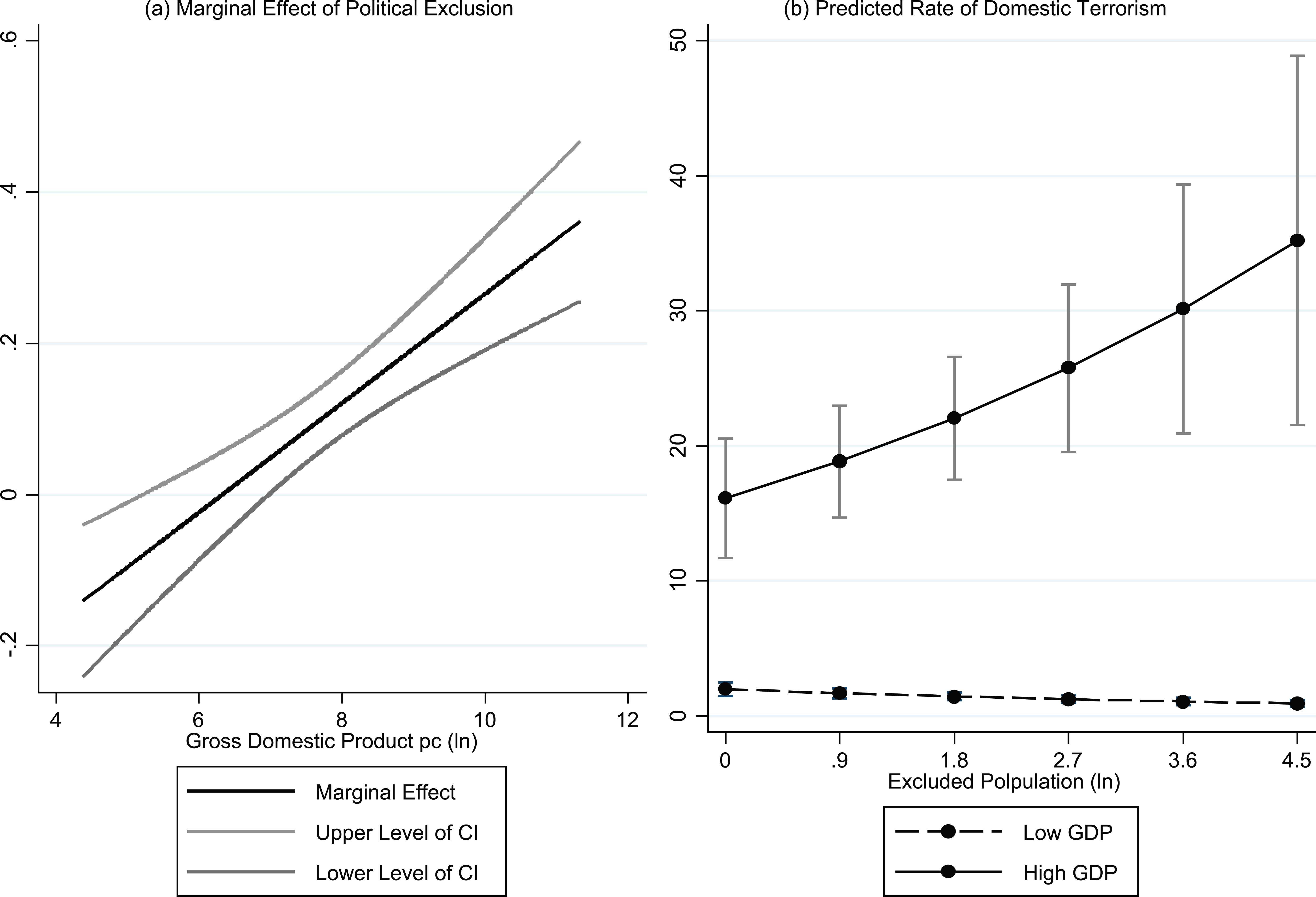
Interaction between development and political exclusion.
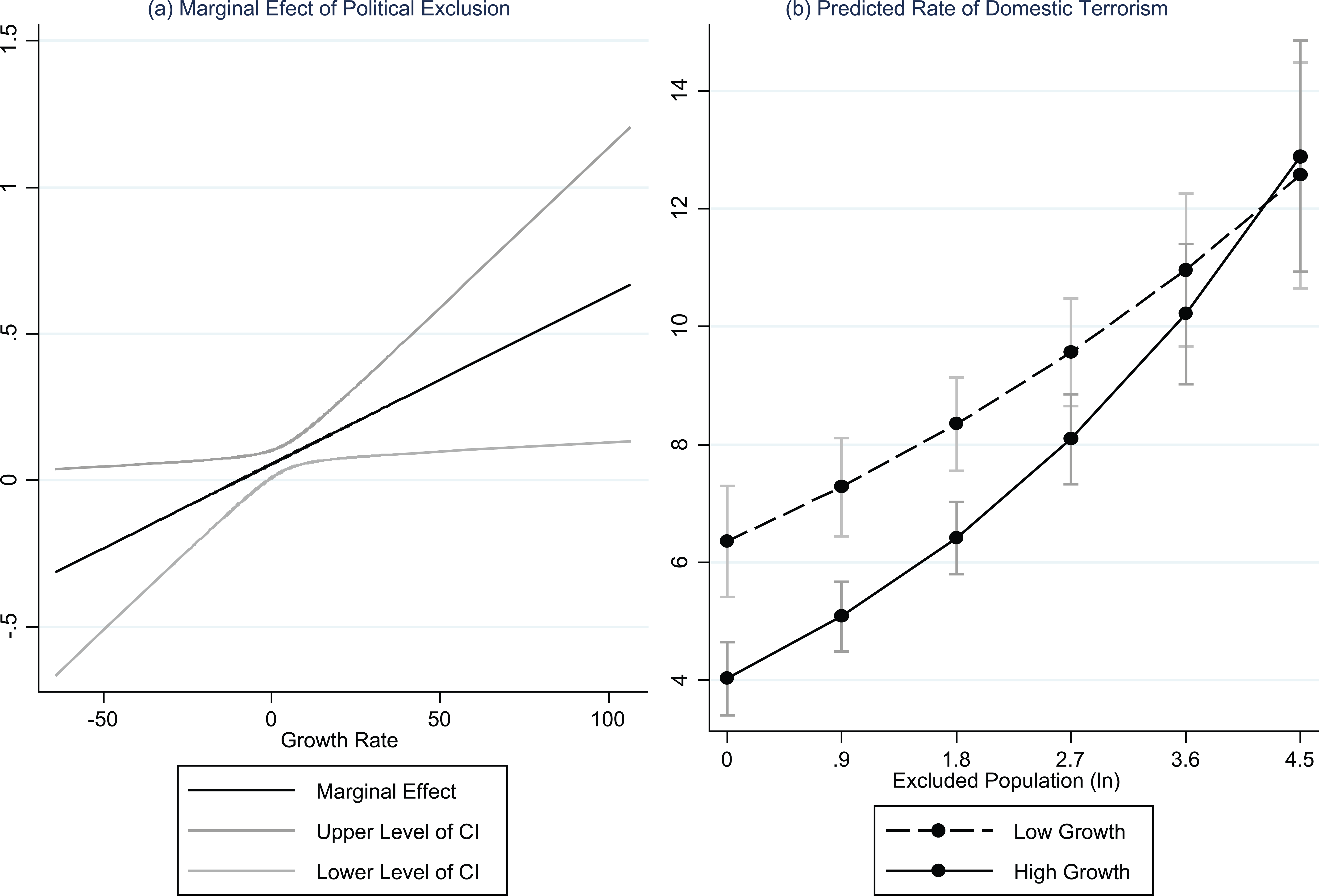
Interaction between growth and political exclusion.
Many of the control variables are statistically significant in the expected direction. The natural log of population has a strong, positive and statistically significant relationship to domestic terrorism. More populous states make it easier for groups to operate by increasing the potential pool of recruits and increasing the costs to the government for monitoring all its citizens. Lai’s (2007) findings on the production of transnational terrorism are supported in our study on homegrown terrorism. We also observe in all models that democracy and anocracy are both positively related to domestic terrorism at statistically significant levels. Crenshaw (1981) argues that modern democratic states may be viewed as weak by terrorists since security forces are constrained by the rule of law. Although our evidence shows anocratic and democratic political systems to experience higher levels of domestic terrorism compared with autocratic systems, we find that democracies confront the highest risk of homegrown terrorism. This finding is driven mostly by emergent and under-developed democratic states. Finally, civil war increases the levels of domestic terrorism in a country. Countries experiencing armed rebellions need to divert considerable resources from monitoring the clandestine activities of terrorist groups. This reduces the opportunity cost of such groups and exposes countries to high levels of terrorist attacks. The results of the country and year fixed effect models presented in Online Appendix Table 2 for robustness check give us further confidence in our findings.
Conclusion and implications
The results from this analysis are supportive of the hypothesis that development increases domestic terrorism in the presence of minority discrimination by creating grievances as well as mobilization opportunities. Similarly, economic growth produces more domestic terrorism in the presence of minority discrimination than it does in the absence of discrimination. We also find support for the hypothesized curvilinear relationship between domestic terrorism and economic development. Even though highly developed countries are less likely to experience domestic terrorism than less-developed ones and the least-developed countries suffer little terrorism, both rich and poor countries, similar to middle-income countries, are vulnerable to domestic terrorism in the presence of minority discrimination. The findings here have several implications for policy makers. First, neo-liberal optimism that economic development leads to peace (Hegre et al., 2003) needs further consideration if a country has an aggrieved minority. We join with other scholars who have emphasized the fair treatment of national minorities. The promotion of rapid industrialization without accommodating discriminated minority groups may not be a good policy choice. Furthermore, economic development may not result in the well-being of the entire population. Those who have been left out of the development process (namely minority groups) have an incentive to challenge the state, especially if they are aggrieved or have been discriminated against. Second, the argument that democracy is a panacea to all internal conflicts, including terrorism, needs further qualification. The mere presence of democratic institutions and peaceful conflict-resolution mechanisms may not be enough to mitigate grievances if minority communities are continually excluded from the political process. This study contributes to the extant literature on terrorism by identifying a curvilinear relationship between domestic terrorism and economic development, and exploring minority discrimination as an important conditional factor that connects economic development to domestic terrorism.
Footnotes
Acknowledgements
We are grateful to Brandon Prins, Wonjae Hwang, Krista Wiegand, Kyung Joon Han and three anonymous reviewers for their suggestions on this paper.
Funding
This research received no specific grant from any funding agency in the public, commercial, or not-for-profit sectors.