




Abstract
How does border settlement—that is, the management of salient territorial conflict—affect the prospects for negative peace? Using recently released data on dyadic interstate relationships during the period 1946–2001, we build on territorial peace research to argue, predict, and find three connections between border settlement and negative peace. More specifically, border settlement: (a) increases the likelihood that a dyad is at negative peace; (b) raises the likelihood that dyads transition from rivalry to negative peace relationships; and (c) consolidates negative peace—by impeding transitions toward rivalry relationships. We confirm each of these findings with a commonly used measure of border settlement, as well as an alternative indicator of unsettled borders: civil wars. These findings cumulatively support our argument, demonstrate the importance of studying relationships outside the rivalry context, and suggest that border settlement plays a critical role in the emergence and consolidation of negative peace.
Bolivia and Paraguay entered the international system with a mutual border that lacked clear delimitation, particularly in the Chaco region. They therefore tried repeatedly to define this border, but failed each time—despite reaching preliminary agreement on five separate occasions (Owsiak et al., 2016). As a result, the dispute festered, causing both states to perceive one another as rivals (i.e. as threats, competitors, and enemies) and to repeatedly confront one another militarily over the issue. These confrontations eventually escalated, producing the Chaco War.
After the Chaco War, the two sides signed an agreement (in 1938) that delimited the entirety of their mutual border. From this point forward, they experienced “negative peace.” They never threatened, displayed, or used military force against one another thereafter. Furthermore, they restored diplomatic recognition, began to integrate more, and worked to establish a generally more cooperative relationship. This is not to say that they settled all of their outstanding issues, or that the use of force became unthinkable—as it has in modern Europe. Nonetheless, delimiting their mutual border transformed their relationship from one of hostility to one of negative peace, and the states never re-established their earlier rivalry relationship.
The case of Bolivia and Paraguay raises three general questions that we pursue in this study. First, does border settlement—whether operationalized as de jure settlement (i.e. the signing of international agreements that delimit the entirety of a contiguous dyad’s mutual borders) or de facto settlement (i.e. the absence of civil wars, which creates stability in border regions)—increase the likelihood that a dyad is at negative peace? Second, does border settlement increase the likelihood that rivalry (i.e. hostile) relationships transform into negative peace? Finally, does border settlement decrease the likelihood that dyads at negative peace escalate into rivalries?
We propose an affirmative answer to each of these questions. Building on the territorial peace (Gibler, 2012), war-making/state-making arguments (Tilly, 1992), and the issue-based approach to interstate relations (Vasquez, 2009), we argue that dyads at negative peace have generally (de jure and/or de facto) settled their borders, that border settlement encourages transitions from rivalry toward negative peace, and that border settlement discourages transitions from negative peace toward rivalry. This suggests that managing territorial (border) conflict significantly alters dyadic relationships—a supposition confirmed by analyzing new data on dyadic relationships during the period 1946–2001 (Goertz et al., 2016).
In pursuing answers to the above questions, we offer several theoretical, empirical, and policy contributions. Numerous studies link border settlement to a decreased likelihood of militarized interstate disputes (or MIDs; Gibler, 2012; Owsiak, 2012). 1 Yet negative peace involves the virtual absence of conflict (e.g. MIDs)—as well as other characteristics, such as diplomatic recognition, the resolution of (some, particularly highly salient) issues, and the presence of (some) peace negotiations or agreements (Goertz et al., 2016). An absence of MIDs therefore does not alone constitute negative peace. Indeed, many possible relationships of varying levels of hostility experience non-MID periods, including rivals not currently fighting (e.g. United States–North Korea), dyads with no capacity to fight (e.g. minor-minor, non-contiguous dyads such as Bhutan–Bolivia), non-rival dyads that choose not to fight but are prepared to do so (i.e. negative peace), and dyads for whom fighting is unthinkable (i.e. positive peace; e.g. the United States–UK). Each of these “non-MID” observations has different theoretical causes for its peacefulness and therefore demands a study of relationships, rather than (non-)MID behavior or state-level characteristics (see Bell and Ghatak, Gold, and Prins, this issue). Our study therefore extends existing research in a novel direction, focusing on dyadic levels of peace.
By studying different relationship types (i.e. negative peace and rivalry), we also entertain the overarching hypothesis of causal asymmetry—that is, that the causes of war are not the mirror image of the causes of peace. Scholars typically build causal symmetry into statistical analysis (e.g. logistic regressions, where the causes of zeroes and ones are mirror images). We, however, allow for causal asymmetry by exploring the transitions in both directions between rivalry and negative peace. As we show, some factors (e.g. border settlement) display causal symmetry, while other factors (e.g. democracy and power) do not.
Of course, scholars study rivalry and its termination. They do not, however, consider what form the dyadic relationship takes before or after the rivalry (e.g. Owsiak and Rider, 2013). We explicitly study these other, non-rivalry forms of dyadic relationships. In addition, scholars note that territorial claims are decreasing alongside the rise of more peaceful relationships (Goertz et al., 2016; on issues, see also Gibler and Hensel and Mitchell, this issue). This work, however, does not offer a sufficient causal explanation or analysis that links these two trends. Our work aims to provide a focus on non-rivalry relationships and an explanation of their evolution, with special attention to the management of territorial (border) issues. Finally, policy makers often seek the paths toward building a more peaceful world. For many years, constructing democratic states has received considerable attention. Although this may be valuable for many reasons, we show that the settlement of interstate borders—that is, the management of territorial conflict—has a greater effect on the establishment of negative peace than democratic regimes.
The continuum of interstate relationships
Few would disagree that interstate relationships vary substantially. The United States, for example, has a quite different relationship with North Korea than it does with the United Kingdom. There has been scant attention given, however, to analyzing the full continuum of these relationships. Goertz et al. (2016) offer an exception; they suggest that interstate relationships can be organized along a continuum from very hostile (i.e. rivalries) to very friendly and integrated (i.e. security communities). Placement along this continuum depends broadly on the number and salience of disputed issues, as well as how states handle the issues over which they disagree.
The hostile, or rivalry, side of the continuum has received a tremendous amount of scholarly and policy attention (e.g. India–Pakistan; see Diehl and Goertz, 2012; and Valeriano, 2012 for overviews). Rivals see one another as enemies and competitors (Colaresi et al., 2007; Klein et al., 2006). Unresolved salient issues often drive such sentiments, which encourage rivals to handle their contested issues via frequent and intense uses of violence. As a result, rivals plan their foreign policy around their counterparts, particularly as past negative interactions lead them to expect such interactions to continue or repeat in the foreseeable future. This institutionalizes the rivalry, thereby “locking it in” for extended periods of time and making rivalry difficult to escape.
Nonetheless, severe rivalry relationships can transition into those in which violence abates or ends altogether. The first case constitutes what Goertz et al. (2016) label “lesser rivalries,” while the latter is “negative peace.” Lesser rivalries are not as severe as the rivalries described above (e.g. Colombia–Venezuela during the period 1841–1982). Within these relationships, both the frequency and severity of violent interactions are lower. The sentiments of threat, enmity, and competition that remain, however—along with the persistence of unresolved issues—mean that lesser rivalries still experience isolated violent episodes (e.g. MIDs), diplomatic hostility, and non-violent crises.
Violent, hostile episodes almost disappear entirely when we move into the middle of the continuum: negative peace (Galtung, 1969; see also, inter alia, Kupchan, 2010 on “reciprocal restraint,” and Bayer, 2010 on “cold peace”). Dyads at negative peace possess a number of characteristics. They maintain war plans; rarely or never fight or threaten one another militarily (i.e. experience few MIDs); make statements suggesting that conflict remains possible, but have resolved or mitigated their major issues; only possess unresolved issues of low salience; recognize one another diplomatically; communicate officially with one another; and engage in peace negotiations and/or sign peace agreements with one another. Peace therefore remains precarious because actors use the threat of violence as a critical mechanism through which to prevent militarized encounters (i.e. deterrence), rather than eschewing violence entirely as a tool for managing their disagreements. Furthermore, at least one state in the relationship often remains dissatisfied with the status quo, fostering feelings of mistrust and, perhaps, ideological competition. At negative peace, states are therefore neither close friends nor bitter enemies (e.g. Egypt–Israel in the period after 1989). They may experience MIDs, just as rivals often experience episodes that lack MIDs. And importantly for our purposes, they have not necessarily settled their borders; indeed, there are many negative peace relationships between states with unsettled borders.
Beyond negative peace lie two additional, more peaceful relationship types (“positive peace”): warm peace—defined by increasing integration and the removal of military options for managing disagreements—and security communities—which involve compatible values, expectations of mutual reward, institutionalized conflict management processes, and mutual responsiveness (Goertz et al., 2016). Although deserving of study, we do not address these categories in the current work, opting instead to focus on rivalry and negative peace for several reasons. First, the absence of territorial claims features prominently in the conceptualization of warm peace or security community relationships (Goertz et al., 2016). 2 It is therefore impossible to study the effect of border settlement on transitions to these relationship categories, as doing so constitutes a tautology. The same definitional issue does not affect studying negative peace; states at negative peace may possess unsettled borders, and many do. Second, most conceptualizations of peace types require states to pass through a negative peace-like period before attaining either warm peace or a security community, and negative and positive peace relationships seemingly have different causal factors (Bayer, 2010; Goertz et al., 2016; Kupchan, 2010). It therefore makes sense to study negative peace as a first step. Third, rivalries contain the majority of militarized conflict (including both MIDs and wars; see Klein et al., 2006). We therefore gain substantial insight into how peace evolves by theorizing first about the factors that lead states from rivalry or lesser rivalry toward negative peace. Finally, most relationships are at negative peace (Goertz et al., 2016). We therefore theorize about how and why states reach this point, as doing so maximizes our study’s explanatory power. Future work can subsequently use this study as a foundation to theorize further about the factors that move interstate relationships from negative peace toward warm peace or security communities—a point to which we return in the conclusion.
Towards negative peace
How does border settlement affect negative peace? When interstate borders remain unsettled (either de jure or de facto), the involved states (i.e. a contiguous dyad) necessarily experience a salient threat from one another as they fight over the territorial distribution that defines their respective states. 3 This threat prompts citizens to give greater autonomy to their leaders (i.e. a rally-round-the-flag effect; Hutchison, 2011) in exchange for protection, which yields centralization and militarization (Gibler, 2012; Tilly, 1992). These two processes, in turn, compel states to extract greater resources from their citizenry, in order to combat the threat (Thies, 2004). Furthermore, a more aggressive foreign policy follows (Vasquez, 2009), as the military needs a task to perform (Hintze, [1906] 1975). Finally, the aggressive foreign policy—targeted toward the source of external threat—leads states down the path to rivalry (Vasquez, 2009; see also Ghatak, Gold, and Prins, this issue). Thus, unsettled borders should produce more hostile interstate relationships. 4 Indeed, most rivalries have a strong territorial component (Dreyer, 2010).
What happens when the external threat dissipates? Gibler (2012) provides the clearest answer. He argues that the removal of an external threat changes the pressures affecting leaders and their constituents. In particular, citizens rally behind the leader for protection when a salient external threat exists. If that threat disappears, however, the citizens no longer need the same level of protection. They therefore begin trying to place greater constraints on their leader’s autonomy (i.e. decentralization of power) and asking for additional benefits from the state in exchange for continued resource extraction (e.g. rights and services in exchange for taxes; see also Tilly, 1992). Providing these other benefits to citizens—coupled with the decreased threat—then requires demilitarization, so that resources can be shifted towards other ends.
Of course, other (non-territorial) foreign policy goals will remain, and the military will not likely be disbanded entirely. Nonetheless, violence may not be the best way to achieve non-territorial foreign policy goals. Vasquez (2009) argues, for example, that state leaders learn that it is appropriate to handle territorial disputes via violence, but not non-territorial ones. Thus, once borders settle, the dyad shifts the means through which they manage foreign policy disagreements toward non-violent processes, such as mediation, negotiation, and adjudication.
The foregoing discussion yields a few predictions about interstate relationships. First, dyads with settled borders should generally avoid the use of violence, whether because violence is a less appropriate means of handling their non-territorial issues or because less centralized and less militarized states possess a reduced capacity to engage in interstate violence (Gibler, 2012; Owsiak, 2012). This reduced willingness and opportunity to engage in aggressive foreign policies should also decrease the chances that the dyad develops the feelings of enmity and competition that define rivalries. In other words, dyads with settled borders should fall more often in the negative peace category than the rivalry categories and should experience a low likelihood of transitioning toward rivalry in the future. Second, border settlement transforms interstate rivalries. Many rivalries exist because of unsettled borders (Owsiak and Rider, 2013). The settling of borders therefore changes the rivals’ relationship. After border settlement, we expect violence to become scarcer, for the reasons noted above. As violence declines, the interstate relationship necessarily changes as well—from more hostile relationships toward negative peace (a necessary stop on the path to greater peace). In short, we expect that:
There are two ways to conceptualize border settlement within the above argument: de jure and de facto. De jure border settlement exists when actors have signed an international agreement that delimits the entirety of their mutual border (Owsiak, 2012). Most work on borders seems to fall within this tradition (Carter and Goemans, 2011; Owsiak, 2012; Simmons, 2005). In contrast, de facto border settlement concerns whether or not actors respect a certain territorial division, regardless of its status under international law. Lack of settlement on either dimension can create uncertainty about how neighboring states will behave with respect to jurisdictional lines, which then necessarily threatens the sovereignty, policies, and development of the state. It is this type of salient threat that encourages militarization, centralization, aggressive foreign policies, and therefore, hostile relationships.
Simmons (2005: 827–828) underscores this position. She casts settled borders as institutions that “provide physical security” and “clarify and stabilize transactional actors’ property rights,” thereby reducing both jurisdictional (i.e. sovereignty and legal authority) and policy (e.g. government interference with cross-border transactions) uncertainty. Thus, they supply the foundations for increased economic interaction between neighboring states.
De jure border settlement—being grounded in international law—is easy to observe; neighboring states sign international agreements to delimit their mutual border. De facto settlement, however, proves harder to locate empirically, as we need evidence that states respect one another’s sovereign jurisdictions in practice. We propose that the absence of civil wars may be such an indicator. Civil wars facilitate de facto unsettled borders, regardless of borders’ de jure settlement status—for civil wars can contribute to border instability and unpredictability, particularly as a significant number of them contain an international element and therefore involve cross-border activity (Themner and Wallensteen, 2014).
Three specific civil war activities breed border instability and unpredictability: cross-border rebel movements, rebel military support, and refugee flows. First, rebels attacking a government might seek shelter in a neighboring state, thereby receiving protection by virtue of international sovereignty norms (e.g. Honduras–Nicaragua, Jordan–Syria, or Ghana–Togo). If the neighboring state either cannot (e.g. southern Lebanon) or will not (e.g. Honduras ceding control of southern Honduras to the Contras) end this protection, instability follows—for the behavior of actors within the border region no longer follows a predictable, mutually accepted pattern. The government experiencing rebellion therefore frequently sees little choice but to violate the neighbor’s sovereignty in pursuit of the rebels (e.g. Israel in Lebanon or Togo’s attacks on Ghana) or to protest the neighbor’s actions within the international community (e.g. Nicaragua filing suit against Honduras at the International Court of Justice). Both actions aim to restore stability and predictability, although they also increase tensions in the interstate relationship as well.
Second, rebels attacking a government might receive military support from neighboring states. This can involve military training or supplies, but may also include the deployment of state forces to assist the rebels in military operations against the government (e.g. see Uganda in the Democratic Republic of the Congo or Thailand’s involvement in Vietnam). Support of this type necessarily rejects the stability of the border region and expectations about how states in the system should behave, as actors violate interstate borders to attack or actively use state resources to undermine the authority of a neighboring state. It also can cause neighboring states’ forces to confront one another directly on the battlefield, which produces militarized interstate disputes and potentially prompts international complaints (e.g. the Democratic Republic of the Congo charges against Uganda). Only re-establishing the sanctity of sovereign jurisdictions (i.e. ending rebel support) stabilizes the border region and behavioral expectations once again.
Finally, civil wars can generate refugee problems that transcend borders, creating a humanitarian crisis for neighboring states (e.g. Ghana–Togo or Nigeria–Cameroon). Much as with cross-border rebel movements, this introduces instability into the border region—as refugees cross interstate borders. Furthermore, actors can predict neither the volume of refugees nor the length of time that refugees will seek protection. As refugees use limited state resources for an unpredictable amount of time, tension in the interstate relationship mounts—leading, in some cases, to militarized interstate disputes (e.g. Ghana–Togo). Only ending the civil war and transferring refugees back to their homes ends both the instability and unpredictability of behavior within the border region.
Through these various channels, a state’s involvement in civil war fosters de facto unsettled borders, sours its interstate relationships, and therefore increases the likelihood of rivalry. Indeed, in each of the examples listed above, the factors we identify contributed to an interstate rivalry (Colaresi et al., 2007). Nevertheless, if civil wars create threats and foster interstate tensions, then it follows that the end or absence of civil wars should, on average, produce more de facto settled borders, lessen tensions significantly, and create space for the interstate relationship to transform. If a civil war ends, for example, chances rise that rebels will be integrated back into society, foreign governments will intervene less frequently, and refugee flows will reverse as people return home. Each of these processes decreases uncertainty about behavioral expectations in the border region, stabilizes the border itself, and reduces threat. Based on this logic, we therefore also expect that:
Research design
We conduct three distinct analyses, which share some similarities. Each uses the contiguous dyad-year as the unit of analysis during the period 1946–2001. 5 For our purposes, contiguous dyads must share an inland or river boundary, the closest level of contiguity in the Correlates of War data (Stinnett et al., 2002). This focus on contiguous states derives from theory; only contiguous states have mutual borders, so only these states can settle their borders—our variable of interest. 6
A measurement of the dyadic relationship serves as our dependent variable in each analysis. The relationships we focus upon are rivalry and negative peace. There are 14,542 contiguous-dyad years (1946–2001) in our analysis. Of these, 72.90% (or 10,601) involve dyads at negative peace, while 27.10% (or 3941) involve rivals of two varieties (severe and lesser). 7 All relationship data come from Goertz et al. (2016).
Rivals differ from dyads at negative peace. Rivals not only possess war plans, but also prioritize military force as a foreign policy tool. Rivals have also not resolved the major issues that fuel their hostile relationship. There are therefore no (successful) peace negotiations or agreements. And, because rivals are hostile toward one another, they either do not recognize one another diplomatically or experience diplomatic hostility. This dampens official communication (if it exists).
Despite drawing off of the same relationship data, the dependent variable differs slightly in each of the analyses that follow. Initially, we explore the factors that increase the likelihood that a dyad is at negative peace vs being in rivalry. We therefore employ a dichotomous variable that denotes whether a dyad is at negative peace. Then, we consider transitions from rivalry to negative peace. A dichotomous variable captures whether a dyad transitions to negative peace, given that they were in a rivalry during the previous dyad-year. Finally, we examine transitions from negative peace to rivalry. A dichotomous variable indicates whether a dyad transitions to rivalry, given that they were at negative peace in the previous dyad-year. 8 Because these variables are dichotomous, we use logistic regression in each of the three analyses that follow.
Our key independent variables concern border settlement. A dyad possesses de jure settled borders (simply settled borders hereinafter) if it signs an international agreement that delimits the entirety of its mutual border prior to the year under observation. We use a dichotomous variable from Owsiak (2012) to indicate whether a dyad has met these conditions—that is, whether it has settled (1) or unsettled (0) borders. A dyad with settled borders must ratify a signed agreement if ratification is required domestically and cannot unsettle its borders under international law, even if it leaves and re-enters the international system (e.g. around the World Wars). New states generally inherit settled borders from those previously exercising sovereignty over their territory (uti possidetis), so long as the previous power settled the states’ borders via international agreement. Nonetheless, new states have one year after independence during which to raise a dispute about the border. If they do so, the border remains unsettled until an international agreement is signed. A full list of coding procedures, as well as examples of each, appears in Owsiak (2012).
A dyad contains de facto settled borders if there exists an absence of civil war within the dyad. A civil war occurs when two units within a state (state government to non-state actor, regional government to non-state actor, or non-state actor to non-state actor): (a) are both organized for conflict and prepared to resist attacks from the other; (b) can each inflict fatalities on the other; and (c) engage in activities that produce 1000 battle-deaths (across all war participants). Using this operationalization—derived from the Correlates of War Project (Sarkees and Wayman, 2010)—we create a dichotomous variable that indicates whether both states in the dyad lack a civil war in each dyad-year. 9
Because factors besides border settlement and civil war can affect dyadic relationships, we also include four control variables in our analyses. 10 First, jointly democratic dyads may be more peaceful than their counterparts. We code a state as democratic if it scores +6 or higher on the Polity Project’s combined democracy–autocracy scale; a dyad is then jointly democratic if both states exceed this democratic threshold (Marshall and Jaggers, 2009). Second, states closer in power may experience more hostile relationships than others (Fearon, 1995). Using the Correlates of War Project’s Composite Index of National Capabilities (CINC; Singer, 1988), we create a measure of relative capabilities by taking a ratio of the stronger to the weaker state’s capabilities (i.e. CINC scores). Third, newly independent states may be more hostile under certain conditions (Maoz, 1989), while dyads may experience greater opportunity for conflict as they grow older. We therefore use a counter variable to capture the age of the dyad and include quadratic and cubic forms of this variable to consider possible non-monotonic effects.
Finally, dyadic relationships are somewhat stable over time (see Table 1); a dyad’s relationship this year may largely be a function of its relationship last year. We therefore include a dyad’s lagged relationship in our first analysis. This approach, however, is not possible in our latter two analyses. When we examine transitions between relationship types, we necessarily condition the analysis on the dyad’s lagged relationship. For example, to study transitions from negative peace to rivalry (at time t), we must begin with the set of dyads at negative peace during the previous period (t − 1) as only these dyads have the opportunity to transition to rivalry. Thus, all dyads in analyses of relationship transitions will have the same lagged relationship (in this example, negative peace), precluding us from including lagged relationship variables.
Logistic regression of being at negative peace (as opposed to rivalry), 1945–2001 (contiguous dyads)
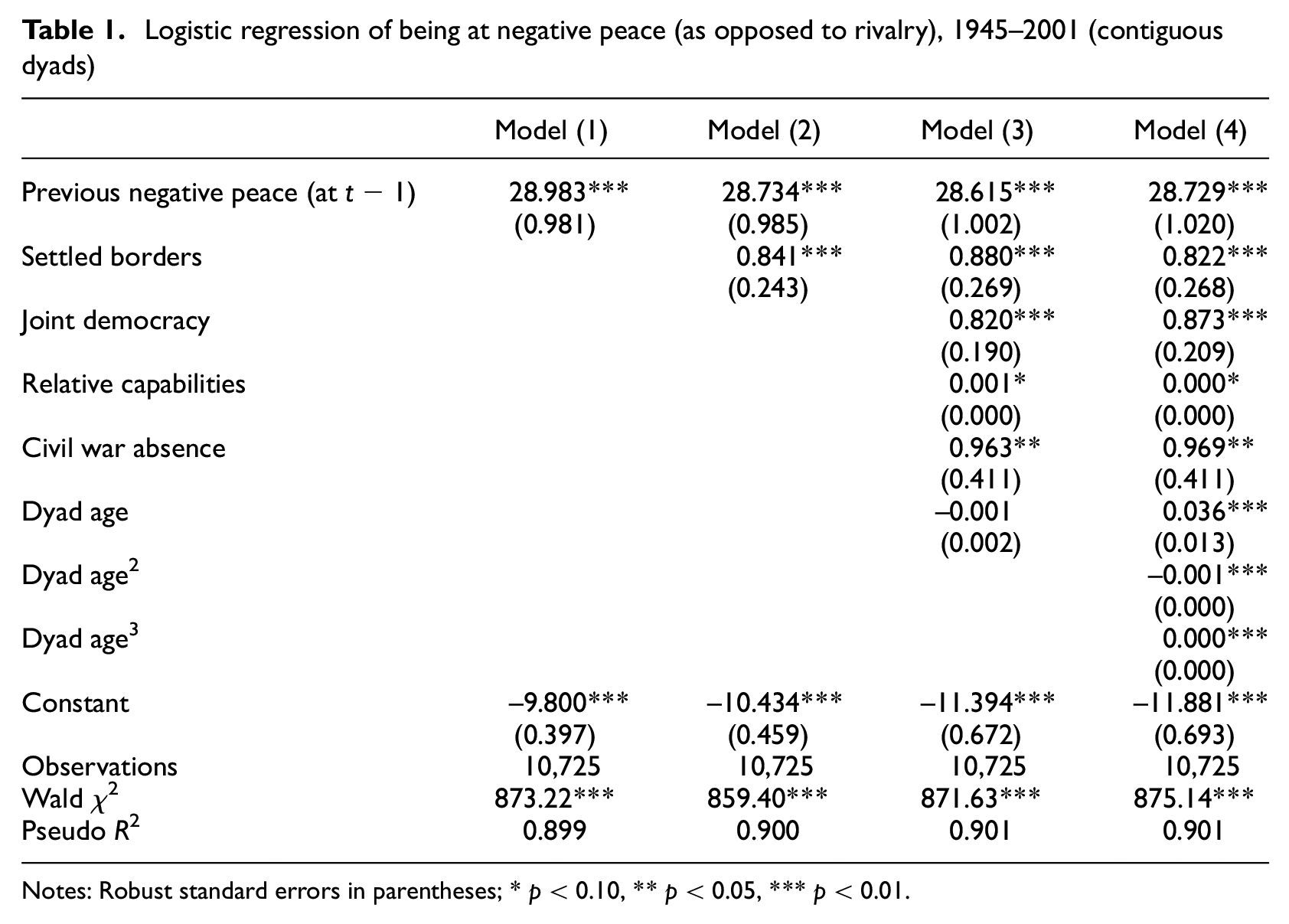
Notes: Robust standard errors in parentheses; * p < 0.10, ** p < 0.05, *** p < 0.01.
Empirical results
We first focus upon the bivariate relationships between negative peace and either border settlement or the absence of civil wars (see online appendix). Of the contiguous dyad-years in which dyads are not at negative peace (i.e. in some type of rivalry), 27.49% contain unsettled borders (or 1462 of 5319). In contrast, only 15.37% (or 1629 of 10,601) of the contiguous dyad-years at negative peace contain unsettled borders. Stated slightly differently, 84.63% of contiguous dyad-years at negative peace possess settled borders, as opposed to 72.51% of dyad-years involving rivals. The difference between these two percentages is statistically significant (χ2 = 332.526, p < 0.001) and moderately positive (ϒ = 0.352, a.s.e. = 0.018).
A similar finding emerges with respect to civil wars. Of the contiguous dyad-years at negative peace, 2.70% (or 286 of 10,601) contain a civil war. In contrast, of the contiguous-dyad years not at negative peace (i.e. within a rivalry), 4.31% (or 229 of 5319) experience a civil war. This relationship is also statistically significant (χ2 = 29.237; p < 0.001) and moderately positive (ϒ = 0.237, a.s.e. = 0.043). 11
The above findings offer preliminary evidence in favor of both our first and fourth hypotheses. Contiguous dyads that settle their borders and lack a civil war (de jure and de facto settlement, respectively) are significantly more likely to be in a relationship that is at negative peace. Of course, neither settled borders nor the absence of civil war is a necessary condition for negative peace. Negative peace can exist without border settlement or despite civil wars. Nonetheless, relationships at negative peace more often contain settled borders and lack civil wars.
The results presented in Table 1 further underscore these preliminary findings. The models in the table gain complexity as we move across the table from left (Model 1) to right (Model 4). Recall that, because relationships can be stable, we incorporate the lagged dyadic relationship into each of the models. This variable explains a large proportion of the models’ variance, offering empirical evidence that relationships are in fact fairly stable over time. Despite such stability, however, many of our independent variables play a statistically meaningful role in explaining which dyads are at negative peace or rivalry.
Table 1 reveals five noteworthy results. First, border settlement significantly increases the likelihood that a contiguous dyad is at negative peace. This variable is statistically significant across each of the models in which it appears, lending strong support to our first hypothesis. Second, the absence of civil wars also contributes positively and significantly to the likelihood that a contiguous dyad has a negative peace relationship. As with border settlement, this variable is also statistically significant in all models in which it appears, offering evidence that affirms our fourth hypothesis. Third, jointly democratic dyads are more likely to be at negative peace than dyads containing at least one non-democracy. This aligns well with extant research proposing that jointly democratic dyads treat one another differently (i.e. more peacefully) than dyads composed of other regime combinations (Russett and Oneal, 2001). Fourth, dyad age may have a significant effect on the likelihood of a contiguous dyad being at negative peace, but the results are somewhat sensitive to model specification (Model 3 vs Model 4). If it has any effect at all, it seems that, as a contiguous dyad ages, its likelihood of being at negative peace first increases, then decreases, then increases once again (Model 4). This suggests that dyads are increasingly likely to be at negative peace as they age. If they spend enough time in the system, however, significant disagreements can arise that push them into more hostile relationships instead—before they return back to negative peace in their old(er) age. Finally, we note that more asymmetric, contiguous dyads experience an increased likelihood of being at negative peace.
Although the models presented above suggest which characteristics contribute to the likelihood of observing a contiguous dyad at negative peace, they do not indicate how much these characteristics matter for such an outcome. Table 2 addresses this latter issue directly by considering the relative substantive effects of our variables on the likelihood of observing negative peace in contiguous dyads. If, for example, we take an average contiguous dyad (i.e. holding all independent variables at their means or modes), then the likelihood that a dyad with unsettled borders is at negative peace is 0.591. This rises to 0.769 if the dyad has settled borders instead—a 30% increase. Similarly, contiguous dyads without civil wars experience a 39% higher likelihood of being at negative peace than similar dyads in which a civil war is occurring. Together, these findings support our larger theoretical argument in which the removal of external threats builds a foundation for negative peace relationships.
Probability of being at negative peace (Table 1, Model 4)
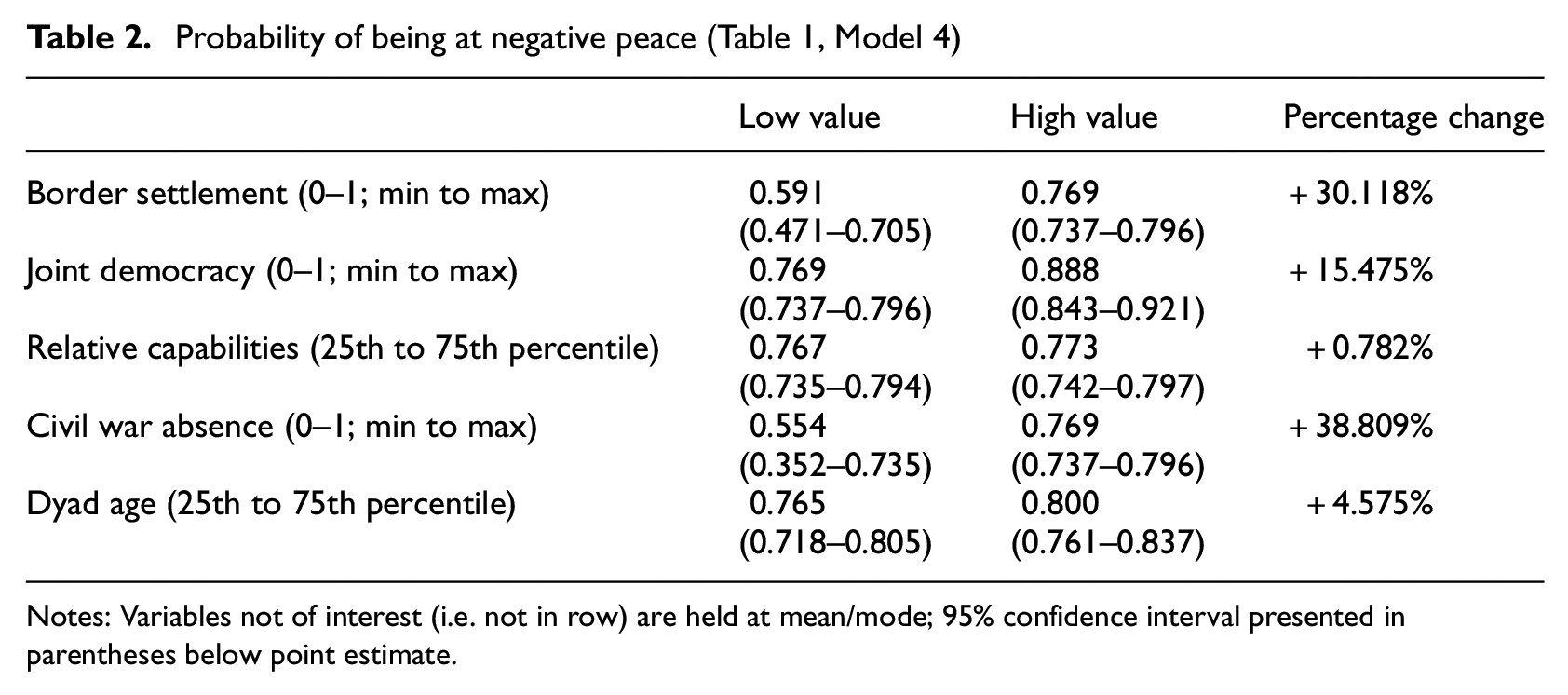
Notes: Variables not of interest (i.e. not in row) are held at mean/mode; 95% confidence interval presented in parentheses below point estimate.
The control variables exert much smaller substantive effects. Jointly democratic contiguous dyads, for example, experience only a 15% higher likelihood of being at negative peace than dyads containing at least one non-democracy—an effect that is roughly half that for border settlement or the absence of civil wars. Changes in relative capabilities or dyad age (from the 25th to the 75th percentile) reveal even smaller effects. These changes exert virtually no substantive effect on the likelihood that a contiguous dyad is at negative peace (1 and 5% respectively)—even though they generate statistically significant coefficients in Table 1.
From these substantive effects, it is clear that managing territorial conflict plays a critical role in negative peace. Border settlement substantially increases the likelihood of observing contiguous dyads at negative peace (by about 30%)—as our first hypotheses would predict. Similarly, an absence of civil war yields an even greater substantive effect (39%) on the likelihood that an interstate, contiguous dyad is at negative peace—as predicted by our fourth hypothesis. In both cases, removing external threats—by clarifying, stabilizing, and enhancing predictability around interstate borders—creates a foundation upon which states can build more peaceful relationships.
Transitions to and from negative peace
Thus far, we have considered the factors that might encourage contiguous dyads to be at negative peace. Nevertheless, dyads do not necessarily stay at negative peace, nor have they always been there. Instead, relationships can transition to and from negative peace. In our data, for example, 50 dyads transition from rivalry to negative peace during the period 1946–2001, while an additional 46 dyads transition from negative peace to rivalry. What factors account for these transitions?
The first three columns of Table 3 examine transitions from rivalry to negative peace relationships, while the last three columns analyze transitions in the opposite direction—from negative peace to rivalry. As the table shows, border settlement demonstrates strong, consistent effects across every model. It is the only factor that significantly facilitates the transition of rival dyads to negative peace (Models 1–3)—a finding that supports our second hypothesis. No other variable—not even the absence of civil wars, contrary to our fifth hypothesis—increases or decreases the likelihood of such transitions. Furthermore, settled borders decrease the likelihood that contiguous dyads at negative peace transition to rivalry (Models 4–6)—much as our third hypothesis predicts. Simply put, border settlement displays causal symmetry; it helps dyads move from rivalry to negative peace and to consolidate negative peace (i.e. to impede dyads at negative peace from developing more hostile, rivalry relationships). It is therefore important not only for rivals to settle their borders, but for other contiguous dyads to do so as well—for this prevents the development of more hostile relationships.
Logistic regression of transitions to/from negative peace, 1946–2001
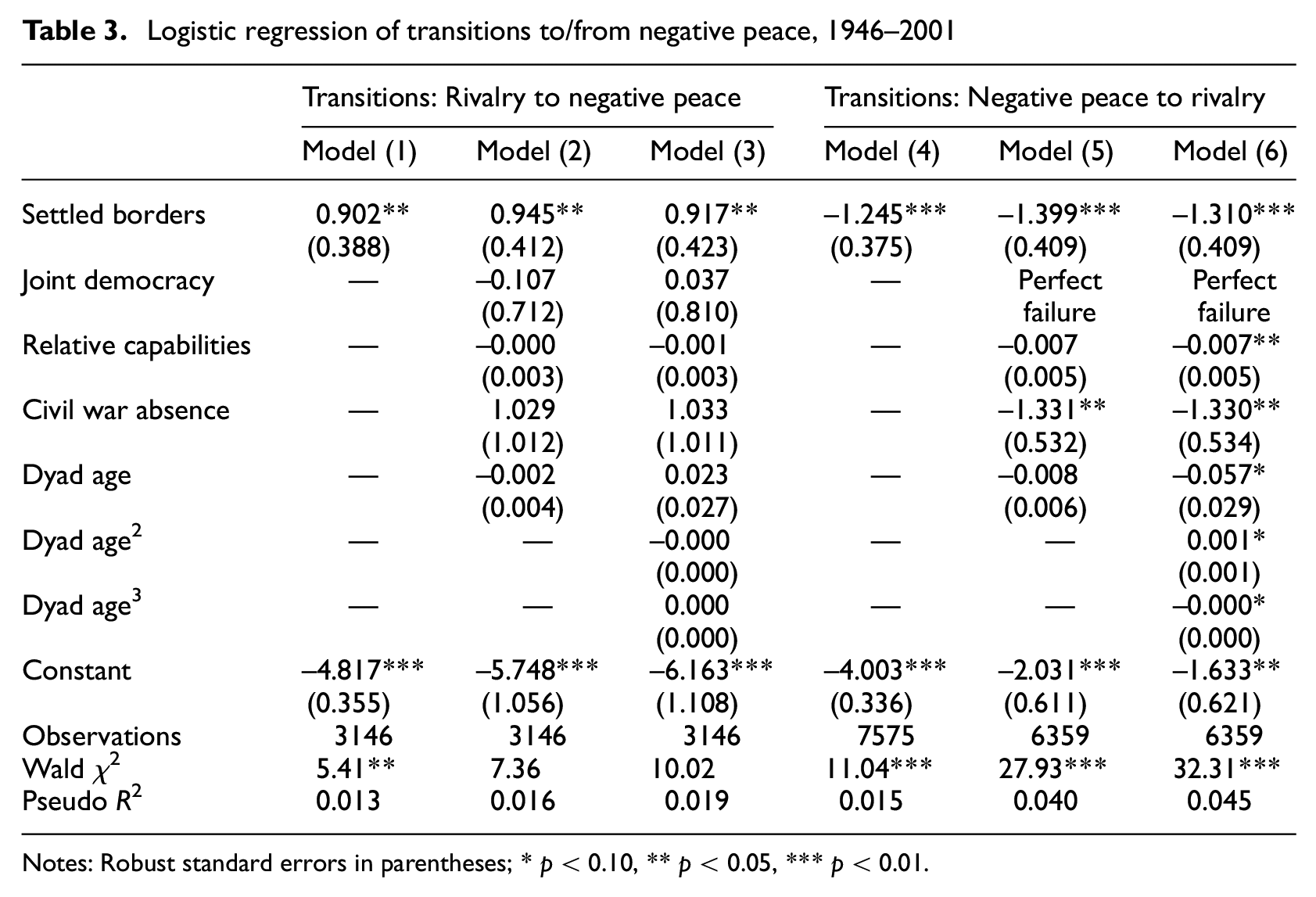
Notes: Robust standard errors in parentheses; * p < 0.10, ** p < 0.05, *** p < 0.01.
The results in Table 3 also suggest that most of the effects we uncovered earlier (in Tables 1 and 2) are conditional. For example, the absence of civil wars, joint democracy, asymmetric power distributions, and dyad age increase the likelihood that a contiguous dyad is at negative peace (see Tables 1 and 2). Yet the dyad’s pre-existing relationship conditions these results. 12 None of these variables significantly increases the likelihood that a contiguous, rival dyad transitions to negative peace (i.e. causal asymmetry exists; Models 1–3, Table 3; on democracy, see also Ghatak, Gold, and Prins, this issue). In contrast, they each play a significant role in ensuring that contiguous dyads at negative peace do not develop into rivalries (i.e. that they remain at negative peace; Models 4–6, Table 3). The absence of civil wars, for example, helps prevent contiguous dyads at negative peace from developing a rivalry relationship—a finding in support of our sixth hypothesis. Joint democracy also decreases the likelihood that a contiguous dyad at negative peace becomes rivals; in fact, we observe perfect failure, which indicates that it makes negative peace relationships immune from becoming rivalries. Finally, power asymmetry displays some complexity—significant in some models but not others. This may result from an interaction between this variable and dyad age, but it lies outside this paper’s scope to explore it. In short, characteristics besides border settlement help ensure that dyads at negative peace remain so, but they do little to help rival dyads move toward a more peaceful relationship.
To get a better sense of our variables’ substantive effects on interstate relationship transformations, Tables 4 and 5 investigate how changes in each variable alter the probability of a representative, contiguous dyad moving either from rivalry to negative peace (Table 4) or from negative peace to rivalry (Table 5). We begin with transitions from rivalry to negative peace (Table 4). In a representative, contiguous dyad (i.e. holding all other variables at their mean or mode), the likelihood of a dyad with unsettled borders transitioning from rivalry to negative peace is 0.009. 13 If this same dyad has settled borders, however, the likelihood of such a transition rises to 0.020—a 122% increase that supports our second hypothesis.
Probability of transitions to negative peace (Table 3, Model 3)
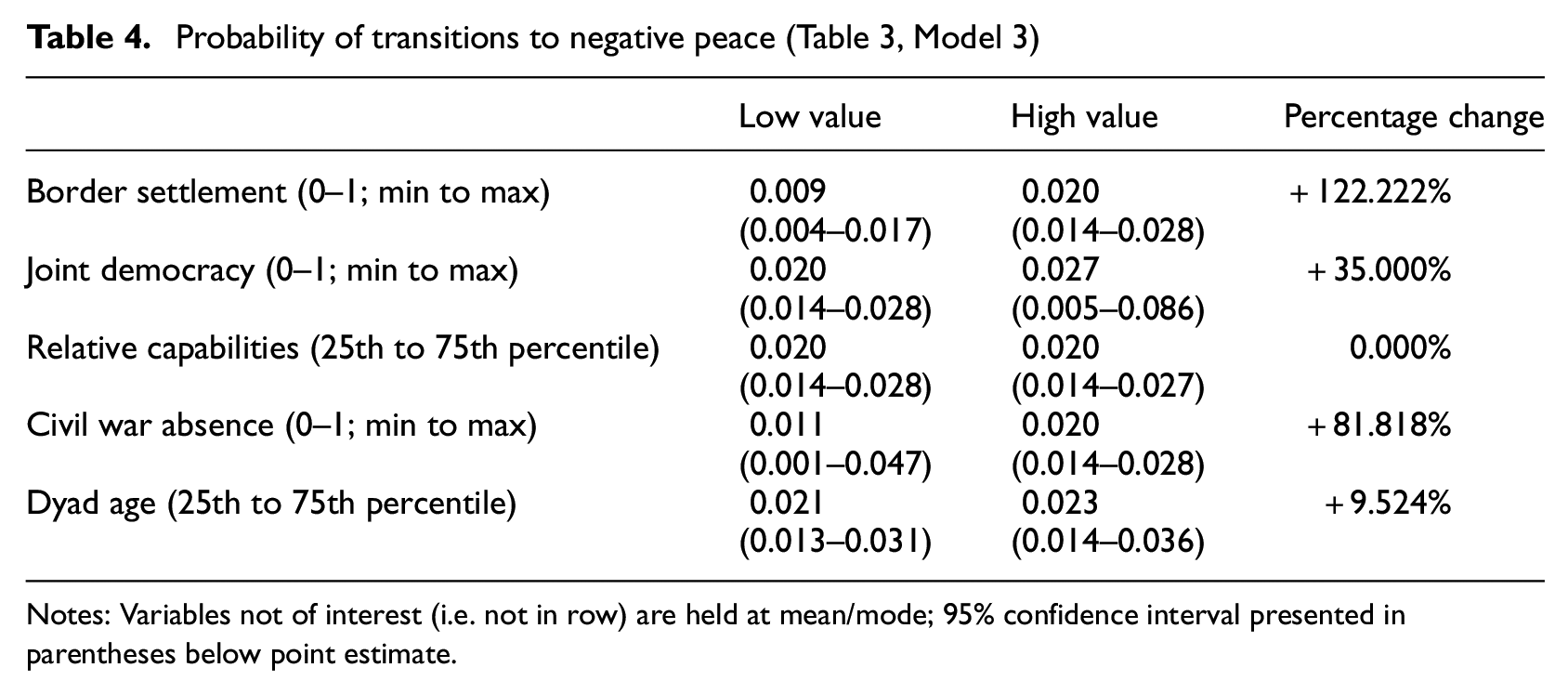
Notes: Variables not of interest (i.e. not in row) are held at mean/mode; 95% confidence interval presented in parentheses below point estimate.
Probability of transitions to rivalry (Table 3, Model 6)
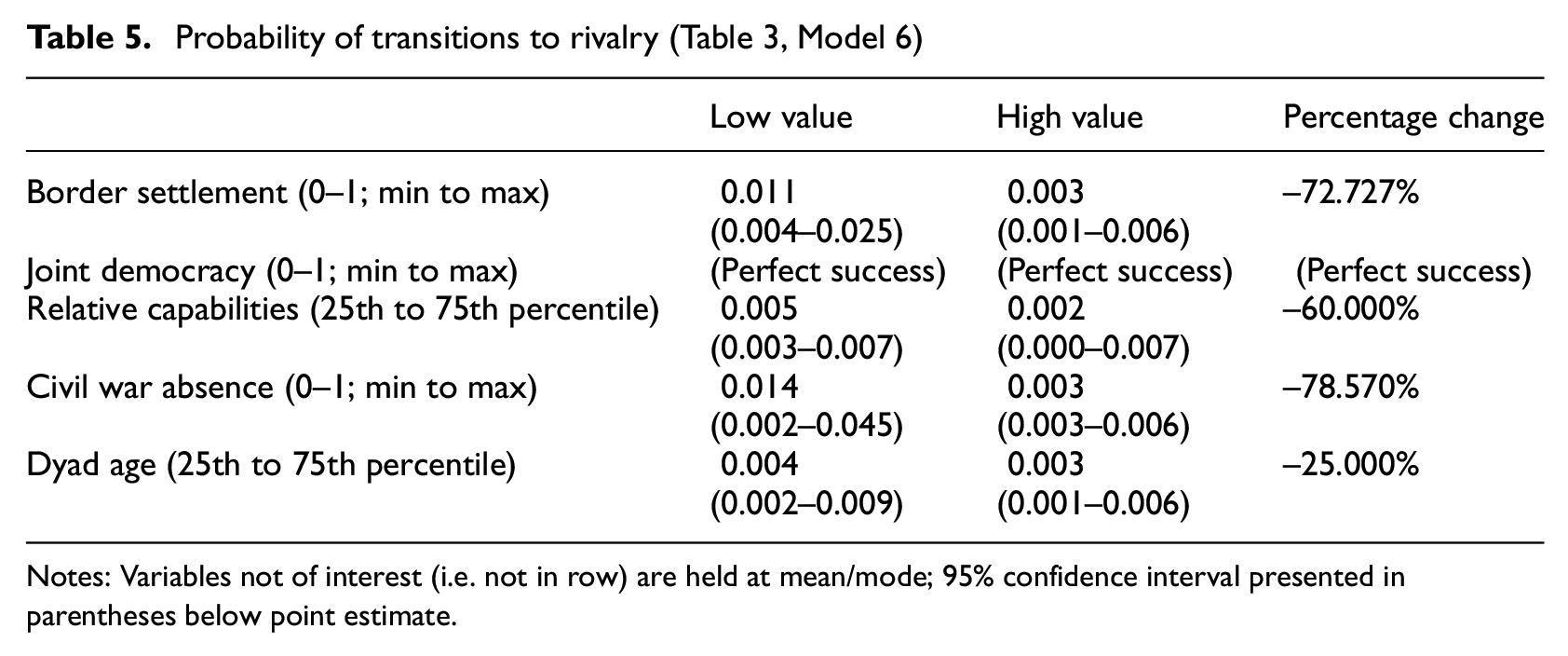
Notes: Variables not of interest (i.e. not in row) are held at mean/mode; 95% confidence interval presented in parentheses below point estimate.
Similar effects derive from our remaining variables, although the effects are smaller than for settled borders. For example, a rival dyad that lacks civil war is 82% more likely to transition to negative peace than a dyad in which civil war is ongoing. Thus, even though the absence of civil war does not exert a statistically significant effect on the likelihood that rivalries transition to negative peace (Table 3), the substantive effects (Table 4) reveal a trend that aligns well with our theoretical argument—offering some (albeit minimal) support to our fifth hypothesis.
The control variables largely behave as one might expect. In the end, numerous factors might help interstate rivalries transition toward negative peace, but the most important appear to involve the effective management of territorial issues. Border settlement and the absence of civil war facilitate such transitions more than the other characteristics we consider—both statistically and substantively.
Of course, this is not to say that border settlement alone explains negative peace—particularly when we consider transitions in the opposite direction: from negative peace to rivalry (see Table 5). To be sure, border settlement still plays a significant role in such transitions (or their prevention). For example, the likelihood that a representative, contiguous dyad without settled borders transitions from negative peace to rivalry is 0.011. This probability falls markedly, however, if the dyad has settled borders instead—to 0.003 (a 73% decline). Such a finding offers clear support to our third hypothesis.
Border settlement is not the only characteristic to affect such transitions. Dyads at negative peace that lack civil wars are 79% less likely than dyads with such conflicts to undergo transitions to rivalry. This finding supports our third hypothesis, as well as our broader border settlement argument—for it seems that civil wars can sour interstate relationships as the argument predicts. In addition, jointly democratic dyads never transition to rivalry. Democracy therefore seems well suited for consolidating negative peace. Finally, older dyads, as well as those containing an asymmetric power distribution, are 25% and 60% less likely than their respective counterparts to transition from negative peace to rivalry. 14 Each of these latter effects, however, is smaller than the ones derived from our border settlement argument.
In the end, de jure border settlement behaves consistently across all of the models. It increases the likelihood that we observe dyads at negative peace, raises the likelihood that dyads transition from rivalry to negative peace, and lowers the likelihood that dyads at negative peace transition to rivalry. These results confirm the logic of our first three hypotheses. In addition, further support for our argument develops from the findings on civil war (i.e. de facto border settlement). Dyads that lack civil war are also more likely to be at negative peace, more likely to transition from rivalry to negative peace relationships (substantively, if not statistically significantly), and less likely to transition from negative peace to rivalry. Both sets of findings derive from external, border-related threats that sour interstate relationships. This suggests that the effective management of territorial issues—in this case, border settlement—offers a key to understanding how peace developed in the interstate system, as well as how states can build and consolidate negative peace relationships on their path toward greater integration and positive peace.
Conclusion
At the outset, we asked three questions: (1) does border settlement increase the likelihood that a dyad is at negative peace; (2) does border settlement increase the likelihood that a hostile relationship (i.e. rivalry) transitions into one at negative peace; and (3) does border settlement decrease the likelihood that dyads at negative peace transition into rivalries? Both our theoretical argument and our multifaceted analyses provide affirmative answers to these three questions.
We argue that both de jure and de facto unsettled borders constitute the kind of salient external threat that causes citizens to centralize power in their leader (Gibler, 2012; Tilly, 1992). To combat this threat, leaders extract resources from the population and militarize the state (Gibler, 2012; Thies, 2004). This produces an aggressive foreign policy—particularly as the leader uses the stronger, larger military to address the threat. Because the threat sustains this entire process, however, the process reverses when the threat dissipates; power de-centralizes, the state de-militarizes, and the state relies more heavily on non-violent mechanisms in pursuit of foreign policy goals (Gibler, 2012; Owsiak, 2012; Vasquez, 2009).
If settled borders constitute a salient external threat—as many argue (e.g. see Gibler, 2012; Owsiak and Rider, 2013)—then the above argument predicts affirmative answers to our main research questions. These predictions receive strong empirical support from our analysis. 15 Border settlement increases the likelihood that a dyad is at negative peace by an average of 30%. Although border settlement neither defines nor serves as a prerequisite for negative peace, it does make negative peace significantly more likely. On average, a rival dyad with settled borders is 122% more likely than a dyad with unsettled borders to transition from a rivalry to negative peace. Additionally, a dyad at negative peace with settled borders is, on average, 73% less likely than a similar dyad without settled borders to transition to rivalry. Notably, these findings hold when we consider an alternative indicator of external border threat: the presence of civil wars within a dyad (i.e. de facto border settlement). We therefore conclude that border settlement—that is, the effective management of territorial issues—plays a crucial role in the emergence and consolidation of negative peace.
Beyond this, our study offers numerous other theoretical and policy contributions as well. Although scholars have studied the relationship between border settlement and militarized interstate conflict (e.g. Gibler, 2012; Owsiak, 2012), they have not yet demonstrated that border settlement yields negative peace. Our study, however, uncovers such a relationship, investigated from numerous angles. This is a critical insight; because negative peace is not defined by the absence of militarized conflict, studying the relationship between border settlement and militarized conflict only goes so far in identifying the factors that promote negative peace. Our study takes the next step. Additionally, those that study rivalries typically do not consider the dyad’s relationship before or after the rivalry (Owsiak and Rider, 2013). They therefore can say little about what happens to dyads outside the rivalry context. In contrast, using new data on interstate relationships over the period 1946–2001, our work provides insight into these non-rival dyads’ relationships and how they develop and evolve. In so doing, we move beyond the intense focus on issues alone (on issues, see Gibler and Hensel and Mitchell, this issue) or state-level characteristics (see Bell and Ghatak, Gold, and Prins, this issue). We also use these relationships to offer a theoretical argument that explains why territorial claims and peace trend alongside one another at the systemic level (Goertz et al., 2016).
In addition, policy makers—particularly in Western democracies—regularly see “positive peace” (i.e. greater political and economic integration, making violence “unthinkable”) as a desirable end. Although we exclude positive peace dyads from this study, preliminary analysis (Goertz et al., 2016) suggests that positive peace is an absorbing state; there are almost no transitions out of positive peace toward negative peace or rivalry. Furthermore, all positive peace cases involve democracies. This makes theoretical sense, as democracy plays a critical role in fostering peaceful conflict management norms and creating greater integration (Russett and Oneal, 2001), and prompts a policy focus on building more democratic states. Yet, to get to the positive peace often sought, states must first pass through negative peace and not transition toward greater hostility (i.e. rivalry). Our analysis shows that de jure and de facto border settlement helps obtain and consolidate this negative peace consistently.
Finally, our study also entertained the hypothesis that causal asymmetry exists in causes of peace vs causes of war. The analyses confirm this supposition, showing evidence of both causal symmetry and asymmetry. Border settlement displays causal symmetry, promoting transitions from rivalry to negative peace and preventing transitions in the reverse direction. In contrast, relative capabilities and democracy seem causally asymmetric—the latter radically so. Democracy has no effect on transitions from rivalry to negative peace, but demonstrates an extremely strong effect on preventing negative peace relationships from becoming rivalries (see also Goertz et al., 2005). Such results suggest that scholars must confront this causal asymmetry hypothesis as they move from studying conflict to explaining peace, for we suspect that many common variables in conflict studies display causal asymmetry (see Goertz et al., 2016). Research designs like ours—which do not hardwire causal symmetry assumptions into their modeling—should therefore be a priority in the analysis of conflict management and peace.
Footnotes
Acknowledgements
An earlier version was presented at the “New Directions in the Study of Territory and Political Violence” workshop, University of Tennessee-Knoxville, 4–6 June 2015. We thank workshop participants, two reviewers, and the editors for their helpful feedback.
Authors’ note
All data, replication materials, and instructions regarding analytical materials upon which published claims rely are available through the SAGE CMPS website.
Funding
This research received no specific grant from any funding agency in the public, commercial, or not-for-profit sectors.
Notes
References
Supplementary Material
Please find the following supplemental material available below.
For Open Access articles published under a Creative Commons License, all supplemental material carries the same license as the article it is associated with.
For non-Open Access articles published, all supplemental material carries a non-exclusive license, and permission requests for re-use of supplemental material or any part of supplemental material shall be sent directly to the copyright owner as specified in the copyright notice associated with the article.
