



Abstract
Scholars widely recognize that democratic dyads are associated with lower hazards of armed conflict and more efficient conflict resolution. Many attempts have been made to challenge the notion of democratic pacifism, but perhaps the most significant is the argument that the Democratic Peace is epiphenomenal to territorial issues, specifically the external threats that they pose. The presence of an external threat might be the mechanism by which democratic dyads, owing to audience costs and resolve, fail to decide contentious issues non-violently. This study seeks to answer the question: “Under what conditions do democratic dyads lower the likelihood of armed conflict?” To do this we propose a hard test of the Democratic Peace. Using an updated global sample of cases, we model joint democracy’s ability to lower the likelihood of armed conflict in the presence of direct external threats in the form of strategic rivalry and territorial contention. The empirical evidence we uncover systematically shows the Democratic Peace to be more limited than previously observed. When we control for each external threat with a simple right-hand-side variable, joint democracy continues to reduce conflict propensities. But when democracies face external threats (i.e. the interaction of democracy and threat), the pacifying effect of democracy is less visible.
Introduction
Evidence tying democracy to lower hazards of armed conflict remains strong and consistent. Not only does the presence of dyadic democracy reduce the risk of militarized dispute involvement (Russett and Oneal, 2001), but democracies are also rarely rivals (Hensel, 2000), show a greater concern for war costs (Bueno de Mesquita et al., 1999; Reiter and Tillman, 2002), and demonstrate an enhanced willingness to resolve disputes via third parties (Dixon, 1996; Mitchell, 2002; Raymond, 1994). Even when controlling for various other correlates of armed conflict across diverse model specifications, democracy remains a robust predictor of peace (Goenner, 2004). Still, several research efforts have challenged democracy’s pacific proclivities. A number of scholars submit that the impact of regime type on dyadic conflict is epiphenomenal, produced more directly by other factors such as preference similarity (Farber and Gowa, 1997; Gartzke, 2000), economic interdependence (Gartzke, 2007), shared contract-intensive economies (Mousseau, 2013), and globalization (Choi, 2010).
The Democratic Peace has also been challenged by research linking both democracy and armed conflict to territorial contention (Gibler, 2007, 2012; Park and James, 2015; Rasler and Thompson, 2011; Senese and Vasquez, 2003; Vasquez, 1993). For example, Gibler (2007, 2012) insists that unsettled borders produce fear and insecurity among political elites, leading to militarization and the centralization of political authority. Where boundary questions exist, then, democracy does not, and where borders remain contentious tends to be where armed conflict occurs. While Gibler submits that territorial contention drives armed conflict, his argument is more fundamentally about external threat. Indeed, when Gibler operationalizes border stability he does so with relative power, previous armed conflict, civil war, and dyad duration, which all define border strength. Ethnic separation, colonial history, and terrain differences define border salience. All of these factors can be seen as indicators of threat and consequently do not explicitly model territorial disagreement as the source of contention between states (Vasquez, 2009). Where threat exists, then, so too does militarization, political centralization, and violent conflict. 1
More recently, Park and James (2015) model joint democracy’s ability to lower the likelihood of conflict in the presence of territorial contention. 2 They find that joint democracy is associated with a lower likelihood of armed conflict, even when controlling for the presence of a territorial dispute. When evaluating whether the relationship between joint democracy and armed conflict is conditional on the presence of a territorial dispute, they find evidence, albeit weak, that it might be. 3 However, what is important about the study conducted by Park and James (2015) is that they attempt to model the interactive effect of democracy and territory on conflict propensity, a model we seek to replicate and extend here. Indeed, we are similarly interested in the conditions under which democratic dyads lower the likelihood of armed conflict. We think that the presence of an external threat could be the mechanism by which democratic dyads—owing to audience costs, resolve, and electoral pressures—fail to maintain their pacifying ability as leaders are pushed to adopt hardline foreign policies when confronted by hostile neighbors and volatile rivals. 4
Recent efforts to determine the limits of democratic pacifism by examining border and territorial disagreements have ignored other critical factors driving states toward conflict, such as strategic rivalry. Not only does strategic rivalry delineate a hostile dyadic relationship, but also evidence currently demonstrates that regime type may not make much difference in rival contexts (Lektzian et al., 2010). Furthermore, it might be possible to organize interstate relationships along a continuum of interactions that help to identify relationships where, for example, while the frequency and severity of violent conflict decline, the perception of threat remains (see Owsiak et al., 2016). Therefore, to specifically address whether regime type affects conflict propensity, we need to consider the overall external security environment that could limit democratic pacifism and the larger continuum of interstate relationships. When faced with a direct external threat, such as strategic rivalry or territorial contention, jointly democratic institutions or norms might not have the same constraining ability on the likelihood of armed conflict as evidence currently suggests. Further, democratic states may be efficient at resolving disputes when external threat remains low. But when confronted with border challenges and persistent hostility, even democratic leaders may find cooperative behavior politically precarious.
In what follows, we draw upon research by Gibler (2007, 2012), Rasler and Thompson (2011), Senese and Vasquez (2003), and Park and James (2015) to develop theoretical connections between territorial contention, rivalry, regime type, and armed conflict. We begin by briefly reviewing challenges to the Democratic Peace. We then move to a discussion of external threat, linking it to territorial contention and strategic rivalry, and discuss how an adversarial dyadic relationship can influence leader decision-making when it comes to using military force. Testable hypotheses of the direct and conditional impacts regime type has on militarized dispute involvement are drawn from this discussion. Specifically, we assess the conflict propensities of democratic dyads relative to mixed and jointly autocratic dyads when controlling for threat. But we also assess the conditional role regime type plays in driving conflict in the presence of external threat. That is, can it be that the Democratic Peace is limited to non-threatening dyadic contexts?
The empirical evidence we uncover systematically shows the Democratic Peace to be more constrained than previously observed. In general, democracies are no less conflict prone than mixed and jointly autocratic dyads when salient external threats are present. More specifically, we find that joint democracy has the strongest effect on lowering conflict propensities when external threat is low to non-existent. In the presence of strategic rivalry, and when rivalry and territorial claims exist together, democratic dyads mostly show little difference in their conflict propensities when compared with mixed and jointly autocratic dyads. Democratic exceptionalism also mostly disappears when we control for political relevance, again signifying that there are clear limits to the Democratic Peace.
The fragility of democratic conflict resolution?
The Democratic Peace—the claim that while democratic states are not necessarily more peaceful than non-democracies (Maoz and Abdolali, 1989), they are less likely to go to war with each other (Small and Singer, 1976)—is probably the most important liberal contribution to the study of conflict. Its explanations rest on the constraining and signaling advantages of democratic political institutions as well as well-entrenched norms of compromise and peaceful conflict resolution (Bueno de Mesquita et al., 1999; Maoz and Russett, 1993; Oneal and Russett, 1997). Challenges to the Democratic Peace have looked to preference similarity (Farber and Gowa, 1997; Gartzke, 2000), economic interdependence (Gartzke, 2007), globalization (Choi, 2010), and shared contract-intensive economies (Mousseau, 2013) instead of joint democracy to explain the peace between democratic states. 5
Even though the Democratic Peace literature has resisted most challenges, 6 perhaps the strongest test has come from the argument that democratic pacifism is epiphenomenal to territorial issues, specifically the external threats that they pose (Gibler 2007, 2012). 7 External threat may be the underlying mechanism that, owing to audience costs, resolve, and electoral pressures, pushes leaders into adversarial relationships regardless of regime type. In this section, we first discuss the concept of external threat and then link it to territory and rivalry. We then consider how an adversarial dyadic relationship might influence a leader’s decision-making when it comes to using military force.
Scholars have long given threat perception a central role in theories of war, deterrence and compellence, alliances, and conflict resolution. In the international relations literature, a threat is defined as a situation in which one agent or group has either the capability or intention to inflict a negative consequence on another agent or group (Davis, 2000; Rousseau and Garcia-Retamero, 2007). Verbal and physical threats are conditional statements designed to signal the capacity and intention to inflict harm if desired results are not forthcoming (Stein, 2013). Deterrent threats require the target to refrain from committing acts that the threatener does not like and compellent threats require the target to engage in actions that they do not wish to do (Schaub, 2004). Leaders do not always threaten verbally; they can also use non-verbal signals to communicate the seriousness of their intent to punish undesirable behavior. They may withdraw their ambassadors, put their forces on alert, or move forces to contested borders (see Bell, 2016). 8 On the other hand, threats may not unambiguously speak for themselves. Understanding the meaning of threats is mediated by the perception of the target. Perception is the process of apprehending by means of the senses, and recognizing and interpreting what is processed (Stein, 2013). We discuss two sources of threat or perception of threat that can push up dyadic conflict propensities and result in a fragile Democratic Peace.
Territoriality as external threat
Considerable empirical attention has been given to the role that geographic proximity plays in inter-state conflict. For example, contiguity is one of most frequently observed predictors of militarized interstate disputes, and war. In a study of major wars from 1816–1976, Wallensteen (1981) finds that contiguity is a critical correlate of conflict that leads to militarized confrontations and to war—93% of the contiguous pairs have at least one militarized confrontation and 64% have at least one war. Similarly, Gochman (1990) examines all militarized interstate disputes from 1816 to 1975 and finds that about 66% of the states involved in militarized disputes are contiguous. Further, for the subset of disputes that involve the use of armed force the percentage of contiguous states increases from 63.88 to 78%. Scholars have extensively addressed the puzzle why neighbors are more likely to fight than non-neighbors (Most and Starr, 1989; Reed and Chiba, 2010; Starr and Dale Thomas, 2005; Vasquez, 1995). The explanation that, until recently, had widest currency was that the relationship between contiguity and war was due to proximity; that is, wars can only occur between states that can reach each other. In some cases war does not occur because distance makes each side physically unable to strike (Vasquez, 1995). Reed and Chiba (2010) argue that neighboring states may have a higher conflict probability because they differ from non-neighbors on observable characteristics such as economic interdependence, alliance membership, joint democracy, and the balance of military capabilities. Neighbors may respond differently than non-neighbors to the same observable variables and are more likely to respond to changes in these than are non-neighbors. However, while contiguity might provide opportunities to fight, wars are mostly fought over issues, which constitute willingness.
Many scholars identify territorial disputes as the most salient issues that states fight over (Bremer, 1992; Colaresi and Thompson, 2005; Huth, 1996; Senese, 2005; Senese and Vasquez, 2008). 9 Vasquez (1995) argues that interstate wars and other severe forms of conflict, like interstate rivalries and militarized confrontations, arise from the attempts by human collectivities to demark territorial units. Aggressive displays and force are frequently used to establish boundaries, and this under the right circumstances can lead to war. 10 Because boundaries are often established or challenged through force, it is no accident that most wars are between neighbors. Humans are territorial in nature. They have learned over centuries that territorial issues can and perhaps should be addressed with the threat and use of force (Vasquez, 1995). Territorial issues often involve the use of a foreign policy that relies on the practices of power politics to resolve the territorial issue in one’s favor. Such practices may include the threat, display, and use of force, the making of alliances and building up of one’s military—realpolitik tactics to compel an opponent (Senese and Vasquez, 2003).
While Reed (2000) finds that joint democracy exerts a pacifying effect only on dispute onset and not on escalation to war, and generally democratic dyads experience fewer disputes than other dyads, there is little research on how such dyads behave when confronted by territorial claims. If democracies are different, then institutional structures and political norms should lower the likelihood of conflict even in the presence of external threat (Bueno de Mesquita and Lalman, 1992; Rummel, 1983; Small and Singer, 1976). But it may be that structural and normative constraints can easily be overcome when salient threats emerge. Indeed, territorial claims may provide democratic leaders with the legitimacy and political cover needed to use military force, even against other democracies.
Yet, Park and James (2015), in a recent study, find that joint democracy is able to lower the likelihood of armed conflict, even when controlling for the presence of a territorial dispute. Even when faced with a territorial dispute, democratic dyads appear less conflict prone than mixed and authoritarian regimes. They contend that this may be supportive of the selectorate model (Park and James, 2015: 96–97, 103), which anticipates that territorial claims will have little impact on the probability of a militarized dispute among democratic dyads (owing to territory’s association with private, not public goods). 11 Still, their evidence for a Democratic Peace when a territorial dispute is present appears fragile. Indeed, they note that this evidence needs to be assessed with caution. When the sample size is limited to politically relevant dyads, democracies do not show a lower likelihood of armed conflict when facing territorial disputes. It appears, then, that democratic states capable of striking one another (based on geographic distance) remain no less but also no more conflict prone than other dyad types when confronting territorial claims. This suggests a limit to democratic pacifism and efficient conflict resolution.
Rivalry as external threat
The strategic environment in which disputes emerge and evolve influences leader decision-making. Vasquez (2000: 379), for example, notes that “the combined effect of hostile external relations and the rise of hard-liners domestically produces a number of psychological effects that help mobilize the society for war and make it difficult to turn the tide to avoid war at the last minute.” So, the context of a demand or challenge affects a leader’s utility for using military force. Challenges from strategic rivals, states that have histories of rancor and violence and consequently deeply mistrust one another, are perceived differently than demands or challenges from non-rivals (Diehl and Goertz, 2000; Hensel et al., 2000). The “fear of exploitation by a rival naturally commits states to hawkish foreign policies” that not only increase the chance of armed conflict but also set the stage for future conflict as well (Lektzian et al., 2010: 1076). Not surprisingly, then, rivals are involved in a disproportionate number of wars—ranging roughly from 50 to 75% of all warfare over the past two centuries—depending on the definition of rivalry (Levy and Thompson, 2010).
Since mistrust plagues rival relations, leaders avoid accommodative policies that might be exploited by their opponents. Hardliners, then, frequently rise to power repudiating diplomacy and peaceful conflict resolution as naive and dangerous, opting for a more muscular, confrontational policy meant to signal resolve and enhance deterrence. Unfortunately, as leaders turn away from accommodative bargaining strategies, mistrust only deepens on both sides and militarization of the relationship occurs. Policy actions taken by rival governments consequently are viewed as threatening and deceitful (see Owsiak et al., 2016).
Protracted conflict also produces hawkish leaders that exploit the rivalry to maintain political power. Colaresi (2004), in fact, observes rivalry sheltering leaders from domestic political punishment. Dovish policies result in electoral losses while more bellicose actions produce electoral rewards. Rivalry becomes self-sustaining as leaders rise to power supporting policies that only prolong the rivalry. Indeed, the context of rivalry exacerbates security concerns by priming leaders for militarized aggression to at least in part ensure their own political incumbency.
While joint democracy has been shown to decrease the hazard of armed conflict overall, the evidence is less clear when dyadic democracy is accompanied by an external threat in the form of strategic rivalry and or territorial contention. The institutional model derives the Democratic Peace from two factors: the hesitancy of leaders in democratic states to risk unwinnable wars and the fact that democracies, once committed to war, “try harder” than autocracies and tend to win most of their wars, thus becoming unattractive targets for aggression (Bueno de Mesquita et al., 2003; Reiter and Stam, 1998). Further, audience costs and electoral pressures enable democratic leaders to signal intentions and resolve more efficiently as they confront political punishment for policy failure (Prins, 2003b). However, rival democracies may find conflict escalation over territory difficult to avoid since the populations of both states may have deep attachments to the contested geographic space. Consequently, voters in democratic states may in fact reward leaders that refuse to concede in such disputes (Colaresi, 2004). Moreover, when leader vulnerability accompanies protracted conflicts then territorial claims may be exploited by elites to stay in power (Lektzian et al., 2010; Rasler and Thompson, 2006). For example, the Kargil War over the disputed territory of Kashmir in 1999 generated tremendous popular support for political elites in both India and Pakistan (see Sarkar, 1999). Our discussion above leads to three basic hypotheses.
That rivalry and territorial contention push states toward armed conflict is unsurprising (see Owsiak et al., 2016). 12 Rivalry generates deep mistrust that precludes compromise and frustrates credible commitment, while territorial incompatibility provides the underlying issue in dispute supporting military action. Democracy, in contrast, tends to alleviate fears of exploitation through transparency, institutional restraint, and efficient signaling. But can democracy continue to lower conflict propensities in the presence of both rivalry and territorial disagreement? Democratic leaders may find accommodative policies politically costly as opposition parties paint government concessions as evidence of weakness, indecision, and a lack of resolve. Consequently, as Lektzian et al (2010: 1079) point out, “audience cost pressures may push democratic leaders toward more aggressive policies in the face of a challenge” especially when that challenge comes from a rival and involves a salient territorial issue. What we propose, then, is a hard test of the Democratic Peace. Does joint democracy continue to lower the likelihood of armed conflict in the presence of external threat in the form of strategic rivalry and territorial contention? Gibler (2007, 2012) appears to suggest that the pacifying effects of liberal institutions will disappear once external threat in the form of border stability is controlled for and Lektzian et al. (2010) find evidence that regime type fails to affect the probability of dispute onset when external threat is present, at least for states in the Western Hemisphere. On the other hand, Park and James (2015) find that joint democracy maintains its pacifying role in the presence of a territorial dispute. We extend this research program in three ways. First, we evaluate our theoretical relationships using a global sample of cases. Second, we estimate the effect of democracy on the likelihood of armed conflict when controlling for external threat, similar to Park and James (2015). Finally, and most importantly, we examine the effect of joint democracy on armed conflict conditional on external threat in the form of rivalry, territory, and an indexed measure of threat. 13
Research design and methods
Two goals guide our empirical analyses. First, we are interested in comparing the direct effects of joint democracy on armed conflict when external threat is present. This involves including several separate measures of threat in our set of covariates to determine whether the pacifying influence of joint democracy remains. Second, our analyses assess the conditional effects of democracy on armed conflict (Park and James, 2015). Given that Gibler (2007), Vasquez (2000), and Rasler and Thompson (2011) all insist that the strategic environment influences leaders’ foreign policy choices, our investigations into when and where democracy matters allow us to comment on this research as well as ascertain the structural conditions possibly limiting the Democratic Peace. The pacifying influence of democratic institutions and values may be more limited than previously established. We uncover and note some of these limiting conditions. Finally, we utilize multiple measures of external threat to ensure the robustness of our empirical results and, in our Online Appendix, we use three different measures of conflict and present our results using a second estimator (general estimating equation).
Estimator, unit of analysis, and dependent variable
Similar to Gibler (2007, 2014), Park and Colaresi (2014), and Park and James (2015), we estimate a standard probit model on a dichotomous measure of armed conflict. Our unit of analysis is the dyad year and the temporal period is from 1816 to 2001. 14 To control for spatial and temporal non-independence, we cluster errors on the dyad and include a cubic polynomial approximation for time since last conflict (Carter and Signorino, 2010). 15 We have 537,961 cases and 13,940 dyads included in our sample. 16 We use three measures of armed conflict. The first is militarized dispute onset. The second is fatal militarized interstate dispute (MID) onset, which is a subset of the first measure using only disputes that result in at least one battle fatality. Finally, we use the Armed Conflict Dataset that records events when at least 25 battle fatalities have occurred. We show model results here only from MID onset, which allows us to compare our findings directly with Park and James (2015). Our results using Fatal MIDs and ACD conflicts can be found in the Online Appendix.
Independent variables
Our primary theoretical variables of interest remain joint democracy and external threat. We use Polity IV to establish a jointly democratic dyad with seven or higher on the individual democracy scores defining a democratic polity. 17 Three separate measures of threat are included in our analyses. First, we use Issue Correlates of War (ICOW) data to distinguish dyads with territorial claims; 18 1 denotes the presence of a territorial claim; 0 if not. Second, we identify strategic rivals using data from Rasler and Thompson (Rasler and Thompson, 2006; Thompson, 2001); 19 1 denotes the presence of strategic rivalry; 0 if not. Finally, we construct a measure of external threat using both territorial claims and strategic rivalry together. This threat index ranges from 0 (the absence of territorial claims or rivalry) to 2 (the presence of both territorial claims and rivalry). A 1 represents the presence of a territorial claim or strategic rivalry. 20
Control variables
We incorporate control variables that generally match a typical model of international conflict as well as correspond to the research design used by Park and James (2015). The first control variable is relative power (expected to be negative). It is measured as the natural logarithm of the stronger CINC score over the weaker CINC score. Data come from the Composite Index of National Capabilities from the Correlates of War Project, Version 3.02 (Singer et al., 1972). The second control variable is a dichotomous variable measuring the presence of contiguous dyads at the 150 mile level. The third control variable, major power, is a dichotomous measure of the presence of a major power. The fourth control variable, alliance, is a dichotomous measure of the presence of an alliance (Gibler, 2009). The fifth control variable, previous MID, counts the number of previous armed conflicts in a dyad. Lastly, as was previously reported, we include the cubic polynomial approximation for time since last conflict (Carter and Signorino, 2010).
Empirical results
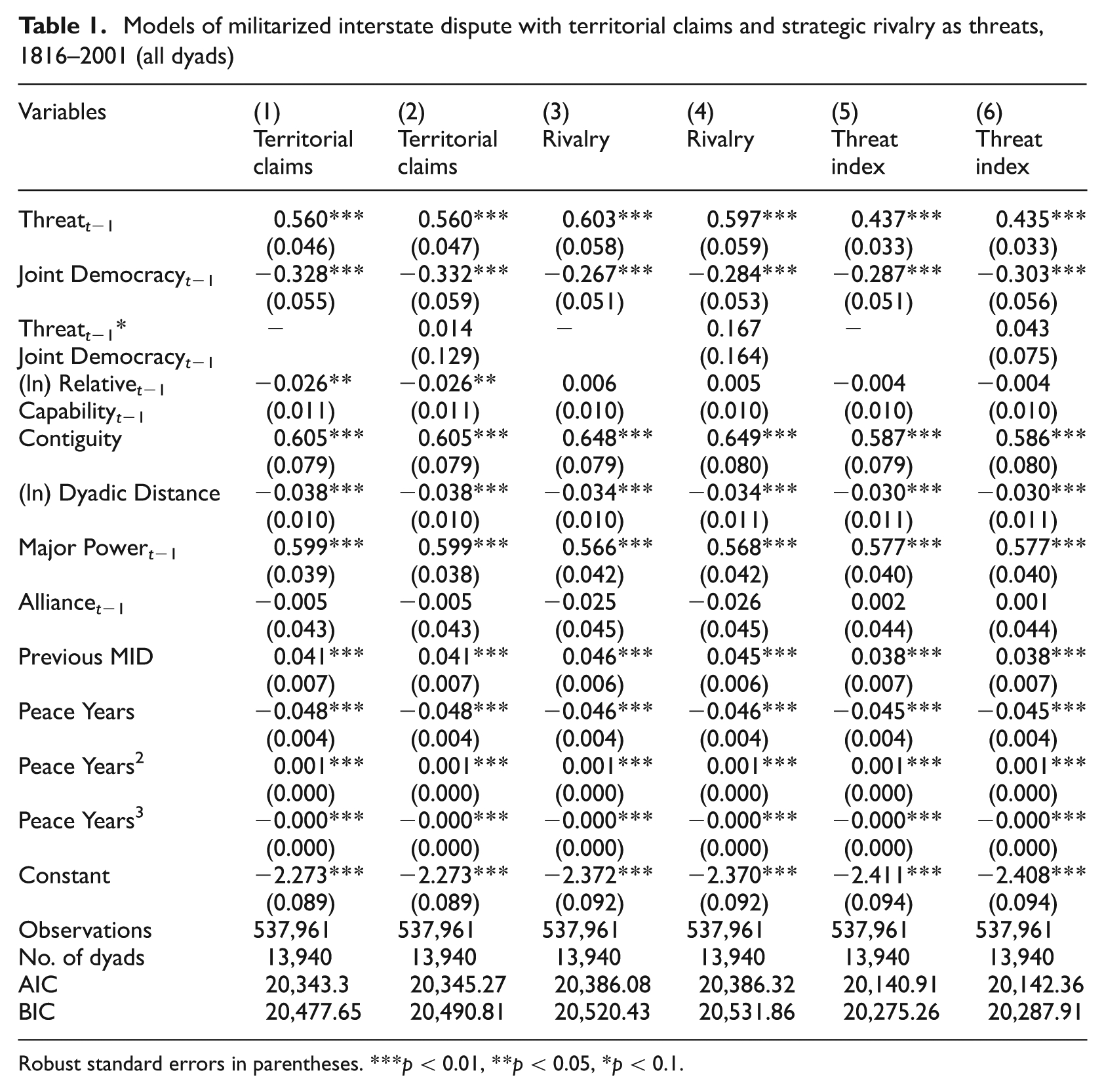
Table 1 presents the results of our inferential analyses using the onset of MID for all dyads between 1816 and 2001, using different measures of external threat. In all of our models (1–6) in Table 1, the control variables are either significant in expected directions or have signs as expected. The presence of a major power in a dyad and contiguity always increase the likelihood of MID onset. Similarly, a dyadic history of previous militarized disputes always increases the probability of conflict onset. Dyadic distance consistently reduces the chance of MID onset, while in general relative capabilities is negatively related to MID onset, although at times the relationship is statistically insignificant. Finally, alliances should result in a lower likelihood of MID onset, but the coefficients do not reach the levels of statistical significance in our models in Table 1. Still, the coefficients are negatively signed as one would expect.
Models of militarized interstate dispute with territorial claims and strategic rivalry as threats, 1816–2001 (all dyads)
Robust standard errors in parentheses. ***p < 0.01, **p < 0.05, *p < 0.1.
Model 1 presented in Table 1 shows that territorial claims as a measure of threat have a strong positive relation with MID onset, while joint democracy has a pacifying effect on the onset of a MID for all dyads while controlling for territorial claims and other standard correlates of armed conflict (support for hypotheses 1 and 2). Our evidence therefore supports most extant research on the Democratic Peace and very closely matches the evidence presented by Park and James (2015: 96). They also find strong direct effects for both joint democracy and territorial claims on conflict propensity. We observe similar direct effects using an alternative measure of external threat. Strategic rivalry strongly increases the likelihood of MID onset (Model 3) and the combination of territorial claims and rivalry (Model 5) is also positively associated with the onset of armed conflict. In all three models (1, 3, 5) in Table 1 that estimate direct effects, joint democracy consistently lowers the probability of MID onset (support for Hypothesis 1).
Model 2 in Table 1 presents the contingent effects of joint democracy and territorial claims. Unlike Park and James (2015), who find an added pacifying effect from joint democracy when territorial issues were present, we observe no such effect. The coefficient on the interaction term is statistically insignificant but is positive, which suggests that joint democracy in the context of territorial claims has a weaker pacifying effect (−0.318 = −0.332 + 0.014) than in an environment where a claim is not present (−0.332). To better show the effects of regime type in the context of a territorial claim, we graph the predicted probability of MID onset across territorial claims and regime type. Figure 1a clearly shows dyads without territorial claims to have lower conflict propensities than dyads with territorial claims. The effects are quite large. For non-democratic dyads, a territorial claim increases the probability of MID onset by a factor of 5. For democratic dyads, the effect is even larger, increasing the probability of MID onset by a factor of 6. Our evidence on the conditional effects of joint democracy both supports and refutes the Democratic Peace. We observe that democratic dyads have a lower probability of MID onset both in the presence of territorial claims and in their absence when compared with non-democratic dyads. However, the effect of joint democracy on the likelihood of armed conflict is weaker and not stronger in the context of territorial claims (limited support for Hypothesis 3).
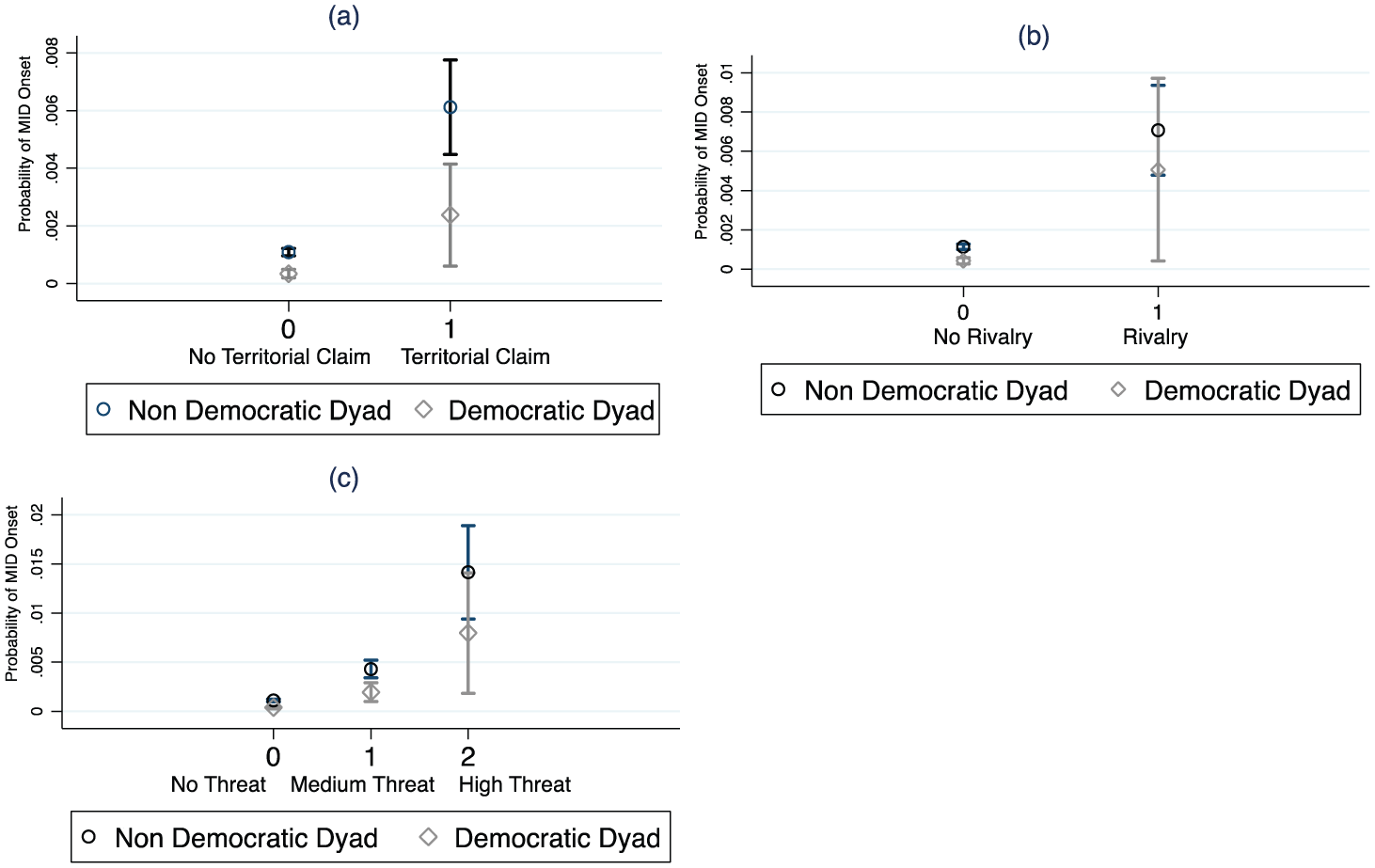
Effects of regime type on the likelihood of MID onset across different measures of external threat, all dyads.
The conditional effect of democracy is even weaker in the context of strategic rivalry. While we again observe a general increase in the likelihood of conflict onset for all dyads engaged in rivalry, no statistical difference emerges based on regime type. While non-democratic dyads clearly show a higher conflict propensity than democratic dyads outside of rivalry, inside of rivalry the difference disappears (Figure 1b). Democratic leaders appear as willing as non-democratic leaders to use military force against other democracies, perhaps owing to electoral and audience cost pressures. Indeed, we see no evidence that democratic institutional structures and norms work best in managing salient disputes. In fact, we observe just the opposite. Democracy tends to lower the incidence of armed conflict only when external threat remains modest. We reach this same conclusion when we combine the contexts of claims and rivalry. Figure 1c demonstrates that increases in external threat increase the probability of conflict onset for all dyads. But the pacifying influence of democracy drops as one moves from low-threat to medium-threat environments and statistically disappears altogether when threat is high (i.e. when both territorial claims and strategic rivalry exist). The supposed conflict management advantages of democracy do not show up clearly in our analyses (Hypothesis 3 is not supported with rivalry as external threat).
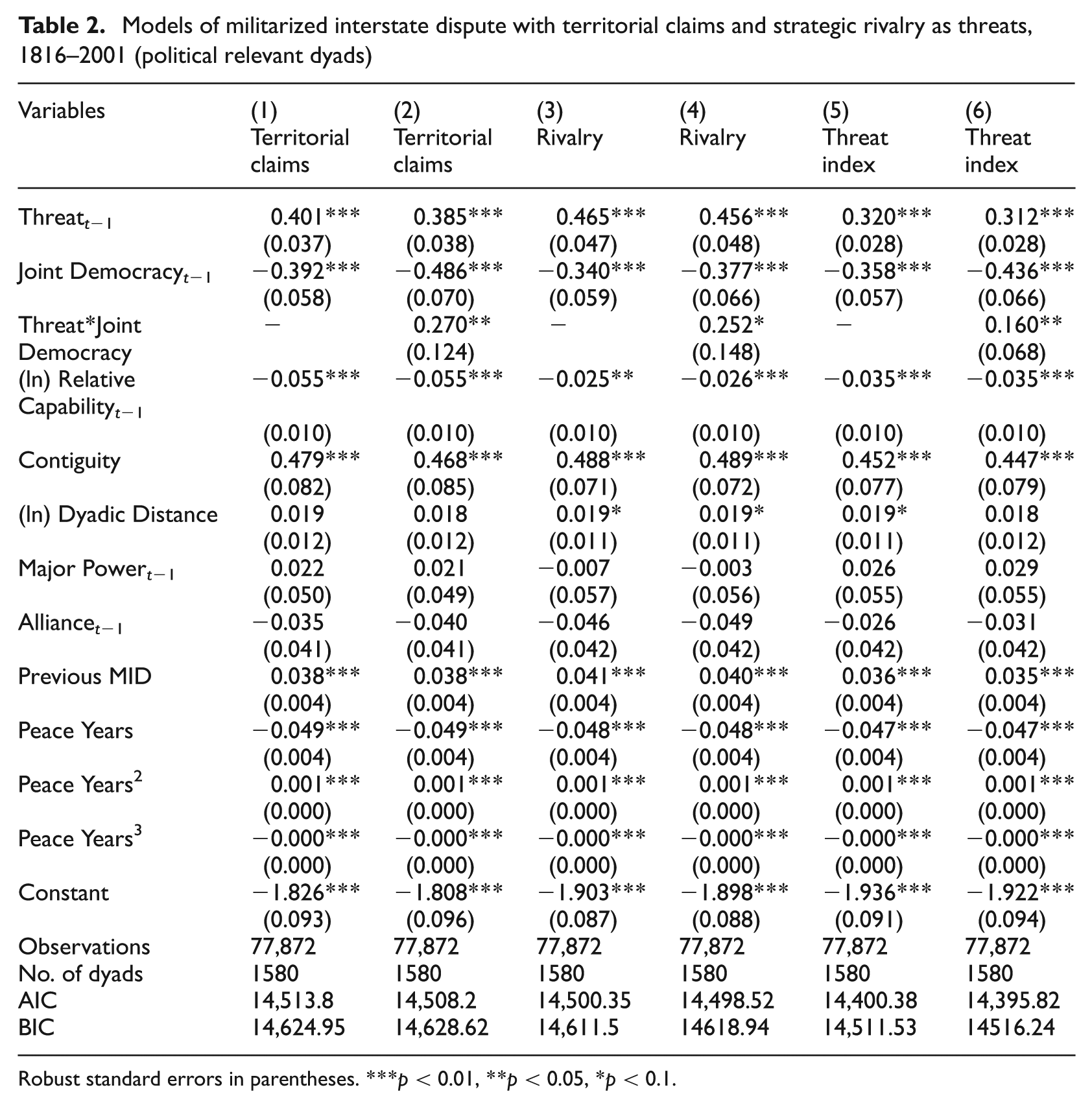
Similar results appear when we restrict our investigations to politically relevant dyads (Table 2). We still find that joint democracy decreases MID onset, while threat (in the form of claims and rivalry) increases MID onset when we estimate direct effects (Models 1, 3, and 5 in Table 2). But when democratic dyads face external threats, they do not appear to show lower conflict propensities than non-democratic dyads (see Figure 2). In fact, the coefficient for each interaction term is positive and statistically significant (two at the 95% and one at the 90% confidence-level using two-tailed significance tests). So, the effect of joint democracy on the likelihood of MID onset is weaker, not stronger, when external threats exist. Our evidence is stronger than that of Park and James (2015), who find only that democratic dyads show no statistical difference from non-democratic dyads in conflict propensity in the presence of territorial claims when examining only political relevant dyads (Table 3 on page 98).
Models of militarized interstate dispute with territorial claims and strategic rivalry as threats, 1816–2001 (political relevant dyads)
Robust standard errors in parentheses. ***p < 0.01, **p < 0.05, *p < 0.1.
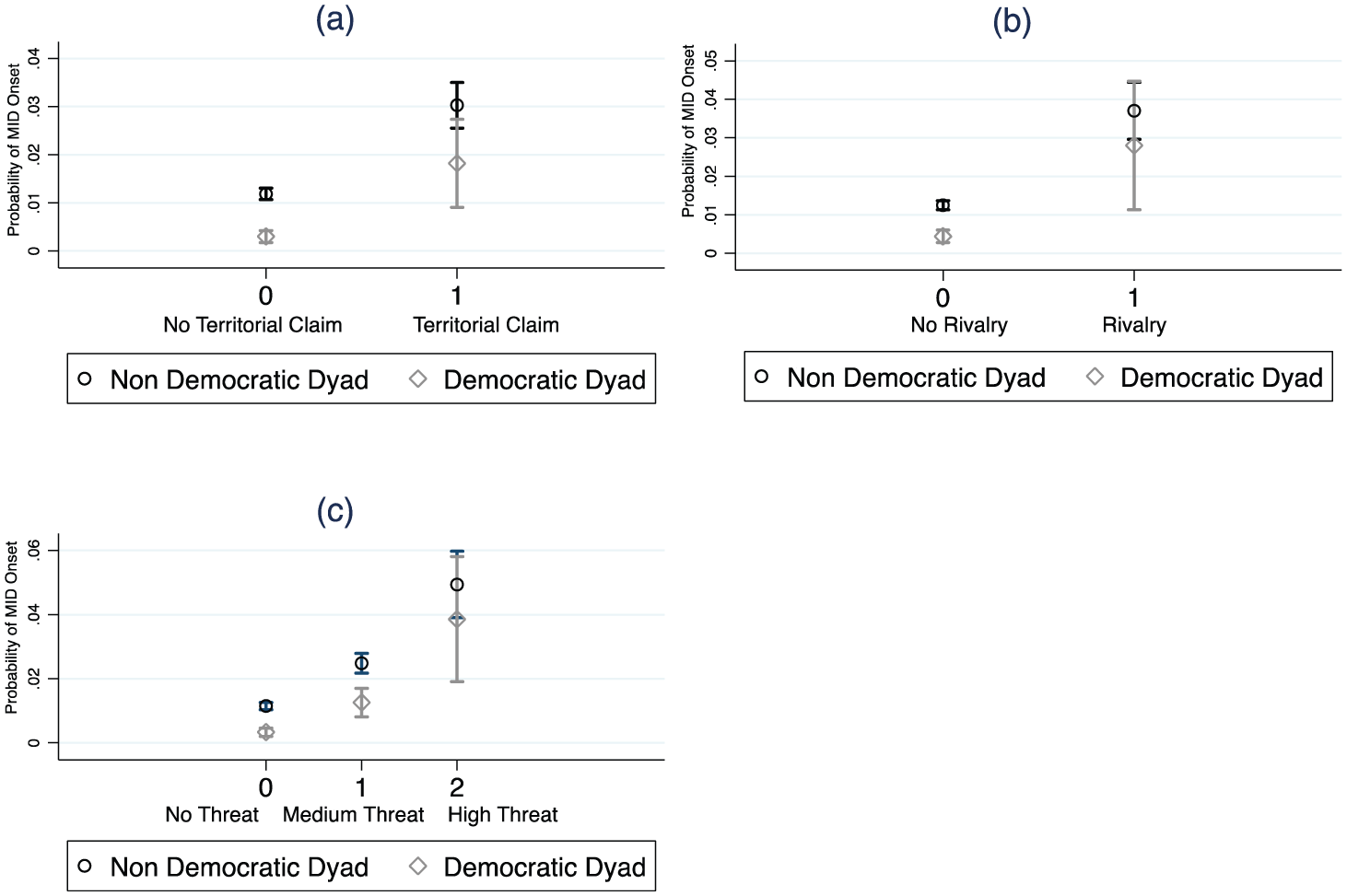
Effects of regime type on the likelihood of MID onset across different measures of external threat, political relevant dyads.
All our interactive models show that the pacifying effect of democracy disappears when threats are present. These findings do not corroborate recent evidence by Park and James (2015) that supports the pacifying effect of democracy. The Park and James (2015) study is for the period between 1919 and 1995, while our study is for a longer time period (1816–2001). Additionally, we use multiple measures of threat, including territorial contention and strategic rivalry. Importantly, our model results are robust to different measures of conflict and different statistical estimators. These results, found in the Online Appendix, show the pacific effects of democracy remain limited to low external threat environments.
Conclusion
It has become a stylized fact that dyadic democracy lowers the hazard of armed conflict. While the Democratic Peace has faced many challenges, we believe the most significant challenge has come from the argument that the pacifying effect of democracy is epiphenomenal to territorial issues, specifically the external threats that they pose. This argument sees the lower hazards of armed conflict among democracies not as a product of shared norms or institutional structures, but as a result of settled borders. Territory, though, remains only one geo-political context generating threat, insecurity, and a higher likelihood of armed conflict. Strategic rivalry also serves as an environment associated with fear, a lack of trust, and an expectation of future conflict. Efforts to assess democratic pacifism have largely ignored rivalry as a context conditioning the behavior of democratic leaders. To be sure, research demonstrates rivals to have higher probabilities of armed conflict and democracies rarely to be rivals. But fundamental to the Democratic Peace is the notion that even in the face of difficult security challenges and salient issues, dyadic democracy will associate with a lower likelihood of militarized aggression. But the presence of an external threat, be that threat disputed territory or strategic rivalry, may be the key mechanism by which democratic leaders, owing to audience costs, resolve and electoral pressures, fail to resolve problems non-violently.
This study has sought a “hard test” of the Democratic Peace by testing the conditional effects of joint democracy on armed conflict when external threat is present. We test three measures of threat: territorial contention, strategic rivalry, and a threat index that sums the first two measures. For robustness checks, we use two additional measures of our dependent variable: fatal MID onset, and event data from the Armed Conflict Database, which can be found in our Online Appendix. As most studies report, democratic dyads are associated with less armed conflict than mixed-regime and autocratic dyads. In every one of our models, when we control for each measure of external threat, joint democracy is strongly negative and significant and each measure of threat is strongly positive and significant. Here, liberal institutions maintain their pacific ability and external threats clearly increase conflict propensities. However, when we test the interactive relationship between democracy and our measures of external threat, the pacifying effect of democracy is less visible. Park and James (2015) find some evidence that when faced with an external threat in the form of territorial contention, the pacifying effect of joint democracy holds up. This study does not fully support the claims of Park and James (2015). Using a longer timeframe, we find more consistent evidence that when faced with an external threat, be it territorial contention, strategic rivalry, or a combination, democratic pacifism does not survive. What are the implications of our study? First, while it is clear that we do not observe a large amount of armed conflict among democratic states, if we organize interstate relationships along a continuum from highly hostile to highly friendly, we are probably observing what Goertz et al. (2016) and Owsiak et al. (2016) refer to as “lesser rivalries” in which “both the frequency and severity of violent interaction decline. Yet, the sentiments of threat, enmity, and competition that remain—along with the persistence of unresolved issues—mean that lesser rivalries still experience isolated violent episodes (e.g., militarized interstate disputes), diplomatic hostility, and non-violent crises” (Owsiak et al., 2016). Second, our findings show that the pacific benefits of liberal institutions or externalized norms are not always able to lower the likelihood of armed conflict when faced with external threats, whether those hazards are disputed territory, strategic rivalry, or a combination of the two. The structural environment clearly influences democratic leaders in their foreign policy actions more than has heretofore been appreciated. Audience costs, resolve, and electoral pressures, produced from external threats, are powerful forces that are present even in jointly democratic relationships. These forces make it difficult for leaders to trust one another, which inhibits conflict resolution and facilitates persistent hostility. It does appear, then, that there is a limit to the Democratic Peace.
Footnotes
Appendix
Summary statistics
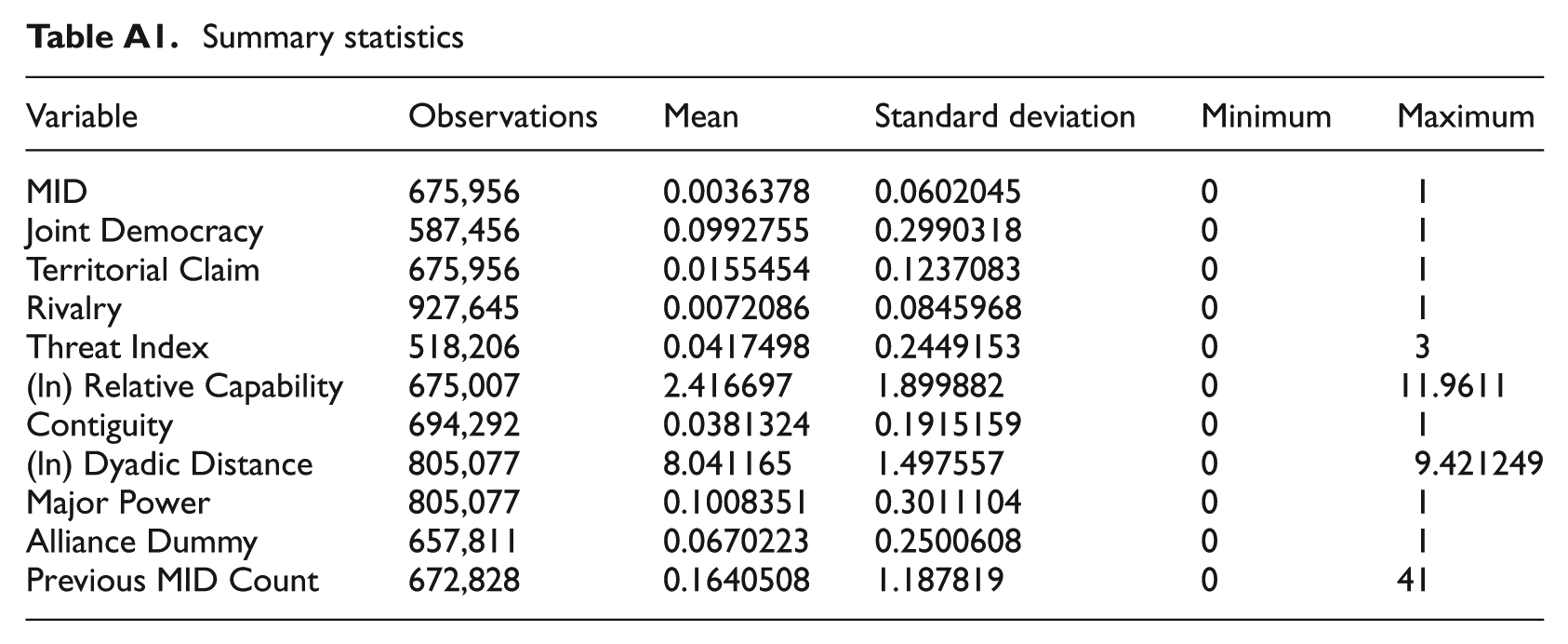
| Variable | Observations | Mean | Standard deviation | Minimum | Maximum |
|---|---|---|---|---|---|
| MID | 675,956 | 0.0036378 | 0.0602045 | 0 | 1 |
| Joint Democracy | 587,456 | 0.0992755 | 0.2990318 | 0 | 1 |
| Territorial Claim | 675,956 | 0.0155454 | 0.1237083 | 0 | 1 |
| Rivalry | 927,645 | 0.0072086 | 0.0845968 | 0 | 1 |
| Threat Index | 518,206 | 0.0417498 | 0.2449153 | 0 | 3 |
| (ln) Relative Capability | 675,007 | 2.416697 | 1.899882 | 0 | 11.9611 |
| Contiguity | 694,292 | 0.0381324 | 0.1915159 | 0 | 1 |
| (ln) Dyadic Distance | 805,077 | 8.041165 | 1.497557 | 0 | 9.421249 |
| Major Power | 805,077 | 0.1008351 | 0.3011104 | 0 | 1 |
| Alliance Dummy | 657,811 | 0.0670223 | 0.2500608 | 0 | 1 |
| Previous MID Count | 672,828 | 0.1640508 | 1.187819 | 0 | 41 |
Acknowledgements
We are grateful to participants from the Territory Workshop held at the Howard Baker Center, two reviewers, and the editor for helpful comments.
Authors’ note

Conflict of interest statement
The authors declare that there is no conflict of interest.
Funding
This research received no specific grant from any funding agency in the public, commercial, or not-for-profit sectors.
Notes
References
Supplementary Material
Please find the following supplemental material available below.
For Open Access articles published under a Creative Commons License, all supplemental material carries the same license as the article it is associated with.
For non-Open Access articles published, all supplemental material carries a non-exclusive license, and permission requests for re-use of supplemental material or any part of supplemental material shall be sent directly to the copyright owner as specified in the copyright notice associated with the article.
