



Abstract
Numerous studies have used monadic or dyadic data to show that democracies are more likely to win wars. Poast (2010; Political Analysis 18(4): 403–425) demonstrates that the use of dyadic data to model events that are really multilateral (or k-adic) can bias the statistical results. In this article, I discuss the potential consequences of that bias for previous studies on democracy and war outcomes. Then I replicate some of those studies using modified, k-adic versions of the original datasets. Finally, I conduct an original analysis using the updated dataset on wars by Reiter et al. (2014a; Journal of Conflict Resolution; doi: 10.1177/0022002714553107). Overall, I find several changes when using k-adic data. Most significantly, the relationship between democracy and war outcomes appears to be strongest for states that join the war effort after it has already started.
Introduction
The phenomenon that democracies tend not to fight each other is often held to be the closest that the field of international relations has to a law. A smaller, but still substantial number of scholars argue that democracies are more likely to win wars than autocracies. Although this democratic advantage has manifested in dozens of statistical analyses, many of the dyadic datasets used in those analyses contain unusual events, such as Turkey single-handedly defeating Russia in the Crimean War in 1856, when really it was the combined strength of Turkey, Italy, France and the UK that led to Russia’s demise. Poast (2010) uses simulations to demonstrate how the accumulation of such cases can influence the statistical results, suggesting that previous studies that used dyadic data to examine the relationship between democracy and war outcomes may have misestimated that relationship. To find out whether this is the case, I replicate several previous studies, including one that supported the idea of a democratic advantage (Reiter and Stam, 1998, 2002) and one that challenged the idea of a democratic advantage (Downes, 2009), using software and code developed by Poast (2010) to transform the original datasets into k-adic datasets, whereby each conflict is represented by a single observation, k represents the total number of countries involved in the conflict, and the control variables are coded to take into account every country involved in the conflict, so that the conflict is reduced to a single observation but no information is lost in the process (Poast, 2010). 1
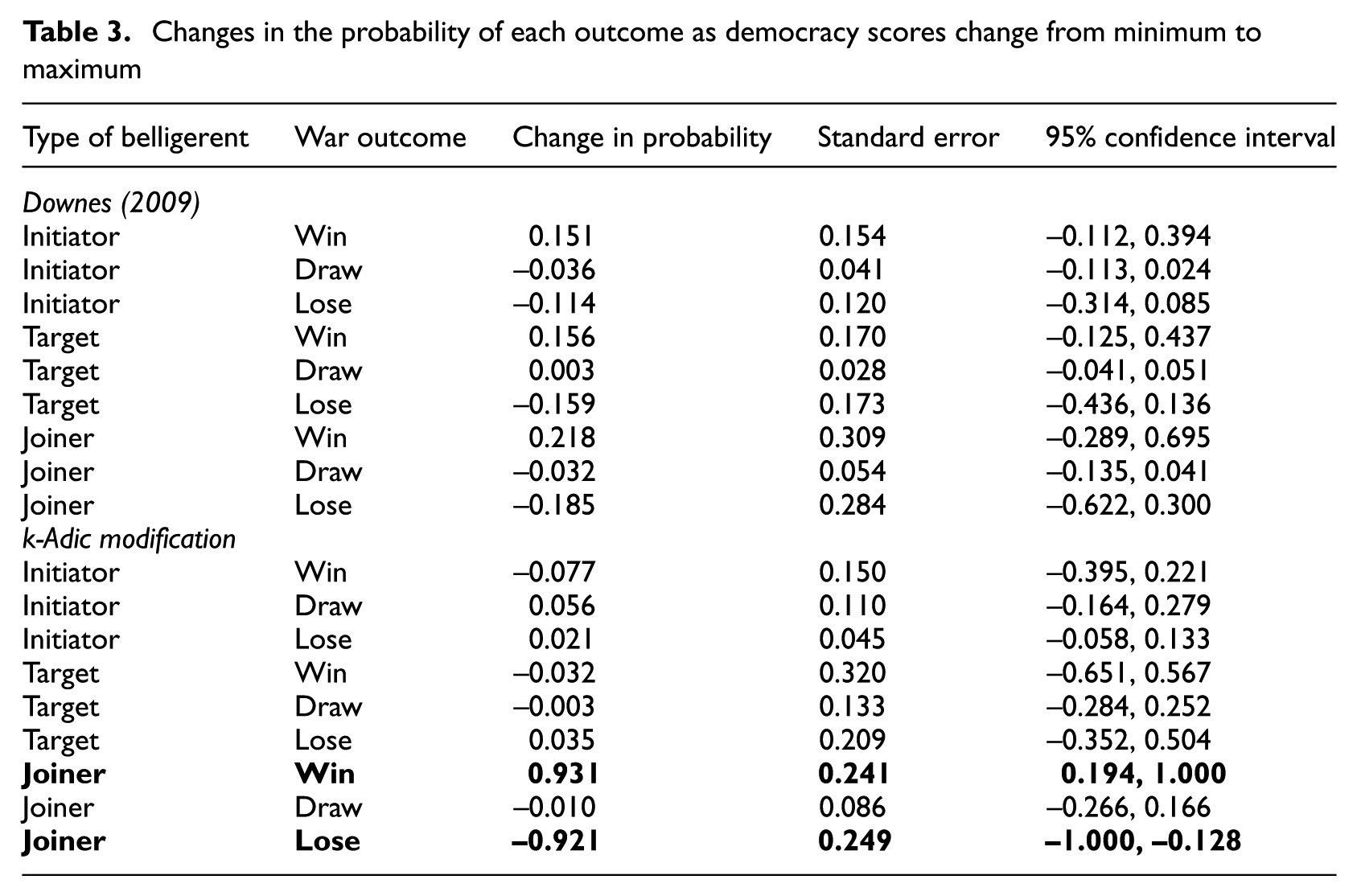
Using the k-adic versions of the original datasets, I find several changes in the relationship between democracy and war outcomes. For example, Reiter and Stam (1998, 2002) showed that a state’s level of democracy has a positive effect on the likelihood that both initiators and targets win wars, but my replication of Reiter and Stam’s (1998, 2002) analysis using k-adic data shows that the relationship between democracy and war outcomes only manifests for targets (Table 1). Next, Downes (2009) criticized Reiter and Stam (1998, 2002) for their method of coding targets and showed that, once correcting for that error, democracies are no longer more likely to win wars. However, my replication of Downes’s (2009) analysis using k-adic data shows that the level of democracy is positively related to the likelihood of winning wars (Table 2, Model 2), although the change in the probability of victory is only statistically significant for states that join the war effort after it has already started (Table 3, bottom).
Probit model of war outcomes: dependent variable is win/lose
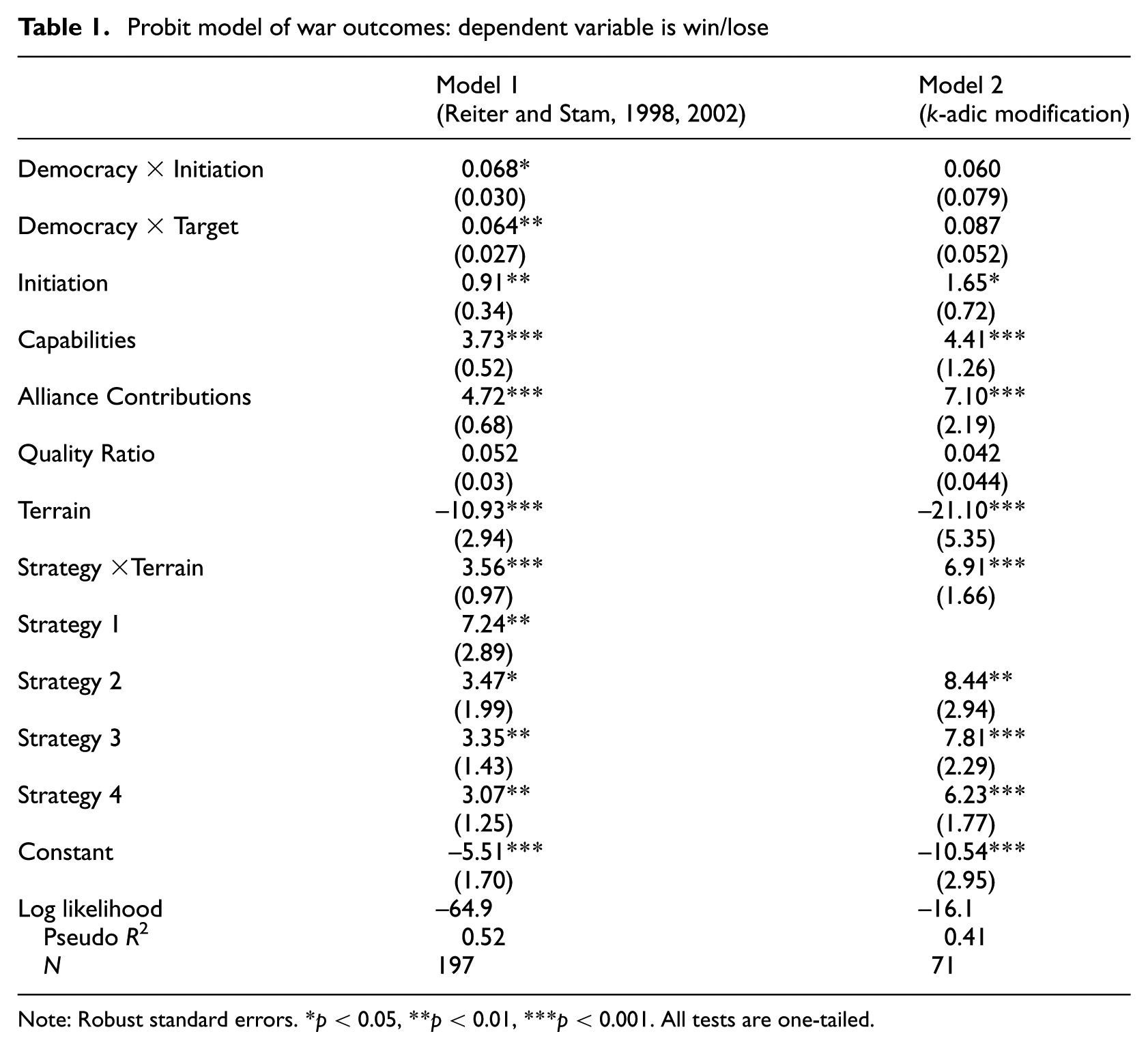
Note: Robust standard errors. *p < 0.05, **p < 0.01, ***p < 0.001. All tests are one-tailed.
Ordered probit models of war outcomes (win/draw/lose) using tripartite coding of belligerents
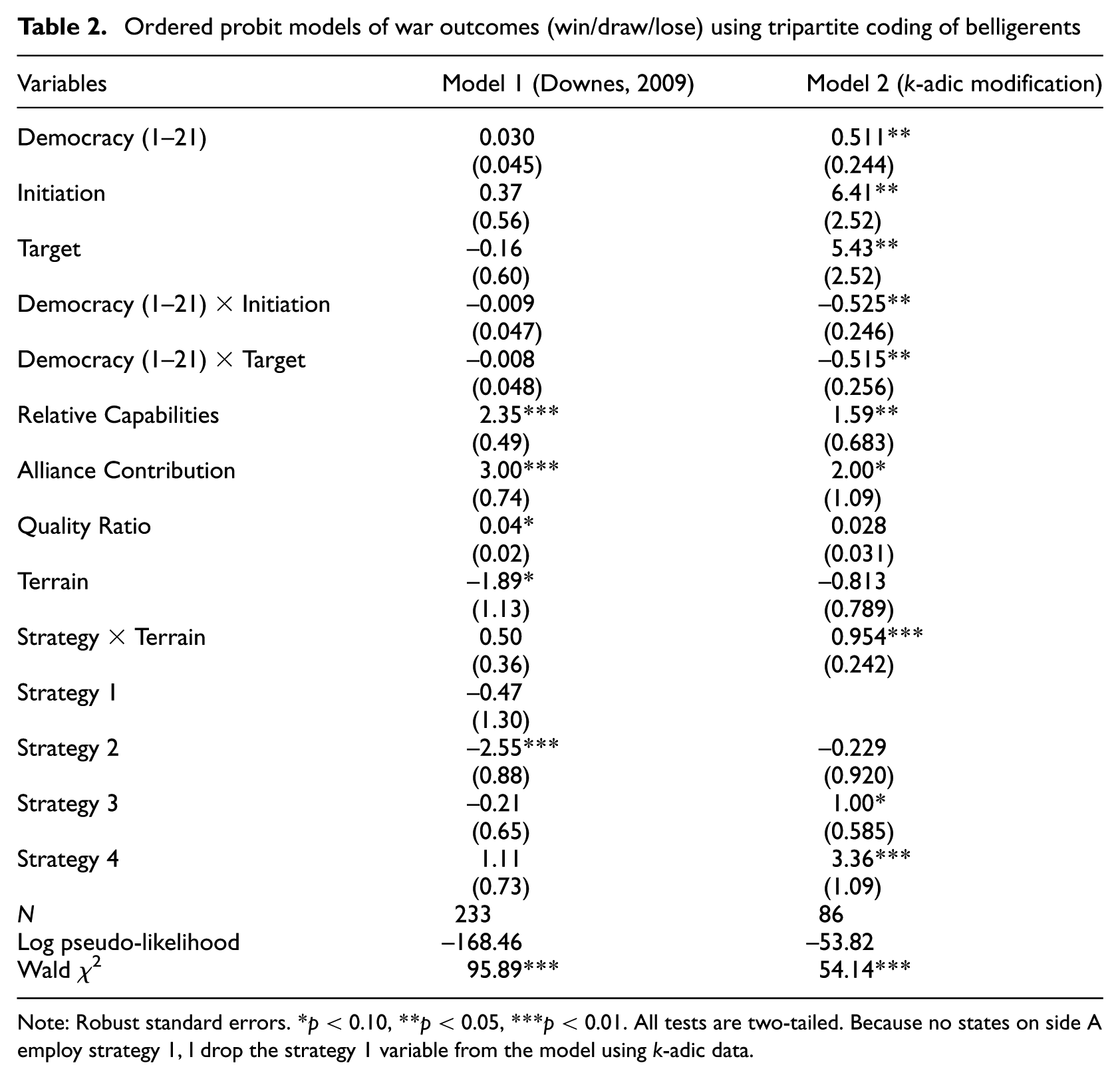
Note: Robust standard errors. *p < 0.10, **p < 0.05, ***p < 0.01. All tests are two-tailed. Because no states on side A employ strategy 1, I drop the strategy 1 variable from the model using k-adic data.
Changes in the probability of each outcome as democracy scores change from minimum to maximum
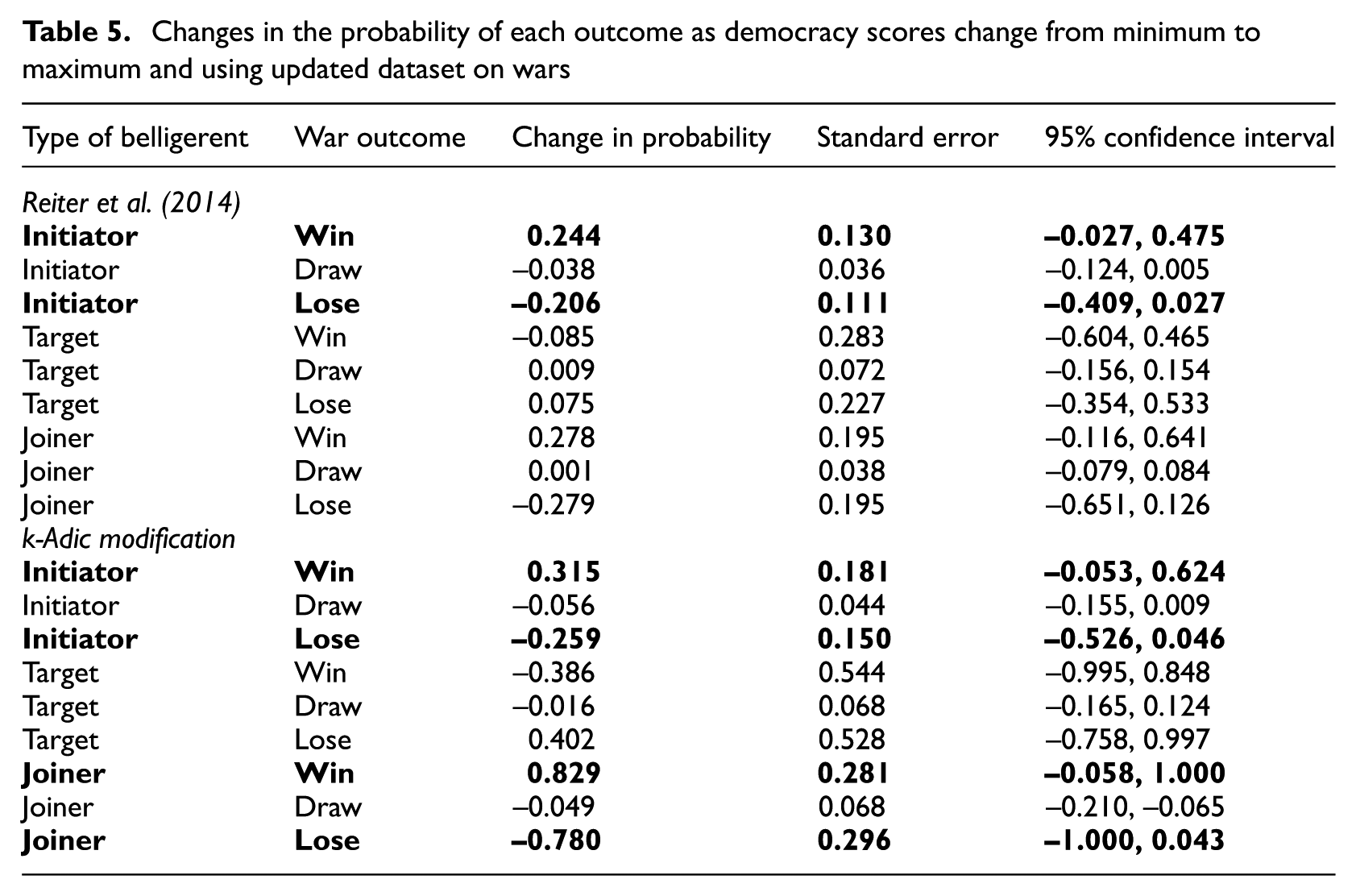
Finally, I conduct an original analysis using the updated dataset on wars by Reiter et al. (2014a). Using the dyadic version of the dataset, I find that a state’s level of democracy is not related to the likelihood of winning wars (Table 4, Model 1). However, my replication of that analysis using a k-adic version of the dataset shows that the level of democracy is positively related to the likelihood of winning wars (Table 4, Model 2), and that the change in the probability of victory is statistically significant for both war initiators and war joiners (Table 5, bottom). Robustness checks indicate that the relationship is particularly consistent for war joiners (Tables 6–15 in the Supplementary Material).
Ordered probit models of war outcomes (win/draw/lose) using tripartite coding of belligerents and updated dataset on wars
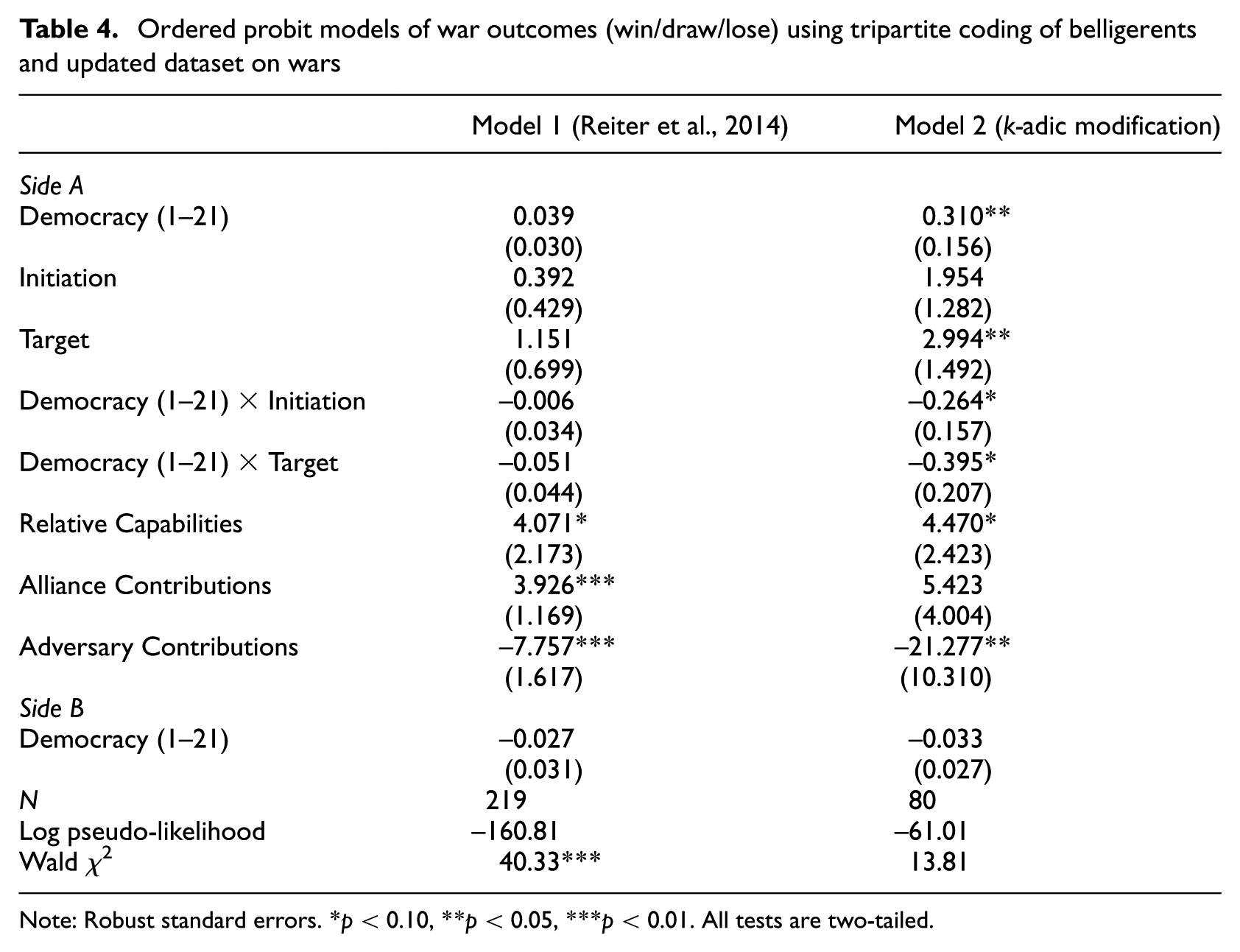
Note: Robust standard errors. *p < 0.10, **p < 0.05, ***p < 0.01. All tests are two-tailed.
Changes in the probability of each outcome as democracy scores change from minimum to maximum and using updated dataset on wars
In the next section, I summarize earlier research arguing that the democratic peace is a dyadic phenomenon for which the use of monadic data is inappropriate. Then I describe in more detail the bias that can result from the misuse of dyadic data to study events that are really multilateral in nature. Finally, I discuss the broader relationship between theory, research design, and k-adic data. In subsequent sections, I present the results of the replications, first describing the original findings and then the changes that result from converting the original datasets to k-adic datasets to more accurately reflect the multilateral nature of the wars contained within. I conclude by discussing the implications of the results for democratic peace theory specifically and international relations research more generally.
Dyadic datasets and multilateral events
Previous research on the democratic peace phenomenon focused not on the advantages of k-adic data over dyadic data, but on the advantages of dyadic data over monadic data, in part because previous research on the phenomenon provided mostly monadic explanations (e.g. that democracies are inherently peaceful). Thereafter the focus turned to dyadic explanations. This move came in recognition of the fact that, while democracies tend not to fight other democracies, they regularly fight non-democracies. 2 Rousseau et al. (1996) assess whether the democratic peace is the result of a monadic effect, dyadic effect, or mixed monadic–dyadic effect and find that the democratic peace is primarily a dyadic phenomenon. Bennett and Stam (2000) find that the democratic peace phenomenon is robust to the use of different statistical estimators (including logit with polynomial spline, general estimating equations with logit, and conditional logit with fixed effects), although the authors only use dyadic datasets. 3
Signorino (1999) argues that dyadic data can inflate the number of positive cases of the dependent variable since it divides an event containing k states into a series of paired observations of size k(k− 1)/2, therefore expanding the number of times that an event is counted in the dataset without contributing any new information. Dyad-year observations can also be temporally correlated (e.g. the probability of conflict between the US and Iraq in 2004 is probably not independent of the probability of conflict between the US and Iraq in 2003; Beck et al., 1998), share unexplained heterogeneity (Beck and Katz, 2001; King, 2001), and have monadic similarity, which is especially important when two dyads are both involved in the same war (e.g. the US–Great Britain and the US–Poland during the Second Gulf War).
Focusing on the simplest form of multilateral alliance—the trilateral alliance—Poast (2010) uses simulations to show how dyadic data can produce biased parameter estimates. He creates a dataset with 100 observations, each representing a single country with a randomly assigned amount of military capabilities ranging from 0 to 100. The countries are then grouped together into all possible trilateral combinations, resulting in 161,700 tri-adic observations (or k-adic, where k is any number ≥3). The “capabilities ratio” of each triad is calculated as:

Next, the dependent variable, Ally, is coded as a dichotomous variable equal to 1 if an alliance is formed between the three states belonging to a triad, and 0 otherwise. The variable is coded 1 if xb > 0, using the formula below, with the constant set at −4 and β set at 0.25:

These tri-adic observations are then converted into dyadic observations so that each triad (e.g. A, B, and C) is broken up into a series of pairs (e.g. A and B, B and C, and A and C). For each pair in the dyadic dataset, the capabilities scores of the two members are used to compute new capabilities ratios. Finally, a logit model is estimated using those scores to generate
Many studies on the relationship between democracy and war outcomes have used dyadic datasets. In the process, multilateral wars are broken up into several isolated wars involving pairs of states, therefore inflating the number of positive cases of the dependent variable (war outcomes) and potentially resulting in the sort of biased estimates that Poast (2010) demonstrates can result from using misdyadic data. To illustrate this bias using the same terminology as Poast (2010), consider a war initiated by an alliance of three states, each with a different level of democracy, democ, where the variable, democracyratio, is calculated as follows:

Now suppose that the variable, democracyratio, is used to predict the probability that an alliance emerges victorious from a war. If that war is broken up into a series of smaller, isolated wars involving pairs of states, then the ratio of the level of democracy between alliance members is calculated as follows:

If the third member of the alliance is never the largest member of the group, then the variable, democracyratio, would still contain the correct numerators (either democ1 or democ2). However, the variable would be systematically overestimated because the denominators would be missing the third country. 4 Any analysis using this variable would produce a biased estimate of the relationship between democracy and war outcomes. This suggests that previous studies that used dyadic data to examine the relationship between democracy and war outcomes may have misestimated that relationship.
Other international relations phenomena have been shown to be affected by the misuse of dyadic data. For example, Gibler et al. (2005) argue that Wallace (1979) incorrectly infers that there is a relationship between arms races and wars because he splits a single example of an arms race escalating into a larger conflict into several different events, therefore inflating the number of arms race-induced escalations. Croco and Teo (2005) argue that the misuse of dyadic data causes scholars to overstate the number of “dangerous” dyad-years. 5
A few scholars have even anticipated the problems caused by the misuse of dyadic data in the context of the democratic advantage in interstate wars. Choi (2003) includes control variables for the number of democratic allies and the number of non-democratic allies that fight alongside a country during a war, but still models war outcomes as monadic rather than k-adic events. More recently, Renshon and Spirling (2013) use the Bradley–Terry model to analyze democratic performance in wars. They argue that the Bradley–Terry model improves upon logit models that utilize dyadic data by accounting for the overrepresentation of multilateral wars, bearing out “the warnings of Poast (2010)… that more flexible methods may be better suited to analyzing this very specific subset of wars” (Renshon and Spirling, 2013: 24). Graham et al. (2016) argues that the democratic advantage in interstate wars can be attributed to the large coalitions that democracies tend to fight alongside. Using a sample of all wars from 1816 to 2000, the authors find that democracies tend to fight alongside larger coalitions and that states that fight alongside larger coalitions are more likely to win wars. One recent study even used k-adic data to examine war outcomes and found that democracy was a significant predictor of war outcomes (Quackenbush, 2015). Although the focus of that study was on centers of gravity rather than democracy, the results suggest that previous studies supporting the idea of a democratic advantage may not have been seriously affected by the misuse of dyadic data. 6 Now that Poast (2010) has developed code and procedures to convert the datasets from previous studies from dyadic to k-adic, it is now possible to examine whether the results from previous studies remain the same when using k-adic data.
The fact that a model is mis-estimated or the wrong unit of observation is used does not necessarily mean that the relationship between an independent variable and dependent variable will weaken when the error is corrected. In some cases, the relationship could grow even stronger (Poast, 2010: 412), or not change at all. In the case of the relationship between democracy and war outcomes, there is reason to believe that the relationship could grow stronger. This is because dyadic datasets, by splitting up multilateral conflicts into several dyadic conflicts, amplify the number of conflicts between belligerents of the same regime type. Logically, such conflicts cannot teach us much about the relationship between regime type and conflict outcomes. 7
An overabundance of dyadic conflicts between belligerents of the same regime type could weaken the statistical relationship between democracy and conflict outcomes, which could be reversed by using k-adic data. Consider a hypothetical dataset in which a war involving four countries is assigned the conflict code 100 and then split into three different dyadic observations, one observation for each of the three countries on side A against the lone country on side B. The Win and Democracy variables are both binary and indicate whether a country won the war (=1) and is a democracy (=1). The dyadic data is shown on the first three lines and a potential k-adic version is shown on the fourth line below:
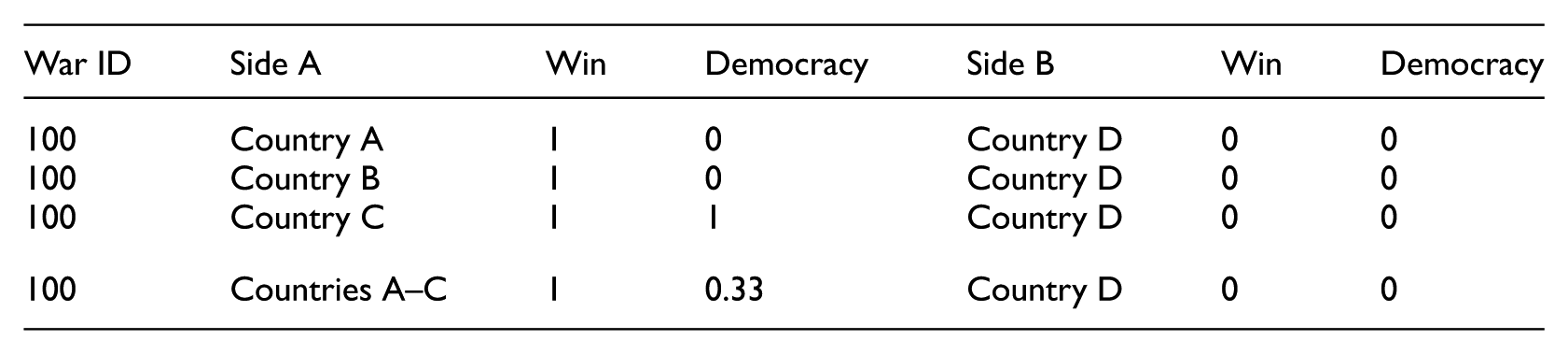
In the first two observations of dyadic data, the countries on either side emerge with different outcomes. However, because both countries are non-democracies, statistically speaking regime type could not explain any percentage of the variation in those outcomes, despite the fact that the level of democracy of country C is what determined the outcome for countries A and B in those two observations.
In the k-adic version of the data, the Win and Democracy variables are both continuous on a scale from 0 to 1 and indicate the mean outcome and mean levels of democracy for the countries on either side. On side A, 100% of the countries won the war and 33% of the countries were democracies. On side B, 0% of the countries won the war and 0% of the countries were democracies. In the k-adic version of the data, the side with the higher level of democracy outperforms the side with the lower level of democracy in 100% of observations.
One reason that conflict scholars include wars between belligerents of the same regime type is that they want to avoid being accused of selecting on the dependent variable, especially when the theory being tested does not necessitate dropping wars between belligerents of the same regime type. So scholars include all wars rather than just the set of wars in which the regime types are different. Even a k-adic dataset will include some observations in which all belligerents are the same regime type, but at least the number of observations in which regime type could not possibly explain war outcomes will no longer be inflated. This is perhaps more relevant for studies that showed that democracies are not more likely to win wars, since it is possible that the use of k-adic data will eliminate a bias that is preventing regime type from explaining war outcomes.
It is also possible that k-adic data will weaken the extent to which democracies are more likely to win wars by alleviating a bias against autocracies in dyadic datasets. Owing to the pattern of the democratic peace (e.g. no all-democratic dyads), dyadic datasets include a disproportionate number of all-autocratic dyads. This could bias the results against autocracies since wars involving autocracies are more likely to be wars between the same regime type and therefore less likely to be wars that can be explained by regime type. This is more relevant for studies that showed that democracies are more likely to win wars (especially if they did not control for alliance size) since it is possible that the use of k-adic data will eliminate a bias that is causing researchers to erroneously conclude that regime type explains war outcomes. It is also possible that the various biases described above may cancel each other out to some extent, resulting in few overall changes to previous studies when using k-adic data.
One caveat is that the theoretical argument being tested may necessitate the inclusion of a disproportionate number of all-autocratic observations. In other words, even though a disproportionate number of all-autocratic dyads may be biasing the results in favor of a democratic advantage in interstate wars, if the theoretical argument being tested requires such a research design, then the takeaway from those results should not be that the research design is flawed, but that there is indeed a democratic advantage in interstate wars.
Another caveat is that, depending on the theoretical argument being tested, k-adic data create a trade-off whereby some pertinent information is lost and some pertinent information is gained. For example, if the democratic advantage in interstate wars is the result of selection effects, with individual states initiating wars that they believe are winnable, then the conversion of dyadic data into k-adic data loses pertinent information by combining several independent decisions to initiate wars into a single group decision. However, while individual states do make the decision to initiate wars, they do not make the decision to win wars. The outcomes of wars are determined by the combined attributes of all states involved, making k-adic data the ideal choice to model the war resolution process because k-adic observations include all relevant information regarding the conflict into the observation for that conflict—information that is lost if war outcomes are examined using dyadic data. Ultimately, if the dependent variable is war outcomes rather than war initiations, then scholars should use k-adic data as the foundation for their research design and make whatever adjustments or modifications are necessary so that their analysis still constitutes an appropriate test of their theory (whether by controlling for other variables such as the total number of countries involved, utilizing a two-stage model, etc.). I discuss this in more detail in the section on Reiter and Stam (1998, 2002) when I discuss the authors’ selection effects explanation.
Poast (2010) uses a choice-based sampling method based on recommendations by King and Zeng (2001) for his simulations of alliance formation. However, the analyses that I replicate in this article use wars as the unit of observation, rather than a temporally based unit such as the country-year or dyad-year. The result is that the datasets are already manageable without any choice-based sampling and remain so after the conversion from dyadic to k-adic data. If this were not the case, choice-based sampling would be required not only for the values of the dependent variable (e.g. including all observations where Y = 1 and 10% of observations where Y = 0), but for the size of the k-ads that constitute the observations where Y = 0 (e.g. including 1000 dyads, 500 triads, and so forth), so that the observations where Y = 0 are not disproportionately dyadic. I should note that because the temporal correlation and unexplained heterogeneity that often feature in dyadic datasets can remain when using k-adic data, it is necessary to keep these problems in mind when switching from dyadic data to k-adic data. Switching to k-adic data merely solves a conceptual problem, whereby the determinants of an event (war outcomes) that results from the actions of, say, four actors, cannot be estimated accurately when only two actors’ actions or characteristics are taken into account (Poast, 2010).
Replications
Reiter and Stam (1998, 2002)
I begin with one of the most highly cited works on democracy and international conflict: Reiter and Stam (1998). The results from that article were also used to bolster the authors’ case in their 2002 book, Democracies at War. I should note that Reiter and Stam (1998, 2002) do not even use a dyadic dataset. They use a monadic dataset in which each observation contains a single war participant, although some of the control variables are coded in ways that capture the k-adic nature of wars. Djuranovic (2008: 73) converts Reiter and Stam’s (1998) unit of analysis from monadic to dyadic and finds that democratic war initiators are no longer more likely to win wars. It is possible that a replication using k-adic data will produce different results as well.
I focus on two of Reiter and Stam’s (1998) hypotheses in particular. First, democratic targets are more likely than other kinds of targets to win wars. Second, democratic initiators are more likely than other kinds of initiators to win wars. The authors observe all participants in wars between 1816 and 1982 using the COW dataset (Small and Singer, 1982) and the encyclopedia on military history by Dupuy and Dupuy (1986) and then simplify the analysis by dropping wars that ended in a draw. The dependent variable (Win) is binary and indicates whether each participant won the war (=1). The initiator and target variables are also binary and indicate whether each participant was an initiator or a target in that war (=1). Finally, the democracy variable indicates regime type and is measured using the state’s Polity III democracy score minus the state’s Polity III autocracy scale, for a scale from −10 to 10 (Jaggers and Gurr, 1995). In Table 1, Model 1, I provide the results of Reiter and Stam’s (1998, 2002) full probit model in which the authors include all interactions and control variables, including industrial capabilities and strategies (corresponding to table 2, Model 4 in Reiter and Stam, 1998 and table 2.2, Model 4 in Reiter and Stam, 2002). Although the results provide some support for the war-fighting explanation (that democracies are better equipped to fight wars), the fact that democracies are more likely to win wars regardless of whether they are the initiator or target and controlling for material capabilities “encourages the conclusion that democracies are more likely to win because they can more effectively rally the support of society for a war effort” (Reiter and Stam, 1998: 384).
Converting Reiter and Stam’s (1998, 2002) dataset into a k-adic dataset was trickier than expected, given that the original data was monadic. Some of the control variables were already coded in ways that captured the k-adic nature of the conflict. For example, the Terrain variable was coded the same for all countries involved in a particular war and indicated the type of terrain on which the war was being fought. Similarly, the Capabilities variable indicated a country’s proportion of the total capabilities of all countries involved in a particular war, and so on for the other control variables. 8
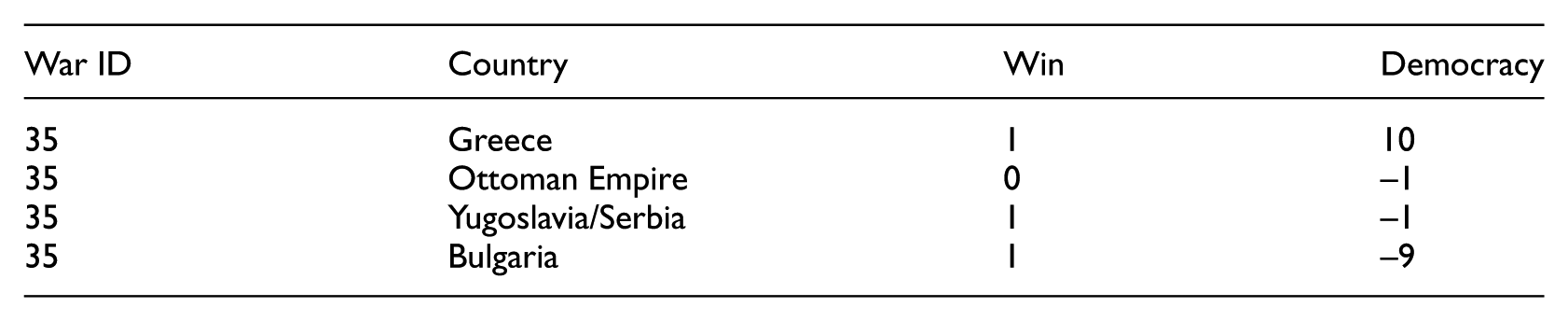
First, I converted Reiter and Stam’s (1998, 2002) dataset into a dyadic dataset. In the process, I created side A and side B versions of each variable. A comparison of the original data and the dyadic data is provided below, using the First Balkan War (1912–1913) as an example:

Next, I use procedures and code recommended by Poast (2010) to transform the dyadic dataset into a k-adic dataset containing one observation per war. 9 This has the effect of reducing the size of the original dataset from 197 to 71 observations, owing to the combination of several dyads involving the same war into a single k-ad. The largest k-ad contains 10 member states (i.e. the most states on one side of a war is 10). A full list of wars is provided in the Supplementary Material. Below I provide a comparison of the dyadic dataset and the k-adic version, using the First Balkan War (1912–1913) as an example:
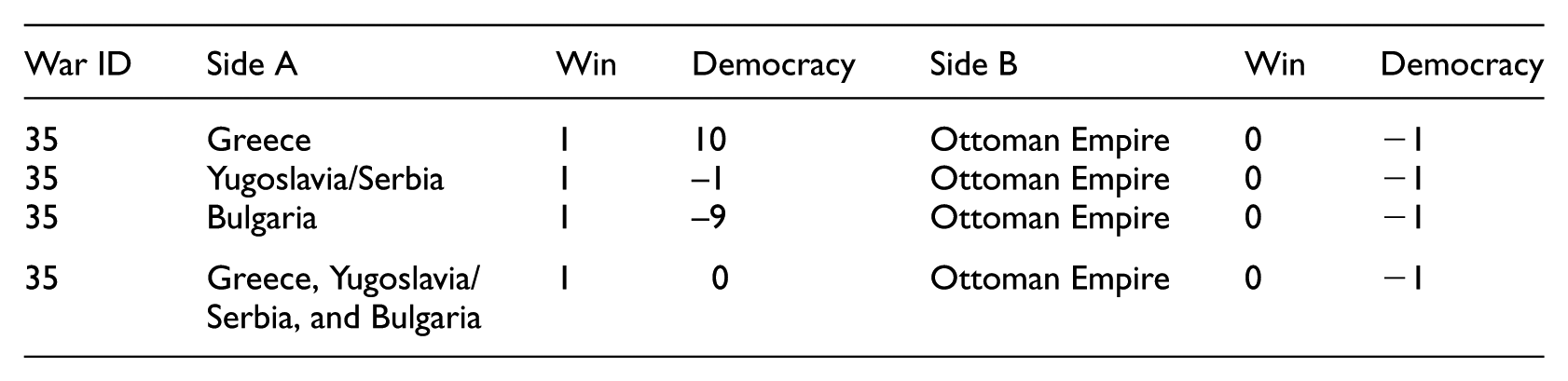
Again there are side A and side B versions of each variable, but this time the side A version of the dependent variable indicates the proportion of the countries on side A that achieved a winning outcome in that war. 10 Similarly, the initiator and target variables indicate the proportion of the countries on each side that initiated or were the target of a war, on a continuous scale from 0 to 1. 11 Although I code the democracy variables using the mean Polity score for the states on each side, there are multiple ways in which the k-adic regime type variables could be coded. For example, one could argue that they should be coded using the weighted average of states’ democracy scores based on their contribution to the war effort, or using the maximum democracy score among the states on each side. In any application of k-adic data to the study of democracy and war outcomes, researchers should consider how best to code the democracy variables to ensure that their research design yields a proper test of their argument. As robustness checks for the replication of Reiter and Stam (1998, 2002), I replicate all of the results in the primary results table using two alternative specifications of the k-adic democracy variables, including one that is equal to the maximum score among the countries on each side of a k-ad and one that is equal to the minimum score among the countries on each side of a k-ad. The results are provided in the Supplementary Material (Tables 6 and 7).
Because Terrain was coded the same for all participants in a war, I used the value for all participants as the value for the k-adic version of the variable. The strategy variables that Reiter and Stam (1998, 2002) included in their model were dummy variables indicating whether (=1) or not (=0) a certain pair of strategies was used by a particular war participant. The k-adic versions of the strategy variables represent the proportion of the countries on each side that employed each strategy. For the interaction between Terrain and Strategy, Reiter and Stam (1998, 2002) used a strategy variable with a five-point scale indicating which strategy a participant used in the war, multiplied by the terrain variable. The k-adic versions of this interaction are the mean values of that interaction for all countries on each side of a war. The original Capabilities variable indicated a country’s proportion of the total capabilities of the countries involved in a war, while the k-adic versions indicate the mean proportion of the total capabilities of all countries involved in the war for the countries on each side of a war, and so on for the Alliance Contribution and Quality Ratio variables.
In my replication of Reiter and Stam’s (1998, 2002) analysis using k-adic data, I use the outcome variable for side A as the dependent variable. This variable indicates the proportion of countries on side A that achieved a winning outcome in a particular war. Because it is rare for countries on the same side of a war to emerge with different outcomes, this variable rarely takes on values other than 0 or 1. In fact, it happens only twice in the k-adic dataset. For those observations, I round the values down to 0 or up to 1 so that I can still estimate the models using probit and mirror the authors’ original analysis as closely as possible.
Given that Reiter and Stam’s (1998, 2002) explanation for the democratic advantage is based on selection effects (i.e. individual states selecting into winnable wars), the conversion of monadic or dyadic data into k-adic data conflates several independent decisions to initiate wars into single observations, therefore resulting in the loss of some pertinent information. However, as discussed earlier, states make independent decisions to initiate wars, but they do not make independent decisions to win wars. The outcomes of wars are determined by the combined attributes of all states involved, making k-adic data the ideal choice to model the war resolution process. 12 Furthermore, even if the democratic advantage is the result of selection effects, the k-adic democracy variable for side A should still be positively related to the dependent variable, provided the selection effects explanation is accurate and the relationship between democracy and war outcomes is robust. 13
When estimating the model using k-adic data (or dyadic data, for that matter), it is not possible to include the initiator variables, target variables, or interactions involving those variables for both sides of the conflict, since the collinearity would cause the model to break down. Therefore, I only include the variables for side A of the conflict. This goes for the control variables as well. One advantage to using only the variables for side A is that it makes comparing the models using monadic and k-adic data easier since the signs of the probit coefficients should be the same. For example, using monadic data, if the capabilities of war participants are positively related to the likelihood that war participants win wars, then using k-adic data, I expect that the mean level of capabilities on side A will be positively related to the proportion of countries on side A that win wars.
Using the side A versions of each variable, I replicate Reiter and Stam’s (1998, 2002) full probit model using k-adic data. Because no states on side A employ strategy 1, I drop the strategy 1 variable from the model (although it would have been dropped automatically anyways). The results of the original, monadic analysis and the results of the replication using k-adic data are provided in Table 1, Models 1 and 2.
What do the results show? Reiter and Stam (1998: 384) claimed that because democracies were more likely to win wars regardless of whether they are the initiator or target and controlling for material capabilities, their results encouraged “the conclusion that democracies are more likely to win because they can more effectively rally the support of society for a war effort” (Reiter and Stam, 1998, 384). However, when using k-adic data, the probit coefficient for the interaction between democracy and initiation loses its statistical significance (Table 1, Model 2), while the probit coefficient for the interaction between democracy and target remains positively signed and statistically significant (Table 1, Model 2). This result challenges somewhat the “selection effects” explanation for the democratic advantage and is essentially what Djuranovic (2008: 73) found when he converted Reiter and Stam’s (1998) unit of analysis from monadic to dyadic and showed that democratic war initiators are no longer more likely to win. I should note that Downes (2009) criticizes Reiter and Stam (1998, 2002) for their method of coding targets. In the next section, I replicate Downes’s (2009) analysis using that author’s more accurate coding of initiators and targets.
Downes (2009)
Downes (2009) criticizes Reiter and Stam (1998, 2002) for coding all states that do not initiate wars as targets even when they later join the war on the initiator’s side. He also criticizes the authors for omitting draws from their dataset, remarking: “The selection effects argument stipulates that democratic leaders, fearing possible removal from office for initiating costly or losing wars, choose to start only those wars they think they can win … Excluding draws would perhaps be warranted if democratic leaders were never punished for settling for these outcomes, but history demonstrates otherwise” (Downes, 2009: 23). After correcting these errors, Downes (2009) finds that democracies are no longer more likely to win wars regardless of their initiator or target status. 14
For his analysis, Downes (2009) uses the same dataset as Reiter and Stam (1998, 2002) but with two important changes: including wars that ended in draws and including a new “joiners” variable indicating whether a state joined a conflict after it had already started. Because the modified dependent variable has three outcomes (loss/draw/win) rather than two (loss/win), Downes (2009) uses ordered probit rather than probit. He also recodes the democracy variable on a scale from 1 to 21 and includes the democracy variable in the model as a constitutive term rather than only as part of interactions. As Downes (2009: 24) points out, because “all states for Reiter and Stam were either initiators or targets, they were able to omit the Polity term from their regressions” since they included interactions between the democracy variable and both state types (initiator and target). However, with the addition of the joiners category, the constitutive term needed to be added to the model. In Table 2, Model 1, I provide the results of Downes’s (2009) ordered probit analysis of war outcomes (corresponding to table 1, model 3 in Downes, 2009), including interactions between the democracy variable and states’ initiator/target status and the same set of control variables used by Reiter and Stam (1998, 2002).
Given that the only change Downes (2009) made to Reiter and Stam’s (1998, 2002) dataset was to add some observations (wars that ended in draws) and a new category of states (joiners), it is not necessary to describe the conversion of his dataset from dyadic to k-adic in too much detail, given that those procedures were already described in the previous section. Downes’s dataset was similarly monadic (with one observation per war participant), so I converted his data into dyadic data first and then converted the dyadic data into k-adic data using procedures and code recommend by Poast (2010). Unlike Reiter and Stam (1998, 2002), Downes’s dependent variable was not binary, having three different outcomes: loss (=0), draw (=1), and win (=2). Therefore, the k-adic versions of the dependent variable indicate the mean outcome of the war for the countries on each side. 15 The k-adic versions of the initiator, target, and joiner variables indicate the proportion of countries on each side that initiated, were targeted, or later joined the war effort on their side of the conflict. Control variables were modified using procedures identical to the replication of Reiter and Stam (1998, 2002). As I did with the replication of Reiter and Stam (1998, 2002), I use the dependent variable indicating the war outcomes for side A and include the independent and control variables for side A only, omitting the variables for side B in order to avoid the overwhelming collinearity that would result from including essentially the same information in the model twice. In Table 2, Model 2, I provide the replication of Downes’s (2009) analysis using k-adic data.
What do the results show? Although the probit coefficient for the democracy variable was statistically insignificant in Downes’s (2009) model, the variable is positively related to the dependent variable and statistically significant at the p < 0.05 level when using k-adic data, suggesting that democracies are indeed more likely to win wars (and more specifically that the mean level of democracy for countries on side A is positively related to the mean outcome for countries on side A). 16 Interestingly, the statistical significance of the coefficient for the Alliance Contributions variable weakens considerably when using k-adic data. This contrasts with a recent study by Graham et al. (2016), who argue that the democratic advantage in interstate wars can be attributed to the large coalitions that democracies tend to fight alongside.
In both models (using the original and k-adic versions of the dataset), the interactions between the regime type variable and the initiator and target variables are quite different from Reiter and Stam’s (1998, 2002) analysis. However, as Downes (2009) points out, these coefficients are hard to interpret given the presence of multiple interactions involving the regime type variable, so he uses CLARIFY to estimate the change in the probability of each war outcome (win, draw, or lose) for each type of belligerent (initiator, target, or joiner) as the belligerent’s democracy score changes from the minimum to the maximum (in other words, as the belligerent changes from an autocracy to a democracy). 17 Downes’s (2009) results are provided in the top half of Table 3, including the probability changes, standard errors, and 95% confidence intervals. Although the probability changes are all in the predicted directions, none of the changes are statistically significant (Table 3, top).
Next, I replicate these results using the k-adic version of the original dataset. 18 The resulting probability changes represent the change in the probability that the mean outcome for countries on side A will be win (=2), draw (=1), or loss (=0) as the mean level of democracy on side A increases from the minimum to the maximum. The results are provided in the bottom half of Table 3.
The results show a dramatic difference in the effect of democracy on war outcomes when using k-adic data, but only for states that join the war effort after it has already started. For war joiners, increasing the mean level of democracy on side A from the minimum to the maximum results in a positive and statistically significant change in the likelihood of victory and a negative and statistically significant change in the likelihood of defeat for the countries on side A.
Although the changes that Downes (2009) made to Reiter and Stam’s (1998, 2002) analysis led that author to believe that democracies are not more likely to win wars, a replication of Downes’s (2009) analysis using k-adic data shows that Downes’s (2009) changes do not eliminate the democratic advantage in international conflict, but rather demonstrate the circumstances under which it manifests. These results restore some support for the selection effects explanation by suggesting that democracies are particularly good at band-wagoning onto ongoing war efforts that are more likely to be successful. Democracies may be better at evaluating ongoing wars according to the likelihood of victory and/or the likelihood of receiving spoils (whether because the spoils are large or because the countries on a particular side are more prone to giving fair shares of the spoils).
Reiter et al. (2014a)
Rather than replicating another past study, I use this section to present the results of an original analysis of the updated dataset on wars by Reiter et al. (2014a). 19 The updated dataset (based on COW 4.0 rather than COW 2.0) improves upon the dataset used in Reiter and Stam (1998, 2000) and Downes (2009) in several ways. First, the authors fix errors in roughly one-third of cases, including proper identification of wars, participants, initiators, and winners. Second, the authors identify the opponents exactly to ensure that the countries comprising each conflict-dyad actually fought each other. The authors also identify the allies and adversaries that fought for or against the initiating state in each conflict-dyad. These changes make it possible not only to ensure correct identification of k-ads, but also to correctly code the control variables for the k-adic observations. The updated dataset also expands the temporal domain, adding an additional 20 years of wars (up to 2007).
The unit of observation in the updated dataset is the initiator-war-year. The observations identify the state that the initiator attacks, as well as the states that fought alongside the initiator against that particular target (allies) and the states that fought alongside that particular target (adversaries). There are two different war identification variables: “The first is a variable for which each initiator–target pairing gets the same coding for all years of the war. So, the five lines of data for the 1941–1945 Germany–Soviet Union war all get the same coding, but the Germany–Norway 1940 war gets a different coding. The second variable identifies all initiator–target codings within the same, larger war. So, all initiator–target cases within World War II (Germany–Soviet Union, Japan–US, Germany–Norway, etc.) get the same coding for this second variable” (Reiter et al., 2014b: 2).
I make several changes to the dataset. First, I delete all initiator-war-years in which the war does not end during that year, eliminating all but one observation for each initiator–target pairing and essentially making wars the unit of observation. Next, for larger wars that were split up into several dyadic wars, Reiter et al. (2014a) often coded the countries on one side as having different initiator or target status, depending on what role they played in the onset of the war. However, I convert the observations from directed dyads into regular dyads by assigning states to side A or side B, putting allies on the same side (A or B) regardless of their initiator status, and then coding three new binary variables, indicating whether the state on side A initiated the war, was targeted in the war, or joined the war after it had already begun, using the same criteria for coding joiners as Downes (2009). Finally, I recode the outcome variable. The original variable was coded 1 if the initiating state in an initiator–target pair won, 2 if the target won, and 3 if the war ended in a draw. But after separating the two sides of each war into sides A and B, I code a binary variable indicating whether side A won the war (=1) or not (=0). I also create an ordered variable indicating whether the war ended in a loss (=0), a draw (=1), or a victory (=2) for side A. Not only do these changes make it easier to compare the results of the statistical analysis with previous analyses, but modifying the data so that the countries on side A all fought on the same side of the war also makes converting the data from dyadic to k-adic easier (and without sacrificing any information).
Next, I impute variables for the level of democracy on both sides of wars. The democracy variables are measured using states’ POLITY IV democracy scores during the year in which the war began minus their POLITY IV autocracy scores from the same year, for a scale from −10 to 10, which I convert to 1–21 to make interpretation of the statistical results easier (Marshall and Jaggers, 2002).
I also impute several control variables into the dataset. Reiter and Stam (1998: 384) argued that because democracies are more likely to win wars regardless of whether they are the initiator or target and controlling for material capabilities, democracies must be “more likely to win because they can more effectively rally the support of society for a war effort.” Rather than using the proportion of all war participants’ capabilities, I operationalize capabilities as the capabilities score for each war participant and impute the scores for both sides of initiator–target pairings, then subtract the capabilities of side B from the capabilities of side A to create a Relative Capabilities variable, indicating the material advantage (or disadvantage) of side A over side B. 20 I expect this variable to be positively related to both outcome variables described above.
Reiter and Stam (1998, 2002) also controlled for the material capabilities of a war participant’s allies. Because the updated dataset identifies not just the allies, but also the adversaries of the initiating state, I use the COW composite capabilities index to code variables for Alliance Contributions and Adversary Contributions, indicating the sum of the index scores for the allies fighting alongside the state on side A and the sum of the index scores for the adversaries fighting against the state on side A. Although the inclusion of these variables helps capture the k-adic nature of the wars, as discussed earlier, a dataset that observes individual war participants or war dyads while including variables that are k-adic in nature is splitting a large war into several, isolated wars and then controlling for most of the information regarding that war each time it is observed. This has the potential to bias the results in either direction; in favor of or against a relationship between democracy and war outcomes.
In conducting the initial analysis, I follow roughly the same procedures as Downes (2009). I use the ordered dependent variable indicating the outcome for side A (0 = lose, 1 = draw, 2 = win) and estimate an ordered probit regression while clustering on wars. My primary independent variables are the democracy variables for side A and side B. I also include two binary variables indicating whether side A was an initiator or target in the war, as well as interactions between the democracy variable for side A and the initiator and target variables. Because states must be an initiator, target, or joiner, I do not include the joiners variable in the model, the result being that the coefficient for the constitutive regime type term for side A represents the effect of side A’s level of democracy when side A is a joiner. I should note that I do not include the initiator, target, or joiner variables for side B, because those variables for side B covary too strongly with the same variables for side A and would cause some of the variables to drop out of the model during estimation. Ordered probit results are provided in Table 4, Model 1.
Given that the procedures were already described in the section on Reiter and Stam (1998, 2002), it is not necessary to describe the conversion of the dyadic dataset into k-adic data in too much detail. The only step that I skip this time is the conversion from monadic to dyadic, since the updated dataset on wars was already presented in dyadic format. Instead I simply convert the dyadic data into k-adic data using procedures and code recommend by Poast (2010). As with Downes (2009), the k-adic version of the dependent variable indicates the mean outcome of the war for the countries on each side. 21 Similarly, the k-adic versions of the initiator, target, and joiner variables indicate the proportion of countries on each side that initiated, were targeted, or later joined the war effort on their side of the war. Control variables were modified using procedures identical to the replications of Reiter and Stam (1998, 2002) and Downes (2009). Finally, as I did with the previous replications, I use the independent and control variables for side A only, omitting the variables for side B in order to avoid the overwhelming collinearity that would result from including essentially the same information twice in the model. In Table 4, Model 2, I provide a replication of the dyadic analysis using k-adic data.
The results using the dyadic data do not provide any support for Reiter and Stam’s (1998, 2002) claim that democratic initiators and democratic targets are both more likely to win wars. None of the coefficients for the democracy variables achieve statistical significance, including the constitutive term and the interactions between side A’s level of democracy and initiator or target status. Although the inclusion of the constitutive term and multiple interactions means that the interactions cannot be easily interpreted in a substantive manner, the lack of statistical significance reflects the findings of Djuranovic (2008: 73), who converted Reiter and Stam’s (1998) unit of analysis from monadic to dyadic and found that democratic war initiators were no longer more likely to win wars. The results for the control variables are as expected. Side A’s advantage in military capabilities (Relative Capabilities) and the capabilities of its allies (Alliance Contributions) are both positively related to the outcome for side A, while the capabilities of side A’s adversaries (Adversary Contributions) are negatively related to the outcome for side A (Table 4, Model 1).
The replication of the dyadic analysis using k-adic data produces several interesting results. First, there is a general strengthening of the relationship between democracy and war outcomes. The coefficient for the constitutive democracy term is positively signed and statistically significant (p < 0.05), suggesting that states who join wars after they have already started are more likely to win if they are democracies (Table 4, Model 2). Second, as with the k-adic replication of Downes (2009), there is a significant weakening of the statistical significance for the Alliance Contributions variable. This suggests that states may be more likely to win wars owing to their regime type rather than realist factors such as military capabilities or powerful allies. It also suggests that the positive relationship between democracy and war victory is not the result of democracies being more likely to fight alongside powerful allies. 22
As Downes (2009) points out, the coefficients for the interactions between side A’s level of democracy and initiator and target status cannot be easily interpreted given the presence of multiple interactions, so he uses CLARIFY to estimate the change in the probability of each war outcome (win, draw, or lose) for each type of belligerent (initiator, target, or joiner) as the belligerent’s level of democracy changes from the minimum to the maximum (in other words, as the belligerent changes from an autocracy to a democracy). 23 I apply the same procedures to the updated dataset on wars by Reiter et al. (2014a). The results using the dyadic version of the dataset are provided in the top half of Table 5, including the probability changes, standard errors, and 95% confidence intervals. Next, I apply the same procedures to the k-adic version of the dataset. 24 The resulting probability changes represent the change in the probability that the mean outcome for countries on side A will be win (=2), draw (=1), or loss (=0) as the mean level of democracy on side A increases from the minimum to the maximum. The results are provided in the bottom half of Table 5.
Although Downes (2009) found that no category of states experienced a significant change in the probability of various war outcomes as their level of democracy increased from the minimum to the maximum, my application of Downes’s (2009) procedures to the dyadic version of Reiter et al.’s (2014a) dataset shows that states that initiate wars are more likely to win as their level of democracy increases from the minimum to the maximum, although the change is only statistically significant at the p < 0.1 level (Table 5, top). The changes become more pronounced when using the k-adic version of the dataset. Using k-adic data, the changes manifest not just for initiators, but for joiners as well. If the countries on side A all initiated the war or joined the war effort after it had already begun, they are more likely to win and less likely to lose as the mean level of democracy on side A changes from the minimum to the maximum (Table 5, bottom). I should note that the results of the robustness checks using alternative specifications of the k-adic democracy variables indicate that the relationship between democracy and war outcomes is more robust for war joiners than war initiators (Tables 12–15 in the Supplementary Material). 25 Only for war targets does the regime type consistently make no difference for the outcome.
As with the replication of Downes (2009), an analysis of the k-adic version of the updated dataset on wars by Reiter et al. (2014) shows that Downes’s (2009) changes—including the tripartite outcome variable and the inclusion of war joiners—do not eliminate the democratic advantage in interstate wars, but rather demonstrate the circumstances under which it manifests. The results suggest that democracies are particularly good at selecting into winnable wars, whether by initiating the wars themselves or band-wagoning onto ongoing war efforts.
Conclusion
Numerous phenomena in international relations have been shown to be affected by the misuse of dyadic data, including arms races (Gibler et al., 2005) and the identification of “dangerous” dyad-years (Croco and Teo, 2005). Other scholars have warned that the misuse of dyadic data (Renshon and Spirling, 2013) or failing to take into account the number and size of states’ allies (Choi, 2003; Lake, 1992) could affect the statistical relationship between democracy and war outcomes. In this article, I replicate several past studies on the relationship between democracy and war outcomes, including one that supported the idea of a democratic advantage (Reiter and Stam, 1998, 2002) and one that challenged the idea of a democratic advantage (Downes, 2009), using procedures and code developed by Poast (2010) to transform dyadic datasets into k-adic datasets. I also conduct an original analysis using the updated dataset on war outcomes by Reiter et al. (2014a).
Overall, I find several changes when using modified, k-adic versions of the original datasets. Although Reiter and Stam (1998, 2002) found that the level of democracy has a positive effect on the likelihood that both initiators and targets win wars, my replication of their analysis using k-adic data shows that the relationship between democracy and war outcomes is only statistically significant for targets (and the relationship is weakly significant at best). Downes (2009) criticizes Reiter and Stam (1998, 2002) for their method of coding targets and shows that, once correcting for that error, democracies are no longer more likely to win wars regardless of their initiator or target status. However, my replication of Downes’s (2009) analysis using k-adic data shows not only that democracy is positively related to the likelihood of winning wars (Table 2, Model 2), but also that the relationship manifests primarily for states that join the war effort after it has already started (Table 3, bottom).
Finally, I apply Downes’s (2009) changes to the updated dataset on wars by Reiter et al. (2014a). Analysis of the dyadic version of the dataset shows that a relationship between democracy and war outcomes manifests for war initiators (Table 5, top), but the relationship is only statistically significant at the p < 0.1 level. When I convert the data into k-adic format, the relationship between democracy and war outcomes becomes stronger (Table 4, Model 2) and manifests for both war initiators and war joiners (Table 5, bottom). Furthermore, the coefficient for the Alliance Contributions variable loses its statistical significance entirely, suggesting that it is democracy, and not the strength of a state’s allies, that explains the democratic advantage in interstate wars. This contrasts with a recent study by Graham et al. (2016), who argue that the democratic advantage in interstate wars can be attributed to the large coalitions that democracies tend to fight alongside. By no means does this settle the debate over the causal mechanism linking regime type to war outcomes, but it suggests that scholars interested in the coalition dynamics explanation should, like Graham, Gartzke, and Fariss, design a study focusing specifically on the relationship between regime type, alliance size, and war outcomes, but utilizing k-adic data.
I should note that for both Downes (2009) and Reiter et al. (2014a), the results of the robustness checks using alternative specifications of the k-adic variables indicate that the relationship between democracy and war outcomes is more robust for war joiners than war initiators (Tables 8–15 in the Supplementary Material). None of the analyses using k-adic data produced any indication that democratic targets were more likely to win wars than autocratic targets. Overall, Downes (2009) appears to have been right about the flaws in Reiter and Stam’s (1998, 2002) dataset, but the use of k-adic data shows that, once those flaws are corrected, Reiter and Stam’s (1998, 2002) argument still receives some support, but primarily for states that select into wars by joining them after they have already begun.
As Poast (2010: 423) notes, k-adic data does not address every interdependency pervasive in dyadic datasets. Nor does its use always reveal significant errors in analyses that misused dyadic data. k-Adic data merely solves a conceptual problem, whereby the likelihood of an event that results from the actions of, say, four actors, cannot be estimated properly when only two actors’ actions or characteristics are taken into account (Poast, 2010). Indeed, the potential for Type I and Type II errors persists whenever scholars misuse dyadic data to model events that are really multilateral in nature, such as war outcomes. Scholars should be mindful of the possibility that the decision to use dyadic data to model events that are really multilateral could introduce bias into the statistical results and that k-adic data could increase their ability to make inferences about important phenomena in international relations.
Footnotes
Acknowledgements
I would like to thank three anonymous reviewers and Caroline Hartzell for their thoughtful comments on previous versions of this manuscript, as well as Rollin Tusalem, Liliana Peschanskaia, Mark Souva, and participants at the SPSA Annual Meeting in 2015. Any remaining errors are my own.
Funding
This research received no specific grant from any funding agency in the public, commercial, or not-for-profit sectors.
