



Abstract
In this article I examine how a state’s conflict environment affects the amount of foreign aid it receives. Specifically, conflict in the recipient state’s neighborhood can have a wide range of externalities that negatively affect the recipient state, but also the interests of donor countries. I argue that the presence of conflict in a state’s region generally leads to an increase in the demand for aid funds and should correlate with an increase in the amount of aid a state receives. I further argue that the degree to which the donor state will increase aid funds to meet this demand depends upon the donor’s economic and political interests in the recipient state.
Between 2011 and 2016 the civil war in Syria expanded dramatically in scope, leading to approximately 4.6 million refugees fleeing the country into the neighboring region. The United States, for its part, has largely resisted direct military intervention in the conflict between the Assad regime and anti-government forces in spite of its varied interests throughout the Middle East, limiting its military operations to fighting the Islamic State of Iraq and Syria (ISIS). And while it largely resisted intervening militarily, the Obama administration opted to use foreign aid as its chief instrument in responding to the conflict. Since 2012, some $5.1 billion in humanitarian assistance has been given to various countries, intergovernmental organizations, and non-governmental organizations to address the growing humanitarian crisis. Of this, $2.6 billion has been allocated to groups operating within Syria itself. The remainder (approximately 50%) has been directed to countries and groups operating in the region surrounding Syria. In particular, several billion dollars have been allocated to more closely aligned states like Turkey, Iraq, and Egypt to aid them in responding to the conflict. 1
As the preceding example helps to illustrate, conflict in a state’s neighboring region can have spillover effects that can create an array of challenges for neighboring countries. In this article I examine how a state’s regional conflict environment affects the amount of foreign aid it receives. I argue that conflict in a state’s region generally leads to an increase in the demand for aid funds and should correlate with an increase in the amount of aid a state receives. I further argue that the degree to which the donor state will increase aid funds depends upon the donor’s political and economic interests in the recipient state. 2 Although the theoretical argument is more generally applicable, my analysis focuses on US aid allocation patterns. The United States is the largest donor (OECD, 2017), spending billions per year on foreign aid to advance political and economic goals, many of which may be threatened by the the occurrence of civil conflict. Unlike other donors, including other major powers, there is also significant cross-sectional and temporal variation in the variables capturing different dimensions of US interests in other states—particularly when considering security ties. Ultimately the United States is unique in terms of the breadth and depth of its ties with other countries and is uniquely positioned to advance a wide range of interests through aid.
This study builds on previous work in three ways. First, I draw on insights from the literature on the spatial diffusion of conflict to explore how donors react to conflict in states surrounding the recipient state. Much of the aid–conflict literature focuses on aid as a cause of conflict (e.g. Collier and Hoeffler, 2002a; de Ree and Nillesen, 2009; Findley et al., 2011; Grossman, 1992; Gutting and Steinwand, 2015; Nielsen et al., 2011; Savun and Tirone, 2011; Steinwand, 2015b). 3 And while previous quantitative studies have included conflict variables in their models of aid flows, conflict is often relegated to a control variable (e.g. Allen and Flynn, 2017; Berthelemy, 2006; Blanton, 1994; Bueno de Mesquita and Smith, 2007; Cingranelli and Pasquarello, 1985; Lebovic and Voeten, 2009; McCormick and Mitchell, 1988; Meernik et al.,1998). Less work has focused directly on conflict as the variable of theoretical interest (e.g. Chauvet, 2003; Balla and Reinhardt, 2008), and only one study has addressed regional conflict (Balla and Reinhardt, 2008). Second, I focus on understanding how donor states’ political and economic interests in giving aid are conditioned by the occurrence of conflict around the recipient state. Balla and Reinhardt (2008) do not explore how other variables might condition the effect of conflict, but the split-sample approach they use demonstrates that the effect of conflict is conditional upon various donor–level, and possibly donor–recipient dyad, characteristics. Third, I utilize spatial measurement techniques to construct an improved continuous measure of recipient states’ regional conflict environments, as opposed to discrete measures utilized by other studies (Balla and Reinhardt, 2008). Taken together this study advances on previous work by providing a fuller theoretical exploration of the interaction between conflict and donor interests, with a particular focus on regional conflict levels, as determinants of aid flows, and also by utilizing a more sophisticated approach measuring regional conflict patterns.
The focus on regional conflict is a particularly important contribution. Although some studies include conflict as an independent variable in their models, few seek to understand how donor governments’ aid allocation decisions are influenced by conflict around the recipient state. Studies have shown how spatial considerations affect states’ policymaking (e.g. Allen et al., 2016, b). If donor governments use foreign aid to support friendly regimes or to promote market access, then it stands to reason that the recipient state’s potential or actual exposure to conflict should influence donor decisions. However, the occurrence of large-scale conflicts within a state might be an ex post indicator that a friendly regime received insufficient support. If policymakers are behaving in a proactive and anticipatory fashion, then they should try to allocate aid in such a way that it will support friendly regimes before conflict breaks out. Although policymakers cannot always predict where and when serious conflict will occur, there are observable indicators that can inform their expectations—the occurrence of social unrest and armed conflict in a neighboring state, for example. There is ample evidence that conflicts diffuse across international borders (Buhaug and Gleditsch, 2008; Salehyan, 2009; Salehyan and Gleditsch, 2006). Even where violence does not directly spread, the externalities of conflicts are often felt throughout the neighboring region. The aforementioned example of the ongoing civil war in Syria is illustrative in this regard, as its effects have been felt in neighboring states and throughout Europe.
The lack of research on how regional conflict environments influence donor decisions is not a trivial omission. Foreign aid is a valuable political tool and donor governments allocate billions of dollars a year to advance their economic and political interests. Often this involves supporting friendly governments or paying recipient states for policy concessions (Bueno de Mesquita and Smith, 2007). Several studies have shown that it can be used to help stabilize recipient governments (e.g. Yuichi Kono and Montinola, 2009; Licht, 2010). However, the ability of donors to get what they want is likely conditional upon the presence of competing pressures (like conflict) that may increase the demand for resources by recipient leaders. Giving aid in exchange for policy concessions should be more effective when recipient leaders are not siphoning off large proportions of donor aid to quell major conflicts. Alternatively, to the extent that donors seek to promote humanitarian relief and economic development, the occurrence of armed civil conflict in particular is likely to obstruct these goals (Balla and Reinhardt, 2008; Collier, 1999; Kang and Meernik, 2005).
The spatial consequences of conflict and aid flows
The purpose of this article is to better understand how variation in the level of regional conflict surrounding a recipient state affects donor aid allocation decisions. Previous studies of aid have often included variables to capture influence of various types of conflict on aid allocation decisions (Allen and Flynn, 2017; Blanton, 1994; Bueno de Mesquita and Smith, 2007; Chauvet, 2003; Cingranelli and Pasquarello, 1985; Lai, 2003; Lebovic and Voeten, 2009; McCormick and Mitchell, 1988; Meernik et al., 1998). However, these studies use measures of conflict that capture levels of conflict within the recipient state only. This overly restrictive focus limits our ability to more fully understand the role played by conflict in the aid allocation process. Existing research finds that militarized conflicts tend to cluster in space, pointing to a variety of mechanisms by which geographic proximity to conflict can increase instability in neighboring states (e.g. Braithwaite, 2010; Buhaug and Gleditsch, 2008; Cederman et al., 2013; Gleditsch, 2007; Maves and Braithwaite, 2013; Salehyan, 2009). Briefly, there are two primary consequences of regional conflict that are of concern for policymakers: (1) the geographic diffusion of violence from neighboring states; and (2) the externalities of conflict.
The primary concern regarding the occurrence of civil conflict is that the violence itself will spread across national borders. The aforementioned case of the conflicts in Iraq and Syria spreading across borders provides one recent example. Previous episodes of violence between the Israeli government and Hamas have drawn in the Egyptian government, as Hamas relied on tunnels running under the Egyptian border into Gaza in order to maintain supplies, leading the Egyptian military to destroy many of these tunnels (Piven, 2014). The conflict between the Colombian government and the Revolutionary Armed Forces of Colombia (FARC) has had spillover effects on neighboring Brazil, Venezuela, Ecuador, Peru, and Panama. In 2008 Colombian forces attacked FARC rebels camped across the border in Ecuador, sparking a crisis in which Ecuador and Venezuela severed diplomatic ties with Colombia and mobilized troops (Reuters, 2008).
Researchers have sought to better understand the precise mechanisms driving the diffusion of violence. Buhaug and Gleditsch (2008) find that the presence of transnational ethnic ties, and proximity to separatist conflicts, specifically correlate with a higher probability of civil war onset. Such ties may spur conflict by raising awareness of shared political or economic grievances that transcend national borders. The presence of such ties may also play a role in funding and supplying ethnic kin groups across a shared border, or even providing territorial safe-havens for co-ethnic fighters (Buhaug and Gleditsch, 2008: 220–221). Salehyan and Gleditsch (2006) find that refugee flows in particular correlate with the onset of conflict. The authors argue that the influx of refugees into peaceful states can exacerbate economic and political tensions within the receiving state if refugees are competing for economic resources with citizens of the receiving state. Refugee camps can create grievances among the refugees themselves owing to poor economic opportunities and poor sanitation, which can, in turn, lower the opportunity costs of fighting. Camps positioned along border areas can also act as catalysts for conflict in the receiving country by serving as sanctuaries to combatants, or by leading combatants to conduct cross-border attacks on refugees (Salehyan and Gleditsch, 2006: 341–344). For example, refugees in Cameroon who were fleeing conflict in Nigeria were pursued across the border and attacked by militants (UN News Centre, 2014).
Conflict can also have spillover effects that impact neighboring states. The most obvious is the humanitarian issue discussed above—civil wars often lead to the displacement of large numbers of people, many of whom flee across international borders to escape violence. Civil conflict can also have devastating economic effects on the afflicted country and its neighbors. Civil wars decrease economic productivity and trade with neighboring states (Bayer and Rupert, 2004; Collier, 1999), often involve the destruction of economic resources, and can lead to capital flight, the diversion of state investment in productive activities, and lower levels of economic growth (Collier, 1999). These consequences can subsequently lead to difficulties in reconstruction. 4 Further, Long (2008) finds that firms’ expectations regarding the likelihood of armed conflict, and the actual occurrence of intrastate conflict, lead to lower levels of dyadic trade. Bayer and Rupert (2004) find that civil war correlates negatively with the afflicted state’s overall levels of bilateral trade. Such losses affect private profits, but should also lead to a potential decline in government revenues from taxation, inhibiting their ability to respond to these issues.
Whether through the direct diffusion of violence or the externalities associated with conflict, proximity to armed conflict can lead to an increased demand for resources by governments in neighboring states. Refugee flows, for example, carry costs for receiving countries. Establishing refugee camps requires the provision of food, water, clothing, fuel, and shelter for the refugees. The security and humanitarian concerns associated with such flows may also lead the recipient government and NGOs to allocate more resources to help administer and police refugee areas and provide food, medical care, education, etc. Where neighboring states are drawn into conflicts we should see them increase military expenditures, as the use of force requires countries to replenish ammunition, replace or fix equipment that is damaged or destroyed, provide medical treatment to soldiers who are injured, etc. (Allen et al., 2016, b; Fordham and Walker, 2005; Phillips, 2015). However, Phillips (2015) finds that states increase military spending when a conflict in a neighboring state reaches a shared border, even when the referent state itself is not directly involved in the conflict. Thus states appear to increase military spending in anticipation of the spillover effects of neighboring conflicts.
The preceding discussion suggests that states neighboring ongoing conflicts should see an increased demand for resources to help them respond to the direct, or secondary, effects of those conflicts. This can include anything from engaging directly in combat with militants to increasing military spending in anticipation of conflict or taking in refugees. The United States in particular supplies a substantial amount of aid to countries afflicted by conflict (see Kevlihan et al., 2014), helping to bear the costs associated with humanitarian relief and strengthening border areas. As the number and/or intensity of conflicts in the neighboring region increases, so too does the potential humanitarian fallout.
Taken together, evidence indicates that the occurrence of conflict in a neighboring state should lead to an increase in the amount of aid the referent state receives. 5
Donor interests, conflict, and foreign aid
Beyond a general positive correlation between regional conflict and aid flows, I further argue that the effect of regional conflict will be conditional upon the recipient state’s political and economic salience to the donor. Drawing on previous work from the foreign aid literature, I discuss those political and economic factors that have been shown to play a significant role in shaping aid allocations, and how these factors should interact with conflict to affect aid flows.
Donors have often sought to use foreign aid to cultivate relationships with friendly regimes. We can explore this dynamic in at least two ways. First, the promotion of democracy has been central to US foreign policy during the post-war era, and so the recipient state’s regime type should also condition how the United States responds to conflict in the recipient state’s neighborhood. During the Cold War period the institutions of the recipient country were often closely tied in with that country’s political alignment vis-à-vis the United States and Soviet Union. Ikenberry (2011) argues that the shared identity associated with shared democratic institutions helped to legitimize and strengthen the United States’ leadership position after the Second World War. Similarly, Lake (2009: 125) argues that democracies are more likely to maintain and honor authority contracts with the United States. Democracies have also been shown to be better at protecting human rights—another major goal of US foreign policy (Davenport and Armstrong, 2004; Poe and Tate, 1994). Given that the occurrence of civil conflict can have a corrosive effect on the domestic institutions of a state, leading to the suppression of political freedoms, the violation of physical integrity rights, and even the breakdown of democratic institutions, policymakers should be especially wary of conflict when the recipient is a democratic state (Davenport and Armstrong, 2004; Poe and Tate, 1994).
Second, the United States has also sought to cultivate support in other ways. Regime type is one indicator of a state’s disposition towards the United States, and the latter has aligned itself with many non-democratic regimes over the years. Bueno de Mesquita and Smith (2007) have argued that major donor states can use aid to purchase policy concessions from the recipient state. Although the precise nature of these concessions may be varied, research has shown that broader indicators of political similarity or alignment, such as United Nations voting patterns, correlate positively with aid flows (Alesina and Dollar, 2000; Balla and Reinhardt, 2008; Gibler, 2008). 6 Exposure to conflict may increase the relative costs of obtaining such policy concessions as neighboring conflicts increase pressure on leaders to take measures to prevent their spread to their territory, or to address the externalities of neighboring conflicts (e.g. refugee flows). As the number of goals towards which aid funds must be directed increases, the amount of aid required to maintain the recipient state’s compliance with US policy goals should increase, leading the United States to increase aid to offset the increased demand created by conflict.
Security ties between the donor state and the recipient state should also condition the United States’ response to conflict in the recipient state’s neighborhood. I consider two forms of security ties—alliance ties and troop deployments. First, alliance ties represent a particularly strong commitment by the United States to the allied state’s security. Although the specific parameters of US alliance ties vary, the occurrence of conflict in states bordering a US ally opens up the possibility that the allied government will be drawn into conflict. Gleditsch et al. (2008) have shown that civil conflicts can lead to interstate conflicts between states, which could increase the possibility that the United States would be pressured to intervene. The spillover effects from conflicts in neighboring states also place greater demands on the recipient state’s resources and can pose security risks. Meernik et al. (1998) argue that aid can be used to train foreign militaries, support friendly governments, or subsidize allied defense expenditures. In the case of allies, the United States is likely to be considering both the allied state’s security and the humanitarian fallout from regional conflicts, thus expanding the range of issues that aid must address. US aid can be used to directly support allies’ security spending in an effort to prevent their actual involvement in conflict, but also to respond to humanitarian issues arising from nearby conflicts.
Second, troop deployments can serve a function similar to alliances. US military personnel can be deployed to states for a variety of reasons, the most prominent being the provision of security for the host state (Allen et al., 2016, b; Lake, 2009). US military personnel can also deploy to other states to train host-state military personnel in tactics and to improve civil–military relations (Bell et al., 2016). Where the United States has particularly large deployments the host state may receive more foreign aid if conflict erupts in its neighborhood so as to prevent US soldiers from having to directly engage in conflict. Aid may also be used to protect US assets and facilities in the host state by increasing the host state’s security capabilities.
Lastly, several studies have emphasized the role played by trade and investment in promoting aid. In general, the literature has found support for the notion that economic interests correlate positively with aid. Studies have tended to focus on indicators associated with recipient state consumption, like economic openness or donor exports (Alesina and Dollar, 2000; Cingranelli and Pasquarello, 1985; Fleck and Kilby, 2006; Meernik et al., 1998). 7 The specific causal mechanisms can be varied. Meernik et al. (1998) argue that the United States uses aid to invest in countries with which it trades heavily in order to promote economic development. This, in turn, should increase the consumption of US exports in the recipient country. Other studies have posited similar mechanisms. Milner and Tingley (2010) find that congressional legislators tend to be more supportive of aid if they represent districts that are high-skill or capital-abundant, arguing that economic aid can be used to help finance the consumption of capital-intensive US exports abroad. Ultimately, aid serves to increase the ability of the recipient state to consume. This, in turn, generates greater tax revenues and profits for the donor country. Herein I focus on exports from the United States to the recipient, as this has the clearest theoretical and historical links to aid (Milner and Tingley, 2010; Trubowitz, 1998; Williams, 2009 [1959]).
As discussed above, the spread of violent conflict can potentially disrupt trade flows. The direct spread of violence can lead to the destruction of the recipient state’s economy, increasing unemployment and decreasing incomes (Collier, 1999). These, in turn, should decrease the amount of goods from the donor state that the the recipient is capable of consuming. The desire to preserve stability in states that consume large volumes of US goods should lead policymakers to increase aid to states where neighborhood conflicts arise. As with the conditional effects discussed above, the presence of conflict in neighboring states and its spillover effects should increase the range of activities that US aid is intended to serve. In addition to supporting the recipient government’s ability to respond to the humanitarian crisis, the United States is also attempting to preserve stability and also help to finance US exports.
Research design
I evaluate my hypotheses on US foreign aid flows using a cross-sectional time-series data format. Since US aid is primarily given to less-developed countries, I focus my analysis on non-OECD states. The unit of analysis is the country-year from 1950 to 2005. The outcome of interest is the amount of foreign aid allocated to the recipient state. For the purposes of this project I define aid in relatively broad terms. The limited type of aid examined by some studies necessarily prohibits an analysis of the sorts of spatial factors that are the focus of this paper (e.g. Kevlihan et al., 2014). Given that I have no specific expectations regarding the effects of conflict on particular aid programs, I use the total amount of economic aid allocated by the United States to the recipient state in a given year. Rather, I am interested in how regional conflict and donor interests motivate shifts in the broader policymaking apparatus, not just a single type of aid. 8 These data are obtained from the US Overseas Loans and Grants database (USAID, 2014). 9
The primary independent variable is intended to capture the degree of conflict in neighboring states. I use the Weighted Domestic Conflict Index from the Banks Cross-National Time-Series Data Archive (Banks and Wilson, 2016). This variable has the advantage of capturing a wide range of conflictual events that can destabilize a state and produce the sorts of spillover effects that I discuss above. Given the geographic clustering of conflict, I control for the level of conflict within the referent state to ensure that the spatial measure is not proxying conflict within the referent state. To measure regional conflict I construct the following spatially weighted version of this variable:

where zit represents the spatially weighted variable for country i at time t. Specifically, zit represents the sum of the regional conflict index in neighboring countries k at time t (xit ) multiplied by the inverse of the distance between states i and k at time t, and cikt , which is a dichotomous variable indicating that the minimum distance between countries i and k is ≤950 km. Substantively, this is the weighted sum of the regional conflict index for countries falling within 950 km of the referent state. 10 This variable is a continuous measure of the overall amount and intensity of conflict in the region surrounding the recipient state, while also discounting conflicts that fall farther from the referent state. Given the skew in the conflict indices I use the natural log of these variables. 11
To evaluate the conditioning effects hypothesized above I include several additional variables. To measure regime type I control for the state’s level of democracy using the 21-point regime type index from the Polity dataset (Marshall et al., 2014). To measure more general US interests in the recipient regime I include a measure of the absolute distance in the ideal points between the United States and the referent state, as measured by their voting patterns in the UN General Assembly (Strezhnev and Voeten, 2013). I include two variables to capture security ties with the United States. First, I include a dichotomous variable indicating whether or not the United States shares a defense pact with the observed state (Gibler, 2009). Second, I include the natural log of the number of US troops deployed to a country in a given year (Kane, 2006). Lastly, to capture US commercial interests, I include the level of US exports to the recipient state. These data are obtained from Gleditsch (2002) and Barbieri et al. (2009). I include all of these variables in each model, and estimate a series of models in which I interact these individual variables with the conflict variables in order to evaluate the conditional effects hypothesized above. Given that conflicts often cluster in space, each regression contains an interaction between the variable of interest and the domestic conflict index. Directly controlling for these relationships should help to ensure that any effects found for the regional conflict index are not simply spurious and actually picking up on levels of domestic conflict.
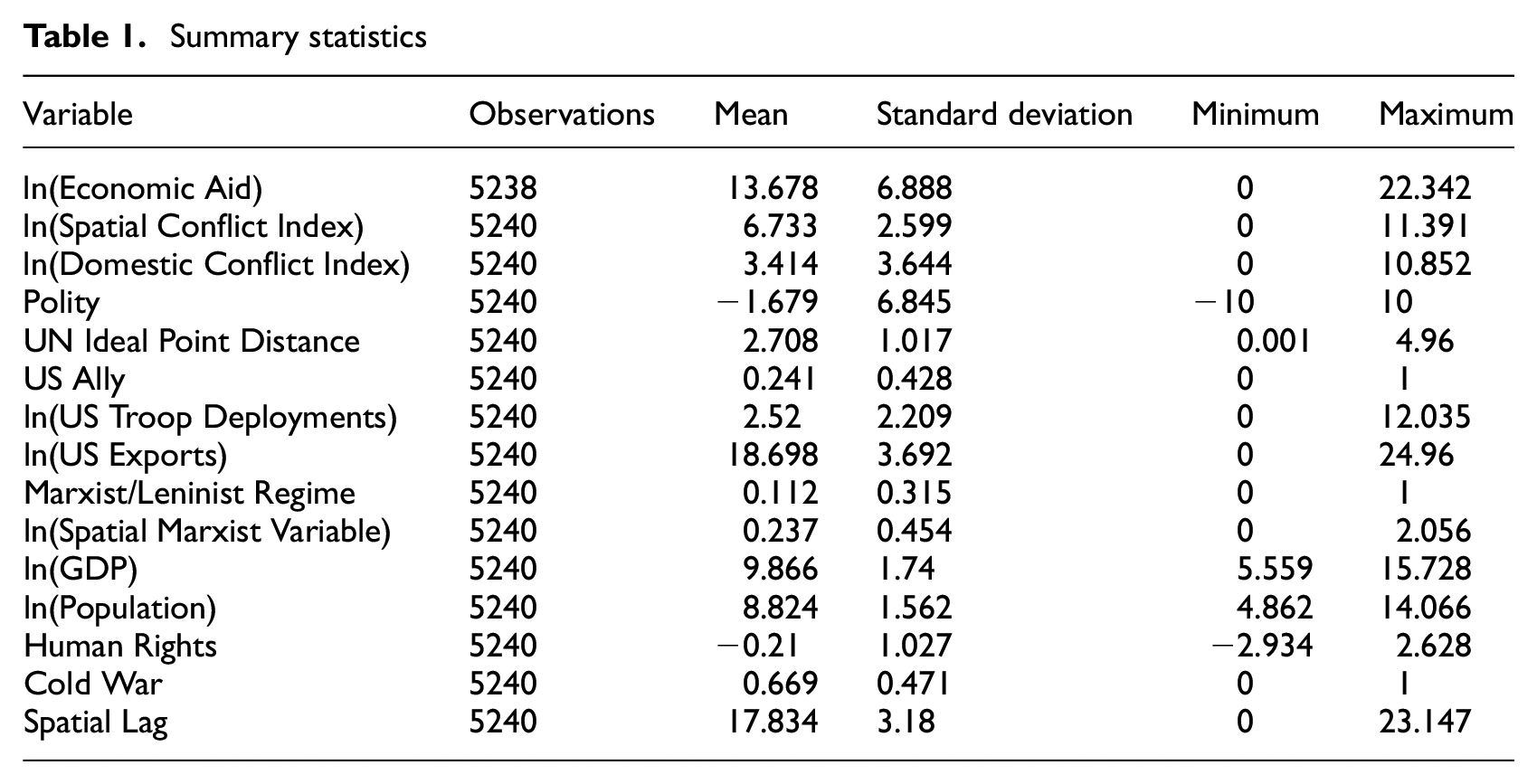
I control other variables that affect foreign aid flows and may be correlated with the independent variables of interest. Descriptions of these variables and citations are located in the Online Appendix. 12 Table 1 displays the summary statistics from the estimation sample in model 1. I estimate my models using a Prais–Winsten regression with panel-corrected standard errors. All independent variables are lagged one time period. Given the presence of serial correlation in the data, I estimate the models with an AR1 correction. 13
Summary statistics
Analysis
Table 2 displays the results for the main models. Model 1 displays the results examining the independent effect of neighborhood conflict. The regional conflict index correlates positively and significantly with the amount of US economic aid the referent state receives. This result provides support for hypothesis 1. Interestingly, the domestic conflict index for the referent state itself is not statistically significant. When directly controlling for both domestic conflict and regional conflict, only regional conflict yields a positive and significant coefficient.
US foreign aid and regional conflict, 1950–2005. Non-OECD countries only
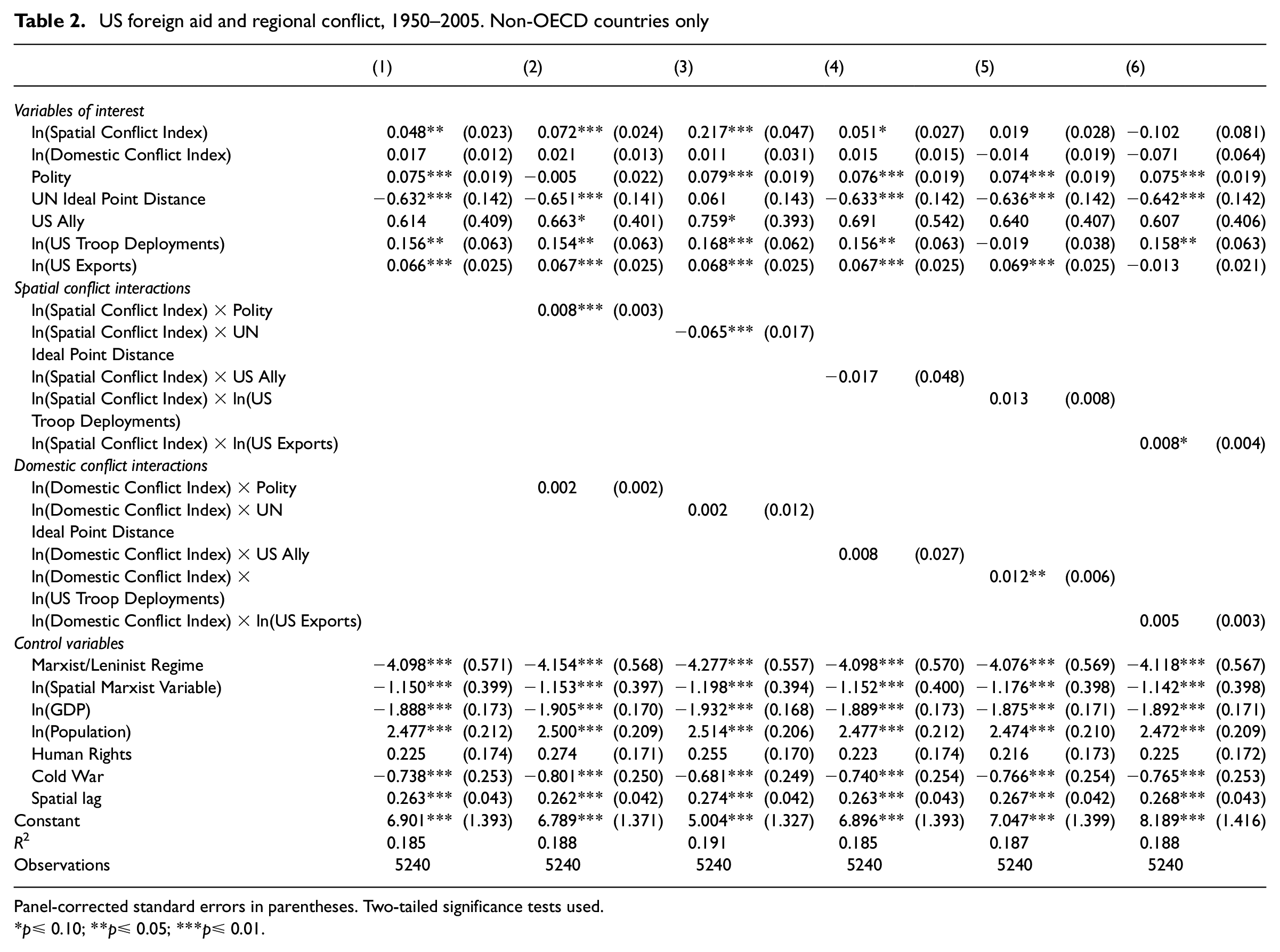
Panel-corrected standard errors in parentheses. Two-tailed significance tests used.
p≤ 0.10; **p≤ 0.05; ***p≤ 0.01.
The remaining hypotheses concern the conditioning effects of US interests on how the United States responds to the occurrence of conflict in the referent state’s neighborhood. Models 2 and 3 examine hypotheses 2a and 2b by looking at the conditioning effect of the referent state’s level of democracy and its UN voting patterns vis-à-vis the United States. Models 4 and 6 examine hypotheses 3a and 3b by looking at how the the referent state’s security ties to the United States condition the effect of conflict in the referent state’s neighborhood. Model 6 evaluates hypothesis 4 on the conditioning effect of US export interests.
I graph the marginal effects for each of these five models below. The figures are grouped according to the hypotheses that the figure’s panels address. Labels show the percentage change in aid corresponding to a 1% or 1-unit change in the x variable. Figure 1 shows the results for models 2 and 3. Panels A and B show the marginal effects for the referent state’s level of democracy and its interaction with the regional conflict variable. Panels C and D show the marginal effects for the interaction between the regional conflict variable and the UN ideal point distance variable. Briefly, the results support hypotheses 2a and 2b. According to model 1, the United States generally responds to conflict in the recipient state’s neighborhood by increasing aid to that state. However, panel A in Figure 1 shows that as the recipient state’s level of democracy increases so too does the effect of neighborhood conflict on aid. That is, while the United States increases aid to states with higher levels of neighborhood conflict, it gives even more aid to more democratic states as compared with less democratic states. In fact, the model indicates that the effect of conflict is null for the most autocratic states in the sample, indicating that the United States does not alter the net amount of aid given to the most authoritarian countries when they see an increase in neighborhood conflict. Similarly, panel B shows that the positive effect of democracy on aid increases as the referent state’s neighborhood becomes more conflict-prone. Importantly panel B also suggests that the effect of democracy on aid flows is conditional upon the referent state’s conflict environment. Democracies with a higher level of conflict in their neighborhoods receive more aid. Importantly, the magnitude of the positive effects we see for Polity ≥−3 and for regional conflict ≥5 becomes statistically significantly greater as we increase along the x-axis.

Marginal effects for hypotheses 2a and 2b. Panels A and C show the marginal effect of the regional conflict variable across the range of the corresponding independent variables. Panels B and D show the marginal effect of the corresponding independent variable across the range of the regional conflict variable; 95% confidence intervals shown.
Panels C and D provide a similar picture. The United States responds to increases in the level of regional conflict by increasing aid, but these increases are larger for states that have foreign policy positions that are relatively close to the United States. For states that are farther from the United States we actually see a negative effect emerge, indicating that the United States actually lowers the level of aid to the recipient country in response to conflict in that state’s neighborhood. In panel D we see that an increase in the distance between the United States and the recipient state’s ideal point estimates correlates with no change in aid where regional conflict is particularly low, but as regional conflict increases we see that the United States begins to lower the amount of aid it allocates to the recipient state. For both panels C and D we see a statistically significant change in magnitude of the effects across the range of the x-axes. On the whole these results provide support for hypotheses 2a and 2b.
The next set of figures plots the marginal effects from models 4 and 5 from Table 2, which explore the conditioning effect of US security ties with the recipient state. Panel A in Figure 2 plots the result marginal effect of the regional conflict variable according to whether or not the recipient state is an ally of the United States. Panel B plots the marginal effect of the alliance variable itself across the range of the regional conflict index. These results fail to produce support for hypothesis 3a on the role of alliance ties. The marginal effect is not statistically significant in either panel, nor is the difference between the two effects statistically significant.
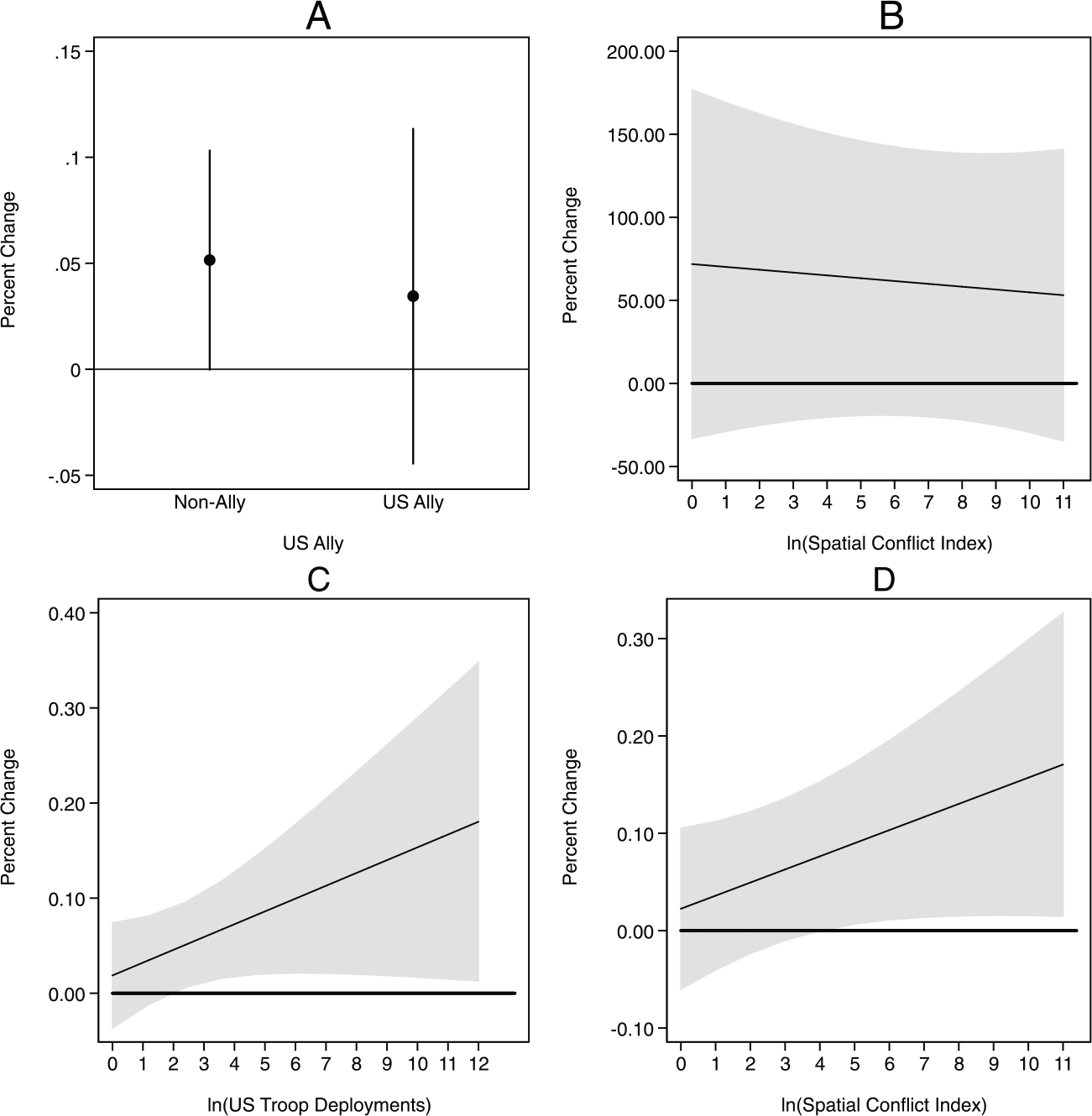
Marginal effects for hypotheses 3a and 3b. Panels A and C show the marginal effect of the regional conflict variable across the range of the corresponding independent variables. Panels B and D show the marginal effect of the corresponding independent variable across the range of the regional conflict variable; 95% confidence intervals shown.
Panels C and D examine the marginal effect of conflict and US troop deployments. In panel C the marginal effect of an increase in the level of neighborhood conflict is not significant at the lowest levels of the troop deployment variable, but a positive effect emerges at higher levels. Within the range of this positive effect (i.e. x≥ 2.4) there is a statistically significant increase in the magnitude of this effect at the 0.10 level using a one-tailed test. Similarly, panel D illustrates that the United States increases aid to the recipient state as the size of the troop deployment to that state increases, but this effect is only statistically significant where the level of regional conflict is slightly elevated. Further, we do see a statistically significant increase at the 0.10 level using a one tailed test in the magnitude of this effect within the positive range (i.e. x≥ 4.6).
The results from these models provide support for hypothesis 3b concerning the conditioning effect of US military forces deployed to the recipient state. Interestingly, alliance ties do not produce a significant effect. This could be a function of the fact that, because the estimation sample includes only non-OECD states, most observations of US allies in the sample are located in Latin America. There are 1263 observations that are coded as US allies in the estimation sample, accounting for approximately 24% of the sample. Of those allied observations, only 108 observations (9%) are located outside of Latin America. The remaining 1155 observations are all Latin American countries. US allies receive, on average, more aid than do non-US allies. The geographic clustering of most US allies in Latin America means that allied states in the sample also tend to have lower levels of regional conflict as compared with countries in other parts of the world. Accordingly, the results presented in panel A may simply reflect the fact that alliance ties and regional conflict levels are offsetting one another, given the geographic clustering of observations and the relative levels of regional conflict for allies vs non-allies.
Last, Figure 3 shows the marginal effects for model 6, which evaluates the conditioning effect of US export interests to the recipient state on neighborhood conflict. Panel A shows the marginal effect of neighborhood conflict on US aid flows across the range of the exports variable. Panel B shows the marginal effect of exports across the range of the neighborhood conflict variable. In both panels we can see a positive effect as discussed in hypothesis 4. Panel A shows that an increase in the level of neighborhood conflict leads to an increase in the amount of foreign aid that the recipient state receives, but only where US export interests are relatively strong. Panel B shows that an increase in the volume of US exports leads to an increase in the amount of aid a state receives, but primarily where states are exposed to higher levels of regional conflict. In both panel A and panel B we also see a statistically significant increase in the magnitude of the positive effects. These results provide additional support for hypothesis 4 and the notion that policymakers view the potential spread of conflict as a threat to US export access.
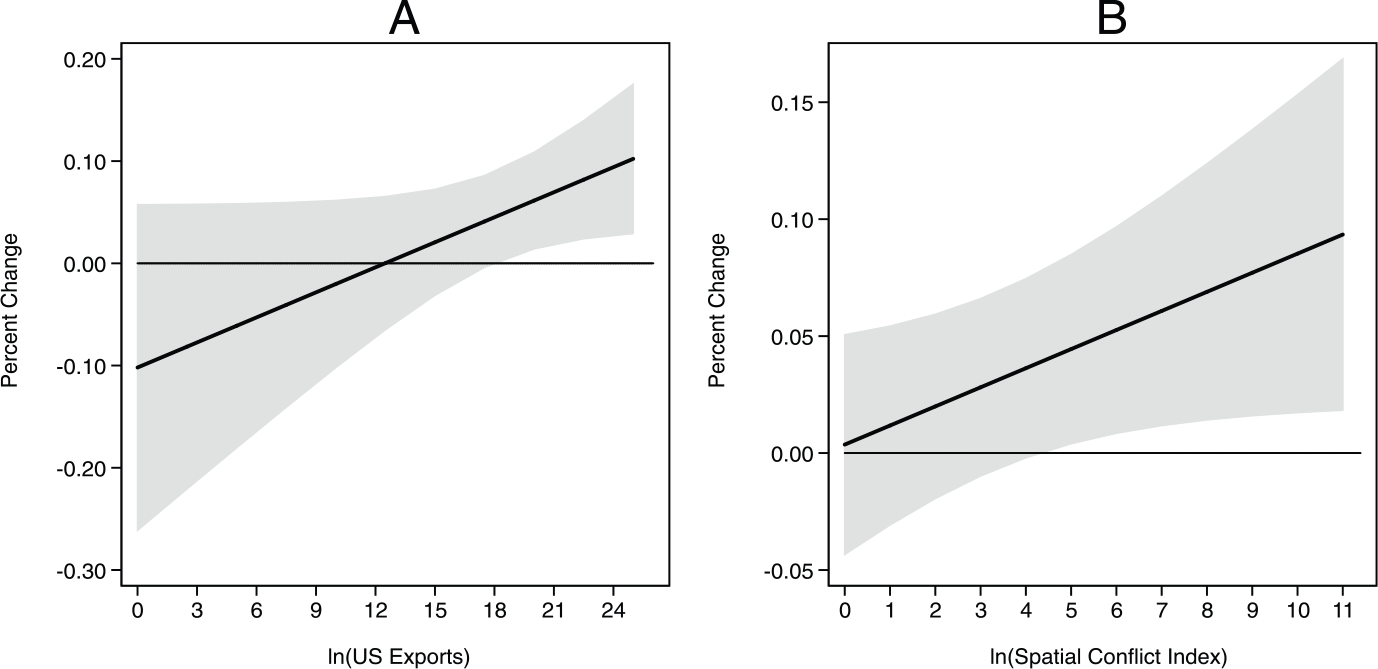
Marginal effects for hypothesis 4. Panels A and B show the marginal effect of the regional conflict variable across the range of the corresponding independent variables; 95% confidence intervals shown.
It is worth noting that, with the exception of the interaction between domestic conflict and US troop deployments, none of the models produce statistically significant coefficients for the domestic conflict index or its interactions with the other variables of interest. The inclusion of these other interaction terms helps to rule out the possibility that the regional conflict index is simply proxying for the presence of conflict within the referent state. Further, robustness checks contained in the Online Appendix re-estimate the models on a sample of countries where domestic conflict equals 0. This helps to ensure that I am only capturing the effects of regional conflict. The primary results remain unchanged.
Finally, while the theoretical argument is more general, robustness checks produce null results for many of the conditioning relationships when examining other countries. The Online Appendix contains additional models for Canada, France, England, Sweden, Norway and Finland. No other state except Norway responds to regional conflict in the same way as the United States, and none exhibit the full range of conditional effects that the United States models yield. Interestingly, Balla and Reinhardt (2008) also find that Norway is the only state besides the United States to respond positively across all three of their regional conflict variables. 14
Conclusions
The results provide support for the hypotheses on the role of neighborhood conflicts in determining aid flows from the United States. In general, increases in the level of neighborhood conflict lead to more economic aid. The occurrence of conflict in a state’s neighborhood can lead to the direct diffusion of violent conflict across national borders. Conflict can also produce a range of externalities that increase the demand on neighboring states’s resources, such as creating or exacerbating humanitarian crises, driving refugees into neighboring countries, lower levels of intra-regional trade, and increased military spending, which can lead to decreased government revenues. Ultimately conflict can create conditions that place greater demands on neighboring governments while also reducing their ability to extract the resources necessary to meet those demands.
The results of this article also demonstrate that the US response to conflict is conditioned by its political and economic interests in the recipient state. Increases in neighborhood conflict correlate with increases in the amount of aid, but the magnitude of this effect is contingent upon factors like the recipient state’s level of democracy, its foreign policy similarity to the United States, the size of US military deployments in the recipient state, and the volume of US exports to the recipient state. Overall these findings support the hypotheses presented above, with the exception of the conditional effect of US alliance ties. The alliance variable is positive and significant in some models, providing some evidence that US allies do receive more economic aid than non-allies, but it may be the case that alliance ties do not condition the effect of other variables as hypothesized. Alternatively, it is also possible that the null findings here are the result of biases related to sample selection, geographic patterns in US alliance ties, and levels of regional conflict.
This study expands upon previous research by clarifying how neighborhood and geographic factors shape states’ foreign policy decisions (Allen et al., 2016, b; Collier and Hoeffler, 2002b). There is ample historical evidence that policymakers care about the spatial implications of a wide range of events. The cases of Colombia, Iraq, and Syria discussed herein provide recent examples that suggest that policymakers care not just about conflict in a particular state, but also about how the externalities of conflict will affect the broader region. Quantitative political science research is still only beginning to develop a fuller understanding of these dynamics. Conflict scholars in particular have tended to look more closely at spatial factors, but research in other subject areas often eschews discussions of spatial issues. This article represents a step forward on this front, but more work remains. For example, it would be useful to know more about how policymakers distinguish between types of conflicts when allocating aid (see Chauvet, 2003). Does the geographic locus of conflict within the afflicted state, or the proximity of major battles to border areas, have any effect on aid levels? Does the occurrence of conflict, or the type of conflict, affect decisions pertaining to aid bypass and the allocation of aid funds to NGOs vs governments? More research along these lines would prove useful in furthering our understanding of how and when conflict affects donor aid allocation decisions.
Footnotes
Acknowledgements
Thanks to Michael Allen and Chad Clay for their comments and suggestions. Thank you to the editorial staff at Conflict Management and Peace Science as well as the three anonymous reviewers for their comments and suggestions. Replication data files are available on the SAGE Conflict Management and Peace Science website and at the author’s Dataverse page:  .
.
Funding
This research received no specific grant from any funding agency in the public, commercial, or not-for-profit sectors.
Notes
References
Supplementary Material
Please find the following supplemental material available below.
For Open Access articles published under a Creative Commons License, all supplemental material carries the same license as the article it is associated with.
For non-Open Access articles published, all supplemental material carries a non-exclusive license, and permission requests for re-use of supplemental material or any part of supplemental material shall be sent directly to the copyright owner as specified in the copyright notice associated with the article.
