




Abstract
We examine the impact of governmental leadership changes on the civil war peace process. In line with the literature on leadership changes and interstate war, we argue that transitions can help overcome lags in the rational updating process, leading to negotiations and termination through negotiated settlements. However, while studies of interstate relations emphasize the role of “outsider” changes that produce new winning coalitions, we argue that owing to the critical nature of credible commitment problems within the civil war peace process, only “insider” changes can generate the benefits of leadership change while mitigating uncertainty generated by leadership turnover. Using existing and original data on changes in governmental leadership, we find support for our expectations. Leadership changes can produce conditions favorable to negotiations and settlements, but only changes from inside the existing regime should be encouraged to avoid prolonging the conflict.
Introduction
There is a growing literature that considers the impact of leaders on civil war duration and termination. Recent studies have examined the effect of leader tenure (Thyne, 2012; Uzonyi and Wells, 2016), leaders who are responsible for war onset (Prorok, 2016), and rebel leadership change (Johnston, 2012; Tiernay, 2015). Thus far, however, less attention has been paid to the impact of governmental leadership changes on civil war duration and termination.
Within the interstate war literature, a number of studies have found that leadership turnover can lead to the termination of conflict (e.g. Croco, 2011; Price, 2012; Stanley and Sawyer, 2009). When wars become “stuck” owing to lags in the rational updating process, government leadership change can help to overcome obstacles related to biases in informational processing and personal leader preferences. This work also suggests that “outsider” changes in particular, which are leadership changes that usher in a new winning coalition and thus different domestic constituencies, are most likely to lead to conflict termination.
In the context of civil war, we argue that government leadership changes can also generate a window of opportunity to kick-start the peace process, increasing the chances of both negotiations and termination through a negotiated settlement. However, we argue that only insider changes will increase the chances of negotiations and termination through settlement. These internal changes can reset personal preferences and information-processing inefficiencies, allowing wars to end. At the same time, insider changes minimize the transaction costs associated with building a new relationship with a different executive. Insiders are more likely to be familiar with the ongoing conflict and past attempts toward a negotiated peace, while the rebels will have information about the new leader’s ability and likelihood to follow through on promises. Put differently, insider changes can produce the benefits associated with leadership change while mitigating uncertainty generated by executive turnover. We expect this to increase the likelihood of negotiations as well as civil war termination through a negotiated settlement, as the government is better able to credibly commit to an agreement. Conversely, outsider changes act as a “shadow veto player,” increasing uncertainty about whether the government will renege on an agreement and reducing the chances of termination through settlement.
To test our expectations, we employ original data on governmental leadership changes, focusing on whether the new leader has a connection to the prior regime, such as belonging to the same political party or holding a key position like a vice president or a cabinet member in the previous regime. We also use data from the Change in Source of Leader Support (CHISOLS) data (Mattes et al., 2016) as a second source on insider and outsider leadership changes. The CHISOLS data code a similar phenomenon, but more specifically focus on whether there is a change in the leader’s winning coalition. Results are generally supportive of our expectations using both sets of data. In contrast to findings regarding termination of interstate war that emphasize the importance of change from outside the regime, we demonstrate that in the context of civil wars it is change from within the existing government that increases the chances of negotiations and termination through settlement. This provides an important policy implication for the civil war peace process. A change in government leadership can encourage negotiations and settlements; however, when foreign or domestic powers advocate for executive turnover during a civil war, our findings suggest that it is best to avoid completely “changing horses in midstream” if a negotiated outcome to the conflict is desired.
Leadership and conflict
There is a growing literature that considers the impact of leaders on civil war duration and termination. Prorok (2016) considers the role of culpability, arguing that leaders who began a war will be more likely to fight for extreme outcomes and to avoid giving political concessions owing to a fear of punishment. Thyne (2012) argues that the stability of executives, as measured by leader tenure, shortens civil wars by reducing uncertainty surrounding the credibility of commitments. Uzonyi and Wells (2016) likewise argue that long-serving leaders will be more likely to end civil wars, but only when there are constraining domestic institutions that make it more difficult to renege on settlement terms. These institutions produce multiple veto players that can keep the executive in check and allow the state to better commit to agreements. Finally, both Tiernay (2015) and Johnston (2012) examine the effect of rebel leader changes, finding that killing or capturing rebel leaders tends to shorten wars. Less work, however, has considered the impact of particular types of governmental leadership change on peace processes in civil wars, which is the question that we examine here. 1
Toward that end, we first consider existing work on the role of leadership changes during interstate wars. A series of studies suggest that leadership change can jump start the peace process. This happens first by changing the government’s overall policy toward the other side, as leadership turnover can reshape government policy preferences by bringing in a new ruling coalition. Ghosn (2010) and Greig (2005), for example, argue that leadership changes can lead to international negotiation attempts and mediation attempts, respectively, as new leaders are able to break from policies of their predecessor and reset their state’s policy preferences. These coalition shifts are seen as an important underlying mechanism in many of the studies that examine the impact of leadership change on foreign policies, where the new leader “relies on different societal groups for support than her predecessor” (Mattes et al., 2015). These “outsider” changes can occur in any system, democratic or autocratic, and do not require a change in institutions. Rather, an outsider change will produce a new winning coalition composed of different social groups who support the incoming leader. This results in different policy preferences that can allow for the initiation of a peace process and termination of interstate conflict.
Beyond bringing in new policy preferences, Stanley and Sawyer (2009) and Stanley (2009a, b) argue that new leadership can “unstick” wars that have developed lags in the rational updating process. In these cases, the war would end if leaders had all available information and were able to act on that information; however, obstacles can block this process that would uncover a bargaining range, leading to a prolonged war. First, issues related to informational processing, such as poor collection processes, failure to share information, or biases in interpretation (e.g. Downs and Rocke, 1994; Kaufmann, 1994) can produce situations in which leaders may not know that the war should end. Secondly, a leader may personally not want to end the conflict, and as a result a bargaining range will not emerge even with complete information. This can arise for a number of reasons, including personal benefits gained from fighting (Mansfield and Snyder, 1995) or the fear of punishment for losing a war (e.g. Croco, 2011; Croco and Weeks, 2016; Goemans, 2000). A culpable leader, for example, may fear losing elections or even physical punishment if he fails to achieve victory, while a leader facing entrapment obstacles may continue fighting because he is supported by hawkish domestic or international constituents who would remove him from power should he end the war (Kaplow, 2016). These leaders may know that the war “should” end, but choose not to terminate as a result of personal gain or fear. Leadership change can reset how information is processed and remove leaders with personal objections to seeking an end to the conflict, allowing for the war to end (Dreyer, 2012; Pilster et al., 2015; Stanley and Sawyer, 2009).
In sum, leadership change can help to end interstate wars through two primary pathways. The first is through changing the government’s policy preferences, and the second is through helping to overcome lags in the rational updating process. In applying these dynamics to the context of civil war, we expect that leadership changes can produce the benefits identified by Stanley and Sawyer, helping to overcome lags in the rational updating process that may prolong wars. However, issues related to credible commitments are particularly acute in civil war settings, and as a result, we argue that outsiders will be less likely to end a civil war through negotiated settlement. From the rebels’ perspective, there will be greater uncertainty surrounding their resolve, modus operandi, and policy preferences, which will take time to understand. Insider changes, in contrast, are comparatively less detrimental because much of the knowledge gained about the regime’s likelihood to renege on an agreement will transfer to the new leader. By overcoming lags in the rational updating process without undermining the government’s ability to credibly commitment, we expect negotiations and settlement to become more likely. In essence, insider changes can bring the benefits of leadership change while mitigating the costs of turnover.
Civil wars, negotiated settlements, and leadership change
We begin with existing applications of the bargaining model of war termination (Brandt et al., 2008; Mason and Fett, 1996; Regan, 2002; Stanley and Sawyer, 2009), which presents government and rebel leaders as deciding to keep fighting or to settle in an iterative bargaining process. While some rebels are strong enough to realistically pursue military victory, many are not, and others may determine that achieving a victory is not worth the costs likely to be accrued in pursuit of that victory. In this case, belligerents can pursue termination through a negotiated settlement (Zartman, 1995). This entails a larger bargaining process, where combatants shift from war, to negotiations, to finalizing an agreement that ends the war (e.g. Bearce et al., 2009; Findley, 2013). Within this process, we focus on two stages: the occurrence of negotiations and the implementation of a peace agreement. Both can be viewed within a rationalist framework, such that negotiations and adoption of an agreement will only occur if both sides determine that the benefits of doing so outweigh the associated costs of continued fighting.
In the following, we first consider the potential benefits that a leadership change can bring during civil war. We then present our argument for why insider changes in particular are expected to lead to both negotiations and settlements, while outsider changes can prolong civil conflict.
The benefits of leadership change during civil wars
Following the logic of Stanley and Sawyer, we argue that the primary benefit of leadership change within civil wars is the ability to overcome lags in the rational updating process. In these cases, the war would come to an end if complete information were known and could be acted upon. First, as with interstate wars, there are problems related to information processing within civil wars (e.g. Filson and Werner, 2002; Regan, 2002). Both sides have incentives to misrepresent their relative strength, cost tolerance, and the concessions they would be willing to give (Fearon, 1995). Negotiations are more likely to occur when there is a stalemate and when both sides approach parity in military strength (Findley, 2013), while a successful settlement can only be generated when an overlapping bargaining space emerges. In either case, both sides must agree about one another’s relative strength and resolve when estimating the costs that would have to be incurred in order to eventually achieve a military victory. This information is revealed through battlefield interactions, the use of civilian victimization (Wood and Kathman, 2014), and negotiation attempts (Langlois and Langlois, 2012). Information, however, must be interpreted after it is obtained, and as noted by Thyne (2012: 309), “Gauging the impact of a victory or loss on the battlefield is a messy business.” Informational updating may not happen uniformly for all conflict actors, while individual or institutional biases may hinder this process, thus producing lags in the conflict termination process. We argue that leadership changes within civil wars can help to overcome this problem. New leaders often handle information processing differently, overcoming biases or rectifying oversights in information collection and analysis that were present under the previous leadership (Stanley and Sawyer, 2009).
Beyond information processing, personal leader preferences present another obstacle to termination. If a leader prefers war over a settlement, negotiations are less likely and an agreement will not emerge even within conditions of perfect information. Leaders can develop personal preferences that are opposed to accepting negotiated outcomes. This can include personal economic gain (e.g. Waal, 2014) or the fear of punishment, including electoral defeat, being removed from power, imprisonment, exile, or even death. Prorok (2016) finds that leaders who bear responsibility for the initiation of the civil conflict—“culpable” leaders, in the parlance of Croco (2011)—are less likely to make concessions and instead pursue extreme outcomes to the conflict. A logical extension to this argument would be that leaders who fear punishment for their connection to the war’s onset would be less willing to negotiate with the rebels in order to maintain an image of their resolve. Leaders may also fear being removed from power by hawkish domestic constituents or foreign sponsors, who could force the leader from power should they end the conflict, or may worry about losing power owing to the terms of a peace treaty. Sudanese Vice Presdient Osman Taha, for example, preferred to keep fighting rather than negotiate so he could avoid losing his post in a power-sharing agreement with the Sudan People’s Liberation Army (Thyne, 2012: 309). Leadership turnover can bring new executives to power with different personal preferences, who generally may be more amenable to pursuing negotiations and settlements as compared with their predecessor.
However, while new leaders may be able to overcome lags in the rational updating process, we argue that not all governmental leadership changes are equal in terms of their ability to produce a settlement. In particular, when a leader comes from outside the previous regime, there is considerable information loss regarding the government’s ability to credibly commit to an agreement that takes time for rebels to regain. We contend that only insider changes facilitate negotiations and hasten settlements in civil wars, while outsider changes make settlement less likely.
The necessity of insider change
While leadership changes in general may be able to overcome problems related to information and personal preferences, the ability to actually negotiate an end to the fighting is often hampered by the government’s inability to credibly commit to that settlement. Rebels are often forced to disarm and demobilize while the government’s military will remain in place, at least in some capacity. The government’s strength will thus improve in relation to the rebels’, which incentivizes the government to renege on agreements and discourages the rebels from signing an agreement in the first place. Given the importance of credibility within the context of civil war, it is important to first consider the effect of leadership change on the ability to credibly commit. The existing literature suggests that, in general, leadership changes make settlements less likely. Wolford (2012: 517) refers to leadership turnover “as a commitment problem,” and Thyne (2012) presents leadership changes as “shadow veto players” that make it more difficult to find acceptable settlements in the present (Cunningham, 2006). In sum, the uncertainty generated by a new leader can hamper the peace process.
We argue that outsider changes, where the new leader was not a part of the previous regime, are particularly likely to introduce heightened uncertainty into the relationship with rebels. This has implications for the peace process in terms of getting to the bargaining table to begin talks, as well as ultimately achieving a settlement. In general, we expect outsider change to have an indeterminate effect on the occurrence of negotiations. This is in part related to the varied policy goals of new leaders, where some emphasize peace and dialogue and others explicitly are focused on achieving military victory. Many outsiders come to power with a platform of increasing the war effort, making any steps toward a successful peace process unlikely. In April 1992, for example, the National Provisional Ruling Council carried out a coup d’état in Sierra Leone to take control of the war effort against the RUF. However, it is not uncommon for outsiders to come to power on a platform of peace and reconciliation. This can open a window for negotiations to take place, as it did in Sri Lanka in 1994 and more recently in the Philippines in 2016. Beyond policy preferences, peace talks also afford the warring sides an opportunity to air grievances and discuss demands, ultimately sharing information about resolve. However, rebels that are skeptical of a new regime’s credibility—especially if they lack information about an outsider leader—will be remiss to enter into peace talks for fear of appearing “soft” in the eyes of supporters. Negotiations are not a costless endeavor, as some might interpret them as the government signaling a willingness to compromise or at least conferring some legitimacy on the rebel group (Thomas, 2014). Thus, while governmental leadership change can incentivize negotiations from a perspective of gaining information within a new relationship, there may be heightened obstacles for negotiations following outsider leadership change given the level of uncertainty that is introduced.
Even if negotiations are initiated following an outsider leadership change, new executives from outside the previous regime are expected to impede the ability of combatants to reach a settlement. Rebels are less likely to have information about the degree of consistency in the government’s behavior, which informs expectations about the new leader’s likelihood of backtracking, the value of promises made, and ultimately the likelihood of reneging (Thyne, 2012; Uzonyi and Wells, 2016). Following 1994 elections in Sri Lanka, the People’s Alliance came to power after 17 years of United National Party rule in an outsider change, and was widely viewed as having a mandate to pursue a peace process with the LTTE. While some progress was made early on under Prime Minister Kumaratunga, negotiations stalled owing to the LTTE’s desire to have a slower process with evidence that confidence-building measures would be implemented before further negotiations were undertaken (Haniffa and Abeygunawardana, 2008). In essence, the LTTE wanted more of a guarantee about the government’s future behavior in the face of mistrust, while the government learned that “enthusiasm alone would not be enough to make the negotiations successful” (Haniffa and Abeygunawardana, 2008: 18).
Outsiders are also expected to have less information about the state of the conflict, which can have an important impact on both policy preferences and the way in which negotiations are carried out. Leadership changes are expected to help overcome lags of sticky wars, but outsiders may not know that the war is sticky, having less information about the status of the conflict, any ongoing peace process, or the demands and sensitivities of the rebels. This lack of information can manifest itself as policy preferences that run counter to attempting to end a war that “should” end, or a lack of understanding in how to conduct the peace negotiations. Along similar lines, outsiders may have less realistic expectations about potential outcomes, which can derail negotiations when expectations are not met.
In the Sri Lankan case, where the government was attempting to find a negotiated settlement, the negotiation team was composed of close friends of the new prime minister but no official representatives of the government, which was also seen as a slight to the status of the LTTE. Between the lack of confidence-building measures and perceived slights, the LTTE abandoned the peace process less than a year after the election (Haniffa and Abeygunawardana, 2008). Rodrigo Duterte of the Philippines, a recently elected outsider with no connections to the previous regime, also made it clear that he was interested in peace talks with rebel groups fighting for Moro independence as well as the communist New People’s Army. Duterte was “seen by many as the Philippines’ best hope to end a decades-long insurgency” (Heydarian, 2017); however, both sides reached an impasse when basic terms could not be agreed upon. Duterte appeared to be overly optimistic about the ease of making progress in the peace process and the rebels were quick to pull out of negotiations once conflicting viewpoints were made known.
Combatants may also need to determine where the new leader stands vis-à-vis other parties in the government, which affects the new leader’s ability to credibly commit in the face of competing government interests. For example, following a unilateral ceasefire announced by the Kurdish Worker’s Party (PKK) in 2009, then Prime Minister Erdoğan of Turkey was unable to commit to a peace process as a result of recent democratic reforms. Both Islamist and Turkish nationalist parties were strongly against any kind of reconciliation with the PKK, which undercut his ability to move forward despite preferences to do so (Thyne, 2012).
In contrast, we argue that insider changes—where there is no change in the ruling coalition but only a change in the “name on the plate” by way of a new head of government—increase both the likelihood of negotiations and ending a war through a peace agreement. Within the context of sticky wars, or conflicts that should end if information were known and could be acted upon, we expect that insider changes are more likely to bring leaders to power who know that peace is the best, or rational, outcome given the situation on the battlefield. At the same time, insider changes can mitigate the various sources of uncertainty that are generated by an outsider change. Internal leaders are more likely to be a known quantity, carrying over the reputation from the previous leader. Rebels will be more familiar with the regime’s behavior and likelihood of reneging on agreements. Insiders may also have greater familiarity with the ongoing conflict and any peace process, and have more realistic expectations about potential outcomes. This can open the door for both negotiations and negotiated settlements.
The case of the Democratic Republic of the Congo (DRC) provides an example of this logic. In the DRC, the peace process had stalled largely owing to Laurent Kabila’s personal objections to reaching an agreement. May (2016: 101) argues that, in relation to the the Inter-Congolese Dialogue (ICD), the negotiations forum for the conflict, Kabila could not stand seeing his rule put into question. The ICD not only gave “equal status” to each of his armed and unarmed opponents but was basically intended to result in a new power sharing arrangement within the DRC. Instead, the self-proclaimed President wanted a new constitution to be adopted and elections to be held (under his control) to provide him with some degree of legitimacy.
As a result, Kabila did all he could to undermine the power of the ICD and stall negotiations. Kabila was then assassinated by his bodyguard, and his son Joseph took over. Joseph was well versed in the ongoing conflict and peace process as a top military leader within his father’s government, as the Deputy Chief of Staff of the Armed Forces with a rank of Major-General. The stalled peace process resumed shortly thereafter. Joseph “was aware that the Congolese authorities had little to gain in appearing to be the main obstacle to peace,” allowing for negotiations to resume and a negotiated settlement to be reached (temporarily) ending the war (May, 2016: 102). We argue that it was not the method of leadership change that mattered, but rather the removal of personal objections from the elder Kabila as well as Joseph’s understanding of the peace process, position within the new government, and ability to credibly commit to the peace process that allowed a settlement to be reached.
This leads to the following set of hypotheses:
Research design
To test the impact of leadership tenure and turnover on the likelihood of negotiated outcomes, we use the UCDP Dyadic Dataset to identify the population of civil conflicts from 1989 to 2014 (Harbom et al., 2008). An armed conflict is included in Dyadic Dataset if it produces a minimum of 25 battle-related deaths in a given year, and is fought between a government and internal, organized opposition group. We employ the dyadic data in order to capture the relationship between the government and rebel group, and also to better account for cases in which a government may settle with one faction during a conflict but continue fighting with others. We define a conflict spell as ending if there are at least 3 years of non-conflict (i.e. no conflict recorded by the Armed Conflict Dataset). 2 Our unit of analysis is thus the conflict-spell dyad-year. As per recommendations of Thyne (2015), we also exclude conflicts that are coups from the analysis.
In addition to the above scope conditions, we also limit our analysis to only include “high severity” events—conflicts spells that generate at least 200 battle-related deaths over the course of the conflict spell. Under the logic that battlefield interactions and battle-related deaths equate to information for both sides, we argue that leadership change should only matter for conflicts where enough information is generated so that obstacles to informational updating can occur, 3 and given the focus of battlefield interactions as a source of information during war (Filson and Werner, 2002), and the finding that higher severity conflicts led to negotiation attempts (Ghosn, 2010), we expect there to be a threshold effect such that leadership change will matter in high-severity conflicts. While any particular threshold will be arbitrary, we believe that 200 deaths indicates that a conflict is of relatively high intensity and that substantial interactions between the two sides have occurred. 4
Dependent variables
There are two dependent variables used for this analysis. The first is a binary measure that codes the presence of negotiations between the government and a rebel group in a given dyad-year. These data were based on the work done by Thomas (2014: 810), who defines negotiations as “instances of formal bargaining between the main belligerents in conflict.” The original data were collected at the dyad-month level for African conflicts. We aggregated these data to the year-level and expanded coverage for all regions of the world through 2009. Following Thomas, negotiations are only coded when both parties in the dyad are present at the meeting; secret or back-channel negotiations are excluded, as well as negotiations handled by third-parties. 5 For the models on negotiations, the time period covered is thus 1989–2009 owing to data availability. As our measure of negotiations is dichotomous, we use logistic regression with robust standard errors clustered at the dyad level.
Second, we examine how conflicts terminate—in particular, whether settlements actually occur and how leadership change impacts the likelihood and time it takes to achieve this result. Negotiated outcomes were determined based on coding from the UCDP Conflict Termination Dataset (Kreutz, 2010). We treat both peace agreements and ceasefires as negotiated settlements. In the time period of this study there were a total of 159 conflict episodes, including 55 conflicts that ended through a settlement of some kind. 6 A competing risks hazard model is used to test the effect of leadership changes on the occurrence of negotiated outcomes. Civil wars can end in a number of different ways, and correspondingly, independent variables can have different effects on the hazard (the likelihood a civil war will end at one point in time, given that it has persisted until that point) of observing a given type of termination. A competing risks model allows for different types of conflict terminations to be taken into consideration by treating the various outcomes as competing events, as only one of them can occur first. In our models, civil wars can end in four different ways: government victory, rebel victory, negotiated settlements and termination through low activity. Here, the focus is on settlements and other outcomes are “competing” with a settlement. 7
Models were estimated using competing risks regression based on the methods of Fine and Gray (1999), with settlement as the outcome of interest. 8 This method is semiparametric and thus similar to a Cox model, in that it makes no assumptions about the functional form of the baseline hazard, but assumes the effect of the covariates to be proportional (Box-Steffensmeier and Jones, 2004). In each model, tests of the proportional hazards assumption were also conducted. We cluster standard errors at the conflict dyad-level.
Independent variables
The primary independent variables measure leadership changes within the government. Original data were collected based on leader start and end dates from the Archigos data (Goemans et al., 2009). Each time a leadership change occurred, it was evaluated for whether the change came from within the regime. Insider changes are coded when a member from the previous regimes comes into power, which can take many different forms. It is relatively common for vice presidents to become the new leader, as well as former cabinet ministers, such as a foreign minister or minister of defense. There were a number of changes where members of the administration, such as ambassadors, became the leader, or when junta members were promoted. We also code insider changes when the new leader is from the same party as the previous leader. Of the insider changes that we coded, just under half (45%) were connected by political party alone. The remaining transitions represent a change to a member of the previous ruling coalition, such as a vice president (20%), minister (18%), military leader or junta member (6%). Outsider changes occur when there are no connections between the new leader and previous regime, when there are regime transitions (such as a change from a civilian to military regime or transition to democracy), if the leader is the first in newly independent country, or if the new leader is not from the same political party. 9 To code the data, we relied on a series of sources, including case narratives from the Archigos data, background reports from the US Department of State, information from WorldStatesmen.org, news stories from Keesing’s, and country-specific research as needed.
Outsider is coded 1 if a new leader from outside the previous regime came to power in a given year, and 0 otherwise. Insider is coded as 1 if there was a change from within the existing regime (as described above) in a given year, and 0 otherwise. Given our expectation that only insider changes will encourage both negotiations and settlements because they allow for a continuation of information and minimal transaction costs associated with building new relationships, we code all years in which both an insider and outsider change occur (six observations total) as outsider change-years only. To explore the data further, we include a series of descriptive tables comparing our coding with democracy and regular/irregular changes.
Table 1 displays the cross-tabulation between insider/outsdier changes and whether a country is democratic (6 or higher on the Polity scale). The results suggest that insider changes are not solely linked to regime type. While there are additional cases of insider changes within democracies than would be expected if there were no dependency between the two variables, this difference is not statistically significant. Table 2 also shows a cross tabulation of the Archigos coding of regular and irregular leadership changes in comparison with our coding of insider and outsider changes. 10 Regular leadership changes are roughly split between the internal and external category, with about 63% as outsider changes. The irregular changes are nearly all outsiders, which makes sense as many irregular changes are coups, revolutions, or assassinations.
Cross-tabulation of leadership changes.
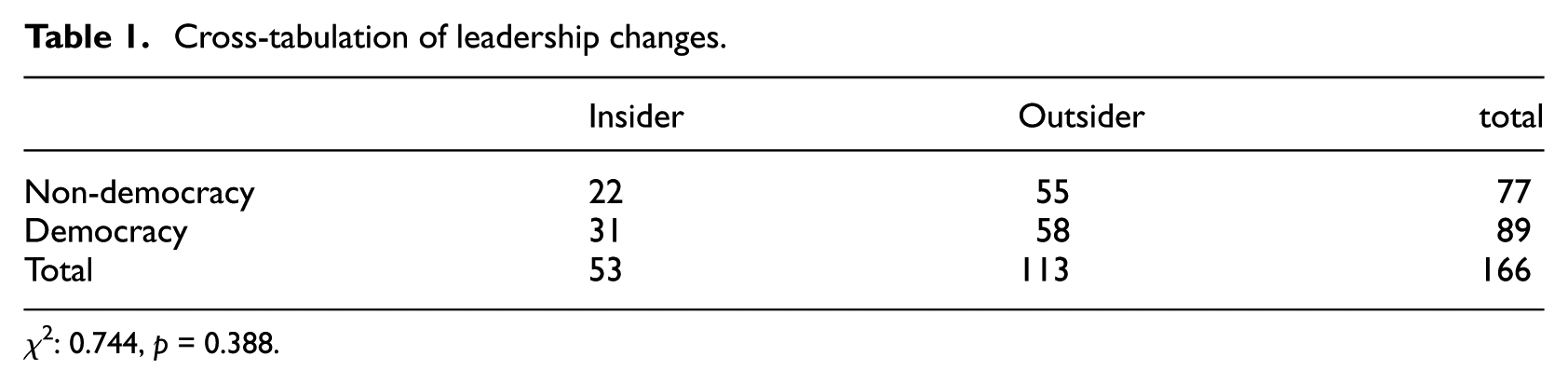
χ2: 0.744, p = 0.388.
Cross-tabulation of leadership changes.
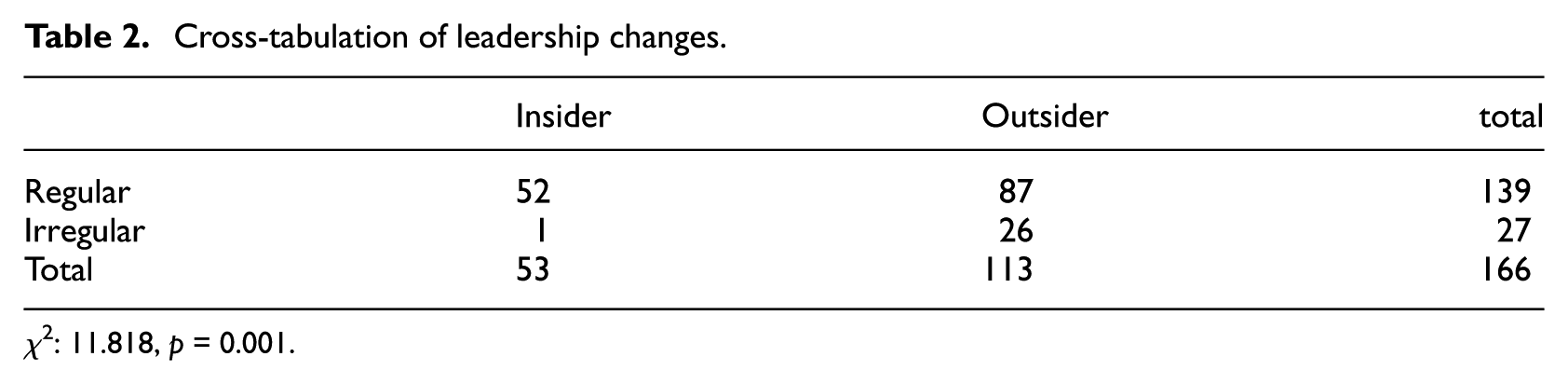
χ2: 11.818, p = 0.001.
An alternative coding of our insider and outsider concepts is derived from the CHISOLS dataset (Mattes et al., 2016). These data are also based on the Archigos data, and focus on the source of leadership support (as compared with our focus on the connection of the individual leader to his predecessor). If there was a leadership change that brought a new winning coalition to power in a given year, an outsider-SOLS change is recorded. If there was a leadership change in a given year, but the change did not result in a new winning coalition, an insider-SOLS change is recorded. As with our insider/outsider coding, years in which an insider-SOLS and an outsider-SOLS change occurred are recorded as outsider changes only.
Table 3 shows the differences between the two datasets, and as expected there is a good amount of overlap between how the two sets of variables are coded. Of 138 leadership changes that occur during this period, there is agreement on 113 transitions (82%). The remaining discrepancies come from different coding rules between the two sets of variables. For example, the CHISOLS data generally code caretaker or transition governments as not a coalition change, while we code this as insider or outsider change based on the new leader’s connection to the previous regime. In other cases, such as the Bangladeshi elections in 1991, the same party retained control after the election, but a coalition partner within the legislature’s governing coalition changed. We code this change as an insider change as the same party retained control, while CHISOLS codes the transition as a coalition shift since there is a new coalition partner.
Cross-tabulation of leadership changes.
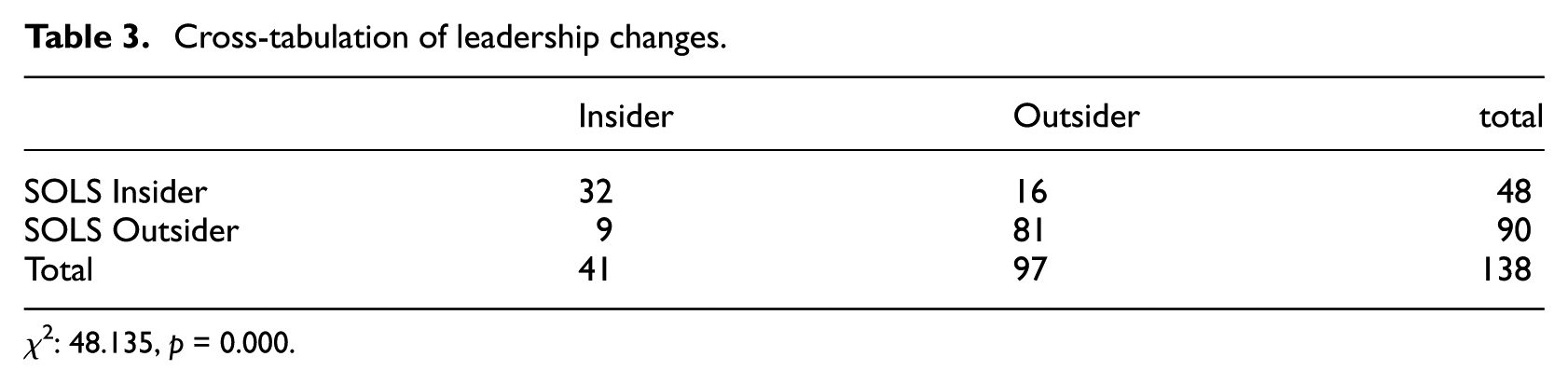
χ2: 48.135, p = 0.000.
Additional explanatory variables
A number of control variables that describe the role of external actors, the rebel group, government, and the conflict environment are also included in our model specifications for both negotiations and settlements. First, an indicator for third-party mediation is included from the Civil Wars Mediation dataset (DeRouen et al., 2011), coded 1 if third-party mediation occurs in a given year and 0 otherwise. It is expected that external mediation will increase the chances of both negotiations and third-party settlements. Mediation represents an effort by third parties to resolve underlying conflict where disputants have either requested or accepted the aid of a third party. DeRouen et al. (2011) report that over 75% of mediation attempts lead to some kind of concession between the two sides.
A measure of rebel group strength, relative to the government, is taken from the Non-State Actor Data (Cunningham et al., 2009). The original indicator is recoded such that 0 indicates a rebel group that is much weaker than the government, 1 that the group is weaker than the government, and 2 that the rebel group is either at parity or stronger than the government. 11 An indicator of rebel territorial control is also included from the Non-State Actor Data (Cunningham et al., 2009), which is a binary indicator for whether a rebel group has a moderate level of control over territory. It is expected that stronger rebel groups, measured relative to the government or in terms of territorial control, will have a greater ability to extract concessions from the government, including negotiated settlements (Thomas, 2014; Tiernay, 2015).
We include both regime type and military size as characteristics of the state that might influence its willingness and credibility as a negotiating partner. We employ the widely used Polity scale, which ranges from −10 to 10, to measure regime type (Marshall and Jaggers, 2006). We expect that more democratic countries will be more likely to end conflicts through negotiated settlements given norms of compromise and the enhanced ability of domestic institutions to hold leaders accountable and prevent reneging on agreements (Uzonyi and Wells, 2016). The logged number of military personnel per 1000 people is taken from the Military Balance data (gathered using the World Bank Development Indicators interface). 12 Countries with stronger militaries are expected to avoid negotiations and granting concessions, as their probability of victory is likely high relative to that of the rebel group (Mason and Fett, 1996)
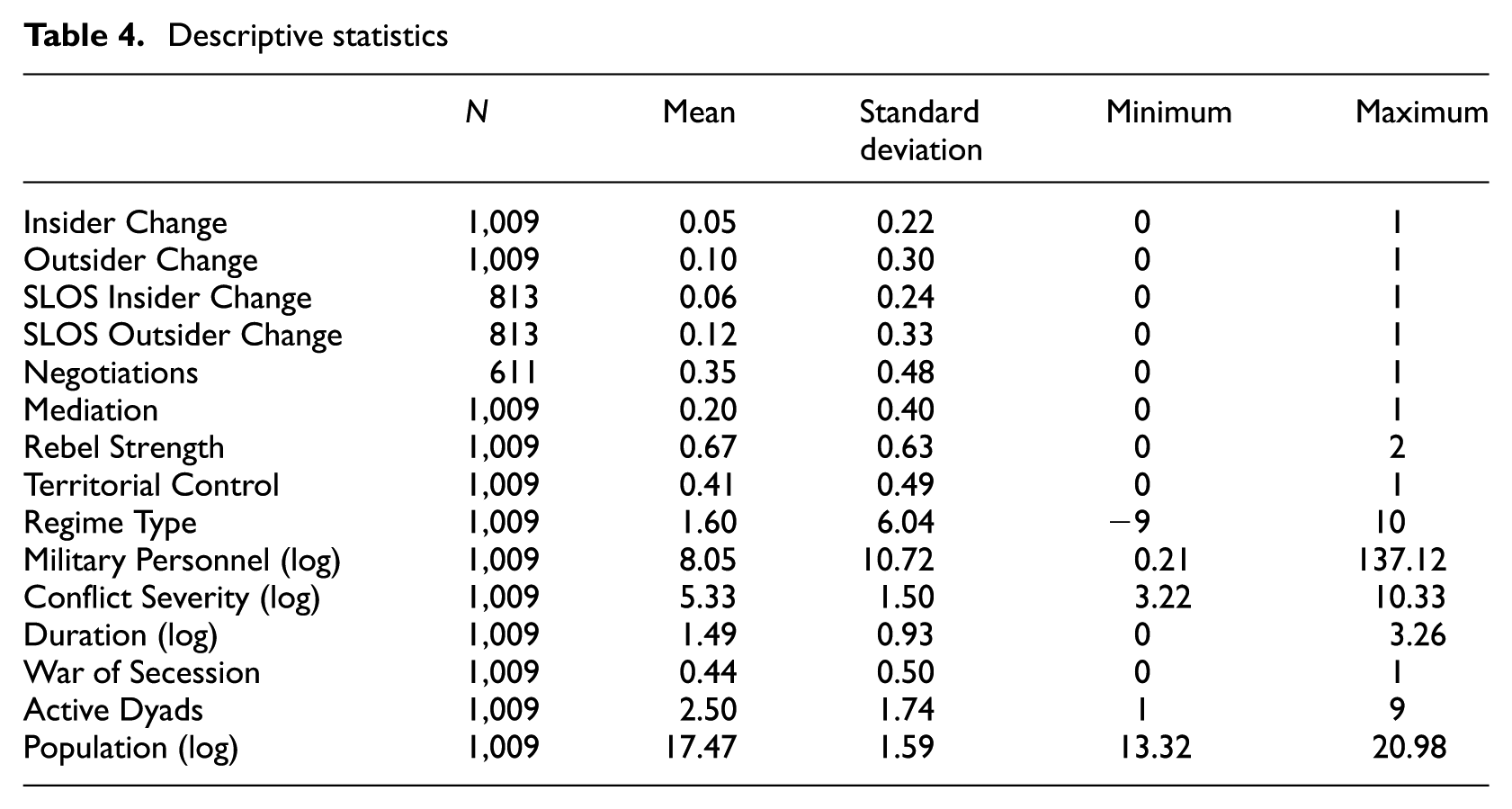
The logged severity of the conflict is included, which is taken from the UCDP Battle-Related Deaths Dataset (Melander et al., 2016). Findings from Thomas (2014) suggest that conflict severity is unrelated to the occurrence of negotiations, but positively associated with granting concessions. In the models for negotiations only, the duration of the conflict, in logged years, is also included. Duration is expected to increase the chances of negotiations; military victories typically happen quickly, and belligerents may look to end the conflict through settlement as conflicts lengthen. Indicators for whether the war is a conflict over territorial secession are also included, which may increase the chances of negotiated settlements as compared with wars over the central government (Mason and Fett, 1996), as well as the number of active dyads fighting in a given country, which can make governments want to seek an end to multiple conflicts through settlement but also complicate the bargaining space. Both measures were constructed using the Armed Conflict Data (ACD). A measure of population size (logged), taken from the World Bank Development Indicators data, is also included as a control variable. Finally, for the negotiations models only, the time since the last negotiation, as well as its squared and cubed term, are included to account for possible time dependence (Carter and Signorino, 2010). Descriptive statistics can be found in Table 4.
Descriptive statistics
Results
Results are reported in Tables 5 and 6, for models examining the occurrence of negotiations and time to settlements, respectively. For each set of models, the effects of insider and outsider changes are reported along with the effect of SOLS insider and outsider changes.
Effect of leadership change on negotiations, 1989–2009
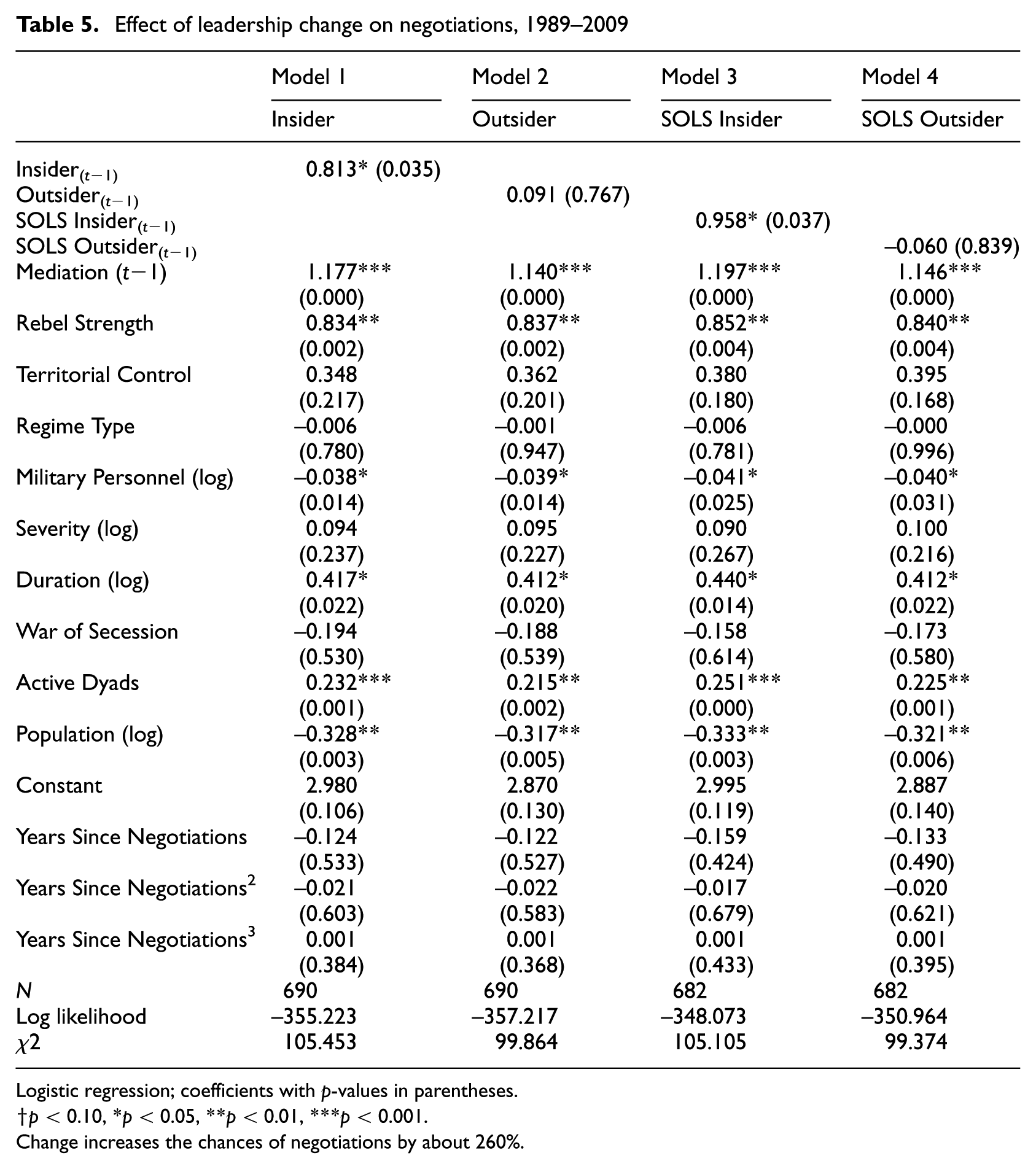
Logistic regression; coefficients with p-values in parentheses.
p < 0.10, *p < 0.05, **p < 0.01, ***p < 0.001.
Change increases the chances of negotiations by about 260%.
Effect of leadership change on negotiated settlements, 1989–2014
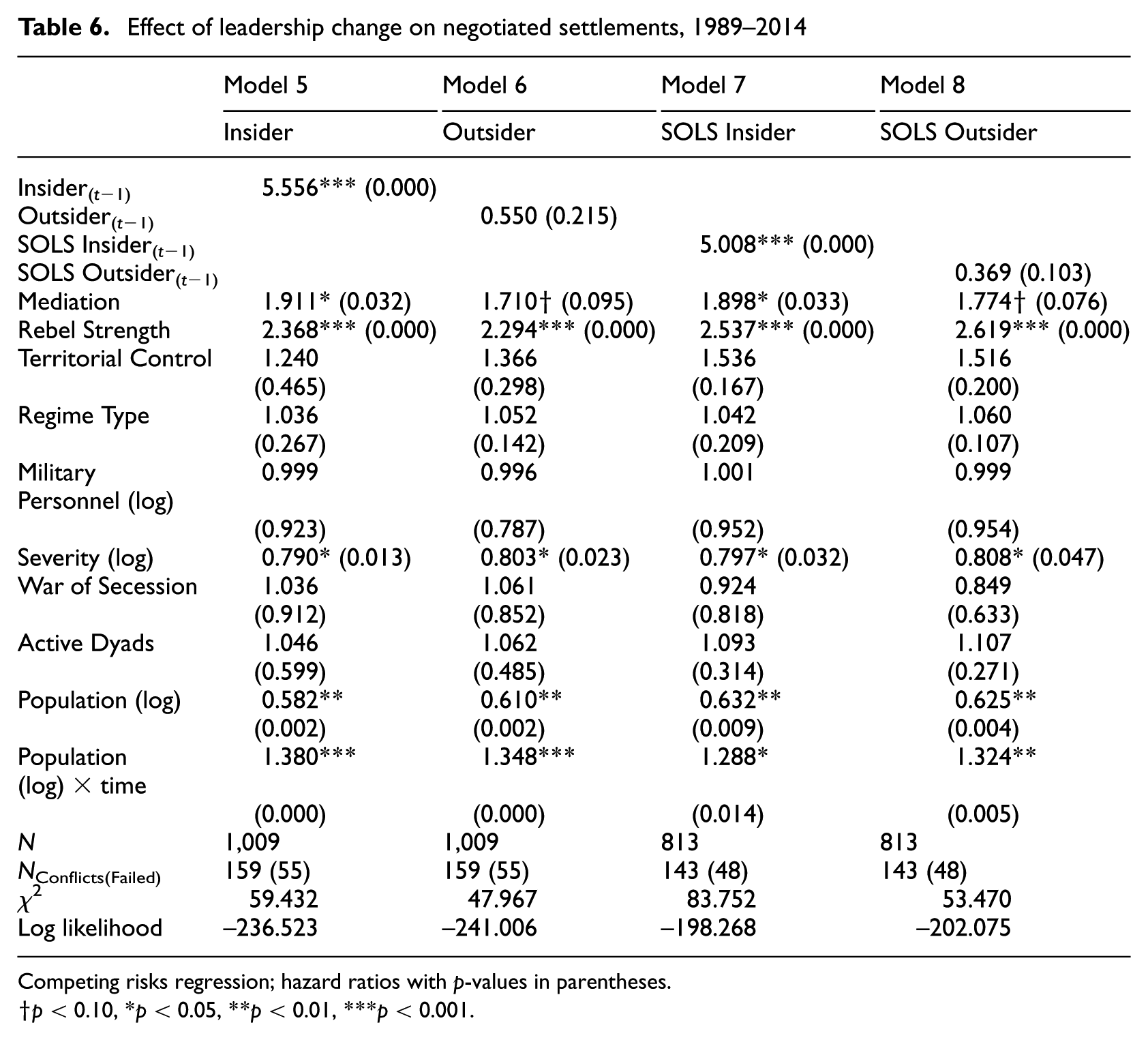
Competing risks regression; hazard ratios with p-values in parentheses.
p < 0.10, ∗p < 0.05, **p < 0.01, ***p < 0.001.
Turning to the first set of models, results are generally supportive of our expectation that insider changes will increase the likelihood of negotiations. Models 1 and 3, which test the two measures of insider change, indicate that there is a positive and statistically significant relationship. Our measure of insider leadership change in the previous year makes negotiations about 225% more likely to occur. When using the measure of insider changes from the CHISOLS data, an insider
Outsider change, by contrast, appears to have little effect on the occurrence of negotiations. Using our outsider variable, there is a small positive effect on the chances of negotiation, where an outsider change increases the probably of negotiations by about 10%. The SOLS measure indicates that outsider changes decrease the chances for negotiations by about 6%. The two measures are in opposite directions, while neither of these relationships is statistically significant. This suggests that, while insider changes can actively encourage negotiations, outsider changes do not have a consistent impact on negotiations as expected. While many outsiders come to power with the intention of ramping up the war effort, others are selected for their commitment to the peace process. Beyond policy preference, some leadership changes may encourage information collection through negotiations, while other rebel groups may be wary of negotiating with an unknown. This would produce an indeterminant overall effect of outsider change on negotiations. While outside the scope of this initial investigation of leadership change and negotiations in civil war, it would be compelling to further investigate how the rhetoric employed by outsiders prior to assuming office impacts their willingness and ability to initiate peace talks.
Moving to the second set of models on the effect of leadership changes on negotiated settlements, results support our expectations with respect to insider changes, and offer rather limited support for our expectations regarding outsider changes. Table 6 presents results for competing risks regressions of negotiated outcomes. Hazard ratios are given, where a value over 1 indicates a faster time until settlement and a value under 1 indicates a longer time until settlement. For insider changes, both our measure and the indicator from the CHISOLS data increase the likelihood of a negotiated settlement and are statistically significant at conventional levels. Our measure of insider change increases the chances of a settlements by about 555%, while the SOLS indicator suggests that negotiated settlements are about 500% more likely after an insider change. Both models lend support to our expectation that insider changes hasten termination of conflict through a settlement. Moving to outsider changes, both measures indicate that there is a decreased probability that the war will end in a negotiated settlement at this point in time. Our measure suggests that outsider changes decrease the chances of a settlement by nearly 50%, while the SOLS measure leads to a decrease in the likelihood of settlement by about 67%. However, although close, especially for the SOLS measures, neither indicator reaches conventional levels of statistical significance.
These results can also be seen in Figure 1, which displays the cumulative incidence functions for Model 5. 13 After 5 years of fighting, about 16% of conflicts end in a negotiated settlement. If there is an insider change, this increases to over 50% of conflicts that end in negotiated settlement after 5 years, while outsider change decreases the cumulative incidence of settlement to about 10%. Taken together, we see that leadership changes are important for the overall peace process, but that not all changes have the same effect on the bargaining process. Insider changes in particular can lead to both negotiations and settlements, and appear to be effective at overcoming obstacles to the peace process while mitigating uncertainty generated by new leadership. Conversely, outsider changes do not have a significant impact on the negotiation process, and may reduce the likelihood of a negotiated settlement.
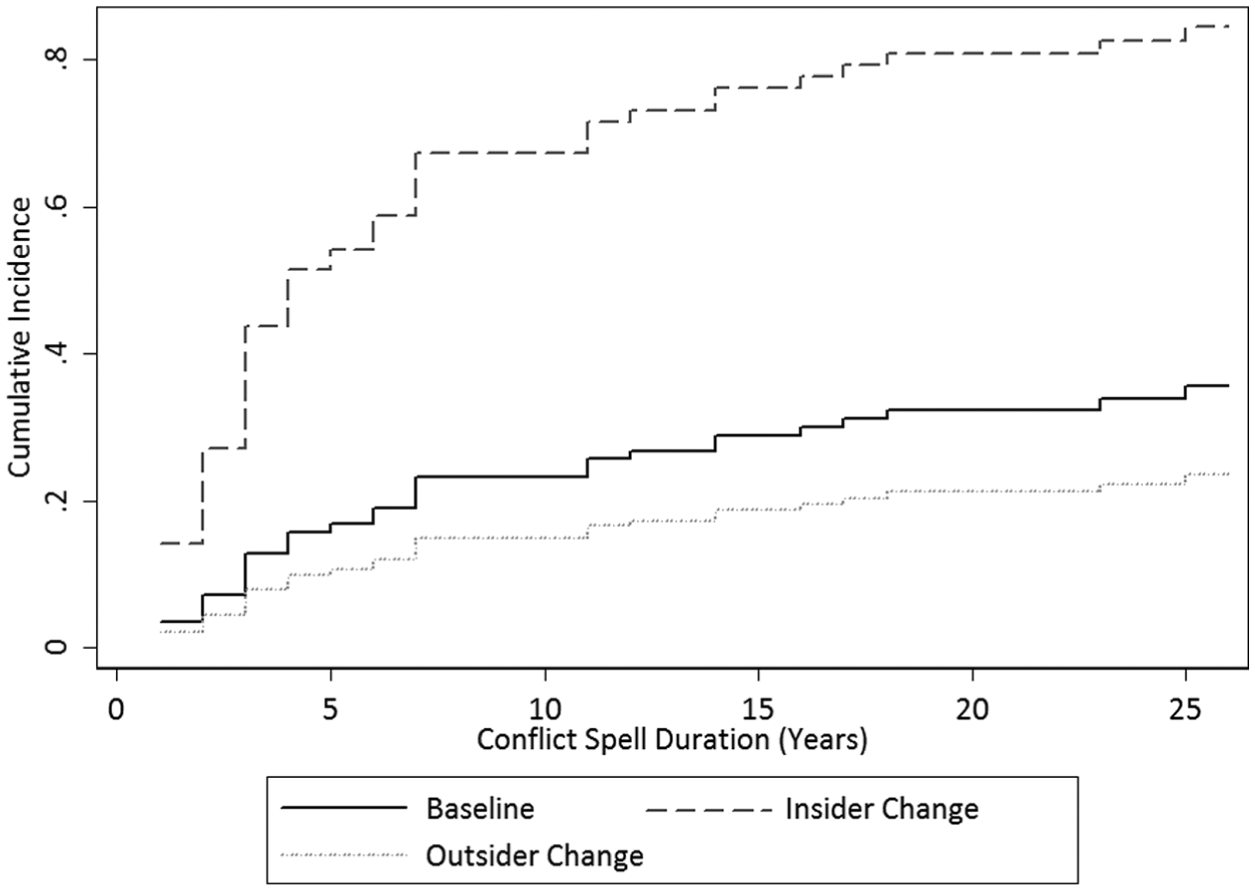
Cumulative incidence function for negotiated settlements.
The control variables largely perform as expected, with some interesting differences between the models for negotiations and settlements. Strong rebel groups are more likely to negotiate with the government and are more likely to have their conflicts end through settlement. As rebel groups have increased relative strength, the government becomes less likely to have a preponderance of power, decreasing the government’s chances of victory and increasing the utility of negotiating. While the indicator for rebel territorial control is also positively related to both stages of the peace process, this indicator is not statistically significant in any of the models. Given the relationship between rebel strength and territorial control, where strong rebels are expected to be better able to hold territory, these two indicators may be competing with one another.
Looking at government characteristics, democratic states are no more likely to negotiate with rebels; however, results suggest that more democratic states may be more likely to come to a negotiated settlement. The results are consistently positive across models, but do not reach conventional levels of statistical significance. This is suggestive of the different costs and benefits that contribute to the decision to negotiate or adopt a settlement. Democracies may be better able to credibly commit, or they may be more likely to accept greater risk or offer greater concessions in order to achieve a peaceful settlement. Weaker states, measured by the size of the military, are more likely to negotiate, which complements the finding that strong rebels are more likely to negotiate. However, military size does not appear to be related to the time it takes to achieve a settlement.
In terms of the conflict itself, as the number of battle-related deaths increases, there is no real impact on negotiations but the likelihood of settlements decreases. Wars of secession are no more or less likely to have negotiations or to terminate through settlements. The number of groups who are active in a conflict increases the likelihood of negotiations both statistically and substantively. There is a weak positive relationship between the number of groups on termination through settlements, but this result is not statistically significant. Finally, states with larger populations are less likely to experience both negotiations and termination through settlement. The effect of population on settlement, however, increases over time, and the effect of population is insignificant after about 5 years of fighting.
Robustness checks
In addition to our main results, we also conducted a series of additional tests on the relationship between governmental leadership changes and peace processes, using alternative concepts of leadership turnover. This includes the effect of regular and irregular leadership changes, as well as culpable leaders and culpable leader changes. 14 These results are presented in the Online Appendix.
Regular and irregular changes
We first consider the effect of regular and irregular executive turnover on both negotiations and settlements. An important consideration for our results is whether our measure is capturing something different than just regular and irregular leadership changes. In addition, it is important to consider whether insider changes are simply a measure of a well-functioning government (although we argue this is better captured by regular leadership change as opposed to insider changes). The results presented in Online Appendix Table A1 are consistent with those of Tiernay (2015). Neither regular nor irregular turnover in the government produces a significant effect on the likelihood of settlements, nor do these types of changes have an impact on the occurrence of negotiations.
Culpable leaders
Our second set of tests considers the role of culpable leaders. Recent research has found that culpable leaders are less likely to settle conflicts, but are more likely to fight until extreme ends in search of military victory owing to their fear of punishment (Croco, 2011; Prorok, 2016). Culpable leaders are coded as leaders who were in charge at the war’s start, as well as insiders who replaced that original leader. This is in line with the coding from both Croco (2011) and Prorok (2016), where we define a political connection as insider changes. The results in Online Appendix Table A2 suggest that culpable leaders have no effect on the occurrence of negotiations—they are no more or less likely to go to the negotiating table than non-culpable leaders. In keeping with existing literature we see that culpable leaders are less likely to settle, and that this is true especially early on in the conflict spell. Within the first 3 years of the conflict, there is a statically significant and negative effect on negotiated settlements. After this point, however, this effect is no longer statistically significant.
We also examine culpable insider changes, where power is transferred from a culpable leader to another leader with a connection to the culpable leader’s administration. Our findings in Online Appendix Table A2 suggest that these changes have no real effect on negotiations, which falls in line with our results on culpable leaders more generally. Culpable insider changes, however, increase the chances of a negotiated settlement, so even if the new leader was part of the regime responsible for the initiation of conflict she still can help expedite a settlement. This result is statistically significant. We believe that this points to the importance of considering time dynamics. Croco (2011) and Prorok (2016) largely focused on the static attributes of a leader at the end of a given conflict, in particular whether the leader was culpable or a culpable replacement leader. We argue that periods of change can open a window of opportunity even for leaders who fear punishment, increasing the chances of a settlement, even if that window closes over time. Our results on culpability also suggest that there is a negative impact on settlement only in the early years of a conflict, which diminishes after about 3 years of fighting. This is important as, in our data, the median time to a culpable insider change is 2 years and the average time is about 4.5 years. Thus, these changes are generally happening around the time where culpability is losing its potency as an explanatory factor.
Endogeneity concerns
Finally, a potentially important concern for this study is endogeneity, as leadership change may be related to the status of the war and the likelihood of conflict termination. It is possible that leadership changes occur because a war is going poorly and the government is unlikely to win. A decreased probability of victory could increase the chances of settlement, so it is important to examine whether the status of the war is leading both to leadership change and to settlements. We believe that the focus on the peace process, and the inclusion of both negotiations and termination through negotiated settlement, partly alleviates these concerns. A series of existing endogenity tests also examine the question of whether leadership changes are the result of a war going poorly. Tests from Croco (2011), Quiroz Flores (2012), Tiernay (2015), and Thyne (2015) each suggest that leadership changes can be considered as exogenous.
In addition to these existing analyses, we also conduct an analysis that tests the effect of battle-related deaths sustained by each side on the likelihood of government leader changes. 15 For the dependent variables, we use our insider and outsider variables as well as whether a regular or irregular change took place. For the independent variables of interest, we calculate the number of battle-related deaths sustained by the government as well as the number of battle-related deaths sustained by the rebels in each year. These measures are constructed using data from the UCDP Georeferenced Event Dataset, version 5 (Sundberg and Melander, 2013), and are lagged one year. The data cover the period from 1989 to 2014.
Figure 2 shows coefficient plots for the four models, which test the effect of battle deaths on different types of leadership change. The results suggest that governmental leadership changes are, in general, not affected by the number of deaths sustained by the government in the previous year or the number of deaths the government inflicted on the rebels in the previous year. This holds for both insider and outsider changes as well as regular and irregular changes. While government losses have a positive relationship with the likelihood of leadership change (with the exception of irregular changes, which are very close to a zero magnitude), as might be expected, these results are not statistically significant. Likewise, as rebel deaths increase the likelihood of leadership changes decreases, but these results also fail to reach standard levels of statistical significance. These results are in line with endogeneity tests from aforementioned studies.
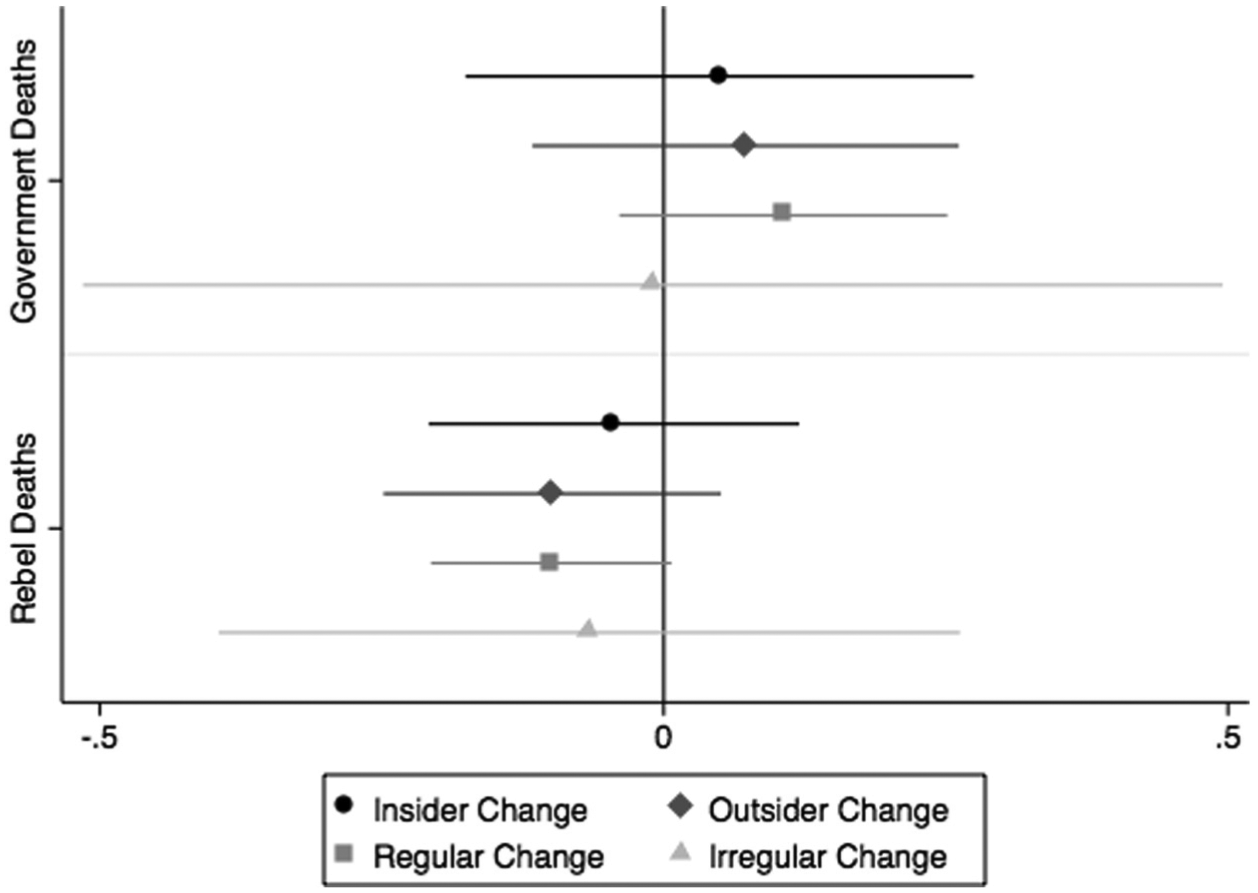
The effect of deaths sustained by the government and rebels on types of leadership change.
Conclusion
We examined the effect of governmental leadership changes on the likelihood of negotiations and achieving termination through a settlement. Existing work on interstate war suggests that leadership change can effectively “unstick” wars that develop lags in the rational updating process, whether due to issues with information processing or personal preferences against ending the war. Much of the work done on interstate conflict and matters of foreign policy more broadly also suggests that coalition shifts—outsider changes—are critical to producing changes in policy.
We argue that leadership changes can also lead to positive movement in the peace process for civil wars, especially as new leaders can overcome problems related to informational processing and can reset personal preferences. However, we argue that insider changes are most likely to produce both negotiations and termination through a settlement. We focus on the problem of a new leader’s ability to credibly commit to a negotiated settlement, which is particularly acute in civil wars. When a new leader comes from within the existing ruling coalition, the rebels already have some information about the new leader’s likely behavior and likelihood of upholding an agreement, his approach to the conflict, and his relationship with other government actors. Conversely, outsider leaders bring many unknowns to the table, and can act as shadow veto players that make it more difficult to reach a settlement. We find that, as expected, insider changes increase the likelihood of both negotiations and settlements, while outsider changes have no real impact on negotiations or settlements.
Our results speak to the importance of considering the role of governance during civil conflicts, the importance of time dynamics, and the larger peace process. An avenue of further research is to consider the role of leadership change on other forms of termination, such as military victory, as well as rebel leadership change. There is a growing body of work on the effect of “leadership decapitation” of non-state groups (e.g. Tiernay, 2015), as well as methods of change, such as processes of rebel leader selection (Cunningham and Sawyer, 2014). We also focus on the impact of change and windows of opportunity, which can impact the bargaining space and chances for resolution, and offers a new lens to view the impact of governance on conflict. Existing studies on leadership tenure and culpability tend to focus on stability and stable leader attributes; examining periods of change provides additional nuance to these stories. Our results also speak to the different stages of the peace process, which are not necessarily influenced by the same different driving forces (Findley, 2013). In this case we find that insider changes encourage both negotiations and settlements, which produces greater evidence regarding the positive impact of insider changes on a conflict space.
In terms of policy recommendations, there are of course significant costs associated with civil war, including civilian casualties, economic decline, destruction of infrastructure, decline in government services, and beyond. Finding a way to bring an end to civil conflicts alleviates these costs. One way to do so is to advocate for negotiations and settlements, and our results suggest that calling for leadership change may help this peace process unfold. Leadership change is something that can be encouraged and influenced by both domestic and international constituencies. Our results, however, suggest that the type of leadership change matters. The international community should focus on insider leadership change, as our results suggest that outsider changes have little impact on promoting negotiations or settlements. Rather, if a war becomes “stuck,” a change from within the existing government should be encouraged to jump start the negotiation process and increase the likelihood of a negotiated settlement.
Footnotes
Funding
This research received no specific grant from any funding agency in the public, commercial, or not-for-profit sectors.
Supplemental material
The Online Appendix is available on SAGE’s CMPS website.
Notes
References
Supplementary Material
Please find the following supplemental material available below.
For Open Access articles published under a Creative Commons License, all supplemental material carries the same license as the article it is associated with.
For non-Open Access articles published, all supplemental material carries a non-exclusive license, and permission requests for re-use of supplemental material or any part of supplemental material shall be sent directly to the copyright owner as specified in the copyright notice associated with the article.
