




Abstract
Does terrorism against third-party state interveners affect their willingness to continue an intervention into a civil war? Drawing on research examining the impact of terrorism on partisanship, public opinion, and political survival, as well as the targeting of states by terrorists, we link terrorist attacks originating from a civil war state with an intervening state’s resolve to continue an ongoing military intervention into a civil war in support of the government. Terrorism can either undermine a third party’s resolve, because the political costs resulting from terror attacks are perceived to be larger than the national security benefits advertised in support of an intervention or it can fortify a third party’s resolve to continue an intervention because it produces a domestic rally effect that raises the political costs of early departure. Event history analysis of 127 interventions with military personnel into civil conflicts on the side of the government during the 1975–2005 period indicates that terrorist campaigns shake the resolve of third-party states and reduce time to their departure.
Introduction
On May 24, 1982, a car bomb detonated outside the French embassy in Beirut, Lebanon. In total, the attack killed 12 people, the majority of whom were Lebanese. This attack was significant at the time, as it represented the latest in a series of attacks on international interests in Lebanon, including the killing of the former French ambassador, Louis Delamare, in September 1981. Terrorist events of this nature quickly escalated in their frequency and scope; indeed, less than a year later, on April 18, 1983, a car bomb exploded outside the US embassy, resulting in 63 deaths. This sequence of escalatory terrorist attacks culminated with the notorious bombings of the American and French military contingents of the Multinational Force in Lebanon (MNF) in 1983. Although the identities of the culprits of these attacks remain enshrouded in some mystery, the general consensus is that they were carried out by members of front-groups associated with the then nascent Hezbollah organization. No matter the provenance of the attacks against the MNF, the potential political consequences were clear to policymakers at the time. American President Ronald Reagan and French President Francois Mitterrand immediately declared their intentions to sustain their respective military forces in Lebanon. Yet, in the face of rapidly waning domestic support for the mission in Lebanon, the various nations contributing to the MNF withdrew from Beirut by February 1984 (Geraghty, 2009). 1
Although the Beirut bombings were notable for their lethality and audaciousness, they are representative of a larger phenomenon, namely, the use of terrorism as a tactic intended to undermine the resolve of third-party states engaged in military interventions into civil conflicts. However, it is not the case that terrorist attacks universally produce a withdrawal from civil conflicts—on November 13, 2015, nine terrorists affiliated with the Islamic State of Iraq and Syria (ISIS) executed the deadliest attack on French soil since the end of World War II (McVeigh and Graham-Harrison, 2015). The ISIS attackers struck a number of targets in and around Paris using a variety of tactics, including suicide bombing and hostage-taking (McVeigh and Graham-Harrison, 2015). These incidents occurred within the context of the ongoing civil war in Syria, in which France participated as a member of a large international coalition, the aim of which was to degrade ISIS with a persisting campaign of airstrikes. These terrorist attacks, carried out in retaliation for French actions, prompted French President Francois Hollande to vow a “merciless” response. A rare Congress of the French Parliament was called, with Hollande requesting emergency measures and an increase in military action against ISIS. Soon thereafter, the French Air Force was conducting its largest airstrikes against ISIS targets of the entire war to date.
The Beirut and Paris anecdotes raise an important question, the answer to which has significant policy implications: how do terror attacks against a third-party state affect the latter’s resolve to continue an ongoing intervention in favor of a civil war government? To date, the cross-national and empirical literature engage in several distinct streams of research on the role of terrorism, including: the general impact of terrorism on partisanship in domestic politics (e.g. Berrebi and Klor, 2006, 2008); the effect of war casualties and terror attacks upon public opinion, voting behavior, and the survival of governments (e.g. Aksoy et al., 2015; Koch and Nicholson, 2015; Koch and Sullivan, 2010; Park and Bali, 2015; Sullivan, 2008; Williams et al., 2013); the states that are most likely to be targeted by international terrorists (e.g. Neumayer and Plümper, 2009, 2010; Savun and Phillips, 2009); and the impact of regime type on terrorism (e.g. Aksoy et al., 2012; Findley and Young, 2011; Li and Schaub, 2004). These separate strands of research can, in turn, be grouped within the larger debate on the efficacy and rationality of terrorism, in which anecdotes like the Beirut bombing are held up as examples of terrorism’s utility (e.g. Abrahms, 2006; Fortna, 2015; Kydd and Walter, 2006; Pape, 2005; Polo and Gleditsch, 2016).
Drawing on this broad body of scholarship, we posit a set of expectations in which international terrorist attacks upon civil war interveners can have one of two potential effects. First, terrorist attacks may “shake” the resolve of such parties, triggering their early departure from the civil conflict because the perceived costs from terrorism outweigh the ambiguous and dispersed national security benefits accruing from an intervention. Alternatively, terrorism directed against the third-party state may “stir” an intervening state’s resolve, inducing domestic political rally effects that provide a political disincentive for third-party leaders to end an intervention before the civil conflict concludes.
Our inquiry has important implications for both academic and policy-oriented communities. With regard to academic scholarship, in theorizing about the connections between terrorist attacks and third-party foreign policy, we are able speak to the debate over terrorism’s effectiveness. Our findings are also of interest to policymakers in third-party states engaged in, or contemplating, interventions into civil conflicts. We find that terrorist attacks against an intervening third-party state are likely to shake the third-party state’s resolve to continue a military intervention to a civil conflict’s conclusion. Moreover, our results further suggest that a campaign of terror attacks affects third-party state resolve more than any single attack.
The remainder of this article proceeds as follows. First, we review the aforementioned literature on terrorism, third-party intervention into civil wars, and the role of domestic politics in third-party intervening states. Second, we rely on strategic perspectives of foreign policy making and terrorism to formulate expectations regarding the impact of attacks on third-party state resolve. Specifically, we conceive of resolve as anchored to whether or not attacks will lead the third-party state to terminate a military intervention before a civil conflict episode concludes. Third, we craft a research design grounded in 127 third-party state interventions with military personnel on the side of civil war governments during the period 1975–2005. We then execute our hypothesis tests using event history analysis. Finally, we conclude the article with implications of our findings regarding third-party state resolve and suggest avenues for future research.
Prior research
Central to our inquiry is resolve in third parties that intervene into civil wars in support of the government, and the impact of terrorism on this resolve. Several strands of research bear on this relationship. For example, third parties are known to intervene in civil wars during periods of strategic competition with rival states to prevent conflict from spilling across borders, to loot conflict zones of their natural resources, to defend ethnic kin, or to engage in humanitarian conflict management (Balch-Lindsay et al., 2008; Findley and Marineau, 2014; Kathman, 2010; Regan, 2000; Ross, 2004; Saideman, 2001). Moreover, third-party intervention contributes to a proliferation of engaged actors and agendas, which complicates the strategic environment, increasing the number of veto players, and thereby increasing the duration of civil wars (Balch-Lindsay and Enterline, 2000; Cunningham, 2006, 2010).
In turn, civil war duration and the tactics used by rebel actors are significantly intertwined (Enterline et al., 2013). In any civil war in which third parties are involved, particularly those in which third parties aid government-based combatants, an asymmetry emerges in which the government possesses significant relative advantages in military and policing power (Lichbach, 1995). It is to the interest of rebel actors, then, to avoid conventional combat and to instead implement classic strategies of asymmetric warfare, such as guerrilla war and terrorism (Kydd and Walter, 2006). Such tactics deny governments and third parties the ability to bring conventional force to bear, thereby prolonging the conflict beyond the government’s patience (Arreguin-Toft, 2001; Mack, 1975). Moreover, rebels have an incentive to direct attacks, including those characterized as terrorism, at the third party, as doing so raises the costs of intervention to the third party (Savun and Phillips, 2009). Indeed, because third parties in civil wars are typically engaged in “wars of choice” (Haass, 2009), in which their national existence is not imperiled, rebel terrorism may accelerate the deterioration of third-party state resolve.
This linkage between civil war tactics and third party publics is well known and posits that the latter must pay for the costs of the intervention, including those counted in casualties, expenditures, or foregone policy pursuits in domestic and foreign policy. These expenditures are deeply connected to the domestic politics of third-party states. Specifically, decision-makers in third-party states must satisfy domestic constituencies with policy choices and outcomes, and the costs attendant to intervention may make this demand impossible to satisfy. Because a third-party leader must satisfy its constituents in order to remain in power, outcomes that increase the costs of foreign policy for those constituents will likely exert themselves on the resolve of the third-party state, as well as its political leader, to continue an ongoing intervention into a civil conflict. Moreover, this linkage between third party resolve and civil war events is not dependent on regime type, or upon the leader selection mechanisms employed by the third party. Authoritarian leaders, like democrats, are selected from among a subset of the population and must maintain the active support of their consistency (Bueno de Mesquita et al., 2003; Chiozza and Goemans, 2003, 2004, 2011; Goemans, 2000; Sirin and Koch, 2015; Weeks, 2008).
Despite the clarity of this logic, the research on terrorism’s effect on the resolve of third parties is ambiguous. Adherents of the rationalist model of terrorism argue that, as a tactic, terrorism is employed because it works (Kydd and Walter, 2006). The Plümper and Neumayer studies are emblematic of this perspective (Neumayer and Plümper, 2009, 2011; Plümper and Neumayer, 2010, 2014). Therein, terrorism is understood as an asymmetric strategy of warfare in which structurally disadvantaged rebels employ terrorism as a means with which to grapple with their governmental opponents. As such, there is a significant incentive for rebels to use terrorism against not only the government but also the international allies of the government. Third-party states responsible for foreign aid flows or military intervention in civil wars, or which are otherwise committed to the governing faction via a formal alliance are therefore likely to be targets of international terrorism. The US and American citizens are especially noted as targets of terrorists for these reasons (Neumayer and Plümper, 2009, 2011; Plümper and Neumayer, 2010, 2014; Savun and Phillips, 2009).
Yet research on the matter of attacks targeting the public finds that terrorism tends to agitate and disrupt politics in predictable ways. For example, experimental evidence suggests that Israeli voters responded to terrorist attacks by becoming politically polarized, thereby lending greater support to parties on the right after periods with high levels of terrorism (Berrebi and Klor, 2006, 2008). More generally, cross-national studies find that those political parties in office during an attack may suffer from an accountability problem, with voters and constituents casting blame upon incumbent politicians, opening a window of opportunity for the opposition party to undermine a government, although right-leaning parties are better able to resist such efforts (Carlin et al., 2014; Gassebner et al., 2011; Merolla et al., 2007; Williams et al., 2013). Although this “blame-casting” in domestic politics has significant implications for the tenure of governments, other research suggests that terrorism engenders a “rally effect” that unites political factions behind the government and in doing so reduces the likelihood of it being turned out of office (Hetherington and Nelson, 2003; Park and Bali, 2015). Further, these effects are not confined solely to democracies. Autocratic governments likewise face reputational concerns when confronted by terrorism, and are shown to be less durable having experienced terrorist attacks (Aksoy et al., 2015; Park and Bali, 2015).
These arguments—terrorism as deleterious or fortifying to government survival—are but one aspect of the debate over terrorism’s effectiveness. This debate has animated both scholars and pundits in recent years, with advocates of a rationalist view of terrorism arguing that terrorism is a remarkably successful tactic, frequently demonstrating credible commitment to a cause, coercing governments, or even extracting outright concessions from its opponents (Kydd and Walter, 2006; Pape, 2003, 2005). Conversely, other commentators consider terrorism less as a means for demonstrating credible commitment than as a highly inefficient method of expressing political grievance or engendering esprit d’corps within extremist organizations. Indeed, terrorism’s inefficiency is manifested such that it can actually harden the resolve of their governmental opposition by convincing it that terrorists seek maximalist goals and that a negotiated settlement is impossible (Abrahms, 2006).
Missing from this discussion, and generally unexplored by the literature as a whole, are the ways that terrorism conditions third-party behavior through the latter’s domestic politics. Specifically, if third-party state action internationally must be supported by the resolve of domestic constituents, then it follows that rebels engaged in a civil war might employ terrorism against third-party constituents in an effort to influence the third-party leader’s resolve to continue an ongoing intervention into a civil war in support of a government. In the next section, we therefore build expectations regarding third-party state intervention into civil wars and the influence of terrorism on third-party resolve.
Theory
To develop our expectations linking terrorism originating from civil wars with the resolve of third-party states engaged in interventions in support of state governments in these conflicts, we set out several assumptions drawn from extant political science research: (1) the third party political leader depends upon the continued support of domestic constituents to remain in office; (2) said leader advertises to his or her constituents the necessity of intervening on behalf of a government faction fighting in an ongoing civil conflict for the maintenance and improvement of the third party’s national security; (3) third-party interventions into civil wars are costly in terms of blood, treasure, and foregone policy opportunities; and (4) the security benefits derived from intervention are diffuse and ambiguous to domestic constituents relative to the perceived direct costs of terrorist attacks against the third-party state. We elaborate upon each of these assumptions in turn.
The political economy theory of foreign policy establishes that a political leader makes foreign policy decisions based on its need to satisfy the preferences of domestic constituents that are essential to the leader remaining in office (Bueno de Mesquita et al., 2003; Chiozza and Goemans, 2003, 2004, 2011; Goemans, 2000; Sirin and Koch, 2015; Weeks, 2008). In terms of intervention into ongoing civil wars, the third-party state leader must advertise intervention to supporters as a strategy beneficial to constituents. Such benefits might include victory by the supported side (Reiter and Stam III, 1998), punishment for a rival state that is also involved in the civil conflict (Balch-Lindsay and Enterline, 2000), or even war profiteering and the plundering of resources in the civil war state (Ross, 2004).
It is crucial to note that the third-party constituents to whom the leader is advertising said benefits need not be voters in a democracy. Rather, these constituents might be, for example, co-ethnics in a dictatorship whose support is crucial to the leader’s tenure. Even if the third-party leader does not attempt to obtain the public consent of voters, as might be expected in a democracy, the autocratic leader is compelled to maintain the continued support of winning coalition members. For example, the leader may mollify such supporters by distributing the private benefits from an intervention (e.g. lootable resources). So long as the distribution of these benefits continues in some form or another, the third party’s resolve to continue an intervention into a civil conflict is unlikely to falter.
Regardless of the specific nature of the advertised benefits, the principal–agent problem applies. Specifically, the third-party political leader and foreign policy elites are likely to possess more complete information on foreign affairs relative to what is available to their constituents, the latter of which may have very little knowledge about geographically distant civil conflicts, the role and and impact of an intervention, and so forth (Downs and Rocke, 1994). Yet domestic constituents are unlikely to support action abroad that requires the expenditure of blood and treasure without the linkage to some benefits, either public or private (Berinsky, 2007, 2009; Wells, 2016). Therefore, it is necessary for a third-party leader to frame, or advertise, a proposed intervention into a civil conflict in a manner that establishes the benefits of such an undertaking for the third-party state, and by extension, the provision of valued goods to constituents (Western, 2005).
However, interventions into civil wars, like interstate wars, are costly foreign policy endeavors (Fearon, 1995). The need to finance an intervention through taxation and debt is a notable example of such costs that are incurred from this policy choice. In addition to these fiscal charges, casualties experienced by military personnel carrying out an intervention are a highly visible medium through which non-monetary costs are assumed by the third-party state, and as such exert the most salient effect on constituent support for war (Gartner, 2008). Democracies are particularly susceptible to this linkage between casualties and constituent support (Wells, 2016). Last, interventions into civil conflicts result in opportunity costs that manifest as foregone policy opportunities. In one notable example, continued funding and expansion of US President Lyndon Johnson’s Great Society programs was effectively derailed by escalation of American military commitment in Southeast Asia. There is thus a need for a political leader to continually convince its constituents of the value and necessity of the state’s foreign policy choices.
Last, national security is a multifaceted good. In the case of interstate war, the national security imperative may be clear to constituents. In the case of intervention into civil wars, however, the necessity for state action may be ambiguous or absent altogether from the perspective of constituents. As such, while third-party constituents might be motivated to support a leader who convincingly advertises the need for an intervention into a civil conflict, their commitment to such policy is likely to be weak. Conversely, terrorism that originates from a civil conflict state affects constituents directly, imposing not only casualties but also material costs associated with upgrading national security in response to terrorism. Therefore, terrorism against the third-party state—its citizens and assets—could justify a political leader’s promise of improved national security as the rationale for intervention, or at least demonstrate that the “good” to be secured through intervention (e.g. a preferred civil war government) is costly.
With this reasoning established, we posit expectations regarding the impact of terrorism against third-party states who have intervened on behalf of a warring state government. After a third-party state intervention is underway, and based on a leader’s advertisement that it reflects a strategy designed and selected to benefit domestic constituents, two scenarios of interest emerge once terrorist attacks occur against the third-party state. First, the resolve of the third-party state may be “shaken,” or falter, in the face of increasing or continued costs that are directly experienced by constituents. Second, and conversely, the third-party state’s resolve might be “stirred” in the face of terrorist attacks during an intervention, because terrorism engenders a rally effect that magnifies the benefit of continuing an intervention and imposes political costs on the third-party leader for departing before the end of the civil conflict.
Rebels engaged in a civil war, however, can never be certain if their third-party opponents are of the type likely to be shaken or stirred. Indeed, this kind of uncertainty lies at the heart of the war-fighting puzzle in international relations. Indeed, Fearon (1995) famously proposed that states fight wars with one another because they are unable to credibly commit to a non-fighting alternative. States are uncertain as to the resolve that each has to fighting over a disputed issue, the length of time each is willing to fight, and so forth. In terms of third-party state interventions into civil wars, rebels are uncertain as to the resolve of the third party’s stake in its civil war government ally. It is in the interest of rebel groups, therefore, to test the resolve of third-party states to continue supporting the government and by doing so reveal the third-party state’s resolve type.
To test the third-party state’s resolve during an intervention, civil war combatants may choose two strategies. The first strategy requires increasing the direct costs exacted by either of the primary civil war combatants, such that the costs required of the third party to shape the course and outcome of the conflict via its government ally exceed the third party’s willingness to do so (Kydd and Walter, 2006). The second strategy involves increasing the indirect costs to the constituents of the third-party leader engaged in the intervention. One method of doing so is for terrorists to “bring the war home” to the third-party leader’s constituents via propaganda, threats, and attacks against third-party assets in the civil war state (e.g. embassies) or within the third-party state itself (Kydd and Walter, 2006).
An act of terrorism is an ideal choice for rebels interested in testing for a third-party state’s resolve type, given the method’s potentially immense symbolic and psychological impact on a target audience. Indeed, one of the benefits of terrorism is its ability to affect a target audience’s perception of a rebel group’s strength. For a domestic audience observing policy outcomes from a distance, the ability of an asymmetrically weak actor to impose indirect costs on a stronger opponent can influence their perception of the continued value of intervention into a civil conflict. Additionally, terrorism is less costly relative to more traditional forms of military combat, enabling asymmetrically weak opponents to elicit possibly large responses from comparatively small investments.
As such, a terrorist’s goal of generating indirect costs in an intervening state is, in part, an effort to reveal the third party’s resolve such that an irresolute third party is shaken and terminates an intervention. The aforementioned case of American and French intervention in Lebanon in the early 1980s exemplifies this relationship between indirect costs, third-party state resolve, and the accelerated departure of a third party from a civil conflict. The logic of shaken resolve is reflected in the following hypothesis:
Implicit in the reasoning reflected by Hypothesis 1 is the idea that third-party state political leaders seek to minimize costly actions in foreign policy that imperil their political survival. However, terrorism against a third-party state can forestall a third-party leader’s inclination to reduce the political costs resulting from terrorism; moreover, political leaders might even capitalize on the political benefits of mobilizing against terrorism. For instance, terrorist attacks are known to directly impact election outcomes by generating greater support for hard-line, or hawkish, military strategies in foreign policy (Abrahms, 2012; Berrebi and Klor, 2006, 2008; Koch and Sullivan, 2010; Sullivan, 2008). More generally, terrorist attacks may also result in a rally effect in third-party states (Hetherington and Nelson, 2003), and in so doing reinforce a third-party leader’s political security and its commitment to continue an ongoing intervention. Terrorism, then, stirs a third-party political leader’s resolve to continue a military intervention into a civil conflict.
There are a variety of ways the logic of stirred resolve might operate. In the first, casualties in war and terrorist attacks at home agitate domestic politics, and in doing so increase constituent activity, particularly in democracies (Koch and Nicholson, 2015). This increased political activism may rebound to the benefit of the incumbent party should the public view the consequences of a possible failed intervention to be especially acute; in other words, the public might demand that the incumbent “stay the course” in an intervention if withdrawal would negatively affect the state’s reputation (Koch, 2011; Sullivan, 2008).
Moreover, terrorism could magnify the benefits of intervention and the costs of an early departure. This “investment” model of third-party intervention suggests that if the third party public views the costs of intervention, either in terms of casualties or civilian deaths from terrorism, as an investment in foreign policy, then leaders will suffer consequences to their tenure in office if they withdraw from the conflict too early (Koch and Sullivan, 2010; Sullivan, 2008). Political leaders, this logic suggests, are faced with an incentive to stiffen their resolve and try to achieve victory in order to avoid being turned out of office. In contemporary events, this logic has played out in the aftermath of the Paris terror attacks in 2015 and the French government’s response in terms of its intervention into Syria. This expectation linking terror attacks with a third party’s resolve to continue an intervention is as follows:
Research design
Sample
We construct a data sample containing all third-party government-biased inventions with military personnel, or “troops,” into civil wars for the period 1975–2005. We operationalize third-party state resolve as the willingness of the third-party state to continue an ongoing military intervention in support of a government until the end of the civil conflict episode. Conversely, an irresolute third-party state is one that terminates an ongoing military intervention prior to the end of the civil conflict. To construct a sample allowing this operationalization of resolve, we first identify third-party state interventions into intrastate armed conflicts, which are obtained with the UCDP External Support Project Primary Warring Party Dataset (version 1–2011; Högbladh et al., 2011), and which covers the period 1975–2009. 2
We focus solely on interventions that involve a third-party state dispatching troops in support of the government engaged in a civil conflict. 3
We make this decision because the dispatching of troops reflects a third-party state leader’s public commitment to an intervention, thereby activating the cost–benefit relationship between the third-party leader and its constituents that we consider to be central to the causal relationship between third-party resolve and terrorism. 4
Next, we combine the sample of third-party troop interventions derived from the ESPPWPD with the set of intrastate armed conflicts contained within the Uppsala Conflict Data Program’s Conflict Termination Data (CTD) (Kreutz, 2010), which includes the period 1975–2009 covered by the ESPPWPD. Our unit of analysis is the intervention-year.
Dependent variable
The CTD facilitates the inclusion of the start and end years of intrastate conflicts episodes, thereby enabling us to construct our dependent variable, which we derive by coding the duration of each third-party intervention to one of three outcomes: (1) the third-party state intervener departs from the conflict episode prior to the episode’s year of termination as identified in the CTD; (2) the third-party state intervener continues an intervention with troops until the conflict episode’s terminal year as identified in the CTD; or (3) the third-party state intervention is right-censored such that the intervention is ongoing in the final year of observation in our sample, 2005, which is dictated by our data source for terrorist events (discussed below). For purposes of reference, we refer to our dependent variable, i.e. the conclusion of a third-party intervention prior to the end year of a conflict episode, by the variable label Early Departure.
Combined, the ESPPWPD and CTD data yield a sample of 127 third-party state interventions with troops for the period 1975–2005, for a total of 378 intervention-years. In this sample, 47 cases (37%) reflect a third party ending an intervention with troops prior to the end year of the conflict episode. Of the remaining cases, 74 (58%) reflect interventions that continue until a conflict episode concludes, with the remaining interventions, 7 (5%), being right-censored. Figure 1 reports the Kaplan–Meier survival curve for civil war interventions with troops during the period 1975–2005. Descriptive statistics and frequency distributions for our dependent variable are reported in the Online Appendix.
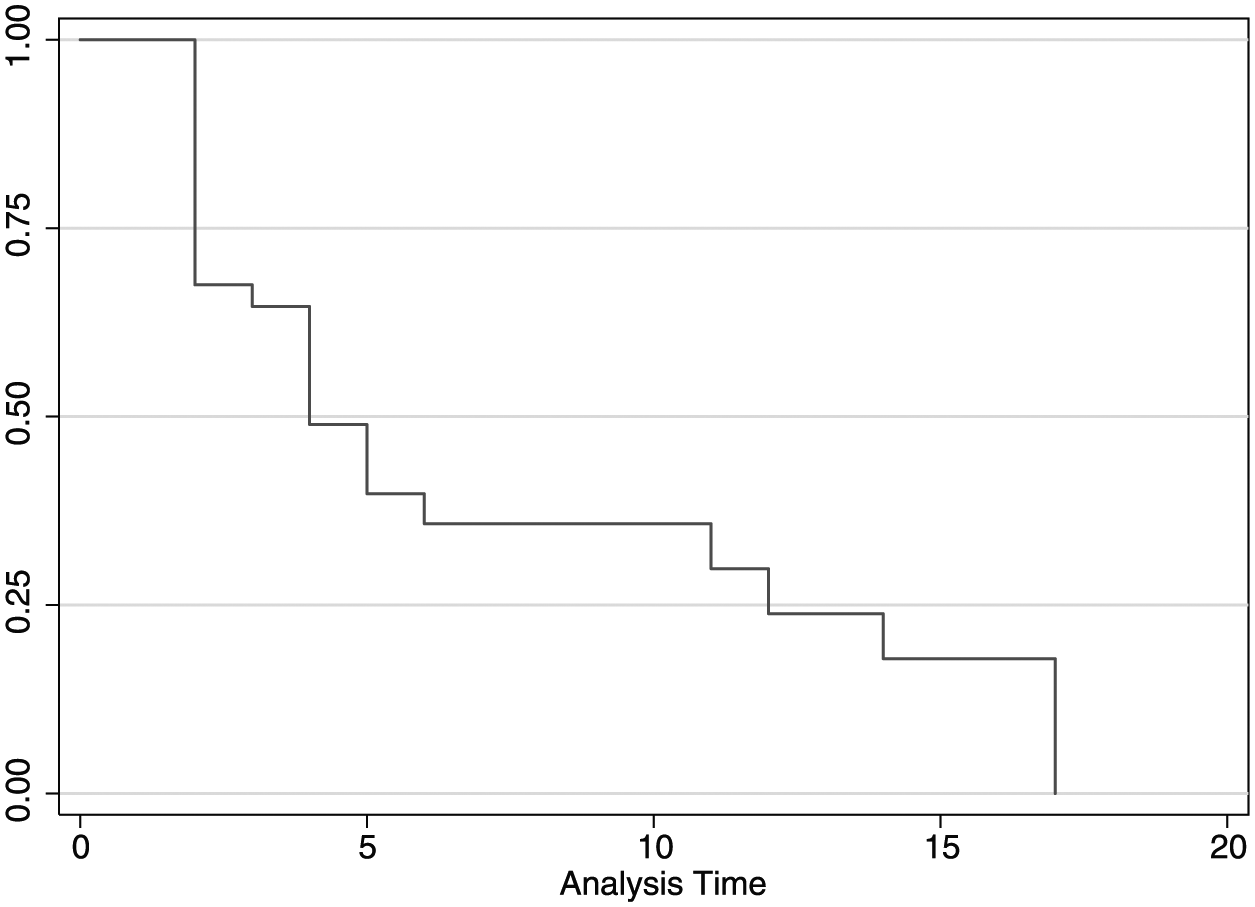
Kaplan–Meier survival estimate for Early Departure.
Independent variables
Terrorism
Our primary independent variable of interest is international terrorism originating from a civil conflict and directed toward a third-party state supporting a warring state government. As noted above, our data on terrorism originate from ITERATE, which offers a number of advantages for our hypothesis tests. The data contained in ITERATE are explicitly focused upon acts of international terror, and exclude attacks committed during international and civil wars unless they are specifically targeted against civilians or dependents of military personnel. We can therefore be certain that the terrorist attacks under analysis are not conflated with civil war or domestic terrorism. 5 The ITERATE data are formatted into directed-dyad-year units of analysis in the Neumayer and Plümper (2009) study, which allows us to determine both the source and target states for a given terrorist attack, and we employ their replication data in our analysis. 6 We further conceptualize terrorism as a stock, such that the impact of terrorist attacks on third-party resolve accumulates with each new attack against a third-party state during an intervention. 7 We refer to the cumulative stock of terrorist attacks during a conflict episode, and originating in the civil conflict state and directed toward the third-party state, by the variable label Attacks.
Controls
We specify the following control variables:
Prior Early Departures. Third-party state resolve is, in part, a function of the motives underlying an intervention. Many such motives are, for a variety of reasons, unobserved. For example, a third-party state may intervene in an intrastate conflict for manifold reasons beyond influencing the outcome of the conflict, including retributive attacks against opponents, seizing assets, capturing territory, and so forth. Because it is difficult to discern third-party state motives empirically, we employ a measure of reputation to access motives indirectly. We reason that third-party state interveners with reputations for ending interventions prior to the conclusion of the conflict episode may have ulterior motives for intervening and will be more likely to terminate an intervention prior to the end of a conflict episode. 8 We rely on our sample of third-party interventions with troops during the 1975–2005 period and our operationalization of Early Departure to code the cumulative frequency of early departures across this sample for a given third-party state in each intervention-year.
Cumulative Victories. We reason that third-party state resolve during interventions is a function, in part, of the state’s prior intervention experience. Specifically, third-party states that intervened in prior conflict episodes that concluded with the third party’s supported side prevailing will fortify the third-party state’s resolve in an ongoing intervention. We rely on our sample of third-party interventions with troops during the 1975–2005 period, in conjunction with the conflict episode outcomes coded in the CTD, to determine the cumulative frequency of prior victories associated with a third-party state in each intervention-year. 9
Ongoing Interventions. Interventions by third-party states into civil conflicts with troops are costly endeavors. As such, we reason that as the frequency of simultaneous military interventions by a given third-party state in separate conflict episodes in year t increases, so too does the incentive to depart from an ongoing intervention prior to the end of the conflict episode. We rely on our sample of third-party interventions with troops during the 1975–2005 period to identify the frequency of simultaneous interventions by a third-party state in separate conflict episodes in each intervention-year.
Lootable Resources. Prior research suggests that the availability of accessible, or “lootable,” natural resources, such as diamonds or oil, in a conflict state may influence the decision by third-party states to intervene and depart civil conflict episodes. We rely on the DIAMONDATA (Gilmore et al., 2005) and the PETRODATA (Lujala et al., 2007) to identify whether diamonds or petroleum are located in the state hosting a civil conflict episode. We then code a variable that has a value of “1” if one or both of these resources are present, and a zero otherwise.
Alliance with Intervener. Third-party state interveners that are joined in intervention by interstate allies are more likely to exhibit a sense of shared purpose in the intervention, distributing costs, limiting the collective action problem, and fortifying resolve to continue an intervention. We rely on our sample of third-party interventions with troops during the 1975–2005 period, in conjunction with the COW data on military alliances, to identify the number of alliance members joining a given third-party state in an intervention in each intervention-year.
Coalition Contraction. Analogous to the effect of alliances, third-party interventions are a function of the behavior of other third parties also intervening in a given conflict episode. Thus, as the group of states intervening on a given side in a civil conflict contracts, the costs of continuing an intervention by a given third-party state increases, thereby creating an incentive that it too will depart from the conflict early. We rely on our sample of third-party interventions, during the period 1975–2005, to identify when the group of third-party states intervening on a given side of a conflict reduces in membership. This variable is coded “1” when a such a contraction occurs, and zero otherwise. 10
The descriptive statistics for the independent variables are reported in Table 1.
Descriptive statistics

Methodology
We are interested in modeling the likelihood that a third party will terminate an intervention prior to the end year of a conflict episode (Early Departure = 1), or continue an intervention until the end year of that conflict episode (Early Departure = 0). 11 Therefore, we model third-party state resolve as an event history process; specifically, we estimate a Cox proportional hazards model, which affords a flexible approach to the shape of the hazard function. 12 Our hypothesis testing is undertaken according to the following plan. Our main Cox estimates on the full sample of civil conflicts in which third-party state military interventions are ongoing are reported in Table 2, Model 1. One concern with this sample involves the unique role played by terrorism and international interventions in the post-9/11 international system. Specifically, following 9/11, exceptionally large multinational coalitions were mobilized in order to undertake military interventions in Iraq and Afghanistan, wars that reflect 31% of our sample of third-party state interventions. It is therefore possible that these two conflicts are outliers that unduly influence our estimations and in doing so undermine any generalizable conclusions. 13 To guard against this possibility, we re-estimate our Cox regressions without the Iraq and Afghanistan conflict episodes, and present the restricted samples in Table 2, Model 2. 14
Cox models of early departure in third party government-biased interventions into conflict episodes, 1975–2005
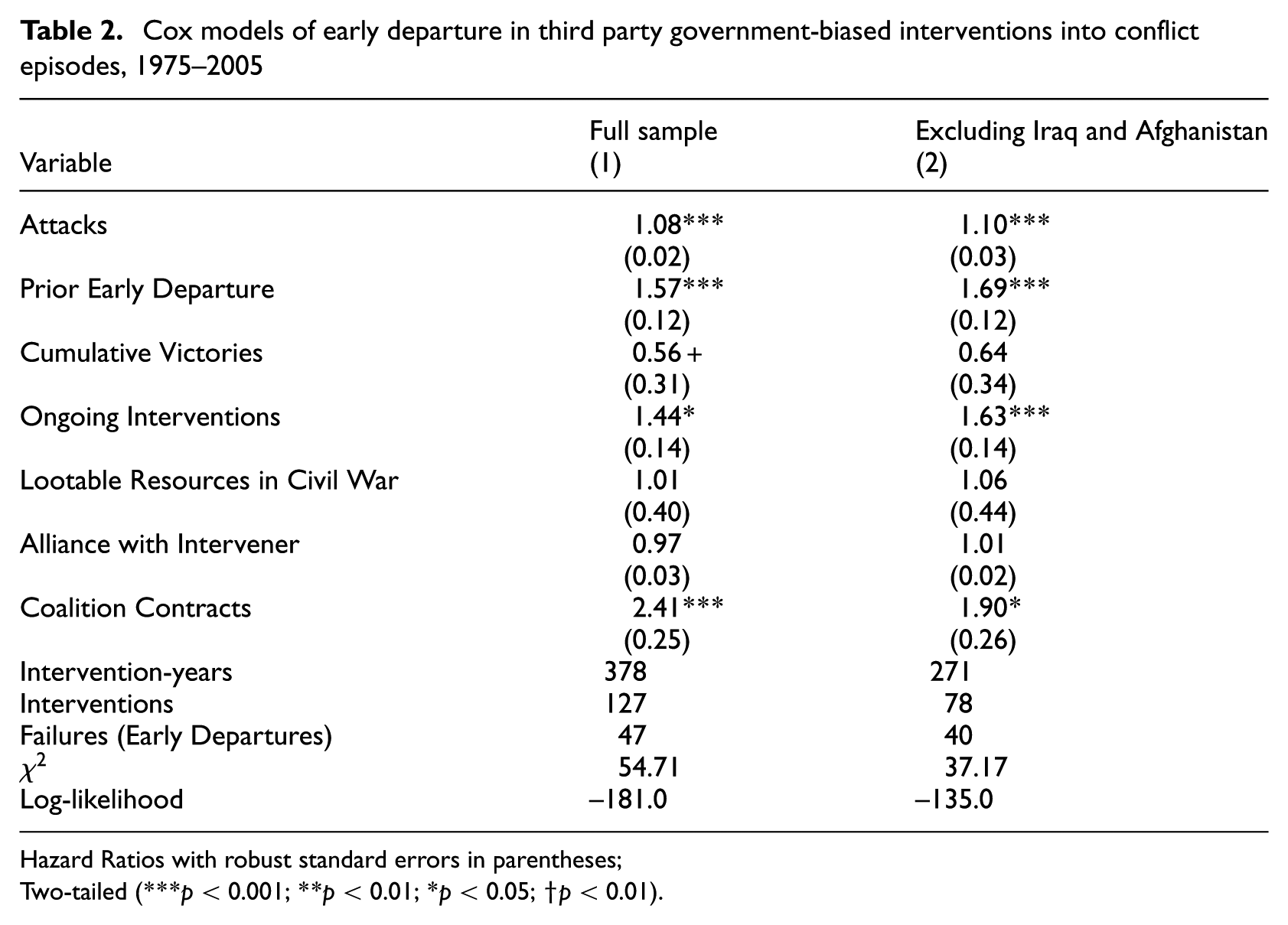
Hazard Ratios with robust standard errors in parentheses;
Two-tailed (***p < 0.001; **p < 0.01; *p < 0.05; †p < 0.01).
Analysis
Table 2 reports the results of the Cox estimations, displaying hazard ratios with clustered, robust standard errors in parentheses and two-tailed significance levels. The hazard ratios for the variable assessing the cumulative stock of terrorist attacks against third-party state, Attacks, is statistically significant. Moreover, the hazard ratios exceeding values of 1 for the variable Attacks indicate that as terrorist attacks cumulate against a third-party state engaged in an intervention in support of a government, there is an increasing hazard that a third-party state will terminate its intervention before the end of a civil conflict episode (Model 1). These findings hold even if we exclude the cases of Iraq and Afghanistan (Model 2). Overall, the results suggest that terrorist attacks directed against a third-party state engaged in a military intervention into a civil conflict shake a third-party state’s resolve, a finding that is commensurate with Hypothesis 1. Thus, despite the well-known rally effects engendered by terrorism, third-party state resolve during interventions is corroded by terrorist campaigns.
In the subsequent discussion of our results, we refer primarily to Model 2, which we take as ground truth with respect to the impact of terrorist attacks on the resolve of third-party state interveners. Our general findings in Model 2 are not without caveats. For example, the hazard ratio corresponding to the variable Attacks, 1.10, is relatively small in magnitude; indeed, it suggests that a one unit increase in the cumulative frequency of terrorism events directed at a third-party state during an intervention translates into a 10% increase in the likelihood that third-party state will end its intervention in a given intervention-year. That said, it is useful to recall that we are modeling cumulative stocks of terrorism. Therefore, the performance of the variable Attacks indicates that a third-party state’s resolve is not shaken by the result of any single attack (e.g. the November 2015 attacks in Paris), but rather as the result of a continuing series of attacks (e.g. the sequence of attacks in 1980s Lebanon), or what we might refer to as a campaign.
Figure 2 substantiates this point, in which we report survival curves for Attacks from Model 2. Here, we allow the value of Attacks to assume values of 0, 1, and 10, while all other variables are held to their modes (the frequency distribution of attacks is reported in the Online Appendix). The marginal impact of a single terrorist attack is evident—a single attack on a third party originating from a civil war is unlikely to shake a third-party state’s resolve; however, a succession of attacks is another matter entirely. Indeed, by the fifth year of a third-party intervention, the impact of a single terrorist attack on a the third-party state’s resolve is nearly indistinguishable from an intervention in which terrorist attacks are absent. But, if we consider this time point under conditions in which a terrorist campaign yielded 10 attacks, only 30% of the third parties continue their interventions. Given this evidence, then, terrorist campaigns result in a deterioration in third-party resolve reflected in early departures from civil conflicts.
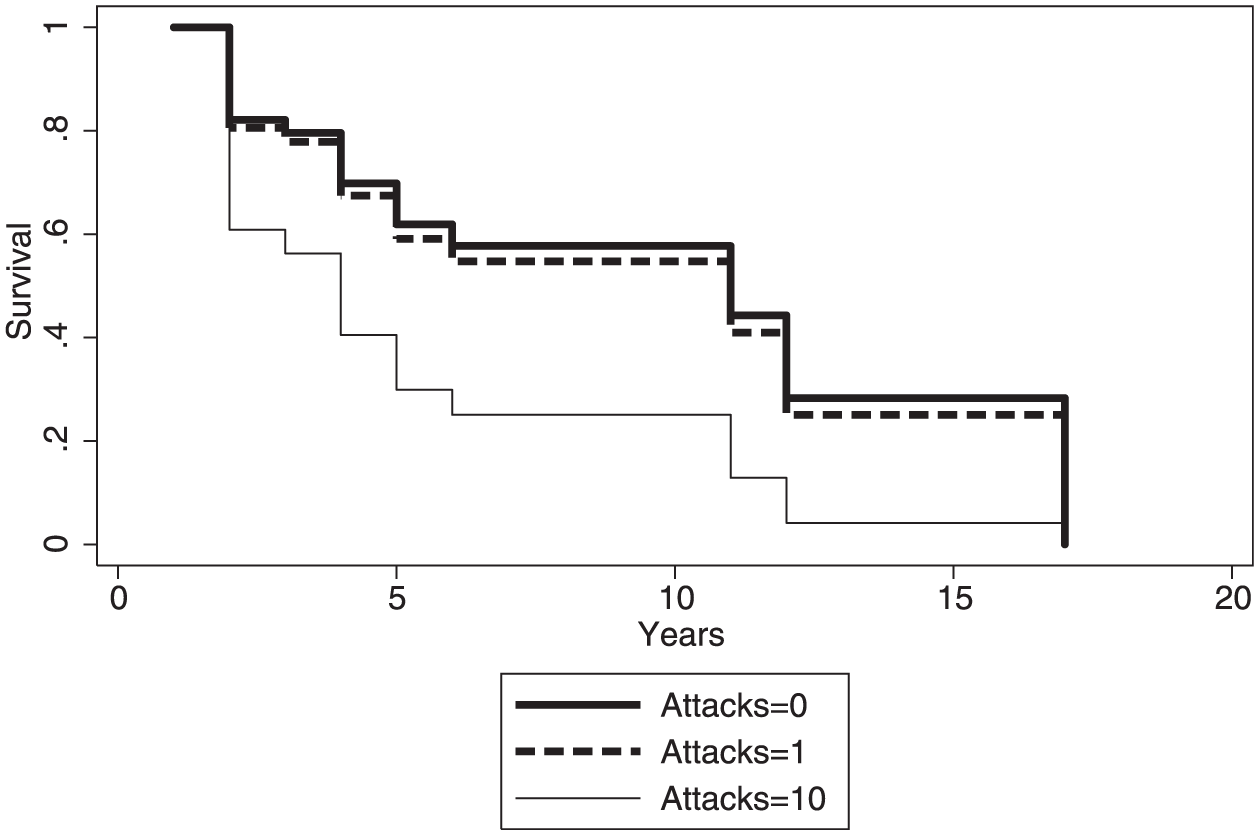
Survival curves for values of Attacks (Table 2, Model 2).
In addition the performance of our main variable of interest, our analysis of Early Departure demonstrates that other causal forces shape the resolve of third parties during interventions. Survival curves corresponding to the statistically significant variables reported in Table 2, Model 2, are reported in Figure 3a–c, and we discuss the substantive implications of each in turn. In Figure 3a, the variable Prior Early Departure reflects the likelihood that third-party states will remain committed to an intervention given a reputation for irresolute interventions. The hazard ratio in Model 2 (1.69) corresponds to a 69% increase in the likelihood of early departure by the third-party state for each one unit increase in the frequency of this variable. Stated differently, by the fifth year of an intervention only 20% of the third-party states with records of two prior early departures from civil conflicts continue in an intervention relative, while 70% of third-party states without prior early departures from civil conflicts continue an intervention.
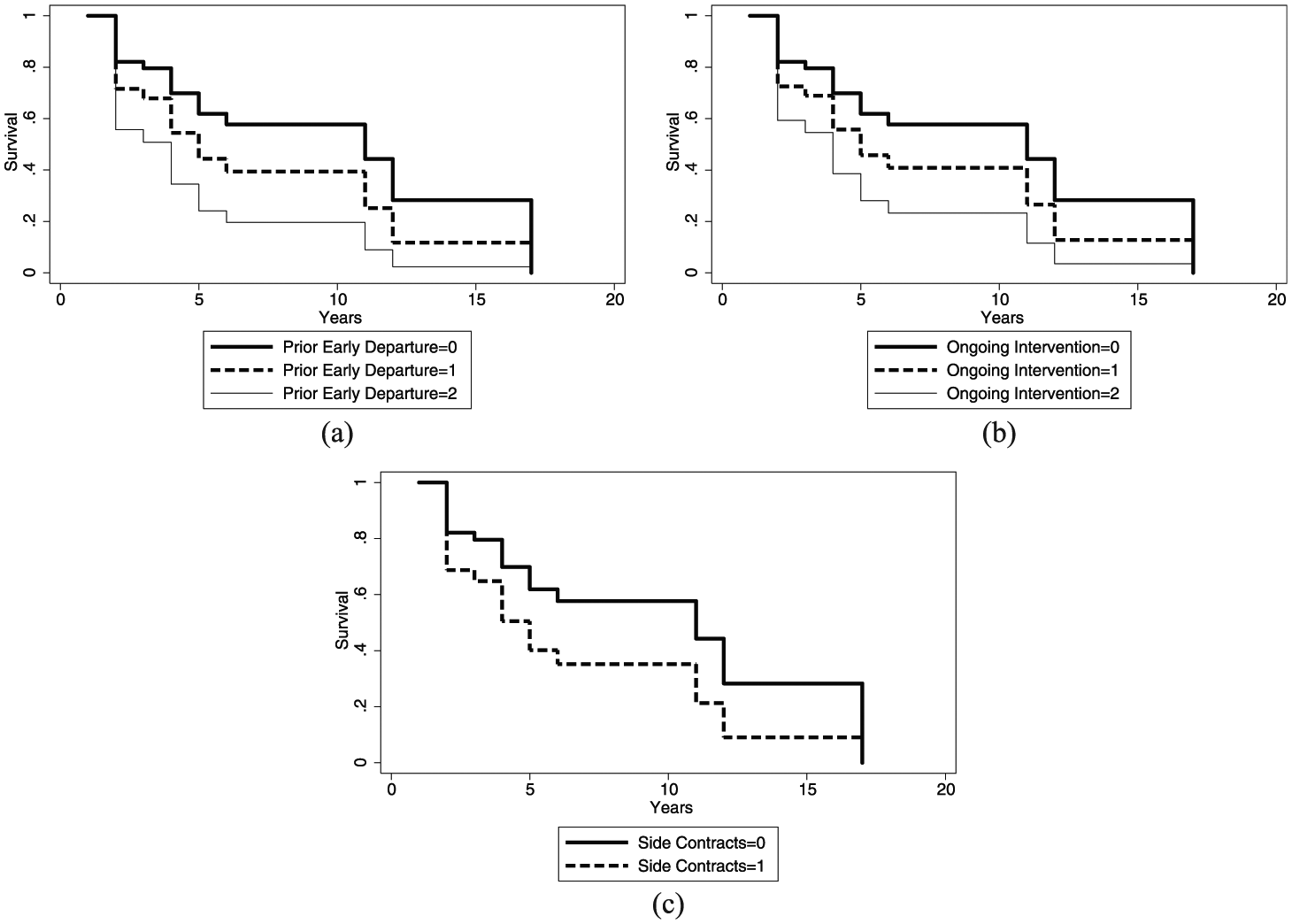
Survival curves for statistically significant control variables (Table 2, Model 2).
The performance of the variable Ongoing Interventions suggests that the resolve of third-party states ebbs as these state engage in multiple simultaneous interventions. Indeed, the hazard ratio in Model 2 reflects a 63% increase in the odds of an early departure from a conflict episode relative to a case in which no additional interventions are underway. Therefore, as states become militarily overextended, they become more likely to reduce their commitments by shedding interventions. Because each intervention constitutes “less” of a state’s total foreign policy portfolio, the attendant costs of said intervention relative to its benefits become less obvious to the third-party constituents and their political leaders. A point of diminishing returns can be reached, then, in which additional intervention translates into a third party becoming less resolved to continue each intervention. Figure 3b illustrates the estimated survival curves for Ongoing Interventions, with increasing frequencies of simultaneous interventions by a third-party state associated with decreasing resolve to continue a given intervention until the end of a conflict episode. Stated differently, by the fifth year of an intervention only 30% of the third-party states with two ongoing external interventions continue in an intervention, while 60% of third-party states without ongoing external interventions continue an intervention.
Last, the variable Coalition Contraction captures some of the alliance dynamics exerted on a given third-party state’s resolve. Alliance with Intervener is not statistically discernible from zero, indicating that participation in conjunction with allied states has little effect on third-party state resolve during an intervention. However, as we illustrate in Figure 3c, if the group of third-party states on a given side of a civil conflict begins to contract, there is a substantial increase in the probability that resolve will be shaken. Specifically, the hazard ratio of 1.90 indicates that each withdrawal from the coalition nearly doubles the probability that a given state’s resolve will be shaken. Alternatively, by the fifth year of an intervention 40% of third-party interventions that experience a contraction in a coalition remain in the sample, while 60% of third parties remain when no such contraction takes place.
Finally, returning to our motivating introductory anecdotes of the US in Lebanon in 1983 and France in Syria in 2015, we create two comparable simulations by setting our variables to values that reflect conditions analogous to these two cases. 15 Figure 4 illustrates the simulated conditions. The simulated survival of American intervention in the Lebanese civil war is particularly striking. Specifically, the probability of intervention survival rapidly declines to less than 10% in year two before declining toward zero. Notably, this decline is associated with an early American withdrawal from Lebanon during the campaign of international terrorist incidents. Although the bombing of the US Marine barracks was a singular event that captured global attention, it should be regarded as the capstone of a long campaign of multiple terrorist attacks that occurred over the course of more than a year. By contrast, a singular attack on the French in 2015 results in a starkly different performance. When interpreted in a similar fashion to the Lebanon case, the probability of French intervention survival declines marginally and certainly not precipitously. All else equal, then, and absent an escalating campaign of terror against France, we would expect the French to remain resolute following the ISIS attacks in Paris and continue their intervention into Syria.
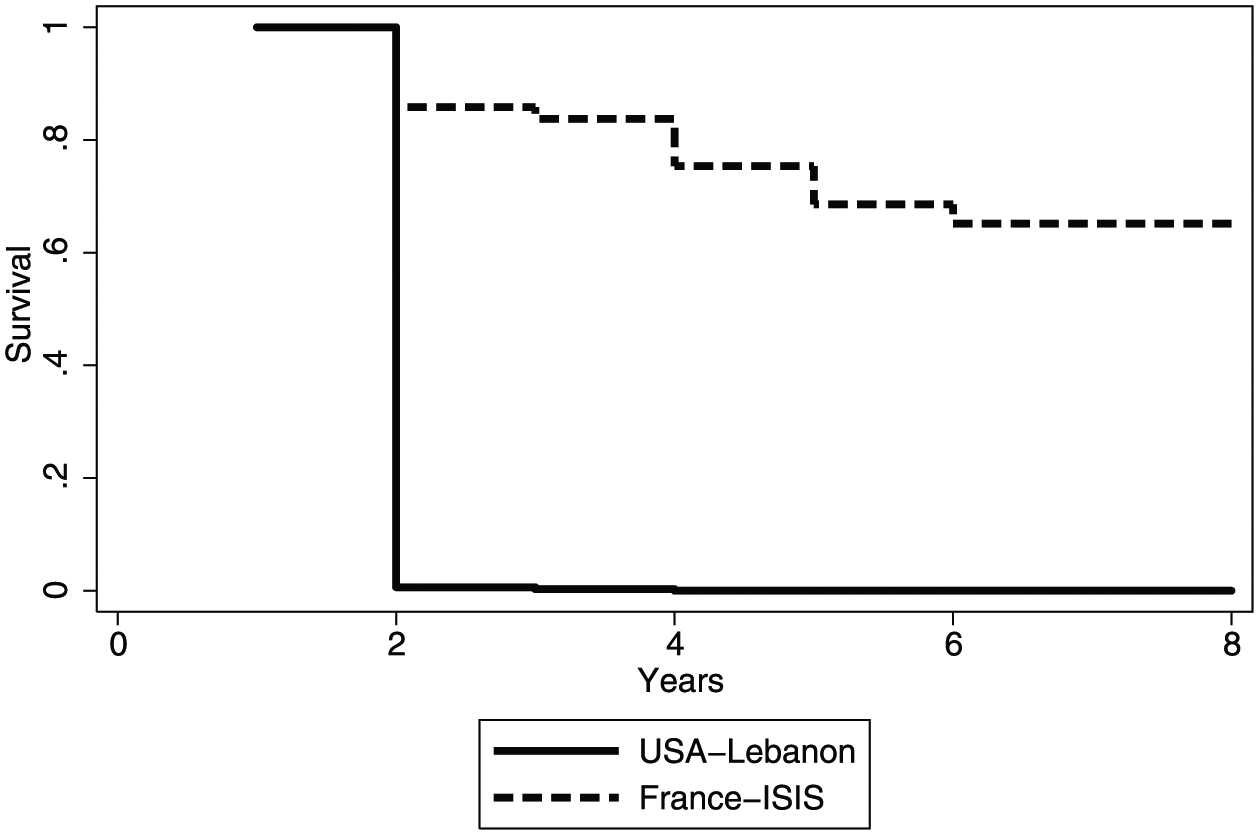
Simulated survival curves for USA–Lebanon (1983–1984) and France–ISIS (2015).
Conclusion
The academic, policy, and media communities are divided as to the matter of terrorism’s effectiveness. These debates are often grounded in historical anecdotes that beg for scientific vetting. Our analysis leads us to conclude that the effect of international terrorism on third-party state resolve is small on a per attack basis. However, terrorist campaigns, wherein terrorist organizations execute a series of organized or connected attacks against a third-party state’s assets, are on average likely to shake the resolve of third-party states to continue an intervention. However, while our empirical study of the linkage between terrorism and third-party state resolve suggests that “terrorism works,” it bears underscoring one outstanding observation that tempers this conclusion: terrorist campaigns against third-party states engaged in interventions in support of civil war governments are exceptionally rare. If one assumes that rebel groups wish to weaken their government opponent and that a principal way of doing so is to discourage the support of third-party states backing said government with military forces, then a plausible assumption is that rebel groups would mount such campaigns if they could. Yet terrorist campaigns require considerable time, resources, and coordination to execute, factors that history suggests are difficult for terrorist groups to assemble and maintain to a degree sufficient to generate a campaign.
Our study also has important implications for the broader study of the relationship between third-party interventions and civil wars. First, empirical studies of intervention generally emphasize how third-party state interventions affect civil war combatants and the evolution of these conflicts. As such, these studies place less emphasis on how the combatants can condition the behavior of the intervening states, even using third parties as strategic instruments in fighting a civil war. Herein, we demonstrate that one mode of unconventional warfare, terrorism, can condition third-party resolve to continue an intervention. Second, extant studies of third-party intervention rarely consider general qualities of third parties that bear on resolve. For example, third-party states join coalitions to reduce the costs and risks of intervention, bring with them records of past successes of intervention success, and possess commitments in terms of simultaneous interventions in other civil conflicts. It is plausible that these qualities shape the behavior of combatants in other conflicts.
Our study also suggests avenues for future research. First, we find that third-party states with reputations for poor resolve in prior interventions are more likely to be irresolute in a given intervention. This suggests a puzzle regarding reasons for, as well the implications of, third parties that exhibit serial irresolution. Second, our analysis suggests that the maintenance of third-party coalitions during an interventions conditions the resolve of individual members. Future research should explore the formation and dissolution of third-party coalitions, their commitments of resources during interventions, and in turn, the impact of coalition dynamics on the evolution of civil conflicts. Third, our analysis demonstrates the importance of simultaneous intervention commitments on third-party resolve. Indeed, it is clear that civil conflicts and terrorist organizations form webs of interdependencies geographically, systems in which the resolve of actors is only artificially isolated. Future research may investigate ways to acknowledge these cross-case influences on third-party resolve.
The role of resolve of combatants in the study of civil conflicts is longstanding. We argue that because third-party states are arguably pivotal to the course of civil conflicts historically, the resolve of third parties is central to the causal story too, but often overlooked. Terrorism is a lever by which civil war combatants, as well as other third-party state sponsors, determine the resolve of third parties engaged in military interventions. Unpacking the causes and consequences of third-party resolve, therefore, is an important exercise if we are to understand the place of civil wars in international politics.
Footnotes
Acknowledgements
The authors wish to thank the editors of Conflict Management and Peace Science, as well as three anonymous reviewers. We would also like to thank our panel participants from the 2016 annual meeting of the International Studies Association in Atlanta, GA, including our discussant Sabrina M. Karim; the participants in the 2016 Human Security Workshop at the University of North Texas, including J. Michael Greig and Phil Paolino; and the participants in the 2016 annual meeting of the Texas Triangle IR Conference in Austin, TX, including Matthew Fuhrmann and our discussant Timm Betz.
Funding
This research received no specific grant from any funding agency in the public, commercial, or not-for-profit sectors.
Notes
References
Supplementary Material
Please find the following supplemental material available below.
For Open Access articles published under a Creative Commons License, all supplemental material carries the same license as the article it is associated with.
For non-Open Access articles published, all supplemental material carries a non-exclusive license, and permission requests for re-use of supplemental material or any part of supplemental material shall be sent directly to the copyright owner as specified in the copyright notice associated with the article.
