




Abstract
This article reveals a temporal pattern of conflict behavior over the course of autocratic leaders’ tenure. By identifying a commonly observed domestic political cycle in autocracies, I discuss how the level of domestic constraints on autocrats’ conflict behavior changes over time in three distinct periods: (1) power struggle in the early period of tenure; (2) power consolidation; and (3) power dissipation in the later period of power transition. The empirical analysis on autocratic conflict cycle reveals that the likelihood of autocratic crisis initiation significantly increases during the early years of autocratic leadership tenure, after which it moderately decreases over time. This finding suggests that autocrats’ tenure is a substantively important predictor of autocratic leaders’ conflict behavior.
Kim Jong Un, a new dictator who inherited his father’s despotic leadership in late 2011, “lacked the long years of preparation for power enjoyed by his father, and had to assert his authority over a cadre of much older senior military figures” (Mundy, 2015). That is why he was obsessed with internal power reconfigurations during the early years of his tenure; for example, Kim Jong Un “has undertaken what appears to be the most sweeping purge of top North Korean officials for decades … as Mr. Kim seeks to consolidate his grip on power” (Mundy, 2015). Despite many outside observers’ prediction of an early downfall, the Kim Jong Un regime is reaching the consolidation period: the regime “has been surviving, if not thriving, with stable political leadership and a gradual economic recovery” (Moon, 2015). In August 2015, Kim Jung Un showed his first tangible military actions against South Korea, which was about four years after he took power. Interestingly, North Korea’s foreign policy stances in 2009 and 2010 also indicate that Kim Jung Il, who was preoccupied with domestic power shifts and reconfigurations for successful leadership transition to his son, did not want to engage in external military conflict. In the period of power transition, North Korea showed unexpectedly cooperative behavior toward the USA. For example, Kim Jung Il invited Bill Clinton and released two US journalists, and showed signs of willingness to join the six-party talks (Yun, 2010).
This anecdote suggests that domestic political constraints on autocratic leadership, especially when autocrats are preoccupied with domestic power rearrangement and potential leadership challenges, can be a reason for less aggressive conflict behavior. This implication is at odds with the argument that autocrats should have a greater incentive to trigger an international crisis particularly when their political leadership is (or at least is expected to be) highly vulnerable. This article examines whether this case is just an outlier or part of a generalizable empirical pattern. Specifically, I investigate whether autocrats with a high level of domestic political constraints are also constrained in their capabilities to pursue adventurous and contentious foreign policy, and whether the magnitude of political constraints in autocracies follows a cyclical temporal pattern which in turn shapes the autocratic conflict cycle over the course of tenure.
In autocracies, an institutional turning point is more irregular and less influential than in democracies. Although numerous studies have found that domestic politics in autocracies is a driving force of autocratic leaders’ foreign policy, 1 it is far from obvious whether autocratic regimes have an observable political cycle, and whether the autocratic political cycle, if any, is systematically related to autocrats’ conflict behavior. This article demonstrates that autocratic politics is neither totally idiosyncratic nor temporally unpredictable in spite of the lack of institutionalized leadership turnovers, and finds that the level of political constraints on autocrats’ foreign policy varies cyclically, in turn creating a systematic temporal variation in autocratic leaders’ conflict behavior. The relationship between leadership tenure and the propensity of international conflict has been examined with a significant emphasis on democracies since Gaubatz’s (1991) pioneering work was published. Yet little scientific knowledge has been accumulated about whether autocratic leaders’ conflict behavior systematically changes over the course of tenure, and if so why. Bueno de Mesquita and Siverson (1995), to the best of my knowledge, was the first study that laid a theoretical foundation about the relationship between autocratic leadership tenure and international conflict. They argue that autocrats are more likely to wage a war later in their tenure because autocrats with longer tenure are less likely to be punished politically for costly foreign policy (even failure). However, since Bueno de Mesquita and Siverson (1995) made the novel theoretical prediction, there have been few attempts to advance their theoretical mechanisms and test the prediction. Although scholars, for example Chiozza and Goemans (2003, 2011), have examined the effect of time-varying leadership factors on leaders’ conflict behavior, the literature lacks large-N empirical tests about when over the course of tenure autocratic leaders tend to be bellicose.
To fill the gap, this article attempts to make two particular contributions to the literature. First, this article enriches theoretical discussions about the cyclical nature of autocratic domestic politics, based on the literature on autocratic political institutions and anecdotal evidence. Second, I conduct a series of large-N empirical tests that reveal empirical evidence that leadership insecurity serves as foreign policy constraints rather than diversionary motives and that the propensity of international conflict follows a temporal pattern in autocracies.
To this end, this article takes three steps. First, I demonstrate the existence of a nonlinear temporal variation in the level of domestic constraints on autocrats’ foreign policy over the course of tenure. Second, I discuss why autocrats’ leadership insecurity is a source of foreign policy constraints, which is consistent with the findings of Bueno de Mesquita and Siverson (1995) and Chiozza and Goemans (2003). Third, these discussions lead to an empirical implication that the likelihood of international conflict has an inverted-U shaped relationship with autocratic leadership tenure. In the empirical analysis, I provide empirical evidence for all three theoretical expectations. The main finding strongly holds against various robustness checks. Since not all circumstantial (and time-varying) political and economic conditions are easily observable in autocracies, this article suggests that autocratic leadership tenure can be an important predictor of the timing of international conflict in autocracies.
Leadership tenure and international conflict
Over the past decade, there has been burgeoning research interest in the conflict behavior of autocracies. While conflict studies that distinguish between democracies and non-democracies have thrived since the 1980s, international relations scholars have recently started to unpack autocracies with regard to various research topics that have been applied to the conventional democracy–non-democracy dichotomy. This scholarly interest originates from the notion that autocratic conflict behavior not only meaningfully differs from that of democracies, but also significantly varies across different autocratic regime types (e.g. Debs and Goemans, 2010; Lai and Slater, 2006; Peceny et al., 2002; Peceny and Beer, 2003; Pickering and Kisangani, 2010; Sechser, 2004; Weeks, 2008, 2012). However, much emphasis on autocratic regime types has inadvertently resulted in the tendency that the leader is considered as a time-invariant unit within an autocratic regime type. 2 As a result, less attention has been given to leadership tenure (i.e. time in office) compared with the significant emphasis on different mechanisms of leadership survival across different types of autocracy.
To date, a small number of studies have examined how leaders’ conflict behavior changes over the course of tenure. Gaubatz (1991) presents an apparent empirical pattern that democratic leaders are more likely to initiate war early in their tenure, while the propensity of war initiation dwindles as an election nears. Although the empirical evidence from the descriptive statistics alone is quite novel and informative, whether the potential causal mechanisms proposed by Gaubatz are applicable to autocracies is unclear. That is because Gaubatz’s theoretical questions, particularly about the potential causal ambiguities, largely revolve around foreign policy implications of democratic election. Empirically, the analysis is also limited to democratic states’ conflict behavior.
Regarding leadership tenure and international conflict, one of the most general theoretical frameworks was introduced by Bueno de Mesquita and Siverson (1995). Their formal model produces many predictions on the relationship between leadership survival (and tenure) and conflict behavior in democracies and autocracies. Most relevant to this article, they hypothesize that “The longer an authoritarian leader has been in power, the higher the probability that the leader will risk waging a war, including waging a war that ultimately is lost” (Bueno de Mesquita and Siverson, 1995: 847). 3 Their model indicates that the longer an authoritarian leader stays in power, the more likely the leader is to believe that he can survive the adverse outcome of war. Thus autocrats with longer tenure are expected to be more likely to pursue adventurous or highly risky foreign policy. In other words, the political burden of costly foreign policy (and failure) is expected to be mitigated by authoritarian leaders’ tenure in office.
However, albeit plausible, this claim is yet to be justified rigorously in the authoritarian context. The key theoretical factor that drives their prediction is leadership reliability that serves as a cushion against regime challenges. Autocrats, compared with democrats, should be better at accumulating reputation for leadership reliability over time owing to relatively small winning coalitions. According to their model, the amount of credit for reliability increases in autocratic tenure. Thus, the longer an autocrat has been in power, the greater opportunity the autocrat has to insulate himself from political punishment for foreign policy failure and to pursue policies closer to his own ideal point.
However, if the logic of increasing leadership reliability over time holds, why do relatively long-surviving autocrats experience severe internal challenges, eventually relinquish leadership, and often face dire post-tenure punishment? Interestingly, the auxiliary empirical tests in this article indicate that the probability of conflict initiation does not linearly increase over the course of autocratic tenure. 4 In addition, given that the primary source of foreign policy constraints is the fear of political punishment, it is possible that even new autocrats are better off pursuing aggressive, risky foreign policy if core constituents’ foreign policy preferences are hawkish; that is, waging a costly and risky war may not necessarily increase the chance of political punishment even early in autocrats’ tenure. Rather, the probability of political punishment may depend on the preferences of core constituents. Thus, without making the assumption that elites in autocracies are inherently averse to risky war, the prediction may not be able to stand alone.
Furthermore, although Bueno de Mesquita and Siverson (1995) reveal empirical evidence that supports their hypothesis, further empirical investigations are needed to reveal a more complete picture of the temporal variation in autocratic conflict initiation. Bueno de Mesquita and Siverson (1995: 852) test their prediction by showing that “the average total tenure of the nonwarring leaders is 3.32 years (N = 2,152), while the average total tenure of those leaders who ultimately engaged in war is 8.52 years (N = 106).” While this finding itself is novel and surprising as they noted, this result alone does not fully reveal the (possibly nonlinear) trajectory of conflict initiation over the course of autocrats’ tenure. In this article, I conduct the first comprehensive large-N empirical analysis testing the hypothesis and find evidence that renders partial empirical support for their hypothesis.
There are several other studies that discuss the relationship between leadership tenure and military conflict (or international crisis). Notably, Gelpi and Grieco (2001) argue that leaders in both democracies and autocracies are more likely to be targets of international conflict early in their tenure because offering concessions is a better option than resisting for inexperienced leaders. Even though their theoretical and empirical focus is, unlike this study, on the likelihood of being a target, I find that their theoretical mechanism, particularly about domestic constraints on new autocrats’ foreign policy, provides an important insight into why autocratic leaders might be discouraged from diverting military resources abroad in times of insecure leadership.
Other studies also find a linkage between leadership tenure and international conflict through unique mechanisms. For example, Potter (2007) views leader tenure as an indicator of leadership experience, and finds that the US presidents with more experience are better at avoiding international crisis or militarized dispute involvement. Another interesting conceptualization of leadership tenure is proposed by Wolford (2007) that demonstrates that leader tenure can be considered as a source of revealing a leader’s resolve in crisis bargaining. Although these studies provide unique theoretical frameworks as well as useful insights into the timing of conflict involvement, the theoretical mechanisms are not specific to autocracies, thus providing few clues about how foreign policy constraints vary over time especially in autocracies. This article seeks to supplement these studies by identifying a commonly observed political cycle that is unique to autocracies, which is a primary theoretical contribution of this article.
Autocratic political cycle
Authoritarian leaders have less institutional restraints on their tenure than democratic leaders, so that they are less susceptible to institutionalized leadership turnover. Thus authoritarian leaders often take advantage of the lack of rule of law when they seek to stay in office longer than allowed by law. This is particularly true when an authoritarian leader survives the early stage of power competition and succeeds in consolidating the dictatorial power base.
Ironically, however, authoritarian leaders have less institutional protection for their leadership survival than democratic leaders, particularly early in their tenure. Conversely, authoritarian leaders tend to be highly concerned about their survival in office in the early period of power struggle. Thus autocrats have an incentive to establish strong launching organizations particularly early in their tenure through constitutions that could be strategically used to consolidate their power (Albertus and Menaldo, 2012). Constitutions in dictatorships, however, are not as effective in securing leadership survival as those in democracies, but are often undermined by both leaders themselves and potential elite dissenters (Ginsburg et al., 2007). Lack of effective institutional guarantees on leadership survival makes autocrats obsessed with establishing para-institutional protective mechanisms. Especially early in their tenure, they have a strong incentive to devote available resources to building shields against potential regime challenges. To put it simply, their utmost concern after grabbing power is to ensure leadership stability at all costs. Thus authoritarian leaders tend to make the most of their military resources available especially for domestic power consolidation early in their tenure.
The literature also supports the argument that authoritarian leaders, compared with democratic leaders, are more uncertain about their fate, especially early in their tenure. Haber (2006: 696) suggests that “The early years of dictatorships therefore tend to be characterized by a power struggle—a game as it were, with the stakes being tenure in office—between the dictator and the leadership of the organized group that launched him”. Geddes (2006) also characterizes the early period of authoritarian regimes as the stage of struggling over power, and forming and consolidating the winning coalition. Autocratic leaders’ vulnerability to violent domestic challenges early in their tenure is also shown in the authoritarian power-sharing model of Svolik (2009). He argues that the likelihood of autocrats being removed by a coup instead of exiting by other means should decline as autocratic tenure increases.
If authoritarian leaders successfully consolidated their grip on power by establishing power-sharing institutions and/or well-organized repressive apparatuses in the military, or by buying off elite dissenters, then autocrats would no longer be preoccupied with severe internal power struggles. “Once they survive the early period of power contest, autocrats tend to enter the phase of power consolidation in which they successfully sort out core elite supporters and insulate themselves from unexpected regime disruptions” (Bak, 2016: 804). That is, political survival in the early period of power competition should serve as a signal that an autocratic leadership and the winning coalition become stable and resilient. Thus, although internal regime challenges may well be present even in this consolidation period, they should be less threatening to leadership survival.
The average authoritarian leadership duration is about 9 years. 5 Some dictators stayed in power much longer, even more than 40 years: for example, Kim Il-Sung in North Korea, Muammar Gaddafi in Libya, and Fidel Castro in Cuba. No matter how long authoritarian leaders stay in power, there is a commonly observed pattern for most autocrats in the world, that is, the period of power dissipation and transition appears as they become older and/or as new anti-regime factions within or outside the ruling coalition arise. This is a defining feature of autocracy because “most dictatorships are by their nature especially susceptible to succession crises and uncertainty about the future … the absence of any independent power to assure an orderly legal succession means that there is always substantial uncertainty about what will happen when the current autocrat is gone” (Olson, 1993: 572). I argue that this period is marked by foreign policy constraints similar to those in the early period of power contest. Thus, whether an autocratic leader expects a peaceful power transition to his successor or a violent leadership turnover, the leader is likely to be preoccupied with domestic power rearrangement.
Autocrats may be uncertain about their own political fate over the course of tenure. That is, they may not be fully aware that they are in the power-dissipation phase. For example, autocrats who face severe internal challenges may try to hold onto power further, and refuse to believe that the period of power consolidation has ended. Nonetheless, the distinction is rather clear between the consolidation and dissipation periods because autocrats who are able to maintain the consolidation period further will take any precautionary measures available that can prevent the rise of the dissipation period. Otherwise, they are likely to make exit strategies to get away with severe post-tenure punishment. That is why many autocrats who have a reason to believe that the exit timing is near consider exit options and prepare credible exit guarantees (Escribà-Folch and Krcmaric, 2017).
For example, the former North Korean dictator, Kim Jung Il, knew even in the late 2000s that he had to prepare for power transition to his son. Most importantly, he tried to reshuffle top-level military officials and create a new military group in order to reduce the precarious dependence of Kim Jung Un on senior military officials (Yun, 2010). Although any violent uprisings against the leadership transition to Kim Jung Un were not reported, it seems obvious that Kim Jung Il knew that the power-transition period was near. Similarly, Fidel Castro at the age of 81 clearly knew that the time had come for leadership transition to his brother Raul Castro, and carefully prepared for successful power transition because serious internal challenges could erupt during both the transition period and the early period of Raul Castro’s rule (Erikson, 2005). As shown in both cases, I argue that autocrats have a fairly good idea about whether they are in the late period of power transition. More importantly, I contend that autocrats are highly preoccupied with potential internal power competition and rearrangement in the late period of power transition.
The following descriptive analysis demonstrates that authoritarian regimes tend to follow an observable temporal trend of leadership instability. To examine the temporal pattern regardless of the length of leadership tenure, autocratic leadership tenure is normalized. Graphs 1 and 2 in Figure 1 show temporal changes in two different proxies of internal strife: (1) the number of purges and government crises (Elite Unrest), and (2) the number of coup attempts (Coup Attempt). 6 Each graph shows a fractional polynomial approximation of the relationship between these proxies and tenure.

Pattern of elite unrest over tenure.
Both graphs show a similar pattern, indicating that the propensity of internal power struggles tends to be high both in the early and late periods of autocratic tenure. Internal challenges to the incumbent leadership are not absent even in the so-called consolidation period, which implies that tenure is not a deterministic indicator that signifies leadership consolidation. However, this empirical pattern provides further support for the following theoretical expectations: (1) autocratic tenure can be characterized by the three periods; and (2) the magnitude of domestic political constraints systematically differs among these distinct periods. 7 In the empirical analysis sections, I show further evidence for this political cycle using multivariate regressions.
Domestic constraints and autocratic conflict cycle
Given vulnerable leadership early and late in their tenure, I argue that autocrats should be highly constrained in their capabilities of initiating military conflict abroad. They tend to maintain or build pro-regime military and security forces for the purpose of domestic power consolidation or successful (and safe) power transition rather than using them for external conflict initiation. Gelpi and Grieco (2001: 801) also highlight new authoritarian leaders’ vulnerability and their insecure winning coalition, and further argue that “The use of military force in an international crisis will be costly for relatively new authoritarian leaders because such military actions require a diversion of military resources away from their most urgent task: defending the leader’s hold on office.” Thus, autocrats, especially early and late in their tenure, are highly preoccupied with domestic power rearrangement and constrained in their ability to divert military resources outside.
Another linkage between a high level of political constraints and international conflict is found in Bueno de Mesquita and Siverson (1995: 847). They make a prediction that is corroborating to the main implication of the discussion above: “Newcomers to power, conversely, cannot afford such boldness and are thus more likely to avoid high-risk gambles in foreign policy”. Their argument hinges upon restraints driven by the risk of political punishment for potentially adverse war outcomes, rather than focusing on limited capabilities to divert military resources externally. Conflict outcome and costs are neither easily nor accurately predicted, which is a defining feature of a risky gamble. What makes the gamble riskier is the domestic political burden resulting from potential foreign policy failure. Recent studies show that autocratic leaders should be highly sensitive to foreign policy outcome (Chiozza and Goemans, 2004; Debs and Goemans, 2010). Given these foreign policy constraints, autocratic leaders early and late in their tenure would be less able to insulate themselves from opportunistic internal challenges in times of international conflict as well as from political punishment for negative conflict outcomes.
Moreover, autocratic leaders tend to be afraid of collusion between internal and external enemies, particularly in the early and late periods of tenure when their power base is relatively fragile. Domestic oppositions and foreign threats can coexist, but more importantly internal challenges may well be instigated and even stimulated by external conflict. In the period of new leadership or power transition, autocrats have difficulties distinguishing between truly loyal followers and opportunistic regime insiders disguised as devoted adherents, and often lack the resources necessary to build a secure winning coalition. Thus, autocrats are likely to believe that the likelihood that domestic challengers will form a coalition with foreign enemies is high, in particular early and late in their tenure.
For these three reasons, initiating armed conflict can be a highly risky foreign policy option early and late in autocrats’ tenure. Sadat, the president of Egypt between 1970 and 1981, survived early years of power competition by purging existing Nasserists and establishing multiparty power-sharing institutions during the Corrective Revolution. Sadat was an ardent supporter of aggressive foreign policy against Israel, and any peculiar strategic and military disadvantages for Egypt did not exist in these early years. Nonetheless, he did not show any tangible belligerent actions against Israel during the first three years in office, mainly because he was obsessed with internal power rearrangements. For example, Sadat did not initially disrupt the influence of Soviet Union that openly opposed further military confrontations between Arab countries and Israel, but Sadat eventually broke from the Soviet Union by expelling Soviet military advisors in July 1972. It was not until 1973 that Sadat launched a massive attack against Israel, crossing the Suez Canal in order to regain control of the Sinai peninsula. 8 A recent Libyan case also indicates that autocrats in the late phase of power dissipation have difficulties in fighting both external and internal enemies, in turn making them less capable of diverting military resources abroad. It seems difficult to imagine that Muammar Gaddafi could even afford to initiate military conflict in 2010 and 2011 when the collusion between internal rebel forces and external enemies was highly threatening.
Hypotheses
Three main implications can be drawn from the theoretical arguments: (1) the magnitude of political constraints is expected to change systematically over the course of leadership tenure; (2) domestic political constraints, identified by leadership insecurity, should make autocrats less likely to pursue external military conflict; and thus (3) autocrats’ conflict behavior should follow a temporally cyclical pattern. Although the main theoretical implication culminates in the empirically observable autocratic political cycle, the empirical validity of the theoretical mechanism itself should not be taken for granted. Thus, I derive two testable hypotheses from the theoretical mechanism to ensure that the first two theoretical arguments are supported by empirical evidence.
After providing empirical evidence for these mechanism hypotheses, I then test the ‘autocratic conflict cycle’ hypothesis.
Research design
Sample
The hypotheses explain a state-level pattern of conflict behavior, which appears to render justification for using a monadic sample. The monadic level of analysis has two advantages over the dyadic level of analysis. First, a monadic analysis can be more parsimonious and efficient because including all possible dyads and relevant dyadic information in regression might introduce too much unnecessary noise. Second, the large sample size of dyadic analysis, given a small number of conflict initiations as rare events, might unintentionally deflate the standard errors of coefficient estimates. However, a monadic analysis overlooks strategic interactions that are the essence of the evolution of any international crisis. Dismissing these strategic components might cast doubts as to the validity of empirical results from the monadic analysis. Moreover, a dyadic analysis allows one to explore the conflict behavior of foreign countries as potential challengers toward autocratic targets, which would be ignored in a monadic analysis.
Given these (dis)advantages of each level of analysis, I use the monadic analysis, which is more consistent with the theoretical mechanism, and run dyadic models for robustness checks. 9 The number of observations in the monadic sample that have information available for all the variables included in the fully specified regression is 4161 in years 1951 to 2006. The sample of autocratic leader years is selected using the Archigos database (Goemans et al., 2009) and the autocratic regime data by Geddes et al. (2014).
Empirical analysis for Hypothesis 1
This article treats (phases of) tenure as an easily observable indicator that approximately captures the latent level of domestic constraints on autocrats’ foreign policy. While this conceptualization of tenure is well suited for my theoretical mechanism, the literature review, several real-world examples, and descriptive statistics might not be enough to justify the changing pattern of domestic constraints over the course of tenure. An obvious reason for this doubt is that internal struggles could erupt again even shortly after early years of power struggle, thus destabilizing leadership. That is, internal strife may not significantly decrease even after autocrats survived several years in office. Thus, I search for further empirical evidence that the overall temporal variation in the magnitude of leadership instability is consistent with my theoretical expectation.
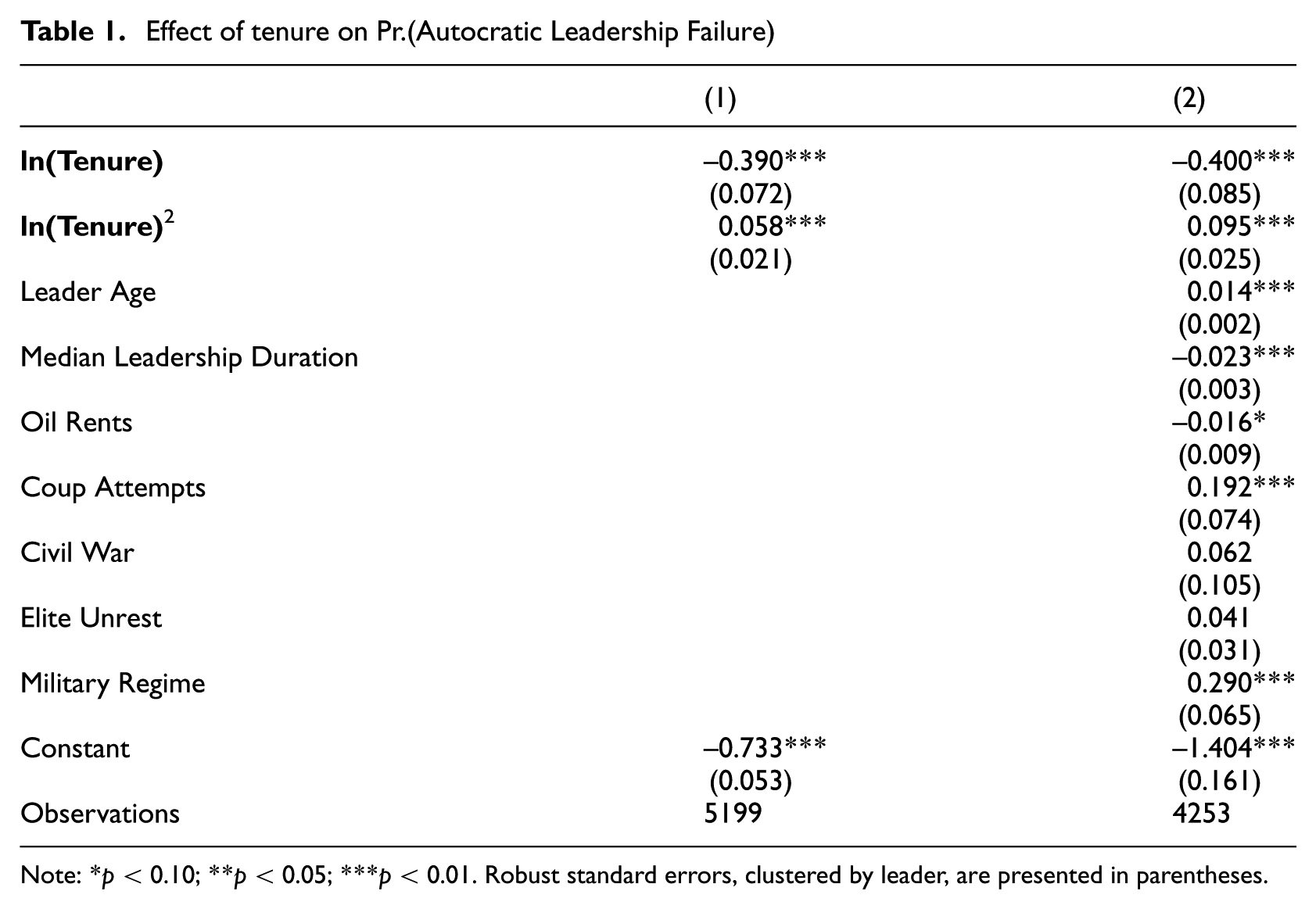
To capture the underlying risk of leadership failure, I run a probit model of leadership failure as a function of tenure, controlling for other predictors of autocratic leadership (in)stability. 10 The dependent variable is autocratic leadership failure defined by the Archigos database (Goemans et al., 2009). The independent variables are ln(Tenure) and ln(Tenure)2. The control variables include leader age (Goemans et al., 2009), a country’s median duration of leader tenure, oil rents (Ross, 2012), coup attempts (Powell and Thyne, 2011), elite unrest that records the number of purges and government crises in a given autocratic country year (Banks and Wilson, 2013), civil war (Gleditsch et al., 2002), and military regime (Geddes et al., 2014). Military regime is included to capture the notion that military regimes are particularly vulnerable to elite challenges (Belkin and Schofer, 2003; Powell, 2012; Thyne, 2010).
Hypothesis 1 suggests that the likelihood of autocratic leadership failure should be higher in the early and late periods of tenure than in the consolidation period. The empirical results in Table 1 show that the coefficient estimate for ln(Tenure)2 is positive and significant, suggesting that the likelihood of autocratic leadership failure decreases in tenure first and then increases once autocratic tenure crosses a certain reflection point. Figure 2 features the graphical presentation of the results based on the post-estimation analysis using the estimates in Table 1. The left graph reveals that the estimated probability of leadership failure decreases over time and rises back up in the later period of tenure, which is consistent with my theoretical mechanism. The marginal effect of tenure, shown in the right graph, also confirms this finding.
Effect of tenure on Pr.(Autocratic Leadership Failure)
Note: *p < 0.10; **p < 0.05; ***p < 0.01. Robust standard errors, clustered by leader, are presented in parentheses.
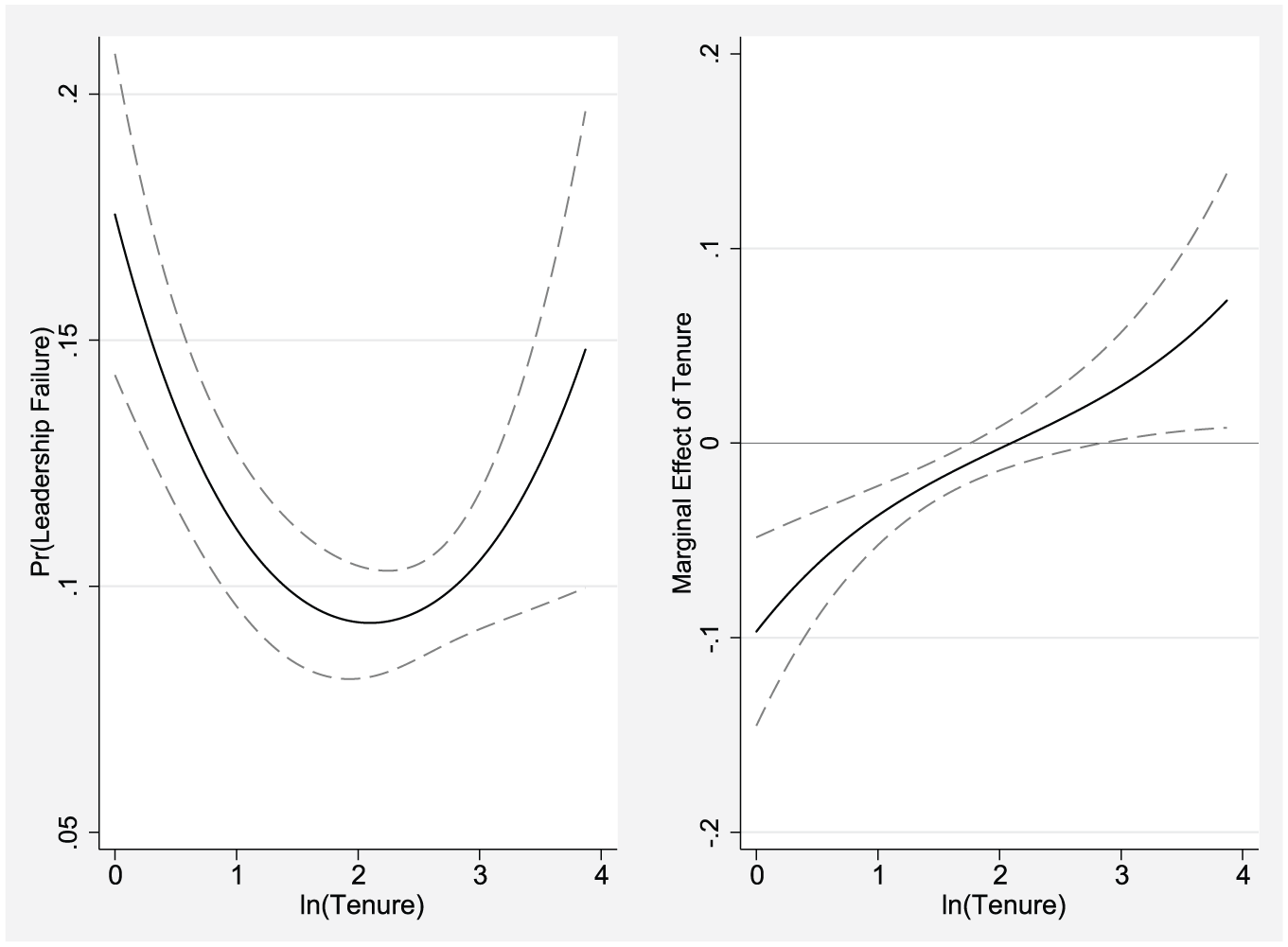
Risk of leadership failure over tenure.
Empirical test for Hypothesis 2
In this section, I directly test the theoretical linkage between leadership insecurity (political constraints) and international conflict in a two-stage model to address the potentially endogenous relationship between insecure leadership and conflict initiation. In the first stage probit model, I estimate the probability that an autocratic leader is removed from office in a given year using the sample of autocratic leaders between 1951 and 2006. The record of leadership failure is taken from the Archigos database (Goemans et al., 2009). Then, I obtain the linear predictions from the reduced-form equation in the first stage. These linear predictions are used as the independent variable of the second-stage probit model that estimates the probability that an autocrat initiates an international crisis in a given year.
Dependent variable
The dependent variable of the second stage is Crisis Initiation that measures whether an autocratic leader initiated an international crisis in a given year according to the International Crisis Behavior (ICB) data (Brecher and Wilkenfeld, 2007). Because the ICB dataset does not distinguish between the challenger (or the initiator) and the target, I extract the information about the number of crisis initiations from the directed-dyad ICB dataset created by Mettler and Reiter (2013) in which authors carefully selected, case by case, conflictual dyads and the initiator that is defined as “the state that made the first threat, mobilized its forces first, or used violence first” (Mettler and Reiter, 2013: 861). I use the dichotomized version of the measure as the dependent variable in a probit model, while using the count measure in a negative binomial model.
Exogenous variable
The first stage probit includes an exogenous variable that is a strong predictor of the probability of leadership failure, which is not endogenous to the probability of crisis initiation. 11 I create such a variable that is measured by the median leadership duration for each country, which is also used by Chiozza and Goemans (2003). 12 The first-stage regression results show that the F-statistic of the instrument (median duration) is 67, which easily crosses the thresholds suggested by Staiger and Stock (1997) and Stock and Yogo (2005). The potentially biased standard error estimates of the second stage are corrected by running the whole system of equations using 1000 bootstrapped samples.
Control variables
To control for the underlying level of hostility toward foreign countries, I include the number of Strategic Rivalries that an autocratic state had in a given year, using the Strategic Rivalry data by Thompson (2001). To capture the notion that contiguous states are more conflict-prone, I control for the number of land Borders that an autocratic state shares with other states, using the Direct Contiguity dataset by Stinnett et al. (2002). Powerful states are expected to be better able to resort to military aggression, so I also control for each autocratic state’s material capabilities in a given year that is measured by the Composite Indexes of National Capabilities (CINC) scores (Singer et al., 1972). Leaders in oil-rich autocratic countries would be better able to resist and appease domestic dissent using resource rents, thus reducing the level of foreign policy constraints. I include the log of Oil Rents that is measured by per capita value of oil and natural gas production (Ross, 2012). To take into account the influence of serious elite challenges on the likelihood of conflict initiation as well as on autocratic leadership stability, I control for the number of Coup Attempts using the dataset by Powell and Thyne (2011). 13 To control for the temporal dynamics of crisis initiation, I include the logarithm of Time Since Last Crisis that measures the number of years since the last crisis initiated by an autocratic leader. The literature suggests that the propensity of conflict initiation varies across different autocratic regime types, 14 so that I control for three dummy variables: Military, Personalist, and Single-party regime (Geddes et al., 2014).
Results
The empirical results are presented in Figure 3. 15 The left graph of Figure 3 presents the results from the second stage probit regression, and the right graph shows the results from the second stage negative binomial model. Both graphs show that the 95% confidence intervals of the estimate of the first stage predictor (the linear prediction of leadership failure) are below zero, which indicates that autocratic leaders who are insecure in power are less likely to initiate an international crisis.
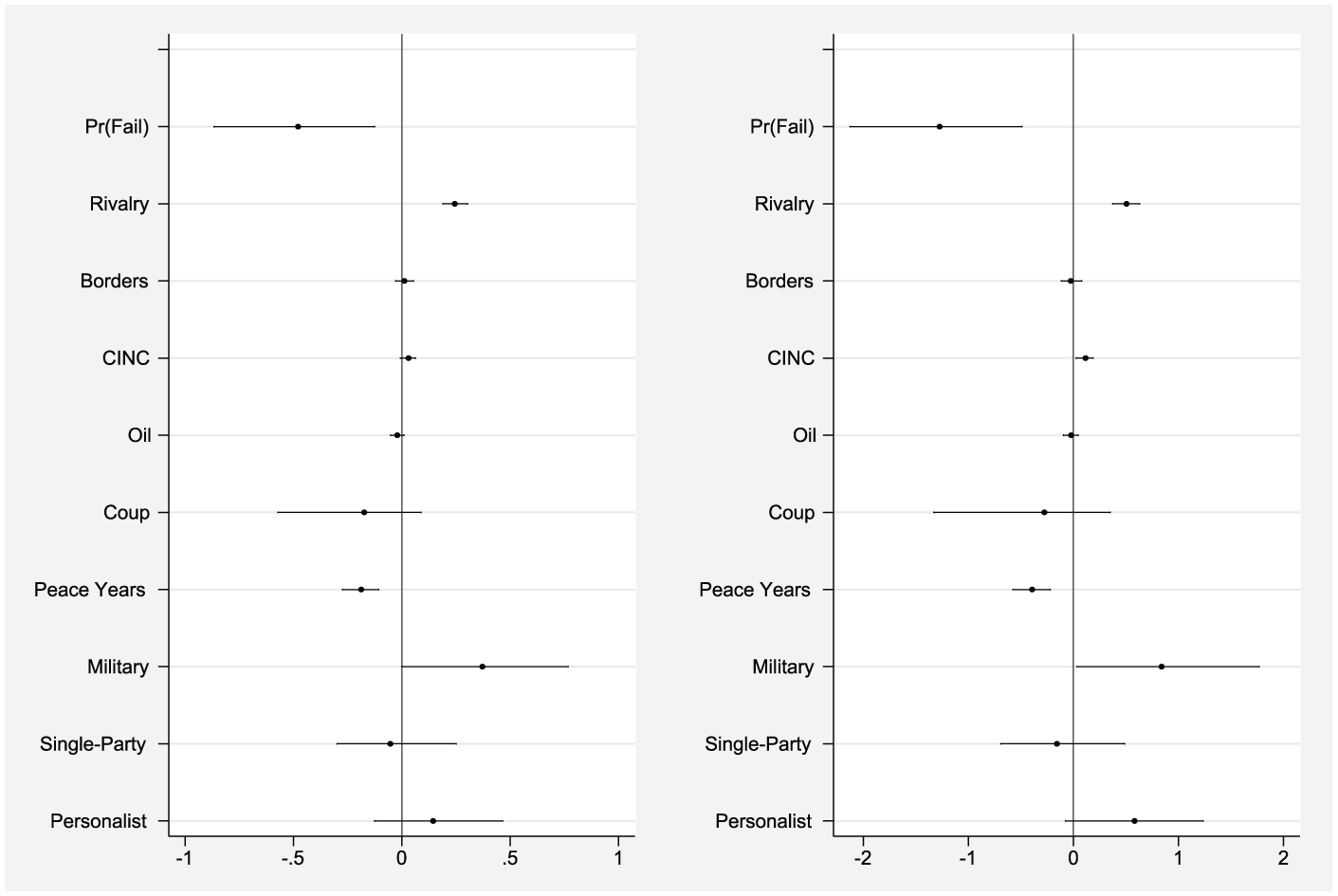
Effect of Pr(Fail) on crisis initiation.
This finding agrees with the expectation of the constraints perspective presented in my theory. This result indicates that the finding of Chiozza and Goemans (2003), peace through insecurity, appears to hold in autocracies. Interestingly enough, this empirical result is at odds with the underlying logic of diversionary conflict in autocracies. To date, Pickering and Kisangani (2010) is the only study that directly tested diversionary conflict hypotheses in different autocratic regime types. They show that diversionary behavior should be most likely to be observed in single-party regimes, which is contrary to the finding of Lai and Slater (2006) that military regimes should be more likely to use diversionary force than party-based regimes. While the empirical focus of these studies is on divergent conflict behavior across different autocratic regime types, their theories are based on the logic of diversionary conflict. My empirical analysis suggests that the diversionary conflict thesis should not be taken for granted at least empirically in autocracies.
Empirical test for Hypothesis 3
Variables
The dependent and control variables are the same as those in the second-stage probit equation of the previous analysis. The primary independent variable is leadership tenure that is measured by the number of years in office (Goemans et al., 2009). The original tenure variable is highly skewed to the right, indicating that extremely long tenure is relatively less common in the sample. Thus this variable is logged to make the distribution less skewed, and more importantly to capture the diminishing effect of tenure over time. Since the hypothesis suggests a curvilinear relationship between tenure and crisis initiation, I include both Tenure and Tenure2.
Estimator
For the dichotomous dependent variable (crisis initiation), I use probit models with robust standard errors clustered by leader. For the count dependent variable, I use negative binomial models because of potential positive conflict contagion and overdispersion in the dependent variable. Empirically, the overdispersion parameters turn out to be statistically different from zero. 16 For robustness checks, I also include country-specific fixed effects.
Empirical results
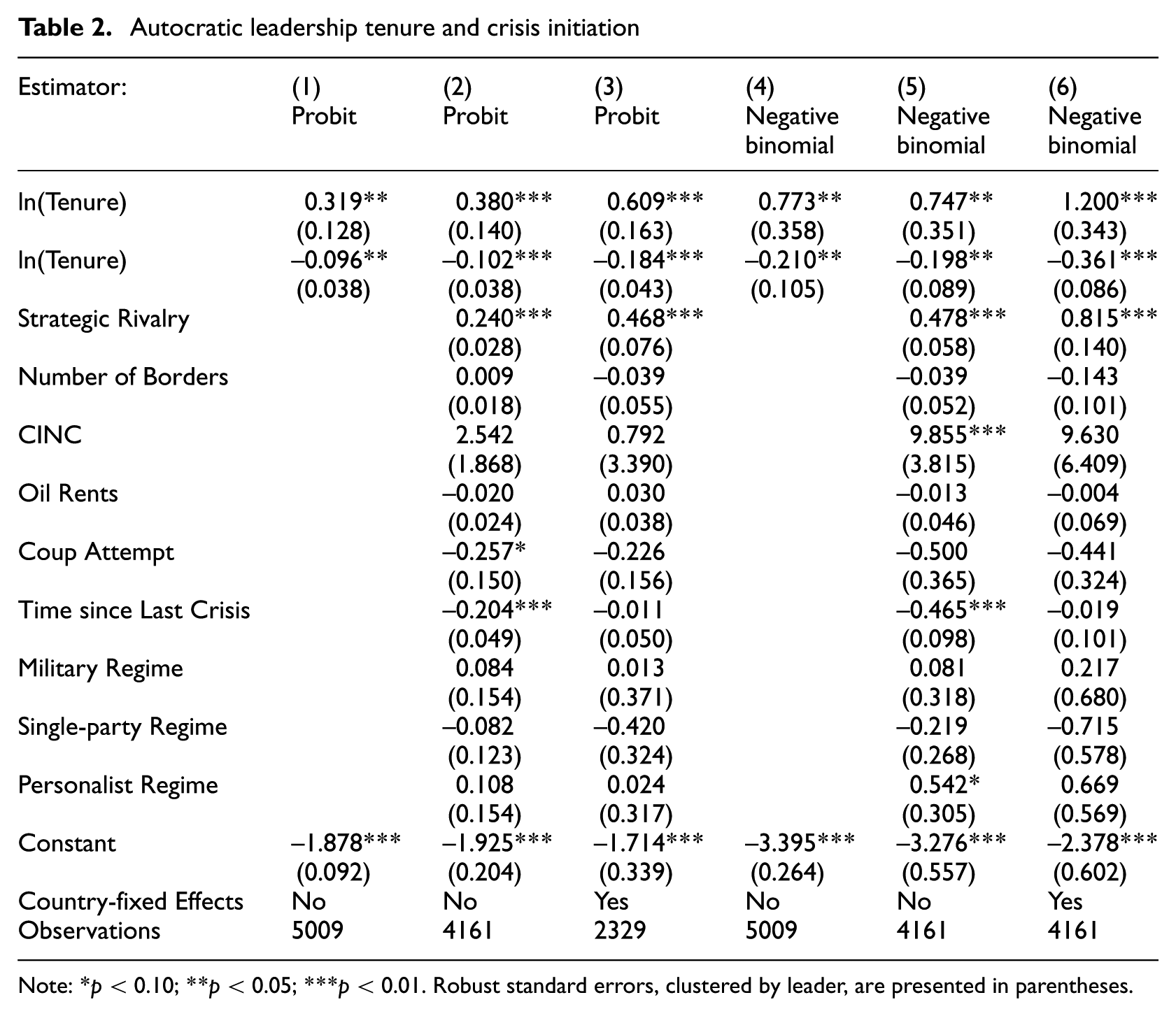
Table 2 features the results from the probit and negative binomial regressions. In all models, the results reveal the inverted-U shaped relationship between tenure and crisis initiation, which is statistically significant regardless of model specifications. That is, the likelihood of crisis initiation or the expected number of crisis initiations tends to increase as tenure increases up to a certain reflection point, but after which it decreases. These results provide support for Hypothesis 3.
Autocratic leadership tenure and crisis initiation
Note: *p < 0.10; **p < 0.05; ***p < 0.01. Robust standard errors, clustered by leader, are presented in parentheses.
The coefficient estimates alone do not fully reveal the curvilinear relationship between tenure and crisis initiation. Thus I ran a post-estimation analysis using the estimates of Model 2. The two graphs at the top of Figure 4 present the results. The left graph reveals a reflection point after which the positive effect of tenure on crisis initiation turns into negative. As tenure increases, autocrats are expected to be more likely to initiate an international crisis approximately up to about 5.4 years in power, and less likely after the reflection point in tenure. 17 Given that the average length of autocratic tenure within the regression sample is about 9.2 years, the graph indicates that the power dissipation period in which foreign policy constraints increase does exist. The right graph confirms the significant positive marginal effect in the early period of power competition as well as the significant negative marginal effect of tenure in the late period of power transition. This nonlinear temporal pattern of conflict initiation is in line with my hypothesis.
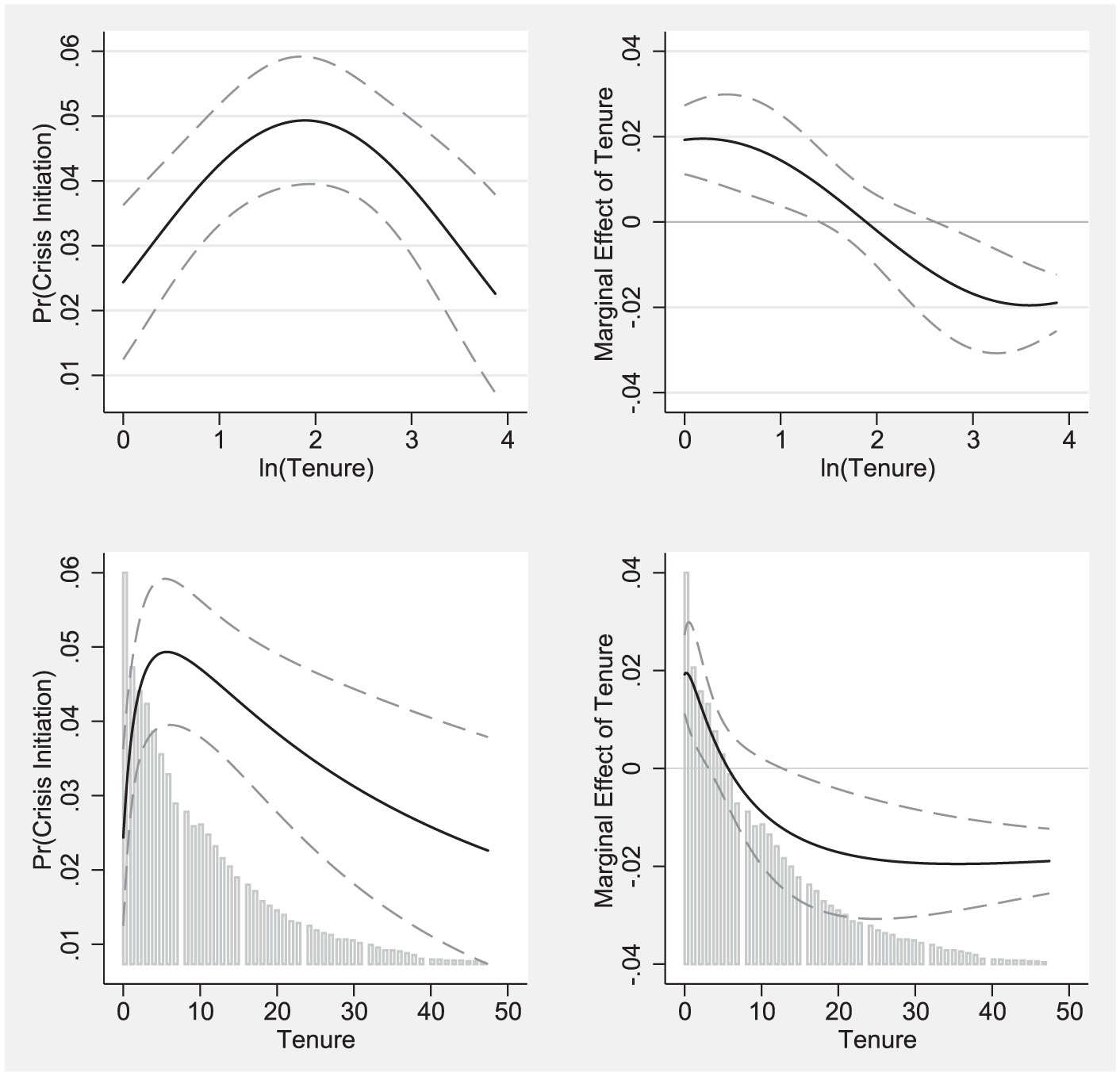
Effect of tenure on crisis initiation.
However, extra caution is needed in interpreting these results due to the skewed distribution of autocratic leadership tenure and the logged tenure on the x-axis. It is misleading to say that the impact of tenure after the reflection point appears to be as large as that before the turning point. The bottom graphs of Figure 4 demonstrate that the more realistic effect of tenure appear once I rescale the tenure variable. One interesting observation from these graphs is that the positive effect of tenure is on average more dramatic than that of the negative effect of tenure after the reflection point. This tendency is observed probably by design (i.e. by the coding decision to use the log of tenure). Even though the main findings still hold using the unlogged tenure variable, 18 taking a log appears to be theoretically more appropriate given the skewed distribution of autocratic tenure.
Interestingly, this finding comforts with the hypothesis proposed by Bueno de Mesquita and Siverson (1995) that highlights the positive impact of tenure on the likelihood of conflict initiation over time. Indeed, the substantially large effects of tenure appear on the left side of the graph. Substantively, the likelihood of crisis initiation is expected to increase by about 51% (or 87%) after one year (or three years) in office.
Nonetheless, this cautionary interpretation does not provide evidence against my hypothesis. First of all, even though the substantive (negative) effect of tenure after five to six years in office appears to be moderate, the downward pattern is far from flat. Moreover, the range of tenure between the 5th and the 95th percentiles is 1–29 years in the regression sample; the number of leader-years with greater than five years of tenure is 2338 which constitutes about 56% of observations used in the regression. Thus, a significant proportion of authoritarian leaders are still expected to experience the increasing constraints after the reflection point.
Regarding control variables, I found that strategic rivalry and material capabilities have positive effects on crisis initiation. Number of borders appears to have positive effect on crisis initiation but the impact is not statistically significant. Interestingly, I found that coup attempt has a negative effect on crisis initiation, which indicates that elite-level challenges do not motivate crisis initiation but constrain autocrats’ aggressive foreign policy behavior. This finding is consistent with the second theoretical mechanism that links leadership insecurity to the lower likelihood of conflict initiation.
Robustness checks
In this section, I present the results from various robustness checks. 19 First, autocrats who took power in an irregular fashion such as by coup or rebellion often have a nascent and weak ruling base, while autocrats who entered the office in a regular manner can enjoy institutional ruling establishments. In the latter case, a new autocratic leadership would be less precarious, especially in the early years of tenure, and less obsessed with power consolidation. Thus, leadership entry mode could affect the level of foreign policy constraints after leadership turnover. This variable was omitted in the main analysis because it significantly reduces the number of observations (approximately 1000 observations). To address this issue, I checked whether the inverted-U shaped relationship between tenure and crisis initiation significantly changes depending on the mode of leadership entry (regular vs irregular). 20 The results show that the hypothesized temporal pattern of crisis initiation significantly holds, controlling for the mode of entry.
Second, Bueno de Mesquita and Siverson (1995) predicted that the probability of international conflict should be linearly increasing over the course of autocrats’ tenure. I test this prediction by including only Tenure as the independent variable. The results in the Online Appendix show that the sign of the coefficient estimate of Tenure is negative, which indicates that the downward temporal trend between the consolidation and transitional period may dominate the positive slope before the consolidation period. However, this linear effect is far from the conventional statistical significance.
Third, I examined whether democracies have a similar conflict cycle over the course of leadership tenure. The results in the Online Appendix show that neither the nonlinear nor the linear effect of tenure on crisis initiation is significant. This finding implies that the conflict cycle proposed in this article does not extend to democracies, but holds only for autocracies. In addition, crisis initiation appears to be less likely in election years, which is in line with Gaubatz (1991), but the effect is not statistically significant.
Fourth, I replicated the main empirical analysis using a dyadic sample. The results in the Online Appendix reveal a similar inverted-U shaped relationship between tenure and crisis initiation, which is statistically significant.
Fifth, in the discussion on leadership vulnerability in the late period of tenure, I hinted that autocratic leaders tend to experience political insecurity again as they get older. Thus, the empirical pattern after the estimated turning point might be a function of age rather than than of tenure. In addition, leader age increases over time as tenure does, so that including age in the regressions is expected to control for the purely temporal aspect of tenure. Furthermore, past studies show that leader age is systematically associated with international conflict (Bak and Palmer, 2010; Horowitz et al., 2005). Given this tendency, the positive effect of tenure on crisis initiation between the early and consolidation periods might be a reflection of the positive impact of age on crisis initiation. Thus I reran the main models including age as a control variable. The results in the Online Appendix show that the hypothesized temporal pattern of crisis initiation significantly holds controlling for age.
Discussion
This article puts forward the possibility that a temporal cycle of autocratic conflict initiation does exist, in particular suggesting that autocratic leadership tenure should be a conspicuous predictor of the conflict behavior of autocratic leaders. The primary implication of the theory and empirical findings is that autocratic leaders are highly constrained in their foreign policy before and after the relatively safer consolidation period. In addition, this article suggests that the fact that an autocratic leader is relatively less belligerent in early or late years of leader tenure does not necessarily mean that the autocratic regime’s foreign policy agenda is peaceful. For example, Sadat’s relatively less aggressive foreign policy in his early years in office might be just an artifact of the domestic political cycle. Conversely, a seemingly peaceful new autocrat is likely to become bellicose ceteris paribus once he succeeds in solidifying his dictatorial leadership.
To situate this article in the literature, I argue that empirical findings here advance our understanding on the determinants of autocratic conflict behavior, among which regime type and domestic strife have gathered much attention. Additionally, this article elaborates and supplements the theoretical prediction made by Bueno de Mesquita and Siverson (1995), and reveals partial empirical evidence for their theoretical expectation. In particular, the nonlinear relationship between tenure and conflict initiation is another important addition to the literature. So far, scholars have paid much attention to the relationship between democratic leadership tenure (along with election timing) and the propensity of international conflict. This article is expected to reinvigorate the discussion on autocratic conflict cycle.
Future studies should examine whether this conflict cycle differs across different autocratic regime types. Weeks (2012) emphasizes that it is hard to fully understand autocratic conflict behavior without taking into account the preferences of influential domestic audiences, and where domestic constraints come from. The winning coalition members of military regimes, for instance, might have strong preferences in favor of aggressive foreign policy; thus their belligerent foreign policy preferences might make military dictators more likely to initiate conflict even early in their tenure. This prediction does not necessarily mean that the risk of opportunistic behavior of military elites in times of international crisis should be absent, but raises the possibility that hawkish domestic preferences could counteract the autocratic conflict cycle found in this article. Also, researchers can examine whether other types of coercive diplomacy also systematically vary over the course of autocratic target leaders’ tenure.
Finally, this research can be extended further by examining the impact of dyadic political cycles on the propensity of international conflict. For example, future research can explore whether a dyad between a democratic leader in the election period and an autocrat in the vulnerable early period is particularly peaceful compared with other types of dyad, or whether a dyad between two autocrats, both of whom have succeeded in establishing a secure winning coalition, is particularly conflictual. Revealing this dyadic temporal peace (or conflict) will further advance our understanding of the timing of international conflict.
Footnotes
Acknowledgements
The author thanks Joseph Wright, Toby Rider and Glenn Palmer for their helpful comments on this project. All errors remain my own.
Funding
This research received no specific grant from any funding agency in the public, commercial, or not-for-profit sectors.
Notes
References
Supplementary Material
Please find the following supplemental material available below.
For Open Access articles published under a Creative Commons License, all supplemental material carries the same license as the article it is associated with.
For non-Open Access articles published, all supplemental material carries a non-exclusive license, and permission requests for re-use of supplemental material or any part of supplemental material shall be sent directly to the copyright owner as specified in the copyright notice associated with the article.
