



Abstract
A critical element that is often overlooked when studying negotiations in civil wars is popular support for the peace process itself. This is particularly important when agreements are subject to ratification by the broader population, as was the case in the Colombian conflict with the FARC. Using survey data from 2014, we find that attitudes toward this peace process were driven by political preferences more than conflict experiences. Some demographic traits (education, religion, and rural residency) were also important. Notably, these determinants of support for talks with the FARC map closely onto voting patterns in the October 2016 plebiscite.
In late 2012, the Colombian government and the largest rebel group, Fuerzas Armadas Revolucionarias de Colombia (FARC), met in Cuba with the intention of negotiating a peace agreement to end a civil war that had lasted for more than 50 years. Throughout nearly four years of talks the government and rebels were able to settle on terms related to agricultural and land distribution policies, political participation by the FARC, curbing the illicit drug trade, victims’ rights, and rebel disarmament, as well as arrangements for United Nations observers to monitor implementation of the final agreement terms reached in August 2016. Public opinion polling in Colombia regarding these peace talks suggested that general support for a settlement varied greatly throughout the process, and there was considerable uncertainty as to whether the agreement would be upheld when put to a popular vote. When it was revealed that the plebiscite held on 2 October 2016 had failed, with 50.2% of voters rejecting the agreement and 49.8% favoring it, people across the country and around the world were stunned.
Initial assessments of voting patterns at the municipal and regional levels revealed some intriguing dynamics at play. Rural areas, many of which played host to the bulk of violence during the civil war, were noticeably more supportive of the agreement as compared to urban centers with the exception of Bogotá (Idler, 2016). There was also some evidence to suggest that religious conservatives believed that elements of the agreement—and recent societal developments in general—stood in contrast to their beliefs and thus voted “no” in the referendum on moral grounds (Casey, 2016). Finally, regional voting patterns in the plebiscite closely mirrored those from the 2014 presidential election. Areas that voted to re-elect President Juan Manuel Santos supported the referendum, while those favoring the opposition candidate from the Centro Democrático party voted to reject the agreement (Brodzinsky, 2016).
Were there identifiable patterns of public support for (or against) a settlement based on individual-level characteristics and experiences during the negotiation process itself? If so, were these pre-agreement preferences stable enough to reflect how Colombians actually voted in the October 2016 referendum? If there are identifiable and systematic patterns of civilian support for peace in Colombia, then we can gain some insight as to how the broader population might be more strategically engaged in the recovery process. Policymakers can seek to include those more likely to be skeptical of the agreement in subsequent discussions about implementation, or at least find ways of crafting reconstruction efforts that work to address their concerns. This will also undoubtedly be an issue in future elections, and politicians can focus their messages and agendas with respect to recovery efforts with a more strategic consideration of the concern and enthusiasm of specific types of voters. Furthermore, moving beyond the Colombian case, if citizens exhibit relatively fixed preferences regarding the desirability of their government pursuing compromise with rebels, this case and our findings could provide lessons for future efforts to gauge and garner popular support for peace talks in other conflicts.
We examine the degree to which popular support for the peace talks between the FARC and the Colombian government was systematically influenced by a variety of individual-level traits and experiences. Specifically, we are interested in how support for the peace process was impacted by two categories of individual-level characteristics: political preferences and conflict exposure, although we also consider a variety of demographic traits. Using survey data from 2014, we find that political preferences overwhelmingly shaped an individual’s support for the peace process in Colombia. Additionally, demographic traits such as one’s level of education, religion, and rural residency also appear to have had some bearing on perceptions of the talks. These determinants of support for the peace process are particularly striking as they map quite closely onto the characteristics of voters who voted “Yes” and “No” in the October 2016 plebiscite. This ultimately suggests that, at least on some level, civilian preferences regarding negotiated outcomes in civil conflicts may be relatively unchanging over time.
Civilian support for peace processes
Historically only one-fifth of conflicts terminated through settlements have fostered sustainable peace, with the majority reverting back to civil war (Toft, 2010). Nonetheless, over the last 20 years, the rate of civil war resolution through peace agreements has considerably increased (Bell and O’Rourke, 2007). Prevailing literature on civil war negotiations has focused either on the structural features that help a settlement succeed (DeRouen et al., 2010; Hartzell, 2009; Toft, 2010) or on the bargaining provisions aimed at securing a stable peace between combatants (Cunningham, 2006; Mattes and Savun, 2009; Walter, 1997). However, the importance of broader public opinion during the peace process in civil wars remains largely unexplored. The literature is quite scarce when it comes to civilian opinions of peace talks (Newman, 2012; Sahliyeh and Deng, 2003), the extent to which civilians participate in the peace process (Bell and O’Rourke, 2007), and why civilians would support peaceful procedures to resolve conflict if they suffered directly during the war.
Neglecting the role of non-combatants in ending civil wars is problematic because, although non-combatants are usually not directly active in the negotiations to end a conflict, civilians have been shown to influence both rebel and government strategies (e.g. Weinstein, 2005; Zhukov, 2013). From the government’s perspective, especially in more democratic regimes, the attitudes of civilians toward peace have a crucial impact on legitimizing and backing the regime’s efforts to end the conflict (Newman, 2012). In some respects, civilians’ feelings constrain government leverage; they also affect the likelihood that the incumbent will stay in power depending on how well he represents general public preferences regarding conflict outcomes.
We can at least partially inform our expectations about what factors influence the level of support Colombians exhibited toward the peace process by considering the determinants of civilian support for negotiated settlements in other conflicts. Researchers studying the Israel–Palestine conflict have pioneered the use of survey data for understanding civilian attitudes toward attempts at peace agreements. Sahliyeh and Deng (2003) demonstrate that support for negotiations among Palestinian civilians is driven more by individuals’ trust in domestic political institutions than by their perceptions of improved economic conditions. Newman (2012) investigates the forces that shape Israeli attitudes toward territorial concessions to Palestinians and finds that religiosity, trust in Arab leaders, and concerns about current security are the most significant predictors of preferences. Abusada (1998) shows that party affiliation and methods to solve the conflict are highly correlated with civilian support for peace negotiations. 1
Conflict exposure
Waldmann (2007) suggests that Colombia has a “culture of violence” with institutionalized violent actors, widespread narcotics trade, and of course the long-running civil war. Civilians disproportionately suffered the brunt of violent activities by the combatants. According to a 2015 Human Rights Watch report, the conflict in Colombia produced the world’s second largest population of internally displaced persons—roughly 5.7 million civilians have been relocated, and more than 200,000 fled their homes every year. Steele (2011) demonstrates that strategic displacement of civilians was used by combatants in the Colombian civil war to (re)gain control over territory, specifically via targeting residents based on their political preferences and voting behaviors. Over 220,000 people have been killed in the conflict, and the National Center for Historic Memory (2013) estimates that approximately 75% of those casualties were non-combatants. Abductions and rape were widespread across the country throughout the course of the conflict. Colombians have also suffered from attacks to public infrastructure and private property that have severely affected their freedom and development across the country.
One might anticipate that those who suffered directly because of a war would simply want the conflict to end, and since a negotiated settlement hastens the end of hostilities, we should expect that victims of attacks would be more supportive of peace talks. Civil wars negatively impact economic performance (Collier, 1999; Kang and Meernik, 2005; Murdoch and Sandler, 2002), and the risk that violence could spread to one’s doorstep is an ever-present threat to many living in areas proximate to a conflict. In irregular civil wars like the conflict in Colombia, it can be difficult to distinguish zones of total control by one side from those under contention (Balcells, 2010). As a consequence, scholars argue that guerrilla wars exhibit more violence against civilians because of warring parties’ strategies to gain control over disputed territories, and once this is achieved, to enforce obedience among non-combatants (Kalyvas, 2006). Assuming that most civilians are risk-averse and prefer to live a secure and economically stable life, it is reasonable to expect that they would support the most expedient end to a civil war—namely, a negotiated settlement in place of a protracted campaign until military victory is achieved, or a stalemate emerges.
However, surveys in some civil war environments suggest otherwise. Scholars studying the Israel–Palestine conflict have pioneered the use of survey data for understanding civilian attitudes toward negotiation efforts. Work by Grossman et al. (2015) demonstrates that Israeli soldiers who were engaged in active fighting during the Second Intifada are less supportive of negotiations as compared with veterans who were not exposed to combat. While the authors focus on members of the Israeli Defense Forces, we might expect that civilians demonstrate similar tendencies. In particular, non-combatants who suffered violence at the hands of armed groups would want revenge against their perpetrators, and thus would be supportive of efforts to defeat their aggressor. In line with the findings from Grossman et al. (2015) regarding military personnel, Newman (2012) suggests that Israelis who are personally impacted by terror are more likely to oppose political concessions than those who did not experience violence. In another conflict, Hayes and McAllister (2001) find direct exposure to violence during The Troubles in Northern Ireland made survey respondents more supportive of militant activity and less supportive of disarming paramilitary groups. Thus, we expect that Colombians who have been victims at the hands of combatants would view the peace process between the government and the FARC with less favor than those who avoided victimization during the war.
In terms of general effects of domestic unrest in a region, Rohner et al. (2013) demonstrate that levels of trust among civilians are lower in areas of Uganda that hosted more intense fighting. Since trust is an important element in negotiations—and perhaps the decision to support such a process—we expect a negative relationship between Colombians’ support for the peace talks and the degree of violence in their home area. Work by Berrebi and Klor (2006, 2008) as well as by Kibris (2011) suggests that geographic regions with higher insurgent activity produce lower electoral support for the incumbent government in Israel and Turkey, respectively. This should translate to lower support for the peace process among Colombians in proximity to conflict, as the ruling coalition strongly favored peace talks with the FARC. Taking all this together, we anticipate that civilians would be less supportive of the peace process when they had been exposed to civil war violence, either personally or by living in an area that had experienced fighting.
Political preferences
Until the early 1990s, Colombia had a tradition of institutionalized bipartisanism (Mainwaring and Scully, 1995). After major constitutional reform in 1991 the political system opened up and numerous political parties emerged. However, many of those parties—including a number of left-wing parties emerging from former insurgent groups—were not able to maintain a political organization and disappeared after one or two elections. Following additional electoral reforms in 2003 and 2009, the Colombian party system stabilized and consolidated around a coalitional multiparty system.
The two traditional parties, Liberal and Conservative, have lost their national supremacy at the ballot box, but they continue to be influential actors at the subnational level and as partners of coalition governments. Many additional political parties emerged after 2002 and most of them are right-wing. 2 Centro Democrático is an even newer party, founded in 2013 by former president Álvaro Uribe. Of these relatively nascent political parties, only Centro Democrático fervently opposed a peace process with the FARC. The rest, with some internal discrepancies, believed in and supported a negotiated solution to the civil war.
Both Liberal and Conservative governments have attempted to negotiate peace with rebels over the last 50 years. However, those efforts were met with limited success, and prior to the talks spearheaded under the Santos regime, the government had failed to achieve peace with the most threatening rebel group in Colombia. Following negotiations from 1998 to 2002 involving the Conservative president Andrés Pastrana and the FARC, civilian attitudes toward the FARC changed dramatically and, consequently, the parties reframed their approach to this issue.
The 2002 presidential election constituted a critical juncture in Colombian politics when a Conservative Party-supported breakaway faction of the Liberal Party, led by former president Uribe, took power by promoting a military solution to the war. The country was subsequently divided primarily between Uribe’s supporters and his detractors. After the 2010 victory of Uribe’s former Defense Minister Juan Manuel Santos, and Santos’ decision to initiate peace talks with the FARC guerrillas, Uribe distanced himself from his successor and created a new party called Centro Democrático, which opposed the negotiations and denounced the resurgence of the FARC.
Given the foundational and continued emphasis of this party’s platform regarding the promotion of a military victory over the FARC instead of a negotiated settlement, we anticipate that Colombians who identified as favoring the Centro Democrático party were most likely to be especially skeptical of the peace process and its prospects for the future.
Previous work on public opinion in the Israel–Palestine conflict has found that Palestinians who value democratic institutions are more willing to support the peace process (Sahliyeh and Deng, 2003). Colombians have elected their politicians since 1957 without interruption, maintaining democratic traditions in the midst of an intense civil war. We anticipate that the positive relationship between preferences for peace and democracy will translate from the Israeli–Palestinian context to the Colombian conflict environment. Democracy promotes inclusion of opposition parties, and in the case of Colombia this has also meant that former combatant groups have been allowed to contest elections as legal political parties. This was a key issue at the heart of the talks between the FARC and the Colombian government, and plenty of Colombians questioned whether members of the FARC should be able to avoid jail time—let alone run for political office. 3 Thus, we expect that those who favor inclusive political environments like democratic systems, as compared with more restrictive and exclusive forms of governance, would have been more sympathetic and inclined to support the negotiations.
Research on ideology and foreign policy consistently suggests that people belonging to right-wing or conservative political agendas view conflict and military solutions more favorably than those who identify with left-leaning political organizations (Eichenberg, 1996; Klingemann et al., 1994). For example, as compared with those aligned with the Liberal Democratic and Labour parties, politicians and citizens aligning with the Conservative Party in the UK were far less supportive of the 1998 Good Friday Agreement that ended the conflict with the IRA. We might expect similar dynamics to have been at play in Colombia, beyond a person’s particular affiliation with the particularly right-wing Centro Democrático party. As such, we consider the following hypothesis about political ideology more generally:
Data
We employ data from the 2014 LAPOP AmericasBarometer survey to address questions of support for the Colombian peace process with the individual respondent as the unit of analysis. 4 The survey, conducted from 28 March to 5 May 2014, involved face-to-face interviews with a nationally representative sample of 1,512 voting-age adults, with one respondent per household. The survey employed a stratified multistage cluster sampling method, with the sample stratified by three factors: municipality size, urban and rural areas, and regions. The sizable number of observations as well as the rigorous design and application of the survey allow us to make inferences from our analysis of this sample to the broader Colombian population.
Our dependent variable peace is an ordinal response to the following survey question: “The government of President Juan Manuel Santos is advancing in a peace process with the FARC. To what extent do you support the peace process?” Response options range from 1 (not at all) to 7 (a lot). The distribution of responses is presented in Figure 1. Despite the high degree of public skepticism conveyed by the press at times, a meaningful number of survey respondents—designed to be representative of the broader Colombian population—seemed to support efforts to negotiate a peace with the FARC in 2014.

Distribution of respondent support for the Colombian peace process.
We seek to determine whether systematic differences exist between those respondents who are on the lower and higher ends of this scale of support for the peace talks with the FARC. We use a number of additional responses from the AmericasBarometer survey as independent variables in an effort to identify which, if any, traits characterize peace process supporters from its detractors. We rely on a tripartite categorization of these explanatory factors: conflict exposure, political preferences, and demographic traits.
Conflict exposure
We employ a few alternative specifications to represent conflict exposure among survey respondents. Namely, we report results using an indicator of direct victimization during the civil war, as well as a variable that captures the indirect experience of violence by measuring the presence and intensity of fighting in the respondent’s municipality.
First, the victim variable indicates whether an individual claimed that he, she, or a member of his or her family suffered some form of violence during the Colombian conflict. The forms and consequences of violence included in the survey are death, torture, kidnapping, rape, forced relocation, internal displacement, refugee flight, and loss of land through occupation by combatants. This variable is coded 1 if the response to any of these forms of victimization was affirmative, and 0 if it was negative.
Not all forms of violence are equivalent in terms of their physical and psychological effects that might influence one’s attitude toward peace between combatants. Therefore, we also consider whether any of the particular types of victimization influenced support for the peace process by including binary indicators of each form of violence. However, none of the aforementioned forms of civilian abuse demonstrated independent statistical or substantive significance, so for the sake of parsimony those results are presented in Table A4 of the Online Appendix.
We also constructed a variable manipulating these same responses, counting all forms of victimization that a respondent experienced in order to capture increasing levels of an individual’s exposure to suffering. This index, victimsum, could range from 0 (no violence suffered by respondent or his/her family) to 8 (respondent and his/her family experienced every form of violence), but in reality the highest value for the variable is 7. Results are similar to using the binary victim indicator, so results are not reported here but can be found in Table A3 of the Online Appendix.
Second, we include a variable representing the presence and intensity of conflict in the respondent’s municipality over a 10-year period. To measure this, we match up the municipality of each respondent from the AmericasBarometer survey and the categorization of conflict presence and intensity in the corresponding location according to the municipal-level Centro de Recursos para el Análisis de Conflictos (CERAC) dataset (Restrepo et al., 2004, 2014). 5 Values of this ordinal variable, proximity, range from 1 (municipality experienced persistent, intense conflict) to 7 (municipality experienced no conflict).
Political preferences
This category of explanatory variables concerns respondents’ specific party affiliations as well as their general attitudes regarding political ideologies and systems. The AmericasBarometer survey asks about party sympathies of respondents. Of the 1,512 individuals surveyed, fewer than 30% identify an affiliation with a party; Centro Democrático, Liberal Party and Conservative Party are the three most popular among respondents.
To test our second hypothesis we construct a dummy variable Centro Democrático which indicates whether the respondent supports the Centro Democrático party (coded 1) or not (coded 0). 6 We also include a binary indicator, National Unity, denoting whether the respondent’s sympathies lie with the coalition government that was involved in the talks with the FARC. The coalition includes four parties: Liberal Party, Radical Change Party, U Party, and the Greens. National Unity is coded 1 if the respondent answered yes to sympathizing with a coalition party and 0 otherwise.
Democracy is an ordinal response to the following prompt: “democracy is preferable to any other form of government,” where a value of 1 represents complete disagreement and 7 represents complete agreement with the statement. This is used to test our third hypothesis, which expects that individuals who prefer democracy will be more supportive of the peace talks. Finally, to test our fourth hypothesis we employ an ordinal response variable ideology, which represents the respondent’s self-identified political ideology along a standard scale ranging from 1 (far left) to 10 (far right).
Demographic control variables
We also draw on data from the 2014 LAPOP survey in Colombia to account for several demographic characteristics of respondents. Controlling for these traits is important in the Colombian context because the conflict has not affected civilians equally across the lines of ethnicity, gender, age, and socioeconomic conditions. According to Bouvier (2009: 8), “women, the rural poor, youth, Afro-Colombians and the indigenous sectors have a history of political, social and economic exclusion in Colombia, and they are bearing the brunt of the armed conflict. About one-third of Colombia’s displaced population is of African descent, more than half are under age 15. World Bank estimates that 80% of rural Colombians live in poverty, with 42% living in extreme poverty.”
The variable age ranges from 18 to 88. Education measures the numbers of years an individual claims to have spent under formal education. The binary variable Catholic is coded 1 if the respondent identified as being Catholic, and 0 otherwise. Another indicator, female, denotes the respondent’s gender with 0 indicating males and 1 indicating females. The LAPOP survey includes measures of 18 different values capturing level of household income, from 0 if no family member receives any income, and 18 if the family earns more than 3 million pesos (approximately US$1500) monthly. We use this information to construct an ordinal variable income, which ranges from 0 to 16. Rural characterizes the area where the respondent resides, where a value of 1 indicates a respondent from rural Colombia and 0 represents urban respondents. We also control for the respondent’s ethnicity by including indicators of whether the individual identified as black or indigenous (1 if yes, 0 if no), with white/mestizo as the reference category.
Findings
Given the nature of our dependent variable we employ ordered logistic regression with robust standard errors. 7 Summary statistics for the variables included in various model specifications are presented in Table A1 of the Online Appendix. Also in the Online Appendix (Table A3) we report results of models focused on the individual categories of explanatory variables: conflict exposure, political preferences, and demographic controls. Here, in a unified model specification, we examine all explanatory individual-level traits and experiences as determinants of public opinion regarding the peace process. Results are presented as a coefficient plot in Figure 2. 8 Point estimates are represented by the dots (with coefficient values listed above), and 95% confidence intervals as whiskers. Point estimates and whiskers crossing the zero line are not statistically significant at conventional levels.
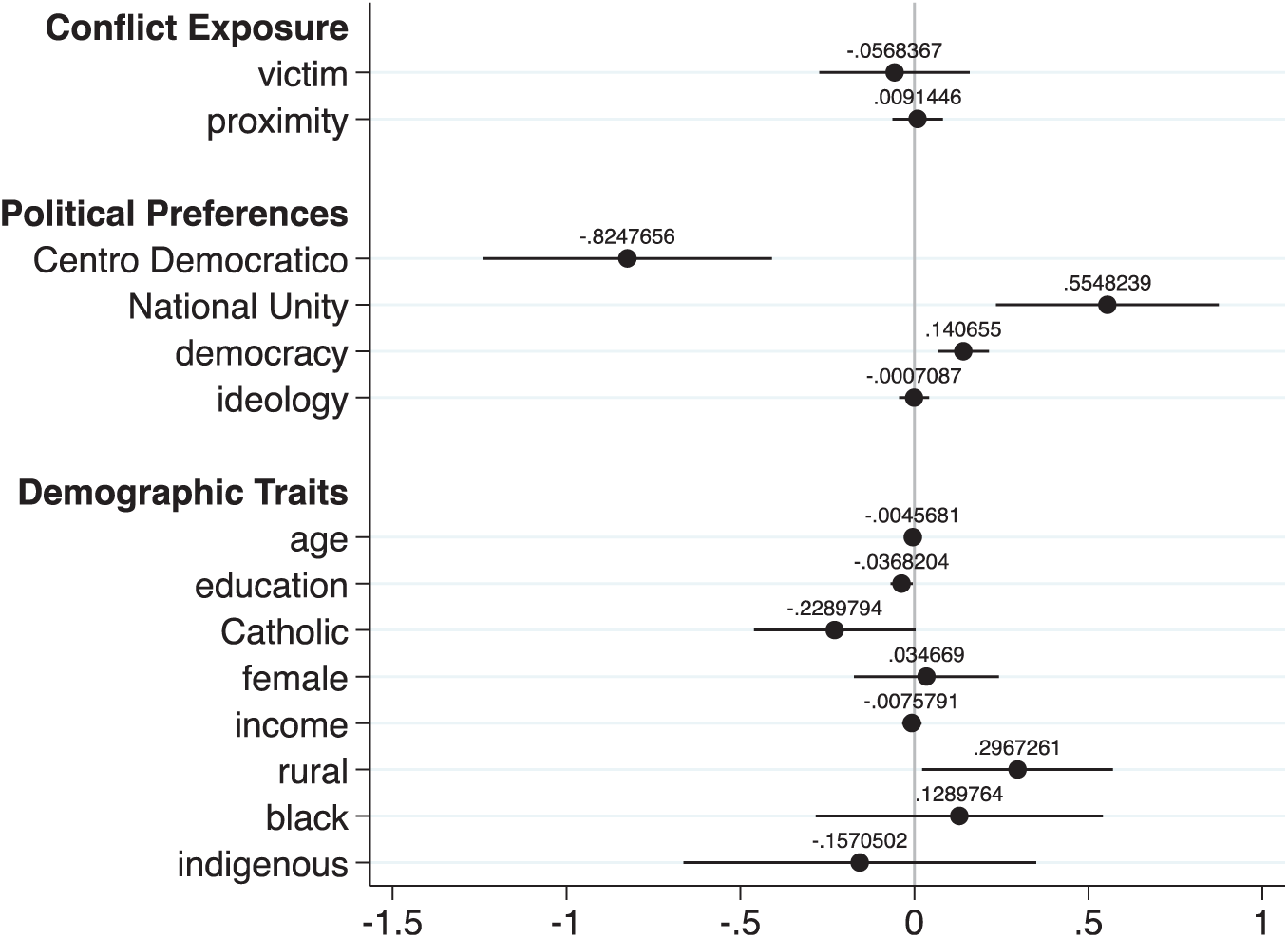
Coefficient plot of variable effects on support for the peace process.
Our conflict exposure variables, concerning the respondent’s household victimization and their geographic proximity to fighting, do not achieve statistical significance. The binary indicator victim is negative; however, the coefficient is not statistically significant at conventional levels. Similarly, the effect of the proximity variable is not differentiable from zero, suggesting that residing in or near an intense conflict zone did not necessarily make a person any more or less likely to support the peace process. Thus, we do not find support for our first hypothesis: Colombians exposed to conflict, either directly or indirectly, were not systematically predisposed to skepticism regarding the peace process.
Conversely, the political preferences covariates demonstrate considerable importance. Respondents who identify with the Centro Democrático party were significantly less likely to support the peace process, whereas those identifying as being sympathetic with the National Unity governing coalition were much more likely to have a favorable opinion of the negotiations. This is in line with our second hypothesis, that Centro Democrático supporters should have been most skeptical of the peace process. In line with Saliyeh and Deng’s (2003) finding that Palestinians who view democracy favorably are supportive of peace talks, it appears as though Colombians who prefer democracy to other political systems also favored negotiations between their government and the FARC. This supports our third hypothesis. However, we do not find evidence in support of our fourth hypothesis: an individual’s identification along a left–right ideological spectrum did not correspond systematically to their opinion of the peace process. 9
Some demographic traits yield additional information about patterns of public opinion regarding the peace process. Rural Colombians were more likely to support the talks than respondents who live in urban areas. 10 Also, individuals with higher levels of education as well as those identifying as Catholic viewed the peace talks less favorably than those with lower degrees of schooling or atheists and those affiliating with other faiths. The latter variable is not statistically significant at the conventional 95% level but is significant at the 90% level, and that is true across the additional models included in the Online Appendix as well. In spite of efforts by the Church to promote a negotiated settlement in this conflict, Catholics appeared to be somewhat less supportive of the talks between the government and the FARC as compared with non-Catholics.
We can use these results to assess the likelihood that a respondent would have been minimally or highly supportive of the peace process, based on his or her traits and conflict experiences. When independent variables are held at median values, the predicted probability that a respondent would be unsupportive of peace talks with the FARC (peace = 1) is 17%. For respondents who identify with the Centro Democrático party, the likelihood that they were not at all supportive of talks increases to 31%. Conversely, that probability decreases to 10% for respondents who identify with a party in the governing National Unity coalition. The likelihood of being unsupportive of peace talks among rural Colombians is 10%, as compared with 17% for urban respondents.
In contrast, the likelihood of an average respondent being highly supportive of the peace process with the FARC (peace =7) is 23%. That likelihood decreases to 12% when the respondent is a supporter of Centro Democrático, but increases considerably to 34% among those identifying with National Unity parties. Rural Colombians were also more likely to be highly supportive of the talks, with a 29% probability of being in the top category of the dependent variable, as compared with 23% of urban respondents.
Discussion
We demonstrate that political preferences were a critical determinant of Colombian attitudes toward the peace talks with the FARC. Interestingly, this is largely in line with what others have found with respect to public opinion regarding peace processes in the Israeli–Palestinian conflict. Even when accounting for other factors that could influence perceptions of the negotiations, supporters of the Centro Democrático party—which was organized in large part around a platform of defeating the FARC militarily—were particularly skeptical of the peace process. Conversely, those who identify with the National Unity governing coalition were especially supportive of talks between the government and the FARC. Just as Steele (2011) finds with respect to patterns of violence in the Colombian civil war, political identity also seems to have had a meaningful impact on civilian support for the peace process in this conflict.
It is perhaps striking that the (reported) conflict-related experiences of respondents and those in their household do not appear to systematically shape attitudes toward negotiations with the FARC. Rather than presuming that people did not allow victimization to affect their perceptions of the current peace process, it is possible that some victims and their relatives were pro-talks whereas others were against them, and this division in attitudes produces a statistically insignificant coefficient. The structure of the survey upon which we rely does not ask the respondent if they directly were victimized, but rather whether they or someone in their household experienced abuse; thus, victims might have held different attitudes toward the agreement as compared with their friends and family that had not suffered abuse directly. This presents a compelling future direction for this area of inquiry, involving a study that facilitates a more detailed understanding of one’s particular experience in conflict to parse out what characteristics of victimization drive someone to be more or less supportive of negotiated settlements.
Certain demographic traits appear to be important determinants of attitudes regarding negotiations as well. Colombians with more years of education, who live in urban areas, and who identify as Catholic were at least somewhat less supportive of peace talks than their counterparts. Unfortunately, we do not have time series data on changes in each respondents’ opinions regarding negotiations, so we cannot determine which categories of individuals were prone to exhibiting decreasing (or increasing) support for settlement over time. This would also be a useful endeavor for future research. Here, we provide initial insight into the factors that can be associated generally with higher and lower favorability toward peace talks with the FARC.
Overall, it is striking to note that many of the voting trends highlighted by experts and journalists following the 2016 plebiscite are very much in line with our findings using data collected more than two years prior to that vote. This suggests that individual preferences regarding negotiated settlements in wars may be quite stable over time, at least for some groups. For example, the lack of support for the agreement among Catholics might not have been wholly the result of “traditional values” campaigning in the weeks leading up to the referendum, but rather a longer-running disapproval of the peace process that was evident in 2014. Furthermore, rural voters and those supporting the National Unity government generally voted in support of the agreement in October 2016—and supported it two years before then as well. Thus, it is likely that some urban residents, Catholics, and Centro Democrático supporters will continue to be skeptical of the subsequent peace agreement that has been reached.
It will be important to find ways incorporate these elements of the population in future peacebuilding efforts so they feel safer and engaged in a post-war society. If that fails to happen, those involved with the peace talks and their implementation need to be equipped to manage the social and electoral backlash likely to ensue if significant portions of the population continue to disapprove of the agreement and its consequences. Efforts to build these connections certainly have been and will continue to be challenging, as they require a willingness to cooperate on both sides of the issue. For example, although President Santos has made efforts to include the Centro Democrático in peace talks with the remaining rebel group Ejército de Liberación Nacional (ELN), Uribe has rejected such overtures of participation. Leaving the door open for moderate members of the Centro Democrático to participate in the future, though, is an important gesture.
This study offers some lessons about what broader segments of the Colombian populace may also be less supportive of efforts to settle with the ELN, so it would be sensible to make an effort to address their concerns during this new peace process wherever possible. The International Institute for Democracy and Electoral Assistance offers a detailed discussion of how communities affected by violent conflict can engage in reconciliation efforts, much of which may be relevant in the Colombian context (Bloomfield et al., 2003). They emphasize solutions such as establishing transitional justice processes early to build on momentum from peace talks, but also more localized efforts like workshops in Northern Ireland hosted by the Glencree Centre that sought to foster and repair relationships within specific communities. Such efforts that include the general public, especially those skeptical of the peace agreement, could be particularly helpful to promote lasting peace in Colombia.
Beyond the Colombian context, we offer some initial insight into the importance of considering systematic patterns in public opinion during peace talks to resolve civil conflicts. Of course, not all negotiated settlements require popular ratification, but many are subjected at least in part to public approval. Having an appreciation of (deep-seated) perceptions of the peace process may help improve efforts to campaign in support of an agreement ahead of a referendum vote, as well as to pre-emptively identify and even incorporate directly some solutions to concerns shared by meaningful groups in society. It is worth exploring whether the seemingly consistent nature of the determinants of Colombian attitudes toward this peace process is also exhibited in other conflicts, such that we can anticipate with more confidence that patterns of public preferences regarding negotiating a peace deal are relatively stable over time.
Supplemental Material
CMP787783_online_appendix – Supplemental material for Determinants of Colombian attitudes toward the peace process
Supplemental material, CMP787783_online_appendix for Determinants of Colombian attitudes toward the peace process by Nicolás Liendo and Jessica Maves Braithwaite in Conflict Management and Peace Science
Footnotes
Acknowledgements
We thank the anonymous reviewers, Jennifer Cyr, Thomas Flores, Caroline Hartzell, Juan Vargas, Chad Westerland, and participants at the Latin American Studies lecture series at the University of Arizona for helpful comments and suggestions. We also thank the Latin American Public Opinion Project (LAPOP) and its major supporters (the United States Agency for International Development, the Inter-American Development Bank, and Vanderbilt University) for making the data publicly available.
Funding
This research received no specific grant from any funding agency in the public, commercial, or not-for-profit sectors.
Notes
References
Supplementary Material
Please find the following supplemental material available below.
For Open Access articles published under a Creative Commons License, all supplemental material carries the same license as the article it is associated with.
For non-Open Access articles published, all supplemental material carries a non-exclusive license, and permission requests for re-use of supplemental material or any part of supplemental material shall be sent directly to the copyright owner as specified in the copyright notice associated with the article.
