




Abstract
What are the effects of war on political behavior? Colombia is an interesting case in which conflict and elections coexist, and illegal armed groups intentionally affect electoral outcomes. Nonetheless, groups have used different strategies to alter these results. This paper argues that differential effects of violence on electoral outcomes are the result of deliberate strategies followed by illegal groups, which in turn result from military conditions that differ between them. Using panel data from Senate elections from 1994 to 2006 and an instrumental variables approach to address potential endogeneity concerns, this paper shows that guerrilla violence decreases turnout, while paramilitary violence has no effect on participation, but reduces electoral competition and benefits non-traditional third parties. FARC violence is significantly higher during election years, while paramilitary violence is lower. This is consistent with the hypothesis that the guerrillas’ strategy is to sabotage elections, while paramilitaries establish alliances with certain candidates.
Introduction
Why do the different playmakers of civil conflict, especially illegal armed groups opposing each other or the state, use divergent strategies to alter voting behavior and affect electoral outcomes? In the case of Colombia, why is it that FARC’s strategy was to sabotage elections and suppress turnout, while the paramilitaries established alliances with candidates and encouraged (or coerced) certain citizens to vote for them? The goal of this article is to show that different non-state armed groups use a wide range of strategies to alter voting behavior and that the choice of such strategies is not random, but rather depends on their military and structural characteristics.
The mechanism proposed in this paper is that military conditions and the strategic interaction between armed groups, elites, and the candidates that represent them, determine the types of instruments used by these groups to alter electoral results. Furthermore, when an illegal armed group establishes territorial control over a populated region, cooperation with the interest groups that coexist in such places becomes feasible and self-enforcing. In the medium and in the long terms, strategic alliances between armed groups or mafias, candidates and economic elites occur as a result of “tacit” agreements, given that these relationships are not enforceable through contracts. Therefore, when a non-state armed group achieves territorial stability, as in the case of mafias and gangs in the US (Gosnell, 1937; Hayde, 2007), militias in Brazil (Hidalgo and Lessing, 2015), gangs in Jamaica (Haid, 2010), paramilitaries in Colombia (Acemoglu et al., 2013; Dube and Naidu, 2015; Lopez, 2010), or many other countries (Carey et al., 2013), violent groups tend to form alliances with candidates and coerce voters into supporting them.
In contrast, when mobility is the basic warfare strategy of an armed group, it is much more difficult to achieve territorial control and to establish strategic alliances with regional elites. Guerrilla groups, in the context of irregular civil wars (Kalyvas, 2006; Kalyvas and Balcells, 2010), make use of guerrilla warfare, in which mobility, surprise attacks, ambushes, and raids are key strategies. Under such conditions, it is more difficult to establish strong ties with politicians and regional elites. This is the case for groups such as FARC in Colombia and Shining Path in Peru. This argument does not state that these types of groups do not achieve territorial control. However, if such control is established in rural, peripheral and unpopulated regions (deserts, jungles or mountains), it is unsurprisingly more difficult for armed groups to form alliances with regional elites. In such cases, violence and elections present themselves as strategic substitutes (Dunning, 2011; Machado et al., 2011; Steele, 2011). For guerrilla groups such as FARC this translates into fighting and sabotaging elections, which becomes the best strategy to challenge opposing political movements that cannot be defeated through votes.
Within this theoretical framework, what are the effects of civil conflict on voting behavior? In order to address potential endogeneity concerns in the relationship between violence and political outcomes, an instrumental variables approach is adopted in this paper, analyzing Senate elections from 1994 to 2006 in Colombia. This paper exploits the fact that, after 1998, FARC attacks were more common around the region in which a failed peace process took place. Additionally, in the case of paramilitary violence, this paper exploits the fact that these groups had special interests on lands suitable for the cultivation of oil palm trees.
My estimations reveal that an additional unit in the rate of FARC attacks (per 100,000 habitants) decreases voter turnout by almost 4 percentage points, while paramilitary violence has no significant effect. These results are robust to different measures of violence. In addition, I find that, after 1998, electoral competition, measured by the vote share of the winning candidate, is lower in municipalities attacked by paramilitaries. Also, after 1998, traditional parties exhibit a decrease in their senate vote shares, while third parties (small, newly created, or non-traditional parties) observe an increase in their shares. This suggests that politicians that established alliances with paramilitaries utilized these new parties as the main channels for acquiring votes. Supplementing this, FARC violence is significantly higher during election years, while paramilitary violence is lower. This is consistent with the hypothesis that the guerrillas’ strategy was to sabotage the elections, while the paramilitaries established alliances with certain candidates.
Overall, these results have important political implications in the actual context of Colombia’s conflict, the peace process with FARC, and the results of the 2016 peace plebiscite. First, if some of the successors of paramilitary groups, in the form of criminal gangs and organized crime, still control entire territories of the country, it can be expected that they employ illicit strategies in order to coerce people into voting against FARC’s newly created political party. As a matter-of-fact, journalistic evidence reveals that in some conflict-prone regions, such as Apartado in the department of Antioquia, illegal organizations coerced voters into rejecting the peace agreements during the plebiscite. In addition, these groups could support right-wing parties that oppose the agreement pursuing the strategy long held by paramilitary groups. Hence, protecting FARC’s candidates is not the only peacebuilding challenge for the Colombian government in the political arena. It is also crucial in impeding right-wing illegal groups from altering electoral competition.
Second, demobilization of the FARC and its commitment to the peace process might imply increased turnout in the regions where they exerted some influence, owing to the removal of militarized suppression and/or mobilization by new FARC political operations. Nonetheless, it is not entirely clear that these effects will take place immediately after demobilization, as the legacies of civil conflict and victimization can endure. Social programs and enhanced state capacity are crucial to counter the potential negative effects of violence on the political engagement of affected communities. In this peacebuilding context, a major challenge for the government is to strengthen social capital among victims. Turnout in affected regions, in a post-conflict scenario, will serve as an outcome variable to test the ability of the State to reincorporate into the political process communities that have been historically excluded.
And third, dissidents of the FARC may continue to exert electoral influence in certain regions of the country. If they achieve territorial control in some places, according to the theory presented in this article, they will establish alliances with candidates and elites and will reduce electoral competition. On the other hand, if they rely on guerrilla warfare, my predictions suggest that turnout will continue to be low in places affected by these dissidents. Furthermore, exacerbation of violence in cities might be an unintended consequence of the peace process. Hence, another major challenge for the government is to thwart the proliferation of illicit electoral strategies in slums and poor neighborhoods of major Colombian cities.
This article is divided into six sections, including this introduction. The relation of the article to the existing literature is discussed in the second section. The third section discusses the empirical strategy proposed to understand the causal effects of civil conflict on voting behavior. The fourth section then describes the data analyzed throughout the paper and provides relevant descriptive statistics. Finally, the main results are presented, demonstrating that FARC attacks decrease turnout, while paramilitary attacks have no impact on turnout, yet have a differential impact on electoral competition and parties’ vote shares after 1998. This section also provides evidence in favor of the proposed mechanism. The paper concludes with the discussion.
Literature
The broad connection between elections and violence has intrigued several authors and inspired interesting studies (Bekoe, 2012; Brass, 2003; Dunning, 2011; Gallego, 2018; Hefner-Burton and Jablonski, 2014; Ley, 2014; Snyder, 2000; Staniland, 2017; Varshney, 2002). This paper represents a contribution to at least four groups of studies that analyze this relationship. First, it is related to the literature pertaining to the political and electoral legacies of civil war (Birnir and Gohdes, 2018; Canetti et al., 2013). Authors like Bellows and Miguel (2009) and Blattman (2009) analyze the causal effects of civil conflict on political behavior, both with optimistic results. Analyzing the Sierra Leone civil war, Bellows and Miguel find that voter registration in postwar elections is higher in areas that experienced increased levels of violence. Blattman finds that forced recruitment leads to an increase in the likelihood of voting. The results presented in this paper are less optimistic, as people have lower levels of political participation in FARC territories.
The paper also echoes the literature on the effects of terrorism on electoral outcomes (Berrebi and Klor, 2006; Bali, 2007; de la Calle and Sanchez-Cuenca, 2013; Gassebner et al., 2008; Gould and Klor, 2010). Montalvo (2010), for instance, using al Qaeda’s terrorist attacks in Madrid, shows how these events have the capacity to affect how people vote. Within the context of the Israel–Palestine conflict, authors like Getmansky and Zeitzoff (2014) and Berrebi and Klor (2008) show that terrorism causes an increase in the relative support for right-wing parties. In a similar vein, Kibris (2011) shows that PKK attacks in Turkey make voters punish the incumbent and support less concessionist parties. In this paper a strong connection between paramilitary attacks and support for right-wing parties is also found, but for different reasons that will be discussed below.
The third group of studies closely related to this paper corresponds to the literature on the strategic use of violence to obtain votes. Wilkinson (2006) offers an interesting account of the relationship between conflict and democracy, showing how ethnic riots are employed as a means to encourage people to vote. Norton (2007) studies how Hezbollah has influenced Lebanese domestic politics, demonstrating that this group’s mix of violence and politics has been electorally successful. In the context of Nigeria’s 2007 presidential election, Collier and Vicente (2014) find that intimidation and violence, mainly used by weak parties and challengers, are effective in reducing voter turnout. These results are consistent with the finding of this paper that attacks affect variables such as turnout and competition, and that violence has been strategically used to alter elections.
Finally, this paper relates to the burgeoning literature on the political economy of paramilitaries and insurgencies in Colombia (Carreri and Dube, 2017; Daly, 2012; Flores, 2014; Steele, 2011). Several studies have shown how these groups established alliances with certain candidates and forced voters to support them (see for example Acemoglu et al., 2013; Garcia, 2008; Hoskin and Garcia, 2003; Lopez, 2007, 2010; Romero, 2007). Dube and Naidu (2015) study the connection between US aid, paramilitary violence and electoral outcomes. Steele (2011) claims that displacement perpetrated by paramilitaries in the city of Apartado was strategic and ideologically oriented. Even though these studies provide insight on the connection between violence and elections in Colombia, guerrilla strategies are usually absent in these accounts, Weintraub et al. (2015) being a notable exception.
Empirical strategy
To uncover the effect of conflict on voting behavior, this paper analyzes Colombian Senate elections at the municipality level, for election-years 1994, 1998, 2002, and 2006. Senate elections are analyzed in this paper to show the magnitude of the problem, as illegal groups were able to shape the composition of national-level entities like the Congress. Former paramilitary leaders claimed that 30% of the Congress was under their control. When presidential or local elections are analyzed, similar results arise, especially in terms of turnout (results not reported). Also, the analysis stops in 2006, the last year of demobilization of most paramilitary units after their peace process with the Uribe government. Many dissident groups emerged after 2006, but their structure, motivations and modus operandi were different. Also, as mentioned previously, one of the main challenges for the Colombian government in the post-conflict scenario is to deter any political influence that dissidents and new factions may exert.
Given that Colombian senate elections take place in March and that, in contrast, yearly measures of violence are used, the main specifications use lagged variables. Thus, for example, it is better to use the 1997 rate of FARC attacks to describe what happened in 1998, because otherwise post-electoral measures would be used. In proceeding like this, it is also possible to mitigate, to some extent, potential endogeneity existing between political outcomes and violence. Naturally, this argument does not hold if armed groups have the capacity of anticipating, some months in advance, how many people will turn out or how they will vote in certain municipalities.
The basic specification estimated in this paper calculates, through a linear regression, the effect of FARC, paramilitary, and State attacks on voter turnout, controlling for municipality and election-year fixed effects, and time-varying municipality level controls. Year effects control for municipality invariant characteristics that are common for a given year and that might be correlated with civil conflict. For instance, if the cancelation of the Caguan peace process in 2001 had a national-level impact on turnout common to all municipalities, this effect will be captured by the year dummies. Municipality fixed effects control for time-invariant characteristics of each municipality, such as climatic and geographic conditions, which tend to be correlated with war. Therefore, we estimate:

where the dependent variable
From Equation (1), it is clear that the coefficients
Even though Equation (1) includes lagged measures of FARC and paramilitary attacks, it is a concern that these groups could anticipate the level of voter turnout in certain municipalities and attack them accordingly. For instance, if FARC’s objective is to sabotage elections, they might attack municipalities in which they expect a high voter turnout. Also, paramilitaries could become active in regions in which low turnout rates are expected, in order to encourage support for their candidates. These forms of reverse causality would lead to endogeneity, biasing the estimations based on Equation (1).
An instrumental variables strategy is used to address this potential endogeneity problem. Given that there are two potentially endogenous regressors, FARC and paramilitary attacks, at least two excluded instruments are needed. Each instrument must be correlated with the respective endogenous regressor, but uncorrelated with the error term. Additionally, given the fixed effects specification followed throughout the paper, time-varying instruments are needed. In the case of the rate of FARC attacks, distance to Caguan will be used in interaction with a post 1998 dummy variable. The discussion given in the previous section justifies this instrument. The post 1998 dummy equals 1 for election-years 2002 and 2006, after the Caguan peace process was aborted and Plan Colombia was launched. Therefore, and as a consequence of the strengthening of the State forces, during these years FARC attempted to retain the control of municipalities close to Caguan. In this region, the guerrillas were able to develop a fully integrated chain of coca cultivation and cocaine production (Mejia and Rico, 2010). Therefore, it is expected that, after 1998, as distance to Caguan increases, the rate of FARC attacks will decrease. In addition, it is hard to think that this instrument might affect voter turnout through a different channel. Why would citizens further away from the demilitarized zone vote more (or less) after 1998, if it is not because of the incidence of FARC attacks?
It could be argued that distance to Caguan is not the best instrument for FARC attacks, as this group was present in other distant regions, such as Choco, Catatumbo, and Nariño. While this is true, it is clear that places near to Caguan were more likely to have FARC presence. Additionally, the estimations presented below reveal that the instrument is not weak, reflecting the fact that there is a positive correlation between distance to Caguan and FARC attacks. It is not perfect, as other places matter, but it is strong enough to serve as an instrument. Also, it could be the case that if the State responds to target FARC zones and addresses electoral violence, the exclusion restriction will be violated. It is important to say that the results still hold even when we control for government attacks, so this potential violation should not be of concern here.
In the case of paramilitary attacks, we exploit the fact that after the 1998 expansion, these groups became involved in the cultivation of oil palm trees, which grow under very specific geographic and climatic conditions. In particular, and according to Mingorance et al. (2004), this tree grows in lands less than 500 m above the sea level, and with average temperatures between 22 and 32°C. Given these characteristics, a dummy variable is created, indicating if a municipality satisfies the conditions for cultivation of oil palm trees. 2 This indicator variable is interacted with the post-1998 dummy, because it is expected that, in 2002 and 2006, years in which the paramilitaries had already consolidated their expansion and demobilized, attacks in these municipalities should have decreased. In particular, attacks in 1998 are expected to be much higher in these municipalities than later, because in this year the AUC were consolidating the control of these regions. Therefore, this study expects that after 1998, municipalities suitable for the cultivation of oil palm trees will have a lower rate of paramilitary attacks, so that the instrument is correlated with the endogenous regressor. Also, it is reasonable to believe that this interaction is uncorrelated with any other factor that might affect voter turnout, satisfying the exclusion restriction. In this context, the first stage equations estimated are given by:

where Farcit−1 and Parasit−1 once more represent the rate of attacks per 100,000 inhabitants of FARC and paramilitaries, respectively. Here,
The second stage is given by:

where
Data
The main conflict-related dataset used in this analysis comes from the Conflict Analysis Resource Center. Based on event-counting, this dataset reports actions (attacks, bombings, murders, etc.) committed by the actors involved in the Colombian civil conflict (State forces, paramilitaries, and guerrilla groups), as well as clashes between them, at the municipality level (for a total of 1077 municipalities) and from 1988 to 2009 (Restrepo et al., 2004). The National Registry provides the basic electoral data; geographical controls for Colombian municipalities are provided by the Center for Study of Economic Development at Universidad de los Andes. Summary statistics are reported in the Online Appendix.
Results
FARC and paramilitary attacks and voter turnout
In this section, the main results of the effects of civil conflict on voter turnout are presented. Table 1 presents ordinary least squares (OLS) estimates of Equation (1). In the complete inventory of specifications, municipality fixed effects and time fixed effects (with year 1994 as the baseline) are included and standard errors are clustered at the municipality level. Columns 1–4 show that the rate of FARC attacks has a negative and significant effect on voter turnout. Columns 1 and 2 do not include time-varying controls at the municipality level, although column 2 indicates that this result is robust to the inclusion of lagged rates of attacks (i.e. rates two years before each election). In columns 3 and 4, the interaction of year dummies with time-invariant measures of population, population density, coca cultivation and education is included. The same result holds: municipalities with a higher rate of attacks per 100,000 inhabitants tend to have a lower level of turnout.
Effect of attacks on turnout

Notes: Standard errors clustered at the municipality level are shown in parentheses. Election years in the sample are 1994, 1998, 2002, and 2006. Turnout is the percentage of eligible voters who cast a ballot. Farc, Paras, and State Attacks are the rates of attack of each group per 10,000 habitants the year before the election. Time-varying controls include the natural log of population, population density, coca cultivation, and education, interacted with year dummies. * Significant at the 10% level; ** significant at the 5% level; *** significant at the 1% level.
The coefficient associated with column 1, the simplest specification, shows that a unit increase in the rate of attacks per 100,000 inhabitants reduces turnout by about 0.157 percentage points. Given that for municipalities with a non-zero rate of attacks the average rate is 7.01, turnout is about 1 percentage point lower for an average municipality attacked by FARC when compared with safe municipalities. Although these numbers might seem small, endogeneity could be reducing the real effects if FARC attacks municipalities in which a high turnout rate is expected.
In contrast, the coefficient associated with the rate of paramilitary attacks is insignificant in all of the specifications. This result suggests that paramilitary violence has a different effect on turnout, consistent with the idea that the strategies employed by both illegal groups to alter electoral results differ. If it is accepted that paramilitaries make alliances with politicians and sponsor certain candidates, it might seem surprising that the effect is not significant and not positive. Nonetheless, this result is still consistent, because it is not necessary to increase turnout in order to make a candidate win. It might be sufficient to suppress opposers’ turnout and to encourage supporters of the sponsored candidate. Naturally, if paramilitary intervention is not having an evident effect on turnout, it is desirable to determine if any other variable is being influenced by the violence of these groups. 4
Table A3 in the Online Appendix shows that these results are robust to alternative measures of conflict. In alternative specifications conflict is measured using the average rates of attacks by each group during the three immediate years that precede an election, a dummy variable indicating if a municipality had one or more attacks in a given year, or a measure of clashes between legal and illegal groups. In any case the main result holds: places attacked by FARC exhibit lower levels of turnout, while paramilitary actions have no clear effect. For the rationale behind each measure, refer to the Online Appendix.
Causal effect of attacks on turnout
As discussed above, reverse causality might lead to biased estimates of the effects of civil conflict on voter turnout. For instance, if FARC forms a (precise) expectation of the turnout rate in municipalities, and attacks municipalities expected to have a high turnout rate in order to deter voters from casting their votes, a form of reverse causality would generate a downward bias of the estimates reported in Table 1. Such a strategy makes sense if one of the objectives of this group is to sabotage elections and challenge the status quo. Conversely, if their strategy is to attack municipalities with low levels of turnout, because in these places the state’s presence is weak or non-existent, therefore making it easier to attack, then the estimates will have an upward bias. To address these potential endogeneity issues, an instrumental variable approach is used as discussed in the empirical strategy section. Table 2 reports the causal effects of FARC and paramilitary violence on voter turnout, using two-stage least squares (2SLS) estimations.
Instrumental variables estimation
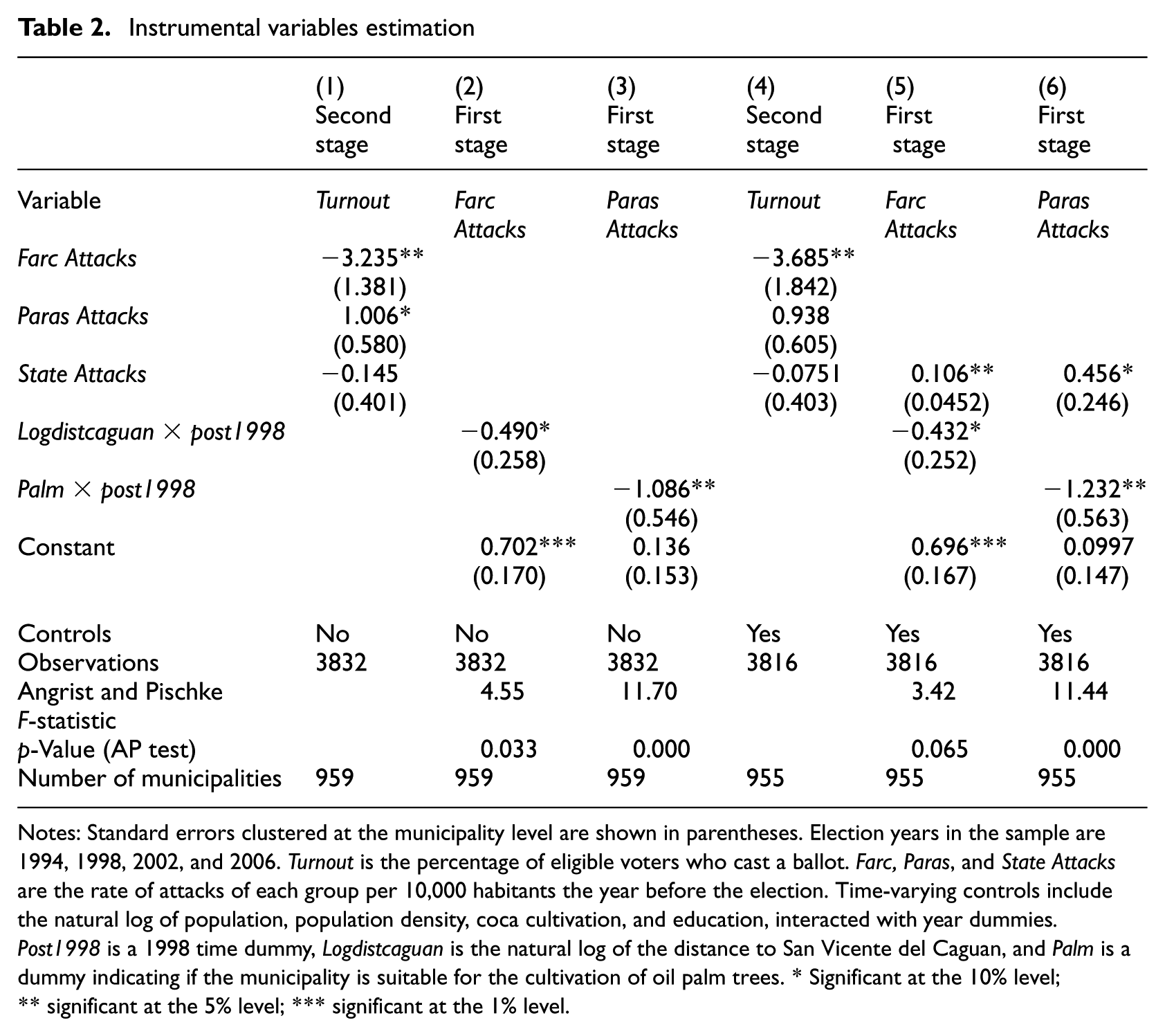
Notes: Standard errors clustered at the municipality level are shown in parentheses. Election years in the sample are 1994, 1998, 2002, and 2006. Turnout is the percentage of eligible voters who cast a ballot. Farc, Paras, and State Attacks are the rate of attacks of each group per 10,000 habitants the year before the election. Time-varying controls include the natural log of population, population density, coca cultivation, and education, interacted with year dummies. Post1998 is a 1998 time dummy, Logdistcaguan is the natural log of the distance to San Vicente del Caguan, and Palm is a dummy indicating if the municipality is suitable for the cultivation of oil palm trees. * Significant at the 10% level; ** significant at the 5% level; *** significant at the 1% level.
In column 1 of Table 2, the second stage results (Equation 2) are reported. Once more, the rate of FARC attacks per 100,000 habitants has a negative and significant effect on voter turnout. Importantly, the magnitude of the estimated parameter is larger (in absolute value) than any of the coefficients reported in Table 1. This finding suggests that without instrumenting the endogenous regressors, the OLS estimates are downwardly biased. Therefore, these results suggest that FARC attacks municipalities in which political participation is expected to be high, which is consistent with the idea that violence is used strategically to alter electoral outcomes or simply to sabotage the electoral process. In this case, the estimations suggest that a unit increase in the rate of attacks per 100,000 habitants reduces turnout by about 3.2 percentage points. This is certainly a non-negligible effect as turnout is about 22 percentage points lower for an average municipality attacked by FARC when compared with a safe municipality—keeping in mind that for municipalities with a non-zero rate of attacks the average rate is 7.01. The effect is robust and even higher after municipality time-varying covariates are controlled. In such a case, the estimated coefficient is about −3.7, suggesting that the predicted difference in turnout between a non-attacked municipality and one with the average rate among attacked municipalities is approximately 26 percentage points.
Column 1 in Table 2 shows, for the first time, that paramilitary attacks have a positive and significant influence on turnout. However, significance disappears once time-varying controls are included as reported in column 4. Once more, this result demonstrates consistency with the concept that paramilitary violence has a non-negative effect on turnout, as these groups formed alliances with politicians and, in many cases, coerced citizens to participate and support their candidates.
Finally, columns 2, 3, 5, and 6 in Table 2 present the first stage results. In both cases, the interaction between the (log) distance to Caguan and the post 1998 dummy variable has a negative and significant effect on the rate of FARC attacks. This is consistent with the idea that in 2001 and 2005, after the Caguan process was over and President Uribe launched his anti-insurgency strategy against the guerrillas, violence close to the former demilitarized zone became more intense. This is not surprising given that during the peace process FARC increased its control over regions around Caguan, intensifying the production of illegal crops (coca) in these places. Therefore, after the peace process ended with the State army going after the insurgents in these regions, the increase in unilateral attacks reveals FARC’s attempt to defend the area and preserve control over it.
In addition, the interaction between the palm condition dummy and the post 1998 indicator variable has a negative and significant coefficient in both cases (with and without controls). This result suggests that, in 2001 and 2005, after the paramilitaries consolidated their expansion, the rate of unilateral attacks in municipalities suitable for the cultivation of palm tree was lower. This is consistent with the hypothesis that, if the paramilitaries gained control of these lands between 1997 and 2001, they were not interested in perpetrating attacks that could alter the exploitation of these lands.
Given that there are two endogenous regressors (FARC and paramilitary attacks), Angrist and Pischke’s F statistic is a suitable test for weak identification (Angrist and Pischke, 2009). Using these criteria for the two instruments, statistics reported in the table reveal that it is possible to reject the null hypothesis that the rates of FARC and paramilitary attacks are weakly identified. Consequently, the first stage results suggest that the excluded instruments are not weakly correlated with the endogenous regressors.
Electoral competition and parties’ vote shares
If the paramilitaries have no effect on voter turnout, which variable is affected by their presence? Acemoglu et al. (2013) show that in regions affected by paramilitary violence, after these actors got involved in politics, the change in third (non-traditional) parties’ vote share was higher than in regions without paramilitary presence. Their argument is that para-politicians used this type of party, instead of traditional parties, in order to win elections. Here, an alternative approach is employed. As previously argued, increasing turnout is not necessary for a candidate to win. But if the paramilitaries were supporting certain candidates in their regions after 1998, these places should exhibit different patterns in terms of electoral competition. The maximum vote share in each municipality is used as a measure of competition. 5
Table 3 presents the basic results of this analysis, where only years 1998, 2002, and 2006 are studied. 6 Columns 1–4 use the maximum vote share as the dependent variable. It is clear that, on average, neither FARC nor paramilitary attacks have a significant effect on this variable. However, in specifications 3 and 4, FARC and paramilitaries’ rates of attacks interact with year dummies for the purpose of identifying if there are any differential effects across time. The results are quite interesting. Compared with 1998, in 2002 and 2006 (after the paramilitaries became involved in politics), the maximum vote share tended to be higher as paramilitary attacks increased. These findings suggest that, in regions with paramilitary presence, after they became involved in politics, electoral competition was lower. Naturally, this result supports the idea that these self-defense right-wing groups were intentionally altering electoral outcomes. The results do not hold in the case of FARC violence. Furthermore, columns 5 and 6 show that this pattern does not hold for voter turnout. This suggests that it is necessary to look at other types of variables in order to determine how the paramilitaries affected elections. It is important to note that given the degree of control that paramilitary groups had in “their” regions, it was difficult or impossible for the opposition (left-wing, and in some cases, traditional) parties to counter their strategies.
Conflict and electoral competition
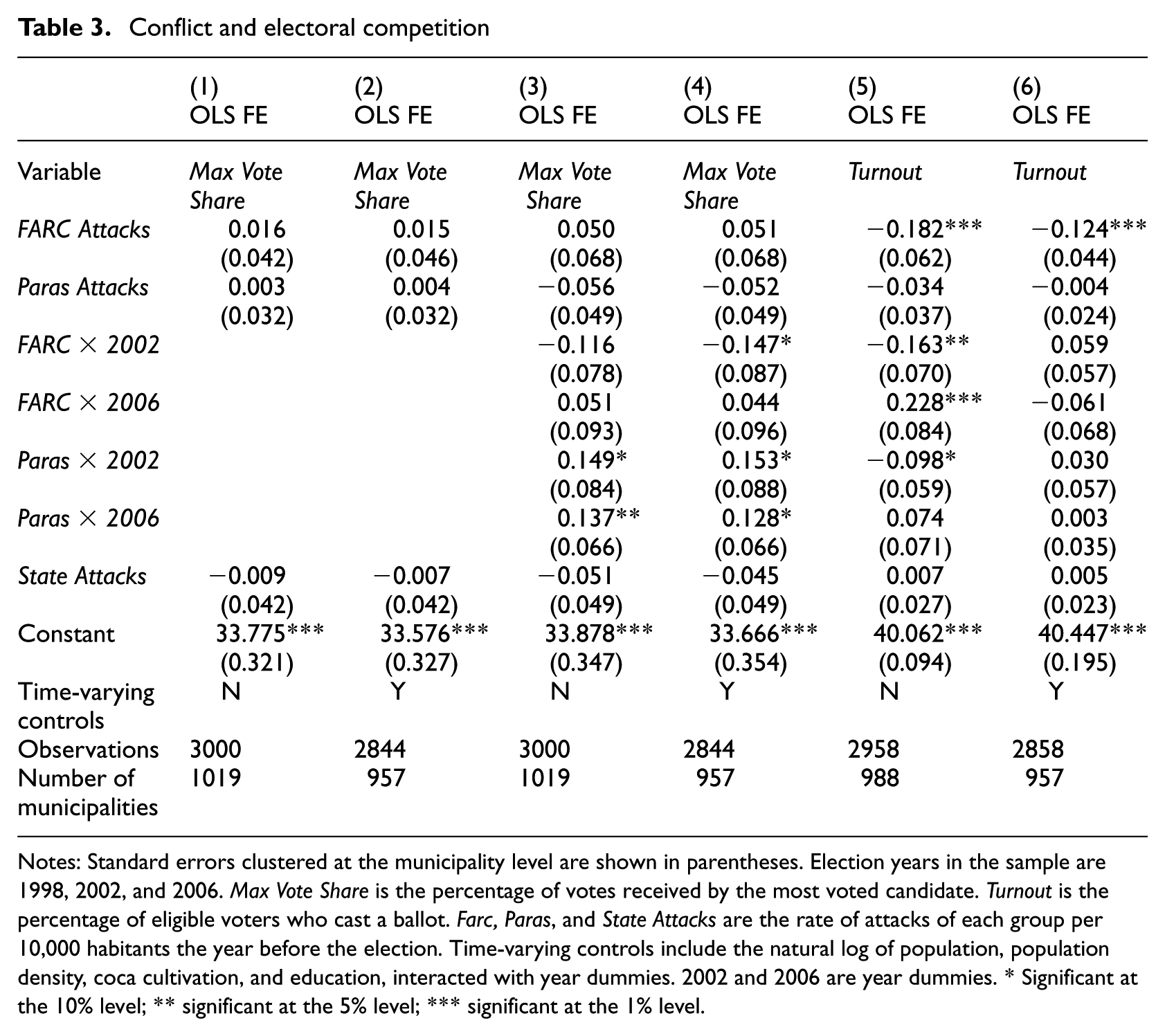
Notes: Standard errors clustered at the municipality level are shown in parentheses. Election years in the sample are 1998, 2002, and 2006. Max Vote Share is the percentage of votes received by the most voted candidate. Turnout is the percentage of eligible voters who cast a ballot. Farc, Paras, and State Attacks are the rate of attacks of each group per 10,000 habitants the year before the election. Time-varying controls include the natural log of population, population density, coca cultivation, and education, interacted with year dummies. 2002 and 2006 are year dummies. * Significant at the 10% level; ** significant at the 5% level; *** significant at the 1% level.
Naturally, if the paramilitaries were affecting electoral competition, with the maximum vote share obtained by a candidate increasing after 1998, there should be winners and losers from this process. As in Acemoglu et al. (2013), Table 4 shows that third parties exhibit an increase in their vote share after paramilitary involvement in politics. Columns 3 and 4 show that the interactions between paramilitary attacks and the time dummies for 2002 and 2006 are positive and statistically significant. 7 Column 3 displays estimations without controls, which are included in column 4. These results suggest that there is a differential growth effect for these years as compared with 1998. The coefficients of 0.258 and 0.337 reported in column 4 reveal, for instance, that holding everything else constant, if a municipality has the average attack rate of an attacked municipality (instead of having a rate of zero paramilitary attacks), third parties’ vote share is about 3 percentage points higher in 2002 and about 4 points higher in 2006. 8 Therefore, empirically these findings support the claim that in 2002 and 2006, after the paramilitaries became involved in politics, third parties were the channel used by these groups to alter electoral outcomes.
Third parties vs traditional parties
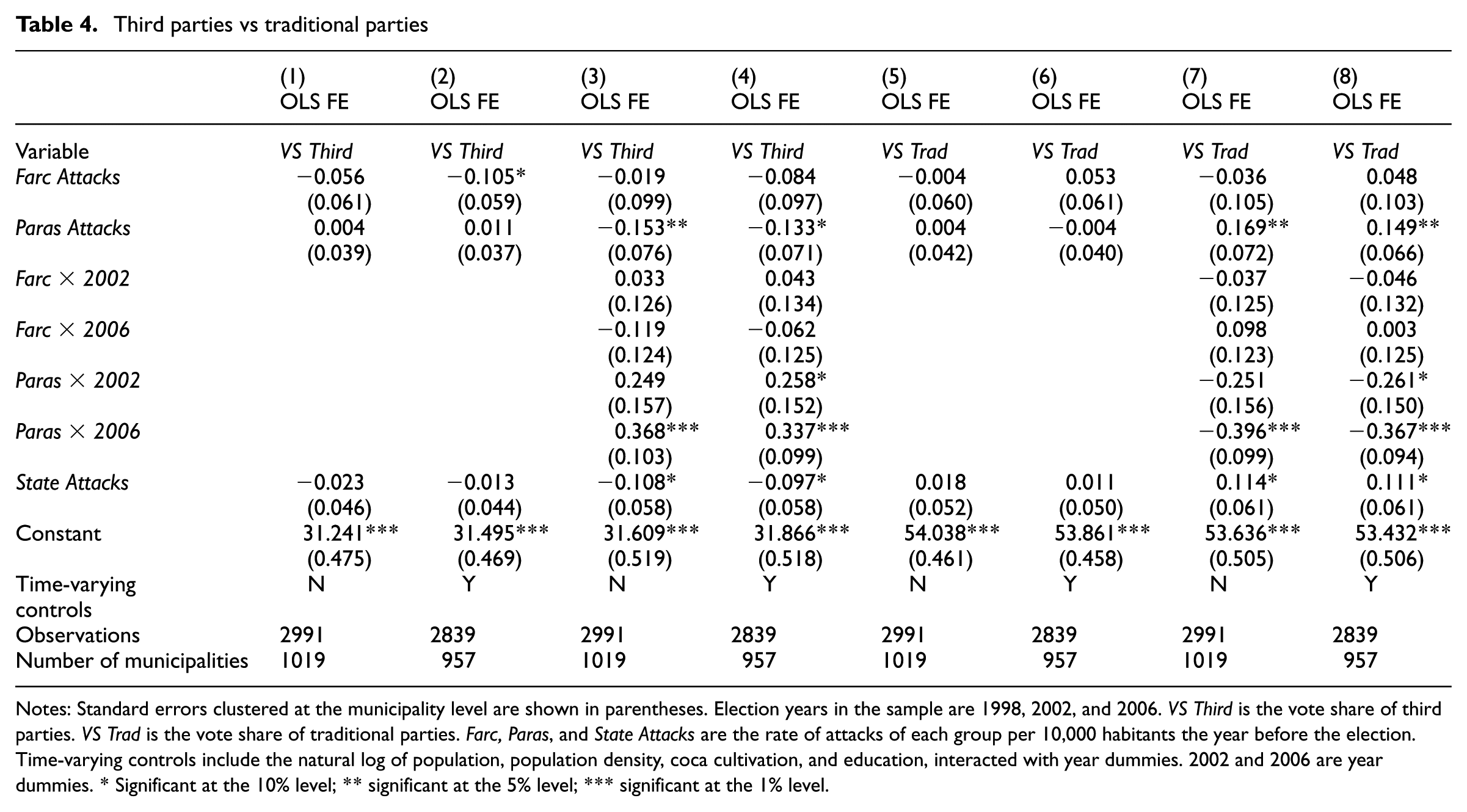
Notes: Standard errors clustered at the municipality level are shown in parentheses. Election years in the sample are 1998, 2002, and 2006. VS Third is the vote share of third parties. VS Trad is the vote share of traditional parties. Farc, Paras, and State Attacks are the rate of attacks of each group per 10,000 habitants the year before the election. Time-varying controls include the natural log of population, population density, coca cultivation, and education, interacted with year dummies. 2002 and 2006 are year dummies. * Significant at the 10% level; ** significant at the 5% level; *** significant at the 1% level.
Columns 3 and 4 show that FARC violence does not have an equivalent impact on third parties’ vote share. This result suggests that the decrease in turnout caused by FARC presence has an equivalent effect on all political parties and that this group is not strategically reducing turnout on a selective basis.
In columns 7 and 8, it is shown that the traditional parties (Liberal and Conservative parties) are the main losers of this process. The negative and significant coefficients associated with the interactions of the rates of paramilitary attacks and the time dummies reveal that the vote shares of these parties exhibited a differential decrease as compared with 1998. Again, these findings are consistent with the idea that paramilitary influence was not channeled through the Liberal or Conservative parties. Also, these columns reveal that FARC attacks have no distinctive effect across time on the vote share of these parties. Finally, Table 5 shows that these effects are mainly a consequence of a differential reduction in the Liberal party’s vote share. Columns 3 and 4 show that, in 2002 and 2006, there is a reduction in this party’s vote share, whereas columns 7 and 8 show that there is no significant effect of paramilitary attacks on the Conservative party’s share. This result is consistent with the fact that many Liberal politicians, after 1998, left this party to join or create new organizations. 9 Table A4 in the Online Appendix illustrates that all the results of the effects of paramilitary violence on party vote shares are robust to an alternative measure of conflict, a dummy variable indicating if municipality i had any form of (FARC or paramilitary) attack in a given year.
Liberal and Conservative parties
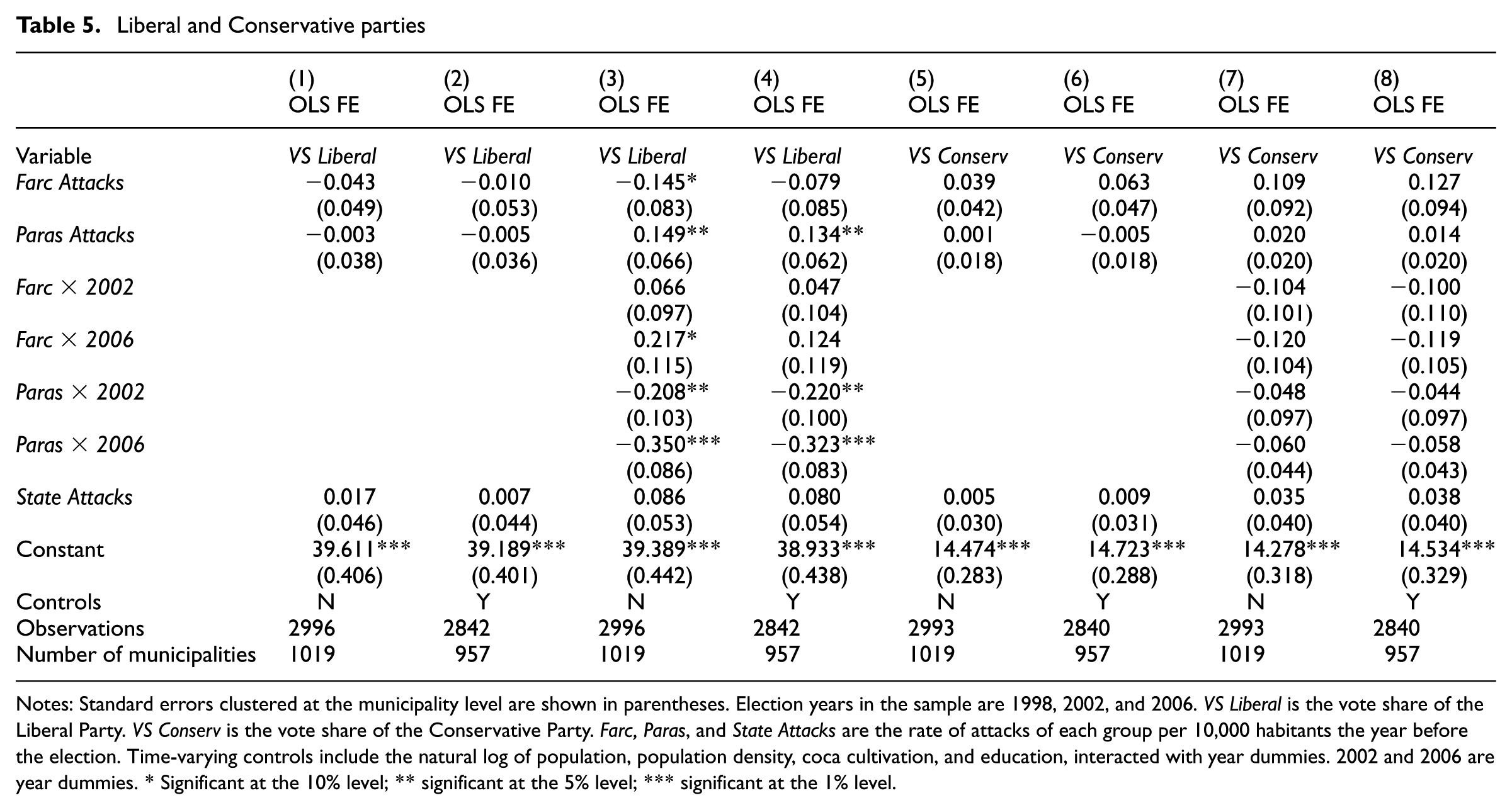
Notes: Standard errors clustered at the municipality level are shown in parentheses. Election years in the sample are 1998, 2002, and 2006. VS Liberal is the vote share of the Liberal Party. VS Conserv is the vote share of the Conservative Party. Farc, Paras, and State Attacks are the rate of attacks of each group per 10,000 habitants the year before the election. Time-varying controls include the natural log of population, population density, coca cultivation, and education, interacted with year dummies. 2002 and 2006 are year dummies. * Significant at the 10% level; ** significant at the 5% level; *** significant at the 1% level.
Overall, the results presented here support the idea that FARC’s strategy is to suppress turnout, while the paramilitaries want to affect electoral outcomes (in favor of third parties and against traditional parties, especially the Liberal Party) and electoral competition (with higher maximum vote shares in paramilitary regions).
Testing the mechanism
The mechanism proposed in this paper has two components. First, the impact of violence on voting outcomes is the result of deliberate strategies followed by illegal armed groups to alter the elections. And second, these strategies respond to military and structural conditions that characterize the groups and their interactions with civilians. To support this mechanism, this paper proceeds in two stages. First, to support the idea that strategies are deliberate, each group’s rate of attacks on electoral years vs non-electoral years is analyzed. Second, to show that military conditions matter, the fact that FARC’s situation has changed over time is exploited. Indeed, as a consequence of the strengthening of the Colombian state after 2002, when president Uribe launched his anti-insurgency campaign, the guerrilla group lost control of many regions and had to rely more on typical guerrilla warfare.
Table 6 reports the main results of OLS regressions where FARC or paramilitary attacks are the outcomes, as a function of dummies indicating election years and municipality-level controls and fixed effects. Columns 1 and 3 suggest that, during electoral years, the rate of FARC attacks is significantly higher. For the rate of paramilitary attacks, the result is the opposite. Hence, these results support the mechanism proposed above to explain the divergent effect of FARC vs paramilitary violence on voting behavior.
Attacks during election years
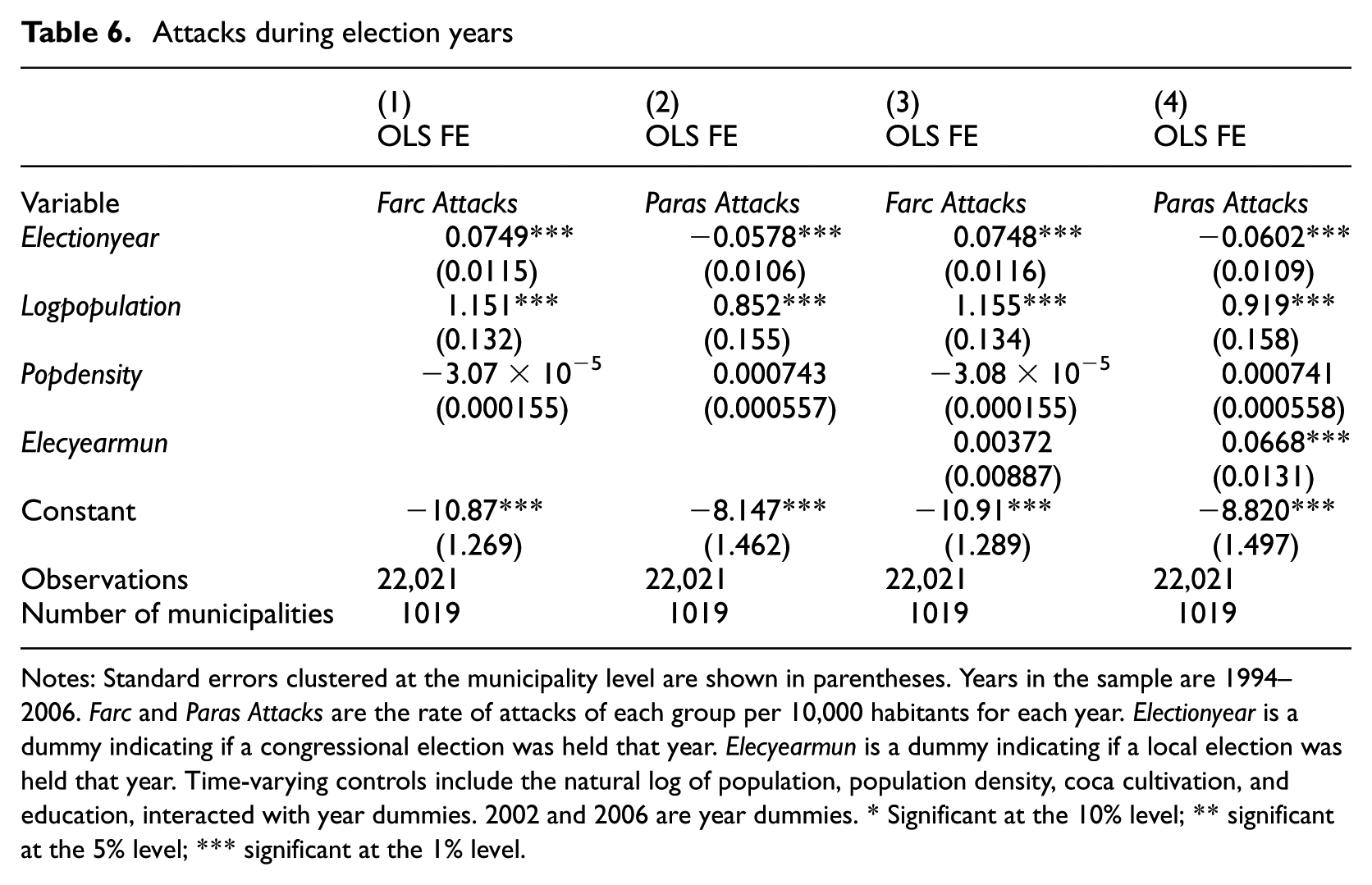
Notes: Standard errors clustered at the municipality level are shown in parentheses. Years in the sample are 1994–2006. Farc and Paras Attacks are the rate of attacks of each group per 10,000 habitants for each year. Electionyear is a dummy indicating if a congressional election was held that year. Elecyearmun is a dummy indicating if a local election was held that year. Time-varying controls include the natural log of population, population density, coca cultivation, and education, interacted with year dummies. 2002 and 2006 are year dummies. * Significant at the 10% level; ** significant at the 5% level; *** significant at the 1% level.
Finally, Table 7 shows that the effect of FARC violence on turnout varies over time as suggested by the proposed mechanism. Different measures of conflict are used in each column. In every specification, the coefficient of the interaction between FARC attacks and a post 2002 dummy is negative and significant. These findings show that, after 2002, FARC attacks have an increased (negative) impact on turnout, supporting the hypothesis that the strengthening of the Colombian state and the retreat of FARC in many regions made them more reliant on sabotage and suppression as strategies for altering elections.
Effect of conflict on turnout after 2002
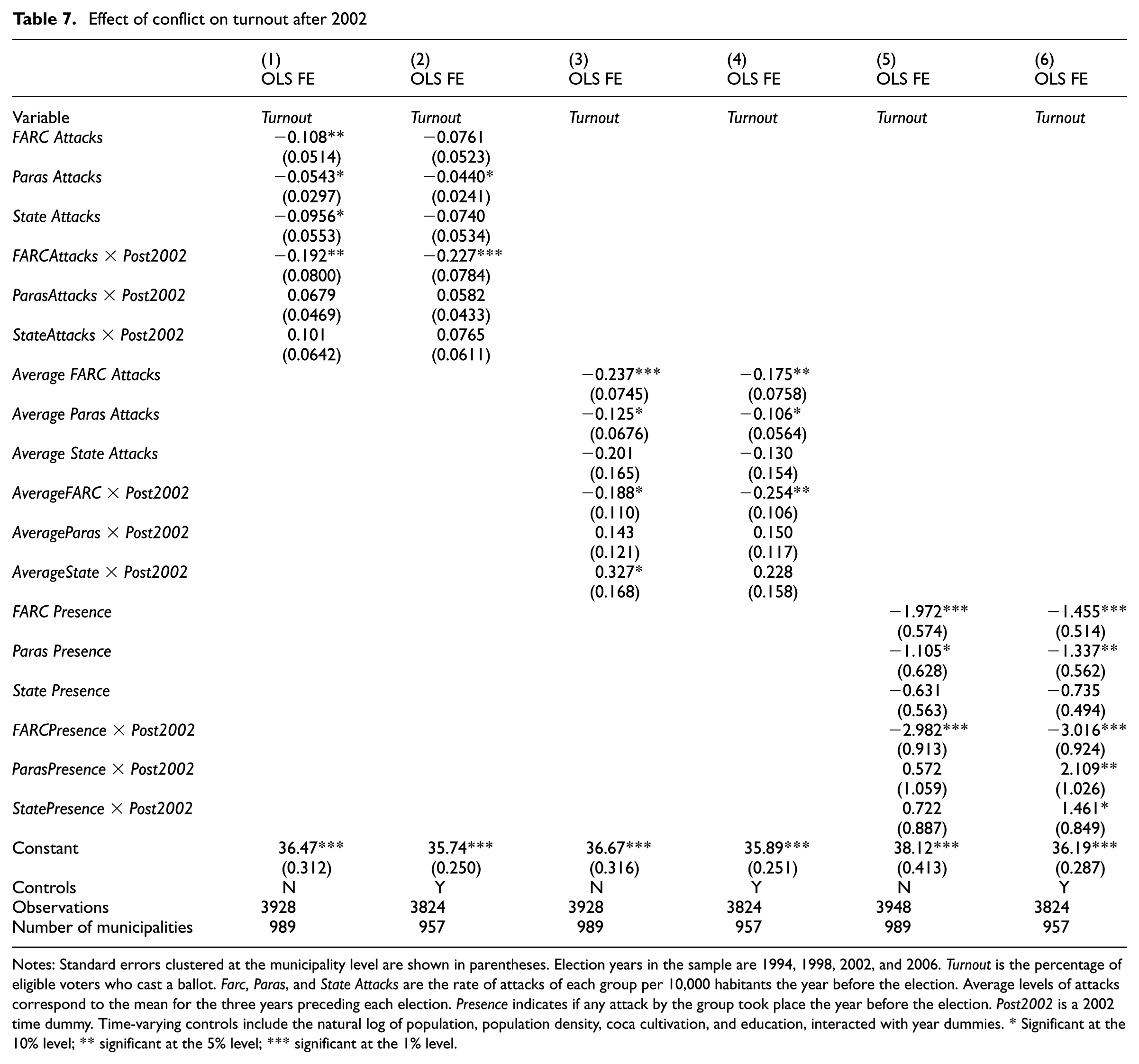
Notes: Standard errors clustered at the municipality level are shown in parentheses. Election years in the sample are 1994, 1998, 2002, and 2006. Turnout is the percentage of eligible voters who cast a ballot. Farc, Paras, and State Attacks are the rate of attacks of each group per 10,000 habitants the year before the election. Average levels of attacks correspond to the mean for the three years preceding each election. Presence indicates if any attack by the group took place the year before the election. Post2002 is a 2002 time dummy. Time-varying controls include the natural log of population, population density, coca cultivation, and education, interacted with year dummies. * Significant at the 10% level; ** significant at the 5% level; *** significant at the 1% level.
To sum up, the results of this section support the hypothesis that attacks by the two different illegal organizations have different effects on voting outcomes as a consequence of divergent strategies deliberately used by these groups. In turn, such strategies result from military conditions that differentiate FARC from paramilitaries. It could be argued that these results are conditional on the time period chosen for the analysis and that groups behave in a different way during other periods. For instance, Steele (2011) shows how the paramilitaries sabotaged elections during the 1990s using a cruel strategy: displacing potential voters of left-wing parties in Apartado, Colombia. This evidence supports the main hypothesis presented in this paper: precisely when paramilitaries had no territorial control, as they were fighting for it, they relied on turnout suppression to alter electoral results. Similarly, it could be argued that at times and in certain places, FARC made alliances with some candidates and coerced voters to support them. Again, this goes in line with the arguments of this paper, as such strategies were employed by FARC whenever they had territorial control over a region. 10 But when they lost territorial control and had to rely more on guerrilla warfare, as was the case in the post-2002 period, forming alliances became impossible, making suppression the second-best strategy to alter electoral outcomes.
Conclusion
A clear understanding of how illegal groups alter democracy is fundamental, given the wave of democratization that took place in the last decades around the world. The main challenge raised by the findings of this article is to explain why different illegal armed groups use distinctive strategies to alter electoral outcomes. Here, one possible explanation is proposed: the relation between illegal groups and the local elites determines the behavior of these organizations. The dynamics of war support this explanation. Structural conditions that define Colombia’s conflict might explain these patterns.
Even though the Colombian case is interesting and dramatic, studies like Wilkinson (2006) and Collier and Vicente (2014) reveal that in many other contexts there is a clear relation between conflict and political behavior. Why is it the case that different groups use different strategies to alter electoral results? Is it always the case that right-wing armed groups form alliances with incumbents and elites in order to perpetuate the status quo? Is it always the case that insurgent groups attack democratic institutions suppressing turnout? Naturally, in order to understand the patterns found in this paper, and in order to answer these questions and challenges, we need a general theory of how illegal armed groups affect electoral outcomes in a context of civil war. That should be the next step.
Supplemental Material
Gallego_CMPS_Appendix – Supplemental material for Civil conflict and voting behavior: Evidence from Colombia
Supplemental material, Gallego_CMPS_Appendix for Civil conflict and voting behavior: Evidence from Colombia by Jorge Gallego in Conflict Management and Peace Science
Footnotes
Acknowledgements
I would like to thank Mario Chacon, Oeindrila Dube, John Ferejohn, Thomas Flores, Jennifer Hill, Andrew Little, Rebecca Morton, Benjamin Pasquale, Adam Przeworski, Pablo Querubin, Andres Rosas, Jorge Restrepo, Daniel Rico, Alexandra Scacco, Alastair Smith, Andres Vargas, Juan Vargas, and Leonard Wantchekon for their helpful comments. I am grateful to the Conflict Analysis Resource Center for providing valuable data for this project. All errors are my responsibility.
Funding
This research received no specific grant from any funding agency in the public, commercial, or not-for-profit sectors.
Notes
References
Supplementary Material
Please find the following supplemental material available below.
For Open Access articles published under a Creative Commons License, all supplemental material carries the same license as the article it is associated with.
For non-Open Access articles published, all supplemental material carries a non-exclusive license, and permission requests for re-use of supplemental material or any part of supplemental material shall be sent directly to the copyright owner as specified in the copyright notice associated with the article.
