




Abstract
While human trafficking occupies a prominent place on the global policy agenda, many aspects of this phenomenon remain empirically underdeveloped. We examine the role of state capacity in these illicit supply chains, positing that trafficking flows may persist because even well-intentioned states might lack the requisite capacity to take effective action. Along those lines, we assess the impact of two facets of state capacity, bureaucratic efficacy and fiscal capacity, upon the probability of a country being a source or destination for the two types of human trafficking, forced labor and prostitution. We find that state capacity, particularly fiscal capacity, is significantly related to reduced labor and sex trafficking at both the source and destination levels.
Since the end of the Cold War, human trafficking has become a prominent global issue owing to a growing awareness of the contemporary slave trade and a rapidly expanding consensus that states should protect their citizens and take action against trafficking. The role of the state in the supply chain of human trafficking is vital, with state weakness commonly seen as a key factor. As former US Secretary of State John Kerry argued, “wherever the rule of law is weak, where corruption is most ingrained, where minorities are abused, and where populations can’t count on the protection of government—we find not just vulnerability to trafficking, but zones of impunity where traffickers can prey on their victims” (United Nations Office on Drugs and Crime, 2016: 4).
Building on this line of reasoning, we examine the ways in which state capacity affects the likelihood of sex and labor trafficking. While global norms opposed to human trafficking have developed into a pervasive prohibition regime—slavery is illegal in every country and a majority (169 countries) have ratified the UN Trafficking in Persons (TIP) Protocol (United Nations, 2016)—trafficking networks nonetheless continue to proliferate. This divergence between the adoption of laws and a state’s ability (or willingness) to enforce them connotes a failure on the part of the state to protect the human security of its populace. Although a variety of underlying socio-economic, geographic, and historical factors influence human trafficking, it is ultimately up to states to “protect vulnerable populations from the risk of being trafficked in their countries of origin as well as in countries of transit and destination” (Clark, 2003: 248; see also Cho, 2015; Hernandez and Rudolph, 2015; Jonsson, 2012; Okubo and Shelley, 2011).
Within this context, the multifaceted concept of state capacity is useful for assessing the ability of the state to prevent trafficking. Broadly, state capacity represents the ability of a state to successfully govern its society and implement policies and initiatives within its borders. In the parlance of principal–agent theory (e.g. Cingranelli et al., 2014a; Butler et al., 2007; Miller, 2005), this means that the central government can minimize “agency loss” on behalf of the local and regional agents of the state, such as border officials, labor regulators, immigration personnel, and law enforcement officials. State capacity is a key facet of political stability and order and has been linked to a broad variety of positive outcomes, including improved human rights conditions (Cingranelli et al., 2014a; Englehart, 2009), labor rights (Berliner et al, 2015), economic growth (Besley and Persson, 2011), and the avoidance of civil conflicts (Hendrix, 2010; Taydas and Peksen, 2012). Strong state capacity may thus be seen as contrary to state weakness or state failure.
Bringing this to bear on human trafficking, we posit that two facets of state capacity—bureaucratic efficacy and fiscal capacity—are particularly germane for assessing how effectively states prevent trafficking within and beyond their borders. Bureaucratic efficacy is particularly vital in reducing agency loss, as effective state agents can greatly increase the prospective costs faced by traffickers. Those free from corruption and not controlled by outside influencers are less likely to be “bought off” or dominated by trafficking interests, and more likely to successfully prosecute offenders (Akee et al., 2014; Hernandez and Rudolph, 2015; Jac-Kucharski, 2012; Shelley, 2010). Fiscal capacity, tied largely to the ability of a state to raise revenue from its population, is particularly germane to reducing trafficking given the cost-intensive nature of anti-trafficking initiatives (Friman and Reich, 2008; Sadiq, 2011). Additionally, states with adequate fiscal capacity are better able to improve some of the societal conditions that underlie trafficking, such as a lack of education or economic insecurity.
To extend our understanding of the determinants of human trafficking, we examine the impact of these two facets of state capacity on the prevalence of two leading types of human trafficking—forced labor and sexual exploitation—across 142 countries for the years 2000–2011. We proceed by discussing the theoretical arguments for how state capacity might influence human trafficking, with particular attention to the impact of bureaucratic efficacy and fiscal capacity. In our research design, we identify our model of human trafficking and the empirical techniques used. We then follow with discussion of the results and policy implications.
State capacity, agency loss and human trafficking: a theoretical framework
The United Nations defines human trafficking as “the recruitment, transportation, transfer, harboring or receipt of persons, by means of the threat or use of force or other forms of coercion, of abduction, of fraud, of deception, of the abuse of power … for the purpose of exploitation,” including “sexual exploitation, forced labour or services, slavery or practices similar to slavery, servitude or the removal of organs” (United Nations, 2000; see also US Department of State, 2017). While trafficking can take on various forms, over 90% of human trafficking is for forced labor or prostitution (United Nations Office on Drugs and Crime, 2016). 1
A growing body of work has begun to examine the various “push” and “pull” factors that encourage trafficking—that is, the elements that make a country more likely to be either a source or a destination for trafficking, such as poverty and population size (Cho, 2015; Hernandez and Rudolph, 2015). The “push” and “pull” dynamic connotes two separate processes that might involve different factors. For instance, repression in a country might be a “push” factor for a source country but not a “pull” factor for a destination country. However, the “push” and “pull” dynamic often encompasses the same factors. For example, income is a common “push” factor in that populations in low-income countries are vulnerable to being trafficked. At the same time, the wealth of higher-income countries makes them attractive destinations for human trafficking flows (Cho, 2015; Peksen et al., 2017). Along similar lines, we posit that state capacity, or lack thereof, is a common permissive factor that affects the probability of human trafficking at each of the stages of its supply chain, including both source and destination countries (Clark, 2003).
The role of the state is key to either curtailing or allowing trafficking to occur. While private agents largely carry out human trafficking, trafficking results from multiple “governance failures” of the state regarding its responsibility to protect its most vulnerable populations (Brysk, 2009). Specifically, the failure of the state to provide the necessary resources to vulnerable segments of its population and protect against potential traffickers through proper enforcement of relevant laws and regulations may stem from shortcomings in state capacity. While these failures may sometimes reflect a lack of political will, 2 even well-intentioned states may simply lack the resources or ability to disrupt trafficking networks.
Principal–agent theory provides a theoretical framework for examining the linkage between state capacity and human trafficking. This theory, often used to account for institutional and bureaucratic behavior, explains the causal dynamics underlying the compliance gap between “principals” who create policies (such as the central government or the public) and the “agents” charged with implementing them (front-line bureaucrats, such as border officials, labor regulators, immigration personnel, and law enforcement officials). The basic dilemma is that principals have only imperfect control over their agents and a lack of compliance (i.e. agency loss) occurs when agents fail to implement the policies put forth by their principals.
Agency loss can occur due to information asymmetries between the principal and agent, in which the agent might have greater knowledge of a given situation than the principal but possibly “have incentives to conceal information displeasing to the principal” (Englehart, 2009: 164; see also Banks and Weingast 1992). Additionally, there might be conflicting incentives, as the agent might face a different incentive structure than the principal and thus develop goals that diverge from those of the principal. Within this context, state capacity functions as the “inverse of agency loss” (Englehart, 2009: 167) as it connotes increased control of the government “principal” over its bureaucratic “agents.”
These dynamics readily apply to human trafficking. The occurrence of human trafficking connotes a gap between the aspirations of central governments—most of whom have signed anti-trafficking protocols and made trafficking illegal—and their effectiveness in stopping these flows. In the next section, we more fully discuss how different dimensions of state capacity, bureaucratic efficacy and fiscal capacity, affect the ability of states to deal with human trafficking.
Bureaucratic efficacy and human trafficking
Scholars have long noted the importance of a professionalized bureaucracy to state power. The so-called “Weberian characteristics” of a state—an independent, “cohesive and competent civil service operating on the basis of well-established rules and routines” (Knutsen, 2013: 4; see also Cole, 2015; Hendrix, 2010)—are vital for its effectiveness. Many of the tasks that states need to perform, such as the provision of public services, enforcement of domestic laws and regulations, and the regulation of markets, might be subject to opposition and contradictory political pressures. Pressure can come from various sources, ranging from government officials who might seek to politicize the tasks of bureaucracies to the “opposition of powerful social groups” (Skocpol 1985: 9) whose interests may be adversely affected by government policies. In such an environment, there is great need for bureaucratic rationalization as it connotes an impartial, fair, and rules-based system that is accountable to the state and ultimately its citizenry.
For our purposes, bureaucratic efficacy reduces the agency loss that can otherwise hamper the enforcement of anti-trafficking laws and regulations and consequently create a permissive environment for trafficking. Three elements of bureaucratic efficacy are particularly germane—a lack of corruption, an effective legal system, and bureaucratic independence. Arguably the most common agency loss is through corruption, which is viewed as a “lifeline of the traffickers” (Shelley, 2010: 46; see also Akee et al., 2014; Hernandez and Rudolph, 2015; Jac-Kucharski, 2012) as it greatly reduces their risks of operating. Studies of trafficking commonly acknowledge how “corruption in law enforcement, border control, and judicial systems allows traffickers to conduct business with minimal consequences” (Kara, 2009: 38). Indeed, each of the stages of a prospective trafficking supply chain rely on corruption. Border officials might be bribed to allow victims to move illegally from country to country, while police might be bribed to overlook brothels and even warn owners of raids.
Corruption often accompanies a pervasive problem within a society, namely an underlying weakness in the rule of law. An independent judiciary and an impartial legal system are vital to the overall rule of law. Yet anti-trafficking efforts are often weak in this area, as legal systems often fail to represent fairly the interests of the victim and actual convictions of traffickers continue to be a rarity. According to the most recent TIP report, produced by the US State Department, while convictions have increased over the past decade, there were still fewer than 10,000 trafficking convictions worldwide in 2016 (US Department of State, 2017: 34). Moreover, in many cases even convictions merely result in “suspended sentences, fines, or administrative penalties in place of prison sentences” (US Department of State, 2017: 4). As Shelley (2010: 321) concludes, “(H)uman trafficking is the only common form of transnational crime where the perpetrators enjoy near total immunity.” While trafficking prosecutions might be difficult even in countries with established rules of law, the challenges of successfully prosecuting traffickers can be particularly acute in countries with a less developed legal infrastructure and judiciary as they are less able to undertake the necessary reforms to impose accountability for trafficking laws.
As an aspect of bureaucratic efficacy, bureaucratic independence affects trafficking prevention. A particularly pernicious aspect of trafficking networks is that many traffickers wield political influence. Indeed “the high social status and education of some human traffickers contrasts sharply with that of drug traffickers;” in many cases “former and current members of security apparati and law enforcement, as well as military personnel, assume key roles in many trafficking rings” (Shelley, 2010: 85). At worst, there is the potential that traffickers might successfully co-opt the bureaucracy. Indeed, Bales (2004: 29) argued this to be the case in Thailand, where “the police are organized crime” (original italics).
The ability of a state to maintain its Weberian functions, limit corruption, and maintain an impartial legal system can be vital in preventing agency loss at the front-line of the fight against human trafficking. This leads us to our first hypothesis:
Fiscal capacity and trafficking
Fiscal capacity is key to the quality of a state’s institutions and is a critical aspect of statehood in general. As Baskaran and Bigsten (2013: 92) note, “some authors even define the state in terms of its ability to acquire resources” with the collection of taxes “a central task for the state to master before pursuing any other goals” (Thies, 2004: 54). Adequate funding undergirds a state’s ability to enforce laws and regulations as “higher state revenue allows the state to pay for more closely monitored, better motivated and properly trained agents” (Cingranelli et al., 2014a: 606).
Bringing this to bear on human trafficking, states with greater fiscal capacity are better able to bear the financial burden of the fight against human trafficking. This burden is sizeable, as the fight against trafficking is a particularly costly and labor-intensive enterprise. In many cases even meeting basic international anti-trafficking requirements—such as modernizing identifications and implementing immigration and port standards—places a heavy burden on poor states (Friman and Reich, 2008; Sadiq, 2011).
Efforts to combat labor trafficking and the use of slave labor in supply chains illustrate these costs. A study of policy initiatives to reduce forced and trafficked labor in Brazil’s pig iron industry concluded that corporate and NGO monitoring is insufficient by itself and meaningful improvements ultimately require “empowering domestic agencies with a mandate to prevent abuses” (Hobbes, 2015; see also Locke, 2013) as well as the requisite resources, including over 3000 trained and well-paid inspectors.
Evaluations of the efforts of the International Cocoa Initiative (ICI) to stop forced child labor in Côte d’Ivoire and Ghana also note the need for greater state resources. While both states were responsive to the protocols of the ICI, neither had sufficient means to alter fundamentally the rampant poverty that served as the endemic root cause of child labor in the region. Likewise, neither were able to effectively “bargain in the face of the concentrated power of the multinational corporations” (Campbell, 2008: 14) whose rhetorical support for the protocol was belied by their competitive actions to continually lower chocolate prices. Ultimately, despite the fanfare surrounding the ICI, the initiative’s efforts affected only a small minority of the actual cocoa producers; one report concludes, “consumers today have no more assurance than they did” before the ICI was founded that “trafficked or exploited child labor was not used in the production of their chocolate” (Campbell, 2008: 1; see also O’Keefe, 2016).
In addition to providing skilled front-line personnel, greater fiscal capacity might help resolve some of the fundamental information problems that exist within a society, and thus reduce the supply of victims. Specifically, greater fiscal capacity has a positive impact on the ability of a state to enhance its human capital (Baskaran and Bigsten, 2013; Moore, 2007) through improved health and educational services. This might play a vital role in combatting human trafficking by ameliorating some of the societal conditions that underlie vulnerability to trafficking, such as poor education levels and economic insecurity. More directly, a lack of information might facilitate human trafficking through unawareness of warning signs of trafficking and the fate of people who are trafficked. Various policy prescriptions have therefore focused on ways in which better training and awareness can potentially reduce trafficking, ranging from outreach to potential victims, education programs for the consumers of the sex trade, and the training of health care professionals to recognize cases of trafficking among their patients (i.e. Clawson et al., 2009; Shelley, 2010; Yen, 2008). In principal–agent parlance, fiscal capacity might be particularly instrumental in resolving such information asymmetry problems among agents, and thus reduce potential agency loss. This leads to our second hypothesis:
Data, variables, and methodological specifications
To evaluate the empirical merits of the hypotheses discussed in the preceding section, we analyze a panel of 142 countries for the years spanning 2000–2011, inclusive. The sample size and the time frame of the analysis are determined by the available data on human trafficking flows and other variables. Summary statistics of each variable included in the main analysis appear in the Online Appendix.
Outcome variable: human trafficking for forced labor and sexual exploitation
To measure human trafficking for labor and sexual exploitation, we use data from the Human Trafficking Indicators (HTI) dataset (Frank, 2013). The HTI is derived from data on human trafficking flows from the US State Department’s annual TIP reports. Since we examine whether state capacity affects both potential source and destination countries of human trafficking, we created a total of six outcome variables. For labor trafficking, we created HT Forced Labor (source) and HT Forced Labor (destination), to identify whether a country is a major source or destination of labor trafficking. HT Forced Labor (source) is coded one when a country is a source of a significant number of people being trafficked for labor in a given year, and zero otherwise. In the TIP reports used to operationalize the variables, “significant” indicates more than 100 people trafficked in a given year. Likewise, HT Forced Labor (destination) is coded one for countries identified as the main destinations of the trafficking flows for labor, and zero otherwise. Human trafficking for labor often occurs for such purposes as domestic servitude, construction, agricultural work, involuntary servitude, begging, and bonded labor. We also created two outcome variables to account for the extensiveness of trafficking for forced prostitution. HT Forced Prostitution (source) is coded one if a country is a source of widespread illicit trafficking in adults or children for commercial sexual exploitation, and zero otherwise. HT Forced Prostitution (destination), on the other hand, takes the value of one for countries that attract a large number of people trafficked for the sex trade, and zero otherwise.
While each of these types of trafficking is somewhat distinct (Efrat, 2016; Peksen et al., 2017), they do not exist in isolation from one another. That is, the same factors that make a country a source for forced labor may also make it a source for sex trafficking. For example, Burmese are commonly trafficked into the Thai sex trade as well as forced labor in the seafood industry (Human Rights Watch, 2018; Maxwell, 2017). Indeed, the correlation score between the forced labor and prostitution variables is 0.68 for source countries and 0.57 for destination countries. To make sure that our binary variables, which separately account for forced labor and prostitution, do not bias the results, we created two additional outcome variables, HT Forced Labor/Prostitution (source) and HT Forced Labor/Prostitution (destination). The former variable is coded one for the years during which a country is a source of either forced labor or prostitution and the latter variable is coded one when destination countries have either forced labor and prostitution in a given year.
It would be ideal to have an accurate count of trafficking victims in both source and destination countries. However, tracking down the exact number of victims and perpetrators of human trafficking is virtually impossible and there is no detailed data available on trafficking flows. In terms of alternative measures of trafficking flows, Cho (2015) created two ordinal indices based on the UN Office on Drugs and Crime (UNODC) trafficking reports to measure the extent that a country is a destination or a source for all types of human trafficking for the years 1996–2003, and added similar measures based on the International Labor Organization labor reports for the years 1990–2005. While these ordinal measures may capture relative intensity of trafficking flows, they are time-invariant as they have the same value across all the years covered in the data. Thus, in an analysis using these measures, we would not be able to account for any changes over time or within-country variation. By way of contrast, although the HTI dataset relies on binary measures, the data show some variance over time and enable us to examine separately human trafficking for forced labor and prostitution. In our sample, there are 92 countries for which the HT Forced Labor (destination) variable varies over time and 75 countries for the HT Forced Labor (source). We nonetheless ran an alternative analysis using the UNODC measures used in Cho (2015), and the findings corroborate the results we present below (see the Online Appendix).
State capacity and other covariates of human trafficking
We include a Fiscal Capacity measure to assess a state’s financial capacity. As discussed earlier, the key issues of fiscal capacity are the ability of a government to raise revenue, particularly its ability to collect it from its citizenry (as opposed to foreign assistance or resource wealth). We thus measure fiscal capacity as the central government’s total tax revenue as a percentage of gross domestic product (GDP). This proxy for fiscal capacity, the tax ratio, is widely used in models of the extractive capacity of the state (Cingranelli et al., 2014a; Englehart, 2009; Hendrix, 2010; Thies, 2004). We gathered the tax ratio data from the World Development Indicators (World Bank, 2015), supplemented by data from the Relative Political Capacity dataset (Tammen and Kugler, 2012). Specifically, we use the Relative Political Capacity data to fill in the missing tax data in the World Bank dataset.
In a manner consistent with extant literature (Easterly, 2001; Knack, 2001; Taydas et al., 2010), we construct an index variable to capture the multifaceted nature of Bureaucratic Efficacy. Based on data from the Worldwide Governance Indicators (Kaufmann et al., 2011), our measure is the sum of the following three indicators: control of corruption in government; rule of law; and government effectiveness. The corruption variable accounts for the extent to which bribes and other forms of illicit financial tools play a significant role in the government’s decision-making. This measure varies from −1.7 to 2.5 in our sample with higher scores indicating less corruption in the government. The rule of law variable captures the strength and neutrality of the legal system and the degree of public observance of law. It ranges from −1.9 to 2.0 in our sample with higher scores denoting more respect for rule of law. Finally, the government effectiveness measure assesses bureaucratic independence, that is the degree to which a country’s bureaucracies are able to fulfill their administrative duties and defend general public interests over private interests. The variable ranges from −1.7 to 2.4 with higher scores indicating more efficient institutions. In all, our Bureaucratic Efficacy variable ranges from −4.7 to 6.9 in our sample, with higher scores denoting stronger and more effective bureaucratic institutions.
As for control variables, we include the natural log of GDP per Capita since wealthier countries are more likely destinations of human trafficking while poorer countries are often the source of the trafficked people for labor and other purposes (Jakobsson and Kotsadam, 2013). We add the natural log of Population to the model as the existence of a larger pool of people for labor and other purposes might make populous countries more likely hubs for human trafficking. Income and population data are from the World Development Indicators database (World Bank, 2015). Regime type—specifically whether a country is a democracy—may also affect human trafficking flows, as democratic regimes are more protective of basic human rights and may thus be more proactive in preventing trafficking. We account for regime type using the Democracy measure from the Polity IV dataset (Marshall et al., 2012), specifically the Polity2 variable that ranges from −10 (most autocratic) to 10 (most democratic).
As mentioned at the onset, a vast majority of states have passed the leading piece of international law related to trafficking, the UN Trafficking Protocol. Yet the impact of international law, particularly treaties, on country practices is contentious. Whereas some studies find an overall negative association between treaty ratification and the level of respect for various human rights (Hafner-Burton and Tsutui, 2005; Peksen and Blanton, 2017), one recent study shows that the adoption of key human rights conventions might have a positive impact on respect for human rights (Fariss, 2016). Similarly, there is some indication that ratification of the UN Trafficking Protocol might discourage human trafficking (Simmons and Lloyd, 2010). We account for these potential effects by including a variable for the UN Trafficking Protocol, which is coded one for the years a country ratified the Protocol to Prevent, Suppress and Punish Trafficking in Persons, especially Women and Children, and zero otherwise.
To assess the possible adverse effects of human rights abuses on the likelihood of human trafficking (Cho, 2015), we control for Repression, Worker Rights, and Women’s Economic Rights. These variables come from the Cingranelli and Richards (CIRI) dataset (Cingranelli et al., 2014b). The repression measure is the Physical Integrity Rights Index of the CIRI dataset, which ranges from zero to eight with higher scores indicating fewer integrity abuses such as torture and extra-judicial killings. The worker rights variable is a three-category variable that varies from zero to two with higher scores indicating more respect for and protection of labor rights. The women’s economic rights variable is also an ordinal measure, ranging from zero to three, with higher values indicating more respect for women’s economic rights.
To account for autoregressive processes (temporal dependence) in the data (Beck et al., 1998), we create a Last HT Incidence variable that counts the number of years since the last time a country was designated as a major source or destination of trafficked individuals. From a theoretical standpoint, countries that suffered from widespread human trafficking incidents in their recent history might be more prone to experiencing human trafficking. The count variable both models this theoretical expectation and corrects for serial correlation. It is also possible that countries can be both source and destination of forced labor and prostitution in our sample. We control for such cases in the model by including the following dichotomous control variables, HT Source Country for forced labor and/or prostitution and HT Destination Country for forced labor and/or prostitution. 3 We include the source variable in the destination model and the destination variable in the source model.
We include a linear Time Trend variable to control for any unobserved time-specific factors. We also include the Report Count (in 1000s) variable in the model to account for possible bias regarding the reporting of human trafficking across the world. Human trafficking incidents are more likely to be exposed in countries with significant international media coverage relative to countries with limited media exposure. It is also possible that trafficking for labor and prostitution may not be equally monitored and thus underreporting might result in underrepresentation of human trafficking incidents in the data. The variable is the total number of reports about a country that appears in Reuters Global News Service in a given year (Murdie and Peksen, 2014).
One issue that requires attention concerning the human trafficking data is its limited time coverage (2000–2011) for over 140 countries. Earlier research recommends the use of the generalized estimating equation (GEE) technique as the more appropriate estimation approach for temporally limited data with a large number of spatial units (Horton and Lipsitz, 1999; Zorn, 2001). We therefore use the GEE specification with the logit link function. To ensure that our explanatory variables temporally precede the dependent variables, we lag all time-variant variables on the right side of the equation one year.
In terms of alternative model specifications and diagnostics, we find similar results when we estimate the models with the logit link without the GEE specification. We also estimated models to control for possible unobserved country (country fixed-effects) and regional effects (region fixed-effects), finding very similar results (see the Online Appendix). Finally, we employed two diagnostic tests—correlation coefficients and variance inflation factors—to check collinearity and found no major issue with multicollinearity in any of our estimations.
Findings
Table 1 reports the results from our models of the impact of state capacity on whether a country is a source of labor and sex trafficking. The first three models examine the impact of the state capacity variables on the likelihood of being a source country for trafficked labor, while the next three models assess the effect of state capacity on the probability of being a source country for sex trafficking. The last three models (Models 7–9) use the combined outcome measure that is coded one for forced labor and/or sex trafficking in a given year, and zero otherwise. We first include our main explanatory variables separately in the models and then include them in the same model to comparatively assess the relative significance and magnitude of their impact on the outcome variables.
State capacity and human trafficking in source countries

Notes: Robust standard errors adjusted for clustering over country appear in parentheses.
p<0.01, **p < 0.05; *p < 0.1.
All time-variant explanatory variables are lagged at t–1.
Results for our key independent variables are consistent across these models. Namely, we find that countries with strong fiscal capacity are less likely to be a source for forced labor or prostitution. However, bureaucratic efficacy is not a statistically significant determinant of a country being a source for either facet of human trafficking. These findings therefore indicate that countries with stronger fiscal capacity are less likely to have a significant number of people trafficked from their country.
How substantial is the impact of fiscal capacity? Figure 1 shows the magnitude of the effect of the fiscal capacity variable on the predicted probability of labor and sex trafficking. Specifically, using the third and sixth models in Table 1, we examine the change in the predicted probability of labor trafficking as the fiscal capacity variable moves from its lower to higher values while holding the continuous control variables at their mean scores and the categorical variables at zero. To exclude the outlier cases with very low and high fiscal capacity scores, we restrict the fiscal capacity variable to the range between 0.1 and 0.7. According to the figure on the left side, the predicted probability of a country being designated as a source for labor trafficking decreases considerably as the fiscal capacity score goes up. Specifically, there is about a 73% decline (from 0.67 to 0.18) in the predicted probability of the outcome variable when the fiscal capacity variable moves from the lowest value (0.1) to the highest value (0.7) in the figure. The figure on the right demonstrates the predicted probability of being designated as a source country for sex trafficking. In this case, the magnitude is somewhat stronger, as probability goes down by about 78% (from 0.81 to 0.18) when the fiscal capacity variable is altered from its lowest (0.1) to highest (0.7) score. In sum, the marginal effects indicate that fiscal capacity has a substantively significant impact on a country being a source for human trafficking.

Marginal effects of fiscal state capacity on human trafficking in source countries with 95% CI.
In Table 2, we model the extent to which state capacity affects the probability of a country being designated as a destination for labor and sex trafficking. Once again, results across the models denote that countries with strong fiscal capacity are less likely to be designated as a destination for human trafficking. The bureaucratic efficacy variable shows no statistically significant association with the outcome variables. Similar to the findings in Table 1 for source countries, we find fiscal capacity to be the most relevant aspect of state capacity regarding inflows of labor trafficking as well as forced prostitution.
State capacity and human trafficking in destination countries
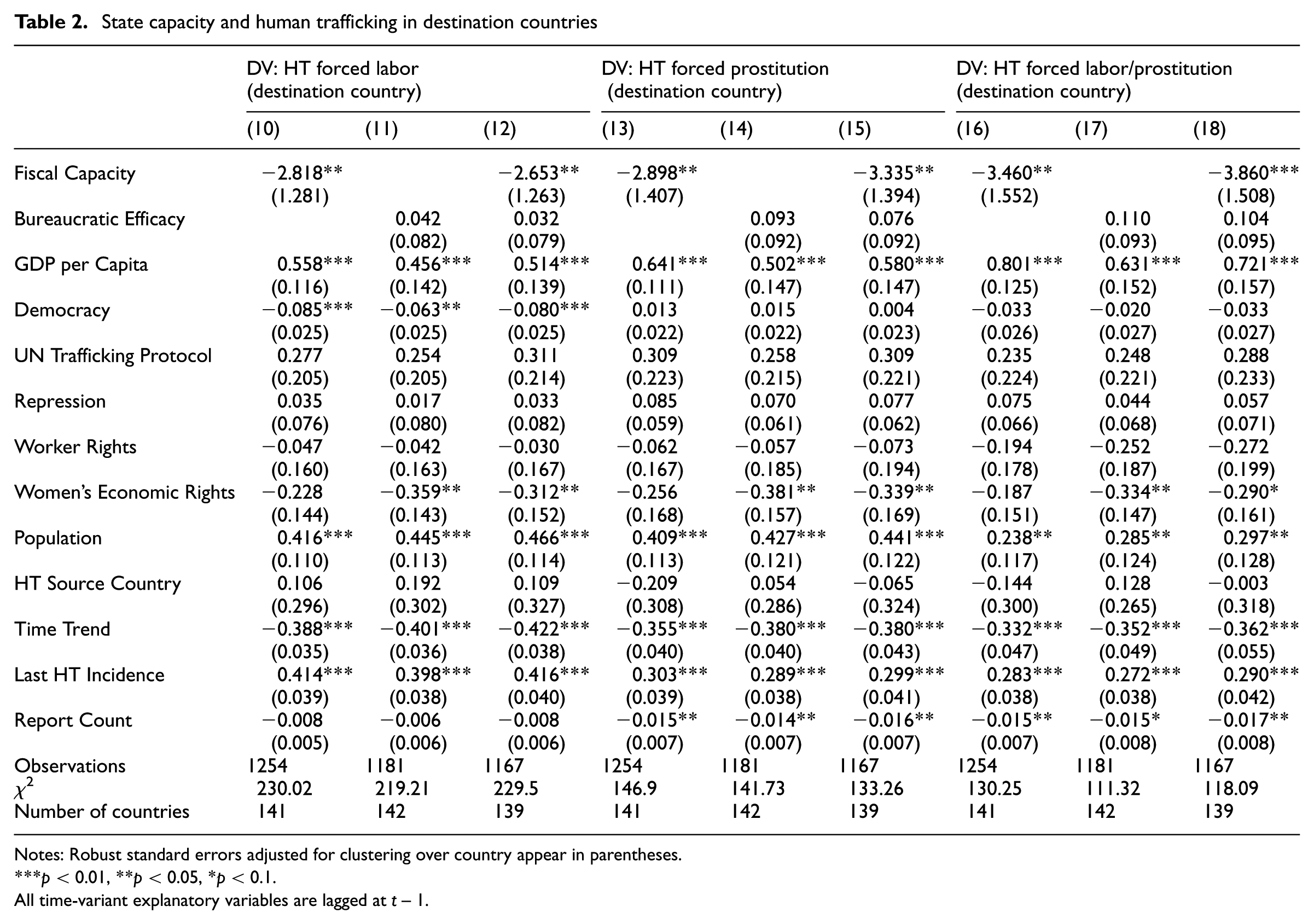
Notes: Robust standard errors adjusted for clustering over country appear in parentheses.
p < 0.01, **p < 0.05, *p < 0.1.
All time-variant explanatory variables are lagged at t – 1.
Figure 2 reports the marginal effect of the fiscal capacity measure on the predicted probability of labor and sex trafficking for potential destination countries, based on the estimates in the third and sixth models in Table 2. The figure on the left reveals that the predicted probability of a country being a major destination of human trafficking for forced labor goes down by 53% (from 0.70 to 0.33) when the fiscal capacity variable shifts from 0.1 to 0.7. The figure on the right side indicates that the predicted probability of human trafficking for sexual exploitation in destination countries goes down by 54% (from 0.81 to 0.37) when the fiscal capacity moves from 0.1 to 0.7. Overall, the results suggest that the magnitude of the hypothesized effect of fiscal capacity on human trafficking for both the labor and sex trade is likely to be quite similar for destination countries.
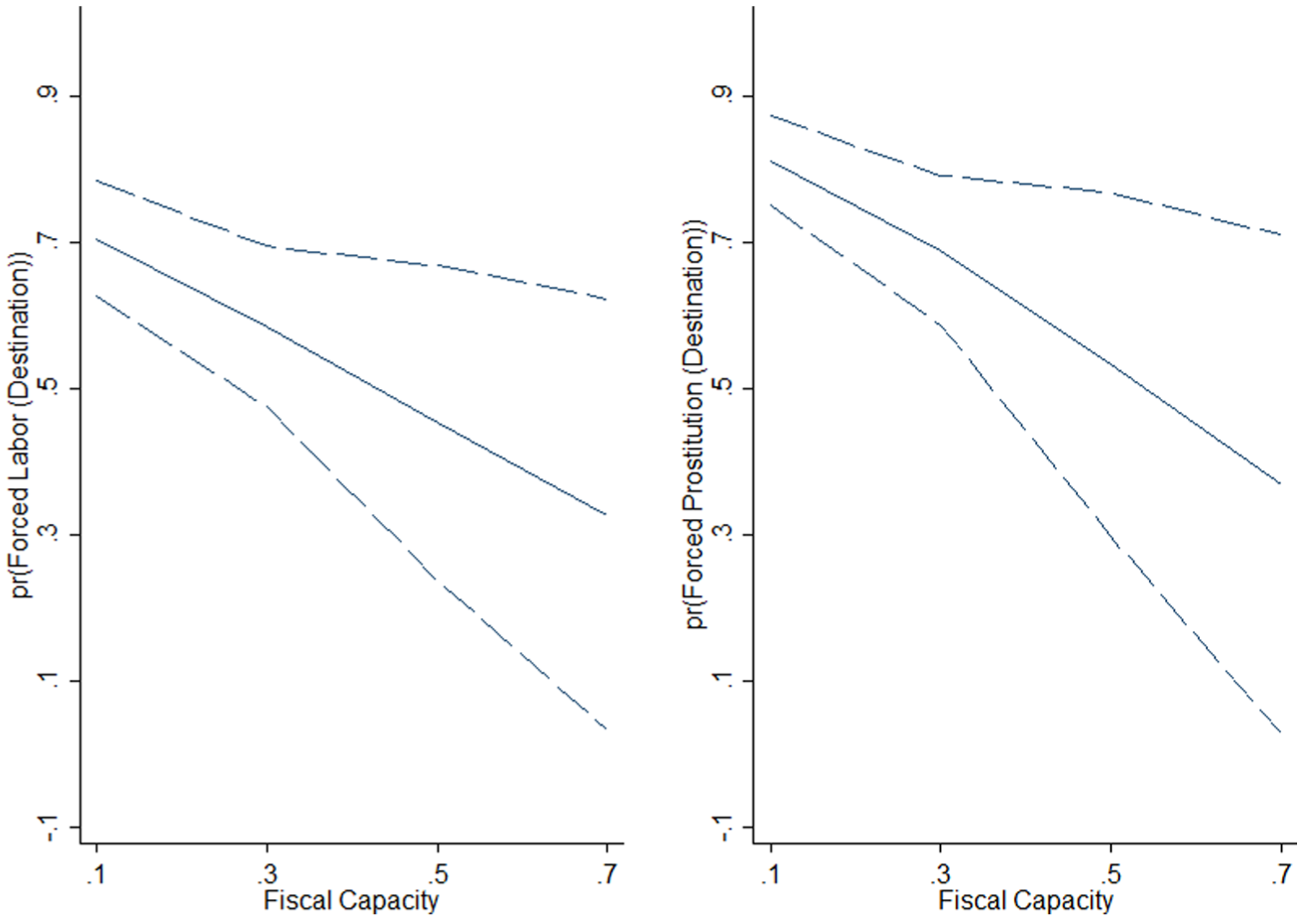
Marginal effects of fiscal state capacity on human trafficking in destination countries with 95% CI.
Turning to the control variables, we find that GDP per capita is a statistically significant “push” and “pull” factor for human trafficking. That is, poorer countries are more likely to be sources of trafficking, while countries with higher income levels have a greater probability of being a destination for human trafficking. Population is also positively related to trafficking across all models, indicating that the potential sizes of the labor pool and the potential market have a significant impact on the probability of trafficking. The impact of democracy is mixed across our models. Specifically, the negative coefficients in the first three models in Table 2 indicate that less democratic countries tend to be destinations for forced labor. Conversely, the relationship changes direction in Table 1 (Models 4–9), showing a positive relationship between democracy and a country being a source for forced prostitution. Substantively, this could reflect some of the difficulties that transition countries, such as those in the former Soviet Republics, continue to have with trafficking.
We find a statistically significant, positive association between ratification of the UN Trafficking Protocol and a country being a source for human trafficking in the models in Table 1. This connotes that countries may aggressively decouple from this agreement and possibly use it as a substitute for effectively combatting human trafficking. However, the UN Trafficking variable is not statistically significant in the destination models in Table 2. The worker rights variable is negatively and significantly related to the outcome variables in Table 1, suggesting that the lack of respect for worker rights increases the likelihood of a country become a major source for human trafficking. The negative results for the women’s economic rights variable in Table 2 denote that gendered economic discrimination is a significant predictor of a country being a destination for forced labor and sex trafficking.
We find no significant results for the repression measure and the dichotomous source/destination control variables in both tables. The time trend variable is statistically significant with a negative coefficient sign, indicating that the likelihood of being designated as a source or a destination country was higher in the early years in our sample. The results for the human trafficking incident variable suggest that countries that were a source or a destination country in their recent history are more likely to be designated as a human trafficking country in a given year. Finally, the report count measure is statistically significant in most models and shows a negative association with the outcome variables. Substantively, this connotes that we find no major reporting bias in our analysis (that is, perceived increases in trafficking may not be purely driven by increased reporting). Moreover, this finding connotes that trafficking may thrive “in the shadows,” as countries with greater media coverage are less likely to be designated as a source or a destination country for human trafficking.
Additional analyses
While our results are consistent throughout our main models, there are other potential nuances in our models that merit further exploration. Although our bureaucratic efficacy index is insignificant, it may be the case that some of the individual components of the index have a significant influence on trafficking. We thus estimate models to assess the individual effect of the components of the bureaucratic efficacy variable, namely control of corruption, law and order, and bureaucratic quality. Results for each component are mostly consistent with the ones for the bureaucratic efficacy variable reported in the main analysis (see the Online Appendix). Specifically, we find no robust evidence that the control of corruption, law and order, and bureaucratic quality have a significant impact on the probability of human trafficking for forced labor and sexual exploitation. These findings mostly hold in the models for both source and destination countries.
Additionally, several possible conditional relationships may exist within our model. While our two state capacity variables capture different facets of the ability of a state to govern, there is reason to suspect that there may be a linkage between them. For example, better-funded agents may be less likely to be corrupt and more likely to be effective in the implementation of policies. Further, while our hypotheses identify a direct linkage between state capacity and human trafficking, several of our other variables might condition the hypothesized effect of state capacity. Regarding income, there could be a conditional relationship between state capacity and income, as states might have an easier time raising revenue, and forming effective bureaucracies, in relatively wealthier societies. State capacity might have a bigger effect in democracies than non-democratic regimes, as democratically elected governments are generally more responsive to their populace. Indeed, extant scholarship has found evidence of a conditional relationship between democracy and state capacity in the attainment of several positive outcomes, including labor rights, development of human capital, and economic growth (Berliner et al., 2015; Hanson, 2015; Knutsen, 2013). Finally, it is also possible that the ratification of the UN Trafficking Protocol might affect the impact of state capacity on trafficking, although in this case there are mixed expectations, depending on whether the state is a “sincere ratifier” or views treaty ratification as a substitute for actions against trafficking (Hafner-Burton and Tsutsui, 2005; Peksen and Blanton, 2017).
To examine these linkages, we construct interaction terms with our key independent variables and democracy, UN protocol ratification and income. We also run models with an interaction term with our two key independent variables (bureaucratic efficacy and fiscal capacity). Full results for the complete models are shown in the Online Appendix. Taken as a whole, the overall results do not show consistent conditional effects across all models, and most of the significant variables are only marginally significant (at the 0.1 level). There were some patterns across the models that merit some mention. We found evidence of a conditional effect of income and state capacity, as well as some interaction effects between the state capacity measures, in some of the forced prostitution models. This would imply that sex trafficking may reflect a somewhat distinct constellation of economic and political factors relative to that of labor trafficking (Efrat, 2016). Moreover, while the bureaucratic efficacy measure was not directly significant in any of the models, interaction terms with the measure were significant in several of the models, which could indicate that the impact of bureaucratic efficacy is less direct than that of fiscal capacity, and that this facet of state capacity may be more of a necessary though not sufficient condition for reducing trafficking.
Conclusions
While human trafficking occupies a prominent place on the global policy agenda, many aspects of this phenomenon remain empirically underdeveloped. To understand better the causes of trafficking, we explore the degree to which the relative capabilities of the state are instrumental in dealing with human trafficking. We posit that while countries might have some common incentives to stop trafficking, they vary in their abilities to successfully implement anti-trafficking policies and thus reduce trafficking within their countries. Simply put, they might lack the capacity to stop trafficking flows into and out of their respective countries.
To examine the relationship between state capacity and human trafficking, we focus on the impact of a state’s bureaucratic efficacy and fiscal capacity on the probability of a country being a source or destination country for human trafficking for forced labor and prostitution. Our results are consistent across these different dimensions of trafficking, as we find that fiscal capacity is significantly and negatively related to labor and sex trafficking at both their source and destination. Overall, we find that countries with strong fiscal capacity are better able to fund and equip their bureaucracies in the struggle against human trafficking. They are thus less likely to be significant source or destination countries for human trafficking.
Our study is particularly germane to two bodies of scholarship. Within the context of the literature on human trafficking, this analysis adds to our understanding of the role of the state, particularly the front-line bureaucracy, within the broader supply chain of human trafficking. Whereas previous literature has focused on narrower aspects of state policies such as the legalization of prostitution (Cho et al., 2013) or single facets of state institutions such as corruption or institutional quality (Hernandez and Rudolph, 2015; Mahmoud and Trebesch, 2010), we provide a broader perspective. Specifically, we assess the effectiveness of agents of a state to prevent or stop their country from being a source or a destination for human trafficking.
We also add to the growing body of work that examines how state capacity empowers a state to better safeguard the rights of its populace in such areas as personal integrity rights (Cingranelli et al., 2014a; Englehart, 2009), labor rights (Berliner et al., 2015) or honoring human rights-related treaties (Cole, 2015). Along those lines, our work shows the particular importance of fiscal capacity as a necessary condition for bureaucracies to successfully address human trafficking, with the implication being that proper funding for such agencies is necessary for the effective combat of modern day slavery.
In terms of policy implications, our findings suggest that any lasting solution to the problem of human trafficking requires not only state involvement in developing new policies and undertaking reforms, but also enhanced state capacity to effectively implement existing or new reforms and policies. Moreover, preventing or halting human trafficking can be a particularly expensive venture, as it requires not only active state involvement but also the political will to properly fund and monitor the bureaucracies on which the battle against trafficking depends. At first glance this seems to be quite discouraging news for international agencies and donors that are vested in the struggle against trafficking. Tax structures are obviously difficult to change, and one of the insights of extant work on fiscal capacity is that foreign assistance—like resource wealth—does not have the same ameliorative properties on governance as broad-based taxation of the populace (Brautigam and Knack, 2004; Moore, 2007). There are thus limits on the ultimate ability of prospective donors or non-governmental groups to combat trafficking.
However, our work provides constructive insights for anti-trafficking efforts. Specifically, one implication is that supporters of anti-trafficking efforts should, at the least, be aware of the need to focus their policies at the front-line level to more effectively prevent agency loss. Along these lines, the fight against trafficking needs to be a cooperative venture with the respective state, and organizations should make efforts to encourage the state to “own” such initiatives and place a higher priority on the effectiveness of its front-line agents. Ultimately, human trafficking is not so much an isolated event as a problem embedded within a society’s broader political, economic, and cultural fabric. Therefore, an effective solution should seek to improve the broader milieu in which human trafficking exists.
Supplemental Material
CMP789875_Final_online_Appendix – Supplemental material for Confronting human trafficking: The role of state capacity
Supplemental material, CMP789875_Final_online_Appendix for Confronting human trafficking: The role of state capacity by Robert G Blanton, Shannon Lindsey Blanton and Dursun Peksen in Conflict Management and Peace Science
Footnotes
Funding
This research received no specific grant from any funding agency in the public, commercial, or not-for-profit sectors.
Notes
References
Supplementary Material
Please find the following supplemental material available below.
For Open Access articles published under a Creative Commons License, all supplemental material carries the same license as the article it is associated with.
For non-Open Access articles published, all supplemental material carries a non-exclusive license, and permission requests for re-use of supplemental material or any part of supplemental material shall be sent directly to the copyright owner as specified in the copyright notice associated with the article.
