



Abstract
Which third parties are more likely to manage interstate conflicts? Once they do, what kind of conflict management methods do they use? I argue that ethnic, language, and/or religious ties between a potential third party and disputant states can affect both the likelihood and the type of conflict management. If there are strong identity ties (ethnic, language, and/or religious) between the majority group in a potential third-party state and the majority group in one of the disputant states, both the likelihood of conflict management in general and the likelihood of economic conflict management in particular should increase. Equally stronger identity ties between a potential third party and both disputants should also increase the likelihood of conflict management in which third parties use verbal and diplomatic conflict management methods since they do not harm any of the disputants. Empirical findings based on a dataset covering the militarized interstate disputes between 1946 and 2011 support my theoretical expectations. These findings contribute to the literature by exploring the role of transborder identities—in addition to material factors such as alliance, trade partnership, or joint regime type—in management of interstate conflicts by third parties.
Introduction
The number of large-scale interstate conflicts has significantly declined since the end of the Cold War (Pettersson and Wallensteen, 2015). However, there are still a number of ongoing interstate disputes, which can escalate into full-scale war (e.g. India–Pakistan dispute over Kashmir, Russia–Ukraine dispute over Crimea, Azerbaijan–Armenia dispute over Karabakh). Climate change is also expected to cause higher numbers of interstate disputes in the future (Devlin and Hendrix, 2014). Therefore, it is important to understand how interstate disputes can be ended before they escalate into full-scale wars. Third parties can play an important role in ending interstate disputes by imposing a settlement or attempting to overcome information and commitment problems between disputants to facilitate a resolution.
Third parties may intervene in an interstate conflict in several ways and for several purposes. They can impose a settlement by taking military action. A military action can be in the form of a direct attack or deployment of forces to deter the target state. An alternative to military action is economic conflict management. Third parties may use economic tools, such as providing economic inducements or imposing sanctions, to influence disputant states’ calculus and end the conflict (Regan, 1996). Economic sanctions, for example, can successfully destabilize governments or disrupt the target’s military capabilities (Hufbauer and Schott, 1983). Third parties can also aim to end an interstate conflict with a negotiated settlement by overcoming information and commitment problems between disputants. They can fix information problems by conveying credible information to disputants as a mediator and mitigate commitment problems by guaranteeing the implementation of settlement (Regan and Stam, 2000). They can use verbal acts such as condemning the violence or calling for a resolution if they are not willing to take any risk or pay any cost as a third party (Frazier and Dixon, 2006). Although it is possible to come up with a more detailed categorization (Dixon, 1996), we can categorize third-party conflict management methods into four groups: military intervention, economic intervention, diplomatic approach, and verbal act. The way they intervene depends on their purpose, ability to influence the outcome, and relationship with disputant states. I focus on the nature of the relationship between potential third parties and disputants which can affect the purpose and ability to influence as well. My research question is: how does the nature of the relationship between a potential third party and the disputants affect the likelihood and the type of conflict management in interstate conflicts?
Biased vs unbiased third parties
One of the main debates in the relevant literature is about the effectiveness of biased vs unbiased third parties. Some scholars argue that biased third parties are more credible and capable of ending disputes because their own interests are attached to the outcome of dispute (Favretto, 2009; Kydd, 2003; Melin, 2011; Savun, 2008; Svensson, 2007), whereas others argue that biased third parties lack legitimacy in the eyes of disputants and/or are not able to use effective conflict management strategies (Beber, 2012; Crescenzi et al., 2011; Gent and Shannon, 2011; Rauchhaus, 2006; Smith, 1994; Smith and Stam, 2003). Empirical findings point out that biased third parties are more likely to intervene and use intrusive conflict management methods given the higher utility/salience and the probability of success. However, the main limitation of the literature in this area is the limited operationalization of bias in material terms, such as military alliances, economic interdependency or joint democracy. We need to take non-material sources of bias into account as well.
Cultural/identity ties and biased third parties
Some scholars have already incorporated cultural factors into the third-party conflict management literature (Bakaki et al., 2016; Bercovitch and Elgström, 2001; Bond and Ghosn, 2015; Leng and Regan, 2003; Reid, 2015). There are three shortcomings in these studies. First, their operationalization of cultural ties and theoretical mechanisms is inadequate. For example, Bakaki et al. (2016) operationalize culture based on anthropological terms such as strength of social hierarchy, uncertainty avoidance, masculinity vs femininity, and individualism vs collectivism. They find that culture does not have any significant effect on mediation. Similarly, Bercovitch and Elgström (2001) and Leng and Regan (2003) find that religious differences between disputants decrease the likelihood of successful conflict management, whereas religious similarity between disputants and mediators does not significantly affect the outcome of mediation efforts. I argue that operationalization of culture should account for all possible ties in the triadic interaction between two disputants and a potential third party. Bond and Ghosn (2015), for example, use a more comprehensive operationalization of identity based on ethnicity, religion, or language. They find that triadic cultural similarity (between two disputants and one mediator) increases the likelihood of mediation more than simple dyadic similarity. The authors code triadic cultural similarity as a binary variable to see whether the disputants and the mediator share the same dominant ethnicity, religion, or language. However, a mediator can have similarities with both disputants where the level of similarity with one side is stronger. It creates a different type of triad in which the mediator can still be biased toward one of the disputants. Furthermore, even when the third party has equally strong cultural ties with both disputants, these equal ties can vary from a single type of tie to a combination of multiple types of ties. Equally stronger similarities with both sides should have a stronger effect on conflict management. Therefore, coding cultural/identity similarity as an ordinal variable would be more appropriate.
Second, the literature has exclusively focused on civil wars. Reid (2015) finds that a third party’s economic resources and military power increase only the likelihood of mediation whereas its historical ties (past mediation efforts, colonial relationships) and cultural ties (shared ethnicity or religion) with disputants increase the duration of agreements. Although this is an important advancement in understanding the role of non-material factors in mediation success, Reid (2015) focuses on only civil wars. We also need to see how these identity ties affect conflict management efforts in interstate disputes.
Last, the earlier studies have clustered around mediation strategies and overlooked the substitutability of different conflict management methods (Bakaki et al., 2016; Bercovitch and Elgström, 2001; Bond and Ghosn, 2015; Leng and Regan, 2003; Reid, 2015). As Melin (2011) and Favretto (2009) point out, we need to compare different conflict management methods that can be used by third parties to understand when and why they are preferred. For example, a third party biased toward one of the disputants may prefer to use intrusive conflict management methods (such as economic sanctions) to protect this disputant rather than a diplomatic method (such as mediation) which requires all disputants’ consent (Favretto, 2009). If we use mediation as the only dependent variable, we will overlook the other possible actions taken by biased third parties. For example, Bond and Ghosn (2015) focus on only mediation offers and find that biased third parties are less likely to offer mediation compared with impartial ones. Yet, biased third parties may use economic conflict management while they are less likely to use diplomatic conflict management. Hence, their inference that cultural similarity between a mediator and one of the disputants does not affect conflict management is misleading as it does not account for substitutability of foreign policy tools.
To address these shortcomings in the literature, I present a causal mechanism relating transborder identity ties to management of interstate conflicts and test it with a large-N sample in which I operationalize identity in a more comprehensive way than the earlier studies. The main causal mechanism I propose is that the informal alignments between transborder groups based on shared ethnicity, religion, and/or language can affect the likelihood and type of conflict management by increasing (1) public support for conflict management, (2) the salience of the conflict for the third party, (3) a third party’s resolve to end the dispute, (4) a third party’s capability of extracting resources and absorbing costs, (5) a third party’s credibility in the eyes of disputant state, and (6) the probability of success. I argue that if there are strong ethnic, language, and/or religious ties between a potential third party and one of the disputant states, this identity bias increases the likelihood of economic conflict management. Equally strong identity ties between the potential third party and both of the disputant states also increase the likelihood of conflict management in which third parties use verbal and diplomatic conflict management methods. Empirical findings based on a dataset covering all militarized interstate disputes between 1946 and 2011 show that the strength of identity bias increases the likelihood of economic conflict management significantly. When the third party has equally strong identity ties with both disputants, they avoid economic conflict management, which harms one of the disputants, and prefer diplomatic and verbal conflict management. The main implication of these findings for the literature is that earlier studies have overlooked the role of ethnicity, religion, and language in third-party conflict management. Effect of identity ties on the likelihood and type of conflict management is at least as significant as the effects of other types of bias based on alliance, trade, regime type, colonial ties, and contiguity. In the next section, I elaborate my causal mechanism and its theoretical implications.
Theory
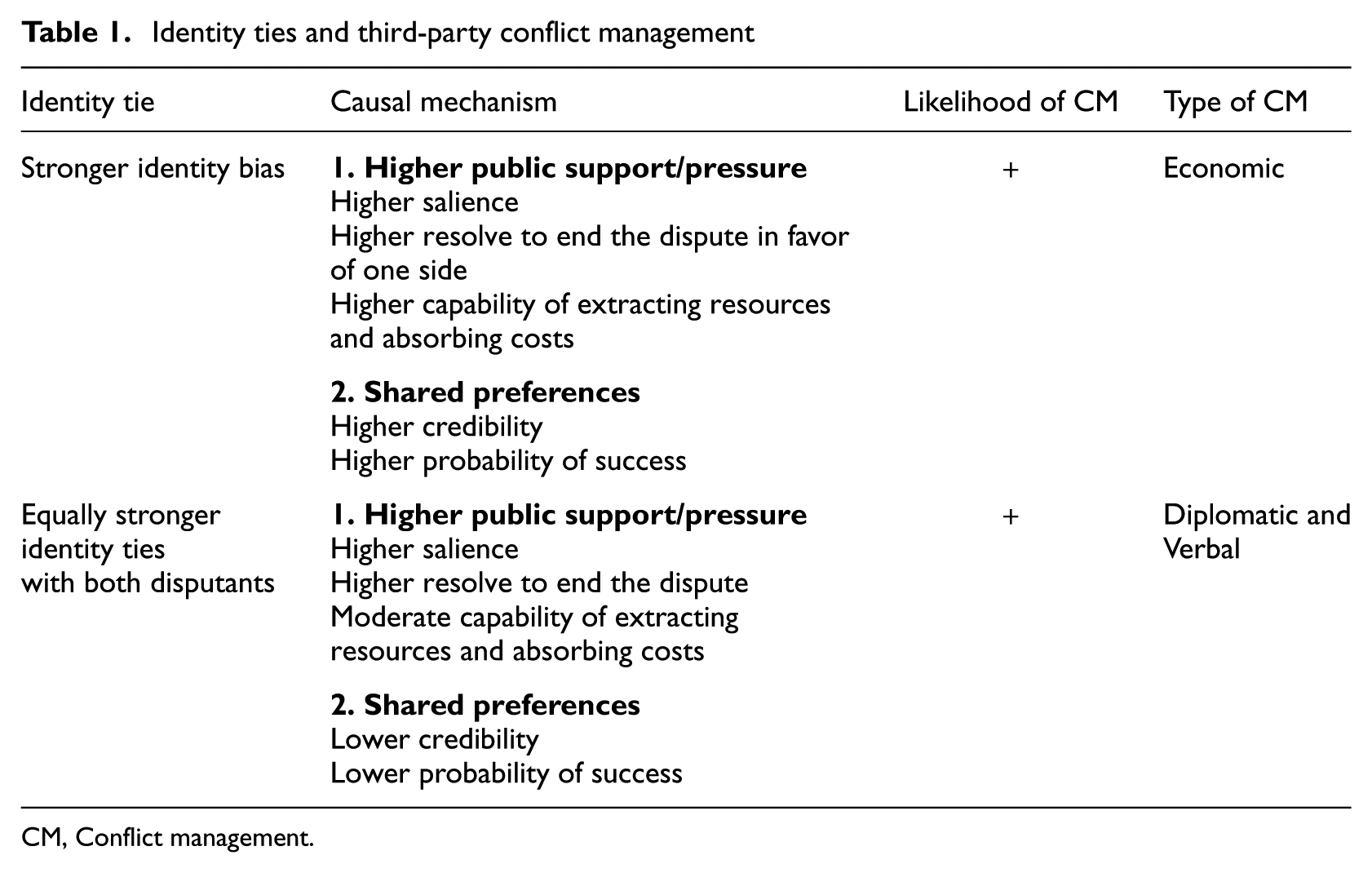
Several scholars have pointed out that shared ethnicity between a group in one country and its kin in another country engenders a natural alliance between these groups (Davis and Moore, 1997; Saideman, 1997, 2002, 2012; Salehyan et al., 2011). Moore and Davis (1998) name these alliances as ethnic alliances and argue that they are quite similar to interstate alliances in the sense that such groups typically have similar policy preferences given their shared cultures and world views (Salehyan et al., 2011). Moreover, the shared identity between two groups, and so the sense of “us vs them”, leads the government of an ethnic group’s country to help its kin in another country in case of repression or ethnic conflict. Saideman (1997: 728) explains this mechanism based on a simple public opinion–foreign policy relationship: “Because constituents care about those with whom they share ethnic ties, they prefer their state to take sides in ethnic conflicts elsewhere, supporting the side with which they have ethnic ties. Politicians, because they need support and fear its loss, take the preferences of their supporters seriously and push for policies assisting the ethnic kin of their constituents.” I extend Saideman’s (2002) theory to explain cases other than ethnic civil conflicts and secessionists crises. I argue that transborder identity ties should motivate states to get involved in interstate disputes as well. If there are strong identity ties (ethnic, language, and/or religious) between the majority group in a potential third-party state and the majority group in one of the disputant states, both the likelihood of conflict management in general and the likelihood of economic conflict management in particular should increase. Equally stronger identity ties between a potential third party and both disputants should also increase the likelihood of conflict management in which third parties use verbal and diplomatic conflict management methods. I suggest two causal mechanisms, which are summarized in Table 1, to explain how transborder alliances based on identity ties affect third-party conflict management.
Identity ties and third-party conflict management
CM, Conflict management.
Identity bias and public support/pressure for third-party conflict management
The primary causal mechanism is about the role of public opinion in the third-party state. Saideman (2002) points out that transborder ethnic ties create feeling of loyalty and political boundaries do not prevent this psychological effect. Hence, the presence of identity ties between a third party and a disputant increases the legitimacy of conflict management in the eyes of the public in the third-party state. Citizens in the third-party country are more likely to be concerned about a conflict in which their kin is involved compared with other conflicts. They may even put pressure on the government to take action to end such a conflict as they feel close to the people in the disputant country. Governments, who want to maintain the support of the majority group in the country, should act according to this desire of voters. It is a “litmus test for a politician’s sincerity on ethnic issues at home” (Saideman, 2002: 23). For example, according to a survey regarding the public opinion on Turkish foreign policy (Kadir Has University, 2016), Turkish voters consider Azerbaijan (59.3%), the US (2.6%), Saudi Arabia (2.4%), the Turkish Republic of Northern Cyprus (2%), Pakistan (1%), Bosnia and Herzegovina (0.8%) and Iran (0.3%) as the closest friends of Turkey. Except for the US, Turkey has ethnic or religious ties with all of these countries. Similarly, the majority of respondents think that Turkey should cooperate with Azerbaijan (48.5%), other Turkish states (such as Kazakhstan, Turkmenistan, Kyrgyzstan, or Uzbekistan; 16.7%) or Muslim countries (9.8%) in international affairs. These numbers show that citizens take identity ties seriously and want their governments to act accordingly in foreign policy. If the majority of citizens think that their country should support one of the sides in an international conflict, we can expect the government to be more sensitive to this conflict and its outcomes. In fact, when Azerbaijan had a territorial dispute with Armenia in 1988, Turkey got involved in this dispute to end the conflict in favor of Azerbaijan. Cornell (1998) states that: The only country that constantly expressed its support for Azerbaijan is Turkey. In all international fora Turkey has tried to explain and promote the Azeri view of the conflict, and has certainly been instrumental in preventing a pro-Armenian approach from totally dominating these fora. Furthermore Turkey and Azerbaijan jointly placed an embargo on Armenia, and Turkey refuses to normalize its relations with Armenia as long as the latter occupies territories in Azerbaijan.
Increased legitimacy and salience also make third-party states more capable of extracting resources for conflict management and encourage more resolve to end the conflict. Public support in Greece (biased toward Greek-Cypriot) and in Turkey (biased toward Turkish-Cypriot) for the management of recurrent disputes in Cyprus is higher than public support in Britain or the US for their attempts to resolve this dispute. In Turkey, almost 60% of citizens still think that the Turkish Republic of Northern Cyprus is an indispensable country in Turkish foreign policy (Kadir Has University, 2016). Given this high level of public support (even public pressure at some points), Turkey and Greece have always been more eager to resolve the dispute in favor of the disputants with which they have identity ties. Therefore, I expect identity ties to increase public support/pressure for governments to take action and manage disputes. This public support should increase a third party’s resolve to manage the conflict, and ability to extract more resources and absorb higher levels of costs associated with conflict management.
It should be noted that this causal mechanism relies on the role of public opinion in foreign policy decisions of government. Yet the direction of the relationship between public opinion and foreign policy can be two-way. Either public support might drive government to take action to protect external kin or the government might use public’s sympathy for the external kin to justify conflict management attempts driven by their ambitious foreign policy goals. As Saideman (2002) points out, it is hard to distinguish whether it is a top-down or bottom-up mechanism in practice. For example, politicians can anticipate that potential public support for conflict management and act proactively. In such a case, we can observe a conflict management attempt supported by majority of public but cannot clearly tell whether the public or political elite is the driving force. In either case, identity ties increase public support for conflict management and thus the government’s resolve and capacity to manage the conflict. Even though this particular public opinion–foreign policy relationship should be analyzed in future research, it does not undermine the validity of the theoretical inferences here.
Identity bias, shared preferences, and third-party conflict management
The second causal mechanism is about the shared preferences arising from identity ties. Given their similar cultures and world views, groups that share the same ethnicity, religion, and/or language are expected to have parallel policy preferences (Salehyan et al., 2011). The shared political preferences increase the legitimacy of the third party in the eyes of the disputant state. As Kydd (2003) and Savun (2008) argue, biased mediators are more credible in the eyes of the disputant they are favoring because they have some parallel interests related to the outcome of conflict or negotiations. When they ask this disputant to make a concession to reach a settlement, the disputant is more likely to trust this type of mediator because they do not have any incentive to lie. Kydd (2003: 597) uses two examples to illustrate this mechanism. In the first example, after the invasion of the Falkland Islands by Argentina in 1982, the US failed to convince Argentine officials that if they did not reach a settlement, Britain would use force and the US would support Britain. However, Argentine officials did not trust the Americans and the mediation attempt failed. In the second example, in the Kosovo War of 1999, Russia successfully convinced Serbia that NATO was getting ready for a ground attack in addition to a bombing campaign. Serbian leader Milosevic trusted in the warnings of Russian officials and accepted the NATO proposal. What made the Russian attempt successful was the lack of any incentive on the part of Russia to lie to Serbia as Russia was biased toward Serbia. Kydd (2003) and Savun (2008) explain this bias in material terms such as a military alliance or trade relationship between Russian and Serbia. In addition to these earlier studies which have operationalized bias in material terms, I argue that third parties might favor disputants because of identity ties as well. By following the same logic presented by Kydd (2003), I argue that, if a third party and a disputant share the same ethnicity, language, and/or religion (as Russian and Serbia did in the Kosovo War), the third party becomes more biased toward this disputant. Shared commonalities and political preferences increase the credibility of the third party and the probability of successful conflict management. Given its greater ability to influence the outcome of the dispute, a biased third party should be more willing to manage the dispute with intrusive conflict management methods.
My theory, therefore, incorporates the role of identity into the expected utility equation of third parties by pointing out how identity ties affect costs and benefits for decision-makers. The magnitude of this impact depends upon the strength of the identity ties. A third party and a disputant state sharing the same ethnicity, language, and religion at the same time will have the strongest identity ties. Such a strong bias should have a bigger effect on a third party’s decision to intervene in a conflict compared with weaker identity ties based on only ethnicity, religion, or language.
When identity ties are stronger, the third party uses more effective conflict management methods (namely economic sanctions or inducements) given the higher salience of the conflict, higher resolve, and higher capability of extracting resources and absorbing costs. Economic conflict management allows a biased third party to protect one of the disputants and end the dispute in favor of one side.
Equally stronger identity ties with both disputants and third-party conflict management
Another possible scenario is the presence of equally strong (or weak) identity ties between a third party and both disputants. In this case, the public should still support conflict management to end the dispute between their distant relatives. However, in contrast to my argument about identity bias, the public is less likely to support intrusive conflict management methods (such as economic sanctions) which are designed to impose costs on the other disputant. They will be in favor of less intrusive methods (such as diplomatic and verbal acts) because they will not want either side to suffer negative consequences of intervention. In addition, when the third party has identity ties with both disputants, its primary goal becomes ending the conflict as soon as possible. The credibility of such a third party decreases since it has an incentive to lie to make disputants concede and end the dispute. Such impartial third parties have a lower probability of success, which should lead them to use less intrusive conflict management methods. Therefore, a third party with equally strong identity ties with both disputants should be more likely to intervene in the dispute ceteris paribus. However, because of lower resolve to end the dispute in favor of one side and lower ability to absorb the costs associated with intrusive conflict management methods, unbiased third parties should use less intrusive conflict management methods.
The magnitude of the impact of equal ties with both disputants also depends on the strength of the identity ties. A third party and two disputant states sharing the same ethnicity, language, and religion at the same time will have the strongest identity ties. Such equally stronger identity ties with both sides should have a bigger effect on a third party’s decision to intervene in a conflict in comparison with equally weaker identity ties based on only ethnicity, religion, or language.
To conclude, I focus on the nature of the relationship between potential third parties and disputant states to explain the likelihood and the type of conflict management. I argue that identity ties between a third party and a disputant state should be considered as a non-material component of bias. Identity bias should increase the likelihood of economic conflict management. If the third party has equally strong identity ties with both disputant states, the likelihood of verbal and diplomatic conflict management, instead of economic conflict management, should increase. In the next section, I present my data sources, sample, and operationalization of the variables for the empirical test of this theory.
Research design
Data and sample
I use the dataset compiled by Melin (2011) based on the Third Party Intervention Data (Frazier and Dixon, 2006) and the International Conflict Management Data (Bercovitch, 1999). This dataset includes all militarized interstate disputes from 1946 to 2001 from the Dyadic Militarized Interstate Disputes Dataset (Maoz, 2005). To overcome the problem of selecting on the dependent variable, I have included observations in which the potential third party did not attempt to manage the conflict. 1 Melin (2011) identifies the population of potential third parties for each dispute based on the three criteria of politically relevant dyads (Maoz, 1996). If a third-party state is a major or regional power, contiguous to disputant states, or has a reputation as a successful conflict manager, it is more likely to attempt to get involved in the conflict management process compared with other states. The unit of analysis is triad-year (Potential Third Party-Disputant A-Disputant B-Year). I have 72,825 observations for 1951 dispute-years.
There are 2375 conflict management attempts in the dataset. Some 1974 of them are economic, 239 of them are diplomatic, and 162 of them are verbal conflict management attempts. Hence, economic sanctions are much more popular compared with others. In 33,283 of observations, the potential third party has at least one type of identity bias (ethnic, religious, or language) toward one of the disputants. These biased third parties are associated with 1267 conflict management attempts. In 7885 observations, the potential third party has equally strong identity ties with both disputants. Some 389 of these are associated with conflict management attempts. 2
Dependent variables and model specification
A third party can intervene in an interstate conflict in several ways. As Melin (2011) argues, we need a holistic approach in which we can include diplomatic tools (such as mediation), economic tools (such as sanctions), or verbal acts (such as call for resolution) to account for the substitutability of different conflict management methods. In line with Melin (2011), I exclude military interventions and use only peaceful conflict management methods: economic intervention, diplomatic approaches, and verbal expressions. 3 A verbal act is relatively less costly and includes a ceasefire appeal or demand, negotiation appeal or demand, troop withdrawal appeal or demand, offer to facilitate negotiations, and offer to mediate negotiations. Diplomatic approaches are more costly for the third party compared with verbal acts and they include inquiry/fact finding, good offices, mediation, and conciliation (Frazier and Dixon, 2006). Economic efforts are basically economic sanctions which aim to persuade the disputant(s) to stop fighting by imposing economic/financial costs. They are the most costly conflict management methods. Also, it should be noted that economic and verbal acts are unilateral in the sense that they do not require the consent of both disputants, whereas diplomatic acts are multilateral as they require the consent of all disputants (Melin, 2011). Hence, I operationalize conflict management as economic, diplomatic, and verbal acts by a third party to stop conflict.
My first dependent variable is Conflict Management. It is coded as “1” if a third party used at least one of the conflict management methods in an interstate dispute and “0” otherwise. I estimate a logit model to test the effect of my independent variables on this binary dependent variable.
My second dependent variable is Type of Conflict Management. The values it takes range from 0 to 3. It is coded as “3” if the third party used economic tools for conflict management, “2” if the third party employed diplomatic tools, “1” if the third party only expressed its discontent verbally, and “0” if there was no conflict management attempt. I estimate a multinomial logit model to see whether identity ties affect the type of conflict management. The base category is “no conflict management”. Thus, results show the likelihood of using economic, diplomatic, or verbal conflict management methods compared with no conflict management.
Independent variables
Individuals or groups can identify with several attributes such as gender, socio-economic class, race, ethnicity, nation, or religion. These attributes may become more or less important for individuals in different contexts. In international and transnational politics, primordial aspects of identity (e.g. ethnicity, language, and religion) constitute special ties between groups in different countries. 4 Ethnic identities, in this sense, are particularly important as they establish natural alliances between kin groups. However, operationalization of ethnicity is a complicated task because it can be based on a simple historical kinship as well as other aspects of identity such as language and religion. As Safran (2008: 178) states, “religion and language are still the two most important building blocks of ethnonational identity. Their primacy has varied, and the relationship between the two has been uneven and often convoluted.” Thus, the boundaries of an ethnicity, language, and religion may be congruent or divergent. Focusing on only one of them would be an incomplete operationalization of transborder identity ties in a large-N sample because we cannot be sure which aspect is more prominent in which case. Therefore, I define identity ties based on these three terms rather than choosing one of them. If two groups of people share the same ethnicity, language, and/or religion, I consider this relationship as an identity tie. I operationalize identity ties variables as ordinal variables because two groups sharing the same ethnicity, religion, and language at the same time should have stronger ties in comparison with two groups sharing only the same language or religion.
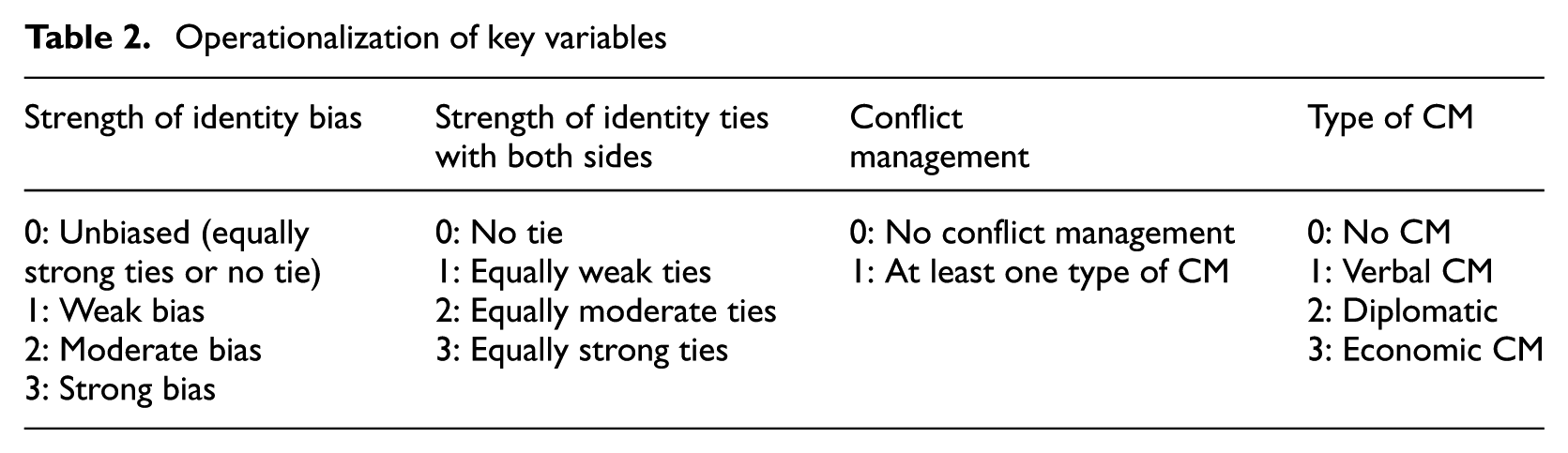
Based on the dataset created by Ellingsen (2000) and Gartzke and Gleditsch (2006), I use the majority groups in countries to code Strength of Identity Bias and Strength of Identity Ties with Both Sides variables. If the majority group in the third party state has ethnic, language, or religious ties with the majority group in a disputant state, then I consider it as an identity bias. In line with Savun (2008), I operationalize Strength of Identity Bias as relative bias since the third party can have identity ties with both disputants. 5
Relative bias ranges from 0 to 3. If the absolute bias toward one of the disputants is equal to absolute bias toward the other disputant, then relative bias score becomes “0”. If the third party has more identity ties with one of the sides, then the relative bias score is equal to the difference between absolute biases toward side A and side B. For example, if the third party shares the same ethnicity, religion and language with side A, and shares only the same religion with side B, the relative bias score is equal to “2”.
I generated a second independent variable called Strength of Identity Ties with Both Sides. The values it takes range from “0” to “3”. It is coded as “0” if there is no identity tie with either side, “1” if the third party has one type of identity tie with both sides, “2” if the third party has two types of identity ties with both sides, and “3” if the third party has all kinds of identity ties with both sides. Table 2 summarizes the operationalization of the dependent and independent variables.
Operationalization of key variables
Control variables
First, I control for the effects of other bias types. I expect third-party bias based on alliance ties, trade interdependency, contiguity, colonial ties, and joint democracy to positively affect the likelihood and the type of conflict management. Alliance ties, trade relationship, contiguity, colonial ties, and shared regime type with both sides should also increase the likelihood of conflict management, whereas they should lead the third party to use diplomatic and verbal conflict management more than economic management. I again use the dataset compiled by Melin (2011) for these variables. I also control for the variables affecting the probability of success of conflict management attempt and its cost for the third party. 6
Results
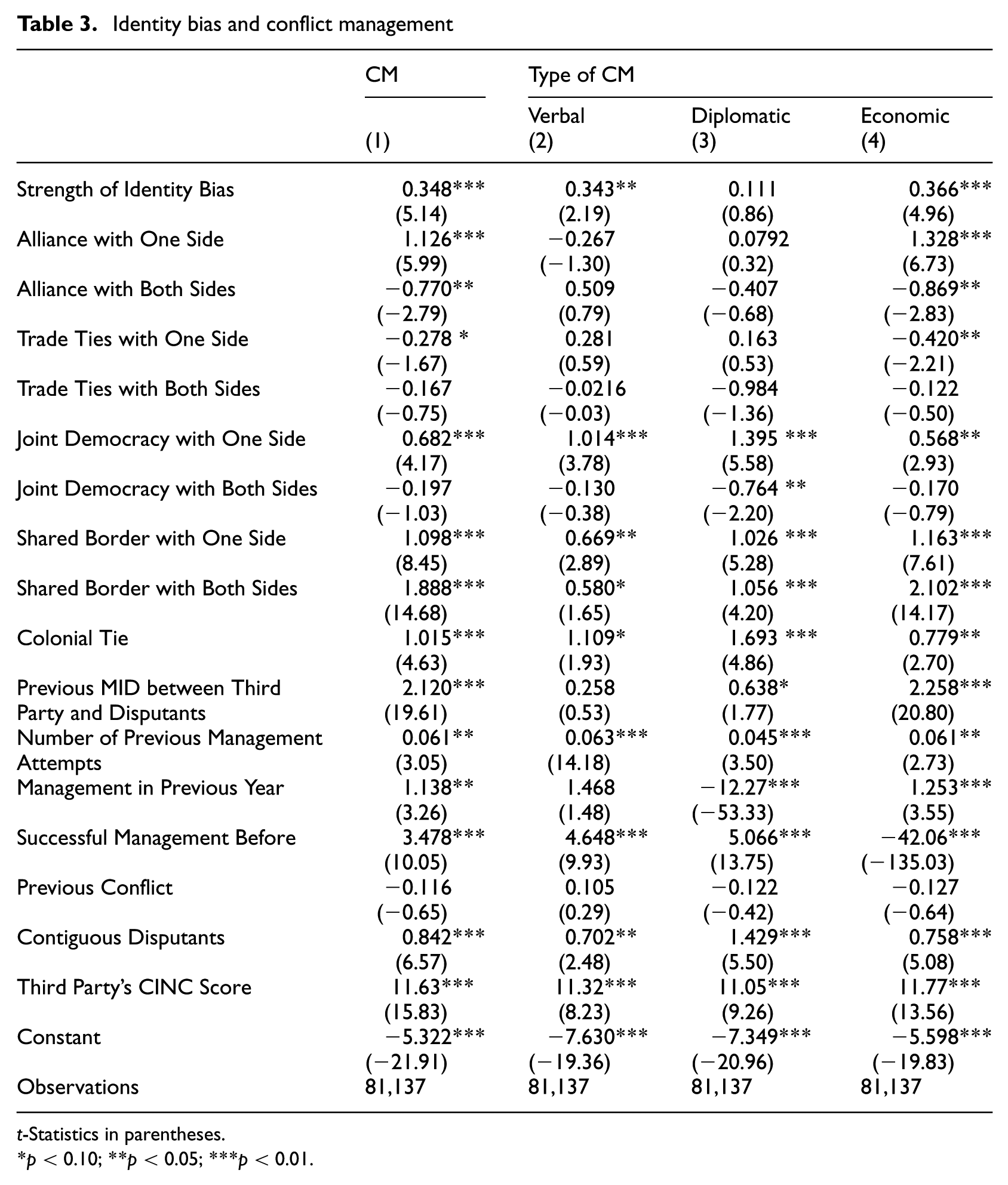
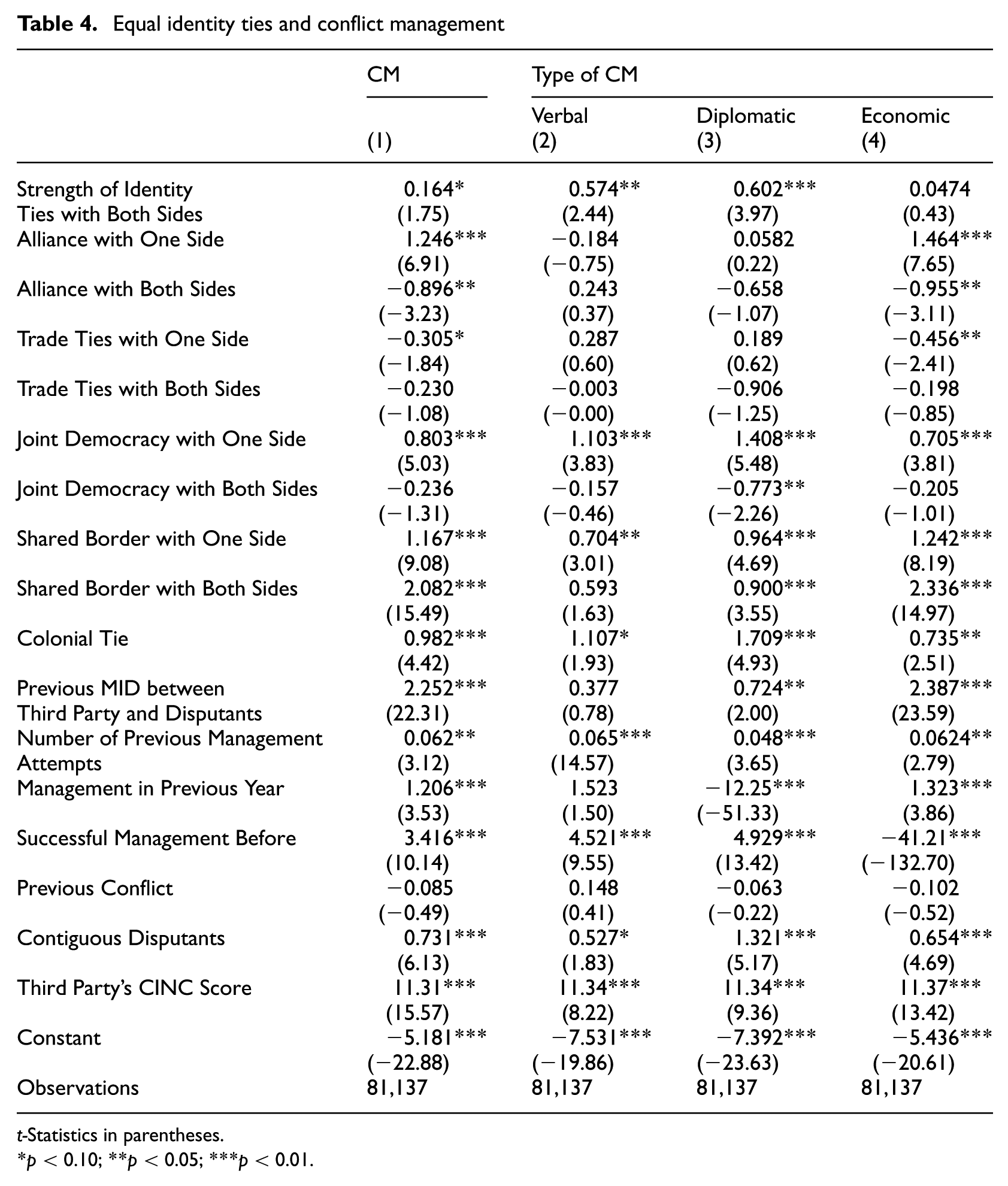
I argue that identity bias increases the likelihood of conflict management in general and the likelihood of economic conflict management in particular. Thus, in Table 3, I expect the Strength of Identity Bias variable to be statistically significant and positive in the first column (Conflict Management) and in the fourth column (Economic CM). If a third party has equally strong identity ties with both disputants, the likelihood of conflict management should increase too. However, such third parties should prefer verbal and diplomatic conflict management instead of economic conflict management. Thus, in Table 4, I expect Strength of Identity Ties with Both Sides to be statistically significant and positive in the first (Conflict Management), second (Verbal CM), and third columns (Diplomatic CM).
Identity bias and conflict management
t-Statistics in parentheses.
p < 0.10; **p < 0.05; ***p < 0.01.
Equal identity ties and conflict management
t-Statistics in parentheses.
p < 0.10; **p < 0.05; ***p < 0.01.
In line with my expectation, Table 3 shows that Strength of Identity Bias has a statistically significant effect (at 99% confidence level) in the expected direction on the likelihood of Conflict Management. This finding provides strong support for Hypothesis 1a and indicates that when the identity bias toward one of the disputants increases, the likelihood of conflict management increases as well. Table 3 also shows that Strength of Identity Bias has a statistically significant and positive effect on the likelihood of Economic CM at 99% confidence level and on the likelihood of Verbal CM at 95% confidence level. This finding supports Hypothesis 1b. Third parties with stronger identity bias are more likely to use economic conflict management than diplomatic conflict management. Although my theory did not predict a significant increase in the likelihood of verbal conflict management, it is not surprising that both biased and unbiased third parties use verbal conflict management tools more than diplomatic conflict management because verbal expressions are less costly and risky than diplomatic initiatives. The prominent real world examples demonstrating the role of identity bias from the sample are (1) the US’s economic interventions in favor of the UK whenever it is involved in a dispute (and vice versa), (2) Greece’s economic intervention in favor of Cyprus (Southern Cyprus) against Turkey, 7 and (3) the economic interventions of Arab states (Jordan, Saudi Arabia, Syria) in favor of each other against Israel.
Besides identity bias, Alliance with One Side, Joint Democracy with One Side, Shared Border with One Side, and Colonial Ties have positive and statistically significant effects on the likelihood of conflict management and the likelihood of economic conflict management. Trade Ties with One Side has a negative and statistically significant effect on the likelihood of conflict management and the likelihood of economic conflict management. These results show that all types of bias, except economic bias, significantly increase the likelihood of conflict management.
Other variables that significantly increase the likelihood of conflict management are contiguity between disputant states, number of previous management attempts, management attempt in the previous year, successful management before, and the third party’s CINC score. Previous militarized interstate dispute between the third party and disputants has a negative effect which is statistically insignificant at 90% confidence level. These findings indicate that a third party is more likely to intervene in an interstate dispute when the probability of success is high, the cost is low, and it is geographically close to the disputant states.
To have a better understanding of the substantive effect of identity bias on the likelihood and the type of conflict management, I estimate the change in the predicted probability of conflict management by using the clarify package (Tomz et al., 2003). This program draws multiple simulations of the parameters and calculates quantities of interest such as changes in the predicted values of the dependent variable. Furthermore, in logistic regression models, the relationship between variables is not linear. To account for this non-linearity, I created three hypothetical scenarios in which the probability of conflict management varies. In the Worst Case Scenario, the CINC score of the third party and the number of earlier conflict management attempts are low, and there is either no conflict management in the previous year or none of the conflict management attempts were successful. In other words, the probability of success is low and the cost of conflict management is high. In the Average Case Scenario, all of the aforementioned variables are held at their mean/median values, which means that the probability of success and cost of conflict management are average. In the Best Case Scenario, the third party has a higher CINC score and the number of earlier conflict management attempts is high. Also, there was at least one successful conflict management attempt before and a conflict management attempt in the previous year. So, the probability of success is high, whereas the cost of conflict management is low.
The results show that identity bias is less effective in the Best Case Scenario. The reason is that when the probability of success is high and the cost is low, all of the potential third parties are likely to intervene in the dispute. So, the bias does not substantively increase (or decrease) the motivation of third parties. When Strength of Identity Bias goes from 0 to 3 (from no bias to strong bias), the likelihood of Conflict Management increases by 187% in the Worst Case Scenario and by 181% in the Average Case Scenario. These effects are also statistically significant as the confidence intervals do not overlap with each other. Hence, substantive effects also provide empirical support for Hypothesis 1a. Figure 1 visualizes this substantive effect of Strength of Identity Bias on the likelihood of conflict management in the average case scenario. 8
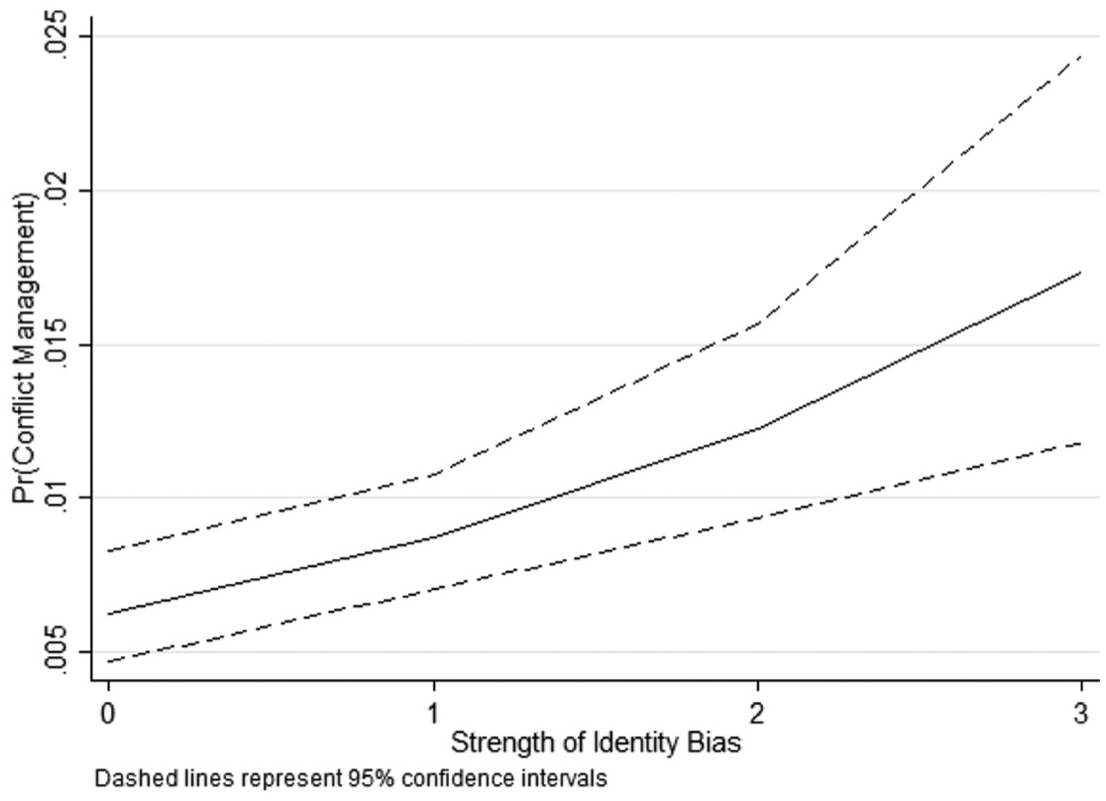
Strength of identity bias and the likelihood of CM in the average case scenario.
Figures 2–4 show the substantive effects of Strength of Identity Bias on the likelihood of different types of conflict management in the average case scenario. When Strength of Identity Bias goes from 0 to 3 (from no bias to strong bias), the likelihood of Economic CM increases by 201%, whereas it does not have any statistically significant effect on the likelihood of verbal or diplomatic conflict management. This means that the statistically significant effect of identity bias on verbal conflict management in Table 3 is not robust. The effect is neither statistically nor substantively significant according to Figure 2. Overall, these substantive effects are consistent with Hypothesis 1b. Third parties with strong identity ties with one of the disputants are more likely to use economic conflict management compared with other types of conflict management.
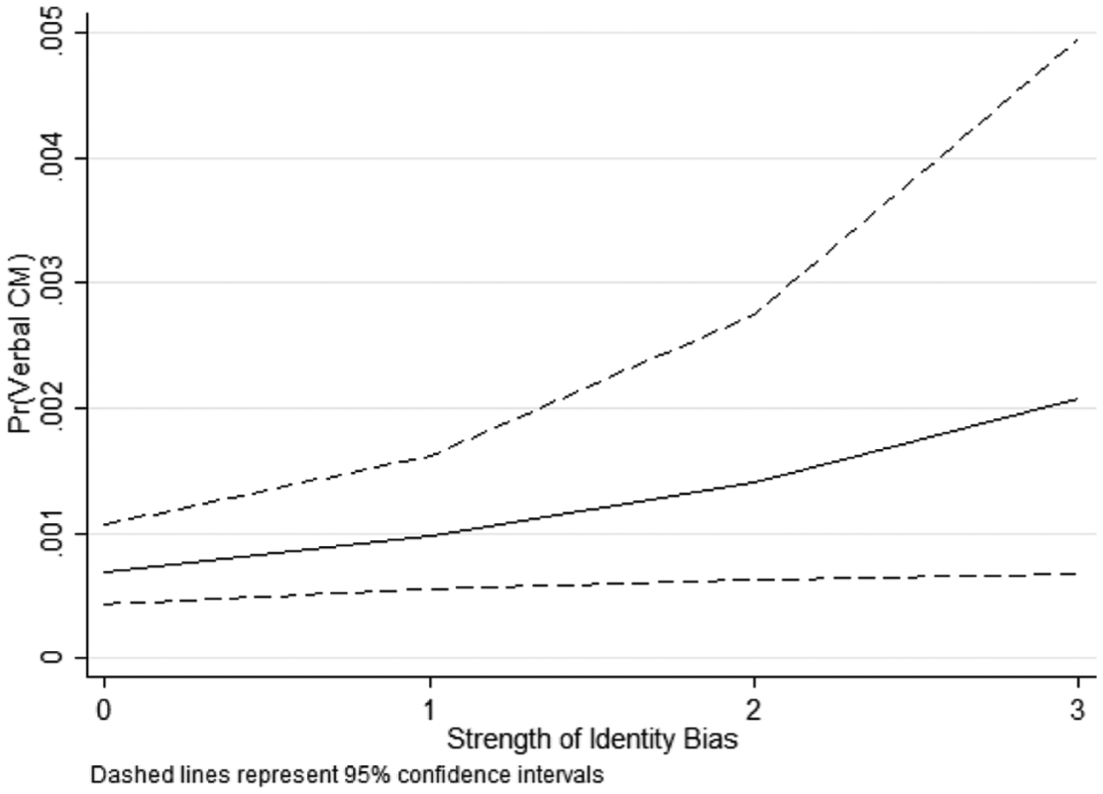
Strength of identity bias and the likelihood of verbal CM in average scenario.
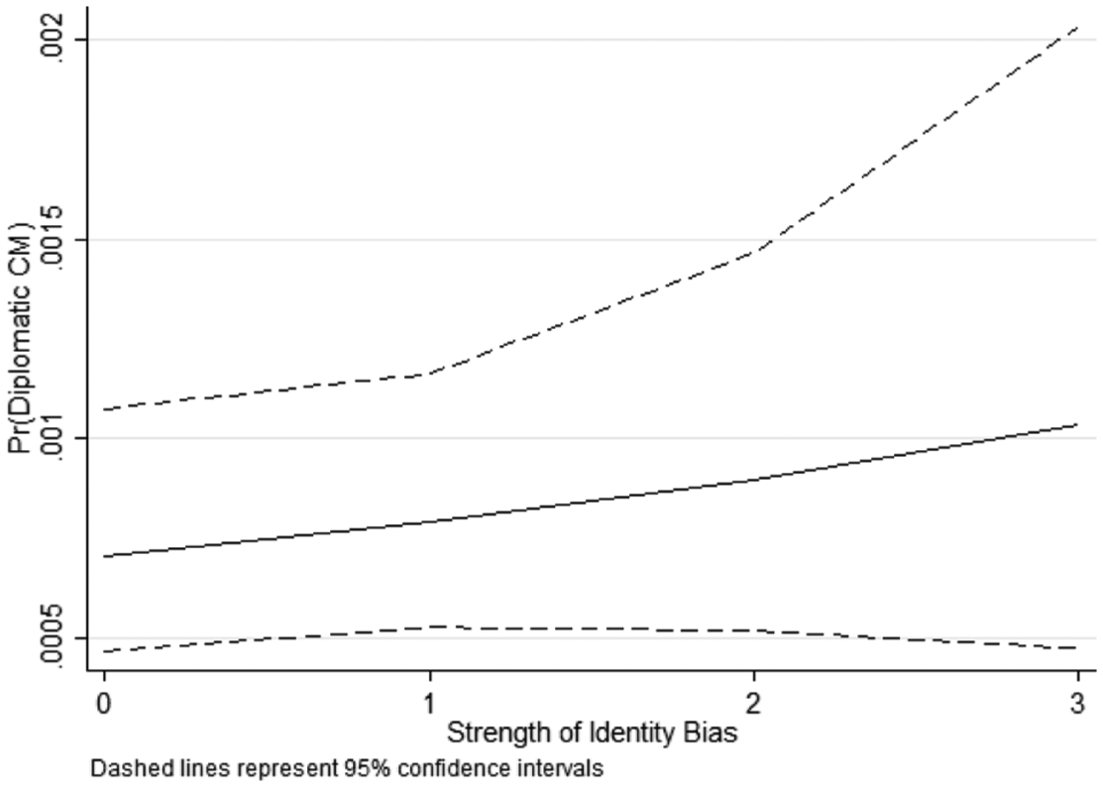
Strength of identity bias and the likelihood of diplomatic CM in average scenario.
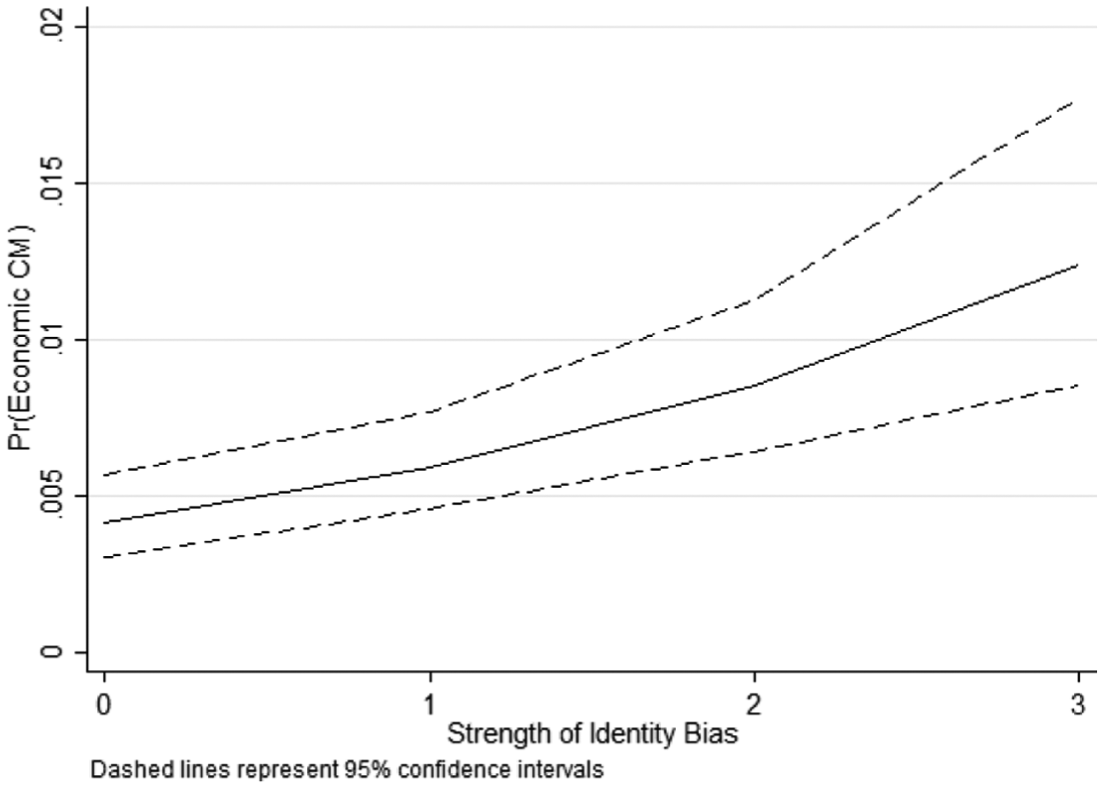
Strength of identity bias and the likelihood of economic CM in average scenario.
In line with my expectation, Table 4 shows that Strength of Identity Ties with Both Sides has a positive and statistically significant effect (at 90% confidence level) on the overall likelihood of Conflict Management. This finding supports Hypothesis 2a. When a potential third party has equally stronger ties with both sides, it is more likely to attempt to manage the conflict. Columns 2–4 in Table 4 also show that Strength of Identity Ties with Both Sides has statistically significant and positive effects on the likelihood of Verbal CM (at 95% confidence level) and Diplomatic CM (at 99% confidence level), whereas its effect on the likelihood of Economic CM is statistically insignificant at 90% confidence level. This means that third parties are more likely to use verbal and diplomatic conflict management methods than economic conflict management when they have equally stronger identity ties with both sides. Some of the real-world examples from the sample showing the role of equally strong identity ties with both disputants are: (1) Morrocco’s diplomatic attempts to manage the dispute between Tunisia and Libya in 1985; (2) Saudi Arabia’s diplomatic efforts to manage the dispute between Syria and Jordan in 1980; (3) Peru’s mediation efforts to end the dispute between Honduras and El-Salvador in 1978; and (4) Burkina Faso’s diplomatic attempts to manage the dispute between Liberia and Sierra Leone in 1999.
As I did for the first two models, I estimate the change in the predicted probability of Conflict Management across the values of Strength of Identity Ties with Both Sides. When Strength of Identity Ties with Both Sides goes from 0 to 3 (from no ties to strong ties), the likelihood of Conflict Management increases by 68% in the average case scenario. However, in contrast to Table 4, Strength of Identity Ties with Both Sides does not have a statistically significant effect as the confidence intervals overlap across its values. I conclude that the effect of Strength of Identity Ties with Both Sides on the overall likelihood of Conflict Management is not robust. Figure 5 visualizes how much the probability of conflict management changes when the third party has equally strong ties with both disputants in the average case scenario. 9
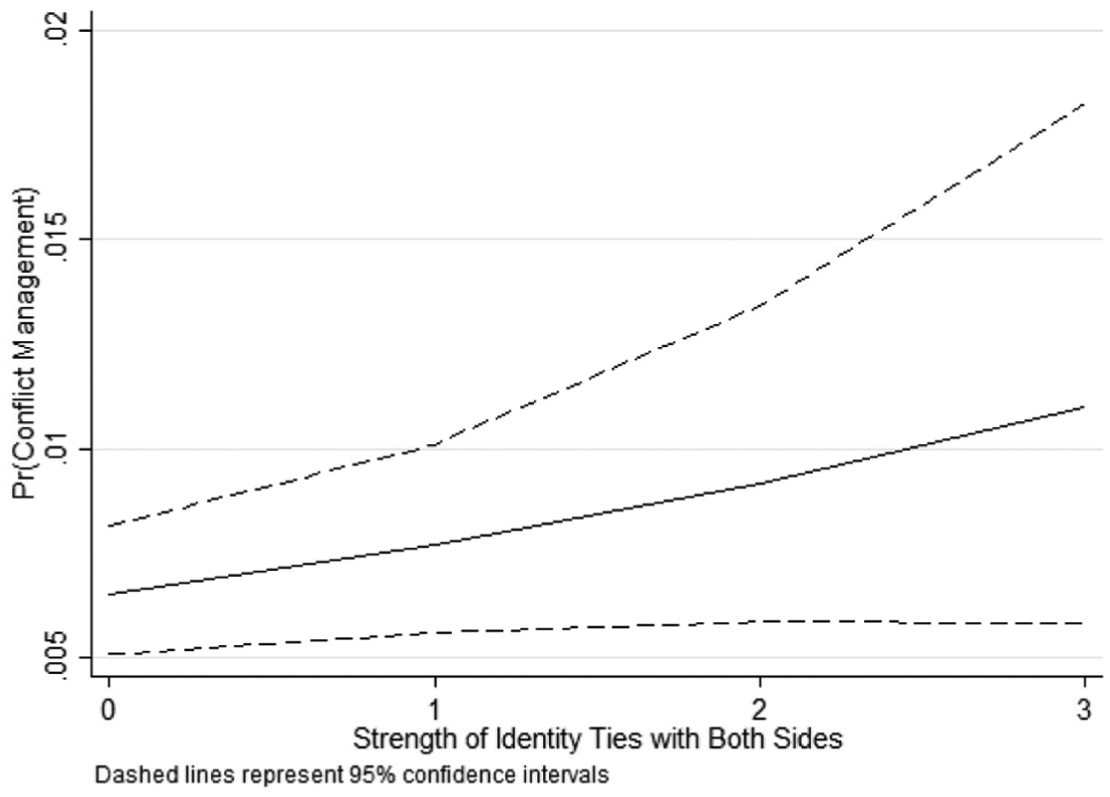
Strength of identity ties with both sides and the likelihood of CM in average case scenario.
Figures 6–8 show the change in the probabilities of different types of conflict management when the third party has equally strong identity ties with both disputants. In line with my expectations, when Strength of Identity Ties with Both Sides goes from 0 to 3 (from no ties to strong ties), the likelihood of verbal conflict management increases by 608% and the likelihood of diplomatic conflict management increases by 557%. The likelihood of economic conflict management increases by only 20% and this effect is statistically insignificant as the confidence intervals overlap in Figure 8. These findings provide further empirical support for Hypothesis 2b. Third parties with equally stronger ties with both disputants are more likely to prefer verbal and diplomatic conflict management whereas they avoid economic conflict management which will impose costs on one of the disputants.
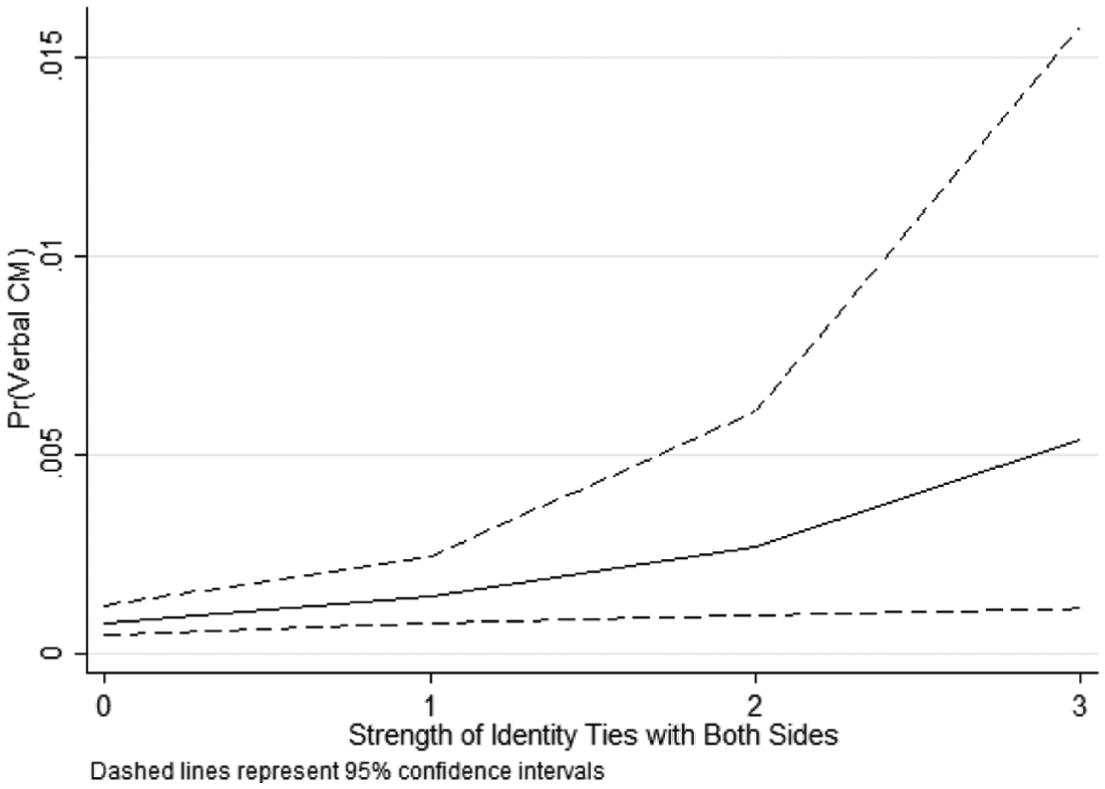
Strength of identity ties with both sides and the likelihood of verbal CM in average scenario.
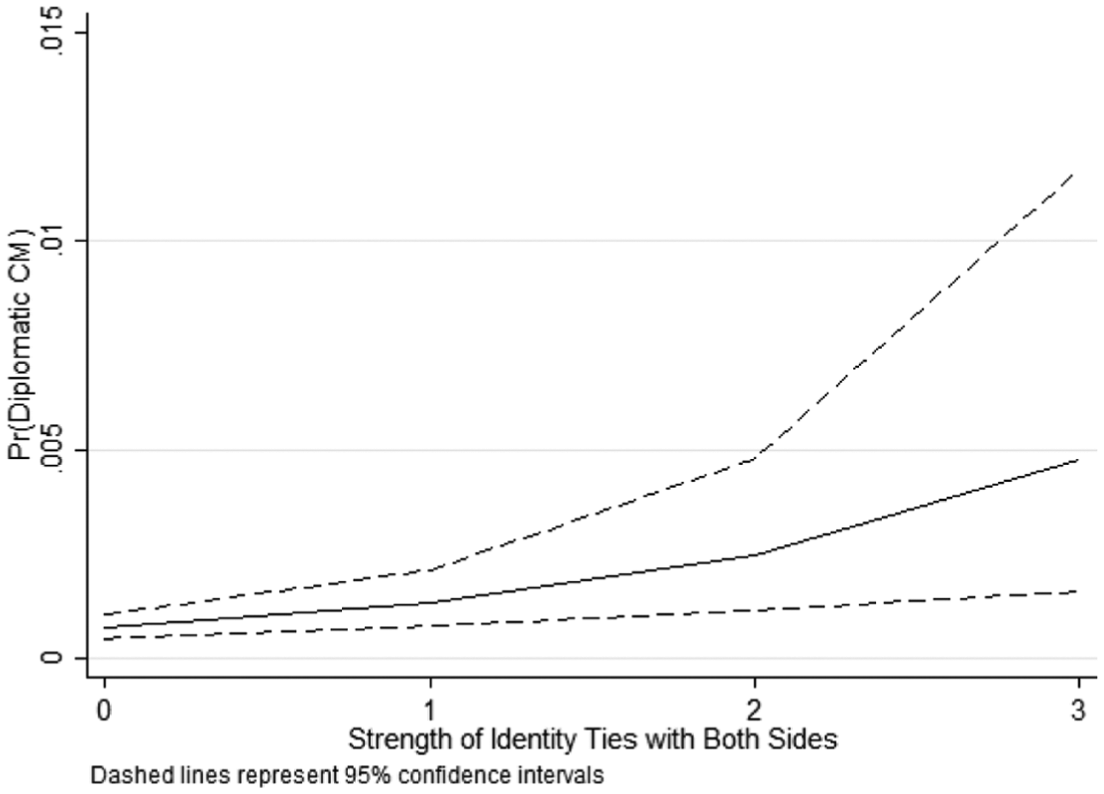
Strength of identity ties with both sides and the likelihood of diplomatic CM in average scenario.
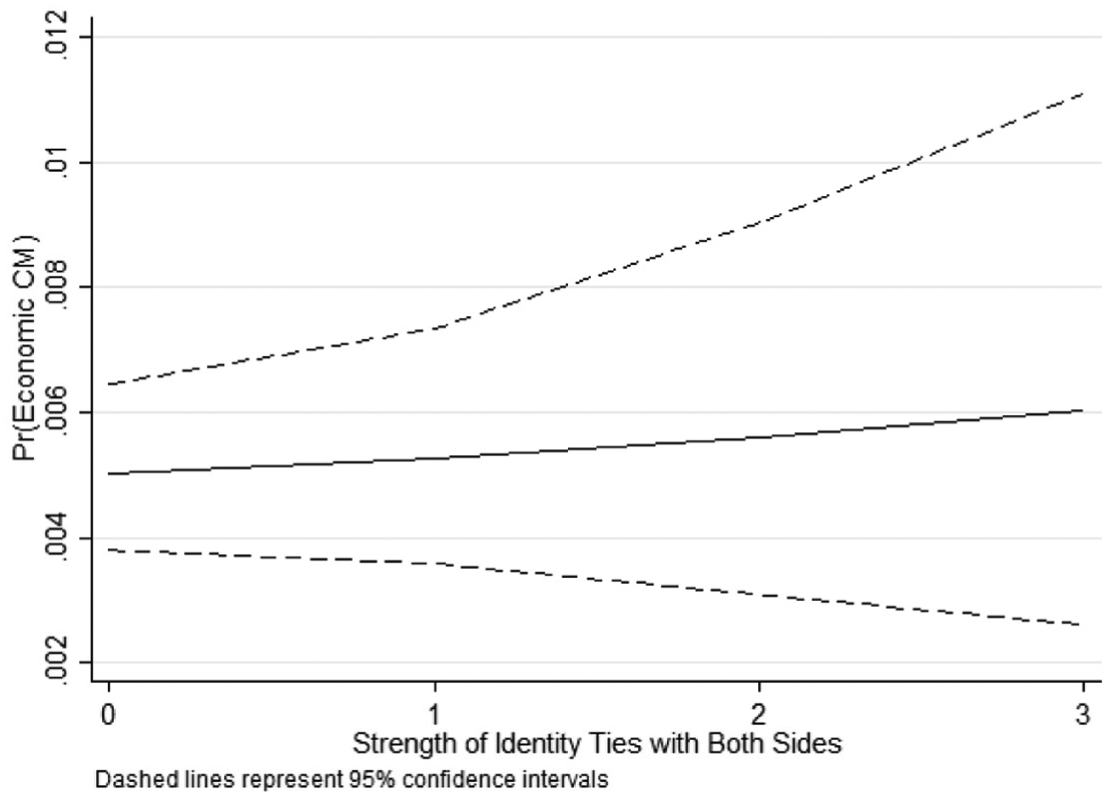
Strength of identity ties with both sides and the likelihood of economic CM in average scenario.
In sum, the strength of identity bias increases the likelihood of conflict management in general and economic conflict management in particular. I argue that the reason for this is the high salience of the conflict, high resolve to end the conflict in favor of one side, high public support which increases the capability of extracting resources and absorbing costs, and the higher probability of success. When the third party has equally strong identity ties with both sides, the conflict still has high salience and the public supports conflict management. However, such third parties avoid economic conflict management, which harms one of the disputants, and prefer verbal and diplomatic conflict management.
These findings do not necessarily contradict the earlier findings in the literature regarding the material relationship between third parties and disputants. I come to the conclusion that earlier studies have overlooked the role of ethnicity, religion, and language in third-party conflict management. Identity ties between third parties and disputants are as important as other types of ties based on alliance, trade, regime type, colonial ties, and contiguity. Also, it should be noted that these empirical findings do not clarify whether transborder identities influence the third-party conflict management process through top-down or bottom-up mechanisms. In a top-down mechanism, governments may use transborder identity ties to legitimize their ambitious foreign policy goals, to extract more resources, and to absorb higher costs by relying on public sympathy for their external kin. In a bottom-up mechanism, citizens may put pressure on their governments to take action to protect their external kin in other countries. In either way, however, these findings show a clear pattern between identity ties and conflict management decisions of potential third parties.
Robustness test
I operationalize identity bias based on ethnic, religious, and language ties. One concern regarding these results can be that they might be driven by one of these specific types of identity ties. To account for this possibility, I estimated models with disaggregated identity tie variables (see the additional tables in the Online Appendix). Consistent with the previous models, all types of identity bias increase the likelihood of economic and verbal conflict management, whereas they do not significantly affect the likelihood of diplomatic conflict management (except religious bias which is significant at 90% confidence level). All types of equal identity ties with both sides decrease the likelihood of economic conflict management. Language and religious ties with both sides significantly increase the likelihood of diplomatic conflict management and ethnic and language ties with both sides increase the likelihood of verbal conflict management. In sum, the models with disaggregated identity variables are consistent with aggregated identity variables.
Conclusion
I argue that third parties are more likely to manage interstate disputes if they have identity ties with one of the disputants given the shared preferences with this disputant and the higher public support for conflict management. The empirical findings support this argument. Stronger identity bias increases the likelihood of economic conflict management as the biased third party will aim to end the dispute in the favor of one side. Equally stronger identity ties with both disputants increase the likelihood of verbal and diplomatic conflict management because the public support for economic conflict management decreases given the reluctance to take a side between two kins. These findings contribute to the literature by underlying the effect of transborder identity ties on the likelihood and the type of third-party conflict management. Although other types of bias (e.g. alliance, colonial ties, shared border, and joint democracy) still matter, my findings demonstrate that identity bias is as important as them. Unbiased third parties are likely to manage interstate conflicts too but with less intrusive conflict management methods.
Another theoretical implication is related to the holistic approach. In line with Melin (2011) and Regan and Stam (2000), the results here show that including different conflict management methods into our analysis allows us to reach more accurate conclusions. For example, identity bias increases the likelihood of economic conflict management, whereas it does not significantly affect the likelihood of diplomatic conflict management. If my dependent variable was only third-party mediation, it would mislead us to conclude that identity bias does not matter. However, including economic conflict management within a holistic approach allowed me to observe the strong effect of identity bias on third-party conflict management.
These findings also speak to a broader debate in international relations literature between material factors (such as military alliances or trade) and non-material factors (such as identity or ideology). I demonstrate that governments take identity issues seriously and act accordingly in their international affairs. In particular, when governments make decisions about conflict management, identity ties matter in addition to material factors like military alliances and regime types.
I should also note some of the limitations of this research. First, the level of analysis here is limited to states because of my theory. I exclude regional and international organizations as potential third parties since these organizations do not have ethnic, religious, or language identities. Second, I focus on the management of interstate conflicts and exclude civil war cases. Third, this research does not assess the effectiveness/success of conflict management attempts by third parties with identity ties. Finally, future research should explore the direction of the relationship between public opinion and foreign policy behaviors regarding the transborder identities. In-depth case studies can explain whether governments use transborder identities to justify their ambitious foreign policies or voters put pressure on governments to manage interstate conflicts when they have identity ties with disputant states.
Supplemental Material
Supplemental_Materials – Supplemental material for Transborder identities, bias, and third-party conflict management
Supplemental material, Supplemental_Materials for Transborder identities, bias, and third-party conflict management by Emir Yazici in Conflict Management and Peace Science
Footnotes
Acknowledgements
Earlier versions of this article were presented at the 2016 Annual Meeting of the International Studies Association—Midwest in Saint Louis, MO, USA and the 2017 Annual Meeting of the International Studies Association in San Francisco, CA, USA. I would like to thank the discussants and panel participants in these conferences, my colleagues in the Political Science Department at the University of Missouri, and anonymous reviewers for their feedback on the earlier versions of this article. I am especially grateful to Bryce W. Reeder for his valuable comments and encouragement.
Funding
This research received no specific grant from any funding agency in the public, commercial, or not-for-profit sectors.
Notes

References
Supplementary Material
Please find the following supplemental material available below.
For Open Access articles published under a Creative Commons License, all supplemental material carries the same license as the article it is associated with.
For non-Open Access articles published, all supplemental material carries a non-exclusive license, and permission requests for re-use of supplemental material or any part of supplemental material shall be sent directly to the copyright owner as specified in the copyright notice associated with the article.
