



Abstract
Is there a trend toward the regionalization of peacekeeping? Does regionalization undermine the United Nations (UN) system of collective security? To answer these questions, we present an innovative dataset of peace operations. Covering the 1947–2016 period, the dataset captures every UN and non-UN peace operation, information on mission type, the existence of target state consent and UN authorization. The unit of analysis is the mission. The first analysis of the dataset yields three findings: (1) There is a significant regionalization of peace operations; (2) regions show distinct intervention patterns; and (3) regionalization does not directly challenge the UN authority.
Introduction
Is there a global trend toward peacekeeping by regional organizations? Since the 1990s, international military interventions to reestablish peace and security, in the form of either Chapter VII or peacekeeping actions, have significantly increased in numbers (Heldt and Wallensteen, 2006; Howard and Dayal, 2018; Wallensteen and Johansson, 2004). Military interventions are no longer conducted primarily just to prevent the escalation of interstate conflicts into threats to international peace and stability, but to prevent intrastate conflicts from destabilizing neighboring countries too (Berdal, 2008; Heldt and Wallensteen, 2006). The shift in the nature of interventions on the one hand, and the overburdening of the United Nations with peacekeeping operations on the other, have seemingly prompted the significantly more extensive involvement of regional organizations (ROs) in these activities worldwide. So, is there a shift from UN-led operations to RO-led operations? And do we observe such a trend across all regions? If it exists, what is the international legal significance of such a shift?
The questions we ask are of political and scientific relevance. First, a number of ROs have set up military intervention capacities and relevant decision-making structures allowing them to rapidly intervene in conflicts. The Peace and Security Council of the African Union is even modeled after the UN Security Council (UNSC), and—according to its member states—significantly improves on it as it does not foresee a veto power for individual council members. Hence, there is—especially in Africa—an emergence of a collective security architecture that parallels the UNSC and claims greater efficiency and legitimacy. In the past, some ROs have also openly challenged the UNSC’s competence as the sole mandator of peace enforcement actions. The Constitutive Act of the African Union (AU) is ambiguous, leaving some maneuvering space where it comes to obligatory UNSC authorization (Boisson de Charzournes, 2017: 181; Williams, 2009: 609–610). Some of the regional interventions, such as NATO’s operation Allied Force in Kosovo in 1999 and ECOWAS’s interventions in Liberia (1990) and Sierra Leone (1997) have been widely discussed in the literature, as they lacked prior UN authorization and hence an important feature making them apparently “legal” according to international law. Finally, meanwhile, peacekeeping in specific countries involves a variety of actors conducting different types of operations: The Multidimensional UN Stabilization Mission in Mali (MINUSMA) started as an invited French peacekeeping mission (“Operation Serval”) in January 2013 and transferred to the African Union and ECOWAS two months later (AFISMA), before it transitioned to the UN in July 2013. Apart from peacekeeping by various actors, an EU mission focusing on police training has been deployed too.
In sum, the questions of how many and what kind of interventions are actually conducted by ROs and whether it is possible to observe a “regionalization trend” contributes to our understanding of how regional and global collective security organizations coordinate to promote peace and security. They also have a broader significance for the system of collective security established by the UN Charter.
We argue here that the previous literature empirically analyzing the regionalization of peace missions does not allow us to answer these questions with a satisfactory degree of confidence. So far, the available data does not allow us to distinguish sufficiently between several types of peacekeeping missions and their regional distribution, or the legal framework of such missions. Moreover, conceptually, the literature has not differentiated well enough between missions that actually challenge the UNSC’s authority and those that do not.
To address this research gap, we constructed an innovative dataset of 293 third-party military and non-military interventions occurring on a global scale between 1947 and 2016. The innovative aspects of the dataset are that it provides data on UN and non-UN missions in a systematic fashion with a long temporal coverage. In addition, it provides information on the mandating practice of the UN, the question of target state consent or its status as an in-area or out-of-area intervention, which together allow evaluation of the missions according to aspects of international law. This allows us to distinguish between different types of intervention, to differentiate between the actors mandating and implementing them, and to discern the regional variations in such operations. Therefore, the major contribution of the dataset is that it enables systematic analyses of peace operation patterns across time, regions, and legal contexts for the first time. Overall, we believe that the dataset is helpful for political scientists, area studies specialists, and international legal scholars alike.
In the next section, we present the theoretical rational for the dataset. The third section describes the key concepts, dataset structure and data collection procedures employed in the Military and Non-Military Interventions Dataset (MILINDA). The fourth section presents descriptive statistics as well as global and regional patterns of peacekeeping operations. The final section discusses future research possibilities.
Why MILINDA? Rationale for a new dataset
Do peace operation missions follow specific trends over time that can be differentiated according to the actors that conduct such missions and the geographical spaces in which these missions take place? For example, do we observe a regionalization of peace operations over time, where regional actors take over more and more missions? If yes, does the process of regionalization challenge the existing distribution of responsibilities between the UNSC and ROs?
The literature disagrees on three fundamental points: first, do we observe a regionalization of peacekeeping, i.e. have ROs indeed taken over more peace operations relative to the UN? Second, the literature disagrees on the scope of regionalization, i.e. whether it is a global or regionally differentiated trend; and, third, it disagrees on the significance of this trend for the UN system of collective security.
Birger Heldt and Peter Wallensteen (2006: 17) state that a common perception was “that peacekeeping has on a global scale developed in the direction of ‘regionalization’” and their study finds that between 1996 and 2004 non-UN operations outnumbered UN operations by some 50%. Andrew Cottey (2008: 432; see also: Frazier, 2006) observes that the “trend towards the regionalization of peace operations … is continuing”. More recently, and based on a UN dataset of peacekeeping operations, Bellamy and Williams (2015: 2) state that there is a false assumption in studies—owing to a lack of data—that the regionalization of peacekeeping is a post-Cold War phenomenon or that “the UN is becoming less central as peacekeeping provider”. However, because statements either lack systematic data or data is incomplete, we cannot answer the question with a satisfactory degree of certainty.
Lack of systematic data also shapes our perception of the global scope of regionalization. A number of studies actually mention that the regionalization trend is potentially regionally differentiated. Many studies note Africa’s and Europe’s leadership in the realm of military interventions while at the same time emphasizing the absence of peacekeeping by ROs in other regions (Bellamy and Williams, 2005, 2015; De Guttry, 2011; Zakopalova, 2011). This raises the general question not only whether it is indeed possible to observe a regionalization of peace operations on a global scale (for all regions in a similar way) but also whether there are distinct peacekeeping patterns constituted by different actor combinations or mission types.
Finally, the literature disagrees on the significance of regionalization for the UN system of collective security and the distribution of responsibilities among the UN and other actors. One strand—mostly inspired by area studies and the international legal literature—even speaks of a challenge to the authority of the UNSC by some ROs—as evidenced by the African Union’s lack of acknowledgment of UNSC supremacy, as well as cases of peace enforcement missions that lacked proper UNSC authorization (Abass and Baderin, 2002; de Wet, 2014; Hettne and Söderbaum, 2006; Ntahiraja, 2012; Simma, 1999; Tomuschat, 1998).
Early studies were skeptical toward attempts by both NATO and African ROs to seek independence from the UNSC. Michèle Griffin (Griffin, 1999: 43) found that not only had military interventions by non-UN actors increased, but that a growing number of them had not received UNSC authorization. Griffin (1999: 48–49) also noted a readiness to accept “a devolution of authority” to other actors than the UN and expected an “irreversible” erosion of UNSC authority over multilateral peace. Yet even more recent studies voice concern: Andrea de Guttry (2011: 27) notes that “the quasi-monopolistic role” of the UNSC in the area of peacekeeping is eroding and that peacebuilding has been “seriously challenged by both ROs and by the so-called ‘ad hoc coalitions of the willing’”. Joachim Koops and Thierry Tardy (2016: 68) outline the formal hierarchical relationship that exists between the UNSC and ROs in the case of interventions according to Chapter VII of the UN Charter, but also note, in particular with a view toward the AU, that “not all accept the hierarchy and its consequences,” thus “creating tensions among peacekeeping actors”. Of particular concern in this regard are the intervention practices of the Economic Commmunity of West African States (ECOWAS) and the South African Development Community (SADC) because their statutes do not explicitly acknowledge the supremacy of the UNSC if it comes to peace and security. In addition, they have conducted military interventions without prior UN authorization (de Wet, 2014; Paliwal, 2010). Björn Hettne and Fredrik Söderbaum (2006) even go as far as advocating a stronger independence of ROs from the UN, as ROs incorporate a logic different from the Westphalian-state-logic embedded in the UN’s system of collective security. They also note that “global and regional approaches can potentially become competing authority structures” (Hettne and Sderbaum, 2006: 230).
The conclusion that regionalization challenges the UNSC is disputed by other studies, even if they may agree that regionalization is taking place. Some studies note that the UN remains an important actor (Bellamy and Williams, 2005, 2015; Williams, 2017); others point to the emerging collaboration between the UNSC and ROs, as evidenced by UN subcontracting (Coleman, 2011; Koops and Tardy, 2016; Walter, 2012; Yamashita, 2016) and the extensive authorization practice of the UNSC vis-à-vis non-UN peacekeeping operations (Cottey, 2008; de Wet, 2014; Howard and Dayal, 2018), as well as the development of a new category of hybrid missions symbolizing an entirely new interaction between the UN and ROs (Hirsh, 2000; Othieno and Samasuwo, 2007; Walter, 2012). Again, the current data does not allow us to systematically study what the regionalization trend actually means for the collective security system of the UN. The area studies and international legal literature discuss such questions in detail, but they only focus on selected case studies—mostly in Africa—and cannot provide a systematic overview (Berger, 2016; Charbonneau, 2015; Coleman, 2011; Murphy, 2016; Rodrigues, 2015; for a similar argument, see: Fortna and Howard, 2012). At present, the literature does not allow us to answer such questions with a satisfactory degree of certainty. In short, a new dataset considerably improves the empirical basis for research on global and regional peacekeeping trends.
The conflict and peace studies field is not short of datasets focusing on peace operations or interventions more generally. Yet, as we will demonstrate, most other datasets do not record the full range of actors mandating and implementing such missions and owing to their different research focus, they do not include key variables of interests that are important to answer the questions raised here. Existing datasets have been primarily designed to answer questions on the effects of such missions on peace efforts (Hoeffler, 2014; Hultman et al., 2016; Kathman and Wood, 2016). For example, the Third Party Interventions (TPI) dataset of Mullenbach (2013) records all intra-state third-party interventions (1947–2014) with the aim of explaining why they have been established, why different missions occur and how these missions affect the duration and resolution of conflicts (Mullenbach, 2005). Mullenbach’s TPI distinguishes interventions by states and state coalitions, ROs and the UN, it codes whether a formal UN mandate has been issued or whether the mission is based on a peace agreement, it distinguishes seven different purposes of peacekeeping missions and records which country led and contributed mostly to the peacekeeping effort. While very comprehensive, the dataset does not record the specific type of mandate, especially whether there has been a Chapter VII mandate or whether the mission had state consent. All of these variables would allow us to answer the questions of the legality of the intervention and the challenge posed by ROs to the UN system of collective security.
This becomes especially apparent when compared with the Data Archive on Italy and Multilateral Security (ADISM), a little-known dataset of the University of Catania in Italy (Attinà, 2012), which records data on UN and RO-led missions (1946–2008). It codes what the status of a particular peace operation is, e.g. whether it is an operation falling under Chapter VI or Chapter VII of the UN and whether it was endorsed or authorized by the UN. Compared with the TPI dataset it has fewer missions, however, and does not record different mission types. The Oxford Handbook of United Nations Peacekeeping Operations (Koops et al., 2015: Chapter 1) provides a list of 175 peacekeeping operations and a separate list of authorization through the UN, but not a combined dataset. Lastly, the SIPRI Multilateral Peace Operations dataset (Stockholm International Peace Research Institute (SIPRI), 2016) is, with over 600 observations, mission-wise the most comprehensive dataset. The SIPRI dataset records missions sanctioned by the UN or authorized by a UNSC resolution. 1 It excludes self-mandated state- or state-coalition-led peace operations documented by the TPI and ADISM datasets and it also does not code the mandating practice in terms of Chapter VI and VII mandates or specifically the mandating and implementing agents, which would allow an answer to the question of regionalization. Moreover, the missions recorded by ADISM and TPI only partially overlap, suggesting that there is something to be gained from combining the two datasets.
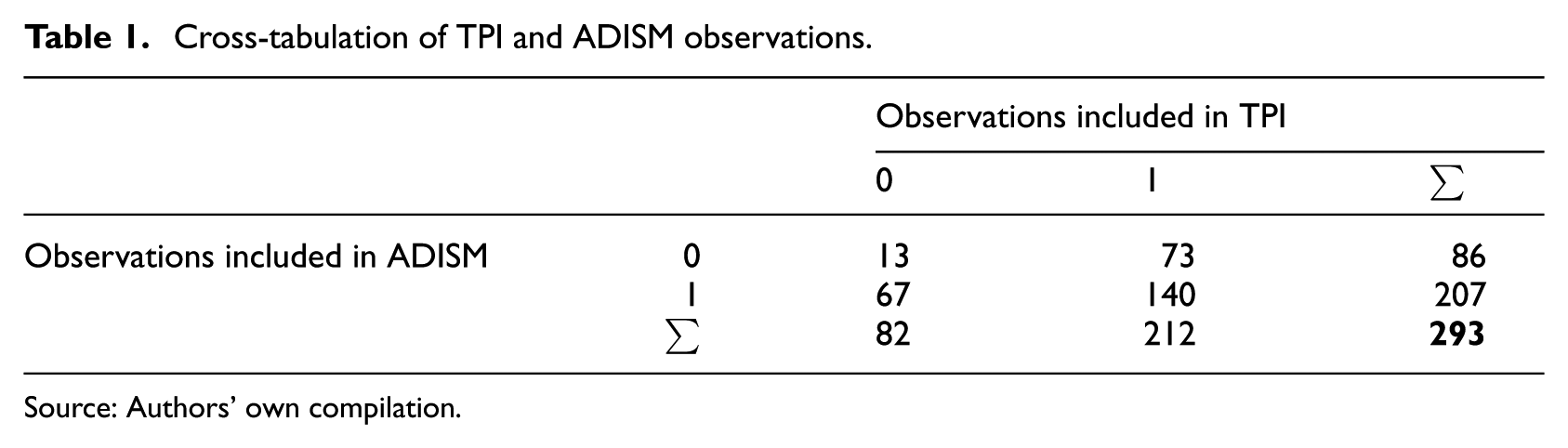
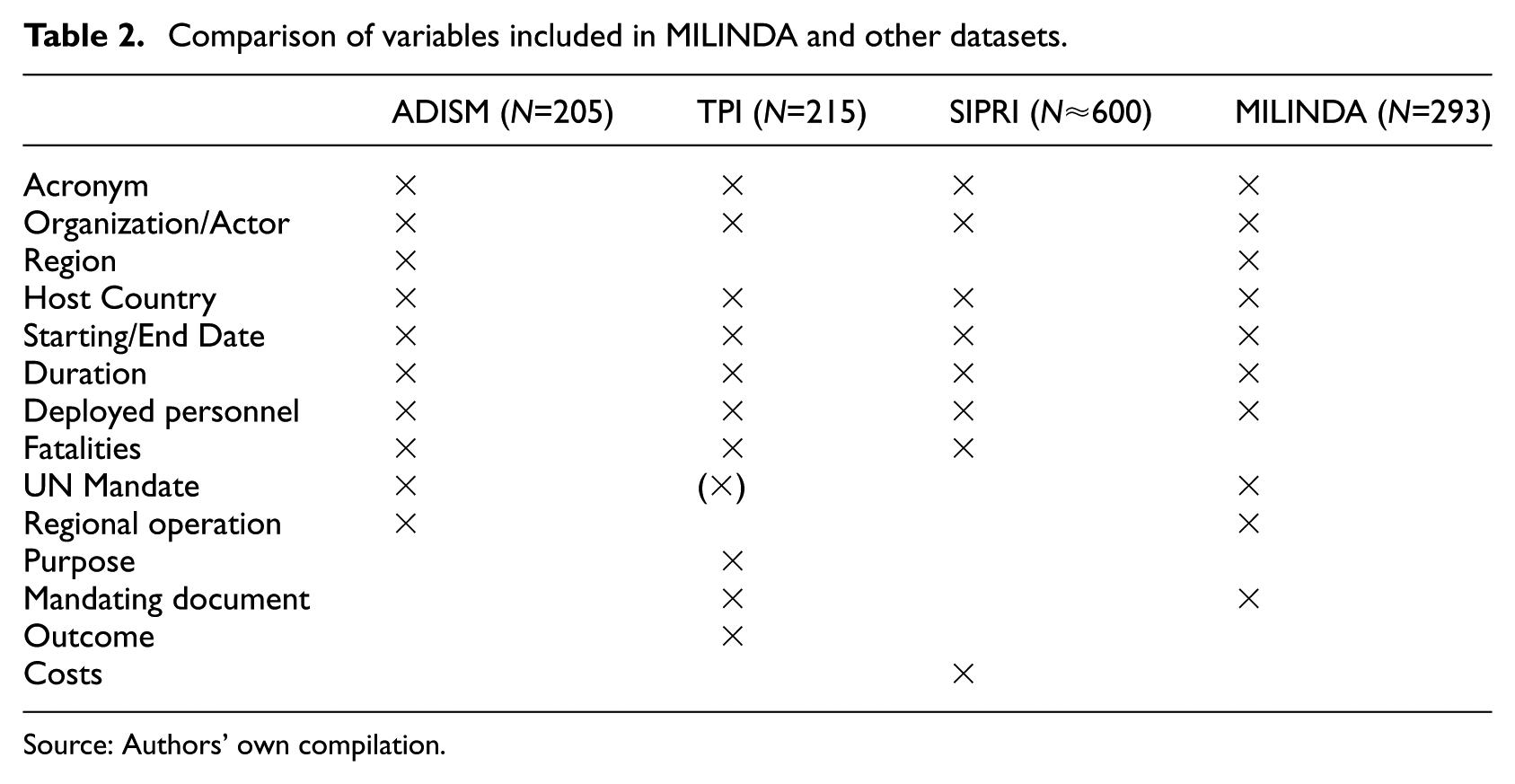
As becomes visible from Table 2, while all three datasets record the acronym of a mission, the host country, start and end dates and deployed personnel, they significantly vary in other aspects. Only two of the datasets have a category for the specific mandate, but ultimately do not code it. Only two datasets code regions. Regarding the overlapping variables, and the 140 observations that are included in ADISM and TPI, intercoder reliability varies, mainly because of the different time frames that are covered by the dataset (ADISM 1947–2008, SIRPI 2000–2012, TPI 1947–2014). While the name of the mission and the organization are identical in almost all cases, and all of the recorded start and end dates match, there is some variation owing to the different time frames of the datasets. Whereas ADISM records all missions that continued through 2008 as having ended in September 2008, TPI does not provide end dates for these cases. Datasets also vary concerning the number of deployed troops. SIPRI is much more differentiated and distinguishes between troops, military, civilian police and civilian staff each by “authorized” and “actual” deployed numbers, but these are difficult to compare with the figures of ADISM, which only codes peak numbers of deployed troops and does not differentiate among different types of personnel. In some cases, the differences are relatively small, as in the case of SFOR in Bosnia–Herzegovina. Here, ADISM counts 36,300 troops, whereas TPI counts 32,000. In other cases, as the one of the International Peacekeeping Force in Sri Lanka, numbers vary substantially. In this case, ADISM reports 53,000 and TPI 80,000 troops. There is clearly a need for data improvement.
While distinguishing among state-, regional-organization- and UN-led missions, existing datasets employ different standards for including peace operations in a dataset and seldom code the specific legal status of a mission. However, without the legal framework of the missions—whether it is a chapter VI or VII operation, self-mandated as part of a peace agreement, whether it is an enforcement action or enjoys state consent, we cannot make statements about the missions’ legality according to international law, and therefore its effect on the UN system of collective security. It is also difficult to make valid statements about the relative importance of UN vs non-UN missions. For example, it is not possible to infer from the missing UN authorization of peace operations by ROs that such missions are problematical or even illegal and therefore also negatively affect the UN system of collective security. Such missions are explicitly foreseen by the UN Charter, provided that they have state consensus. 2 Hence, if we relied simply on an existing UN authorization as an indicator for a regional peace operation’s legality, we would overestimate the challenge that regionalization presents to the UNSC, as about 46% of all peace operations by non-UN actors and about 22% specifically of peacekeeping and enforcement operations do not have a UN mandate. Distinguishing between intervention types and intervention categories, as we did in the new dataset and as we outline in the reminder, is key to differentiating between forms of regionalizing peace missions. Only one of them that we call regionality and that we define based on the indicators in our dataset would challenge the collective system of security. We define regionality as shift of decision-making competences within nested institutions.
MILINDA: defining peace operations and their mandates
The MILINDA universe of cases encompasses all military and non-military peace operations between 1947 and 2016 explicitly designated as peace operations. 3 We follow here the definition of Bellamy and Williams (2015: 13) who define peace operations as the “expeditionary use of uniformed personnel (…) with or without a UN mandate, but with an explicit mandate to assist in the prevention of armed conflict by supporting a peace process.” SIPRI’s definition of a peace operation is quite similar: it is designed to facilitate the implementation of peace agreements already in place, to support a peace process or assist conflict prevention and/or peace-building efforts. 4 MILINDA excludes other types of foreign military intervention, such as those collected in the International Military Interventions dataset (Pickering and Kisangani, 2009). International Military Interventions encompasses information on cross-border movements of military forces in the context of “some political issue or dispute” and hence on distinctive interventions that mostly do not conform to the definition of peace operations above. 5
The MILINDA dataset builds on but also extends the Third Party Interventions dataset (Mullenbach, 2013) and the ADISM dataset (Attinà, 2012). 6 Given our interest in shifts of peace operations among different groups of actors, our data includes not only UN missions but also a substantial number of missions conducted by ad hoc coalitions of states or individual state not included in the UN or SIPRI’s database. The MILINDA dataset contains 293 observations altogether. 7 Of these 293 observations, 13 are newly coded and not included in either of the two datasets, 8 140 can be found in both datasets, 67 in ADISM only, and 73 in TPI only (see Table 1).
Cross-tabulation of TPI and ADISM observations.
Source: Authors’ own compilation.
Comparison of variables included in MILINDA and other datasets.
Source: Authors’ own compilation.
The unit of analysis is the mission. If a mission changes its category—for example, from an Observer to a Peacekeeping operation—we coded this as a new observation. By merging the two preexisting datasets, we gain a much more comprehensive number of observations overall. While merging the data, we compared all observations in the datasets and carefully checked whether identical missions were recorded. We also cross-checked data with the SIPRI Multilateral Peace Operations dataset (SIPRI, 2016).
The new dataset includes variables such as the name of the mission, the target country of it, the start and end year, and the number of personnel deployed, which are also all included in ADISM and TPI.
MILINDA extends both ADISM and TPI by adding in specific variables of interest, which we describe in detail below. The new variables in the dataset are:
MILINDA codes four types of interventions, denoting the distribution of responsibilities among the various actors, which we defined in line with the international legal literature (Abass, 2004; Abass and Baderin, 2002; Berdal, 2008; de Wet, 2014): Peace Enforcement, Peacekeeping, Observer, and Other.
Peace enforcement missions (Peace Enforcement) are defined here as ones that do not have the prior consent of the affected states. Peace enforcement measures require a mandate from the UNSC to be legal. A mission was coded as enforcement if the mandating document explicitly mentioned the lack of consent of the target state. In these cases, the mandate also cites a Chapter VII situation. Here, we followed strictly the argument in the international legal literature that the term “peace enforcement” is reserved for enforcement measures that lack the consent of the target state and are implemented against the explicit will of it (Nolte, 2010; United Nations, 2014). Because such missions are controversial from a legal point of view, they usually leave a huge paper trail in the literature and hence they are easy to verify.
Peacekeeping missions (Peacekeeping) actively mediate between two or more conflicting sides—and they always include the deployment of military personnel. They are defined as ones with the prior consent of the affected parties. These can be measures to monitor and implement a peace or ceasefire agreement between two conflict parties including domestic ones, and they can involve the use of force to guarantee the integrity of the mission (such as the taking up of arms for self-defense purposes). A mission was coded as peacekeeping mission (KEEP) if the mandating document explicitly cited peacekeeping. A mission was also coded as peacekeeping mission if the mandating document explicitly mentioned the invitation of the target government or its explicit consent. In other words, the criterion for being coded as peace enforcement mission is neither the use of military power nor the mentioning of a Chapter VII situation, but the lack of government consent to a military mission. Whenever not explicitly stated in the mandating document, we obtained this information from the secondary literature, such as the Historical Dictionary of Multinational Peacekeeping (Mays 2011) (in which case the source is provided in the comment section of the dataset).
Observer missions (Observer) are defined as ones having the prior consent of the affected parties and that aim to mediate between two or more conflicting sides to monitor a truce or peace agreement—but they involve only a very limited number of armed personnel. A mission was coded as observer mission (OBSR) if the mandating document explicitly mentioned as purpose the observation of a ceasefire agreement and if the mission was deployed to observe a truce or ceasefire agreement between two states. This conforms to the classical definition of observer missions during the Cold War.
Other missions (Other) refer to training ones having the prior consent of affected parties, political, or humanitarian missions that primarily involve the building up of institutional capacities for elections and the like. While sometimes including uniformed, military personnel, they mostly deploy civilian personnel. We coded a mission as mission of the OTHER type if the mandating document deployed civilian forces or police forces only, if the mission was for election monitoring (with only civilian forces), or quoted an explicitly political purpose, such as “peace consolidation” or “capacity building of national institutions,” or disarmament or security sector reforms. Also, the political offices of the UN were coded as OTHER. This is a non-exhaustive list. For example, the UN Mission in Nepal (UNMIN) is a political mission that was established in January 2007 to oversee a peace accord between the Maoist Communist Political Party of Nepal and the government. The mission had the purpose of supporting the government in organizing a constitutional assembly and observing elections.
Table 3 demonstrates that both peacekeeping and enforcement missions use military force (while Observer and Other missions do not), but they differ in requiring consent from the affected party (peacekeeping) or not (enforcement). Peacekeeping and Other missions can be distinguished by the deployment of (mostly) civilian personnel.
Definition of intervention types.

Source: Authors’ own compilation.
For example, the NATO-led Implementation Force (IFOR) in Bosnia–Herzegovina, called by NATO “Operation Joint Endeavor,” was a peacekeeping mission based on a peace agreement, the General Framework Agreement or “Dayton Agreement,” which provided the legal basis for the mission. IFOR entrusted NATO with the task of “implementation of the territorial and other military related provisions of the agreement” (US Department of State, 1995: Annex 1A, Article I), and it authorized NATO to deploy ground, air and maritime units to establish a durable cessation of hostilities. It also authorized the use of necessary force. Because the mission is based on the consent of the parties, it is not an enforcement mission. When established, it did not have UN authorization, but the Dayton Agreement invited the UNSC to issue such a mandate, which it received two weeks later (UNSC Resolution 1031, 15 December 1995).
Intervention categories (intcat) are defined by the actual actors involved in such a mission. We use here Bellamy and Williams’s (2005) distinction between mandating and implementing agents to generate this classification. In principle the UN, ROs, or individual states can act as mandating authorities, and all three can act as implementing agents too. “Coalitions of the willing,” ad hoc coalitions of states, or even a single state acting on its own can also establish a peace operation. However, under international law, delegation from actors lower in the hierarchy to actors higher in the hierarchy is not possible, so that delegation from states to ROs or the UN or delegation from ROs to the UN is not possible. Individual states and ad-hoc-coalitions operate under the same legal constraints as ROs do, meaning that they cannot engage in enforcement missions without proper authorization from the UNSC. This leads to the combination of authorizing and implementing bodies plotted in Table 4.
Intervention categories.

Source: Authors’ own compilation.
Legend: UN, United Nations; RO, regional organization; IndS, (coalition of) individual states. The acronym UNUN hence denotes a mission that is mandated AND implemented by organs of the UN. UNRO is a mission mandated by the UNSC and implemented by a regional organization (RO), while RORO again stands for missions mandated AND implemented by ROs. IndSIndS is a mission mandated AND implemented by a (coalition of) independent state(s), while the acronym UNIndS refer to the UN and the acronym ROIndS to ROs as the mandating actors.
The information on intervention categories (UNUN, UNRO, UNIndS, RORO etc.) comes primarily directly from the mandating documents (UNSC resolutions, decisions by the councils of ROs, peace agreements), but also uses the information on the status of the mission—used by ADISM and Bellamy and Williams (2015). Whenever UNSC resolutions mentioned implementation by UN forces, the mission was coded as a UNUN mission. When they explicitly authorized the implementation to a regional organization or an individual or group of states, the mission was coded as a UNRO or UNIndS mission. This is also indicated by our status variable, which would be UN-A-7. When the UNSC endorsed a mission by a regional organization or state coalition (status=UN-E), we coded it either as an RO- or an IndS-mandated mission, not as a UN-mandated mission. UN endorsements can be interpreted as a respectful acknowledgment concerning the independence of non-UN missions, which provides them with additional legitimacy but does not establish a formal hierarchy between the two groups of actors. We proceeded in a similar way with RORO and ROIndS missions.
Furthermore, MILINDA defines eight regions: Central South Asia (CSA), Eurasia (EURA, the post-Soviet space), Europe (EUR), Latin America (LAC), the Middle East and North Africa (MENA, the area of the Arab League), the Pacific (PAC), Southeast Asia (SEA), and Sub-Saharan Africa (SSA). Herewith we use a greater number of regions as compared with other studies, allowing for a more sensitive study of regional intervention patterns. Regional definitions vary significantly (Thompson, 1973; Volgy et al., 2017). For example, Bellamy and Williams (2015) categorize the post-Soviet space as belonging to Europe, and subsume the Pacific region under Asia. In their discussion, they argue, however, that the Pacific should be seen as a region with a distinct intervention pattern. Zakopalova (2011) categorizes the countries of the post-Soviet space as in the Asian region. Even the UN uses different regional criteria, depending on the UN unit. 9 Our own regional categorization takes the regional categorization of the UNESCO as a model, 10 but we divide the region “Asia and Pacific” into two and the region “Europe and North America” into two regions. A list of the countries included in each region can be found in Appendix A entitled ‘MILINDA Regions’ of our Online Appendix. 11
The following text example provides an example of the coding procedure: UN resolution 976 of 8 February 1995 (S/RES/976) on Angola welcomes “the offer from the Government of Angola to provide substantial contributions in-kind to United Nations peace-keeping operations” (para 10), and “authorizes the establishment of a peace-keeping operation, UNAVEM III to assist the parties in restoring peace and achieving national reconciliation in Angola” (page 2, para. 5). The status of the mission is a UN-6 mission, and since it is mandated and implemented by the UN, the intervention category is UNUN. The mission is coded as “KEEP” and as having the government’s consent, as the document mentions that the mission receives financial support from the government. It does not have a Chapter VII mandate (ch7=0), as the term is not mentioned in the document. In this example, the country is Angola and the region is Sub-Sahara Africa.
When do non-UN actors challenge the authority of the UNSC? Regionalization and regionality
Our differentiation between intervention categories and intervention types provides combinations allowing inferences for those interventions that actually challenge the UN system of collective security and those that shift the distribution of authority among the UN and ROs. As currently defined, Chapter VIII of the UN Charter foresees a substantial role for ROs vis-à-vis the promotion of international peace and security—with the UNSC even being in a subsidiary role toward ROs in the case of the peaceful resolution of conflict according to Chapter VI. They are conceived as “pillars” of the UN collective security system, which are supposed to unburden the UNSC, especially in the area of the peaceful resolution of conflict (UN Secretary-General, 1992). An increase in the number of missions by non-UN actors therefore does not necessarily indicate a challenge to the system of collective security; it is particular missions of the enforcement type that would challenge the authority of the UNSC. It is only in this area where the UN has exclusive authority.
Using earlier concept-building efforts and the international legal literature on the division of labor between the UNSC and ROs according to the UN Charter, we differentiate between: (1) the regionalization of peacekeeping, as an increase in the number of RO peacekeeping activities relative to those of the UN; and (2) regionality, as taking over responsibilities that are currently under exclusive UNSC authority and which indicate a challenge to the UNSC. Hence, “regionality” can be seen as an instance of a shift in decision-making authority within nested institutions (Alter and Meunier 2009; Ntahiraja 2012). Nested institutions are institutions with overlapping jurisdiction with no hierarchy to resolve conflicts across regimes. Peacekeeping is nested because both the UN and ROs have substantial authority to act. In the case of target state consensus the area of overlap is principally all types of operations, as the UN, ROs and individual states can conduct such missions, but ROs have primary responsibility relative to the UNSC. In the case of missing target state consensus, there is an area of exclusive authority by the UNSC, as enforcement actions need to be mandated but can be delegated (and the UNSC cannot always act due to decision-blockades). We argue here that it is a specific combination of RO intervention that indicates a transformation of the collective security system rather than an increase in the number of RO interventions relative to other intervening actors per se (Heldt and Wallensteen, 2006). We therefore define as a development toward regionality the shifting of enforcement competences from the UNSC to ROs. If one such occurrence appears, we are observing regionality. Yet if we observe more than one instance of this, we observe higher degrees of regionality or a development toward more regionality. This definition requires us to examine the distribution of responsibilities between the UNSC and ROs in the areas of peace and security.
For regionality, the combination of the intervention type Peace Enforcement and the intervention category RORO is particularly relevant, as these would be the instances wherein ROs engage autonomously in peace enforcement actions and hence challenge the authority of the UNSC. In contrast, the combination of RORO and Peacekeeping, Observer, or Other would measure regionalization only. They are based on the consent of the target state and hence do not constitute an enforcement action. The in-area variable is relevant here, too, as ROs are only allowed according to the UN Charter to operate in the jurisdiction defined by the territories of their member states and need UN authorization if they operate outside of it.
Presenting new data on military and non-military interventions
Global trends in mission types
We start the presentation with the patterns of global and regional interventions. Did an increase of regionalization actually take place? Figure 1 displays the development of different interventions (bottom, Peace enforcement, peacekeeping; top, Observer, others) over time. By only plotting labels for every five years, the graph not only becomes neater, but also demonstrates that between 1950 and 1980 several years saw no intervention at all (e.g. 1975, 1985). What is clearly visible is the sudden increase in such missions beginning in the year 1991, when a number of them were launched. Examples are an observer mission organized by the Organization of African Unity in Rwanda, a European Union observer mission in Croatia, and a UN-led peacekeeping mission in El Salvador. There are several spikes in the distribution of missions, and most significantly in the years 1992–1993, 1997 and 2004–2005. By and large, the number of missions has declined since 2005 though.
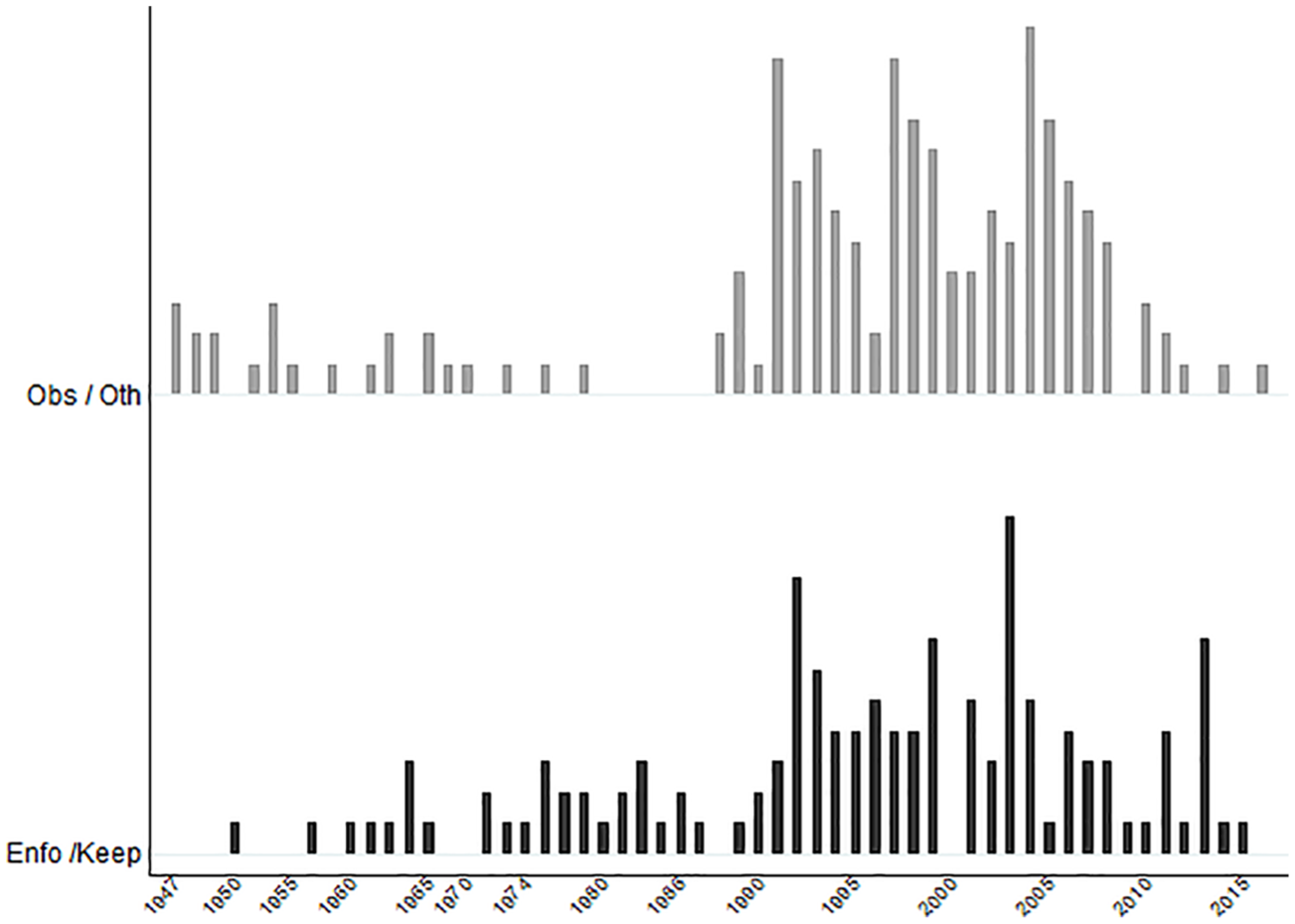
Frequency of interventions over time (top, only Observer and Other missions; bottom, Peace enforcement and Peacekeeping missions).
The fact that the cut-off point of Observer and Other missions takes place in 1991 instead of 1992—see the upper part of Figure 1—seems to be in contrast to experts’ assessments (Berdal, 2008: 177; UN Secretary-General, 1992), with the practices of the UN—especially in regard to peace interventions and peace keeping missions—changing substantially only in the latter year with the issuing of UN Secretary General Boutros Boutros-Ghali’s “Agenda for Peace” (see lower part of Figure 1).
Keeping this in mind, we choose to use 1992 as the cut-off point—with further analyses distinguishing between the two timeframes up to and including 1991 and from 1992 onward. This seems to also speak to one potential explanation for this cut-off—the dissolution of the Soviet Union and regional developments following from that. Summarizing Figure 1 numerically, 90 missions had taken place before 1992 and 203 occurred since then. If one breaks these numbers down into a yearly basis, we have about 2 missions per year in the timeframe up to 1991 and about 8.2 missions per year during the period from 1992 to 2016. Does this change in the frequency of all missions translate to a change in the frequency of certain types of intervention too?
Examining the relative distribution of types, as displayed in Figure 2, brings a number of noteworthy results: the major changes from 1992 onward occurred in the intervention types Observer and Other, and hence are of kinds posing no challenge at all to the UNSC. Observer missions have declined substantially, whereas political ones—included in Other—have increased from 7% to about 35% of all types of missions (numbers plotted in Table B1, see Online Appendix B entitled ‘Additional Tables and Figures’). Although Peacekeeping missions account for a substantial absolute number of all missions, they have actually declined as a share thereof. We will discuss what the implications of these findings are in due course.
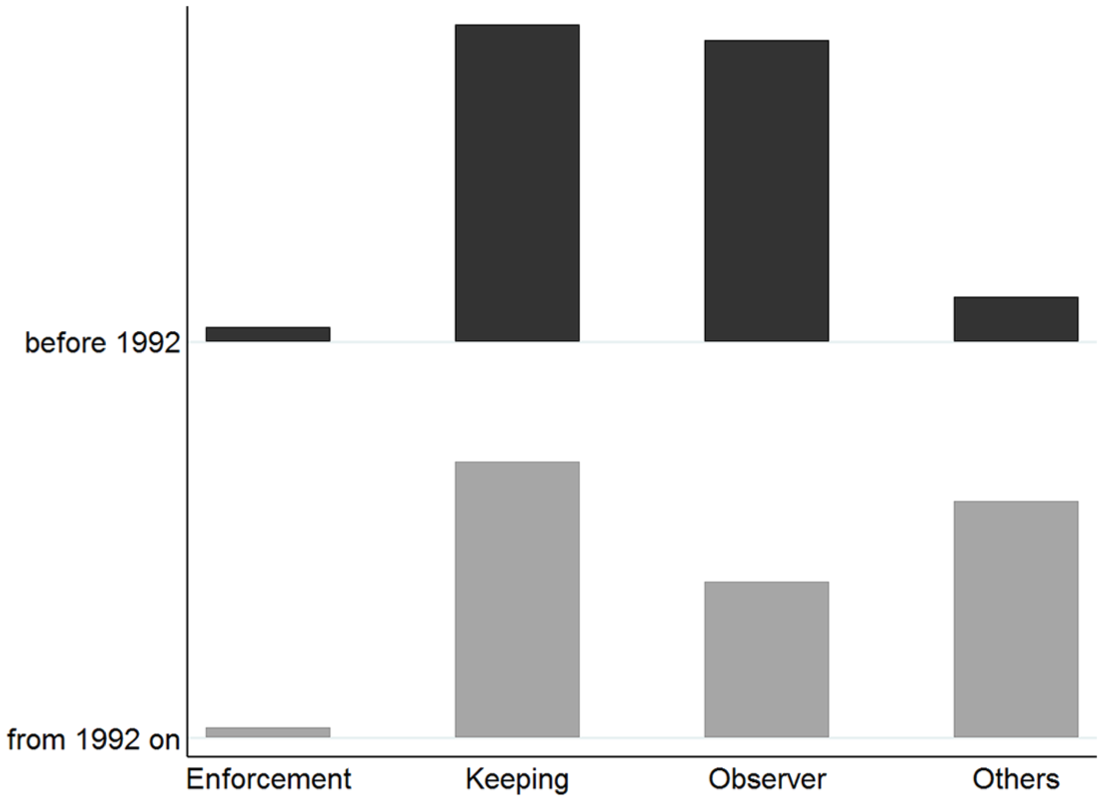
Distribution of intervention types up to 1991 and from 1992 onward, as percentages.
Regionalization as a challenge to the UNSC? Regionalization vs regionality
Following on from these descriptive insights, we now move to empirical analyses of whether trends of regionalization or regionality actually appear in reality. To do this, we first of all describe the relative distribution of the six categories of intervention over the two time frames before then moving on to a more robust and fine-grained analysis.
Table 5 demonstrates that the share of RORO interventions—that is, interventions mandated AND implemented by ROs—does change substantially. The major change occurs in the categories of RO interventions mandated by the UN (UNRO) AND of RO interventions mandated by ROs themselves, with numbers in both categories increasing by 11 percentage points. In reverse, individual state interventions mandated by states themselves (IndSIndS) decrease by about 16 percentage points. Hence, there is development toward regionalization from two different directions: first, interventions that were earlier conducted ad hoc by individual states or a state coalition now appear to be conducted by ROs instead; second, the share of UN-mandated and of RO-mandated RO interventions has increased. Therefore, there is a regionalization or RO-ing-up effect in the sense that ROs have become more important relative to individual states and the UN in terms of the number of interventions pursued.
Distribution of intervention categories over time.

Numbers in parentheses denote absolute number of missions per category and time period. ***p < 0.001, **p < 0.01, *p < 0.05, †p < 0.1.
Our data qualifies the findings of other studies. Bellamy and Williams (2015: 22), for example, find that “as a proportion of the global total, non-UN peace operations have become a less important element of the past few decades”. Our data confirms that the share of non-UN interventions (as measured by the sum of the first three rows for each time period) has decreased since the end of the Cold War, but so has the share of UN implemented interventions (from 40 to 32%). More importantly, however, the statement is only true if one sums up the (decreasing) share of individual state interventions and the (increasing) share of ROs. Otherwise, the share of ROs has significantly increased. In between are a substantial number of missions that are mandated but implemented by ROs (and partially also states) which have strongly increased and constitute new categories if compared to the period before 1992. Taken together with the missions autonomously mandated and implemented by ROs (the RORO missions), ROs indeed take on a much larger share of peacekeeping operations. The UN remains an essential source of legitimation, however (see also Bellamy and Williams, 2005: 167).
This finding on the UN staying (and becoming even more important as) the main mandating actor is also supported when we have a look at its actual mandating practices (not plotted). Especially in the type of Peacekeeping, these missions frequently take place under a Chapter VII mandate. This is true even if the missions take place with the consent of the target state, and thus strictly speaking do not require a Chapter VII mandate, a finding that confirms Lise Morjé Howard and Anjali Kaushlesh Dayall’s (2018) observation of an overuse of the Chapter VII mandate. For example, whereas the UN authorized only two state-led interventions before 1992 and one RO-led interventions at all it then authorized 14 of the former and 25 of the latter after 1992.
If we focus on the distribution of the types of intervention (Peace Enforcement, Peacekeeping, Observer, Other) by category (UN, RO, IndS), another development becomes evident too: the overwhelming majority of all interventions are indeed legal (not plotted as table). Since 1990 only one truly autonomous peace enforcement operation by a RO has taken place that did not have UNSC authorization. This was the North Atlantic Treaty Organization’s (NATO) intervention in Kosovo (1999). 12 Nevertheless, with about one third of all interventions the UN still figures quite prominently in the type of Peacekeeping—even though that is ROs’ traditional realm of activity.
What does the UN’s mandating practice mean for the system of collective security of the UN? Some authors regard the interaction between the UN and non-UN actors, ROs in particular, as a sign of a tighter integration between the two. Some go as far as to suggest that there has been a “centralization of political and legal authority into the hands of the UNSC such that member states are less likely than they once were to deploy peace operations without a license of one form or another from the Security Council” (Bellamy and Williams, 2015: 21). Empirically, this interpretation is supported by the fact that the UN has mandated more non-UN operations after 1992. Yet our data leaves room for different interpretations: one is that ROs are simply using the UNSC to legitimize their interventions. In this case, the mandate would just confer legitimacy but not imply the acknowledgment of a hierarchical relationship vis-à-vis the UNSC and hence not indicate “centralization” (Barnett 1995; Boisson de Charzournes, 2017: 171). The second interpretation is that the UNSC authorizes ROs to conduct the operation. To the effect that this might also imply a delegation of authority to initiate enforcement, a Chapter VII mandate can be interpreted as the opposite of centralization, namely as a decentralization of the use of force and hence as undermining the UNSC’s authority (Boisson de Charzournes, 2017: 176). As Boisson de Charzournes (2017) points out, this not only raises questions regarding the UNSC’s exercise of control over ROs in the case of UNRO missions, but also creates “pockets of institutional autonomy” for ROs towards the UNSC. We will discuss the implications of these findings in the conclusion. The next section briefly focuses on MILINDA’s capacity to differentiate among regional intervention patterns.
Is the regionalization trend really global? Intervention patterns across regions
Closer inspection of the regionalization trend shows interesting regional variations within it. In fact, Heldt and Wallensteen’s (2006: 21) observation that there is “something about some regions that makes them more or less likely to allow/require the UN to establish peacekeeping operations” is highly relevant here. The contrasts in regional intervention patterns are rather large, and effectively lead us to qualify the trend toward regionalization. A meaningful regionalization of peace operations can only be reported for Africa and Europe, whereas we do not find such a regionalization trend in other world regions.
In terms of the number of interventions, Sub-Saharan Africa counts by far as the largest. About 43% of all interventions have occurred there since 1992. The world region with the second-largest number of interventions is Europe, accounting for 44 out of 203 (22%, see Figure 3 and Table B2 in Online Appendix B). Eurasia, Latin America, the Middle East and the Pacific follow these two regions, with about the same number of interventions each. Only Central and South Asia accounts for considerably fewer interventions in comparison.
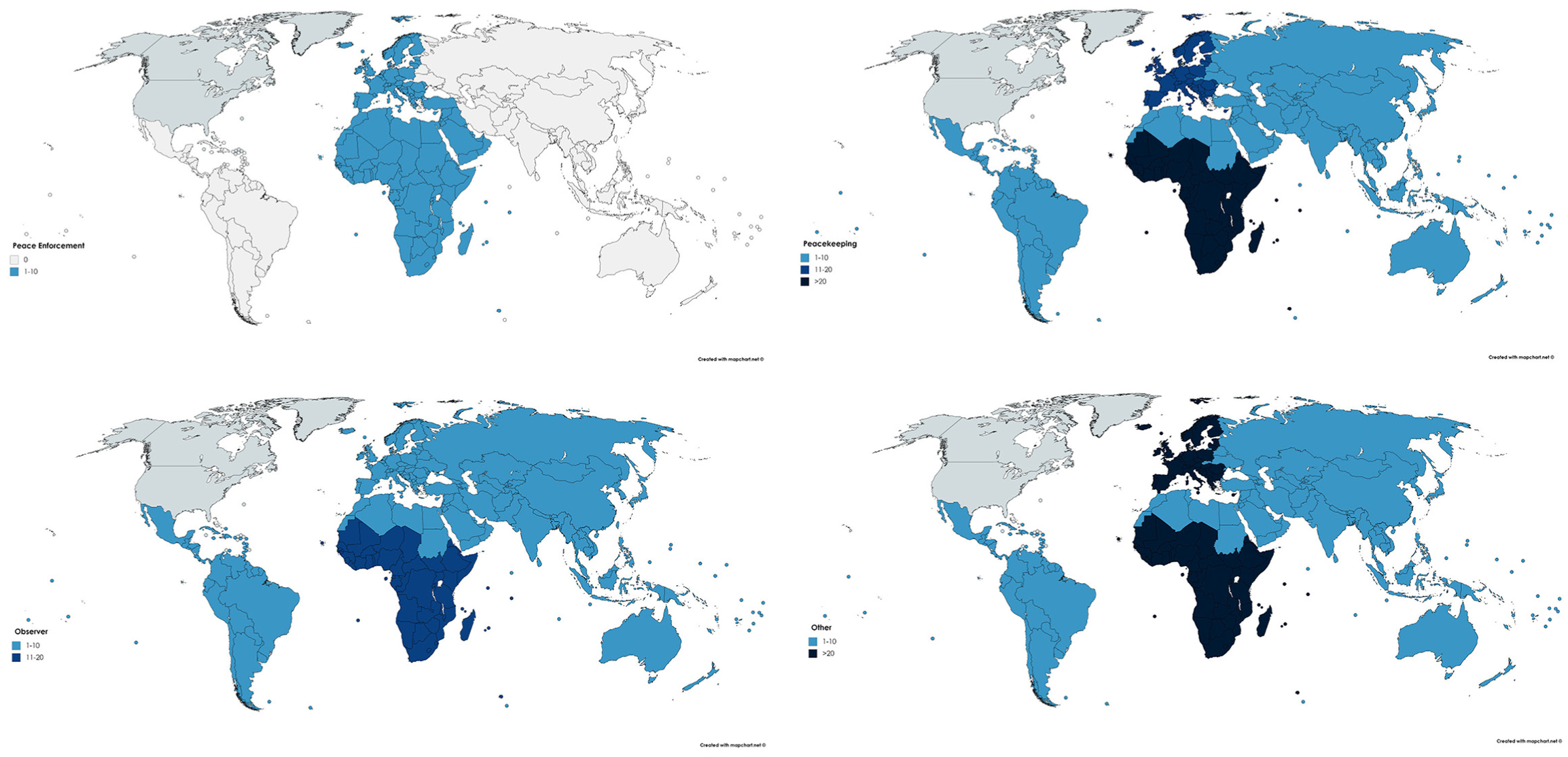
Distribution of intervention types across regions (from 1992 onward).
Table 6 provides an overview of the regional distribution of ad hoc, RO, and UN interventions. The table reveals distinct intervention patterns, of which some are incompatible with a trend toward regionalization, as we do not observe any interventions by ROs. Only one region, Africa, shows all categories of intervention, with Europe and the Middle East—in which every type but IndSIndS occur—following suit. Several regions show remarkably extreme intervention patterns: in Eurasia, peace operations are monopolized by a RO, the Commonwealth of Independent States. Latin America, the Pacific, and Southeast Asia show the reverse intervention pattern. These regions can be called RO-free regions. All interventions in those regions are either conducted by individual states or by the UN, and the regional level is absent altogether. Central South Asia might be added here too, as the only regional intervention there has been conducted by NATO (in Afghanistan specifically, as an out-of-area intervention).
Distribution of intervention categories across regions (from 1992 onward; peace enforcement and peacekeeping missions only).
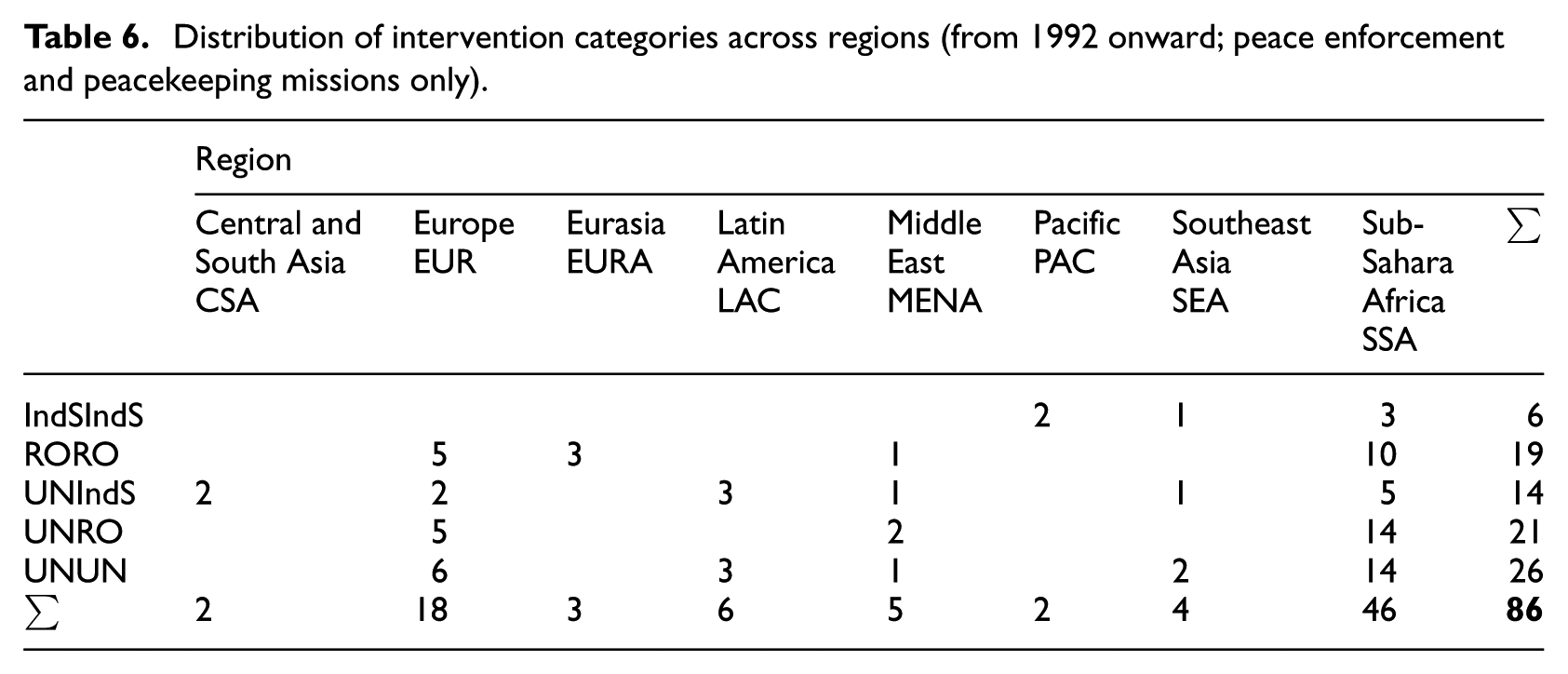
Accordingly, the regionalization trend that we earlier identified is itself regionally limited. It is observable in four regions only, Europe, the Middle East, and Sub-Sahara Africa, whereas there is no such trend in four other regions Central and South Asia, Latin America, the Pacific, and Southeast Asia.
Conclusion
Can we observe the regionalization of peacekeeping? What regional patterns are detectable, and does regionalization challenge the UN system of collective security? On a global level, our data indicate a regionalization trend occurring vis-à-vis military interventions: regional ones have increased remarkably since 1992. This trend is mostly due to a shift from individual state-led interventions to regional-led ones. The regionalization trend is geographically limited, however, to Africa and Europe, whereas Asia—most importantly—has been completely exempt from this trend. Moreover, we find distinct intervention patterns: UN- and state-led interventions dominate in some regions, while RO-led interventions prevail in others.
As we have argued, the activities of ROs are in line with the provisions of the UN Charter. Hence, despite regionalization, there is no regionality. The number of non-mandated peace enforcement missions is very small; most interventions are mandated or, as in the case of peacekeeping, do not even require a mandate. Hence, the observable trend toward the regionalization of peacekeeping missions does not seem to challenge the distribution of decision-making competences between the UNSC and ROs so far.
Three important research fields emerge from our descriptive findings: first, the inter-organizational issues of delegation (through authorization) and control in the relationship between the UNSC and ROs; second, variation across regions; and, third, the increase in the number of missions subsumed under the term “Other missions”.
First, while our findings indicate that regionalization does not directly challenge the UNSC in the case of enforcement actions, the increasing use of Chapter VII authorizations for peacekeeping missions of ROs ultimately raises important questions concerning the hierarchy between the UNSC and ROs. The existing literature discusses several motivations for ROs seeking a Chapter VII mandate: the benefit from the legitimacy that UN authorization entails, or reliance on the UN’s resources (Barnett, 1995; Williams, 2017). Yet there are also indications that Chapter VII authorizations by the UNSC are an attempt to maintain its control over non-UN actors, in particular ROs. In effect, the increase in peacekeeping missions by ROs challenges the UNSC’s monopoly over the use of force. The institutional response of the UNSC has been to authorize such peacekeeping missions in an attempt to maintain its control. Yet it is not clear whether this strengthens the role of the UNSC or whether it is rather a case of the UNSC yielding to the pressure of ROs in favor of a less hierarchical model. While the UNSC has resorted to a pragmatic posture toward ROs and—through devising hybrid missions, partnership and cooperation models (Yamashita, 2012)—has averted open tensions between itself and ROs, it is not clear whether this bans the potential challenges. There are indications that there is a greater chance of inter-organizational conflict where the UN faces better equipped ROs, such as NATO or the EU for example (Boisson de Chazournes 2017; Cellamare, 2018; Koops and Tardy, 2016).
Focusing on the organizational interactions between the UN and ROs could complement the existing focus of the peacekeeping literature on the effects of peacekeeping on conflict situations: so far, most of the studies focus on the combined effects of peacekeeping operations on conflicts but rarely differentiate among UN- or non-UN-led missions (but see: Diehl 1993; Sabrow 2016). Given the important questions of inter-organizational cooperation and legitimation of peacekeeping missions, an important question is whether UN legitimation and control make a difference to the effectiveness of peacekeeping. MILINDA could also shift the research focus from the effects of peacekeeping operations on the ground to the study of UN–RO interactions from an international organization perspective. Here, it could provide important insights into the literature on nested institutions and institutional complexity (Alter and Meunier, 2009). MILINDA could aid such efforts by providing information on mandating practices, the sequencing of interventions and parallel interventions of UN and ROs that might indicate attempts to control ROs.
A second implication of our descriptive findings is explaining the regional patterns of intervention across time and space. While there obviously exists great variation across regions, the actual reasons for this have so far been empirically underexplored. The existing disciplinary literature (Binder, 2015; Perkins and Neumayer, 2008) assumes that the severity of crises, their frequency, or alternatively geographical factors influence the choices of actors. The area studies literature (Aris, 2011; Cornell and Jonsson, 2014; Kirchner and Domínguez, 2011; Williams, 2017) emphasizes the historical genesis of ROs and of regional intervention cultures. Only very few world regions have developed a willingness and capacity to conduct peace enforcement and peacekeeping missions. Africa is a case in point, where about 20% of all peacekeeping and enforcement actions have been implemented by ROs. Some of these ROs appear to have the capacity to engage in peace enforcement missions, but lack the mandate to do so. This is without doubt the case in EURA, where the Commonwealth of Independent States only has a peacekeeping mandate—which is conditioned on the consent of the target state (Baev, 2004). Others have monopolized peace enforcement missions, such as in EUR—where such missions have been conducted exclusively by NATO. Some regions, meanwhile, have neither the willingness nor the capacity to set up a regional peacekeeping capacity, as is the case with South East Asia’s ASEAN (Morada, 2009).
Yet, so far, no systematic comparative studies, controlling for variables such as power asymmetries or conflict severity, have been undertaken. Our findings strongly point to the need for such analysis, which should focus not only on cultural and geographical variables but also on historical path dependencies and diffusion effects. Such research will at the same time need to tackle the question of why some ROs develop a mandate for peacekeeping or even enforcement actions while other ones do not. Are these a sign of regional cohesion and deeper regional integration (Haftel and Hofmann, 2017), the result of hegemonic imperatives, and/or a reflection of ideational considerations regarding the prevention of neocolonial behavior by Western states?
Finally, the demonstrated increase of “Other” missions relative to peace enforcement and peacekeeping ones might be a third puzzle. Here again, the functional explanation is that these missions serve important peace functions: they might either be conducted to prevent the further escalation of a conflict or to ensure continued peace (Fortna, 2008; Mullenbach, 2005). However, there might also be a symbolic function: regional integration scholars (Söderbaum, 2007; Victor, 2010) have long argued that regional integration, especially in sub-Saharan Africa, might be a game of “old buddies,” of authoritarian but befriended rulers who use foreign policy to garner domestic support. Increasing the number of political missions—the main component of the type Other ones—might be a promising way to show one’s strength externally. This might be even more true given that political missions are not, unlike military ones, accompanied by the extensive fatalities of one’s own soldiers that result in declining support at home.
To delve deeper into these and related questions, further improvement is necessary regarding available information. Working ourselves on a more extensive dataset that covers several of the potential explanatory variables mentioned above, we are excited to participate in this highly interesting endeavor moving forward.
Supplemental Material
sj-pdf-1-cmp-10.1177_0738894218821044 – Supplemental material for MILINDA: A new dataset on United Nations-led and non-united Nations-led peace operations
Supplemental material, sj-pdf-1-cmp-10.1177_0738894218821044 for MILINDA: A new dataset on United Nations-led and non-united Nations-led peace operations by Anja Jetschke and Bernd Schlipphak in Conflict Management and Peace Science
Supplemental Material
sj-jpg-2-cmp-10.1177_0738894218821044 – Supplemental material for MILINDA: A new dataset on United Nations-led and non-united Nations-led peace operations
Supplemental material, sj-jpg-2-cmp-10.1177_0738894218821044 for MILINDA: A new dataset on United Nations-led and non-united Nations-led peace operations by Anja Jetschke and Bernd Schlipphak in Conflict Management and Peace Science
Supplemental Material
sj-jpg-3-cmp-10.1177_0738894218821044 – Supplemental material for MILINDA: A new dataset on United Nations-led and non-united Nations-led peace operations
Supplemental material, sj-jpg-3-cmp-10.1177_0738894218821044 for MILINDA: A new dataset on United Nations-led and non-united Nations-led peace operations by Anja Jetschke and Bernd Schlipphak in Conflict Management and Peace Science
Supplemental Material
sj-docx-4-cmp-10.1177_0738894218821044 – Supplemental material for MILINDA: A new dataset on United Nations-led and non-united Nations-led peace operations
Supplemental material, sj-docx-4-cmp-10.1177_0738894218821044 for MILINDA: A new dataset on United Nations-led and non-united Nations-led peace operations by Anja Jetschke and Bernd Schlipphak in Conflict Management and Peace Science
Supplemental Material
sj-xls-5-cmp-10.1177_0738894218821044 – Supplemental material for MILINDA: A new dataset on United Nations-led and non-united Nations-led peace operations
Supplemental material, sj-xls-5-cmp-10.1177_0738894218821044 for MILINDA: A new dataset on United Nations-led and non-united Nations-led peace operations by Anja Jetschke and Bernd Schlipphak in Conflict Management and Peace Science
Footnotes
Acknowledgements
We are particularly grateful to Rafael Biermann, Clara Egger, Yoram Haftel, Sukehiro Hasegawa, Arie Kacowicz, Nico Krisch, Densua Mumford, Kathy Powers, Tonya Lee Putnam, Thomas Risse, Fredrik Söderbaum, Joseph Weiler and Michael Zürn for very constructive comments on earlier versions. We also thank Fabian Rasem, Frauke Riebe and Ronja Niedenführ for their research assistance.
Funding
This research received no specific grant from any funding agency in the public, commercial, or not-for-profit sectors.

Supplemental material
Notes
References
Supplementary Material
Please find the following supplemental material available below.
For Open Access articles published under a Creative Commons License, all supplemental material carries the same license as the article it is associated with.
For non-Open Access articles published, all supplemental material carries a non-exclusive license, and permission requests for re-use of supplemental material or any part of supplemental material shall be sent directly to the copyright owner as specified in the copyright notice associated with the article.


