



Abstract
Violent crime in Colombia is analyzed following the demobilization of ex-combatants using municipal-level data. The main findings are that an increased presence of ex-combatants does not systematically increase homicides, but may increase robberies. Reintegration programs are shown to matter. Former paramilitaries who are not in a reintegration program increase crime. Former guerillas increase robberies, regardless of whether they are in or out of reintegration, but homicides decrease for guerrillas in reintegration. Ex-combatants often settle in municipalities with more crime. Controlling for reverse causality, ex-combatants only increase crime if they are not in reintegration, while in reintegration they may reduce crime.
Introduction
The end of civil war does not necessarily lead to a reduction of violence. When fighting stops and even with peace-building strategies in place, kidnapping, homicides, robberies and domestic violence often persist. In fact, for a number of countries, such as El Salvador, Guatemala, South Africa and Afghanistan, among others, studies report an increase of crime after the end of civil war. 1 Types of violence normally associated with post-conflict situations are riots, violent crime, domestic violence, sexual abuse, gang violence and revenge killings (Aguirre, 2012; Barron, 2014). Importantly, the violence is generally not politically motivated (Geneva Declaration Secretariat, 2008). Our first research question is whether the demobilization of former combatants can explain the increase in violent crime. In their seminal study on post-conflict crime, Archer and Gartner (1976) characterize this as the “violent veterans model”. However, demobilization does not take place in a political vacuum. Demobilization, disarmament and reintegration (DDR) processes are increasingly used as tools of peace consolidation, which enable the state to regain its monopoly on the use of force while providing security guarantees to ex-combatants. From a development point of view, DDR programs also aim to improve the socio-economic position of ex-combatants and their communities (Correia, 2009; Giustozzi, 2012). Better economic opportunities for ex-combatants as well as reintegration into their communities, rather than continued reliance on social networks established during conflict, should reduce crime. Therefore, our second question is whether programs that support the reintegration of ex-combatants reduce post-conflict crime.
To address these questions, we examine Colombia, which has witnessed various periods of internal armed conflict since 1948. The focus is on the dynamics of violent crime after 2003 following the peace negotiations with the United Self Defense Forces (Autodefensas Unidad de Colombia, or AUC) as well as the implementation of demobilization programs targeting individual rebel combatants or guerillas (primarily from the Fuerzas Armadas Revolucionarias de Colombia, or FARC, and the Ejército de Liberación Nacional, or ELN). 2 The paramilitaries and guerillas had different wartime experiences affecting the connections to their communities and also participated in distinct DDR processes. The individual and collective programs were run by the Ministry of Defence, Oficina del Ato Comisionado para la Paz (OACP), and the Colombian Agency for Reintegration (ACR) in collaboration with other governmental institutions.
Our analysis distinguishes accordingly between the presence of former rebels and paramilitary forces, and also between ex-combatants who are still in reintegration and those who dropped out. It covers the period 2003–2013 before the signing of the peace agreement between the government and FARC in November 2016 and the agreed DDR program for FARC fighters starting in March 2017. The possible end of the long-running conflict makes it even more pertinent to understand how the presence of ex-combatants affects crime and how reintegration can alleviate such concerns.
The social disruption of communities, economic collapse and reduced institutions are troublesome legacies of conflict. Family and community ties get broken because of wartime killings as well as increased (female) mortality as a consequence of deteriorating healthcare. Young people find themselves with limited educational opportunities (Lai and Thyne, 2006) and may have been recruited to fight instead. Wars force people to flee, and their return after the end of conflict can usher in disputes over land and housing. The wartime destruction of infrastructure and production facilities can lead to an economic collapse with limited availability of consumption goods and (legal) employment opportunities. Instead, black markets and illegal economic activities flourish. Civil wars also tend to undermine state capacity. In the immediate post-conflict period, there is often a limited police presence with poorly functioning (local) public authorities and court systems.
The legacy of conflict is commonly seen as a major cause for post-war crime waves. For example, Nussio and Howe (2016) explain the increase of post-conflict violence in the Colombian department of Córdoba as resulting from the breakdown of the illegal protection system established by paramilitary groups. Studying Northern Ireland, Deglow attributes increases in crime after the conflict to its legacy: “The results indicate the more an area has been exposed to violence, and the larger the proportion of this violence committed by anti-government groups, the more violent crime on the local level” (Deglow, 2016: 786). Barron (2014) explains post-conflict violence in Indonesia as a legacy of conflict, with a political economy of violence, elite struggles for power and limited state capacity to maintain order. After the signing of a peace agreement in 1987, Nicaragua witnessed a dramatic increase in urban crime attributed to high unemployment rates, in particular among urban youths, low levels of social capital and existing drug trafficking routes (Brune and Bossert, 2009; Chamorro, 2015; Martí Puig, 2002, Rodgers, 2002, 2013; Rodgers and Jensen, 2015).
Ex-combatants are often seen as pivotal in the upsurge in post-conflict crime. Former combatants commonly struggle to reintegrate in society and to make use of legal opportunities to earn money (Howe, 2012). Moreover, the skills they gained in fighting and the close social bonds between ex-combatants tempt them to criminal activities. Ex-combatants are not only more at risk of committing crime themselves, but their activities also have a spillover effect on the wider community. At the same time, demobilization and reintegration programs target ex-combatants specifically. To the extent that these programs are effective, they should reduce the risks of ex-combatants committing crime and may even have positive spillover effects to the wider community. In Colombia, Kaplan and Nussio (2018b) find lower rates of recidivism and more socially vibrant communities where ex-combatants are better able to integrate. Recognizing the broader impact of demobilization and reintegration, our study examines the impact of the presence of former combatants and their participation in reintegration programs on municipal crime levels.
To properly evaluate any link between ex-combatants and crime, it is important to deal with possible reverse causality, particularly when analyzing municipal-level data. It is plausible that former combatants base their decision on where to settle in part on their perception of crime levels and they avoid areas with high crime rates because of safety concerns. Yet it is also possible that they have little choice but to settle in municipalities with high crime rates. Regardless, failing to control for endogeneity would bias our estimates. If ex-combatants avoid high-crime areas, we are likely to underestimate their effect on crime. If they settle mainly in high-crime areas, we will overestimate their impact. We address possible reverse causality via an instrumental-variable approach (Baltagi, 2005; Cameron and Trivedi, 2010) using place of birth as an instrument. The assumption is that changes in crime rate do not affect where former combatants were born, but place of birth is arguably highly correlated with where combatants settle following demobilization. 3
The main empirical findings are that the increased presence of ex-combatants sometimes has a statistically significant and positive effect on robberies, but it does not appear to increase the rate of homicides. These results are sensitive to contrasting former paramilitaries and guerrillas, as well as the number of ex-combatants involved in reintegration. The presence of former paramilitaries who are not in reintegration increases homicide and robbery rates. Former guerillas, regardless of whether they are in or out of a reintegration program, are associated with increased robberies. A higher number of guerrillas in reintegration correlates with fewer homicides. The findings of the instrumental-variable models, moreover, indicate that ex-combatants are more likely to have settled in municipalities with high crime rates. Controlling for reverse causality, the robust finding is that only former combatants who are not in reintegration increase crime rates, while ex-combatants in reintegration tend to decrease crime rates. Rather than a general “violent veterans” model, these findings support a more careful understanding of the legacy of conflict. Any link between ex-combatants and crime appears conditional on limited socio-economic opportunities and a continued reliance of wartime social ties instead of reintegrating into civilian society.
The next section develops our theoretical argument regarding the link between ex-combatants and post-conflict crime and discusses the relevance of DDR programs. Before presenting the results of the statistical analysis, the research design and data are introduced. The main results are followed by an overview of robustness checks (with details in the Online Appendix). We conclude with a discussion of the main findings and policy implications.
The problem of post-conflict crime
Archer and Gartner (1976: 961) observe that “[m]ost of the combatant nations in the study experienced substantial postwar increases in their rates of homicide. These increases did not occur among a control group of noncombatant nations”. Collier and Hoeffler (2004) show that homicide rates increased after the end of African civil wars, while Rivera (2016) reports increased homicide rates after conflict in Latin America. In the “violent veterans model”, the experiences of ex-combatants are considered pivotal to the dynamics of post-conflict crime. Accordingly, we consider the legacy of conflict as well as the conditions of peace for ex-combatants.
Legacy of conflict
Ex-combatants provide a direct link between the conflict and post-conflict situations. They are often particularly vulnerable to the insecurities of the post-war environment and considered more likely to resort to crime because of their wartime experiences. Commenting on veterans returning from the Vietnam War, Lifton (1970) writes: “Some are likely to seek continuing outlets to a pattern of violence to which they have become habituated, whether by indulging in antisocial or criminal behavior or by offering their services to the highest bidder” (Lifton, 1970, quoted in Archer and Gartner, 1976: 943). Nearly all combatants lived through violent episodes and their personal history continues to shape attitudes and behavior. Moreover, former combatants commonly have to deal with a lack of opportunities for legal work, which increases their insecurity (Özerdem, 2012).
Built on the experience of having to rely on and trust fellow combatants during the war, the bonds between ex-combatants are often very close and strong. The wartime networks help veterans through periods of personal, economic and social upheaval after demobilization. At the same time, these networks can be conducive to criminal activities. Rodgers argues that the first wave of gang violence in Nicaragua was linked to the demobilization of the Sandinista popular army and that for many ex-combatants joining a gang was “a natural continuation of their previous role as a soldier” (Rodgers, 2013: 21). Nussio finds that especially mid- and high-ranking former combatants have accumulated “criminal capital”: “They are the nodes in the criminal networks who hold the organisational memory about the extraction of criminal rents from existing war economies, ie knowledge about the smuggling routes, contacts to suppliers and customers, and strategies to cope with competitors and authorities” (Nussio, 2018: 143). Daly et al. (2017) also highlight the enduring social ties between ex-combatants and especially former commanders. They emphasize that the social ties between former combatants increase not only the capabilities to engage in crime but also their motivation.
The wartime experience may also lead to the social legitimation of violence (Parsons, 1917) in the sense that during wartime killings are portrayed as normal or possibly even heroic. Killings in the post-war period are seen as a lasting effect of the social legitimation of violence. Analyzing post-apartheid violence in South Africa, Schuld (2013) considers the culture of violence inherited from the apartheid system as a primary cause of persisting xenophobia, political assassinations, mob violence and violent protests. Importantly, as Archer and Gartner (1976: 944) observe: “since civilians and soldiers alike could be influenced by this legitimation process, this model predicts that homicide increases will occur among both veterans and nonveterans”. However, it is reasonable to expect that ex-combatants are most prone to internalizing the legitimation of violence, and that communities with most extensive and close ties to ex-combatants will be exposed most to the change in norms.
Previous studies such as Kaplan and Nussio (2018a, b) and Daly et al. (2017) study the susceptibility of ex-combatants to crime in Colombia at the individual level, whereas our research focuses on the municipal level. 4 Howe (2012) also studies the crime at the municipal level and finds a positive correlation between ex-combatants and crime. We consider individual- and municipal-level approaches to be complementary, each with specific strengths and weaknesses. At the individual level we can measure directly any link between being an ex-combatant, participation in DDR programs and crime. However, measurement error and high variation of idiosyncratic circumstances make it difficult to establish such a link statistically since random error easily overwhelms any substantive effect. Moreover, even if former combatants are not involved in crime themselves, their presence could have an impact on the communities where they reside. If the presence of former combatants legitimizes violence, it will increase instability, tensions and crime rates within the wider community. If the social networks of former combatants are transformed as criminal organizations, they will also attract and recruit persons who did not participate in the war originally.
These arguments suggest that the presences of former combatants should increase crime levels, since they have fewer opportunities for legal work, they are trained to use force, and they have internalized more violent norms. The tight bonds between former combatants provide a network that may be used to facilitate criminal activities. Moreover, any effects are likely to spill over to the wider community. Consequently, municipalities with a larger number of former combatants are expected to experience more crime.
We recognize that there is notable variation in the experience and socio-economic background of former combatants. The analysis therefore distinguishes between former guerrillas and paramilitaries, and between robberies and homicides as distinct crime categories. In Colombia, former guerrillas left their often rural communities to fight and hide in remote forests. In contrast, paramilitary fighters generally operated in the urban areas where they resided and thus remained more closely connected to their communities. Former guerrillas generally held a weaker socio-economic position, making them more susceptible to property crimes, such as robberies.
During the period covered in our research, guerillas and paramilitaries were demobilized by means of different processes. Fighters from FARC and ELN demobilized on an individual basis and basically deserted their rebel armies. The paramilitaries demobilized collectively as part of an agreement between the government and the AUC. The social ties between former paramilitaries are thus likely to be stronger than among former guerillas, making the former more likely to engage in more organized and violent crime, such as homicides.
Conditions of peace
There is increased awareness that the insecurity of former combatants needs to be addressed in peace negotiations and peace-building programs to avoid political instability. The objective of demobilization, disarmament and reintegration (DDR) programs is not only to strengthen peace agreements but also to address the specific concerns of former combatants. Studying DDR programs in Southern Africa, Dzinesa observes that these goals are often closely intertwined:
DDR processes stood a better chance where the principle of a comprehensive, coordinated, and sustainable approach was encompassed. In the absence of this, DDR floundered resulted in reigniting of fighting as Angola demonstrated. Also, in the absence of re-emergence of outright war ineffectively reintegrated ex-combatants only went so far; there came a time when disillusioned and enflamed ex-combatants shifted from an acquiescent mood to a confrontational one against the state. (Dzinesa, 2007: 87–88)
DDR programs address the situation of ex-combatants in a number of ways. Fighters often find it difficult to return to family and home communities. According to Bauer et al. (2018: 1814): “The common view is that the reintegration of soldiers after civil wars is complicated by the lingering effects of trauma among them, as well as the resentment and ostracism that they face from receiving communities.” Reintegration programs can help to increase acceptance. Transitional justice with (limited) prison sentences for crimes committed by former combatants creates accountability and an opportunity to leave the past behind (Samset, 2013). Support offered to ex-combatants helps them to deal with trauma and stress, and to internalize norms and values of civilian life. If ex-combatants are less marginalized within civil community, they become less dependent on their bonds with former combatants and less likely to resort to crime. Focusing on paramilitary violence, Restrepo and Muggah (2008) argue that the demobilization of the AUC led to a “deparamilitarization” of the conflict in most Colombian sub-regions.
Economic support is an important part of most DDR programs. Ex-combatants often struggle with staying in legal employment. Several studies have highlighted the importance of economic reintegration, as an employee or entrepreneur, to prevent recidivism and crime. Colletta (1997) argues that a key challenge of reintegration programs is to create legal economic opportunities and to develop job skills for demobilized fighters. Ayalew et al. (1999: 6) identify the lack of economic opportunities as core difficulties in reintegrating ex-combatants and they describe young people with little hope of future work as “an army in waiting”. They argue further that ex-combatants should be helped to settle in rural areas. If ex-combatants settle predominantly in urban areas, they add further pressure on urban labor markets and increase housing shortages (Ayalew et al., 1999: 16; see also Ayalew et al., 2003; Dercon and Ayalew, 1998). Studying the effect of demobilization on crime in Uganda, Collier (1994: 343) finds: “in the short term demobilization significantly increased crime if soldiers lacked access to land, but significantly reduced it if they had access”. Economic reintegration programs also provide benefits for the wider community; for example, when ex-combatants build infrastructure or attain transferable skills. A general improvement of economic conditions makes it more likely that communities will accept former fighters, while making it less attractive for them to engage in crime.
DDR programs are not without their problems. Often, states and other international donors are not fully committed to their implementation; for example, Betancourt (2010) noted that the demobilization of the AUC in Medellin reduced crime rates dramatically in the short run, but in the long run homicide rates increased, because of poor reintegration of former paramilitaries. Howe (2012: v) also concludes “the more combatants who demobilized to an area, the higher the homicide rate in the post-demobilisation period, holding other causes of homicide constant”, and attributes this to the weakness of reintegration programs. Nussio (2018) notes that since ex-combatants are only a fraction of the whole population, concentrating resources on this sub-populations risks diverting attention away from other groups at risk of committing crime, such as urban youths in marginalized neighborhoods. Finally, former combatants regularly drop out of reintegration programs. Regardless, the participation of former combatants in reintegration programs should at least moderate any crime-inducing effect that the presence of ex-combatants may have. Post-conflict violent crime rates may still increase but less so when a larger number of former combatants participate in reintegration programs. Therefore, we test the following hypothesis.
The differences between former guerrillas and paramilitaries and different crime categories are likely to matter for the second hypothesis as well. We do not expect a uniform effect since rebels were demobilized individually, while paramilitaries were demobilized collectively.
Research design
The empirical analysis relies on information aggregated at the municipal level using data on demobilization and violent crime as well as relevant socio-economic control variables. The unit of analysis for all models is the Colombian municipality-year including 1,122 municipalities and 11 time points, spanning the period 2003–2013. 5 The Colombian government provides detailed statistics on crime rates as well as socio-economic variables at the municipal level. We report the findings from fixed-effects linear regression models with municipal level and year fixed effects. Since we have relatively short time series for a large number of cross-sectional units, we estimate the models with robust standard errors to correct for any clustering of errors within panels. The models include controls for the exposure of a municipality to the conflict and local state capacity. We estimate instrumental-variable models (2SLS) to account for possible endogeneity, because the location where ex-combatants settle may not be random but related to municipal crime levels.
The impact of DDR programs in Colombia has received extensive scholarly attention recently (Daley, 2016; Howe, 2012; Kaplan and Nussio, 2018a, b; Nussio, 2018). It is important to note that the Colombian experience is not necessarily generalizable to other conflicts. Most importantly, and reflected in the availability of official data, the long-standing civil war in Colombia has not led to the Colombian state to “fail”. Colombia may therefore be in a better position to reintegrate ex-combatants compared with many other post-conflict states.
Dependent variables
Municipal homicide rates and municipal robbery rates per 1000 inhabitants are the dependent variables. Homicides and robberies are good proxies for violent crime while capturing different dimensions of crime. Homicides are often motivated by revenge and perpetrators tend to know their victims. Robberies have an economic motivation and perpetrators generally do not know their victims. The main source of information is the crime observatory of the Colombian National Police using its statistical data system (Observatorio del Delito—Sistema de Información Estadística, Delincuencial, Contravencional y Operativo—SIEDCO). The crime data compiled by the Colombian police are generally considered to be of high quality. 6
The main public crimes are “drugs related” (34.91%), “weapons trafficking” (32.06%), and “conspiracy” (18.76%). The analysis below excludes public crimes, because we want to clearly distinguish post-conflict crime from guerrilla and paramilitary activities that are related to the on-going Colombian civil war. Instead, we analyze the two major types of crime against persons, namely “homicides” (27.61%) and “robberies” (24.63%). Other notable types of private crimes are “mayhem/battery” (11.11%), “extortion” (8.19%), “domestic violence” (6.15%), “kidnapping” (3.76%), “sexual assault/rape” (3.52%) and “forced disappearance” (0.67%). We exclude these categories because we suspect more serious underreporting of these types of private crime.
Main independent variables
Since our primary interest is the impact of former combatants on crime rates, we count the number of ex-combatants who have settled in a particular municipality. “Ex-combatants” estimates the total number of former fighters in a municipality. The estimates correct for deceased participants. The main source of information is the statistical information system of the Colombian Agency for Reintegration (ACR) consulted in 2015. 7 Following demobilization, most guerrillas started an individual reintegration program, while paramilitaries were demobilized collectively as part of a peace agreement. Some ex-combatants started their reintegration program immediately, but others only after several years. A number of ex-combatants could not or did not want to be involved in reintegration. The variable “Ex-combatants, in” counts the number of former combatants who are engaged in the Colombian reintegration program. Our data probably overestimate the share of the ex-combatants who are involved in reintegration, because of the way the information on ex-combatants is formally administered. “Ex-combatants, out” measures the number of ex-combatants registered as uninvolved. Here, we retain the final place of residence for any veteran who dropped out of the program, since we can only trace where ex-combatants reside as long as they are involved in reintegration. Contrary to our assumption, however, they may have moved. Ex-combatants may have left the reintegration program because of threats against them and for the same reason they may also have decided to move out of the municipality. 8 The “in” and “out” variables for each category of former combatants are highly correlated. 9
The number of combatants per municipality is not normally distributed. A large number of municipalities have no former combatants residing at all, while a few communities are outliers with a large number of ex-combatants. We therefore use the natural log of the original variable (adding one combatant to each municipality). Table 1 summarizes the descriptive information for the data on ex-combatants.
Ex-combatants descriptive statistics.
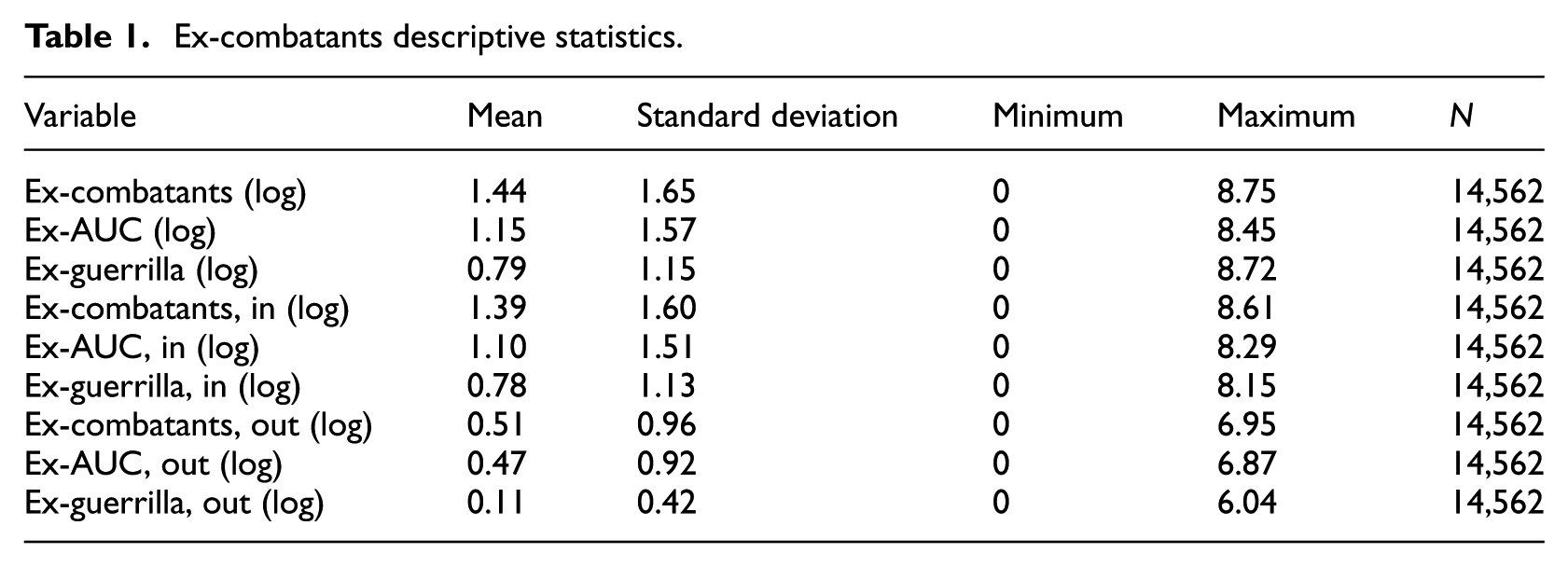
Table 2 reports the distribution of paramilitaries and guerrillas, both in and out of reintegration. In our sample the majority of ex-combatants are paramilitaries, and most of them were participating in reintegration. Consequently, the coefficients reported are not directly comparable.
Ex-combatants and reintegration.
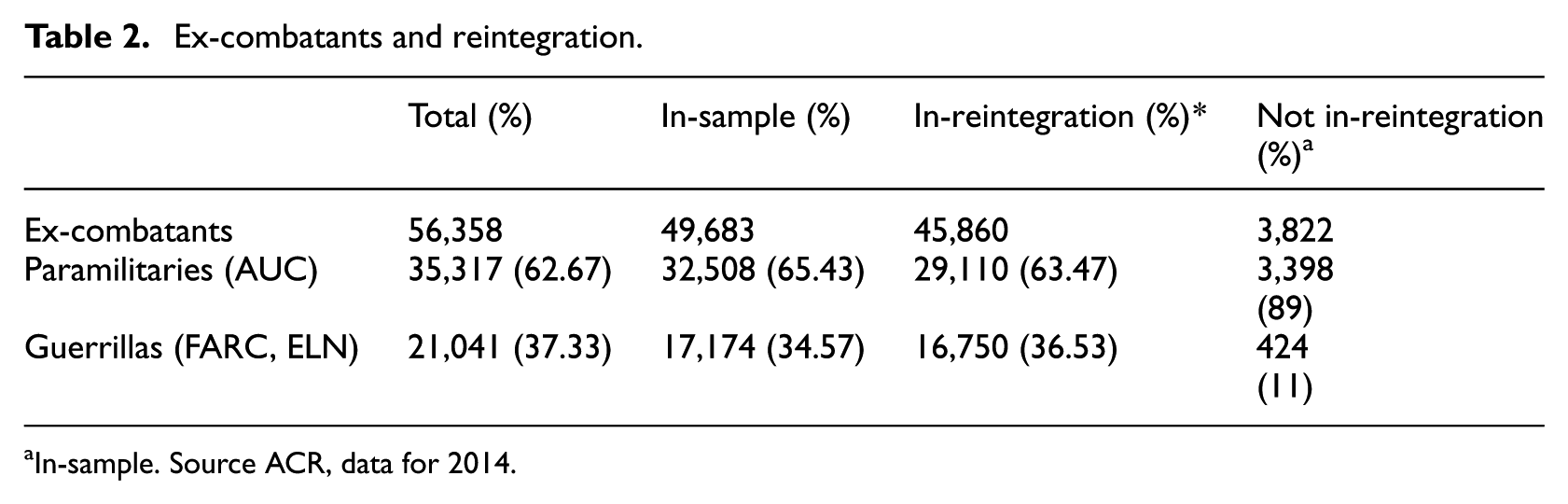
In-sample. Source ACR, data for 2014.
Control variables
The models include key control variables identified in the existing literature on the determinants of (post-conflict) violent crime (Howe, 2012). Controls include how armed conflict affected the municipality, the number of displaced persons in the municipality, and the continued presence of ELN, FARC or AUC fighters in the municipality. Since in Colombia crime is often linked to the production of illegal drugs, we control for presence of coca cultivation in the municipality. Further control variables account for other factors thought to determine crime: percentage of youth population, urbanization, municipal capacity to tax and infant mortality rate. 10
Instrumental variables
There may be reverse causality in relationship between the presence of ex-combatants and crime: crime rates may affect where ex-combatants prefer to live, or end up living because of lack of choice. To address endogeneity we use an instrumental-variables approach. The challenge here is to find a suitable instrument for the presence of ex-combatants, where the instruments should be closely related to the location decision of former combatants but unaffected by changes in crime rates. We propose to use data on the birthplace of ex-combatants, since we considered it unlikely that changes in current crime rates affect the probability of ex-combatants being born in a particular municipality. Although there is limited information on the relocation of former combatants, we argue that they are likely to settle in the place they were born or recruited. For example, Podder (2012) observes that ex-combatants settle where they were recruited. In her research on remilitarization of rebel groups in Colombia, Daly concludes: “there exists a great deal of path dependence, with relocation determined by recruitment rather than by individual agency or post-war considerations. In particular, individuals should tend to return to where they were recruited, underscoring the importance of the geography of recruitment” (Daly, 2016: 86). It is therefore plausible that following demobilization, ex-combatants return to their place of recruitment, which is often the same as their place of birth.
To appreciate the use of birthplace as an instrument, it is important to note that the instrumental-variable models also include municipal and year fixed effects. It follows that the dependent variable measures changes in crime rates rather than levels of crime. Birthplace would be a poor instrument for levels of crime, since there is plenty of evidence that living in high-crime areas makes it more likely that individuals will be recruited into rebel and paramilitary groups and that crime rates are structural features of many neighborhoods. There is, however, more over-time variation in changes in crime rates, and any change in crime rates is unlikely to be related to the number of ex-combatants born in a particular municipality more than 20 years ago. Moreover, the fixed-effects models also control for any underlying structural conditions that led to crime in the past as well as currently, and which may also have favored recruitment.
We consider information about the places where former combatants were born, where they were recruited and where they are living following demobilization. Guerrilla and paramilitary groups recruited from 888 of the 1,122 Colombian municipalities. In the paramilitary case, 8% of the 32,508 former combatants report the same birth, recruitment, and living place; 31% report the same location for residence and birth, and 15% are living in the area of recruitment. For the guerrillas, 2% of the 17,174 individual combatants report the same birth, recruitment, and living place; 11% report the same location of residence and birth, and 4% are living in the area where they were recruited. Former combatants—especially former paramilitaries—regularly reside in either their birth or recruitment place. Figure 1 shows the relocation decision of former fighters.
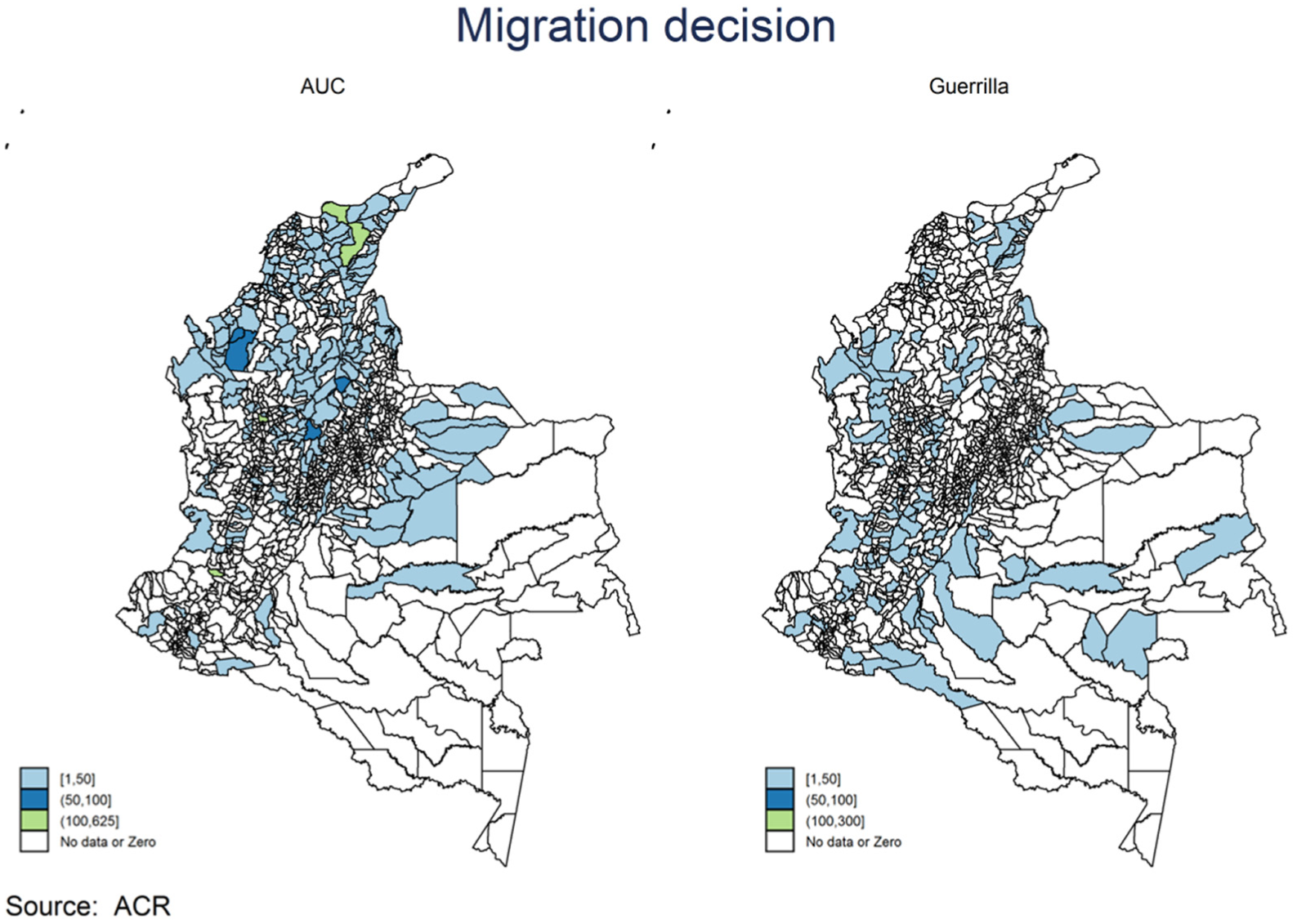
Location of ex-combatants with overlap of current residence, birthplace, and recruitment.
Statistical evaluations of instruments in the models for homicides and robberies indicate that birthplace and place of recruitment cannot be used simultaneously as instruments. Below we present the results with birthplace as instrument. Birthplace is operationalized as the number of ex-combatants who indicated a particular municipality as their place of birth at the time of demobilization. Accordingly, it varies with the number of ex-combatants who demobilized in any particular year. 11 The Online Appendix (Tables A.6 and A.7) shows that birthplace is a strong instrument in all models (Baum et al., 2007). The models were estimated in Stata 13 using xtivreg2 (Schaffer, 2010).
Empirical results
Two sets of models are presented: first the fixed-effects models and next the instrumental-variables models. Since the key independent variables are logged but the dependent variable is linear, the models are linear–log models and the relevant coefficients are best interpreted as the effect of percentage change. In the robustness section, we report random-effects linear models that distinguish between the within (over-time) and between (municipalities) effects (Bell and Jones, 2015). For each set of models, we discuss the results for homicides and robberies separately
Homicides
Table 3 presents the findings for the fixed-effects models for homicide rates. All four models include municipal and year fixed effects as well as time-varying controls. Model 1 evaluates the effects of the aggregate of all former fighters, while Models 2 and 4 separate the effect of former fighters that are enrolled in reintegration programs and those not, or no longer, taking part. Models 3 and 4 separate between former paramilitaries (AUC) and guerrillas.
Ex-combatants and municipal homicide rates, 2003–2012.
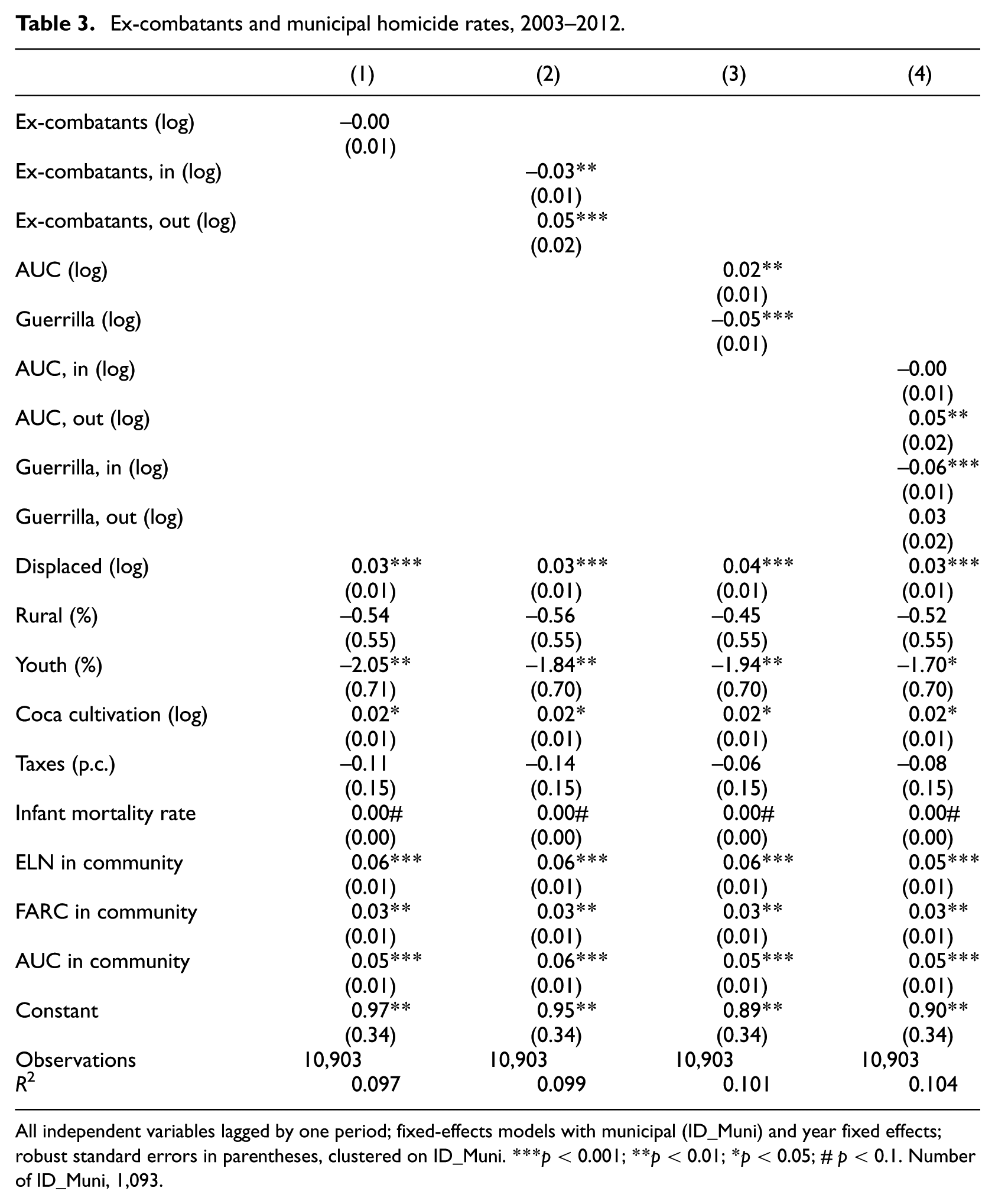
All independent variables lagged by one period; fixed-effects models with municipal (ID_Muni) and year fixed effects; robust standard errors in parentheses, clustered on ID_Muni. ***p < 0.001; **p < 0.01; *p < 0.05; # p < 0.1. Number of ID_Muni, 1,093.
In Model 1, and contrary to the first hypothesis, the presence of former fighters in the municipality does not significantly increase the homicide rate. Disaggregating the total number of combatants, however, leads to more interesting findings. Model 3 indicates that former paramilitaries significantly increase the homicide rate, while guerrillas lead to significantly fewer murders. Moreover, Model 2 shows that any positive correlation between former combatants and homicides applies only to the number of ex-combatants that are not in reintegration. The presence of more ex-combatants who are in reintegration actually reduces the homicide rate. Finally, in Model 4, having more former AUC members who are not in reintegration significantly increases the municipal homicide rate, while having more ex-guerillas enrolled in reintegration programs decreases it. These findings support the second hypothesis: a larger number of veterans participating in reintegration programs correlates with fewer homicides.
Even though the coefficients for former combatants are often significant, the substantive impact is quite limited. The mean value of the homicide rate is 0.337, and an increase of the number of ex-combatants in reintegration by 10% reduces it by 0.001. If 10% more ex-combatants are not in reintegration, the crime rate increases by 0.006. To have a measurable impact on the number of murders, we consider the impact of doubling the number of ex-combatants. To do so for ex-combatants who are not in reintegration increases the mean homicide rate by 0.04, which is about 10% of the standard error of the homicide rate or four additional murders in a city of 100,000 inhabitants. At the same time, doubling the number of ex-combatants in reintegration leads to two fewer homicides. 12
The results for the controls are largely intuitive. The presence of active guerrilla (ELN, FARC) or paramilitary (AUC) forces correlates with increased homicide rates, as does the presence of displaced people. We do not observe a clear correlation between wealth or poverty and murder rates. Contrary to a possible youth-bulge effect, a higher percentage of young people in a municipality is associated with lower homicide rates. Illicit economic activities such as coca cultivation tend to increase homicide rates, but we do not find a difference between rural and urban areas.
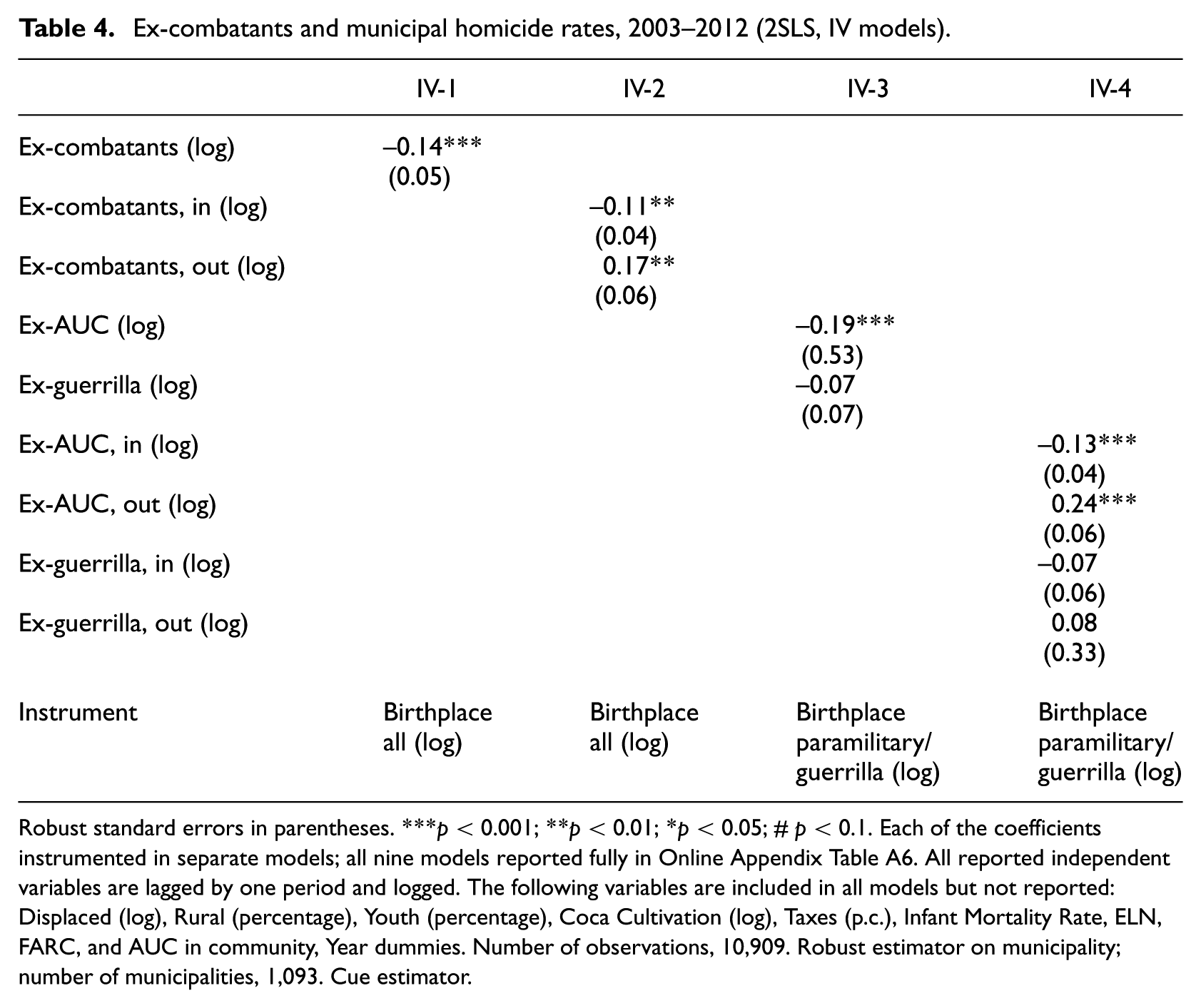
Table 4 presents the results of the instrumental-variable models (2SLS) replicating the models in Table 3. In columns IV-1 and IV-2, information on the birthplace of ex-combatants is used as an instrument, while in columns IV-3 and IV-4, the birthplace of former paramilitaries and guerrillas is used to instrument ex-paramilitaries and guerrillas respectively. Table 4 summarizes the coefficients of interests of nine 2SLS/IV models. The Online Appendix (Table A6) gives the full models. The p-values and F-statistics of the first stage of all models indicate instrumental relevance, showing that birthplace is a strong instrument (Stock and Yogo, 2005).
Ex-combatants and municipal homicide rates, 2003–2012 (2SLS, IV models).
Robust standard errors in parentheses. ***p < 0.001; **p < 0.01; *p < 0.05; # p < 0.1. Each of the coefficients instrumented in separate models; all nine models reported fully in Online Appendix Table A6. All reported independent variables are lagged by one period and logged. The following variables are included in all models but not reported: Displaced (log), Rural (percentage), Youth (percentage), Coca Cultivation (log), Taxes (p.c.), Infant Mortality Rate, ELN, FARC, and AUC in community, Year dummies. Number of observations, 10,909. Robust estimator on municipality; number of municipalities, 1,093. Cue estimator.
The instrumental-variable analysis shows that some of the findings presented in Table 3 may be biased because of reverse causality. In Model IV-1, the presence of ex-combatants actually significantly decreases the municipal homicide rate. The negative correlation between former combatants in reintegration and homicides is consistent across fixed-effects and instrumental-variable models (IV-2). Similarly, the models in IV-3 and IV-4 show that former paramilitaries in reintegration significantly decrease homicide rates. Yet former paramilitaries who are not in reintegration increase the murder rates. Compared with the fixed-effects models in Table 3, the IV models for former guerrillas show similar associations, although often no longer statistically significant, between former guerrillas and municipal murder rates. Overall, we find a stronger association between former paramilitaries, compared with former guerrillas, and homicides. Notably, paramilitaries in reintegration decrease homicide rates, while a larger number out of reintegration leads to more homicides.
Robberies
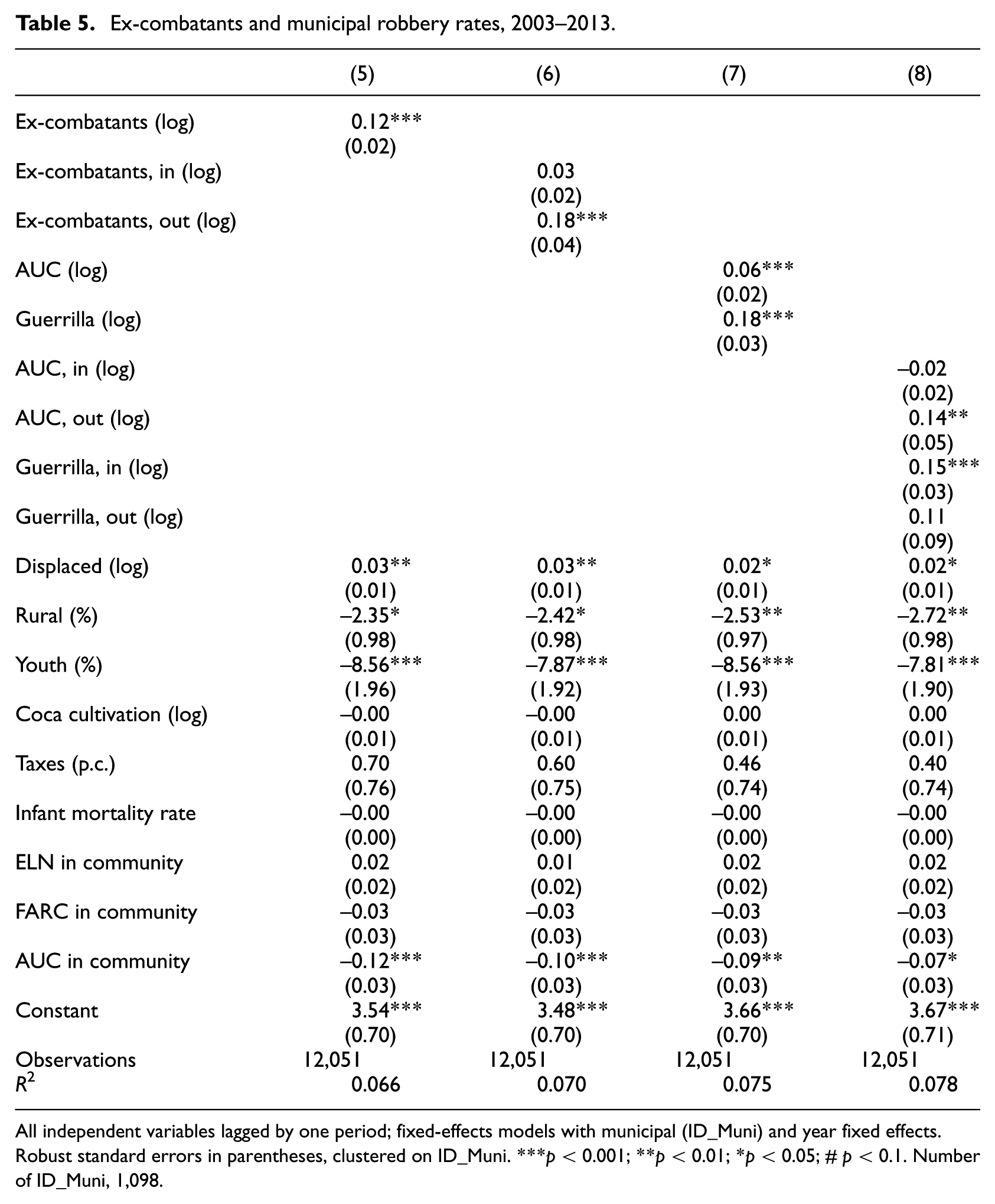
Table 5 reports the results for the fixed-effects models (with municipal and year fixed effects) for municipal robbery rates. In all models we observe a positive and generally statistically significant association between the number of ex-combatants and robberies, suggesting that ex-combatants increase the number of robberies. Model 7, moreover, shows that the positive effect holds for former paramilitaries as well as guerrillas. Yet distinguishing between ex-combatants in and out of reintegration programs (Model 6) indicates that the positive effect is largely attributable to former combatants who are not in reintegration. Finally, Model 8 finds that only the number of former paramilitaries who are not in reintegration has a statistically significant effect on increasing crime. In contrast, a larger number of guerrillas, regardless of whether they are in reintegration or not, appears to increase the robbery rate in a municipality. So far, these findings seem to provide support for Hypothesis 1 in the case of robbery rates. The evidence for Hypothesis 2 is more mixed; engagement in reintegration programs only appears to matter for former paramilitaries.
Ex-combatants and municipal robbery rates, 2003–2013.
All independent variables lagged by one period; fixed-effects models with municipal (ID_Muni) and year fixed effects. Robust standard errors in parentheses, clustered on ID_Muni. ***p < 0.001; **p < 0.01; *p < 0.05; # p < 0.1. Number of ID_Muni, 1,098.
Substantively, a 10% increase of the number of ex-combatants increases the robbery rate by 0.012 (where the average robbery rate is 0.805), but this is entirely attributable to ex-combatants who are not in reintegration. Doubling the number of veterans increases the robbery rate by 0.09, which means approximately 15 additional robberies in a city with 100,000 inhabitants. Of course, the number of robberies is much larger than the number of homicides. Municipalities between 90,000 and 110,000 citizens experienced on average 200 robberies (maximum is 900) and 40 murders (maximum is 144) in any year. If the number of former paramilitaries increases by 10%, the robbery rate goes up by 0.006 while 10% more guerrillas lead to an increase of 0.018.
The results for the controls for the robbery rate models diverge notably from the homicide rate models, suggesting that both types of violent crime are associated with different factors. The presence of active guerrillas (ELN, FARC) is unrelated to robbery rates, while the presence of paramilitaries (AUC) in a community correlates with lower robbery rates. Rural areas have lower robbery rates compared with urban areas. We do not observe a significant association of wealth, poverty or coca cultivation with robberies. As in the models for homicide rates, a higher percentage of young people in a municipality correlates with lower robbery rates while having more displaced people is associated with increased robberies. The overall fit of models for robbery rates is lower than for homicide rates, reflecting the higher variability of the former.
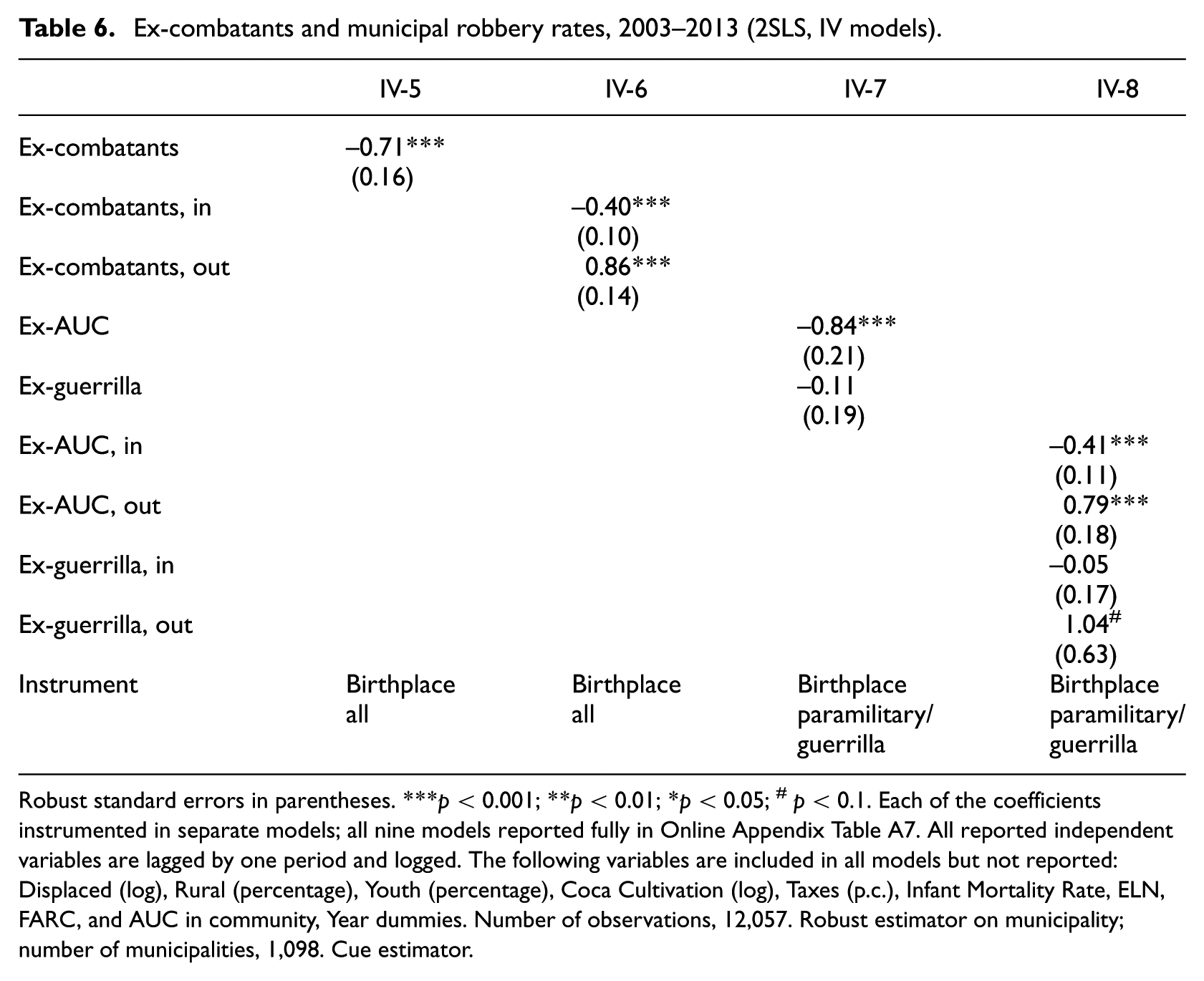
Analogous to the analysis of municipal homicide rates, Table 6 presents the 2SLS instrumental-variable analysis of robbery rates. In the Online Appendix we report the full models (Table A7.1) and statistics indicating that birthrate is a relevant and strong instrument (Table A7.2).
Ex-combatants and municipal robbery rates, 2003–2013 (2SLS, IV models).
Robust standard errors in parentheses. ***p < 0.001; **p < 0.01; *p < 0.05; #p < 0.1. Each of the coefficients instrumented in separate models; all nine models reported fully in Online Appendix Table A7. All reported independent variables are lagged by one period and logged. The following variables are included in all models but not reported: Displaced (log), Rural (percentage), Youth (percentage), Coca Cultivation (log), Taxes (p.c.), Infant Mortality Rate, ELN, FARC, and AUC in community, Year dummies. Number of observations, 12,057. Robust estimator on municipality; number of municipalities, 1,098. Cue estimator.
The results of the IV/2SLS analysis raise some doubts about the findings of the fixed-effects models presented above (Table 5). Most notably, the IV models indicate that veterans, in particular ex-combatants in reintegration and former paramilitaries, may actually decrease robbery rates. This suggests that former combatants move to areas with higher robbery rates rather than the other way around. However, even correcting for possible reverse causality, we still find a positive (and significant) effect of former combatants who are not in reintegration programs. The IV models therefore contradict Hypothesis 1 but lend support for Hypothesis 2. Finally, the positive association between former guerillas observed in the fixed-effects analysis becomes insignificant in the IV analysis. Still, former guerrillas (even in reintegration) are never associated with fewer robberies.
Robustness
To further assess the robustness of the findings presented above, we have run a number of alternative model specifications. Considering the high correlation between the variables measuring the number of ex-combatants in and out of reintegration respectively, we entered these variables separately and expressed as percentage of the total number of veterans (see Online Appendix B). The findings are consistent with the models presented above, although generally they give less support for any effect of the number of ex-combatants in reintegration programs.
Alternatively, we specified random-effects models distinguishing over time (within) and cross-sectional (between) effects (Online Appendix C). The results for the measures for the over-time effect of ex-combatants are consistent with those presented above. The coefficients for the cross-sectional measures suggest that veterans are associated with fewer homicides but with more robberies. These results are, however, highly uncertain. They are often statistically insignificant and the models do not correct for reverse causality.
The random-effects models include the same controls as the fixed-effects models but also include some additional time-invariant controls. The presence of illegal mining in the district is not significant. In the case of Colombia, altitude is occasionally suggested as a proxy for colonial experience and possibly quality of governance (Arjona, 2017). We find a statistically significant association with reduced homicides but not with robberies. Distance from Bogota could also be seen as a proxy for lower quality of governance, but we observe lower, rather than higher, homicide and robbery rates. 13
Conclusions
In contrast to most countries affected by long-running conflicts, in Colombia there exists detailed information on the experience of former fighters and their engagement with reintegration programs as well as extensive statistical information on crime rates and socio-economic background conditions at the municipal level. We have leveraged this information to evaluate whether the presence of demobilized combatants can indeed be associated with increasing crime rates, as commonly asserted, and whether reintegration programs can modify this impact, as often doubted.
We have examined the dynamics of violent crime in Colombia in an effort to understand the regional dynamics of post-conflict violence. The focus has been the presence of ex-combatants who participated in reintegration. In other words, do communities with more ex-combatants experience more crime and does reintegration matter? Importantly, the analysis distinguishes between former paramilitaries and guerrillas, but also between different types of crime—homicides and robberies. Since the decision of former combatants on where to settle is not random, we further correct for possible reverse causality.
In Colombia, as in most countries, underreporting of crime in official statistics is a serious problem. People may simply not bother to report property crimes when they are not insured and do not expect the police to take action. Lack of police capacity may also lead to non-random underreporting of homicides. Our analyses, however, do not provide clear evidence suggesting that state capacity affects the number of (reported) crimes. Further, since the data on ex-combatants are also official statistics, a reasonable expectation would be that municipalities that are able to keep track of ex-combatants are also better able to record crime, but generally we do not find a positive correlation between ex-combatants and crime.
Since 2016, the Colombian peace process has gained momentum making the reintegration of ex-combatants highly policy relevant. First of all, we find very limited support for a uniform “violent veterans” effect on crime. Concerns about the presence of veterans as a cause of crime would seem exaggerated. Rather, any effect is sensitive to contrasting former paramilitaries and guerrillas, as well as the number of ex-combatants involved in reintegration or not. The presence of former paramilitaries who are not in a reintegration program is linked with increased homicide and robbery rates. Controlling for possible endogeneity, the number of paramilitaries in reintegration is associated with lower homicide and robbery rates. Former guerillas, regardless of whether they are in or out of a reintegration program, are associated with increased robberies, but when they are in reintegration, guerrillas are associated with fewer homicides. A first policy implication is that the reintegration of ex-combatants matters for controlling post-conflict crime. Crime has marred the peace processes in several Central American countries such as Nicaragua and El Salvador. Our data for Colombia suggest that this cannot simply be attributed to ex-combatants and that, moreover, inclusive reintegration programs can even lead to a reduction of crime.
In the instrumental-variable models the presence of ex-combatants is generally associated with fewer homicides and robberies. The different findings of instrument-variable models suggest that ex-combatants (have to) settle in areas with high crime rates. Rather than increasing crime, veterans have to return to civilian life in areas that are increasingly crime-affected. The distinction between former paramilitaries and guerrillas, however, persists in instrumental-variable models. In our opinion, the most plausible explanation is that guerrillas more often had to settle in municipalities unfamiliar to them, and that they often have a relatively weak socio-economic position. Both factors make them more prone to engaging in property crimes.
A second policy implication is therefore that reintegration programs should not exclusively focus on ex-combatants but rather consider the community where ex-combatants have settled. In line with Kaplan and Nussio (2018b), our analysis highlights the role of communities in facilitating reintegration and avoiding recidivism. It matters that veterans often end up in areas where crime is a problem. Rather than focusing on veterans, the Colombian government has to extend its policing authority across the country. Particularly municipalities that were controlled by rebels run the risk of becoming a “no man’s land”. Since the socio-economic vulnerability of some veterans may well cause them to engage in (property) crime, it is worthwhile for the Colombia government, as well as external donors, to address the difficult circumstances in which some veterans have to provide for their livelihood. Our research indicates that keeping veterans in reintegration programs has a positive impact, and that reintegration programs can therefore been seen as a good investment to minimize post-conflict crime.
Supplemental Material
Appendix_final – Supplemental material for The reintegration of ex-combatants and post-conflict violence. An analysis of municipal crime levels in Colombia
Supplemental material, Appendix_final for The reintegration of ex-combatants and post-conflict violence. An analysis of municipal crime levels in Colombia by Andrea González Peña and Han Dorussen in Conflict Management and Peace Science
Footnotes
Acknowledgements
Earlier versions of the paper were presented at Universidad de los Andes (2016), LASA–New York (2016), the EARC Workshop on Conflict and Conflict Resolution (2017), and the workshop at the ISA Annual Convention (2018) We thank ACR, CEDE and the Colombian National Police for sharing the data. Authors are fully responsible for analysis of data and interpretation of results. Andrea González Peña acknowledges the Colciencias—Francisco José de Caldas scholarship for her PhD program.
Funding
The authors received no financial support for the research, authorship, and/or publication of this article.

Supplemental material
Notes
References
Supplementary Material
Please find the following supplemental material available below.
For Open Access articles published under a Creative Commons License, all supplemental material carries the same license as the article it is associated with.
For non-Open Access articles published, all supplemental material carries a non-exclusive license, and permission requests for re-use of supplemental material or any part of supplemental material shall be sent directly to the copyright owner as specified in the copyright notice associated with the article.
