




Abstract
Social science answers to the essential question of group conflict have focused on two main explanations—their motivating “grievances” and their mobilization “capacity” for collective action. Recent years have seen a renewed focus on grievances in the form of horizontal inequalities (between-group inequality), but the important conceptual and potential empirical differences between horizontal inequality and relative deprivation have not yet been incorporated into this discussion fully. This article first discusses these distinctions, and then assesses how they influence collective violence using new global evidence. Consistent with the theoretical discussion, the empirical results indicate that these concepts are not substitutes, and indeed are only weakly correlated, but rather tap into distinct aspects of grievance. The paper discusses the implications of these results, validates them in a series of robustness checks, and concludes with possible extensions along with future directions.
Why do groups rebel? Social scientists have offered various answers to this question, but most explanations can be classified into one of two broad perspectives—one focused on motives or grievances and the other on capacities or opportunities. Each has advanced our understanding of group conflict in important ways, but they are also both woefully incomplete on their own. Opportunities and motives are both necessary conditions, as has long been established by scholars of international conflict (Starr, 1978). An increasing number of articles suggest that this is true also at the level of intrastate conflict (Lindstrom and Moore, 1995; Gurr and Moore, 1998; Østby et al., 2011; Basedau and Pierskalla, 2014; Kuhn and Weidmann, 2015; Morelli and Rohner, 2015; Siroky and Cuffe, 2015).
“Grievances” have occupied a privileged position among the motives for groups to rebel, but scholars have recently focused almost exclusively on how grievances stem from the group’s horizontal economic and political inequality (Buhaug et al., 2014) or from political exclusion (Wimmer, 2002). As a result, it has been less often appreciated that grievances may also derive from less- or even non-material sources, such as negative social–psychological comparisons that result in the perception of relative deprivation (Bustikova, 2020; Davies, 1962; Gurr, 1970; Hechter et al., 2016; Hewitt, 1981; Horowitz, 1985; Peterson, 2002; Østby, 2013; Regan and Norton, 2005). This article theorizes, distinguishes and measures both material and non-material sources of grievance—that is, horizontal inequality and relative deprivation—and how they potentially interact with opportunities in a unified framework to explain conflict. Using new global group-level data, this model is assessed, and then its implications and limitations are discussed.
In addition to clarifying the difference between material and psychological forms of grievances, this article shows how these forms of grievance interact with a group’s opportunity for collective action, which we call its “relative mobilization capacity”, and conceive of as the group’s ability to acquire resources in order to mobilize people toward accomplishing the group’s goals (McAdam, 1982; McCarthy and Zald, 1977, 2001; Skocpol, 1979; Tilly, 1978). According to this supply-side perspective, the key lies in factors that make rebellion feasible, such as sufficient resources for leaders to offer selective incentives (Buhaug, 2010; Butler and Gates, 2009; Regan and Norton, 2005), a large pool of fighters (Dube and Vargas, 2013), low opportunity costs for rebellion (Besley and Persson, 2011; Collier and Hoeffler, 2004; Collier et al., 2009; Miguel et al., 2004), low state capacity (Besley and Persson, 2009; Migdal, 1988), natural resource and ethnic group concentration (Morrelli and Rohner, 2015), dense forests (Siroky and Dzutsev, 2015) and mountainous terrain (Fearon and Laitin, 2003).
An increasing number of studies recognize the important interactions that bridge these two perspectives, which we also articulate and assess in this article. For instance, Østby et al. (2011) examine scarcity and grievances, while Basedau and Pierskalla (2014) look at the interaction of resources and political inequalities on civil war in Africa, both highlighting the interaction of demand and supply side factors. Kuhn and Weidmann (2015) also examine how different types of inequalities affect both an ethnic group’s willingness and opportunity to fight, which is very much in the same spirit. Using novel, global data, we build on these approaches. We advance the literature by explicitly assessing the interaction of a group’s perception of relative deprivation and its relative mobilization capacity in leading the group to be engaged in violent conflict.
Too often in the past, these perspectives have talked past each other. Mobilization capacity approaches, for instance, often noted that grievances are too widespread and static to account for variable collective action, 1 and therefore concentrate on who has (or who lacks) the resource capacity for mobilization. Similarly, grievance-based approaches have often observed that many rebellious groups are quite resource-poor, which suggests that a large amount of resource mobilization capacity may be secondary to the group’s grievances that motivate contentious collective action. Both sides seem to recognize, however, that group conflict is most likely when a group has both grievances to motivate it and the mobilization capacity for collective action. To move forward, it is therefore important to unpack what is meant by grievance, and under which configurations it interacts with capacity to produce conflict.
Our focus here is to reexamine the conceptual and empirical distinction between “relative deprivation” and “horizontal inequalities”, which have been frequently conflated and treated as exchangeable manifestations of “grievances”, and to offer an initial test of the differential effects, both on their own and in interaction with relative capacity. The extent of “horizontal inequality” is typically based on objective economic differences between groups and the country mean. Lichbach (1989) called the emphasis on horizontal inequality the “economic inequality–political conflict” (EI–PC) nexus. Cederman et al. (2013) have further theorized and estimated this relationship across many groups and countries using new data, and provided strong evidence that on average horizontal inequality increases the probability of civil conflict. 2
In contrast, the social psychology literature more often thinks of “grievances” in terms of “relative deprivation”, which is premised on perceptions rather than on objective indicators, and has relied almost exclusively on experimental studies. Relative deprivation emphasizes group frustration owing to a gap between what the group has relative to what it feels it deserves—not necessarily to what others have. Studies of relative deprivation do not assume that it automatically stems from horizontal inequality—in fact, the original studies of relative deprivation were designed precisely to tease out key aspects of this distinction. To better understand what each concept adds to our understanding of group conflict, there is first of all a need to provide a separate assessment of them. To the best of our knowledge, this study may be the first cross-national analysis to measure and evaluate the role of relative deprivation explicitly on a global scale, at the level of dyadic groups, and thus to assess potential empirical differences between the effects of horizontal inequality and relative deprivation on conflict.
Using a new global dataset that offers explicit measures of the key concepts across a large number of directed dyads in about 100 countries across the world, we find that “grievances” in the form of relative deprivation increase the probability that groups engage in conflict, and to a lesser extent in the form of horizontal inequality, and that relative deprivation and relative mobilization capacity display a strong interactive effect on group conflict. The paper concludes by discussing several possible threats to inference and presents a variety of robustness checks. The final section addresses limitations of this study, and some potentially promising directions for future research.
Grievances as horizontal inequality and relative deprivation
Whereas “poetry is about grief,” noted Robert Frost, “politics is about grievance.” The role of grievances in stimulating group conflict has been central in many of the pioneering studies of group conflict (Davies, 1962; Gurr, 1970; Hechter, 1975; Horowitz, 1985; Petersen, 2002). While other scholars have discounted grievance-type arguments, arguing that grievances are too pervasive to explain rare events like group conflicts (e.g. Collier and Hoeffler, 2004; Fearon and Laitin, 2003; McCarthy and Zald, 2001; Tilly, 1978), a new wave of scholarship has pushed back, focusing on “horizontal inequalities” between groups as the preferred indicator of grievance. This work demonstrates that greater horizontal inequalities increase the likelihood of group conflict. Evidence has come both from case studies (Murshed and Gates, 2005; Must and Rustad, 2019; Simmons, 2014; Stewart, 2008) and from analyses based on large samples (Buhaug et al., 2014; Bustikova, 2014; Cederman et al., 2011; Østby, 2008; Sambanis and Milanovic, 2014; Siroky and Hale, 2017).
However, an important distinction has been blurred between the original focus on relative deprivation to capture grievances (e.g. Gurr, 1970) and the new wave’s focus on material horizontal inequality. Relative deprivation occurs when there is a perception that one’s group lacks a desired status (relative to a specific comparison or “reference” group). In some cases, relative deprivation may reflect objective economic differences, but it need not in all cases. For psychological reasons, low-resource groups may not always perceive their situation as unjust. Similarly, high-resource groups may feel relatively deprived, even though objectively they would be described as well off. If their reference group has a much higher status, a well-off group may still feel relatively deprived (Barbalet, 1992; Crosby, 1976; Merton, 1938; Runciman, 1966; Walker and Smith, 2002).
Relative deprivation is inherently social and relational, since people “must not only perceive difference, but they must also regard these differences as unfair and resent them” (Pettigrew, 2002: 368). Individuals and groups do not blame themselves for not having what they want and feel entitled to (Crosby, 1976: 90). Instead, they isolate “a particular villain … to whom blame for the in-group’s disadvantaged position can be attributed” (Guasti and Bustikova, 2019; Rauschenbach et al., 2015). Feeling relatively deprived can foster strong feelings of frustration, resentment, and grievance (Pettigrew, 2002: 361; Smith et al., 2012: 204). As a result, the group’s perception of relative deprivation vis-à-vis a particular group (Kus et al., 2014) may sometimes be more important than the group’s objective economic condition vis-à-vis another group, or compared with the country as a whole (Must and Rustad, 2019).
The concept of horizontal inequalities is different from relative deprivation in crucial respects. The most important is that horizontal inequalities are largely material, whereas relative deprivation is primarily psychological. Yet most scholars provide a story that links material inequalities (such as uneven income or land distribution across groups) to emotionally charged feelings of relative deprivation. Relative deprivation, in turn, provides a motive to engage in conflict because of in-group and out-group comparisons (Buhaug et al., 2014; Cederman, et al., 2011: 481; Horowitz, 1985; Turner, 1981). It is noteworthy that relative deprivation has been proxied using materialist measures because the concept was developed precisely because objective measures were deemed inadequate and misleading.
The sociological study by Samuel A. Stouffer et al., The American Soldier (1949), was arguably the first major study to use the concept of relative deprivation. Facing the odd finding that objectively better-off groups of soldiers often expressed less satisfaction and felt more deprived than worse-off groups of soldiers, Stouffer et al. invoked relative deprivation theory to explain the soldier’s satisfaction or deprivation as a function of how his situation was perceived relative to the group with which he compared himself and not his objective situation (Hyman, 1942; Merton, 1938; Merton and Kitt, 1950). This study formalized the term relative deprivation for social scientific research, and has served as the basis of extensive subsequent theorizing, particularly in social psychology.
Stewart (2012) argues that a key difference between horizontal inequality and relative deprivation is that the former expects both those below and those above the mean to engage more in conflict, whereas relative deprivation theory is only linear and never quadratic (curvilinear). However, the earliest study we know in modern social science on this subject (Stouffer et al., 1949) investigated the concept and developed it precisely because it was often those (in the military) who were better off that felt most relatively deprived. The main distinction, on this count, is that horizontal inequality is structural and largely material, whereas relative deprivation is psychological.
This emphasis on the role of emotionally charged social comparisons in the formation of relative deprivation has long been echoed in social psychological work (Barbalet, 1992; Crosby, 1976; Merton, 1938; Runciman, 1966; Smith et al., 2012; Walker and Smith, 2002) and earlier research in political science (Davies, 1962; Gurr, 1970: 36–58; Horowitz, 1985: 181–184). Relative deprivation occurs when there is a perception that one’s group lacks desired economic, social, or political goods compared with another group. Relative deprivation may, but need not, reflect the objective differences. Low-resource groups do not always perceive their situation as unjust, and high-resource groups may feel relatively deprived. Thus, even a group that objectively would be described as well off or at economic parity with another group could feel relatively deprived.
Highlighting results from the social psychology literature, Walker and Smith (2002: 2) write, “the ways that people interpret grievance—central to relative deprivation—are now recognized as essential to a full understanding of social movement participation.” The essence of the concept is social and relational: people “must not only perceive difference, but they must also regard these differences as unfair and resent them” (Pettigrew, 2002: 368). More important than the group’s objective condition is therefore its perception of relative deprivation (Kus et al., 2014). As Must and Rustad (2019: 500) state, “[s]tructural inequalities need to be perceived to be unfair … in order to spark mobilization”.
Even Gurr (1970) in his seminal political science work on the relative deprivation–conflict nexus described relative deprivation as the gap between “expectations and achievements”, and argued emphatically that this gap is both conceptually and empirically distinct from economic inequality. 3 The link between relative deprivation and conflict, as Gurr noted (1970: 210), is that groups perceiving themselves as relatively deprived—regardless of how poor they actually are—“believe that they stand a chance of relieving some of their discontent through violence” (Corning, 2000; Foster and Matheson, 1995; Smith et al., 2008, 2012). He predicted that the larger this relative deprivation gap, not the larger the economic inequality, the greater the chances of political violence. 4
Gurr probably did more than anyone else to advance the notion of relative deprivation in political science, and to propose examining the gap between expectations and achievements as a contributing factor to ethno-nationalist rebellion. Although the arguments he proposed made intuitive sense and appealed to many scholars, the quantitative empirical evidence was only modestly supportive (Brush, 1996; Moore and Gurr, 1998). For Gurr, relative deprivation existed where there was a gap between objectively measured expectations and achievements. The larger this gap (the degree of relative deprivation), the greater the chances of political violence (Gurr, 1970). Using public opinion polls from 13 countries on how people compared their past, present, and future position with their ideal life, he found a modest correlation between this measure of relative deprivation and political conflict at the country level. We suggest that this may be due to limitations on how relative deprivation has been measured in large-N studies, and also due to the failure to consider the interaction theory proposed here.
The Minorities at Risk project expanded on Gurr’s early efforts and collected group-level indicators, such as relative regional GDP, education, and regional autonomy (Moore and Gurr, 1998). The Ethnic Power Relations project (Cederman et al., 2010) has also relied on similar types of indicators to construct measures of horizontal inequalities (relative GDP per capita of the group/region to the country mean) and access to political power. 5 Although we agree that horizontal inequalities, political exclusion, lost autonomy, ethnic or religious dominance, population pressure, and the like may lead to a perception of relative deprivation, as these models typically assume, we argue that the translation is not automatic. Relative deprivation is a psychological state—a perception—that filters the material world and interprets inequality (Corning, 2000; Foster and Matheson, 1995; Smith et al., 2008, 2012). Political scientists have mostly relied on materialist proxies, however. Lacking direct measures and clear reference categories (Theurkauf, 2010, 117), scholars working with grievance-type explanations remain unable to properly test the causal mechanisms most often stipulated. We take suggestions from earlier research seriously that relative deprivation needs to be measured directly, and not just among individuals but at the level of groups in order to understand group-based conflicts (Østby, 2013). Furthermore, owing to the failure to explicitly model relative deprivation in interaction with resource mobilization, as proposed here, the results have often been inconsistent. The data we utilize overcome these problems to some extent and allow us to assess relative deprivation directly and test its ability (alone and in interaction with mobilization capacity) to predict the likelihood of collective violence.
The early literature reminds us that the translation from material inequality between groups to relative deprivation is not automatic—and it is arguably important to re-emphasize this distinction moving forward, both theoretically and empirically. The literature on horizontal inequality has tended to either equate it with relative deprivation or to posit that the causal mechanism by which horizontal inequality becomes a grievance is relative. Both of these versions are unsatisfactory, and disaggregated measures of both are needed to sort out these claims.
The most widely use measure of horizontal inequalities comes from the Ethnic Power Relations project (EPR; Cederman et al., 2010), which measures the group’s GDP per capita relative to the country mean (GDP per capita). 6 The idea is that poorer groups (and to a lesser extent, richer groups), engage in more conflict, via the presumed mechanism of relative deprivation. Moreover, the specific group with which horizontal inequality is compared, which is an essential component of relative deprivation theory, is the country mean (rather than another group). This suffices to capture relatively “poor groups” and “rich groups”, but not to overcome the essential reference group problem, which is critical because the poor do not always feel relatively deprived and the rich sometimes do. A crucial component of the theory is the “reference group problem”, which refers to the comparison group, and is necessarily obscured when the national average income is used as the implicit reference group. Both relative deprivation and horizontal inequality should therefore be measured vis-à-vis a particular group, as in the subsequent data analysis. This is precisely what relative deprivation theory was meant to address, and why it should not be conflated with horizontal inequality.
The proposed conflict model posits that relative deprivation (and separately horizontal inequalities) interacts with relative mobilization capacity. In other words, groups with sufficient mobilization capacity to engage their potential opponent in conflict, but which lack “grievances” vis-à-vis that group, are not likely to engage in conflict very often because they lack the motive. Similarly, groups that harbor grievances but lack sufficient mobilization capacity will also not engage in much conflict for they are unable to muster what is needed to mobilize. Rather, the effect of grievances is enhanced when the group also has an advantage in mobilization capacity over the rival group, and the effect of a mobilization capacity is magnified when the group harbors significant grievances, both with respect to a particular group. Earlier studies have pointed to the importance of the framing of grievances, leading members of a group to perceive their situation as unfair, and have shown that grievances have a role in civil unrest, independent of actual levels of inequality (Must and Rustad, 2019). We build on this, both theoretically and empirically, by arguing and showing that it is when perceived grievances are combined with mobilization capacity that violent conflict is more likely to materialize.
This captures the motivation and opportunity conflict model, which recognizes the importance of both mobilization capacity and grievances (conceived of here as both relative deprivation and horizontal inequality), and suggests that mobilization capacity and relative deprivation/horizontal inequality provide a mutually reinforcing mechanism that jointly generates more conflict than either does alone or additively. Some groups are unable to do anything about their grievances—for instance, one recent study found that very disadvantaged groups often refrained from collective action, anticipating repression from powerful governments and stronger rivals that could effectively crush weak movements (Lacine, 2014). Just as the effect of grievances is diminished in the absence of the capacity for collective action, so too a group’s mobilization capacity lacks clear behavioral implications when there is no apparent motive for conflict. These motives have often been bundled under the heading of “grievances”, but it is important to recognize that there are at least two distinct sources of grievance, one more and the other less material in nature, and that these afford different ways of understanding the effect of grievances on conflict. To clarify the distinction between horizontal inequality and relative deprivation, and to examine these conjectures empirically, we turn to a group-level dataset developed in the context of an interdisciplinary National Science Foundation grant called the Global Group Relations Project (GGRP) and described fully in Psychological Science (Neuberg et al., 2014). 7
Data, design and methodology
A major advantage of the dataset (Neuberg et al., 2014) utilized in the analysis here is that it offers indicators of all of the relevant concepts consistently at the group and dyad levels—namely: relative deprivation, horizontal inequality, mobilization capacity, and dyadic conflict—thereby enabling a fairly direct test of the paper’s primary hypotheses. Since these data have not yet been utilized in political science, we briefly introduce the data as it relates to our analysis. The unit of analysis is the directed dyad (two groups). The sampling of groups spanned five continents and the roughly 100 countries in the sample encompass approximately 80% of the world’s population. However, it is important to fully acknowledge that, since only one dyad is (randomly) selected per country, the actual proportion of the world’s population that is included in the final sample (the percentage of the world’s population) is significantly less than 80%. 8
Employing the list of United Nations member states (as of January, 2008), simple random sampling was used to select 75 dyads. 9 However, because conflict is a relatively rare event—relative to its potential—a purely random sampling of groups would be unlikely to generate sufficient variation on conflict (and potentially on its predictors) to effectively test hypotheses about relationships among these constructs with sufficient statistical power. In addition to the random sampling of 75 dyads, the data collection strategy therefore also employed an over-sampling procedure to ensure an adequate amount of conflict to test these hypotheses by selecting 25 a priori dyads with significant recent or ongoing conflict, for a total of 100 distinct dyads across 100 countries. Approximately 70% of the 25 a priori cases included target groups engaged at the time in moderate or high levels of collective violence, compared with 21% of the dyads (within the 75 randomly sampled sites) that were engaged in moderate or high levels of collective violence. The final dataset therefore has a more class-balanced outcome to predict—with a total of 33% of the dyads involved in moderate to high levels of conflict. 10
The data collection effort ran for six months, and relied on hundreds of scholars, building upon the logic of similar indices that are widely used in the social sciences, e.g. WGI (World Governance Indicators), EPR, Polity and Freedom House (e.g. Benoit and Laver, 2006; Bueno de Mesquita and Feng, 1997; Cederman et al., 2010; Hooghe et al., 2010; Marshall et al., 2010), the BTI (Bertelsmann’s Transformation Index), CHES (Chapel Hill Expert Survey), and others. 11 Expert-generated indices, especially those directly informed by a large number of experts with deep knowledge of the cases, can provide a level of intellectual rigor, disciplinary judgment and methodological sophistication that is hard to acquire from non-specialists. In this way, expert surveys can produce data using deep area knowledge, across a wide range of cases. Some recent research has shown that data aggregated across experts yields more accurate predictions than observational data gathered by non-experts from English-language news sources (Lewis and Neiman, 2007; Hooghe et al., 2010; Glasgow et al., 2012).
The sampling procedure reflects the data’s social psychological origins. It included a quota for six different types of group dyads: ethnic group vs. ethnic group, religious group vs. secular group, religious group vs. religious group, state vs. ethnic group, state vs. religious group and state vs. state. 12 This merits a brief discussion, since it departs from what is typical in political science, which believes that it draws a sharp line between inter- and intra-state conflict, and between types of conflicts, say ethnic conflict vs religious conflict. However, in reality, many datasets cross these boundaries without stating so explicitly, since the groups included are ethno-linguistic groups on the one hand, while other groups in the same dataset are defined by their religion. The earliest quantitative studies of studies of conflict (e.g. Richardson, 1960) did not see such sharp lines and viewed differences as a simple question of magnitude along a continuum. 13 While there is a tendency to treat social groups “separately” in an ever more fine-grained fashion—separatist groups as distinct from ethnic groups as such, ethnic groups distinctly from religious groups, etc.—the assumption is that the processes underlying different types of inter-group relations are qualitatively distinct, so they should not be pooled together.
The aim of the GGRP project that collected the original data was to detect factors that potentially shape fundamental aspects of group processes and dynamics shared by interdependent groups of various sorts (Neuberg et al., 2014). This practice of seeking to understand more “universal” or general influences has a long tradition in psychology and the natural sciences, which assume the presence of some fundamental commonalities of human sociality even across its many diverse manifestations. In terms of how such a practice may influence our inferences, the heterogeneity of group type within the GGRP data lends itself to more conservative hypothesis testing, for if the theorized factors and processes do in fact operate differently across dyad types, as analyzing them separately implies, this makes it more difficult for researchers to detect signals in the data. Thus, any signals that do emerge should be treated with greater confidence, with respect to both their strength (because they emerged, despite the countervailing force of heterogeneity) and their broad applicability across a large variety of the world’s group types. We therefore assess these dyads jointly in the main analysis, but also conduct sub-group analyses to assuage concerns about the effects of pooling and show that the results are indeed consistent across the sub-types. 14
Now we can turn to the measurement of the key predictors: relative deprivation, horizontal inequality, relative mobilization capacity and dyadic conflict.
Relative deprivation
Expert informants were asked, for each group, “To what extent do [Group A(B) Members] view themselves as having been unfairly deprived of resources and favorable outcomes, relative to [the Group B(A) Members]?” Responses were indicated on a nine-point scale where higher numbers indicated that a group felt deprived relative to the other group. This is a group-level variable. 15 Note that the relative deprivation score has embedded within it information that implies whether the other group is a relevant comparison group. This is because high relative deprivation scores imply both that the other group is relevant for comparison and that the focal group sees itself is being deprived relative to that group. As a comparison, we also considered an alternative operationalization of “grievances” in the form of the less psychological and more materialist horizontal inequality.
Horizontal inequality
Expert informants were asked, “To what extent do [Group A(B) Members], on average, actually lack access to sufficient food, water, and/or land?” Responses were on a nine-point scale and higher scores indicated greater lack of resources. Horizontal inequality was operationalized by subtracting the resource access score from Group A from the resource access score from Group B. A positive score thus indicates that Group A has a greater access to resources (less lack of resources) than does Group B. Scores near zero indicate that the two groups have similar access to resources, and negative scores indicate that Group B has the greater access to resources. 16
Relative mobilization capacity
Although various approaches to measuring mobilization capacity have been proposed, most analyses rely on absolute structural indicators, either at the state level (low GDP, mountainous terrain, dense forestry, reliance on primary commodity exports) or at the group level (demographic and structural indicators). 17 However, mobilization capacity is inherently relational and therefore must be measured vis-à-vis another group. Topographical features, the existence of lootable resources or GDP per capita are crude proxies. Although more powerful groups may be better equipped for conflict, predicting their behavior requires also specifying their rival’s mobilization capacity. Two groups with high or low absolute levels of resources may be deterred from engaging in a costly conflict, but deterrence often fails when the groups have asymmetric mobilization capacities. The point of a group’s mobilization capacity is to provide an advantage over another group but knowing absolute mobilization capacity does not tell us whether it has any advantage over its rival because its rival’s mobilization capacity is never specified. It is when one group has a greater relative capacity to mobilize, and a sense of relative deprivation, that group conflict often ensues, rather than simply because mobilization capacity or deprivation exist per se. 18 Moreover, relative mobilization capacity is largely indeterminate without knowing the extent to which the group is also relatively deprived. This is precisely why we propose and estimate a model in which relative deprivation and mobilization capacity explicitly interact within a unified framework.
To assess mobilization capacity, expert informants were asked for each group within a country, “To what extent is [Group A(B)], as a collective, able to mobilize tangible resources (e.g. money, political influence, arms, people) when needed?” Responses were on a nine-point scale and higher scores indicated greater absolute capacity to mobilize. Relative mobilization capacity was operationalized by subtracting the mobilization capacity score of Group B from the mobilization capacity score of Group A. A positive score thus indicates that Group A has a greater capacity to mobilize resources than does Group B, scores near zero indicate that the two groups have similar capacity, and negative scores indicate that Group B has the greater capacity to mobilize.
Dyadic group conflict
Expert informants were asked, for each group, “To what extent do [Group A(B)Members] perpetrate violent acts of physical aggression against [the Group B(A)’s Members], such as riots or police/military actions?” This group-level variable is a directed-dyad and was measured on a nine-point scale for both groups in the dyad. To understand how to interpret and use the scale, experts were provided with a sample of dyads included in the study, and were asked to think about these groups, or others with which they were more familiar, in order to provide a global reference for the response scale. In terms of UCDP battle death cut-offs, all of the conflicts with at least 25 battle deaths would be included in these data, probably at a level of 3 for a low-level UCDP conflict, and of course higher (for more violent conflicts). Experts would only code group conflict as a 9 for a massive ethnic cleansing campaign or similar large-scale armed conflict. The advantage is that a nine-point scale provides a uniform scale (not based on battle-deaths, which depend on population sizes, military technology, and other confounding factors) as well as offering experts significant range to code more and less intense conflicts, rather than binary indicators of conflict based on an arbitrary battle-death threshold.
Finally, there are some important modeling considerations. The model should account not only for covariation among predictors, which OLS could achieve, but also for multiple outcomes and covariation among them (i.e. to account for directed dyads). 19 Structural equation models (SEM) provide an elegant solution (e.g. Merrilees et al., 2013). If such covariation exists, SEM can detect it, account for it and produce unbiased parameter estimates. 20
Empirical analysis
First, we note that horizontal inequality and relative deprivation were only weakly correlated (0.29) in this dataset, 21 indicating that the two constructs are empirically (and not only conceptually) distinct. Second, we report that the bivariate model with horizontal inequality predicting conflict is not consistent with the data (b = 0.068, s.e. = 0.044, p = 0.123, or in curvilinear form b = 0.023, s.e. = 0.020, p = 0.231). 22 In comparison, the simple bivariate relative deprivation model is consistent with the data: b = 0.174, s.e. = 0.041, p < 0.001. Most important, when we compare two models, one using horizontal inequality and another using relative deprivation, we do not find direct evidence that horizontal inequality predicts group conflict in the fully specified model that includes relative mobilization capacity. The model fit was adequate but was significantly worse (CFI = 0.922; RMSEA = 0.10) than the model fit for relative deprivation (CFI = 0.972, RMSEA = 0.060). 23 An adequate fit is generally considered to be above 0.90, and the root mean squared error of the approximation (RMSEA) should be less than 0.10 for good models. To facilitate interpretation, all predictor variables were mean centered, so that each coefficient can be interpreted as the expected effect at the mean value of other predictors in the model (Aiken and West, 1991).
The full conflict model includes one of the two forms of grievance (horizontal inequality or relative deprivation) interacted with mobilization capacity. In Figure 1, where we examine the prediction for horizontal inequality (resource advantaged and resource disadvantaged groups) as a moderator of mobilization capacity (or vice versa), we see that there was a significant positive relationship between mobilization differential and that group’s engagement in collective violence for resource advantaged groups (b = 0.276 (s.e. = 0.076), p < 0.001), but not for disadvantaged groups (p > 0.2). Another test is the comparison between this baseline model and one in which the paths are constrained to equal magnitude, but opposite sign, for the low- and high-resource groups. If the effect of mobilization capacity is moderated by horizontal inequality, then we would expect a significant nested model test comparing the chi square output of the baseline model with that of the constrained model. The nested model test, however, was only marginally significant [χ2(1) = 2.869, p < 0.090], indicating that horizontal inequality does not moderate the effect of mobilization capacity on conflict, except for resource advantaged groups, and does not appear to have a strong direct effect itself on conflict.
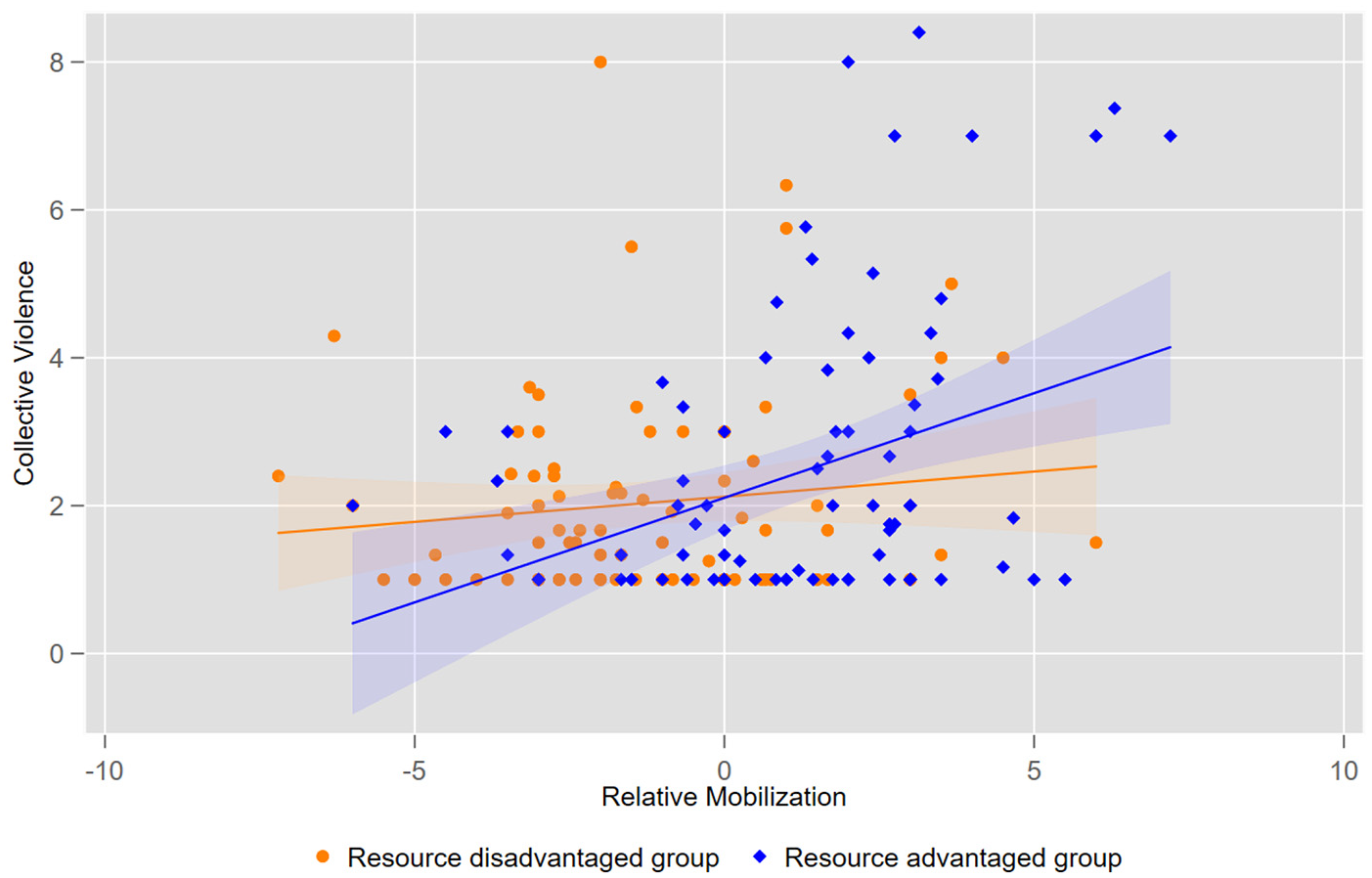
Relative mobilization capacity by horizontal inequality (advantaged and disadvantaged groups) on group conflict.
We now compare this with the same specification with relative deprivation instead of horizontal inequality (Figure 2). This figure depicts how the likelihood of group conflict changes for varying levels of relative deprivation and relative resource mobilization capacity. It shows that relative deprivation and relative mobilization capacity mutually shape each other’s effect on group conflict. As the group’s relative mobilization capacity increases, groups that feel more relative deprivation are significantly more likely to engage in collective violence. Likewise, the effect of relative mobilization capacity is most pronounced in the presence of high levels of relative deprivation and least marked when relative deprivation is low. The model fit for the fully specified relative deprivation model (CFI = 0.972, RMSEA = 0.060) offers a significant improvement over the fully specified horizontal inequality model (CFI = 0.922; RMSEA = 0.10). In sum, relative deprivation on its own and in interaction with relative mobilization capacity predicts inter-group conflict significantly better than does horizontal inequality.
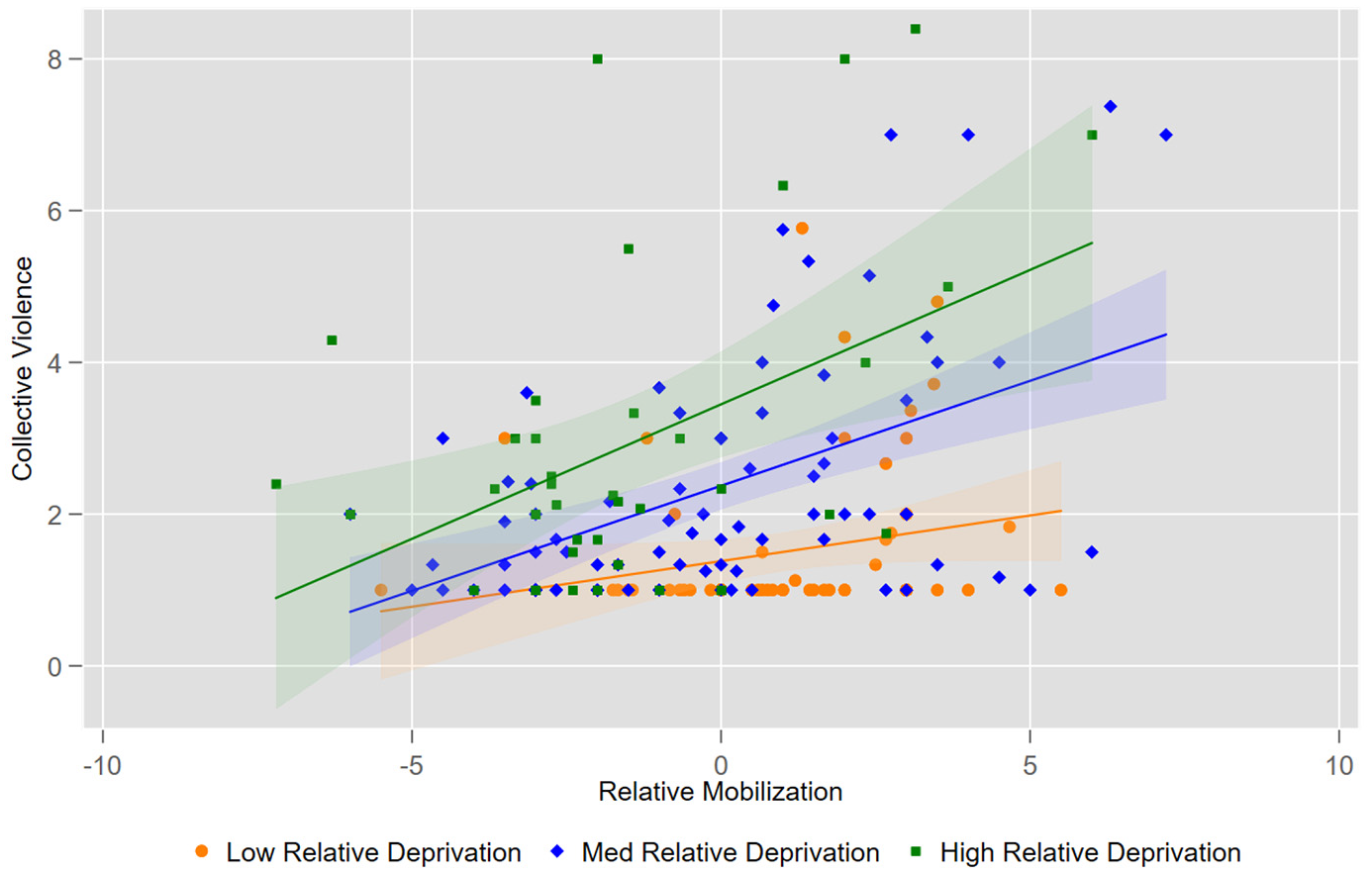
Relative mobilization capacity by relative deprivation on group conflict.
Robustness
We tried to evaluate and consider several potential threats to inference, including omitted variable bias, sampling, expert bias, unit heterogeneity, and reverse causality.
Beginning with omitted variable bias, which could stem from confounding variables that correlate with our independent variables, we examined several possible confounds, including GDP per capita (pc) and contact, but none modified our core results and none were able to account for the particular interaction patterns observed here—patterns in which relative mobilization capacity moderates the ability of relative deprivation to predict collective violence (Online Appendix Tables 3 and 4). The effect of horizontal inequality was also unaffected by including GDP per capita. 24 First, we assessed one of the strongest empirical findings in the quantitative study of civil war: the effect of GDP pc on the likelihood of civil war onset. 25 Using different data and methods, our results are consistent with the literature—the effect of GDP is negative and significant. The main effects of relative deprivation and relative mobilization capacity and their interaction remain significant (Online Appendix Table 3). 26 Another potential omitted variable is rooted in one of the most common explanations for group conflict and cooperation—the so-called contact hypothesis. Using an indicator of contact between the members of the dyad drawn from the survey, 27 we find that the main effects of relative deprivation and relative mobilization capacity hold, as does the hypothesized interaction between the two (Online Appendix Table 4). Unlike GDP pc, there is no main effect of contact, and contact does not significantly interact with the other variables. 28
A different kind of concern from omitted variable bias is that the observed effects are just artifacts of the expert informants’ existing theories—this goes to the validity of data (and possible bias) from expert surveys. One might conjecture that our expert informants share some common theoretical biases, thereby generating the observed findings. This is unlikely for two reasons. First, the informants provided information only about one site and only about individual parameter values, not about the relationships among variables. Second, the informants represented many disciplines, and few of them were actually researchers of inter-group relations or conflict, decreasing the likelihood that the informant population on the whole would share any one theory (Neuberg et al., 2014). An artifact-driven explanation of this kind assumes a degree of theoretical consensus among scholars that is belied by the extent of scholarly disagreements on these issues. For these reasons, we think that it is not very likely that a theoretical consensus among respondents could have generated the patterns of findings observed here.
A different issue is the sampling of groups, which was partly random but partly selected intentionally. In the final dataset, three-quarters of the countries were sampled randomly, and one quarter were selected a priori and thus not sampled at random. These latter countries represented an intentional oversampling of conflict sites to create an adequate distribution for testing hypotheses. However, it is reassuring that none of the conclusions changed when we looked at only the randomly sampled countries and excluded those selected a priori from the analysis. 29
Another issue is that, for political science, our units of analysis (e.g. states, ethnic groups, religious groups) are heterogeneous. We address this conceptually in the main discussion but here we also assess it empirically by conducing sub-group analyses (Online Appendix Table 5). The simultaneous consideration of different types of social groups is common and explicit in other fields (e.g. social psychology), whereas in political science it appears in ways that often go unrecognized. For example, “ethnic” group datasets in political science (e.g. EPR) often cover linguistic groups, sectarian groups, regional groups, etc., and almost always aggregate across these groups. At other times, such datasets include sub-groups and tribes for some collectives, but not for others, without clear rules for inclusion or exclusion. Similarly, some armed conflict datasets (e.g. Uppsala Conflict Data Program—UCDP) that cover “rebels” include groups that range from motorcycle gangs to full-fledged militias. Pooling of various social collectives is thus a common practice in political science but is rarely made explicit. The presumed threat in all these cases, and in our case, is that the units are too heterogeneous to be coherently pooled into a single analysis. This is not something that can or should be decided ex-ante in all cases but can be sorted out empirically in view of disagreements over how the data-generating processes should differ across group types.
A related concern is that, by mixing together different group types, the findings may be driven solely by a subset of the group types included, with the consequence that the discovered causal mechanisms are mistakenly generalized to the other subsets of units. To determine whether our results were driven by a particular type of site (e.g. ethnic–ethnic, state–state), we present six models in each of which a different site-type was removed (see Online Appendix). If our overall findings depend on a particular dyad type that is qualitatively distinct from the others, then the overall pattern of findings should disappear in at least one of the analyses. 30 Despite decreased power, the focal interaction remains statistically significant in five of the six sub-models, and in that one model in which the interaction was not statistically significant (p = 0.377: excluding religious vs. secular groups) the direction of the pattern remained the same. The predicted interaction effect seems robust to “unit heterogeneity.” 31
Because our research is correlational and cross-sectional, we have taken care to avoid causal language. Our design cannot formally rule out the possibility that inter-group conflict causes our focal predictors rather than the other way around. Although pre-existing inter-group conflict might lead groups to feel more relatively deprived, or to produce relatively more mobilization capacity, this does not readily account for the interactive pattern observed here—that mobilization capacity moderates the ability of relative deprivation to predict conflict. Reverse-causality arguments in which conflict serves as the causal force cannot explain in any obvious way the particular interactive relations of relative deprivation and relative mobilization capacity. This argument of course also does not provide an alternative plausible explanation for the origins of the existing conflict. We are careful not to claim causal effects of our predictors and conclude that the empirical patterns are consistent with the proposed theory. Perhaps the greatest weakness was due to the cost of data collection—the evidence only represents one snapshot in time and does not permit us to conduct longitudinal analysis that might permit causal claims. Future data collection efforts along these lines would help to develop causal arguments by providing temporal leverage. Moreover, more detailed process tracing of exactly how group-level relative deprivation and horizontal inequality interacts with mobilization capacity is needed.
Conclusion
While there has been a return in the literature to the concept of grievances as a crucial factor in quantitative studies of conflict, scholars have been limited by available data on distinct forms of grievances. In focusing on horizontal inequalities, we have imported into the concept of grievance the same type of factors that those emphasizing mobilization capacity use: material resources. What has been missing is an assessment of relative deprivation underlying the grievances that scholars have long hypothesized to influence the likelihood of conflict. This research complements a recent study using survey data to measure group-based grievances (Must and Rustad, 2019), and extends it by explicitly measuring group mobilization capacity, and with a large, cross-national sample. We take advantage of a relatively new dataset, the Global Group Relations Project data, to measure the actual sense of relative deprivation perceived by groups, as well as their more objective level of (material) horizontal inequality, and then assess their roles in stimulating conflict. We find that relative deprivation predicts conflict much more consistently and produces a model with a better fit than does the model with horizontal inequality, both on its own and in interaction with greater resource mobilization capacity, which suggests that they tap distinct concepts and cannot be treated as substitutes, as they have been in many recent studies.
Moving forward, there is therefore a need to collect additional time-varying data on grievances that capture both the material and psychological aspects of this important dimension of conflict processes, and to match these sources and forms of grievance with different types and levels of longitudinal conflict data. The data analyzed here suggest that this is a promising area. Owing to the data’s cross-sectional nature, however, there inherently are limits to causal claims that additional data could help to overcome.
The findings suggest that policymakers may need to be more attentive to perceptions that groups have of being deprived, rather than relying solely on socioeconomic indicators of inequality, to identify groups that may be motivated to engage in violent collective action. While the results indicate that there is a clear need to unpack grievances, they equally imply a need to keep an eye on the groups’ relative capacity to mobilize. This approach to forecasting when and where rebellions and other protests might take place, and working to ameliorate the inter-group dynamics that give rise to conflict, may be more labor-intensive than relying on objective indicators, yet promises to help us create a model of conflict that would better inform conflict management and peace-keeping efforts.
Supplemental Material
CMP906372_online_appendix – Supplemental material for Grievances and rebellion: Comparing relative deprivation and horizontal inequality
Supplemental material, CMP906372_online_appendix for Grievances and rebellion: Comparing relative deprivation and horizontal inequality by David Siroky, Carolyn M. Warner, Gabrielle Filip-Crawford, Anna Berlin and Steven L. Neuberg in Conflict Management and Peace Science
Footnotes
Acknowledgements
For comments and discussions, we are grateful to Valery Dzutsati, Petra Guasti, Michael Hechter, Zdenka Mansfeldova, Stephen Mistler, Will Moore, Mark Ramirez, Cameron Thies and Thorin Wright. We are very thankful for the extensive and thoughtful comments received from anonymous reviews and the editor. The Center for Study of Religion and Conflict at ASU, and in particular Carolyn Forbes, was instrumental in bringing this project together and supporting it. We especially thank Babak RezaeeDaryakenari for preparing the revised Figures 1 and 2, and Pratik Nyaupane for his work preparing Appendix Figure 4. Anna Berlin Tamayo and Gabrielle Filip-Crawford prepared the data replication and supplemental materials.
Funding
The author(s) disclosed receipt of the following financial support for the research, authorship, and/or publication of this article: This material is based upon work supported by the National Science Foundation under grant numbers SES-0729516 and IBSS-1416900. Any opinions, findings, and conclusions or recommendations expressed in this material are those of the authors and do not necessarily reflect the views of the National Science Foundation.

Notes
References
Supplementary Material
Please find the following supplemental material available below.
For Open Access articles published under a Creative Commons License, all supplemental material carries the same license as the article it is associated with.
For non-Open Access articles published, all supplemental material carries a non-exclusive license, and permission requests for re-use of supplemental material or any part of supplemental material shall be sent directly to the copyright owner as specified in the copyright notice associated with the article.
