




Abstract
This paper identifies profound contradictions within and across nuclear deterrence strategies that evolved in response to the proliferation and modernization of nuclear weapons. To reconcile theory with practice, we summarize the theoretical assumptions and implications of nuclear strategy. Informed by these discussions, we develop a decision-theoretic model of deterrence based on power transition theory. We explore conditions for the stability of deterrence and link outcomes to policy decisions. The conditions for conflict emerge when a dissatisfied nuclear nation is threatened with conventional loss, when conventional and nuclear parity is achieved and if dissatisfied non-state actors acquire even minimal nuclear capabilities.
The unleashed power of the atom has changed everything except our thinking. Thus, we are drifting toward catastrophe beyond conception. We shall require a substantially new manner of thinking if mankind is to survive. -Albert Einstein.
Introduction
Nuclear war and environmental degradation are the most critical threats to human existence. US grand strategies were almost abandoned following the collapse of the USSR. The West underrated the importance of nuclear stability despite the rise in the likelihood of nuclear war. Whereas deterrence has long inhabited the realm of great power confrontation, the new regional environment is marked by asymmetric rivalries and violent non-state actors. Given all this, for several decades, a debate has been raging in security studies on the relative virtues of nuclear deterrence as opposed to disarmament and non-proliferation (e.g. Sagan and Waltz, 2002). We address here how shifting deterrence postures are related to stability.
Current deterrence postures are frequently contradictory, reflecting persistent frustration with the difference between theory and practice. It is imperative to establish a more reliable framework that can inform and even alter the current understanding of how divestment, proliferation and modernization of nuclear weapons affect global and regional stability.
This paper explores the link between nuclear proliferation, deterrence and stability. Schelling (2013) proposes that nuclear strategists explore the stability of deterrence as an equilibrium condition. A stable deterrence presents a peaceful equilibrium where the deterrence moves back to the status quo point after a slight haphazard disturbance, whereas an unstable deterrence exists when the deterrence relationship does not move back to that position. Deterrence theory should allow us to understand how those equilibrium conditions are affected by proliferation and technological changes.
We first summarize the evolution of nuclear strategies and identify profound policy contradictions across alternate proposals. Informed by these discussions, we formulate a more enriched power transition deterrence model that reconciles deterrence specifications and policy implementation. We specifically explore how different nuclear challenges are derived from proliferation and related to alternate deterrence strategies. The power transition deterrence model identifies conditions under which stability is sustained or unlikely in the nuclear era.
Previous nuclear deterrence postures
Deterrence strategies in the nuclear era have evolved in response to the proliferation of nuclear weapons. Each version aims to provide security from a massive nuclear war, but the means to achieve and endure long-term stability substantively differ. The short summary provided here isolates key assumptions and implications of significant variants.
Massive retaliation deterrence before proliferation
Nuclear deterrence as we know it today came into existence immediately after the Second World War ended. Observing Hiroshima and Nagasaki, Brodie (1946) noted that the introduction of nuclear weapons altered the calculus of war. Massive casualties could now be inflicted in days, not years. Brodie argued that because of their “unacceptable” destructive potential, Clausewitz's central tenet is no longer valid in the nuclear age: war using absolute weapons is not the continuation of policy by other means. A first strike was unthinkable. The only use for nuclear weapons should be the threat of a disproportionate massive retaliation against potential challengers. This early deterrence posture of no-first-use and massive retaliation (MR) was later extended to mutual assured destruction (MAD) (Brodie, 1959).
The unexpected implication of Brodie's intellectual framework was that the proliferation of massive nuclear weapons would secure stability. Figure 1 summarizes the implications of Brodie's deterrence perspective following Intriligator and Brito’s (1984) dyadic analysis of nuclear competition, which explicitly indicates how stability can be enhanced by deploying nuclear weapons. On the one hand, war is deterred under MR because the nuclear-preponderant side is committed to a no-first-use policy but promises to retaliate against serious challenges with a massive nuclear strike. On the other hand, nuclear contenders do not initiate conflict under MAD because assured retaliation is far too costly. In sum, nuclear countries do not take advantage of temporary superiority to advance policy goals with a preemptive strike using nuclear weapons because such an attack would inflict unacceptable massive destruction on the opponent side. Once MAD is achieved, stability is further enhanced by assurances that a nuclear war is “unthinkable” to both contenders.
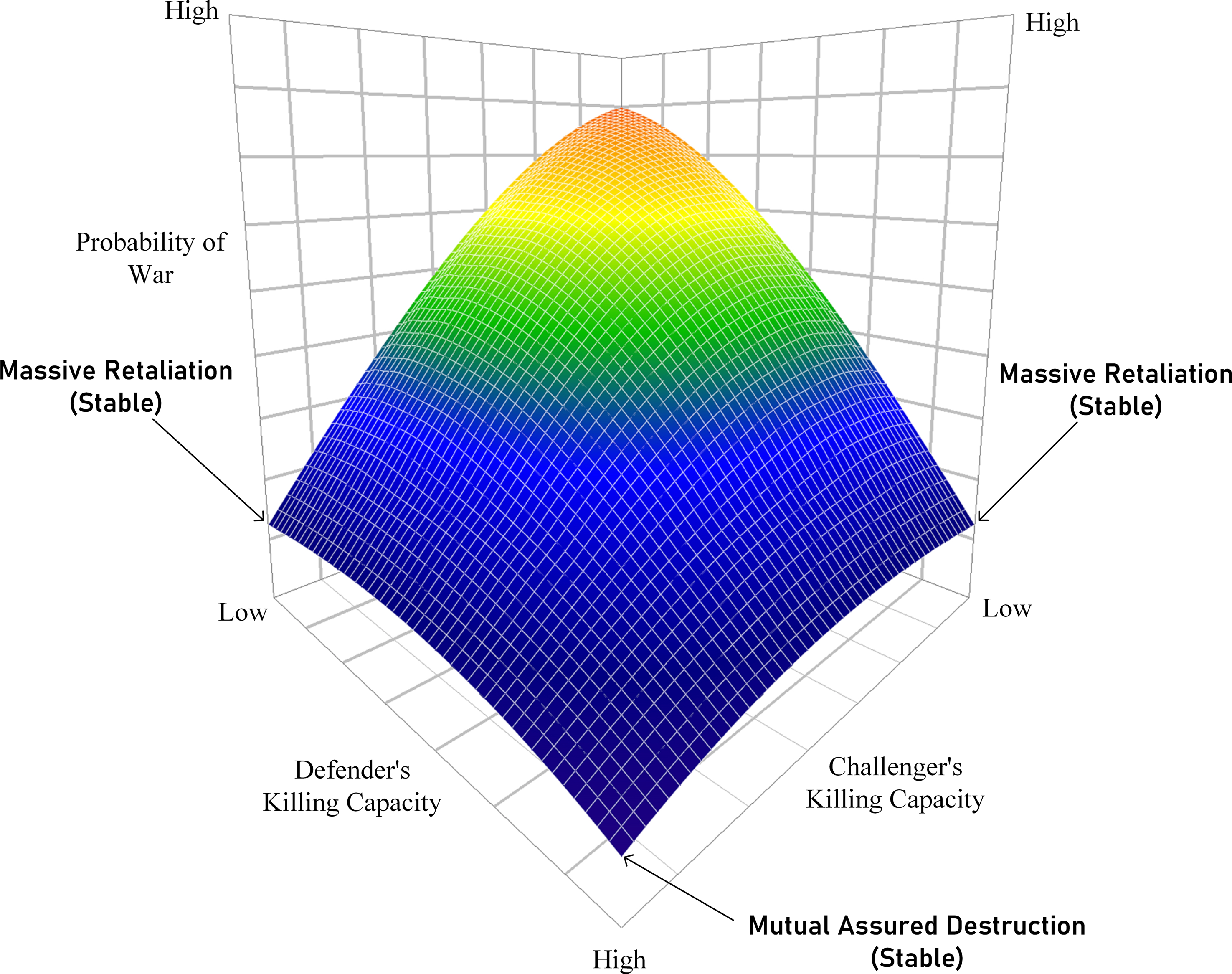
Brodie's deterrence posture.
Attempting to fulfill Einstein's challenge seeking “a substantially new manner of thinking”, Brodie's early deterrence scheme relied on the no-first-use commitment to secure peace. His argument assumes the altruistic self-constraint. The initiation of nuclear war does not serve any legitimate purpose under any circumstances. Logically, if all nuclear powers prohibit the use of nuclear weapons, even when faced with a conventional loss, deterrence would not fail.
Classical deterrence and mutual assured destruction
Early strategists accepted the idea of deterrence solely relying on the US nuclear preponderance, but their support eventually became lukewarm as Soviet nuclear strength expanded. Responding to this pressure, MR implementation was widely criticized in the United States by disarmament advocates. 1 After Sputnik 1 was successfully launched in October 1957, future President Kennedy argued that the Soviet Union was overtaking the weapon production capacity of the United States, leading to grave concerns about “Missile Gaps”. Fears of a Soviet missile attack became exacerbated, as Wohlstetter (1959) famously articulated the possibility of a devastating surprise attack by the Soviets, after which MR by the United States would be impossible or inconsequential.
As strategic nuclear weapons have proliferated, deterrence under MR is no longer viable but emerges only under the condition of MAD. In addition to long-range bombers, intercontinental ballistic missiles and submarine-launched ballistic missiles moved into full production in the 1960s. The United States’ and the Soviet Union's nuclear weapons exceeded global overkill capacity, while Britain, France and China followed with regional overkill capacity.
Classical deterrence theorists could now discard Brodie's assumption of “altruism” and extend prevalent realist theory to deterrence settings that met two necessary conditions for strategic stability: balance of nuclear capability and the terror of massive reciprocal attacks. 2 Snyder (1965) suggested that the very idea of “balance” that the introduction of nuclear weapons “has not terminated but only modified the balance of power process” (p. 186). This idea is extended to the deterrence settings by Waltz (1981), who makes the clear distinction between nuclear and conventional wars concerning their costs. Since any war objective should be commensurate with its cost, the proliferation of nuclear weapons will enhance nuclear stability by making the cost of wars prohibitive. This view has been widely accepted by advocates of classical deterrence, arguing that more bombs make us safer (e.g. Berkowitz, 1985; Bueno de Mesquita and Riker, 1982; Intriligator and Brito, 1981, 1984; Rosen, 1977; Waltz, 1981, 1993, 2003). The conditions for deterrence stability are now restricted to nuclear nations that hold MAD, but MR is unstable. 3
Figure 2 summarizes the theoretical prediction of classical deterrence. The U-shaped valley implies that balance of power reduces the likelihood of conflict, but conventional balances cannot fully secure peace because the costs are “acceptable”. 4 Before achieving a sufficient level of destructive capability to render the first strike advantage impossible—the condition labeled “the delicate balance of terror” (Wohlstetter, 1959)—nuclear war is likely. War can be avoided only under MAD, where a nuclear exchange between equally capable countries is “unacceptable” without effective damage limitation. 5 In contrast, MR is not a stable condition because nuclear-superior countries can escalate a conventional conflict to a strategic nuclear use when their core interests are threatened. The commitment to no-first-use is now contingent on a mutual second-strike capability, not moral or altruistic motives.
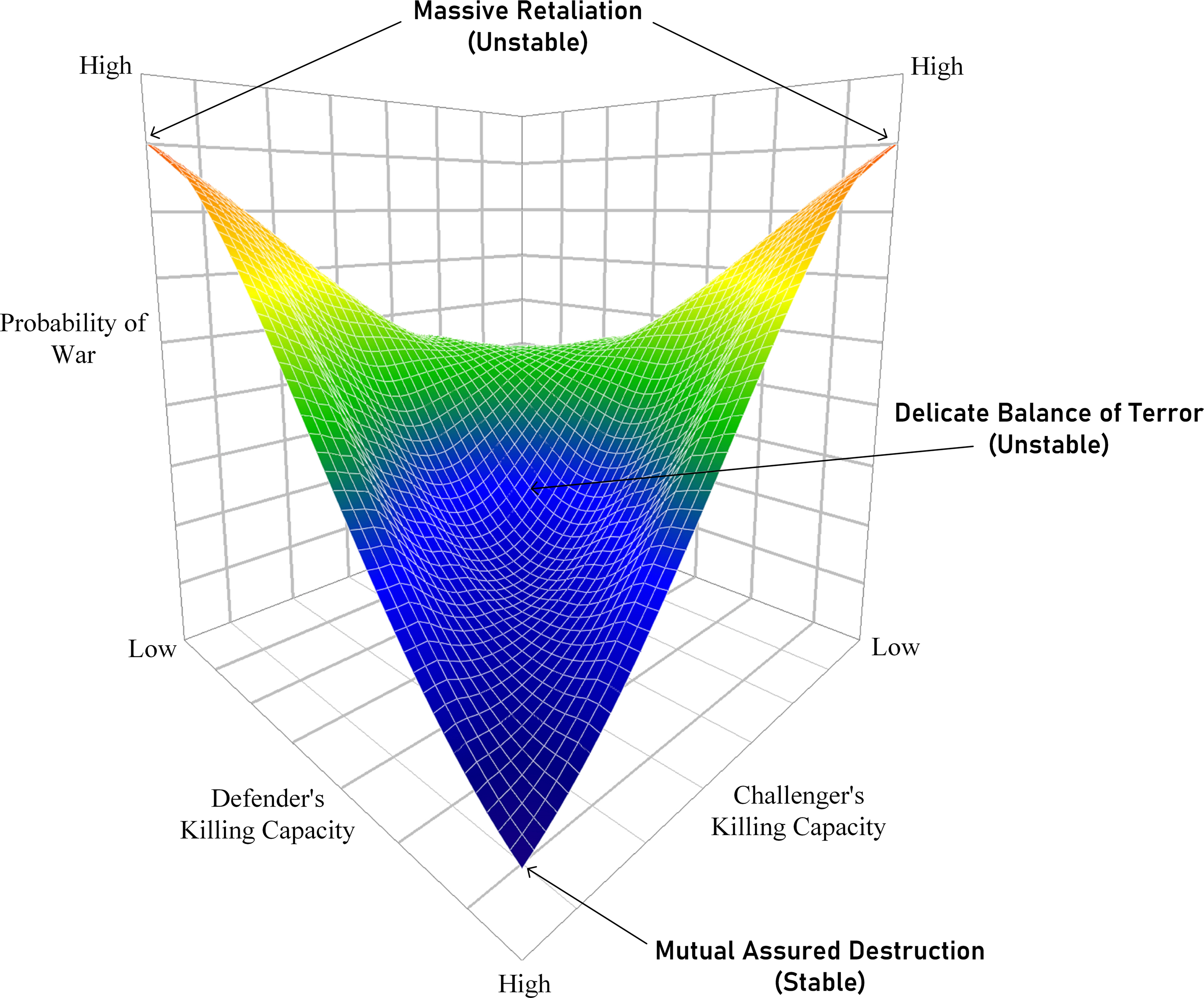
Deterrence under mutual assured destruction.
The MAD policy of classic deterrence was widely supported among superpowers. Policy experts no longer needed to worry about running the risk of nuclear war (Dyson, 1984: 249). Deterrence under MAD excludes a possibility of “intentional” nuclear exchange since there would be no premium attached to launching a nuclear strike. Accordingly, an impressive number of classical deterrence theorists welcome the spread of nuclear weapons, contending “the more horrible the prospect of war, the less likely it is to occur” (Mearsheimer, 1990: 19), and “the probability of major war among states having nuclear weapons approaches zero” (Waltz, 1988: 627).
This logic of classic deterrence continues to be advocated in both global and regional contexts. Addressing the challenge of proliferation explicitly in the Middle East, Waltz (2012) proposed that Iran should be allowed—even assisted—to have nuclear weapons to achieve a regional nuclear balance with Israel. 6 Under a regional MAD in the Middle East and North Africa, Waltz argues that all competitors would restrain their behavior and ensure a similar level of stability to that observed during the Cold War.
One non-obvious deduction from the proliferation optimism of classical deterrence is that nuclear weapons will only benefit nations that achieve MAD at the global or regional level. Non-nuclear nations are at the mercy of nuclear powers. Despite such arguments, however, surprisingly few nations capable of deploying nuclear warheads have chosen to do so. While both the United States and the Soviet Union tacitly encouraged or supported their selected allies—Britain, France, China or Israel—to acquire nuclear weapons, none of them achieved the level of capabilities required for global MAD. Further, undermining the classical deterrence postulates, nuclear powers seek to prevent proliferation and press non-nuclear societies to join the non-proliferation agreements. Most importantly, a rejection of deterrence logic is embedded in the nuclear nations' support for the voluntary denuclearization of South Africa or that of Belarus, Ukraine and Kazakhstan after the collapse of the Soviet Union. All these nations dismantled their nuclear warheads, bypassing the opportunity to maintain regional MAD or, in the case of South Africa, MR. If nuclear deterrence guarantees ultra-stability, why encourage third parties to abandon a path to peace? Finally, the United States has persistently been pursuing Anti-Ballistic Missile programs in violation of the MAD seeking to approach MR. The inconsistency between classical deterrence advocating proliferation and the actual policy choice of national leaders is profound. Warhead deployment dynamics have kept changing and have painted a dramatically different picture from the one proposed by classical deterrence.
Power transition deterrence and tenuous stability
Organski (1968) shows that the cost of war matters for national leaders on the brink of war, but commitment to the status quo equally matters. Organski contends that nuclear weapons increase the cost of wars but cannot prevent the escalation of conventional to nuclear war under all conditions. Supporting this argument, empirical deterrence studies found that the characteristics of military disputes and settlements have not changed with the advent of nuclear weapons (e.g. George and Smoke, 1974; Huth and Russett, 1984, 1990; Kugler, 1984; Organski and Kugler, 1980). Further, Kugler and Zagare (1987) and Zagare and Kilgour (1993, 2000) offer decision-theoretic models that systematically reevaluate the underlying assumptions and major policy implications of deterrence theory and show that when credible retaliation is questioned, MAD fails. Extending those ideas, we formulate a model of deterrence using an analytical extension of power transition theory that explicitly evaluates relevant and crucial concepts often overlooked in the stability assessment of previous deterrence literature.
To examine the conditions of deterrence failure, we model deterrence as a strategic risk-taking process. Since decision-makers hope to attain the best ex-post result, they consider their ex-ante position as a trade-off between the anticipated benefit of choosing war and the risk-adjusted likelihood that the actual outcome will be better or worse than anticipated. Along with the previous power transition-based explorations, our model is concerned with the possibility of intentional nuclear attack by rational actors.
Key assumptions
The following assumptions are used to build our perspectives:
Assumption 1—the propensity to take risks should vary with different decision-makers (Bueno de Mesquita, 1981; Kugler and Zagare, 1987; Zagare and Kilgour, 1993, 2000). Assumption 2—all conflicts are of graduated intensity, and their scopes are proportionate to the political objectives under dispute (Morgan, 1994; Morrow, 1985). Assumption 3—the level of risk generated during the crisis is in keeping with what the disputant desired (Rapoport 1964; Trachtenberg, 2000).
We provide extensive justifications why those assumptions are required in deterrence with derivations and proofs in Online Appendices A1–A3. Below we summarize important implications. First, we argue that the disputant's risk propensity works as an analytical channel in which political dissatisfaction enters the calculus of war (e.g. Achen and Snidal, 1989; Bueno de Mesquita, 1981; Kugler and Zagare, 1987). Yet, besides a few exceptions (e.g. Dacey, 2003; Goemans and Fey, 2009), degrees of risk propensities are almost invariantly taken as given or exogenous in most formal approaches without serious consideration regarding what determines their level. In our model, political dissatisfaction can induce the risk-taking preference of the disputant who perceives a risky confrontation as an opportunity rather than a danger.
An important issue raised here is that decision-makers are not all equally risk averse, and such dissimilarities should be addressed for stability assessment for nuclear deterrence. We fundamentally challenge, for example, classical deterrence's rigid assumption that decision-makers have “zero” risk tolerance (e.g. Kugler, 1984; Kugler and Zagare, 1987; Zagare and Kilgour, 2000). If that is true, historical events such as the World Wars and 9/11 should be considered “error terms” or episodes of pathological “craziness”. In contrast, in our view, political leadership is at times willing to bear the risk of war even when expecting high costs. Extreme risk-takers—like Hitler, Mao Zedong or Bin Laden—seemingly viewed war as a reasonable means to challenge the status quo given their resources. A relevant observation for deterrence found in the historical analysis of Dyson (1984) thoughtfully described the fundamental difference between US and Russian ways of strategic thinking during the Cold War: American nuclear strategists consistently demanded strategic certainty by emphasizing assurance, whereas Soviet strategists accepted uncertainty and risk as inherent in the nature of war. 7
Second, classical deterrence depicts the nuclear-armed states confronting the stark binary choice between fighting a full-scale war and surrendering. In contrast, our specification allows for the possibility that nuclear war may be waged ranging in intensity from limited to total. Each side would choose the intensity they assess to be most advantageous. Policymakers seem to have adopted this view. History shows that tactical warheads were first introduced into the NATO inventory during the 1950s under MAD and increasingly integrated with general-purpose forces. Early military strategists (e.g. Drell and von Hippel, 1976; Halperin, 1963) recognized that, while MAD was the dominant deterrence strategy, nuclear weapons could provide a broad spectrum of warfighting strategies ranging from tactical applications to limited regional uses and even to global employments. 8 In these works, nuclear war is not excluded.
Third, when war outcomes occur on continuous scale, we assume that the war planners deliberately opt for the desired war intensities they wish to employ. Political aims and military constraints rather than accidents or chances guide such choices. Note that the advancement and proliferation of offensive and defensive weapon technology allow a would-be initiator to afford greater control over the possible escalation of conflict. Therefore, from the perspective of rational decision-makers, the outbreak of nuclear war is envisaged in the form of calculated risk. Intuitively, the dissatisfied and risk-acceptant belligerent would willingly accept an aggressive and more risky war operational plan—including the use of nuclear force—leading to a high-intensity “boom-and-bust” outcome in pursuit of a more decisive victory. In this sense, we depict the military strategists not as helpless victims of autonomous risk (Powell, 1987) but rather as rational oddsmakers who do the best of a bad job at coordinating their military potential with political objectives (Weigley, 1991).
Eliminating those assumptions would reduce policy options to two ideal nuclear strategies: complete disarmament or the retention of only pure strategic weapons coupled with countervalue targeting. The equivalent implication can be traced to the missile war model of Intriligator and Brito (1984: 69), who assume that the optimal nuclear strategy is “firing missiles at either zero or the maximum rate”. Indeed, the former constitutes a core policy of MAD to maintain mutual vulnerability via the apocalyptic threat to wholly vulnerable civilian populations. Yet today, nuclear countries endorse alternative defense planning for the selective and controlled employment of nuclear weapons, which undermines existing arms control agreements. 9 There is a real-time concern about whether or not tactical weapons will play a part in Ukraine. We build our perspective with more realistic assumptions to reflect the current trend.
The model
The major strength of decision-theoretic deterrence models is that they provide an analytical description of what military planners could do. Most importantly, such models can serve as an approximation of what policymakers will encounter without the need for making actual observations. We instantiate our three assumptions described above within a war escalation game to identify a set of the significant sequential problems that the disputants should confront in a potential nuclear crisis. Our emphasis on the risk preference (i.e. status quo evaluation) and warfighting capabilities (i.e. relative strengths and intensity of warfare) provides a common basis for comparing the contrasting perspectives of classical and power transition deterrence.
We construct the model of escalation as illustrated in Figure 3 to consider two disputants, A and B, who represent a challenger and a defender, respectively. Once the crisis begins, the disputants can decide whether to settle their dispute through win–loss negotiation or escalate the crisis. They bargain prior to the war and, if they cannot settle non-militarily, they establish final positions to advance in crisis. A would-be challenger chooses to either back down from its original pledge or initiate military action. War is likely when the challenger has an optimistic expectation about the outcome, composed of the direct costs and benefits of conducting war and the indirect costs and benefits from the interplay of uncertainty and the challenger's risk propensity. In developing the model, we assume that all characteristics of the game and payoffs are observable to both disputants. For example, the disputants have shared information on their warfighting capabilities, establishing conditions of MAD or MR, as well as their evaluation of the status quo. This setup allows us to narrow down the possible conditions of deterrence failure to only those identified by power and dissatisfaction. The specification is as follows:
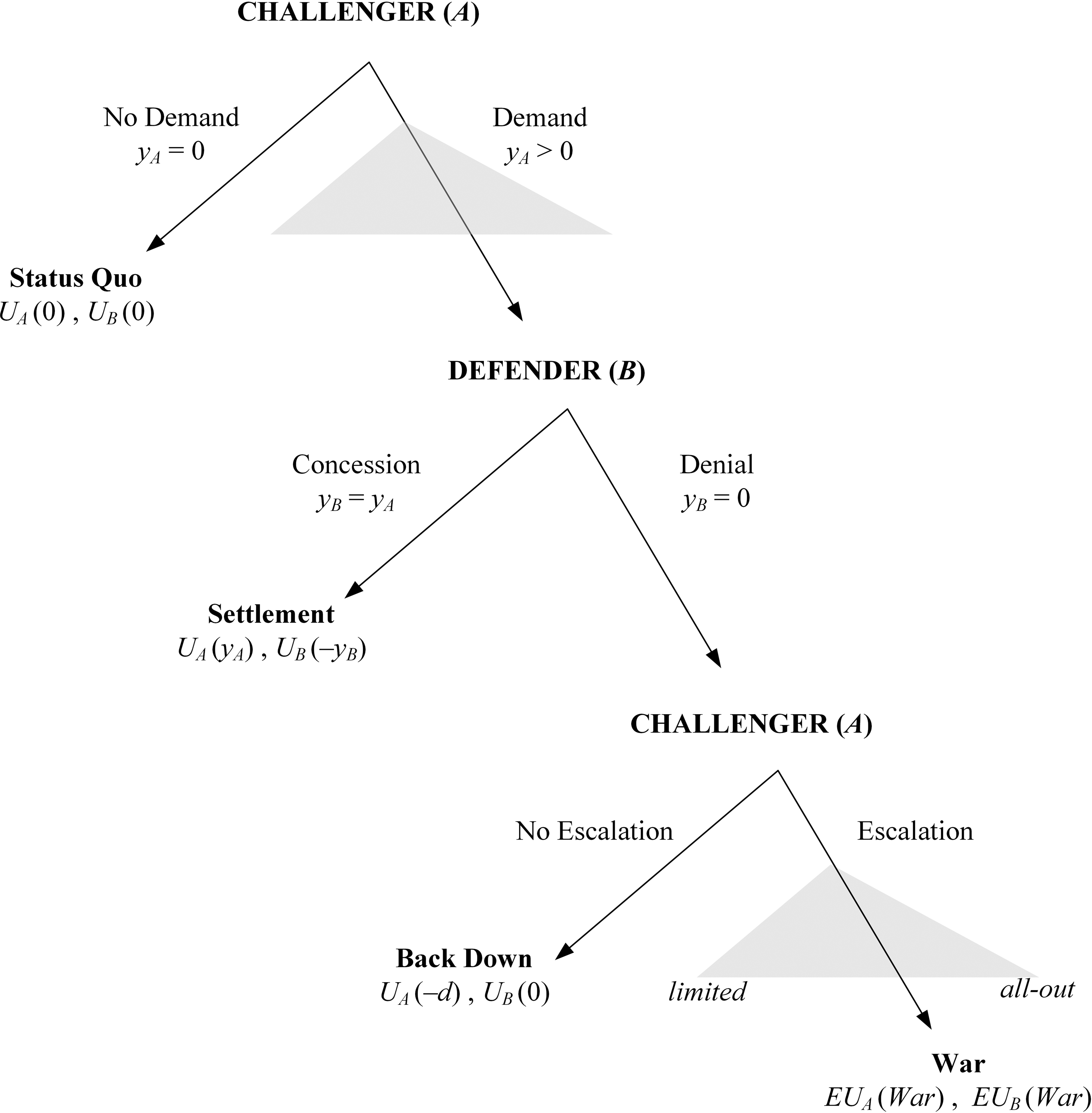
War escalation game.
Stage 1—challenger A decides whether to provoke a crisis by making a political demand (yA >0). If the challenger does not make a demand (yA =0), deterrence is stable as the status quo remains unchanged.
Stage 2—observing the positive amount of the challenger's demand (yA >0), defender B either accepts or rejects the challenger's demand. If the demand is accepted, the challenger's utility increases to UA (yA), and the defender's utility decreases to UB (–yB). If the demand is rejected, the bargaining impasse occurs, and the dispute escalates to the next stage.
Stage 3—after the defender's denial takes place, the challenger decides whether to go to war or back down from the crisis. The backdown is risk-free, but the challenger will be “dishonored” and required to make a non-negative payment (d ≥ 0) as an exit fee. If the challenger is willing to fight, the dispute will be escalated to the war of the challenger's desired level of intensity, from limited war to all-out exchange. Given military opportunities and constraints, both sides reciprocate with their military forces to determine the award of war, maximizing their subjective expected utility over the range of possible outcomes:

Equilibrium analysis
Using the setup with the payoff structure in Figure 3, we proceed to identify the disputants’ potential strategies as a subgame perfect Nash equilibrium solution. To determine the optimal strategies in the negotiation process, we first consider the final node of war. Each disputant knows the types of utility functions the opponent has and pursues their optimal bargaining strategy given the knowledge. The process continues backward until the challenger starts considering the possible provocation to upset the status quo. We explore the conditions under which war can occur on the equilibrium path.
Stage 3—observing the defender's denial, the challenger chooses to attack or back down. To determine the optimal choice for disputants, we calculate their certainty equivalent of war (xCE), that is, the settlement offer that leaves the disputants indifferent between settling and going to war. By definition, xCE satisfies Eqn (2):


Eqn (3) also shows that the intensity of war is directly linked to the range of stakes depending on what the challenger desires to obtain and how much risk he can take. 10 Intuitively, the difference between the expected war award (R) and the certainty equivalent of war (xCE) increases in the riskiness of war (V). Holding other factors constant, the risk-accepting disputant would choose a higher intensity war of strategy with the greater V to maximize xCE.
Stage 2—in the shadow of conflict, the demand-concession decisions are based on comparing “propensity to fight” characterized by each disputant's certainty equivalent value of war (Crawford, 1982). Consider first the defender's choice, who expects the challenger to conduct a war without backing down and so interprets the challenger's demand as a non-empty threat.
11
The defender is willing to make a settlement offer y to make the negotiation worthwhile. The defender wants to minimize the expected payout and thus will not make an offer (yB) more than the defender's certainty equivalent of war (


Stage 1—for the challenger's military threat to be effective, the challenger should have a sufficient level of warfighting capabilities and willingness to take a risk for war, making the challenger's certainty equivalent of war greater than zero.
13
Otherwise, the defender will not respond to the challenger's provocation because the defender expects that the challenger will not initiate a military conflict, which will lead to the challenger's backdown.
14
The challenger will start a crisis by making a demand (


Implications of power transition deterrence
Figure 4 examines a crucial case where contenders do not trust each other while the challenger is risk-acceptant and dissatisfied. Consistent with the historical records of major wars, the rare condition of nuclear and conventional parity is associated with war, not peace. We preserve the format previously applied to summarize deterrence implications to facilitate the comparison among different views.
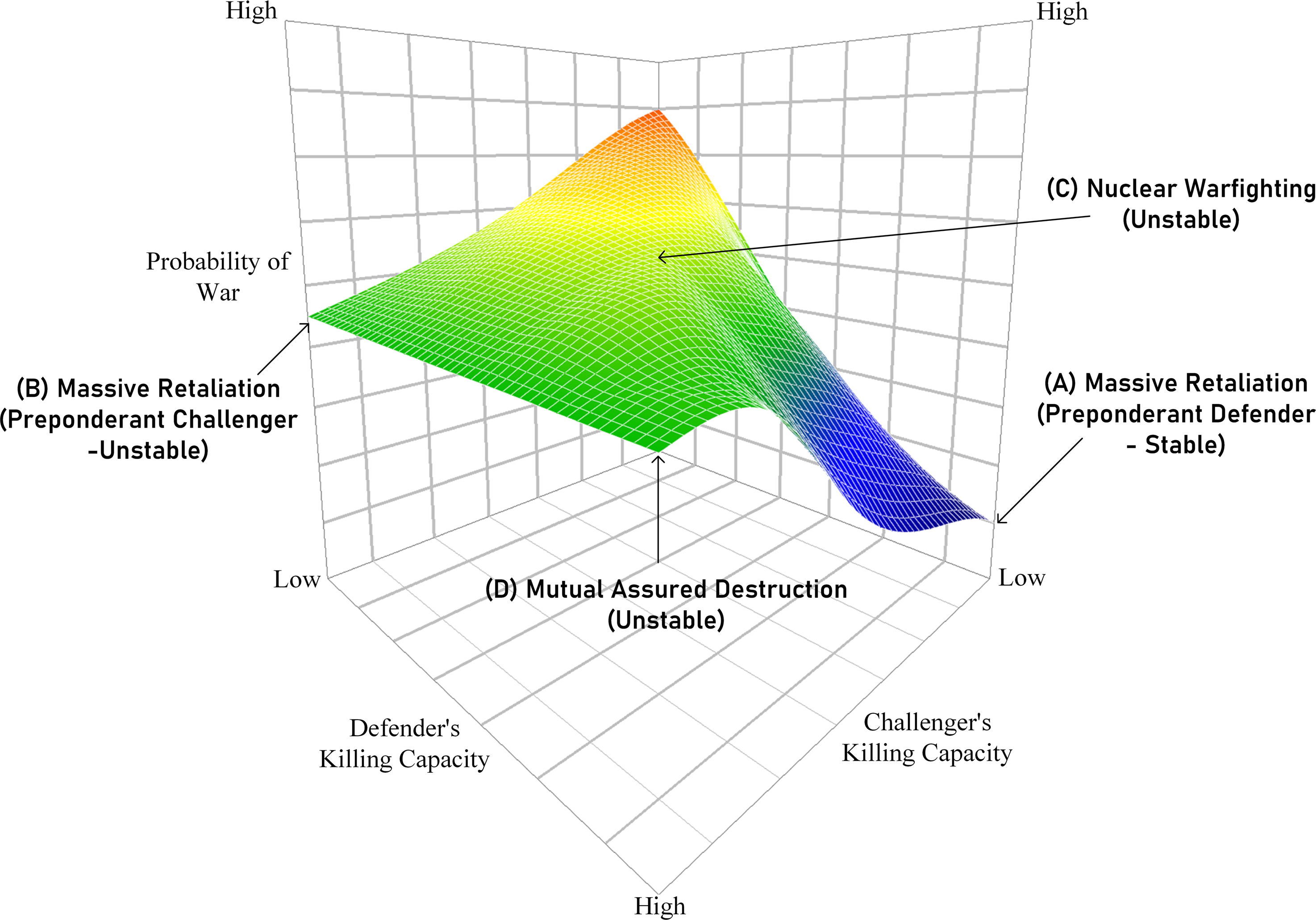
Power transition deterrence.
The key predictions for the stability of deterrence from the power transition perspective differ radically from previous models of deterrence. Based on our game-theoretical analysis above, we locate several important equilibrium outcomes on the surface of the figure and highlight their salient conditions in the context of deterrence. 15
Stable massive retaliation (area A)
Deterrence is stable when a dissatisfied risk-acceptant challenger is inferior in relative capabilities to the satisfied defender. The challenger adheres to the status quo and is unlikely to initiate a military crisis. The preponderant satisfied power does not wish to risk altering the established status quo. Historically, this condition produced the stable deterrence between the satisfied United States and the dissatisfied Soviet Union. The United States was always conventionally preponderant during the Cold War, while the Soviet Union was conventionally inferior but only achieved nuclear parity.
Unstable massive retaliation (area B)
Deterrence is unstable when a dissatisfied risk-acceptant challenger gains nuclear preponderance. Historically, this condition has not emerged yet between global or regional powers.
Nuclear warfighting (area C)
Deterrence becomes unstable when a dissatisfied risk-acceptant challenger approaches power parity and is technologically capable of nuclear warfighting with anticipated bearable cost. Unlike classical deterrence, the power transition perspective anticipates that the potential for a nuclear war between a dissatisfied nuclear Iran and Israel is real, given the level of mutual dissatisfaction and the relatively lower levels of nuclear capabilities required to destroy both societies.
Mutual assured destruction (area D)
Deterrence becomes tenuous when the two great powers approach nuclear and conventional parity. The military conflict can start with a tactical nuclear strike but can lead to the use of strategic nuclear weapons. Although the challenger and the defender may share an interest in limiting their uses of nuclear capabilities, there is a possibility of expansion and escalation to all-out war. This is likely to be the case when the losing side in a limited conflict becomes motivated to fight a higher-intensity war to compensate for the regional defeat. For example, as the conventional capabilities of China keep rising and its nuclear arsenal approaches parity with that of the United States, our model expects that the probability of major nuclear war would increase rather than decline as classical deterrence postulates. The deployment of effective damage limitation technologies that aim to reduce the costs of war—like the anti-ballistic missile defense systems—will increase the stability of deterrence only when held by satisfied nations. In contrast, if acquired by dissatisfied nations, they will reduce stability. Anti-ballistic missile strategies will be counterproductive in the long-term because they trigger another arms competition, accelerating technological development for offensive weapons and the further buildup of nuclear arsenals.
Comparing the stability of deterrence strategies
In Figure 5, as proliferation expands nuclear capabilities, the dotted line displays the theoretical prediction of classical deterrence, and the solid line shows the implication of power transition deterrence. 16 The vertical axis reflects anticipated levels of deterrence stability, and the horizontal axis summarizes the implications of variations in nuclear capabilities. Nuclear proliferation is the primary factor that generates new opportunities for stable and unstable deterrence.
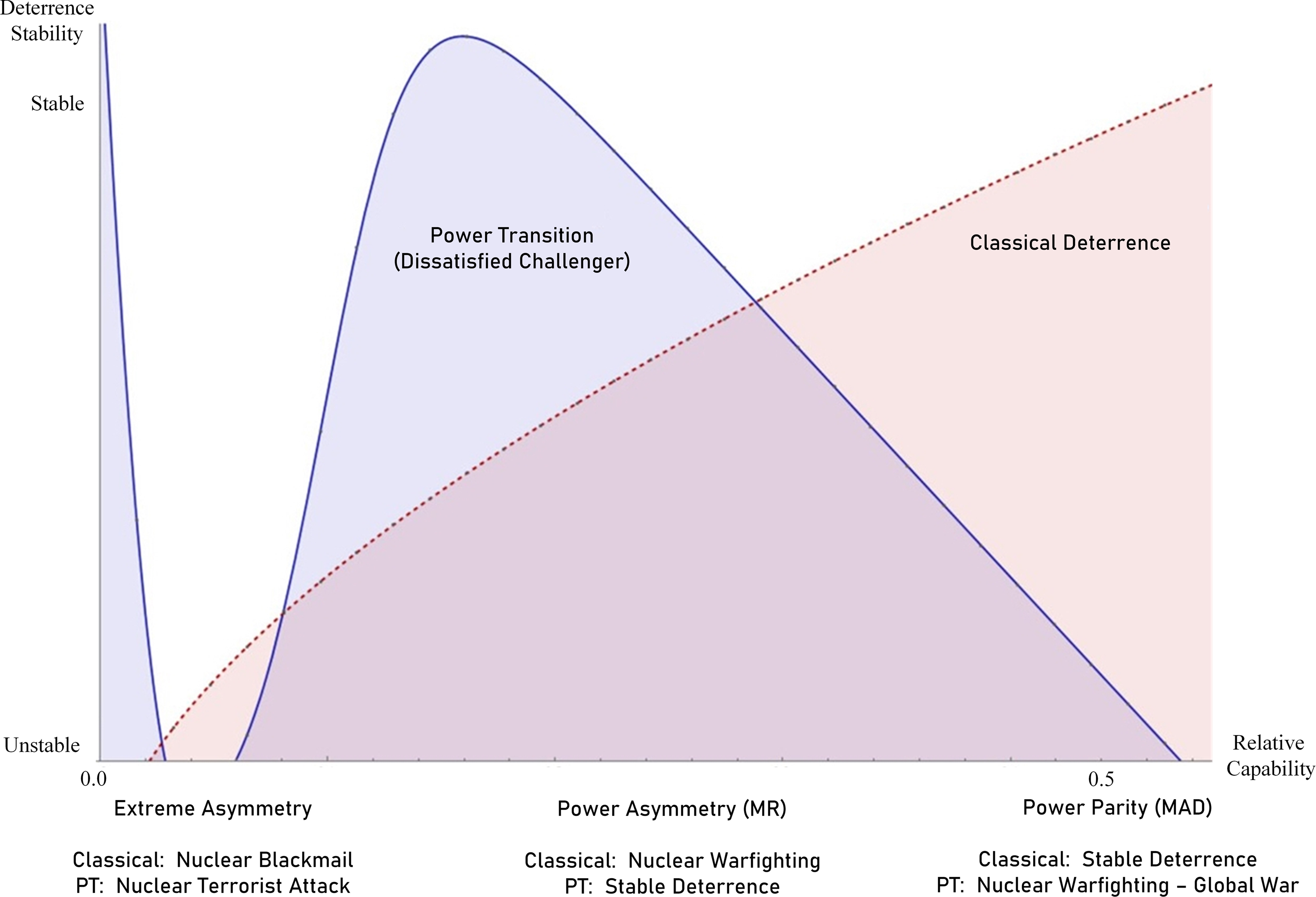
Contrasting assessments on nuclear proliferation.
First, consider one more time classical deterrence arguments that balanced nuclear arsenals ensure peace. The search for MAD (in Figure 2) implies that proliferating nuclear weapons and achieving MAD prevents nuclear war. Following the balance of terror logic, the more horrible the prospect of war is, the less likely it is that it will occur. The lethality of conflict can escalate rapidly if only one nation holds MR. The preemptive use of strategic weapons under MR is likely when a nuclear power uses a preemptive strike to thwart a serious conventional threat—as is the case between Israel and Arab nations. Only MAD ensures stable deterrence. Classical deterrence concludes that persistent terror is the price of peace in the nuclear era. This argument is reflected in the “deterrence/proliferation optimism” during the Cold War and continues to be advanced (Kroenig, 2015).
Despite the popularity of this perspective, it is perplexing that the actual strategic decisions of policymakers are inconsistent with the fundamental tenet of classical deterrence. If the advantage of MAD were fully recognized, then the deployment of tactical nuclear warheads or anti-ballistic missile systems would not proceed. Thus, if a nuclear threat ensures peace, Israel should follow Waltz’s (2012) advice and welcome Iran's nuclear capabilities seeking to achieve MAD. They do not. We now know that all nuclear powers have chosen to prevent proliferation and add defensive and tactical weapons to their arsenals. The viability of classical nuclear deterrence is clearly challenged.
Power transition deterrence acknowledges that high costs diminish the likelihood of war but proposes that nuclear weapons do not guarantee stability. Power transition theory challenges both the stability of nuclear parity and the viability of nuclear deterrence under proliferation. Power transition deterrence proposes that MR held by a preponderant satisfied nuclear power ensures peace, as shown in the case of the United States in the years immediately after the Second World War. Indeed, after the collapse of the Soviet Union along with the Warsaw pact, the United States once more emerged as a single global superpower, and did not act. Long-term, stable nuclear deterrence is in question. 17
The critical difference between the classic and power transition perspective is nuclear stability under MAD. In this critical dimension, the deductions of two different deterrence theories are fundamentally at odds. According to power transition theory, the balance of terror opens the windows of opportunity for dissatisfied contenders to challenge existing norms rather than preserve stability. Nuclear weapons make a dissatisfied challenger perceive a risk confrontation as an “opportunity” rather than a “danger”. During the Cold War, strategic stability was backed by the conventional preponderance of NATO. However, a confrontation with a new dissatisfied, conventionally and nuclear contender at parity likely set the preconditions for global war. Nuclear MAD does not guarantee that peace will be preserved as the distribution of conventional capabilities changes. Instead, a large nuclear arsenal can allow a dissatisfied challenger to escalate a conventional conflict to an all-out war even when a potential nuclear exchange looms large. Theoretically, after the once-mighty Soviet Union collapsed, the missed opportunity was great without building a preponderant nuclear coalition of the United States, Russia, Britain, France and China. Today, as we know, core disputes with China over the China Sea and Taiwan suggest interactions where deterrence is tenuous. Without a political accommodation that leads to mutual satisfaction, the current trend in China's nuclear buildups and weapons technology improvements suggests that we may face challenges to global nuclear peace in the long term. Similar conditions in disputed regions like the Middle East and future Sub-Saharan Africa suggest possible replications of conventional and nuclear parity at the regional level, implying the possibility of future regional nuclear exchanges.
The final and most perverse challenge to nuclear stability will emerge when or if non-state challengers acquire limited nuclear capabilities. While such actors are too small and weak to conduct conventional regular warfare, they maintain no fixed locality and are not exposed to retaliation from preponderant state defenders. Deterrence cannot address conflict without a viable retaliation option. Preventing such threats would be extremely challenging because the punishment required for deterrence is not feasible when the source of strikes and perpetrators cannot be effectively located and attributed. Although the destructive power of a terrorist attack is limited, a low-yield nuclear weapon or a radiological dispersion “dirty-bomb” device would be sufficient to disrupt any modern society. The incentive to use such a weapon is deep and immense. Thus, with minimal nuclear or weapons of mass destruction proliferation, a “terrorist” challenger such as Al-Qaeda likely initiates a risky attack taking advantage of their limited exposure to retaliation. None of the deterrence proposals explored in this work address this contingency.
Conclusion
Classical deterrence theories argue that states will not intentionally seek to fight a nuclear war. We disagree. Nuclear initiation is rational. As Zagare (2004:116) correctly put, in classical deterrence, “the only way to explain the remarkable stability … is to assume that the players are at once rational or irrational”. In our view, rational actors have a reason for what they do. They have motivations and strive to respond to them with available resources. The choice of a particular warfighting doctrine—choices between local and central war—should be a product of the calculated strategic process regarding different combinations of military options (Halperin, 1963). We accept Rosecrance’s (1966) observation that the nuclear force is a synthesis of the physical capability and the incentives to use it. There is no reason to view nuclear escalation as the process of unleashing “autonomous” risk (Powell, 1987). Rather, nuclear war is a calculated decision seeking to attain policy goals that may require the use of nuclear weapons. One important implication of the model developed here is that the fragility of nuclear deterrence is characterized without having to appeal to the common but yet indeterminate contention over whether nuclear war will occur only in an inadvertent or accidental manner. As Zagare and Kilgour (2000) rightly observed, “nuclear war has been avoided not because of nuclear weapons, but in spite of them” (p. 25).
Our analysis of deterrence shows that policymakers consider nuclear war as an extreme but rational option. Indeed, contrary to arguments advanced by Brodie in the early statement of deterrence, nuclear nations are not committed to a no-first-use option. Reversing the tenets of classical deterrence, great powers seek nuclear superiority rather than balanced capability. They continue to deploy tactical nuclear weapons designed for warfighting as well as anti-ballistic missile systems that can, if successful, minimize losses and even reimpose nuclear preponderance among balanced nuclear contenders. Gorbachev's 1986 Reykjavik proposal for drastic reductions of nuclear arsenals was rejected by Reagan, who wanted to preserve the Strategic Defense Initiative “Star Wars” program that promised preponderance for the United States.
The power transition deterrence perspective we propose indicates that while the costs of war have exponentially increased in the nuclear era, a valid grand strategy that promotes the long-term stability of deterrence should be informed by our historical observations empirically—the rare events of power parity between great powers were associated with wars, not peace. Simultaneous parity condition of conventional and nuclear capabilities was never met during the Cold War. However, for the first time in the nuclear era, two global contenders—the United States and China—are now approaching conventional and nuclear parity. In both China and the United States, policymakers correctly see such developments with caution, reserve or fear.
In sum, power transition deterrence suggests that doing nothing will eventually lead to war. Proliferation alters the likelihood of nuclear stability, but the direction depends on politics, not the cost of war. The task of sustaining stability and even maintaining the international order can be achieved only by the collective effort of satisfied great powers seeking the preservation of the nuclear preponderance. No proposal or set of actions by a single state is likely to ensure stability; rather, a host of actions from many actors in concert is required. The specter of increasing regional nuclear conflicts is unfortunately alive and well.
Postscript (amid the Russia–Ukraine war)
This paper was completed before Russia's invasion of Ukraine. As a response to reviewers’ supportive suggestions, we add this postscript to describe what our model tells about the ongoing war: the danger of a tactical nuclear strike in Ukraine is real. National decision-makers choose war as an attempt to coordinate their military influence with political objectives. The likelihood and magnitude of a nuclear strike directly depend on what is at stake rather than the vagaries of humans or other beings. The war in Ukraine has disclosed that Russia is now a second-tier power unable to impose its objectives in eastern Europe with conventional force. Given the prolonged conventional defeat, we anticipate that Putin may well fight what Halperin called a “local” nuclear war in which the stakes would be the annexation of the contested regions. Russia's threat of using a tactical nuclear weapon is not empty, but this regional crisis fails to meet the structural preconditions for escalation to a massive nuclear exchange. It is not an existential war fought by superpower rivalry. If any person has influence over Putin, it is Chinese President Xi. An essential lesson from Ukraine is that global nuclear stability can be guaranteed only by the joint effort of two global powers. The United States and China can reduce confrontation postures and work toward establishing a partnership that deters a nuclear first strike and resets a new global status quo. A failure of such coordination at the top of the international hierarchy, triggered by the crisis over Taiwan, can rekindle a new Cold War, which this time points to the real risk of “Armageddon”.
Supplemental Material
sj-docx-1-cmp-10.1177_07388942221149670 - Supplemental material for Beyond deterrence: Uncertain stability in the nuclear era
Supplemental material, sj-docx-1-cmp-10.1177_07388942221149670 for Beyond deterrence: Uncertain stability in the nuclear era by Kyungkook Kang and Jacek Kugler in Conflict Management and Peace Science
Footnotes
Acknowledgments
The authors thank participants in the 2021 University at Buffalo conference honoring Frank Zagare, anonymous referees, and the editor for helpful comments and suggestions. We are grateful to the TransResearch Consortium and the Decision Science Lab of Loma Linda University for their invaluable assistance and support.
Funding
The authors received no financial support for the research, authorship, and/or publication of this article.

Supplemental material
Notes
References
Supplementary Material
Please find the following supplemental material available below.
For Open Access articles published under a Creative Commons License, all supplemental material carries the same license as the article it is associated with.
For non-Open Access articles published, all supplemental material carries a non-exclusive license, and permission requests for re-use of supplemental material or any part of supplemental material shall be sent directly to the copyright owner as specified in the copyright notice associated with the article.
