



Abstract
This study examines how military background of chief executive officers (CEOs) of private military and security companies (PMSCs) that intervened in Iraq from 2003 to 2019 affected the frequency with which companies committed human rights abuses. My findings show that PMSCs with CEOs who served in the military, for any regime type, are more likely to commit a high number of human rights abuses than companies led by CEOs without service experience. The risk is higher for PMSCs with CEOs who served in the Navy and lowest for CEOs with experience in the Air Force. The risk increases when ex-military CEOs lead private rather than publicly traded companies. The study contributes novel data on military service of CEOs for international PMSCs that were present in Iraq. The data reports on the type of governing system where CEOs served, their service branch, and whether they graduated from military academies/colleges.
Introduction
Since the 1990s the global community has witnessed a growing presence of private military and security companies (PMSCs) in conflicts. In 2009, the peak year for private security contractors’ assistance in Iraq, over 15,000 contractors supported the efforts of the US Department of Defense (DoD) (Peters and Plagakis, 2019). The presence of contractors working for the DoD in Afghanistan peaked in 2012 at 28,000 (Congressional Research Services, 2021). Beyond Iraq and Afghanistan, contractors support the counterterrorism missions of the US Africa Command (AFRICOM) (Zalan and Freudenthal, 2020), and their services have expanded to include the strengthening of defensive cyber capabilities, the piloting of unmanned aerial vehicles and analysis of drone-gathered intelligence (Mahoney, 2020). The demand is increasing among states in Asia Pacific and those involved in the Ukraine War (Vantage Market Research, 2022).
Amid these developments, there are concerns about the ethical behavior of PMSCs in conflicts. As profit-oriented entities, private companies may maximize gain over civilian protection and engage in practices that cause harm. This study investigates conditions under which some PMSCs behave more ethically in a conflict zone than others. I examine how the military background of the chief executive officers (CEOs) of PMSCs that provided services in Iraq from 2003 to 2019 affected companies’ connection to human rights abuses. Given that 47% of CEOs in my data served in the military, exploring the significance of their experience with regard to company behavior merits attention.
Many clients of international PMSCs, defined as legally registered international corporate entities with a clear business structure that deliver military/security services for monetary compensation (Gomez del Prado, 2016; Singer, 2003), value PMSCs’ ethical behavior. For one, democracies are inclined to respect human rights and revelations of abuses by governments can carry political costs (Cordell, 2021). These governments are likely to work with international PMSCs rather than mercenaries owing to the former's reputation for greater accountability rooted in a business structure oriented toward long-term survival in a marketplace. Second, ethical behavior of PMSCs can impact military effectiveness. For example, Blackwater's Nisour Square shooting of civilians was utilized by Iraq's Shia leader al-Sadr as a propaganda and recruitment tool (Singer, 2007).
Considering this, national, international, and industry-driven initiatives have explored approaches to improving PMSCs’ ethical behavior. They have included emphasis on detailed contractual obligations (Dickinson, 2007) and governments’ request for ANSI/ASIS International or ISO certifications on risk assessment to show commitment to reducing abuses (ANSI/ASIS International, 2012). Many PMSCs have joined trade associations and have signed the International Code of Conduct for Private Security Service Providers (International Code of Conduct Association, 2010). The latter built upon the Montreux Document (International Committee of the Red Cross and Swiss FDFA, 2008), an international effort of governments, academics, NGOs and industry representatives that outlined practices for states to adopt to adhere to international humanitarian laws when working with PMSCs (International Committee of the Red Cross and Swiss FDFA, 2008).
My research contributes to the literature on PMSCs’ accountability by examining the overlooked aspect of the companies’ leadership, the CEOs’ background, and its impact on companies’ ethical behavior in conflicts. Presently, empirical studies consider the companies’ structure and its effect on commitment to human rights, anti-fraud practices, or the reduction of civilian casualties (Akcinaroglu and Radziszewski, 2020; Tkach, 2020a; Tkach, 2020b). Another work examines the impact of program managers who facilitated PMSCs’ activities on the level of civilian casualties (Tkach, 2020b), while the most recent empirical study analyzes the role of clients’ normative considerations and PMSCs’ connection to civilian victimization (Penel and Petersohn, 2022). Finally, a case study of two companies’ use of force in Iraq connects military culture to personnel behavior (Fitzsimmons, 2013).
I build on these studies by exploring whether PMSCs that intervened during the Iraq War were linked to a higher number of human rights abuses when they had a CEO with a military background. Cultivating values in the military is undertaken more systematically than in most civilian professions because unlike in civilian life, some of these values make a difference between life and death (Rose, 2017). Military values can thus impact the management style of CEOs with service experience and their companies’ connection to abuses. The literature in psychology finds that a military background is linked to aggressiveness, confidence, and risk taking (Elder et al., 1991; McManus et al., 2013, 2015), traits that could negatively affect the CEOs’ goals of exercising caution when company employees interact with civilians.
My findings show that PMSCs with CEOs who served in the military, for any regime type, are more likely to commit a high number of human rights abuses than companies led by CEOs without service experience. The risk is higher for PMSCs with CEOs who served in the Navy and lowest when CEOs were in the Air Force. The risk increases when ex-military CEOs lead private rather than publicly traded companies.
The study contributes novel data on military service of CEOs for international PMSCs that were present in Iraq. The data report on the type of governing system where CEOs served, their service branch, and whether they graduated from military academies/colleges. It offers a glimpse into the leaders’ background, which has implications for the policies that PMSCs embrace.
I begin with a discussion of existing findings on the variation in PMSCs’ ethical behavior in conflicts. I explore how CEOs’ military background could shape PMSCs’ commitment to human rights protection. Utilizing insights from new data, I discuss the connection between the leaders’ background and companies’ ethical behavior and conclude by highlighting the study's broader implications for improving PMSCs’ accountability in conflicts.
Ethical behavior: existing insights
Research that examines the variation in PMSCs’ impact on human rights abuses in conflicts is limited. Most recently, an empirical study by Penel and Petersohn (2022) that focuses on civilian victimization by contractors and the clients’ regulatory engagement shows that contracting by states involved in the Montreux process strengthens normative compliance and lowers the rate of victimization. Focusing on PMSCs’ corporate structure, Akcinaroglu and Radziszewski (2020) find that publicly traded PMSCs’ greater transparency and risks of reputational costs from possible scandals reduced the frequency of human rights abuses and fraud in Iraq. Lastly, Avant and Neu (2019) have a dataset on abuses committed by PMSCs, but their data do not cover Iraq, and have not been utilized in empirical analysis of abuses.
Related empirical research that explores the PMSC–civilian casualties link shows that company culture, ownership, and the role of program managers serving as points of contact between PMSCs and clients help explain variation in civilian violence. Studying Iraqi governorates, Tkach (2020a) demonstrates that PMSCs with closed ownership exacerbate information asymmetries, thereby reducing the client's ability to select companies based on information about performance. This creates an advantage for companies that increase violence yet do not suffer reputational costs from lower levels of transparency, resulting in more civilian violence.
Program managers also affect levels of civilian casualties in Iraq. To facilitate contract fulfillment, the DoD relied on substitute managers to ensure that the expected service met technical requirements (Tkach, 2020b). When contracting officers with military ranks managed PMSCs, there was a greater reduction in civilian casualties because of the officers’ prior managerial experience, technical knowledge, and networking capacity. However, reliance on enlisted military personnel with limited managerial experience increased levels of casualties (Tkach, 2020b).
Finally, a connection was made between PMSCs’ culture and civilian casualties. Fitzsimmons (2013) shows that a bellicose military culture emphasizes less restrained use of force and taking personal initiative when faced with insurgent threats. While these norms serve to help personnel protect themselves, they cause harm to non-threatening targets (Fitzsimmons, 2016). He notes that an embrace of bellicose norms by Blackwater, encouraged by the CEO's Navy special operations training, but not by DynCorp, explains variation in the number of people killed and injured. The cultural differences also accounted for the two companies’ divergent approach to issuing non-violent warnings, firing bullets at closer distance, and firing lower numbers of bullets. CEOs can shape company culture by developing documents on the rules for the use of force and requesting all personnel to read and sign them, requiring personnel to follow mandatory checklists before deciding to use force, and instructing company trainers to encourage specific types of behaviors when personnel participate in simulated tactical drills (Fitzsimmons, 2013).
My work builds on these studies. I delve into the military background of companies’ CEOs to examine how differences in military–civilian leadership impact PMSCs’ behavior. These include differences in the CEO’s past military branch service, exposure to ethics training as captured by graduation from military academy/college, and the differences between the types of states where service was completed. My insights come from new data on the CEOs of international PMSCs to expand our understanding of companies’ behavior in Iraq, 2003–2019.
CEOs’ military background and PMSCs’ human rights abuses
To explain variation in PMSCs’ commitment to human rights, I utilize Most and Starr's (1989) framework of opportunity and willingness, which they used to explain decisions about war. Opportunity is the environment that constrains or empowers; it captures the presence of possibilities. In the context of PMSCs, the opportunity to commit abuses consists of the conflict environment where a company operates, its corporate status, the degree of oversight, and the types of tasks performed. Willingness refers to the decision-maker's cost–benefit analysis reflected by conscious and unconscious factors (Most and Starr, 1989).
Company CEOs exercise significant influence over business and ethical development. They craft the company's approach to strategy and recruitment, reinvent practices and define company values (Farkas and Wetlaufer, 1996). Hospira, a hospital product manufacture, reinvented itself upon the arrival of new company leadership by creating a clear commitment statement or a roadmap for how to serve customers, and a value statement, which described how integrity would drive the company's ability to achieve its mission (Porrini et al., 2009). These mission statements were developed after the CEO's arrival, and the CEO communicated company values and practices through weekly contact with employees of all levels to reinforce commitment (Porrini et al., 2009). Sometimes, CEOs require employees to read and sign mission statements and work with managers to establish clear understanding of punishment for violating company values (Fitzsimmons, 2013). CEOs develop strong relationships with senior managers and grant them autonomy to implement the vision outlined in commitment statements to other employees (Fredberg et al., 2008).
Lastly, reflecting and admitting that something is not working has proven to be a vital role of CEOs in developing company practices and adjusting to the changing environment (Fredberg et al., 2008). Chris Kubasik, who took over as L3 Technologies’s CEO 1 in 2018, for example, played a critical role in eliminating layers of bureaucracy and rebranding the company's image through extensive use of innovation sprints or ideation sessions involving employees at various levels. These sessions, used on a scale and level of intensity previously unseen at the company, fostered a culture open to learning from mistakes and to embracing change (Weisberger, 2019).
While environmental factors (opportunity) impose limitations on the CEOs’ actions—for example, responding to competition in the market for force, PMSCs may adjust to providing services required by lucrative clients rather than freely select what they want to do—leaders are still able to shape some environmental opportunities and constraints depending on willingness. Belief systems, values, and experiences (Most and Starr, 1989) constitute the CEO's background and shape their willingness to make decisions. The literature on the impact of political leaders’ personal factors on choices in crises is vast (Schafer and Smith, 2020). Research on military background has shown that policy makers with prior military service were more likely to initiate militarized disputes and wars (Horowitz and Stam, 2014). Thus, focusing on the military background of CEOs of PMSCs is useful for understanding why some adopt stricter policies on civilian protection than others, therefore limiting possible risks generated by the environment (opportunity). Below, I explore several hypotheses about the relationship between the CEO's background and the PMSC's commitment to human rights protection.
With its goal of ensuring state survival, the military is a unique institution that functions by fostering specific values with implications for honoring human rights. Values are more strongly cultivated in the military than they are among civilians because of the frequent processes of socialization focused on teamwork, training, exercises and bonding that also come with combat experience. Dalenberg and op den Buijs (2013) note that in the US and Dutch armies, women and men underwent a profound change in a period of a few months, a transformation that took their parents a decade to achieve. Military experience, even without combat engagement, has a lasting impact on individuals’ perceptions of the world when they return to civilian life (Jackson et al., 2012).
Studies in psychology have shown that military service cultivates confidence, aggressiveness, and risk-taking in the US and UK (e.g. Elder et al., 1991; McManus et al., 2013; McManus et al., 2015). These values are formed during training for combat, through indoctrination into a masculine culture (Siminski et al., 2013), and strengthened through exposure to combat (McManus et al., 2015). While such traits yield positive dividends in some areas of CEO business management, they can also have negative consequences. In the case of PMSCs, overconfident, aggressive, and risk-taking leaders might be susceptible to so-called ethical blind spots, phenomena where cognitive biases prevent people from being objective or considering different perspectives when faced with ethical dilemmas (Jones, 2018; Lee, 2019), such as how best to fulfill a contract and secure profit while reducing negative externalities. Overconfident and risk-taking leaders might be willing to offer grand promises to the clients but fail to meet contractual expectations in practice. They can promote practices that encourage their employees to carry aggressive weapons without considering the risks to civilians. Such leaders might be reluctant to develop a wider range of strategies that PMSC employees could embrace to manage threats, pushing instead for only one approach that may be ineffective in limiting civilian harm. These decisions need not reflect a deliberate desire to inflict harm but could be based on unconscious biases that are magnified for individuals who are risk-takers, confident, and aggressive. The CEOs’ willingness to externalize more aggressive values into their companies’ practices combined with a high-risk environment (opportunity) increases the likelihood of a PMSC’s involvement in incidents causing harm.
The cases of Blackwater and DynCorp in Iraq illustrate how variation in the military background of CEOs affects company norms and practices with varying outcomes on human rights protection. Blackwater's CEO had a military background, while DynCorp's CEO did not. Both companies were American, providing security, and like Blackwater, DynCorp was mostly a private company while operating in Iraq. In my dataset Blackwater is linked to 15 human rights abuses while DynCorp is connected to two. Fitzsimmons (2013) argues that Blackwater's leadership maintained military culture in the company that fostered norms on the proactive use of force, greater personal initiative and protecting oneself and the client rather than other actors in comparison with DynCorp, where such norms were absent. These norms were internalized by employees and translated into security teams’ divergent approaches to managing situations on the ground. Unlike DynCorp, Blackwater's security teams fired upon suspected threats quickly, from a greater distance, and used more bullets (Fitzsimmons, 2013). Comparison of these two companies highlights how a more risk-taking military culture affects norm creation with negative consequences on civilian protection.
There are also concerns about the impact of personal networks on the CEOs’ willingness to create policies that promote the proper treatment of civilians and establish zero-tolerance standards regarding violations. Military networks help build relationships across bureaucracies and governments and clarify expectations regarding transparency and the proper treatment of civilians (Tkach, 2020b). Military networks also cultivate a strong sense of comradeship and trust (Petersohn, 2018), a bonding that is rarely found in civilian professions (Puiu, 2014). Personal networks could magnify ethical blind spots and prevent CEOs of PMSCs from deterring risky behavior of company employees. This occurs because networks with shared experiences foster trust, which is linked to granting personnel a lot of autonomy and personal initiative in making decisions (Hall, 2001). Allocating too much autonomy to senior managers, most of whom also have a military background (Swed et al., 2020), means that there is a greater likelihood of such personnel resorting to their own prior values, in this context the values of risk taking and aggressiveness, when designing practices for lower-level employees in security operations. This is likely when CEOs do not set clear expectations about ethical behavior and rely on the management to develop their own practices. Too much autonomy also means that CEOs may display limited interest in creating oversight and communicating punishment for wrongdoing because they are less likely to anticipate wrongdoing from trusted managers with whom they bonded. Research supports the idea that manager autonomy increases the risk of opportunistic behavior (Shimzu, 2011). A similar dynamic applies to PMSCs that hire third-party nationals, which has been a trend in Iraq. 2 If managers have a lot of freedom to make decisions about training third-party nationals, they may rely on prior military values of risk taking to develop practices in the field with limited oversight. Doing so in a conflict environment that already creates an opportunity for human rights abuses can exacerbate the problem.
There is another negative network effect that can create ethical blind spots. CEOs who are at the center of a social network believe that their ideas are widely accepted by others (Flynn and Wiltermuch, 2017). This could embolden them to pursue practices without questioning the consequences and seeking different perspectives (Flynn and Wiltermuch, 2017). As ex-military CEOs of PMSCs tap into their own military network from which to recruit,
3
this dynamic is more likely to occur for ex-military CEOs of PMSCs than civilian CEOs. Khanna et al. (2015) show that appointments from pre-existing networks promote strong loyalty toward the CEO even when the latter's behavior is questionable and this has been linked to higher instances of fraud in companies. Overall, there is a possibility that shared military networks in a company will reduce the CEO's willingness to evaluate policies towards risk-taking and aggressiveness to offset the possibility of causing harm when a PMSC is working in a conflict environment (opportunity) that is conducive to such abuses. A PMSC is more likely to be involved in a high number of human rights abuses when it has a CEO who served in the military than one with a CEO who did not serve in the military.
While military experience cultivates the values of risk-taking, confidence, and aggressiveness, nevertheless the strength of these values and related consequences may not be the same across all militaries. Avant (2005) notes that in mature democracies, integrating societal values such as respect for human rights and the rule of law into the military has reflected principles rooted in theories of democracy, liberalism, and the laws of war. Integration of such societal values has been seen as a good thing (Avant, 2005); it could soften the values of risk-taking and aggressiveness by encouraging restraint and reducing ethical blind spots. In states that are authoritarian or less mature democracies, focus on human rights and the rule of law is either not explicitly prioritized or deliberately neglected as the dominant societal values do not create expectations for integrating democratic norms into the military (Avant, 2005). Authoritarian regimes often rely on repression to maintain order (Human Rights Watch, 2020). In the Egyptian military, enlisted soldiers are treated as less than human and taking care of another is found only among elite units (De Atkine, 1999). Immature democracies exhibit some elements of democracy such as elections, civil society, and free press, yet also have aspects of authoritarianism such as weak rule of law and limited oversight (Polishchuk, 2002). Such regimes struggle with cultivating values that promote human rights more generally and especially in military institutions that are slow to change. Nigeria's military has been linked to directing excessive violence against civilians (Reuters, 2020). In the 1990, MPRI, an American PMSC, trained the Croatian military on the importance of human rights and the rule of law, a new set of values previously not cultivated in a weak democratic regime (Avant, 2005). Overall, respect for the rule of law and greater emphasis on human rights protection in mature democracies should promote accountable behavior for CEOs who have been exposed to such values. A PMSC is less likely to be involved in a high number of human rights abuses when it has a CEO who served in the military of a mature democracy than one whose CEO did not serve in the military of a mature democracy.
Just as the type of regime where military service was completed can shape CEOs’ values, so can individuals’ enrollment in a military academy influence their belief system. Military academies prepare individuals to be commissioned for duty and become future leaders (OneSource, 2020). In mature democracies, cadets and midshipmen are socialized to embrace a wide range of values, including honesty, courage, and moral growth. The process occurs through an exposure to the organizations’ norms, interactions with and observations of older students, enrollment in courses on ethics, and participation in activities promoting ethics (Dalenberg and op den Buijs, 2013; Thomas Interview, 2021). For example, midshipmen at the US Naval Academy take Ethics and Moral Reasoning for the Naval Leader, Congress-mandated course that utilizes writings in philosophy to analyze ethical conundrums (USNA Academics, 2021). Men and women in the Royal Netherlands Military Academy participate in a six-day orientation to discover military values, and this exposure to values and ethics-centered education has enhanced moral competence. (Dalenberg and op den Buijs, 2013).
Non-military colleges’ focus on formally cultivating ethics is narrow. While schools provide courses in ethics, there is rarely a requirement for every student to enroll. Most schools do not have academic ethics centers nor is it the norm to have orientations that focus on cultivating a sense of integrity, comradeship, and respect for human dignity to the extent that it exists in military academies.
Although military structure has also been linked to risk-taking and aggressiveness, the potential negative aspects of these values might be offset by the moral growth in military academies. The emphasis on moral reflection coupled with the mission to train leaders who oversee planning and are less likely to participate in direct combat where aggressiveness might harden should reduce ethical blind spots of service members who become the CEOs of PMSCs. Such CEOs should display willingness to promote balanced and restraint-focused policies in favor of human rights protection. This willingness could offset risks that a company faces when it performs services in contexts where the opportunity to commit civilian abuses is higher to begin with. A PMSC that has a CEO who graduated from a military academy of a mature democracy is less likely to be involved in a high number of human rights abuses than one with a CEO who did not graduate from a military academy of a mature democracy.
The service branch that one was a part of could also influence the CEOs’ approach to developing PMSCs’ ethical culture. In the US, the culture of the Navy's special operations unit, the SEALs (Sea, Air and Land), emphasizes taking personal initiative and “hurting the enemy” (Fitzsimmons, 2013: 717). Focusing on getting the job done before the enemy becomes aware of what is happening fosters risk-taking and aggressiveness. Both Eric Prince and Gary Jackson, who served in the Navy and oversaw Blackwater in Iraq, embraced proactive use of force that involved fast engagement and contributed to greater civilian harm (Fitzsimmons, 2013).
The 2020 report by US Special Operations Command notes that post 9/11 all Special Operations Forces prioritized getting things done aggressively, which has resulted in violations (Ismay, 2020). Anecdotally, the SEALs have been linked to a larger number of unethical behaviors (Dickstein and Garland, 2019). Fitzsimmons (2013) also notes that Navy SEALs’ hurt the enemy hard and fast culture differs from the Army's Green Berets’ emphasis on training foreign forces. These characteristics are not unique to the US. The US special operations units drew their inspiration from the UK, while recently the UK started to model on the US by giving more responsibility in combat to the Royal Marines Commandoes whose focus on a hit-them-hard approach resembles the get-it-done culture of the SEALs (Akam, 2021; Atlamazoglou, 2021; Saunders and Cornish, 2019).
While the SEALS maintain a separate culture within the Navy as a service branch, nevertheless certain aspects of Navy culture differentiate it from other services and could lead to ethical blind spots for CEOs with a Navy background. Barnett (2009: 14) notes that ocean environment cultivates greater intimacy among shipmates and confidence building as the ship environment is “inherently hostile.” Powerful ships have weapons to strike blows at adversaries at long ranges in the air, on the surface of the planet and beneath the oceans, and Naval officers have adopted to this environment by embracing an aggressive approach to fighting (Barnett, 2009). In some cases, the ocean environment fosters constant alertness to threats, and so Barnett (2009) argues that the Navy's psychological focus on threats is greater than that in other services.
The implication is that CEOs who served in the Navy, even if they were not part of the SEALS, might still have developed stronger levels of confidence, aggressiveness, sensitivity to threats, and personal networks than those who served in other military branches and those without service experience. As argued earlier, close personal networks lead to assumptions about shared agreement within the network and build trust, which reduces CEOs’ willingness to critically evaluate policies and grants managers a lot of autonomy to make difficult choices on the ground. This encourages ex-military employees to resort to their prior values of aggressiveness and risk taking when implementing operations, leading to carelessness in managing contact with local population. Thus, when the opportunity to cause harm is high owing to the nature of the environment in which a company operates (e.g. more contact with the locals), and the willingness to promote policies of restraint is low, there is a likelihood that a PMSC might be connected to harmful practices. A PMSC that has a CEO who served in the Navy is more likely to be involved in a high number of human rights abuses than one with a CEO who did not serve in the Navy.
Lastly, the impact of the CEO’s background should have a varying effect on the company’s connection to the frequency of human rights abuses depending on the opportunity structure that limits or empowers what the CEOs can do. Of importance is the company's corporate status and the extent to which it subcontracts services as past research shows that both explain differences in PMSCs’ contract fulfillment and human rights abuses (Akcinaroglu and Radziszewski, 2020; Tkach, 2020a). Private companies are accountable to a lower number of shareholders and are less scrutinized by the media for their connection to scandals (Eden, 2010), which could make it easier to recover from contract mismanagement and human rights violations. This dynamic reduces the incentive to develop practices of restraint in security operations. Subcontracting makes it easier to lose track of accounting and complicates oversight of operations on the ground with many smaller firms having their own practices that may not always align with best ethical principles (Akcinaroglu and Radziszewski, 2020; Krahmann, 2016). Thus, the opportunity structure of private company and subcontracting creates an underlying risk of human rights abuses. When combined with ex-military CEOs' traits of risk-taking, aggressiveness, and confidence, the risk could be even greater. Ethical blind spots emerging from these values could be reduced if ex-military CEOs take on the leadership of a PMSC that is publicly traded and with established rules on commitment to civilian protection that could not be easily reversed owing to greater shareholder accountability. The risk could also be reduced if their company does not hire smaller companies to fulfill contractual obligations. A PMSC that has a private corporate status and has a CEO who served in the military is more likely to be involved in a high number of human rights abuses than one that is not private and does not have ex-military CEOs.
A PMSC that subcontracts and has a CEO who served in the military is more likely to be involved in a high number of human rights abuses than one that does not subcontract and does not have an ex-military CEO.
Analysis
I focus on PMSCs that provided services during the Iraq War, 2003–2019. This conflict has garnered significant media attention, receiving more coverage than Afghanistan (Korn, 2011). This increases confidence in data reliability on reports of human rights violations. By focusing on a longer time span within the same conflict, I can examine variation in the impact of CEO background while controlling for changes that took place within the private military and security industry that could have affected the companies’ performance related to human rights abuses. This includes the development of the Montreux Document in 2008, which established good practices for regulating PMSC operations in conflicts. In the second half of the war, there have been greater efforts by the US government to improve PMSC monitoring (Petersohn, 2013). Findings are generalizable to similar conflict environments—insurgencies with high numbers of casualties and opportunities for PMSCs to deliver a wide range of military and security services—and contexts where most clients are mature democracies.
The US government has relied on contractors in Iraq for a myriad of tasks. The greatest number of resources and the highest number of personnel were spent on professional and management support, with logistics comprising the largest subset in this category (Congressional Budget Office, 2008; Schwartz, 2010). When looking at international PMSCs’ activity performed beyond DoD contracts, the most frequent type of service involved convoy and guard protection (Akcinaroglu and Radziszewski, 2020). My data also show that 38% of companies conducted training, 17% provided intelligence and 12% helped with demining. The supporting nature of these tasks created opportunities for companies to engage in human rights abuses, making this case suitable for the analysis of PMSC behavior.
I rely on data from Akcinaroglu and Radziszewski (2020) for the list of PMSC interventions and define PMSCs as legally registered international corporations with managerial business structure. There are 120 companies in the data. Several companies are listed twice to account for a change in their corporate status, a shift from private to public, or for a change in the CEO. Thus, the total number of observations is 138.
Dependent variable
Human rights violations committed by a PMSC is the dependent variable. Human rights violations were included in the dataset if they focused on abuses noted in the fourth Geneva Convention on civilian protection. Examples of abuses in the data include killings, sexual crimes, and torture. I rely on data compiled by Akcinaroglu and Radziszewski (2020), which include 38 human rights violations. Fifteen percent of companies engaged in human rights violations. Blackwater has a high concentration of human rights abuses (15), while the remaining number of abuses ranges from three to one across 17 companies. This low number of harmful incidents supports Petersohn's (2013) data description of field reports in Iraq published by Wikileaks, in which he finds that private contractors had a lower incident–casualty ratio (0.81) than Iraqi troops (1.10). In the context of friendly fire incident–casualty, contractors had a ratio of 0.17 casualty per incident while US troops had a ratio of 0.25. Furthermore, international PMSCs have exhibited less aggressiveness (0.18) than local PMSCs (0.52) (Petersohn, 2013).
Key independent variables
I use newspaper articles, PMSCs’ company websites, LinkedIn profiles, and Google searches to compile data on the CEOs’ military background.
Military CEO: I note whether the company's CEO or equivalent, such as a company director, served in the military at any point prior to leading the company when it provided services in Iraq. The variable is a dummy. The data is cross-sectional. The entire duration of the company's presence counts as one observation unless there was a change in the CEO, in which case I include two time periods. Military CEO Regime Type: I note whether the company's CEO served in the military of a full or mature democracy prior to assuming leadership (Military Democracy CEO). I also note whether the company's CEO did not serve in the military of a mature democracy (Non-Democratic Military CEO) and include a reference category for Civilians or CEOs without military background. I use Polity 4 Political Regime Characteristics and Transitions, 1946–2013, data on democracy scores, which range from −10 (autocracy) to 10 (full democracy) (Center for Systemic Peace, 2014). Polity considers scores 6–10 as democracies. To differentiate between mature (full) and weak democracies, I include a dummy variable for mature democracies, scores 8–10. The latter score ensures that regimes with Polity's highest ranking on unrestricted political participation, elective executive recruitment, and substantial constraints on the chief executive are included. For the reference category I merge civilian CEOs from mature democracies with those from non-mature democracies as the data have three observations in the latter category. Service Branch: this variable focuses on the CEO's service branch. There are three service branches in the data: navy, air force, and army. I code each as a dummy. I include a reference group, a dummy for a civilian CEO category (Civilians), which denotes a CEO who has never served in any military branch. Military Academy/College Graduate: I note whether the CEO graduated from a military academy or a military college of a mature democracy. The variable is a dummy. Military CEO × Private PMSC: this interaction variable captures leadership of CEOs with military background in a private PMSC and is coded as a dummy. Data on company corporate status come from Akcinaroglu and Radziszewski (2020). Military CEO × Subcontracting: this interaction variable captures leadership of CEOs with military background in PMSCs that subcontract and is coded as a dummy. Data on subcontracting come from Akcinaroglu and Radziszewski (2020).
I include several control variables as alternative explanations. These variables come from Akcinaroglu and Radziszewski (2020). They include company size, publicly traded status, age, subcontracting, type of services, whether the company operated post Montreux, the hiring client, and the company's membership in professional trade organizations. I cluster standard errors according to the PMSCs’ origin for European companies other than the UK, US, the UK and others to account for intra-group collinearity as they might be subjected to similar legal constraints and behave in similar ways. I discuss the coding rules and the logic behind every variable inclusion in the Online Appendix section of the Supplemental Information.
CEOs of PMSCs are unique in their background in comparison with CEOs from other industries. In 2006 only 6% of CEOs of American firms across various industries had service experience (Benmelech and Frydman, 2014). In contrast, 47% of CEOs in my data served in the military while nearly 48% had no service background (civilians). 4 Thus, the CEOs’ military background has the greatest potential to affect the private military and security industry. Among the 65 CEOs with military background in my data, most served in mature democracies (87.7% vs. 12.3% for non-mature democracies), led private companies (86.2% vs. 13.8% for those leading public ones), companies that did not subcontract (90.8% vs. 9.2% for those whose PMSCs subcontracted). The minority of such CEOs graduated from a military academy/college (32%). Service was most frequently completed for the Army (77%), followed by the Navy (20%) and Air Force (7.7%). In three cases, CEOs served for both the Navy and the Army. PMSCs with CEOs who served in the military were linked to 68% of instances of human rights abuses.
Discussion of results
I used a negative binomial model that is recommended when a response variable is represented by discrete count outcomes (Green, 2021). In deciding between a Poisson, another count model, or a negative binomial model, it is important to detect whether the dispersion statistic is close to one, in which case a Poisson model is a better fit. I used the likelihood test to confirm that that the dispersion parameter is above one in all the models. Hence a negative binomial model is appropriate. Negative binomial regression offers flexibility in modeling data that is overdispersed. The use of logit or ordinary least squares, which do not model count data, can obscure relationships by generating more false positives or no effects in comparison to negative binomial model (ibid, 2021; Sturman, 1999). I present insights from models with different sets of control variables to reduce multicollinearity.
I find that PMSCs with CEOs who served in the military are more likely to commit a high number of human rights abuses than PMSCs whose CEOs had not served in the military (Table 1, Models 1–3). This impact of CEOs’ background on the dependent variable is high in magnitude. In cases when other variables in the model are held constant, a change in the company's leadership from a CEO without military background to one with service experience increases a PMSC's connection to a high number of abuses by 62%.
Military background of chief executive officers (CEOs) and private military and security companies’ (PMSCs’) frequency of human rights abuses.
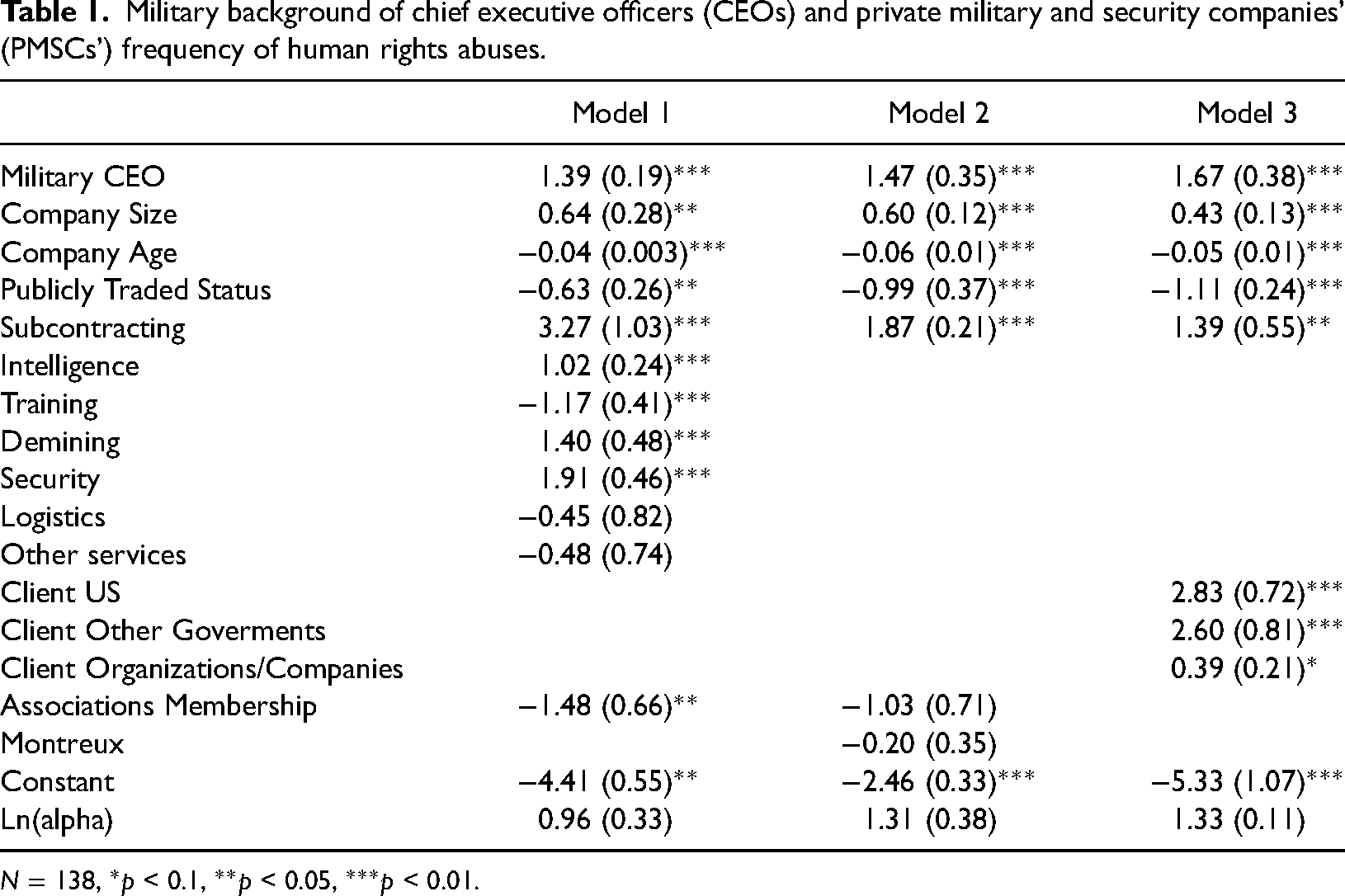
N = 138, *p < 0.1, **p < 0.05, ***p < 0.01.
Findings also show that PMSCs with CEOs who served in the military of a mature democracy are more likely to engage in a high number of human rights abuses than civilians. The variable is statistically significant, although in the opposite direction to what I hypothesized. Furthermore, the results show that while CEO service in the military of states that are not mature democracies is linked to a higher number of human rights abuses in comparison to those without service experience (Table 2, Models 1–3), these CEOs are only 5% more likely to increase the risk than CEOs who served in mature democracies.
CEOs’ military service in full democracies and PMSCs’ frequency of human rights abuses.

N = 138, *p < 0.1, **p < 0.05, ***p < 0.01; reference category is civilian CEO.
These results show that serving in the military of a mature democracy that emphasizes respect for human dignity is not a deterrent for PMSC criminal behavior and does not offer substantial advantage over CEOs who served in non-democracies. Nor does CEO service in the military of mature democracies offer more benefits over civilians of any regime type. Instead, military socialization that fosters confidence and aggressiveness coupled with the power of military networks leads to stronger ethical blind spots for the CEOs with military experience, regardless of regime type. However, owing to the small number of observations for ex-CEOs from states that are not mature democracies (7 vs. 57 for mature democracies), the finding regarding this variable needs to be approached with some caution.
I do not find robust evidence that PMSCs with CEOs who graduated from a military academy/college are more likely to refrain from committing a high number of human rights abuses (Table 3, Models 1–3). This CEO background has a statistically significant impact in increasing the risk that a PMSC will be linked to a high number of human rights abuses in one model. The results suggest that emphasis on positive value cultivation in these institutions may be insufficient to reduce ethical gaps that emerge due to confidence and aggressiveness that is fostered during subsequent years of service or because of loyalty networks that prevent a more proactive approach to oversight.
CEOs’ military academy/college graduation and PMSCs’ frequency of human rights abuses.

N = 138, *p < 0.1, **p < 0.05, ***p < 0.01.
Turning to insights on the service branch, the results show that PMSC connection to a high frequency of human rights abuses is more likely for CEOs who served in the Navy than for CEOs without this service branch experience (Table 4, Models 1–3). The Navy's emphasis on alertness to threats and aggressiveness is likely to have a negative effect on the CEOs’ approach to PMSC management. There is some evidence (two out of three models) that CEOs who served in the Army are also connected to a high number of human rights abuses, while CEOs who served in the Air Force are less likely to be linked to a high number of abuses. In the US, the Air Force is more focused on deterring the enemy than on defeating it (Thomas, 2004), an identity that places less emphasis on aggressiveness.
CEOs’ military branch service and PMSCs’ frequency of human rights abuses.
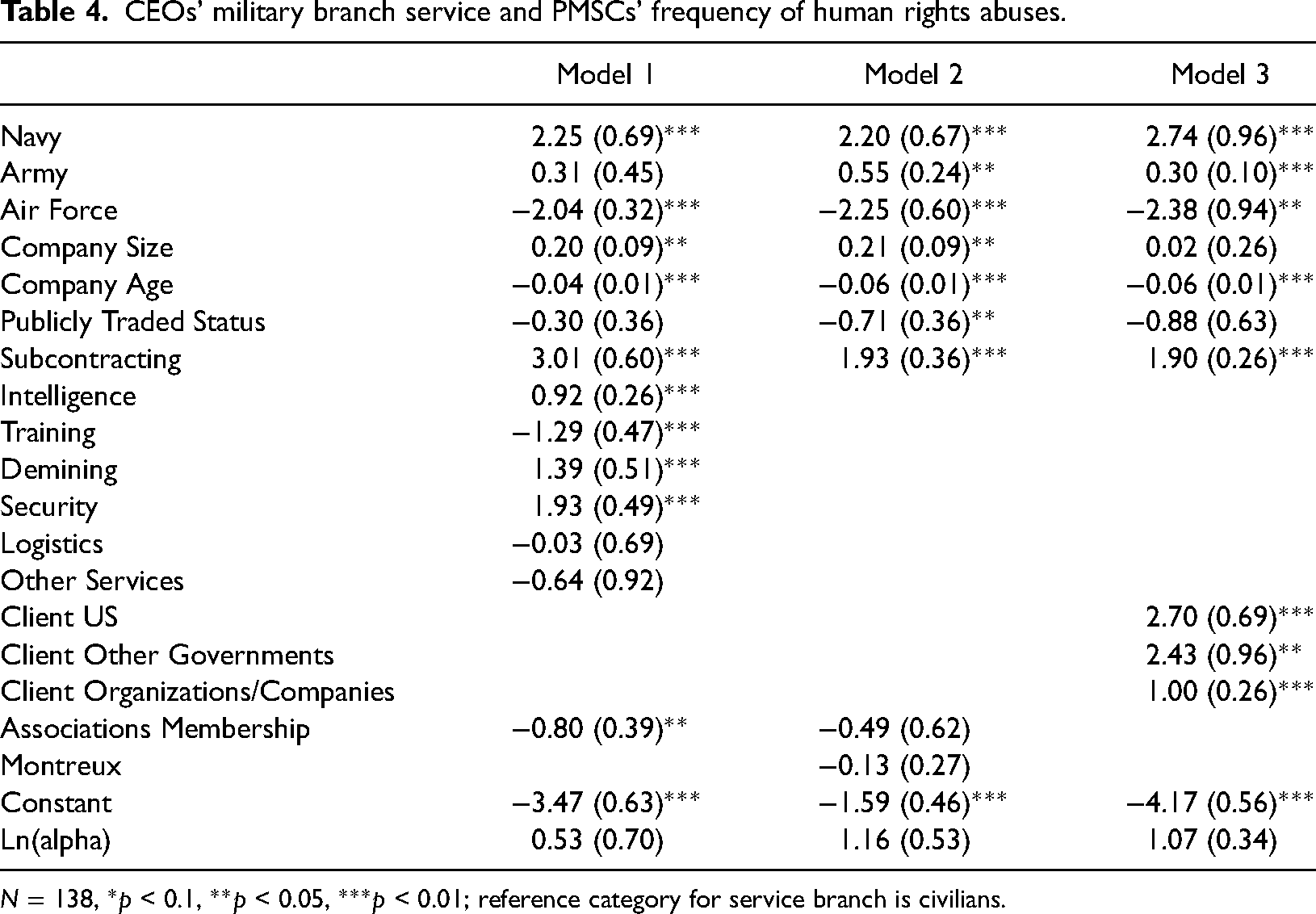
N = 138, *p < 0.1, **p < 0.05, ***p < 0.01; reference category for service branch is civilians.
The risk of committing a high number of human rights abuses also increases when ex-military CEOs oversee private companies (Table 5, Models 1–3). In the absence of corporate structure with greater transparency and accountability mechanisms, something that is more associated with publicly traded companies, having a CEO with a military background can further increase the risk that PMSCs will be connected to a higher number of abuses. There is no statistically significant relationship between subcontracting PMSCs with ex-military CEOs and a high frequency of human rights abuses (Table 6, Models 1–3). However, with only six observations for this interaction term, the finding needs to be approached with caution.
Military background of CEOs of private PMSCs and PMSCs’ frequency of human rights abuses.
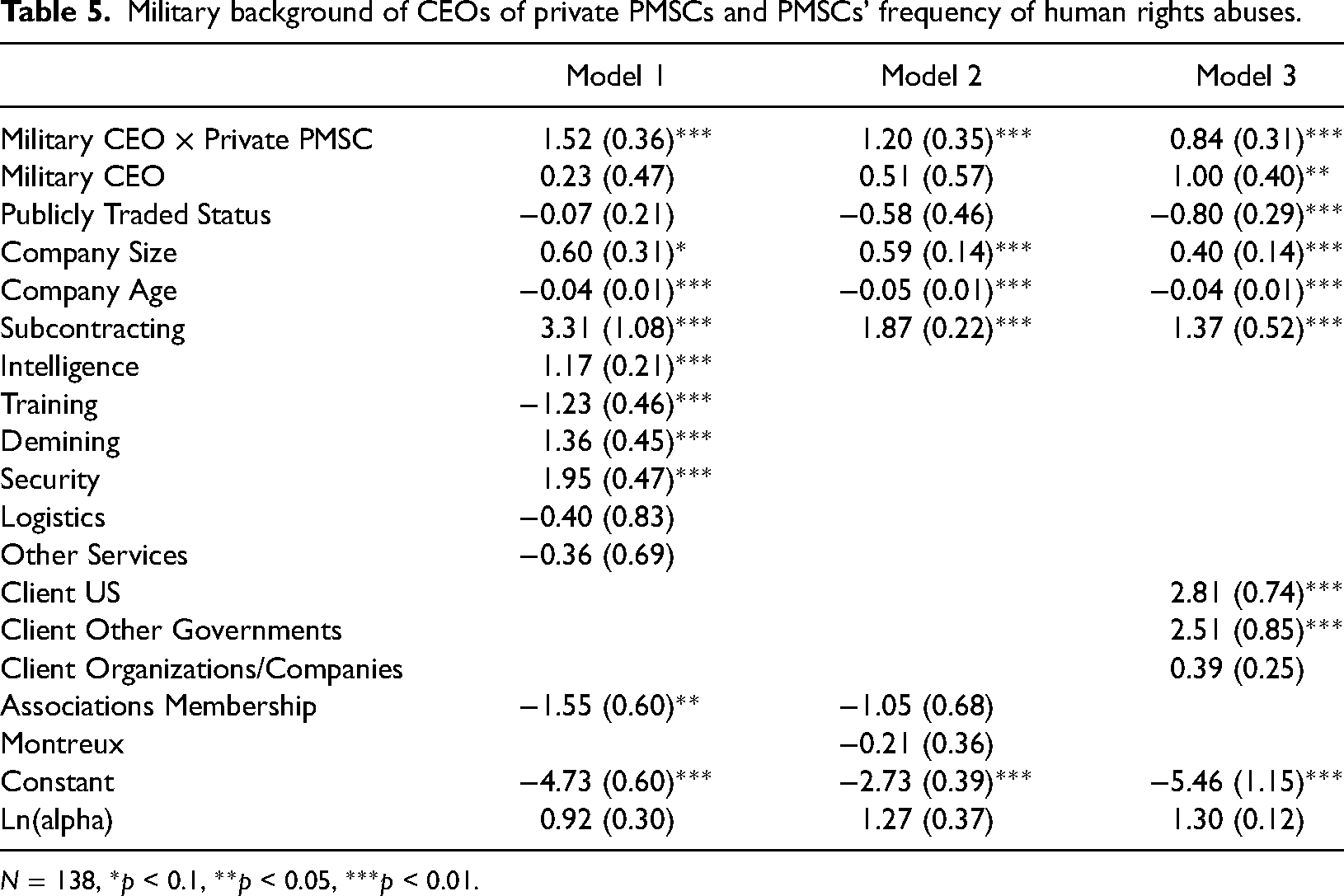
N = 138, *p < 0.1, **p < 0.05, ***p < 0.01.
Military background of CEOs of subcontracting PMSCs and PMSCs’ frequency of human rights abuses.
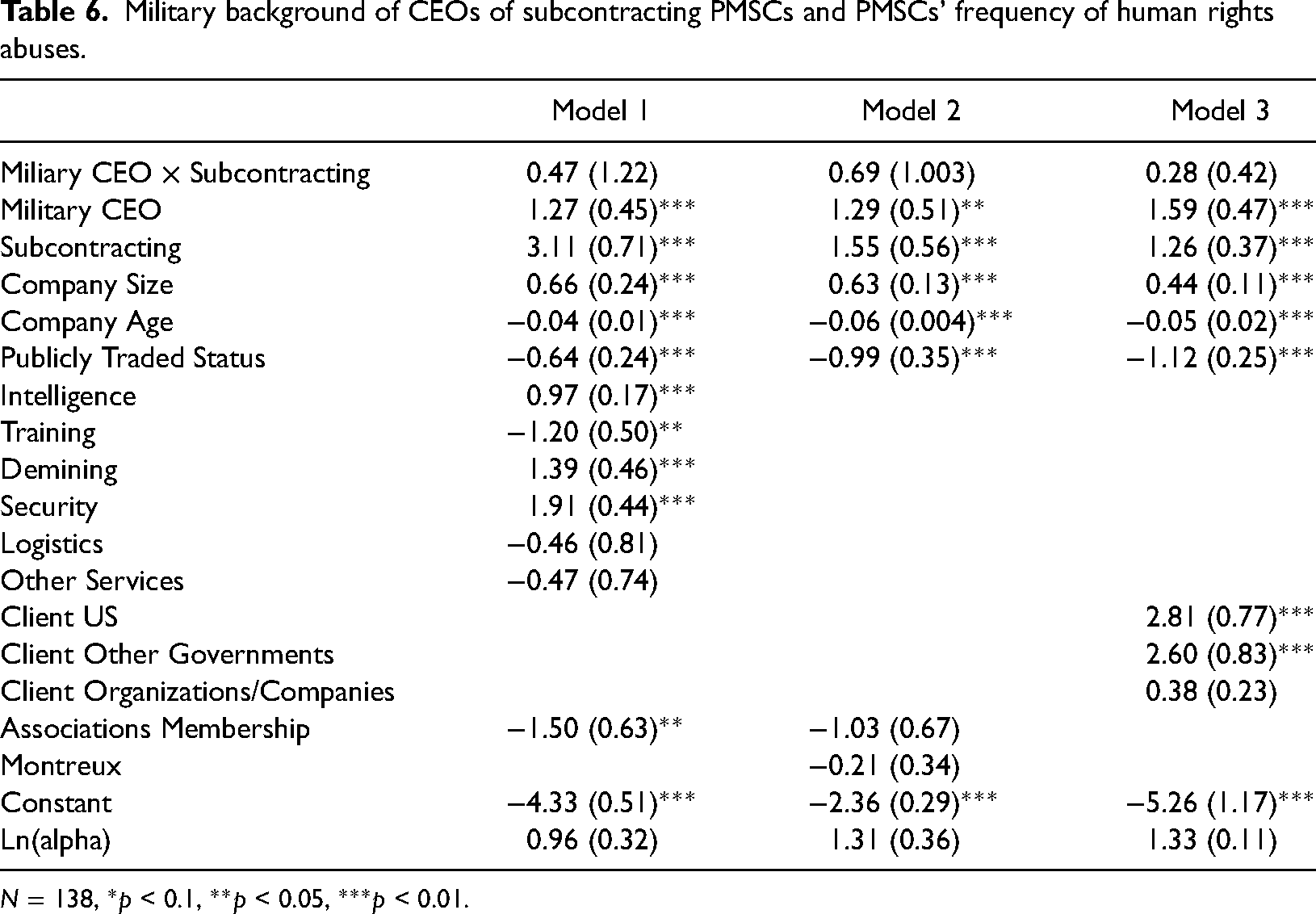
N = 138, *p < 0.1, **p < 0.05, ***p < 0.01.
Turning to control variables, the most robust ones that explain the frequency of human rights abuses are age, size, company status, subcontracting, type of client and service. Biggest risk comes from larger companies, subcontracting, and providing services to governments (US or others). 5 Delivering services in intelligence, demining, and security is also linked to a higher number of abuses. Unlike other tasks, performing these services means greater contact with the local population, which creates an underlying risk of encountering uncertainty about differentiating between civilians and fighters and a higher risk of threats. Publicly traded companies, older companies, and those that deliver training decrease the risk of frequent human rights abuses. 6
Lastly, given that Blackwater and KBR were linked to a much greater number of human rights abuses, I account for the possibility that these companies could be driving the results. As the sample size of companies committing violations is small to begin with, eliminating data points would risk losing important information. Instead, I normalized the dependent variable (range 0–1) to reduce overdispersion. The results for explanatory variables remained the same with respect to human rights abuses. 7
Conclusion
This study focused on leadership background to explain variation in PMSCs’ frequency of human rights abuses. Adopting a theoretical framework of willingness and opportunity, I examined the extent to which CEOs’ military background impacts leaders’ willingness to pursue policies that mitigate the risks of wrongdoing in the context of the Iraq War. Even when environmental factors such as conflict complexity or the type of service that a company delivers create greater opportunities for interactions with civilians, the CEOs’ decisions to be mindful of risks and undertake steps to offset the danger could improve ethical behavior. I explored how confidence, risk taking, aggressiveness, and military networks cultivated in the military create ethical blind spots that could limit the CEOs’ willingness to develop practices to promote PMSCs’ restraint in the field and greater oversight.
The study's results show that PMSCs with CEOs who served in the military are more likely to commit a high number of human rights abuses than civilians. The risk is higher regardless of regime type. There is also strong evidence that risks are high if ex-military CEOs lead private PMSCs and served in the Navy, but low for those ex-military CEOs with the Air Force background. I find that ex-military CEOs’ experience at the military college/academy has no impact on the frequency of human rights abuses committed by their companies. There is also no evidence that subcontracting by PMSCs that are led by ex-military CEOs is linked to a higher number of human rights abuses.
This study suggests that when deciding to work with PMSCs that are led by CEOs with military background, the clients should be proactive about requesting evidence of practices that companies have adopted to minimize civilian harm and of those practices’ effectiveness. Future research should address the study's limitation in generalizability. As the majority of PMSCs in my sample had ex-CEOs who served in mature democracies and hiring clients were mostly democracies, it is useful to examine markets with greater proliferation of PMSCs whose CEOs served in non-democracies and whose clients are not democracies. As not all contracting governments attach the same value to human rights (Penel and Petersohn, 2022), turning to other markets could generate a greater sample of human rights violations and more opportunities to examine this study's findings. It would be valuable to consider contexts other than insurgencies to analyze how variation in intensity of conflict environment affects PMSC behavior.
Supplemental Material
sj-docx-1-cmp-10.1177_07388942231155396 - Supplemental material for Private military and security companies and human rights abuses: The impact of CEOs’ military background
Supplemental material, sj-docx-1-cmp-10.1177_07388942231155396 for Private military and security companies and human rights abuses: The impact of CEOs’ military background by Elizabeth Radziszewski in Conflict Management and Peace Science
Supplemental Material
sj-docx-2-cmp-10.1177_07388942231155396 - Supplemental material for Private military and security companies and human rights abuses: The impact of CEOs’ military background
Supplemental material, sj-docx-2-cmp-10.1177_07388942231155396 for Private military and security companies and human rights abuses: The impact of CEOs’ military background by Elizabeth Radziszewski in Conflict Management and Peace Science
Supplemental Material
sj-xls-3-cmp-10.1177_07388942231155396 - Supplemental material for Private military and security companies and human rights abuses: The impact of CEOs’ military background
Supplemental material, sj-xls-3-cmp-10.1177_07388942231155396 for Private military and security companies and human rights abuses: The impact of CEOs’ military background by Elizabeth Radziszewski in Conflict Management and Peace Science
Footnotes
Acknowledgement
Research for this article was possible with fellowship support from the Stockdale Center for Ethical Leadership at the US Naval Academy. I am grateful to Edward Barrett, Joseph Thomas, David Luban, Mitt Regan, Pierce Randall, Marcus Hedhal, Seden Akcinaroglu and anonymous reviewers for helpful comments on the manuscript.
Funding
Research for this article was possible with fellowship support from the Stockdale Center for Ethical Leadership at the US Naval Academy. Any findings and conclusions or recommendations expressed in this article are those of the author and do not necessarily reflect the views of the U.S Naval Academy.

Supplemental material
Supplemental material for this article is available online.
Notes
References
Supplementary Material
Please find the following supplemental material available below.
For Open Access articles published under a Creative Commons License, all supplemental material carries the same license as the article it is associated with.
For non-Open Access articles published, all supplemental material carries a non-exclusive license, and permission requests for re-use of supplemental material or any part of supplemental material shall be sent directly to the copyright owner as specified in the copyright notice associated with the article.
