




Abstract
Commitment problems and information asymmetries represent key impediments to peacekeeping. We posit that mass media—more specifically, United Nations (UN) peacekeeping radio broadcasts—is a cost-effective, easily implemented method of addressing common roadblocks to conflict resolution. We analyze monthly battle-related deaths across 51 UN peacekeeping missions during the years 1992–2014. Using negative binomial models with two-way fixed effects, we find that peaceful UN radio broadcasts are associated with decreased conflict intensity. We argue that radio-based, mass communication is particularly effective owing to the socio-economic conditions within conflict zones; these properties include severe under-development and lack of access to modern technology.
Keywords
Introduction
United Nations (UN) peacekeeping missions have long been synonymous with ground operations executed by military personnel. Yet this perception denotes only a portion of peacekeeping activities. In this project, we observe that peacekeeping operations (PKOs) and conflict resolution may be achieved through additional UN instruments. One such instrument, which has received limited attention in the peacekeeping literature, is UN peace radio broadcasts. Radio stations mitigate violence during times of conflict by broadcasting messages of peace and reconciliation to affected communities. A case in point is Radio Okapi, a national radio station in the Democratic Republic of the Congo (DRC). The DRC is marked by its vast rural interior. The Congolese radio station operates in multiple languages and reaches people in even the most remote areas of the hinterland. The station reaches a wide audience, with an estimated daily listenership of over 8 million people. (Betz, 2004). Radio Okapi serves as a platform for local voices and perspectives, giving a voice to marginalized communities and promoting national unity. Notably, it stands as a source of accurate and unbiased information in a country where misinformation and propaganda often fuel violence. UN radio broadcasts represent a valuable resource and a key component of successful peacekeeping efforts (Udo-Udo Jacob, 2014, 2016). These broadcasts promote education and conflict awareness; they shine as beacons of hope amidst violence and devastation (Hoffmann and Hawkins, 2015; Kimani, 2007).
In this project, we investigate the effects of UN peacekeeping radio stations on conflict intensity, operationalized as monthly battle-related deaths during civil conflicts. The extant political science literature acknowledges the influence of mass media on conflict-related violence. However, most projects are predominantly focused on individual case studies; they lack comprehensive analyses of trends across different geographical locations and time periods (Chalk, 2017; Chiluwa et al., 2020; Straus, 2007). We theorize that UN radio stations impact conflict intensity through both direct and indirect channels. In a direct way, radio broadcasts provide neutral information to combatants. This information may include real-time updates on the progress of settlement negotiations, the presence of compromises or ceasefires, or news conveying the true destruction caused by continued fighting. In these ways, radio broadcasts directly connect with belligerents in the field. In addition, radio broadcasts, as a form of mass media, have the power to transform public opinion. Combatants must operate within and around civilians who may or may not support the war. By serving as beacons of trust, democratic values, voices for the marginalized, and humanitarian aid, UN radio stations are a constant reminder for rural people of the presence of the UN itself. This function—the ability to reach millions of isolated listeners—can also change individual views on violence. In these ways, radio stations are an inexpensive, easily implemented, low-infrastructure, low-technology method of putting peace into the air—or more specifically, the airwaves.
In this project, we posit that UN peace missions with radio station broadcasts more effectively mitigate conflict intensity than missions devoid of such media tools. Our research design utilizes data spanning from January 1992 to December 2014. Our unit of analysis is the conflict dyad-month; we focus on intrastate conflicts with peacekeeping missions and recent fighting. Our findings reveal a notable disparity in conflict intensity levels between UN missions with and without radio stations. We also observe that ancillary conditions, such as the absence of technology, reduced access to education, decreased literacy, and poor infrastructure, each play a role in the effectiveness of radio-based communication in war zones. Our findings demonstrate that radio stations are an important—and life-saving—component of multi-dimensional peacekeeping operations. Owing to their minimal cost and maximal efficacy, radio station broadcasts represent an unqualified best practice for the peacekeeping community; our findings contain critical implications for the design and implementation of peacekeeping missions. Lessons from this project support the development of more effective strategies for promoting peace and stability in conflict zones.
Literature review
Civil wars and conflict severity
One of the most prominent characteristics of civil wars is the large-scale, indiscriminate killing of both combatants and civilians. Research suggests that intrastate wars cause more than 10,000 battle deaths on average (Lacina and Gleditsch, 2005; Lacina, 2006), which fluctuates over time (Hultman et al., 2019). We employ the Uppsala Conflict Data Program (UCDP) definition of battle deaths as, “deaths caused by the warring parties that can be directly related to combat.” These numbers refer to direct deaths and do not contain indirect deaths such as those caused by disease and starvation owing to conflict (Pettersson, 2022). More importantly, however, scholars typically operationalize conflict severity through battle deaths (Butler et al., 2017; Lacina, 2006).
Conflict severity is predicated on multiple factors (Brandt et al., 2011; Bagozzi, 2015; Hegre et al., 2017). Some authors argue that country-level factors determine the conflict severity. For instance, Chaudoin et al. (2017) emphasize economic development; they postulate that severe conflicts are engendered by economic inequality and lower economic development (see also Collier and Hoeffler, 2004; Lu and Thies, 2011; Wischnath and Buhaug, 2014). Others highlight the link between conflict severity and economic sanctions (Hultman and Peksen, 2017). Still other literature underscores the role of demographic and geographic factors, such as population, natural resources, and rough terrain, in terms of conflict intensification (Fearon and Laitin, 2003; Lacina, 2006; Lujala, 2009). For instance, Lujala (2009, 2010) finds that the geography of natural resources such as oil production in a civil war zone can prolong and intensify the war. Some studies examine the variations in battle deaths and refer to factors such as regime type, external support and foreign assistance, and ethnic heterogeneity (Eck, 2009; Heger and Salehyan, 2007; Lacina, 2006). Other scholars underscore factors such as relative strength and the number of rebellion groups (Heger and Salehyan, 2007; Hultman and Peksen, 2017). Consensus is lacking regarding the role of rebel strength. Beardsley et al. (2019) argue that civil war severity stems from two important factors; these factors include bargaining failures and the absence of external restrictions to punish violent groups. Metternich et al. (2019) deploy an actor-centric approach to predict battlefield deaths and find that the behavior, characteristics, and interdependence of armed actors in both government and rebel organizations affect the severity of the conflict.
While conflict scholars underscore the factors that exacerbate conflict, scholars within the peacekeeping literature highlight the ways that external actors de-intensify armed violence. From this literature, UN peacekeeping operations mitigate conflict severity and reduce battle-related fatalities (Hultman et al., 2014, 2019). The presence of peacekeeping forces can provide a sense of security to conflict-affected communities, which can reduce the likelihood of violent confrontations. However, it is important to note that the effectiveness of peacekeeping operations can be influenced by various factors, such as the level of media outreach. Practitioners understand that media communication may combat hatred and reduce conflict severity; as a result, media components are often included in humanitarian interventions (Tomiak, 2018). To date, however, there is an absence of peacekeeping and conflict resolution research that evaluates the effectiveness of radio media for reducing conflict severity in a systematic way.
Mass media and conflict-related violence
During wartime, mass media may reduce conflict intensity (Lynch and McGoldrick, 2012; Lynch, 2015b; Shaw et al., 2012; Tomiak, 2018). Additionally, extant research suggests that radio broadcasts, in particular, contribute positively to peacebuilding (Adejo, 2014; Lihavi, 2020; Malakwen, 2014). The advantage of radio over other media tools is that radio waves span large geographic areas, even in remote places (Ortiz Dos Santos, 2021). Furthermore, radio is inexpensive—usually with existing infrastructure—and more affordable than other comparable media tools. Scholars demonstrate that radio is accessible to more than two-thirds of people living on the African continent (Betz, 2004; Costa, 2012). A case study in Sierra Leone illustrates that the broadcast of Bush Wahala ameliorated conflicts over land governance by facilitating communication (Baú, 2019). Case studies of UN radio broadcasts in the DRC and Central African Republic—named Radio Okapi and Radio Ndeke Luka respectively—illustrate that peace journalism can have noteworthy impacts (Ortiz Dos Santos, 2021). However, appreciation for radio media primarily stems from media and journalism scholars; there is a relative dearth of research within political science regarding this form of communication, particularly as it applies to conflict management. Media scholar, Ortiz Dos Santos, remarks, On this basis, I have argued that both radio stations attempt to realize the ethos and praxis of peace journalism, considering that each outlet is immersed in a specific context having created its own modus operandi. It also makes the point that radio can play a chief mobilizing role, particularly in conflicting environments, and that such role is worthy of scholarly research. (2021: 191)
This type of speech is not uncommon. Other authors have expanded this literature to include the impact of hate speech within media more generally (Fuchs, 2022). The Indigenous People of Biafra is a separatist movement in Nigeria seeking independence for the Biafran ethnic group. Their provocative rhetoric and demonstrations, along with reports of hate speech and incitement to violence, have garnered media attention. Communication from both the Indigenous People of Biafra and their opponents in politics and media have increased accusations of promoting ethnic and religious divisions (Chiluwa et al., 2020). Here, too, scholars describe a connection between extremist language and genocidal killings. For instance, Fuchs conducted an in-depth examination of the role of media hate speech in relation to the persecution of the Rohingya in Myanmar (2022). She found that state-controlled media and social media platforms were used to disseminate hate speech and anti-Rohingya propaganda, which played a significant role in inciting violence and genocide against the minority group (Fuchs, 2022).
Many studies have examined the role of radio as a form of national media in promoting peace. For example, the peace negotiations in Northern Ireland were supported by the media, which provided a platform for different groups to share their views and engage in dialogue (Spencer, 2004). However, there are important lacunas within this literature. First, our research represents the only systematic study of radio media across time periods and geographies from within the conflict resolution literature. Second, few scholars, if any, have examined the importance of UN radio stations as a component of UN peacekeeping missions in conflict zones (Essoungou, 2010; Nejadat and Shatanawi, 2014). Unlike previous research, which primarily relies on qualitative methods such as interviews and case studies (Essoungou, 2010; Nejadat and Shatanawi, 2014), our work is both archival and overtly quantitative. Additionally, we offer a theoretical contribution to the peacekeeping and conflict resolution literature that underscores the importance of mass media within UN missions.
Peacekeeping and the role of radio
The UN alone has created approximately 44,000 radio stations around the world (Bazley, 2016). Radio stations become integral to mission objectives during conflicts; however, in some missions, such as Cambodia and Liberia, UN radio stations also facilitated the political transition process and conflict termination. In part, the utility of peacekeeping radio stations stems from the ability to reach both urban and rural areas (UN Department of Global Communications, 2020). In conflict zones, individuals often lack access to more advanced forms of communication such as cell phones, televisions, or internet access. This is often due to limited income or a lack of physical infrastructure to support such devices. Furthermore, widespread illiteracy within these areas erodes the effectiveness of other media sources such as newspapers and internet technology. Thus, radio broadcasts are more critical in such situations. According to the Special Representative of the UN Secretary-General for South Sudan and Head of the UN Mission in South Sudan (UNMISS), David Shearer, “For the great majority of people across South Sudan there is no internet, television or newspapers available. So how do people get their news? Some by word of mouth, but mostly from Radio Miraya” (UN Department of Global Communications, 2020: 3). Archival documents, as well as qualitative scholarship, demonstrate that UN radio broadcasts connect directly with combatants and potential recruits while also serving an indirect public broadcasting function that affects civilians within conflict zones.
UN radio broadcasts and combatant behavior
UN radio stations have the ability to connect directly with combatants and potential recruits. This connection may serve several functions. Examples include directly urging the de-escalation of violence, conveying imperatives of the international community, discouraging potential recruits from perpetrating new violence, and updating combatants on the progress of peaceful negotiations (Essoungou, 2010; Kimani, 2007; Momanyi, 2015; Restoy, 2006; Tomiak, 2018; UN Department of Global Communications, 2020; United Nations Peacekeeping, 2022; Vollhardt et al., 2006). Peaceful radio broadcasts send messages aimed at combatants. A senior radio journalist from Radio Bakhita opines, It is those on the ground we are supposed to reach. These are the people, we are supposed to convince them. You are fighting. But it is only one person who is going to get the post. Are all of you going to get the president? All of you are going to get the ministers? No. You are going to remain in the bush. You are going to remain a small military. So why don’t you focus and just give your service to the people. … At this stage, the only thing I have in mind is to present this peace program to the people, at least to give my one message. You are fighting your brother. You are killing your mother. You are killing your sister. You are supposed to stop what you are doing and think. (Tomiak, 2018: 460)
Broadcasts are also critical components of disarmament and demobilization. Peaceful messages facilitate the top-down process of armed leadership encouraging disarmament among rank-and-file soldiers (Kimani, 2007). Another case in point is Mega FM radio, which has been integral to the UN Observer Mission in Uganda and Rwanda (UNOMUR). As part of its public service function, Mega FM broadcasters encouraged rebel groups in northern Uganda to stop fighting and return home. Following the Ugandan conflict, Mega radio programs also encouraged ex-combatants to share their experiences on air (Kimani, 2007). UN radio stations in Uganda and the DRC broadcasted a message entitled, “Come Home,” to encourage members of armed groups to surrender their weapons and participate in the disarmament and demobilization process. Former combatants, who heard these broadcasts, subsequently surrendered their weapons and were successfully reintegrated into their communities (Ross, 2016).
Radio broadcasts disseminate information about the benefits of compliance and the costs of non-compliance, both of which incentivize parties to abide by settlement agreements. The UN mission in Sierra Leone (UNAMSIL) staff set up the first radio station to explain and introduce the mission's purposes to people around the country; these efforts contributed to the termination of a conflict that had previously caused thousands of fatalities (Kimani, 2007). The directors of UN radio stations ensure that broadcasts only include reliable information and verified facts (Kimani, 2007). As a result, radio broadcasts represent a reliable source for real-time updates regarding the destructiveness of the conflict as well as the progress of settlement negotiations. The dissemination of verified information informs combatants in rural areas, recognizes the interests of rival factions, and simultaneously corrects misperceptions of the conflict itself (Momanyi, 2015).
UN radio broadcasts and civilians in conflict zones
United Nations radio broadcasts represent neutral, public information that reaches civilians and potential recruits. People living in conflict zones often suffer from information vacuums; these information voids contribute to uncertainty, fear, and sometimes, spiraling pre-emptive violence. Additionally, many civilians and potential recruits lack any real knowledge of the detrimental effects of the conflict or the progress of possible settlement negotiations. UN broadcasts fill this void by providing news, discouraging violent rhetoric and hate speech, and offering value-added public education (Momanyi, 2015). Case study research evidences these vital functions. Radio Okapi in the DRC and Radio Miraya in South Sudan have deliberately broadcast programs to counter hate speech (Tomiak, 2018; Vollhardt et al., 2006). In the Congo, Radio Okapi's focus on promoting national unity has been instrumental in bringing people from different regions and communities in Congo together (Essoungou, 2010). Additionally, Radio Miraya and Radio Bakhita embedded in the UNMISS provided public information and raised awareness about the consequences of the conflict (UN Department of Global Communications, 2020). Radio Miraya and Radio Bakhita air peace programs on the radio, featuring role models for positive behavior in various situations, including interethnic conflicts. These programs aim to empower the public to promote peace by transcending biases and resisting manipulation. Scholars offer indirect evidence of these effects with respect to national elections; in these instances, radio stations provide primary sources of non-partisan information, an essential component of democratization (Orme, 2010).
UN radio stations are typically administered by third-party intervenors, and as a result, they tend to embody democratic notions of equality and free speech. Station broadcasts provide a platform for dissent as well as minority voices. Polls demonstrate that these stations are popular and trustable among national audiences. For instance, UN radio Okapi in DRC became a credible nationwide news source (Orme, 2010). The popularity of this radio crossed borders and became a universal service in neighboring countries. In the past, UN peacekeepers have also leveraged radio stations to publicize corruption, political intrigue, and human rights violations (Orme, 2010). UN peace broadcasts not only relay neutral current events to the masses; they also deliberately refute hate speech. This represents one of the UN’s major strategic objectives. According to the UN (2020) Strategy and Plan of Action on Hate Speech (2020), “The United Nations must confront hate speech at every turn. Silence can signal indifference to bigotry and intolerance, even as a situation escalates and the vulnerable become victims” (United Nations, 2020: 15). It follows that UN radio broadcasts would deliberately embody this purpose.
As a result, radio stations are often vital throughout geographic areas in which political and ethnic factions have previously spread hate propaganda and/or incited violence using media tools (Kimani, 2007). Radio Okapi in the DRC and Radio Miraya in South Sudan have deliberately broadcasted programs to counter hate speech (Tomiak, 2018; Vollhardt et al., 2006). Outstanding examples include the DRC and Uganda. In the Congo, Radio Okapi's focus on promoting national unity has been instrumental in bringing people from different regions and communities in Congo together (Essoungou, 2010). The station has helped to create a sense of shared identity and belonging among Congolese people by highlighting their common interests and concerns. By providing a platform for local voices and perspectives, it has helped to create a more just and equitable society where everyone's voices are heard and valued (Essoungou, 2010). The rationale behind the approach is that by equipping individuals with the knowledge and skills to recognize and resist manipulation, they can in turn educate others, thereby fostering a culture of peace (Tomiak, 2018).
Additionally, UN radio stations provide important services. Multiple archives within the UN highlight the significance of radio stations in delivering educational advantages. The main objective of Radio Okapi, with MONUSCO, was to support peacekeeping personnel and promote UN mandates. Radio Okapi offers a variety of services such as educational classes on air (UN Department of Global Communications, 2020). Radio Miraya, embedded in the UNMISS, also served as a source of public information; it raised awareness about the consequences of the conflict (UN Department of Global Communications, 2020). In each of these cases, UN peacekeeping radio became a critical component of peacekeeping success through its ability to provide news and education to a large body of people. According to Yves Laplume, the former program director of Radio Okapi in the DRC, “We gave people real and verified facts. We saw in different surveys that they like it … They want you to give them the information and let them make up their minds. It is basic, but it has a great impact” (Kimani, 2007: 3)
Radio broadcasts may also accelerate the transition out of conflict for civilians living in conflict zones. UN radio broadcasts in Sierra Leone promoted the benefits of peace, such as economic development and social stability. As a result, public support for peace increased, and public support for fighting decreased, making it difficult for the fighters to continue the conflict (Rippon and Willow, 2004). By highlighting these costs and benefits, UN radio broadcasts can decrease public support for fighting. When the public supports fighting, they provide combatants with the necessary resources, such as money, food, and shelter. In contrast, when public support for fighting diminishes, it becomes increasingly challenging for combatants to continue the conflict. This is because the cost of continued fighting becomes too high (Gelpi et al., 2009; Larson and Savych, 2005; Sullivan, 2008). Many UN officials have acknowledged that radio station broadcasts are on par with disarmament in terms of their contribution to the peacebuilding process in the aftermath of war. For instance, scholars such as Betz and Papper (2015) posit that radio broadcasts were critical in terms of preventing additional bloodshed and violence during the 2002 presidential election in Sierra Leone. Thus, peaceful radio stations not only impact civilians living in conflict zones, but they can also facilitate the transition out of conflict. In sum, UN archives and case study research provide strong support for the twofold impact of peaceful radio broadcasts; namely, they appeal directly to combatants, but also indirectly affect civilians living in conflict zones. Now, we take up these cases and look more closely at trends across geographies and over time.
Theory and mechanisms
We theorize that UN radio stations have a two-fold impact on conflict intensity. Specifically, we propose that their direct effect is achieved through purposeful appeals to combatants as well as the resolution of informational asymmetries; indirectly, UN radio also serves a mass media function that affects public opinions about political violence. By deliberately broadcasting information about the devastation of the conflict and the progress of peaceful negotiations—which might otherwise be limited to government affiliates—public radio bridges the information gap and reaches remote populations on an individual level. As a result, the ability to affect individual citizens suggests that the impact of radio is potentially both positive and multiplicative. Both direct and indirect mechanisms support the utility of UN radio stations for reducing conflict intensity.
Information asymmetries and the bargaining theory of conflict
Game theorists within international relations emphasize asymmetric information as one of the key causes of conflict (Fearon, 1995; Powell, 2002); however, informational vacuums can also prolong and escalate violence in unnecessary ways. Lack of information creates security dilemmas; it contributes to spiraling fears, preemptive violence, and the breakdown of potential bargaining agreements. As a result, information sharing can both reduce the likelihood of conflict and de-escalate violence after intrastate wars have already begun (Rauchhaus, 2006). Game theorists, such as Rauchhaus (2006), demonstrate that the effectiveness of conflict intervention is fundamentally based on the ability of third parties to provide information about the disputants’ reservation points. Thus, mass media can rebalance information on both sides of the conflict, which is critical to conflict resolution.
Practically, UN radio stations serve as trusted sources of information during wartime. Our proposed mechanism is straightforward; radio broadcasts solve the information asymmetry problem. Peaceful messages appeal directly to combatants. Broadcasts may include explicit messages promoting peace and reconciliation, updates on the political and security situation, and information about disarmament and demobilization efforts. Additionally, by providing accurate and timely information, UN peacekeeping radio can help to reduce tensions and promote stability in the region. Radio stations mitigate information asymmetry by providing all parties with accurate and unbiased information. UN peace radios serve an informative function among combatants by gathering constructive information and, more importantly, neutralizing misinformation and/or negative propaganda. Providing information may help promote meditation between warring parties; thus, the presence of neutral broadcasts may initiate intergroup communication as well as engender trust and confidence.
The presence of UN radio stations in conflict zones helps peacekeepers solve commitment problems. In bargaining theory, the commitment problem refers to the difficulty of ensuring that a party will follow through on a promise or agreement (Powell, 2002, 2006). Radio stations resolve this dilemma by providing a channel for intergroup communication and conveying information directly, which can help to build trust and increase transparency on both sides of the conflict. For example, UN radio peace stations broadcast information about disarmament and demobilization efforts, which increases the transparency of these efforts and the probability of compliance. Each of these efforts builds trust and reduces the risk of reneging on agreements, which are common problems during peacebuilding.
Mass media and public support for peace
UN radio broadcasts connect with both combatants and civilians on an individual level. In this way, UN peace radio serves a mass media function that both informs and educates. By indirectly increasing public support for peace, we argue that radio broadcasts may also increase the opportunity costs of continued fighting. UN Radio stations play a pivotal role in shaping public opinion. Radio broadcasters inform and report to the wider population; they provide transparency and neutral sources of information. Thus, the construction of peaceful narratives and greater information has the potential to create bottom-up change. Informed public opinion regarding political violence creates a narrative with the potential to influence both domestic and international actors as well as macro-level decision-making. Multiple radio stations feature role models of tolerance and national unity, particularly within areas marked by interethnic conflicts (Tomiak, 2018). These programs empower the public to promote peace by transcending biases and resisting manipulation. The rationale behind the approach is that by equipping individuals with the knowledge and skills to recognize and resist manipulation, they can in turn educate others, thereby fostering a culture of peace (Tomiak, 2018).
We posit that the indirect effect of UN radio broadcasts is predicated on the fact that public support for fighting is a crucial factor in the continuation of the conflict. UN radio broadcasts can influence public support for fighting in several ways. For example, broadcasts highlight the costs of fighting, such as the loss of life, destruction of property, and displacement of people (Kimani, 2007; UN Department of Global Communications, 2020). Broadcasts can also promote the benefits of peace, such as economic development, social stability, and human rights (Rippon and Willow, 2004). By highlighting these costs and benefits, UN radio broadcasts can decrease public support for fighting, thereby increasing the opportunity costs of the conflict (Gelpi et al., 2009; Larson and Savych, 2005; Sullivan, 2008). Peaceful radio station broadcasts impact conflict zones through both direct and indirect mechanisms. In light of these processes, we postulate:
UN Radio networks constitute an essential means of communication within heterogeneous and extensive communities, particularly in regions with limited internet access, and populations that are frequently on the move owing to forced migration and displacement. A case in point is South Sudan. A UN Educational, Scientific, and Cultural Organization (UNESCO) survey on perceptions revealed that 83% of individuals rely on radio as their primary source of news, whereas a mere 4% of individuals access information regularly via online platforms (UNESCO, 2023). Civil wars often take place in areas that are the least conducive to facilitating communication across adversarial groups. War-torn countries are typically poor and primarily rural. Weak infrastructure acts against the efforts of third parties to effectively communicate with both sides. Thus, physical communication constraints often prevent third-party intervention from achieving lasting success. In these instances, UN radio offers multi-faceted utility. Not only is it inexpensive and easy to implement, but it provides numerous intangible benefits that may be difficult to achieve through other means. National broadcasts are accessible within rural areas; their effectiveness is not predicated on literacy or access to education; and they simultaneously reduce uncertainty while facilitating trust. Radio broadcasts provide enormous benefits with very few costs. In sum, each of these factors reinforces the mechanisms that we propose. We recognize, however, that socio-economic factors may represent an important caveat to the generalizability of these precise mechanisms.
Methodology
Dependent variable
Our unit of analysis is the conflict dyad-month, in which each dyad represents one state actor paired with a single non-state actor. 2 We compose our population of interest from countries experiencing intrastate war in which peacekeeping missions were present at some time within that country's history. We employ monthly data ranging from January of 1992 through December of 2014. We study periods of active conflict combined with periods of UN Missions in which there has been active fighting within the last 24-month period (for a detailed description of the dataset creation, see Hultman et al., 2019). For a description of missions, locations, and time periods, see Table 1. Our dependent variable is conflict intensity, which we operationalize as battle-related deaths per month. The UCDP defines this form of violence as, “the use of armed force between warring parties in a conflict dyad, be it state-based or non-state, resulting in deaths” (UCDP, 2022). We follow the UCDP's definition of armed conflict denoted, “a contested incompatibility that concerns government and/or territory over which the use of armed force between two parties, of which at least one is the government of a state, has resulted in at least 25 battle-related deaths in one calendar year” (Pettersson, 2022).
Sample of conflict periods 1992–2014.
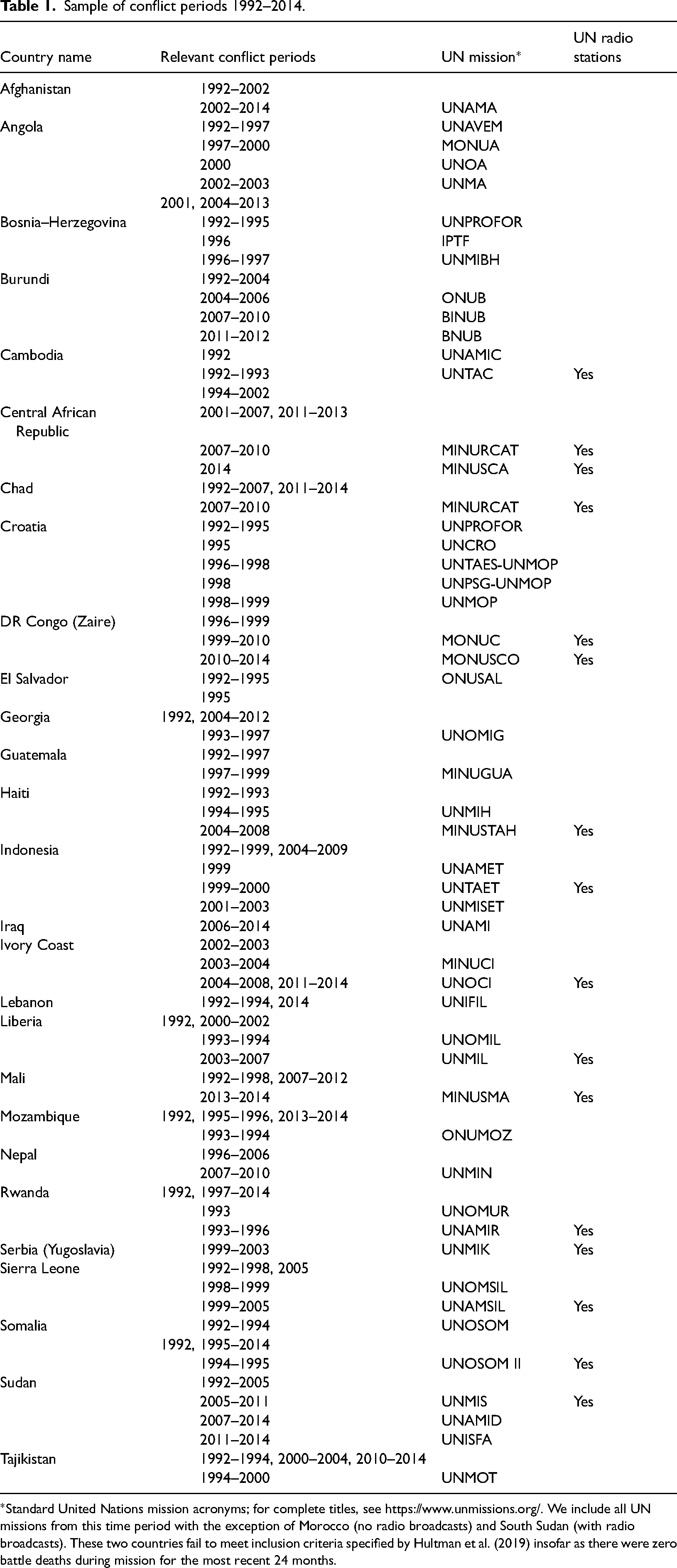
*Standard United Nations mission acronyms; for complete titles, see https://www.unmissions.org/. We include all UN missions from this time period with the exception of Morocco (no radio broadcasts) and South Sudan (with radio broadcasts). These two countries fail to meet inclusion criteria specified by Hultman et al. (2019) insofar as there were zero battle deaths during mission for the most recent 24 months.
Independent variable of interest
Our independent variable of interest is the presence of UN radio stations during peacekeeping missions. We acquired this data from a number of archival documents (Hoffmann and Hawkins, 2015; United Nations Peacekeeping, 2022). We code monthly data using 1 for the presence of radio broadcasts and 0 otherwise. 3 See also Table 1.
Controls
Following Hultman et al. (2019), we include variables that are theoretically and statistically important for understanding the relationship between peacekeeping operations and battle deaths. As previous scholars have emphasized, the effectiveness of peacekeeping is primarily tied to (1) military strength, which—following Hultman et al. (2019)—we operationalize as the number and composition of peacekeeping personnel (observers, police, and troops). In addition, we include the following controls, (2) third-party government military intervention, (3) degree of democracy, (4) population size, (5) cumulative battle deaths, and (6) prior (month) conflict intensity. The intervention of third-party governments may impact violence committed by state actors during conflicts. For instance, Peksen (2012) argues that foreign intervention by another state can raise the government's coercive power and contribute to increasing state repression and violence. This arises regardless of whether the external government military favors or remains neutral towards the target state. We obtain third-party government intervention data from the UCDP External Support Dataset and code it as a binary measure of intervention—presence (1) or absence (0)—on a monthly basis. Scholars find that pre-existing political regimes are related to intrastate violence, but the direction of this effect is indeterminant. Tynes and Early (2015) posit that democracy as a structural factor is likely to reduce violence by armed groups more generally; democratic governments, in particular, are less likely to violate human rights because of audience costs and institutional constraints (Harff, 2017; Valentino et al., 2004). However, Stanton (2013) proposes that this may have a reverse effect on violence by non-state actors. In this project, we employ data drawn from the Polity IV project (Marshall et al., 2017). The political regime variable is a 21-point ordinal measure with (10) representing consolidated democracy and (−10) representing consolidated autocracy. For a complete description of this variable, see “Political Regime Characteristics and Transitions, 1800–2017” by Marshall et al. (2017). Additionally, scholars highlight the role of population size in terms of the scale of observed violence (Hultman et al., 2013; Hultman et al., 2019). This outcome was obtained because larger populations, spread over a vast geographic area, are physically difficult to police and monitor (Fearon and Laitin, 2003). Thus, larger populations are associated with greater opportunities for violence and human rights abuses (Hultman et al., 2013; Wood, 2013). We log transform this variable owing to skew.
We also control for mission strength operationalized as the number of UN officials within a conflict zone for a specified month. We differentiate three different types of UN peacekeepers, namely military troops (Blue Helmets), police officers, and observers. We derive information on mission strength from global data on UN peacekeeper deployments within the International Peace Institute Peacekeeping Database. The data includes the total number of peacekeepers in every country by month, type (troop, police, and observer), and mission (International Peace Institute, 2019). Work by Hultman et al. (2019) underscores an inverse (negative) of troops and battle-related deaths. In contrast, there is a positive relationship between observers and the number of battlefield deaths; police strength is not statistically related to conflict intensity (Hultman et al., 2019). We include each of these measures and log them owing to skewed distribution. Finally, we wish to control for pre-existing conflict intensity. We operationalize this measure through two additional controls. We include logged cumulative total battle deaths, defined as, “the number of deaths that have occurred between a particular rebel group and government, aggregated over time through the course of the conflict” (Hultman et al., 2019: 89). We also incorporate lagged battle deaths from the prior month; following Hultman et al. (2019), we operationalize this variable as a binary measure.
Modeling strategy and robustness checks
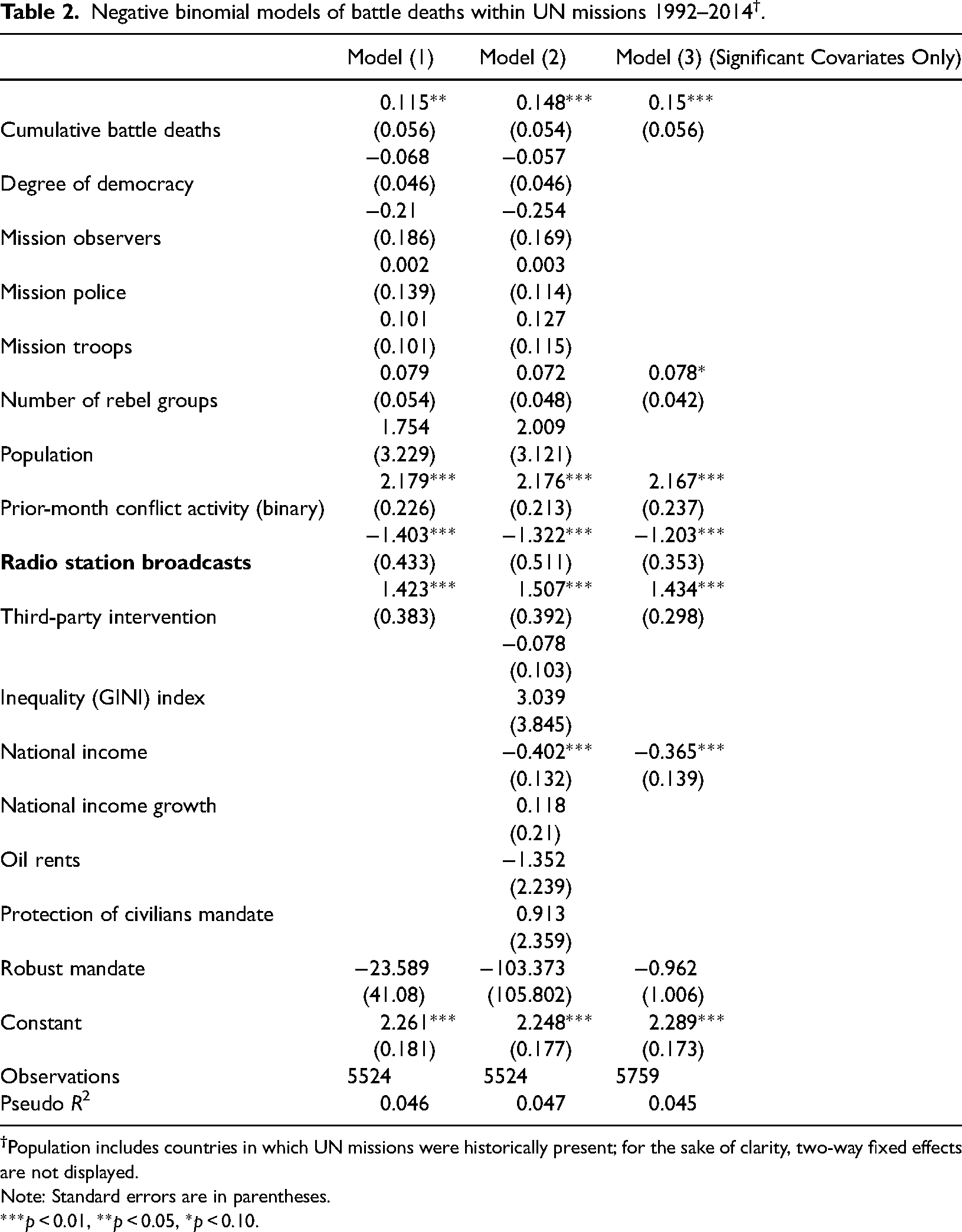
Our dependent variable, conflict intensity, is a count measure of monthly battle deaths per conflict dyad, which includes a single state actor paired with one non-state actor. To analyze this data, we employ a negative binomial model to control for over-dispersion. We cluster error terms using the country location of the conflict. To increase robustness, we employ fixed effects for both year and country in every model. Our initial model replicates the research design employed by Hultman et al. (2019). For an identical replication of Hultman et al. (2019) see Online Appendix Table S3. Our modified version, presented in Table 2, Model 1, includes transformations to correct for heteroskedasticity as well as two-way fixed effects for country and year. We supplement our modified design with several additional controls that include factors typically associated with conflict intensity (see also Table 2, Model 2). These additional controls are (1) income inequality, operationalized as the Gini index, (2) logged national income in constant 2015 USD, (3) percent per capita national income growth, (4) oil rents as a percentage of national income, (5) UN mandates to protect civilians, and (6) robust UN peacekeeping mandates. We obtained each of the economic measures from the World Bank Group data portal (World Bank Group, 2022). The concept of protecting civilians involves the responsibility of ensuring the safety and well-being of non-combatants. Additionally, in certain volatile situations, the UN Security Council has given UN peacekeeping operations strong mandates, known as “robust” mandates. These mandates grant them the authority to use “all necessary means” to prevent violent actions. UN peacekeeping mandates data is available through 1992–2014 (Cil et al., 2020). We argue that additional covariates, such as elevation, tropical location, and ethnolinguistic fractionalization are (relatively) constant over time and, therefore, are already captured within our fixed effects design. Starting with the extended model (Table 2, Model 2), we employ successive t-tests to trim the model down to only statistically significant variables. This version is displayed in Table 2, Model 3.
Negative binomial models of battle deaths within UN missions 1992–2014†.
Note: Standard errors are in parentheses.
***p < 0.01, **p < 0.05, *p < 0.10.
Results and discussion
Figure 1, parts (a) and (b), provides descriptive support for our research hypotheses. In this figure, each mission is represented by its own plot line. There is a clear dichotomy in battle deaths between UN missions with and without radio stations. Additionally, the statistical results in Table 2 highlight the importance of radio broadcasts for de-escalating violence. Models 1–3 in Table 2 each provide support for our research hypothesis. The effect size may not be particularly large in the absolute sense, i.e. a reduction of approximately 1–2 battle deaths per month; however, this effect is still substantively meaningful. Note that a reduction of approximately 2 battle deaths per month (∼25 battle deaths per year) represents the annual threshold for scattered political violence (<25 deaths/year) vs. minor conflict (>25 deaths/year). This suggests that the mere presence of radio has important substantive effects. In addition, Table 2, Model 3 indicates that radio broadcasts have a meaningful impact on de-escalating violence. However, it is crucial to note that this does not diminish the role of UN personnel—observers, police, and troops—in peacekeeping efforts. Both components are part of a multifaceted approach to peacekeeping and are often interdependent in complex ways that our study does not fully disentangle. 4
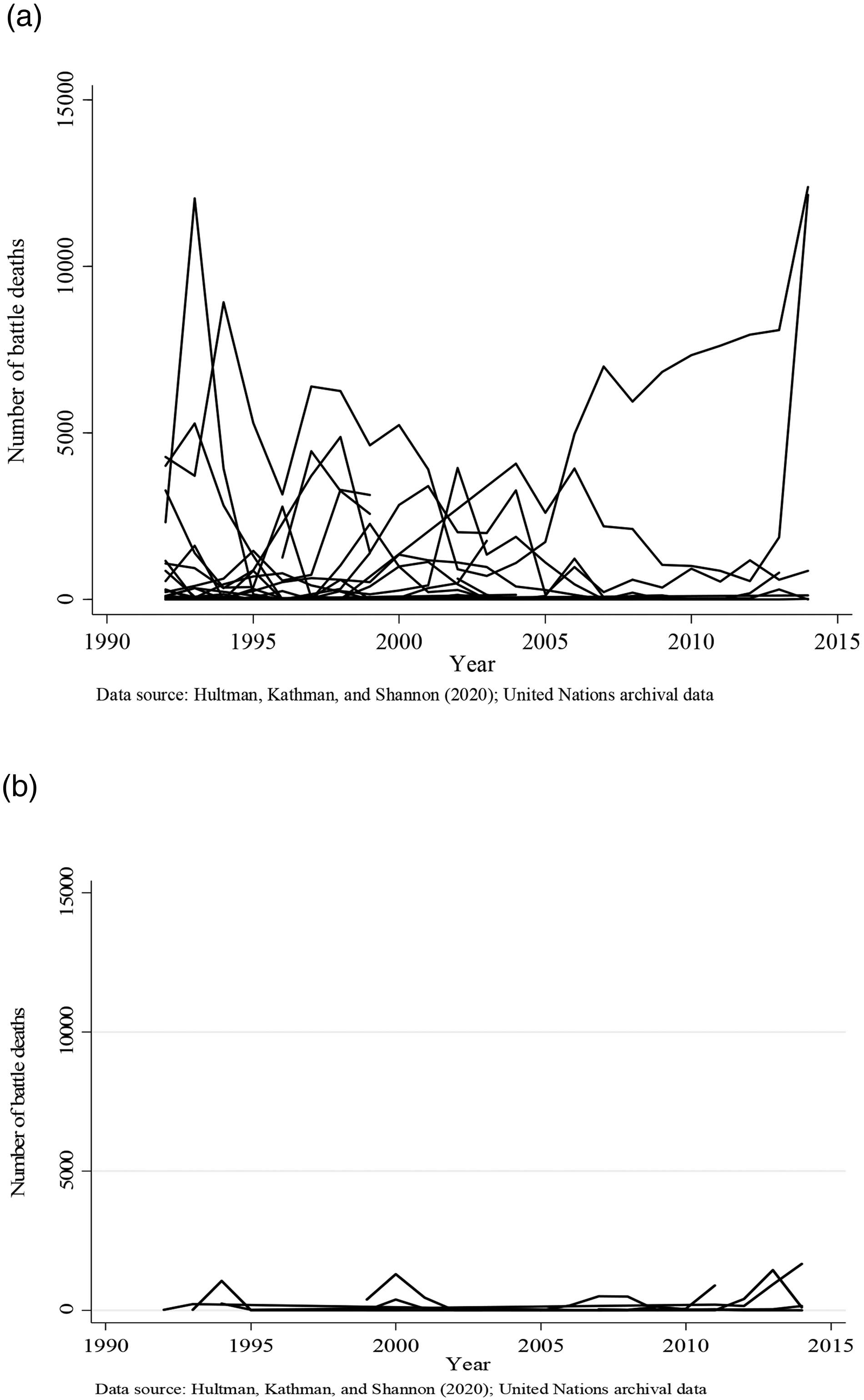
Spaghetti plots of battle deaths during individual UN missions 1992–2014. (a) Missions without radio broadcasts. (b) Missions with radio broadcasts. Each plot line represents an individual mission.
We postulate that the effect of radio broadcasts operates through multiple, concurrent mechanisms. These mechanisms are threefold. First, radio broadcasts include direct appeals to combatants with messages of peace; they also resolve many of the information asymmetry and security problems that typically plague conflict resolution efforts. Second, radio broadcasts represent a form of mass media that provides news and public education to both combatants and civilians. Factual information about the devastation of the conflict as well as the progress of settlement negotiations impacts public support for violence. Finally, the effectiveness of radio rests on its ability to reach largely uneducated populations with little access to technology; radio stations are cost-effective with minimum infrastructure requirements. Each of these mechanisms contributes to our primary finding, namely, that UN missions with radio stations are associated with fewer battle deaths.
Our models include two-way fixed effects, which increase the robustness of our results. Additionally, we find little evidence of endogeneity, or reverse causality, in terms of whether increasing battle deaths would encourage UN mission staff members to create radio stations—this possibility also seems intuitively unlikely. The Online Appendix offers several additional statistics. Tables S1 and S2 present summary statistics and binary correlation coefficients respectively. In Online Appendix Table S2, we observe that battle deaths and radio broadcasts have a slight negative correlation (Pearson r = 0.090), which is consistent with our assumptions regarding the absence of endogeneity.
Additionally, we wish to analyze the mission data for possible selection bias in terms of the types of missions that would be more likely to employ radio stations. The most obvious question is whether the qualities of specific missions, such as the number of personnel or the mission mandate, are correlated with the use of UN radio stations. In this instance, we find that the use of radio stations is positively associated with increasing numbers of UN personnel (Online Appendix, Table S4) as well as specific UN mandates, such as the protection of civilians or robustness (use of force). The results in Online Appendix, Table S4 demonstrate that (1) police presence and (2) a mandate to protect civilians are statistically significant correlates of radio station use. However, UN mandates and types of peacekeepers, i.e. observers, police, and troops, are all closely correlated (Online Appendix, Table S2). Because of the strong multicollinearity between the mandates and UN personnel, we posit that fully unpacking this mechanism would be beyond the scope of the current project. However, it follows, theoretically, that the use of radio broadcasts would be consistent with mandates to protect civilians, which is what we observe (Online Appendix, Table S5).
Finally, we also test for the possibility that radio broadcasts are more closely associated with areas in which other forms of technology are less accessible. In other words, perhaps the UN administration builds radio stations in areas that are particularly poor or less developed. To test for this potential mechanism, we provide an additional zero-inflated negative binomial model in Online Appendix Table S5. Here, we allow for inflation according to income; we hypothesize that measures of national income would be inversely (negatively) related to the use of radio stations. The results contained in Online Appendix Table S5, however, do not provide support for this proposition. None of the inflation factors related to income are statistically significant. This suggests that the UN indiscriminately employs radio stations, or, at a minimum, this use is not closely tied to the absence of other technological tools, such as television, newspapers, or the internet.
Peaceful radio broadcasts are an important peacekeeping tool, one whose use is not necessarily predicated on the type of UN mission or external characteristics of the conflict zone. We argue, however, that the utility of radio—rather than other forms of mass communication—may be contingent on the absence of widespread access to other, more sophisticated tools. Yet it is challenging to test this assertion because there is relatively little within-sample variation in the quality-of-life measures that we would wish to observe. Note that the median per capita GDP in our sample is approximately $11,000 per year (standard deviation = $16,000) (See Online Appendix, Table S1). Additionally, observe that, by itself, national income is not a statistically significant inflation factor in the negative binomial model of battle deaths (Online Appendix, Table S5). Thus, we look comparatively at quality-of-life measures outside our research sample to analyze the external validity of our results. Note the quality-of-life measures that we present in Figure 2, Parts (a)—(c). Figure 2 plots mobile phone use, internet use, and literacy rates for the years 1992–2014, respectively. In these figures, we observe that UN missions are typically located in areas with an absence of access to other forms of technology. Not only do conflicts often arise throughout areas with less access to technology and education, but from among these areas, UN missions are often stationed in some of the least developed areas in the world. In war-torn areas, individuals lack access to both education and technology; these facts permit radio broadcasts to take on a major significance for conflict resolution. Figure 2may also represent an important caveat to our findings. Namely, the use of radio stations, in particular, as peacekeeping tools may not be generalizable beyond low-income contexts. Our results suggest that the use of media, more generally, for reducing conflict intensity may represent an area for future research.
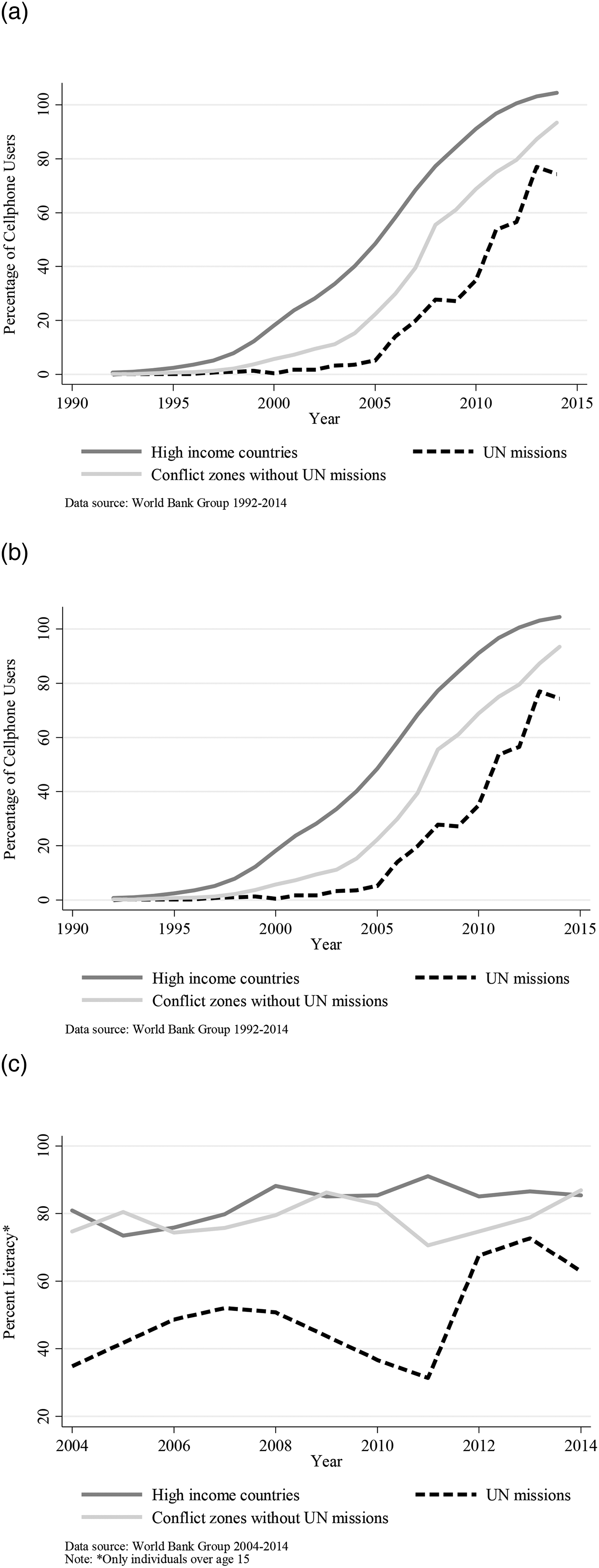
Comparison of technology use and literacy rates 1992–2014. (a) Mobile phone use. (b Internet use. (c) Literacy rates over age 15 (2004–2014).
Conclusion
This project represents one of the first systematic tests of mass media as a peacekeeping tool across geographies and time periods. We employ UN archives in order to chart the use of radio broadcasts within UN peacekeeping missions from 1992 to 2014. We combine archival information with monthly dyadic data on UN mission strength and conflict-related deaths. Although scholars recognize that peacekeeping missions create positive change, our research underscores the importance of utilizing communication strategies, such as UN radio, to further enhance their efficacy. Lessons from this study support the development of more effective strategies for promoting peace and resolving conflicts in vulnerable areas.
The challenging communication conditions in war-torn countries make it difficult for third-party interventions to be successful. The lack of infrastructure, literacy rates, and access to technology are particularly problematic in conflict zones. UN missions are present in some of the poorest areas with the least access to education and technology, which may limit the effectiveness of other forms of mass media. In this context, UN radio provides a low-cost, efficient, and accessible form of mass communication that can help reduce information uncertainties, ameliorate commitment problems, and de-escalate violence, ultimately facilitating conflict resolution. Radio is an inexpensive medium that easily reaches large populations without the need for expensive infrastructure or individual literacy. As such, peace radio broadcasts serve important functions by appealing directly to combatants, providing news and educational programming, deliberately neutralizing and replacing hate speech, publicizing the devastation of the conflict as well as potential settlement negotiations, and serving as international symbols of trust, equality, and national unity. Each of these functions reduces information asymmetries and commitment problems, which represent key impediments to peace. In addition, radio broadcasts have the ability to reach individuals, regardless of their connections to the government or the conflict itself. Peaceful public radio has the power to change public opinions regarding armed violence; this change in public perceptions can accelerate peace processes. Thus, UN radio broadcasts mitigate battle violence indirectly by reducing public support for fighting. Policymakers should consider the potential indirect effect of UN radio broadcasts when designing strategies to promote peace and stability in conflict-ridden regions.
The conventional wisdom associated with the UN peacekeeping missions is ground operations executed by military personnel donning blue berets. By incorporating over 20 years of archival and statistical data, our work emphatically underscores the role of mass media as a vital component of UN mandates. We find that non-traditional UN mechanisms can accelerate peacekeeping operations and violence reduction. Notably, UN peace radio stations represent a lesser-explored resource that has the potential to mitigate violence during times of conflict. This simple, cost-effective, far-reaching tool represents an unqualified best practice for peacekeeping practitioners.
Supplemental Material
sj-dta-2-cmp-10.1177_07388942231216730 - Supplemental material for Peace is in the air: Reducing conflict intensity with United Nations peacekeeping radio broadcasts
Supplemental material, sj-dta-2-cmp-10.1177_07388942231216730 for Peace is in the air: Reducing conflict intensity with United Nations peacekeeping radio broadcasts by Mahtab Shafiei and Kathryn Lauren Overton in Conflict Management and Peace Science
Supplemental Material
sj-dta-3-cmp-10.1177_07388942231216730 - Supplemental material for Peace is in the air: Reducing conflict intensity with United Nations peacekeeping radio broadcasts
Supplemental material, sj-dta-3-cmp-10.1177_07388942231216730 for Peace is in the air: Reducing conflict intensity with United Nations peacekeeping radio broadcasts by Mahtab Shafiei and Kathryn Lauren Overton in Conflict Management and Peace Science
Footnotes

References
Supplementary Material
Please find the following supplemental material available below.
For Open Access articles published under a Creative Commons License, all supplemental material carries the same license as the article it is associated with.
For non-Open Access articles published, all supplemental material carries a non-exclusive license, and permission requests for re-use of supplemental material or any part of supplemental material shall be sent directly to the copyright owner as specified in the copyright notice associated with the article.
