




Abstract
Partition theory holds that ethnic mixing is associated with violence and therefore promotes separation. This article assesses the empirical validity of this logic through a survey in mixed neighborhoods in Israel. The findings largely contrast with partition theory, suggesting that Jewish and Palestinian Israelis interact frequently and positively with each other, and that these interactions are associated with support for contested conflict resolution proposals. Consistent with the psychology literature on inter-group contact, the identified correlations show that even in conflict environments marked by physical separation and violence, ethnic mixing may be related to peaceful interactions and support for conflict resolution.
The physical separation of ethnic groups has often been discussed as a solution to ethnic conflicts (Dicter and Byman, 2006; Hilmyy, 1972; Horowitz, 1985; Johnson, 2008; Kaufmann, 1998; Tir, 2005; Totten, 2015). Ethnic conflicts are believed to harden ethnic identities (Kaufmann, 1996), which can make cross-ethnic appeals unlikely to succeed and partition the only available solution. The long-running Israeli–Palestinian conflict is often suggested as an example of this dynamic. Since the 1947 UN partition plan, policy solutions have focused overwhelmingly on the physical separation of Israelis and Palestinians (Federal Government of the United States, 2020). Today, the majority of Palestinians live separated from Israelis, walled off in the West Bank, under siege in Gaza, or exiled abroad. Policy reports (Dicter and Byman, 2006; Hughes, 2011; Palti, 2004), Israeli government documents (The Israeli Ministry of Foreign, 2004), and academic research (Bhavnani et al., 2014; Kaufmann, 1998) suggest that this physical separation dampens violence, and that reduced contact and increased local segregation are therefore desirable.
What is the empirical validity of these claims? To investigate this question, this article draws on the psychology literature on inter-group contact. This literature shows that ethnic mixing carries benefits that are essential for peacebuilding (Brown and Hewstone, 2005; Christ et al., 2014; Hewstone and Swart, 2011; Lopez Alvarez et al., 2025; Pettigrew et al., 2011; Scacco and Warren, 2018), thus presenting an important theoretical perspective contrasting with partition theory. Although proximity of ethnic groups may, logically, provide opportunities for violence, it also, equally logically, provides opportunities for ethnic mixing. When positive, this mixing between groups—called inter-group contact, insofar as it implies actual interaction and not mere coexistence—can facilitate conflict resolution efforts by improving the groups’ attitudes toward each other (Pettigrew and Tropp, 2006).
This article explores Jewish–Palestinian interactions in a rare setting, where contact between the two groups remains possible: mixed neighborhoods in Israel. 1 These neighborhoods are shared by Jewish Israelis and a minority of Palestinians who hold Israeli citizenship (The Jerusalem Post, 2024). 2 Palestinians with Israeli citizenship lead fundamentally different lives from the majority of Palestinians inhabiting this conflict setting (see, for example, Dornschneider, 2023 on Palestinian life in the West Bank), and we cannot assume that our findings translate to Palestinians outside of Israel. However, focusing on Palestinians within Israel is the only way to study contact between civilian Jews and Palestinians in a natural setting of the conflict environment—Gaza and the West Bank are walled off, which prevents the mixing of Jewish–Palestinian civilians.
Mixed Israeli neighborhoods constitute a most likely setting (Bennett, 2004) for intergroup contact. This provides us with a rare glimpse into the important question of whether ethnic mixing might work at all in this unique setting within a larger, overall conflict. This question is often negated by official Israeli rhetoric and overlooked by existing research focusing on conflict and violence. However, our findings from mixed neighborhoods suggest that peaceful Jewish–Palestinian coexistence may be possible under certain conditions. This is an important observation in its own right, even if it cannot be generalized to other settings of the conflict.
Despite their differences from Palestinians in Gaza and the West Bank, Palestinian citizens of Israel are clearly linked to the broader conflict. This is well documented by academic research revealing their unequal treatment and discrimination (Golan-Agnon, 2006; Nuseibeh, 2019), their suffering from racism and microaggression (Shoshana, 2016), and their differing views on politics, including major episodes of violence like 7 October and the subsequent war on Gaza (The Palestine/Israel Pulse, 2024). 3
Despite the known benefits of contact in mixed neighborhoods (Christ et al., 2014; Schmid et al., 2014; Tausch et al., 2011), relatively few studies have investigated this crucial setting in the Israeli–Palestinian conflict (Goldblatt and Omer, 2016; Shdema et al., 2018; Shtern and Yacobi, 2019). This article provides new empirical data from respondents in 96 mixed neighborhoods in seven cities. To the best of our knowledge, this constitutes one of the largest studies of contact in mixed Israeli neighborhoods and the first to investigate empirically whether inter-group contact in this setting is associated with support for conflict resolution proposals.
Surprisingly, this study records frequent positive self-reports of contact in mixed Israeli neighborhoods, departing from views that ethnic mixing naturally leads to little or negative contact and, ultimately, violence. This contrasts with the partition literature and studies of Israeli–Palestinian violence in the form of inter-state war (Coerdesman, 2006; Louis and Shlaim, 2012), wars between Israel and non-state actors like Hamas (Lambeth, 2012) or Hezbollah (Sobelman, 2016), or other Palestinian actors, often labeled as terrorists (Berrebi and Klor, 2006; Khashan, 2003; Moghadam, 2003).
Our findings also stand in contrast to communal violence in Israeli neighborhoods which took place in 2021 in the same settings as our study, but after our study was conducted (The New York Times, 2021). 4 Rather than revealing underlying animosities, our findings suggest that daily interactions in these settings that later, and briefly, became known for their violence are actually mostly peaceful and positive.
The findings speak to contact programs that have successfully brought together Jewish and Palestinian Israelis (Maoz, 2011). Set up with the specific purpose of facilitating Jewish–Palestinian relations, these programs take place in carefully constructed environments with conditions known to facilitate more positive inter-group relations (Allport, 1954), which differ fundamentally from the real conflict setting in which violence continues. This article adds a rare examination of the real conflict environment.
Consistent with the contact literature more generally (Amir, 1969; Lemmer and Wagner, 2015; Pettigrew and Tropp, 2006; Ramiah and Hewstone, 2013), the findings show an important association between positive contact and support for contested conflict resolution proposals. Among Jews, positive contact with Palestinians is linked to more support for Israeli concessions. 5 Jewish respondents who report positive contact are significantly more likely to support a two-state solution that acknowledges Palestinian statehood, 6 the dismantling of Jewish settlements in the West Bank, and the return of a limited number of Palestinian refugees. This is surprising, since these attitudes represent a major strengthening of the Palestinian position that is widely rejected by Israeli officials (Magid, 2023; Staff, 2018; The Israeli Ministry of Foreign, 2004).
Among Palestinians, positive contact with Jews is associated with support for mutual recognition (Singer, 2021). This finding adds to the psychology literature on the putative sedative effect of contact (Cakal et al., 2011; Pereira et al., 2017; Reicher, 2007), which claims that positive contact reduces motivation to engage in dissent among disadvantaged minorities. 7 Adding to related studies on the Israeli–Palestinian conflict (Albzour et al., 2019; Albzour et al., 2022; Guffler and Wagner, 2017; Saguy et al., 2009; Thornton and Kubinec, 2021), the identified correlation between positive contact and mutual recognition echoes this literature. However, we do not find significant correlations between positive contact and support for the remaining examined conflict resolution proposals.
Our findings on negative contact are consistent with expectations from both partition and inter-group contact theory. Jewish respondents who report negative contact are overall less likely to support Israeli concessions. They show significantly less support for the limited return of Palestinian refugees, and the sharing of holy sites. Conversely, Palestinian respondents who report negative contact are significantly more likely to support the two-state solution, which advances their current status by providing them with statehood. However, Palestinians who report negative contact are not overall less likely to support conflict-resolution proposals.
This article proceeds as follows: first, we introduce the partition debate and the literature on inter-group contact theory; then we present the contested issues explored in the analysis, followed by a discussion of the data and measurement; subsequent sections are dedicated to the main findings of the analysis and their implications.
The partition debate
The Israeli–Palestinian case is characterized by highly salient ethnic cleavages (Kaufmann, 1998; Rouhana and Bar-Tal, 1998; Sambanis and Shayo, 2013). How to overcome these cleavages is hotly debated. While a number of studies highlight the benefits of physical separation of the opposing groups (Bhavnani et al., 2014; Hilmyy, 1972; Kaufmann, 1996), others have outlined the costs of partition (Sambanis, 2000), or the potential of ethnic mixing (Habyarimana et al., 2008).
Prominent research in conflict studies argues that partition is the preferable solution to ethnic conflict because of the dangers associated with ethnic mixing (Horowitz, 1985; Johnson, 2008; Kaufmann, 1996; Kaufmann, 1998; Tir, 2002). Mixing, it is argued, creates a security dilemma, in which opposing ethnic groups are motivated to defeat each other in order to create a safe environment for themselves (Kaufmann, 1998; Mitzen, 2006; Posen, 1993). Given this dynamic, ethnic groups are believed to separate from each other naturally, in the course of conflict, making partition a necessary outcome of ethnic war (Kaufmann, 1998; Tir, 2002; Tir, 2005). Accordingly, the main question to be considered in the settlement of the conflict is how to achieve partition, rather than the question of whether partition is the favorable solution (Kaufmann, 1998).
This logic, often applied to conflict in the Middle East more generally (Dicter and Byman, 2006; Totten, 2015), has been central to policy-making regarding the Israeli–Palestinian conflict. The most prominent example is the 1947 UN partition plan, which proposed two separate states for Jews and Palestinians. However, the plan was never implemented and was followed by numerous wars, involving groups with differing goals, and void of straightforward tit-for-tat logic (Jaeger and Paserman, 2006; Jaeger and Paserman, 2008).
Consistent with partition theory, war has created a conflict situation in which both groups have moved, or been moved, to clearly separated territories. This process has led to power asymmetry (Maoz and McCauley, 2008), with Israel occupying and maintaining settlements on the Palestinian side. Partition theorists argue that the safest way forward is to draw new dividing lines that accept the status quo, as this would make both sides more secure and increase chances of bringing them to support previous peace agreements (Kaufmann, 1998). This view has been bolstered by academic research suggesting that reduced contact between Israelis and Palestinians can be expected to curb ongoing violence (Bhavnani et al., 2014).
Contrary to expectations, however, Palestinian resistance has remained high (Lee, 2016), underlining the limits of military superiority to overcome the security dilemma in this conflict. This outcome is in line with expectations from studies showing that the potential for continued violence is particularly strong if one ethnic group is placed in a more dominant position (Cederman et al., 2011; Ito, 2020).
One of the main arguments against partition is that it creates suffering, which potentially far outweighs the costs of alternative solutions. Forced population movements are known to violate human rights and create long-term grievances (Kumar, 1997). The separation barrier, 8 which is praised by Israel, has worsened economic suffering on the Palestinian side, with increased probabilities of poverty persistence (58%) and entry into poverty (18%) (Sadeq and Lubrano, 2018). According to public opinion polls, most Palestinians (76%) describe their economic situation as bad or very bad (Arab Barometer, 2019). In addition, Palestinians report grave social grievances, such as permanent separation from their families, denials of travel permits, harassment at checkpoints, feelings of imprisonment, and frequent loss of community members through death and imprisonment (Dornschneider, 2023). A well-known source of conflict (Gurr, 1970), these grievances underline the dangers of partition and continued segregation.
The role of inter-group contact
The following analysis provides an important addition to the partition literature by investigating the potential of inter-group contact as a facilitator of conflict resolution efforts in the Israeli–Palestinian case. In general, the partition literature acknowledges the benefits of inter-group contact by suggesting ethnic diffusion (the geographical and social spread of different aspects of one culture to different ethnicities, religions, and nationalities) as an alternative solution to ethnic conflict (Sambanis, 2000). Diffusion, it is argued, makes it harder for a specific ethnic group to gain control over the other (Sambanis, 2000). The inter-group contact literature (Brown and Hewstone, 2005; Christ et al., 2014; Hewstone and Swart, 2011; Pettigrew et al., 2011; Pettigrew and Tropp; 2006) adds to this argument by showing that ethnic diffusion improves inter-group relations by changing inter-group attitudes (Pettigrew and Tropp, 2006), empowering collective action when contact is supportive (Droogendyk et al., 2016), and promoting solidarity-based collective action (Kotzur et al., 2019). Such changes are crucial to bridge ethnic cleavages and overcome the security dilemma in the long term.
Although policy-making has focused on partition in the Israeli–Palestinian context, Israel and third parties 9 acknowledge the importance of contact, and have applied organized contact programs as a means of facilitating conflict resolution efforts (Bekerman, 2002; Maoz, 2000; Steinberg and Bar-On, 2002; Wallach, 2000; Zigenlaub and Sagy, 2020). There has been a large range of efforts, including short-term encounters and more sustained contact in the form of so-called coexistence programs (Hertz-Lazarowitz, 2003; Hughes, 2007; Lazarus, 2011; Maoz, 2011; Maoz and Ellis, 2008; Ross, 2014; Saguy and Kteily, 2014; Shwed et al., 2018; Stephan et al., 2004). 10
In spite of these efforts, empirical studies show important limitations, which include barriers to engaging in contact, experiences of negative as opposed to positive contact, and differing experiences of contact among Jewish and Palestinian participants. Relatedly, there are important problems in the design of the inter-group contact programs (Bekerman, 2007; Maoz, 2011; Thiessen and Darweish, 2018).
Studies show various types of barriers to the occurrence of inter-group contact. Both groups have been found to hold inaccurate understandings of the other's desire for peace (Leshem and Halperin, 2020) and to display limited willingness to engage in contact in the first place (Maoz, 2002; Mi’ari, 1998 ; Ron et al., 2017; Ruesch, 2019; Shwed et al., 2018). In addition, prevailing negative emotions of anger (Halperin and Gross, 2011) or hatred (Halperin, 2008) burden the occurrence of interactions in daily life. Given such difficulties, researchers have observed the need for sustained, long-term contact programs (Lazarus, 2011).
Even when contact takes place, problems arise. Most importantly, the occurrence of negative instead of positive contact poses a challenge (Guffler and Wagner, 2017). While positive inter-group contact improves inter-group relations (Pettigrew and Tropp, 2006), negative inter-group contact is related to increased prejudice (Paolini et al., 2010). Initial work posited that the deleterious effects of negative contact were stronger than the beneficial effects of positive contact (Barlow et al., 2012; Graf et al., 2014), but other studies have shown that the effects of positive contact were as strong as the effects of negative contact (Árnadóttir et al., 2018) and that positive contact is typically more frequent than negative contact (Dhont et al., 2010; Graf et al., 2014). 11
Our first hypothesis follows from research on negative contact and partition theory:
Existing research moreover finds differences in how inter-group contact is experienced by Jews compared with Palestinians. Given the asymmetric nature of the overall conflict, these differences constitute another important challenge. Existing findings show that Jews may show less willingness than Palestinians to engage in contact in the first place (Omer et al., 2018). During contact experiences, the two groups may differ in their perceptions of power (Ben David, 2019). Identity salience may be higher among Palestinians than Jews (Omer et al., 2018), and Palestinians may consider inter-group interactions to be more positive than Jews (Goldenberg et al., 2017). Consistent with the putative sedative effect of contact (Dixon et al., 2012; Droogendyk et al., 2016), positive contact may be associated with decreased support for social change among Palestinians (Albzour et al., 2019; Saguy and Kteily, 2014). Palestinians may also display significantly weaker positive, or more negative attitudinal change than Jews (Ditlmann and Samii, 2016; Gilad et al., 2021).
We explore the association between inter-group contact and attitudes toward six common conflict resolution proposals. Mutual recognition refers to Israel's recognition of the Palestinian Authority as the legitimate representation of the Palestinians and to the Palestinians’ recognition of Israel's right to exist. The two-state solution (Farsakh, 2011; Gordon and Cohen, 2012) envisages a clear land border between Israel and Palestine and international recognition of the two states, unlike the status quo where only Israel is recognized. The right of return of Palestinian refugees, outlined in UN Resolution 194, implies the return of Palestinians to properties currently inhabited by Jews in Israel. While the initial number of Palestinians affected was 750,000, it has risen to 5 million Palestinians (UNRWA, 2022). The dismantling of settlements refers to the Jewish settlements in the West Bank, with close to 700,000 inhabitants in 2021 (UN, 2021). The transfer of neighborhoods refers to land around Jerusalem, privately owned by Palestinians but expropriated by Israel since 1967 (B'Tselem, 2019). Finally, the status of Jerusalem and its holy sites constitutes a major source of contention. While currently Israel controls access to the Jewish Temple Mount and the Muslim Haram ash-Sharif, the 1947 UN plan designated it as having special, international status.
Given intergroup contact theory and these various proposed solutions to the conflict, we formulate the following hypotheses:
Mixed neighborhoods
There are very few settings in which inter-group contact happens naturally in the Israeli–Palestinian context: Gaza is under siege, the West Bank is walled off with highly securitized Israeli settlements, and most cities in Israel have a clear Jewish majority (Central Bureau of Statistics, 2022). Nevertheless, there are some mixed cities, and this study adds to research on this unique setting (Falah, 1996; Leibovitz, 2007; Monterescu, 2011; Omer et al., 2018; Schnell et al., 2015; Shdema et al., 2018).
So-called “mixed cities” in Israel, are, however, known to have high levels of segregation (Leibovitz, 2007), which limit inter-group contact. Some research has responded to the difficulty of studying inter-group contact empirically by applying agent-based modeling to inter-group interactions (Bhavnani et al., 2014). Our study adopts a different strategy by focusing on the more granular level of mixed neighborhoods within mixed cities. These neighborhoods offer a unique natural setting in which to investigate inter-group contact empirically. Owing to their more constrained geographical area, mixed neighborhoods offer an increased chance to observe inter-group contact (Goldblatt and Omer, 2016).
Contrasting with studies supporting the physical separation of Jews and Palestinians, existing research on mixed neighborhoods in Israel suggests that most Palestinian and Jewish residents have some kind of peaceful contact with each other (Abraham Initiatives, 2019). This positive outlook is confirmed by related studies of intergroup contact in natural settings, including re-developments like malls, new city districts, and public transport (Shtern, 2016; Shtern and Bollens, 2023; Shtern and Rokem, 2023), as well as mixed social settings like hospital teams (Raz-Rotem et al., 2020) and the labor market (Shtern and Rokem, 2023).
Research on mixed cities is very limited. The most systematic data collection is undertaken by the Abraham Initiatives, which survey mixed cities in Israel. However, these data have not yet been examined by research published in academic journals. The existing literature focuses mostly on isolated neighborhoods, including Tel Aviv–Jaffa (Goldblatt and Omer, 2014; Leibovitz, 2007; Omer et al., 2014) and the French Hill neighborhood in Jerusalem (Shtern and Yacobi, 2019), or specific cities, such as Haifa (Leibovitz, 2007; Shdema et al., 2018), or Lod and Ramla (Shdema et al., 2018). Its research focus is diverse, ranging from tolerance (Omer et al., 2014) to citizenship (Leibovitz, 2007), shared identity (Shtern and Yacobi, 2019), neighborhood perception (Goldblatt and Omer, 2014), social integration (Shdema et al., 2018), and space (Goldblatt and Omer, 2016; Omer et al., 2014; Shdema et al., 2018; Shtern and Yacobi, 2019). 12
The overall outlook of these studies is positive, suggesting that social integration between Jews and Palestinians is happening (Leibovitz, 2007; Shdema et al., 2018), that inter-group attitudes are characterized by tolerance (Goldblatt and Omer, 2014), and that shared identities are forming (Shtern and Yacobi, 2019). Nevertheless, numerous obstacles discussed in the previous parts of this article are acknowledged, including ethnic tensions (Leibovitz, 2007), ongoing segregation (Shdema et al., 2018), practices of avoidance (Omer et al., 2014), or ethno-nationally motivated competition over space (Shtern and Yacobi, 2019). Obstacles to peaceful co-existence are also highlighted by recent experiences of communal violence in mixed neighborhoods in Israel (The New York, 2021).
Data collection and measurement
Our survey 13 was conducted in 2019 in seven mixed Israeli cities—Lod, Ramle, Acre, Haifa, Jaffa, Upper Nazareth and Ma’alot-Tarshiha. Within these cities, we identified 96 mixed neighborhoods, based on demographic information published by the Israeli Central Bureau of Statistics. The survey included telephone interviews with 315 Jewish and 287 Palestinian Israelis, who were given a choice of language. 14
Sampling relied on the database of households in Israel and corresponded to the size of the neighborhoods. The mean proportion of the Jewish population in the sampled neighborhoods was 0.61 (SD = 0.32; min = 0.003; max = 0.999). We tested for neighborhood random effects, but the related intraclass correlation coefficient is very small (0.04 or less) and so these effects are not included in the models below.
Sampling proceeded in two stages, with the goal of constructing a random sample of Jewish and Palestinian Israelis in each neighborhood. In the first stage, phone numbers of those sampled were collected, which were subsequently used as an “address book.” Within the household, one person over 18 years of age was interviewed. Interviewees who were not reached were listed in a log that monitored return calls on different days and times, or according to a time set with the interviewee. Calling took place over five days, at different times and on different days, with up to four repetitions per household and one attempted persuasion call for refusers.
Based on this procedure, we obtained a response rate of 24% for each group. Owing to the sensitivity of our research subject and the difficulty of accessing the research setting, this rate is lower than that of surveys conducted in Israel in other research fields, but standard for telephone data collection procedures among the general public (see the Online Appendix for more information). While researchers in health studies have reported higher response rates in Israel than in the US (Ziv and Schellekens, 2020), surveys of Palestinian Israelis in particular have reported a “low response rate” (Abraham Initiatives, 2015). A study focusing on ethnic diversity and prejudice against Palestinian doctors within Israeli healthcare similarly acknowledged the “challenges relating to the low response rates of surveys” (Weiss, 2021). For comparison, telephone surveys worldwide show response rates declining into the single digits (Dutwin and Buskirk, 2021).
In response to these challenges, our sampling procedure was designed to ensure balance between Jewish and Palestinian respondents. The resulting parallel structure of participation across groups supports the internal validity of our comparative analyses between Jewish and Palestinian respondents. Thus, while we cannot exclude sampling bias, the balanced distribution of our sample ensures that any bias is non-differential.
The collected data are cross-sectional and observational and therefore cannot provide information on the direction of causality. The many challenges for survey research in this particular context prevent a longitudinal design (e.g. given the low initial response rate, with further attrition the sample size would be unusable). Furthermore, the focus on inter-group contact in a natural setting, and the associated focus of our research on both negatively and positively valenced contact, do not lend themselves to experimental manipulation (e.g. manipulating negative contact in this context would probably be dangerous and thus unethical). In the current research design we cannot, of course, exclude the possibility that the association between positive contact and support for proposals for conflict resolution is endogenous.
Nevertheless, these correlations between contact and attitudes on proposals for conflict resolution provide important, counterintuitive information that advances our understanding of the conflict in a meaningful way. Even if causality cannot be established, the identified correlations do not correspond to the expectations of partition theory. Given the current violence and the general focus on violence to study this conflict, the finding that Jewish–Palestinian contact in mixed neighborhoods is mostly positive is very important and encouraging. Even if respondents self-selected to interact or inflated the frequency of the interaction, this finding is remarkable.
Finally, we acknowledge further limitations regarding, or omitted, by our survey. Unfortunately, we did not include a question on the respondents’ self-identification along national vs. ethnic lines, which could have helped in our interpretation of the results. Future studies may also make the reference period of contact even more explicit (e.g. anchoring it to a specific week or month). Nevertheless, our survey included more than 80 questions in total, and the Online Appendix shows analyses on additional questions on trust and empathy, to investigate whether these influenced the findings reported in this article.
Contact
The survey included fourteen questions from which we developed inventories of positive (Positive Contact Inventory, PCI) and negative (Negative Contact Inventory, NCI) contact experiences. The inventories are based on seven separate questions on positive and negative contact experiences respectively. Both inventories are internally consistent, with NCI having a Cronbach α value of 0.88 and a PCI of 0.96. Answers to questions related to the inventories were based on five-point scales, ranging from “never” (1) to “several times a week” (5), 15 including the additional options “don’t know” and “prefer not to say.” 16
With regard to NCI, we asked: Have [outgroupers] in your neighbourhood ever treated you as follows … … treated you as inferior … verbally abused you … threatened you … forced you to do something you didn’t want to … unfairly criticized you … made you feel unwanted … treated you as a threat.
With regard to PCI, we asked: Have [outgroupers] in your neighbourhood ever treated you as follows … … treated you as an equal … were friendly to you … shown you that they appreciated you … respected you … been generous to you … made you feel that they were not judging you … been nice to you.
Attitudes on Israeli concessions
The survey also includes questions investigating the respondents’ attitudes to the previously discussed issues. As above, all answers are based on five-point scales, ranging from “very much oppose” to “very much support,” including the additional options “don’t know” and “prefer not to say.” 17
Each issue is addressed by a separate question. With regard to mutual recognition, we asked: “There is a proposal that there will be a mutual recognition of Israel as the state of the Jewish people and Palestine as the state of the Palestinian people. Do you support or oppose this proposal?” Related to the two-state solution, we asked: “Do you support or oppose the political solution based on the establishment of a Palestinian state alongside Israel, known as the two-state solution?” Concerning the dismantlement of the settlements, we asked: “To what extent do you support or oppose dismantling most of the settlements in the territories as part of a peace agreement with the Palestinians?”
We also asked respondents about their views on statements expressing each of the remaining attitudes. The statement on return of the refugees read: “A limited number of Palestinian refugees should be permitted to return to Israel.” The statement on the return of Palestinian neighborhoods in Jerusalem read: “Arab neighbourhoods in Jerusalem—except for the Old City—should be transferred to the Palestinians.” The statement on the sharing of the holy sites read: “The Temple Mount should be given to the Palestinians and the Wailing Wall retained by Israel.”
To capture all the responses, we computed the average response to the six questions on contested issues (Cortina, 1993). High scores indicate support for Israeli concessions. The obtained Cronbach's α, across the six items, of 0.76 indicated an acceptable level of consistency.
Control variables
Control variables address contact outside of the neighborhood, and demographic variables related to gender, education, and age. With regard to contact outside of the neighborhood, we asked respondents two questions, focusing on positive and negative contact experiences. Regarding positive contact, we asked: “In general, how often do you have positive contact with [OUTGROUP] people outside your neighbourhood?” Regarding negative contact, we asked: “In general, how often do you have negative contact with [OUTGROUP] people outside your neighbourhood?” Answers were provided based on five-point scales, ranging from “never” to “several times a week,” including the additional options “don’t know” and “prefer not to say.” Education was captured by eight categories ranging from “primary education or less” to “complete higher tertiary degree (MA).”
Findings
Contact frequencies
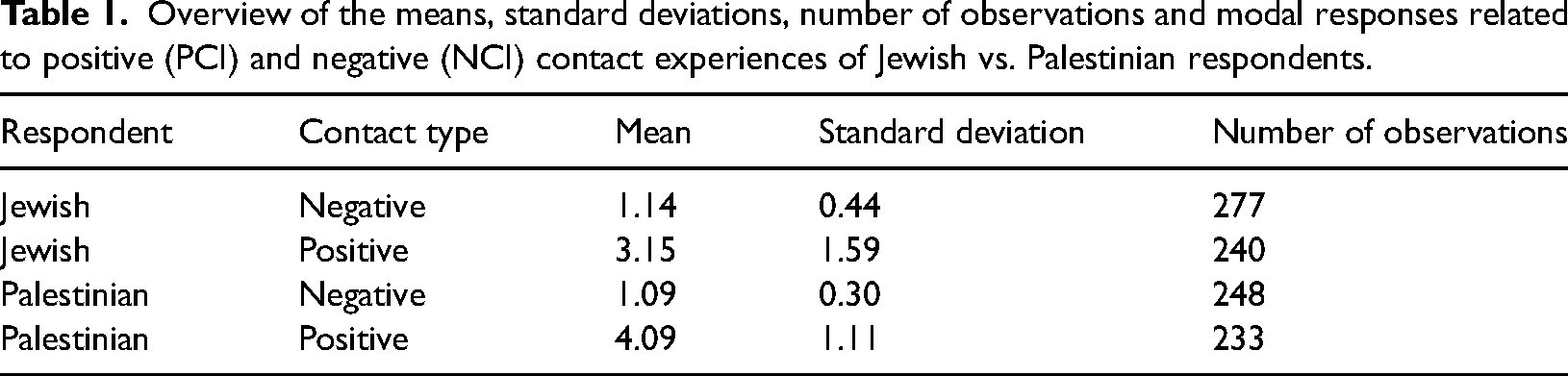
On average, positive contact experiences are reported “once or twice a month” by Jews and “once a week” by Palestinians. The modal occurrence of negative contact experiences is described as “never” by both groups. Table 1 gives an overview, including means, standard deviations, and number of observations. As shown in Table 1, the range of scores for negative contact (for both Jews and Palestinians) was restricted. We checked whether the scores were normally distributed and found that they were skewed (see the replication file, Attitudes [Palestinian and Jewish respondents]). We therefore computed all subsequent analyses using the bootstrapping procedure (Efron and Tibshirani, 1994).
Overview of the means, standard deviations, number of observations and modal responses related to positive (PCI) and negative (NCI) contact experiences of Jewish vs. Palestinian respondents.
We conducted a 2 (respondent identity: Jewish vs. Palestinian) × 2 (contact type: positive vs. negative) mixed analysis of variance (ANOVA), with repeated measures on the second factor, to investigate whether there are significant mean differences between reported positive vs. negative contact frequencies and Jewish and Palestinian respondents. The analysis revealed a significant main effect of respondent identity, F(1, 461) = 49.80, p < 0.001, a significant main effect of contact type, F(1, 461) = 1399.64, p < 0.001, as well as a significant interaction between the two, F(1, 461) = 59.12, p < 0.001.
We followed up with Tukey-corrected pairwise comparisons of the estimated marginal means of the interaction. Contrary to Hypothesis 1, respondents reported significantly more positive than negative contact, regardless of their identity: specifically, Jewish respondents reported a higher frequency of positive contact (M = 3.15, SE = 0.09) compared with negative contact (M = 1.15, SE = 0.03), t(461) = 21.09, p < 0.001; the same pattern was found for Palestinian respondents as they also reported a higher frequency of positive contact (M = 4.12, SE = 0.09) compared to negative contact (M = 1.09, SE = 0.03), t(461) = 31.79, p < 0.001. Furthermore, Palestinian respondents reported a higher frequency of positive contact compared to Jewish respondents, t(461) = 7.69, p < 0.001. However, no difference in the reported frequency of negative contact between Jewish and Palestinian respondents was detected, p = 0.32.
These findings contrast with policy reports and academic research associating mixing in the Israeli–Palestinian conflict with negative contact, or violence. The present data instead suggest that where contact remains possible, daily interactions are largely positive, thus facilitating peaceful co-existence and conflict resolution efforts (Figure 1).
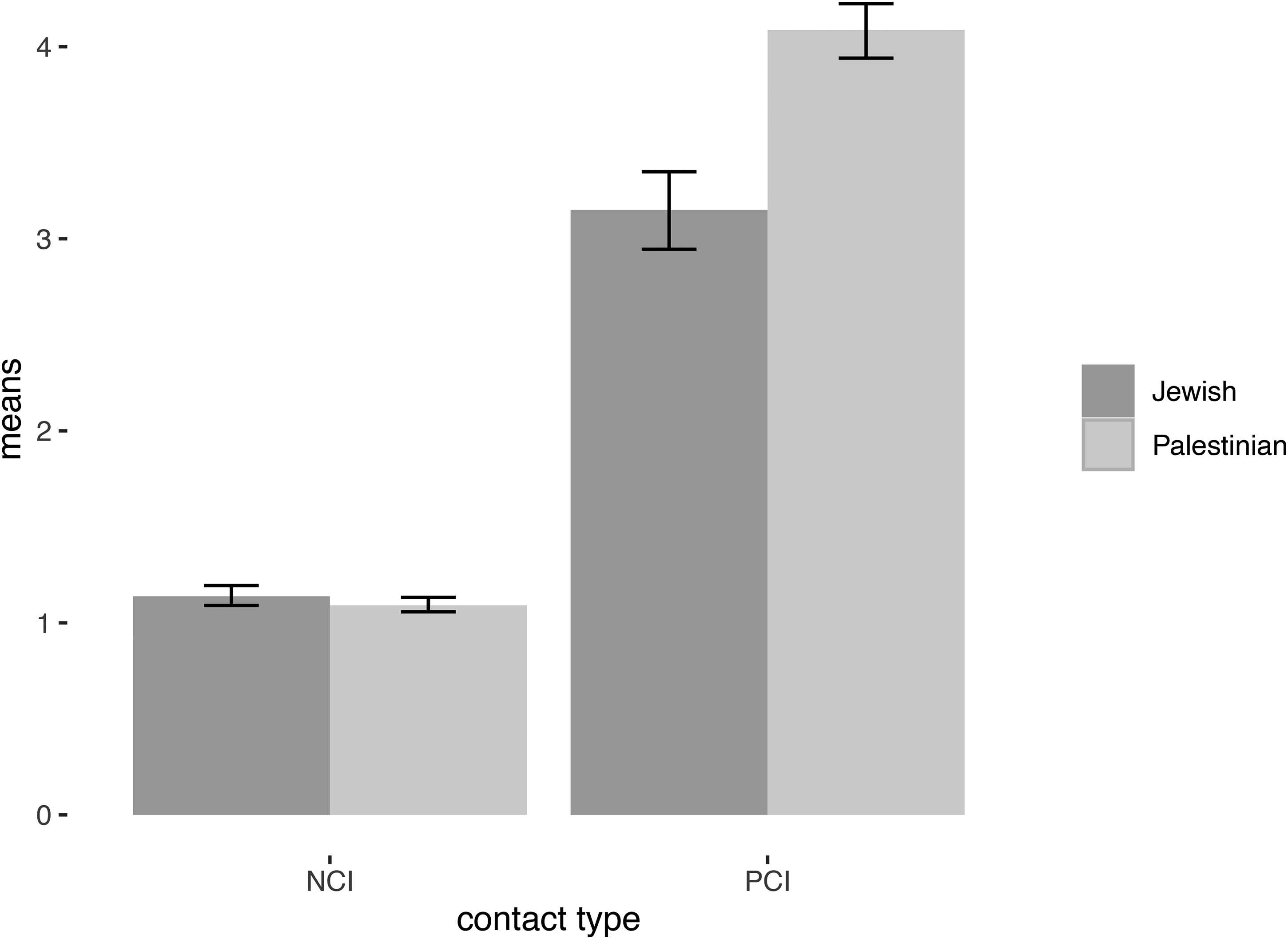
Means and standard errors for positive (PCI) and negative (NCI) contact reported by Jewish vs. Palestinian respondents, with 95% confidence intervals based on 2500 bootstrapped samples.
The findings are particularly surprising in light of the communal violence that happened in mixed cities across Israel in 2021, after our data collection. Our research, conducted in neighborhoods located within these cities, shows frequent peaceful interactions in the same setting. Consistent with the sudden outbreak and subsequent ending of communal violence, this suggests that violence is the exception rather than the rule.
Contact and attitudes
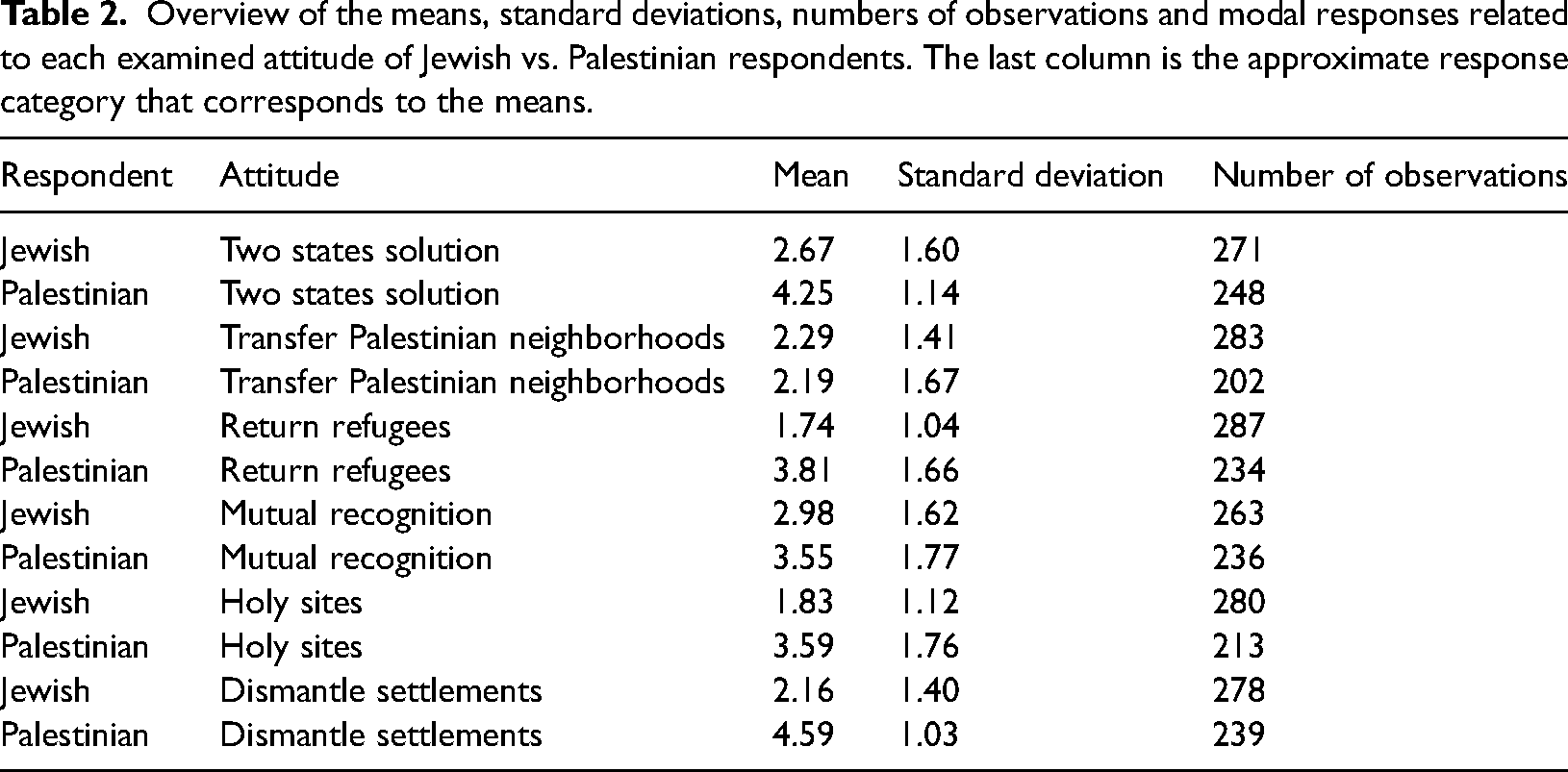
We applied regression analysis 18 to investigate the association between contact and attitudes to Israeli concessions. The findings provide some confirmation of the expected role of positive contact among Jewish, but not among Palestinian, respondents. The findings are shown in Figure 2. Table 2 additionally gives an overview of mean averages, standard deviations, and observation numbers for each attitude. The Online Appendix provides the regression tables from which Figure 2 was generated as well as visualizations of the frequencies for each of the examined attitudes. The Online Appendix also provides additional analyses, specifically coarsed exact matching to evaluate the overall robustness of our findings; structural equation modeling to add some nuance to the findings; multicollinearity; model fit indices (AIC and BIC); an analysis of the balance of positive vs. negative contact; a sensitivity analysis; and an analysis of simulated correlated measurement error.
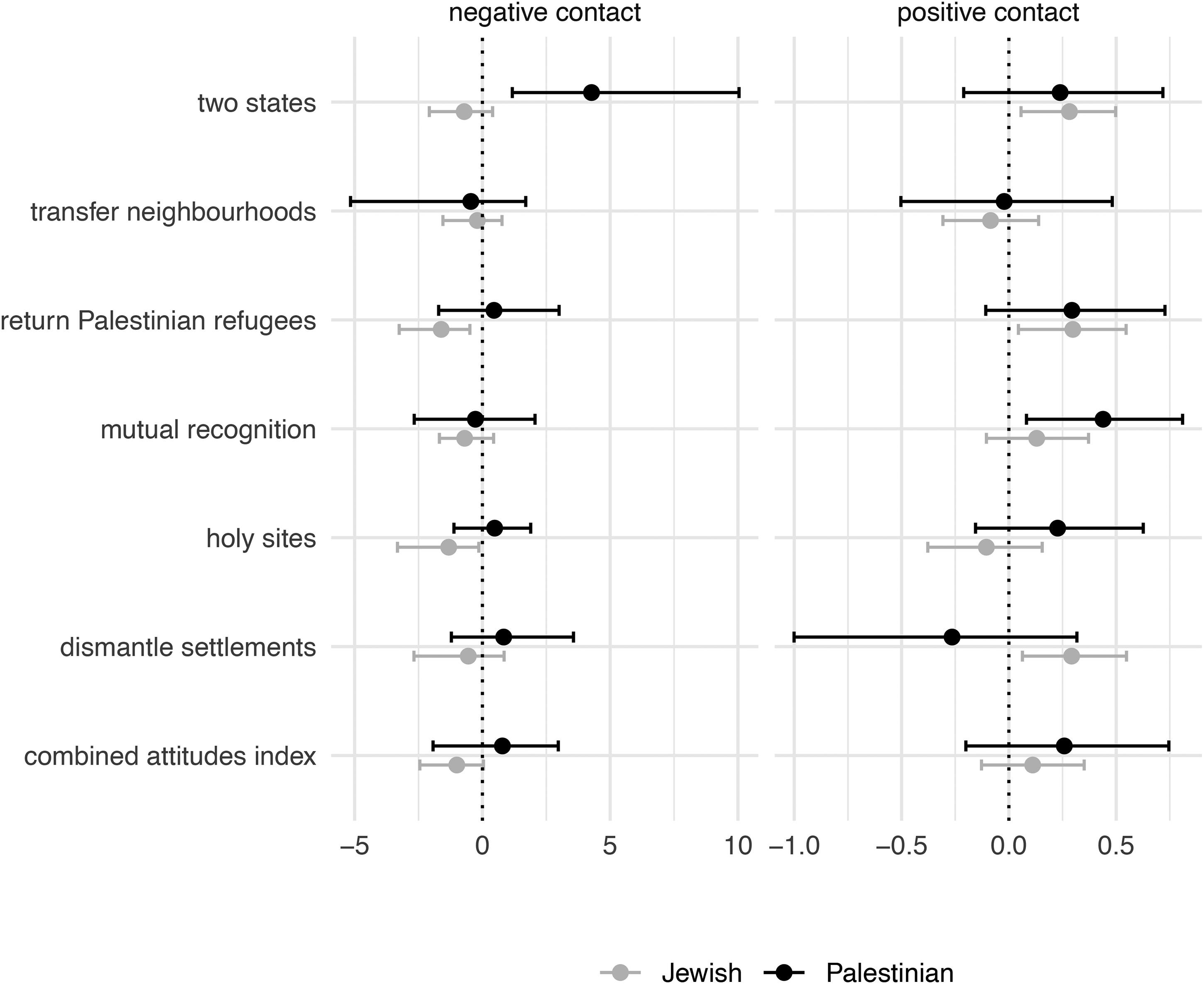
Overview of the regression coefficients, showing the effects of positive or negative contact for Palestinian and Jewish respondents on attitudes, with 95% confidence intervals based on 2500 bootstrapped samples. The combined attitudes index combines the responses to all six measures. Each of the variables corresponds to a separate regression analysis. The Online Appendix shows the regression tables.
Overview of the means, standard deviations, numbers of observations and modal responses related to each examined attitude of Jewish vs. Palestinian respondents. The last column is the approximate response category that corresponds to the means.
Looking, first, at positive contact, the analysis shows that, consistent with Hypothesis 2a, among Jewish respondents this form of contact is positively associated with more support for Israeli concessions. Jewish respondents who report more positive contact with Palestinians hold significantly more positive attitudes on the two-state-solution, the dismantling of the settlements, and the return of refugees. Nevertheless, there are limitations, shown by the small size of the effects and the non-significant findings regarding the combined attitudes index, as well as the return of Palestinian neighborhoods in Jerusalem and the sharing of the holy sites in Jerusalem.
The non-significant findings on positive contact suggest that concessions involving Jerusalem may be particularly hard to support for Jewish Israelis. Jerusalem is one of the most contested and symbolically charged spaces in the Israeli–Palestinian conflict. The holiest city in Judaism, it is the site of the First and Second Temples, with the Western Wall serving as the key prayer location. Jerusalem is also claimed as a capital by both Israelis and Palestinians. Israel recaptured the city in the 1967 war and passed a law declaring Jerusalem its capital in 1980. 19 For decades, Israel has tried to consolidate control over Jerusalem by building Jewish neighborhoods in and around Palestinian neighborhoods in East Jerusalem. In negotiations, the city's status remains a core issue of contention, with concessions away from the current status seen as a zero-sum loss.
Among Palestinian respondents, the expected role of positive contact is not confirmed. Contrary to Hypothesis 2b, no significant negative associations between positive contact and support for Israeli concessions are identified. Instead, the analysis finds a significant positive association between positive contact and support for mutual recognition concerning the broader recognition of Israel rather than particular contested conflict resolution proposals. Contrary to prior claims of a sedative effect of positive contact (Dixon et al., 2012; Droogendyk et al., 2016), this finding is consistent with the lack of support for a sedative effect found by Reimer and Sengupta (2023) in their meta-analysis. In the case of the Israeli–Palestinian conflict, the absence of such an association among Palestinians living in mixed Israeli neighborhoods may reflect the prolonged history of unsuccessful negotiations, compounded by a deeply rooted sense of injustice within the Palestinian community.
Turning to negative contact, the analysis identifies some evidence supporting the hypothesized role of this form of contact for Jewish, but not Palestinian, respondents. Consistent with Hypothesis 3a, there are significant negative associations between negative contact and attitudes on Israeli concessions among Jews. This is found regarding the return of refugees and the sharing of the holy sites. The findings regarding the remaining attitudes and the combined index align with this pattern, showing associations consistently in the same direction, even though not statistically significant. These results are in line with expectations from both partition and contact literatures, which suggest that negative contact with Palestinians is connected with decreased willingness to make concessions among Jews.
Regarding Palestinians, the analysis identifies a significant positive association between negative contact and attitudes on Israeli concessions. Consistent with Hypothesis 3b, it shows a significant positive correlation between negative contact and support for the two-state solution. This result makes sense, suggesting that respondents with more negative contact experiences are more likely to support a (two-state) solution which keeps the two groups apart. No additional significant associations are found between negative contact and the remaining attitudes or the combined index.
While a two-state solution could, in principle, be negotiated on the basis of land currently inhabited by Palestinians, the remaining attitudes concern Israeli concessions that would involve returning territory not presently under Palestinian control—specifically transferring neighborhoods, allowing the return of Palestinian refugees, dismantling Jewish settlements in the West Bank, and establishing shared access to the holy sites. In addition, the remaining attitudes include the broader symbolic acknowledgement of Palestinians through mutual recognition. These non-significant results might show that Palestinians with more negative contact experiences view such Israeli concessions as highly unlikely. In contrast, they might see a two-state solution as more attainable, especially in light of international support for Palestinian statehood, such as UN Resolution 67/19, which upgraded their status from “observer entity” to “non-member observer state.” However, our survey did not include specific questions that would allow us to empirically assess these interpretations, and future studies are needed to explore them.
Conclusions
Consistent with arguments from partition theory, policy recommendations in the Israeli–Palestinian conflict typically suggest separating Jews and Palestinians (Bhavnani et al., 2014; Kaufmann, 1998; Palti, 2004; The Israeli Ministry of Foreign, 2004). Contrary to this understanding, our analysis of mixed Israeli neighborhoods suggests that contact between the two opposing groups is mostly positive and associated with support for contested conflict resolution proposals. These findings are consistent with the psychology literature, which shows that positive contact can facilitate better associations between opposing groups by improving their attitudes towards each other (Pettigrew and Tropp, 2006). Our study shows that, in addition, positive contact may be associated with more conciliatory attitudes on contested conflict resolution proposals. This finding is surprising, as the Israeli–Palestinian conflict is known for its high levels of violence (Jaeger and Paserman, 2008), frequent breakdowns of negotiations (Louis and Shlaim, 2012), and failures of decade-long peacebuilding efforts (Hirsch-Hoefler et al., 2016).
Our data came from a unique survey conducted at the granular level of mixed neighborhoods in Israel. They offer new insight into inter-group interactions in natural mixed environments of this typically highly segregated conflict setting, where most Jews and Palestinians do not have the chance to interact normally with each other.
Overall, the findings confirm existing studies highlighting the importance of Jewish–Palestinian contact (Gilad et al., 2021; Hertz-Lazarowitz, 2003; Hughes, 2007; Lazarus, 2011; Maoz and Ellis, 2008; Ross, 2016; Saguy and Kteily, 2014). The findings show, for the first time, that positive inter-group contact may be associated with more support for concessions among Jews, who constitute the more dominant conflict party. Since this party is widely believed to have no incentive to make concessions owing to its dominance (Lustick, 2013), this finding is especially encouraging. Among Palestinians, we find that positive contact is associated with support for mutual recognition.
In contrast, negative contact, although reported much less frequently than positive contact, is, unsurprisingly, associated with less support for conflict resolution proposals. Jewish respondents who report negative contact are overall less likely to support Israeli concessions, showing significantly less support for the return of Palestinian refugees and the sharing of the holy sites. Conversely, Palestinian respondents who report negative contact are significantly more likely to support the two-state solution, which advances their current status by providing them with statehood.
These findings are consistent with expectations from partition theory, according to which negative contact may increase existing divisions. Nevertheless, the findings regarding Palestinians are remarkably limited, identifying no additional significant associations between negative contact and attitudes on conflict resolution proposals. Most importantly, there is no significant association between negative contact and the combined attitudes index. As such, the findings suggest that negative contact with Jews is not linked to generally decreased support for conflict solution proposals, at least among Palestinians living in Israel. This finding contrasts with views that link Palestinians with violence and terrorism (Abrahms, 2004; Jaeger and Paserman, 2006; Merari and Elad, 2019; Rubin, 2014), suggesting that Palestinians are more supportive of conflict resolution proposals than is often assumed.
Future studies are needed to further explore these findings. Related research could adopt a mixed-methods approach complementing survey data with qualitative interviews. Such interviews could provide meaningful additions to our findings by showing the interpretations and broader lived experiences of respondents. Future research may also draw on existing data on conflict at the neighborhood level, provided by the Armed Conflict Location Events Dataset, for example. Such data analyses may show whether conflict exposure influences attitudes on conflict resolution proposals, beyond self-reports by survey respondents. Finally, future research could aim to identify settings suitable for experimental or longitudinal designs within mixed Israeli neighborhoods. Studies of these settings could help to uncover causal mechanisms underlying peaceful coexistence.
Supplemental Material
sj-pdf-1-cmp-10.1177_07388942261427231 - Supplemental material for Positive contact dominates Jewish–Palestinian interactions in mixed Israeli neighborhoods
Supplemental material, sj-pdf-1-cmp-10.1177_07388942261427231 for Positive contact dominates Jewish–Palestinian interactions in mixed Israeli neighborhoods by Stephanie Dornschneider-Elkink, Oliver Christ, Sarina J. Schäfer, Anja Katrin Munder, Samer Halabi, Ifat Maoz and Danit Sobol-Sarag in Conflict Management and Peace Science
Supplemental Material
sj-docx-2-cmp-10.1177_07388942261427231 - Supplemental material for Positive contact dominates Jewish–Palestinian interactions in mixed Israeli neighborhoods
Supplemental material, sj-docx-2-cmp-10.1177_07388942261427231 for Positive contact dominates Jewish–Palestinian interactions in mixed Israeli neighborhoods by Stephanie Dornschneider-Elkink, Oliver Christ, Sarina J. Schäfer, Anja Katrin Munder, Samer Halabi, Ifat Maoz and Danit Sobol-Sarag in Conflict Management and Peace Science
Footnotes
Acknowledgments
We thank Anat Oren and Karin Bar at BI Cohen for implementing our survey. We also thank the editor, Marius Mehrl, and three anonymous reviewers for their helpful feedback. Finally, we acknowledge valuable comments from participants in panels on intergroup conflict at the annual meetings of the American Political Science Association (2021) and the International Society of Political Psychology (2023).
Declaration of conflicting interests
The authors declared no potential conflicts of interest with respect to the research, authorship, and/or publication of this article.
Ethical approval
The underlying research is a survey executed by a respected polling company in Israel. BI Cohen operates under a code of ethics and under the strictest privacy protection guidelines, as required in international surveys. The implementation of our survey design is considered ethically permissible under the guidelines of the German Psychological Association (the context in which we secured funding for our study), which are aligned with the standards set forth by the American Psychological Association. The Fernuniversitaet Hagen established that ethical approval was not deemed necessary.
Funding
The authors disclosed receipt of the following financial support for the research, authorship, and/or publication of this article: This research was funded by the Deutsche Stiftung Friedensforschung (German Foundation for Peace Research), grant number PS 01/12-2016.

Supplemental material
Supplemental material for this article is available online.