




Abstract
Cities throughout the world face the challenge of preparing for climate change impacts. Since urban climate adaptation is an emerging policy domain, however, few institutions exist to guide cities among the first to take action. Drawing on institutional theory and case study research, this article examines the initiation and development of adaptation planning in two cities in the global south: Durban and Quito. The cases suggest that action in nascent policy domains is motivated by endogenous factors and sustained by taking advantage of opportunities rising and creatively linking new agendas to existing goals, plans, and programs.
Cities throughout the world are experiencing new weather and climatic patterns that are being attributed to global climate change (IPCC 2007). As temperatures and precipitation shift over time, many scientists argue that urban areas will need to cope with a host of events, including increased incidence of heat waves, water shortages, storm surges, and natural disasters. The impacts of these events will stress urban infrastructure, decrease the habitability of many buildings, tax services, and in the process, create housing, health, and livelihood hardships for the most vulnerable residents (Satterthwaite et al. 2007; Dodman and Satterthwaite 2008). While cities in all regions are at risk, scientific projections suggest that urban areas in the global south are likely to experience some of the most immediate and severe impacts.
Minimizing the impacts that climate change will have on cities requires that municipalities make concerted efforts to protect natural systems, the built environment, and human populations. Since urban areas play a significant role in anthropogenic warming (IPCC 2007; Satterthwaite 2008), climate action plans typically focus on mitigation or measures designed to reduce greenhouse gas emissions. In contrast, adaptation refers to efforts that reduce vulnerability against current or expected impacts of climate change (IPCC 2007). While cities are places where synergies between adaptation and mitigation measures can take root, they differ in orientation and emphasis. Mitigation programs typically focus on developing clean technologies or changing consumer demand. In contrast, urban adaptation casts a wider net. It not only requires that municipal officials and agencies set policies and performance targets that foster emission reduction but that they engage in comprehensive actions to make their cities more sustainable and resilient.
Climate mitigation initiatives are taking place in cities around the world. However, despite the high visibility that adaptation has on the global policy agenda and the imperative for cities to initiate action, relatively few have made concerted efforts to develop dedicated adaptation plans or to set adaptation initiatives in motion. Since action has been dominated by mitigation, urban research has emphasized policies, programs, and planning initiatives designed to reduce greenhouse gas emissions (e.g., Gore and Robinson 2009; Schreurs 2008; Zaharan et al. 2008; Bulkeley and Betsill 2005; Robinson and Gore 2005). While some scholarly attention has been directed to adaptation, empirical research has focused on risk assessments, the role of participation, and the creation of policies and plans within specific sectors (e.g., Kirshen, Knee, and Ruth 2008; van Aalsta, Cannon, and Burton 2008; Few, Brown, and Tompkins 2007). Among those studies that address urban adaptation planning (e.g., Lwasa 2010; Sharma and Tomar 2010; Hamin and Gurran 2009), few investigate motivations or consider the broader issue of how new policy agendas such as this take root and can be implemented in cities. Therefore, in this article, we investigate climate adaptation planning in two cities in the global south—Durban, South Africa, and Quito, Ecuador—in order to understand what leads cities to initiate planning processes and how initiatives in this emerging policy domain are able to emerge and become established in the absence of norms and models to guide action. This study illustrates that climate adaptation initiatives are motivated by endogenous factors and sustained as a consequence of local actors taking advantage of opportunities that arise and creatively weaving this emerging agenda into existing goals, plans, and programs.
Climate Adaptation Planning and Institutional Change
City plans and planning processes typically reflect goals that local public officials, representatives, and communities seek to advance. According to neo-institutional theorists, municipal governance also is shaped by the local institutional landscape (Healey 1999; Lowndes 2001). Institutions are composed of formal rules and informal codes of behavior that shape expectations and guide interactions (North 1990; Ostrom 1990). Formal institutions are associated with regulations, standards, and policies. As a result, they tend to be implemented by government actors who rely on the threat of sanctions to ensure conformity (DiMaggio and Powell 1983; Scott 2001). Urban institutions also include informal norms such as best practices and conventional wisdom that take root through the course of normal interactions among stakeholders (DiMaggio and Powell 1983; North 1990; Scott 1995). Whether formal or informal, institutional rules and norms come to be accepted as the appropriate way to behave and, therefore, condition urban decisions and actions (Healey 1999, 2006; Lowndes 2001).
Institutional conditioning may lead to inertia (DiMaggio and Powell 1991), but the goals, management approaches, policies, and priorities of many cities still have changed over time. For instance, public officials traditionally advanced the goals of the welfare state. From this perspective, planners and other government representatives ostensibly worked to address the needs of all of the citizens within their jurisdiction with the goal of ensuring social protection (Saunders 1979; Castells 2000). As economic development came to dominate urban agendas, policies were reoriented to support economic growth and city governments shifted from a managerial to an entrepreneurial orientation (Logan and Molotch 1988; Harvey 1989). Today, most cities remain dedicated to economic development and private capital accumulation, often to the detriment of social redistribution and social cohesion (Squires 1991; Mollenkopf 1983; Sassen 1991).
More recently, some municipal governments have been moving beyond traditional models of economic development by addressing sustainability and resilience in their goals and initiatives. The movement toward sustainable cities has been growing since the mid-1990s when concerns about environmental quality and equity in urban areas were joined with emerging ideas about localism. The fundamental principle gaining traction at the time was that people are most concerned about, and therefore most likely to improve, the environmental and social conditions that affect them directly (Selman 1996; Portney 2003). Cities pursuing sustainability have altered their priorities to balance economic vitality with improvements in environmental quality and social justice. This suggests that advancing an adaptation agenda will require shifts in the values and goals guiding city priorities as well as adjustments in the institutional frameworks related to decisions and actions (Healey 1999; Lowndes 2001).
Exogenous and Endogenous Forces Associated with Early and Late Adopters
Transitions in city goals and priorities over time demonstrate that urban institutions can and do change. However, there are competing views regarding how and why change takes place. From one point of view, exogenous pressures are the dominant motivating force for transformation such as when sudden shocks disrupt the established order (Thelen and Steinmo 1992). Shocks often are associated with violent conflict, but from a climate perspective they primarily are linked to the experience and impacts of natural hazards (Amundsen, Berglund, and Westskog 2010; Penning-Rowsell, Johnson, and Tunstall 2006). In addition to extreme events, different types of incentives also can serve as exogenous forces that create imperatives for change (Meyer and Rowan 1977; Zucker 1988). With respect to climate adaptation, likely sources of incentives will be national climate regulations and plans as well as sector-based policies, such as coastal regulations, as these create imperatives for action (Amundsen, Berglund, and Westskog 2010; Urwin and Jordan 2008). Support from development banks and foundations also may serve as incentives for action through the provision of monetary and technical assistance to cities. While incentives offer desired rewards, they also can constrain action by requiring adherence to behavioral or reporting standards (Scott 1995).
The diffusion of information and ideas are additional forces that can serve as exogenous drivers of subnational change (Clemens and Cook 1999). The presence of dense network ties can foster stability rather than change (Zucker 1988). However, since networks are a means through which institutional rules and norms are diffused (Strang and Meyer 1993; Strang and Soule 1998), they also can be influential in facilitating the adoption of new forms of action (Tolbert and Zucker 1983). Previous research suggests that urban climate mitigation initiatives have been shaped by the diffusion of information and ideas stemming from transnational sources, including other cities, professional associations, development banks, and intergovernmental (IGO) and nongovernmental (NGO) organizations (e.g., Hicks et al. 2008; Schreurs 2008; Bulkeley and Betsill 2005). For instance, the Cities and Climate Protection Program run by ICLEI–Local Governments for Sustainability, has been linked to the dissemination and diffusion of ideas about how to pursue urban mitigation (Schreurs 2008). Given these patterns, adaptation initiatives have the potential to be shaped by exogenous ideas and norms originating from national and regional contexts, as well as by those diffused from the international arena through association memberships, participation in conferences and workshops, information obtained from the Internet, and through network ties.
Although exogenous forces can lead to institutional change, in new policy domains such as climate adaptation there are no models that can be diffused, best practices for cities to emulate, or mandates to guide action. As a result, exogenous forces tend to be associated with adoption at later stages while leaders within a policy domain are more likely to be motivated by endogenous actors and goals (e.g., Tolbert and Zucker 1983; Pfeffer and Salancik 1978). Often, a critical endogenous force is a local champion or entrepreneur who is instrumental in initiating institutional change (Greenwood and Suddaby 2006; Kingdon 2003). These individuals typically have a strong rationale for seeking change and frequently will leverage their positions and resources to achieve desired outcomes (Maguire, Hardy, and Lawrence 2004).
Champions may promote a cause, but policy change still requires municipal commitment to altering the status quo and to implementing new policies or plans over time (March and Olsen 1984). The desire of local public officials to advance existing urban agendas, achieve a competitive advantage, or demonstrate national, regional, or global leadership are among the critical endogenous factors associated with institutional change (Berry and Berry 2005). Managers and staff in city departments also play an essential role in ensuring that agencies implement new policies. A further endogenous force that can contribute to municipal change is civil society actors. Numerous citizen and community groups, as well as environmental organizations, have effectively advocated for their cities to develop and implement mitigation targets and plans (Alber and Kern 2008). The influence that these groups have had on local climate action suggests that the mobilization of community-based actors also has the potential to influence local government action on adaptation (Berry and Berry 2005).
In summary, advancing an adaptation agenda requires shifts in the values and goals guiding city priorities. It also requires adjustments in the institutional frameworks related to decisions and actions (Healey 1999; Lowndes 2001). According to institutional theory, the impact of exogenous and endogenous forces that give rise to changes in decisions and actions varies based on the maturity of the policy domain. In particular, late adopters alter their behavior as a consequence of exogenous pressures and the desire to achieve the types of legitimacy that are derived by aligning practices with prevailing norms. In contrast, early adopters are driven by internal goals and objectives (DiMaggio and Powell 1991; Tolbert and Zucker 1983). While scholars have identified general trends and advanced explanations for behavior at different points in the adoption cycle, most studies of institutional change draw on macro-level assessments. This approach offers insight into general trends among early and late adopters. However, it fails to identify specific motivations that cities have for changing their behaviors or explain how cities initiate actions in emerging policy domains such as climate adaptation.
Climate Adaptation Planning in Cities of the Global South
In this article, we present an in-depth analysis of climate adaptation planning in Durban, South Africa, and Quito, Ecuador, in order to understand how cities navigate new policy domains and the ways in which exogenous and endogenous forces shape their decisions and actions. These two cites were selected because they are among the first to develop adaptation plans. In addition, both cities are experiencing flooding, droughts, and severe storms, which they interpret as an indication of future conditions that could result from climate change. At the same time, they are facing longstanding challenges associated with poverty, economic development, infrastructure, and basic service provision.
Data for the case studies were collected through in-person and telephone interviews. Exploratory interviews were conducted with representatives of fifteen municipal departments in Durban to get a basic understanding of urban adaptation. This was followed with twelve semi-structured interviews in Durban, seven with individuals who participated in the exploratory interviews, and eighteen in Quito. As summarized in Appendix A, the interviews were with political officials as well as representatives from municipal departments working on environmental, health, disaster, and urban planning. Participants were selected for their involvement in climate adaptation at different stages of the planning process, knowledge of local climate risks and challenges, and familiarity with policy and planning action for climate adaptation in their cities. On average, each interview lasted one hour. In addition to the interviews, we engaged in email correspondence with interviewees, and reviewed plans and documents related to climate adaptation in each city, in order to clarify points and to ensure the accuracy of our chronology and understanding of events and processes. 1
Climate Adaptation Planning in Durban
Durban, a coastal city with the largest port on the east coast of the African continent, is planned and managed by the eThekwini Municipality. The municipal governance consists of a nonexecutive Mayor, Executive Committee, and 205 councilors who oversee 103 wards. Administratively, the city is led by the City Manager with operations divided into seven functional areas, each with a dedicated Deputy City Manager. The rise of democracy in South Africa in 1994 was accompanied by expectations that socioeconomic imbalances of apartheid would be addressed, including achieving equitable development and access to basic services such as water, electricity, and sanitation. As a result, Durban places a priority on traditional forms of economic development and basic service provision. Current development priorities for the city are summarized in the Integrated Development Plan and reflected in the stated goal that “by 2020, eThekwini Municipality will be Africa’s most caring and livable city” (Corporate Policy Unit, n.d., 10).
Adaptation Planning Process in Durban
In 2004, Debra Roberts, head of the Environmental Management Department, commissioned an assessment of the projected impacts of climate change in Durban. The results presented in a 2006 report, Climatic Future for Durban, indicated that climate change would make it difficult to achieve the degree of economic stability and development gains advanced in the Integrated Development Plan (CSIR NRE 2006). In particular, the report suggested that by 2100 Durban would experience an increase in maximum and minimum temperatures, as well as in the number of days with temperatures exceeding 30°C. Increased rainfall, in combination with changes in the temporal distribution of precipitation, are expected to result in longer periods of drought and more frequent flooding. Furthermore, the report indicates that the sea level is rising, on average, by 2.7 cm each decade. Based on these projections, the assessment concluded that the city would be vulnerable across all sectors with notable threats to Durban residents through vector- and water-borne diseases such as malaria and cholera, heat stress, food insecurity, and water scarcity; harm to natural systems such as coastal erosion and species extinction; infrastructure damage due to extreme weather events; and economic losses stemming from property damage and reductions in tourism revenue.
The assessment report underscored the need to ensure that climate change was considered in all aspects of city planning and development. While the findings did not result in much action within the city, they did serve as a catalyst for the creation of the Municipal Climate Protection Program within the Environmental Management Department and, as Roberts (Interview 2010) suggests, provided a foundation for initiating the adaptation planning process:
Essentially, the adaptation work stream was really born out of that first impact assessment phase. It was one of those “aha” moments, which followed us compiling and putting in one place—in that Climatic Futures document—the range of impacts. We weren’t calling it adaptation at that particular point in time. We just knew that it has an impact and we had to respond to it. . . . The political message from that meeting [with City Council where we presented the results of the assessment] was very clear: Sort out this problem, find some way of responding to it.
Given the recognition that it was important to take action, the Environmental Management Department commissioned the development of an adaptation strategy. Toward this end, group and individual discussions were convened with representatives of municipal departments to present the findings of the impact assessment and explore ways each could pursue adaptation based on existing plans and initiatives. This input was then incorporated into the Headline Adaptation Strategy, also published in 2006, which comprised summaries of general adaptation actions that could be taken by departments.
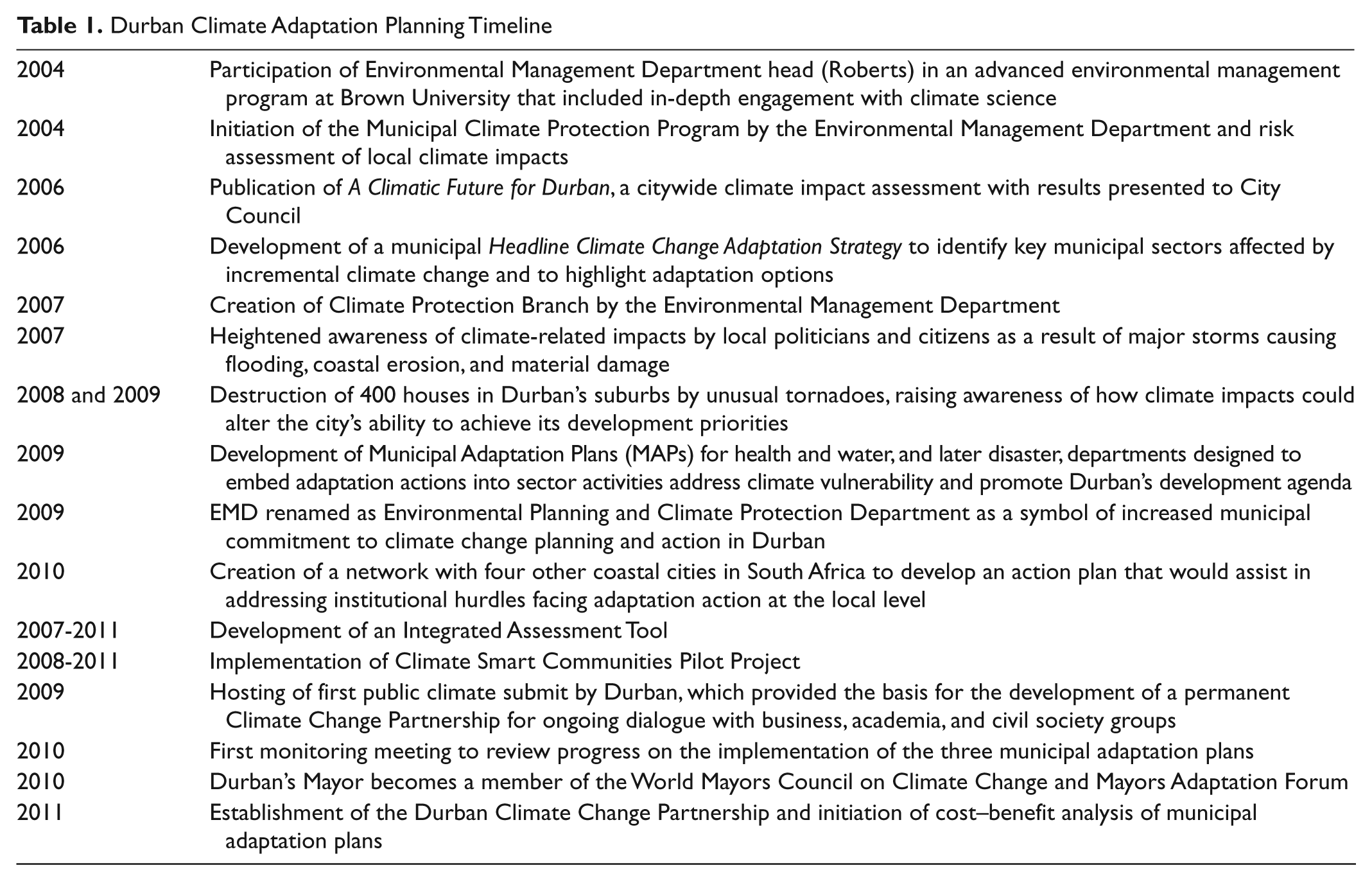
The Strategy was an important step in the process since it helped further the discussion on climate change with a range of actors in city management. However, it quickly became apparent that the Strategy would not be a catalyst for action, in part because it did not specify goals or activities that departments should pursue. Therefore, in 2008, Roberts began working with individual departments to develop detailed plans, starting with water and health. Referred to as Municipal Adaptation Plans (MAPs), the vision is that each department will establish measures and protocols to maintain or improve the functioning of municipal systems, services, and infrastructure in light of projected climate impacts. In 2009 the Environmental Management Department changed its name to the Environmental Planning and Climate Protection Department (EPCPD) to demonstrate that climate change was an integral and important aspect of the department’s work. Table 1 summarizes the steps taken by the city to advance climate adaptation planning.
Durban Climate Adaptation Planning Timeline
Exogenous Pressures and Adaptation Planning
When the climate assessment and subsequent adaptation planning processes were initiated in Durban, there were no national or provincial policies or laws that required cities in South Africa to pursue adaptation planning. The country ratified the United Nations Framework Convention on Climate Change in 1997, but it has not converted the relevant elements into national law. In 2004, the South African government released its National Climate Change Response Strategy with the aim of integrating climate change response programs across national and regional boundaries (DEAT 2004). However, there were no explicit provisions for provinces, municipalities, and local communities (DEAT 2005). In addition, although a national white paper addressing climate change response strategy is expected to be in place in late 2011, there were no policies, guidelines, or mandates that addressed adaptation when Durban took its initial steps to plan for climate impacts (DEAT/UNDP 2008). Furthermore, there are no sector policies that specifically serve to promote adaptation. For instance, the mandate given to South African municipalities to prepare disaster risk reduction plans in the Disaster Management Act of 2002 had no bearing on adaptation in Durban (Roberts 2010). Given the lack of formal regulations and policies, the initiation of adaptation in Durban was not driven by exogenous forces originating at the national or provincial levels of government.
As with mandates, there were few sources of national or transnational diffusion shaping the adaptation initiative in Durban. When the planning process was taking root, there were no other cities in South Africa pursuing adaptation and no formal efforts in place to promote joint learning. In addition, at the time Durban was initiating its planning process, most international funders had not started to support adaptation planning and implementation. The result is that adaptation in Durban has not been influenced by direct foreign investments or other forms of funding. At the international level, Durban has longstanding ties to networks and research centers engaged in environment- and climate-related issues. For instance, the city affiliated with ICLEI–Local Governments for Sustainability in 1994 and then, with support from the United States Agency for International Development in 2000, engaged in work on climate mitigation under ICLEI’s Cities and Climate Protection Program. Over the years, Durban has participated in a variety of other activities and networks, all of which helped build global connections, created access to information, and provided a means for exchanging information and ideas. Although these relationships are important, they did not influence adaptation planning. In contrast to mitigation efforts, Durban took early and independent action in the adaptation arena.
Endogenous Forces and Adaptation Planning
Despite the void in national and international mandates, sources of funding, and protocols, Durban was able to initiate and sustain a climate adaptation agenda. After taking two courses in the United States, one on the science of climate change and one on Quarternary climate change, and realizing that the greatest impacts of climate change would affect countries, cities, and populations in the global south, Roberts assumed the role of champion. Her understanding of the science behind climate change helped her recognize that action to address the climate change challenge would likely need to be a priority in Durban, but she knew that she and others in the city needed to better understand the risks they would face. With this in mind, she commissioned the risk assessment that subsequently was presented in the Climatic Futures report. Once the assessment was complete, a critical step in this process was sharing the results and gaining the support of elected officials. However, her understanding of what would be meaningful and lead to action in the city began to change when she presented the results of the assessment and engaged officials about their implications. As Roberts (Interview 2010) notes:
[The Council members asked] . . . How’s the city’s development path going to be impacted and how will you deal with that? When you know that that’s what you’ve got to do [you realize], you have to figure out how to respond to that because that’s clearly the priority.
In response to their questions, Roberts and staff in the EPCPD realized that to gain widespread support, they had to reorient their approach. While the impacts of climate change were important to understand, they became aware that they would only gain acceptance of the agenda if they shifted from emphasizing threats to presenting adaptation as a means to realize development priorities and equity goals stipulated in the Integrated Development Plan. Although a change in emphasis garnered sympathy for adaptation among some city representatives over time, not all departments were keen to address this issue. For the most part, this did not reflect resistance to adaptation planning or innovation per se. Most often, limited interest and action were based on the fact that many departments in eThekwini Municipality are coping with work backlogs and overloads, lack of funding to complete mandated tasks, and diminished capacity because of decreasing levels of staff.
A further endogenous force shaping action was the way in which natural hazards were reinterpreted in light of the vulnerability assessment. In 2007, flooding and coastal erosion resulted in significant damages to hundreds of kilometers of coastline around Durban. In addition, a series of unusual tornadoes in 2008 and 2009 destroyed four hundred houses in the suburbs and caused severe damage to infrastructure. Although Durban had experienced storms and flooding for many years, the severity of these events reinforced the argument that climate impacts would make it more difficult for the city to achieve its development goals. In speaking about sea level rise, a staff member from the Coastal, Stormwater and Catchment Management Department (Interview 2009) highlights how the experience of the storms created sensitivity to the ways in which the full range of climate impacts could affect critical city agendas:
The question is, what could sea level rise mean for the coastline? Durban has strong [coastal] tourism activity and the economy is underpinned by the tourism issue. It is critical to know from an economic point of view what we are looking at [with climate change].
Although there was no concrete evidence that extreme weather events are the result of climate change, the storms raised awareness and created a sense of imperative for addressing climate impacts. This point is underscored by the staff member from the Coastal, Stormwater and Catchment Management Department (Interview 2009), who goes on to state:
There was so much work and so many Departments affected. People who were skeptical about climate change said, “Hang on, we can’t carry on our work like this, we have to see how to reduce the impacts of droughts, storms. We need to build resilience into the system.” People have now bought on to the idea of adaptation.
Innovation in an Emerging Policy Domain
In the absence of mandates, standards, and models to follow, moving from assessment to strategy to plan in Durban was the result of generating ideas internally, experimenting, and innovating. As Roberts (Interview 2010) points out:
It’s literally learning by doing . . . it’s like a process of taking a walk through a very long and dark wood and occasionally you get some sort of light coming through the branches. The first point was just to try and understand how we were vulnerable. We weren’t thinking mitigation or adaptation or any of that stuff. I couldn’t see beyond that. I didn’t know what lurked beyond that.
The vulnerability assessment provided a basis for developing the adaptation strategy. However, what the strategy and the sector plans (MAPs) that were subsequently developed should contain, let alone the process through which the plans should be created or implemented, was far from clear in those early days.
Funding from international donors frequently has been shown to shape local agendas, but in Durban this process has been reversed. Rather than being driven by funding, representatives from the EPCPD have used the financial support to test ideas related to adaptation planning generated internally. For instance, the city took advantage of a funding window from the Danish bilateral aid agency, DANIDA, as a means to support adaptation projects. One project involves research on food security. Maize, the predominant food source on which low-income periurban residents rely, either is grown as a subsistence crop or purchased for amounts in excess of 50% of their monthly income. The productivity of dry land maize is expected to decrease according to climate change projections, as a result of changes in temperature and distribution of rainfall. Using the DANIDA funds, Durban has implemented field trials in different climatic zones that simulate conditions similar to those that might occur in the near and intermediate future. The municipality has also conducted tests to determine whether households find these new crops to be a palatable and acceptable maize substitute (Golder Associates 2008). In addition, Durban drew on this funding to establish a pilot program on community-based adaptation. Neither of these initiatives were the product of funders pushing particular agendas, but of representatives of the EPCPD seizing an emergent opportunity to promote adaptation.
Since there are few international norms to guide the adaptation planning process, the EPCPD has been reaching out to groups within the city to obtain input and extend its capacity while building support for the climate adaptation agenda. A staff member from the Disaster Management Unit (Interview 2009) commented on how Roberts in her capacity in the EPCPD has been taking the lead in engaging others across the city:
Debra is hooking up with a variety of organizations [in the city] that she believes are strong role players. . . . She is very good at presenting the facts in workshops and everybody listens to her and people like the materials. There is also a growing body of information from agencies she works with and she is able to introduce it to the city.
To further enlist the support of diverse stakeholders, in 2009 the EPCPD hosted a public climate summit. The summit, which was attended by representatives from the city, business, academia, and civil society groups, concluded with the recommendation that a Climate Change Partnership be developed to foster an ongoing exchange and, in the process, provide Durban with input while promoting widespread involvement in climate initiatives.The work and influence of the EPCPD extends beyond Durban. For instance, the department formed a network with four other coastal cities in South Africa as a way to address some of the common institutional hurdles these cities face when seeking to pursue adaptation. The vision is that the greatest insights will be generated and gains achieved by working closely with cities facing similar administrative and climate challenges. However, it was not possible to sustain this initiative because of lack of funding, In addition, because of the experience she has gained in adaptation, Roberts is sought out to assist with international programs and speak at international conferences. This not only has been a means for disseminating experience with adaptation in Durban but for promoting an adaptation agenda within the city. For instance, Roberts was invited by the Rockefeller Foundation to attend a meeting and present her work. This was followed by an invitation to sit on the Advisory committee for their Asian Cities Climate Change Resilience Network. Because time spent on the network would take her away from work from time to time, Rockefeller offered to compensate her either through an honorarium or by allocating money for local projects. She elected to use the funds to jumpstart work on the MAPs.
Climate Adaptation in Quito
The Metropolitan District of Quito, located in the Central Andes of South America and surrounded by glaciers, is home to approximately 2.1 million people. While the mountains create a majestic setting, they form barriers that compress the city into a valley. The Municipality, situated within the broader Metropolitan District, is governed by a Metro-politan Mayor. As a result of this governance structure, policy and planning for the municipality are shaped by the Metropolitan Council for the District of Quito. The city has made notable strides in providing social housing, upgrading infrastructure, protecting biodiversity, and maintaining environmental quality. However, it continues to face numerous challenges and has outlined key local development priorities for the next decade. These include the construction of a viable waste treatment system, creation of new suburban centers and affordable housing, and promotion of nature and cultural tourism. Transportation also is a pressing issue as there is a strong need to develop new arterial roads and tunnels and to implement a proposed light rail system.
Adaptation Planning Process
Planning for climate change in Quito was initiated in late 2006 when the former Mayor, Paco Moncayo, and the Metropolitan Council took the lead in organizing Clima Latino, a climate change conference for the Andean Community of Nations. The event, held in October 2007, was meant to help participating governments identify appropriate measures for climate mitigation and adaptation while highlighting initiatives in Quito. Climate planning became more concrete in January 2007 when Gonzalo Ortiz, a Metropolitan Councilor, gave a presentation to his fellow Council members about the need for Quito to take heed of the data on temperature and glacial changes and develop a climate strategy that addressed mitigation and adaptation. Ortiz received strong support from the other Councilors and Mayor Moncayo and was empowered to create an Inter-Institutional Commission. The Commission, which consisted of representatives from the municipal air and water corporations, staff from the Metropolitan Office for the Environment, and members of the Strategic Research Unit, was charged with preparing a draft climate strategy for Quito.
In fall 2007, the Inter-Institutional Commission presented a draft document to municipal agencies and later to participants at Clima Latino. As a means for identifying public concerns and gather suggestions for the climate strategy, the Commission initiated a public consultation process in October and November 2007. It hired the NGO ECOLEX to coordinate citizen consultation and organize four workshops across Quito. The purpose of the workshops was to engage residents, particularly vulnerable and marginalized communities, as well as key social and community development organizations so their input could be incorporated into the final version of the strategy.
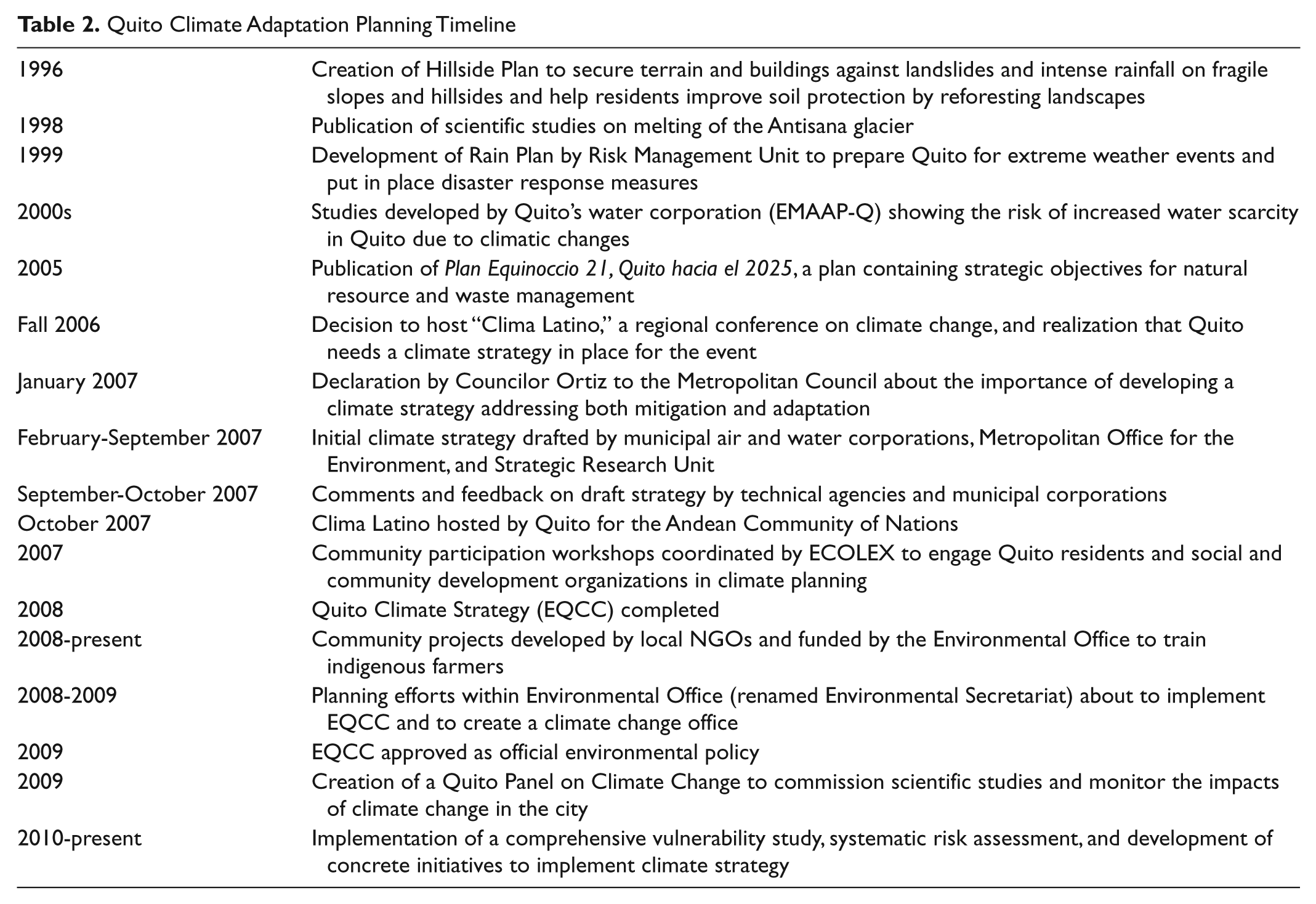
The Quito Strategy for Climate Change (EQCC) was released in February 2008 and formally approved by the Metropolitan Council in October 2009. Throughout the planning and write-up process, Ortiz and several other councilors used their position to generate ongoing support, keep politicians informed, and ensure that relevant technicians and planners from municipal departments were engaged. Since its formal approval, the EQCC has become an official environmental policy in Quito as well as a tool for institutional planning in the Metropolitan district. In addition, at the time the strategy was approved, Quito created a Climate Change Office within the Environmental Office. Since its creation, the new office has initiated a process of annual planning to review, advance, and implement the climate agenda and is coordinating a new study on vulnerability and water adaptation in cooperation with other municipal secretariats. It also has created the Quito Panel on Climate Change to commission scientific studies by leading Ecuadorian experts and scientists and to monitor the impacts of climate change in the city. These studies and activities are meant to facilitate the translation of science into policy and improve decision makers’ access to research and scientific progress. In parallel, the Office for Security and Governability works to systematically assess climate risks in Quito. Table 2 summarizes the steps taken by the city to advance climate adaptation.
Quito Climate Adaptation Planning Timeline
Exogenous pressures and adaptation planning
No national laws, policies, or international frameworks guided or supported Quito’s efforts to plan for the impacts of climate change. Instead, the city’s activities took place within an institutional and resource vacuum. In 1998, working under the auspices of the Ministry of the Environment and the National Climate Change Committee, Ecuador developed its National Policy and Strategy for Climate Change and, as of 2011, is in the process of creating a National Climate Change Adaptation Strategy. This effort of national climate change planning is centralized in the Ministry of the Environment. As a result, it has not influenced Quito in the development of its climate change programs. Reflecting on the role of climate action in Ecuador, a representative from the Environmental Office (Interview 2009a) who worked on the initial version of the Quito Climate Strategy commented, “climate change as an issue has not had a transcending relevance in managing this country. Other elements had much more importance.” Ortiz (Interview 2010) expanded on this point in noting that there was no cooperation between national and local environmental planning agencies in the context of Quito’s climate adaptation efforts.
Quito has received some support from bilateral funding agencies and development banks for its climate work, but local officials have approached these sources a posteriori in order to advance initiatives already underway. As a result, no funding agency imposed requirements on the city to engage in climate adaptation planning, nor did any pressure Quito to change its ongoing approach to preparing for climate impacts. For instance, the Andean Regional Project for Adaptation to Climate Change, funded by the Global Environmental Facility and the World Bank, has been studying and monitoring the evolution of the ecosystems around the micro-basins of the Antisana Volcano. In this project, the Quito municipal water company, the EMAAP-Q, is collaborating with researchers to understand how water provision and distribution for Quito’s residents is being affected by changes in conditions around the city’s microbasins. Although this was a new study implemented with the support of international funders, the EMAAP-Q already had started to plan for scarce water resources before the Andean Regional Project was initiated. Rather than being driven by the preferences and priorities of international organizations, Quito is working proactively to engage and partner with these agencies.
Endogenous Forces and Adaptation Planning
Adaptation planning in Quito was the result of visionary local officials, the desire to be regarded as a national and regional leader, and the intent of serving as an example for other cities or countries. Quito was the first municipality in Ecuador to address environmental issues. Stepping out ahead has given metropolitan decision makers a strong level of independence in developing environmental policies and offers them an important place in the Ecuadorian and Andean community. As noted by a representative from ECOLEX (Interview 2009), the history of being a proactive municipality carried forward into the domain of adaptation:
Quito already had a lot of experience with issues such as improving air quality and waste management. These were a long-time municipal concern, one where we were a pioneer government. The idea with adaptation in Quito was to position it to a greater extent into public policies and make visible all the efforts of the municipality and all the effects of climate change. . . . [Quito] was among the first cities to initially give a response to emergencies and manage extreme events. This is part of a long trajectory of the city in which public authorities are sensitive to environmental questions and respond to demands.
The major catalyst for initiating climate planning was the decision to host Clima Latino. Having a climate change strategy drafted in time for the conference was a way in which city officials and representatives felt they could exhibit that they were good stewards. Also, they could continue to demonstrate that they are leaders.
[It was envisioned that] the EQCC would be a document that could be helpful for other policies and documents within the country and outside the country. We showed leadership with the EQCC. We knew it could be a demonstration for the country. There was no other [climate] strategy in Ecuador. We had not seen anything like this in any other municipality. (Ministry of Environment, Interview 2009a)
By taking the lead on climate action planning, the municipality believed it would reinforce its position as an innovative city and be imitated for its leadership. International conferences often are viewed as a source of exogenous pressure since they can be a means through which ideas and best practices are diffused. However, participating in international conferences and meetings on issues such as climate change was seen as a means to showcase the city’s knowledge and experience (Interview, EMAAP-Q 2009a, 2009b). Rather than influencing activity within Quito, the Mayor and several Metropolitan Council members viewed international conferences and other forms of international engagement as a way to further build their profile.
Clima Latino initiated the development of the climate plan, but its contents were influenced by awareness of existing risks. Quito elected not to conduct a separate risk or vulnerability assessment at the outset of the adaptation planning process, but to build on studies that previously had been conducted. One of the most critical risks factored into the adaptation plan was water scarcity. Scientific studies stretch back to the mid-1990s when assessments of the Antisana glacier, which controls the climate of the páramos around Quito, indicated that the glacier was shrinking (Semiond et al. 1998).
When adaptation planning was initiated, water engineers already were familiar with projections suggesting that climatic changes were threatening water security, and were able to emphasize the need to address water scarcity. In addition, the plan was influenced by scientific studies indicating that the city was experiencing increased periods of rainfall, that this was triggering landslides and floods in the hillside areas around the city and, in the process, placing vulnerable populations at greater risk. In other words, the contents of the plan were rooted in a longstanding commitment within the city to addressing risks that could endanger the health and wellbeing of residents and to maintain advances made in infrastructure development and housing security.
Innovation in an Emerging Policy Domain
Public officials in Quito regard the support and engagement of municipal departments or offices as an important condition for generating ownership and success in the climate adaptation arena. As a representative from the Environmental Office explains (Interview 2009b), “The sustainability of a project is not the money, but is conditional on the city being committed and having a sense of ownership.” A civil servant from the Environmental Office (Interview 2009c) working on climate adaptation planning further commented:
The priority is to incorporate climate adaptation [into existing initiatives] in a way that is more grounded. It is about finding ways where adaptation has meaning for decision makers and is placed in the context that they need to confront many different necessities in the short term.
For instance, Quito could have developed a comprehensive adaptation plan or had each department develop its own adaptation strategy. However, the Environmental Office elected to take an incremental approach so that municipal agencies would have the autonomy and flexibility to learn and adapt as they moved forward. The result is that rather than focusing on creating new plans, the city has been linking adaptation to existing plans and programs in the belief that this will increase the likelihood that adaptation measures will be successfully developed and implemented.
One of the ways adaptation has been promoted is by finding linkages to environmental planning. In pushing both climate mitigation and adaptation planning in Quito, Mayor Moncayo and Councilor Ortiz sought to make concrete commitments that would make the city more livable for growing populations and create an urban space of optimal environmental quality. Such goals are being achieved through the sustainable management of local natural resources, considered as patrimony to be protected and enriched. A manager in the Office for Territorial Planning (Interview 2009) explains:
The long-term vision [in our office] is sustainable development of the territory. There is no direct discourse of adaptation. Our logic is to promote high quality of life and sustainable management of the environment, including the water, the air, and the hillsides while addressing risks.
In keeping with this sentiment, Quito has a history of planning and preparing for extreme events. For instance, in 1999, staff in the Risk Management Unit developed the Rain Plan (Plan Lluvias) to prepare Quito for extreme weather events and put in place disaster response measures, acknowledging that the level of the rain was not “normal” and that climatic impacts were increasing the vulnerability of the high risk areas. More recently, the Risk Management Unit has developed the Hillside Project (Laderas Project), which seeks to help inhabitants living in these areas improve soil protection by reforesting fragile landscapes, preventing further housing construction through community policing, and changing unsustainable growth patterns.
The commitment to environmental quality and the presence of existing disaster, environmental, and infrastructure plans are being used as foundation for climate adaptation in the city. A representative from ECOLEX (Interview 2009) elaborated on this point:
Planning for climate adaptation has meant [that departments find ways] to position [adaptation] within existing public policies and publicize existing efforts of the municipality against climate effects.
Some of the initiatives linked to adaptation include the implementation of a future light rail system, improvement in waste water management, creation of new parks, river clean-up and restoration, and reforestation. The long-term environmental plan, Plan Equinoccio 21, Quito hacia el 2025, serves as guide for programs of relevant public agencies and indicates which environmental initiatives should be prioritized. Since the plan includes efforts to protect and restore fragile ecosystems and promote adequate conservation of water resources, it too is being used as a basis for climate adaptation.
The involvement of local NGOs, research centers, and residents are central to advancing the adaptation agenda. Emphasis also is given to training and capacity building activities as a way to develop concrete adaptation strategies, especially for vulnerable communities. As a result, Quito has prioritized intervention areas for capacity development through the use of geographic information on poverty indexes and natural disasters. Community engagement and public participation in local policy making and development were central features of Mayor Moncayo’s election campaign and term in office. This commitment was reflected in the Environmental Office drawing on local organizations to support and implement environmental programs, including those related to adaptation. For instance, the Environmental Office funded local NGOs to train indigenous farmers to improve the management of water resources in their urban agriculture practices, diversify as well as privilege native crops, and replant native tree species in hillside areas around the Lloa district. The NGOs also train indigenous leaders to monitor variations in rainfall and flows from local rivers so that municipal staff members receive up-to-date information on changes in water levels in Quito.
Quito’s efforts are not limited to working with local residents as they have made efforts to share their experiences beyond their urban borders. As is the case of Durban, Quito has taken a leadership position by presenting their adaptation work to other cities at international conferences. Furthermore, rather than being directed by international organizations, Quito has engaged these agencies on their own terms. One example is the Manual for Local Climate Change Management. This manual, a joint endeavor with UN Habitat, will be disseminated to other municipalities in Ecuador so that they can develop local climate change strategies based on Quito’s experience. The city is also the organizer of the First National Summit of Local Authorities which took place in June 2011 in partnership with the Al Gore Foundation, ICLEI, and World Wildlife Fund, among others. Quito took the lead for this summit in order to demonstrate its commitment to the Pacto de la Ciutat de México, a group of ten climate actions signed by 43 cities from around the world in November 2010. The National Summit, which will host local authorities from Ecuadorian cities, will engage participants in roundtables and thematic sessions to share ideas, further develop climate mitigation and adaptation actions and foster greater synergies among governments, academia, NGOs, foundations, and international cooperation agencies.
Initiating and Sustaining Action in an Emerging Policy Domain
As the cases demonstrate, Durban and Quito have made inroads in advancing citywide climate adaptation agendas. Previous research emphasizes the ways in which exogenous pressures shape the behavior of actors. In particular, these studies maintain that coercive measures such as regulation, the need to attract funding, and the diffusion of best practices and other forms of knowledge and norms originating from sources such as foreign governments, intergovernmental organizations, professional associations, and NGOs influence action (e.g., Stone 2004; Castells 2000; DiMaggio and Powell 1991). However, these types of exogenous pressures are more likely to be associated with mature policy fields, ones in which institutions have been established, and forces shaping both expectations and behavior are present. In contrast, in emerging domains such as climate adaptation, the expectation is that cities and municipal departments at the frontier of the field will be driven by endogenous goals and objectives rather than exogenous forces (DiMaggio and Powell 1991; Tolbert and Zucker 1983).
The patterns of adaptation planning in Durban and Quito conform to the expectation that endogenous forces are influential in nascent policy arenas and, at the same time, advance our understanding by illustrating specific factors that serve as catalysts for initiating actions. Three endogenous factors appear to drive adaptation initiatives in both cities. First, adaptation was influenced by the efforts of champions who were inspired to push the agenda forward and creatively navigate an ambiguous domain. Second, as the cities learned about climate impacts, they came to the realization that they were highly vulnerable and began to interpret natural hazards as a consequence of climate change. This realization led them to further recognize the importance of protecting residents and assets. The third critical endogenous driver of action was the advancement of local priorities. In both Durban and Quito, adaptation was seen as a means to secure the cities’ development paths while promoting sustainability and resilience by addressing the projected impacts of climate change. A further priority for Quito was to enhance city visibility and to be viewed as an environmental leader in the Andean region. Climate action in general and adaptation in particular were seen as ways to advance these goals.
In the initial phases of planning, adaptation had different degrees of acceptance in each city. Durban had a single champion who initiated the process, engaged sectoral departments, and worked to gain the attention and support of the city manager and elected officials. Because adaptation was promoted by a single person and the initial focus was on assessing climate impacts and risk, it was perceived as an environmental problem, separate from or even in opposition to the city’s socioeconomic development priorities. The situation was quite different in Quito where climate adaptation work was initiated by elected officials, as a strong political push for a priority they believed was essential for the city, including advancing sustainable development, the provision of basic services, and improvements in safety for residents. Rather than focusing on conducting assessments, they placed an emphasis on engaging and obtaining input from municipal departments as well as from the public. This approach led adaptation to have rapid and widespread support.
Despite variations in initial acceptance, adaptation has gained traction in both cities. As summarized in Table 3, this study illustrates how these cities engaged endogenous and exogenous forces as a means to advance a new policy agenda. A critical step toward promoting adaptation in both cities was to connect it to citywide as well as departmental goals and agendas. The framing of adaptation as a development issue in Durban was a response to inquiries from the city council about how it supported city priorities. The creation of the Headline Strategy marked a first attempt at engaging departments. To more fully enlist their support, subsequent initiatives are taking place to develop detailed sector plans that link adaptation to existing departmental agendas. Quito started with a focus on climate mitigation and adaptation, but quickly realized the importance and advantages of aligning adaptation with the city’s sustainability and environment agenda and the focus on lowering risks in vulnerable areas.
Advancing Climate Adaptation in Durban and Quito
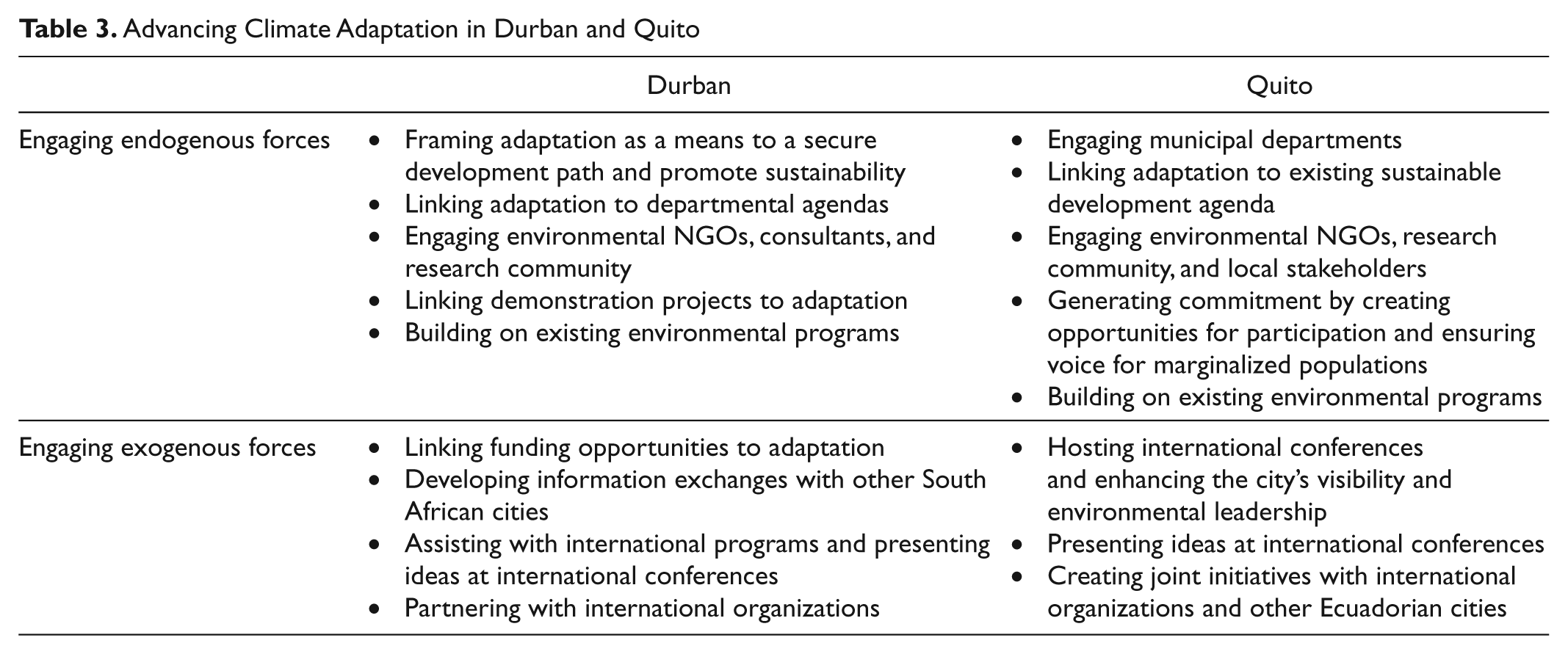
In Durban and Quito, the leaders of the adaptation processes engaged diverse stakeholders, such as universities, research institutions, and business associations, as a means to establish a foundation for their initiatives. They also took advantage of local initiatives and opportunities that emerged. These types of activities are exemplified by Durban initiating programs to test the palatability of crops that would grow in conditions of water scarcity and increased temperature and to pilot community-based adaptation, and by Quito integrating an adaptation element into funding and activities sponsored by the Environmental Office. As such, both cities were able to draw on endogenous forces and craft a foundation for adaptation out of existing and emergent initiatives.
Conclusion
The ways in which Durban and Quito are advancing climate adaptation suggests that cities taking action in noninstitutionalized policy domains engage in a process of bricolage. Bricolage refers to the creation of something new by piecing or stitching together existing materials. While often used in the context of manual activities, in social domains these materials can be activities, resources, or concepts (Lévi-Strauss 1962). As a way to gain the support of critical stakeholders, leaders in Durban and Quito have found ways to link adaptation to existing policies and plans as a way to demonstrate that this is not an unfamiliar or inconsequential issue but one that was already part of current citywide priorities and initiatives. They are also making concerted efforts to help municipal departments see adaptation as integral to their ongoing work routines. Furthermore, they have engaged diverse stakeholders and used support available from funders to test ideas related to adaptation. As a result, they are able to gain credibility for adaptation as well as ensure that this agenda gains visibility and traction.
The experiences of Durban and Quito reveal how planners and public officials can be innovative and entrepreneurial when seeking to initiate and promote an agenda in an emerging policy domain. Rather than being pressured by mandates or influenced by the agendas, practices, or recommendations of external parties, these cities were driven by internal goals and aims. At that same time, the absence of guidelines led them to strategically engage external actors, creatively knit together existing initiatives, and avail themselves of opportunities in order to ensure that adaptation planning took root. The result is that, rather than conforming to national, regional, or global norms, these cities not only are acting independently but are in the process of identifying approaches and advancing protocols that others may be able to follow.
While Durban and Quito both demonstrate how cities can and do act in emerging policy domains, those that follow in their footsteps are likely to exhibit different patterns of action. As the policy field matures, other cities will have the option of adopting practices that have been identified and vetted by those that have gone before them. Furthermore, since these cases were conducted in developing country settings, it is important to acknowledge that cities in other locations and at alternate levels of development may approach new policy agendas with different assumptions, needs, and limitations. Despite these considerations, the patterns revealed in Durban and Quito suggest that cities in the global south that are at the forefront of a new policy domain are likely to be motivated by their goals and priorities and, in the absence of institutions, to find creative ways to sustain these initiatives.
Footnotes
Appendix A
Acknowledgements
We are grateful to the editor and JPER reviewers for their helpful comments. An early version of the article was presented at the Fifth Urban Research Symposium held in Marseilles, France.
The author(s) declared no potential conflicts of interest with respect to the research, authorship, and/or publication of this article.
The author(s) disclosed receipt of the following financial support for the research, authorship, and/or publication of this article: This research was supported by the Department of Urban Studies and Planning at Massachusetts Institute of Technology and a grant from the U.S. National Science Foundation (No. 0926349).