



Abstract
Informal transnational networks support unauthorized communities, in what I call Shadow Transnationalism. I trace the intertwined fortunes of Postville, Iowa, and El Rosario, Guatemala. I identify shadow network flows through employment recruitment networks, lending networks, remittance transfers, and smuggling networks. I further investigate efforts of transnationalism from “below” scholars by building on the idea of a “shadow place.” I then analyze the transnational networks that are supported by employers, the state, and immigrants, and that create exploitative transnational spaces dependent on unauthorized communities. The study offers planners a better understanding of the vulnerability, risks, and interdependence of shadow transnational networks.
Keywords
At the Dueñas Municipal Office, I was looking at a map of the U.S., to show where Postville was located, while the local municipal planner/architect looked at a map of Guatemala to show me where El Rosario was located. We could not find either town. They were virtually invisible small towns.
The Underbelly of Immigrant Communities: Shadow Transnationalism
An estimated 11.2 million unauthorized immigrants are living in the United States (Passel and Cohn 2011). Unauthorized immigrants are now firmly embedded in the social and economic structures of advanced societies (Leerkes, Engbersen, and Van San 2007). It is a population that planners generally have overlooked, as unauthorized immigrants live in the shadows, considered “illegal” by the gaze of regulation and authority (Chávez 2007; De Genova 2002). Although many times invisible, these shadow populations are directly shaping cities and towns and present challenges to planners who would intervene in these global spaces. This shaping of cities and towns via shadow networks is not a smooth process, but one riddled with contradictions and conflicts. If planners want to intervene in these shadow spaces, they first need to recognize this “underground” world and then consider how planning could work in the context of these shadow movements and shadow economies. This study uncovers how Postville, Iowa, and El Rosario, Guatemala, were linked via Shadow Transnational flows and networks of unauthorized immigrants. I specifically identify and trace the shadow networks within both communities that sustained the underground system, networks of recruitment, lending, remittances, and smuggling, and I consider the more exploitative aspects of transnational migration for a better understanding of how unauthorized immigrants, the state, and employees maintain a system of Shadow Transnationalism.
Planning in a transnational era is marked by unprecedented movement, a crisscrossing of capital and labor via global networks that demands a new approach to investigating both theoretically and empirically these global immigration flows and their effects on planning practice (Miraftab 2011). The transnational literature has contributed greatly to the understanding of how these global networks increase immigrants’ agency. However, the scholarship’s scope is limited when analyzing the exploitative mechanisms and relationships that are structurally a part of these same global transnational networks. Shadow Transnationalism provides a framework to investigate these exploitative relationships within and involving unauthorized communities.
Shadow Transnationalism refers to network relations that transcend the territorially bounded jurisdiction of the nation-state and link together unauthorized immigrant societies of origin and settlement within socioeconomic structures intended to remain informal and actually or plausibly “under the radar” and invisible. Shadow Transnationalism represents the underbelly of immigrant communities, where the most marginal and vulnerable groups, the unauthorized immigrant populations, engage in networks and practices under a veil of intentional invisibility—intentional on the part of employers, immigrants, and the state. These “co-conspirators,” as former U.S. Labor Secretary Ray Marshall calls them (2007), support global transnational flows of people, information, and money that link the shadow mechanisms of recruitment networks, lending networks, remittance networks, and smuggling networks. As global capital ferments labor markets, within global cities and global towns, these invisible populations are increasingly present (and increasingly visible).
Ray Marshall provides a scathing critique of the system in place that promotes unauthorized immigration. He argues that immigrants should not be criminalized because a system of co-conspirators exists that is perpetuating this crisis. The co-conspirators
include Congress, which passed a seriously flawed law [IRCA] and failed to adequately fund an effective enforcement strategy; businesses that hired workers with clearly fraudulent documents and, along with members of Congress, pressured officials not to enforce immigration laws; banks that issued credit cards to unauthorized immigrants; the IRS, which gave them taxpayer ID numbers; the public, which sympathized with hardworking immigrants who seemingly did little, if any, harm and purportedly only took jobs natives wouldn’t take; various sympathetic support groups, who thought immigrants deserved the right to seek the American dream; labor unions—formerly among the staunchest opponents of immigrant worker programs—who now actively organize and protect unauthorized workers; and public officials in Mexico, who emphasize both the immigrants’ constitutional right to migrate and America’s dependence on unauthorized immigrants and have adopted measures, like photo ID cards, that facilitate unauthorized immigrants’ ability to work and live in the United States. Given numerous co-conspirators, it would be hard to assign culpability only to the immigrants. (Marshall 2007, 6)
In other words, these three pillars maintain the system of unauthorized migration and work the following way: the state as it criminalizes populations and purposefully sends them to the shadows; employers who provide the great migration pull and create the labor conditions that allow unauthorized immigrants relatively easy access to employment; immigrants as they seek purposeful invisibility in maneuvering the shadow mechanisms. This shadow system is a self-generating process supported by unauthorized immigrants’ own transnational social capital, a process that does provide them with added agency (via economic and network resources) but exposes them to great risks and exploitation.
The concept of “Shadow” refers to processes that are intentionally hidden from (or at times by) formal regulating institutions. I argue that the shadows created for unauthorized communities, via the state’s construction of illegality, serve as a functional/structural mechanism that increases the vulnerability and risks within these communities and that maintaining such spaces of illegitimacy blocks those populations’ access to the civil rights that benefit “legitimate” populations.
In turn, mechanisms of Shadow Transnationalism exist as hidden complementary integral parts of immigrant networks within global labor markets in the transnational cultural and spatial spheres. They complement and at times support the more formal networks of transnational migration as they are intentionally constructed and function (or are perceived or permitted to function) “under the radar” of regulation. They exist “within” immigration channels, yet remain “hidden” from regulated spaces and often ostensibly outside the governments’ gaze.
New vulnerabilities arise associated with these transnational networks for cities and towns that are transformed via these shadow relationships. Planning and placemaking in communities with many unauthorized immigrants is scantly addressed in the planning literature (Valenzuela 2003) although it is increasingly important because economic restructuring in our global era increasingly relies on unauthorized labor.
Postville, Iowa, is a paradigmatic case (Flyvbjerg 2006) of these types of shadow relationships. A system of Shadow Transnationalism exists within Postville and other rural meatpacking towns. By exploring this hidden world, planners can gain a more nuanced understanding of the vulnerabilities and interdependencies existing in communities with high numbers of unauthorized immigrants. As the restructured meatpacking industry requires cheap and expendable labor, the industry becomes increasingly reliant on low-wage unauthorized immigrant laborers and on shadow transnational relationships.
This paradigmatic case study first reviews the key literature on transnationalism from “below” and demonstrates its limitations, as most of these scholars do not address the exploitative and shadow side of transnationalism. I then empirically trace how mechanisms of Shadow Transnationalism existed between Postville and El Rosario. I end by challenging planners to embark on a research agenda that will shed new light on understanding the dynamics within and involving unauthorized populations and help practitioners better plan for these vulnerable and invisible communities.
The Exploitative Side of Transnationalism
Glick Schiller defines transnationalism as “the processes by which immigrants build social fields that link together their country of origin and their country of settlement” (Glick Schiller, Basch, and Blanc-Szanton 1992, 2). Immigrants build, develop, and maintain multiple relations that connect them to two or more societies simultaneously. Or as Parnreiter explains, transnational communities, corporations, activities, and ideas are thus multicentered, “developing in a “state of ‘betweenness’” rather than having geographically identifiable centers, origins, or destinations” (Parnreiter 2011, 417). Smith and Guarnizo (1998) have argued that global relationships are not only materialized via international forms of capital, but also function from the ground up, as transnationalism from “below.”
The transnationalism from “below” literature has advanced transnational analysis substantially, arguing that immigrants are not powerless actors caught up in structural international economic forces. As AbdouMaliq Simone eloquently narrates, the fluidity of African migrants goes beyond simple distinctions of push and pull factors (Simone 2011). Likewise, transnationalism from “below” theorists argue that migration movements are conscious and successful efforts by ordinary people to escape control and domination from “above” by capital and the state (Smith and Guarnizo 1998). Smith and Guarnizo ultimately shifted the conversation to include everyday agency created by immigrants, agency that had been overshadowed by institutionalists’ accounts. Smith and Guarnizo view the distinction between “above” and “below” transnational social fields as capturing dynamics of power. Sarah Mahler elaborates on this power distinction: “The basic concept of transnationalism from ‘above,’ as I understand it, is that multinational corporations, media, commoditization and other macro-level structures and processes that transcend two or more states are not produced and projected equally in all areas, but are controlled by powerful elites who seek, but do not necessarily achieve, political, economic and social dominance in the world” (Mahler 1998, 67). She argues that transnationalism from “below” generates multiple counterhegemonic powers among nonelites and that it is grounded in the daily lives and social relations of immigrants within transnational social fields. “In short, through transnational processes everyday people can generate creole identities and agencies that challenge multiple levels of structural control: local, regional, national, and global” (Mahler 1998, 68). This literature demonstrates how immigrants acquire and maintain a sense of agency and power as they traverse and at times use transnational links to capture the dynamics of power relations in the transnational arena (Goldring 2004).
Shadow transnationalism’s conceptual contribution is to further the efforts by transnationalism “from below” scholars by bringing further to light the underbelly, the exploitative aspects of these networks and processes within and involving immigrant communities. These types of economic shadow systems aren’t at the margins but rather are critical parts of the overall system of capital accumulation. They are structural components of the formal and informal transnational global economic networks of labor and exist as hidden complementary socioeconomic networks within transnational social fields. They support highly exploitative transnational cross border movements of labor corroborating the more formal networks within transnational social fields encouraging migration among global cities and towns.
I aim to shed light on the more exploitative aspects of transnationalism by complementing the scholarship of transnationalism from “below” with a better understanding of how unauthorized immigrants, the state, and employers engage in transnational networks that maintain a system of Shadow Transnationalism. I take from Leerkes, Engbersen, and Van San (2007, 1492) their concept of “the spatial opportunity structure.” They argue that three central dimensions are determining conditions to the creation of what they term “shadow places.” First, transnational social networks provide social capital that gives immigrants the opportunity “to mobilize resources (money, work, housing, information, and documents) from their ethnic and family networks” (Leerkes, Engbersen, and Van San 2007, 1493). Secondly, the right labor conditions and opportunities need to be present such as abundant demand for low-skilled labor-intensive jobs with little regulation. Lastly, shadow places need a presence of cheap and accessible housing, where the housing market caters specifically to unauthorized workers (Leerkes, Engbersen, and Van San 2007). Their innovative characterization of the spatial opportunity structure of unauthorized immigrants has explanatory power regarding the contextual environment under which shadow mechanisms manifest themselves. I agree with their and others’ acknowledgment of the extreme importance social capital plays within immigrant communities. For Leerkes, Engbersen, and Van San, this is a key determining factor and one of their three prerequisites for a place to attract unauthorized immigrants. However, they do not trace, what Tsuda calls the simultaneity of transnationalism (Tsuda 2012), that is, the simultaneous identification of transnational processes in both the sending and the receiving immigrant communities. Neither do they specify the networks that penetrate and connect those flows nor do they identify the system that keeps these exploitative shadow systems in place.
At the core of this exploitative shadow transnational system are employers who in their demand for unauthorized labor provide access to unregulated jobs. The physical and social presence of unauthorized immigrants is mainly associated with the need for a cheap and vulnerable labor force (Portes 1978). As De Genova rightly notes, unauthorized migrations are preeminently labor migrations. De Genova also notes that the U.S. Border Patrol, from 1925—when it was first created—until 1940, operated under the auspices of the Department of Labor (De Genova 2002, 422). Unauthorized workers live in the shadows because their illegality and insecurity make them vulnerable, a labor characteristic that directly benefits employers. Alejandro Portes explains the exploitative nature of unauthorized labor:
It is the political status of immigrants and the legal relationship it entails with the state, which accounts for their objective position of weakness vis-a-vis their employers. It is for this reason that the objective interest of firms for which profit depends on a low-wage labor force is to import immigrants in the most legally tenuous position. Thus, illegal immigrants become the most vulnerable of workers. Their juridical situation deprives them of most civil rights and prevents their effective organization for making demands (Portes 1978, 474).
This shadow labor system could not function without the regulative structure that the state provides. The State purposefully creates this underclass of unauthorized immigrants. Studies focusing on this underclass view them as vulnerable workers who remain in the shadows as an invisible underclass (Chávez 2005; Ruiz 2008; Kim 2009). This condition of “shadowness” could not exist without labor and immigration laws created by the state.
To understand how the state serves as the opaque body that creates the shadows, we must examine illegality as purposefully constructed by the state: this construction, through regulation, creates the shadows under which unauthorized communities exist. De Genova (2002, 427) underscores how illegality is constructed as a social space that imposes invisibility, exclusion, subjugation, and exploitation. De Genova argues that the everyday experiences of unauthorized immigrants are outcomes of the state’s racialization and production of “illegality” (239). Therefore, migrant “illegality” is a spatialized social condition that is frequently central to the particular ways that migrants are racialized as “illegal aliens” within nation-state spaces—the spatialized condition of “illegality” reproduces the physical borders of nation-states in the everyday life of innumerable places throughout the interiors of the migrant-receiving states. Thus, the legal production of “illegality” as a distinctly spatialized and typically racialized social condition for unauthorized migrants provides an apparatus for sustaining their vulnerability and tractability as workers” (De Genova 2002, 439). Hence, although smuggling across the border, overstaying your visa, etc. are not crimes (those acts don’t make you a criminal under U.S. law), being “illegal” places these unauthorized populations in a subordinate position where they are more easily exploitable.
Immigrants and their use of transnational social networks flow through a shadow labor system that profits them and others who support that system (state and employers) who profit greatly from those flows and the illegal labor that permits and supports it. Immigration sociologists argue that the economic sociology of immigration depends upon networks (Portes and Borocz 1989). In fact, networks of trust and reciprocity are what define social capital (Bourdieu 1986) and these networks provide durable, efficient conduits for the flow of information and support (Waldinger 1997, 2). Cecilia Menjivar’s important study of Salvadorian immigrant social capital and networks directly addresses the existing structural constraints within immigrant social networks and begins to address the negative aspects of immigrant networks and social capital. She argues that “immigration scholarship is still concentrated on depicting a one-dimensional view of immigrant informal networks that focuses almost exclusively on their positive aspects” (Menjivar 2000, 33). She demonstrates how the negative context in an immigrant receiving community changes the networks of support that were present before migration. By explaining the difficult migration journey (via professional coyotes) from El Salvador to San Francisco and the challenges experienced in the receiving community by these immigrants, she shows how the “structure of opportunity” for low-income, unauthorized immigrants, is constrained by the receiving context. She further argues that unauthorized immigrants’ extreme dependence on their locally accessible social capital leads to detrimental effects as unauthorized immigrants’ networks are limited to whom they know and resources around them and, hence, this also strains their relationships and constrains their mobility.
Although her path-breaking work sheds light on the limits of immigrant social capital, she does not explore how those networks link to other flows and networks supporting either the migration process or the process of adaption in the receiving community. Hence, she does not directly deal with how employers, the state, and immigrants collude within transnational social networks to create specific opportunities for unauthorized migration. The Postville case demonstrates how social capital within transnational networks actually remained very strong before and during the migration journey and once the unauthorized immigrants were already in the receiving community. In other words, Menjivars’ units of analysis are the networks between immigrants, whereas this case study’s units of analysis are the networks within and among the key players supporting the shadow mechanisms. Although Menjivar does an excellent job of demonstrating the limitations of social capital in immigrant communities, she does not explain how the “deleterious” conditions in immigrant receiving communities are created or sustained by the immigrants themselves, the state, and employers. The Postville case study aims to shed light on those shadow relationships by connecting the immigrant, state, and employer networks with broader social network structures.
Other studies addressing immigrant shadow networks have addressed smuggling networks as a form of transnational activity (Ahmad 2006; Staring 2004; Cohen 2010). David Kyle’s study, in particular, of Ecuadorean migrants to New York draws on ethnographic work that addresses the limits of migration theories by linking the historical development of clandestine migrants via globally organized networks engaged in financing and facilitating labor smuggling. His study reveals how activities of returned migrants facilitate the movement of distant relatives, neighbors, and coethnics out of Ecuador and into New York, making the Ecuadorean community one of the largest Latin American communities in New York (Kyle 2000). Kyle’s work is a useful reference point for understanding how kinship-based smuggling networks function. However, his analysis is mostly tied to the immigrant networks themselves and not directly linked to other shadow players that support and profit from those networks, such as the state and employers.
Transnational remittance networks have been studied extensively in the literature. However, they have not been adequately studied from a shadow perspective. Most remittance studies emphasize how immigrants contribute to their sending communities via economic multiplier effects as they send back money for private housing consumption (Guarnizo 2003, 670; Durand, Parrado, and Massey 1996; Waldinger 2010; Landolt 2003). Landolt has emphasized the impacts remittances have had on households via kinship networks as they provide access to education, health care, and land (Landolt 2003). Goldring has specified remittance types at various levels, stemming from the individual, family, collective, and investment, and Adida has showed that remittances help improve roads and infrastructure back in the immigrants’ places of origin (Adida and Girod 2001). The transnational village literature demonstrates how social bonds are maintained through grassroots efforts that invest in public works (often via hometown associations) and through building social capital (Levitt 2001; Alarcon 2000). These studies have showed that remittances change social reproduction in immigrants’ communities of origin (Levitt and Niemba 2011). However, the scholarship on remittances has not addressed how remittances are used to finance the clandestine trips to the United States and how the investments at individual, household, and community levels create a shadow dependency and increase vulnerability and fragility related to the system of unauthorized labor that provides the funds sent as remittances.
Network recruitment of labor plays a key role in sustaining unauthorized migration. Network recruitment is inexpensive, fast, and efficient since it relies on social capital and kinship networks, as I saw in the Postville case. Employers within the meatpacking industry are largely responsible both for channeling Latinos into low-wage sector jobs and for recruiting them based on their unauthorized status (Maldonado 2009). In fact, Maldonado argues that unauthorized status is seen as an important predictor of workers’ quality and desirability. In her interviews of employers within the meatpacking industry, it was not uncommon to hear statements such as this: “I’ve heard foremen that they say that illegals, those guys sometimes work harder than the legal guys. Because the illegal guys evidently have a harder time finding work . . . they’re hungrier, they work harder just to keep their job, and then hopefully stay here longer. Because if they lose their job, it’s pretty much dire straits” (Maldonado 2009, 1030). Literature on labor network recruitment has shed light on how informal recruitment functions within a racialized and criminalized labor system. It has demonstrated how employers benefit from this system and the lengths to which they are willing to go (via transnational kinship relationships and social capital) to recruit workers into their plants. However, this literature has not studied the asymmetrical relationship between informal recruitment mechanisms and how unauthorized labor complements the formal economic structures. In other words, how the thriving of the informal (and shadow systems) improves the productivity and profits of the formal economic relationships. For example, most of the unauthorized workers in the Postville meatpacking plant who were deported paid taxes. They might have been informal in terms of their being unauthorized, but they were formal workers in that they were taxed by the state. Reliance on unauthorized labor and on informal recruitment and labor strategies also encourages the formation of unauthorized communities. Hence, this case sheds light on the transnationalism from “below” literature by building on Leerkes, Engbersen, and Van San’s idea of a shadow place and tracing the transnational networks that are supported by employers, the state, and immigrants that create exploitative transnational spaces dependent on unauthorized communities.
The Restructured Meatpacking Industry in Small Midwestern Towns with Postville “Shining”as a Paradigmatic Case
Estimates place unauthorized immigrants as high as 8 percent of the national labor force (Passel and Cohn 2011). But in rural small towns in the Midwest, these trends might be even higher because of pressures from globalization and the restructuring of the meatpacking industry, which is providing the labor pull that encourages more unauthorized immigration. A growing body of literature has described the dynamics involved and links the cultural changes occurring in these meatpacking plants to the industry’s labor changes that occurred in the mid-1980s (Huffman and Miranowski 1996; Cantú 1995; Chávez 2007; Fennelly and Leitner 2002; Jensen 2006; Miraftab 2011). Meatpacking plants in the United States now rely on low-wage, mainly immigrant and refugee labor, and much of that labor is coming from Latin America (Longworth 2008; Kandel and Parrado 2005; Lewis 2009). The impacts of these labor changes are dramatically felt in culturally homogenous small rural towns (McConnell and Miraftab 2009; Miraftab and McConnell 2008; Miraftab 2011; Gouveia and Stull 1995; Broadway 2000; Maldonado and Licona 2007; Trabalzi and Sandoval 2010).
The transnational links and labor relationships in these towns are becoming clearer. As Faranak Miraftab (2011, 401) demonstrates in her global ethnography of Beardstown, Illinois (a Midwestern meatpacking community): “The story of Beardstown reveals the ways in which items of collective social reproduction that produce the place are provided through transnational processes both in communities of origin and communities of immigrants’ destination. This insight ultimately enables us to see how faraway locations are intimately connected through series of transnational strategies for social reproduction and deployment of labor power in places like Beardstown.” Although Miraftab does not focus on unauthorized labor, she demonstrates how the “transnational relocation of labor ultimately involved global restructuring of social reproduction processes by socially, temporally, and spatially reorganizing the biophysical, social, and cultural reproduction responsibilities, and by creating new sources of expectation and obligation for the provision of collective social reproduction” (Miraftab 2011, 399).
As much as these small towns might try to accommodate the new populations, the fact that unauthorized labor is structurally built into the labor force creates challenges, risks, and conflicts within and around the meatpacking industry in Iowa (and elsewhere, especially in small, single-industry, or single-employer towns). Reliance on unauthorized labor creates a sensitive situation for these small towns, as they try to figure out ways to maneuver in the face of the types of risks the situation involves for them, especially as the federal government showcases a few of these towns by conducting immigration raids as examples for employers and unauthorized workers. Hence, these small Midwestern towns, no longer tranquil, are now nodes within the global industrial network of food production, a network teeming with immigration-related issues such as the unauthorized status of many workers, exploitation of workers, and new and often “invisible” human, gender, and racial dynamics.
Postville represents such a node within the global industrial network of food production. At first glance, Postville might not seem like a global town, as it is a typical Iowa farming community, with a population of 3,285 (2010 Census), no traffic lights, and farms that primarily grow corn or soybeans. However, the town was launched into the national debate on unauthorized labor when the meatpacking plant was raided by Immigration and Customs Enforcement officers on May 12, 2008, and 389 workers, most of them Guatemalan, were deported. Postville has become a focal point of conflict around diversity and cultural change. To date, two books have been written on the subject of cultural challenges in this small Midwestern town. One book focused on the cultural challenges between the Orthodox Lubavitch Hasidic Jews (who migrated from Crown Heights in Brooklyn in 1987 to start the kosher meatpacking plant) and the native Iowans (Bloom 2000). The other book addresses issues of diversity in Postville before and after the raid and identifies the raid’s impacts on the town (Grey, Devlin, and Goldsmith 2009). Neither book addresses the Guatemalan community or the transnational relationships that exist in the town.
Postville has ethnically transformed in the past 15 years. As the meatpacking plant relied more and more on low-wage immigrant labor from Latin America, the demographics of the town and of the town’s schools changed accordingly. For example, the percentage of Latino elementary school children increased from 0 in 1997 to 40 percent in 2008 (Postville Community School District Information; See Figure 1).
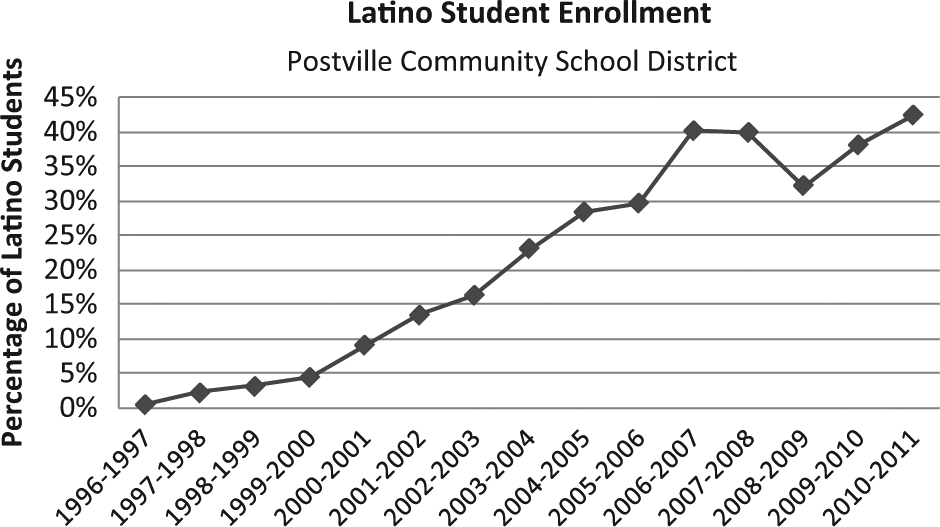
Latino students as percentage of enrolled students, Postville School District, 1996–2011.
Interviews with Guatemalan immigrants to Postville indicated that at its peak from 2007 to 2008, Postville’s Guatemalan community had grown to about 800 people. In the ICE immigration raid in Postville, of the 389 workers arrested about 300 were Guatemalan and about 180 were from one small Guatemalan village, El Rosario. The workers in El Rosario’s population were agricultural laborers who had worked and lived with their families on a flower plantation in the 1980s and early 1990s. When the flower plantation went out of business in 1991, they relocated just outside the plantation and started their community. El Rosario (population 500 as of 2010) is considered an “aldea,” a type of village that is controlled by a municipality, in this case the municipality of Dueñas (population 12,000) in Sacatepéquez Department, Guatemala. Most of the El Rosario residents have very little formal education, engage in subsistence agricultural practices, and collect wood in the nearby forest for heat and cooking. This transnational case study is based on the empirical connections I identified between Postville and El Rosario.
In this study, I demonstrate how shadow networks existed in both global towns by (1) identifying actors that sustained these mechanisms, (2) tracing how they interacted via transnational networks, and (3) indicating where they act in terms of the spaces and locales in both Postville and El Rosario. These networks and players create the conditions for employers and firms (mainly in the United States and other developed countries) to acquire and benefit from steady flows of unauthorized immigrants who in the process may essentially forfeit their civil rights and worker’s rights (and thereby are placed “in the shadows”).
I carried out this transnational paradigmatic case study over a four-year period (from October 2008 to April 2012) during which I visited Postville eleven times and spent a total of five weeks in El Rosario, visiting in 2009 and 2011. I selected Postville after hearing of the raid, realizing that most of the Latino community was composed of unauthorized Guatemalans, and understanding that most of the immigrants came from one town (which potentially meant that the transnational links would be strong). Hence, Postville provided an excellent location to study these shadow relationships. Bent Flyvbjerg (2006, 230) clarifies the rationale for examining a paradigmatic case study as “to develop a metaphor or establish a school for the domain that the case concerns.” Postville could serve as a paradigmatic case study of Shadow Transnationalism, as an example that highlights more general characteristics of the phenomena being examined. Postville’s transnational links were severed by a raid that exposed these mechanisms (bringing them out of the shadows) and provided the opportunity to examine them empirically. The empirical observations gained through qualitative research guided the evolving research questions and the flexible research design of the study. 1
The case study was based primarily on snowball sampling that began by interviewing the Catholic priest in Postville and then spread throughout the community to engage as many as possible of the stakeholders who had knowledge and (or) experience of the networks I studied. These included fifty-five in-depth semistructured interviews and another sixty informal interviews 2 with various individuals involved in one or both global spaces. I conducted interviews in English or Spanish (or both) depending on the interviewees’ preferences. Twenty-five formal semistructured open-ended interviews were conducted in Postville and thirty in Guatemala. 3
Interviewees in Postville included community and religious leaders (from the Catholic, Lutheran, and various evangelical churches), Latino and Anglo leaders, people in town who helped the unauthorized immigrants during and after the raid, Guatemalan immigrants who remained in Postville (authorized or unauthorized), and planners and officials from state agencies and local government. Gaining entry into the El Rosario community was difficult, because I had to meet with three different gatekeepers before being given access to the village. 4 Interviewees in Guatemala included immigrants who had been deported from Postville, community and religious leaders in El Rosario and Dueñas (the municipality that controls El Rosario), local planners and city officials in Dueñas, coyotes (smugglers of immigrants) in El Rosario, and school officials in El Rosario.
Mechanisms of Shadow Transnationalism
And then the Guatemalans came and it started as a few, and then grew and grew . . . people would say, “my uncle’s coming because he needs work, and my brother’s coming and my sister-in-law’s coming” and it was word of mouth more than anything. People joked that there was a big sign in Guatemala that said “Postville: this way.” (Former Postville Meatpacking Worker) The owner of the meatpacking plant asked me for a favor. He said, “Tell the people [the Guatemalan workers] to not speak to the reporters because people will start to notice and more reporters will come, then the government will start to take notice, and the town will also notice.” I told him, “Do you seriously think the people of the town do not know that we are unauthorized? The people know!” (Guatemalan leader in the town of Postville) When I was in Postville, I would see my friends that just arrived and they would all tell me, “It’s great to have you here. Make sure you work hard. Make some money!” It was great to see them all. (Deportee living in El Rosario)
The meatpacking plant’s demand for cheap, exploitable, unauthorized labor was the initial catalyst that sustained the emergence of shadow flows and networks within and involving Postville. This section will analyze the flows of people, information, and money that permeated the shadow transnational networks between Postville and El Rosario and were supported by the co-conspirators in both transnational locations.
Postville developed the ideal “dimensions” of a Shadow Place, the “right” labor conditions, transnational social networks, and access to housing (Leerkes, Engbersen, and Van San 2007). The meatpacking plant had relied on unauthorized labor since it started in 1989, as it first employed unauthorized Eastern Europeans (Bloom 2000). The transition to Latino labor occurred in the mid-1990s, and most of the plant’s workers were Guatemalans by early 2000. The shadow labor conditions were ripe in Postville as there was initially an abundant supply of low-skilled labor-intensive jobs and the meatpacking plant paid little attention to regulations regarding hiring practices and verification of documents and authorizations to work. The housing conditions were also “cheap and accessible,” with little regulation. Immigrants would share rooms to afford the housing and there was little enforcement of regulatory housing codes, even though Postville had such regulations. And after the arrival of the initial “pioneer” immigrants from El Rosario, Guatemala, the key transnational social networks linked Postville and El Rosario, which allowed the connection of social capital that provided work, money, and information that workers from El Rosario needed first to migrate and then to establish themselves within Postville. Postville initially possessed the shadow conditions advanced by Leerkes, Engbersen, and Van San (2007, 1492), and then provided fertile ground for their further development.
This labor system supported a labor tunnel system sustained by employers, immigrants, the state, and the transnational networks of remittances, lending, recruitment, and smuggling. Table 1 indicates findings as to how the co-conspirators were or are linked to the shadow networks.
Relationships between Networks and Co-conspirators.
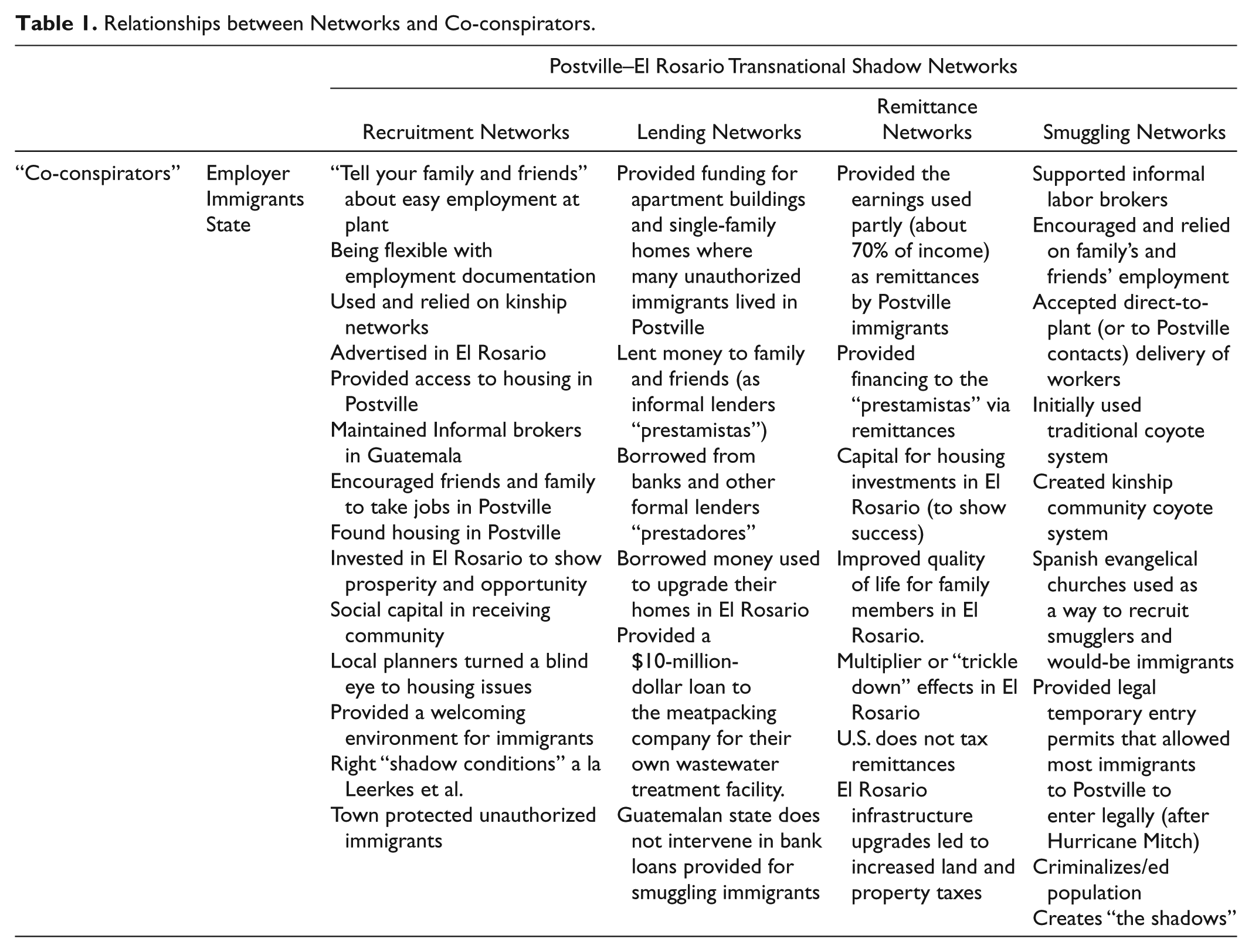
The relationship between the co-conspirators and the transnational shadow networks is analyzed by studying two key informal networks that arose between Postville and El Rosario: community coyote networks and prestamista networks. Detailing their emergence and understanding how these networks functioned before the raid and how they changed after the raid shows the importance that social capital among Guatemalans played in linking all the various shadow network actors participating in shadow transnational relationships within and between the two locales. The housing networks in Postville and in El Rosario and how remittances flowed within these networks demonstrate the various roles the state, employers, and immigrants played in housing development and access both in Postville and in El Rosario. Understanding how these flows and shadow networks transferred after the aid provides empirical validation of shadow transnationalism and its resilience.
The recruitment networks provided, inter alia, key information related to job availability in Postville and to obtaining U.S. employment documentation. The plant recruited Guatemalan immigrants by providing conditions within the plant that made it easy for unauthorized workers from El Rosario to gain employment there. Interviewees reported that plant managers were impressed with the Guatemalans’ work and asked key members of Postville’s Guatemalan community to “tell their friends” that there were jobs in the meatpacking plant. The plant management’s recruitment strategy involved a combination of being “flexible” in the type of documentation needed to secure employment within the plant, using the kinship and friend networks of current plant workers to get the word out about available jobs, advertising the jobs in Guatemala (also in part via kinship networks), and providing access to housing (with little regulation) in Postville. A female interviewee who had worked in the plant for 10 years told of a newspaper clipping she had seen in Guatemala. She stated that the newspaper said:
If you want to work, make good money, then come to Postville. Agriprocessors [the meatpacking plant] is hiring hard working people. You will be making eight dollars an hour [workers in Rosario make six dollars a day].
My key informant also explained that when he was in Guatemala visiting family, a plant manager, “a green helmet called me. He would call me in Guatemala and ask me if I could bring more Guatemalans over [to Postville].” Another interviewee explained how the kinship networks worked as a recruitment strategy for the plant:
I come and I tell my brothers, “Oh you have to come to Postville because, you know, we can work and we can send money back to El Rosario. I can help you make the payments for the coyote to bring you here.” And then my brothers come. And if they are married, they start telling brothers-in-laws, “Oh you know if you come to Postville, you will be able to find employment here. It’s easy.” And that’s how it continues. It branches out. And another thing is that a lot of the supervisors at Agriprocessors, the workers tell me that a lot of the supervisors will say, you know, “I need 20 workers, but I want them to be hard working people like you. So what I want you to do is call back home and say they are telling me that as long as I bring 20 workers and they work hard, then we have a job.” That’s how it all works.
The recruitment networks would not have functioned without the sophisticated smuggling network that emerged between Postville and El Rosario and the key role coyotes played in those networks. This smuggling system consisted of a traditional coyote system where “professional” coyotes would take unauthorized migrants from El Rosario, through Mexico, into the United States and directly to Postville and into the meatpacking plant. Interviewees described the trip as risky because they had to trust the unknown coyotes with their lives as they led them through Mexico and sometimes abandoned them in the U.S.–Mexican border desert.
Remittance networks also played a key role in financing the $5,000-per-person trips. Remittances provided the needed capital within the immigrant transnational community to provide the financing of the trips. Because of the increased capital in El Rosario and the future potential of increased earnings by immigrants, a “prestamista” (informal moneylender) system of financing emerged in El Rosario. Prestadores were formal and prestamistas were informal moneylenders who would finance the immigrants’ trips to the United States.
The tunnel system worked extremely effectively. The cost of the trip was financed with the help of the prestadores and prestamistas, and the coyotes provided the transportation system that would get the immigrants to Postville. In Postville, there was also a housing system, supported by the meatpacking plant, that provided the necessary affordable and accessible housing. Jobs were easily available at the meatpacking plant, and its management encouraged the tunnel system that gave them access to unauthorized labor. Strong social capital within the immigrant community, especially among those who came from one sending community (El Rosario), meant that the migrants were not making this journey alone, and in fact were coming to another El Rosario.
The Community Coyote System
As the town’s unauthorized population grew, a new tunnel system, initially paralleling that of the “professional” coyotes, evolved into a sophisticated system of smuggling people and of financing their trips via kinship and friendship networks. The Guatemalan immigrants to Postville had figured out how to smuggle people into the United States, to Postville, and directly into the meatpacking plant, all without the help of “professional” coyotes.
A family from El Rosario organized the new, more efficient, smuggling network. This family consisted of five brothers, three of whom had worked in the meatpacking plant in Postville, including one who was a “pioneer” migrant to Postville in 1995. Once they learned how the system worked, they were able to organize a sophisticated tunnel between El Rosario and Postville through which a high proportion of new employees at the meatpacking plant arrived. The brothers served as informal labor brokers for the meatpacking plant, and initially they received bonuses for bringing workers to the plant. 5 Their path consisted of taking El Rosario residents to the Mexican–Guatemalan border and legitimately crossing that border (with visas), then providing the information to help immigrants get through Mexico, providing them with maps, information, and points of contact for their long northward journey through Mexico. Once at the U.S.–Mexican border, the community coyotes figured out various ways to cross the border, both legitimately and illegally.
For example, most of the immigrants who came to Postville during 2003–2005 went there legally, with temporary three-month permits (not allowing employment) given to them at the U.S.–Mexican border. During that time, because of humanitarian efforts after Hurricane Mitch, the U.S. government had stopped deporting Guatemalans, El Salvadorans, and Hondurans. In the twenty-four months between February 2003 and March 2005, Postville’s Guatemalan community grew from fifty to five hundred! Once the immigrants were across the border, one of the brothers would meet them in Texas and drive them to Postville. Each brother would serve as a point of contact through various portions of the journey, providing the key information and resources to make the following leg of the journey. It was a system that worked and was relatively safe: it brought about 650 unauthorized immigrants into Postville with not one death during the long journey. 6
This “community coyote” system was a system based on kinship and trust, and the meatpacking plant supported it in that there were jobs already waiting for the immigrants. An interviewee explains how that relationship worked and how coyotes charged immigrants differential prices based on whether or not they had a job and housing waiting for them:
“You want to arrive to the United States with a job waiting for you or without work? Without work, it’s going to cost you $4,000 or $5,000. If you want work, it’s going to cost you $6,000–$7,000; we also have a place for you to live.” Why? They had a good plan. They would tell them that they were going to be received well since they were Guatemalan.
The risks and fears associated with the journey were mitigated based on several factors: the information provided had already proven useful to others, the coyotes were brothers and well known in the community, and the migrants also received information from family members already in Postville who had experienced the journey and could easily be contacted by mobile phone throughout the journey. It was a system that could function under relatively low levels of risk because of the closed networks and social capital that existed between the migrants in the journey and the ones already in Postville. And it was an efficient system because the kinship networks were tied to the smuggling and financing of the trip. An interviewee provided a key example:
I’m going to use Miguelito as an example. Miguelito’s cousin was the one who would bring people, he’s a coyote. So then Miguelito would tell him, “Look, my brother wants to come, bring him for me, and I’ll give you a car, I’ll give you the rest later.” He brings the brother over . . . then when the brother’s over here he starts to pay. This one comes and he tells the same coyote, “Look, I want you to bring my sister.” This same coyote brings his sister. But I’m telling you this was happening on an individual basis. But let’s say that just like there was Miguelito, there was also Juan, Simon . . . so they would tell him, “Look, bring me my family, bring me my brother, my sister.” So there were ten to fifteen people every trip, the coyote would bring ten to fifteen people exclusively to Postville every trip. There was one trip that came with almost twenty-five people.
The smuggling network also worked via the Spanish-language evangelical churches present both in Postville and El Rosario. Most of the El Rosario immigrants in Postville were not Catholics, but rather evangelical Christians. There were three evangelical churches in Postville that originated in El Rosario and whose members were mostly unauthorized, and immigrants would send remittances to improve the churches back in Guatemala. It was in the financial interest of these churches that the immigrants in Postville maintain their transnational connections. One of the pioneer immigrants to Postville explained that members of the Spanish evangelical churches in El Rosario would encourage potential migrants to take the trip north and they would informally provide the contacts with the coyotes and the prestamistas. He provided the example of an aunt of the community coyotes who would visit the evangelical churches on her trips to El Rosario:
She would get there [to El Rosario] and start promoting, she would visit her family, would go to church and in church she would start saying, “I’m visiting from the United States” . . . and all of that. . . . Ultimately, her objective was to promote and motivate people, so that they would travel. And they already had people here in Postville, there were people calling and saying, “Look, come, I will help you. . . .” and “Look, I’m going to give you this telephone number and my son will contact you, and that’s it.” So family members would get connected via the church and come.
Other Postville immigrants became their own coyotes. They traveled with these community coyotes a few times, learned the route and how the system worked. They would go back and forth, visiting family in El Rosario and then returning to work in Postville. They learned how the smuggling system worked themselves and decided to bring their families without the help of the coyotes. As a deportee in El Rosario explains,
There are people who are very clever, very intelligent . . . and they learned the route. Ok . . . now . . . for example, I’m going to talk to you about Toj . . . he traveled like two or four times, he learned the route! So what did he do? . . . He brought his family, he brought his family by himself, you understand. He brought his sons, his wife, he brought everyone . . . he passed with them and brought them all the way here . . . but he learned the route, you understand? He learned the route.
Other types of smuggling businesses developed within the shadow smuggling networks. The coyotes started to take packages and even vehicles bought in Postville back to families in El Rosario. Hence on the way north, they would bring people and medicine from Guatemala, and on the way south, they would take clothing, electronics, and vehicles.
Prestadores and Prestamistas
The smuggling networks needed the financial support of the “prestadores” and “prestamistas.” At first, El Rosario residents would rely on formal Guatemalan “prestadores” for financing the trip. These financiers collected as collateral the titles of people’s homes or land and provided them with high-interest loans (20 percent per month interest rate, paid monthly) to access the funds needed for their migration journey. Some immigrants even reported formally borrowing from banks and directly telling the banks they were using the money as financing for their trip to the United States. A high proportion of later migrants, however, relied on less formal remittance-based loans from presumably more lenient family members and friends.
A type of informal “prestamista” system that relied on remittance networks and was based on kinship emerged that helped finance the tunnel system and increase the number of unauthorized Guatemalan immigrants in Postville. The “prestamistas” in this informal financing system were Guatemalans living in Postville who had saved up enough money to lend funds to their family and friends to support the travel cost of other Guatemalans to Postville.
An interview exchange with an immigrant in Postville reveals the complicated nature of this kinship financing mechanism:
There was a cousin of my husband that lent a lot of money, lent a lot of money out to people. He would tell anybody that came, “bring me the title of your house or the title of your land or car, bring it and I’ll lend you the money.” Everyone would come looking to them for money; people were taking a great risk borrowing the money.
Much of this informal “prestamista” system was based on cousins’ lending money to each other. They either sent remittances back to El Rosario that would be used for smuggling or they would send remittances to their families back in El Rosario so that they could serve as “prestamistas” to others in the community. An interviewee explained,
So, for example, a family member over in Postville would send money to family members here [in El Rosario] and they would in turn lend money to other community members in El Rosario. And then they would ask people for collateral to ensure that they paid them back. . . . Then they could collect interest from these people and get their money back. It’s a business.
Some of the lending practices were even less formal. Friends and family members would just let each other borrow money for the trip, without asking for collateral. It was based on trust and the prospects that the travelers would eventually earn enough money to pay it back. As a deportee who borrowed from prestamistas stated:
People would borrow from each other, from friends. They would say, “do me a favor, let me borrow some money.” It was a big chain. One person would help another and then that person would help another, and it would keep growing, until finally, people could not pay and the chain broke.
Housing Flows and Shadow Networks
The housing flows in Postville and El Rosario and between them transnationally were also connected to shadow mechanisms and involved collusion among the co-conspirators. Access to housing in Postville was a network matter; in Postville a real estate/investment/rental company was linked to the plant owners and their families, linked with at least one evangelical church, and abetted by the town’s housing regulations (or the lack thereof) as supported by the town’s planners.
The owners of the meatpacking plant informally controlled much of the rental housing in Postville in that their close collaborators owned a property company named Neville Properties (Bloom 2000). Town officials estimate that these collaborators owned about 90 percent of the rental housing in Postville. These officials stated that they “had a monopoly in our housing market. We had 2 major Jewish landlords that owned a large portion of this town. They went around offering to buy houses and knocking on doors, ‘I want to buy your house. What’s the taxable evaluation? I’ll pay you more.’”
Unauthorized immigrants in Postville had easy access to housing, which was ultimately controlled by the meatpacking plant and served as an important adjunct activity in recruitment networks. Immigrant interviewees described living in four-bedroom houses with twenty immediate and close family members and paying about $1,500 monthly rent, which did not include utilities that during the winters reached $1,000 per month in energy costs. Immigrants would rent from these management companies because the property managers turned a blind eye to the overcrowded living conditions and provided housing without checking documentation, credit or rental history. Immigrants described how they only needed two people to serve as representatives of the household and how these two people would take care of interacting with the landlords, paying the utility bills, and dealing with any housing issues that would arise.
The town’s structures (the state collusion) and its regulative apparatus understood the specific economic roles that the Guatemalans played for and in the town. They were the important source of labor that needed to be sustained for the plant and were also directly contributing to the rental housing, small business development, and an emerging multicultural milieu in town. Hence, not only did the local government not monitor or regulate their documentation status or regulate issues surrounding housing (unlike some other small towns that adhere to and enforce strict housing occupancy codes), but the planners and townspeople went out of their way to make sure the matters were kept (ostensibly) hidden and in the shadows. In fact, Postville did not hire a housing inspector until after the raid.
Housing in Postville also played another important role as a closely related network of people that helped provide access and convince people to migrate, hence serving as a part of the smuggling networks. Postville immigrants would encourage family members in El Rosario to come to Postville and they would help them find housing within their networks of family and friends. Interviewees stated that immigrants who attended an evangelical church in Postville, run by an Anglo pastor, encouraged their friends to rent housing from the pastor, who according to various interviewees, owned apartment buildings in town. My key informant summarized the housing relationships in Postville best, he said simply, “Postville was a company town.”
The housing networks that existed in El Rosario were dependent on the remittances being transferred to Guatemala as they were mainly invested in housing improvements. Networks of El Rosario residents developed a housing construction industry that used the remittances and completely transformed the housing stock in El Rosario. The remittance networks going back to El Rosario were mostly invested in housing in the immigrant sending community and in turn created multiplier effects that provided jobs. The state’s (in this case, the Guatemalan government’s) response to the investments and to the availability of remittance cash that could be tapped through taxes on improvements was to invest in urban upgrading infrastructure projects in El Rosario.
El Rosario, formerly a village of homes made of sugar cane, became a small town with two- and three-story brick and cement block homes and improved infrastructure. Immigrants were sending a total of $20,000 to $25,000 a month to El Rosario at the peak of the Postville Guatemalan community in 2008. El Rosario’s investments in housing reflect and confirm the literature of remittances, which shows that most remittance investment is private family investment, mainly to improve families’ housing stock (Adida and Girod 2001; Smith and Mazzucato 2009; Goldring 2004). A community leader in El Rosario explained the saving and remittance patterns of immigrants sending remittances for housing investment in El Rosario.
What they would do over there [in Postville] was that whatever they would earn they would save for family expenses, and that depended on the size of the family. When they would raise $1,000 they would send it here [to El Rosario], all at once, so that their wife would save it. But they would always send $100 every 15 days. Once someone had saved up $4,000 to $5,000, they then could really work with that. Most of the people here had houses made of sugar cane.
These remittances directly changed the physical structure of El Rosario (see Figure 2). One immigrant in Postville spoke of the changes as she viewed photographs of how the houses currently looked in El Rosario:
The houses have changed. When I got married, we lived in a house that had three sheets of corrugated metal, a government house. Houses used to be made out of sugar cane.
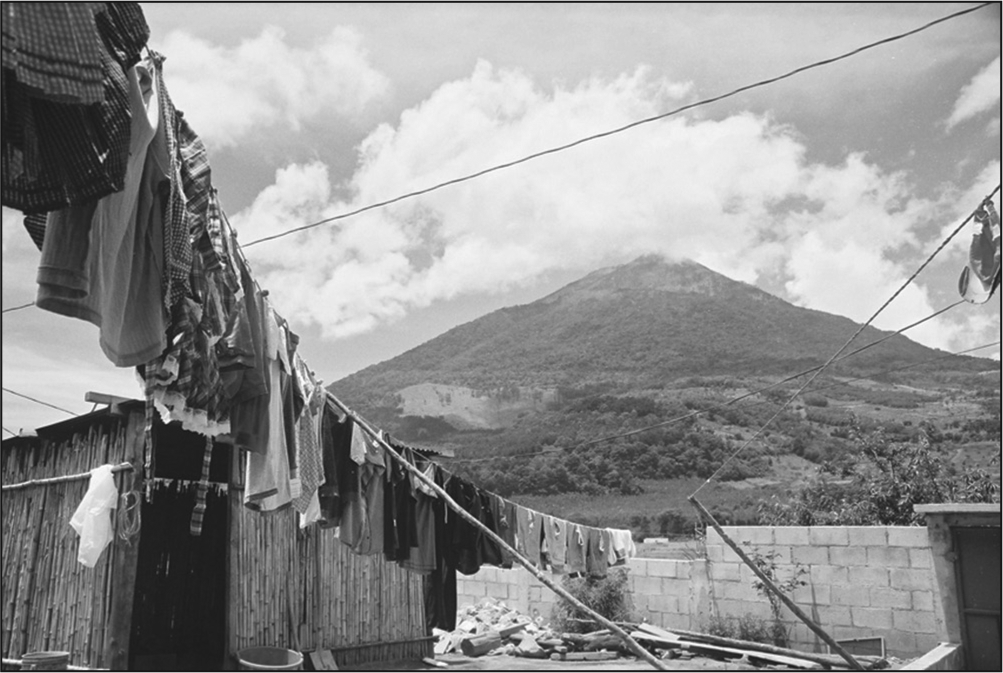
Physical transformations from sugar cane homes to cement block homes.
Much of the remittances were spent on family subsistence and investments, as the literature supports (Goldring 2004; Waldinger 2010; Portes, Guarnizo, and Haller 2002). The multiplier effects of those investments proved to be a great resource for the community in general. The remittances were used for construction, food subsistence, education, and clothing, and the ripple effects created second-tier economic activities that in turn created jobs. The construction industry took off in El Rosario and provided employment for some of those people who did not immigrate and had remained in El Rosario (see Figure 3).
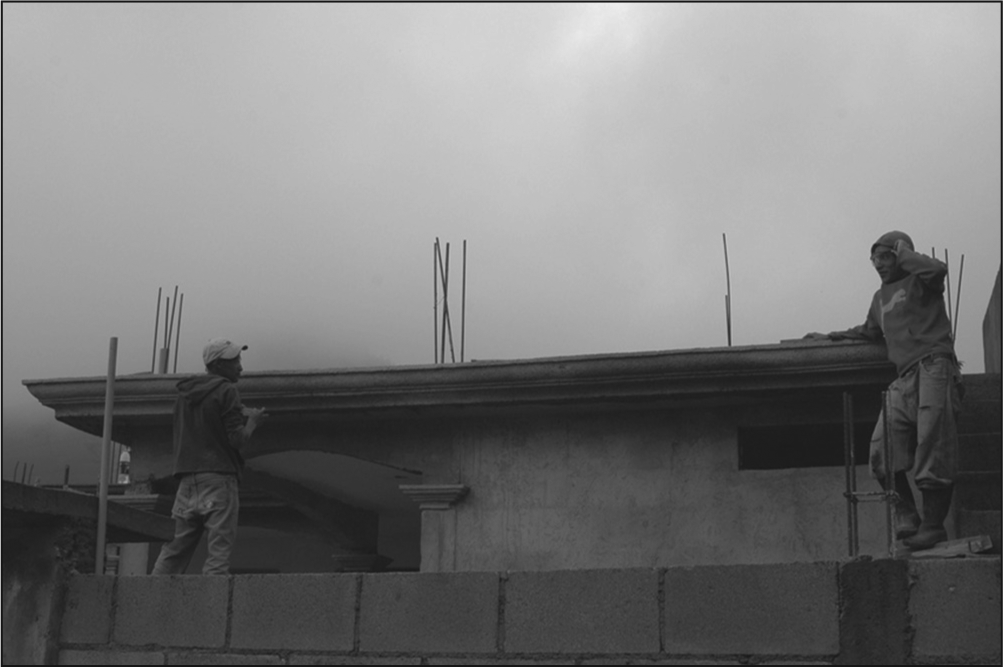
Multiplier effects from the private remittances encouraged the development of construction jobs.
As one interviewee stated:
Some of the immigrants were able to build houses, send back cars, and pay their debts. Some could employ other workers to plant and cultivate their fields and had maids in their house who washed their clothes, cleaned, and so forth.
A COCOE, a type of city council member in El Rosario, sees the benefits of the immigrant remittances for the community in general.
It helped a lot because people that were over there would send money, they maintained the family, and the people would plant beans, sweet potatoes, and vegetables. And many of the women would pay other local workers to plant for them. This lasted 6 or 7 years, that it worked this way, things improved, because a lot of people constructed nice houses. Therefore, it benefited greatly because there was work for everyone. The community had an opportunity for a better life.
The local government’s response (as a good co-conspirator in shadow transnational relationships) was to support the townspeople in El Rosario by providing infrastructure upgrades in the town. Dueñas, which is the municipality that controls El Rosario, has the authority to tax land tenure and also to provide services to El Rosario. In interviews, municipal workers, planners, architects, and local politicians in Dueñas stated that since the private remittances were improving El Rosario, they decided to also invest additional local resources in the community. Hence, the remittances, in an indirect way, also contributed to the urban upgrading of El Rosario through infrastructure projects that were initiated by the municipality of Dueñas. Therefore, although the remittances were not pooled for developing community-based infrastructure projects, something the literature around hometown associations in Mexico stresses (Alarcon 2000; Orozco 2000; Orozco and Garcia-Zanello 2009; Landolt 2003), the remittances were nevertheless the catalyst for the municipality’s investments in El Rosario’s infrastructure. By providing infrastructure to El Rosario, the municipality could now tax the improved value of land and charge fees for services such as running water and sewerage services. The government also paved the road that leads from Dueñas to El Rosario, built a small bridge that links El Rosario to that road (in December of 2007), improved the drainage system in the town, and greatly improved the school in El Rosario. For many people in El Rosario, life became starkly different from how people had lived in El Rosario before the remittances started coming, as one of the first woman Postville migrants recalls:
Before there wasn’t any water, no lights, there was no infrastructure, nothing (see Figure 4). We had to wash in the river.
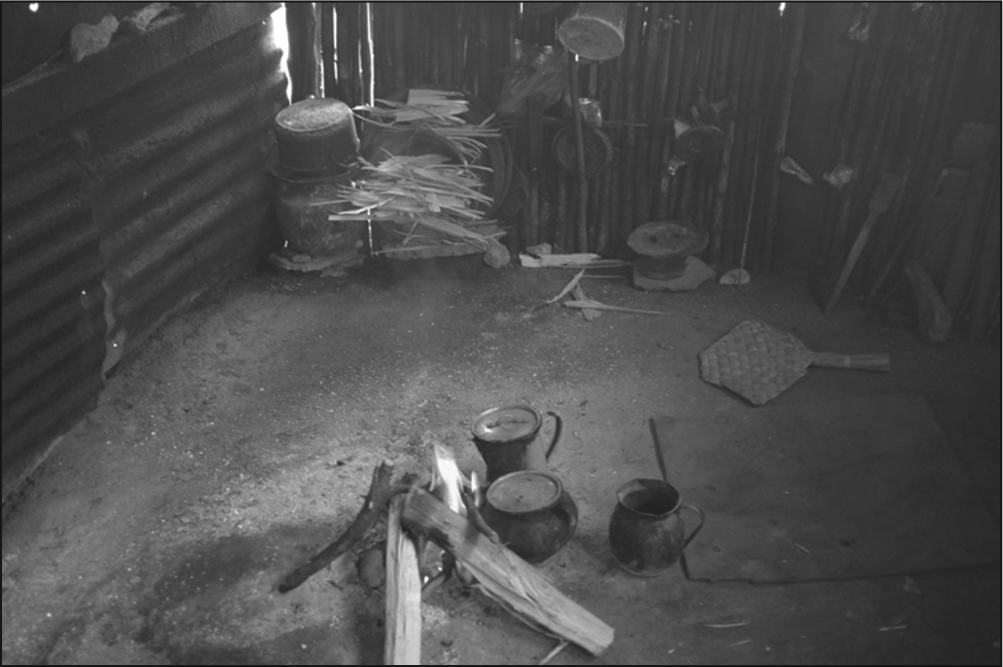
Some families did not have anyone in Postville and could not upgrade their homes; they also still cooked their food using wood without a stove.
The transnational shadow networks between Postville and El Rosario are presented in a conceptual diagram that demonstrates their relationships and grounds them in both places (see Figure 5).
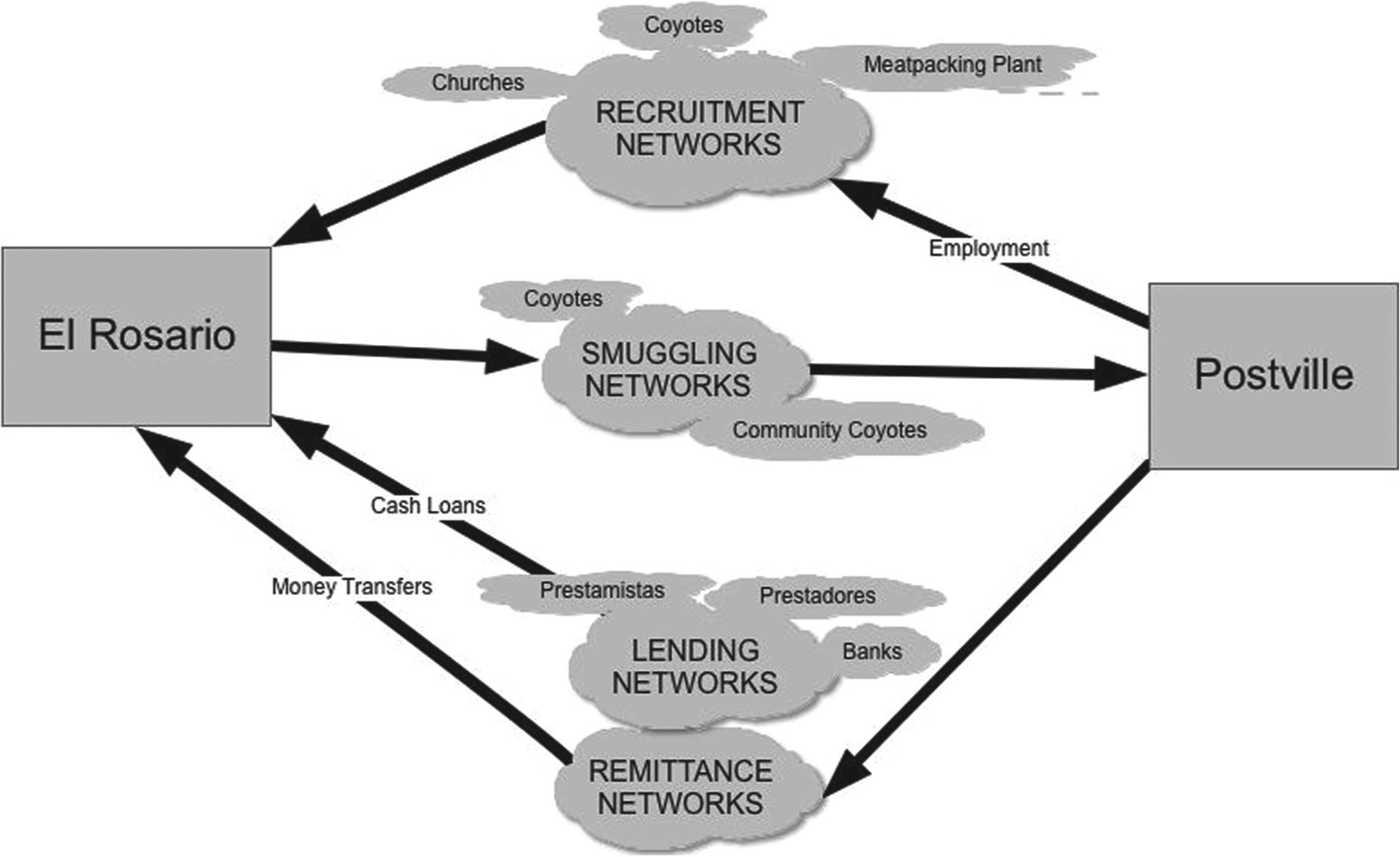
Conceptual diagram showing the relationships between the transnational flows and the shadow mechanisms within and between Postville and El Rosario.
Out of the Shadows: The Exposure of the Shadow Transnational Mechanisms
About a year before the raid, the Guatemalan community in Postville had grown so large that its members were no longer living in the shadows of the small town. The shadow mechanisms involved in the transnational flows were still working effectively but were increasingly more difficult to hide.
As the plant found it easier and easier to meet its labor needs, managers began charging newly applying unauthorized immigrants $500 for the opportunity to work in the plant. Abuses increased within the plant, especially against women, who had increased both in numbers and as a proportion of the shadow community’s members as the community grew. The smuggling systems also changed, as both the community coyotes and the previously relatively informal community “prestamistas” started charging higher fees and interest rates for their services. Housing also became saturated, which led the Postville community to take notice and to put pressure on the city to develop a housing code (which however was only enacted after the raid). With housing saturation, overcrowding increased, and housing managers did not provide services or maintenance.
The Postville ICE raid occurred on May 12, 2008, and the transnational flows were severely impacted. Ultimately the transnational mechanisms that developed between Postville and El Rosario were based on an unstable foundation, a foundation based on shadow transnationalism that needed to remain hidden (or de facto accepted).
In Postville, the raid affected the town by collapsing its tunnel labor system. Transnational Shadow networks linking the two towns were temporarily disrupted, and this led to drastic changes between the towns. The community coyote activities ended, the prestamista activities morphed into collection activities, and the housing flows collapsed. 7
The housing flows’ collapse had a large impact on Postville. The collapse of the rental housing market affected the overall housing market and the taxes generated by the town. The Agriprocessors-linked realty company that rented out apartments to immigrants filed for bankruptcy; all those properties went into foreclosure and were taken over by the town (with funding provided by the state), leaving town officials to ponder what to do with so many vacant homes and buildings.
As a town planner who worked in Postville explained in an interview.
In the last count we were at about $162,000 of unpaid property taxes and we are, have assessed about $150,000 onto properties for non-payment of water utilities. So, that’s a lot of money owed to the town.
It was the perfect storm in Postville. The downside risks of the transnational mechanisms and conditions established under Shadow Transnationalism had finally caught up with the town. The invisible population working, living, and contributing to a multicultural community there had just been taken abruptly out of the shadows, with dire consequences for the town and the immigrants.
In El Rosario, the break in the transnational mechanisms was as damaging, and probably more damaging. The town had become completely dependent on the remittances by family members in Postville. The remittances had dried up overnight, devastating the housing construction activities in the communities. The town that had been transformed by the private remittance investments in its homes was left with many abandoned-looking and half-constructed structures. The lack of remittances also affected the multiplier effects in the community. As a community leader who did not migrate explains,
Now we are in a critical time in the Aldea because there is no money. The trucks would come to bring material to build houses and they would drop it off at the towns’ entrance and many people would help to carry those bricks up to people’s lots. Even the women and kids would bring the bricks up to the lots. They would pay 1 quetzal [the equivalent of 1/8 of a dollar] per brick to carry to the lots, because it was difficult to carry 5 or 6 bricks to the top of the hill. That was a great help that people in Postville provided to El Rosario.
Another El Rosario resident sees the situation in a similar fashion.
All that money stopped because many were building houses. For those that had already finished, that was okay, but for those that were half way done, they could not finish because there were no funds left to finish. Even for work, when they used to send money, people would pay others to do their job, but when the people were deported, that stopped. Now things are difficult because jobs are scarce.
The situation was also desperate for the El Rosario deportees who had not finished paying off their debts to the “prestadores.” The formal debt collectors collected or foreclosed on the titles to property and small plots of land that they held as collateral for the loans. The informal “prestamistas,” who were mostly family members and had no legal claim to titles, lost most of the money they had lent out. Hence, the small town of El Rosario, which had looked like such a promising and up and coming transnational village, now suffered from the lack of remittances, lack of local employment, and the situation of its indebted Postville returnees who had risked much in their transmigration journey and in many cases lost more than they had gained.
Implications for Planning Practice: Planning for Shadow Communities
This study underscores the need for new approaches to planning in communities with high numbers of unauthorized immigrants. It also complements transnationalism from “below” scholarship and advances knowledge of the risks and exploitative relationships that exist within or involve transnational communities. As unauthorized immigrants serve a structural socioeconomic function within U.S. cities/towns, planners must confront this difficult issue. These global towns are interdependent within networks tied to Shadow Transnationalism, and Postville/El Rosario provide a paradigmatic example of how badly things can go wrong if planners and other civic leaders become overly dependent on these shadow economic relationships.
The shadow system that existed in Postville was sustained by Shadow Transnational networks, and I have demonstrated how these transnational global networks function by focusing the analysis on two kinds of networks: coyote (smuggling) networks and prestamistas (lending) networks. I have also identified how housing played a key role in providing access to Guatemalan immigrants to Postville and the importance remittance transfers played in housing development within El Rosario. These network relationships could be maintained because the “right” conditions existed in Postville and El Rosario: the demand for unauthorized labor in the plant, the capital and social capital available to immigrants (for the trip and their investments), and finally, the “right” context of Postville’s acceptance of illegality and El Rosario’s benefiting from it. Hence, I concur with Leerkes et al., regarding their three key determinants that create shadow places, but I go beyond their arguments by demonstrating the transnational simultaneity that supports this shadow system. The shadow system in Postville could not have existed without migrants from El Rosario and the transnational shadow networks between the two locales. I also show the structural and exploitative side of transnationalism from “below” by demonstrating how these shadow relationships could not have existed without the “co-conspirators” colluding with the shadow networks, which keeps the shadow system in place.
Shadow Transnationalism, hence, provides the networks that support a steady supply of unauthorized immigrants that leads to an exploitative form of transnationalism. The shadow networks constitute a system that creates and maintains vulnerable populations. The vulnerable populations provide cheap and docile low-wage labor in intensive and dangerous jobs in the United States. The immigrant-receiving state, via its regulations, is the opaque body that creates the shadow environment by criminalizing these populations. By illegitimating these populations, the state accomplishes three things: (1) it does not have to take on the responsibilities of the social welfare mechanisms (social safety net) that it would bear with other workers; (2) it also creates vulnerabilities to maintain these populations in a subordinate position and disproportionally pushes the risks associated with this dangerous system and dangerous jobs onto the unauthorized immigrants; and (3) by keeping some parts of the unauthorized immigrant economy going, such as collecting payroll taxes and social security premiums from unauthorized immigrants (hence the use of tax ID numbers) and their employers, the state directly benefits financially from unauthorized labor. It also benefits indirectly from the taxes employers pay on profits increased by the exploited labor of unauthorized immigrants. In summary, the state benefits from a population that is dispensable, invisible, and exploitable.
These shadow networks are informal, and hence the co-conspirators are able to protect themselves by denying direct links to this shadow world. In the Postville case, transnational social networks played a key role, as the co-conspirators were able to link into the shadow networks in mostly informal ways and under the radar. Most of the relationships supporting shadow transnationalism were networks of trust and reciprocity and were informal, so that when the system came tumbling down, the people who “got caught” were the unauthorized immigrants. This was a result of the informal relationships among and within the shadow mechanisms and the involvement of the trust and reciprocity that existed among the Guatemalans involved. The criminalization of unauthorized immigrants by the state (via the raid) placed the blame on the immigrants. The owner of the meatpacking plant received a long prison term, but that was for financial fraud, not immigration-related charges. The town of Postville was left to deal with the aftermath in terms of its housing market, foreclosed properties, and the major debts for which it had accepted co-responsibility with now-bankrupt Agriprocessors. Nevertheless, on balance it is clear that among the co-conspirators the illegally employed immigrants and their families suffered the most damage.
The shadow transnationalism networks were all linked to the social capital that existed between Guatemalan immigrants in Postville and those in El Rosario. These transnational Guatemalan-to-Guatemalan social networks with the embedded bonds of trust and reciprocity emboldened people of El Rosario to use the informal shadow networks. Why else would a Guatemalan in El Rosario entrust their children to community coyotes to cross Mexico and the U.S.–Mexican border? The shadow system is based on informality and trust.
Planners can play important roles within these shadow spaces. Planners’ roles are diverse, from a comprehensive code enforcement regulative staff member of a municipality to a transformative equity-seeking advocate pushing for immigration integration at the local level. As Michael Brooks suggests, planners deal “with matters of public concern and relevance” (Brooks 2002, 10) such as unauthorized immigration. Hence, planners working in these shadow places, first of all, need to recognize the complex transnational relationships that exist within these spaces (Miraftab 2011). They need to understand that planning for a mix of unauthorized and authorized immigrants is different than planning for authorized immigrants. This is because shadow places are spaces that breed vulnerability as the regulations that exist (the opaque body) create the climate that pushes these populations into the darkness where (1) they are difficult to see (remain invisible); (2) they link with other informal activities (such as criminal networks) that expose them to greater risk and further illegitimate them; and (3) the state and employers can “wash their hands” of many social and safety responsibilities such as providing health care, retirement arrangements, or even planning-related interventions such as providing public outreach mechanisms or transportation services to these “illegitimate” communities. Interventional policies and programs targeting the local sphere are critical and create a concrete role for planners, especially around inclusivity of marginalized populations (Miraftab and McConnell 2008). Although immigration policy might be structured at the national level, and the mechanisms and flows can exist because of global networks (Castells 2000), their reification occurs at the local level (Smith 2001) and that is the spatial sphere where planners mainly intervene. Lastly, planners should understand the risks and vulnerabilities that exist in these spaces to assess how their interventions can change those risks.
Postville developed into a shadow place where various co-conspirators were taking calculated risks through their transnational socioeconomic activities and in turn became interdependent on a Shadow Transnationalism that to varying degrees increased their vulnerabilities. The meatpacking plant needed the cheap, exploitable, unauthorized labor. The landlords welcomed the new rental population. The town’s political and civic leaders (including planners) needed the meatpacking plant’s job base and taxes, and the increased population brought by immigrants. And the unauthorized immigrants, desperate to improve their socioeconomic standing, developed informal mechanisms of sending money to El Rosario, smuggling, lending, and recruiting their family and friends to Postville in which the entire shadow system depended. The immigrants took the greatest risks and suffered the most damaging consequences. Those Shadow Transnational flows culminated in the ICE raid. When the ICE raid publicly exposed and disrupted the flows of Shadow Transnationalism at the local level, that fragile foundation temporarily broke and those parts of the system based on it came tumbling down.8 However, it is increasingly clear that the shadow systems, linked with and required for the optimal functioning of the global and regional nonshadow systems, are quite robust and resilient overall.
This case study complements theories such as transnationalism from “below” that in trying to explain transnational relationships place emphasis on immigrants’ ability to transcend their structural positions via increased agency. This study, however, goes further by analyzing the transnational structural constraints existing simultaneously within both global towns (Tsuda 2012). It also furthers transnationalism scholarship by uncovering structural relationships that exist within unauthorized communities and how institutions function to sustain a system of “illegality” that benefits employers, the state, and immigrants. Understanding Shadow Transnationalism could enable a more balanced planning approach, one that considers the shadow networks and the related risks and vulnerabilities present in communities with a large presence of unauthorized immigrants, as well as the dependencies and risks present in those immigrants’ communities of origin. Planners need to be aware of these issues and to take proactive roles in planning for unauthorized populations, even if the planners are uncomfortable working in or with environments of illegality and informality.
Dependency on Shadow Transnationalism leads to instability and increased vulnerability in the global towns because of the criminalization environment that unauthorized immigrants are relegated to and within which they must maneuver. This in turn morphed the informal social networks into ones that relied heavily on informal shadow networks and eventually involved patterns of abuse that fed on vulnerabilities, especially the vulnerabilities of unauthorized immigrants.
While uncovering the mechanisms of Shadow Transnationalism helps planners better understand communities with high numbers of unauthorized immigrants, it also opens up new questions and directions for planning scholarship. One critical question to explore in future research is how can or do planners “plan” in environments of un-authorization or illegality, for “illegitimate” communities? The Postville case demonstrates why planners need to engage these communities and take on the challenges associated with planning in the presence of Shadow Transnationalism.
Footnotes
Acknowledgements
I would like to acknowledge and thank the residents of Postville and El Rosario for sharing their experiences.
Declaration of Conflicting Interests
The author(s) declared no potential conflicts of interest with respect to the research, authorship, and/or publication of this article.
Funding
The author(s) received no financial support for the research, authorship, and/or publication of this article.