




Abstract
Despite the growing interest in expanding the joint use of K–12 public schools by public health and planning practitioners to promote healthy, sustainable communities, the topic has received little attention in the urban planning and public health scholarship. The objective of this article is to situate joint use in the academic literature focused on the links between built environments and health. I examine the “state of the field” of K–12 joint use through studying the academic and associated literature, interviews, participant observation, and case examples. I develop a joint use classification system to aid researchers and practitioners.
Keywords
Introduction
Despite growing interest in expanding the joint use of K–12 public schools, including playgrounds and other recreational facilities, to promote healthy communities, formal study of existing joint use policies and practices is limited in the urban planning and public health literatures. Research bridging the analytic perspectives of urban planning, public health, and education regarding joint use of schools is particularly limited yet necessary to guide real-world planning and decision making. This article aims to fill this gap by establishing an understanding of K–12 joint use as a place-based strategy and to better situate K–12 joint use in the academic planning literature focused on the links between built environments and health.
K–12 joint use occurs when school facilities or grounds are utilized by nonschool entities or individuals, often after school or on weekends, when school is not in session (Filardo et al. 2010). 1 In recent years, public health advocates and policy makers have repeatedly recommended joint use to promote healthier communities, citing its potential for increasing physical activity, especially among children and youth (Health in All Policies Task Force 2010; Kappagoda and Ogilvie 2012; American Heart Association 2012). Planners, too, have looked to K–12 joint use as a way of promoting smart growth and sustainable communities (Council of Educational Facility Planners International, Inc., and U.S. Environmental Protection Agency 2004; Vincent and McKoy 2013). Educators have long viewed joint use—often referred to as community use—of schools from varied perspectives, most often in relation to fostering parent and community relations and bringing external service providers onto school campuses to offer added social or extracurricular services and programs to students (Dryfoos, Quinn, and Barkin 2005).
The contemporary push for increased K–12 joint use from the public health and planning fields comes as they better understand the relationship between built environments and health outcomes (Corburn 2004). As obesity rates rise, research reveals low levels of physical activity and of access or proximity to places for physical activity in many communities across the country, especially in rural and lower-income areas (Kaczynski and Henderson 2007; Brownson et al. 2001; Gordon-Larsen et al. 2006). Adequate park and recreation space is widely seen in the planning field as important to planning for healthy and more sustainable communities (e.g., U.S. Green Building Council 2009; American Planning Association 2005). Studies have shown that expanding the availability of such spaces can have positive effects on increasing physical activity among children and other community members (Li et al. 2005; Rosenberger et al. 2005). Citing its potential to increase physical activity, K–12 joint use has been recommended in several recent policy reports, including the influential Healthy People 2020 (U.S. Department of Health and Human Services 2010), National Physical Activity Plan (National Physical Activity Plan Alliance 2010), a White House Task Force on Childhood Obesity (2010) report, and “Voluntary School Siting Guidelines” (U.S. Environmental Protection Agency 2011).
However, public health and planning practitioners face challenges in working with educators and school districts to prioritize joint use for community physical activity (Evenson and McGinn 2004; Cox et al. 2011; Cooper and Vincent 2008). While some practitioner-oriented resources have emerged to inform implementation (Kappagoda and Ogilvie 2012; Marrow and Frost 2012; Filardo et al. 2010), planning and public health academic literature has yet to look comprehensively at the policy and practice of K–12 joint use (Vincent 2006; Cox et al. 2011).
Prior to this research, no systematic review of types and strategies of K–12 joint use existed. To bridge this gap, I examined the “state of the field” of K–12 joint use and probed the following questions: What is the prevalence and distribution of joint use? What are its various goals? What types of joint use occur? How is joint use implemented? What challenges to joint use implementation exist? My findings suggest that the physical activity–related rationale for expanding joint use of schools is one among many and that varied and sometimes competing joint uses occur at schools. This creates a potential for tension when planners and public health practitioners work with schools to expand joint use. To ameliorate this tension, I developed a framework to distinguish varying approaches to joint use. The analysis provides new insights for the planning and public health fields on pragmatic policy levers to implement and sustain K–12 joint use as a place-based strategy for promoting healthy communities.
The article proceeds as follows: First, I briefly describe the public health, planning, and education scholarship fields’ orientations toward K–12 joint use. Next, I present the research methods and findings. The remainder of the article is devoted to analyzing my findings and developing a framework to inform pragmatic joint use implementation, concluding with suggestions for useful future research.
Perspectives on Joint Use of Public Schools
Interests in K–12 joint use overlap among the planning, public health, and education fields. Yet each field has its own set of theories about potential benefits. In some cases, empirical evidence supports those theories. For many, however, empirical studies have yet to be conducted.
Urban Planning and Public Health Perspectives on Joint Use: Promoting Smart Growth and Healthy Communities
The planning and public health fields continue to converge around promoting healthy communities as understanding of the relationship between built environment characteristics and health outcomes grows (Corburn 2004; Boarnet 2006; Frumkin 2002). As a result, these fields have similar perspectives on the potential benefits of K–12 joint use as a place-based built environment intervention. Practitioners in both fields have recommended expanding K–12 joint use to promote broad concepts of healthy, sustainable communities. Planners use terminology such as “community-centered schools,” “smart-growth schools,” and “schools as centers of communities” to discuss a belief that schools should be located to provide for easy commuting and act as a central public space to foster events and community building (in part through joint use) in addition to providing quality learning (Council of Educational Facility Planners International, Inc., and U.S. Environmental Protection Agency 2004; Sharp 2008; Kuhlman 2010; Torma 2004; Passmore 2002). In part, this perspective emerged in response to concerns over new school siting and design trends toward large, single-use greenfield sites, believed to encourage sprawl, increase vehicle miles traveled, inhibit walking and bicycle access, and deter joint use (McDonald 2010; Norton 2007; Ewing and Greene 2003; Vincent 2006; Michigan Land Use Institute 2004; Gurwitt 2004; McMahon 2000; Passmore 2002; Beaumont and Pianca 2002; Steward 1999; Beaumont 2003). Planners claim that siting and designing schools to incorporate “smart growth” concepts (urban design and infrastructure approaches that counter low-density suburban sprawl with location efficiency, multimodal transportation options, and so on) will create “centers of community” to counter these trends, providing mutual benefits for education and communities (Sharp 2008; Kuhlman 2010; Torma 2004; McKoy, Vincent, and Bierbaum 2011). No studies in the planning literature appear to have measured the potential land-use and travel outcomes noted above in relation to joint use (McDonald 2010; Vincent 2006, 2010).
Sharing these concerns with planners, many in the public health field focus on the health-promoting potential of K–12 joint use, particularly through increasing opportunities for physical activity (Sallis and Glanz 2006; Story, Kaphingst, and French 2006). Childhood and adolescent obesity rates have risen sharply across the country over the last couple of decades; more than one-third of all children and adolescents in the United States are overweight or obese, a strong predictor of future health problems (Ogden et al. 2010; Flegal et al. 2012). While many factors contribute to this trend, a decline in physical activity appears to be a key part of the equation (Muller 1999; French, Story, and Jeffery 2001; Kaczynski and Henderson 2007; Brownson et al. 2001). Half of adults and two-thirds of children in the United States get less than the recommended amounts of physical activity (Centers for Disease Control and Prevention 2012). The health benefits of regular physical activity for children are well documented, including positive impacts on child cognitive function and academic performance (Strong et al. 2005; Must et al. 2009; Durant et al. 2009; Raspberry et al. 2011; Singh et al. 2012; Trudeau and Shephard 2010).
However, many communities do not have publicly accessible spaces for physical activity (at schools or elsewhere), limiting opportunities for people to be physically active (Babey et al. 2008; Krahnstoever Davison and Lawson 2006; Powell, Slater, and Chaloupka 2004; Powell et al. 2006; Gordon-Larsen, McMurray, and Popkin 2000; Gordon-Larsen et al. 2006). In some communities, schools may be the only existing indoor and outdoor physical activity spaces or the only spaces that parents feel are safe for their children (National Association of Counties, Center for Sustainable Communities 2007). Yet, the availability of school facilities and grounds for community use varies, with many school campuses locked and inaccessible after school and on weekends (Kappagoda and Ogilvie 2012; Evenson et al. 2010). These challenges of poor health and lack of space for physical activity appear to be even more pronounced in low-income and minority communities, demonstrating a relationship of K–12 joint use to health equity (Day 2003; Centers for Disease Control and Prevention 2012; ALR 2012; Maddock et al. 2008; Evenson et al. 2010; U.S. Department of Health and Human Services 2010; Spengler, Connaughton, and Maddock 2011; Cox et al. 2011). Moore, Diez Roux, and Evenson (2008) found that 70 percent of African American neighborhoods and 81 percent of Hispanic neighborhoods lack recreation facilities, compared to 38 percent of white neighborhoods.
An excerpt from PolicyLink’s 2011 report Why Place & Race Matter summarizes the overarching health rationale for K–12 joint use, with an emphasis on health equity considerations:
Where can a child play if there are no parks or playgrounds in her community, she has no backyard, and there are gangs controlling the streets? Where can a child learn a traditional dance or play basketball or tennis when she is surrounded by farmland? One way to address these problems is through a policy called joint use, or the sharing of public space by several institutions or groups within a neighborhood. While seemingly a simple concept, it can have a positive impact on residents’ physical activity and can lead to an enhanced sense of community. The majority of joint use partnerships are between schools and community organizations, daycare centers, athletic teams, adult education programs, and affordable housing developments; however, any piece of property or new construction can be used for this purpose. Ironically, joint use agreements have generally not been in effect in communities that need them most. (Bell and Lee 2011, 70, emphasis added)
Researchers are finding evidence that greater access to park and recreation space in individual communities can lead to increased physical activity, especially among children and adolescents in the nearby neighborhood (Durant et al. 2009; Farley et al. 2007; Brink et al. 2010; Maddock et al. 2008; Li et al. 2005; Rosenberger et al. 2005; Krahnstoever Davison and Lawson 2006). For example, Maddock et al. (2008) found that a joint use agreement in Hawaii increased physical activity programming on the school site after school hours and led to increases in physical activity overall. Yet, despite these findings, it appears that nationally “progress towards opening school facilities for recreational use outside school hours is slow” (ALR 2012, 3). A national study measuring changes in community access to school physical activity facilities found no meaningful change in the overall prevalence of access for youth or adults to these spaces from 2000 to 2006 (Evenson et al. 2010).
Public health researchers have begun to identify barriers to joint use as a way to speed the pace of implementation. These include (1) school district concerns about legal liability issues, should someone get physically hurt while on school property; (2) school district concerns about security and the risk of increased vandalism; (3) school district constraints of insufficient staffing to administer and/or coordinate joint use logistically; (4) school district constraints of inadequate funding to support joint use; and (5) school designs that make sharing facilities with nonschool users difficult (Baker and Masud 2010; Cooper and Vincent 2008; Cox et al. 2011; Filardo et al. 2010; Lau 2012; Maddock et al. 2008; Spengler, Young, and Linton 2007; Spengler et al. 2010; Spengler, Connaughton, and Maddock 2011; Spengler, Ko, and Connaughton 2012; Vincent 2010; Young et al., forthcoming). To date, research has made solid progress identifying barriers but has focused less on understanding their deeper nuances and context. Overall, academic research in the planning and public health fields on approaches and strategies for K–12 joint use is in its early stages.
K–12 Education Perspective on Joint Use: Promoting Student Achievement and Community Connection
Public educators have a long tradition of community use of schools, dating back at least to the early 1900s. Some of this tradition is rooted in promoting physical and mental health of students. Scholars have written on issues ranging from community use of school spaces for social activities (Edwards 1926; Riley 1906; Dewey 1902; Englehart and Englehart 1940) to community-based organizations working inside schools to deliver social services (Dryfoos, Quinn, and Barkin 2005; Epstein 2001; Warren 2005) or promote enhanced social capital (Hanifan 1916; Hanifan 1920; Warren 2005; Putnam 2001). All of these are believed to indirectly promote student achievement (Furman 2002; Rothstein 2004).
A constant theme seen in the education literature on community use is concern that weak school–community relationships hinder educational achievement, particularly in low-income neighborhoods (Furman 2002; Noguera 2003; Arum 2000). As K–12 public schools in the United States have moved from their locally governed “village” beginnings around the turn of the last century to the much larger, bureaucratic school districts seen today, control over curriculum, staffing, and facilities use has become increasingly centralized (Tyack 1974; Katz 1987; Tyack and Cuban 1995). During this evolution, schools also became more resistant to serving local neighborhood needs (Sarason 1992; Etzioni 1964; Mathews 1996; Furman and Merz 1996). With regard to joint use, increased bureaucracy often meant more formalized control and coordination of facilities access and use.
Joint use of public school facilities is at the heart of the popular present-day education reform model of “full-service community schools” (sometimes referred to as “community schools” or “full-service schools”). The approach aims to bring educational, recreational, and health services together under one roof, particularly in disadvantaged neighborhoods, to better meet the wide variety of needs for children and their families (Dryfoos, Quinn, and Barkin 2005; Blank, Melville, and Shah 2003). Typically, this is done through collaborative partnerships with community-based organizations operating on school campuses (Warren 2005; Dryfoos and Maguire 2002). Tracing its roots to the Settlement House movement of the late 1800s, the community school model has gained prominence since the 1990s and is being adopted in school districts across the country (Dryfoos, Quinn, and Barkin 2005; Blank, Berg, and Melaville 2006). Research has found community school model implementation to increase academic outcomes, reduce dropout rates, improve behavior, increase parent involvement, and promote indirect community benefits (Coalition for Community Schools 2009). The research has focused much more on outcomes than on implementation, likely because the community school model is promoted as a general (not prescriptive) approach to be uniquely implemented locally depending on context and culture. The community schools approach has been bolstered by federal support from the Full Service Community Schools Act of 2011 (HR 1090, S 585) 2 and Department of Education’s Promise Neighborhoods program (U.S. Department of Education 2011a, 2011b). Support is also seen in the U.S. Department of Education’s (2000) report, Schools as Centers of Community: A Citizen’s Guide for Planning and Design (Bingler, Quinn, and Sullivan 2003).
Yet, research specifically on joint use is limited in the education field. As Uline (2009) noted in the Journal of Educational Administration, the role of school facilities (and joint use) in education is underexamined by the education field as a whole. One of the leading books on school facilities planning echoes this sentiment, stating, “Planning and managing of school facilities continues to be one of the most neglected areas of school administration” (Kowalski 2002, ix). More focus on joint use has occurred in school-facility trade magazines such as School Construction News (Perry 2007), Athletic Business (Brown 2008), American School & University (Kennedy 2006), School Planning & Management (Westlake 2008), School Business Affairs (Mahoney 2008), and Building Design and Construction (Schneider 2008).
The research and associated literature on joint use reveal that many challenges remain in “moving the needle” on increasing K–12 joint use. This is especially true with regard to increasing physical activity in local communities, described in a recent research review as making slow progress (ALR 2012). Most fundamentally, a comprehensive understanding of K–12 joint use—its prevalence, what types exist, why and how it is being implemented—remains missing in the literature to guide these three fields.
Research Methods
To examine the “state of the field” of K–12 joint use, I conducted a multiphase qualitative research study over the course of three years to obtain in-depth and contextualized data. First, I assembled joint use examples from across the country to aid in understanding the scale, scope, and variation of its occurrence. Next, I conducted interviews with stakeholders in the field and participant observation of joint use implementation meetings. These provide rich, in-depth data on joint use implementation. Each method is described in more detail below.
I chose California as the case site for conducting the interviews and participant observation research because my location and history of working with public health, planning, and education stakeholders in California allowed ease of access to informants and meetings. California was also a logical choice for exploring the policy and implementation aspects of joint use, as policy and advocacy interest in the topic has grown here in recent years, particularly from public health actors. In June 2008, at a California Convergence Partnership 3 convening of health providers and advocates from across the state, participants identified two key policy priorities for advancing health in disadvantaged communities, one of which was increasing K–12 joint use (Convergence Partnership 2009). Similarly, the California Strategic Growth Council’s Health in All Policies Task Force Report (Health in All Policies Task Force 2010) recommended expanding K–12 joint use to promote health. In 2010, the California Department of Public Health’s Project LEAN awarded $20,000 planning grants to support expanding joint use to five local partnerships of school districts, local governments, and nonprofits across the state (California Department of Public Health, n.d.).
Case examples of K–12 joint use
The lack of available data sets on existing joint use in schools greatly hinders research on the subject. To overcome this problem, I compiled a database of 230 K–12 joint use case examples from across the country in 2009–2012. Examples came from a variety of newsletters, documents, and other sources from California health advocacy organizations (e.g., Kappagoda and Ogilvie 2012; http://www.jointuse.org); Internet searches of news and other articles on joint use; and search of professional magazines in the school facilities field. Once identified, readily available information was gathered from the source. Case examples contained varying amounts of detail; I aimed to collect a baseline of data points (type of joint use, grade level of school, location/type of community). Forty-four percent (n = 101) of the examples collected were located in California. This does not necessarily mean that more joint use occurs in California. Rather, it is likely a result of many cases having been identified by informants interviewed, all of whom were in California; also, given recent heightened interest in joint use among public health advocacy organizations and foundations in the state, more information on California joint use was likely to be reported.
Informant interviews in California
I conducted 65 semistructured interviews with state, school district, local government, and community organization representatives throughout California to understand trends, learn about specific projects and strategies, and probe deeper on joint use implementation and its challenges. Interviews ranged from 20 to 120 minutes, with most lasting about an hour. I used snowball sampling (Babbie 1983) to identify informants, whereby each was asked to recommend additional informants. First, I interviewed staff of the California Department of Education’s School Facilities and Transportation Services Division (n = 5) and the California Department of Public Health (n = 3) about their knowledge of and insights on the scope of K–12 joint use practices across the state and their opinions on the role of related state policies and statutes. These state officials then identified local contacts across the state who they believed would provide useful perspectives on joint use. These included local school district leaders (n = 18), former local school district leaders (n = 8), and county health officers (n = 3) having experience implementing joint use. I interviewed these local officials, who also provided contact information for those at community organizations (n = 15) and municipal or county agencies (n = 9) they felt it would be useful to interview.
Interviews began with broad questions about individuals’ perspectives on joint use, followed by more specific questions about their experiences with implementing joint use and their opinions on barriers to joint use identified in the literature, as cited above. I asked school district representatives to describe the breadth of shared uses that occur in their schools, why this use occurs, and how it is facilitated (e.g., policies, regulations, approval systems). I asked other informants similar questions, focusing on their perspectives as outside entities interested in using K–12 school facilities and grounds. Questions were added or revised over the course of the interview process as new issues were identified.
Participant observation in California
I conducted participant observation in eight K–12 joint use meetings from January 2009 to April 2012. The meetings were part of joint use projects led by three different California public agencies: The School Facilities as Community Assets Task Force of the San Francisco Unified School District and the City of San Francisco’s Department of Children, Youth, and Their Families (2009–2010); the California Department of Public Health’s California Project LEAN (Leaders Encouraging Activity and Nutrition) joint use grantee project (2010–2011), 4 and the Los Angeles County Joint Use Moving People to Play (JUMPP) program (2010–2012). 5 Each project convened stakeholders for the purpose of expanding joint use opportunities in their respective local communities and included participation by school districts and their partners from across all parts of California, and including urban, suburban, and rural communities.
Data gathered using the three methods described above represent a wide variety of communities across California. However, the data were generated opportunistically, based on readily available information of joint use projects, not through random sampling, potentially limiting the generalizability of the findings.
Findings: Prevalence, Purpose, and Implementation of K–12 Joint Use
The research reveals that “joint use” is a broadly used term that refers to many variations on the central theme of nonschool entities using schools facilities and grounds.
Prevalence and Distribution of Joint Use
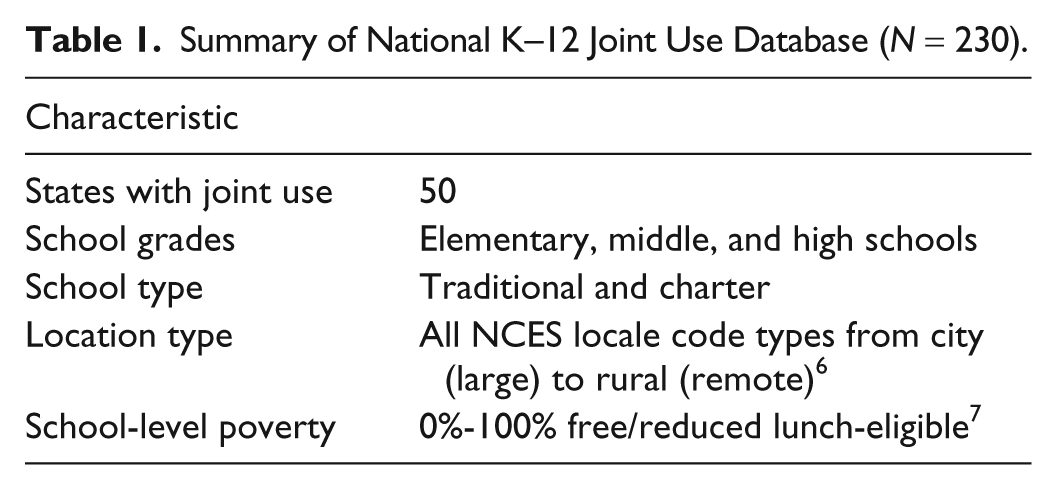
The 230 examples gathered illustrate the diversity of K–12 joint use across the country, as summarized in Table 1. I found examples of joint use in every state and in all K–12 grade levels (elementary, middle, high) and types (traditional and charter schools); in high- and low-poverty schools; and in all location types, from rural to city. Thus, it appears that K–12 joint use occurs in all types of communities across the country. The examples also reveal that sometimes construction or renovation is used to enable joint use at a school.
Summary of National K–12 Joint Use Database (N = 230).
Purpose of Joint Use
Stakeholders pursue K–12 joint use for many reasons. At a conceptual level, nearly all informants articulated that joint use is seen as “good government” that achieves “fiscal efficiencies.” As one school district informant noted, “Joint use is what we should be doing. The public wants it and expects it. These are public fields and buildings, they’ve paid for them.” This orientation reflects the notion that public schools are public goods; communities often feel they should have some rights to use these public facilities (Neal and Neal 2012).
The examples collected nationally and those discussed by informants can be placed into four broad categories of purpose for K–12 joint use. The categories are not mutually exclusive; in some cases, each type of joint use can—and does—occur at individual schools.
Joint use for physical activity. Use of outdoor or indoor recreation spaces such as playgrounds, sports fields, hard court surfaces, gymnasiums, or swimming pools, appears to be the one of the most common joint uses. Outdoor space use often occurs informally, with schoolyard gates left open for unsupervised public access during nonschool hours. It can also occur more formally, as when spaces are reserved for specific users (e.g., sports leagues).
Joint use for expanded student and community social services or amenities. The vast majority of K–12 public schools house academic support services, social services, or related extracurricular activities (e.g., mental health services, after-school tutoring, physical health services) run and sometimes funded by outside entities such as city or county agencies or nonprofit, community-based organizations. Educators generally view these services as supportive of and complementary to core academic goals (Rothstein 2004; Warren 2005), and many school district informants considered these practices to be joint use. Schools have also partnered with other entities to build and/or operate community amenities such as libraries and performing arts spaces.
Joint use for direct curriculum enhancement. In some cases, joint use occurs when schools and other entities partner on academic curriculum efforts inside schools. These efforts often involve a specialized curriculum or approach such as vocational education, work-based learning, linked learning/multiple pathways, and other pedagogical approaches whereby an outside partnering entity contributes to curriculum development and delivery (e.g., see California Department of Education 2010).
Joint use for broader land development or local revitalization. In some examples, multiple joint use strategies are employed simultaneously and might build upon one another, particularly as part of a broader land development or revitalization initiative, often on land adjacent to a school property. Such cases are often characterized by jointly aligned capital investment with the purpose of revitalization and ongoing joint use opportunities.
Stakeholders from different disciplines focused on different priorities for joint use. As might be expected, public health informants focused on joint use for physical activity, educators focused more on social services and curriculum enhancement, and planners focused mainly on joint use in land development or revitalization.
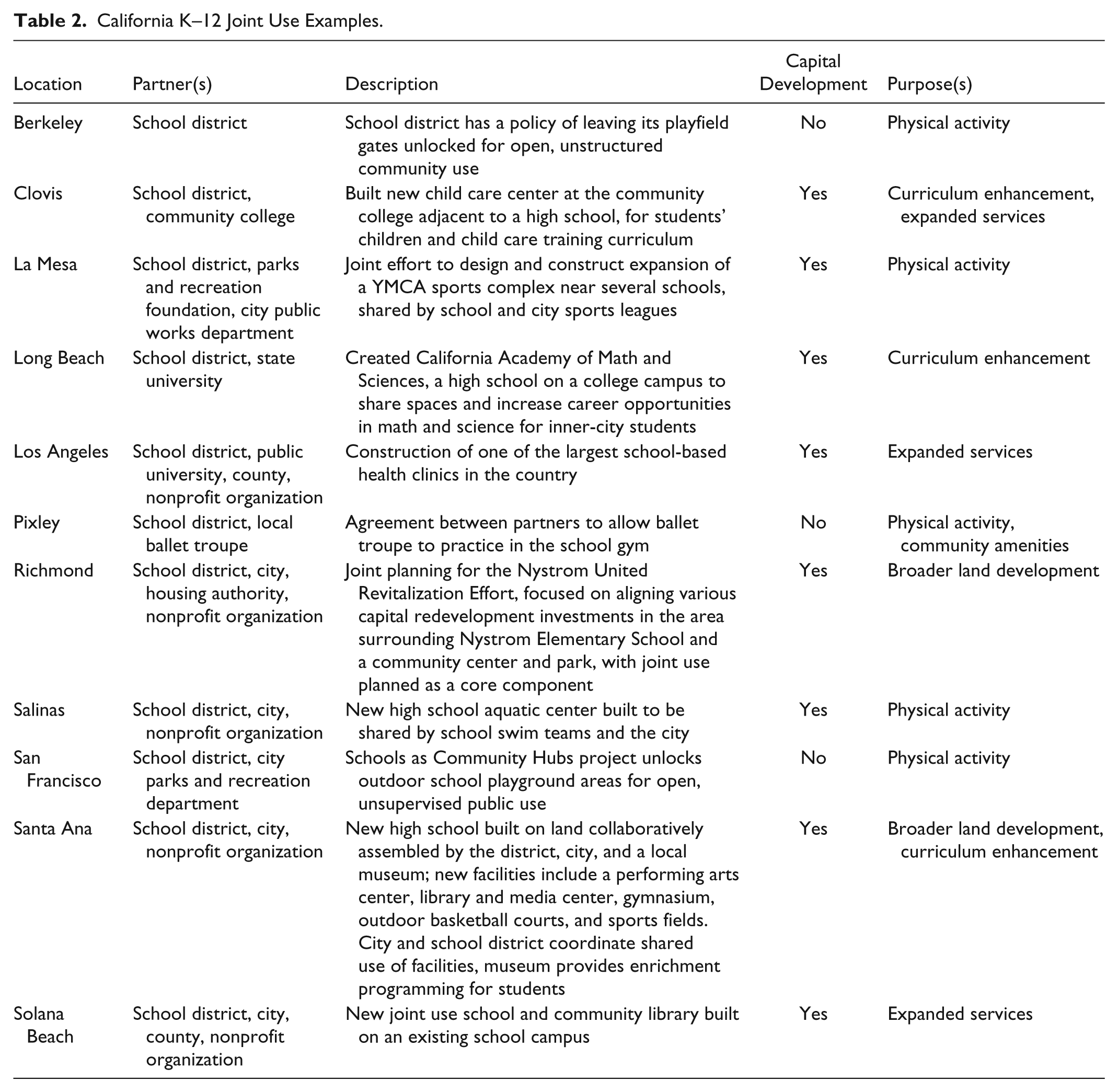
In Table 2, I present joint use example summaries from California chosen to illustrate each of the four purpose-based categories of joint use. The examples represent a diversity of place types and types of agency partners involved. The table also specifies whether a capital development component (construction or renovation) was involved. Sometimes capital development is required to enable or facilitate the logistics of ongoing joint use. Thus, capital investment appears to be an influential lever used in some cases to promote joint use.
California K–12 Joint Use Examples.
In addition to joint use serving various purposes, I found that the term itself lacks a consistently understood definition. For example, school-facility manager informants often assumed I was referring to bricks-and-mortar capital development when using the term joint use. By contrast, public health informants often assumed I was referring to “joint use agreements” when using the term. My data suggest that “joint use” carries varying built-in assumptions by stakeholders in different fields, assumptions usually rooted in issues of type (what joint use is), purpose (why joint use is happening), and the orientation of agency relationships assumed to be needed (how joint use happens).
“Partnership” was one of the words most widely used by my informants, but this too held different meanings across disciplines. For the most part, health and physical activity advocates for joint use have defined partnerships in terms of getting formal joint use agreements (JUAs)—signed documents that set forth the rights and obligations of partnering entities regarding use of property (Kappagoda and Ogilvie 2012; Marrow and Frost 2012)—in place locally. As JUAs have been shown to yield positive outcomes, particularly for increasing physical activity, JUA templates have been developed (e.g., Kappagoda and Ogilvie 2012; Marrow and Frost 2012).
School district and other education field informants spoke less about JUAs, focusing more on partnering with nonprofits for student-focused activities, and with nonprofits or other local public agencies to construct or renovate schools for joint use.
Driven by goals associated with their fields, planning and public health stakeholders tended to view joint use differently from educators. Planners and public health practitioners asked things like, “Why can’t we just agree to unlock the playfield gates on the weekends?” whereas an educator commented, “It’s very complicated and we’re balancing many competing demands and interests.” Thedifferent purposes of joint use—which may occur simultaneously in individual schools—contribute to the complexity of competing demands and interest being juggled by educators.
As might be expected, stakeholders’ varied definitions of joint use influenced their perspectives on the nature and challenges of implementation, to which I turn next.
Implementation of Joint Use: Aspects and Challenges
All of my informants noted difficulties in implementing joint use. One school district informant stated, “We should be doing joint use whenever we can. The thing [physical activity advocates] don’t realize is that it’s incredibly complicated to pull off!” Overcoming implementation barriers was also the primary focus in the meetings I observed. As stated above, the literature has identified numerous barriers to joint use; my data confirmed these research findings but also provide new insights on these and other joint use challenges. In particular, my data illuminate how practitioners differentiate joint uses from one another in the process of devising implementation strategies. These findings provide greater detail on the variety of joint use approaches and how those relate to implementation. Overall, I find that many joint use implementation challenges are symptoms of larger structural issues of capacity, policy, and politics.
Practitioners working on implementation identified five key aspects of joint use that shape their efforts:
Users. Who is jointly using the school? This can range from individuals, civic groups, and other public agencies to private nonprofit groups and for-profit corporations.
Space. What space(s) are being used? K–12 campuses may have classrooms, gymnasiums, multipurpose rooms, kitchens, libraries, swimming pools, and athletic fields, all of which have potential to be jointly used.
Time. When is the school being used? Joint use can occur during or outside of school hours, including weekends and holidays.
Frequency. How often is the school being used? Depending on the terms of the joint use, users may be permitted one-time, repeated (over a defined time period), or long-term use.
Payment. How is the cost of use being covered? Costs associated with joint use are often spelled out in the terms of an agreement. This can take the form of permit fees, in-kind maintenance, direct negotiated payments, capital fund match, or other forms of payment.
These five aspects, in effect, serve as a loose conceptual framework that school districts (and partners) can use to identify the characteristics of any given joint use. School district informants and individuals at observed meetings frequently discussed the complexity of having multiple joint uses varying on each of these aspects at any one school. As one school district informant stated, “This is hugely complex, logistically. Some people want to use it these days, others want to use it other days. Some want to use it this time of day, others these times. The variation goes on and on. We’re expected to accommodate all of that.” These aspects shape implementation approaches in that each might play a role in influencing the perceived level of the challenges involved.
My interviews and observational data suggest that school districts’ lack of institutional capacity to effectively accommodate or manage joint use presented a common structural challenge. The lack of clearly defined school district–level policies and procedures for joint use and inadequate staff assigned to coordinate joint use appeared as two main factors undermining capacity. Both of these have been noted in the literature (Cooper and Vincent 2008; Vincent et al. 2010) but not deeply investigated. Numerous informants in our research spoke of challenges created by this lack of capacity. Potential partners (e.g., nonprofit organizations, local governments) felt that figuring out how to access facilities was confusing. One nonprofit staff member stated, “It’s super-confusing, and the rules aren’t written down anywhere. There’s no accountability . . . for anyone. We need transparency and consistency to ensure use.” Others perceived rules of use as being different and sometimes inconsistently applied for different types of users.
Many of the individual challenges cited were attributed to a lack of fully fleshed out policies and procedures for joint use or to the inadequacy of staffing assigned to joint use, at both central school district and individual school site levels. Lack of policy framework was illustrated by a school principal informant: “I’ve never been told by the school district if I should encourage or discourage joint use at my school. I’m not really sure what the school board’s desire is.” My data suggest that many school boards have not established an official statement of intent or purpose related to community use of their facilities. In the San Francisco meeting observations, this issue was identified by participants as hampering consistent, widespread community use across the district. In response, the school board adopted a resolution in support of “school facilities as community assets.”
Because of unclear policies and inadequate staffing, school districts (and their partners) had varying degrees of understanding about their liability risk. In concordance with other studies, my data suggest that school district leaders tend to err on the conservative side and limit joint use to avoid problems absent a full understanding of the legal protections and liability risk (Marrow and Frost 2012; Spengler et al. 2010; Baker and Masud 2010; Cooper and Vincent 2008). My data also suggest that school districts may view “casual use” (e.g., unlocked gates for open community use) with more concern than more formalized community use organized by a partnering entity (Uerling 2002). However, most of my informants did not feel that the legal risks were so great as to obstruct joint use. Many cited examples of existing joint use, either in their school districts or others, that they felt set a precedent for other joint uses they might wish to apply. Informants and those in observed meetings also frequently referenced new legal analyses and tools developed to aid joint use implementation (e.g., Kappagoda and Ogilvie 2012). These findings appear consistent with the general agreement among legal scholars that liability for school districts is not unusually risky for joint use and should therefore not be a justification to deny recreation access (Baker and Masud 2010).
Inadequate school-facility funding to support joint use also appeared to be a prominent factor affecting school district capacity. As numerous school district informants noted, the additional use of school buildings and grounds increases wear and tear on those facilities, incurring costs to school districts. Informants cited funding shortfalls for custodians, maintenance, renovation, and repair of school facilities. Many school districts face budget cuts and have long lists of deferred facility-maintenance needs. (A national study estimated that K–12 public school facilities needed $271 billion to get into good working order [Filardo 2008; Center for Green Schools, U.S. Green Building Council 2013]; and a 2008 California study estimated statewide K–12 deferred maintenance need was $25.4 billion [Crampton and Thompson 2008].) One school district informant described how inadequate facility funding affected joint use implementation: “We are first and foremost required to provide a safe and quality education to students. If anything even remotely compromises that . . . well, you can imagine the reaction.”
Inadequate facility funding along with increased joint use can be seen as a “free-rider” problem whereby the common resource (school facilities and grounds) is overused such that it significantly degrades and, in extreme cases, poses challenges for teaching, learning, and school operations—a classic “tragedy of the commons” (Neal and Neal 2012). My interviews with school district informants found that school districts tend to receive little revenue from joint use and often end up largely subsidizing the community use of their schools. One study of a California school district found that the district recouped less than 1 percent of its total annual facilities expenses through joint use activities, while having identified more than $500 million in maintenance and repair needs (Vincent et al. 2010). A study of school districts across the country found that only 18 percent of districts were recovering most or all of their costs associated with community use, while 57 percent recovered some, and 25 percent were “not scratching the surface” (Schooldude 2008). Many of my school district informants viewed this as “just the way it is”; others pointed to a real missed opportunity to recoup some costs associated with expanding joint use.
I also found concerns among stakeholders that the design and layout of many schools may not facilitate smooth access by communities, hindering joint use. Numerous school district informants felt that school building design and campus layout issues were a challenge for joint use at some, but not all, schools; many had concerns rooted in student safety, property vandalism, or both. A school district informant stated, “We can’t just be letting anybody onto a school campus at any time—there has to be some measure of control of who has access to what rooms, fields, etc. These are safety and property concerns. So it really matters where doors and gates are located and where they aren’t.” Thus, new school designs or renovations to existing campuses require a thoughtful design process that considers impact on joint use (Council of Educational Facility Planners International, Inc. 2004). School-facility planning and design practices, however, have seldom prioritized joint use (Kuhlman 2010; Vincent 2006; Building Educational Success Together 2006). The challenge of inadequate facilities funding noted above contributed to school districts’ being unable to remedy access and safety issues (without outside funding).
Closely related to the lack of capacity of many school districts to accommodate joint use is the finding that school districts and their potential partners typically are not structurally set up to collaborate. As one municipal staff informant noted, collaborating “goes against every fiber of our separate bureaucracies. Unfortunately, we don’t have the cross-agency relationships and trust that we really need . . . and should have.” Thus, while joint use “may seem like a common-sense ‘no-brainer’” (to quote one of our informants), its implementation is fraught with complex challenges, including different funding sources and funding cycles, different institutional cultures, and competing political agendas (Earthman 1976, 2000; Vincent 2006). My informants frequently raised the issue of distrust among parties as a significant obstacle underlying these challenges. One nonprofit organization informant noted, “Our partnership was established with a strong spirit of cooperation—which is not always the case.” School district informants in particular expressed concern about some joint use advocates seeming like they did not have the best interests of students or the school in mind, did not understand that many different demands for use might compete for time and space in the schools, or did not acknowledge the costs associated with joint use.
To overcome structural obstacles to joint use, many localities have established joint use agreements (JUAs). These are contracts or formal agreements (sometimes referred to as memoranda of understanding or master agreements) that bind both the school district and the partnering entity to specific terms for sharing space (e.g., Lau 2012). Public health informants were especially interested in JUAs as a formal mechanism to facilitate the expansion of community use, especially of spaces for physical activity on school campuses. Elements of successful JUAs have been documented elsewhere (Kappagoda and Ogilvie 2012).
My findings confirm, however, that JUAs can be challenging to establish. A city planner lamented the difficulty of getting a JUA approved, saying, “We’ve really struggled to come to agreement. . . . Oh my gosh, it’s been painful! Two years we’ve been working on this, and we still have yet to have a signed agreement!” This planner described the political obstacles to getting agency leaders to come to agreement when they had little history of collaboration and their relationships were characterized by distrust (McKoy, Vincent, and Makarewicz 2008). The need to build relationships of trust between potential joint use partners emerged as a central topic in many of my interviews. One informant noted, “You have to build trust. And that takes time. Without trust you’ll never come to agreement in the first place, and you’ll never solve problems as they arise—and they will—when the joint use actually starts happening.”
Although JUAs have emerged as key to promoting physical activity, my data raise questions about the efficacy of JUAs in the real world of varied joint use prevalent in individual schools. Some of my informants expressed concern that a JUA approach may be too limited or piecemeal to “move the needle” on widespread implementation of K–12 joint use. As one public health advocate informant described it, “We’re winning battles, but not the war.” Some informants expressed concerns, too, that their existing JUAs had termination dates, meaning it remained to be seen if they would be renewed. Such uncertainty may make long-term planning for joint use problematic.
Finally, my informant and participant observation data suggest that even though joint use is a local issue, state policy plays a role in implementation. A variety of state policies affect local responses and expectations regarding K–12 joint use (Morandi 2009). For example, the public’s rights of access to its schools outside of school hours are set forth in state statutes (NPLAN 2010; Baker and Masud 2010). One school district facility manager informant described this as a “state-local policy partnership.” My informants (all in California) frequently cited California’s Civic Center Act (enacted in 1917 and found in the California Education Code § 38130), whereby every public school facility is considered a civic center where citizens, school-community councils, and clubs as well as senior, recreation, education, political, artistic, and other organizations may meet. California school districts must grant access on request in most circumstances, and they are instructed to establish policies and procedures to make this happen. As a result, many California school districts have a permit process of some form whereby an outside individual or entity can “rent” the use of school space, usually by the hour for a fee. Still, I found varying opinions on how exactly to interpret portions of California’s Civic Center Act.
Analysis and Discussion: A Framework for K–12 Joint Use
The research finds that K–12 joint use has many rationales and variations and that there is no consistently applied definition of it and its components in policy or practice. This can contribute to implementation challenges, particularly when potential joint use partners come from different agencies, disciplines, or both. Hence, public health and planning advocates and practitioners face challenges in working with educators and school districts to prioritize joint use for community physical activity. Varying assumptions about joint use and the limited perspectives of individual stakeholders can cause confusion or misunderstanding during implementation.
To aid implementation efforts, my analysis focused on developing an analytic framework for K–12 joint use to situate the understanding of what K–12 joint use is and how and why it occurs in the contemporary context. The framework, then, becomes a lexicon of sorts to aid practitioners and policy makers in collaborating across disciplines on joint use implementation. The terminology I developed reflects three overarching categories of joint use as articulated by informants: “basic joint use,” “joint development for joint use,” and “joint use partnership.”
Basic joint use (or “community use”) occurs when nonschool users make use of school district–owned indoor or outdoor property. Basic joint use establishes a right to access school spaces. Often this is done without a formal contract, but it can sometimes involve a use permit–type of relationship between the school district and the user. Expanding basic joint use was a frequently cited goal among health advocacy informants; as one said, “We just want them to unlock the gates on the weekends. Is that too much to ask?”
Joint development for joint use refers to bricks-and-mortar strategies to build or renovate school facilities to be used jointly by the school district and a nonschool entity. With joint development, two or more entities partner to plan, site, design, and/or build a new school or renovate an existing one to better support joint use of the building, land, or both (Filardo et al. 2010).
Joint use partnership establishes ongoing joint use and describes the formal relationship, policies, procedures, and outcomes agreed upon between a public school district and one or more other entities. Joint use partnerships typically involve a contract or formal agreement (often called a memorandum of understanding, master agreement, or joint use agreement) binding the school district and partnering entity to specific terms for sharing space. The educators and nonprofit service providers interviewed usually meant this type of arrangement when using the term “joint use.” Some joint use partnerships involve joint development. When they do, the joint development typically enables the ongoing joint use, and building or land use designs are done so as to facilitate the logistics of the shared use. In such cases, capital investment can be an influential lever to promote joint use.
The above framework establishes categories of joint use approaches as a means to clarify for implementation stakeholders precisely what is being talked about. However, many examples straddle multiple categories. This is certainly true when capital development is involved. When joint development occurs, the ongoing joint use might best be described as “basic,” but, more likely, a joint use partnership will exist.
Figure 1 presents a conceptual spectrum to help visualize this framework for classifying joint use examples. Since each example has unique characteristics negotiated by local school districts (with or without outside partnering entities), examples could fall anywhere along the spectrum, with “basic joint use” on one end and “joint use partnership” on the other. The more robust the partnership, the farther to the right the example would fall. In the figure, if a joint use example involved capital investment, it would fall below the continuum line; if not, it would fall above the line.

A Conceptual Spectrum for Classifying K–12 Joint Use Examples.
This analytic framework illustrates that K–12 joint use is multidimensional, extending far beyond simply unlocking the gates of a campus for informal recreational use on the weekends, a public health focus. Thus, policy, practices, and theory on joint use will likely require multidisciplinary contributions. In that spirit—and in the spirit of recent public health research citing a need to expand “translational research” that reaches across disciplines and utilizes a variety of policy levers to inform health promotion, particularly in relation to built environment interventions (Mendoza, Salmon, and Sallis 2012)—I draw on literature from a variety of fields.
The following are elements within the framework requiring knowledge from diverse fields: questions about rights of access and the adequacy and distributive equity of public spaces (Lynch 1972 [1990]; Banerjee 2001); communities seeing their local school campuses as untapped resources for a variety of benefits, which requires taking an asset-based community development approach (Kretzmann and McKnight 1993; McKnight and Block 2010; Chung 2002); property management challenges of school districts figuring out how to schedule users and collect fees to cover costs associated with joint use; forming and negotiating public-interest partnerships among local public and nonprofit agencies for problem solving, a challenge that can be informed by multiple theoretical lenses including coalition building in local politics (for strategic alliances for service delivery and sometimes capital development) (Briggs 2002, 2003), evolving forms of governance (Stoker 1998), and infrastructure and public works (Lau 2012); and issues to be found in the growing literatures on public–private partnerships (PPPs) (Brinkerhoff and Brinkerhoff 2011) and public–public partnerships (PuPs) (Lobina and Hall 2006; Hall, Lethbrigdge, and Lobina 2005).
Characterizing “partnership” within the framework may be the most complex task. What Brinkerhoff and Brinkerhoff (2001, 13) have said about PPPs appears to hold true for K–12 joint use: “The permutations of partnership, purposes, structure, and processes are enormous.” No single analytic framework may fully capture the diversity, relevant parameters, and qualities of all K–12 joint use examples because local creativity creates enormous variation. Partnerships of this nature—between public agencies or with nonprofit organizations—have been described as “strategic alliances” (Briggs 2002), “cross-sector collaborations” (Bryson, Crosby, and Stone 2006), and other like-minded terms across various literatures. Bryson, Crosby, and Stone (2006, 44) define cross-sector collaboration as “the linking or sharing of information, resources, activities, and capabilities by organizations in two or more sectors to achieve jointly an outcome that could not be achieved by organizations in one sector separately” (emphasis added). Briggs (2002) and Brinkerhoff and Brinkerhoff (2011) also comment on achieving together what no sector could achieve alone. It is unclear, however, if this principle applies across the board to all K–12 joint use. It would not apply for basic joint use, for example, when a school district grants access but gets nothing in return. Brinkerhoff and Brinkerhoff (2011, 3) note the importance of mutuality as a key defining element in PPPs, where “mutuality” refers to “commitment to a shared goal and the extent to which partners operate within the spirit of shared control and responsibility” (i.e., mutual interdependence). Looking at the spectrum of joint use above, mutuality likely decreases the farther left an example falls on the scale. As one school district informant stated, “I fully understand the importance and value of widespread community use of our schools. I get it. And I want it. But we need help in making this happen. Where’s the reciprocity? Show me real partnerships.”
Informants who voiced concerns about JUAs were interested in finding ways to make collaboration between public agencies (and, in some cases, nonprofits) and K–12 for joint use the norm, rendering individual JUAs unnecessary. That is, they wanted to know how to institutionalize joint use as a regular part of school and community planning. None of my informants described their current local situation in such a way; most, in fact, characterized it as quite the opposite and fragile. The more joint use leans toward deeper partnership, the more it can involve complex and nontraditional relationships that cross organizational divides (“silos”) to provide added services and amenities for students, families, and communities. These partnerships are largely driven by complex local issues (elements of which often are dealt with by separate public agencies) and fiscal limitations. Overcoming the “silo planning” nature of schools and other local governments, which hinders joint use, is central to developing solutions for joint use implementation. One local practitioner interviewed expressed a common sentiment by saying, “We are coming together to do more with less, realizing that we are serving the same public.” By so doing, joint use partnerships can become shining examples of the kind of partnership-driven problem-solving efforts extolled in the public policy and community development–related academic literatures.
Implications for Research and Practice
Several research implications emerge from this study. First is recognition of the diversity of purposes and types of joint use that occur. While research on joint uses for physical activity appears to be growing, other types of joint use would benefit from a similar focus. In such studies, researchers should investigate the policies and governance structures utilized to promote and implement different types of joint use. Are some better suited in certain contexts? Most likely different perceptions of barriers exist depending on the type of joint use. How do they differ? Based on research and best practices, what should be included in a comprehensive policy framework that promotes widespread, intensive joint use?
Researchers should also assess the impacts of different state policy approaches on K–12 joint use. Nationally, there is no uniform approach by the states toward joint use. Eight states (Alabama, California, Hawaii, Indiana, Maryland, Massachusetts, Ohio, and Utah) require that public schools be made available for community use, thrity-seven states and the District of Columbia permit community use of schools, and five states (Illinois, Michigan, New Hampshire, Rhode Island, and Wyoming) do not address the issue in legislation (Baker and Masud 2010; Spengler et al. 2010). 8 It seems logical to expect that more joint use of schools occurs in the states that require school districts to grant community access, but given the local nature of control over K–12 education, there may not necessarily be less community use in states that either permit use or are silent on the issue.
To help prevent potential “free-rider” problems from arising with K–12 joint use that would degrade school facilities and grounds, planners, public health practitioners, and school districts should understand the real costs associated with joint use. By knowing all the costs associated with maintaining their facilities, school districts can engage in informed negotiations with potential partners to collect the resources needed to sustain intensified use. Joint use partnerships ought to structure financing supports among partners that realistically capture the facility- and grounds-related expenses for which school districts are responsible.
My findings also raise numerous questions about the relationships between joint use and communities. For example, how do K–12 joint use projects affect nearby property values, adjacent land development, and transportation (particularly vehicle miles traveled)? Does implementing joint use increase community support of K–12 public education (such as voter support of school capital bonds)? How does joint use affect community social capital?
Conclusion
Joint use has emerged as a significant place-based health promotion strategy. The health-related empirical rationale for expanding K–12 joint use comes from studies showing the role built environments play in promoting or hindering health and well-being (Saelens, Sallis, and Frank 2003; Sallis and Glanz 2006; Durand et al. 2011). Health and health equity advocates have sought ways to expand opportunities for physical activity in communities by increasing access to physical-activity spaces (such as schools) as a means to promote health and wellness and, in particular, to decrease childhood obesity. My interview, participant observation, and case example data show the wide variety and high prevalence of joint use in K–12 schools. Given increased policy and advocacy interest in joint use, this article provides a timely understanding of the range of joint use strategies, their organizational structures, and a purpose-based taxonomy.
As public agencies increasingly look to do more with less, joint use will likely attract more interest. So, too, will joint development as communities look to make bricks-and-mortar investments to both improve existing neighborhoods and shape entirely new ones. More research on joint use is needed to provide increased instruction to local leaders in overcoming the complex obstacles and institutional inertias working against these types of partnerships. At present, K–12 joint use is occurring largely in a vacuum, without comprehensive research, best practices information, or coherent state policies. The findings presented here provide new and important insights for those in the planning and public health fields working with educators to find policy levers for implementing and sustaining K–12 joint use.
Footnotes
Acknowledgements
Thanks to Mary Filardo for her continued insights on all things school facilities.
Declaration of Conflicting Interests
The author(s) declared no potential conflicts of interest with respect to the research, authorship, and/or publication of this article.
Funding
The author(s) disclosed receipt of the following financial support for the research, authorship, and/or publication of this article: Council of Educational Facility Planners, International.