



Abstract
Regional planning may require a better understanding of multijurisdictional planning and equity within intergovernmental context. This research explores how intergovernmental context and metropolitan planning organization (MPO) activities impact rail proposals for low-income and minority communities. In two case studies, Boston and Miami, other government agencies determined the projects within MPO plans. In Boston, however, advocates leveraged agreements and federal rules to secure rail, and the MPO has developed extensive equity analyses. The cases exemplify the fiscal paradox that MPOs face—they have fiscally constrained plans but control little funding. Findings indicate the need to better relate multijurisdictional planning ambitions to intergovernmental context.
Keywords
Regional planning has become a popular solution to the interrelated problems of environment, sprawl, and equity (Wheeler 2002). Federal agencies in the United States have recently increased funding for regional cooperation on land use and transportation planning. This growing interest offers promise for multijurisdictional problem solving, but the field of planning still knows too little about cooperative, regional planning in complex intergovernmental contexts. Furthermore, regional efforts have frequently prioritized economic development and quality of life over social equity objectives (Rast 2006; Scott 2007).
Federal requirements for metropolitan coordination and equity in transportation planning make the sector unique and instructive for the field of planning. Federal funding requires that metropolitan planning organizations (MPOs) create regional transportation plans and consider harms and benefits for low-income and minority populations. Although MPO planning has a stronger federal basis than other regional planning in the United States, research finds that existing government entities and entrenched planning norms limit MPO influence (Goldman and Deakin 2000; Katz, Puentes, and Bernstein 2005; Weir, Rongerude, and Ansell 2009; Wolf and Farquhar 2005). These studies identify the limits to MPO influence but have not demonstrated how decisions made in intergovernmental contexts relate to MPO planning or the potential equity implications. Practitioners and researchers may observe that politicians and many government agencies influence transportation decisions, but the design of the regional planning process and federal directives for MPO planning and equity may not sufficiently account for this intergovernmental context.
This research examines how MPO planning and federal directives relate to proposed rail investments in low-income and minority communities. By examining decision making and MPO plans’ investments in Miami and Boston, the article shows how intergovernmental processes outside of official MPO planning can determine investment. In other words, federal directives may have shaped regional transportation planning paradigms, but government entities—other than MPOs—determined the use of limited rail funds in the case studies. Subsequent MPO plans, created through the rational, comprehensive planning process, reflected previously made funding choices, because long-range plans are limited to estimated funds that other agencies control. In Boston, federally required MPO planning and environmental justice rules did provide leverage—but not redress—for lower-income communities. In addition, the Boston MPO has developed extensive assessments of whether transportation plans benefit low-income and minority communities, whereas MPO activities in Miami-Dade focus on public outreach and the dissemination of existing demographic data.
Findings indicate the importance of understanding multijurisdictional planning efforts in intergovernmental context. In the case studies, the mismatch between the planning process design and institutional realities created tension or confusion. In other regions and sectors, expectations and planning processes may also not reflect intergovernmental context, and federal directives may not match funding realities. The next section describes the evolution of and existing research on regional transportation planning. Following that, the article describes case selection, decisions about proposed rail projects for low-income communities in Boston and Miami, and whether these projects are part of MPO plans.
Regional Transportation Planning and Equity
Metropolitan Planning Organizations
Federal law first required continuing, comprehensive, and cooperative metropolitan transportation planning in the 1962 Highway Bill (Zoller and Capizzano 1997). During the 1960s, new federal rules required regional coordination in other areas, such as housing, and regional review of federal grant applications (Zoller & Capizzano). Yet, early results from the transportation requirement were disappointing, perhaps because of federal agency oversight that favored highways and the status quo (Solof 1998). Amid the highway revolts and frustration with heavy-handed state departments of transportation, 1973 legislation required specific designation of MPOs that would include local elected officials (Solof 1998). MPOs conduct required long-range planning, and major transportation projects must be part of their plans in order to receive federal funds. MPOs were affected by major shifts in federal policy during the 1980s, specifically reduced funding for MPO planning and the termination of some regional requirements in housing and environmental issues. As a result, MPO planning became “lonely, less comprehensive, and shorter range” (McDowell 1984, p. 127). Nonetheless, MPOs and transportation planning remained a requirement for federal aid.
The Intermodal Surface Transportation Efficiency Act (ISTEA) of 1991 increased federal emphasis on intermodalism and enhanced the MPO role. Legislation passed in 1998 and 2005 included some refinements to metropolitan planning, 1 whereas 2012 legislation, with requirements for MPO transportation system performance measures, could lead to larger changes. To some outside of transportation, ISTEA made metropolitan planning organizations appear to be the lead actors in transportation decisions. The federal process-based rules for long-range planning and common MPO planning procedures, such as goal setting and project selection, also convey the impression that MPO planning is a site of decisions. The reality is more complex because of fragmented control of funds and the closely tied division of responsibilities and powers among government actors.
Among other changes, federal transportation legislation in the 1990s granted MPOs control over some funds and directed them to produce fiscally constrained plans. In other words, long-range plans must be financially realistic; they cannot simply list desired projects. To receive federal funds, projects must be included within MPO plans. Yet, MPOs do not generally control a majority or even a plurality of regional transportation funds, which come from federal, state, regional, and local sources. The requirement for fiscal constraint provides legitimacy and leverage to MPOs (Goldman and Deakin 2000; Sciara 2012), but MPOs still have limited direct control over many financial decisions and federal funds typically do not flow directly to them (see pp. 13–15 in Edner and McDowell 2002). ISTEA did allow “flexing” of some federal transportation funds across modes, increasing MPO control over two federal funding streams. These funding programs, however, “are modest compared with other federal transportation dollars” (Sciara and Wachs 2007, p. 383). Furthermore, decisions on these funds must be made “in consultation” with other agencies.
In addition to financial limitations, several studies indicate that current intergovernmental contexts blunt the influence of MPOs. Wolf and Farquhar (2005) explain that state and local agencies are more powerful than MPOs, which generally defer to local officials. In an account of local tax ballot measures for transportation, Goldman explains how decisions may “bypass” MPOs (2007, p. 10): “In general, MPOs act primarily to accommodate the decisions already made by complex constellations of higher- and lower-level governments; they continue to work in the coordination tradition of the postwar era in which they were founded.” Innes and Gruber (2005) conducted a five-year study of the San Francisco Bay Area’s MPO and its advisory partnership “to find the degree to which the collaborative planning group . . . was producing decisions that were regional rather than parochial” (p. 177). They found so much contention and so little collaboration that they shifted their study’s focus.
Federal legislation directs MPOs to work in “cooperation” with state departments of transportation (DOTs) and transit agencies. Goldman and Deakin (2000) find that most state and MPO relationships are weak. Federal rules fail to specify the mechanisms for relationships among transportation agencies (Goldman and Deakin 2000)—though 2012 legislation requires that public transit agencies have board seats in large metros—or final decision power in the iterative process.
MPO partnerships with and roles vis-à-vis other government entities may be gaining strength, even though MPOs may struggle to build planning capacity and secure the required local match (20 percent) for federal planning funds (Government Accountability Office [GAO] 2009). Goldman and Deakin found that states and MPOs were just beginning to form strong partnerships in their 2000 paper. Gruber and Innes’s observations may have been too soon after ISTEA for collaboration to have developed. Furthermore, Taylor and Schweitzer’s (2005) more recent study finds that in some instances mandates for collaboration have indirectly contributed to greater coordination between states and MPOs. MPOs have also shown capacity to influence outcomes from congressional earmarking, by using federal planning requirements as “leverage” when negotiating with other agencies (Sciara 2012).
Federal Rules and Environmental Justice
In addition to federal transportation policy change, the 1990s marked increased rulemaking on and attention to environmental justice. In 1994, President Clinton directed federal agencies to create rules to ensure they do not create disproportionate harms for low-income and minority populations (Sanchez and Brenman 2007), an executive order based on Title VI of the 1964 Civil Rights Act. Subsequently (1997), the U.S. Department of Transportation (US DOT) identified three components of environmental justice/Title VI: (1) ensuring that low-income communities and communities of color do not face an unfair share of costs or harms, (2) avoiding a delay or reduction of benefits for these populations, and (3) enabling their participation in decision making (Deakin 2007). With the inclusion of harms and benefits in Title VI/environmental justice definitions, community advocates have used environmental justice (EJ) as a rationale for increasing transit in underserved low-income and minority communities (Deakin 2007).
All agencies that receive federal transportation funds must meet Title VI requirements, and MPOs must consider equity across regions, agencies, and modes. After the US DOT issued environmental justice rules, the Federal Highway Administration (FHWA) and the Federal Transit Administration (FTA), which jointly oversee MPOs, directed their staff to incorporate Title VI/environmental justice into MPO review (FHWA and FTA 1999). More specifically, federal staff should consider whether MPOs identify the locations and needs of low-income and minority populations, include them in planning, analyze the regional distribution of benefits and burdens, and address potential “imbalances” (FHWA and FTA 1999). In 2012, the Federal Transit Administration and the Federal Highway Administration issued separate, clarified environmental justice guidance for their grant recipients. The agencies, however, have never released a more developed, joint environmental justice guidance for MPOs. Thus, like MPO planning more broadly, how equitable investment fits into complex intergovernmental, regional decision making is underspecified.
The need to understand regional transportation planning in context reflects a larger need to study cooperative planning in intergovernmental landscapes. March (2010) identifies the need to further examine institutional relationships. He finds that “the institutional framework for planning, at least in Victoria [the site of his case studies], appears to be the most influential factor affecting planning’s effectiveness. Accordingly, theory divorced from this institutional context has little meaning” (p. 121). In line with the “new institutionalisms” (Hall and Taylor 1996; Teitz 2007), González and Healey (2005), Healey (1999, 2006), and Moroni (2010) use “institution” to refer to large-scale processes and intangible norms, but the planning field lacks even extensive discussion of the “old” institutionalism—formal government powers (Lewis 1996). To improve the utility of planning—regardless of whether evaluated along “performance” or “conformance” criteria (see Laurian et al. 2004)—the field needs greater understanding of the role of intergovernmental context. The following study thus examines the equity implications of regional planning within intergovernmental context, in a policy arena with relatively strong federal rules. Insights on regional planning in intergovernmental context are critical for regional transportation planning and to enhance dialogue on planning’s relationship to regional decision making. Within each region, I examine rail projects proposed in low-income and/or minority communities but first describe research design.
Research Design
As stated in the introduction, this research explores proposed rail projects for low-income communities within intergovernmental processes and as related to MPO plans. Research is based on two case studies, metropolitan Boston and Miami. Case studies are appropriate for complex processes (Yin 2003) and for studying the links between regions and other scales (Harrison 2006). Like Sciara’s (2012) study of MPOs and earmarking, the expansive scope of potential variables made case selection challenging. But to explore different context and institutions, case studies were narrowed to large metropolitan areas, where MPOs are more likely to have substantial capacity. Even though a small share of MPOs (11 percent) serve areas with more than 1 million residents, these areas contain about half of the U.S. population and typically have more capacity in terms of MPO staff (GAO 2009). California MPOs were excluded, given the state’s unique laws and the study’s greater interest in federal rule change. Regions were also selected to include projects that supporters situated within narratives of inequitable investment. Seeking to understand the impact of federal rules from the 1990s, I focused on projects that were considered during the period following the FHWA and FTA memorandum on metropolitan planning and Title VI (1999).
Some contrasts, however, were also desirable. Cases were selected for differing MPO board structures, as well as divergence in MPO formal programs on equity/Title VI. Metropolitan Miami and Boston provided these similarities and contrasts; basic regional data are displayed in Table 1.
Metropolitan Profiles.

Sources: RITA 2011; U.S. Census Bureau 2006–2008.
While known for its municipal fragmentation (Frug and Barron 2008), metro Boston’s transportation agencies are somewhat unified. A state-appointed board oversees the Massachusetts Bay Transportation Authority (MBTA), which operates extensive bus, commuter rail, subway, and light-rail service in Boston and its suburbs. The Boston Region Metropolitan Planning Organization covers 101 municipalities. On its fourteen-member board, the Massachusetts Department of Transportation (MassDOT) has three seats, including the chair. The region’s separate, voluntary planning agency (the Metropolitan Area Planning Council) is vice chair. The other board members are the transit authority, the transit authority’s advisory board, the port authority, the City of Boston, and six other municipal representatives. The Federal Highway Administration, the Federal Transit Administration, and the MPO’s Regional Transportation Advisory Council are nonvoting members.
In the Miami metropolitan statistical area, government transportation agencies are more fragmented. Each county oversees its own transit agency. Among the counties, only Miami-Dade County operates rail (the twenty-two-mile Metrorail); a regional authority operates the tri-county commuter rail line. Miami-Dade Transit is a unit of the county government, controlled by the Board of County Commissioners. Each county has its own MPO, and each MPO has a separate long-range transportation plan. In Miami-Dade County, where I focus, the MPO board has the following members: the county’s thirteen commissioners; representatives from the Miami-Dade Expressway Authority, the Miami-Dade County School Board, and each municipality (six) with more than fifty thousand residents, two gubernatorial appointees, and two nonvoting members from the Florida Department of Transportation.
Case study data collection was qualitative. Sources included twenty-one semistructured interviews in Boston (2010) and thirty-five in Miami (2009). 2 As the list in the appendix reflects, interviewees were stakeholders from public agencies, business associations, and civil society organizations. Several interviews had multiple respondents, and a few were conducted by telephone. Extensive document review included MPO plans, federal certification documents, organizational materials, FTA reports, and media coverage.
The Big Impacts of Boston’s Big Dig
State-Level Decisions and Community Activism
Over the past twenty years, highway mitigation agreements have largely determined rail investment in metropolitan Boston, while MPO plans have shifted with state-level action, activism, and changing finances. In the 1990s and 2000s, the Massachusetts Office of Transportation and Construction (now MassDOT) built the “Big Dig”—a $14.8-billion project that moved Boston’s downtown highway system underground and added a harbor tunnel. To complete the project, the Commonwealth of Massachusetts entered into mitigation agreements and significant debt.
Unlike other environmental groups, the Conservation Law Foundation (CLF) planned to fight the Big Dig, unless there were guaranteed mitigation measures. To avoid litigation and delay, in 1990, the Massachusetts Secretary of Transportation and Construction negotiated a written agreement with CLF. The organization pledged not to pursue litigation, if the state implemented the included list of mitigation measures, including between $2 billion and $4 billion of transit expansion projects, which were selected without public input (Luberoff and Altshuler 1996). The state built several transit projects, particularly commuter rail projects, and transferred some of the associated debt to the transit agency, the MBTA. Although implementation has been incomplete, debt payments absorb more than one-quarter of the MBTA’s budget (Kladko 2006).
Without full implementation, the Conservation Law Foundation threatened legal action in 2005 (CLF 2005). The state and the organization negotiated a new agreement, with just two rail expansions. The subsequent MPO plan includes only the major rail projects from the newest agreement, a Somerville Green Line extension and the Fairmount Commuter Rail Line improvements (CTPS 2009). 3 The Conservation Law Foundation and community activists pushed state agencies, the transit provider, and legislators to fund and build these lines and thus shaped the content of MPO plans, as described below.
Community-based organizations have advanced the Fairmount Commuter Rail Line improvement project, which was added to the mitigation agreement in 2005. The $114-million project (CTPS 2009) will increase access to rail in underserved black neighborhoods by adding four new stops along a nine-mile commuter rail line. In the late 1990s, a grassroots community group (the Greater Four Corners Action Coalition) began asserting that residents in the black communities of Dorchester and Mattapan suffered from diesel fumes but could not access service on the Fairmount Commuter Rail Line. These neighborhoods are part of a gap in rapid rail service that aligns with a concentration of black residents in southern Boston, as seen in Figure 1. The gap in rail service among these heavily African American communities grew when an elevated rail line was dismantled in 1987 and a new line built west of it. Despite promises of replacement service, the community had a standard bus service for fifteen years and then later bus rapid transit—the Silver Line. The Silver Line, however, lacks many of the features that can make bus rapid transit comparable to rail. For example, it does not have an exclusive lane that would increase speed (see Marin and Terrell 2005 for an advocacy-based account). Called the “Silver Lie” because of promised replacement service, the controversy has fostered distrust, as well as attention to environmental justice in transportation. 4
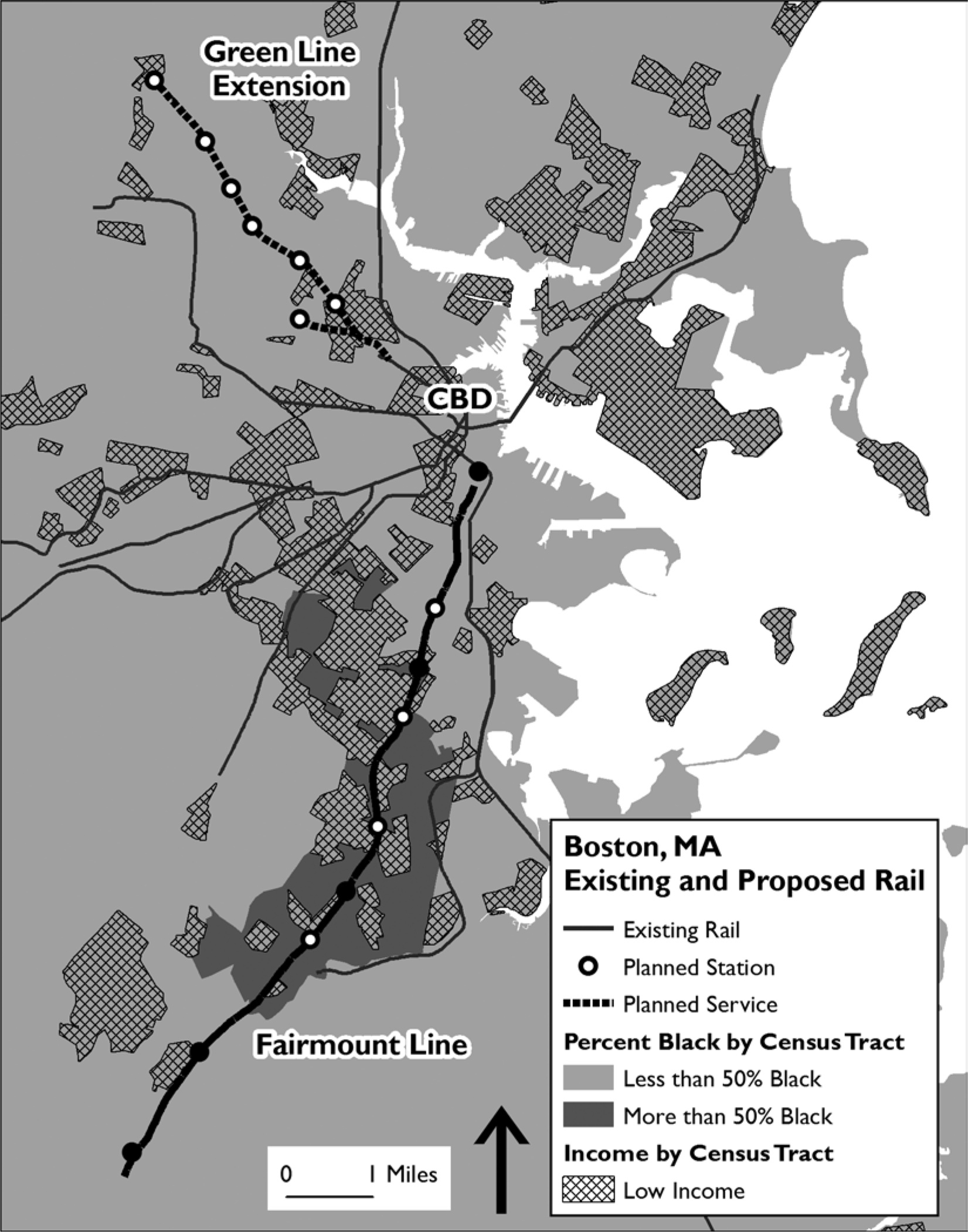
Boston rail infrastructure.
Activists proposed a hybrid commuter rail/rapid transit service along the corridor, titled the Indigo Line. It would have added stops and increased frequency. Responding to a feasibility report spurred by community action, the transit agency pledged half of the funds to add stations (but not more frequent service) in 2002. Community development corporations then formed the Fairmount/Indigo Corridor Coalition, which philanthropic foundations have supported. The coalition worked with state legislators, who secured the remainder of funds for more stops in a 2005 state budget.
According to some interviewees, including the project in the 2005 mitigation agreement secured its implementation. One interviewee suggested, on the other hand, that the legislative budgeting had been the vital action. In this account, MassDOT proposed adding the Fairmount Corridor to the mitigation agreement, because the state budget already obligated the funding—it was already paying for it. The new stops will bring rail into walking distance for thousands of low-income and minority residents, but with infrequent service the benefits—and equity gains—may be modest. The coalition is working with federal agencies and other community partners to promote transit-oriented development, a related greenway, and study of increased service frequency (Interviewee).
The second rail project, which was included in the final mitigation agreement, is a four-mile light-rail extension, with six new stations. It will cost approximately $954 million and serve Somerville, a diverse but gentrifying municipality (pop. 69,662; U.S. Census Bureau 2008a) that borders Boston. Despite a high number of college students (12,744), the city has a higher labor force participation rate (75 percent) than the MSA (69 percent) (U.S. Census Bureau 2008b). It has a greater share of adults with at least a bachelor’s degree (52 percent) than the MSA (42 percent), coupled with a higher poverty rate. The extension will serve some census tracts that the MPO identifies as low-income. While these tracts have minority residents, they do not have a substantial share of black residents.
The state first promised the rail extension in the original (1990) mitigation agreement, but it was in the early 2000s that municipal leaders, Somerville residents, and a coalition called the Somerville Transportation Equity Partnership increased pressure for implementation. One citizen leader explained the effort: What we decided to do was raise awareness about the Green Line issue and what was going on and start a campaign to get people to write letters to the MPO. . . . We kept it up with articles in the local papers and stuff like that. . . . We had this meeting at the high school planned . . . almost 500 people showed up. The MBTA was floored. They were stunned.
The community mobilization at least partially ensured that this project remained in the latest agreement. I observed many transportation meetings in 2010, and almost always there were public comments related to the Somerville extension (including at a very poorly attended MPO certification public meeting). These speakers seemed disproportionately white and native born, relative to the Somerville population, which overall is almost 26 percent foreign born (U.S. Census Bureau 2008b). One coalition leader noted the difficulty of engaging low-income residents but that the coalition had successfully enabled some participation. The supporting coalition does include an organization focused on preserving housing affordability and preventing small business displacement.
Boston Timeline.

Note: MPO = metropolitan planning organization; MBTA = Massachusetts Bay Transportation Authority; CLF = Conservation Law Foundation; DOT = department of transportation.
MPO Engagement and Environmental Justice
State-level investment decisions and financial constraints (partially due to the state’s Big Dig and commuter rail mitigation measures) have determined recent MPO plan content. The MPO plan that followed the 2005 agreement included only the rail projects that the state had pledged to build.
Interviewees had varied perceptions about MPO-led planning, but for the most part agreed that the state department of transportation (MassDOT) dominates regional investment choices. The Executive Director of an organization with an MPO board seat explained, It’s never been exactly clear to me how the [project evaluation] scores relate to the selection [of projects], because again it is principally the Commonwealth [of Massachusetts] that makes those judgments. They deliver them to us. At most a couple of days before the MPO meeting but quite frequently at ten o’clock that morning . . . there’s some influence by some legislators and some influence by some locals and some influence by a few business folks. I think very often the governor’s office will get involved. If they’ve been contacted about a particular project they will turn to MassDOT and say, “You will do this one.” But I think that’s the way it operates.
State domination of the MPO board was only one of the issues raised by environmental justice advocates in the 2000s. Following ISTEA, federal rules on Title VI, and a local clean bus campaign, social justice groups became more involved in transportation issues and sought out the MPO as a site for action. The advocates challenged the MPO and its decision-making process, pressing federal agencies to take action on equity planning requirements and investment in minority communities. They organized meeting attendance during federal review of the MPO: We brought lots of people to the hearing. . . . And we said, “We recommend the following: the MBTA is guilty of transportation disinvestment. They have discriminated against our communities. We don’t believe that the MBTA should receive a dime of federal money to do anything until this situation is resolved.
5
As a matter of fact, you should decertify and disband the Boston MPO.” . . . They [federal agency staff] looked out into the audience—they had never heard a group of people come and ask for the decertification of an MPO.
Following this 2001 site visit, the Federal Highway Administration and the Federal Transit Administration directed the Boston Region MPO to better assess the distribution of transportation benefits and link this analysis to project selection (Peterson, Rasmussen, and Kaplan 2007). The MPO formed an environmental justice committee, but MPO staff and environmental justice advocates had mismatched expectations. One participant explained his goal was to influence which projects were in the long-range plan, but
[the MPO’s] game plan was to establish a mobility model that was supposed to be multi-modal, that they could then use to show that there were no significant inequities in mobility, whether you were a transit user or a highway user, whether you lived in Roxbury [Boston black community] or you lived in Waltham [mixed-income, inner suburb] or you lived in Wellesley [wealthy suburb]. That’s where they were coming down to. And they wanted our help and complicity in setting up the perfect computer model.
Government agency staff, likewise, remarked on conflicting expectations for the committee. As they saw it, the MPO sought input for analysis, while the participants wanted to change investment choices. One planner explained: “They [activists] came with the expectation that they would be selecting projects at the end of the process. . . . They really didn’t expect the technical component to the analysis and the advisory component. They didn’t realize that they were advisors not decision makers.” The quoted advocate, however, perceived a technical process destined to validate existing investment decisions. The activists resigned from the EJ committee, feeling that they were “wasting” time and that “the feds were really unwilling to really back us on the important issues of equity metrics and a real measurement of whether we were getting a fair share and getting adequate services” (Interviewee). An MPO board member described this initial foray as a failed attempt, in part because of unspecified outcomes from EJ participation: I don’t think anybody did it maliciously. . . . The MPO failed I think to find a way to have—to give that community a voice . . . where we did get environmental justice people to the table, we really didn’t know what to do with them. We had nothing to give them in the sense of what’s the reward for their participation, how do we engage them, what is the upside for them? We thought we’d show them the plan, they’d bless it and we’d all go on with our lives . . . this was a relatively new mandate, and nobody did a good job in my opinion.
Since that original foray, the Boston MPO has developed a substantial set of activities and analyses related to environmental justice. In the long-range plan released in 2009, the MPO devoted a chapter to regional equity and noted its explicit, three-pronged approach: outreach to, assessment of benefits and burdens for, and investment in low-income and minority communities (CTPS 2009). MPO staff members build relationships with and attempt outreach through community groups across the region. Environmental justice, operationalized as benefits to low-income or minority households, is a project evaluation criterion for regional planning.
An additional chapter, in the long-range plan, details the projected distribution of benefits and burdens from planned investments. Since its original analysis, the MPO has adopted a finer spatial scale and designates “environmental justice areas” as transportation analysis zones with disproportionately high shares of minorities and/or median incomes substantially below the metro’s median. As part of this technical analysis, the MPO predicts average travel time to different job types, educational facilities, and hospital beds, as well as total counts of each opportunity type within a twenty-minute drive or forty-minute transit trip. The MPO also models environmental conditions, such as air quality, by neighborhood. As in the original analysis, this is based on future forecasts and models, but includes comparison between environmental justice areas and nonenvironmental justice areas for build (the plan) and no-build scenarios. MPO findings indicate that the regional plan will generally benefit environmental justice areas more than the remainder of the region.
The analysis and other MPO activities ensure some attention to equity issues. Interviewees across sectors were conversant about regional equity, environmental justice, and Title VI, unlike most respondents in Miami. In fact, several interviewees pointed out that the Fairmount project’s environmental justice benefits made it an important project and one that appealed to government officials.
Regardless, for the Fairmount Corridor and Green Line projects, state-level action drove transit investment. Decisions made within intergovernmental context—outside of formal MPO planning—in turn influenced the projects within the MPO’s plan. Through sustained mobilization in multiple forums, activists asserted ideas of justice and equity, as well as challenged the MPO’s certification. MPO activities include analysis of access in areas with high shares of low-income and/or minority residents relative to access in the region as a whole. MPO contributions and contention may have shifted the parameters of debate and decision making. However, these shifts came as the state and transit agency have substantial debt, and with limited funds, long-range rail projects have shrunk to those the state agreed to in the most recent Big Dig mitigation agreement.
The Miami-Dade People’s Transportation Plan and Sales Tax
A County Sales Tax and the North Corridor
In 2002, Miami-Dade County voters passed a ballot measure to increase sales tax to support a large set of public transit improvements. MPO projects and analysis were used in the related sales tax campaign, but county commission decisions have determined transit investment in Miami-Dade. MPO plans have reflected changing revenue expectations, as well as ballot and commission votes, as detailed below.
Through extensive public outreach, County Mayor Penelas and his office created a list of projects that became the “People’s Transportation Plan.” While promising to “consult” with the MPO on a “draft plan” (Ross 2002), Mayor Penelas and his team controlled the slate of projects in the People’s Transportation Plan. According to the campaign, Miami-Dade Transit (MDT) would dramatically expand bus service, provide free passes for seniors, and increase Metrorail service to twenty-four hours a day. For the longer term, the People’s Transportation Plan included almost ninety miles of rapid transit. MDT would implement all of this with an annual $120 million of sales tax. While voters had rejected transportation sales tax referenda since the 1970s (Viglucci 2002), this 2002 campaign led to passage of a half-cent sales tax.
The top rail priority in the associated plan was the North Corridor Metrorail extension, which would serve the populous black communities north of Miami (see Figure 2). The area’s county commissioner, Betty Ferguson, fought to ensure the North Corridor was the top priority: We were convinced as a community that if we supported the half-penny sales tax that that extension would come to pass, that North Corridor, as we’re calling it. Because the half-penny sales tax would support the build-out of that extension. That is what we were told; that is what I was convinced. I was sitting on the commission at the time. . . . I asked them to put that in writing, that the North Corridor extension would be the number-one priority. (Commissioner Ferguson at community group meeting)
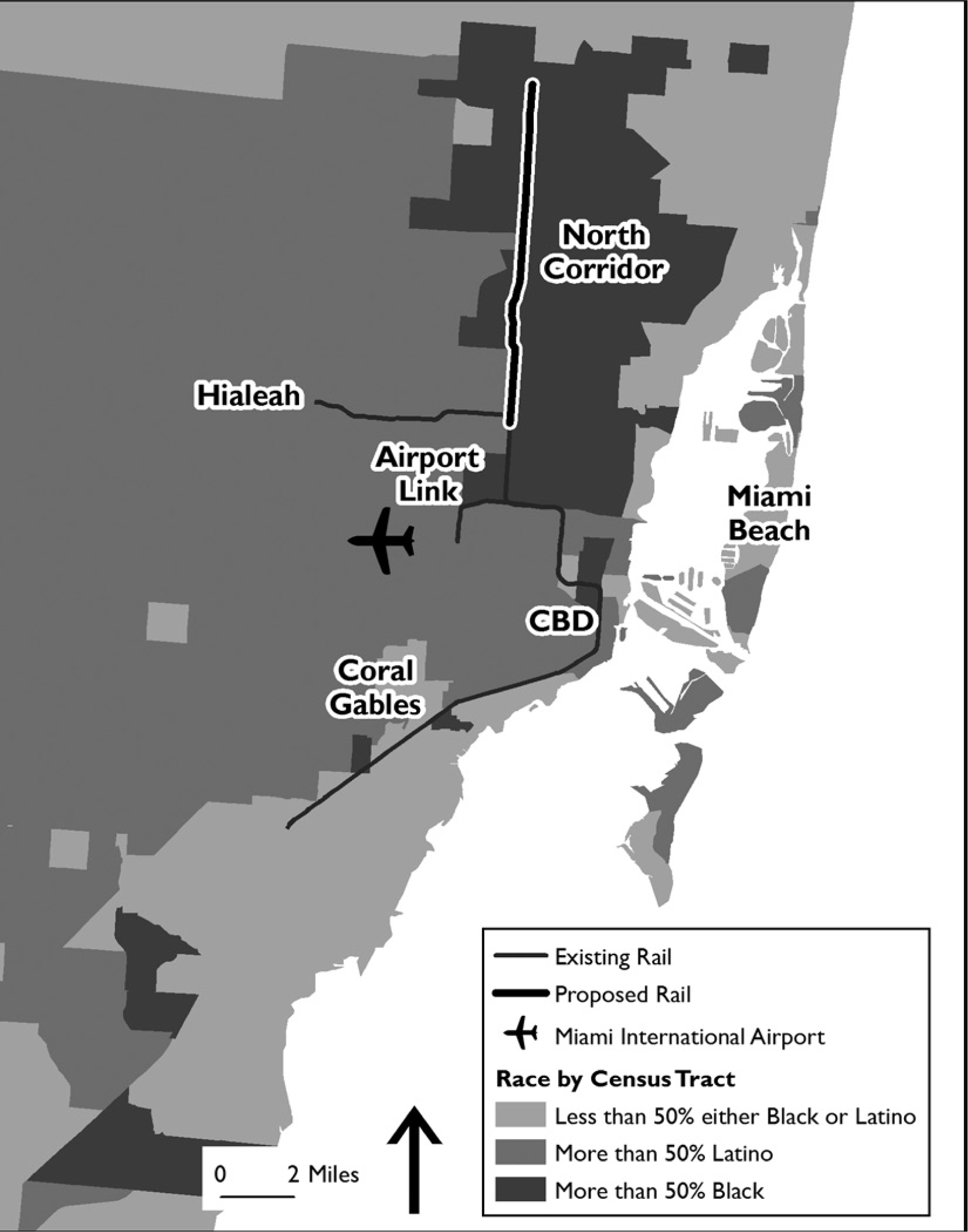
Miami rail infrastructure.
In fact, county officials had originally promised the North Corridor line in the 1970s (Charite 2008). Miami’s one Metrorail line was part of a planned network, but securing federal funds for more lines already seemed doubtful when the first line opened in 1984 (Anderson 1984, May 20). Some believe that Latino leaders orchestrated the decision to route the first—and only existing—line northwest to Hialeah, a largely Latino community. In an interview, a business leader explained, [The North Corridor] was promised many years ago that would connect downtown into the northern part of the county, which is predominantly an African-American community, and it was promised to them that they would be the next expansion of the Metrorail. Well, those have never come because the county’s never been in a position to support it.
The new sales tax brought additional revenue, and the sales tax campaign and negotiations prioritized rail investment for an underserved black community. Amid a deteriorating financial picture, however, county-level decisions have made the North Corridor’s implementation highly unlikely. Several interviewees questioned the benefits of the North Corridor project. These interviewees explained it was a racial or political compromise, and that the corridor lacked density—and hence ridership potential—relative to other corridors. The larger problems were that campaign cost estimates were dramatically too low (Lebowitz 2008) and that the transit agency had been operating on a deficit, with deferred maintenance expenses. One county official explained, [F]rom the minute it was passed, Miami-Dade Transit was trying to get its hands on that money, because it needed it—because it was running a deficit operation. . . . So there’s not enough money really to complete anywhere close to what they said they were going to do.
The limited implementation that has gone forward has not been the plan’s top priorities, because of county commission—not MPO—choices. Miami-Dade Transit had submitted applications for federal matching funds for the North Corridor and another expansion, but the county commission authorized sales tax funds to go first to a different project in 2004. The “AirportLink” is a two-mile spur connecting Metrorail to the Miami International Airport’s new intermodal, ground transportation center (see Figure 2). The county commission’s resolution authorized the new spur, originally using $160 million of sales tax funds (later growing to more than $400 million), but instructed the transit agency to continue pursuing federal funds for the two longer expansions. The rationale was to advance the smaller, quicker project, while pursuing federal matching funds that were ultimately not awarded. The proposal for first funding the AirportLink officially originated in the office of the county manager, but the supporters and behind the scenes arrangements were not clear to former County Commissioner Betty Ferguson (interview): So the county manager and officials, who write those reports for the transportation department, they presented to the county commissioners, well you know these dollars are available and this is what we recommend . . . in actuality they have already lobbied . . . it’s hard to pinpoint, to put your finger on who made the decision or when it started or who’s really pulling the strings, because you don’t see all that’s happening.
The Commission and the MPO
The roles of the MPO and regional planning are not overt in these processes. The MPO plan has incorporated or excluded transit projects as financial circumstances and priorities have shifted. After the sales tax passed, the MPO included added new rail projects. Later, the MPO removed them.
The Miami-Dade Board of County Commissioners made a critical vote in 2009 that further changed MPO plans. The Federal Transit Administration had repeatedly withheld matching expansion funds, because of the transit agency’s poor financial condition. With this and ongoing struggles to fund the existing transit system, the county commissioners voted to redirect most of the sales tax revenue to Miami-Dade Transit’s general fund. Just after the commission’s decision, the MPO described how it might respond to the vote: That just happened two weeks ago . . . only 10% of revenues are to be set for something called aspirational projects, which . . . gives me the idea that we’re moving away from heavy rail. . . . But again, that only happened two weeks ago, we still need to see how that’s going to trickle down. (emphasis added)
Subsequently the transit agency’s next ten-year plan included the airport rail spur as its only rail expansion and states that it will “pursue incremental and affordable transit improvements [for the North Corridor] . . . until heavy rail funding options are identified” (MDT 2009, pp. 9-2). The 2009 long-range MPO plan likewise excluded the North Corridor from the cost feasible plan (listing it in the unfunded/partially funded category with no planning monies allocated to it) (Gannett Fleming 2009, p. C-38). When explaining the long-range plan and major challenges to reaching regional transportation goals, an MPO insider explained, Functional classification kind of dictates jurisdiction of different facilities and with it goes funding a lot of times. So, even though priorities in the plan might show this at the time of deployment, it’s that funding mix that makes those projects happen.
While funding availability and control may drive investment choices, interviewees identified important ways that the MPO influences transportation decisions. One transportation agency official explained that the MPO is “a major player, in the sense of giving up a platform to vet ideas, to test projects. . . . They give us the venue to go and seek input from policy makers.” Stakeholders outside of transportation agencies may have an unclear or limited concept of the MPO’s role. One sustainable transportation advocate explained his perception of the MPO role thus: Basically they’ve issued studies and then the studies are acted upon by the county. I think that’s where the MPO plays its role. . . . The [county] commission has to have the will to want to do these things when the transit authority, Miami-Dade Transit, proposes to spend a certain amount of money.
While the MPO did not control the slate of projects in the People’s Transportation Plan, it had identified and studied many of the projects. Furthermore, prior to the sales tax campaign, the MPO had begun to engage with a social justice group, People Acting for Community Together (PACT), which shifted its focus to the sales tax campaign: PACT came to a few of the meetings at our [MPO] board and then an effort was made by the same commissioners to invite them . . . [to participate in the sales tax/People’s Transportation Plan campaign] and they accepted. . . . I think that was the last we heard from that group.
PACT successfully fought to include the purchase of more buses in the People’s Transportation Plan (PACT n.d.). As noted above, the other major equity component in the People’s Transportation Plan was due to an elected official, not federal rules.
Federal Title VI rules and oversight may have increased the MPO’s attention to low-income and minority groups. In 2001, federal reviewers directed the Miami-Dade MPO to better demonstrate compliance with Title VI (FHWA and FTA 2004). The MPO adopted tools to better understand the geographic distribution of low-income and minority residents. In its subsequent review, the MPO emphasized its Title VI outreach efforts, including adapting methods for the populations surrounding proposed projects, based on demographic data. In 2004, federal reviewers “commended for their [MPO employees] extensive work relating to socio-economic data for the area . . . [a] tool has been created which enables the MPO to review the social, economic, and geographic characteristics of an area before PI [public involvement] outreach is initiated. This work will . . . aid in more effective PI and address Title VI issues” (p. 101). The 2007 certification review again discussed Title VI in terms of outreach and neighborhood demographic information, as well as related improvements in online access and training (FHWA and FTA 2007, pp. 102–5).
By the 2009 plan (Gannett Fleming 2009), there still was not a comprehensive discussion of how the benefits and harms of planned projects would be distributed over the region. Neither equity nor environmental justice appears within the plan’s goals. Environmental justice and Title VI appear only in a chapter section on public involvement. The plan documents outreach through online notifications, direct mailings, event attendance, and printed materials at the offices of elected officials. The plan reports that the MPO “contacted” various organizations that serve ethnic groups, homeless citizens, and the elderly, in order to encourage participation (see pages 4–7 and 4–8). The plan does not discuss Title VI/environmental justice impacts or include a map of investments layered over regional demographic characteristics.
In 2010, the MPO issued a report on Title VI (Miami-Dade MPO 2010). As in federal reports, the MPO’s Title VI discussion revolves around outreach to organizations and information on neighborhood demographics, not cumulative benefits and harms from planned investments. The report recounts success at ensuring minority membership on the MPO’s Citizen Transportation Advisory Committee (42 percent white, 32 percent black, and 26 percent Latino). The impact of the committee, however, is limited according to one member: “Everything has to come before us. But . . . and I’ve made this statement more than once . . . sometimes I feel like we’re a rubber stamp.” Under the section on “address[ing] the distribution of benefits and impacts of the transportation investment program” (Miami-Dade MPO 2010, p. 26), the paragraph mentions an online data mapping tool and its potential use in the analysis of specific projects. The section does not discuss the distribution of impacts from the entire slate of projects in the MPO’s long-range or near-term plans.
Miami Timeline.
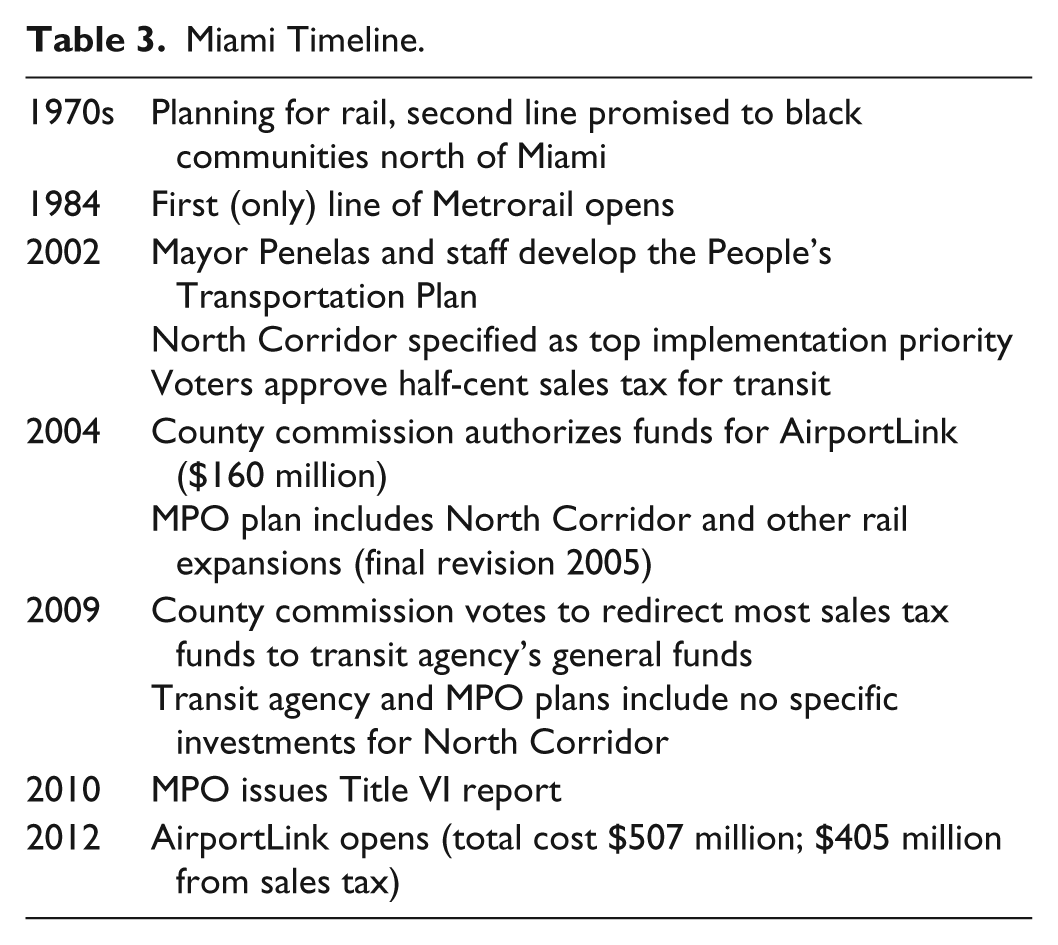
Without funds identified by the implementing agency, the effect of the commission’s vote “trickled down” to the MPO, which had to exclude the North Corridor from its fiscally constrained, long-range year plan. The MPO provided project ideas and analysis for transit decisions. Interviewees noted MPO cooperation and feedback, as well as the role of MPO dialogue in setting general principles. The pivotal site for transit decisions, however, was elsewhere.
Discussion: Regional Planning and Institutional Context
In both cases, ad hoc processes and other government agencies determined whether rail investment was directed toward low-income and minority communities. A massive highway project set the stage for transit choices in Boston, although the state responded some to advocacy organizations. In Miami, an increased sales tax and the People’s Transportation Plan appeared to open up investment opportunities, but later county commission votes directed limited funds away from the promised project for a black community.
While both cases had unique processes, together they demonstrate how existing government arenas largely determine the outputs from the MPO planning process. In the case studies, rail investment decisions were outside of direct MPO control. For some, this is neither surprising nor problematic. Yet, many reformers hoped for a more influential regional process that would ensure regionally appropriate investments. Federal directives for multimodal planning suggest it is a forum for making regionally significant choices, such as determining the fate of rail proposals. The MPO-led rational planning process also creates the impression that MPO planning is the regional decision site. Such tension between the planning process design and actual sites of decisions might occur in other multijurisdictional planning efforts.
In Boston and Miami, MPO plans evolved amid changing external decisions and fiscal realities, exemplifying the fiscal paradox that MPOs grapple with. MPOs must have a plan within budget, but most of the budget is determined elsewhere—a fiscal paradox. As prior research has found, the federal requirement for fiscally constrained long-range plans may legitimize MPO plans (Goldman and Deakin 2000) and provide leverage (Sciara 2012). Yet other subnational government agencies control the bulk of transportation funds. Fiscally constrained plans thus must reflect how other agencies will spend their funds and their changing financial realities. In metropolitan Boston, the powerful state led an enormous roadway project. The state forged mitigation agreements that largely determined regional transit investments, and the roadway project and suburban rail expansions created substantial debt. MPO plans reflect state mitigation agreements that have shifted, transit agency decisions, state budgets, and shrinking funds.
In Miami, an ad hoc process led to increased revenue and hopes for rail, including a long-promised line to black communities. The county commission became a critical site for changing implementation priorities and the use of sales tax dollars. In turn, the transit agency (controlled by the county commission) and the MPO adapted plans to those decisions and the dire state of the transit agency. In both regions, the shortage of funds limits expansion capacity and MPO plans. Nonetheless, the fiscal paradox makes it appear that these MPOs adapted long-range plans to choices made outside of their planning processes.
Even with limited authority and funding control, the cases show that MPOs have some discretion in how and whether to direct attention to the regional distribution of transportation benefits and harms. In Boston, the MPO used its travel model to forecast how different neighborhoods would fare under the adopted plan. The equity advocate quoted above, however, asserted that the travel model did not capture existing realities. The MPO’s findings—that EJ-designated communities may especially benefit from the plan—may be because EJ areas are most concentrated in the primary or secondary urban cores where transit service, planned facilities, and activity sites are typically denser. Regardless, the technical analysis and two chapters related to equity ensure some attention to low-income and minority communities and could prompt further conversation about the distribution of transportation benefits and harms. Although, among numerous metrics, equity is one criterion for project evaluation. These MPO activities may reflect and contribute to a regional transportation paradigm in which stakeholders are relatively attuned to equity issues. On the other hand, the MPO in Miami has largely interpreted Title VI requirements as outreach to disadvantaged communities, and neither advocates nor federal reviewers have pushed the agency to conduct extensive analysis of harms and benefits.
Federal directives alone did not lead to investment in Boston and Miami communities with histories of underinvestment, but these rules can provide leverage. At times, community groups and elected officials secured pledges for rail. In Boston, activists were frustrated by the MPO’s focus on analysis, rather than need or historic investment patterns. Federal rules provided leverage for their efforts. This likely contributed to the MPO’s increased attention to regional equity, a shifted paradigm, and the appeal of equity benefits from the Fairmont project. Elected officials in Miami-Dade County used the language of fair investment, without explicitly using federal environmental justice or MPO rules. With limited funds (and less community mobilization), however, the county will not build the North Corridor rail line.
Directions for Research and Practice
The preceding discussion presents unique processes, embedded in Boston and Miami’s informal and formal intergovernmental contexts. The cases reflect the larger fiscal paradox that MPOs face, that (fiscally constrained) regional planning and equity-oriented rail investments are subject to decisions made by more established government entities with funding control. The MPOs’ planning processes—with goal setting and project selection criteria—can thus foster confusion, as intergovernmental context may substantially determine plan content. Given these complexities and inconsistent federal oversight standards, federal directives on environmental justice do not ensure investment in underserved, minority, or low-income communities. Elected officials and advocacy groups sometimes secured investment in low-income and minority communities, with Boston-area advocates using federal directives as leverage. In Boston, leveraging federal directives and MPO equity-related activities may have shifted transportation discourse.
As planners who see the externalities of the current transportation system and the challenges of coordinating across boundaries, we may hold high hopes for equity directives and regional planning. Future transportation legislation and efforts for multijurisdictional planning, however, could better incorporate the reality of current intergovernmental arrangements, responsibilities, and funds. A Boston business leader explained the mismatch between the process and decision-making realities: [T]he rules and regulations that relate to MPOs from the federal government really need to be reconsidered. It’s almost like a system that supports the illusion of choice. . . . I completely appreciate and respect the amount of time and energy that people put into the MPOs. . . . But I think we need to be more thoughtful about what we want the MPOs to be responsible for, what we want the states to be responsible for, and what we want the federal government to be responsible for. And, be more honest about both the resources that are available and the context for which the decisions are being made.
To strengthen the MPO role, Katz, Puentes, and Bernstein (2005) argue that funds need to be more fully devolved to MPOs, while Sciara and Wachs (2007) present cases of locally generated regional transportation funding. Either approach might enhance MPO influence over investment choices. Alternately, MPOs could play a different role, serving as capacity-building and information coordination entities without their own planning process that the fiscal paradox constrains. In any of these scenarios, MPOs could still direct attention to the distribution of transportation benefits and harms. Even MPOs without substantial in-house modeling capacities can create regional maps that show planned investments overlaid on regional and community demographic characteristics. Such visualizations could bring attention to equity and provide new perspectives for decision makers. Future research could further explore the contributions that MPOs can and do make to regional agenda-setting and knowledge.
For the field of planning, the research raises normative and practical questions related to planning for multijurisdictional spaces and the federal role in equity. Multijurisdictional planning processes should reflect diffuse authorities and responsibilities. Participants need to understand which processes determine visions versus how and where they can directly affect implementation and policy decisions.
The federal government is deeply involved in transportation through its administration of funds, and the Boston and Miami-Dade cases could provide a rationale for an enhanced federal role in redressing current inequities and past promises. Black community leaders in each region describe a history of disinvestment, inequity, and broken promises. The federal government could more actively ensure that its rail capital investments support service to low-income and minority communities. Or given a financially constrained environment and many debt-burdened transit agencies, the federal government could reexamine its capital emphasis. In the cases, Title VI/environmental justice MPO rules have provided leverage but not directly changed investment. This could indicate that equitable transit and associated access to opportunities may require capacity to mobilize in the very communities where other issues are pressing and resources are most limited.
Footnotes
Appendix
Acknowledgements
For assistance and/or comments, the author is grateful to Rolf Pendall, Juliet Gainsborough, Ann Forsyth, Susan Christopherson, Marla Nelson, and three anonymous reviewers. The MacArthur Foundation (through the Building Resilient Regions Network) and a fellowship from the Clarence S. Stein Institute supported this research. An appointment at the George Perkins Marsh Institute of Clark University also aided this research. Peter Bennett assisted with map design.
Declaration of Conflicting Interests
The author(s) declared no potential conflicts of interest with respect to the research, authorship, and/or publication of this article.
Funding
The author(s) disclosed receipt of the following financial support for the research, authorship, and/or publication of this article: The MacArthur Foundation (through the Building Resilient Regions Network) and a fellowship from the Clarence S. Stein Institute supported this research. An appointment at the George Perkins Marsh Institute of Clark University also aided this research.