




Abstract
Planning education has engaged little with the question of how to educate our students regarding interdisciplinary inquiry. This article proposes pedagogy to educate planners and environmental designers to engage multidisciplinary theory and methods to perform interdisciplinary environmental research, synthesis, and interpretation. Experiential and situated learning theories guide a course design where students first perform a series of disciplinary inquiries, followed by collaborative interdisciplinary inquiries, along an urban research transect. Assessment of this pedagogy finds that (1) interdisciplinary understanding can successfully grow from disciplinary understanding and (2) “collaboration in parallel” can lead to successful interdisciplinary collaboration.
Keywords
Introduction
CitySection is a field research theory and methods course for planning, a diffuse discipline that is broadly interdisciplinary (Pinson 2004). In CitySection, students gain experience in applying a range of disciplinary theoretical and methodological approaches to urban fieldwork and cultivate collaborative experience in interdisciplinary synthesis and interpretation. As a pedagogical method for engaging planning’s multidisciplinary history, CitySection helps prepare future practitioners for successful interdisciplinary engagement with the openness and diversity of planning and planning’s complex problems.
Often, interdisciplinarity in planning and environmental design education involves building teams of people with different disciplinary backgrounds, and then devising ways for this team to work on multiple aspects of a complex problem with the goal of creating a collaborative, interdisciplinary solution. Cross-disciplinary miscommunication and a lack of collective understanding are major barriers to this method of interdisciplinary collaboration and can pose significant problems in arriving at interdisciplinary solutions in these situations (Yocom et al. 2012; Chettiparamb 2011).
The CitySection experiment takes a different approach to the subject of interdisciplinarity in planning and environmental design education. Rather than fostering interdisciplinarity by assembling a diverse team of disciplinary practitioners, in CitySection interdisciplinarity is cultivated in all team members.
Interdisciplinary Education and the Self-Aware Learner
The CitySection pedagogy was created to educate students across planning and environmental design disciplines with specific skills to understand and to apply a range of disciplinary theories and methods for studying urban environments in an effort to arrive at multidisciplinary and interdisciplinary understandings of complex urban planning and design problems. There are three interrelated innovations in this course: students engage in applied multidisciplinary fieldwork; this multidisciplinary fieldwork provides a common grounding for interdisciplinary action; and students use an innovative web environment that enhances student collaboration. In CitySection, students are not only reading from different disciplines but are actively applying the theories and methods from multiple disciplines, and synthesizing what they learn.
Each student in the CitySection course is assigned a portion of an urban research transect on which they perform five theoretically and methodologically structured field research inquiries. These first five modes of inquiry stem from disciplinary roots, and students collaborate in parallel on these exercises. CitySection students then move on to the final exercise that requires interdisciplinary synthesis and interpretation, both individually and in collaboration with other student researchers. Students demonstrate their interdisciplinary understanding in the final exercise through three different modes of communication. The shared knowledge and shared experience among student researchers in the first five exercises enables meaningful communication and constructive collaboration in the final exercise. While the disciplinary theories and methods used can be tailored for unique classes, for the example given here, the exercises were as follows: Visual Perception; Morphology and Change; Land Use and Power; Human Ecology; and Reading Historic Landscapes. These exercises fit curricular needs and the instructor’s expertise. Here the exercises increased in complexity from first to last, moving from a straightforward application of theory and methods to situations that demand more interpretation and analysis.
Learning Theories in CitySection
The learning theories used in CitySection, experiential learning and situated learning, were chosen because they offer hands-on experience and grounded realities for each of the sets of disciplinary theory and methods under study. These learning theories, applied to each discipline under study, serve student learning by providing a common framework of application for the theories and methods of the different disciplines. The common framework of these learning theories also guides interdisciplinary synthesis and collective understanding by providing shared knowledge and experience.
Experiential Learning
Experiential learning actively involves the learner in making meaning from first-hand experience. As a learning approach it is learner-centered, decentering the instructor and empowering students to discover insights for themselves. Learning-centered approaches have many advocates in the planning literature for their benefit in empowering students as self-aware learners (Schweitzer, Howard, and Doran 2008; Hung et al. 2004).
A major innovator in experiential learning, Kolb (1984) has defined a four-stage cycle of experiential learning that is well known among educators and that is applied in CitySection because the cycle is focused on learning as a process of discovery. Each stage requires abilities from the learner in order for learning to occur. In the first stage, learners must be active in an educational experience. In the second stage they must then make reflections and observations on that experience. Learners then, in the third stage, use analytical skills to conceptualize the experience and develop theories about the experience. Finally, in the fourth stage, learners use problem-solving skills to apply new ideas gained from the experience.
As exercises in experiential learning, each CitySection module follows Kolb’s cycle and treats ideas as formed and reformed through experience, not as fixed and static. There is a strong fit between this approach to learning and both the nature of planning as an interdisciplinary discipline and the goal of CitySection of enabling students to learn how to learn by seeking out and applying theories and methods to approach complex urban problems. For CitySection students, the concrete learning experience was the understanding, application, and analysis of each disciplinary exercise to an urban research question in the city.
Situated Learning
The focus in situated learning is on the context of learning and the social characteristics of that context, leading to learning activities that are termed authentic. There are three interrelated dimensions of situated learning (Utley 2006; Zheng 2010): a culture of social interaction, the gaining of problem-solving strategies in authentic activities (also called “activities that matter”), and the creation of a learning community. Each of these dimensions is engaged in CitySection.
Common for pedagogies based in situated learning is that student learning occurs in cooperative groups, and ideas and analyses are interchanged through conversation and debate. As well, in situated learning, students try to answer questions and solve problems based in a social and physical environment (Ling and Choo 2005). As Utley argues, students learn from acting in situations and being acted upon by situations (2006). The goal for the instructors is to create the circumstances under which a culture of social interaction can develop. The activities that make up the CitySection assignments are authentic in that they are situated in urban environments and involve practices including field research and primary research (Zheng 2010). In engaging authentic problems, students develop problem-solving strategies as part of a learning community (Utley 2006). Within the CitySection project, the students, the professor, a learning consultant, and a web designer served as the core of the learning community.
As an experiment in planning pedagogy, CitySection presented students with well-considered learning approaches to the study of the city, while the disciplinary modules presented an understanding of the connections between the city as a physical object, a cultural phenomenon, and a social and economic force. The instructional design of the course, discussed below, created a strong student-oriented focus through the applied learning theories, moving students from the position of passive recipient of information to active designers constructing their own knowledge through both disciplinary and interdisciplinary inquiry.
Pedagogical Framework for CitySection
How students learn can differ across disciplines. Bradbeer (1999, 384–85) argues that true interdisciplinarity is very difficult to achieve and that the greatest difficulty stems from the fact that “different disciplines both process and structure knowledge in different and distinctive ways.” Other differences stem from this difficulty and include the different disciplinary traditions of teaching and learning, the different approaches to learning in students, and the different conceptions of teaching and learning among academic staff (Bradbeer 1999, 392). These barriers suggest that skills of interdisciplinarity are best developed in a disciplinary context, with students understanding the types of urban research questions asked within a discipline and then embracing the research theories and methods of the discipline in pursuing answers to the questions (Krizek and Levinson 2005).
The CitySection pedagogy is designed to educate planning and environmental design students to engage disciplinary theory and methods as a basis for performing interdisciplinary environmental research, analysis, and interpretation (Figure 1). CitySection teaches students to be conscious appliers of learning approaches appropriate to urban research and in this way makes learning to learn a tool of inquiry.
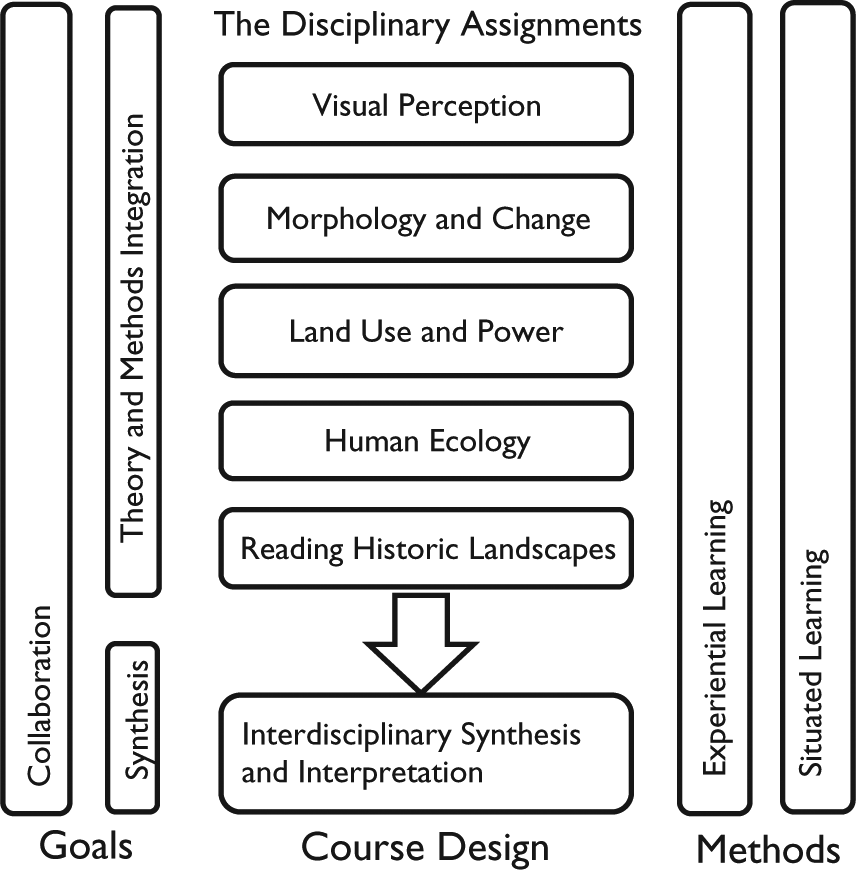
Integration of course goals, course design, and learning methods.
The Transect as a Research Tool
The study area for CitySection were two transects of the urban and suburban environments of Boston. Each transect was an approximately 150 foot wide strip running along the latitude and longitude lines of Boston City Hall as they radiate out from the city center to the suburbs. The length of the transect assigned to each student varied based on the environment transected. For instance, if the transect cut through a body of water, then the assigned student received a section of built-up land adjacent to the water as well as the body of water itself. The path of the transect, however, was never modified. Study areas exactly followed the transect through whatever it cut, the banal as well as the extraordinary, the backyard as well as the boulevard. Technologies such as Google maps and online city planning databases made basic research easy. These transects allowed the student researchers to each have a unique transect section for individual study, while also offering the possibility that the combined research of the entire transect might offer insights into the large-scale urban environment (Talen 2002).
Transect is a term borrowed from biology and ecology and is defined as an area of study in the form of a long continuous strip. Biologists and ecologists use transects to sample their study areas, identifying what organisms are present along a transect while working to discover relationships between organisms and their environments. Ecological transects were chosen as a model for the CitySection experiment because the work of ecologists, who study the interrelationships of organisms and their environments, offers a starting point for the study of the interrelationships of people and their environments. In this way, CitySection embraces the social science roots of planning, researching social systems in relationship to the built environment in which people live. The transect sections of CitySection are also collaborative in that student researchers must work closely in data collection and analysis with the students working on the neighboring transect sections.
Course Design
There were forty-three students in the CitySection cohort. All were advanced undergraduates (fourth year) in the same degree program. CitySection was organized into five 2-week modules focused on disciplinary inquiry followed by one final four-week module focused on interdisciplinary synthesis and interpretation. Students were each assigned a study area, a section of the urban transect, and conducted all of their work on their study area. Each two-week module included a range of learning activities and required active participation from all members of the learning community, the instructor, learning consultant, web designer, and students. For each module, the instructor provided thematic readings and a written assignment that included the parameters for the field research and performance criteria for the presentation of data and the analysis and synthesis of the data. The instructor presented a classroom lecture that introduced the urban research theory and methods under study for the module, and led a discussion of the assigned readings. Students were responsible for outlining and then writing a response paper for the readings and attending the lecture and discussion of readings. Students also met in small groups with their transect neighbors to plan for their field research and to speculate on the data they were to collect and their potential findings. This exercise in shared speculation, combined with research objectives provided by the instructor, generated hypotheses to be explored. Students then conducted field research with these hypotheses in mind, and finally presented their analysis and how it grew from the data they collected.
An innovative website was made available to everyone in the CitySection project, as well as to the public (Figure 2). The website not only created a space for students to present, compare, and analyze their ongoing work but also fostered a sense of community and made each individual student an essential part of the overall project. Used as a collaborative learning environment, the website added an online component to CitySection, making the course an in-class-online hybrid (Willson 2008).

Overview of the CitySection Website structure.
There were two main criteria for the design of the website: that it be a collaborative workspace for the students and the instructor and that the site be easy for visitors to navigate and understand. The instructor posted all course materials on the site and actively used the site for review and feedback on student work, both confidentially to individual students and on a forum for everyone. As well, students could reference, as well as provide feedback on, the work of fellow students. Each student had their own area within the CitySection site, graphically keyed to their study area along the overall transect. These student areas were constructed as easy-to-use templates with online tutorial guides ensuring a level of comparability student-to-student. On the first page of their sites students had to write abstracts of their work on a particular project, then link to open pages on which they could format and present their work as they best saw fit, within the guidelines stipulated by the assignment.
While the CitySection website was designed to allow students to collaborate on their research and to post their work, the CitySection site was also designed to allow global research objectives to be explored, such as an inquiry into transect planning coming from research interests of the instructor. As well, the site was designed to allow visitors to access the research in an active way, to find research on an area of interest and to comment on that area and the research as they saw fit.
Methods of Assessment of the CitySection Pedagogy
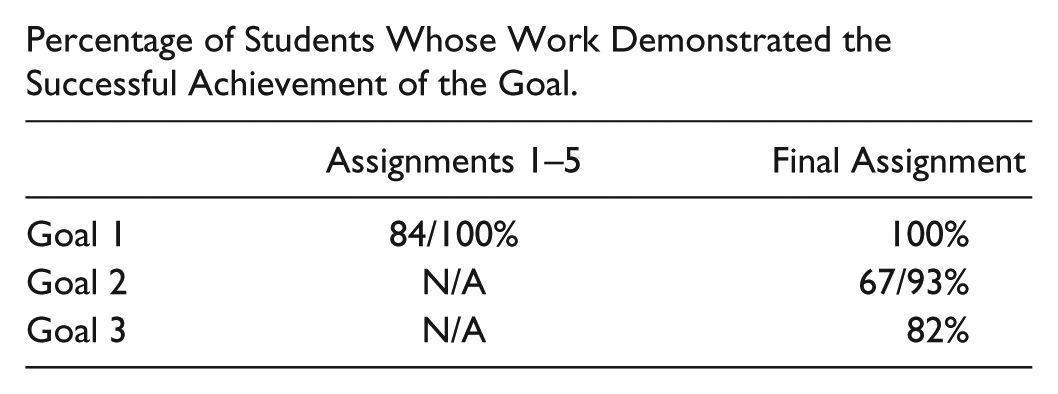
The assessment of the CitySection pedagogy was designed to understand the extent to which students operationalized the three goals of the project: the integration of theory and methods in primary research; the synthesis of disciplinary exploration into interdisciplinary understanding; and the development of collective understanding and interdisciplinary collaboration. There were three assessment methods for CitySection: (1) a qualitative assessment of student work performed by the course instructor and another faculty member in the field, with comments by the course learning consultant; (2) a Likert survey of all students; and (3) a focus group discussion with nine students (approximately 20 percent of all students).
Results of the Pedagogical Assessment
1. The qualitative assessment of student work performed by the course instructor and another faculty member in the field, with comments by the course learning consultant, resulted in the following statistical data. Two numbers separated by a slash (/) denote the percentage of students who achieved a goal in their first attempt and the percentage of students who achieved their goal in a second attempt with the aid of both peer and instructor advice.
Percentage of Students Whose Work Demonstrated the Successful Achievement of the Goal.
2. Survey responses from students were in agreement across the board with statements of the achievement of the CitySection goals. For example, a statement from the survey, “I synthesized the theory, information and ideas in new ways to achieve the best result possible,” had the following student responses: strongly agree (5); agree (18); neutral (14); disagree (3); strongly disagree (1). This statement was written to assess Goal 2, “the synthesis of disciplinary exploration into interdisciplinary understanding” and demonstrates student agreement that this course goal was met to a significant degree.
3. The focus group explored questions concerning the goals of CitySection, and the course materials and the mechanics of the class.
Findings
There are two significant findings in the assessment of the CitySection project.
Interdisciplinary understanding can successfully grow from disciplinary understanding.
“Collaboration in parallel” can lead to successful interdisciplinary collaboration.
The first of these findings confirms the work of Krizek and Levinson (2005) who suggest that skills of interdisciplinarity are best developed in a disciplinary context. The success of student achievement on Goal 1 (the integration of theory and methods in primary research) and 2 (the synthesis of disciplinary exploration into interdisciplinary understanding) point to the value of a firm grounding in disciplinary modes of inquiry. The second of these findings points to an important principle worthy of more testing, that collaboration in parallel can avoid the problems of cross-disciplinary miscommunication and collective misunderstanding.
Instructor Reflections
In practice, the CitySection project was a whirlwind of activity for the students, instructor, and others involved in the course. While the instructor created a learning framework and established project parameters, no one at its inception imagined the completed form of the CitySection project. Students embraced the learning theories and aggressively acted on their growing research skills and their ability to analyze and interpret the existing city.
Assessment of the CitySection project, including the work of both the students and the instructor, recognized that the project was an exercise in active learning and that learning was an ongoing social process. Formative assessment, aiding the learning process, was emphasized in CitySection over summative assessment, although all assignments including the final project and final written analysis were important in final grading. In CitySection, learning was a dynamic interaction between the instructor, the student, and the student’s peers over the task at hand and resulted in continuous dialogue and critique over a student’s field methods, interpretation and analysis, and presentations. For the instructor, continuous dialogue resulted in an ongoing critique of the course framework, and its effectiveness for student learning. The result was information leading to some measure of on-the-fly adaptation of the experience.
The main burden for the instructor was in mediating the process of students making research decisions on their own. The learning theories gave students guidance in a number of forms, including being shown models in lectures and questioning them in discussion, and also in reference form in articles and online resources that students could access at any time. Perhaps most important, however, was the collaborative work environment offered by the CitySection website where students could test their work and have it open to scrutiny by their peers. Key to the CitySection project was a support system set in place for technical and research questions. A student research assistant oversaw much of this work, although the instructor also lectured on the design and use of the site, and placed tutorials for student use on the site. The instructor felt that the quality of the research, analysis, and interpretation of the CitySection project proves that the work was not too difficult, only unfamiliar, and perhaps required a different level of investment by the student.
Perhaps the most significant outcome regarding students learning in the CitySection project was the greatly reduced achievement gap across the students in the class. All students successfully completed all of the course assignments. This success was evaluated by the ongoing critical feedback from the instructor and peer group, as well as self-assessment by the student, all in relation to the carefully outlined performance criteria established by the instructor at the beginning of the course and reiterated throughout the semester. Every student completed their portion of the overall transect project, a reality mutually enforced by all the project participants.
As a vehicle of assessment, the website provided integral feedback to students allowing them to review other peers’ work while reflecting on their own quality of work. Ultimately this stimulated ideas, contributed to a solid understanding of outcomes, and formatively allowed students to modify their performance and motivation particularly in the field studies. The instructor decided to post all of the pedagogical materials, and the reasoning behind the construction of the project, the goals of the project being to put the researcher in an active web of interpretation and discussion.
The instructor’s experience suggests that significant guidance and structure must be established at the beginning of the project and presented to the students as a complete framework. Significant changes and modifications should be expected by all participants—however, providing the course materials up front and working hard to limit “deadwork” by students will go far in creating and sustaining strong student motivation throughout the project. In similar situations, students will develop an appreciation for the project and feel as respected and equal participants of the learning community. A major effect of this particular project is that as a mode of public education the CitySection website makes this research and analysis of the urban environment of Boston easily available to whoever has an interest in the information and moves it to a larger stage.
Conclusion
Most planners and indeed anyone exploring complex urban problems would agree with the idea that interdisciplinarity is of benefit. But what form should interdisciplinarity take. The CitySection pedagogy was designed to ground interdisciplinarity in the knowledge and experience of the individual researcher, establishing a common ground from which researchers could then collaborate in parallel. The structure of this pedagogy is very different from the common form of interdisciplinarity where a collection of disciplinary practitioners are brought together on an interdisciplinary team.
But what can be taken as a success of CitySection, of achieving interdisciplinarity in the individual researcher, can also be seen as a shortcoming. The CitySection group was not multidisciplinary, but instead was composed of students with similar backgrounds. In addition, there was no project that students worked on collectively at the end. These two issues could be next steps for exploration. It would be very interesting to test the CitySection pedagogy with a group of students drawn from a range of disciplines. It would also be of interest to teach the CitySection class to a group of students one semester and then have the same group of students work on a collaborative design studio exercise the next semester (Balassiano and West 2012). Both classes would be meaningfully related by similar theoretical and methodological approaches to collective understanding problems best engaged by interdisciplinary synthesis.
Footnotes
Acknowledgements
The author wishes to thank S. Carello and M. Fuchs for their contributions to the project.
Declaration of Conflicting Interests
The author declared no potential conflicts of interest with respect to the research, authorship, and/or publication of this article.
Funding
The author received no financial support for the research, authorship, and/or publication of this article.