



Abstract
This article examines issues in conducting economic impact analyses in regions undergoing substantial or rapid transformations. Economic impact analysis methods, like many other analytical techniques, are predicated on economic stability, yet commonly are applied to situations that violate this condition with little consideration of the implications. Special attention is paid to regional input–output modeling because of its prevalence in economic impact studies and susceptibility to distortions. Advice and suggestions for practitioners and educators teaching analytical techniques are discussed. Military communities in the United States impacted by the 2005 round of base realignments provide illustrative examples and applications.
Introduction
National and global economic events and trends receive the lion’s share of political and media attention across the United States, yet economies at the regional scale change directions at least as frequently and arguably are more prone to direct influence by purposive public action. In circumstances of substantial economic change, designing and implementing public interventions to improve economic conditions requires data and analyses that provide an understanding of the shifts occurring and their consequences. Regional economies undergo rapid transformations as a result of a disaster event; an abrupt swing in the macroeconomic cycle; an alteration in the technological base of a key industry; or the opening, closing, or restructuring of a large factory, laboratory, or government facility. Economic development practitioners and policy makers turn to economic impact analyses for estimates of the incidence and effects of economic changes. Yet the methods of conducting economic impact analyses that are taught to economic development planners and used by economic analysts are not suited to situations in which there is extensive or rapid economic change. The results obtained from such assessments may be incorrect or unreliable, leading to serious and lasting consequences when they are used to guide planning efforts or to distribute resources.
This article describes issues in conducting economic impact analyses in regions that have undergone rapid changes and/or major economic transformations. The techniques considered have been appraised in detail in the scholarly literature, but for the most part individually and with little consideration of strategies to improve their practical application. This work synthesizes the issues across analytical methods and presents them in the context of dynamic or transitioning regions. Particular attention is paid to regional input–output modeling as the most popular method by which scholars and practitioners conduct economic impact analyses, and because the input–output approach illustrates well many of the methodological vulnerabilities engendered by economic change. Rapid economic transitions also challenge other common analytical planning techniques that rely on extending current understandings of economic trends and relationships into the future, including fiscal impact assessment, facility siting, and environmental impact assessment. This article concentrates on economic impact analysis, but also notes some of the implications for these associated methods. Finally, suggestions and advice for analysts and for educators are offered. There is no straightforward or graceful “magic bullet” solution for perfecting impact studies, yet several approaches can be helpful in teaching, conducting, and communicating economic impact analyses, along with other planning techniques undermined by economic shifts, both generally and amid rapid change.
The methodological problems with economic impact analyses and their implications apply broadly to assessments conducted in regions that undergo substantial economic changes or transformations. In this work, examples are drawn from American defense communities. 1 These regions offer several advantages (see “Defense Communities” below) in evaluating economic impact analysis methodologies. As a secondary objective, the article contributes to a relatively small but valuable literature that focuses on evaluating the impacts of military installations, and as such, some attention is paid to issues of data and timing that are particular to the analysis of defense communities.
The next section describes defense communities and their advantages as examples for appraising economic impact analysis methods. A brief overview of economic impact analysis and a review of impact studies of military realignments follow. The bulk of the article evaluates the implications of instability for conducting and interpreting economic impact analyses, illustrated with defense community cases. The subsequent section suggests approaches to start to remedy or compensate for the methodological problems of conducting economic impact analyses in evolving economies, followed by the conclusion.
Defense Communities
Defense communities offer an excellent setting for examining the application (and misapplication) of economic impact analyses. Some of the most pronounced regional economic transitions have been occurring in America’s defense communities. Defense communities are those regions that adjoin or surround military installations, where the military presence and activities substantially impact the economy. 2 Numerous domestic military installations were slated for changes in the 2005 round of base realignments recommended by congressional commission and approved by President George W. Bush (Defense Base Realignment and Closure Commission 2005). These realignments involved expansions or contractions of military activities, movements of personnel, and alterations in military missions and appropriations, producing rapid change in a diverse set of local economies.
Although most of the realignments were phased in over a number of years, in many cases the scale was immense in comparison to the size of the local economy. Shifts in military activities, as with other localized events, layer on top of underlying economic conditions. These include the lasting effects of the downturn that began in late 2007 and the ongoing underperformance of the private sector economy, interacting with long-term trends such as globalization and declining manufacturing employment. All else being equal, events that are substantial in terms of the scale of the local economy and that occur swiftly present fewer complexities and are more straightforward to isolate and describe. Thus, defense realignment examples support the illustration of issues in economic impact analysis, especially those arising from rapid economic change. Moreover, because military goals are devised at the national scale, the initial motivations behind the changes within these defense communities are principally of external origin, not driven by local conditions. (Political activity, however, subsequently engages local concerns and capacities; see “Econometric Modeling” below.)
More defense community transitions can be expected in the near future. The congressional sequestration plan that went into effect in March 2013 mandated extensive reductions in Defense Department expenditures. How these cutbacks have been and will continue to be distributed geographically is not readily discernible, and there is disagreement as to their size so far. 3 Nevertheless, if sequestration levels of funding continue into the future, their scale all but ensures effects on numerous military regions across the nation. In addition, the Defense Department favors the next round of base realignments to start in 2017 (Medici 2014).
What Is Economic Impact Analysis?
Economic impact analysis does not refer to a single method but to a category of analysis that is defined by the output sought: estimates of the effects of economic changes. Economic impact analyses can involve a wide variety of techniques, including benchmarking, economic base analysis, input–output modeling, time-series projection, macroeconomic modeling, indexing, and social network analysis. These techniques range extensively in complexity and sophistication, from back-of-the-envelope calculations based on rules of thumb to standardized models executed with user-friendly software packages to unique statistical models calibrated with primary data collected from local sources. (Chapter 6 of Blakely and Leigh 2010 provides a good introduction.)
There is strong demand for economic impact analyses as inputs into the development and implementation of policy responses to economic transitions. Economic developers call upon economic impact analyses in order to understand how changes propagate throughout the economic system from one or more initial events, to judge the scope and magnitude of impacts, and to pinpoint the industries or sectors likely to be most affected through particular interactions and relationships. The most common application of economic impact analysis is to construct forecasts of future economic conditions. Accurate estimates of outcomes are valuable in guiding local development or redevelopment efforts, from understanding the initial setting in which planning is taking place through assessing possible strategies, implementing projects, and evaluating progress toward goals (Buss and Dwivedi 1997). Impact analyses frequently are commissioned or applied toward political ends as evidence of the outcomes of policies both before and after public action. For example, promoters of major public investments typically cite at least one prospective economic impact study as ammunition justifying the expenditure. Economic impact forecasts can be crucial in acquiring funding to use in alleviating the negative effects of economic changes, both for persuading public officials and other government representatives of the likelihood and severity of the impacts and to compete with other communities seeking assistance from the same pool of funds (that also are likely to submit estimates derived from economic impact analyses).
Despite the variety of techniques, nearly all economic impact analysis methods are predicated to a greater or lesser degree on the relative stability of the local economy. In this context, economic stability can be defined as consisting of three conditions: (1) the changes being evaluated occur gradually, (2) the changes constitute a small portion of the total activity of the economy, and (3) the economic changes do not fundamentally alter the relationships that exist among economic actors, both locally and extra-locally situated. Many situations of economic change and adjustment about which planners and policy makers have need of information do not meet these stability conditions, leading to inaccurate or misapplied economic impact studies, potentially conflicting findings, and misinformed planners and policy makers.
Economic Impact Studies of Major Change: A Short Appraisal
Along with military expansions and contractions, transformative economic events include natural disasters, man-made disasters (including environmental contaminations, terrorist attacks, and wartime destruction), large plant and prison openings or closures, and the boom and bust cycles of energy development (Besser, Recker, and Agnitsch 2008). The scale and scope of these changes vary enormously both in absolute terms and relative to the communities affected. Some types of incidents cannot be anticipated at all; many more typically happen without the foreknowledge of economic developers and public officials accountable for policy responses. In contrast, plant and prison openings, and many closures, as well as some man-made disasters, accord some advance warning and may occur gradually, permitting economic adjustments to begin earlier and phase in more smoothly. In comparison to other economic shocks, military base realignments tend to be predictable, large relative to the communities they inhabit or adjoin, and transpire in stages.
Economic impact studies of situations of rapid economic change and major adjustment are plentiful in spite of the theoretical and methodological flaws of the usual approaches that are described below (Okuyama 2007; Thanner and Segal 2008). Economic development practitioners and consultants regularly develop economic impact analyses to fulfill a strong demand for quantitative estimates. As mentioned earlier, impact assessments are used to guide planning efforts and regularly form an essential component of funding applications. Politicians, policy makers, and interest groups commission economic impact studies to help them make appropriate policy decisions or to justify predetermined positions. Scholars are interested in better understanding the effects of shocks on local economies and communities.
Economic impact analyses of military base realignments conducted or commissioned by affected communities or government bodies most often adopted a case study approach until about the mid-1980s, and since then have frequently employed regional input–output models (Hooker and Knetter 2001). Econometric models sometimes are used for scholarly research, but the number and breadth of such studies is limited. 4 (Examples in this category include Krizan 1998; Hooker and Knetter 2001; Poppert and Herzog 2003; Andersson, Lundberg, and Sjostrom 2007; Paloyo, Vance, and Vorell 2010; Hultquist and Petras 2012; Gauchat et al. 2011.) Some analyses ignore secondary economic impacts to concentrate on tallies or tabulations of direct effects, presumably with the idea that readers and users can infer their own conclusions from comparisons among regions or with other studies (Dardia et al. 1996; Siehl and Knight 1996; MacKinnon 1978; Stenberg and Rowley 1993).
Analyses by both practitioners and scholars reveal discrepancies between ex-ante and ex-post examinations. Studies conducted prior to bases closing typically overestimate the associated negative economic impacts and hardships, compared with actual outcomes observed later (Krizan 1998; Cowan and Webel 2005; Bradshaw 1999). Many ex-ante studies are intended as ammunition for efforts to resist closure or otherwise engage the community politically (Buss and Dwivedi 1997; Wolman and Spitzley 1996). Overstated estimates prevail in scholarly analyses as well because of methodological rather than political reasons, including failing to consider changes in transaction patterns such as purchasing substitutions, overlooking the mitigating effects of governmental assistance, and overgeneralizing from more visible cases with atypical impacts. These issues and others are described in more detail below. Although much less well researched than closures, one piece of evidence pertaining to expanding bases suggests that fiscal impact analyses conducted by the Office of Economic Adjustment 5 have tended to overestimate the positive impacts of new military facilities (Muller, Hansen, and Hutchinson 1991). On the whole, violations of economic stability seem to lead to exaggerated estimates of the impacts of changes in military activity.
Economic Impact Analysis Techniques Amid Rapid Change
Economic impact analyses use a range of methods that require different data inputs and generate varied estimates. Yet all conventional methods rely on some form of the assumption that the local economy will continue to look and behave as it has during observed times. 6 Violations of this assumption diminish the accuracy and reliability of the estimates produced, essentially because there is no alternative evidentiary basis from which to project into the future. This section examines the specific consequences of economic instability for the analytical techniques most common in economic impact analyses, with illustrations from defense communities impacted by the 2005 base realignments (Table 1).
Defense Community Realignment Types and Events, through 2013.
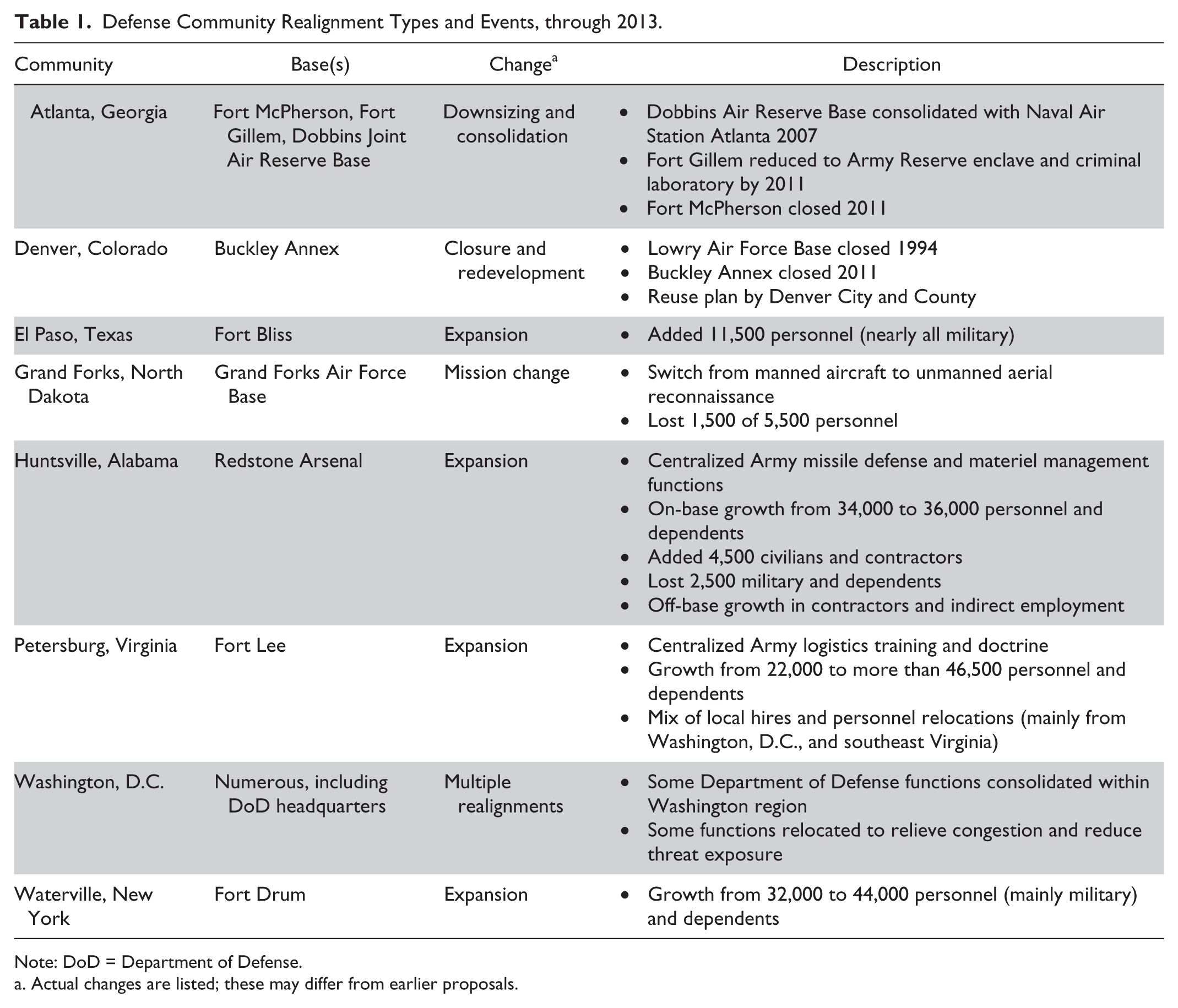
Note: DoD = Department of Defense.
Actual changes are listed; these may differ from earlier proposals.
Regional Input–Output Modeling
Input–output modeling is the technique most frequently employed for producing economic impact estimates at the regional scale. Its results may also feed into other planning methods. Some fiscal impact studies use an input–output model to forecast tax revenues (Jenkins, Kuo, and Shukla 2000). Economic impact estimates derived from input–output models may be integrated into environmental assessments (Ai and Polenske 2008; James 1994).
In brief, an input–output model tracks monetary transactions among industries, consumers, and the public sector as a representation of the interdependencies among economic agents (Miller and Blair 2009). The structure of these transactions is calibrated using estimates (or, rarely, direct observations) pertaining to an accounting time period, usually one year. Because the model essentially is linear, it is easy to automate the computations demanded by updates to the underlying estimates or required to analyze particular changes of interest occurring in the economy. Ready-made software packages and data sets are available for purchase or loan at the scale of counties and even smaller geographic units throughout the United States. Private vendors offer several competing products to accommodate different budgets and interface preferences. The forecasts made with these software tools can be projected to different outcome years; can be reported in numerous units, such as jobs, value-added, output, or tax revenues; and can be disaggregated according to industry sectors or segments of the workforce or resident population. Because the software mostly hides the assumptions and complications of regional input–output models from immediate users, the degree to which the input–output approach relies on economic stability is not readily apparent. 7
Critical assessments of the limitations and drawbacks of the input–output approach abound in the scholarly literature (Miller and Blair 2009; for recent discussions see Oosterhaven, van der Knijff, and Eding 2003; Hall 2004; Porter and Fletcher 2008), yet the practical implications for conducting an economic impact analysis are not widely grasped—or heeded—among analysts and practitioners. One primary concern is that the framework underlying input–output models imposes a number of technical conditions that ensure that the model is tractable for algebraic manipulation. These include linear production technologies, constant returns to scale, and the absence of supply constraints (Warf 1997). The linear production technology and constant returns to scale restrictions imply that as a business or industry increases or decreases the volume of its production, the amount of each input used adjusts proportionally. A lack of supply constraints ensures that changes in demand are satisfied by existing producers using their current sources of inputs, including both human and physical capital. Put more simply, these technical conditions taken together dictate that the changes being examined do not alter the ways in which economic agents interact with each other. The patterns of purchases made by producers and consumers are stable. The demand for local production continues to match the supply. Except for its scale, importing and exporting activity proceeds as before. No economic behavior is modified in response to new economic policies or incentives.
This is an obvious place in which the reasonableness of the model depends on the extent of economic stability. As mentioned above, prepackaged impact analysis software shields users from confronting possible violations of the conditions assumed in the input–output framework. 8 In regions with major and swiftly occurring economic shifts caused by external influences, such as defense communities, there is little reason to believe that the technical conditions approximate reality. 9 Regions near military installations that experience brisk population growth are likely to witness soaring local demand (for housing, consumption goods, etc.). Local input sources may not be able to provide sufficient quantities to supply the escalation in production in the short run, forcing producers to increase their expenditures on nonlocal inputs or to reallocate among substitutable inputs, either of which actions violates the input–output model’s technical conditions. In the long run, industries growing in response to swelling population and demand are likely to realize economies of scale or find economies of scope in production, contradicting the assumption of constant returns to scale or altering local transactions structures, respectively.
Regions with downsizing or closing bases are less likely than growing regions to violate the technical conditions in the short run. In contrast to the situation of insufficient supply in expanding regions, declines in consumption and reduced demands for inputs need not immediately alter the distribution of the remaining purchases. The economies of such areas are, however, experiencing a selective loss or diminishment in certain sectors. In addition, base land, physical structures, and other resources eventually may be redeveloped to serve new uses. Over several years, businesses may shift their former sales or shrink in volume, new supply constraints may evolve, and new capital and investment may be attracted (Hooker and Knetter 2001).
The forecasting inaccuracies that result from breaches in the technical assumptions of input–output models can occur in either the positive or negative direction and differ according to the types of economic changes considered and the length of the forecast. Nevertheless, it is possible to make sensible judgments about the implications in particular cases. In the situation of a massive military base expansion, input–output estimates will most likely overstate the short-run impacts because inadequate local supply markets will force businesses and consumers to purchase imports, the scale of this effect swamping other violations of the model’s assumptions.
Fort Lee, located near Petersburg in central Virginia (Figure 1), offers an excellent example. The Army base more than doubled in size from 2005 to 2011, adding about twelve thousand military and civilian personnel and contractors, another twelve thousand dependents, and doubling its physical footprint. Many of these new consumers relocated from the Washington metropolitan area and were used to urban amenities and prices. In addition, the base houses the Army Logistics University that opened in 2009, a lifelong learning center hosting students for six to eight weeks each on a rolling schedule and averaging more than 2,300 enrollees at any given time. Not only is the total expansion at Fort Lee a sizeable fraction of the regional population (approximately 2 percent of the Richmond-Petersburg metropolitan statistical area), but the purchasing power it represents is centered in the outskirts of the region: Fort Lee is situated about 25 miles south of Richmond. The Crater Planning District Commission, the organization that coordinates regional planning for military-driven growth in the region, commissioned economic impact studies of the Fort Lee expansion that are based on input–output models but realized that additional economic development actions are necessary to attain the local impacts projected by the analyses. Without further local business development, the Commission anticipated that the capacity of the hospitality, food, and entertainment services industries would not be sufficient to meet increases in demand. They also projected greater burdens on public services including transportation, social assistance, and education. These demands were expected to be especially pronounced in the municipalities located closest to the base (Petersburg, Colonial Heights, and Hopewell).
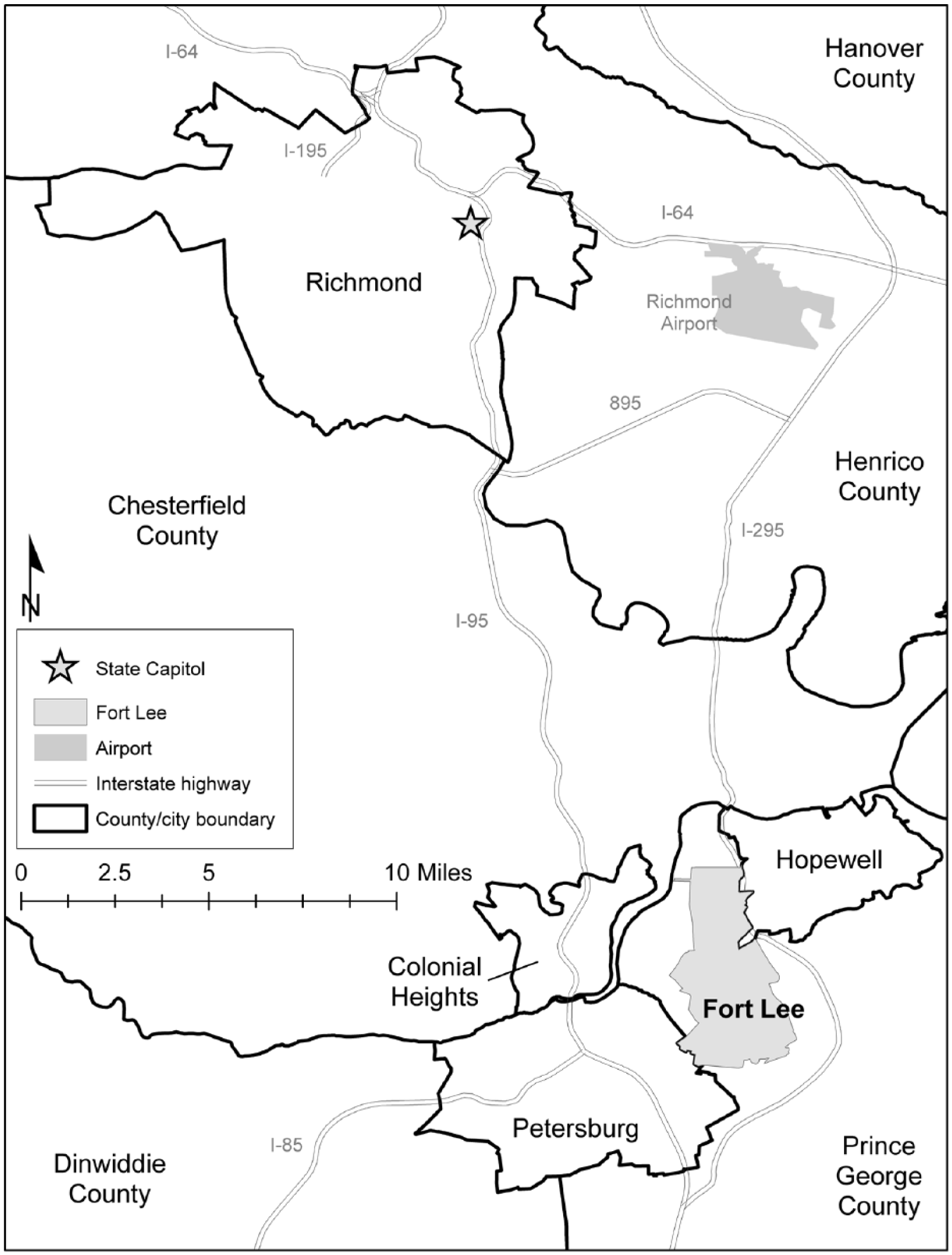
Fort Lee, Virginia, and surrounding region.
On the other hand, regions that experience a small amount of growth or a shift in the mission of a military installation may be able to accommodate the moderate increases or changes in demand without expansion through accessing formerly unused capacity and taking advantage of economies of scale. These adjustments alter transaction patterns to retain economic benefits locally. In such circumstances, input–output forecasts that assume static purchase and supply relationships err on the conservative side.
In the 2005 round of base realignments, the Grand Forks Air Force Base in North Dakota gave up its tanker aircraft maintenance responsibility but gained a new unmanned aerial vehicle program. Much of the effort put forth by the local realignment planning agency, the Grand Forks Region Base Realignment Impact Committee, was aimed toward redirecting private sector businesses and public infrastructure to accommodate the labor and service needs of the new mission (less mechanical and more computing-intensive than the previous mission) and to boost the possibility of local spinoff development. At the University of North Dakota, this included orienting computer science and engineering graduates to local military employment opportunities and broadening unmanned aircraft operations training curricula from remote agricultural evaluation to encompass military surveillance applications. These efforts, if successful, will enable the Grand Forks region to capture economic benefits in excess of estimates derived from a typical input–output model.
In conducting an analysis of the impacts of economic change, forecasts are interpreted relative to a counterfactual situation, whether this alternative outcome is defined explicitly or is implicit in the technique. With standard regional input–output models, unless otherwise specified, the implicit counterfactual is the naïve scenario of the calibrated economy continuing unaltered (except possibly for inflation adjustment). In other words, there is an “all else equal” presumption that precludes both endogenous market and government responses to economic shocks (Hooker and Knetter 2001; Hattery and Koch 1995).
A recent illustration of the importance of carefully determining the counterfactual comes from Denver, Colorado. The Lowry Redevelopment Authority, charged with planning the redevelopment of the seventy-acre Buckley Annex site within the former Lowry Air Force Base, in 2011 examined the potential economic impact of converting the site into office and retail space. The analysis judged as unwarranted the supposition that all projected future office employment on the site would be new to the city and region—an assumption not at all uncommon in site development impact studies. Rather, a substantial proportion of the anticipated employment reasonably could be expected to consist of relocations of activity from within the Denver metropolitan area. Therefore, the counterfactual scenario included some of the office jobs even in the absence of the redevelopment project, reducing the total projected employment impact. 10
A more involved counterfactual scenario might consider potential changes in public support. If a base or site closure did not lead to a prompt and successful redevelopment effort, the region might lose public funding because of declines in population or economic activity. The community could gain eligibility for additional assistance from local agencies, the Department of Defense, and other state and federal government programs (Cowan and Webel 2005; Poppert and Herzog 2003).
Although it is possible to compare the outputs obtained from input–output models to more realistic and complex counterfactual scenarios constructed either within or external to the input–output model, this step almost never is taken. Doing so can muddle the analysis by introducing a second forecast that itself is subject to inaccuracies. The more complicated the counterfactual scenario relative to the calibrated model, the less likely it is that an analyst can access the information required to quantify it reasonably. Often the better choice is to provide words of caution and carefully distinguish short- from long-term assessments of forecast accuracy. More sophisticated software is available that combines an input–output component with a macroeconomic module that can model market adjustments and user-specified policy responses, 11 but such tools are not as commonly used at the municipal and regional levels because of the cost, requisite expertise, and substantial demands for high-quality data as model inputs. Moreover, the forecasts they generate are heavily dependent on the precise specification of the policy responses and the underlying economic theories driving the macroeconomic model, usually favoring approaches that facilitate estimation (i.e., econometric systems that tend toward convergence; see the discussion of computable macroeconomic models in Other Methods below).
A naïve and possibly unrealistic counterfactual scenario occasionally can serve as an intentionally extreme illustration to garner policy attention. This tactic can be traced back to the originator of the input–output technique, Wassily Leontief, in his position as a consultant to the Office of Strategic Services during the second World War (Karier 2010, 183–84; Vanoli 2005, 23). 12 Leontief applied a national-scale input–output model to reveal ominous consequences for employment and economic activity, suggestive of a return to the conditions of the Great Depression, that would stem from an abrupt demobilization of the industrial capacity that had been constructed or assigned to supporting the war effort. 13 In a very different situation in 2006, the Crater Planning District Commission acted in a comparable fashion in commissioning a study of the economic impact of Fort Lee. The analysis employed an input–output model to estimate the increase in consumption expenditures that would be generated by new military personnel, civilian employees, and their families, while intentionally assuming no expansion of the local retail sector. By illustrating the gap between anticipated future retail demand and contemporary capacity, the study demonstrated the need to develop more local retail options to be able to capture growth in consumption spending. 14 A subsequent supplement to the analysis highlighted further local business opportunities outside of the retail sector.
Econometric Models
Another approach to conducting economic impact analysis is to specify an econometric model, with forecasts determined by applying the parameters estimated from known observations to projections of independent variables. This strategy is a mainstay of the empirical and applied academic literatures in the social sciences, as it entails minimal a priori assumptions and is practicable with data sets that are less well structured and comprehensive than demanded by most other methods. A multitude of software options provide broad access to econometric techniques at all levels of statistical and computing sophistication, and, as with input–output software, enable economic impact studies to be conducted with insufficient attention to (or perhaps not enough patience for) the subtleties of the method and its prerequisite conditions. Outside of the scholarly realm, econometric models are not yet commonly applied in economic impact analyses, but are frequently employed for generating forecasts of population and land values (sometimes as components within a more complex set of models), which in turn are essential inputs into fiscal impact and facility siting analyses (e.g., Norton 2007; Ottensman 2000; Edwards and Huddleston 2010). The numerous cautions elucidated by scholars and researchers (contained in any standard econometrics or statistics textbook; e.g., Allison 1999; Gujarati 2003) should be evaluated thoroughly by analysts in considering whether to apply an econometric model for impact assessment and by educators in teaching econometric modeling and forecasting.
Failures of independence conditions are probably the most widespread violations encountered in forecasting economic impacts with econometric models. Most basic statistical frameworks require that empirical observations be independent of each other, or else standard interpretations of the numerical outputs are inappropriate. Longitudinal data commonly possess dependence along the time dimension because economic and other physical and social conditions exhibit inertia. Analogously, observations of geographically proximate units may display dependence along spatial dimensions. Accounting for dependency among observations can be accomplished with more involved statistical techniques. The analyst must first recognize the failure to meet the independence condition and the implications of the violation, and then must have knowledge of the structure of the interdependence among observations, generated either from theory or empirical analysis. Determining which characteristics “spill over” to affect neighboring jurisdictions or subsequent observations is especially difficult in situations of considerable and rapid change because there is no stable baseline for comparison.
Multiple interacting events, such as occur in regions housing more than one military base, exacerbate dependence problems (Poppert and Herzog 2003). When several installations are changing in different ways and on divergent timelines, it is not possible to isolate the economic impacts of a single facility or a particular set of shifts in activity. In the Atlanta region, Fort McPherson is located five miles southwest of the Georgia State Capitol and Fort Gillem is approximately a half hour’s drive to the southeast in suburban Clayton County (Figure 2). More than eight thousand active duty military and civilian personnel worked on the two bases in 2005. By the end of 2011, after restructuring, the activities of the bases had diminished nearly to nothing: Fort McPherson retained only a small veteran’s clinic and Fort Gillem housed a single laboratory that assisted in Army criminal investigations. The downsizings took place in irregular intervals as individual military commands and supporting activities were relocated to sites in Illinois, North Carolina, and South Carolina. The local population of military retirees and their dependents, estimated to exceed fifty thousand, now must travel to relatively distant bases to access services such as commissary supplies and temporary housing or else patronize private vendors. During the same period, Dobbins Joint Air Reserve Base, located 15 miles northwest of the State Capitol in Cobb County, consolidated with the adjoining Naval Air Station Atlanta. Some functions were relocated to aviation bases elsewhere in Georgia and in Louisiana and Texas. With such complicated and overlapping shifts of activities and personnel occurring across multiple years, econometric models are not effective in identifying particular impacts. Econometric models are suitable for estimating average or combined economic impacts across many bases and regions (or a large number of units such as land parcels), but not the impacts of individual events or installations.
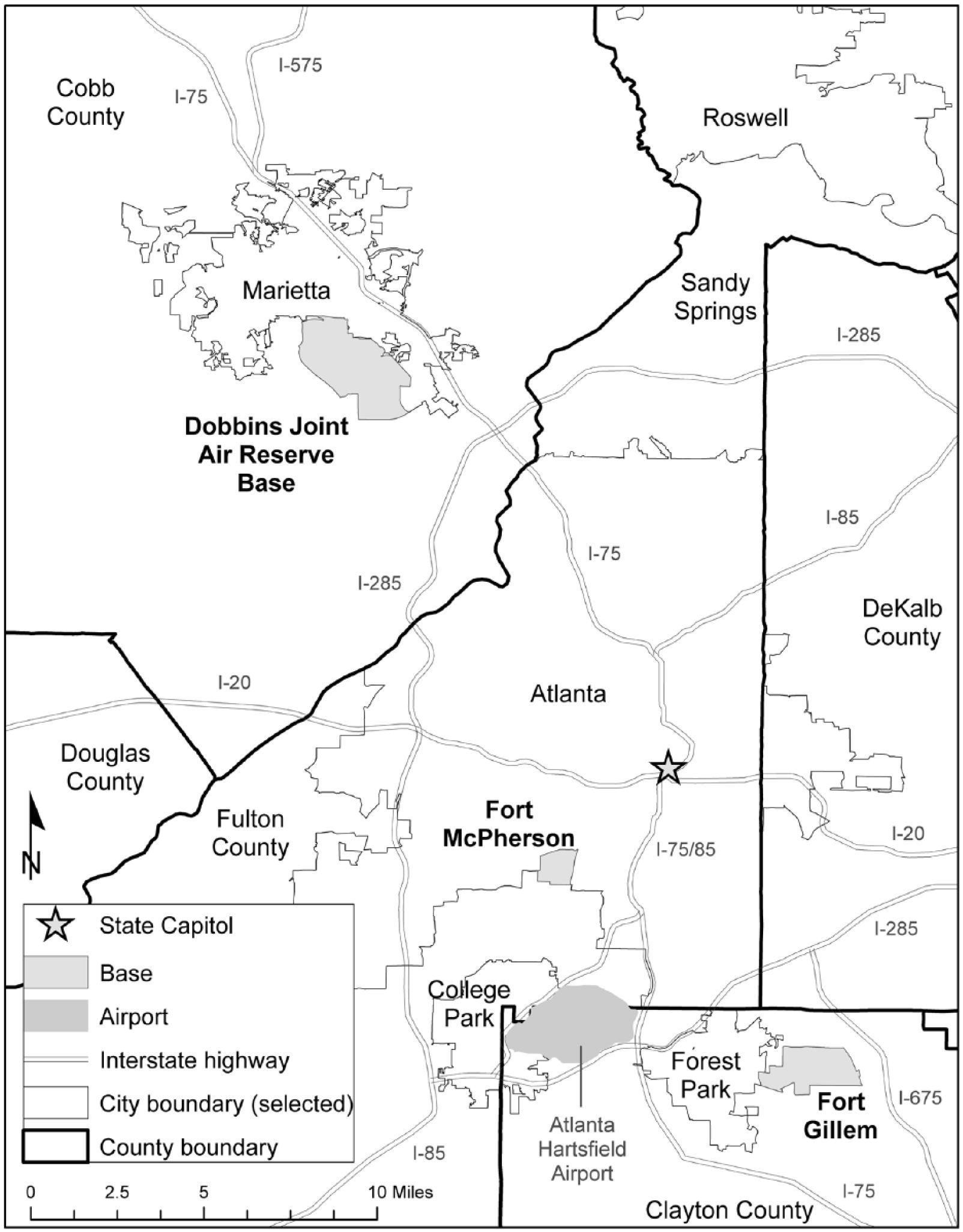
Military bases in and near Atlanta, Georgia.
Endogeneity, a reverse causal relationship in which the dependent variable affects one or more of the independent variables, is another type of independence violation that stymies econometric models. 15 Unlike the other concerns described throughout this section, endogenous causal relationships are not the result of nor are aggravated by economic instability. They are, however, common to politically involved situations, and such causal connections disrupt the application of econometric models to analyze the impacts of other types of planned or anticipated economic events in the same way as for military realignments. In the case of defense communities, political resistance and community-level opposition to base realignments based on possible negative local impacts may be greater and more effective in regions facing more difficult initial economic circumstances (Paloyo, Vance, and Vorell 2010). The Base Realignment and Closure commissions may select bases for closure and downsizing strategically in order to avoid anticipated resistance or sequentially to start with the “easier” targets (Hultquist and Petras 2012). (Equivalently, the commissions may respond to Department of Defense recommendations that arise from the same considerations). Such feedback from potential outcomes to the initial economic events being analyzed biases statistical inferences; the complexity of the interactions generally precludes confident determination of the magnitude and sometimes also the direction of probable error.
The advantage of econometric models that they are applicable in situations in which information is scarce or theoretical clarity is lacking has a downside as well. The intrinsic complexity of regional economies, and of the societal structures within which economies function, means that econometric models are incapable of accounting for all potentially important influences (Poppert and Herzog 2003). Since a scientific experiment with randomized selection is not possible, analysts can never be sure that they are considering all of the essential factors that shape economic outcomes.
Other Methods
Case studies are valuable in economic impact analysis when the aim is to describe in detail the economic circumstances that follow an event or series of events in a region. The extensive and varied information that can be obtained by thoroughly investigating a selected case, often with a mixture of qualitative and quantitative methods, permits a highly nuanced and richly descriptive interpretation and supports the process of policy evaluation (Hill 2000; Hill, Deitrick, and Markusen 1991; Yin 1994). Thanner and Segal (2008), for instance, conducted an ethnographic study of the social effects of the 1998 closure of the Fort Ritchie Army Garrison in Cascade, Maryland, a facility that had trained intelligence troops and provided support for a nearby nuclear bunker. The study focused on how local institutional roles and evolving circumstances, such as extensive cleanup of unexploded ordnance and unanticipated lawsuits, served to divide or unite the community during the extended process of closure and subsequent land conveyance and redevelopment.
Where the case study approach is not useful is in producing impact assessments that are immediately generalizable beyond the specific situation. Individual case studies cannot readily resolve questions of attribution because they do not identify the necessary and sufficient conditions for eliciting particular outcomes. Alternative and counterfactual scenarios can be considered only by relying on observer or participant judgments about what might have been expected to occur under different circumstances. Case studies are appropriate and common in situations in which generalization is not the chief concern, such as many fiscal and environmental impact studies (Edwards and Huddleston 2010; Greenberg 2012). In-depth studies of discrete cases also support subsequent analyses through revealing relevant relationships or demarcating complex interactions and sequences of events of which researchers might otherwise remain unaware or unconcerned (i.e., exploratory research). In assessing military realignments, the details of specific cases often suggest subjects that researchers then examine using other forms of analysis (Hill 2000; Thanner and Segal 2008). Furthermore, to the extent that multiple case studies scrutinize comparable situations and address related questions, their compilation can yield tentative generalizations or preliminary tests of findings produced with other methods (Lijphart 1971). Yet such collection loses validity and utility as cases diverge as a result of extensive change.
Case–control studies assemble individual counterfactual scenarios for multiple cases by matching each case to one or more nontreatment or control cases similar in respects other than the treatment (i.e., other than the economic changes being evaluated). The approach is not common in economic impact assessment for two major reasons. First, it is very difficult, often not possible at all, to find matches that are convincingly similar with regard to the relevant variables other than the treatment. To the extent that there are substantial differences between the matched cases other than the events or economic changes of interest, the attribution of the outcomes remains ambiguous. Second, case–control analyses rely on consistent or standardized data being available across numerous observations or cases. Rapid and thorough change, such as occurs in defense communities experiencing base realignments, expands both obstacles.
The author is aware of only one case–control study of defense communities. Isserman and Stenberg (1994) matched each of seven counties that experienced major military base closures in the 1970s to a control group of twenty of the most similar counties in the United States. The choice of twenty controls for each case represented a compromise between the goals of maximizing the similarity between the target and the controls and averaging the idiosyncrasies of individual counties across many controls. The data were restricted to those items available on identical terms for each county: per capita income, population, major industry sector earnings, great circle distances to large cities, etc. Isserman and Stenberg found an absence of the drastic employment declines that had been projected by some earlier input–output studies. Perhaps not surprisingly, they also found that the local economic environment was the most important factor in determining the impacts of base closure.
Without going into detail, other methods for generating estimates of economic impacts fare no better in conditions of economic instability than those described above. Indexing and benchmarking analyses are predicated upon valid comparisons, and so involve the same problems of comparability and data quality as case–control studies. Network analysis is gaining popularity as a tool for evaluating industry interactions; however, it does not lead readily to measurable impact figures. The technique is especially susceptible to data obsolescence, a risk that intensifies with the rapidity and scale of economic change. Economic base analysis has been almost entirely supplanted by regional input–output modeling, for the compelling reason that economic base analysis offers little advantage over and yet includes nearly all of the disadvantages of input–output models, including those described earlier. Computable macroeconomic models (also called computable or applied general equilibrium models) favor certain economic theories—typically neoclassical theory and its variants—in order to facilitate model solution. Economic instability tends to disrupt solution algorithms. 16 Moreover, whether the theories embodied in an economic model appropriately describe the functioning of the regional economic system is debatable in each case. The purpose of noting the faults in these alternative methods is not to discount them as useful in the proper situations, but rather to illustrate that none of the ordinary methods for conducting economic impact analyses manage economic instability particularly well.
Information Challenges
There are additional problems that affect estimates of economic impacts for areas undergoing rapid change that are common across analytical methods. One of these is the challenge of finding suitable information: obtaining data that are precise, accurate, and timely. Data obsolescence is pervasive throughout economic analyses, particularly at subnational scales, and economic shifts hasten the pace with which information becomes outdated. Collecting primary data usually does not address obsolescence and introduces even more severe obstacles. 17 As one example, regional input–output models ideally should incorporate measurements of key characteristics that are specific to the region being analyzed, such as industry productivity, interindustry transactions, and the local purchasing proclivities of businesses and consumers. 18 These figures are rarely available, so state- or even national-level averages of these traits are used as substitutes. Occasionally, studies employ approaches such as location quotients or minimum requirements to estimate local parameters (e.g., Erickson 1977; Asteris et al. 2007), but these approaches do little to improve accuracy in the absence of more detailed regional data (Isserman 1980; Gibson and Worden 1981). Economic changes at the regional scale degrade the quality of these alternative measures as surrogates for local traits—the swifter and more extensive the transformations, the greater the deficiency. Similarly, analysts employing econometric models are often forced for lack of data to accept weak variables as indicators for locally specific information or concepts. These too decline in effectiveness with greater situational volatility. A study of military communities in Sweden by Andersson, Lundberg, and Sjostrom (2007) uses a single dummy variable to indicate a base closure. Less extreme examples include incorporating year fixed effects (i.e., dummy variables) to account for unobserved time-specific phenomena (Poppert and Herzog 2003), proxying reuse potential with base acreage (Poppert and Herzog 2003), and lagging personnel changes uniformly by one year to accommodate unknown project delays (Paloyo, Vance, and Vorell 2010).
The problem of missing data is compounded in defense communities because of the ways in which they are dissimilar to other communities. Military installations are more economically isolated from their host communities than most other entities of comparable size. Purchasing that is directed or overseen at the national level is less likely to favor local suppliers. The prevalence of subcontracting in industries that receive defense contracts confounds analytical efforts to distinguish local from extra-local impacts, and there is slim possibility of obtaining the information necessary from the highly secretive firms operating in the military-industrial arena (Warf 1997; Markusen et al. 1991). Military personnel typically spend substantial portions of their disposable income on base rather than in the local community, including for housing and commissary supplies, and many services are offered on base at minimal or reduced costs (Dardia et al. 1996; Poppert and Herzog 2003; Paloyo, Vance, and Vorell 2010). Salaries of military personnel are only loosely related to regional price structures, though civilian and contractor remuneration is more closely tied to local living costs. More generally, because defense-dependent communities exhibit a lesser degree of economic self-determination, they tend to behave differently than other regions in response to external economic conditions, complicating benchmarking exercises and the calibration of econometric forecasting models (Dardia et al. 1996; Cowan and Webel 2005). For example, personnel deployments that slash local consumption expenditures are scheduled and imposed by centralized command and logistics operators independently of regional economic circumstances. Local labor force compositions and interregional migration patterns result more from administrative decisions and less from household choices than in other regions.
On the other hand, studies that do obtain and exploit locally specific data produce results that are not amenable to generalization and are difficult to replicate. Case studies inherently present this shortcoming (e.g., Erickson 1977; Asteris et al. 2007; Hill 2000). Other types of analyses that use unique methods or data, however, carry the same disadvantage. Dardia et al. (1996) compare three large California bases that closed in 1992 through 1994 with similar California bases that remained in operation to determine the impacts upon population, employment, and housing, an exercise that may not be repeatable in smaller states with fewer bases or in periods of pervasive downsizing or pervasive growth. Soden, Schauer, and Conary (2005) employ an impact model developed by the Institute for Policy and Economic Development at the University of Texas–El Paso to study the impacts of changes occurring at three military facilities in the Paso Del Norte region. 19 Whereas the authors note that their choice of model ensures compatibility with an earlier study of Fort Bliss (located in El Paso, Texas), the model depends on previously completed mail surveys of installation personnel and thus is unlikely to be replicable in other locations.
Several features unique to defense communities raise additional questions and dilemmas. Defining the region for an impact analysis is a decision that can affect quantitative impact estimates substantially. Larger geographies mean that estimated economic impacts are spread across a greater space: more jurisdictions may be impacted, but each more modestly (Buss and Dwivedi 1997; Hill 2000). On the other hand, larger regions offer more options for production and consumption, and, together with the inference of diminishing convenience with increasing distance, yield greater estimates of the local capture of economic benefits. Sizeable military installations often are situated on the outskirts of populated areas, intensifying the consequences of the geographic definition for the spatial distribution of estimated impacts. Moreover, many civilians are willing to commute impressively long distances to access the specialized opportunities and benefits of military base employment (Muller, Hansen, and Hutchinson 1991). Opportunities for redeveloping closing military sites and the costs associated with doing so are extremely context-dependent, both in terms of the surrounding location (at multiple spatial scales) and contemporary economic circumstances (Cowan and Webel 2005; Hattery and Koch 1995; Stenberg and Rowley 1993; Hill, Deitrick, and Markusen 1991). There may be some “crowding out” of private sector employment because of the remuneration or desirable working conditions offered at military facilities. The opposite effect may also be important. Military retirees have substantial flexibility in choosing where to access services; the economic shock of a base closure can be softened by the redirection of military retiree spending to community providers (Buss and Dwivedi 1997). Transfers of military personnel and their spouses can leave job openings behind for local residents (Dardia et al. 1996). Many of these features apply to other large facilities or anchor institutions as well, such as prisons, universities, hospitals, factories, and nonmilitary government installations.
All of these issues are present in assessing the role of the defense sector in the Washington, D.C., regional economy. The capital region contains several major and numerous smaller military installations, schools and training sites, medical institutes, veterans and retiree service centers, and of course the Department of Defense headquarters at the Pentagon. Washington is the center of the national military-industrial complex, the network of defense contractors and industries that fulfill most of the military hardware and services contracts that come out of the gargantuan defense budget of the United States (Markusen et al. 1991). The interconnections among these firms and their relationships with government agencies cannot be approximated with national-average transactions data. Many workers travel on a regular basis from as far away as Pennsylvania, New Jersey, and West Virginia to access the defense-related employment opportunities in the region. Any assessment of defense spending impacts in the region depends heavily on the choice of geographic study boundaries.
Some of the social implications of military installations simply are not amenable to quantitative measurement. A strong cultural identification with the military may make downsizings and closures particularly wrenching in some communities (Cowan and Webel 2005), though the loss of military activity can provide impetus for economic diversification efforts or greater regional cooperation toward economic goals (MacKinnon 1978; Bradshaw 1999). Researchers have identified contextual factors that affect the way military changes impact a community: local perceptions of military shifts as an opportunity or as a threat, the extent to which the public is included in forming and implementing community responses, and the quality and ability of local leadership (MacKinnon 1978; Poppert and Herzog 2003; Hill 2000). Evidence of these influences is predominantly anecdotal, and none are considered in standard economic impact analyses.
Ways Forward
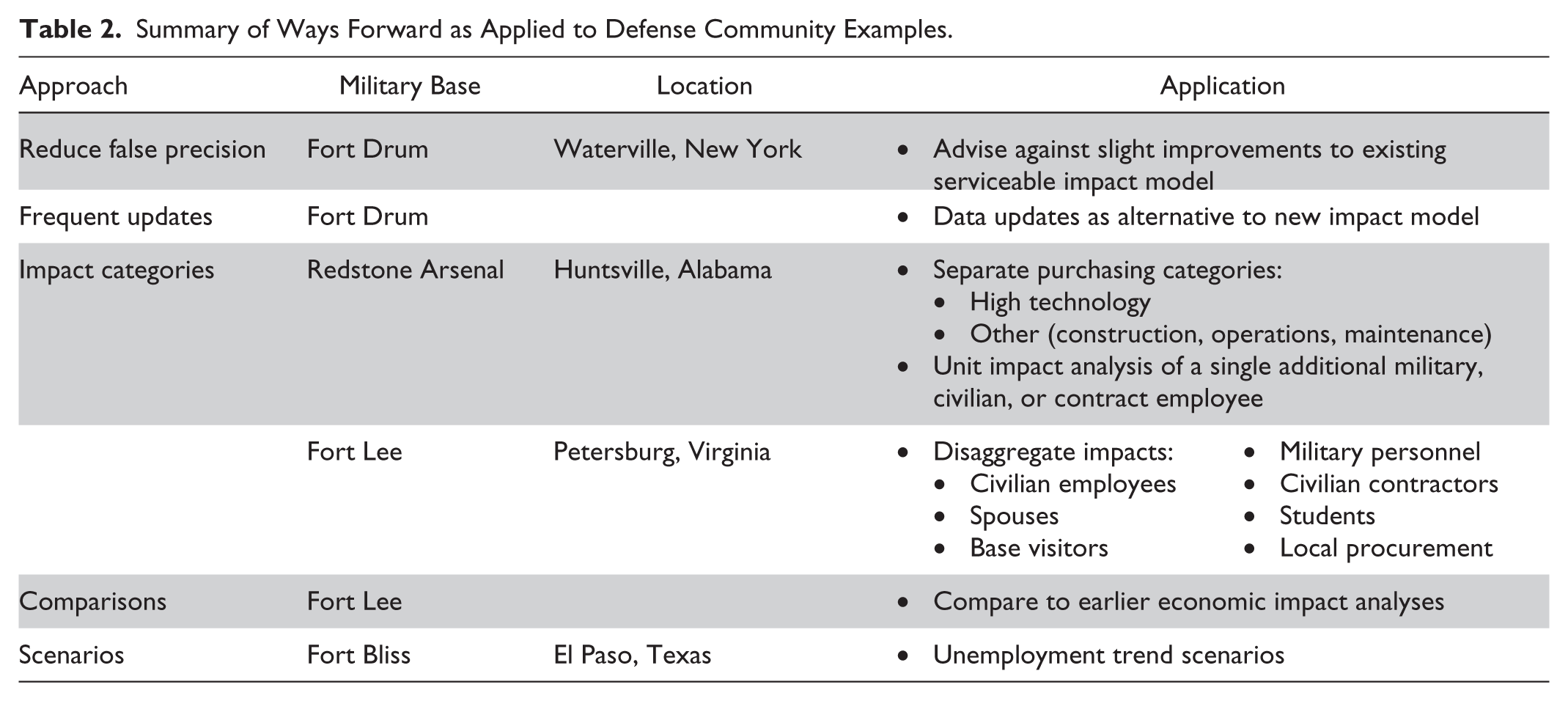
The problems caused by economic instability in assessing the impacts of economic events have no simple solutions. The techniques most commonly used in conducting economic impact analyses are accepted as standards—they are not about to disappear—and there are no undemanding yet effective ways to address their shortcomings. Nevertheless, there are ways forward. This section offers suggestions with the intention of providing appropriate options for planners and analysts engaged in the task of assessing impacts in dynamic economic environments as well as guidance for educators in teaching “good practices” for economic impact analysis and other analytical planning techniques. Much of the focus is on presenting the information produced by economic impact analyses openly and candidly, conveying the shortcomings along with the findings of the approaches and minimizing the potential to mislead economic development practitioners and other end users. Table 2 summarizes defense community examples that apply these suggestions. The last subsection discusses planning instruction in more detail.
Summary of Ways Forward as Applied to Defense Community Examples.
Reduce False Precision
Policy makers are notorious (among analysts, at least) for their impatience with the qualifications and equivocations of academics and researchers explaining analytical findings. Not unreasonably, decision-makers seek a bottom-line result useful for informing policy determinations and implementation. The same trait often describes the clients for whom consultants produce economic impact assessments. Some sponsors expect or demand results and interpretations that support their positions. Yet it is incumbent on analysts to document not only possible inaccuracies in their work but also the level of precision that they attribute to numerical findings. Approaches to the presentation of results that encourage audiences to consider potential ambiguities and steer away from unreasonable expectations can be ignored or resisted but ultimately may have efficacy in averting poor policies that are based on misunderstandings of the quality of the analytical information.
Various presentation tactics help to communicate data with an appropriate degree of precision and to convey the degree of confidence that an analyst places in the findings. Numerical outputs can be presented in ranges, either omitting point estimates entirely or else explicitly stating that range boundaries carry greater confidence than precise figures. Accuracy should be assessed sincerely, to the point of advocating against performing quantitative tasks that the analyst judges will add little information because of insufficiencies in the data or in the accuracy yielded by available methods. In lieu of delivering falsely precise results, the analyst can try to find reasonable alternatives, or failing in that, can suggest better methodological choices for expending the time and effort of the local organization.
Fort Drum, located near Waterville, New York, offers a relevant illustration. In 2011, the local growth management organization, the Fort Drum Regional Liaison Organization (FDRLO), sought an independent evaluation of several regional economic impact models that they had commissioned from outside consultant groups in 1998, 2004, and 2008 to assess the total economic impact of Fort Drum in their three-county jurisdiction. 20 The FDRLO desired that the faults found in the previously commissioned models be addressed, presumably by constructing a new model. Although there were indeed some shortcomings in the existing models, examination suggested that realistic data and time frame constraints would permit only minor improvements to the models. Instead, the FDRLO was urged to purchase periodic updates of the data underlying their most recently constructed model, as opposed to commissioning new models, and to concentrate instead on obtaining information on the activities of Fort Drum from the base commander’s office on a quarterly or annual basis. The accuracy gained from more precise and up-to-date model inputs would greatly outweigh improvements to the model itself. Another suggestion was for the FDRLO to consider exploring the economic consequences of the spouses and dependents of military personnel, a topic that had not been examined in detail in the region and may have sizeable impacts.
Impact Categories
Disaggregating impacts by categories provides more useful detail and at the same time delineates areas of data inadequacy. Analysts can assess different types of impacts separately for accuracy using information such as the particular data vintage, quality, and estimation methods. Perhaps counterintuitively, multiple categories help to mitigate the false implied precision of point estimates. Compound estimates obscure the notion of a single bottom line and allow the analyst some control over the message in terms of recommending an appropriate way to form and evaluate a single aggregate impact. Possibly the most important advantages are that inaccuracies in estimating one type of impact need not spill over to the entire assessment and that alterations can be made much more easily as modified or updated data become available.
The economic impacts of military bases can be disaggregated in several different ways. A 2011 economic analysis of Fort Lee separated the effects of the direct employment of military personnel and contractors from the impacts of the employment of spouses within the region, the expenditures of transient students enrolled in the Army Logistics University, spending associated with base visitors outside the auspices of the Logistics University, and local procurement. Furthermore, the study distinguished the impacts of military personnel from civilian employees and contractors, with students’ and visitors’ lodging expenditures considered apart from their other expenditures. Not only do these categories allow for a more precise explanation of methodology, they also permit the Crater Planning District Commission to make quick adjustments by scaling individual impact components according to new or revised information. In analyzing the economic impacts of the expenditures made by the many commands and agencies located in Redstone Arsenal in Huntsville, Alabama, it was advantageous to differentiate materials procurement and engineering services (largely concentrated in the high-technology aerospace, aviation, avionics, and related sectors) from construction, administrative services, and general operations contracts. Uncertainty regarding localized interindustry transactions and backward linkages stemming from aerospace material and service procurement thus was detached from the more commonplace purchasing activities.
Unit impact analyses take this strategy a step further. Estimates of the average economic impacts generated by a single additional soldier, civilian employee, or contractor, accounting for factors such as pay scale, spousal employment, and base housing allowance, have been generated for several defense communities including Huntsville, Alabama, using regional input–output models. These estimates allow the community to re-scale impacts according to various suppositions about personnel shifts. Of course, the accuracy of the estimates declines as the scale of the changes increases, and all of the issues with regional input–output models apply. The main advantages are in explicitly differentiating the impacts among personnel categories, such as to demonstrate the economic importance of trailing spouses, and in enabling assessments of small adjustments in personnel shifts that do not require reconstructing the impact analysis.
Comparisons
It is valuable to provide communities with comparisons whenever possible to illuminate the meaning of economic data. This is relatively easy to accomplish with standardized metrics by bundling community-specific data with comparison information for the nation, the state, and, when applicable, neighboring or competing metropolitan regions. Custom-designed analyses present more of a challenge. For a project serving many communities, one strategy is to prioritize requests that could be useful for multiple regions, and then supply the analytical results and interpretations to all of the relevant communities including those that did not present the initial request. Another tactic is to benchmark evaluations against previous investigations—many analyses neglect to consider preceding work. The 2011 economic impact analysis of Fort Lee, described earlier, explicitly compares the results to earlier studies.
Unfortunately, in the context of economic impact analyses, there are no steadfast rules concerning which items or evaluations are appropriate to compare across regions, time periods, and economic conditions. The analyst must judge the validity and utility of the comparison in each case. As many impact analyses focus closely on selected aspects of economic events, even a brief mention of excluded impacts can be a valuable reminder. An analysis of the regional economic growth anticipated to follow a base expansion may, for instance, judiciously mention the possibility of increased demands on education and transportation systems and recommend the evaluation of such implications with a different study.
Scenarios
Presenting multiple scenarios and their associated impact assessments illustrates the uncertainty inherent in the exercise in a way that assists the audience to understand the implications of varying the assumptions and initial conditions. At its simplest, the scenario approach can be considered an extension of the strategy described earlier of eschewing point estimates in favor of ranges, but with scenarios broadening the scope along multiple dimensions. A counterfactual situation other than the naïve assumption of the continuation of the status quo can be included explicitly as an alternative scenario.
Advocates promote scenarios as an effective way to engage communities in planning and thereby improve planning outcomes. Presented as representations of future possibilities and consequences of current decisions rather than as predictions or expectations, scenarios offer a starting point for prompting discussions about planning options, informing participants of issues and concerns, exposing hidden values and preconceptions, and stimulating audiences—and planners—to envision and judge contingent futures (Myers and Kitsuse 2000; Klosterman 2013). Such engagement early in the planning process may stimulate public interest and facilitate consensus-building (Isserman 2007). From the practitioners’ point of view, writing scenarios forces planners to think about (and perhaps prepare for) a wide range of eventualities, and presenting them to the public reveals probable reactions to policy initiatives (Chakraborty et al. 2011). At any stage of the planning process, scenarios are a valuable unidirectional communication tool because illustrative examples, properly explained as such, can represent complexity authentically without overwhelming audiences with the intricacies of economic issues.
In early 2010, city officials in El Paso, Texas, home to Fort Bliss, were interested in considering what their pattern of unemployment might be like stretching into the future. They requested an unemployment trend analysis. Instead of a standard forecast, they received an analysis designed around four scenarios: the United States would return to pre-recession rates of unemployment gradually over a period of either two or five years, and El Paso either would or would not be insulated from national trends by the continual rapid expansion of Fort Bliss. 21 To improve the conception of these scenarios, they were also applied to other regions (see “Comparisons” above) that offered contrasts in military employment trends (gains versus losses) and size (the extent of gain or loss relative to total employment). Graphs prepared for each of these scenarios supported visualization and comparison. Ultimately, the analysis was presented not as a forecast but as an aid for thinking about what each possible future might entail for Fort Bliss and El Paso.
Multiple Methods
The advantages of applying more than one technique pertain to economic impact analyses as much as to any other research or analysis endeavor. Triangulation increases confidence in findings to the extent that dissimilar techniques yield comparable results, particularly if the effects of rapid economic changes interfere differently with the methods employed. Divergent results rationally should inject additional caution into the analytical process. Yet the inevitable constraints—data availability, time, effort, expense—often preclude applying multiple methods. Analysts should search for opportunities to employ multiple methods and take advantage when they can be justified. Educators can assign exercises that provide students the opportunity to contrast and choose among the results obtained using several methods.
Frequent Updates
In situations of rapid economic change, analysts may counsel their clients and communities to trade more sophisticated and detailed analysis for more frequent updates. Much of the precision seemingly generated by economic impact assessment techniques such as regional input–output modeling and time-series projection is countered by amplified uncertainty regarding the accuracy of the methods. Therefore, regular and timely updates of the underlying data and encompassing economic conditions will do more to ensure high-quality estimates and forecasts than deepening the methodological approaches. Many research and advocacy organizations follow this advice in collecting and disseminating standardized information.
Planning Instruction
Educators can promote the strategies described above beneficially within planning classes that include analytical techniques. Students should be coached in and encouraged to use comparisons (both contemporary and drawing from relevant earlier studies), apply multiple methods, and present scenarios where appropriate and feasible in planning analysis. Avoiding misleading precision and disaggregating quantitative results to improve explanation and enhance practical value makes sense for environmental assessments, fiscal impact analyses, and other quantitative techniques along with economic impact analysis. Promoting and teaching these approaches and attitudes within professional planning education will help to improve the conduct of technical analysis gradually in practice.
Whether based on actual or hypothetical situations and data, open-ended assignments and projects that emulate the work of practicing planners are most suitable for instructing in and practicing these analytical and communicative approaches. Exercises that encompass real-world complexity and force students to acknowledge and confront the struggles involved in making analytical choices, explain and justify those choices, and communicate results to varied audiences, help to prepare them to encounter these challenges in the planning profession. Instructor feedback and grading should gauge the quality of explanation, interpretation, and justification as much as mechanical competency with the technique (Urey 2002). In planning education generally, such assignments train students to evaluate and address uncertainty and to balance among conflicting substantive and communicative objectives (Balassiano 2011; Wolf-Powers 2013). Supporters contend that “learning by doing” engages students with analytical techniques in a way that lectures and abstract discussions do not and can reach students that are not well suited to traditional teaching approaches (Sawicki 1989; Patton, Sawicki, and Clark 2013). Not least important, realistic planning assignments—for which there is no “correct” answer—tend to excite student interest and spur creativity.
Economic impact analysis is a complicated enough topic that it is normally taught over a substantial period of time, incorporating instruction regarding both theoretical foundations and practical (software) operations. Thus, it is viable to program an extensive or multiple-stage implementation exercise to be completed either as the subject is taught or after the course moves to other topics. Analytical techniques such as facility siting and environmental and fiscal impact assessment present similar scheduling possibilities. With the exception of frequent updating, the suggestions and strategies described in this section are taught and successfully implemented by students studying economic impact analysis and other analytical methods, including regional benchmarking and employment forecasting, in the master’s-level economic development planning techniques course at the University of Illinois at Chicago.
Conclusion
This article describes challenges and concerns associated with economic impact analysis amid unstable economic conditions. Many of the concerns pertain to additional analytical techniques useful in planning practice, including other types of impact analyses such as fiscal and environmental assessment. Defense communities in the United States that struggle to cope with shifting military missions and swift economic transitions illustrate these issues along with presenting their own analytical and informational challenges. The methods that practitioners and scholars use to conduct economic impact analyses, including regional input–output modeling, econometric estimation, and generalization across case studies, lose accuracy and validity in the context of rapid and extensive economic change. Although the vulnerabilities differ from method to method, all originate from information insufficiencies. Economic change upends the foundational premise that the economy will continue to resemble its past or current state. Therefore, there exist no direct and complete solutions, nor are there prospects for any in the foreseeable future.
Yet the situation is far from hopeless. Adopting strategies to enhance clarity and reduce misinformation will constitute substantial forward progress for practitioners and researchers endeavoring to deliver valuable and unambiguous information and for educators striving to teach sound and effective analytical methods. These approaches include reducing the emphasis on deceptively precise estimates, providing comparisons and frequent updates to augment the usefulness of analytical results, and taking advantage of categorization and differentiated scenarios to convey uncertainty and to impel those involved in the planning process to consider and engage with multiple possibilities for the future. Examples of analyses in military communities illustrate these suggestions in application. Teaching these analytical and communicative approaches within a planning curriculum, and affording future practitioners the chance to practice them in a forgiving setting, holds the potential to produce analysts that not only compose superior technical studies but are better at communicating them as well.
There is no indication that economies in the United States or elsewhere in the world will become more stable and thus more predictable in the coming years. On the contrary, most prognosticators expect continuing and even increasing economic volatility, including at the regional scale. As the limitations of impact analysis methods gain in relevance and consequence, scholars and practitioners should continue to appraise, implement, and improve strategies for analyzing economic impacts in rapidly changing economies.
Footnotes
Acknowledgements
I wish to thank Nichola Lowe and Rachel Weber for providing perspicacious reviews of earlier versions. Their suggestions, along with those of three anonymous reviewers, have improved the paper immensely; any remaining deficiencies are of course solely my own.
Declaration of Conflicting Interests
The author declared no potential conflicts of interest with respect to the research, authorship, and/or publication of this article.
Funding
The author received no financial support for the research, authorship, and/or publication of this article.