




Abstract
More effective methods are needed to meet the Planning Accreditation Board’s requirement to teach all master’s students about the “global dimensions of planning.” Our survey of accredited US planning programs confirms that field-based courses, traditionally the most effective option, are costly and time-consuming and are therefore occasional, rather than regular, options for exposing students to international planning practice. Based on active learning theories, we suggest that a deliberative learning, case-based approach can facilitate many of the learning outcomes that make travel courses so attractive while also making internationally oriented pedagogies available to a wider range of students and programs.
Introduction
Planning educators increasingly recognize that they must expose their students to contexts outside of their home countries (Hinojosa, Lyons, and Zinn 1993; Stiftel 2009; Stiftel et al. 2009; Dandekar 2009). In the United States, efforts to legitimize the teaching of international planning issues began in earnest in the late 1980s, leading to an edited book, Breaking the Boundaries (Sanyal 1990), and an Association of Collegiate Schools of Planning (ACSP) National Commission report distributed at the 1994 ACSP conference, “Global Approaches to North American Planning Education” (Dandekar 2009). Today, the revised 2012 Planning Accreditation Board (PAB) standards—for the first time—include “global dimensions of planning” as a core area of general planning knowledge that every graduate of an accredited program must study to increase their “appreciation of interactions, flows of people and materials, cultures, and differing approaches to planning across world regions” (PAB 2012, 8).
The increased focus on internationally oriented planning education stems from a number of changes in settings where planners practice. In today’s majority urban world, the fastest-growing cities are in low- and middle-income countries where unique urban planning challenges—as well as innovations—are emerging rapidly and are worthy of attention (Obaid 2007). Economic shifts, public health epidemics, migrant flows, political transformations, and climate crises also make metropolitan regions increasingly interdependent (UN Habitat 2012).
These globalized changes are leading to the internationalization of university curricula across numerous fields, but particularly professional programs preparing future practitioners (Goldstein et al. 2006; Felker and Gianecchini 2015). For planning students, educators cite the importance of increasing global understanding (to ensure that future practitioners are attuned to globalization processes), comparative thinking (to build a repertoire of lessons from other contexts and to recognize that urban planning can operate on entirely different economic, cultural, and physical design assumptions), intercultural skills (to develop the ability to adapt to and be sensitive to other cultures and views), adaptive learning (to work effectively on emerging problems in unfamiliar contexts and critically assess the appropriateness of transferring professional planning practices from one culture to another), and finally, perspective transformation (the process of becoming self-aware of “how and why our presuppositions have come to constrain the way we perceive, understand and feel about our world”) (Mezirow 1991, 14; Goldsmith 1999; Afshar 2001; Goldstein et al. 2006, 351; Brinkerhoff and Brinkerhoff 2005; Kiely 2005; Crabtree 2008; Stiftel 2009; Sletto 2013).
Such competencies are essential for the growing number of international students enrolling in US master’s programs and for US students who intend to work abroad (Stiftel 2009; GPEIG 2015). As the new PAB standards now imply, the perspectives and capabilities learned in internationally oriented courses are also important for students who plan to work in the United States, where planning contexts are increasingly affected by global trends and cultural differentiation and as US-based planning and urban design firms attract more international contracts (Haar 1999; Abramson 2005). This article takes up the call to devise more effective ways of teaching international planning and to make such pedagogies available to a wider range of students and programs. We do so by first reviewing the current state of international planning education in the literature and as experienced by US Master’s of Planning programs we surveyed. We then describe the case-based, deliberative approach we propose for making international planning education more accessible in the classroom. We end by describing the preliminary student reactions to our model, outlining future research needed, and discussing the implications for international planning education.
The Challenges of Offering International Planning Education
Despite the recognition and heightened importance now placed on global planning education for all students, a survey of planning programs and a review of the literature suggest that many programs, especially smaller ones, find it difficult to offer robust international planning education. The survey we conducted was e-mailed to the department chairs or program leaders of the seventy-two accredited 1 Master’s of Planning programs in North America in April 2015. Of the thirty programs that responded, faculty in larger programs (more than seventy graduate students) were more likely to believe that it is easy or very easy to meet the PAB global dimensions requirement (25 percent) and less likely to believe it is difficult (33 percent); no respondents in the larger programs we surveyed believe that it is “very difficult” to meet the standard (Figure 1). By contrast, only 17 percent of respondents from smaller programs (fewer than seventy graduate students) believe the standards are easy or very easy to meet, whereas 50 percent believe it is difficult or very difficult.
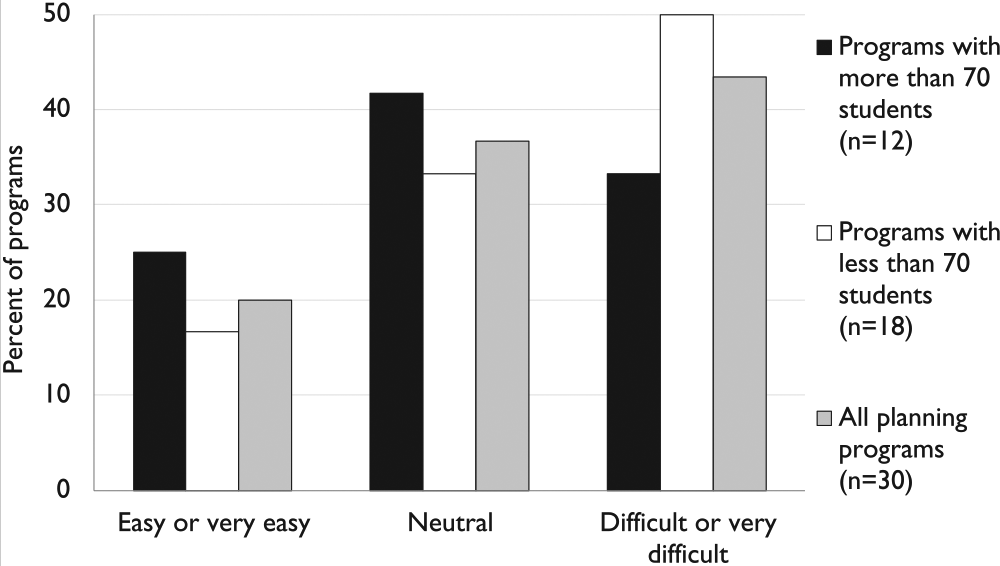
The ability of planning programs to meet the PAB “global dimensions” standard.
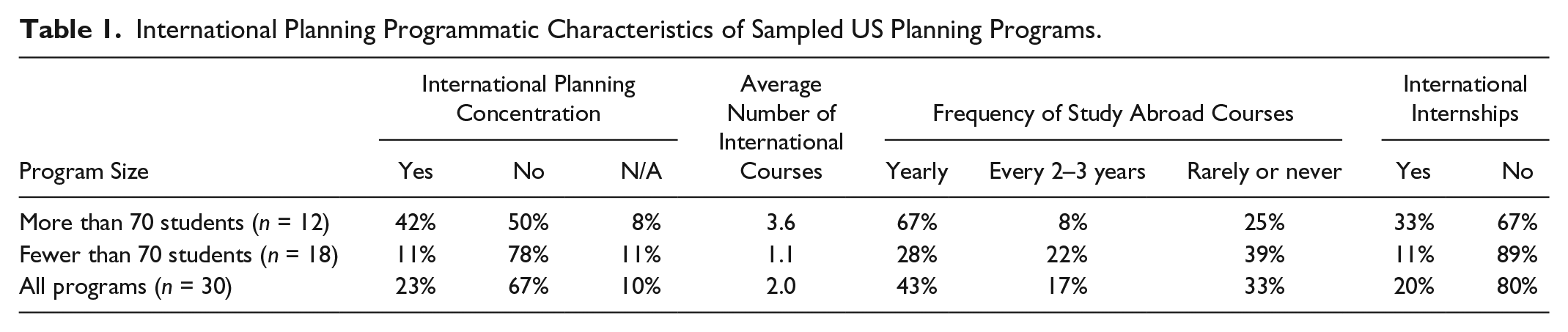
Most programs reported that they meet the “global dimensions” standard by integrating global topics into core courses such as planning history, planning theory, and economic development, or by encouraging students to participate in noncore classes with an international focus. Several programs also invite internationally oriented practitioners and scholars to their regular speaker series. Respondents from smaller programs, however, described numerous challenges such as small faculty size, lack of faculty expertise in international planning, and uneven interest among students for international electives or study abroad opportunities. One person noted that while their small program had a dedicated elective on the topic, it is not mandatory and it is “difficult to channel students there.” A faculty member from another small program answered similarly, noting, “we admittedly fall short of offering adequate coverage on the topic.” Dedicated concentrations, courses, or opportunities abroad were also less common among smaller programs (Table 1). Larger programs were more likely to offer
concentrations in international planning, international development, or similar areas (42 percent compared with 11 percent of smaller programs);
dedicated international planning or international development courses (an average of 3.6 courses per year vs. 1.1 in smaller programs); 2
study abroad courses on a yearly basis (67 vs. 28 percent of smaller programs); and
formally arranged internships abroad (33 vs. 11 percent of smaller programs).
International Planning Programmatic Characteristics of Sampled US Planning Programs.
Despite the limited ability of smaller programs, in particular, to offer field-based opportunities, study abroad courses are the most commonly discussed approach for teaching about international planning practice in the literature (Hinojosa, Lyons, and Zinn 1993; Brinkerhoff and Brinkerhoff 2005; Abramson 2005; Dandekar 2009; Stiftel 2009; Rubbo 2010; Sletto 2013; Yigitcanlar 2013; Klopp et al. 2014). These same planning educators and others, however, confirm what our survey suggests—that field-based programs are costly, time-consuming, and challenging to facilitate well and are therefore occasional, rather than regular, components of most international planning programs. One review of planning program curricula shows that, on average, students have only one opportunity to take a US field-based studio during a two-year master’s program, and even fewer internationally based courses (Long 2012). International planning educators have also expressed that resource differences across planning schools can mean that smaller programs and universities experiencing budget cuts face “prohibitive barriers” for faculty time and dedicated funding for international field courses (Dandekar 2009, 384). A lack of administrative support to manage the added logistics, the high cost for students, and the time needed to establish a strong network of actors to assist with programs on the ground also add to these barriers. Programs abroad, furthermore, do not tend to engage the student who is not already aware of or interested in international topics, as PAB now requires. A one-shot, one-country experience also limits the diversity of issue areas and practice contexts students can explore, while other educators have found that placing a student abroad can do little for their learning and can even reinforce prejudices if the international program is not thoughtfully designed and facilitated (Kiely 2005; Williams and McKenna 2002).
A Proposal for Improving International Planning Education
Given the challenges of taking students into the field, we argue that there is considerable room for devising more effective ways of bringing international planning practice to the classroom. The model we propose blends case-based learning, individual reflection, and deliberative peer learning. We argue that these instructional approaches are particularly relevant to teaching more globalized perspectives and skills, but they also respond to broader appeals from planning educators to integrate more practice-based and active learning into planning pedagogy.
Reviews and commentaries about US planning curricula and surveys of practicing planners have expressed concerns about the limited exposure students have to the experiences, practices, and contexts where planning professionals work, in both domestic (Friedmann 1996; Edwards and Bates 2011; Forester 2013; Greenlee, Edwards, and Anthony 2015) and international contexts (Hinojosa, Lyons, and Zinn 1993; Pezzoli and Howe 2001; Brinkerhoff and Brinkerhoff 2005; Stiftel 2009). In addition to more practice-based instruction, planning educators have also called for more active learning approaches to better prepare students for dynamic planning environments (Shepherd and Cosgrif 1998; Wolf-Powers 2013), critiquing the heavy reliance on readings and lectures about theory as “convenient for faculty . . . [but] less than optimal for learning to become a professional planner” (Friedmann 1996, 101). Active learning pedagogies have spread across academia as educators realize that complex societal problems demand new teaching approaches that depart from traditional lecture formats, where students receive information passively (Halvorson and Wescoat 2002; Prince 2004; Michael 2006; Centellas and Love 2012). As Worthen (2015) has argued, a good lecture can still teach students to pay attention, make connections, synthesize through note taking, and critique an argument. Active learning pedagogies, in contrast, involve students in the learning process intentionally, typically through problem-solving, self-reflection, group work, and discussion (Michael 2006), the methods we emphasize in our model.
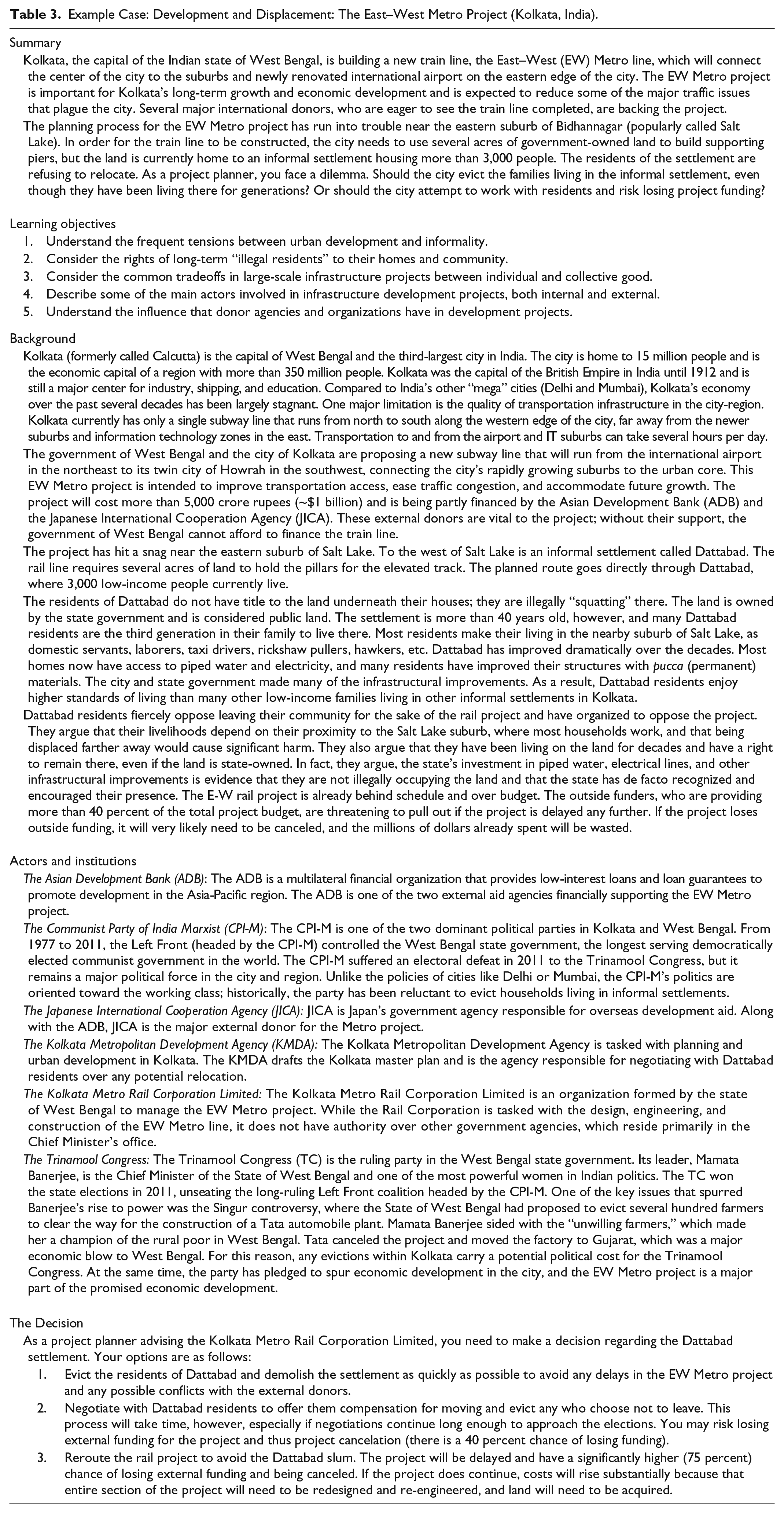
To develop our approach, we first cowrote fifteen cases with planning practitioners and action researchers who work closely with foreign governments, international institutions, or community groups in low- and middle-income countries. We identified case authors whose work we were familiar with that covered sectors important in international planning in a diversity of geographical locations (Table 2). Additional case authors emerged from contacts each of these initial case writers suggested that could fill particular gaps in topics and locations. We intentionally desiged the cases—which are freely available 3 —to be short and self-contained, accompanied by learning objectives, suggested readings, instructor notes, and overview slides so that planning instructors can easily insert one or more cases into existing courses (see Table 3 for an example case). We describe below and summarize in Table 4 the theories about case-based learning, reflection, and peer learning components of our model that align with student learning goals of a globalized planning curricula.
Case Study Sectors and Locations.

Example Case: Development and Displacement: The East–West Metro Project (Kolkata, India).
Components of the Proposed Case-Based, Deliberative Model That Theory Suggests Should Lead to the Student Learning Goals of International Planning Education.

Case-Based Learning
The heart of our approach revolves around international case studies that are intended to ground theoretical readings on international planning to the everyday work of development professionals. Case studies offer windows into the deeply situated contexts where planning happens, similar to what planning theorists Forester, Innes, and Flyvberg accomplish in their case-based writing (Watson 2002). Cases also link theory to practice and allow students to practice problem-solving skills (Sawyer, Tomlinson, and Maples 2000; Michael 2006), essentially creating a “simulated apprenticeship environment [that] acts as a bridge between the theoretical learning of the classroom and the actual practice of the work environment” (Resnick 1987, 17). Watson (2002) also suggests that practice stories help students build a “mental repertoire of past experience” that they can later draw upon to respond to and adapt to new situations and problems (184). This is similar to the way that Schön (1983) believed that practitioners build their capacity for “reflection-in-action”—“an epistemology of practice implicit in the artistic, intuitive processes which some practitioners . . . bring to situations of uncertainty, instability, uniqueness and value conflict” (49).
Case-based learning is now a common pedagogy used in professional programs like law, business, and medicine, because it teaches about problems that have multiple causes, solutions and interpretations (Herreid et al. 2014; Barnes, Christensen, and Hansen 1994). Just as research methodologists argue that case studies allow for more holistic understanding (Yin 2003), Sprain and Timpson (2012) also contend that case-based learning pushes students to move beyond “dichotomous thinking” or “reductionist reasoning” to interdisciplinary analysis, systems thinking, and reflection from a “multiplicity of perspectives” (542). Banning (2003) also found that case studies increased his students’ tolerance for ambiguity and the ability to work under situations of uncertainty. Other education scholars have also found that case study exercises helped students develop interpersonal relations and become self-aware of (and to correct) personal misconceptions (Sawyer, Tomlinson, and Maples 2000; Michael 2006), in the same way Kiely (2005) discusses perspective transformation.
In developing international case studies for our project, we asked authors to focus on a particular initiative, policy, or circumstance they experienced that was representative of the kinds of professional decisions or actions common to their line of development planning. We also asked them to follow elements of effective case studies suggested by Tracey Sutherland (2004), so that the case study:
Tells a story, with a beginning, middle, and end (the “end,” in this case, are the choices posed to the students), following a narrative arc that involves real actors and institutions. The goal was to develop cases that were grounded in a place and time, not abstract or theoretical.
Creates empathy with the central characters, with enough details to make the main “characters” memorable and relatable to the reader, explaining what is at stake for each of them, what their motivations are, and how their history may have a bearing on the choice or dilemma presented.
Provokes conflicting views, or at least an issue where reasonable people could disagree. To reflect real-world practice, we looked for cases where decisions were typically not obvious, but reflected complex tradeoffs.
Forces a decision, to make the users of the case active participants, not passive observers. Rather than one clear “best” choice, we coached case writers to present multiple, viable options, each of which also presents tradeoffs.
The decision point, in particular—where students have to take a position and justify that choice, however difficult it might be—is a key component of our case study approach. Some cases, especially problem-based learning exercises that present a complex problem for students to resolve, rely on ambiguity as a learning tool in the information provided—students are either given very little information or too much information that they have to manage to develop an answer (Shepherd and Cosgrif 1998). In team-based or peer learning, especially in the natural and physical sciences, the ambiguity is in how students go wrong in the method to arrive at the correct answer (Crouch and Mazur 2001). Our approach places the ambiguity in the answer itself, in an effort to invoke a sense that several answers are often equally valid when dealing with complex social problems that involve imperfect information, conflicting interests and value orientations, contrasting perceptions of “the good,” institutional constraints, and more. We also intend to move students beyond detached analysis of a case, to encourage students to empathize with case actors, reassess their own worldviews, put themselves in the planner’s shoes, and recognize that different pathways for action carry specific benefits and drawbacks for the diverse stakeholders involved.
Reflection and Peer Learning
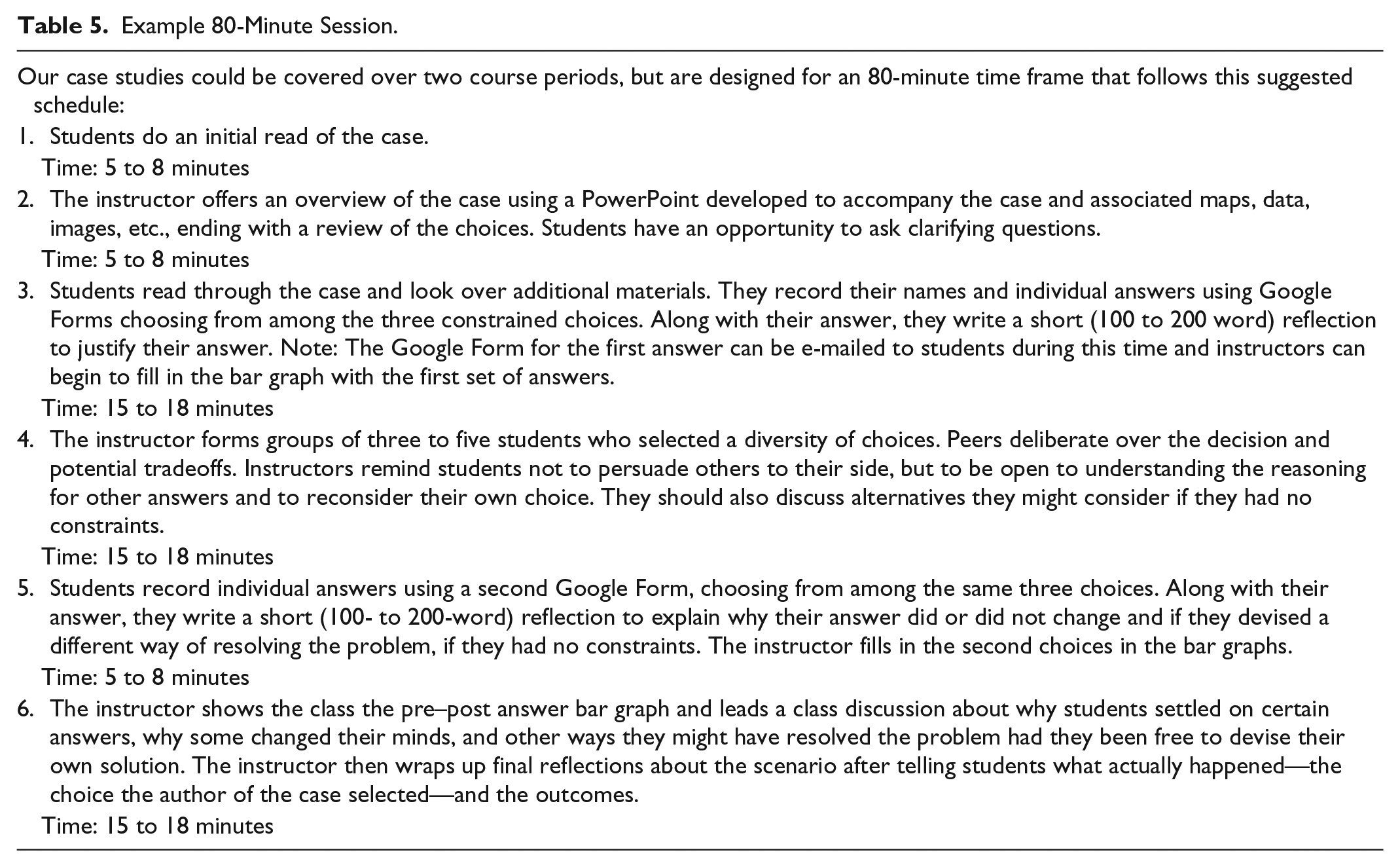
To draw out this self-assessment and increase the potential for students to learn deeper lessons from the case exercise, our approach also incorporates several opportunities for students to reflect on their decision, both individually and with peers. First, after students read the case, they must formulate an opinion individually and reason why they would choose a certain option, reflecting through a written explanation. They are then intentionally grouped with classmates who chose a different option to discuss their decisions. After exploring the case choices more closely with their peers in addition to discussing alternative solutions they might devise, they have a second opportunity to decide what they would do, reflecting again in writing why they made that choice, why their answer did or did not change, and whether there was an alterative approach for resolving the situation. Finally, the instructor shows the class the total number of votes for each choice before and after the peer discussion, engaging the entire class in a final, collective reflection about why students chose particular answers over others, and why some students changed their minds or not. The class also discusses alternative solutions. Each case also offers a “what actually happened” conclusion instructors reveal to the students, to compare the way the students and the planning professional chose to resolve the scenario (see Table 5 for the detailed class procedure).
Example 80-Minute Session.
These reflective and discussion-based procedural elements of our model draw from experiential education and international education theories that suggest that both are essential for “perspective transformation”—to help students become aware of their reactions and tendencies—and to also increase the likelihood that immediate learning will influence their future actions (Dewey 1910; Kolb 1984; Eyler, Giles, and Schmeide 1996). Reflection and discussion also forms the basis of double-loop learning that Argyris and Schön (1978) promoted among practitioners as well as critical pedagogy and transformational learning methods (Freire 1970; Mezirow 1990; Brookfield 2000), all of which require the examination of underlying assumptions and values that shape the understanding of a problem and its solution.
Grouping students together to discuss their answers, especially students who selected different options, also draws on the concept of peer learning—that students often reframe a concept in a way that their peers can grasp more easily than the language a professional instructor might use (Topping 2005). Although peer learning is typically used in the physical and natural sciences where there is a factually correct answer (Crouch and Mazur 2001), we expect that the process of having students explain their choices to their peers will expose different interpretations about the case based on students’ diverse worldviews, assumptions, and values. Grouping students also allows them to educate one another in areas where some students might have more knowledge or experience related to the case topic. The classwide discussion also ensures that students hear additional perspectives outside their group and allows faculty time to ensure that students connect the lessons from the real-world scenarios to more abstract concepts and theories presented in the weekly readings. Furthermore, the purpose behind showing students the pre–post answer comparison—incorporated into peer learning exercises (Crouch and Mazur 2001)—is also to illustrate to students how peer instruction, and collaborative work in general, can help them all reach more well-informed and thoughtful decisions.
Preliminary Student Reactions and Future Research
Although more quantitative evidence and systematic evaluation is needed, initial observations and student reactions to the cases we have piloted suggest that the exercises are enriching students’ learning experience in ways we have theorized. Our preliminary student data is based primarily on pilots carried out by two instructors (the first and second author) in their respective master’s-level international planning classes between the fall of 2013 and winter of 2015 using five of the completed case studies: the example case on informal settlement displacement in South Asia (Table 3), a case on disaster planning in an island nation, a case on refugee resettlement in Africa, a case on private-sector housing development in the Middle East, and a case on health planning in Africa. Both courses where the cases have been piloted use a similar syllabus and attract a mix of 10 to 18 students each year, including Master’s of Planning students focusing on international planning or who take the course as an elective, as well as several students from other fields (e.g., architecture, public policy, social work, environmental sciences).
Although students in these courses were not asked to comment directly about the case studies in their evaluations, when they were asked to describe the “strengths” of the course on the end-of-year, anonymous university-administered course survey, several students in each class noted that the case studies were a highlight. An in-class focus group one author leads with students on the last day of class generated similar responses when students were asked to comment about course activities that were the most effective for their learning. One student, for instance, commenting on the cases, noted, “I learned about what planners actually face—the compromises; it’s good to know before we get a job,” while another student described how the case studies offered an effective way to integrate “practical experience rather than just theory.”
Student responses during case study exercises, when they are asked to justify specific case decisions, also suggest that they are learning about the complex nature of tradeoffs they may encounter and the role of values in many planning decisions. One student wrote, “At the end of the day, the situation is not so black or white. . . . As planners we will always be thrown into these situations because there are always these kinds of developers around.” Others referred directly to the usefulness of discussing the possible choices with fellow students, noting in one case, “After discussing the options with my peers, I understand the need to insert values and propose some alternative solutions,” or “we discussed the positive and negatives of each course of actions, and realized that in the end, the risks were fewer and supplied aid to more people through Action 2.” Students also referred back to cases in other class sessions as examples or scenarios that helped them think through theoretical readings.
In addition to these international planning-focused courses, the example case study (Table 3) has also been piloted during the “international planning” week of a core Planning History and Theory class for three consecutive years—to a total of 140 students—one of the primary ways this program meets the PAB’s “global dimensions” requirement. The case was paired with foundational readings on urbanization in the Global South and introduced first year graduate students to concepts like informality, “right to the city,” and the politics of donor-funded infrastructure projects. The lead instructors have received consistently positive feedback from students, so much so that they have made the case exercise a standard part of the class. Several students have also said that the experience of doing this case in their core class led them to take the international planning elective course, even though they do not have a primary interest in working internationally in their future careers.
To continue to test these initial reactions, we are currently implementing more rigorous, comparative, longitudinal evaluations of student outcomes that result from using the case study exercises. Specifically, we will be studying the impact of these cases on student interest in future careers in international planning, self efficacy and competencies required to work in low- and middle-income country settings, and worldviews about different planning cultures and contexts. We also plan to address a gap in the literature on the use of peer-based learning that focuses heavily on physical and natural sciences problems that have a factually “correct” answer, as opposed to social science problems like our cases where conflicting values, uncertainties, resource constraints, and other factors can mean that no single answer is “best.”
Conclusion
Ultimately, classroom-based pedagogies should not be seen as a replacement for field-based learning. Whenever possible, opportunities should be expanded for students to experience international planning personally, to establish the types of relationships that often form while immersed in another culture, to learn to deal with the uncertainty that always emerges while traveling, or to apply, in a specific place, what they covered in the classroom. What we theorize here is that a deliberative, case-based approach like ours—either as an add-on to existing international curricula or as a stand-alone component, in cases where programs cannot offer regular international field experiences—can generate many of the desired learning outcomes and understanding about international planning practice students need in order to work in today’s globalized world, while also offering other benefits that one-shot trips abroad may not.
For planning programs working to incorporate the PAB “global dimensions” requirement across their core curricula, our approach offers a convenient and effective way of introducing more students to international planning that is diverse in its content and regional coverage, while being accessible to programs with limited resources and faculty expertise. Our cases connect theory to practice, bringing to life comparative perspectives of concepts taught in core courses on planning history, theory, and practice. Single cases can also be easily integrated into sector-specific elective courses, such as housing policy, economic development, disaster planning, environmental planning, or food systems planning, exposing greater numbers of students to global dimensions of these areas of planning.
Programs that already offer students regular overseas experiences might also find approaches like ours useful for better preparing students before going abroad, as Deardoff (2008) and Kiely (2010) advocate. Jackson’s (2008) evaluation of an international field course, for instance, found that students with initially high intercultural sensitivity were more empathetic, observant of the new culture, and aware of their own gaps in cultural understanding during their trip than those who started with lower cultural sensitivity. Our approach might be one way to intentionally prepare students to be more culturally competent before their trip, giving them an opportunity to consider how they would handle scenarios that are ethically, logistically, politically, and culturally challenging in the low-stakes environment of a classroom.
More rigorous research is still needed about the impacts of field-based planning courses abroad (Klopp et al. 2014), just as future research is needed about the learning outcomes that may be equally possible with more practical, accessible approaches like the model we propose. Just as some evaluators have found in study abroad programs, our approach may simulate “low-level dissonance” for students—increasing their tolerance for ambiguity, adaptability, and other competencies that will make them more culturally respectful, and more willing to change their habits to live and work in equally challenging, new contexts, but without fundamentally changing their worldviews (Kiely 2005, 15). Even these outcomes, however, match more closely the type of exposure to dynamic global dimensions educators agree is necessary to better prepare tomorrow’s planning professionals.
Footnotes
Acknowledgements
The authors are grateful to the practitioners and action researchers who helped us build a library of international planning case studies and to the many students who participated in piloting them. Thanks also goes to Lacey Sigmon, Wajiha Ibrahim and Lorin Crandall for assisting with the case study development and web design. Finally, we thank the funding sources that made this project possible.
Declaration of Conflicting Interests
The author(s) declared no potential conflicts of interest with respect to the research, authorship, and/or publication of this article.
Funding
The author(s) disclosed receipt of the following financial support for the research, authorship, and/or publication of this article: the University of Michigan’s Center for Research on Learning and Teaching (CRLT) Gilbert Whitaker Fund for the Improvement of Teaching and the Provost’s Learning and Transforming Learning for Third Century (TLTC) Quick Wins grant program.