



Abstract
Urban security (or public safety), rather than a “social problem” tackled neutrally, is an issue of political contestation, owing to its threefold gist as right to not be victims of crime, policy goal, and social demand. This article, highlighting how planning research has neglected to engage with contemporary paradoxes of security, makes the case for a critical approach to crime prevention and explores the embeddedness of urban security in planning practice in the Lisbon Metropolitan Area. We debate the relations of urban security with changing planning paradigms and political approaches around the vertical (multilevel/multiscale) and horizontal distribution of planning practices.
Keywords
Introduction
The object of study of this article is the relationship between urban planning and local policies for urban security—“urban security,” similarly to the expression “public safety” used in the United States, refers to the prevention of crime and violence in urban settings. 1 We will explore urban security as a threefold concept: a right, a policy goal, and a social demand. Urban security is the right not to be a victim of violent crime in urban space and, thus, a policy goal for democratic institutions, which are responsible for guaranteeing individual safety through policies for direct and indirect prevention of crime and violence 2 (ECOSOC 2002). European local governments, traditionally not responsible for security policy (with the exception of the United Kingdom), have recently become aware of their role in urban security (EFUS 2012). This, together with the absence of direct competence over law enforcement (which is competence of national police and criminal justice systems) and decentralization trends, brought about the emergence of a vast array of local policies for urban security. Urban security within urban planning is a brand new field in Europe—again, with the exception of the United Kingdom (see Office of the Deputy Prime Minister 2004).
Urban security is also a social demand, which is capable of powerfully shaping political and public debates. We will debate how, given its threefold gist, urban security is not a social problem to be tackled “neutrally.” On the contrary, it is always imbued with politics; see Gusfield (1989) on the differences between, and relations among, “political issues” and “social problems.” This is the reason this article adopts a critical perspective, one that “emphasizes the politically and ideologically mediated, socially contested, and therefore malleable character of urban space, that is, its continual (re)construction as a site, medium, and outcome of historically specific relations of social power” (Brenner 2009, 198). Critical scholarship seeks to question the “prevailing order” of things (Morton 2007, 111; see also Flyvbjerg 2004, 296). Accordingly, rather than looking at urban security as a “problem” that needs technical “solutions,” we will privilege the exposition and acknowledgment of paradoxes of the problem, which are inherent to the very understanding of crime and the political dimensions of crime prevention policy making.
The field of enquiry of the article is the institutional practice of urban planning, that is, planning as carried out by public actors through formal means (plans, programs, projects). A literature review shows how critical approaches to urban security are a blind spot of planning research and sets the ground for an exploratory framework for practice, with the aim of answering two complementary research questions: How does urban security inform the extant institutional practice of urban planning? And how can urban planning contribute to improving, while at the same time overcoming the paradoxes of, urban security?
The embeddedness of urban security in urban planning practice is explored empirically in the Lisbon Metropolitan Area (Portugal) through three case studies (Lisbon, Cascais, and Barreiro). Then, we reconsider the findings through the lenses of the exploratory framework, looking at the relations of urban security with planning paradigms and political approaches to planning, around the vertical (multilevel/multiscale) and horizontal distribution of practices.
In our concluding remarks, we suggest that a critical approach to urban security, emphasizing existing paradoxes, can set the grounds for urban planning to effectively engage with security/insecurity issues; and set out some recommendations for an approach of this kind. Further areas for research are also suggested, inasmuch as this exploration is a first step toward a complete understanding of multifaceted relations between urban security and urban planning, hence the use of the term “toward” in the title.
A Critical Understanding of Urban Security
Crime prevention policies can be categorized under two paradigms, social and situational prevention, which mirror two complementary understandings of the problem of crime and violence: Their dichotomy constitutes a privileged point to discuss the political dimensions of urban security.
From the perspective of social prevention, crime is, above all, the result of societal and power relationships. According to Melossi, “deviant behaviour is not the property of the individuals that enact them. It is rather the result of a system of relationships, which is characteristic to a given society, and unfolds together with (much more than against!) that society” (2003, 383; emphasis in the original; see also Morelle and Tadié 2011). According to this paradigm, “a just city is a safer city” (EFUS 2012, 9), and crime prevention is pursued by engaging in structural issues, through policies that foster social justice and well-being around fields such as “employment, education, urban planning, housing, health, youth protection, social exclusion” (Chalom et al. 2001, ii).
The situational paradigm, in contrast, emphasizes individual responsibility and rational choices. From this perspective, a crime occurs when a motivated offender meets a suitable victim in a favorable space/time context; see theories about routine activity (Brunet 2002), opportunity (Felson and Clarke 1998), and crime pattern/place (Brantingham and Brantingham 1995). Situational techniques for crime prevention are aimed at (Brantingham, Brantingham, and Taylor 2005): reducing opportunities for crime, either making it more difficult or more risky to commit a crime; reducing the gains to be made through crime; reducing provocation; and removing excuses for crime. Predictive policing (see Fittered, Nelson, and Nathoo 2015) exemplifies a spatial approach to situational prevention in the context of recent trends for data-driven governance, “the new urban science” (Townsend 2015). Predictive policing, a hypertechnological version of hot-spot policing, analyzes historical and geographical patterns of reported crimes to decide where and when police patrols should be deployed to maximize their preventive function.
Although these two paradigms, together with the underlying conceptions of crime, are theoretically antagonistic, they coexist in practice, both being necessary—for example, situational prevention is designed to produce immediate impacts, whereas social prevention is aimed at structurally reducing crime in the long term. Actual urban security strategies are a mix of policies stemming from the two paradigms. A critical understanding of urban security should therefore focus on the positioning of extant security policy making in the continuum between the two paradigms, questioning the relations with the realm of politics, for a variety of reasons. To start with, the categorization of behaviors as criminal and deviant is a social production contingent on values, hegemonic beliefs, and power relationships among social groups (Gusfield 1981; Mosher and Brockman 2010). Different political cultures, and conceptualizations of the problem of crime, will therefore influence crime prevention policy making. The case of the United States, for instance, with the New Deal crisis and the following shift from social prevention toward repression and mass incarceration, is paradigmatic of the way the state can use criminalization, and hence crime, to govern social problems (Simon 2007; see also Mosher and Brockman 2010).
Indeed, urban security in the Western world is imbued with paradoxes. Criminologists agree on the evidence that since the early 1990s, public perceptions of unsafety have boomed at the same time as Western cities have become more and more safe because of the significant decline of violent crime 3 (see, among others, Tonry 1998; Arvanites and Defina 2006; van Dijk, van Kesteren, and Smit 2007; ICPC 2012). Fear of crime, nowadays, is often irrational in scope and priority (Glassner 1999; Simon 2007). There is a crucial nexus between (irrational) perceptions of (un)safety, the social demand for security that stems from them, and security policy making: media have influenced public demands for security (Glassner 1999; Heath, Kavanagh, and Raethompson 2001) and politicians have deliberately inflated feelings of fear in order to justify repressive policies, with more evidence since the terrorist attacks of the 2000s (Tonry 1998; Oza 2007; Schuermans and De Maesschalck 2010). Contemporary security paradoxes have brought about marginalization and criminalization of (minority) groups, especially immigrants, youths, and the homeless (Melossi 2003; Pain 2010).
To sum up, urban security is never a neutral policy goal, that is, one characterized by a “problem” (crime) to be tackled with technical “solutions.” Let us return to predictive policing as an example. Among the reasons for its success is that the reliance on data analysis and advanced technology provides an illusion of objectivity, which is particularly appealing in times of fiscal constraint and public requests for accountability (Ferguson 2012, 269; Townsend 2015). However, technological development is always imbued with social, political, and economic considerations (Bijker, Hughes, and Pinch [1987] 2012). Specifically, predictive policing predominantly targets, and has proven to be effective against, property crime (Ferguson 2012), whose patterns are explained by risk–benefit calculations of the rational offender more accurately than violent crimes. As such, the success of predictive techniques—and the channeling of public funds from other types of programs—should be understood against the background of a political climate where cost reduction and immediate measurability of results are overemphasized over, for instance, long-term goals of societal advancement.
To sum up, urban security is negotiated with power relationships and proves to be a “socially-constructed problem” (Colebatch 2005), that is, a concept with political and contested dimensions, owing to its threefold essence as an individual right, a policy goal, and a social demand. A critical approach to urban security will thus privilege the exposition and acknowledgment of paradoxes inherent to the specificities of both the problem of crime and the political dimensions of crime prevention policy making. The next section applies such a critical perspective to the relations between urban security and planning.
Urban Security and Planning Practice
Debates about spatial justice (cf. Soja 2010; Fainstein 2010) are especially useful with the aim of emphasizing the spatial dimensions of urban security. “Security is not the mere product of unequal political and social relations, it has an influence on urban dynamics and on the general degree of injustice in cities” (Morelle and Tadié 2011, 6). Morelle and Tadié (ibid., 1), advocating a redistributive understanding of urban security, suggest that it be considered a “common good,” its absence or presence an “indicator” of spatial justice. From this perspective, urban security practices and policies are debated for their capacity to spatialize (in)equalities, that is, to produce spatial differentiations in security/insecurity patterns and worsen spatial inequalities (Jacquot 2011; Rebotier 2011). It has been widely debated how the contemporary paradoxes of urban fear and security have boosted fortification, fragmentation, privatization, and control of urban space (see, among others, Sorkin 1992; Davis 1998; Graham 2010; Tulumello 2015b), that is, have influenced urban planning and produced spaces marked by exclusion (Abu-Orf 2013; Tulumello 2015a).
Let us thus debate planning practice for its capacity to influence urban security patterns. If we intend planning practice, because of its embeddedness in institutional structures, as a public policy (Friedmann 2005; Ferrão 2011), we can explore its relations with the two paradigms for crime prevention.
From a social prevention perspective, and recalling the introductory debates to this section, urban planning contributes to the prevention of crime and the reduction of feelings of insecurity when it fosters social and spatial justice (Indovina 2001). But this is not always the case. Harvey (1993) understands land-use zoning as a capitalist means to control the working classes. Gunder (2003), Pløger (2008), and Harris (2011) consider planning crucial for the state’s will to control and repress. Yiftachel (2009) discerns tendencies toward “creeping apartheid” in the very mechanism of urban planning. In a nutshell, urban planning does not inherently foster spatial justice, and hence social prevention.
Within a situational prevention paradigm, urban planning contributes to crime prevention when it enacts on the individual action of the offender. In architectural and urban design, Secured by Design (SbD), an initiative of the UK police that aims to “reduce burglary and crime in the UK by designing out crime through physical security and processes,” 4 is a case in point. Efforts toward situational prevention in planning have been made through “environmental” approaches to crime prevention, which bring together environmental criminology, urban design, and urban planning as a way to design out crime and threats; see Crime Prevention Through Environmental Design (CPTED) (Cozens 2007, 2011) or dialogues between New Urbanism and SbD (Kitchen 2002).
The cultural foundations of environmental crime prevention lie between human ecology theories, which address the relations between urban spatial patterns and moral order (cf. Park 1967), and Jane Jacobs’s “eyes on the streets” (1961). Newman incorporated these theories in the concept of defensible space, “a model for residential environments which inhibits crime by creating the physical expression of a social fabric that defends itself” (1972, 4). Advocates of environmental approaches consider them a third way to crime prevention, combining aspects of the situational and social paradigms. However, those same advocates are adamant in emphasizing the role of the individual offender, rather than structural societal relationships, in their understanding of crime. According to Newman, the aim of defensible space is to “restructure the physical layout of communities to allow residents to control the areas around their homes” (1996, 9), in a clear-cut dichotomy between the offenders (the outsiders) and those who actively protect the environment (the insiders). Sorensen, Hayes, and Atlas (2008) set out an understanding of crime grounded on rational choice theories before emphasizing the contribution of CPTED to situational crime prevention. Accordingly, they understand CPTED as “a practical versus a moralistic approach to reducing criminal motivation by reducing the opportunities to commit crime” (ibid., 75; emphasis added). Theories about the “second generation CPTED” (Saville and Cleveland 2008) emphasize issues of social cohesion and community culture. However, rather than tackling structural societal issues, they aim to increment the internal cohesion of the community as a way to reinforce its capacity to defend against external threats.
According to Sandercock’s taxonomy (2002) of policies used to manage urban fears, environmental approaches are therefore “moral reform” actions, 5 that is, efforts to create “good citizens” through civilizing actions. This is because the underlying idea behind defensible space—and its more recent versions—is that a built environment is capable of self-defense when it is the spatial expression of a moral social order: It should simultaneously chase off intruders and civilize the insiders.
Critiques of environmental crime prevention have been put forward on two grounds. First, there is a doubt as to whether it is capable of actually reducing crime and increasing safety perceptions (Koskela and Pain 2003; Day et al. 2007). Second, the creation of a self-defensive environment and society, constructing “a vision of the good, well-ordered society” (Gilling 2001, 384), may boost exclusionary effects (Harvey 2000, 164–70; Gilling 2001; Bookman and Woolford 2013). Unsurprisingly, studies on environmental prevention do not engage with contemporary paradoxes of security. On the one hand, their advocates tend to conflate the issues of security and perceptions of it, neglecting to acknowledge and address their mutual relations; for example, Cozens (2007, 187; 2011, 481) stresses “the ubiquitous issues of crime and the fear of crime” (see also Kitchen 2002, 155). On the other hand, the problem of crime is taken for granted, without any discussion of the relations between space, public policy, and social relationships at its grounds—and urban crime is generically assumed to be a growing issue/concern.
A Framework for Critical Exploration of Urban Security in Planning
The literature review highlighted two critical issues for planning research. First, some strands of research have addressed Western paradoxes about security and structural issues at the roots of crime, debating how urban security practices (are capable of) worsen(ing) spatial injustice. However, the exploration of how the actual practice of urban planning does, or could, foster social prevention seems a blind spot in planning research. Second, further strands of research have explored how planning practice can contribute to the situational prevention of crime, but have failed to address paradoxes and structural issues. There is thus a need for planning research to further explore the embeddedness of urban security in the institutional practice of urban planning, as well as the relations with the realm of politics.
In order to take some steps in this direction, the second part of this article will try and “learn” from the actual, day-to-day practice of urban planning, giving priority to the particular as an instrument of theory building; see Flyvbjerg (2004, 2006) on phronetic planning research and how to generalize from case studies. According to the critical approach set out, rather than tagging “best” or “worst” practices, the empirical exploration will aim to acknowledge paradoxes and problematize relations between urban security as a policy goal and the sociopolitical demands for it. The methodology is designed to produce thick narratives (cf. Flyvbjerg 2004, 2006) with this aim. In doing so, some indications for practice will be set out in an approach that aims “to enrich the material available to those seeking to learn about experiences elsewhere which could help them work out whether and how to make use of them” (Healey 2012, 196).
A framework for a critical analysis of urban security in urban planning practice can therefore be set out in two dimensions, which entail two dichotomous relations. First, we shall explore the relations of urban security policy-making with changing planning paradigms. Recent debates about the evolution of spatial planning systems (in Europe) have depicted a general shift from approaches and instruments typical of land-use management toward integrated spatial planning (Vigar 2009) and performing approaches to planning regulation (Janin Rivolin 2008). Accordingly, master plans are expected to shift their focus away from regulations toward strategic indications, whereas detailed planning takes a greater role in the implementation of strategies.
Second, the connection of urban security with the realm of politics can be expressed in, and hence explored around, the relations between crime prevention paradigms and different political approaches to urban planning. Planning, and its instruments, can either be aimed at economic growth or socioterritorial cohesion; see Campbell (1996) on conflicting interests for planning practice. Economic growth approaches emphasize competitiveness, competition among cities, attraction of investments, and trickle-down economics as redistribution instruments. Socioterritorial cohesion approaches, in contrast, emphasize spatial justice, that is, the need for a fair distribution of resources among social groups and in space, and cohesion as a precondition for fair economic growth.
Similarly to what has been argued for crime prevention paradigms, these dichotomies also are theoretical: the actual planning practice is characterized by a continuum where different, often contradictory, dimensions coexist. The two dichotomous relations will be explored by looking at the spatialization of urban security in planning practice around (1) the horizontal distribution of security practices (cf. previous section; Jacquot 2011; Rebotier 2011) and (2) vertical relations among planning instruments on different scales. With regard to (1), this article will compare different planning cultures at the municipal level, where “planning culture refers to the role [of] perceptions, values, interpretations, beliefs, attitudes and collective ethos of the actors involved in planning processes” (Getimis 2012, 29; cf. Knieling and Othengrafen 2009). As for (2), the article will emphasize the operational distinction between strategic/regulatory plans at the municipal and supra-municipal level (regional and town master plans) and instruments on a smaller scale designed with specific objectives (detailed plans and specific programs/projects).
Setting the Frame: The Lisbon Metropolitan Area and Methodological Notes
The next sections apply the exploratory framework in practice through case study research. A multiple-case strategy was chosen with the aim of exploring urban security within different urban planning cultures through “replication logic” (Yin [1994] 2003, 47). The cases needed to be compatible with the assumptions about Western paradoxes of fear and security. At the same time, extreme cases (e.g., divided cities, cities in situations of conflict), where paradoxes of security have dimensions that are often not generalizable, have not been included. Avoiding contexts in which urban security is a consolidated reality in planning practice was a way to explore contexts in evolution, hence especially sensitive to political and social demands for security.
Accordingly, we selected the Lisbon Metropolitan Area (hereafter LMA), Portugal’s main metropolis. The LMA shows extreme territorial contrasts and is undergoing turbulent transformation—a metropolis balancing an introverted past and globalizing trends, suburbanization and reurbanization, and internationalization and social polarization (Ferrão 2003; Seixas and Albet 2012). Three dimensions are relevant to the research theme.
First, Portugal is one of the most centralized countries in Europe (and no regional/provincial-level government exists), as is especially evident in its security policy. The Internal Security Law (Lei 53/2008) identifies the state as solely responsible for security. In recent times, municipal governments, especially in the LMA, have expressed growing concern about crime prevention, developing a variety of policies accordingly.
Second, the development of formal planning cultures has come relatively late in Portugal, and the Europeanization of the planning system is recent (Ferrão 2011; Campos and Ferrão 2015). The study will thus show the place of urban security in a planning system undergoing change. Moreover, urban security is a brand new concern in planning; the national Directorate for Spatial Planning has recently released a document about CPTED (Machado and Neves 2011).
Third, Western paradoxes of (in)security are especially evident in the LMA. The LMA is among the metropolises with the lowest victimization and reported crime rates in Europe and the world, and violent crime has dropped since the early 2000s at least (Ferreira 2003; van Dijk, van Kesteren, and Smit 2007; Tulumello 2014). However, feelings of unsafety are among the highest in the world (van Dijk, van Kesteren, and Smit 2007, 131). This may be the result of several factors (Crucho de Almeida 1998; van Dijk, van Kesteren, and Smit 2007): an ageing population; the visibility, in public spaces, of criminal or antisocial behavior not connected with the risk of being a victim of violent crime, such as drug dealing and vandalism; and a general feeling of a lack of faith in the future. 6
Three municipalities have been selected as cases, following a strategy of maximum variation (cf. Flyvbjerg 2006) with the aim of comparing planning cultures differently located in the two layers of the exploratory framework (cf. previous section). The municipalities differ in (1) socioeconomic characteristics, (2) political traditions, and (3) approaches toward urban planning.
With regard to (1), Lisbon is Portugal’s capital and, despite three decades of demographic contraction boosted by suburbanization, the country’s most populous municipality (548,000 inhabitants, 2011 census). Cascais (206,000 inhabitants), having grown demographically since the 1960s, is among the most socioeconomically developed municipalities of Portugal, despite the polarization between the more developed coastal parishes and the inner ones. Phases of industrialization and deindustrialization toward the end of the twentieth century have characterized the recent history of Barreiro (79,000 inhabitants), with demographic contraction and efforts to reconvert the local economic system characterizing recent decades.
In terms of (2), different political cultures and governmental continuity characterize the three municipalities. In the last decade, Lisbon was governed continuously by the main national center-left party (Partido Socialista), Cascais by the main center-right party (Partido Social Democrata) and Barreiro by the communist party (Partido Comunista Português).
As for (3), different political cultures are mirrored by different political approaches to urban planning. Strategic guidelines for town master plans are more oriented toward economic competitiveness and growth in Cascais, and socioterritorial cohesion in Barreiro, with Lisbon falling between the two. The three cities also show different equilibria between the dominance of land-use management and integrated strategic approaches, as will be evident in the next section.
As far as violent crime is concerned, Cascais and Barreiro show very low crime rates and stable trends in the last decade, whereas Lisbon shows rates above the national average, 7 but below international levels and in decline since the year 2000 (Figure 1; see also Tulumello 2014).
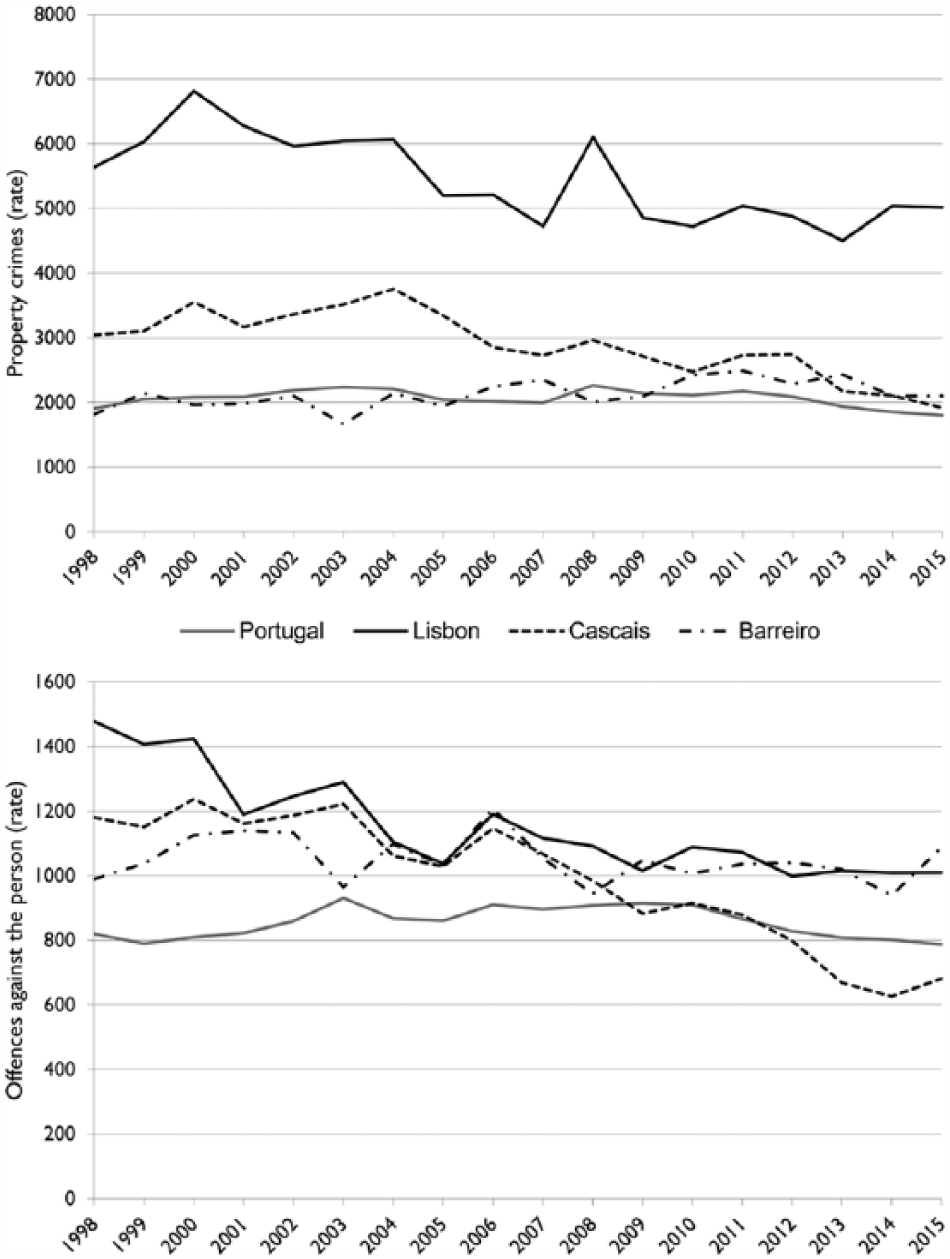
Reported property crimes and offenses against the person for every 100,000 inhabitants in Portugal and in Lisbon, Cascais, and Barreiro.
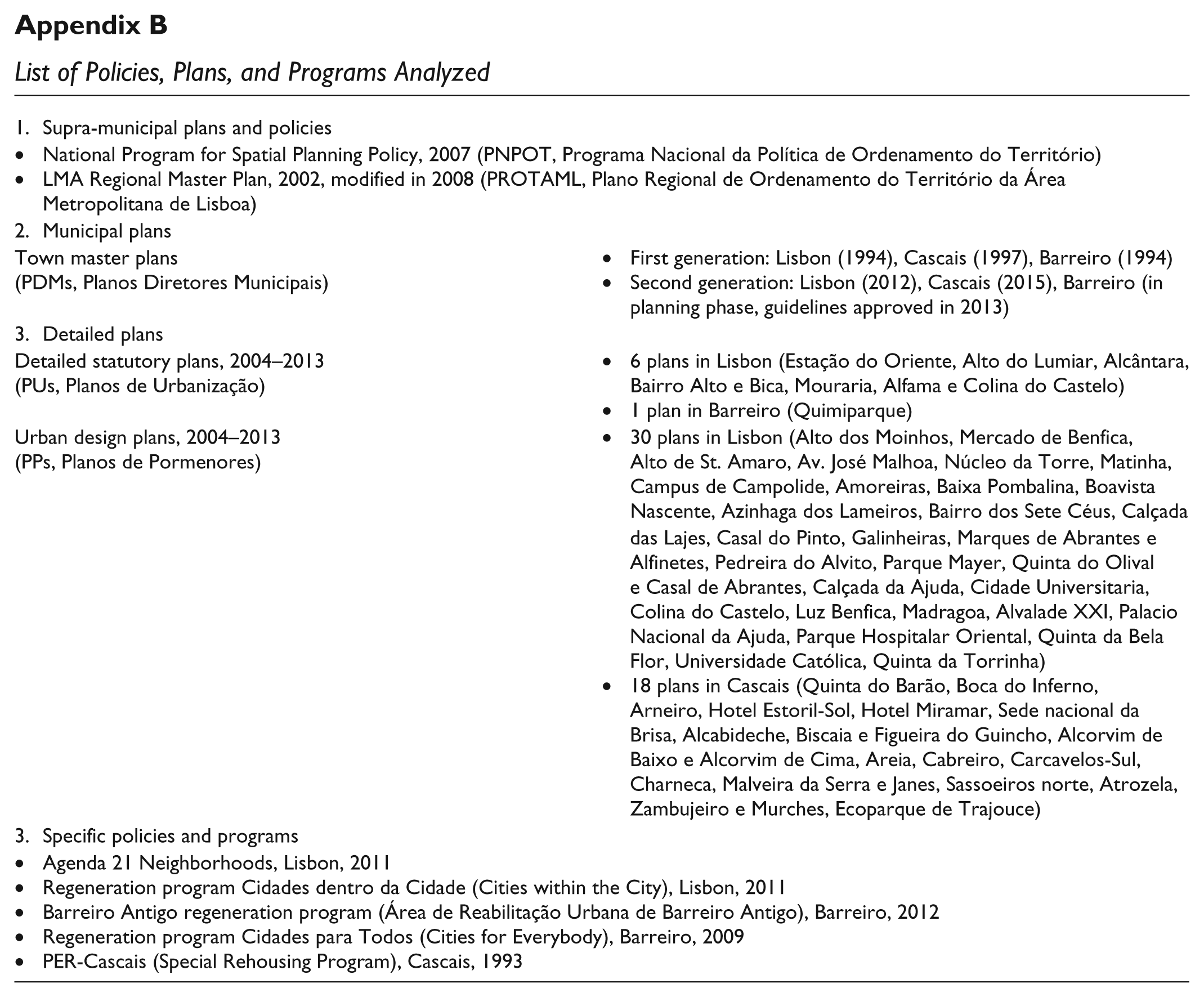
The collection of empirical data was carried out in three steps. 8 First, all formal plans (town master plans and detailed plans) launched during a ten-year period (2004–2013) were analyzed through the screening of primary sources (planning documents and reports, institutional websites, records of meetings of municipal boards and assemblies). Also, the main supramunicipal policies were analyzed to enable understanding of vertical relations between municipal, regional, and national planning policy. Second, a set of interviews with planners in charge of key areas was carried out (see Appendix A for the list and the reference codes used in the text). 9 In addition to debating their opinions in relation to security and safety, the planners were asked to point out further planning instruments that they consider relevant to urban security. Third, a new set of planning instruments was analyzed among small-scale instruments designed for specific objectives, which explicitly address issues of security and/or were suggested by planners (see Appendix B for the complete list of instruments analyzed).
The temporal frame was not respected in two cases. First, town master plans designed during the 1990s were screened in order to gain an understanding of the temporal evolution of urban planning. Second, within the policies highlighted by planners, a rehousing program carried out during the 1990s in Cascais under a national funding scheme (PER, Programa Especial de Realojamento) was found: Although at that time concerns about urban security did not form part of planning practice explicitly, the participatory process implemented has managed to prevent the conflictual patterns found in most developments constructed under the same national program, for example, Quinta da Mina in Barreiro (see the Specific Instruments section).
With regard to the analytical strategy, the findings are presented in the next section (municipal and supra-municipal planning; detailed planning; specific instruments), before being critically analyzed according to the exploratory framework (cf. previous section).
Urban Security and Planning Practice in Lisbon, Cascais, and Barreiro
Municipal and Supra-Municipal Planning
The National Program for Spatial Planning Policy and the LMA Regional Master Plan address urban security within a socioterritorial cohesion strategy. The themes mentioned are participatory planning, integrated interventions for contrasting poverty and social exclusion, socioinstitutional partnerships, sport facilities, and proximity security programs (National Program); urban regeneration, valorization of human capital, and territorial equity policies (LMA Master Plan).
The analysis of two generations of town master plans shows the appearance of urban security as a concern in urban planning. Urban security is absent in the 1990s plans—the so-called first generation of Portuguese comprehensive plans—which belong to a land-use management paradigm and focus on the regulation of urban growth. The plans designed in the early 2010s in Lisbon and Cascais belong to a mixed regulatory-strategic approach. The creation of “secure” urban spaces is an explicit objective, with specific references to (problems of) council housing districts (Lisbon), feelings of safety/unsafety (Lisbon), and public transport hubs (Cascais). Urban security is absent in earlier documents of the plan being elaborated in Barreiro, which will have a stronger emphasis on land-use regulation (B1).
Detailed Planning
There are two categories of detailed plans in the Portuguese spatial planning system: detailed statutory land-use plans (Planos de Urbanização, PUs) and nonbinding urban design plans (Planos de Pormenores, PPs). Fifty-five plans, in force or in the making, have been analyzed. Where final documents were not yet available, the guidelines (Termos de Referência) approved by municipal boards have been screened.
No reference to urban security was found in the PUs analyzed—six in Lisbon, one in Barreiro. In contrast, urban security is a common concern in the PPs analyzed—it is tackled in ten of thirty plans in Lisbon and thirteen of eighteen in Cascais.
In PPs in Lisbon, the most common reference (found in seven plans) is to adequate lighting and urban design as means of enhancing the safety of public spaces. The plan for the historic Baixa district (urban regeneration) mentions security in relation to different hours of the day: long-term abandonment of dwellings and sparse use of public spaces at night produce some feelings of unsafety. The plan for the regeneration of the university campus also envisages new retail facilities as a way to provide security through “eyes on the street.” In two plans elaborated in the same period (Parque Mayer; Marques de Abrantes e Alfinetes), a similar section of the socioeconomic analysis is devoted to urban security in public spaces (DMPU-CML 2010, 30–33; DCIP-CML 2011, 53–54). Both texts provide generic arguments about causes of feelings of unsafety, analyses of crime trends in Lisbon, and data from an outdated survey about feelings of safety. 10 In both cases, the strategic and project sections do not address security issues emphasized in the analyses. When asked about this, the planner responsible (L2) suggested that the envisaged urban regeneration would be the way to revitalize the areas, bringing about natural security.
In Cascais, generic references to the triad of comfort, image, and security of public spaces were found in eight plans designed in abidance with the plan for the Sintra-Cascais nature park. Generic references to urban security are also found in plans for Boca do Inferno (public space refurbishment) and Carcavelos-Sul (urban restructuring). In the latter case, the chief planner (C2) reported that officers and local politicians had debated the idea of fencing a planned park. The planner, who believes that creating lively public spaces is a way to achieve appropriation of space by residents, and hence natural prevention of deviant behaviors, successfully insisted on leaving the park open. The Sassoeiros Norte (tertiary development) plan refers to the presence of some feelings of unsafety, caused by robberies and vandalism, as a risk for tourism. The planner (C2) considers a further plan for commercial development (Arneiro) an example of the need to consider security issues stemming from the expectable fluxes of users. As a matter of fact, the strategic section emphasizes the need for policing of, and gives design recommendations for, public spaces, green areas, and pedestrian paths.
Specific Instruments
This section analyzes five planning instruments: Lisbon’s Agenda 21, three urban regeneration programs in Lisbon and Barreiro, and a rehousing program in Cascais.
The action plans of four of Lisbon’s five Agenda 21 Neighborhoods 11 —three council housing districts (PER da Ameixoeira, Quinta do Charquinho, Padre Cruz) and a middle-class residential district (Telheiras)—emphasize the existence of feelings of unsafety caused by “frequent” robberies and dilapidated public spaces and dwellings. However, crime statistics were not analyzed, and victimization surveys or safety audits were not carried out. The action plans of two neighborhoods, Bairro do Charquinho and Telheiras, envisage community patrols by residents.
Three regeneration programs (Table 1)—one in Lisbon in an advanced stage, two in preliminary phases in Barreiro, and none in Cascais where urban regeneration has been promoted through PPs only—were mentioned by planners in relation to their role in social prevention of security issues.
Main Features of Urban Regeneration Programs Analyzed.

The first program targets Mouraria, in Lisbon, a historic district heavily stigmatized for its historical characterization as a place of residence for immigrant communities (see Tulumello 2016, for a detailed analysis). The chief planner considers the program an emblematic one: “[It] is very relevant for urban security. . . . This area was strongly affected by prostitution and drug dealing. It was the only one of the historic districts not to be frequented by Lisboners, because of its marginal activities. . . . Perceptions have radically changed . . . and this was achieved with the participation of local agents and social development plans rather than through security measures” (L1). Ferro (2012) emphasizes how local populations have felt active agents of the regeneration process, and perceptions of safety have been improved, especially among the elderly. The second program targets the main historic district of Barreiro, which has experienced long-term decay and demographic contraction. In the program, urban security is addressed in relation to urban image and identity (DPGU-CMB 2011, 12). The chief planner (B2) added that (in)security, and perceptions of unsafety, act as a restraint to real estate development. The third program targets Quinta da Mina, a housing development bought by the municipality of Barreiro during the 1990s to rehouse around 100 households previously living in slums. The program’s bid highlights the poverty and socioeconomic exclusion experienced by rehoused families, and makes reference to some conflicts caused by the coexistence of different ethnic groups, mainly Gypsies and populations from former Portuguese colonies 12 —as planners confirmed (B1, B2).
Finally, the Programa Especial de Realojamento (PER, Special Rehousing Program), launched in the early 1990s, has almost entirely eradicated slums in the metropolitan areas of Lisbon and Porto, but has been criticized for top–down processes and the construction of modernist-like peripheral outskirts (Cachado 2013). The case of Cascais has been an exception, with the implementation of a “participated and sustained” process of socioterritorial development (Freitas 2002, 23). According to the public officer that led the working unit (C3), the program was a success because of the engagement with both the communities being rehoused and the residents of neighborhoods where the new dwellings were placed and the design of medium-density settlements made up of low-rise dwellings. For example, the officer mentioned the rehousing of the community from the Bairro das Marianas, which was an illegal settlement inhabited by populations from former Portuguese colonies in Africa and deeply stigmatized. In preliminary meetings, the “hosting” communities protested. The officer (C3) recalled the paradoxical case of a mixed-race man complaining, “we do not want pretos [disparaging term for colored people] here!” Thanks to months of mediation by the unit, concerns over ethnic conflict dissolved once the rehousing process was completed and the civil servants recalled how long-term residents of the area were “surprised” by the absence of criminals (C3).
Critical Analysis
This section, complemented by insights from the interviews with planners, debates the findings with the lenses of the exploratory framework set out, around the relations of urban security with planning paradigms and the realm of politics.
With regard to the relations between urban security and paradigms of urban planning, the article has compared three municipalities with significantly different planning cultures. In the continuum from a prevalence of land-use management toward integrated spatial planning, Barreiro, Cascais, and Lisbon represent, in this order, a gradual shift from the former toward the latter. The findings suggest that urban security is fully embedded in planning cultures oriented toward a strategic integrated paradigm (Lisbon and Cascais), whereas it is marginally present in planning cultures oriented toward regulation—in Barreiro, “urban security as a component of town planning is something we have not considered so far” (B1). Beyond the municipal comparison, this is confirmed by the shift between the 1990s and 2010s generations of town master plans and the absence of urban security in land-use regulation instruments: PUs (detailed statutory land-use plans) and statutory parts of master plans.
The evolution toward integrated strategic approaches to planning has been bringing about an increasing centrality of small-scale, problem-oriented instruments over instruments at the municipal and supra-municipal level. Against this background, and looking at the multiscalar organization of planning instruments, in the cities studied, urban security is
a general aim—often a “generic” one (C2)—in strategic guidelines of municipal and supra-municipal plans;
a background theme underpinning detailed planning—“we ‘season’ with security [incluímos o tempero segurança] the planning process” (C2);
a driver of recommendations in urban design, especially in public spaces (section Detailed planning);
a specific objective of urban regeneration policies (Specific Instruments section).
To sum up, the findings suggest that urban security tends to become more meaningfully embedded in urban planning on a smaller scale, and especially in urban regeneration policies, which planners consider the domain where planning can actually make a difference for security and safety feelings (L1, L2, C2, B1, B2) – and the regeneration of Mouraria district is among the most successful initiatives (Specific Instruments section).
However, urban security may also be invoked in discursive struggles on a smaller scale, as in the case of two detailed plans in Lisbon, where security is debated in the socioeconomic analysis and neglected by strategic and operative sections. In relation to this, the responsible planner (L2) stated that socioeconomic analyses are often “academic” sections, which may not influence the strategies and design of plans. This confirms that the actual capacity of planning to engage with urban security depends not only on the scale of action, but on the very way security is understood. According to the critical understanding set out, urban security should be considered in strict relation to the realm of politics. But this is not always the case in real practice, as some quotes from the interviews emphasize.
Although we do not explicitly tackle issues of urban security, . . . we are aware that when some urban conditions are guaranteed, security is guaranteed as well. . . . If we achieve a cosmopolitan city and a compact urban fabric, a vibrant city with a multiplicity of uses and activities, . . . we are creating natural conditions for security, without any need for, say, behavioral regulations (L2). Urban security is guaranteed on the grounds of the traditional city. . . . Luckily enough, modernist planning was not successful in Cascais. . . . The urban fabric of Cascais is the traditional one, where people walk in the streets, streets are peppered with stores; stores lighten sidewalks, hence security is guaranteed naturally (C1). Our goal is to not talk of security, security, security, security. . . . This is half the way to generating insecurity. . . . We introduce mechanisms and technical solutions that will increase security, so there is no need to talk about it (C2).
These planners believe that urban security is a goal for technical solutions, emphasizing the role of urban fabric, and of regulations for achieving a desirable one, for (perceptions of) security (see also Detailed Planning section). It is not surprising that planners believe that a neutral implementation of their specific expertise would bring about wider beneficial effects; compare Jasanoff (2003) on the role of experts in policy making. However, the tendency toward a blind faith in the power of good urban design reflects the depoliticization of approaches to urban security and the neglect to acknowledge its paradoxical dimensions – for instance, the planners interviewed in Cascais (C1, C2) believe that crime is growing and will keep growing in the near future, despite actual trends in Cascais and Portugal (cf. Setting the Frame section).
Against this background, we shall now question the relations between political approaches to urban planning and crime prevention paradigms in the three municipalities. In Barreiro, the prevalence of left-wing politics is mirrored by a planning discourse more oriented toward socioterritorial cohesion and social prevention of crime—at least in strategic orientations of urban regeneration programs (Specific Instruments section). In contrast, Cascais is characterized by a dominance of center-right politics and economic growth approaches to urban planning. This is mirrored by the centrality of situational prevention theories in the way planning instruments and planners approach urban security—as evident in several references to environmental prevention in detailed plans and specific references of planners to New Urbanism plus zero tolerance (C1) and broken window theories 13 (C2). Lisbon, coherently with its political tradition, falls between Barreiro and Cascais, with a mix of different paradigms and approaches.
The findings on the municipal scale therefore give some hints of a possible correlation between approaches to urban security and positions on the political spectrum. However, further considerations regarding some processes in Lisbon and Cascais depict a more complex frame. On the one hand, we have shown two programs capable of effectively doing away with spaces of conflict, rhetoric on degradation and crime, and feelings of unsafety (Specific Instruments section). This is the case for Mouraria in Lisbon, characterized by sociocultural development grounded in effective engagement with strong, local grassroots (see also Tulumello 2016). In the case of the PER in Cascais, the construction of relationships of mutual trust between actors was crucial; it may not be surprising, on the light of the previous discussion, that during the 1990s the municipality was governed by a center-left government. It is also worth stressing that the rehousing program, designed with an integrated approach, was led by the department of social intervention rather than that of planning.
On the other hand, in the case of Agenda 21 Neighborhoods in Lisbon, generic demands for safety (i.e., not grounded on evidence of a danger of violence) led to a problematic practice such as voluntary neighborhood patrols replicated without specific adaptations to very different contexts (Specific Instruments section). Falanga (2013, 209) highlights how limited time allocated to the participatory processes, and flaws within these, resulted in the limited involvement of local populations. This tells us of the risks stemming from superficial approaches to participation in critical issues such as urban security.
Finally, although this article has focused on the municipal scale, the findings enable a preliminary debate about the horizontal distribution of planning and urban security practices on a small scale, which may be debated in relation to insights of studies on the “geographies of fear” (cf. Koskela and Pain 2003; Pain 2010; Tulumello 2015b). Urban security practices, that is, the geography of policy priorities stemming from experts’ and politicians’ perceptions and will, clash with the actual geography of crime and the geography of fears, that is, generic public/media perceptions and specific perceptions of citizens living in a given area. In this respect, we can look back at the case of Chelas, an affordable-housing district in Lisbon. Chelas is among the critical spots for urban security in Lisbon: Planners interviewed stated so (L1, L2) and issues of security were debated during the elaboration of two detailed plans (L2), PP Parque Hospitalar Oriental (new hospital plan) and PP Marques de Abrantes e Alfinetes (housing development). This is coherent with the stigmatization of Chelas in media and public discourses: “Chelas is feared because the discourse about the district confuses dangerousness with ‘marginality’: socioeconomic deprivation, a presence of visible illegal activities (in the past and in some places), images of poverty and of a place where criminals inhabit” (Tulumello 2015a, 490). However, when compared to municipal averages, Chelas shows relatively low levels of violent crimes (ibid., 483) and its citizens do not feel Chelas is an especially dangerous place (ibid., 486). This suggests that a depoliticization of planning approaches to urban security (cf. above) may bring about a distribution of practices influenced by rhetorical discourses.
Concluding Remarks, Recommendations, and Ways Forward
This article has sought to explore how the institutional practice of urban planning engages with urban security. A critical theoretical framework made the case for an understanding of urban security as a concept with political and contested dimensions, owing to its threefold essence as an individual right, a policy goal, and a social demand. A debate about implications for urban planning set the ground for an exploratory framework aimed at problematizing relations between the paradoxes of urban security and the practice of urban planning. Building on the findings from the Lisbon Metropolitan Area, four arguments were debated. First, urban security becomes embedded in planning practice when planning cultures shift toward strategic integrated paradigms. Second, urban security tends to be relevant to planning policy on a small scale, assuming a discursive role on larger scales. Third, political cultures, influencing the dominance of paradigms of crime prevention, are linked to the way urban planning engages with urban security. Fourth, the neglect to critically engage with the geographies of fear may bring about a distribution of urban security practices that is grounded on generic social demands and rhetorical discourses.
Altogether, these arguments confirm that security and its paradoxes are capable of shaping certain dimensions of urban planning. At the same time, they suggest that a critical approach to urban security can set the grounds for urban planning to effectively engage with security/insecurity issues. This is because the nuanced understandings made possible by localized, in-depth studies are capable of deconstructing relations between, and paradoxes of, global discourses about security and local power relations.
Four recommendations for a critical approach to urban security in urban planning stem from the debated arguments. First, there is a need to overcome sectorial approaches to, and systematically include urban planning among the instruments for, urban security. Second, it is on a small scale, and through a multilevel integration of actions and instruments, that security paradoxes can be more effectively dealt with. Third, urban planning can contribute to crime prevention and increasing feelings of safety when it is capable of engaging with structural issues at the roots of local social problems and potentials for conflict, that is, when it promotes spatially just and cohesive cities more generally. Fourth, the geography of urban security practices needs to be carefully assessed in relation to the geography of crime and the geographies of urban fear.
Further studies should complement the exploratory approach of this article with the aim of making planning practice and research more effective in this regard. The relations between the geography of urban security practices and the geographies of urban fear should be explored systematically, looking at the variegated, eventually uneven, spatialization of planning policy in relation to security/insecurity patterns (crime rates, perceptions of safety) in municipal/metropolitan territories. In addition to this, research should go beyond an institutional understanding of urban planning, exploring relations between planning policy, bottom-up and grassroots action, and security/safety patterns through in-depth, small-scale, critical explorations of planning practices.
Footnotes
Appendix
List of Policies, Plans, and Programs Analyzed
| 1. Supra-municipal plans and policies | |
| ●National Program for Spatial Planning Policy, 2007 (PNPOT, Programa Nacional da Política de Ordenamento do Território) ●LMA Regional Master Plan, 2002, modified in 2008 (PROTAML, Plano Regional de Ordenamento do Território da Área Metropolitana de Lisboa) |
|
| 2. Municipal plans | |
| Town master plans (PDMs, Planos Diretores Municipais) |
●First generation: Lisbon (1994), Cascais (1997), Barreiro (1994) ●Second generation: Lisbon (2012), Cascais (2015), Barreiro (in planning phase, guidelines approved in 2013) |
| 3. Detailed plans | |
| Detailed statutory plans, 2004–2013 (PUs, Planos de Urbanização) |
●6 plans in Lisbon (Estação do Oriente, Alto do Lumiar, Alcântara, Bairro Alto e Bica, Mouraria, Alfama e Colina do Castelo) ●1 plan in Barreiro (Quimiparque) |
| Urban design plans, 2004–2013 (PPs, Planos de Pormenores) |
●30 plans in Lisbon (Alto dos Moinhos, Mercado de Benfica, Alto de St. Amaro, Av. José Malhoa, Núcleo da Torre, Matinha, Campus de Campolide, Amoreiras, Baixa Pombalina, Boavista Nascente, Azinhaga dos Lameiros, Bairro dos Sete Céus, Calçada das Lajes, Casal do Pinto, Galinheiras, Marques de Abrantes e Alfinetes, Pedreira do Alvito, Parque Mayer, Quinta do Olival e Casal de Abrantes, Calçada da Ajuda, Cidade Universitaria, Colina do Castelo, Luz Benfica, Madragoa, Alvalade XXI, Palacio Nacional da Ajuda, Parque Hospitalar Oriental, Quinta da Bela Flor, Universidade Católica, Quinta da Torrinha) ●18 plans in Cascais (Quinta do Barão, Boca do Inferno, Arneiro, Hotel Estoril-Sol, Hotel Miramar, Sede nacional da Brisa, Alcabideche, Biscaia e Figueira do Guincho, Alcorvim de Baixo e Alcorvim de Cima, Areia, Cabreiro, Carcavelos-Sul, Charneca, Malveira da Serra e Janes, Sassoeiros norte, Atrozela, Zambujeiro e Murches, Ecoparque de Trajouce) |
| 3. Specific policies and programs | |
| ●Agenda 21 Neighborhoods, Lisbon, 2011 ●Regeneration program Cidades dentro da Cidade (Cities within the City), Lisbon, 2011 ●Barreiro Antigo regeneration program (Área de Reabilitação Urbana de Barreiro Antigo), Barreiro, 2012 ●Regeneration program Cidades para Todos (Cities for Everybody), Barreiro, 2009 ●PER-Cascais (Special Rehousing Program), Cascais, 1993 |
|
Acknowledgements
This article stems from the postdoctoral project “Which ‘Secure Cities’? A Critical Approach to Security and Feelings of Fear in Urban Planning in Southern Europe.” A preliminary version has been presented at the 2014 AESOP Congress, Utrecht. I wish to thank the editors, three anonymous reviewers, as well as Ana Evans, João Mourato, Roberto Falanga, and the other colleagues at the research group Environment, Territory, Society of my institute, for tough critique and constructive commentaries.
Declaration of Conflicting Interests
The author(s) declared no potential conflicts of interest with respect to the research, authorship, and/or publication of this article.
Funding
The author(s) disclosed receipt of the following financial support for the research, authorship, and/or publication of this article: Funded by Fundação para a Ciência e Tecnologia, grants SFRH/BPD/86394/2012 and UID/SOC/50013/2013.