



Abstract
Global climate change increases the necessity for mid-latitude cities to tackle urban heat. Climate change adaptation plans are common policy mechanisms to approach the issue. This paper studies the city climate development plan (StEP Klima) of Berlin, Germany, by using Constellation Analysis. We analyzed to what extent StEP Klima might trigger planning and governance processes for the implementation of heat stress measures. Berlin’s plan brought attention to the local risks of urban heat and possible strategies. To translate its aims into decision makers’ everyday governance and planning practice, institutionalized guidance and an activation of policy instruments is needed.
Introduction
Following scientific advice and political statements declaring that the regional and local level is of high priority in adapting to climate change (e.g., Carter et al. 2015; Dannevig, Rauken, and Hovelsrud 2012; Frommer 2009), a huge number of cities have created adaptation plans. The question remains whether these plans indeed trigger actions concerning local adaptation to climate change or if they remain tokenism.
Several scholars have assessed local adaptation plans and strategies (e.g., Reckien et al. 2014; Baker et al. 2012; Lehmann et al. 2015). Reckien et al.’s (2014) survey highlights the distribution of climate change mitigation and adaptation plans across European cities. It includes a broad analysis of adaptation plans, but does not capture the complexity of the policy processes involved in various cities’ adaptation to climate change (Baker et al. 2012). The authors call for studies that “investigate potential drivers and barriers of plan development as well as of the implementation of planned actions” (Reckien et al. 2014, 339). Baker et al. (2012) developed an evaluation framework to assess seven local climate change adaptation plans in Southeast Queensland, Australia. The study provides an insight into structural, procedural, and contextual factors that pose limits to a comprehensive adaptation process. However, it does not pay much attention to the interplay of factors inhibiting the implementation of a plan’s goals. Lehmann et al. (2015) compare four cities in developing and developed countries concerning barriers and opportunities for effective climate change adaptation planning. They focus exclusively on the preparation and adoption of adaptation strategies and action plans and identify a similar set of barriers in developing and developed countries. The authors stress the importance of the institutional context, participation, and multilevel governance to mainstream adaptation.
Only recently has the scientific community given more attention to the way planners and policy makers perceive and deal with the particular climate change adaptation issue of urban heat (Runhaar et al. 2012; Mees, Driessen, and Runhaar 2015; Carter et al. 2015; Kleerekoper, van Esch, and Salcedo 2012). Wilby (2007) identified urban heat as a risk factor aggravated by the global greenhouse effect due to an intensification of urban heat islands (Oke 1982) and a higher frequency of extreme weather events such as heat waves. Heat stress has been associated with a significantly lower human well-being, as well as higher mortality and morbidity rates (e.g., Kravchenko et al. 2013; Scherber, Endlicher, and Langner 2013; Harlan et al. 2014). In causing tremendous numbers of excess deaths, heat waves have had the strongest impact of all natural disasters on human health in Europe between 1998 and 2009 (EEA 2010). In particular, the 2003 heat wave with approximately seventy thousand fatalities throughout Europe (Robine et al. 2008) proved the high health risks for populations who do not commonly experience extreme temperatures.
Knowledge about policy instruments guiding urban development in tackling heat health risks is still scarce. Stone, Vargo, and Habeeb (2012) reviewed fifty municipal- and state-level action plans in the United States regarding their emission control and heat management strategies. They found that the plans lack heat management strategies, which potentially puts human health and welfare in the covered areas at risk. The study of Donner, Müller, and Köppel (2015) examines the importance German climate change plans assign to heat-related risk factors and prevention measures. While many German cities adopted climate change adaptation plans, the reduction of urban heat risks still receives insufficient attention. Berlin has been one of the forerunners and addressed most, but not all, relevant heat-related indicators (e.g., albedo enhancement, green roofs/façade, or unsealing).
Thus, current research has reviewed outputs of adaptation plans regarding preferred heat stress measures. An in-depth analysis of the adaptation plans’ performance and outcome concerning the implementation of proposed measures is missing. We investigate how a local climate change adaptation plan can lead urban development governance and planning toward the implementation of heat stress measures.
The Berlin city climate development plan (StEP Klima) fulfilled a pioneering role in Germany for urban climate change adaptation planning. It was acclaimed for its methodological approach, which should serve as an example for other cities (SenStadtUm 2010). The aim is to systematically integrate the StEP Klima’s goals into administrative processes (BBSR 2015). Studying the Berlin city climate development plan, we identify challenges to use climate change adaptation plans as a guiding policy instrument for the implementation of heat stress measures.
Method
Study Site
Berlin is the largest city and capital of Germany. It covers an area of 892 km2 with, as of 2014, about 3.46 million inhabitants (Statistical Office for Berlin-Brandenburg 2014) and is expected to grow substantially in the next decade (SenStadtUm 2016). Berlin infamously suffers from a precarious economic situation (INSM 2012). The city has two tiers of public administration; the Senate and its Departments set the general policy guidelines for the entire city and execute tasks of citywide importance. All other tasks, including local land-use planning, are to be taken over by the 12 districts (Musil and Kirchner 2012).
Berlin’s humid continental midlatitude climate is characterized by warm to hot summers and cold winters (Peel, Finlayson, and McMahon 2007). Daily mean temperatures of 19.0°C have been observed for the two warmest months in summer during 2000 to 2010 (Dugord et al. 2014). Climate change projections for the city of Berlin imply a rise in temperatures of 2.5°C degrees by 2050 with more hot days and tropical nights as well as more extreme weather events (Lotze-Campen et al. 2009).
Gabriel and Endlicher (2011) showed a positive correlation between heat and mortality in Berlin, particularly for the most densely built-up districts during the two main heat waves within their study period. Scherber (2014) identified spatial clusters with elevated relative risks of summer mortality and morbidity, especially for respiratory system diseases, in the northwestern and southeastern parts of Berlin’s city center. In their statistical study for the city, Scherer et al. (2013) estimate an average heat stress–related death rate of about one thousand six hundred people per year (app. 5 percent of all annual deaths).
Research Approach: Constellation Analysis
To support interdisciplinary research, the Center for Technology and Society at the Berlin Institute of Technology (TU Berlin) developed the Constellation Analysis (CA) approach. Inter- and transdisciplinary research often faces the challenge of balancing different disciplines with specific methods and theories, while at the same time ensuring a comprehensive problem orientation. CA is a tool to facilitate mutual understanding of complex societal problems focusing on questions regarding technology, sustainability, and innovation.
Societal processes are characterized by heterogeneous influence factors, which CA intends to consider equivalently. The various factors relate to each other and form constellations. A graphical illustration and an explanatory description of the identified network of factors provide a multiperspective appraisal of the problem at hand (Schön et al. 2007). Visualization and explanation support each other and remedy the deficits of the other medium of presentation, allowing different disciplines to relate to the analysis (ibid.).
Various interdisciplinary research projects have successfully applied this approach to explore and analyze complex research objects, to structure discourses, and to develop strategies and new projects (Bruns et al. 2011; Mohajeri and Dierich 2009).
Application of the CA for the Given Research Objective
From February 2014 to May 2015, twelve semistructured, problem-centered expert interviews (cf. Meuser and Nagel 1991) were conducted with Berlin administrative officials. The interviewed officials were either involved in the creation of the city climate development plan or apply the instrument in their daily work routine. Moreover, we examined gray literature and policy and planning documents on the city climate development plan. The empirical material was analyzed using Content Analysis (Mayring and Fenzl 2014).
For the subsequent CA, all main influences on the studied subject, derived from the empirical material, are categorized into four equal element groups:
Actors: Individuals and groups of actors (e.g., human beings, organizations, social movements)
Natural elements: Materials, resources, plants and animals, the landscape, or a natural phenomenon
Technical elements: Strategies and measures
Symbolic elements: Policies, institutional, legal, or economic factors (Ohlhorst and Schön 2015; Ohlhorst and Kröger 2015; Schön et al. 2007).
Furthermore, CA displays the interplay of the elements, classifying relations according to their frequency and state of occurrence within the analyzed empirical material. Relations between the elements can be simple, directed, conflicting, oppositional, or simply missing (Ohlhorst and Kröger 2015). Conflicting relations occur between elements that intentionally act against each other or multiple other elements. If an element resists unintentionally to the expectation or attribution of others, the relation is called “oppositional” (ibid.). Ohlhorst and Schön (2015) point out that the relations between elements can be undetermined or missing. Spatial proximity or distance mapped in the constellation show how close or loose the connections between some elements are. The most important elements are arranged in the center of the constellation. Less central elements for the analytical problem are assembled further away from the core of the CA.
The StEP Klima proposes strategies and actors to implement heat stress measures. The constellation described in the following paragraphs classifies these strategies and actors as CA elements (Figure 1). Furthermore, it shows their relation to the climate change adaptation plan, revealing challenges for the plan in the existing urban development governance and planning system.
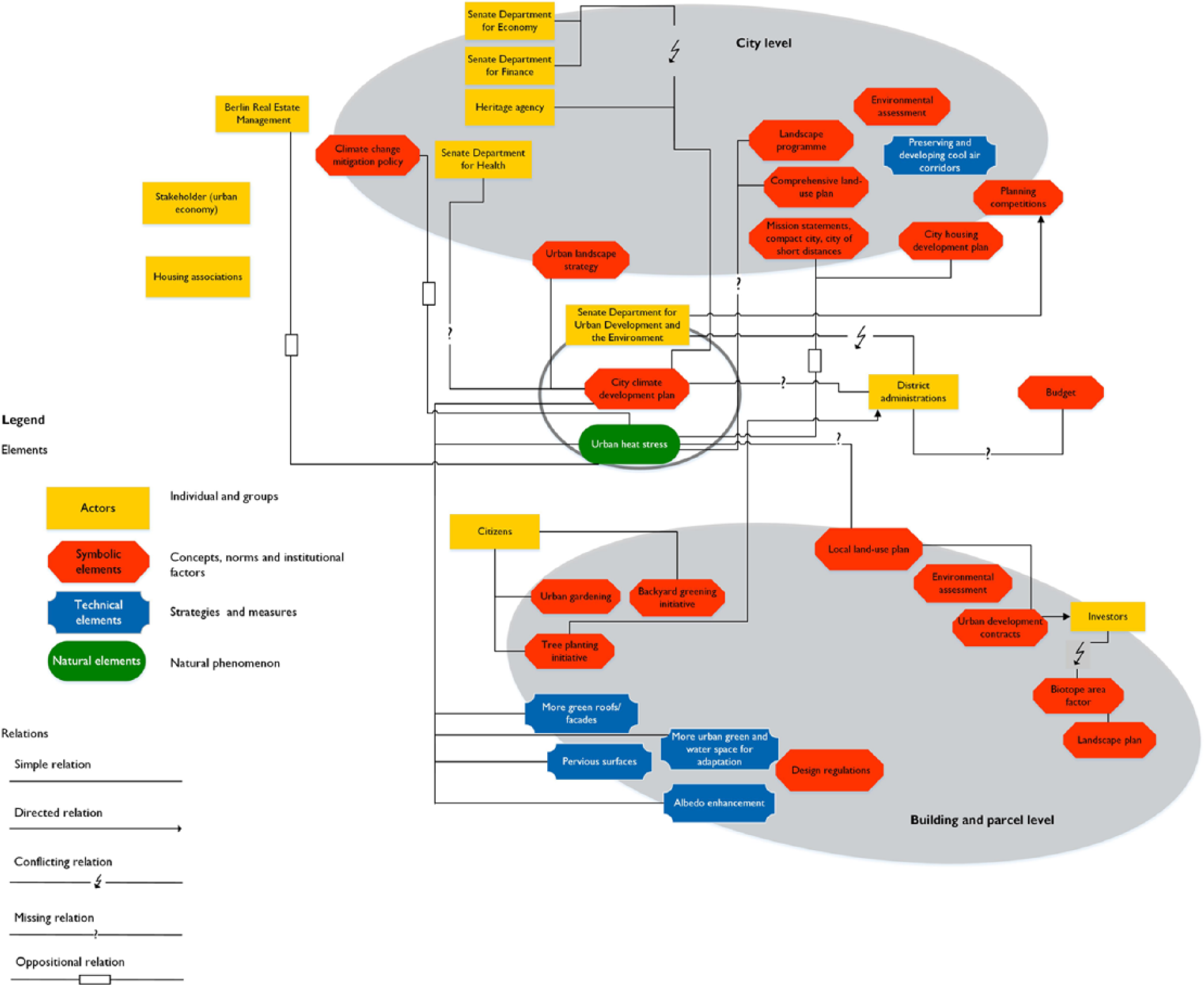
Constellation Analysis: Integration of heat stress measures into urban development planning and governance according to StEP Klima.
The corresponding text explains the diverse components of the CA element groups—natural, technical, symbolic elements, and actors. The discussion of “symbolic elements” refers predominantly to the planning instruments, whereas the paragraph on “actors” focuses on important urban development actors and explicitly relates to governance-oriented strategies. Assuming that all elements have varying potentials to influence the main variable of heat stress, they are not explained in any hierarchical order. Rather, the following paragraphs first of all study the policy mechanisms at the city level, followed by the ones that mainly target the building and parcel level.
Results
Implementing Heat Stress Measures under the Guidance of a Climate Change Adaptation Plan—The Berlin Example
Content and purpose of the city climate development plan
After being adopted by the Senate of Berlin in 2010, the city climate development plan (StEP Klima) was published in May 2011 by the Berlin Senate Department for Urban Development and the Environment (SenStadtUm 2011). The StEP Klima is the first policy instrument that spatially differentiates the climate change adaptation needs for a German city focusing on urban development (SenStadtUm 2011).
StEP Klima contains a “set of weighing-up and control tasks rather than a detailed set of instructions. It outlines prospects rather than making rigid regulations” (SenStadtUm 2011, 8). Nevertheless, to ensure that the informal instrument is considered in every planning process, it was passed in the legal form of an urban development plan.
The plan covers three different aspects:
It provides spatially differentiated analyses of the areas of adverse climatic impacts within the period of 2001 to 2010. Moreover, the areas that are projected to be affected in 2046 to 2055 and prioritized action zones are mapped.
It introduces measures and strategies that aim at improving the urban design to reduce adverse impacts on the local climate. The city’s existing built environment and green and open spaces are the focal points in the four main action fields of “bioclimate,” “green and open spaces,” “water quality and precipitation,” and “climate change mitigation.”
It outlines governance and planning strategies on how to achieve the implementation of proposed measures (SenStadtUm 2010) and presents an action plan that includes model projects to develop a climate-proof city.
Constellation Analysis—Explanatory text
Natural element
The “natural element” of heat is represented in StEP Klima’s analysis of risks and the proposed measures (Aspect A and B of the plan). The constellation element of urban heat stress is depicted primarily by the StEP Klima action field of “bioclimate.” This action field focuses on the strains on human health due to climatic conditions. StEP Klima highlights seniors and those with medical conditions as the most vulnerable, affected severely by a degradation of the urban “bioclimate.” Even though the term “bioclimate” also covers extreme heat events, 1 StEP Klima’s analysis of local heat prioritizes gradually rising temperatures and corresponding risks and measures. To react to extreme heat events, adaptation approaches need to go beyond anticipatory urban development measures. They demand strategies that allow for concurrent reaction to the risk such as the installation of cooling centers or drinking fountains that are not outlined in the plan.
Technical elements
StEP Klima emphasizes the urban structure, in particular the building density, to be an important factor influencing the “bioclimate.” In order to make the city’s building stock more heat resistant, the instrument recommends using trees to provide shading, increasing albedo values of buildings, and greening façade and rooftops. To make use of the cooling potential of green spaces, StEP Klima endorses the effects of planting and preserving trees and creating other neighborhood green and open spaces, unsealing courtyards and other suitable spaces, installing open water bodies, as well as preserving and developing cool air corridors.
As part of the plan, the heat load is modeled in a spatially explicit way for the current and future day- and nighttime situation. Interviewed experts appreciate the modeling approach that identifies areas of high risk for urban heat to lead priorities for action. They nevertheless point out difficulties to apply the risk maps in planning practice because of their low resolution. Current modeling approaches of urban heat load also provide only a risk approximation, as personal heat exposure varies with location, sun exposure, personal characteristics, psychological and physiological factors, and individual time-activity patterns (Chan et al. 2001; Chen and Ng 2012; Middel et al. 2016). Without strong political support for the adaptation to climate change, planners find it difficult to implement measures in a legally incontestable way based on these risk maps.
Moreover, StEP Klima gives a rather implicit qualitative definition for its aim of ensuring a healthy urban climate. It neither contains information on adverse health effects induced by bioclimatic conditions that should be avoided, nor does it include benchmarks or normative goals to achieve a healthy climate.
Symbolic elements
Mission statements for urban development
For the Senate Department for Urban Development and the Environment, the StEP Klima is just one of many, sometimes contradictory, policies it pursues for Berlin’s urban development. The plan proclaims a climate change adaptation in conjunction with Berlin’s long-term guidelines of urban development. Since the 1980s, the city has been following the mission statement of realizing a “city of short distances” and in this context the concept of a “compact city.” The outer city development shall follow the inner one to guarantee short distances and to prevent space consumption in uninhabited areas (SenStadtUm 2011).
With Berlin growing, the need for housing space is a pressing political issue. Berlin documents its housing policy aims, similarly to the policy goals for the adaptation to climate change, in an urban development plan. The different urban development plans need to be acknowledged equally, but according to the interviewees, creating new residential property is a topic that currently overshadows all others in the city administration. However, expanded urban building activities imply impacts on the local climate now and in the future.
Denser urban forms do not necessarily have a negative effect on the urban “bioclimate”; several studies have shown that dense urban forms, especially in hot urban environments, can create local “cool islands” during the day (Oke 1987; Pearlmutter, Bitan, and Berliner 1999; Ali-Toudert and Mayer 2007; Georgescu et al. 2011; Middel et al. 2014). While shading from buildings has a positive impact on thermal comfort at daytime, buildings store heat during the day and slowly release it at night (Ali-Toudert and Mayer 2007; Chen et al. 2012). Even though general evaluations of heat risks of dense urban forms cannot reflect the complexity of heat generation, a single assessment of the impact of every new building or the evaluation of suitable heat risk measures for new buildings does not seem feasible in daily planning practice. Interviewees confirmed that combining new housing and climate change adaptation for a long-term sustainable city has not yet been pursued explicitly in urban planning and politics.
The aims of StEP Klima were further defined and politically backed in another conceptual framework—the Urban Landscape Strategy—expressing a focus on greening measures to tackle high temperatures. However, with the political focus on the provision of new housing, the preservation of green and open space is often compromised for new building projects.
To sum it up, mission statements for urban development sometimes complement, but also at times compete with, the agenda and objectives of climate change adaptation (see Knieling et al. 2012). Interviewed planners feel overwhelmed by many concepts and frameworks that are too vague—one reason why the informal instrument of StEP Klima gets neglected and does not have much influence on urban planning. Currently, the ranking of various development plans undermines climate change adaptation and causes nonintegration rather than mainstreaming into administrative practice.
Planning competitions
The Senate Department of Urban Development and the Environment sets the framework for urban planning competitions for the city of Berlin. Since adopting StEP Klima, all “calls for proposals” also need to take climate change adaptation demands into account (SenStadtUm 2014a).
However, according to interviewees, these directives collide with standards and ideas of competing architects who usually prioritize the architecture rather than hiding it under a green façade or roof. Planning competitions inspire actual building processes, but the realization of heat stress prevention measures included in architectural concepts might be compromised because of budgetary restrictions.
Environmental assessment
Strategic Environmental Assessment (SEA) and Environmental Impact Assessment (EIA) are methods to identify the effects of a program, project, or plan on the environment and humans at an early stage in the planning process.
In a StEP Klima communication workshop, district planners recommended the introduction of an obligatory climate impact assessment for every local land-use plan (SenStadtUm 2012a). Interviewed Berlin planners also stress the difficulties to handle the complexity involved in assessing climatic effects in planning processes. Interviewees state that they do not have the capacity and lack strategies to operationalize measures suggested by StEP Klima on a local planning level. They plead for binding citywide strategies that can be integrated easily into the workflow.
Comprehensive land-use plan and landscape program
In Germany, the formal planning instruments of comprehensive land-use plans and their supplementing landscape programs, which add environmental objectives, regulate citywide urban development.
In Berlin, both documents were amended comprehensively for the last time in 1994 (SenStadtUm 1994a, 1994b). Accordingly, the more recent demands of a growing city and a changing climate have not been integrated thoroughly into the plan but acknowledged only by an additional report. Considering current findings on the interplay of urban development and local climate at the level of the citywide comprehensive land-use plan would set a distinct guideline for all subordinate zoning plans. By including climate change projections into the comprehensive land-use plans, it could fulfill a longer-term planning function, rather than being an instrument displaying urban development in Berlin reactively. Several scholars suggest ways to consider changing urban heat risks adequately in comprehensive land-use plans (Greiving 2009–2010; Othengrafen 2014), for example, by displaying a change in land-use over time.
Urban heat risk prevention needs the integrative perspective of comprehensive land-use plans for informed decision making (Wamsler, Brink, and Rivera 2013). Cooling measures such as air corridors provided by a distinctive positioning of green and open space can only be planned and preserved by taking the setup of the entire city (resp. metropolitan area) into account. The status quo displays no coordination between either the comprehensive land-use plan or the landscape program and the recommendations of StEP Klima. Thus, a translation of the policy objectives of the StEP Klima into a mandatory citywide planning instrument is missing.
Local land-use plan
According to the German Federal Building Code, local land-use plans are key planning instruments that should ensure sustainable urban development and foster climate change mitigation as well as adaptation. The interviewees confirmed the importance of land-use plans to tackle urban heat as measures not only need to be implemented in the existing builtup area but also in new building projects planned to serve the needs of the growing city.
In fact, the StEP Klima encourages using the local land-use plan for climate change adaptation. In terms of reducing heat load, local land-use plans can determine which parts of an estate can be built upon or need to remain unsealed. They can regulate the location of buildings, green and open spaces, as well as open air corridors, and even façade greening and other measures (Birkmann et al. 2012; Kumar and Geneletti 2015; SenStadtUm 2011).
Nevertheless, according to the interviewees neither the informal planning instrument of StEP Klima nor an amendment of the Federal Building Code, which should enforce a climate-friendly development in cities (§ 1 (5) BauGB), have had a profound impact on their planning routines. When issuing a local land-use plan, public and private interests have to be considered and well balanced (§1 (5 &7) BauGB). The interviewed experts at the district level stated that in an economically challenged city such as Berlin (Berlin.de 2015; INSM 2012), serving investors and creating tax income has been an important, politically backed up argument in the land-use planning process that often outweighs climate considerations (SenStadtUm 2014c).
Moreover, planning experts declared that local land-use plans are overloaded with environmental concerns such as biodiversity requirements, a reduction of land consumption, etc., which makes it difficult to prioritize urban climate. Noise prevention is assigned an outstanding role in Berlin planning practice, but respective measures often conflict with those recommended to reduce climatic risks. 2 The temporary nature of high temperatures, unlike ongoing noise exposure, makes it difficult to legally enforce the implementation of heat reduction measures. Guidelines and orientation thresholds are available for noise prevention, which help planning officials to define binding standards in a local land-use plan.
The biotope area factor of the landscape plan
Local landscape plans (concretizing the aforementioned citywide landscape program) can serve the mitigation of heat stress by fixing biotope area factors (BAFs) (e.g., Carter et al. 2015; resp. “green area ratio”: Stone 2012; Othengrafen 2014). BAFs assess the surface area that is covered by biomass and shall create a balance of green spaces and other land-use forms. Yet needs and measures of nature conservation and landscape management in city states, such as Berlin, are defined in citywide landscape programs. Landscape plans are optional for each district; they are therefore only sporadically used in the current planning practice, limiting also the application of BAFs (SenStadtUm 2011). According to the interviewees, StEP Klima could not resolve this issue and they plead for enhancing the BAF’s scope by including climatic considerations as well as integrating it into other planning instruments.
Urban development contracts
Urban development contracts represent a special form of public service contract, binding public authorities and investors. They can assure a climate-adapted layout of properties or a binding land use. The configuration of buildings can be specified by demanding roof or façade greening or a façade design with an increased albedo value (e.g., BMVBS 2013).
In the context of tight budgets for public authorities and limited options to enforce the implementation of measures in local land-use planning, urban development contracts can be instruments to implement heat stress measures. Yet Berlin planning officials can only secure the implementation of measures negotiating with investors if they can offer something in return. For example, authorities allow building more extensively than average, if extra greenery is added to the site. However, even if investors offer to install greening measures, standards recommended by the officials are not always followed (e.g., plant species composition). District-level planning authorities therefore demand Berlin-wide guidelines and training on how to assess and handle the climate impact of certain operations to apply urban development contracts with regard to climate risk reduction (SenStadtUm 2014c).
Design regulations
Design regulations aim at preserving, protecting, and developing the building stock and surrounding area, its specific architecture and other characteristic features, by defining standards for building materials and layout. These instruments could protect existing garden areas, trees, and façade greening or regulate the color of building faces in order to increase albedo values.
To date, design regulations are often used for cultural preservation, sometimes to explicitly prevent the application of climate change mitigation measures such as façade insulation or solar panels. Even though there have been considerations to apply the instrument for climate change adaptation (Frankfurter Rundschau 2015), StEP Klima could not yet stimulate its use for that purpose.
Actors
Coordination of StEP Klima’s aims within the Senate Department in charge
The StEP Klima was set up as a policy instrument by the Senate Department of Urban Development and the Environment (SenStadtUm), one of nine Berlin Senate Departments. As the department is also the main actor to promote the StEP Klima, it takes a prominent position in our constellation. Responsibilities assigned to climate change adaptation lie within the authority of that department. Consequently, the intention of the climate change adaptation plan was to systematically address sector-specific needs of urban development actors. Nevertheless, even within the Senate Department for Urban Development and the Environment, there are difficulties to mainstream climate change adaptation into the work logic of different subunits. In the Heritage Agency, for example, strategies are still missing of how to apply heat-related measures, such as green roofs or façade, to the currently 10 percent of the building stock with heritage conservation requirements (LUGV Brandenburg 2014).
Coordination of StEP Klima aims across different departments
An urban development policy that takes the risks of urban heat stress into account needs to be multidimensional. Nevertheless, aspects that overlap with other Senate departments, for example, the departments concerned with health issues or the local economy, are only marginally involved in the climate change adaptation plan. This creates problems when it comes to the implementation of measures; a necessary prerequisite for further action would be to financially back up the plan by the Department of Finance. To tackle urban heat stress in the long run includes harmonizing actions against increasing temperatures, in a precautionary manner with pro- and reactive strategies for extreme events. The Senate Department for Health pursues some strategies, such as precautionary and self-help information campaigns addressing especially elderly people, health care personnel, as well as employers and employees. As of now, interviewees miss an exchange of health and urban development authorities on the crossover of heat-health and urban development issues, especially with regard to disaster risk reduction.
Local multilevel coordination between the district departments and the Senate Department
The Senate Department for Urban Development and the Environment assigns the responsibility for the implementation of proposed measures of StEP Klima to a range of different actors, among them the twelve Berlin districts. After the plan’s adoption, a workshop addressed the district planners to discuss their role in local climate change adaptation (SenStadtUm 2012a). However, a continuous participatory process has not been established. Lehmann et al. (2015) consider this “a weakness of assigning climate change to a single department that selected relevant fields of action in a top-down approach.” Interviews revealed that a missing involvement in the process of creating the climate change adaptation plan contributes to its general lack of acceptance among decision makers at the district level.
Coordination of StEP Klima’s aims with local stakeholders
To raise awareness for the new urban development plan and to discuss possible measures another workshop was held with local stakeholders from the housing economy, environmental associations, banks, insurances, and water economy in November 2011. One conclusion of the workshop was a need for an ongoing communication and discussion of what climate change adaptation means. However, to date a permanent and institutionalized stakeholder involvement in the climate change adaptation process has not been realized.
As some of the main stakeholders to support the implementation of its heat stress aims, the plan mentions the real estate and housing economy. One important actor in that respect is the Berlin Real Estate Management (BIM), an institution that administers, rents out, and sells the city-owned real estate. With approximately four thousand five hundred estates in its repertoire, a commitment of the BIM to foster the implementation of heat adaptation measures would be highly influential. There are efforts to design the company’s processes in an environmentally friendly and sustainable way, but StEP Klima’s goals still need to be incorporated. As part of a “Climate Change Mitigation Contract” with the City of Berlin, the BIM committed to reducing CO2 emissions as well as to setting up an environmental management system. With regards to reducing waste heat generation, energy efficiency measures and combined heat and power generation are promoted for the administrative buildings under BIM management (BIM 2016). However, BIM, as well as predecessor Real Estate Funds, sells property mainly considering fiscal aspects, not yet taking regulations to promote StEP Klima aims into account (Berlin House of Representatives 2012).
Especially the efforts of the major housing associations, subsidiaries of the federal state of Berlin, reflect if the local government and administration succeed to mainstream climate change adaptation goals. More than 85 percent of the Berlin citizens live in apartments (SenStadtUm 2014b). Urban housing associations, often landlords with a large building stock, are pivotal players for tackling heat stress indoors and outdoors. Measures such as green roofs, façade planting, or a higher albedo value have hardly been applied yet. Housing associations focus on climate change mitigation strategies, for example, energy standards for buildings (e.g., DGNB 2009). Home insulation to improve the energy efficiency of buildings can also increase thermal comfort—especially indoors (Harlan and Ruddell 2011). Housing associations focus on the reduction of greenhouse gas emissions for financial reasons as measures have to be profitable for them. Implementing the heat stress strategies recommended in StEP Klima, such as green roofs or façade, demand long-term financial commitment. They may also lead to potential conflicts with residents concerning rising rents and health concerns such as allergies or insects (SenStadtUm 2014a).
Involvement of citizens to coordinate StEP Klima’s heat prevention aims
Citizens constitute an important element of the CA as they are the objects of protection from heat stress, but the StEP Klima plan also acknowledges their role in realizing its goals. Civic engagement, taking up a few of the StEP Klima greening objectives, is in various ways supported by the authorities. Urban or guerilla gardening as well as tree planting or backyard greening initiatives create new green spaces and mitigate heat stress.
An example for projects that realize ecological aims in the building stock in cooperation with residents is the backyard greening initiative. By providing minimal funding for plants, other material, and consultancy, the program sets incentives for residents to “green” their backyards (SenStadtUm 2012a). The tree planting initiative, a public–private co-funding of street trees, is used to replace dead trees, but young trees cannot provide enough shade for effective heat mitigation. Interviewees demand a better protection of existing green space by the city.
Recent scientific findings suggest that urban green’s effectiveness in reducing heat stress depends heavily on its positioning in the city (see Hagen et al. 2014). This implies that even though private greening initiatives are crucial to achieve the goals set by the government, especially on private plots, they can only be an addition to a publicly planned comprehensive approach to realize a heat-adapted urban design.
Discussion and Conclusion
In Berlin, heat stress mitigation through smart urban design remains pioneer work even in the presence of a climate change adaptation plan. The StEP Klima example showed that Constellation Analysis (CA) can identify challenges of climate planning and governance. The approach of CA provides new insights into the impacts of planning instruments, a field in need for more empirical work (Millard-Ball 2012). CA discloses deficits of the plan itself in dealing with the risk of urban heat as well as the governance and planning system it is embedded in. While the CA shows whether the plan’s regulatory decisions conform with other urban policies, it also sheds light on the plan’s performance by analyzing its potential role in decision situations.
Millard-Ball (2012) sees little evidence that climate change mitigation planning leads to outcomes that would not be realized otherwise. Our CA suggests that this also applies to the Berlin StEP Klima plan. However, the challenges to integrate a climate change adaptation plan into practice are different from the ones faced for mitigation.
In the Berlin case, the climate change adaptation plan constitutes an attempt to gather knowledge on the various impacts a changing climate can have on a city. As impacts and solutions have a local character, raising awareness might not necessarily take place through “media coverage, peer effects, and other channels” like it is the case with climate change mitigation processes (ibid.). The planning instrument of StEP Klima represents an important step to bring attention to relevant local actors and available instruments and spatially defined hot spots of risks. By creating a specific local problem perception of heat risks and coping strategies, the plan is an instrument that influences perceptions and preferences while giving recipients orientation of how to handle the subject (Dupuis and Knoepfel 2011). It addresses relevant actors and possible means by explicitly assigning responsibilities to act.
However, the CA points to the plan’s limitations to have an impact on outcomes and shows that its approach inhibits a mainstreaming of urban heat reduction strategies into urban planning and governance. For instance, StEP Klima and related policies prioritize greening strategies to reduce heat stress. Political discourses claim that Berlin is already a “green city” (SenStadtUm 2012a, 2012b; Kabisch and Haase 2014), which hampers to give local climate issues higher political priority. The Berlin StEP Klima constellation also showed that the main challenges for heat risk policy are similar to the ones faced by planning and governance in dealing with other climate change adaptation problems. Among those barriers are ill-equipped policy and planning instruments, a lack of participation in the plan creation, competing policy agendas, financial and information deficits, and coordination problems within the urban institutional setting (see, e.g., Measham et al. 2011; Lehmann et al. 2015; Runhaar et al. 2012; Baker et al. 2012).
Policy and planning instruments to implement StEP Klima heat stress measures—represented in the CA as symbolic elements—exhibit a gap between their legal potentials and the actual planning practice. Analyzing the various constellation elements illustrated that the goals of the Berlin climate change adaptation plan often conform to other policies on a theoretical level. However, in the weighting process, climatic aspects cannot compete against other environmental and social claims. In the case of Berlin, climate change adaptation considerations are often overpowered by social or economic interests and not framed as part of those interests. Investigating the efforts of various cities to implement climate change mitigation programs, Sharp, Daley, and Lynch (2011, 1) conclude that “while financially strapped cities may adopt climate mitigation programs to advance co-benefits or cost savings, fiscal stress also impedes program implementation.” Similar observations can be made for the Berlin climate change adaptation plan. It can be considered a strategic instrument to position the city in an international climate change adaptation discourse. Financial strains, affecting staff or funding, restrict further promotion of its heat stress reduction aims.
Most prevalent difficulties to improve the performance of StEP Klima are coordination deficits within the urban institutional setting. Results derived from the StEP Klima governance and planning constellation bear similarities to Langeland, Klausen, and Winsvold’s (2013) findings for the city of Bergen, Norway: one challenge of urban climate change adaptation is to coordinate the complex interplay between many different actors and activities and the attached distribution of responsibilities. Our study confirms the requirement of integrated approaches that include multiactor and multilevel governance to tackle this complexity (ibid.). In this respect, the CA shows a need for a more action-driven, normative document: Getting backed with quality goals for urban climate and health could expand the function and performance of the plan by committing all the diverse actors toward common aims.
Actors need to participate in the strategy development right from the beginning to avoid fragmented climate governance (Romero-Lankao 2012) and discuss procedures on how to integrate heat reduction measures into planning projects. A careful translation of climate change adaptation objectives into daily planning practices requires constant communication between urban government levels and different sectoral units. Precise knowledge can thus be gathered on how heat adaptation works on various urban scales (cf. Carter et al. 2015; Adger, Arnell, and Tompkins 2005) and how the formal and informal planning and governance instruments at different levels can be linked. Information gained in different cases and projects in the city needs to be bundled, and consultation made available regarding common citywide standards as well as possible pathways to implementation. This understanding of climate change adaptation transcends the provision of planning documents. It calls for a long-term institutionalized strategy to coordinate activities across all government levels as well as the perennial participation and exchange of local stakeholders. Ultimately, political backup and public support is needed to elevate the StEP Klima from a policy instrument in a rather conceptual and informative stage to a tool that truly changes planning practices and sets incentives for implementation.
Our analysis is an example how to study the performance of a climate change adaptation plan. Further research is needed to assess quantitatively how many climate change adaptation projects the plan triggered and how these projects contribute to reducing urban heat stress. An adaptation plan, especially when it is set up as a flexible planning instrument, needs constant updating and integration of new knowledge. It can only be the very beginning of a process to integrate climate change adaptation into local political and administrative work. Berlin is about to approach the challenges and is currently working on an additional document that will provide more details on how to apply heat measures in urban development and instruments facilitating the implementation. 3
Footnotes
Appendix
Acknowledgements
We are immensely grateful to Prof. Johann Köppel who provided insight and expertise that greatly assisted the research, the anonymous reviewers for comments on an earlier version of this manuscript, and all experts for their willingness to share their knowledge in the interviews.
Declaration of Conflicting Interests
The author(s) declared no potential conflicts of interest with respect to the research, authorship, and/or publication of this article.
Funding
The author(s) disclosed receipt of the following financial support for the research, authorship, and/or publication of this article: The study was part of the Research Unit 1736 “Urban Climate and Heat Stress in Mid-latitude Cities in View of Climate Change” ( ) funded by the German Research Foundation (DFG) (KO 2952/2-1; SCHR 1254/2-1).