




Abstract
Limited research has explored the reasons behind the level of environmental concerns in master plans in China, where serious environmental degradation has caught the world’s attention and the planning regime is significantly different from those based on representative democracy. Analyzing eighty master plans of China’s large municipalities, we find that the education and age of local leaders have a significant effect on environmental concerns in master plans, while their work experience and state mandate do not. We conclude that that well-educated local leaders and a more collaborative planning approach could deal more efficiently with environmental problems in China.
Introduction
Master plans, also called general plans or comprehensive plans, are important documents for the future vision of local jurisdictions (Levy 2003). Environmental concerns typically refer to the awareness of environmental problems and prioritizing policies and actions to tackle these problems. Generally, master plans that address more environmental concerns may improve local collective action in regard to ecosystem protection, climate change, and smart growth (Berke et al. 2013; Norton 2008). The extent of environmental concerns in master plans varies from place to place depending on the degree to which the state mandates attention to environmental issues, as well as the role played by local education level, political will, officials, and planners in the development of the master plans (Brody, Highfield, and Carrasco 2004; Norton 2008).
Though these factors influencing master plans in North America and Australia are well discussed in the planning literature (Berke and Godschalk 2009; Stevens 2013; Tang and Brody 2009; Tang et al. 2011), little research has been conducted in China, where the master planning process is different in terms of nationwide statutory requirements, powerful local leaders, party-state regime, and a planning culture dominated by modernization and physical planning (Abramson 2006; Leaf 2005; Tian and Shen 2011; Zhang 2002). In particular, the effects of local leaders’ attributes on environmental concerns in master plans are not well explored, although some studies have found that local leaders have a prominent role in China’s local public affairs (Li and Zhou 2005; Zhang 2002).
In this article, we report the findings of a study that evaluates environmental concerns in 80 municipal master plans (MMPs) from China, and explores the impacts of local leaders. The research can contribute to a body of knowledge on plan evaluation with the master plans from China, a region not well covered by the existing plan evaluation research. Second, the word count method we use is especially appropriate in a context in which a hierarchical administration and planning system dominates the planning process. Third, we explain factors influencing environmental concerns in Chinese master plans, in particular, the factors from local leaders, which can give a distinctive explanation as to why some MMPs show more environmental concerns than the others. In doing so, we address two research questions: (1) To what extent are environmental concerns expressed in China’s MMPs? (2) What kinds of influence do local leaders impose on the level of environmental concerns expressed in the MMPs?
We begin by drawing on the literature to establish a theoretical framework to explain the presence of environmental concerns in master plans and the influence of local leaders’ personal characteristics on those concerns. Then we describe the methods used to collect and analyze the plan quality and their influential variables. Next we present our findings and discuss the implications of the findings for promoting environmental concerns.
Literature Review
Environmental Concerns in MMPs from China
Environmental concerns generally refer to “the degree to which people are aware of problems regarding the environment and support efforts to solve them and/or indicate a willingness to contribute personally to their solution” (Dunlap and Jones 2002). Master plans are important documents for thinking about a city in an integrated way (Levy 2003). Therefore, it can reflect the environmental concerns of cities—the extent to which these cities express their awareness of environmental problems and their priority in policies and actions to tackle these problems. They are especially important in that the scope of master plans has expanded from land use to addressing social issues, economic needs, and environmental crises (Kaiser and Godschalk 1995). As Berke et al. (2013) recommended, it is time to incorporate environmental thinking into comprehensive plans, but the approach must consider different planning regimes.
Most existing frameworks of plan evaluation, covering broad issues like environmental protection, affordable housing, climate change actions, hazard mitigation, community plans, ecosystem protection, and smart growth, are conducted from plans in the United States, Australia, New Zealand, and Canada (Baker, Sipe, and Gleeson 2006; Berke, Song, and Stevens 2009; Berke et al. 2013; Berke and Godschalk 2009; Brody, Highfield, and Carrasco 2004; Lyles and Stevens 2014; Tang et al. 2011). Plans from these countries, based on the principle of representative democracy, are engaged with elected officials and the general public. Therefore, comprehensive plans in these local contexts can express openly and freely the future viewpoint and trade-off between economic development and environmental protection (Norton 2005; Loh and Norton 2015). Master plans in China, however, are still dominated by a hierarchical system and party-state regime, despite the growing effects from the market and the local public. Under the institutional context, the central government sets down general goals of economic development, social equality, and environmental protection, and local governments cannot openly express disagreement on these goals in their master plans, but can make implicit choices by emphasizing some goals and neglecting others.
The standard procedures of municipal master planning in China include four steps. First, once the locality has the proper permits in hand stating its intention to do master planning, the municipal government can offer the master planning work to a certified planning institute through a contract or a consultancy agreement. Second, the commissioned planning institute will survey, collect data, and interview cadres from different departments and other stakeholders from the public. During the survey process, the municipal mayor organizes the procedure and the municipal Chinese Communist Party (CCP) secretary will attend important discussions and express his or her opinion for the future image of the city to the planners. The institute will finish several preliminary drafts of the master plan based on “scientific” data analysis, discussions with local cadres, and opinions of municipal leaders, while also incorporating national laws, ordinances, and statutory technical guidance. Then planners can display the positive and negative responses to preliminary drafts to local leaders, planning staff, and cadres from other departments. Based on the feedback they receive, planners will then form one single draft of the master plan. In the process of communication and plan adjustment, local leaders play a dominant role in directing the strategy of the final draft. Some planners even complain that during master planning “it is the local leader doing the planning and planners doing some drawing” (Zhang 2002).
The third step is public involvement, hearings, and consultation. The final draft must be open to the general public for their suggestions and opinions. Meanwhile, the municipal government will also consult experts and conduct public hearings. The planners can then adjust the master plan according to the suggestions of the experts and the public. However, the effects of public involvement vary widely across cities because local governments can choose both the form that public involvement takes and the extent to which the opinions of the public and experts are accepted or rejected.
Later the revised version of the MMP of a large municipality (with urban population more than one million) is submitted to the State Council for approval. 1 An expert committee led by the Ministry of Housing and Urban-Rural Development (MHURD), the national department in charge of urban planning, and joined by fourteen other related ministries (e.g., the Committee of Social-economic Reform and Ministry of Environmental Protection) checks whether the MMP complies with the state’s mandated planning goals according to laws, ordinances, policies, and statutory guidance and standards. The approved MMP will then become a statutory plan, regulating urban development for a specified term of ten to twenty years. A final MMP is in fact a negotiated result between the state and local government and reflects preferences of local governments balancing multiple objectives of economic development, environmental protection, and social stability.
Evaluating Environmental Concerns by Word Counting
MMPs in China reflect local preference in a different way than western plans; it is necessary to rethink a plan evaluation method suitable to the distinctive context. Until now, the most common approach to plan evaluation content analysis is by item coding with an established framework of good plans (Berke and Godschalk 2009; Berke et al. 2013; Brody 2003; Brody, Highfield, and Carrasco 2004; Godschalk et al. 1999; Stevens 2013; Tang and Brody 2009). The plan evaluation process of item coding generally includes developing a conceptual framework, constructing a protocol of items, coding items by a single or multiple trained coders, and checking the reliability and validity of results (Berke and Godschalk 2009; Lyles and Stevens 2014; Stevens 2013). Though the item coding approach holds a potential in evaluating plans beyond North America and Europe, Counting Word Frequency (CWF) can be a reliable approach, with three advantages to measure the environmental concerns of MMPs in China.
First, the CWF method, based on a naïve Bayes assumption in content analysis that “a text is represented as vector of word counts or occurrence” (Slapin and Proksch 2008), has been commonly used in content analysis in political science, public management, and, to a less extent, of urban planning (Laver, Benoit, and Garry 2003; Klüver 2013; Quinn et al. 2010). Though having poor performance in flexibility and complexity, CWF approach, with the help of computer aided program, can reduce the likelihood of human error and personal bias associated with code noting (Grimmer and Stewart 2013). Moreover, in case of using CWF for English text, it is necessary to simplify the vocabulary with stemming, which reduces the complexity by mapping words that refer to the same basic concept to a single root. In Chinese, however, there are no separate singular and plural forms for nouns, no verb conjugation to denote sense or match with the corresponding subject. For example, family, families, and familial all use the same word of jiating (family) in Chinese. Therefore, the stemming work for Chinese texts can be much easier than that for English texts.
Second, MMPs in China reflect local preference in an implicit approach. As previously mentioned, the central government sets down general goals of economic development, social equality, and environmental protection; local governments cannot openly express their disagreement on these goals but can make a choice among them, emphasizing some goals and neglecting others. As for the words and expression on environmental concerns, few plans use these environment-related words with negative expression, such as “a municipality should neglect the environment, environmental protection, and climate change.” For instance, a municipality prioritizing economic growth even at the expense of the environmental degradation will not express its idea in plans with a phrase such as “strengthen the economic growth and disregard environmental protection” but replace it with “strengthen the economic growth” and mention no ideas on environmental protection. Thus, the frequency of words in a certain domain can reveal the extent to which a municipality prioritizes the issue. The approach of measuring the level of policy priority through the number or relative proportion of documents or terms on different issues is commonly used in studies of environmental issues in an authoritarian political setting (Huang et al. 2010). The reluctance to use a negative expression on environment-related words partly relieve the problem of the different meaning a word might have within another text in MMPs.
Third, China’s MMPs are very standardized in their structure of drafts, and similar in language style. MHURD issues a series of guidelines and requirements for drafting urban and rural plans. These guidelines regulate the structures and styles that the text of master plans in China should obey. Moreover, planners making MMPs in China are required to pass the Chinese Registered Planner (CRR) certification exam, the only nationwide, official verification of planners’ qualifications in China. Once passed, they also need to complete several training courses required in each year for CRR certification maintenance. The China Association of City Planning led by the MHURD is in charge of both the CRR exam and the subsequent training programs, assuring that all registered planners are familiar with the guidelines and requirements for drafting master plans.
Both the standardized form and the reluctance to use negative expression can make CWF a suitable method to measure the environmental concerns in China’s MMPs. But it should also be mentioned that all languages are complex. There is no exception for Chinese language. The CWF method will not eliminate the need for careful thought by researchers nor remove the necessity of reading texts. Therefore, it is also necessary to supplement the CWF method with careful human reading, and confirm their results with the common approach of item coding.
Local Leaders’ Effects on Environmental Concerns in China
Early plan evaluation research discussed methods to evaluate the differences in the quality of plans, but more recent studies focus on factors that explain these differences. They broadly include planning contexts (e.g., population, wealth, education; Berke 1996; Brody, Carrasco, and Highfield 2006; Brody, Godschalk, and Burby 2003; Stevens 2013; Tang et al. 2010), local jurisdictions (e.g., local political supports, the values and preferences of decision makers, statutory obligations, and interplay with higher levels of governance; Berke 1996; Betsill 2001; Burby and Dalton 1994; Burby and May 1998; Tang et al. 2010; Urwin and Jordan 2008), planning agencies and planners (Burby and May 1998; Loh and Norton 2015; Tang and Brody 2009), and public participation (Brody, Godschalk, and Burby 2003).
Among these four explanations, planning scholars have consistently stressed the dominant role of decision makers on the policy focus of local plans (Betsill 2001; Burby and May 1998; Tang et al. 2010). The difference in their awareness of, commitment to deal with, and capacity to solve issues may lead to differences in the policy focus of local plans (Burby and May 1998; Norton 2005; Tang et al. 2010). However, many of these debates on the role of decision makers (e.g., mayors) on local plans are based on a North American or European context, where local regimes are based on representative democracy. Although the policy focus may not entirely reflect the preference of the general public, the policy preference in a local representative government should align with the public preference as closely as possible (Loh and Norton 2015).
Local governments in China differ from those of North America and Europe in their accountability and commitment. Effects of local leaders in China are also distinctive from their counterparts in North America or Europe. The state exerts more influence on public affairs, and local officers are more accountable to the Central Government than to the local public (Abramson 2006; Zhang 2002).
Leaders in China’s municipalities answer to both the CCP secretary and the mayor, which reflects the dual presence of the communist party and administrative government (Li and Zhou 2005; Zheng et al. 2014). Despite being equal in rank within the hierarchy party-state regime, CCP city secretaries have somewhat more authority than the mayor according to laws that regulate the government under the leadership of the CCP. In practice, CCP secretaries are mainly in charge of personnel and political affairs, and mayors are responsible for the administration of economic development, environmental protection, education, and so on. Neither municipal CCP secretaries nor mayors are directly elected by residents of the jurisdiction. Rather, they are selected by those serving in higher tiers of government.
China’s municipal leaders are powerful and strongly influence local public affairs (Eaton and Kostka 2014; Wu et al. 2013). Since the economic reform in 1978 and the tax sharing reform in 1994, the Central Government has decentralized most decision making and given partial budgetary control to local governments (Li and Zhou 2005; Tsui and Wang 2004). Moreover, local governments may also acquire extrabudgetary revenues through their monopolistic power over the land market (Tao 2010). Municipal leaders wield significant authority and influence over almost all major decisions in a municipality, especially those involving the appointment of sublevel officials and economic problems (Eaton and Kostka 2014).
However, these powerful municipal leaders do not operate without constraints. As agents of the state, municipal leaders are evaluated by metrics and held directly accountable to higher levels of government (Li and Zhou 2005). Since the economic reforms in 1978, the central government has adjusted these metrics from political ideology and loyalty to the ability to promote economic growth (Bo 1996). The effects of these changes have been shown in the literature, confirming the positive connection between economic growth and official promotion in provincial, municipal, and township levels (Edin 2003; Martis et al. 2000; Li and Zhou 2005). Most recently, facing severe problems of environmental degradation along with economic growth, the Central Government has increasingly focused on environmental issues in evaluating local leaders (Wu 2009; Ran 2013). The transition, sometimes defined as “authoritarian environmentalism,” is top–down and rooted in the statutory power of the central state (Gilley 2012) and differs from democratic environmentalism in Western countries, which relies more on public concerns, elections, and mobilization (List and Sturm 2006).
However, the environment-oriented transition of the Central Government has not generally aligned with practical outcomes in localities (Gilley 2012; Yu, Pagani, and Huang 2012). Little research has found a positive connection between environmental protection and official promotion (Ran 2013). On the contrary, Wu (2013) found that more spending on environmental amenities negatively affects the promotion of prefectural-level city leaders in China. Ran (2013) attributes the failure to the Central Government, which provides little political, financial, and moral incentive to encourage local leaders to focus on the long-term (e.g., environmental protection and sustainably) instead of tangible and short-term outcomes (e.g., economic growth). However, Economy (2004) and Lo and Tang (2006) blamed local governments as the key obstacle in including environmental concerns, because of their popular pro-growth values and weak control from the Central Government.
Further research shows that local leaders’ performance levels vary with key attributes, including their duration, education, age, and working experience (Eaton and Kostka 2014; Lorentzen, Landry, and Yasuda 2010). Among them, Eaton and Kostka (2014) found that short duration generates significant negative effects on environmental policy implementation. Lorentzen (2010) showed that local leaders’ education, such as training abroad and training in law, can promote more expedited implementation of environmental amenities and higher levels of environmental transparency. However, little research has explored the effects of local leaders’ attributes on environmental concerns in master plans.
Methods and Data
The first step in carrying out our study was accessing the MMPs. Given the fact that full versions of MMPs in most of China’s large municipalities are inaccessible to the public, we collected MMPs adopted from 2000 to 2012 by direct requests to planning authorities or planning institutes participating in master planning, by emails and phone calls. Some of them refused to provide their plans, resulting in us collecting 80 MMPs, which accounted for 76.2 percent of the total 105 MMPs for China’s large municipalities during this period. They covered all thirty-one provincial-level administrations in mainland China.
Then we measured the environmental concerns by CWF method, comparing the probability of environmentally related words within each master plan draft. We counted the occurrence of environmental-related words in master plans in three steps. First, we briefly read all texts of master plans. Then we listed the frequency of all Chinese words in texts using Rost CM 6.0 (a software for Chinese content analysis), and excluded all conjunctions, adverbs, and adjectives (Chinese does not have articles), as well as all words in maps, figures, and charts. The most common word used in the eighty master plans is development (fazhan), with the frequency of 8.28 per thousand, and the frequency of the hundredth common word is 0.26 per thousand. The average frequency of the most common one hundred words is 1.57 per thousand, in contrast to 0.03 per thousand of the succeeding one hundred most common words. So we just chose the words related to environment from the one hundred most common words, and come up with seven words, including environment (huanjing), environmental protection (huanbao), sustainable (kechixu), ecological (shengtai), carbon emission (tanpaifang), and climate change (qihoubianhua). The frequency of these seven common environmental-related words were summed in each plan as the variable reflecting the environmental concerns.
To confirm the reliability of the CWF method, we also employed a correlation analysis between the result of environmental concerns from word counting and that of the common approach of item noting in plan quality research. The protocol for item noting takes in part upon the common seven dimensions of plan quality developed by Godschalk et al. (1999), as well as the framework of direction and action recently developed by Berke et al. (2013). Since this study focuses on the environmental concerns as a whole, rather than individual dimensions of plan quality, we regard the fact base as awareness for environmental issues and combine dimensions of goal, policies, implementation, and monitoring and coordination as one reflecting the willingness and supports to improve environment. Each item of the protocol was established by the authors and two research assistants with consensus on score assignments after coding five master plans other than those under study. Each item was scored on a 0 or 1. 1 means that the indicator was included, and 0 means not. The protocol originally contained sixty items. After coding all eighty master plans under study, six items were excluded because their intercoder reliability was less than 80 percent, a standard that most existing plan quality studies meet (Berke and Godschalk 2009).
Because master plans differ in both their length and number of environmentally related words, we employed a logistic model for grouped data to analyze the possible effects on environmental concerns using Stata 12.0. Each draft of the master plan is regarded as a group, within which each word is defined as environmentally related (coded as 1) or not (coded as 0). Then the effects on the probability of environmentally related words occurring could be explored by the logit model, which produces maximum-likelihood logit estimates on grouped data (Hamilton 2013; Hosmer, Lemeshow, and Sturdivant 2013; Rabe-Hesketh and Everitt 2004).
We analyzed these variables on environmental concerns in two stages. First, variables of local leaders’ attributes, planning consultants and public participation, were separately examined with logit regression. Then in the second stage, we combined all three groups of variables into one model and confirmed variables being statistically significant.
Attributes of Local Leaders
As we discussed above, both the mayor and CCP secretary have predominant effects in the process of master planning. Their effects on environmental concerns in finalized master plans possibly differ according to their age, education, and working experience, as has been identified in studies of environmental policy implementation and environmental transparency (Eaton and Kostka 2014; Lorentzen 2010). Therefore, we chose age, education level, major and working experience of both CCP city secretary and mayor as variables possibly affecting environmental concerns in a master plan (as Table 1 shows).
Variable Definition and Summary Statistics.

Note: GDP = gross domestic product; CNY = Chinese yuan; CCP = Chinese Communist Party.
Data based on the content analysis of master plans by research team.
Data from the China City Statistical Yearbook from 2001 to 2013.
Data collected from websites of planning authorities of 80 large municipalities under the study in 2014.
Data collected from the website of Baidu Baike http://baike.baidu.com and websites of city governments of 80 large municipalities under the study in 2014.
We first divided local leaders into three age groups of young (forties), middle (fifties), and aged (sixties) based on their age when plans are made, because fifty and sixty are important age points for higher-level governments to promote local leaders. Second, education level of local leaders was classified into three levels: high level refers to these officers with a full-time master’s degree or a bachelor’s degree from China’s top thirty-nine universities. 2 Middle level refers to those with a full-time bachelor’s degree from a university other than the top thirty-nine universities. Low are those without a full-time bachelor’s degree. We posit that the education level of local leaders may have a positive effect on environmental concerns. Another variable reflecting education of local leaders is whether or not their major is related to the environment. Training in environmentally related fields provides local leaders more professional skills and knowledge, which could possibly promote environmental concerns in master plans. The last variable on the personal characteristics of local leaders is whether or not their working experience is related to the environment. It is possible that an officer with environmentally related working experience would be more concerned about environmental issues. The personal information of city leaders was collected from the website of Baidu Baike, which provides both the curriculum vitae of local leaders who have been appointed since the late 1990s and their links with the official website of city governments. 3
City Context
The variables of city context control for the possible impacts of the general socioeconomic background on local environmental concerns in master plans. In this study, city context variables are wealth, education, scales, industrial structure, and the time being adopted. All city context data, except for the time, are collected from the China City Statistical Yearbook from 2001 to 2013, which, issued by the National Bureau of Statistics of the People’s Republic of China every year, is an authoritative data source to acquire information on the population, economy, and education of all Chinese cities.
The wealth of a city possibly contributes to the environmental concerns in plans because with increased income, the general public concerns itself more with environmental issues (Scott and Willits 1994; Selden and Song 1995). In addition, wealthier cities have more financial, human, and technical resources, which could also contribute to high-quality plans reflecting more environmental concerns (Tang et al. 2010). Finally, wealthy cities in China face less pressure on economic growth in the race for GDP, and, as a result, can possibly lead to a relatively high environmental priority in their master plans. Therefore, we measure the wealth of the eighty municipalities according to their per-capita GDP value in the year when their plans were finished. The per-capita GDP values in different years are all converted to that of 2000.
In addition to the wealth, municipalities with industrial structure highly dependent on secondary industry can also lead to more attention on environmental concerns in their master plans. The reason is that these municipalities confront more pollution due to the heavy weight of the secondary industry (Shen 2006), and the national transfer to environmental priority promoted by the central government forces cities with serious environmental degradation to be more responsible for environmental degradation, no matter if they prefer or not (Gilley 2012; Ran 2013). We measure the industrial structure by the GDP share of the secondary industry.
Education is the third city context variable that can influence environmental concerns in master plans. A highly educated population may influence the planning process and encourage an increased interest in environmental concerns (Brody, Highfield, and Carrasco 2004; Howell and Laska 1992; Tang et al. 2011). We measure the education level by ranking incidence of highly educated people of the total population of the city in the year the plan was made.
Large municipalities in different regions may differ in policy and cultural contexts. China divides all provinces into four regions. Cities in the Eastern region are economically well developed; the Central Region is considered a rapid growth area; the Western Region receives more financial support from the Central Government and the Northeastern Region is more strongly influenced by the prior command economy.
China’s large municipalities also differ in population size (ranging from one million to more than ten million) and administrative level (the highest is provincial level city and the lowest is prefecture level city) (Abramson 2006). Large-scale cities or communities can potentially raise more concern about environmental issues in plans (Tang and Brody 2009). High administrative level means the municipal leaders should comply more with the Central Government’s environmental concerns. In China, these two variables are closely intertwined, with a larger urban population in most cases acquiring a higher administrative level. So we combine both size of urban population and political position into a variable of scale, and code provincial-level city, sub provincial-level, and provincial capital municipalities as 1, and all others as 0.
Environmental concerns in MMPs may also differ because of the time of adoption. National efforts to tackle environmental problems have been increasing over the last two decades, particularly after 2007, when a cabinet-level environmental ministry was established and environmental targets were adopted in the National 12th Five Year Plan. As well, the law of Urban and Rural Planning, requiring more sustainable development, was issued. We divided the MMPs into those being issued after 2007 (code 1) or not (code 0) to check the possible effects of increased environmental concerns from the state mandates.
Planning Consultants and Public Participation
We also have control variables for planning institutes and public participation. There are three types of planning institutes in China (Abramson 2006): local planning institutes subordinated to provincial and municipal governments, the national planning institute subordinated to the Ministry of Housing and Urban-Rural Development, and planning institutes at departments of universities. Because none of our sample master plans was done by a university planning department, we divided the planning institutes as either national (coded as 1) or local (coded as 0). In general, the national planning institute has a more highly esteemed professional reputation and better developed social networks with the Central Government, while local planning institutes take advantage of local knowledge and social networks with local governments.
The role of public participation has been thoroughly discussed in European and North American planning circles (Brody, Godschalk, and Burby 2003; Berke et al. 2013; Tang et al. 2010), but it is a new topic for China’s urban planning. Most cities began to incorporate public participation during the process of master planning by posting a draft of the master plan either onsite or online for public suggestions or recommendations. However, great differences still exist in practice. Some city governments exhibit draft master plans for a long time at sites that are popularly known and easily accessed by the general public, while others do not. Similarly, some planning staff members in municipalities actively reply to popular opinions online, whereas those in other municipalities do not. Therefore, we take two variables to measure public participation in master planning. One is whether or not the city has an accessible and fixed place to exhibit the draft plans (coded as 1), or not (coded as 0). Another is whether planning staff reply to general suggestions (coded as 1), or not (coded as 0) about master plans on their official website. The information for these two variables was collected online via the official websites of municipal urban planning bureaus, planning exhibition halls, etc.
Results and Discussion
The results confirm that there are great differences in the degree of environmental concern in master plans, in the degree to which large municipalities in China express their awareness on environmental problems and in priority on policies and actions to curb environmental problems. Table 1 shows that the mean frequencies of environmental words in master plans is 245.3 words, with a standard deviation of 105.31. In addition, the mean length of master plans is 48,811.06 words, with a standard deviation of 15,187.85.
In a different way, item noting based on established protocol also confirms the difference of the eighty master plans under study in environmental concerns. As Table 2 shows, the mean score from the protocol of environmental concerns was 34.85, with a standard deviation of 4.44.
Summary Statistics for the Environmental Concerns Score from Code Noting.

Table 3 shows the Pearson correlation coefficient between the score when environmental concerns are evaluated by item noting and the frequency from environmental word counting. The correlation is positive and strong, with a value of 0.883, as well as being statistically significant. Moreover, we also separately analyze the correlations between the frequency of environmentally related words and score of awareness, and that of willingness and supports by item coding. Both the awareness and willingness and supports are important aspects of environmental concern. Awareness, referring to the extent to which a municipality is aware of environmental problems, is measured by score of fact base by item coding within MMPs. The willingness and supports to improve the environment is measured by the score of goal, policies, implementation, and monitoring and coordination in MMPs. Both of the two correlations are positive, with values of 0.633 and 0.718. All results from the correlation analysis confirm the credibility of the method that using word frequency counting evaluates environmental concerns in China’s MMPs.
The Correlations Analysis between the Score from Code Noting and Frequency of Word Counting.
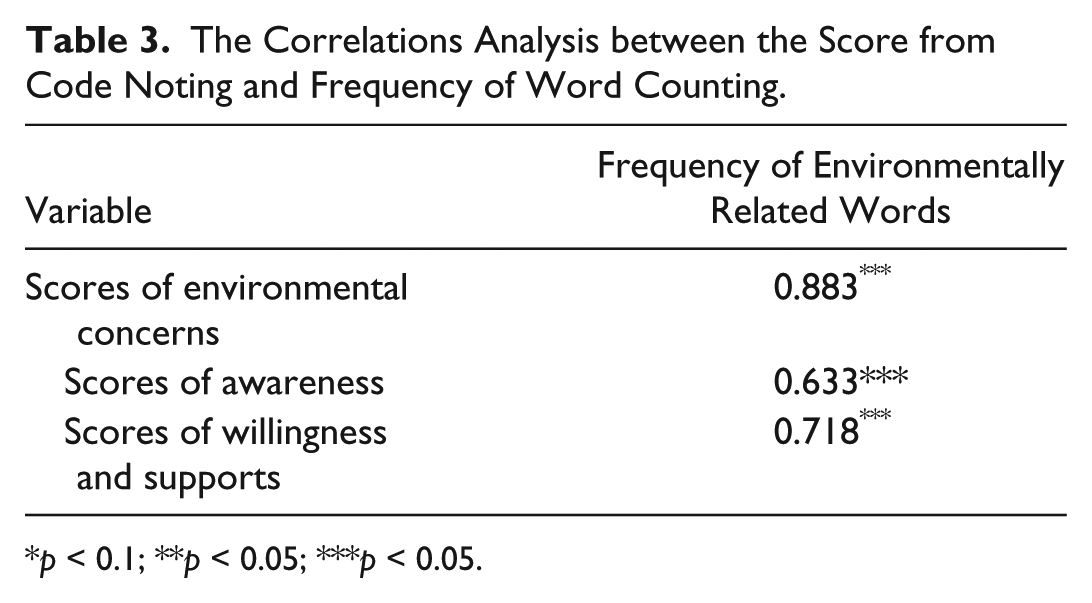
p < 0.1; **p < 0.05; ***p < 0.05.
Using the probability of environmentally related words, Table 4 reports the maximum likelihood estimates resulting from four logit models. Models 1 to 3 separately explore effects from variables of local leaders’ attributes, city context, planning consultants, and public participation. Model 4 then combines all three groups of variables.
Logistic Regression on Environmental Issues.
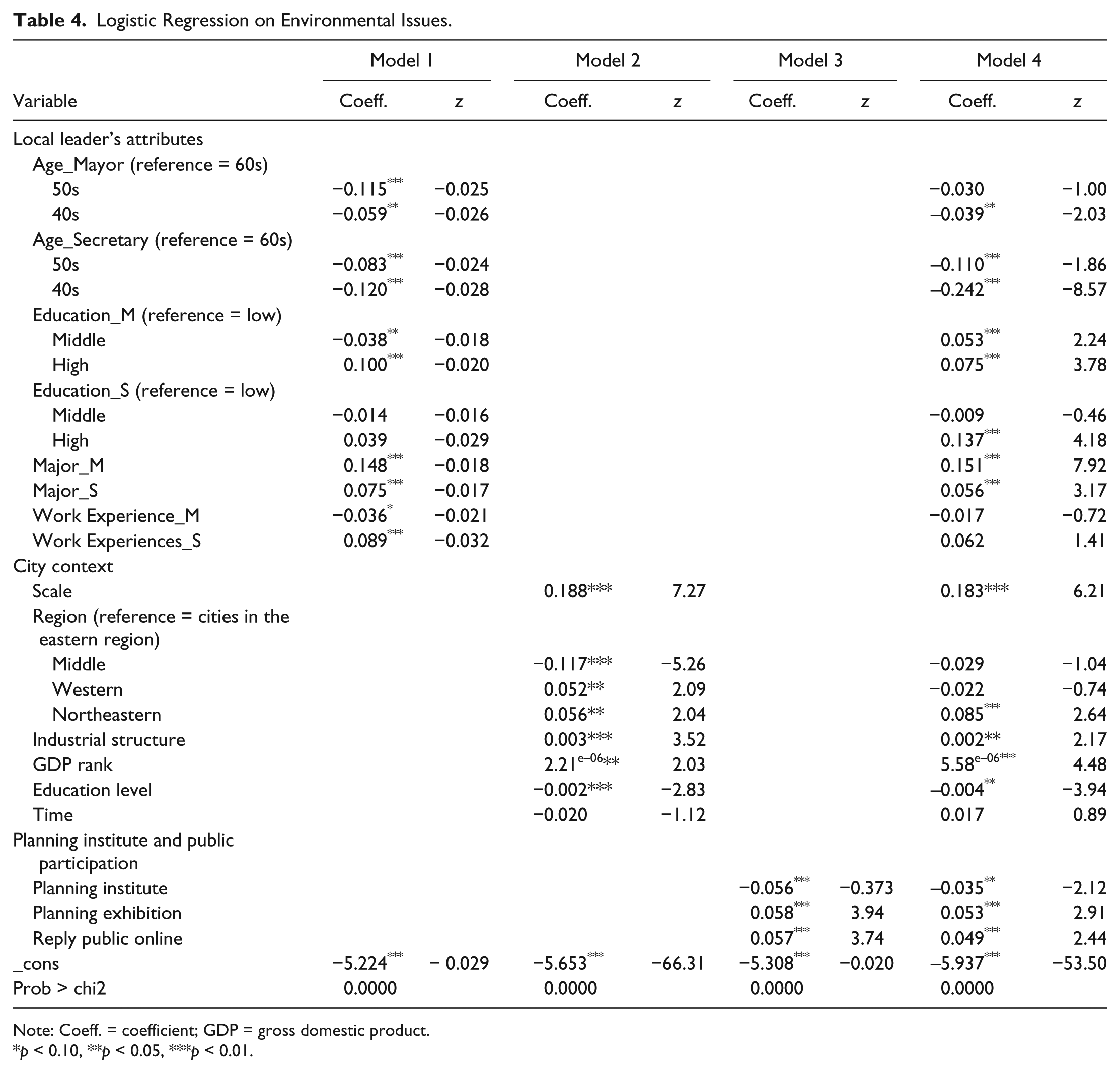
Note: Coeff. = coefficient; GDP = gross domestic product.
p < 0.10, **p < 0.05, ***p < 0.01.
Local Leaders’ Attributes
The results of models 1 and 4 indicate that the attributes of local leaders are closely associated with environmental concerns in MMPs. Among them, age, personal education level, and major are statistically significant, while work experience related to the environment is not.
First, the results indicate that the age of local leaders, both mayors and CCP secretaries, connects positively to environmental concerns in MMPs. MMPs of large municipalities with local leaders aged sixty years or older have, in general, more environmental words than those with local leaders aged less than sixty years, and hence MMPs with local leaders aged fifty to fifty-nine years more than those with local leaders aged less than fifty years. The results correlate with the argument (e.g., Li and Zhou 2005; Zheng et al. 2014) that that since China’s cadre personnel system prefers to promote young leaders, the aged CCP secretaries and mayors who have lost their chance for promotion can afford to be more concerned about long-term municipal environmental issues rather than short-term economic growth.
The education of local leaders also positively correlates with environmental concerns. Both the mayors and CCP secretaries with environmentally related majors correlate positively with the degree of environmental concerns. Moreover, the education level of mayors shows more significant positive effects than that of CCP secretaries. Models 1 and 4 indicate at a statistically significant level (p < 0.01) that highly educated mayors show a greater concern about environmental issues than mayors with a middle or low level of education. However, the effects of CCP secretaries’ education level are not so confirmed, giving the result that the dummy variable of both highly educated and middle educated are not statistically significant in the separated model 1, and only the variable of the highly educated are statistically significant in combined model 4 (p < 0.01). Even so, we can say that China’s large municipalities with local leaders having higher and more environmentally related education can positively affect environmental concerns in their MMPs.
Finally, the working experience of local leaders related to the environment contributes little to environmental concerns, as in the popular Chinese saying “The position of officers directs their thinking.” Some local leaders may have working experience of the environment, but that does not strengthen their value toward the environment. When they are promoted to be a mayor or CCP secretary, no difference exists between them and those without environmentally related working experience.
City Context
Our study also identified several contextual factors influencing environmental concerns in master plans. First, the wealth of a city contributes to more environmental concerns in its master plan. The result comes from the fact that the wealth rank of a city has a negative effect on the degree of environmental concerns of master plans in both separate model 2 (p < 0.05) and combined model 4 (p < 0.01). The positive effect of wealthy cities to plans is as similar to that of plans from the United States, Canada, and Australia. Another parallel result is in the argument that education makes a difference in terms of environmental concerns in master plans. In China, the high education level of urban residents also promotes more concern about environmental issues, which is reflected in the master plans as well.
In addition, cities with higher shares of secondary industry also have positive effects on environmental concerns. It is understandable that cities with high shares of secondary industry face more challenges in reducing environmental problems, as well as increasing pressure from the Central Government, which has begun to prioritize national environmental goals. Even if implementation is difficult, the fact that the master plans have an environmental focus reflects their awareness of, and willingness to consider, potential action to address the problem.
Finally, environmental concerns also differ slightly among regions. Table 2 shows that there is a high probability of environmental words in the master plans of cities in the Northeastern Regions, compared with those from the other three regions. It is interesting to note that cities in the Central Region, where the economy has grown fast and environmental degradation has become more serious during the last decade, do not include as many environmental concerns in their master plans, while cities in the Northeastern Region, where the urban economy has increased slowly or even decayed in some cities, show high levels of environmental concern.
Planning Consultants and Public Participation
The results also found that planning institutes have effects on environmental concerns. Models 2 and 3 show a statistically negative effect from the national planning institute (p < 0.01). It is quite strange that the national planning institute, with its high professional planning reputation, induces less environmental concerns than local planning institutes. One possible explanation is that the national planning institute is much more familiar with professional guides, procedures, and requirements for approving MMPs, and has a strong social network with the Ministry of Housing and Urban-Rural Development as well. These two advantages may make it easier to receive approval from the Central Government on an MMP with less environmental concerns. Another possible reason is that local planning institutes, familiar with local knowledge, have more awareness about local environmental challenges and express them more in MMPs.
Public participation also has some positive effects on the environmental policy focus in MMPs. First, the cities with stable plan exhibition places accessible to the general public promote more environmental concerns in MMPs. The result is statistically significant in both separate model 3 (p < 0.01) and combined model 4 (p < 0.01). In addition, the positive effects of the variable on reply public online are also statistically significant in both model 3 (p < 0.01) and model 4 (p < 0.05). The two results confirm that a municipality in which planning staff actively reply to the public online or display more information on site can increase the extent to which environmental concerns are expressed in master plans.
Conclusion
This study answers the question of the extent to which environmental concerns are expressed in China’s MMPs, in the case of eighty large municipalities, and the question of what kinds of influence local leaders impose on the level of environmental concerns. The two questions are significant in understanding the planning process and accountability of local governments in systems that are different from those based on representative democracy in Europe and North America. Moreover, we focused on environmental concerns because the environment has become an issue of note for both China’s Central Government and the general public. To what extent the environmental concerns were combined in master plans could extensively reflect the roles of the local leaders, Central Government, general public, and planners in the planning process and planning outcomes under certain city contexts.
We evaluated environmental concerns in MMPs with CWF method. The result shows that environmental concerns are differently addressed in MMPs of China’s large municipalities. We also confirmed the result by correlation analysis with that of item coding, the common approach to plan evaluation. The positive and statistically significant correlations confirm the potential of the CWF method, being used in plan evaluation within the institutional context of the hierarchy planning system, party-state regime, and the standardized form of master plans.
We also found that personal characteristics of local leaders, the CCP city secretary and the mayor, do affect the level of environmental concerns expressed in master plans based on a logit regression for eighty master plans. Among these personal attributes, their education and age generally play a positive role in environmental concerns. In addition, there are no obvious effects from their working experience. The reason for the positive effect of age may be partially explained by the existing cadre evaluation system, where aged local leaders, with less chances for promotion, could pursue more long-term environmental concerns instead of the short-term objective like economic growth. While higher education and environmentally related majors improve local leaders’ environmental values, which become infused into the planning process.
Moreover, we identified positive effects of contextual variables like wealth, general education level, and public participation. These results are similar to that of cities in Europe and North America. While it is quite interesting that in some countries based on representative democracy, state mandates on the environment have an obvious effect on environmental concerns (Berke 2009; Berke and French 1994; Tang et al. 2011), in China, a country with strict hierarchal administrative structures, the increasing central mandates on environment are not reflected in the MMPs of large municipalities. Explaining this deviation is difficult, but it shows that the existing planning system in China is far from the ideal hierarchal structure, and local governments in reality hold more autonomy in local plans. To improve the environmental focus in MMPs, a more collaborative approach should replace these top–down and coercive mandates.
Our study also suggests that improving environmental concerns in plans may reflect various strategies under different local regimes. For China’s large municipalities, more environmentally related training could cause considerable effects on promoting environmental concerns in MMPs. Also the existing cadre evaluation system, which prefers young officers, should be readjusted to reduce local leaders’ incentives to implement short-term metrics.
However, our research does not explore the processes by which these local leaders exert their personal influence on MMPs through planning institutes and planners. Also our study is limited in that we did not consider the role of public servants and managers in the planning bureaus, important agents who connect local leaders, the general public, and local knowledge with planning institutes and planners, because the personal information of the managers and staff members of planning bureaus in most large municipalities, unlike these local leaders, are inaccessible to the public. Therefore, further studies on the master plan making process by case study could deepen our understanding of how these mayors and CCP secretaries influence master plans through communication with planning staff members, planning institutes and planners, or vice versa.
Footnotes
Acknowledgements
I would like to thank Jian Zhang, Yiming Jiang, Xingxing Chen, Haiquan Song, and Ruiying Wang for assistance with data collection. Thanks also goes to Saul Wilson, the anonymous reviewers, and JPER editors who offered constructive suggestions and valuable comments on an earlier manuscript.
Declaration of Conflicting Interests
The author(s) declared no potential conflicts of interest with respect to the research, authorship, and/or publication of this article.
Funding
The author(s) disclosed receipt of the following financial support for the research, authorship, and/or publication of this article: This paper is funded by Renmin University of China: the special developing and guiding fund for building world-class universities (disciplines), No. 17XNKI 001.