




Abstract

This essay is the eighth in a series on the recipients of the Association of Collegiate Schools of Planning Distinguished Educator Award, ACSP’s highest honor. The essays appear in the order the honorees received the award.
I remember vividly the day Mel (as he was commonly known) Branch received his Distinguished Educator award. I was deputized to introduce him on behalf of our faculty. I followed Chris Silver, chair of the awards committee, who, in introducing Mel, mentioned that he did some research on Branch’s roots, and found that a library in Richmond, Virginia, was named after the family. I couldn’t pass up this opportunity and began by saying extemporaneously that not just Richmond, but all major American cities have one or more libraries named “Branch.” This brought the house down (my only achievement as a stand-up comedian) and much to my relief, got a big chuckle from Mel himself.
It is hard to imagine today that national-level planning was once romanced in this country. Although historically not uncommon in many countries including Western economies (Cohen 1977; Johnson 1982), the idea of planning at the national level remains suspect and antithetical to the liberal economic traditions in the United States. Nevertheless, the post-Depression Roosevelt administration saw planning as the “fourth power” of the government, famously advanced by Rexford Tugwell, a noted member of the Roosevelt “brain trust.” Those were the heady days of planning, and in many ways marked the institutional beginning of planning in the United States, albeit since limited to local and regional scale.
Branch’s planning career began as an associate of Tugwell. This made him one of the pioneers who defined modern American planning along with his colleague Harvey Perloff, recipient of the 1983 ACSP Distinguished Academic Award. He was a pioneer in another way. He received a PhD in regional planning from Harvard University in 1949, the first in planning ever awarded, thus beginning the scholarly tradition in planning, advancing the field beyond a professional identity.
Mel Branch was born in 1913 in Richmond, Virginia. He graduated from Princeton in 1934, studied at the Ecole des Beaux Arts Fontainebleau, and received a master’s degree in Fine Arts in Architecture from Princeton in 1936. He did independent research on city planning at the Cranbrook Academy of Art in Bloomfield Hills, Michigan, in 1937 and 1938.
Branch directed the urban landscape design for the General Motors Futurama exhibit for the 1939 New York World’s Fair. He served as a Research Assistant at the National Resources Planning Board (NRPB), headed by Rexford Tugwell, in the executive offices of President Franklin D. Roosevelt until 1941. He took a leave of absence from NRPB to direct and design “The City” exhibit at the Baltimore Museum of Arts, the largest exhibition on city planning in the United States at that time. After finishing his stint at NRPB, he became the Director of the Bureau of Urban Research at Princeton. He was commissioned by the US Navy in 1943 where he taught maps and aerial photographs at the US Naval Air Combat Intelligence School; those topics became the subject of one of his books (Branch 1948).
Branch’s association with Tugwell continued long after his years at NRPB. Tugwell recruited Branch and Perloff when he started the legendary Graduate Program in Education and Research in Planning at the University of Chicago. The program’s distinguished faculty later included Martin Meyerson (recipient of the 1996 Distinguished Educator award), Edward Banfield, Julius Margolis, and Richard Meier. At Chicago, Branch mentored distinguished planning academics including John Friedmann (recipient of the 1987 award), Jack Dyckman (recipient of the 1985 award), Lowdon Wingo, and Ira Robinson. The latter three became his colleagues at the University of Southern California (USC).
Branch and Meyerson brought some of the traditional design orientation to the Chicago program but also “provided the leadership in the effort to broaden physical planning through the social sciences without losing the central focus on improving the human environment” (Perloff 1985, p. 340). He always cherished his association with Tugwell and years later raised funds to create an annual award in Tugwell’s name at USC and designed the medallion for the Tugwell Award.
Branch left Chicago in 1951 to join the US Central Intelligence Agency. Three years later, he joined Thompson-Ramo-Woolridge Corporation (commonly known as TRW) and was appointed to the Los Angeles City Planning Commission, where he served for nine years. He joined the planning faculty at USC in 1966, where he taught until 1992.
Branch published twenty-three books and more than seventy-five professional papers in his remarkable sixty-year career in planning practice, research, and pedagogy that spanned government, private sector, and academia. His publications included twelve articles in the Journal of the American Institute of Planners (now the Journal of the American Planning Association).
Branch’s writings encompassed urban design, mapping and photogrammetry, corporate planning, comprehensive planning, planning theory, and the future of planning. His early writings focused on the technical aspects of planning using objective and synoptic evidence that included the view from the air. This led to three books on aerial photography and planning, presaging the current popularity of GIS applications in planning. His years at TRW led to a publication on corporate planning (Branch 1962), which was well regarded in the business world. His years on the Los Angeles City Planning Commission, which he chaired for several years, led to four books on comprehensive (and continuous) city planning.
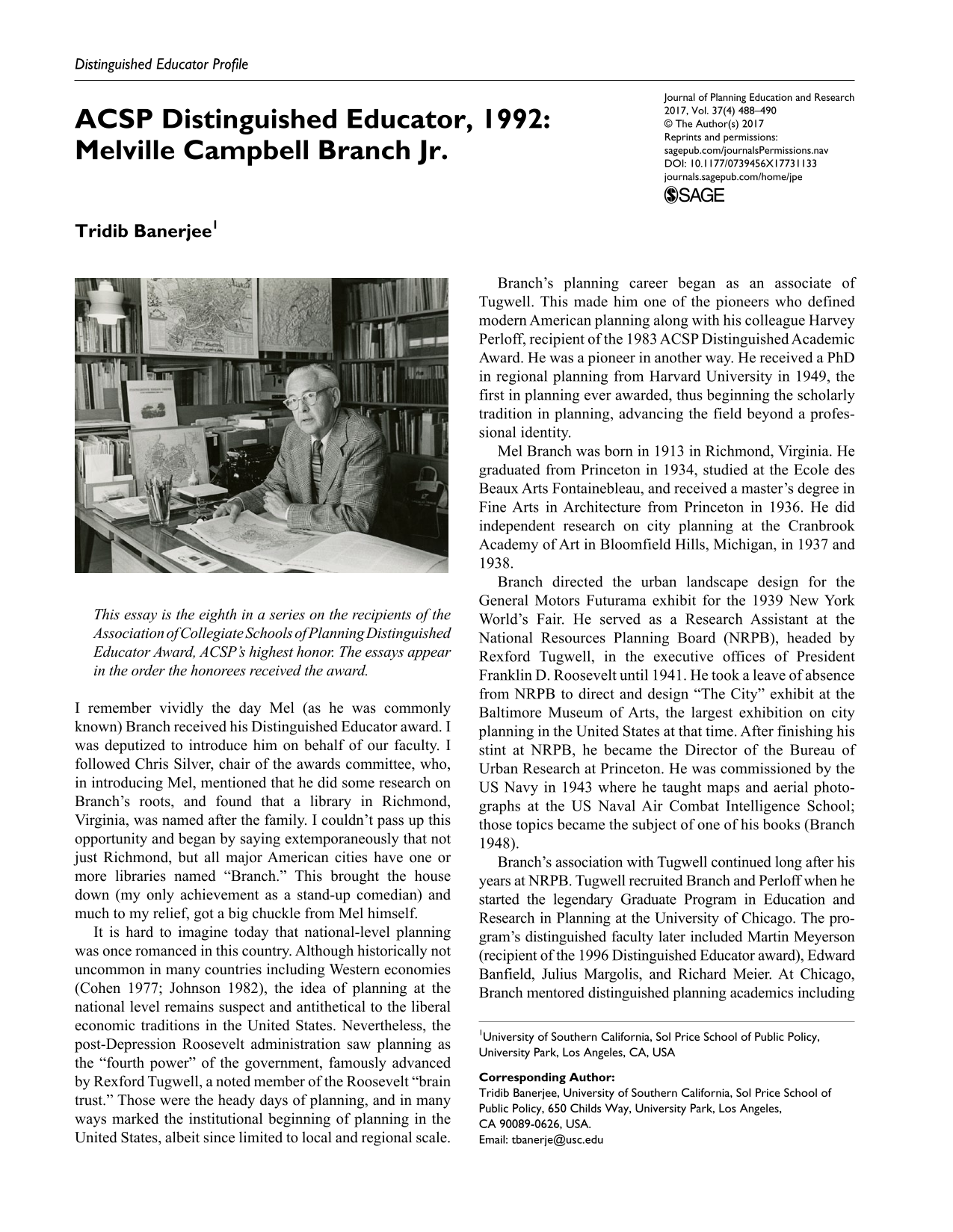
The scope of his writings broadened in subsequent years, as reflected in the titles of his books that tumbled forth in short order: Regional Planning—Introduction and Explanation (Branch 1988); Planning—Universal Process (Branch 1990); Planning and Human Survival (Branch 1992); and Telepower, Planning and Society—Crisis in Communication (Branch 1994). His later writings addressed broader themes, almost philosophical in tenet: Simulation, Planning, and Society (Branch 1997); Planning Imperatives and Human Behavior (Branch 1999a); and Planning and the Human Condition (Branch 2002), his final book. During this period, he also published an atlas of rare and historic nineteenth-century maps (Branch 1999b) that he described as examples of comparative urban design, a topic of his early interests. (The photo above shows him at his desk surrounded by prints and proofs of these maps.) His journal articles considered a broad array of topics: specific aspects of planning such as outdoor noise and oil extraction, the planning process, ethical aspects of planning, business planning, operations research, and simulations.
Branch was a true Tugwellian planner. He was an earnest follower of Tugwell, who was a friend and mentor, and like him probably believed that “planning should be the overriding guiding force in societal action directed by a scientifically trained elite” (Perloff 1985, 341). This smacks of “command and control” planning, you may say. No matter, Branch was a rational thinker who believed in clarity, rigor, precision, and evidence-based decision making. He wished for a “war room” setting for the Los Angeles Planning Commission where planners could display all relevant and readily accessible data.
Despite his rational and technological proclivities and futurist orientation, Branch was somewhat an anachronism himself. As far as I know, he never used a computer or an electric typewriter, which we all used in those days. He wrote all his memos, draft of books and articles, course syllabi, and class notes in longhand, to be typed and mimeographed by the office staff. Nevertheless, his writing was exceptionally precise, always legible, and without any corrections.
Branch not only believed in precision, but also prescience. He meticulously organized and catalogued all his papers, correspondence, diplomas, birth and marriage certificates, ordered in boxes and folders chronologically catalogued by different periods of his life. The list is twenty-two pages long and his papers are now available at the Special Collections and Archives of the James Branch Cabell Library of Virginia Commonwealth University, a treasure trove for future planning historians interested in documenting the early years of planning in the United States.
Mel Branch died in 2008. In a Los Angeles Times obituary, his USC colleagues referred to him as a “one of the patriarchs in planning,” “a giant in the field,” and one of the scholars “who built a definition of what planning is all about.” Without doubt, Mel Branch was a pioneer of city and regional planning education and practice, who clearly deserved ACSP’s highest award.
Footnotes
Acknowledgements
Many thanks to Grace Kim, a graduate planning student at USC, who helped research background materials.
Declaration of Conflicting Interests
The author declared no potential conflicts of interest with respect to the research, authorship, and/or publication of this article.
Funding
The author received no financial support for the research, authorship, and/or publication of this article.