



Abstract
Narrative work is a critical aspect of producing complex stakeholder engagement processes. I demonstrate the value of attending to the effort and consequences of enactment forms of narrative work to complement attention to talk forms of narrative work. Through ethnographic analysis of a contentious planning effort, I show how master narratives structure expectations about what a “participatory process” involves, how narrative logics provide momentum for moving through an engagement process, and how storytelling represents perspectives, imagines futures, and persuades. I suggest prompts for investigating, designing, and troubleshooting narrative work to improve engagement processes.
Scholars and practitioners have long been interested in how the public is involved in decision making about planning and policy (Arnstein 1969; Forester 1999; Innes and Booher 2004). Yet, despite a great deal of practical knowledge and research about organizing public participation, there are still many challenges relating to process design and implementation. They include inadequate representation of diverse perspectives, entrenched conflicts among stakeholders, technically or politically unworkable decision outcomes, or a lack of legitimacy in the decision-making process (Flyvbjerg 1998; Young 2000; Feldman and Quick 2009; Forester 2009; O’Leary and Bingham 2009). Public participation processes are highly variable and complex, with many opportunities for them to go awry. Thus, planning scholars and practitioners are continually engaged in improving our knowledge about how they are organized, both when they are successful and when they fall apart.
This study contributes new insight by illuminating how different forms of narrative work help to produce public engagement. Attention to certain aspects of narrative is already commonplace in planning and public policy today, so readers may at first react to this as old news. Typically, however, in this literature, narrative refers to persuasive storytelling or framing, which is a valuable lens for improving and analyzing public engagement processes. To this important scholarship, I add both focus and expansiveness. First, I suggest focusing on narrative work, meaning both the work involved in narration (the practices and effort) and the work that narration does (its consequences) to produce people’s experience of engagement processes. Second, I suggest that our understanding of narrative work and its implications for engagement processes is incomplete without expanding beyond talk forms of narrative work (framing and storytelling, described below) to include the separate and complementary aspects of enactment forms of narrative work, or what Bruner (1991) describes as the “narrative construction of reality.”
Why complicate a commonplace, already useful term—narrative—in this way? It is worthwhile to attend to enactment as well as talk forms of narrative because both provide great practical and theoretical value for organizing, analyzing, and improving public engagement. In Bruner’s view, narrative construction is a fundamental means through which we make sense of and go along in the world. For example, going to the store to buy groceries is accomplished through assembling intentions and actions into a narrative chain that allows us to orient, organize, and adjust without reinventing a novel set of logics and sequences every time we buy groceries. Buying groceries is a narrative structure that enables complex tasks to happen more or less routinely and be communicated simply to others in a shorthand fashion yet also permits improvisation to occur (e.g., which store, how to get there, and what to buy). Turning this lens on public engagement processes, we can see that an intention, such as “hold a public meeting,” involves all kinds of narrative work: not only communication before, during, and after the event but also the narrative work of constructing a process, chain of events, and logic to guide action from one step to another in an unfolding narrative. Narrative work is an inevitable, ongoing part of stakeholder engagement processes, regardless of whether a given process does or does not proceed according to ideals or expectations.
Thus, it is useful to broaden prior scholarship about the storytelling talk forms of narrative work to include the use and consequence of enactment forms of narrative work in constituting engagement processes. I recommend this broadened perspective on narrative work based on my experience as a practitioner, educator, and scholar of this field of practice. What I present here builds on a set of narrative analysis tools that were first introduced to me by Tuesday Ryan-Hart, a skilled deliberative practitioner who was training a group of people to improve process design and facilitation skills (Sandfort, Stuber, and Quick 2012). In a training session on collective story harvesting, a seasoned practitioner described, in detail, a thorny engagement process in which she had been involved. The other participants were coached to listen carefully for smooth patches, key moments, pivotal turning points, and ruptures and then to work in groups to create a map of how the process had unfolded; they then presented this narrative of the process back to the practitioner. I have since experimented with expanded versions of this exercise in eight graduate classes on designing and critiquing public engagement processes. Invariably, the storyteller and the participants find that focusing their attention on talk and enactment forms of narrative work uncovers subtleties of process design sequence and flow. Used in real time, these diagnostic lenses assist practitioners to discover how things fall apart and to remap a path forward when they do (McKeever 2013).
Through interpretive, ethnographic analysis of a contentious, participatory planning effort in a neighborhood facing gentrification, I identified three different forms of narrative work that helped to produce the collapse, resumption, and successful conclusion of the planning process. Narrative work supported a dynamic process, robust negotiation, and closure on decisions that participants with divergent policy preferences could accept. The details of the narrative work in this case do not imply a particular set of narrative techniques to be used in public engagement. Rather, I use the case to illuminate how narrative work helps to produce all kinds of processes involving engagement and to exemplify how applying the lens of narrative work yields useful information to explain and guide engagement practice. In the conclusion, I argue that expanding planners’ competence in a broader array of types of narrative work is especially useful in agonistic and emergent processes. I suggest a set of prompts to assist with investigating, designing, and troubleshooting narrative work in complex stakeholder engagement processes.
Narrative Lenses for Interpreting Planning and Policy Making
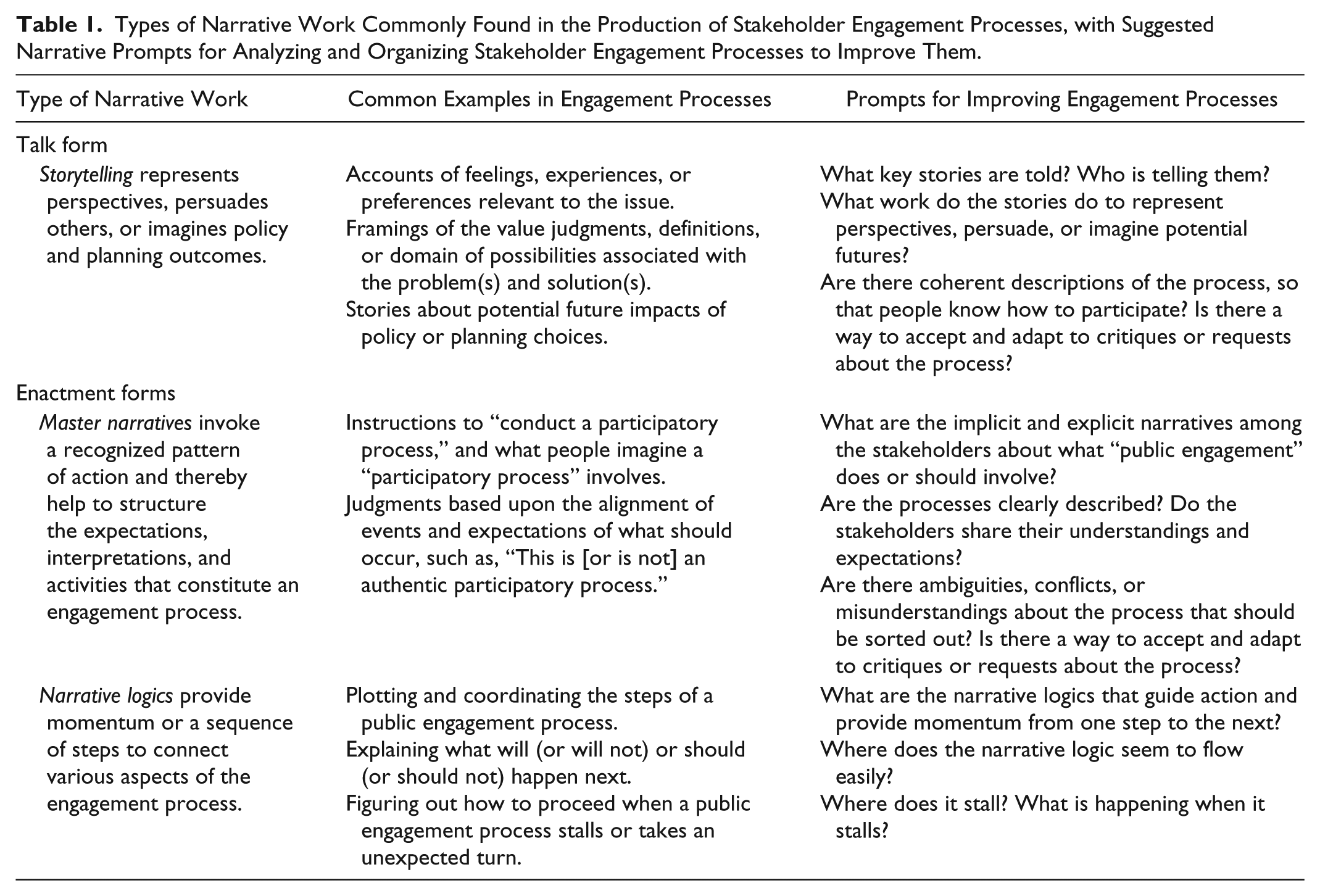
Many planning, public administration, and public policy scholars have contributed to the “narrative turn” in the social sciences by employing narrative lenses in the interpretivist analysis of a wide variety of policy phenomena (Ospina and Dodge 2005). Building on these foundations, I suggest expanding our understanding of narrative practice to recognize a broader palette of the types of narrative work that help to produce public engagement (Table 1). This palette includes the type of narrative work already familiar to planners—narrative as talk—which includes framing and storytelling practices that represent participants’ perspectives, persuade, interpret actions, and imagine the future outcomes of planning or polices. To this, I add two types of narrative as enactment: master narratives, which structure expectations about what an engagement process involves, and narrative logics, which provide momentum for enacting an engagement process.
Types of Narrative Work Commonly Found in the Production of Stakeholder Engagement Processes, with Suggested Narrative Prompts for Analyzing and Organizing Stakeholder Engagement Processes to Improve Them.
Narrative as Talk: Framing and Storytelling
Rich traditions of planning and public policy scholarship and professional training draw attention to narratives in the forms of talk and other communicative acts—messaging, framing, and storytelling—that shape issues, interpret actions, convey feelings, and imagine future planning and policy outcomes. For example, practitioners are exhorted to use different tools to construct a congruent narrative message of their policy or plan (Guhathakurta 2002) and to promote their ideas by “devis[ing] plans (stories about the future) that are designed to persuade the audiences that most matter to them” (Throgmorton 2003, 127).
Competing narratives are a standard feature of planning and public policy. Different versions of the issues and impact of a proposed plan or policy change vie to plot and legitimate possible future courses of action (Mandelbaum 1991), to provide a view of how to interpret a situation and what must be done about it (Fischer 2003), and to assert the proper rationale for different courses of action (Scott 2008). These narratives make some policy arguments and issues more salient or palatable than others to decision makers or the public (Roe 1994). Their framing power is substantial; Gunder (2006, 208), for example, has demonstrated how the broader umbrella of “sustainability” has been “deployed under a narrative of sustainable development,” a framing that directs and confines possibilities. Recognizing the influence of these overarching narratives, participants in policy-making coalitions intentionally co-construct narratives that enable them to work together (Schön and Rein 1995) or create new arenas for exploring and deciding policy (Hajer 2003).
Imaginative narratives also facilitate planning and policy imagination as part of the process of trying on and constructing workable connections between policy options and the outcomes planners and other public managers desire (Stone 1989). For example, Abolafia (2010) describes the governors of the Federal Reserve Board “plotting” various policy options to construct an “operating model” to infer how a policy might be justified and designed. They collectively built stories to try out sequences of actions and logics to connect them, which allowed them to lay out and enact a set of policy-making and implementation steps.
Storytelling forms of narrative work also shape the future of community planning processes and outcomes. Storytelling is persuasive and constitutive of planning outcomes (Throgmorton 1996; Flyvbjerg 1998). Planners share and interpret stories about their work with one another, and this storytelling identifies new issues, frames agendas, shapes reputations, and helps realize practical judgment about how to proceed (Forester 1999, 3). Planners are encouraged to use storytelling in public deliberations to help participants establish a framework for coordinating action about what can and should be done and how (Healey 1992) and to minimize emotional/subjective and rational/objective dichotomization of ways of knowing in political decision making (Hoch 2006). Storytelling provides fuel for the imagination of possibilities, structure to processes, and justification and critique of the performance of policy making and planning (Sandercock 2003). Polletta and Lee (2006) observe that stories enhance participants’ expression of their preferences, encourage empathy, and support groups reaching understandings and agreements. Storytelling helps people to articulate desired choices and their consequences and justification.
Narrative as Enactment: The Narrative Construction of Processes
Enactment forms of narrative work have been less frequently explored in scholarship on policy making and planning. Bruner’s (1991) highly cited theory of the “narrative construction of reality” is the best recognized articulation of this view; he characterizes narration as a means of making sense of and going along in the world, accomplished through assembling actions into narrative chains through which we orient, organize, and interpret their unfolding. The relevance of the narrative construction of reality for planning theory and practice is that planning processes can be reconceptualized as constituted through narrative work that includes enactment, talk, and interpretation.
Master narratives are central in Bruner’s (1991) theories of narrative as enactment. In Bruner’s terms, a master narrative refers to the construction of a process, chain of events, or logic to guide action from one step to another in an unfolding narrative. It is a schema available for adaption and use. (Note that this connotes something different from “competing narratives” described above, which refer to framing moves designed to persuade people to interpret actions and possibilities in a particular way.) “Buying groceries” is an example of a master narrative. As we shall see in the case described below, a particular engagement effort can be understood as an enactment of master narratives about what constitutes a “participatory process” in planning.
Narrative logics, which connect one action and the next into a narrative with flow and causality, also help to produce engagement processes. Narratives do not simply exist a priori to be enacted (i.e., switching from brick-and-mortar to online shopping is still buying groceries). Narratives and narrative logics are also produced by the participants in real time during the course of action (Czarniawska 1997; Pentland and Feldman 2007). The relationship between actions and narratives is recursive, involving a narrative logic that knits one step into the next and into an overall narrative.
Research Methods
This is an interpretivist paper built through ethnographic study of a process to create a land-use plan for Belknap, a neighborhood in Grand Rapids, Michigan, a midwestern American city where I had been conducting a longitudinal study of a wide range of public engagement processes. During the early stages of the participatory planning process I describe here, numerous people whom I had already been interviewing for years began mentioning what was happening in Belknap. They suggested I should look at it as an “example of what happens when public participation goes awry” or “a case study of how not to do participation.”
I used an interpretive approach of observing and analyzing this tumultuous process as it was unfolding (Schwartz-Shea and Yanow 2013), which led me to note the narrative work that was occurring. The study participants do not describe their work in terms of narrative, but by using an iterative, inductive research method, I began to notice how narrative theories and frameworks helped to make sense of the case. For example, in analyzing interview transcripts, I noticed how people were using narrative to reinterpret past actions and make sense of surprising turns of events. When the process became mired for months at a time, I observed them struggle to piece together a story of what would or could happen next and grasp for narrative logics to constitute their next steps.
The study of processes like public engagement efforts benefits from historical analysis of the “chronology, sequence, and contextualization” of events (Sewell 2005, 11). Thus, I adopted a process-based view of the data, which “focuses on the sequences of incidents, activities, and stages that unfold over the duration” (Van de Ven 1992, 170) and analyzes “how and why things emerge, develop, grow, or terminate over time” (Langley et al. 2013, 1). To accomplish this, I constructed a chronology of the process from data from interviews, observations, and published materials. This very detailed document was over 80,000 words and included what occurred in the participation process and accounts from multiple perspectives of what had occurred at each stage and why. From that baseline, I noted episodes, junctures, momentum and disruptions in the flow of action, divergent and convergent interpretations of actions, and conflicts between what people had expected would happen and what they judged had happened.
Analyzing data from numerous sources both exposes divergences in interpretations by the study participants and strengthens the validity of the analysis by allowing triangulation among accounts (Lin 1998). Therefore, I used data from interviews, observation, media coverage, and policy documents. I conducted 63 interviews with those study participants in person or by phone concerning the Belknap neighborhood and planning process. All were confidential, unstructured, active interviews (Spradley 1979; Holstein and Gubrium 1995) in which the study participants provided accounts and interpretations of what they observed and experienced. Informed consent was received for all interviews, almost all of which were audio-recorded and then transcribed. In a few exceptions, when recording was not possible, I immediately jotted down the highlights, which I then used to write up the interview as completely as possible within two days.
Contrary to what some might expect from ethnographic research, I quote study participants sparingly in this paper and typically only in the form of short, key phrases they used to describe events. That is partly for parsimony and partly to protect study participants, who were acutely concerned about confidentiality in this acrimonious process. Most important, however, segments of conversation are not always the medium or artifact of the work that I am characterizing (Scribner et al. 2007). Narrative takes the form of enactment as well as talk. In this case, narrative work often cannot be captured in a single quotation or short exchange because it emerged through long negotiations among multiple people to plot a story line that would guide their future action. Other narrative work takes the form of enactment of master narratives that are implicit and never voiced aloud, such as implicit master narratives of what “public engagement” is.
Scholars offer a wide range of possible units for narrative analysis (Feldman et al. 2004), including accounts (Feldman and Sköldberg 2002; Abolafia 2010), narrative logics (Pentland and Feldman 2007), storytelling (Forester 1999; Polletta and Lee 2006), and stories (Czarniawska 1997; Sandercock 2003). In analyzing and presenting my data from interviews, observations, media coverage, and policy documents, I highlight three kinds of narrative work that helped to produce the public engagement process in this case—master narratives, narrative logics, and storytelling—because of their presence in the data.
Before launching into the following account and analysis, I remind readers that narrative work is not the only dynamic operating in this public engagement setting or the only explanation for how it unfolded. Narrative work is neither a totalizing explanation of all the dynamics occurring in a particular case nor a prediction of what will necessarily happen in any given public engagement setting. Instead, my pointing to narrative work fits Barzelay’s (2007, 527) characterization of social mechanism explanations as “fairly general, but only sometimes true, (partial) theorization[s] of complex temporal phenomena in the social world.” This does not mean, however, that a social mechanism explanation lacks generalizability. The following is the kind of ethnographic “thick description” of a single case that allows “generalizing within” it to identify dynamics that may help to interpret other “cases of” that broader phenomena (Geertz 1973, 26). Thus, I invite readers to approach the following account and analysis with curiosity about what attentiveness to a broadened palette of types of narrative work (using the typology of narrative work and prompts in Table 1) adds to the interpretation of this—or another—public engagement case. I suggest that the lens of narrative work allow scholars and practitioners to observe and reshape important features of participation in public engagement, mediation, deliberative democracy, or collaborative governance that they might not otherwise observe.
Narrative Work in Belknap’s Neighborhood Planning Process
When I began studying the Belknap neighborhood planning effort in 2008, planning efforts had stalled. Stakeholders had been unable to collectively articulate development goals and guidelines for the physical development of Belknap, and the community was in acute conflict about whether the planning process could legitimately be called “participatory.” Within two years, however, city planners, elected officials, and community leaders would reorient the planning process to be inclusive, reestablish hope and legitimacy about it, generate creative new options to address seemingly irreconcilable differences in opinion about the desirable planning outcomes, and complete a consensus-based plan. The neighborhood plan was adopted in early 2010 and is now being implemented. I suggest that recognizing the narrative work in this process provides important insights into the stalling, resumption, and successful conclusion of this lengthy and complex participatory effort. Each of the three types of narrative work—master narratives, narrative logics, and storytelling—is most prominent as a way to make sense of a particular chronological period of the process. Therefore, following an account of each chronological phase of the participatory planning effort, I demonstrate how paying attention to that particular form of narrative work provides useful explanations and options for the unfolding public engagement process.
First, however, I provide some general background on the problem that gave rise to the participatory planning effort. The impetus was mounting gentrification pressure. Belknap is primarily a residential neighborhood, comprising single-family homes and duplexes, many of them historic structures built sometime between the 1870s and the 1920s. Belknap is slightly less than one square mile in area, densely populated, and pedestrian in scale, with small blocks, narrow streets and alleys, and low-rise structures. Encircled by a bluff, reservoir, park, and freeway, Belknap is centrally located in the city of Grand Rapids and yet physically set apart from it. In research interviews, media coverage, and public meetings, residents often described it as an “island” and “our village in the city.” They repeatedly expressed pride in living in one of the city’s most diverse neighborhoods in terms of ethnicity, income, occupation, household types, and housing choices. By the early 2000s, however, many residents had become concerned by signs of stress, such as declining population, the loss of neighborhood businesses, and rates of violent crime, poverty, and unoccupied housing units that were well above the citywide average.
Their concerns became more acute with the rapid transformation of the area immediately adjacent to Belknap into a sizable, regionally significant center for medical service, research, and education. Approximately $1 billion was poured into what a New York Times writer characterized in 2007 as a “concentrated magnitude” of investment in medical development unlike anything else in the United States at that time. City leaders hoped that the creation of at least 4,000 new jobs, including many for skilled professionals in medicine and technology, would encourage more educated, high-income people to live in their midsized city. They expected Belknap to experience some of the strongest impacts of this remarkable change because they believed many high-income employees of the growing medical campus would want to live in Belknap due to its physical proximity to their workplace, historic homes, pedestrian scale, and green space.
Master Narratives of a “Participatory Process”
Getting Stuck
As plans for the medical center were under discussion, Belknap’s residents and neighborhood organizations consistently asserted that they would welcome development but wanted to be part of managing its direction. Recent experience poised them to play such a role. Beginning around 2000, neighborhood organizers had begun mobilizing to be included in decisions about what happens in Belknap, partly in response to a history of having been left out of previous policy-making processes. In the 1960s, the neighborhood was bisected by a new interstate highway, had a new hospital displace its once-thriving commercial district, and lost blocks of housing for a planned school that was never built. Soon after, however, several collective triumphs—including alleviating drug dealing in the park, locating a lost child, and preserving the neighborhood school—boosted residents’ sense of community cohesion and political efficacy. Not long before the planning effort studied here, residents had been among the most enthusiastic participants in two citywide planning efforts (Quick and Feldman 2011, 2014) and in creating a transportation access plan for Belknap. Residents whom I interviewed proudly identified “passionate people,” “participation,” “activism,” or “our sense of community” as among Belknap’s greatest assets. Elected officials, city employees, and staff of citywide community organizations, businesses, and foundations also pointed to Belknap as one of the city’s most politically engaged neighborhoods.
Therefore, as residents grew concerned about gentrification pressures, they became interested in using a participatory planning process to establish goals and guidelines for development in their neighborhood. City planning staff agreed it was important to have a plan, developed with lots of neighborhood involvement, to manage redevelopment of Belknap. Unfortunately, they felt the city did not have sufficient funding or staff to sponsor a plan. Things came to a head in early 2008 when a group of three investors requested approval for several small-scale projects in Belknap. City officials and residents suddenly realized that the three investors had collectively acquired the equivalent of six blocks of property in the neighborhood. This both affirmed the need for a plan and suggested an opportunity to create one. The city planners informed the developers that because their city does not make planning decisions without public involvement, they would not consider the proposals until the developers created an Area Specific Plan through a “participatory process with the neighborhood.” The developers agreed to hire a consultant to facilitate the effort, to pay for the process, and to have it be overseen by a steering committee that the developers and the Belknap neighborhood council would assemble.
When they charged the developers to undertake a “participatory process,” the city planners did not specify what that meant. They also did not clarify whether the steering committee, city planning department and commission, or developers had responsibility and authority to decide how to respond to public input. My analysis of meeting minutes, media coverage, and research interviews uncovered no evidence of a discussion of what steps or qualities would be involved in implementing the planning process to ensure that it was participatory. Instead, there was an assumption that there was a strong and shared understanding about what a “participatory process” involved. The developers relied on their consultant to know what that meant, and the city planning staff and commission relied on the city’s extensive previous experience with and a growing reputation for participatory planning (Quick and Feldman 2011).
The developers and neighborhood council agreed to hold six open community meetings in the neighborhood about the plan, sequenced to involve participants in increasingly fine-grained decision making about the land-use plan for the neighborhood. The meeting was open to anyone interested, though outreach was clearly oriented toward Belknap residents. The organizers posted notices around the neighborhood about the meetings. Over 100 people participated in at least one of the first five meetings. At each meeting, the developers’ consultant shared revised and increasingly detailed plans that incorporated the feedback they had received. The consultants and developers believed that they were implementing a good participatory process because of the large turnout, high levels of transparency about the process, and responsiveness to input.
However, my research interviews reveal that at the same time, residents and neighborhood organizers had reservations about the legitimacy of a participatory process sponsored by developers seeking to profit from the plan and facilitated by the developers’ consultant. Their concerns mounted at a community meeting about priorities and preferences for Belknap’s development. The developers strategically distributed their employees, relatives, and other supporters across breakout discussion groups. Participants were told to use a limited number of dots to indicate their favorite locations for high-density housing development. Many were incensed by how this played out, which they interpreted as a subversion of the democratic process akin to stuffing a ballot box. A community organizer later described it to me: What happened was the developers got all of their people together and distributed them around the tables. There were arguments over who held the dots. It was a flawed process from that point on. Instead of actually engaging and listening, it was more, “I yelled the loudest, so this is what we’re going to do.”
However, for a long time, people held these concerns in private. I asked repeatedly whether anyone had voiced their concerns publicly or approached the city, developers, or steering committee about reshaping the process and was told these concerns had not been expressed. When I asked why, study participants explained they had decided to wait and see what would happen or felt that they were satisfied with the shape the neighborhood plan was taking and therefore felt it was not important to challenge the process. The developers and their consultant were not aware of how badly they had offended some residents. They arrived for the sixth meeting with a final draft plan, and they and the steering committee members were confident that the neighborhood would express strong support and encourage them to take it to the planning commission for approval. Instead, the process fell apart. A resident who was participating for the first time that evening vehemently protested that the process had not been sufficiently advertised and had not been inclusive of diverse populations in the neighborhood, particularly nonwhite residents and residents of a subsidized housing complex. A chorus of newcomers accompanying her echoed her views. The developers and consultant tried to defend the level of involvement they had observed, but none of the other steering committee members or regular participants in the previous five meetings stood up to defend the process. Several people yelled personal and obscene insults at each other. New and returning participants voiced suspicions that “developers” and “the city” could not be trusted. Alarmed, the developers and consultant left hastily through a back door. Interviewed afterward about what they called “the screaming meeting,” residents were not surprised about the concerns that were expressed but were surprised about “how bad” the interactions had been.
In the following weeks, the conflict became even more acute. Plans for the neighborhood were the subject of lots of discussion as neighbors encountered each other or the developer on their block and in the local school and parks. Police were called out several times to intervene in sidewalk disputes over the planning process and plan outcomes. People began accusing each other of behaving irrationally, undemocratically, or malevolently. Nasty debate erupted in online forums hosted by the local newspaper. Some writers freely painted opponents of the planning process as “anti-development,” while many of those being classified as anti-development insisted that they accepted development but wanted a legitimately democratic decision-making process.
Analysis: Seeing the Work of Master Narratives in Belknap
This beginning phase of the neighborhood process points to the importance of master narratives as a form of narrative work in public engagement. Specifically, it points to how people use implicit master narratives to produce engagement: to plan, orient themselves to, and evaluate the quality of participatory processes. Paying attention to master narratives generates fruitful insights into how confusion, dissatisfaction, and distrust arose in Belknap. Observing master narratives does not provide a unique, totalizing, or definitive explanation of why the process unrolled as it did. However, it does provide a compelling interpretation: when competing implicit narratives of a “participatory process” were not publicly aired and negotiated, people could not see and negotiate the differences among their imagined paths of action, and the mismatched narratives contributed to the dissonance and conflict they experienced. Frequently, planners are advised to provide a clear and explicit road map to the decision-making process to reference before launching the effort and as it proceeds. Using a lens of narrative work does not change the essence of that very sound advice. Instead, it recasts it as a form of narrative work in which a master narrative of the participatory process is made explicit and calls attention to the fact that there may be multiple implicit narratives to be sorted out.
Master narratives may be referenced as if there is a taken-for-granted way of enacting them, but they are not formulaic or deterministic. Rather, they are schema for interpreting and enacting particular instances of commonly recognized themes or patterns, such that events are constituted “in light of” a master narrative, and the narrative is reconstructed through each enactment (Bruner 1991, 7–8). The narrative of “being in love,” for example, might be implemented in any number of ways depending on circumstances, and over time, collective cultural and individual narratives of what constitutes “being in love” might change based upon how being in love is being enacted (Swidler 2001). Often narratives are implicit and uncontested, but sometimes they are negotiated explicitly as different “operating models” for explaining and guiding action (Abolafia 2010). Individuals can connect the same events quite differently according to the logics of their particular narratives (Pentland and Feldman 2007).
Looking for master narratives in Belknap reveals several dynamics. No one stated what a “participatory process” would involve, and thus, multiple versions of that master narrative were in play. For the developers and consultant, transparency, good turnout, and responsiveness were critical. For the newcomers at the final meeting, inclusiveness and representativeness of different groups and parts of the neighborhood were critical. For the people who had been privately doubting for some time whether the process was participatory by their definition, shared ownership and a lack of bias were critical. These different actors were using master narratives to faithfully enact their respective versions of public engagement and to judge what happened. It is commonplace and not necessarily problematic for multiple versions of any master narrative to be operating at one time (Swidler 2001). Sometimes, organizers willfully co-opt a narrative of a “participatory process” to legitimate efforts that are actually tokenistic or intentionally manipulative (Arnstein 1969). These “participatory processes” may be disingenuous window dressing for decisions that have already been reached in a nonparticipatory manner (Flyvbjerg 1998).
In Belknap, however, the data indicate that the misalignment of master narratives contributed to disruption. My interpretation of the accounts of diverse participants during dozens of confidential interviews is that the conflict ensued less from ill intent and intentional abuse of participation than from unresolved, divergent interpretations of the master narratives about how a “participatory process” should be enacted. Parsing out the different operating versions of a master narrative makes legible how they enable different courses of action and judgments about what is a legitimate approach. When people encountered others deviating from their own version of the narrative, they interpreted the other people as behaving irrationally, illegitimately, or with ill intent. The competing versions were at the heart of the legitimacy crisis over whether the Belknap effort could or could not be justifiably described as a “participatory process.”
A specific example is the developers’ strategically distributing employees, relatives, and other supporters across the breakout groups for the dot voting exercise. The developers’ narrative of a participatory process was that policy outcomes depend upon individuals’ bringing their interests to the table and having their input counted. Consequently, their team recruited a large number of advocates, placed a representative in each group to try to persuade others to its position, and recorded its preferences with as many dot votes as possible. Since some of the developers lived in the neighborhood with their families, and no limits had been set on who could participate, the developers considered this legitimate. They presumed that other stakeholders were doing the same and felt their own goals for development would be left behind if they did not maximize their input. Their operating version of a “participatory process” in this setting resembles a “winners-take-all,” competitive version of interest politics. In contrast, the people incensed by the developers’ actions interpreted them as a subversion of the democratic process akin to illicitly stuffing a ballot box. The offended parties’ version of the narrative was based in part on their previous experiences in the city, in which participants exchanged views and developed new perspectives through deliberation. Thus, they regarded dot voting as fodder for further dialogue, not a decisive result.
The example of Belknap implies that publicly airing and negotiating among different versions of a “participatory process” might have avoided some of the conflict and disruption. However, the multiple competing versions were not visible until the process was well under way, at the sixth community meeting. At that point, without a commonly accessible and legitimate narrative, the various parties could not figure out what their map was for moving forward. Indeed, in the next phase of this chronology, the parties created an explicit, publicly accessible narrative of what a “participatory process” would involve.
Narrative Logics
Narrative logic is the more prominent type of narrative work in this second phase of the engagement process. The data reveal community members’ struggles to discover a narrative logic that would help them proceed. As I will discuss following the account of this phase, attending to the role of narrative logics helps to explain how the process became mired while the participants lacked narrative logics that could sustain momentum and provide cohesion for the next steps. Ultimately, the participants restored a narrative logic of their participatory effort by plotting together how it would unfold.
Getting Unstuck
After a few weeks of heated conflict following the sixth neighborhood meeting, a group of interested neighborhood residents created a new group to try to restart the process in a neutral forum. Lacking the legitimacy of a sponsoring organization and support from people skilled in land-use planning or process facilitation, they did not gain much traction. A few months later, when the deadline the planning commission had set for producing the plan arrived, the various parties briefly roused themselves for a public hearing where they argued vociferously about whether the processes for creating the draft and alternative plans had been legitimate. At the planning commission meeting, the commissioners tabled action on the plan and urged all parties to keep trying to work things out together.
They did not keep trying, however. Instead, the developers, city staff, and residents stopped participating in any kind of public discussion and retreated to lick their wounds privately. In research interviews, they explained that they wanted to protect themselves from being misunderstood or attacked and, furthermore, that they were not taking action because they were deeply confused about what to do next. The developers felt blindsided and maligned for their good intentions and effort. Residents and city planners were pained and confused that Belknap, despite its proud history of having very engaged residents who work on problems together, could suddenly experience such dysfunctional community meetings and have people be so alienated from one another.
Everyone had believed they knew how to have a participatory process and work together. When that expectation was not realized, they understood they would have to actively forge a path forward. They used confidential conversations with me to speculate about various ways to move forward. The pathways they speculated about included continuing the initial process with some kind of remedy, starting over, or completely dropping efforts to create a neighborhood plan. However, they were not confident that any of them would necessarily work and feared they would be reproached for even suggesting them. The planning director stated most succinctly what many others had expressed in interviews when she said, “I can’t see anything I can do. Every option seems like a losing proposition.” The community was stuck.
Finally, 10 months after the explosive community meeting, the developers made a move that helped things become unstuck. They felt hamstrung by having no neighborhood plan within which to act. They owned property they could not develop and had spent months and thousands of dollars on a neighborhood planning process that had not produced a plan on which they could act. So, to shake things loose, they deliberately did something provocative. They submitted an application to the city to demolish several houses and replace them with small apartment buildings. Alarmed, neighborhood organizers, the planning staff, and the planning commissioners were reenergized to attempt a participatory process to complete the plan.
The planning director called a meeting of the planning commissioners, the developers, neighborhood advocates, and city legal staff to discuss how to handle the developers’ proposal. She chose to have the discussion as part of a working session of the planning commission, so that it was transparent and open to anyone interested but not a venue for making decisions on the merits of the property development application. She recommended staging formal decision making about the proposed project and neighborhood plan in two parts: first a discussion of whether an exception could be made to the policy that projects be reviewed in the context of an adopted neighborhood plan and then, only if that was approved, a discussion of the developers’ specific project application.
During the discussion, which I observed and recorded, the participants played with several options for moving forward. As they experimented with, modified, and evaluated the possibilities, everyone spoke consistently in terms of what would best serve the community at large and move them beyond the impasse. Notably, as the whole group brainstormed, the developers discouraged a few options that might have been shortcuts to approve their projects more quickly. The developers explained that they rejected those options because they might compromise the legitimacy of a “participatory process.” Everyone avoided discussing the merits of the specific project (the proposal to demolish houses to build apartment buildings); instead, they repeatedly affirmed a need for an overall neighborhood plan and focused on the procedural question about how to create one. After some deliberation, they unanimously agreed to the two-stage process the planning director had proposed: they agreed to delay action on any specific proposals until the overall plan was completed.
Following that dialogue, neighborhood council members and other leaders in Belknap felt urgency to resume the planning process. Yet, they also felt they needed a new structure that would be considered more legitimate. They did not want to use the developers’ funding, feeling it could taint the legitimacy of the process, nor did the developers want to contribute more money. A neighborhood leader and a planning staff member did two things. First, they contacted a local foundation that had helped fund engagement efforts in the past to ask for facilitation support, which the foundation provided. The neighborhood organizers and planner believed that an external facilitator would help the parties adopt and implement a good process to complete the neighborhood plan and, furthermore, that the foundation was a trusted, neutral party that was well placed to sponsor someone who could work with all sides to find solutions. Second, they worked with the neighborhood council to reformulate the steering committee to retain representation from the developers and neighborhood but expand it to include more diverse representation of renters and homeowners from different income groups.
At the subsequent public hearing, the people who had plotted the two-stage process together followed that pathway, but with some new elements and the inclusion of many additional people who turned up for the hearing. The planning commissioners and staff began the meeting by explaining how and why the rezoning request was being broken into two stages. The commission also proposed a more deliberative approach to decision making than the typical public-hearing format. Specifically, the chair proposed that instead of a long line of speakers who would each be allotted a few minutes to make their point as forcefully as possible, they have a few representatives of the major viewpoints speak at greater length, in dialogue with the commission and one another, to try to formulate some mutually agreeable outcomes. On the basis of previous commission hearings, the meeting where key players had plotted how to proceed, and what he knew of people’s reputations in the community, the chair had ideas about who would be trusted and articulate spokespeople for each side. He suggested those names to the audience. Hearing many murmurs of agreement and no objections, the hearing started.
A resident who had led the effort to renew the participatory process began by assuring the commissioners that there was “now a place and a space” for a “civil conversation” and a commitment to “building consensus” as an alternative to “duking things out.” He pointed to reenergized commitment from all parties, the community foundation’s support to provide an independent facilitator who would reset the legitimacy of the process and guide the group’s progress, and the more diverse steering committee. Notably, the steering committee included a member of the developers’ team, who lived in the neighborhood, whom residents respected, and who served as the spokesperson for the developers during the hearing. In his testimony, he observed that the developers had willingly agreed to and funded a neighborhood planning process. He then recommended that the process be resumed and brought to a satisfying closure rather than abandoned. The commissioners gave several other people an opportunity to speak, played with a few options, asked for reactions, and repeatedly affirmed their commitment to a participatory process.
The commissioners’ decision was consistent with what the working session had implied: they determined that specific projects could not be considered outside the context of a neighborhood planning process and delayed the project proposal hearing to allow the neighborhood plan to be completed. In addition, they articulated, as they had not originally, some details about what they meant by a “participatory process with the neighborhood.” This time, they specified the importance of neighborhood “ownership” of the plan, they endorsed having a steering committee that would be independent of developer sponsorship and be composed of people with diverse perspectives, and they directed the disputing parties to work together to try to “agree with each other” about the planning outcomes that they could mutually endorse. They also warned the parties that after five months, they would act on the developers’ proposal—with or without a plan—explaining that they wanted to be fair to the developers and both “force the hand” and “give a chance” to the planning process.
The developers’ team seemed to accept that this was what everyone had agreed upon at the working session. They stated for the record that they were disappointed that their development proposals were being delayed yet again after considerable expense and effort on their part to have a good process with the neighborhood, but they did not try to change the commissioners’ minds. Belknap residents and city staff, in contrast, were ebullient about the decision when they gathered with each other right after the meeting and when they spoke with me privately afterward. They expressed relief that, as a neighborhood organizer put it, “we can stop asking ourselves over and over, ‘Do we have to start all over again?’” and that there were few remaining “complications” to work out about their next steps. They acknowledged that the deadline was challenging but also felt it was fair and a useful impetus to get them back to work. They had gotten unstuck.
Analysis: Seeing the Work of Narrative Logics in Belknap
This interim phase of the neighborhood process illuminates the work of narrative logics. Specifically, it suggests how narrative logics guide action, enable the next steps, and provide momentum and cohesion in a process. Logic in this context is not the same thing as valid reasoning used in argumentation. Narratives embed logics that enable people to know what to do next (Bruner 1991) in a recursive process in which flow and causality are constructed along the way (Pentland and Feldman 2007). Paying attention to narrative logics generates fruitful insights both about how action stalled and about how it resumed. It does not provide a unique and exclusive explanation of what happened, but the difference in momentum between the moments when people could—and could not—find a narrative logic is striking, suggesting that paying attention to this type of narrative work provides fruitful insight. Moreover, by doing the plotting inclusively, they created a way for the disputing parties to collaborate on creating a way forward and made the process accessible to newcomers.
The work of narrative logics in this case implies that when participants are disputing, co-producing a narrative logic for the process may help them to reengage. This will be familiar to mediators and scholars of dispute resolution, who often engage the parties in designing the ground rules and a rough plan of action as a foundation for moving into negotiation that is contentious over content. Using a lens of narrative work makes visible that cocreating ground rules is not only a soft, easy way to begin building agreement but also a vital step in creating the logic that is necessary to produce any coordinated action. Similar arguments could be made about other kinds of engagement and collaborative processes.
Ruptures in the master narratives under which people have been operating rob them of the logic that has been guiding their action. These interruptions can be generative, enabling change through the “positive effects of questioning received ideas” (Czarniawska 1997, 96). One of the ways to address these ruptures is through conversing to negotiate and construct logics for how to proceed. The narrative logics are not merely logistical but also persuasive, and multiple versions of “what if we try this” may be tested to plot, compel, and legitimate particular courses of action (Mandelbaum 1991). Abolafia (2010, 349) defines plotting as the “preceding constitutive process” of constructing a plausible narrative to justify and guide action. As with master narratives, however, plotting does not predetermine action. Instead, plotting a shared narrative of collective action builds trust and identity among multiple players and serves as an enabling resource, rather than a formula, for complex, coordinated actions that are both planned and improvised (Quinn and Worline 2008).
From this perspective, the long stall of the neighborhood plan, when people stopped trying to work together and did not know what to do, can be reinterpreted not merely as burnout but as a lack of a narrative logic to guide subsequent steps in a cohesive narrative. They got back on track through a particular form of narrative work: plotting inclusively to create a shared narrative logic. This occurred multiple times, including in the working meeting where the parties decided on the two-step process to handle the developers’ project request, during the public meeting when the chair of the planning commission proposed a more deliberative alternative to the traditional hearing, and when commissioners deliberated about several possible paths to direct the neighborhood to take. The elation many felt after the hearing speaks to the work that narrative logic does. Once the hearing clarified the expectations for neighborhood participation, the next steps, and a deadline, the residents were no longer burdened by continuing “complications” about how to proceed or the prospect of having to start over.
I characterize the participants’ narrative work as plotting inclusively to create a shared narrative logic. Whereas participation often involves just gathering input from stakeholders on a proposed policy decision, inclusion involves diverse stakeholders in co-producing the process for democratic decision making as well as the policy outcomes (Quick and Feldman 2011). To get the process back on track, the parties intentionally avoided negotiating about decision-making outcomes regarding the developers’ proposal until they had negotiated the process for decision making. Plotting in this inclusive way helped to bring cohesion and momentum to Belknap’s neighborhood planning process in several ways. In part, an inclusively generated and blessed plan addressed the problem that the environment had become so acrimonious that it was a “losing proposition” for any individual to step out alone. Co-producing a way out of the impasse created resources to support ongoing negotiation. For example, the developers’ balking at scenarios that might have expedited their project approval, but hampered the legitimacy of the process as a whole, generated resources in the form of trust and commitment to collaborative problem solving.
Storytelling
At this point in the creation of Belknap’s neighborhood plan, the narrative work just described had created a framework for the planning process. A narrative logic had been negotiated for a master narrative of engagement that was publicly visible and explicit, so people could participate in or challenge the process. Several contentious planning decisions (i.e., specific land-use choices) had not been addressed at all while the process was still so ambiguous and contested. Once the planning process became unstuck, however, the community could get down to the nuts and bolts of making planning decisions, some of them difficult. At this point, the public engagement process was especially aided by another form of narrative work—storytelling—that enabled people to imagine novel planning solutions and to frame persuasively the plan they produced.
“Cottage Retail” and “Plan 3.0”
The reconstituted neighborhood plan steering committee met repeatedly in the months following the planning commission hearing. The new facilitator helped them to sort out how they did, and did not, want to conduct their work. After deliberating about the options, with the help of his clarifying questions and skill in engagement process design and techniques, the committee members realized they wanted to avoid what one steering committee participant described as the “dot voting meetings” that the developers’ consultant had convened because they seemed to polarize people. Instead, they did a lot of work within their own small committee, since they represented the major stakeholders and the points of difference that needed to be resolved. With the facilitator’s help, they implemented a strategy to reach others in the community through small group meetings, outreach at community events, and one-to-one meetings with key stakeholders to gather their input. Thus, the facilitator helped to create a functioning narrative guide for their particular “participatory process” by leading them to articulate their goals and preferences and by translating those into an explicit road map of the participatory methods they would use and the sequence of steps they would take.
The community made progress on many aspects of the plan but remained divided about whether to allow commercial development on the edge of the neighborhood closest to the growing medical center. Steering committee members repeatedly stressed the need to get a plan passed and urged compromise. Just a few days before the deadline set by the planning commission, a provocative question allowed the disputing sides to imagine new options. A steering committee member later recounted, The facilitator said to people who were more opposed to mixed-use stuff, “Is there any way you could see mixed use happening in a residential-style building type?” “‘I guess if it looked like a house, it might be okay.” So, he asks the developer, “Is it hard to create a commercial-style business in a building that might look like a residence?” “I guess we could work with that.” Out of that came a special land-use classification called “cottage retail.” We were able to compromise on that corner, which we hadn’t even begun to scratch the surface on the first time around. A little-better-structured process, including the right people facilitating the conversation, led to finding common ground nobody foresaw.
Just as the committee had reached a point of being ready to accept unexpected solutions in order to get a plan passed, the city’s planning staff were eager to have an approved plan despite some reservations about the completeness of what the neighbors proposed. One of the ways that the steering committee inspired confidence in the plan was by describing what they were producing as “Plan 3.0.” They did this to signal that they were building on the initial effort sponsored by the developers and an alternative plan that some Belknap residents had started. They also made an analogy to Web 2.0—a term used to describe Internet sites that allow users to iteratively and interactively generate content—to signal that they were creating not a fully complete product but rather a platform for ongoing collaboration to interpret and implement the plan. The full steering committee turned out to show its support for Plan 3.0 at the planning commission hearing. A year had passed since the commissioners had tabled the plan and urged the neighborhood to “keep trying.” This time, the commissioners praised the plan and unanimously approved opening an official 30-day public comment period.
Making good on their promise to move the developers’ proposals forward as soon as the neighborhood plan was in place, at their very next meeting the commissioners considered the developers’ long-delayed application to demolish a few buildings and build apartments. They rejected it as a poorly designed and conceived project. Remarkably, the developers neither protested the project decision nor tried to hold up approval of the neighborhood plan. During the comment period on the plan, no additional input was provided; study participants’ explanation for this was that so much input had already been thoughtfully considered that they did not feel a need to revisit or raise topics for consideration at that point. Thus, at the end of the comment period, the planning commission unanimously approved it. The city council immediately approved the plan, which is now being implemented.
Analysis: Seeing the Work of Storytelling in Belknap
Reviewing the final stages of Belknap’s planning process through the lens of narrative work reveals the contribution of storytelling to production of the process as well as the final plan. Through storytelling, the participants represented their perspectives and views, used metaphors to constitute new ways of working together, generated novel ideas about land-use planning in the neighborhood, and reinterpreted the work they were doing. Significantly, group storytelling to play with and create new ideas about actions and outcomes not only helped the parties to resume the neighborhood planning process but also helped them to overcome a critical bottleneck—a persistent dispute over the plan’s final content. Like plotting, creative group storytelling about desired and possible futures is a form of narrative work through which possibilities for action are created by imagining endpoints or pathways to them. Storytelling about a particular outcome or pathway is not enough to make it occur but can facilitate its occurrence if those listening both “supply and accept” the story (Feldman and Sköldberg 2002, 287). As discussed in the introduction to this paper, planning scholars have previously argued that storytelling is persuasive and constitutive of planning outcomes (Throgmorton 1996), may stimulate “a new imagination of alternatives” (Sandercock 2003, 18), and can facilitate the transformative community changes that are needed to realize desired futures (Healey 1992).
Indeed, creative group storytelling does seem to have these predicted effects in Belknap. Storytelling to imagine new planning processes and decisions helped to transform old patterns and construct the path toward a desired future. For example, the neighborhood organizer’s assertion that there was now “a place and a space” for “building consensus” instead of “duking things out” was an invitation not only to the planning commission to endorse the renewed planning process but also to potential participants to accept and enact the actions needed to bring the story to life. Resolving the thorniest dispute about the content of the plan—relating to where commercial land uses could be permitted—also involved creative group storytelling. Talk of a “cottage retail” category for land use that would look like housing but function as a business created a new alternative that allowed the parties to move beyond entrenched positions.
Similarly, by recasting the “big gym dot voting meetings” and other detested features of the initial phases of planning as Plan 1.0, the steering committee renarrated the past as a story of ongoing learning and a foundation for continuing progress rather than of failure. The stunning outcome of the first proposal reviewed under the provisionally accepted plan—a rejection of the developers’ long-delayed project and the developers’ acceptance of that decision and of the plan—suggests that hopes had been well placed that Plan 3.0 would be a foundation for an ongoing process of deliberation that would support substantively rational decisions.
Narrative Work as a Container for Agonistic and Emergent Processes
The primary contribution of this paper is to make visible three general types of narrative work that help to produce public engagement. I derived this expanded palette of the types of narrative work that are relevant in public engagement through ethnographic analysis of a particular case. The particular manifestations of narrative work found in Belknap would not be present in every participatory process, and it is not my purpose to use the case to recommend specific narrative techniques. Rather, this analysis illuminates the presence and operation of narrative work, which in one form or another is inherent in all engagement contexts.
Belknap has intriguing features that merit additional exploration. This case is in some ways unique and in others not. For example, it happens that the participants in the Belknap process chose a consensus-based approach for the final phase of their work. It would be a mistake, however, to assume that it was the consensus orientation that allowed them to overcome impasses in planning processes and plans and thereby to produce Plan 3.0. Consensus processes have lately been valorized as a “better” way to address conflicts and break through impasses by forging agreements that enable action. Yet, they are also prone to gridlock when sustained competition, efforts to interrupt and polarize, and active refusal to participate are in play (Dodge and Lee 2017). Consensus may lack legitimacy as a democratic process because it silences dissent or elicits strong protest from people who feel they must surrender their interests to promote consensus (Bulkeley and Mol 2003).
Thus, just as invoking a “participatory process” does not provide a stable, mutually understood and agreed narrative for action, neither does a “consensus-based” approach ensure that a particular kind of process and outcomes will unfold. As always, the micropolitics of the process matter (Forester 1988; Healey and Hillier 1996; Briggs 1998): prenegotiating a master narrative for a proposed process will not strictly and predictably define how it will unfold. However, creating a publicly accessible narrative of the process does construct a container within which robust and even agonistic negotiation about the process design and legitimacy, as well as about differing positions and ideas, can occur (Mouffe 1999; Forester 2009). This is true of both a consensus and a voting approach. Thus, a clearly, publicly articulated master narrative for a nonconsensus approach in Belknap—such as “we will vote and the majority will win”—might have brought as much cohesion, momentum, and closure as the final, consensus-based approach.
Being mindful about how master narratives shape engagement does not mean constructing and communicating a version of the process that everyone must accept. Instead, actively narrating the process—the intentions, its steps, its performance—enhances stakeholders’ agency to make it possible for anyone interested to coordinate their actions relative to that narrative, without being hindered by a lack of transparency or feeling disoriented by a lack of clarity. Narrative work of this type cannot eliminate the relations of domination and power that challenge the realization of inclusive democracy (Young 2000), but it can support contentious politics without resulting in breakdowns of the process. Narrative work can enable robust negotiation, as happened in Belknap. The narrative work undertaken in Belknap to reconstruct the participatory planning helped to produce a stabilizing container for a process within which debates could rage about planning processes and outcomes. Conflict did not dissolve once the parties met informally with the planning commission to plot their steps and logics to resume the process of working together again. On the contrary, conflict over planning outcomes and land-use decisions became even more heated after that point. With the benefit of a container for their process, the parties could disagree, negotiate, and ultimately engage in creative group storytelling to discover a novel, persuasive solution for sites they ultimately zoned for “cottage retail.” “Plan 3.0” is a metaphor for the container the participants created for ongoing interaction to interpret and implement their intentions.
One of the important practical implications of Belknap’s example is that narrative work to construct a planning process (how to work together) may be a useful antecedent to narrative work to construct policy outcomes (land-use decisions). When the participants were stuck, the narrative work that repaired rifts and allowed neighborhood planning to recommence were not creating a cohesive, unified outcome narrative of “this is what kind of land use development we want.” Belknap needed a shared narrative of “this is what a participatory process looks like in this case” before the parties could construct a narrative of plan outcomes. Once that container was in place, the parties could engage their differences about land-use choices, which they were then able to resolve. As the neighborhood organizer observed with pleasure and surprise, “A little-better-structured process . . . led to finding common ground nobody foresaw.” Educating planners to be attentive to the role of enactment forms of narrative work in structuring processes should help participatory processes to find that common ground more often.
Several manifestations of narrative work found in this case may be especially useful for processes that are emergent, are dynamic, are influenced by many parties, and involve stakeholders with antagonistic views because they are inclusive. Creating publicly accessible master narratives, inclusive plotting to create shared narrative logics, and creative group storytelling are examples of inclusive narrative work in Belknap. I characterize them as inclusive practices, as defined by Quick and Feldman (2011), because they involve democratic accountability and transparency (through creating the publicly accessible master narrative), co-production of the process (through working together to plot the steps and logics), and collective decision making about the plan and land-use decisions (through creative group storytelling).
The enactment forms of narrative work play an essential role in what is sometimes termed “creating the container” for group processes within which inquiry, constructive conflict, and learning can occur. Several leadership scholars have observed that constructing and sustaining the container demands active, adaptive work so that complex, dynamic participatory processes can be productive rather than so confusing, chaotic, or disrupted by conflict that people abandon the effort (Senge 2006; Lehman and Linsky 2008). They advise attentiveness to norms, assumptions, the physical space, and time frames, but narrative work is also important in creating a container for robust negotiation, holding a dynamic process together, and reaching closure.
Bruner’s (1991) theory of the narrative construction of reality reminds us that narrative work involves a union of speech (or text) and other forms of action. Their union is relevant in two ways for organizing successful engagement processes. First, talk forms of narrative work—communication about intentions for a “participatory,” “deliberative,” or “consensus-based” process—are not enough to make such a process occur. In Belknap, even if from the outset there had been a shared, publicly transparent master narrative of how to undertake a “participatory process,” accomplishing that intention would still have required active, ongoing narration through both talk and enactment forms of narrative work. Second, narrative work can be used to reorient a process when adjustments need to be made, instead of letting it derail.
Through inductive theory development from an ethnographic case study, I have identified the place of narrative work in participants’ organizing and interpreting the planning process in Belknap. This is the foundation for recognizing and characterizing the narrative production of public engagement as a social mechanism for organizing and interpreting engagement. I suggest that narrative work occurs and is consequential in any kind of participatory planning process, however, and furthermore that it would be valuable to educate planners to be more attentive to their significant impacts on planning processes and outcomes.
Lessons for Practice
In graduate planning and executive education settings, as I describe this case, seasoned practitioners wince in recognition when I describe the participatory processes derailing. They express surprise that it could be turned around to a successful resolution. I have argued here that the narrative work that the people involved in Belknap did is an essential part of producing that positive outcome. In the latter stages of creating the neighborhood plan, they used a broad palette of types of narrative work to reconstruct a legitimate participatory process, provide coherence and momentum for it, and generate creative, persuasive plans and recommendations. Their narrative work helped to facilitate closure on a highly contentious process and on planning decisions that participants with divergent policy preferences could accept. Belknap is thus a hopeful story, representing a positive resolution of many commonly experienced dilemmas in public planning efforts.
By gaining awareness of the numerous types of narrative work that help to produce public engagement, practitioners can organize and adapt better participatory processes. Forester’s (1999) early guidance on encouraging participatory planning observed that sharing stories about what has happened in public engagement is an important component of interpreting and learning from them. I suggest extending that with the enrichments described here to illuminate more features of all kinds of narrative work. I have observed both seasoned planning professionals and new graduate students, armed with the prompts in Table 1, use their expanded awareness of narrative work to discover new and incisive explanations and potential remedies to problems in participatory planning processes. 1
Awareness of the narrative production of public engagement can also assist planners to be proactive about mobilizing different types of narrative work to improve process design and to adapt as they go. It layers nicely on existing guidance and good practice in organizing public engagement. For example, planners are already exhorted to knit “talk” or “promises made” to the public about engagement with the purposes and actions of the engagement process. This is good advice and has become a centerpiece of guidelines on aligning the purposes, design, and communication about public participation to accomplish good processes (International Association of Public Participation 2007; Nabatchi 2012; Bryson et al. 2013).
This paper extends that advice by recommending that planners match talk forms of narrative with enactment forms of narrative. I have highlighted the contributions of Bruner (1991), Czarniawska (1997), and Pentland and Feldman (2007) to remind us that action is another kind of narrative. I have demonstrated that narrative work of talk and enactment types is consequential in an ongoing way, not just in the design and messaging that are prominent in the early stages of participatory processes. Midcourse, being attentive to a wide array of narrative work can help planners to adapt and produce better processes. Observing that stakeholders have divergent master narratives of “participatory planning” opens space for being explicit about and negotiating expectations. Articulating the narrative logics for a process and then interpreting how it is going relative to those logics are tools for course corrections of two kinds: keeping processes on track with their stated intentions, and iteratively redefining the logic and reorienting the process.
This analysis of the Belknap case offers rich lessons to guide planning practice. They should not be cast as how-to methods for organizing public engagement, however. While such best-practice guidelines are appealing for their simplicity, they all too often overwrite the critical importance of contextual features (Bardach 2004). Numerous idiosyncratic features of Belknap, and indeed of any case setting, make replication treacherous. More important, the lessons to be learned from Belknap are not about what kind of narrative work to do. Rather, the takeaway is that everything planners and participants say and whatever planners and participants enact are always part of what Bruner (1991) describes as the continual “narrative construction of reality.” Master narratives, narrative logics, and storytelling are not kinds of participatory methods to be used in public engagement. Instead, talk and enactment forms of narrative work are ongoing, inevitable components of the production of stakeholder engagement processes, regardless of whether any given engagement process proceeds according to plan, ideals, or expectations. There is no time-out from the narrative production of public engagement. Becoming more attuned to this fact through the visibility and prompts that I have provided will strengthen our capacities to plan and accomplish the kinds of engagement we want to have.
Footnotes
Acknowledgements
I am grateful to Martha Feldman for introducing me to Grand Rapids and for her extraordinary wisdom and generosity as my mentor. I thank the many people in Grand Rapids who shared their time and insights on the Belknap neighborhood planning process. I also thankfully acknowledge thoughtful feedback on this paper from the editors, three reviewers, and Scott Bollens, Helen Ingram, Anne Taufen Wessells, John Forester, Karen Golden-Biddle, Melissa Stone, Suzanne Gagnon, Guillermo Narváez, Leslie Watson, Brynn Saunders, Victoria Fiorentino, and Mary Lou Garza.
Declaration of Conflicting Interests
The author(s) declared no potential conflicts of interest with respect to the research, authorship, and/or publication of this article.
Funding
The author(s) received no financial support for the research, authorship, and/or publication of this article.
